A Daily History of Holes, Dots, Lines, Science, History, Math, Physics, Art, the Unintentional Absurd, Architecture, Maps, Data Visualization, Blank and Missing Things, and so on. |1.6 million words, 7500 images, 4.9 million hits| Press & appearances in The Times, Le Figaro, Mensa, The Economist, The Guardian, Discovery News, Slate, Le Monde, Sci American Blogs, Le Pont, and many other places… 5000+ total posts since 2008.

  • Important Supplemental Paper in the Discovery of Morphine–in the Original Wrappers (1817)


    SERTUERNER, Friedrich.  “Ueber eins der fürshterlichen Gifte der Pfalnzenwelt, als ein Nachtrag zu seiner Abhandlung über die Mekonsäure und das Morphium; mit bmerkungen, den aciden Extractivstoff des Opiums und seine Verbindungen betreffend”  In Annalen der Physik, I/57, 1817; pp 183-202. Offered in the full volume of 440pp. Four full numbers (#s 9-12), each with their original front and rear wrapper, thus making this version quite scare. This is the important supplemental paper on morphine to the first paper just months earlier in of January 1817 in the same journal (vol I/55). $450

    On the discovery of morphine:

    “Rational drug discovery from plants started at the beginning of the 19th century, when the German apothecary assistant Friedrich Sertürner succeeded in isolating the analgesic and sleep-inducing agent from opium which he named morphium (morphine) after the Greek god of dreams, Morpheus. He published a comprehensive paper on its isolation, crystallization, crystal structure, and pharmacological properties, which he studied first in stray dogs and then in self-experiments…This triggered the examination of other medicinal herbs, and during the following decades of the 19th century, many bioactive natural products, primarily alkaloids (e.g., quinine, caffeine, nicotine, codeine, atropine, colchicine, cocaine, capsaicin) could be isolated from their natural sources”–Atanas G.Atanasova, et alia, “Discovery and resupply of pharmacologically active plant-derived natural products: A review”, Biotechnology Advances, Volume 33, Issue 8, December 2015, Pages 1582-1614.

    “(Serturner’s) determination now of the alkaline nature of morphine marks an important step in the beginnings of alkaloid chemistry. Its isolation is the first isolation of an alkali with a vegetable origin”–Claire Parkinson, Breakthroughs, p. 264. 

    Ex-libris Deutsche Akademie der Luftfahrtforschung, then Wright Patterson Field Library (USAF), then Library of Congress.  Library markings:  small gilt-stamped “Akademie der Luftfahrtforschung”, page edges stamped “Wright Field LIbrary/Dayton, Ohio” on top and bottom.

    Also in this volume:

    • CHLADNI, Ernst Florens Friedrich . “Ueber Unabhängigkeit der meteorsteinfälle und der Feuerkugeln von Jahres-Tagesseiten, von den Himmelsgegenden, von der geographischen Lage, vom Wetter und bestimmten Perioden” (“…German physicist and musician. His most important work, for which he is sometimes labeled the father of acoustics, included research on vibrating plates and the calculation of the speed of sound for different gases”–Wiki)
    • VOLTA, Alessandro. “Ueber periodische Wiederkehr von gewittern, und über den sehr kalten und ausserordentlich trockenen Wind, den man nach Hagelschauern mehrere Stunden lang bemerkt”, and many others.

    ·Posted by :

    ·in:

    —
  • The Aritmometer, 1873

    THOMAS, Charles Xavier de Colmar.”The Arithmometer“, in Nature, August 21, 1873, pp 326-327, the weekly issue of pp 317-336, removed from a larger bound volume.  $150/.

    There is also a nice line drawing of the instrument, which appears here–in 1873–pretty much the way it looked when Thomas first began to make the thing back in 1820.  The big deal about the arithmometer is that it became the first mass-produced calculating machine when it entered into production in 1852–it was, basically, the birth of the calculating machine business. And not of course simply because of the mass production but because it was so reliable and dependable, and did the job. 

    Also in this issue: J. Herschel’s “The Flight of Birds” and Henry Proctor’s “The Origin of the Nerve Force”.  

    ·Posted by :

    ·in:

    —
  • James Clerk Maxwell

    New to this list:

    • MAXWELL, James Clerk.  “On the Final State of a System of Molecules in Motion Subject to Forces of any Kind”, pp 5378. AND with: “On the Equilibrium of Temperature of a Gaseous Column Subjected to Gravity”, (letters to the editor section), p 527. Both in the same issue of Nature, volume 8, no. 208, October 23, 1873. Offered in the original weekly issue of pp 521-542. This issue removed from a larger bound volume. VG copy. $125
    • MAXWELL, James Clerk.  “Clerk Maxwell’s Kinetic Theory of Gases”. London: Nature Magazine, May 29, 1873, vol 8 # 187,  p 84 in the issue of pp 81-96. Wrappers. Weekly issue removed from a larger bound volume.  VG copy. $75

    MAXWELL,   James Clerk.  On a Real Image Stereoscope.  London:  Isaac Taylor,  1867.  The Chemical News, vol 16, #408, Sept 27, 1867  Pp 163-174  Small 8vo.  Printed wrappers.  Very good condition.  Clerk Maxwell’s article squeezes onto the bottom corner of pp 167 and runs about 400 words. This notice first appeared earlier this years as an address to a meeting of the British Association for the Advancement of Science (Section A). Maxwell was of course perhaps the leading scientist of the 19th century, and his foray into this aspect of optics produced one of the finest designs for the stereoscope.   $95

    MAXWELL,  James Clerk.  Mathematical and Physical Sciences–address to Section A of the British Association.  London:  1870.  1st edition.  Nature, vol 2, Sept 22, 1870  8vo.  Original printed wrappers.  Very good condition.  Maxwell addresses the British Association for the Advancement of Science meeting in a long (for Nature) entry of about 4,000 words, over 4 pages. We offer the entire issue of 20pp, with their very scarce original wrappers.     $225

    MAXWELL,   James Clerk.  On Colour Vision.  London:  Nature,  1871.  Nature, a Weekly Illustrated Journal of Science  Original printed wrappers.  Very good condition.  This is the entire weekly issue of 4 May 1871, offered with the original outer wrappers, the whole cleanly removed from a larger bound source. The Maxwell article occupies pp 13-16 and runs about 1500 words. $250

    The following lengthy quote is taken from the wonderful maths website at the University of St. Andrews http://www-groups.dcs.st-and.ac.uk/~history/Projects/Johnson/Chapters/Ch4_2.html

    • “Maxwell’s major paper in optics, On the Theory of Colour Vision, was presented to the Royal Society of London in 1860 and was awarded the Rumford Medal. It showed that colour blindness was due to individuals being unable to recognise red light and conclusively proved his theory of three primary colours. Most of the experiments for this work were conducted in Maxwell’s London home with the help of his wife, Katherine Mary Dewar daughter of the Principle of Marchisal College, Aberdeen. These were wonderfully constructed and made use of a colour box designed by Maxwell himself. Maxwell’s final achievement in optics was producing the first ever colour photograph. He displayed the picture of a Scottish tartan ribbon at a lecture on his colour investigations at the Royal Institute in May 1861. He took a black and white photograph through three filters – green, red and blue – and then projected and superimposed the results through the same filters. Later it was noticed that this should not have worked, as the collodion process he had used was not red sensitive. However Maxwell was lucky as the process, which was sensitive to the ultraviolet passed by the filter, compensated for the error. [Early photographic process using glass plates coated with iodised collodion sensitised with silver nitrate solution and exposed in the camera while still wet. This technique is still used by many large photograph companies to develop important film.] Maxwell’s work on colour vision, although very clever, was probably some of his least astonishing work. It was not ground breaking like his work on gases or the electromagnetic field, nor did it contain the same originality of thought. However it was easier for his contemporaries to understand and it received more recognition than some of his other works. It is merely in comparison to his greater works that this excellent combination of mathematics and experimental physics is made to look ordinary…”

    MAXWELL, James C. “Molecules”, in Nature, 1873, a very long piece (for this journal) running four pages and about 6,000 words. Removed from larger bound volume but with the original front and rear wrappers, including ads.  $225

    [MAXWELL,   James Clerk.]  Clerk Maxwell’s Electricity and Magnetism–a review by the editor of Nature.  London:  Nature Magazine,  1873.  Nature Magazine, April 24, 1873  16pp  Royal 8vo.  Printed wrappers, removed.  Very good copy.  This is Nature’s very close review of Maxwell’s masterpiece “Electricity and Magnetism…” published just the month before. It appears on only 3 pages, but the Nature pages are 2 columns of 83 lines and 12 words per line per page–so the review turns out to be fairly lengthy by Nature standards. $150

    MAXWELL, James Clerk.  “Clerk Maxwell’s Kinetic Theory of Gases”. London: Nature Magazine, May 29, 1873, vol 8 # 187,  p 84 in the issue of pp 81-96. Wrappers. Weekly issue removed from a larger bound volume.  VG copy. $75

    MAXWELL,   James Clerk.  On Action at a Distance.  London:  Nature Magazine,  1873.  Nature Magazine, 2 issues, February 27 and March 6, 1873  32pp  Printed wrappers, removed.  Very good copy.    $250

    MAXWELL,   James Clerk.  Plateau on Soap Bubbles. A REVIEW of J. Plateau’s “Statique experimentale…”.  London:  Nature,  1874.  Nature magazine, Thursday June 18, 1874.  Pp 119-138  Wrappers.  Very good condition.  Interesting and concise review by Maxwell occupying pp 119-121. Nature was a very closely-printed periodical; Maxwell’s review runs about 3500 words even though it occupies but 3 pages. +++This is the weekly issue removed from a larger bound issue of the entire year. It is the complete issue for June 18, 1874.   $135

    MAXWELL,   James Clerk.  “Grove’s ‘Correlation of Physical Forces’ “.  London:  Nature,  1874.  Nature Magazine, August 20, 1874.  Pp 299-330  Wrappers.  Very good condition.  This is Maxwell’s review of the sixth edition of William Grove’s The Correlation of Physical Forces (1874). It occupies pp 302-304 and is about 2500 words long. Also contained in this issue is Helmholtz’s appreciation of John Tyndall, occupying pp 299-302 and running more than 4000 words. +++ We are offering this weekly issue in its entirety; it is removed from a larger bound volume containing all 52 issues of the magazine.   $175

    MAXWELL,  James Clerk.  Van der Waal’s on the Continuity of the Gaseous and Liquid States. REVIEW.  London:  Nature,  1874.  Nature magazine, Thursday, October 15, 1874.  pp 475-494  Wrappers.  Very good condition.  This is Maxwell’s reviews of Van der Waal’s significant contribution and occupies pp 477-480, running about 3500 words. We’re offering the entire weekly issue of the great journal, removed from a larger bound collection of a year’s-worth of the publication.   $150

    MAXWELL, James Clerk. “Diffusion of Gases Through Absorbing Substances”, an article in the weekly issue of Nature, 11 May 1876, pp 24-24 in the issue of pp 21-40.  Very nice copy, removed from a larger bound copy.   $150

    MAXWELL,   James Clerk.  Whewell’s Writing and Correspondence (Book Review).  London:  Nature,  1876.  1st edition.  Nature, an Illustrated Weekly…vol 14, 6 July 1876  Royal 8vo.  Original printed wrappers.  Fine condition.  We offer the entire weekly issue complete with its very scarce outer wrappers. The Maxwell review is of Todhunter’s biographical account of the Whewell correspondence.  $150

    MAXWELL,  James Clerk.  Report on the Committee for Testing Experimentally the Exactness of Ohm’s Law….  London:  Nature,  1876.  Nature, an Illustrated Weekly…, vol 14, 21 Sept 1876  Royal 8vo.  Original printed wrappers.  Fine condition.  We offer the entire weekly issue, complete withj the scarce outer wrappers, removed cleanly from a larger bound volume. The Maxwell bit runs one full column but is about 500 words.  $150

    MAXWELL,   James Clerk.  Hermann Ludwig Ferdinand Helmholtz–Scientific Worthies No. X.  London:  Nature,  1877.  Nature, volume 15, March 8, 1877  8vo.  Original printed wrappers.  Fine condition.  Maxwell writes a lovely appreciation of von Helmholtz–one of the premier thinkers of the 19th century and perhaps its most outstanding polymath (with Thomas Young perhaps). Complete with an excellent steel engraved portrait. We offer the entire weekly issue of 25 pp (of which Maxwell’s effort occupies several pages and about 2500 words, in its scarce original outer wrappers, cleanly removed from a larger volume.   $175

    MAXWELL,  James Clerk.  Tait’s “Thermodynamics”. REVIEW article..  London:  Nature,  1878.  Nature Magazine, January 31, 1878  Pp 257-276  Wrappers.  Very good condition.  This is part 1 of a review of PG Tait’s great Thermodynamics by Maxwell, covering pp 257-259, running about 2500 words. This is the entire issue for the week of 31 January, removed from a larger bound volume. This also and unusually contains the very scarce cover wrappers and rear (advertising) wrappers. Uncommon thus.   $175

    [Maxwell, James Clerk] “Scientific Worthies, XVIII–James Clerk Maxwell.”  In: Nature, 27 October 1881, the weekly issue on page 601 (though a single page the article runs a tight 1500 words) with the fine steel engraved portrait of Maxwell and the article occupying pp 601-602. The article removed from the larger bound volume, with the original outer wraps and ads.  Fine condition.  $150

    MAXWELL,   James Clerk.  Theory of Heat.  London:  Longmans, Green and Co,  1916.  11th edition.  348pp  Cloth.  Very good condition.  This is the 1916 printing of the 1891 edition with the Lord Rayleigh additions and corrections. This is also in unusually nice condition for this work–generally copies from this series are usually seen pretty well used and rubbed. This copy is quite fresh. It bears the former owner’s signature on the front free endpaper and front pastedown (Raleigh Gilchrist, of the NBS) and dated 1920.  $100

    MAXWELL,   James Clerk.  Scientific Papers of James Clerk Maxwell.  New York:  Dover,  1965.  606+804pp  8vo.  Cloth, dust jackets.  Very fine condition.  Fine dust jacket.  Excellent copy of the “Squat and Sturdy” edition of the Maxwell papers–this is the second-best copy of this book that we have had for sale. $225.
    ·Posted by :

    ·in:

  • Announcing the Chicago Subway (October, 1943)

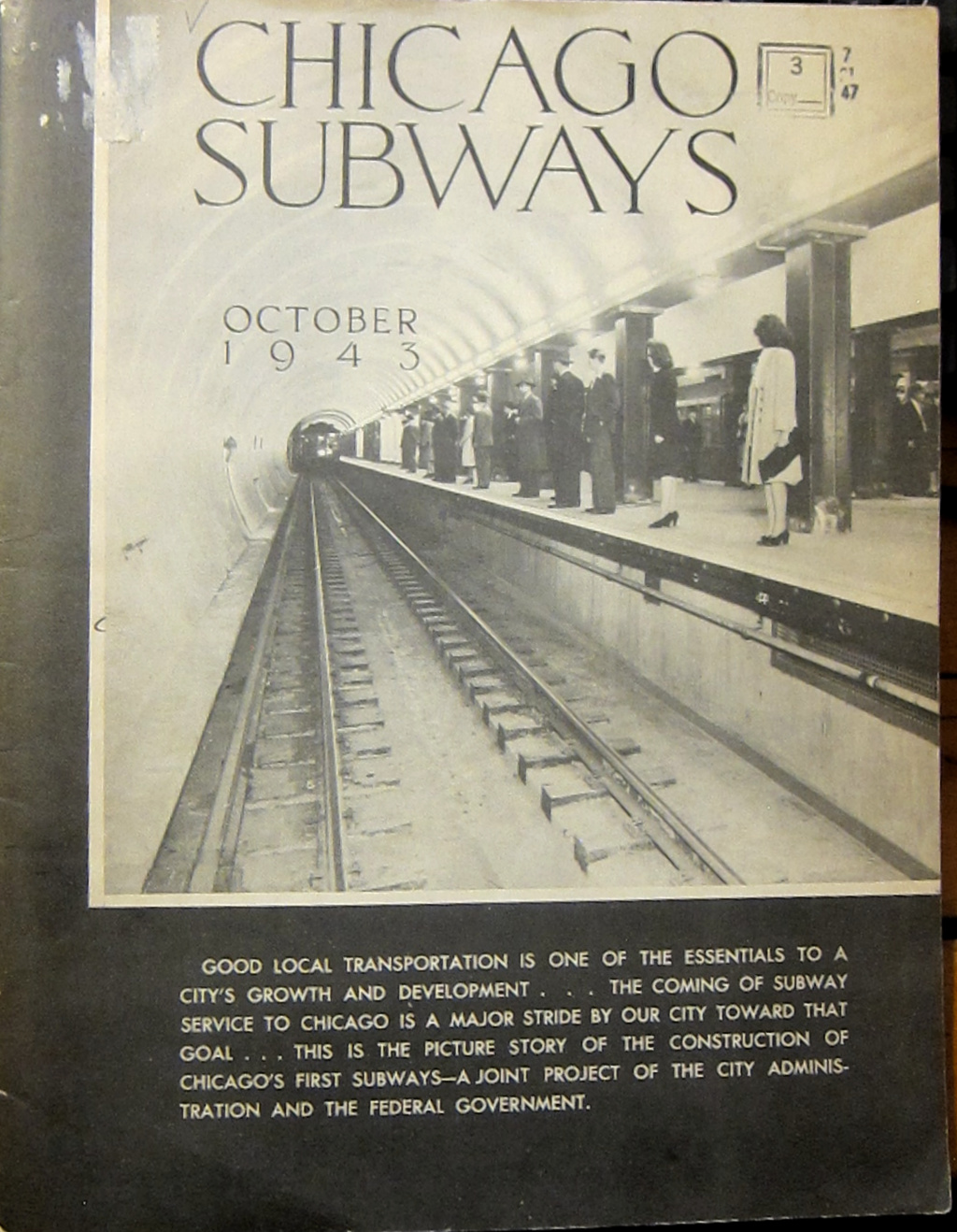
    Chicago subways 1943 coverChicago Subways, October, 1943.

    10″x8″, 31pp, illustrated throughout. Original printed wrappers, very lightly ex-library (U.S. Census). very nice condition.

    Scarce! It seemed unlikely, but there are no copies of this publication located in WorldCat/OCLC, even after some creative searches. SOLD

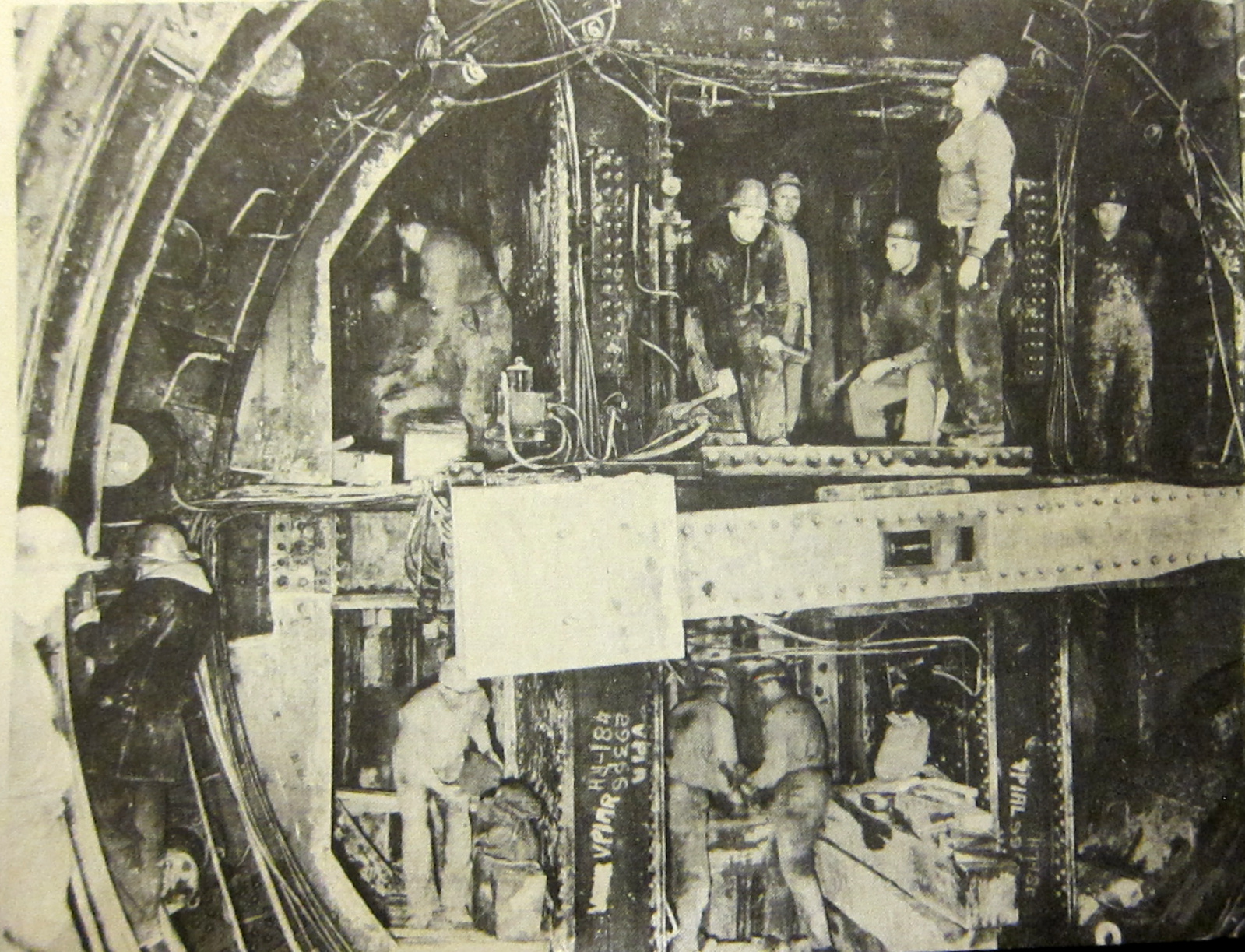
    Following a few pages of photos of the movers and shakers of this project (begun in 1938), the rest of the publication is devoted to the subway itself: 30 photos of construction and some of the finished parts, plus 3pp of maps. The photos have a surprising documentary style to them, not of a simple laudatory style. (Except for the front cover, which is a little bizarre in the way the riders are featured so evenly spaced apart.)

    Chicago Subways in tunnel _1_

    ·Posted by :

    ·in:

  • Rare Chronology of Television Publication (1935)

    [TELEVISION]  Kersta, Noran E. Chronological Record and Index of Television Activities.  June, 1935.  11×8″, offset process, from the Library of Congress. 37 leaves. Brass gathers in a manila folder chipped at the corners and a bit of the spine–the contents are in fine condition, however.  Library of Congress surplus stamp on front free (onion paper) leaf. 

    • Rare.  No copies are located in WorldCat/OCLC.  $950  I cannot determine that this has seen publication beyond this seemingly low-distribution production.  

    This is a very nicely indexed chronology of television from 1920-1935, containing 878 entries which are referenced and cross-referenced in seven pages of indexes.  It is an unusual accumulation as Kersta uses nothing but the New Yrok Times as the source of the chronological development of television–although there’s a lot of technical information, using the Paper of Record gives the work an interesting insight from the public/popular point of view.  This seems to be a full and appreciative work by a present-at-the-creation person who was also an MIT Ph.D. 

    On Kersta (1911-2003), from his obituary in the Sun Sentinel: “…Chemical Engineering at Georgia Tech, a Masters in Electrical Engineering at New York University, and a PhD in Statistics at MIT. In 1932 Nick joined NBC as a clerk in the network’s mail division. In his spare moments at NBC, Nick was thinking about a new idea called television. He read all the published papers on the subject that were available. While still in high school, he had seen one of the earliest public video demonstrations in the country that was staged by AT&T’s Bell Labs. His duties with NBC had no immediate connection with television, as his job was to analyze the audience mail. At night he studied at NYU where he earned a graduate degree. He was subsequently offered a scholarship at MIT. While at MIT, he lectured on television at the university’s extension courses and joined with two other young video enthusiasts in founding the Television Research Institute. His work with the Television Research Institute prompted NBC to rehire him to develop plans for the commercial operation of television. When NBC established a separate television department in 1939, he became the assistant to the vice president in charge, and in 1941 was made manager of the department. NBC inaugurated commercial television on July 1, 1941. On that historic day, contracts of all four advertisers taking time on WNBT, NBC’s video station, bore the signature of Noran E. Kersta, who negotiated then for NBC…”

    ·Posted by :

    ·in:

  • Typed Letter by Glenn Seaborg (1970)

    Glenn Seaborg.

    Typed/printed letter, signed (“Glenn”), dated March 20, 1970. 3pp, with cover letter from the recipient acknowledging Seaborg’s letter.

    Glenn Seaborg (1912-1999), Nobel Prize recipient in Chemistry (1951 with Ed McMillan) and at the time of signing this document, chair of the USAEC. TLs signed by Seaborg to Carly Haskins (president of the Carnegie Institution at the time). This is a 3pp review of the AEC Annual Report to Congress for 1969.  Fine copy.  $200

    ·Posted by :

    ·in:

  • Early Papers on the Telephone, Phonograph, and Liquefaction of Oxygen

    Ayres, Brown (Stevens Institute). “The Telephone”, June 1878, pp 378-393 in Journal of the Franklin Institute, Philadelphia, 1878; volume 75 (third series) and volume 105 overall, with text illustrations and several folding tables,  432pp.  Half-calf, with raised bands. Ex-library, with some scuffing on the spine; also a few stamps on the title page, and a library card pocket at the rear endpaper. Good/Very Good. $150

    Also in the volume:

    S.M. Plush, “Edison’s Carbon Telephone Transmitter, and the Speaking Phonograph”, April 1878, pp 266-271;

    Gustave Trouve, “Apparatus for Producing Electric Light”, Jan 1878, pp 44-47;

    Report of the Committee on Dynamo-Electric Machines”, May 1878, pp 289-303; continued as Edwin  J. Houston and Elihu Thomson, “Report of the Committee on Dynamo-Electric Machines  (continued from vol 85 pg 303). June 1878, pp 361-378.

    W.H. Greene, trans., “Liquefaction of Oxygen”, translating the famous report of Cailletet to the Academie des Sciences in December 1877.  February 1878, pp 119-129.

    “M. Cailletet’s Apparatus for Liquefying Gases” “In 1877 Louis Paul Cailletet in France and Raoul Pictet in Switzerland liquefied oxygen in the form of a mist. The liquefaction of the first of the so-called permanent gases heralded the birth of low-temperature research and is often described in the literature as having started a ‘race’ for attaining progressively lower temperatures. In fact, between 1877 and 1908, when helium, the last of the permanent gases, was liquefied, there were many priority disputes—something quite characteristic of the emergence of a new research field.”—Faidra Papenelopoulou,  “Louis Paul Cailletet: The liquefaction of oxygen and the emergence of low-temperature research”, Royal Society, 2013

    ·Posted by :

    ·in:

  • Jevons on Numerical Discrimination (1871)

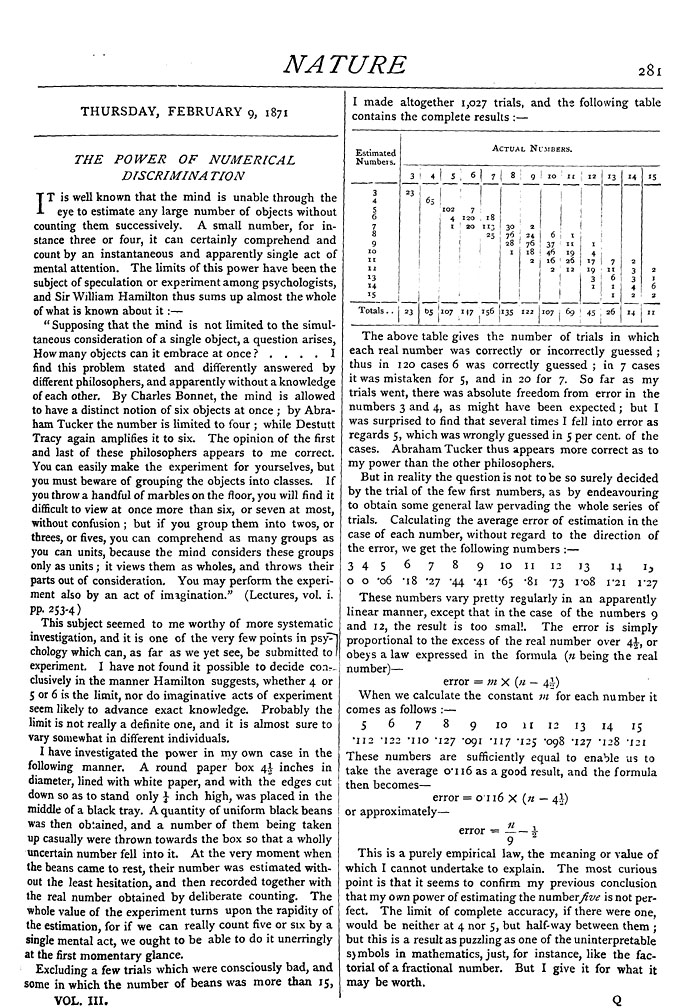
    William Stanley Jevons.  “The Power of Numerical Discrimination”, an article in Nature, 9 February 1871, occupying pp 281-283 (but a tightly-packed, tightly-printed 4,000 words) in the issue of pp 281-300.  Offered in the original weekly issue, removed from a larger bound volume, but with the original front wrapper and 4-pp of ads.  Scarce in this format.  VG condition.  $250

    “IN an article with this title in a recent number of NATURE, Mr. W. S.
    Jevons offered the results of some ingenious experiments he had been
    making to determine how many objects the human mind could count by an
    instantaneous and apparently single act of attention. He comes to the
    conclusion that the power of his mind was limited to something less than
    five.”–review in Nature 3, 367-367 (09 March 1871)

    http://www.nature.com/nature/journal/v3/n71/abs/003367b0.html 

    “In a remarkable brief note in Nature, 1871, W. Stanley Jevons described the results of an experiment he had conducted on himself to determine the limits of the number of objects an observer could comprehend immediately without counting them.  This was an important philosophical question: How many objects can the mind embrace at once?”

    “He carried out 1027 trials in which he tossed an “uncertain number” of
    uniform black beans into a box and immediately attempted to estimate the number
    “without the least hesitation”.  His questions, procedure and analysis anticipated
    by 75 years one of the most influential papers in modern cognitive psychology
    by George Miller (1956), “The magical number 7 plus or minus 2: Some limits on
    …”
    For Jevons, the magical number was 4.5, representing an empirical law of
    complete accuracy.”– By Vincent Arel-Bundock, http://vincentarelbundock.github.io/Rdatasets/doc/HistData/Jevons.html

    Jevons numerical 1

    ·Posted by :

    ·in:

  • Edison’s Phonograph, 1878

    JF Ptak Science Books

    Edison’s name was not a popular item in the average American home before his invention of the phonograph.  It was actually some months later, after the initial announcement in 1877, that Edison became justifiably famous.  It is difficult today to place the amazement and astonishment that greeted the invention–there was nothing like it, before, ever–except for writing, of course, and then the recording telegraph.  It was a sensational piece of power, being able to record and save sound–and then play it back again.  It was the first time in human history that the auditory sense world could be audibly preserved.

    • Edison,  Thomas.  The Talking Phonograph.  London:  Nature,  January 3, 1878  Royal 8vo.  Original printed wrappers.  Very good condition. 

    This is a two-page report on Edison’s visit to the offices of  Nature and his very successful demonstration of his new phonograph  machine (the patent for which is applied for December 27, 1877). The editors  record their favorable impressions of the machine and describe it in some detail–there is even a small woodcut illustration of the device. In all the  article occupies pages 190-191 of the weekly issue. It is removed from a larger bound volume but does come with the uncommon front wrapper and rear ads. Uncommon.

    • Mayer,  Alfred M..  Edison’s Talking-Machine.  London:  Nature Magazine, vol 17 #441, April 11, 1878.  8vo.  Original printed wrappers.  Very good condition. 

    Alfred Marshall Mayer (1836-1897) was an American physicist and astronomer who at the time of publication was professor of physics at Stevens Institute of Technology (New Jersey), and concentrated during this part of the decade was on acoustics, and so was well-qualified to comment on the Edison invention. Mayer’s article stated that “Mr. Thomas A. Edison has recently invented an instrument which is undoubtedly the acoustic marvel of the century” and proceeded to discuss the composition of the  machine. Occupies pages 469-471 with three drawings in text–quite a long contribution by Nature standards. This seems to be the second earliest statement on the phonograph in Nature preceded only by Edison’s paper four months earlier–which seems to me to be a long period of silence on such an important invention.  Offered with the original front wrapper and five pages of ads; removed from larger bound collection. 

    Both: $450

    ·Posted by :

    ·in:

  • Typed Letter Signed by a Mars and Life-on-Mars Visionary (1953)

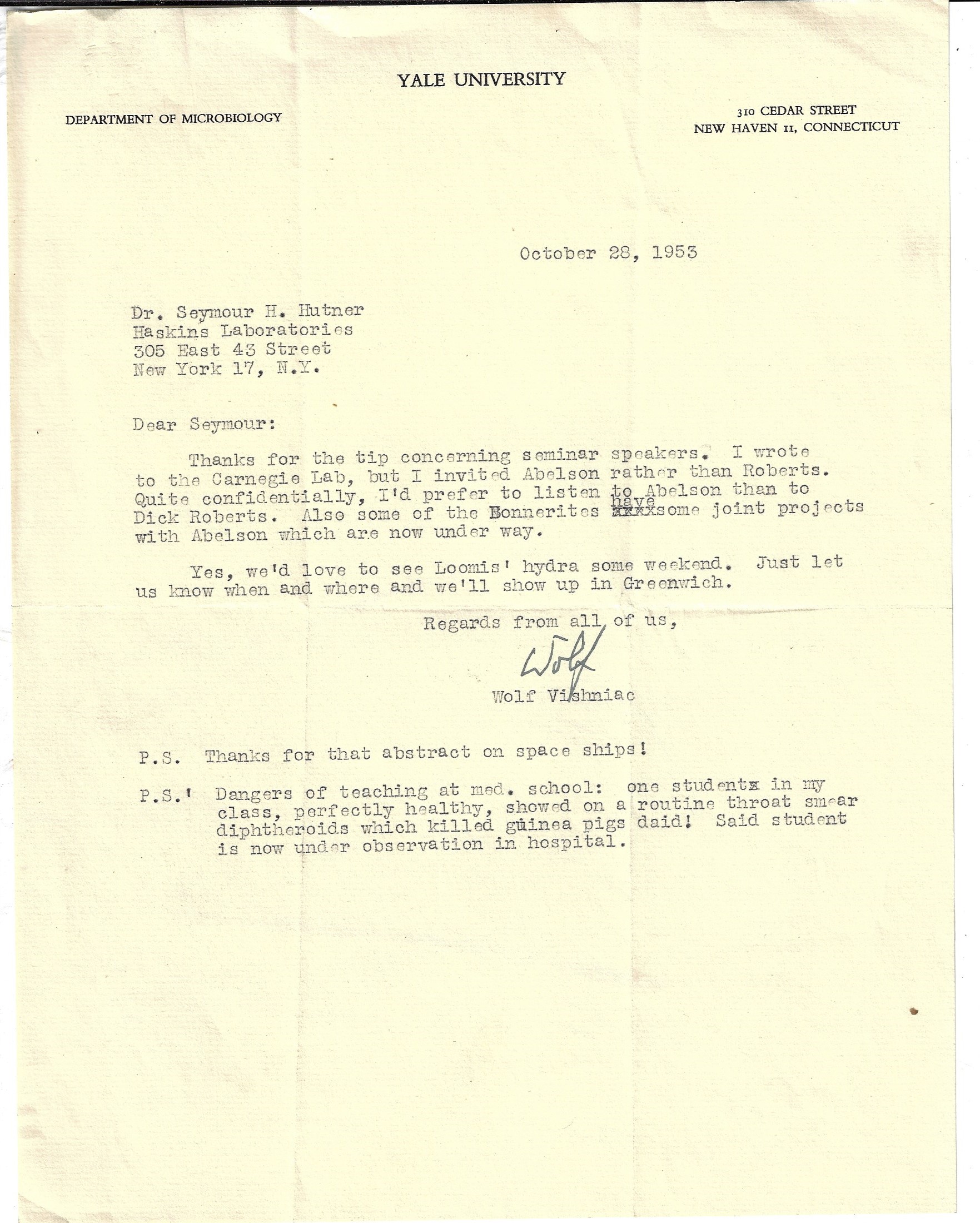
    VishniacWolf Vishniac. Typed letter signed, dated October 28, 1953, on Yale University stationery, department of microbiology. written to Dr. Seymour Hutner of the Haskins Labs (NYC).  $125

    “Wolf Vladimir Vishniac (April 22, 1922 December 10, 1973) was an American microbiologist, son of famed photographer Roman Vishniac [of Warsaw Ghetto photographs fame]. Educated at Brooklyn College and Stanford University, he was a professor of biology at the University of Rochester. He died on a research trip to the Antarctic attempting to retrieve equipment in a crevice. The crater Vishniac on Mars is named in his honor. Wolf Vishniac contributed greatly to the search for life on Mars by developing a special miniature laboratory that could be transported to that planet, known as the “Wolf Trap”. This research was supported by a NASA grant started in 1959, the very first ever for the biological sciences.” –Wiki

    In his obituary for Vishniac Carl Sagan remarked that the Wolf Trap was remarkable and the first of its type, being the leader of an evolutionary development of such microbiological instrumentation, particularly for the Viking landing mission (summer of 1976) on which Vishiac worked on from 1960 forward. 

    ·Posted by :

    ·in:

    —
  • An Early Document on Mutually Assured Destruction and Atomic Energy (Summer 1946)

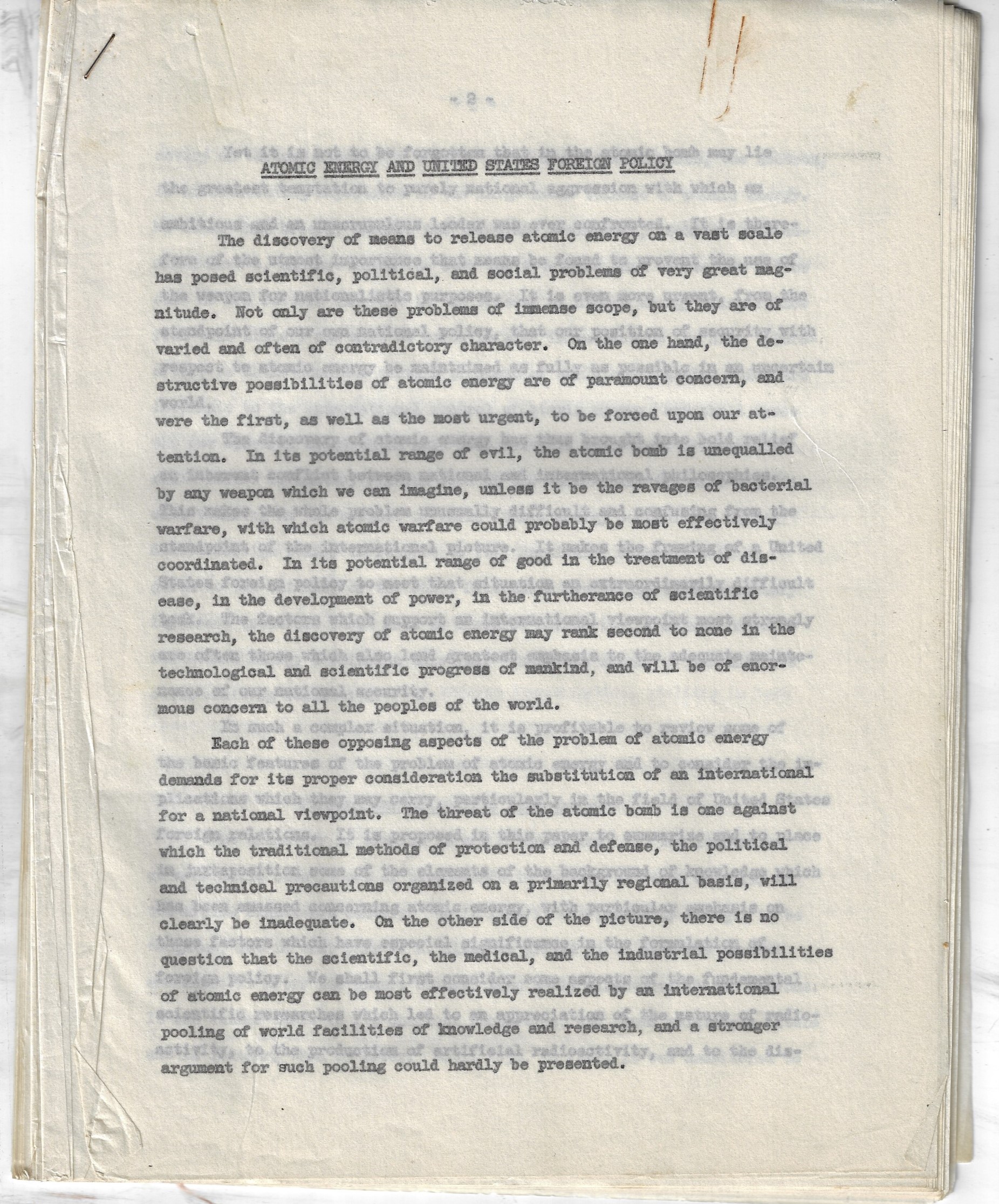
    [Atomic Bomb Control and Atomic Energy]  Haskins, Caryl P. Two drafts of “Atomic Energy and United States Foreign Policy”, published July 1946 in Foreign Affairs. Two versions, one 37pp and the other, presumably an earlier version, 28pp (pp 1-28, incomplete). Both are original carbons on tissue paper. The two documents: $500   

    • Dr. Caryl Haskins (1908-2001, Ph.D. Yale ’30 (E.E. at 22), Ph.D. Harvard 1935; LL.D. Carnegie Institute Technology 1955) was a close and long-time friend of the great Vannevar Bush with whom he throughout World War II at the OSRD,  as well as executive assistant to Bush at NSRD 1941-1945.   He was research associate at MIT 1935-1945;  he was on the Scientific Advisory Board of the Army and Navy, 1947-8; Research Consultant to the Secretary of the Army, 1950; Executive Research Consultant to the Secretary of State 1950-1972  Haskins was on the board of Scientific advisors to President’s Truman and Eisenhower, and succeeded Bush as president of the Carnegie Institution (1956-1973). 

    Haskins atomic energyWhat I find remarkable about this paper is its prescience regarding MAD, the need for international regulation and control, and the absolute belief that the U.S. could not rely on its monopoly of weapons and intelligence even in the short run. He reasons some ways in which to deal with sharing information, restricting the growth of a weapons culture, and the use of atomic energy.

    Haskins sees the delivery of atomic bombs by “long range rockets”, and that the temptation for developing an atomic arsenal would curtail expenses for military development by possibly as much as 100-1. (He mentions at one point that 10,000 atomic bombs could be used to secure world domination, at a cost of only $10 billion (or 10 Iowa-class battleships)—making this highly appealing. (He was not referring to the U.S. in this.)  He goes on to say that without guidance in atomic energy and control of atomic weapons that an exchange of two (or multiple) countries with such weapons “would be largely destructive of civilization as we know it”.

    Haskins also makes the case for the U.S. not to be isolationist in these regards, “and not count on the security of a monopoly of knowledge”.

    Haskins was certainly sounding a very considered, scientific, reasoned alarm about what may turn out to be a devastating near-future with uncontrolled atomic weapons. (This was written in 1946, three years before the Soviets exploded their first bomb. In 1946, Lee Groves thought it would take 20 years for the Soviets to develop a bomb; James Byrnes gave them 7-10 years; and Bush-Conant 3-5 years. Some scientists put it sooner than that. My impression is that Haskins was on the side of the bomb coming to the USSR much sooner rather than later, hence this urgent article in Foreign Affairs.

    Here’s an interesting notice on this article by Haskins:

    • “We therefore cannot count on maintaining our security through a monopoly of fundamental knowledge in the atomic field […]. Further, our monopoly of technical information and facilities is limited and is diminishing. At present we do have a monopoly of stockpiles of raw materials and finished atomic bombs, and we are equipped with gigantic plants for producing these materials. Within something like ten years, however, our monopoly in technology may have disappeared completely, whatever the policy we now adopt with respect to international action.”– This could almost pass as modern commentary for the U.S., but it was written 71 years ago (July 1946) by Caryl P. Haskins, then deputy executive officer of the National Defense Research Committee, who conveyed a heightened level of concern that the U.S. would lose its monopoly in nuclear science and technology for military applications. This created a direct threat to the U.S. and the world as the Soviet Union leveraged nuclear energy in its pursuit of military primacy over America and geopolitical dominance in Europe and Asia. The genie was out of the bottle and nuclear science was in the public domain. Consequently, America had a peer competitor militarily and its national security was at risk. David Gentile, Forbes, Sept 19, 2017


    ·Posted by :

    ·in:

    —

Recent Posts

Archives

Categories