A Daily History of Holes, Dots, Lines, Science, History, Math, Physics, Art, the Unintentional Absurd, Architecture, Maps, Data Visualization, Blank and Missing Things, and so on. |1.6 million words, 7500 images, 4.9 million hits| Press & appearances in The Times, Le Figaro, Mensa, The Economist, The Guardian, Discovery News, Slate, Le Monde, Sci American Blogs, Le Pont, and many other places… 5000+ total posts since 2008.

Category: Perspective

  • Girdle vs. Goedel: the Pink Ice Girdle Ballet of 1951 vs. Logic. Part I of the History of Holding Things In

    JF Ptak Science Books  
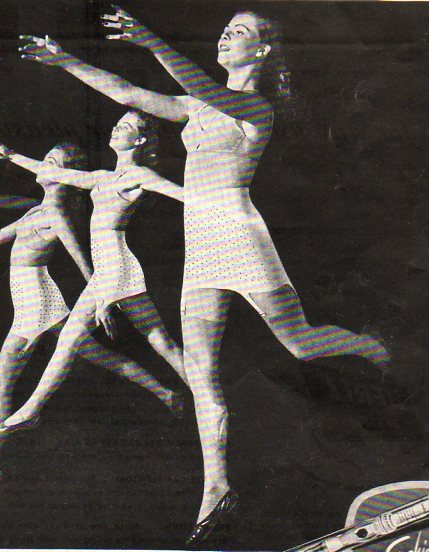
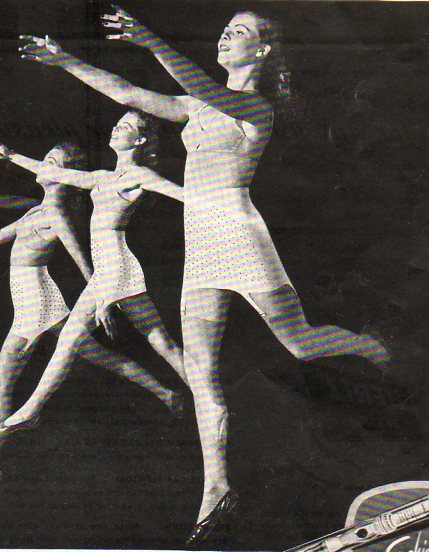
    Girdle--a det428[My thanks to Patti Digh for providing the idea for the Goedel part of this adventure into Playtex and Logic–she did so because (a) they fit together and (b) girdle/Goedel sounded almost identical to a woman who once lived in Munich!]   

    In the long history of Holding Things In, perhaps the newest of its
    members was upon us only recently. In the long, deep past we have held
    our breath, hidden our anger, stowed our emotions, and so on, but it was
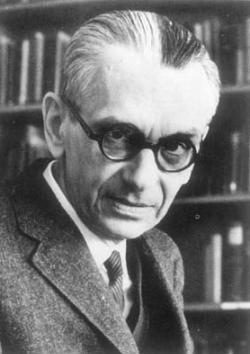
    only recently that we began to hold our bellies in.  One of the masters of Holding Things In for this period turns out to be the sublime logician and re-inventor of modern mathematics (by putting one piece of the great Hilbert to sleep), Kurt Goedel, who towards the mistakenly-self-engineered end of his life, Goedelheld on to everything, virtually–he organized and filed almost very piece of paper that he came into contact with at any level, became ever more reclusive, and at the end (due to his theories of people/institutions wanting to kill him) refused food and, of all things, water.  Surrounded by the smartest people on the planet (including his friends Einstein and von Neumann) up there at the Institute for Advanced Study at Princeton, Goedel withered away until he had almost no shadow. It is a bad irony that he could be so inconceivably unmovable and restrained while at the same time, and in the same life, offered such incredible newness to the maths–both ends of the mountain at the same time.
    1951, the year in which these girdle advertisements appeared in Life magazine, was also the year that Goedel present us with the Goedel  metric, and also in which he received (with Julian Schwinger) the first Albert Einstein award (and of course delivered his famous Gibbs lecture  “Some basic theorems on the foundations of mathematics and their implications”).

    The popular introduction of the girdle I think that
    this happened at about the same time for the sexes, only these
    conveniences were much more often advertised for women than they were
    for men.  Slender and non-existent waistlines for women were more of a cultural identifier
    than a slim-hipped man, and the ads for his cheaters appeared far less
    frequently than those for women.

    The first widespread appearance of the girdle for the sake of vanity must have occurred during the 19th century, or perhaps a little later is my best guess–but the first time the device began to appear for the common woman must’ve come around the time when there was time for leisure, or shopping, or of being seen in public in short intervals.  And that I believe is a Victorian-age invention.

    But the binder doesn’t come into fabulous presence until the distribution of mass population illustrated magazines, or I should say the advertisements that made these magazines possible:  production like LIFE (from which these 1951 images come) reached far more women than the popular older periodicals like Harper’s Weekly or other polite mid-19th century journals for women.  The advertisements were certainly more enticing, the possibilities more rewarding, and the girdle comfort levels far higher than their predecessors, and the availability of disposable income for women far greater–and so incidentals like the girdle became more greatly commodified, and moved into the “essentials” category. 

    The idea of these ads seem horribly revolutionary: on the one hand, the badly-named and hyphenated  Playtex product “Pink-Ice” squeezed women into new tight but  malleable molds, while at the same time promised some sort of ballet-like freedom because of it. Like the creeping (“two steps forward and one step back”) communism of the time, Playtex promised the possibilities of enhanced freedom through restrictive clothing (in a “peace through strength” vision).  In any event, and in spite all of what I just wrote, the pictures are kind of amazing.  

    [I’m well aware that this may be one of the worst things ever written about Kurt Goedel–the Renault Dauphine of Goedeliana.  But it doesn’t matter, because in all of his powers, Goedel could absolutely prove that g_d existed, and that  I don’t.]

  • Daily Dose of Dr. Odd: Sierpinski Triangles & the Empire State Building

    JF Ptak Science Books   Daily Dose series   [Also part of the History of Lines series] 

    So, Nat’rists observe a flea

    hath smaller fleas that on him prey,

    And these have smaller fleas to bite ’em, and so on ad infinitum.

    –Jonathan Swift, 1733 

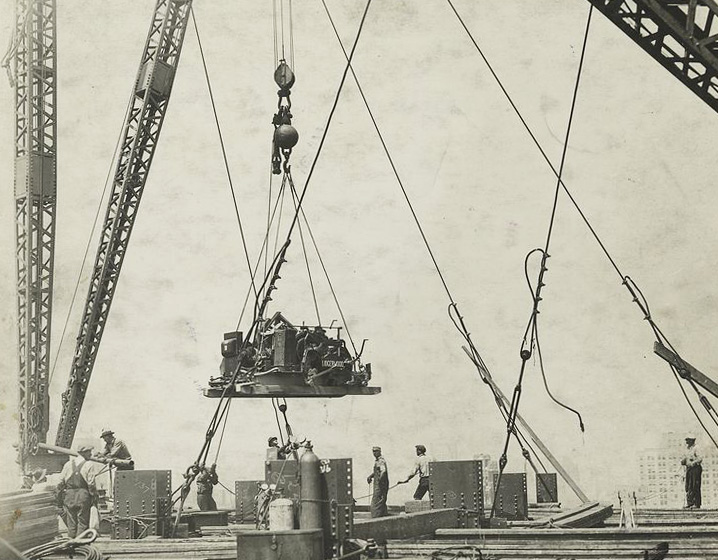
    There are a lot of triangles in this fabulous photo of the construction of the Empire State Building in 1931–a lot. At least fifty–more if you use your imagination or get your pinhole specs out. It is simply an excellent photo in which I’m seeing things of a reducible nature–not in the sense of a Sierpinski triangle/sieve/gasket, obviously–but just a simple exercise along those lines (ha!), experiencing the image by recognizing different sorts of boundaries within it.

    Lines empire state bldg

     [Source: New York Public Library Digital Collections, here.]


  • Ancient “Spacecraft”: the Flavor of Moving Very Heavy Things a Long Time Ago

    JF Ptak Science Books    Post 1872

    Obelisk624
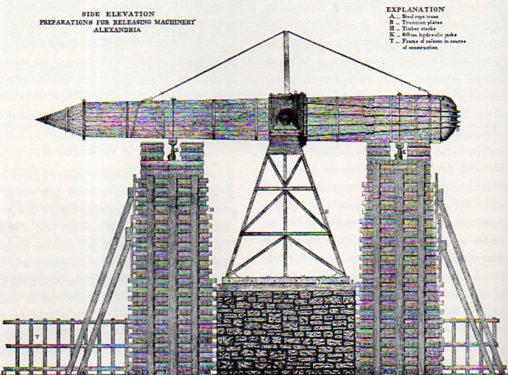
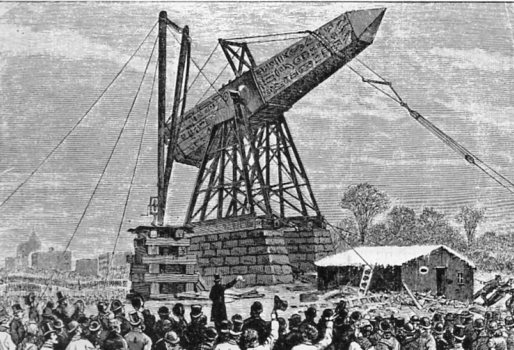
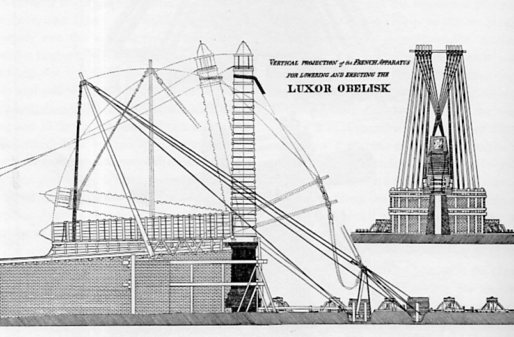
    This of course is not a story of ancient spacecraft, but it is about Very Large Things being manipulated in space in the days of steam and pre-steam engineering. It is hard to escape the “rocketship” interpretation, as some of the images, sculpted slightly out of context and cleansed of any identifying text and viewed with a squint, look as though they might be large booster rockets being readied for flight. They are of course images of some great and famous pieces of engineering–moving massive obelisks, and moving them in the 19th century and before.  And in the case of the Romans, and the original Egyptians, moving them way before our last millennium, moving 200- and 900-ton objects without benefit of very much at all. 

    Obelisk625
    Two of the great examples are the pair of obelisks that the Romans moved from Heliopolis to Alexandria, where they stood for another 2000 years.  Over time there was only one standing, and that one wasn’t doing so well by the end of the 19th century.  The fallen obelsik was taken to London in 1877; the other, the standing obelisk, was given to the United States by the Khedive of Egypt two years later, in 1879.  The man in charge of this second operation was Lt. Commander Henry H. Gorringe, U.S.N., who had the very tricky job of lowering the monolith, bracing it for transport by sea, fitting it out for a ship, and then transporting it to Central Park and raising it again.  He was able to accomplish this feat with the “fragile” 100-ton object in just a year.

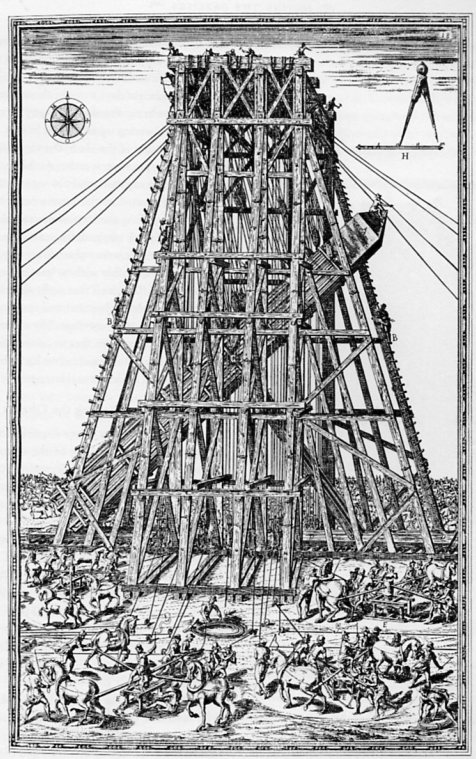
    This next image is more classical and probably iconic, at least in the history of science world, and is found in the superb book by Domenico Fontana, Della Transportatione dell’Obelisco Vaticano (published in Rome in 1590 and again in 1604):

    Obelisk627

    Obelisk626They really do have a certain modern taste for interplanetary access, at least to me.  That aside, it is interesting to consider what this vastly heavy movement must’ve looked like to people long ago, when big machines with enormous powertrains (like this 1,200 ton capacity 300′-tall mobile crane)could be hauled into service to do their end in manipulating highly problematic and very heavy things in space.  To think of moving these very heavy objects with steam (or less) was a daunting task, and to see these images showing the progression of movement of these things must have been enormosuly satisfying.


  • The History of Normalcy and the Idea of the Center

    JF Ptak Science Books   Post 1855

    Where is the center?

    Where is the center of the Earth, of religion, of the United States, of the universe, of art, of consciousness, of seriousness, of complexity?

    The center of stuff throughout history has been an almost entirely shifting matrix, a collection of vortices coming from Jupiter’s strongbox–a three dimensional representation of the location of their shifting centers over time would make an interesting Fibonacci-like display, I think.

    Center--theatrephone567

    The question may seem meaningless at first, but people have long asked it of nearly everything within their experience, trying to find the center of their world and universe, of their selves, of their religion, of their country, of politics, of art and music, and on through the Encyclopedia of Things that Could Have a Center.

    Take for example the questions of where the center of the Earth, or solar system, or galaxy, or universe might be?  There have been answers to these question more often than not over time, though the answers have been shifting.  The center of the Earth has certainly stayed more-or-less constant over thousands of years, though the stuff in the center has been swarming with change, from being hollow, to being filled with magma, to being a solid magnetic core, to being occupied by Mole Men, to housing the seat of the Inferno, or to be simply located on the surface of the sphere at Jerusalem (as the old T-maps have shown for hundreds of years), and on and on.  Working backwards, the center of the universe has drastically changed over time–for thousands of years, it was assumed that the Earth was the center of all things, until it wasn’t (that beginning mostly with Copernicus, and then challenged with Galileo’s use of the telescope and his discovery of an order of magnitude more stars, etc.).  And then William Herschel beautifully represented the shape of the galaxy in 1782, placing our solar system in a far from central location.  The center of the universe’s fate changed along with that of the Earth, incredibly so beginning with the Big Bang and then with the possibilities of their being a universe without boundaries.  And then of course there’s multiple universe theories, and worm holes, and the space time continuum, which complicates things even further, making the discussion of a “center” pretty much nonsensical.

    Mar 23 center of levity cvr det 3

    Simpler things can be as complicated–where is the center of the United States?  If we measure the center for the lower 48 states, it will be different than if we included the two far-flung states, or protectorates like Puerto Rico. The geographical center is one thing; another might be where the population center might be–that has made a beautiful map published over time by the U.S. Census Bureau (Department of Commerce), showing the star of the center moving not-so-slowly westward into Ohio over the last 20 censuses or so.  And where is the heart of the country?  Where is the heart of the West?  Better yet, where is the center of the West (or North, or South, or Mid-West)?  To answer where the center of these places might be you’ve got to first locate where those geographical ideas begin and end, which for many is a tricky subject, making it a matter of opinion as to where the center of these places might be. 
                                       
    The center in art had been a findable thing for some time, though more recently people like the Impressionists and Kandinsky have shown that the center might not exist, and it might not exist along with anything that is recognizable as a form of nature, representation and the center falling away completely.  Perhaps this is like finding the center of a decade or year or month, or week or day or second.  The parameters keep getting both smaller and larger, the ability to measure halves of things or the center of a second growing almost incalculably small, small enough to reveal that in this Zeno-paradoxical way, that there is no center because there are no boundaries; getting half-way to something into infinity doesn’t tactually get you there. 

    The center of balance, the center of levity, of concern; the center of emotion–another center that has been mapped all over the human body, from the heart to the head to the limbic system to a confusion of freudian desires to an inelegant and intractable collection of stimuli   and response.  The center becomes more of a belief-but even there, center can have no more a constant than change.  The center of Christianity may be Christ (though it wasn’t always so, witness the Mary Cults through the first few centuries of Christianity), but then you have to understand which Christ it is coming from which Bible, the center becoming more a concern of interpretation and spread over many Christian groups than one solid center. And when you spread the field to include all religions and you expand the center notion to a primum mobile or collective or whatever, then the center gets very big—and in some religions, it is nothing but the center. 

    It seems to me that if the issue of finding the center of big and small things alike is difficult, then why does it seem so easy for people to determine and adhere (and sometimes to believe in at all costs) to expansive ideas like “normalcy”?

    Blog--May 24--girlA history of normalcy is one that looks at the things deemed to be “normal”, or standard, or acceptable at one time that became not so over the course of time.  Buying and selling human beings, women and their children being property of the husband, Chinese immigrants in America not have (any) legal rights, classification by skin color or sex or financial status or political belief are a few good candidates (among thousands) for this history.  It is an interesting proposition to think about—what things around you, or better yet, what thing you think or say or do, that look good and acceptable today might look embarrassing and unacceptable thirty years hence.  In 1935 one issue might’ve been accepting the codified behavior of treating women as less than equal of men, deserving less in the workplace (if they were in the workplace), less rights in the courts, less deserving of equality in general; by 1965, this viewpoint may have well been in the minority; by 1995 it begins to look fossilized; by 2025 it might well be unbelievable.  What are the issues of 2010 that could be the equivalent of the 1935 issue?

    I’m just wondering why it is that even when people cannot find the center of almost everything that has ever been, that a strict and damningly judgmental regimen of “normalcy” can be so easily instituted, and enforced? This especially since part of the code of adjudicated normalcy for one generation seems mostly gone by the next, that the important becomes trite, and the socially disgusting becomes acceptable.  Just  as the concept of the center becomes elusive, so too does the standardized idea of normalcy become vaprorous over time.

    ·Posted by :

    ·in:

    —

  • Putting Black-and-White Back into Color: 1930’s Schoolrooms

    JF Ptak Science Books    Post 1840

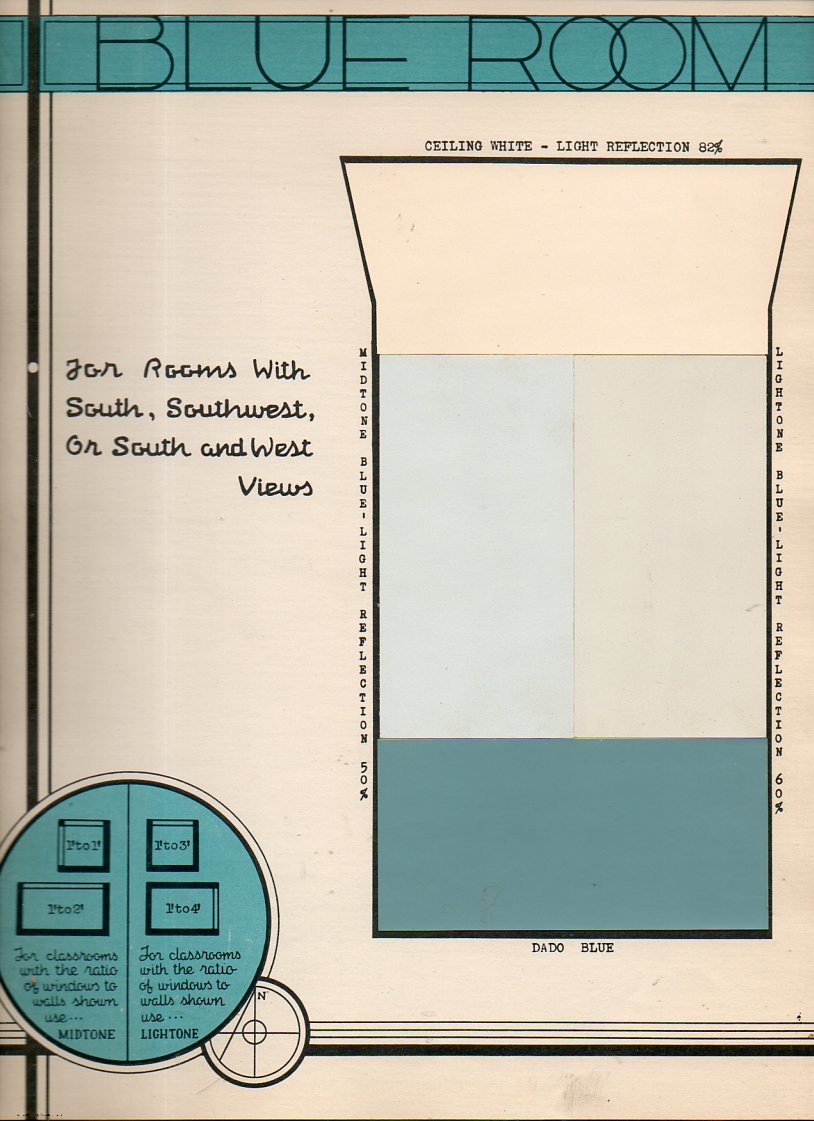
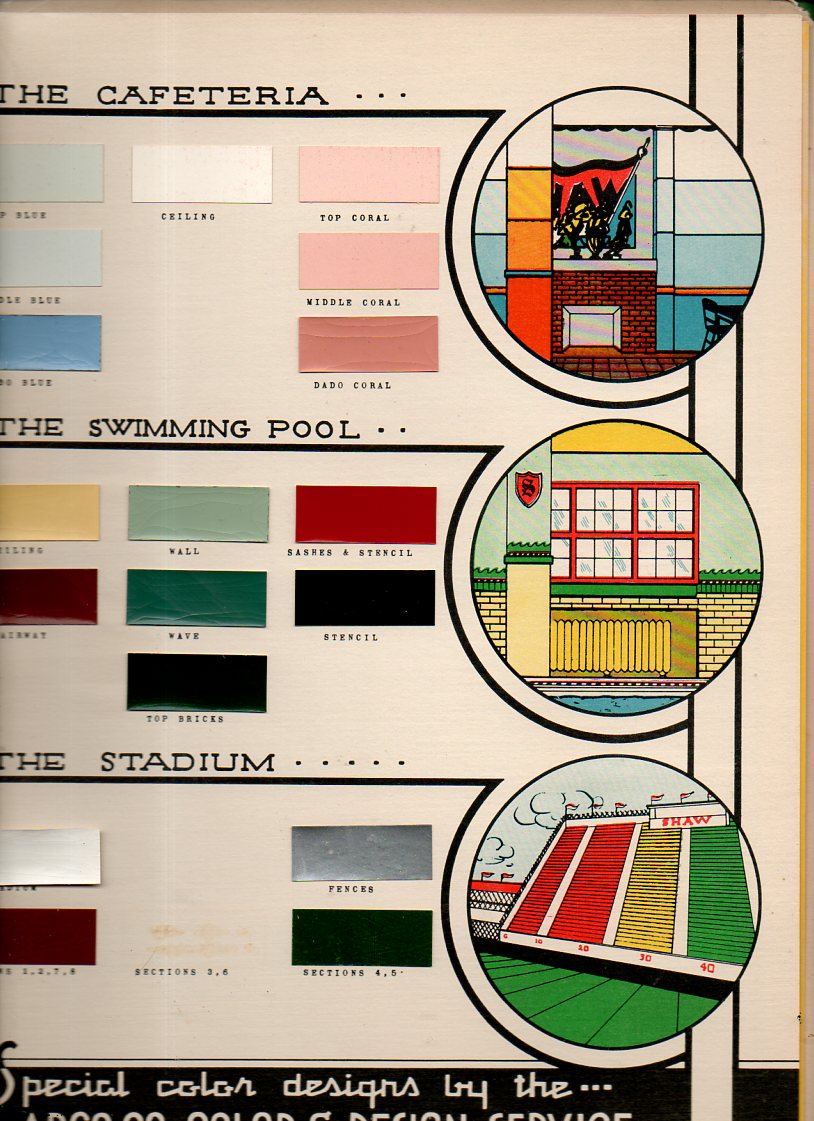
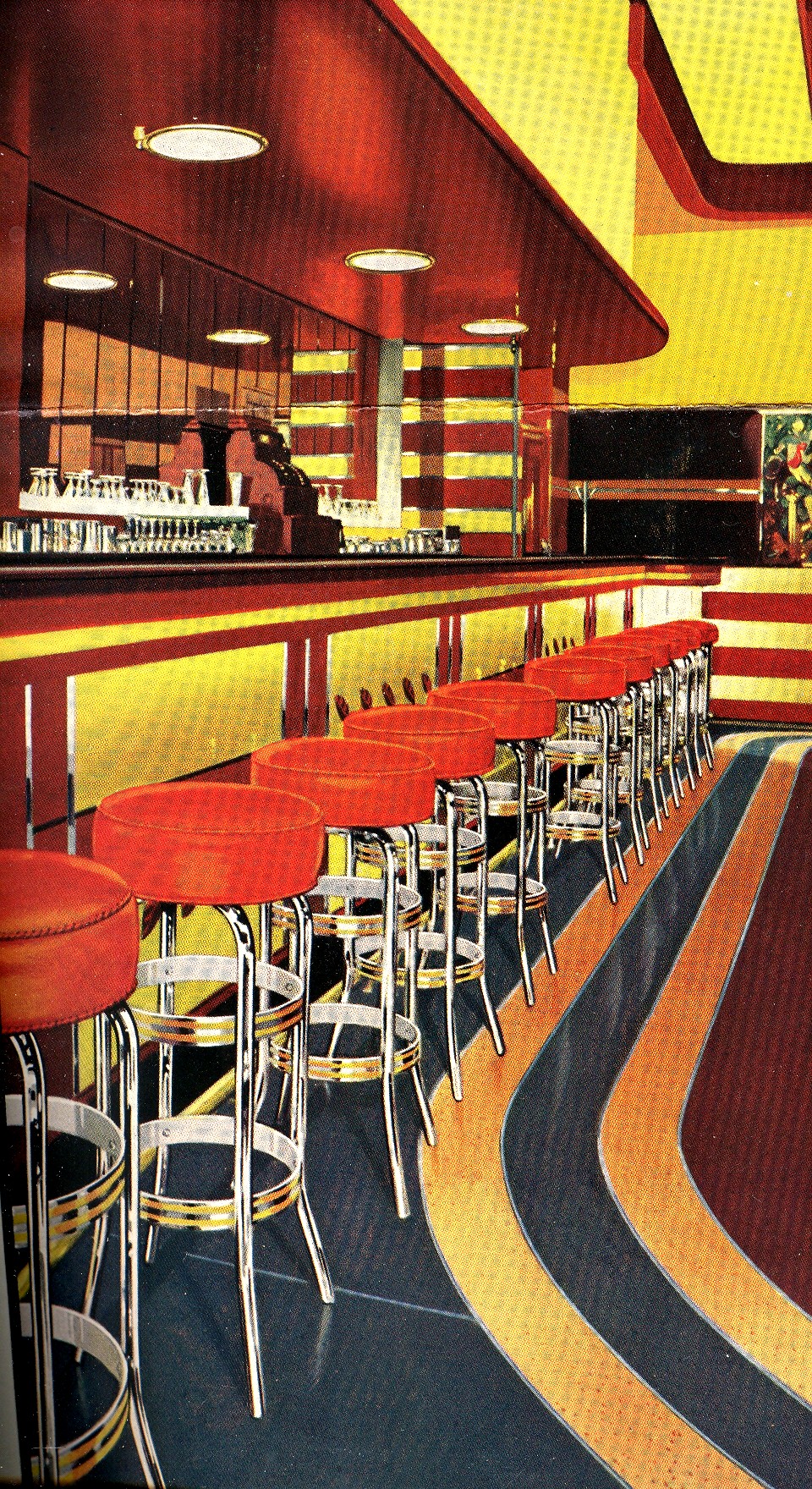
    Its easy to assume a modern prejudice regarding the interior decoration of 1910-1940 school rooms, allowing a certain conceit and picturing them in shades of gray, the images formed being “colored” by the images of those things that we have seen, almost all of which have turned up in black-and-white photographs or movies. But of course we know that this can’t be true, and that Humphrey Bogart didn’t always wear a gray worsted in his movies, and didn’t move that gray suit through gray rooms. Its just that the image-formation is influenced by what we’ve seen, and since what we’ve seen of these rooms is mostly without color, then our images are difficult to assemble outside black-and-white.  This applies to just about everything from that era, which explains why it is such a glorious shock to see motion pictures or photographs of (say) New York City street scenes from 1944. (And why is it such a jolt to the visual system to learn that police cars in Chicago during the 1933 World’s Fair were orange?)

    This thinking came to the surface again this morning when I uncovered the Paint Specifications for the Model School, prepared for the East Cleveland Board of Education under supervision of the Foremost Authorities, and published by ARCO in 1939.  It reminds us that the only thing that lived in black-and-white in those days are in our memories.  (I’ve written about unexpected color in Lost German Color of 1927,  The Very Describale Macro Color of 1937, The Color Green in the History of Squares, and of course the non-immortal 200,000,000 Pounds of Buttocks-or-Putting the Black-and-White back into Color, and others.   [This item is available for purchase via our bookstore blog, here.]

    Color school587

    Color school592

    The rest of the ARCO catalog is below; but first, here’s a sample from the 200,000,000 Pounds of Butts post, showing the 1938 barroom in color:

    Mar 14 7th red bar


  • A Note on Music of the Future and Wagner’s Trashbin Philosophy, 1879

    JF Ptak Science Books  Quick Post

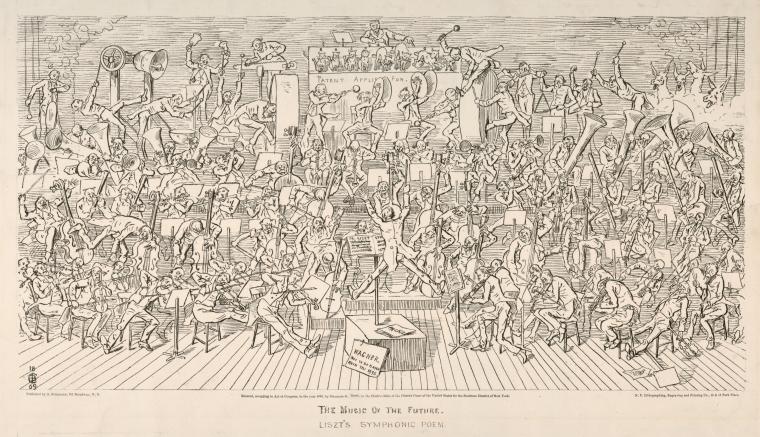
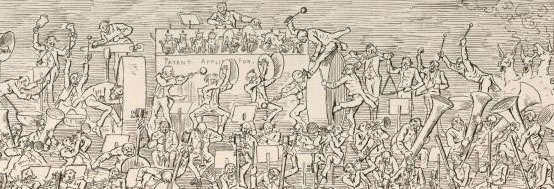
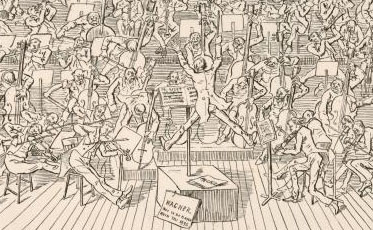
    This cartoon appears in Punch in 1879, and it clearly show’s the bitey Mr. Punch’s proclivities towards the rise of the “music of the future”.  Over the years Punch had seen little value in the new music possibilities, the form and function of which is on display in this kinetic appreciation of a hyper-functioning orchestra.  There is a considerable stab made at Richard Wagner (as we can see in the scores on the floor), the composer who perhaps (along with his considerable supporter, Franz Liszt) was at the deepest heart of the publishing end of the “music of the future”.

    The Music of the Future. Liszt's Symphonic Poem.
    Wagner published his views on the development of music and art in general for the future in Das Kunstwerke der Zukunfts (1849), and then more specifcally to music in Zukunfstmusik (“La Musique de l’Avenir”) in  1850.  But little of that feels like very much to me at all, given the other work he was completing in 1850–Das Judenthum in der Musik.  In some circles the work is translated as “Jewishness in Music” and also “Judaism in Music”, but this is far too polite–what Wagner was talking about was “Jews in Music” or “The Jew in Music”, as it was a savage attack on the place of Jewish people in music and of Judaism as a whole.  It is a virulent and nasty work, first published anonymously to protect Wagner’s “freedom” (as he called it) and then again–unable to leave it alone–in 1869, proudly under his own name.  The work is widely seen as a hallmark of German antisemitism and an embarrassment to Wagnerians, and in some editions of Wagner’s complete collected works, it is forgotten.  On the other hand, it wasn’t just here that Wagner’s antisemitic views are made known–he was a prolific writer, and his work against the Jews appeared numerous times in newspapers and other periodicals, playing the same tune.
    I’m okay with the man’s name on the floor. 
    Dailydose--music of future
    Daily dose--music future 2


  • Antiquarian Comparative Analysis: Lakes, Islands, Mountains

    JF Ptak Science Books   Post 1817

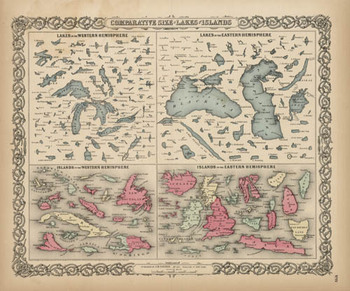
    Blogjuly_19_comparative_big_colton 1856 may have been the first time that these 150+ lakes and islands of the Western and Eastern Hemisphere were ever been printed on the same page and in the same scale exclusive of their associative land masses and placed contiguously, side-by-side.  They were, of course, seen in a common perspective before on any world map, but I think that this is the first year in which the islands and lakes of the world were displayed without oceans and land masses, and the effect is a little odd.  If you take away the color and the text the image takes on a very definite biological flavor (I keep thinking of that tiny bone in the ear for the small lakes…)  In any event it is far easier to compare these features without the distractions of the non-lakes and non-islands clouding and confusing our perspective fields.
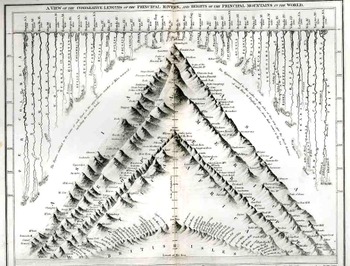
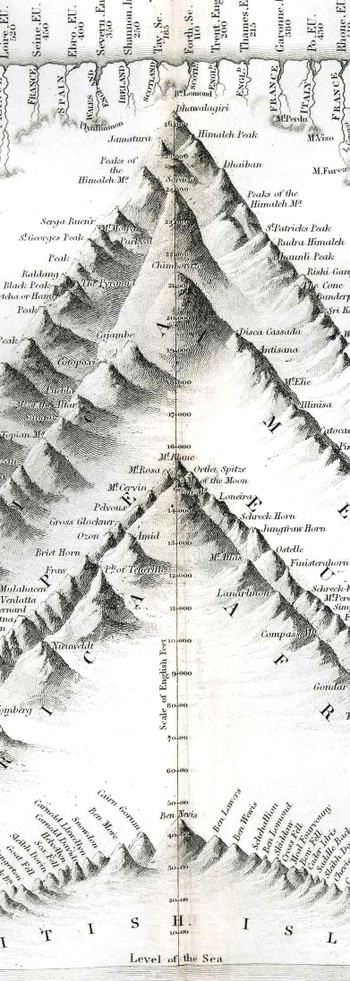
    This was also the beginning of the heyday of publishing comparative this-and-that in atlases:  from 1840-1880 or so was the period in which the majority of descriptive comparatives were published.  This is when you would see comparatives of the lengths of rivers and the heights of mountains and waterfalls beautifully displayed in atlases.  I don’t know what happened after then, but the publication of this sort of data really fell off, with the heights of mountains/lengths of rivers stuff relegated to filling the empty areas in double-hemisphere world maps 
    Blogjuly_19comparative_1836350
    Here’s a relatively early image of this type called “A View of the Comparative Lengths of the Principal Rivers and Heights of the Principal Mountains in the World”, published by Orr & Smith in London (1836), featuring 44 rivers and a hundred or so mountains.  It is a lovely and graphically pleasing work, and an early effort in displaying the dissected river and mountains in such a forensic-like way.
    Blogjuly_19comparative_1836_detail_

    This I think is my favorite genre of specialty map, and I plan to write on them in great detail (and heavily illustrated) in just a bit; but, for now, I’d just like to surface this map by George Colton, and admire it, and try to imagine the kind of impact it must’ve had on people back there in 1856 who were seeing this sort of data displayed so for the first tine.  It would have been a huge revelation to see the lakes and islands compared side-by-side; it was a fresh, new idea, and an insight in how to look at things in general.


  • Found Surrealist Parabolic Art, 1905

    JF Ptak Science Books    Quick Post

    A continuation–of sorts–of “Earths Inside the Earth“, which is part of the History of Blank, Empty and Missing Things series.

    This wonderful bit of Found Surrealist artwork is part of a series of patent drawings by Sir Hiram Maxim, inventor of many things (including the Maxim Gun, which was the first portable fully automatic machine gun, but not the electric light bulb as he claimed, and many many other things) for a hollow spherical structure made to deceive, thrill and confuse the people inside the structure with parabolic mirrors. An amusement.  This is not out-of-keeping for Maxim, as he also designed a “Captive Device Flying Machine” for amusement parks that every kid today would recognize. 

    But I do like this drawing, the third of four for the patent application, and I guess it gives a pretty good approximation of what folks might see inside his amusement palace of combined optics and sensory confusion. 

    Here’s the cross-section of the structure:


    Which is a detail from the set of patent drawings for


  • Unusual Antiquarian Perspective–Directly Above and Oblique. J.J. Grandville, 1844

    JF Ptak Science Books   Quick Post

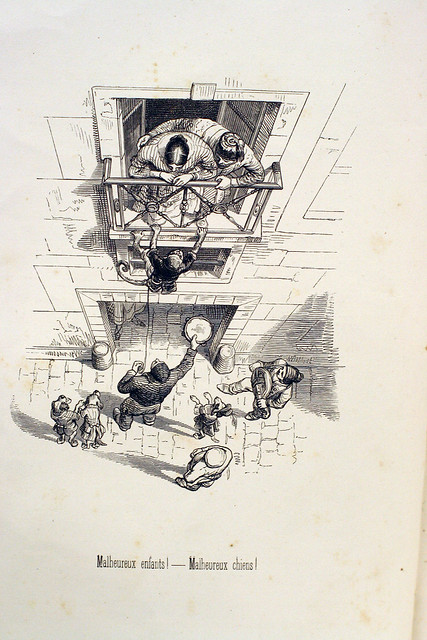
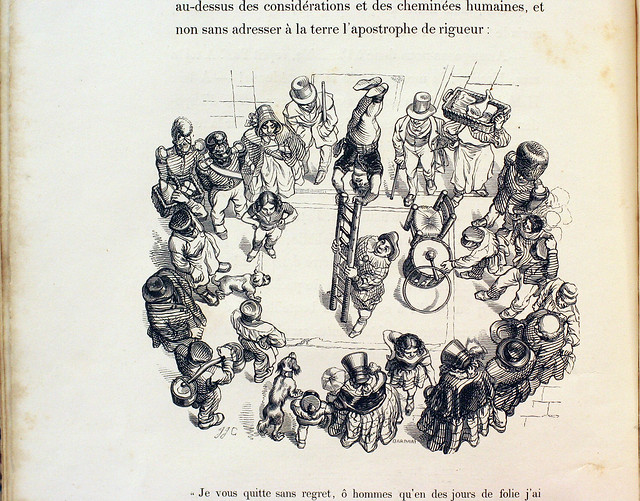
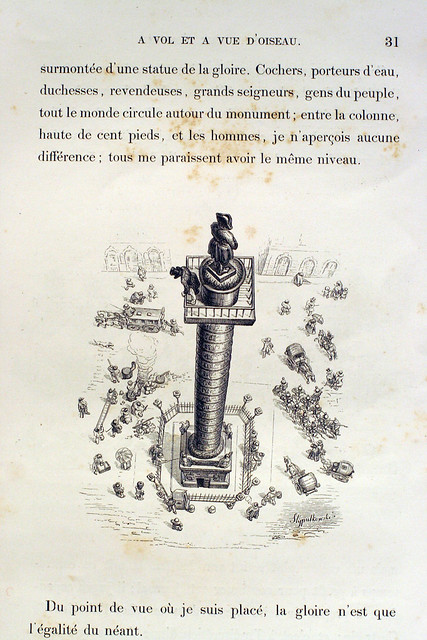
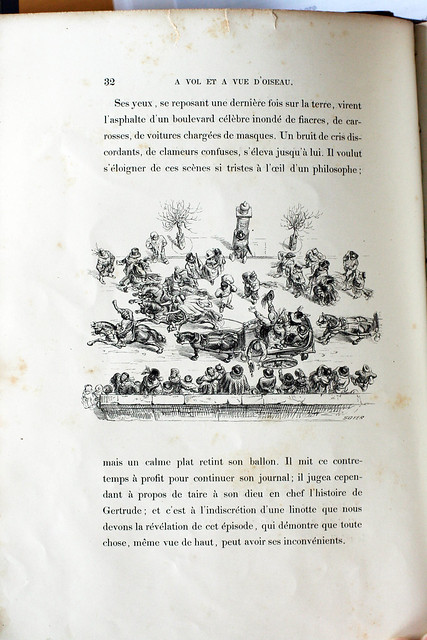
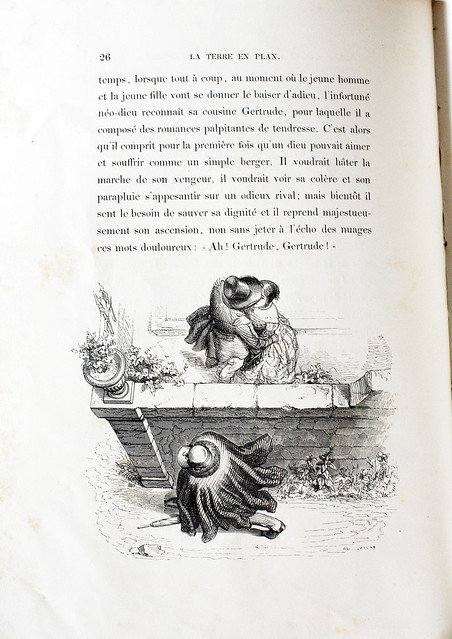
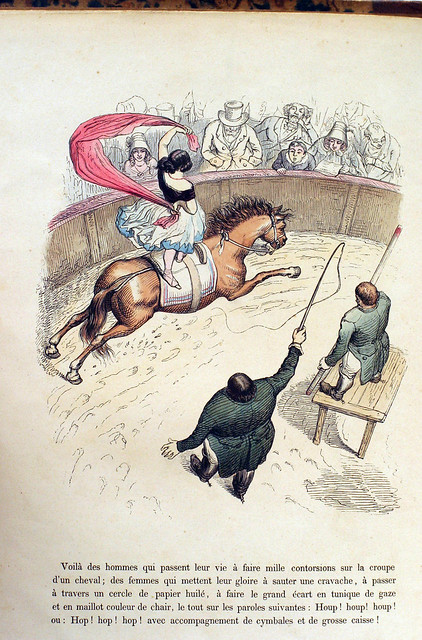
    This is the fourth installment in as many days (starting here) on the artwork of the great proto-Surrealist, J.J. Grandville.  Today’s quick post (again from his Un Autre Monde, 1844) isn’t so much fantastical as the other work pictured here, but it is subtly unusual.  It is my experience in looking at prints and other artwork for the last 30 years or so that antiquarian images looking straight and directly down froma  height are very unusual–so too for the next thing closest to it, looking down from a slightly oblique angle.  Grandville does this often in his work, and I think gives another insight into a brain that was just seeing (most) things differently.  [Here’s a link for some posts on looking straight down, here and here, for example.]

    photo

    photo
    photo
    photo
    photo
    photo


  • The Ship of Fools, In Praise of Folly, and Intelligent Dischord: Brant, Erasmus, and Geiler, 1497-1515

    JF Ptak Science Books  Post 1788
    Bloggeilership186
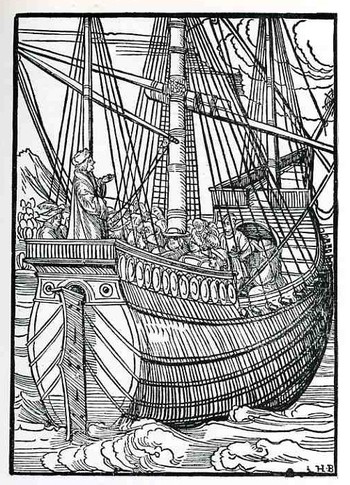
    Johann Geiler von Kayserberg’s Navicula Penitentie (Augsurg, printed by Johann Ottmar, and printed in 1511) is a remarkable book in many ways, but what I’m concerned with here is the fantastic woodcut illustrating the title page.  The book itself is a collection of penitential sermons against moral corruption in his Strassburg community—the sermons won him wide respect and some considerable fame as an orator, writer and theologian—but it is the woodcut of the ship (I’m sorry to reveal) that distracts me more.  It is evidently the earliest depiction of a fully-rigged and outfitted ship, with great and accurate detail, far beyond what had been published in the previous 50 or so years of movable type printing.  Presumably what we are seeing is Geiler preaching to ship full of what seem to be clerical/clergy folks rather than sailor—clearly Geiler is approaching the upper class here in the ship and not the working man. 

    I think that Geiler had Sebastian Brant’s 1494 Ship of Fools in mind when the great Hans Burgkmair (the “H.B” who signed this work of art) produced this seafaring image for him.  Also Geiler’s publication date of 1511 is shared with Erasmus’ fantastically influential (and leading-to-the-Protestant-Reformation) book The Praise of Folly. (It was written very quickly, in about a week, and centered around conversations he had with his good friend Sir Thomas More; the Latin title of the book is a bit of a wink and a nod to More, Moriae Encomium.)  The Fool, the Feast of the Fool, the Feast of the Beasts and so on were all very old institutions that allowed and tolerated the caricature and criticism of church and power structure officials—and this at a time in the Middle ages and Renaissance when such free speech by non-Fool types was strictly unacceptable.
    Brant_books
    In the same work by Brant (“Of Useless Books”, thankfully found with all 117 of the images from the work at the University of Houston library  ) we find the following image of the sage Fool.shorn of his headdress, sitting in the library, wearing glasses, and reading, surrounded by disheveled books that were clearly being used and consumed by the supposed clown. To me it shows the substantiation of the wisdom of the free-thought folly speech of the Fool, who, although clothed ridiculously, was a thoughtful, careful, well-read individual whose message much resembled the messenger. 

    The images in Brant’s book are so singular and many of the titles so captivating I’ve included many from the list from Houston’s table of contents, below: 


    Of Useless Books the Haintz-Nar-Meister
    Of Beggars Albrecht Dürer
    Of Good Counselors the Haintz-Nar-Meister
    Of Bad Women Albrecht Dürer
    Of Greed the Gnad-Her-Meister
    Power of Fatuity Artist unknown
    Of Newfangled Ways the Haintz-Nar-Meister
    Of Star-Gazing Albrecht Dürer
    Of Old Fools the Haintz-Nar-Meister
    Wanting to Know All Regions the Gnad-Her-Meister
    Of Training Children Albrecht Dürer
    Not Wanting to be a Fool Albrecht Dürer
    Of Trouble-Making Albrecht Dürer
    Not Understanding Raillery Albrecht Dürer
    Not Following Good Advice Albrecht Dürer
    Wanting to Escape Consequences of Evil Albrecht Dürer
    Of Bad Manners Artist unknown
    Not Providing in Advance Albrecht Dürer 
    Of True Frienship Albrecht Dürer
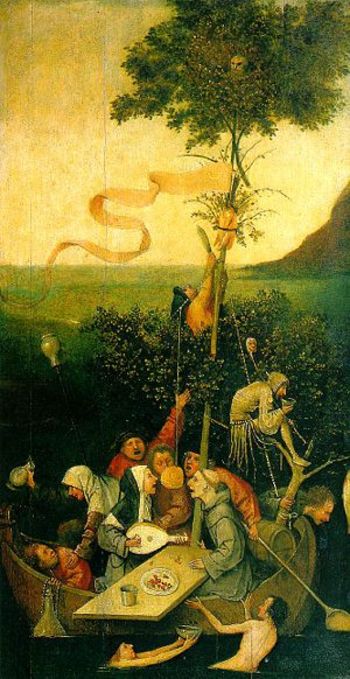
    Ship_of_fools_bosh_2
    Quarreling and Going to Court Albrecht Dürer
    Disdain of the Holy Scriptures the Gnad-Her-Meister
    Of Crude Fools Albrecht Dürer 12 Of Hasty Fools Artist unknown
    Of Becoming a Cleric Albrecht Dürer
    Of Wooing Albrecht Dürer
    Of Great Boasting the Haintz-Nar-Meister
    Of Arrogance Toward God Albrecht Dürer
    Of Gamblers the Haintz-Nar-Meister
    Of Foolish Plans Albrecht Dürer
    Of Oppressed Fools Albrecht Dürer
    Of Gluttony and Rebelling Albrecht Dürer
    Highwaymen and Lawyers Albrecht Dürer
    Of Useless Death the Haintz-Nar-Meister
    Foolish Messengers Artist unknown
    Of Serving Two Masters the Haintz-Nar-Meister
    Of Cooks and Waiters Albrecht Dürer
    Of Much Babbling the Haintz-Nar-Meister
    Of Peasants’ Squandering Albrecht Dürer 2
    Of Finding Treasure Albrecht Dürer 7
    Contempt of poverty Artist unknown
    Not Practicing What You Preach the Haintz-Nar-Meister
    Of Persisting in Good Albrecht Dürer
    The Teaching of Wisdom Albrecht Dürer
    Not Preparing For Death Albrecht Dürer
    Of Overestimating One’s Fortune
    Of Too Much Care the Haintz-Nar-Meister r
    Of God’s Plagues and Punishments Albrecht Dürer
    Of Unnecessary Wishes the Haintz-Nar-Meister
    Of Foolish Trading Albrecht Dürer
    Of Useless Studying Albrecht Dürer
    Of Jabbering in the Choir Albrecht Dürer
    He Who Judges Others Albrecht Dürer
    Of Overbearing Pride Albrecht Dürer
    Of Seeking Postponement Albrecht Dürer
    Expecting Inheritance Albrecht Dürer
    Of Guarding Wives Albrecht Dürer
    Giving and Regretting It Albrecht Dürer
    Fools, Far, Near, and Forever Albrecht Dürer