A Daily History of Holes, Dots, Lines, Science, History, Math, Physics, Art, the Unintentional Absurd, Architecture, Maps, Data Visualization, Blank and Missing Things, and so on. |1.6 million words, 7500 images, 4.9 million hits| Press & appearances in The Times, Le Figaro, Mensa, The Economist, The Guardian, Discovery News, Slate, Le Monde, Sci American Blogs, Le Pont, and many other places… 5000+ total posts since 2008.

Category: Perspective

  • Descartes–Discourse on the Method of Rightly Conducting the Reason, and Seeking Truth in the Sciences

    JF Ptak Science Books  Quick Post

    DISCOURSE ON THE METHOD OF RIGHTLY CONDUCTING THE REASON, AND SEEKING TRUTH IN THE SCIENCES  by Rene Descarte. 

    Descartes contributed a towering amount in the history of science and in establishing modern Western philosophy, all accomplished in a relatively short period of time, as Descartes for all of his massive output only lived to be 54 (1596-1650)…and most of that was completed between 1630 and 1650.  Twenty years. Outstanding. 

    René Descartes. Engraving by Jacques Lubin, after Frans Hals. MS Hyde 77 (1.48.1)

    René Descartes. Engraving by Jacques Lubin, after Frans Hals (via Houghton Library blog, here).

    “PREFATORY NOTE BY THE AUTHOR

    If this Discourse appear too long
    to be read at once, it may be divided into six Parts: and, in the first, will
    be found various considerations touching the Sciences; in the second, the
    principal rules of the Method which the Author has discovered, in the third,
    certain of the rules of Morals which he has deduced from this Method; in the
    fourth, the reasonings by which he establishes the existence of God and of the
    Human Soul, which are the foundations of his Metaphysic; in the fifth, the
    order of the Physical questions which he has investigated, and, in particular,
    the explication of the motion of the heart and of some other difficulties
    pertaining to Medicine, as also the difference between the soul of man and that
    of the brutes; and, in the last, what the Author believes to be required in order
    to greater advancement in the investigation of Nature than has yet been made,
    with the reasons that have induced him to write.

    ·Posted by :

    ·in:

    —

  • Porta’s Visions, Big & Small: On “Magic”, Chaos and Not Inventing the Telescope

    JF Ptak Sciene Books   Post 1906
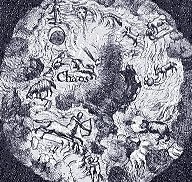
    https://historyofideasblog.com/a/6a00d83542d51e69e201156ecdf55e970c-pi

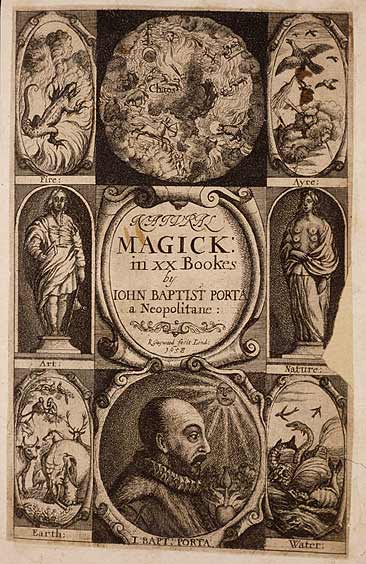
    [Detail from the title page of Natural Magic, below.]

    Giovani Baptista della Porta was a magus, or a natural (science)
    “magician”, who searched nature for similarities that would serve to build a
    broad template of forced  understanding of seeming likenesses, looking for the great connector
    in the exceptional and the unusual, the stuff outside of the formerly
    Aristotlean world.   Natural Magic is his magnum opus, an expansion of  its earlier
    version (Magna naturalis)  published in Latin in 1558, which Porta expanded to twenty sections in 1589. The 1589 edition was a maturing of the 1558 edition, toning down the philosophical/religio-mystic basis for the ordering of the natural environment with an approach more suitable to observation and experimentation. It was an encyclopedic work of vast proportions, a
    gold-mine of information and clever wishfulness, and very accessible due to
    Porta’s  wide inter-personal travel,
    very wide reading and critical abilities, clear reasoning and deep vision:  the book was hugely successful, going into at
    least twelve Latin, four Italian, seven French, two German, and two English
    editions in the early modern era. Natural
    Magic
    , which first appeared in English in 1658, concerned itself with
    magic, alchemy, optics, geometry, cryptography, magnetism, agriculture, the art
    of memory, munitions, and many other topics, all grouped together and refined,
    distilled, into a cloudy assemblage of natural knowledge—it would end up that the magical
    whole was worth far less than the sum of its parts. 
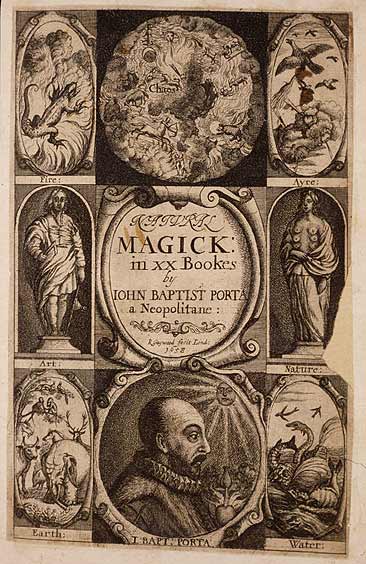
    Porta magic english
    But the parts were pretty considerable, and much of the
    information was spot-on for the time, not the least of which was a very capable
    demonstration and explanation of a lensed camera obscura. 

    What I’m interested in right now though is the title page of
    the book (pictured above).

    It turns out and as we can see in the top image of the
    title page, Chaos is not some subspace trajectory of cellular automata, or in
    Dr. Brown’s/Einstein’s dancing dust—it is right above us.  This recognition of its regular, localizable structure
    probably does not support parameterization, or anything else for that matter,
    except to say that it is definitely “pretty”. 
    The title page has nine illustrated compartments:  the four corners depict the four elements,
    the two opposing middles show art and nature; the bottom shows the author,
    illuminated by the knowing sun.  The top
    center image is the element showing “chaos”, which I’ve chosen to use a map,
    identifying where exactly chaos might be. 
    I’ve not seen an antiquarian map identifying chaos, though I have seen a
    number showing lots of other non-existent places, like heaven and hell and
    purgatory and Eden and the Kingdom of Prester John, to name a few.  But not chaos.

    It is very interesting to note that while in the process of looking at nature, and observing connections real and imagined, and creating ways of organizing and storing information in the brain, Porta conceived of a telescope, and this several decades in advance of Galileo. (The idea of the telescope stretches pretty far back, though.  The idea seems ancient, though the scientific thought on the matter really weren’t present until the 13th century with the work of Roger Bacon and Robert Grosseteste, and then with Nicolsa of Cusa (in 1451) doing experimental work on the properties of lenses, and then on to John Dee and Thomas Digges in 1570/1.  Porta seemed right about there, just ont he edge of the invention of an instrument which would have allowed him to see farther and deeper than anyone else before him, but he didn’t follow through.  He mentions in the 1589 edition of Magiae:

        “With a Concave lens you shall see small things afar off very clearly. With a Convex lens, things nearer to be greater, but more obscurely. If you know how to fit them both together, you shall see both things afar off, and things near hand, both greater…”  (Porta would expand this section of the 1589 book (section XVII) into a complete and separate work in 1593,  De refractione optices.)

    I do not know what happened to this idea, or why it didn’t flourish in Porta’s hand like it would in those of Galileo less than three decades latter.

    Porta was a very  nimble and penetrating man–his Magia naturalis was a dissecting tool for the complexities that he saw around him, and his later works were in some ways continuations on this theme.  The first two books following Magiae were concerned with private visions of Very Large Things:  the first, De furtivis literarum notis (published in 1563) was one of the earliest works on cryptology.   This looking-deeper book was followed three years later in 1566 by a book on how these thoughts could be organized in the mind.  Given the spirit of the times and the difficulty of actually recording what it was you saw, Porta wrote  Arte del ricordare, which addressed the very idea of memory and then the more applicable bits of mnemonic devices.  He looked for more hidden messages in his next work–on the physiology of hands–but it didn’t see the light of publishing day until after Porta died.

    Working in the areas of pharmacology, hydraulics, military engineering, physiology, and physics, among many other areas, Porta published De aeris transmutanionbus (1609) on meteorology; De distillatione (1610), on chemistry; Coelestis Physiogranonia (1603), on a sort of “writing in the sky” and both a blast and support of astrology; and De humana physiognomonia libri IIII (1586), which was a work physiognomy and discerning function from structure. There were other books, not to mention at least 17 dramatic works.  Porta was basically unstoppable.

    All of this takes me back to the question of wondering about his inability (?) to see the possibilities of the telescope. In all of his books on deterministic vision, and of seeing things deeply–whether it was in the sky, or in chemical experiments, or in seeing the structure of a plant incised with its function in nature, or in the complexities of memory, and so on–it is a mystery to me how he could have left the development of the telescope along. 


  • Letters Inscribed in the Sky: Gaffarel, Kircher and Curious Ideas

    JF Ptak Science Books    Post 1905

    Alphabet Hebrew sky806

    Could we satisfy our selves in the position of the lights above, or
    discover the wisdom of that order so invariably maintained in the fixed
    stars of heaven……we might abate…..the strange Cryptography of
    Gaffarell in his Starrie Booke of Heaven. 
    Thomas Browne1 (1605-1682) in his major Hermetic effort, The Garden of Cyrus, or The Quincunciall Lozenge, or Network Plantations of the Ancients, naturally, artificially, mystically considered (published in 1658).

    The Garden of Cyrus is a neo-Pythagorean insight weaving together all manner of visions in nature and art, and the art of nature and vice versa and so on, all tied up in universal thinking about these intersections in terms of the great quincunx patterns and the number five and it various variants in terms of latticework and the figure X. 

    Quincunx


    “What is more beautiful than the
    quincunx, that, from whatever direction you regard it, presents straight
    lines?–
    Quintillian’s Institutio Oratoria VIII.3.ix

    The Browne quote relate to the work of J. Gaffarel, who saw connections in art and nature quite literally in the structure of the heavens, among other places–but it is his “star-writing”  that I’d like to address a bit here.  His provocatively-titled Curiositez inouyes sur la sculpture talismanique des Persans, horoscope des Patriarches et lecture des estoiles  (“Unheard-of Curiosities concerning Talismanical Sculpture of the Persians, the horoscope of the Patriarchs and the reading of the Stars”) was published first in 1629 and then many times thereafter well into the 18th century.  Garrafel (1601-1682) presented to the world a wide class of interesting subjects which had previously been thought of as being outside the normal realm of academic discussion, the subjects being mainly seen as dogmatic occultism.  What Garrafel did was very interesting, writing about these areas as discussion-builders, as “curious” topics that could or should be considered to widen general inquiry. (In an interesting article, “The Use of Curiosity in Early Medieval France and Germany” the author  Neil Kenny writes of Gaffarel, “Making occult knowledge into conversation rather than a dogmatic system made [his work] less likely to be universally censured”)

    His work definitely interesting and curious, though the use of that word didn’t save him, as some of the topics  were verbotten–certainly Gaffarel
    was aware of this, and he tried his best to write about them in a way
    that the ruling intellectual powers would not find offensive, but it
    didn’t work, and his book was found to be abusive and was banned by the
    Sorbonne. This was such an integral action that Gaffarel succumbed to
    not one but two retractions.

    What is of primary interest right now with Gaffarel is his interpretation of writing systems, and how frequently they seem to exist exclusive of human manufacture.  It seems that a fair percentage of the time that these appearances came in the form of agate. and that these durable micro- explorations in agate go back thousands of years,
    expounded by Pliny and some of the other ancients, who followed the origins of
    humanity back into the 1blog_oc_t_9_not_here_kircher_793rocks. This was a
    popular idea for the origin of animate beings, propounding itself for centuries,
    even winding up in the bony lap of Leibniz of all people, who wrote that “men
    derive from animals, animals from plants, plants from fossils, which in turn
    derive from bodies that the senses and imagination represent to us as being
    totally dead and formless”. Stones
    therefore held the seeds of the formation of the world; all things living,
    breathing, and not.

    Our own Athanasius Kircher, the definition of polymathic ability and
    superior imagination was responsible for many such observations and
    discoveries. It seems to me that as much
    as Kircher gave, he took away, keeping ahead of his critics and the rest of the
    scientific community with tremendous output…people I think just couldn’t keep
    up with him. He found all sorts of
    things in stone: as early as 1619  he exhibited an image of   St. Jerome (in no less a place than the cave of the Nativity
    in Bethlehem!) that he found in
    agate. His Mundus Subterraneus (1661)
    is a home to a wide range of these
    objects: quadrupeds of all shapes and descriptions, human full-length
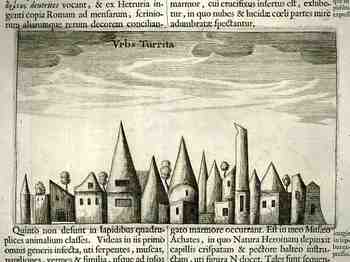
    portraits, hands with jewels, and even the Virgin Mary and child. AS spectacular as these are there is always
    more: the magnificent cityscape
    (reproduced here) and the sublime discoveries of a full set of the alphabet and
    a series of 15 geometrical drawings, all naturally impressed in stone.

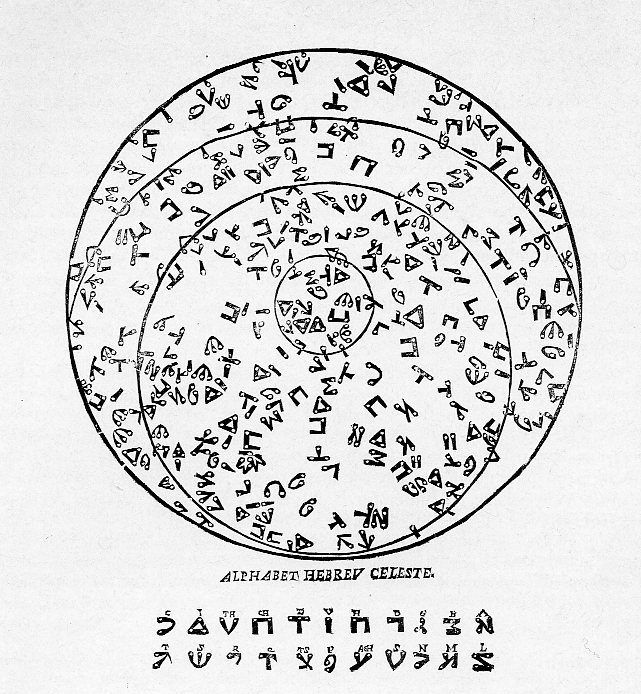
    Gaffarel’s principle and perhaps first-on-the-scene notion (though some of it may have appeared in Agrippa’s Three Books of Occult Philosophy (first published in 1533))  was the elements of an alphabet–the Hebrew alphabet–was found not in stone, but actually written in the night sky. In the stars.

    It was another sort of artificial language, an entire alphabet, though this was written in the sky; Hebrew letters transcribed in the stars, lines connecting them here and there.  Replaceable letters from one point to another.  The possibilities of the formation of actual words was present.  This seems to have been the first time this idea appeared in print. 

    Notes:

    1. Browne’s writing is both beautiful and difficult, or complex and impenetrable, as can be seen from the very opening paragraph of his work here.

    That Vulcan gave arrows unto Apollo and Diana the fourth day after their Nativities, according to Gentile Theology, may passe for no blinde apprehension of the Creation of the Sunne and
    Moon, in the work of the fourth day; When the diffused light contracted
    into Orbes, and shooting rayes, of those Luminaries.
    Plainer Descriptions there are from Pagan pens, of the creatures of the
    fourth day; While the divine Philosopher unhappily omitteth the noblest part of the third; And Ovid (whom many conceive to have borrowed his description from Moses) coldly deserting the remarkable account of the text, in three words,
    describeth this work of the third day; the vegetable creation, and
    first ornamentall Scene of nature; the primitive food of animals, and
    first story of Physick, in Dietetical conservation.

    2.  An interesting article in the blog 8vo appears here on Gaffarel’s celestial writing.


  • On Seeing Things Backwards Series, 1: UNIVAC and the 1952 Election

    JF Ptak Science Books   Post 1917

    Univac-cronkite
    Leonardo wrote backwards and from right to left, Benjamin Button lived backwards at the hands of Scott Fitzgerald, Rene Magritte’s man in the bowler saw the back of his head, Herrimann’s Ignatz the Mouse I am sure saw the back of his head looking around the world with the world’s most powerful telescope, rugby passes are all done backwards, paper images of vue optiques appear backwards, lightning for all intents and purposes starts backwards from the ground up, reverse mathematics are worked from theorems to axioms, and the Chicago River (1900) was engineered to flow backwards for the foreseeable future, while the Mississippi River famously flowed backwards for just a bit in the New Madrid Earthquake of 1812. 

    I can only imagine what audiences must have felt when they saw the first moving pictures played backwards–seeing them played forwards was a novel-enough (and revolutionary) idea, but the simple idea of reversing the direction of the film would have proved to be equally fascinating. 

    Imagine the first time you witnessed a staged train wreck on film, back there in 1897, and imagine being able to see it played over and over again, until you were filled.  I’m not so sure that there were even any still photographs of a train wreck as it occurred to this point, even with advances in film speed and lens, so seeing the even unfold in front of you at leisure must have been overwhelming.  Now imagine these same folks seeing the event and watching the locomotives reconstitute themselves.  It would have been an extraordinary event.  Even observing the Etienne Marey sequences and seeing what actually happens when a person bends over to pick up a pail of water would have revealed almost as much in new detail as when Galileo was in the middle of his earliest observations. 

    Looking at things backwards is a good idea so far as thinking about engineering problems and of course in checking experimental results in the sciences–its not so good an idea though to change the results produced by the scientific method because they’re not a good intuitive fit to expected parameters.

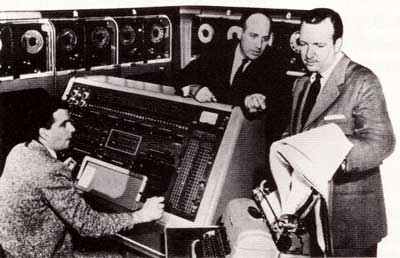
    Such was the cased with the first (and successful) employment of a computer to predict the outcome of a presidential election.  THe computer was the UNIVAC (the world’s first commercial computer and a blazingly fast machine at 10k operations a second, nearly six orders of magnitude lower than “superfast” by contemporary standards), which was brought in by Remington Rand to CBS News to crunch the numbers on the tight race between General Dwight Eisenhower and Gov. Adlai Stevenson (II) on 4 November 1952.  (Stevenson was the son of a former U.S. Vice President and would run again against Eisenhower in 1956.) Pioneers Pres Eckert and John Mauchley, along with Max Woodbury (and programmer Harold Sweeney, who is seated at the UNIVAC’s control panel and who seems never to be mentioned in the iconic photo at top, with Eckert at center and anchorman Walter Cronkite at left).   CBS News Chief Sig Mickelson and Cronkite were not comfortable with the proposal, but ran with it anyway, sensing a moment of the-future-is-now.

    The Eisenhower/Stevenson race was seen by the large majority of pundits to be too close to call, so when the UNIVAC’s results pointed to a landslide for Eisenhower (438 electoral votes and 43 states to Stevenson with 93 electoral votes and 5 states) folks got very sweaty and nervous, not trusting the outcome. As this was still a very early age in human-machine interaction, and the computed results fell far away from perception and expected response, changes were made in the UNIVAC’s programming to determine a more “reasonable” response by the machine, the new results making the race very tight and fitting human expectations and giving Eisenhower a very slim margin of victory.  As poll results started to sweep in an hour or so later indicating that Eisenhower was showing with a huge victory, the UNIVAC was again reprogrammed and at about midnight the announcement was made that the UNIVAC had indeed been correct in the first place.  The final results were 442 electoral votes for Eisenhower and 89 for Stevenson.  In the next presidential election in 1956 the three networks all had computers working for them–with them–and a different perception had been formed on working with computers. 


  • Master of Little but Curious About it All (1839)

    JF Ptak


    M of A868
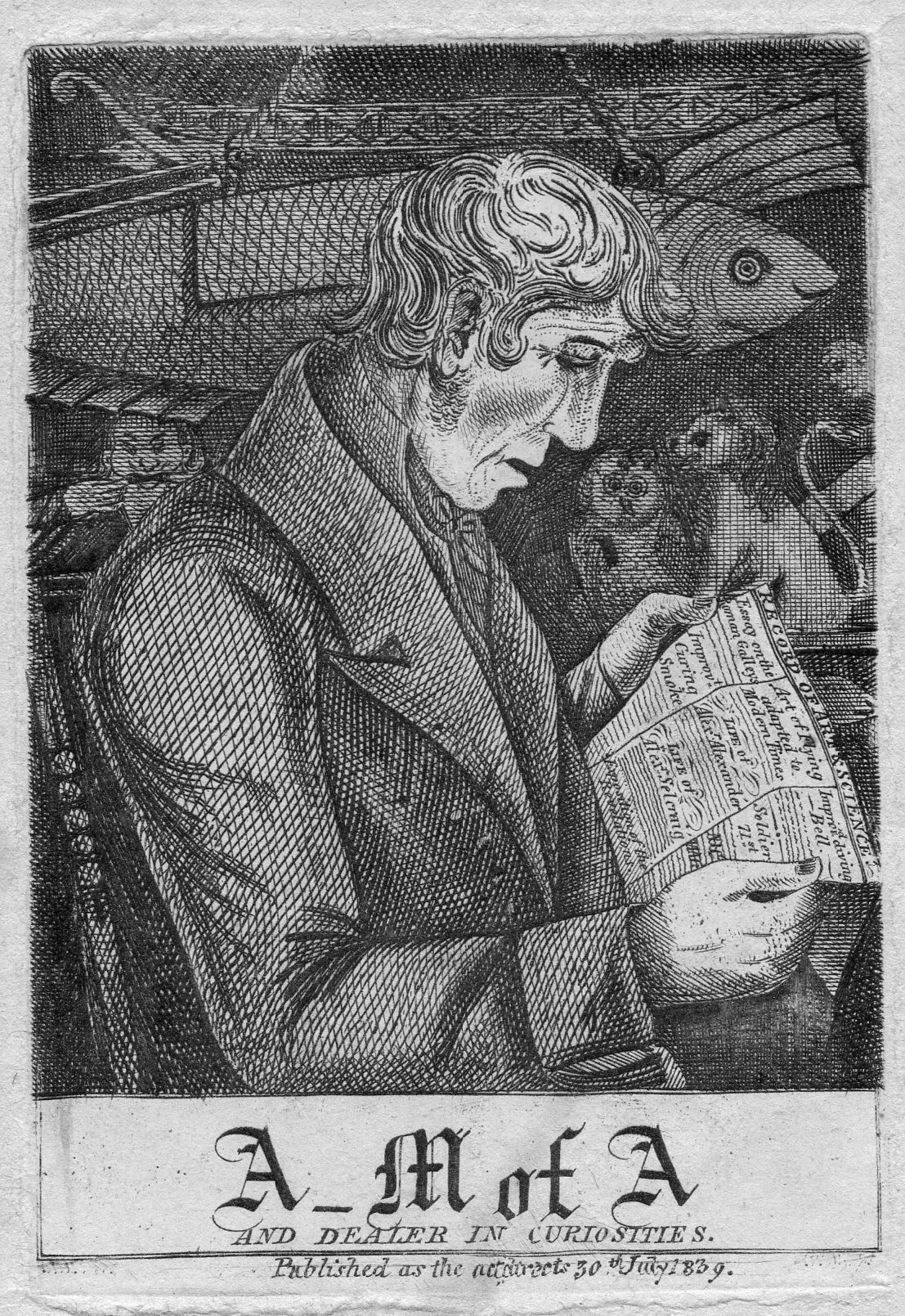
    This print has been hanging here and there at home for many years–it has always been amusing, and somehow warming. 

    “A _M of A, and Dealer in Curiosities” was “published as the act directs 30 July 1839”, is an etchign which depicts,
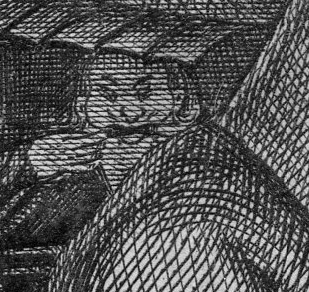
    M of A face I guess, a lettered/educated man who winds up as a seller of scientific and intellectual bric-a-brac and interesting bits, perhaps wonderful natural history/physics materials, perhaps trivialities.  He seems satisfied to me, regardless of the little man over his shoulder making a face, a reminder perhaps to not take the curiosities too seriously.  [There’s also another face off to the right, peering into the image (see below).]

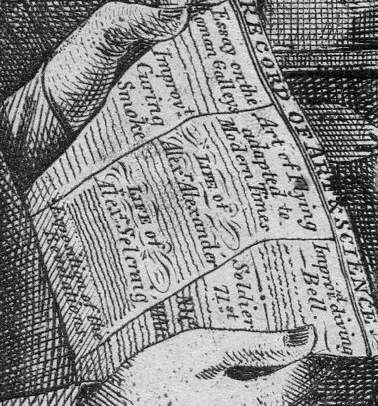
    The Record of Arts & Science that our dealer is reading has some interesting parts to it:, including something on new mechanical flight and a new diving bell–it would’ve been more interesting historically if it had mentioned the brand-new Daguerre invention. 


    M of A reading


    ·Posted by :

    ·in:

    — —

  • Reference Tool: Your Handy Guide to U.S. Patent Numbers

    JF Ptak Science Books   Quick Post

    Patent Office Print
    This is a simple tally of  American patent numbers and the years in which they appeared.  I’ve found this list handy from time to time and thought to repost it here.  It is a lot easier to have this series posted here than have to wrangle he data out of the occasionally labyrinthine U.S.P.T.O.:


    ·Posted by :

    ·in:

    — — —

  • Inside Looking Out: Ernst Mach vs. the Hudson River

    JF Ptak Science Books  Post 1913

    Machbook

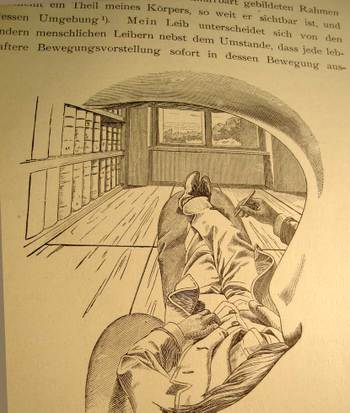
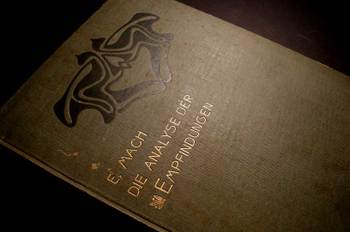
    I cannot think of another illustration by a scientist or philosopher who attempts to explain their own, literal, view of the world and then offer what this looks like to the reader from inside his own head, looking out through his own eye.  That’s exactly what Ernst Mach is doing right here on page 15 of his influential book Die Analyse der Empfindungen,  the fourth German edition (“The Analysis of Sensations and the Relation of the Physical to the Pyschical”, published in Jena in 1903).

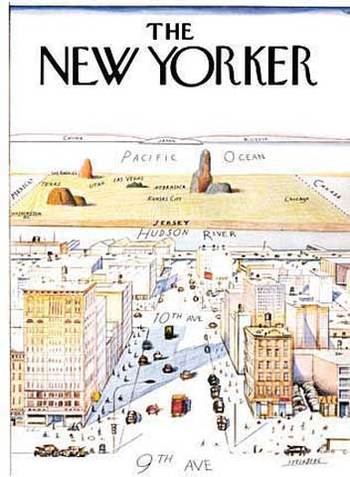
    There is nothing in this world for Mach that is not admissible to the human brain that is not empirically verifiable–that is, the world is nothing but awash in sensation and that sensation itself forms part of the experience of, well, experience. I’ve actually never been interested in the philosophy of science, and this is one of the reasons why.  Nevertheless I boldly break through my own prejudices to enjoy this phenomenally original image, drawn from the inside of Mach’s working mind, looking out through his eye socket, over his mustache, under his eyebrow, around his nose, out across his body and then leaping into the rest of the world.  I think he does make his point about the essentialSteinberg_352
    nature of the observer. And much like the classic Steinberg New Yorker cartoon of the world view of the New Yorker (of course this includes only Manhattan), I know some number of people who have transposed their bodies much like Herr Mach into the Steinberg map–except that their worldview ends basically at the Hudson River (Mach’s feet) with the rest of the world being the sliver out there beyond the river (Mach’s window) until you go 359 degrees around the world to get back to the East River (and back inside Mach’s noggin).  It is an unusual world view to have, but someone has to have it so that we can at least identify it so. 

    I just like the picture.   

    (Section 10, describing this image,  with translation by C M Williams and Sydney Waterlow from the blessed Dover people in 1959):

    “The considerations just advanced, expressed as they have been in an abstract form, will gain in strength and vividness if we consider the concrete facts from which they flow. Thus, I lie upon my sofa. If I close my right eye, the picture represented in the accompanying cut is presented to my left eye In a frame formed by the ridge of my eyebrow, by my nose, and by my moustache, appears a part of my body, so far as visible, with Mach2_3
    its environment. My body differs from other human bodies – beyond the fact that every intense motor idea is immediately expressed by a movement of it, and that, if it is touched, more striking changes are determined than if other bodies are touched – by the circumstance, that it is only seen piecemeal, and, especially, is seen without a head. If I observe an element A within my field of vision, and investigate its connexion with another element B within the same field, I step out of the domain of physics into that of physiology or psychology, provided B, to use the apposite expression of a friend of mine made upon seeing this drawing, passes through my skin. Reflexions like that for the field of vision may be made with regard to the province of touch and the perceptual domains of the other senses.”


  • Looking Straight Down Department: Antiquarian Waterspouts

    JF Ptak Science Books   Quick Post   Some examples from the uncollected series on Looking Straight Down can be found here and here.

    I’ve been involved in this blog at retrieving and tabulating antique images that look straight down on something. Today I imagine that we all take these sorts of views for granted, what with satellite images and Google Earth and airplanes and all.  But in the pre-heavier-than-air era, seeing a published image that looked straight down from a height was quite rare. (And it needs to be strait down, not a bird’s-eye view.  Things are very different between looking obliquely from an airplane window onto a cityscape than skydiving directly down on top of it.)

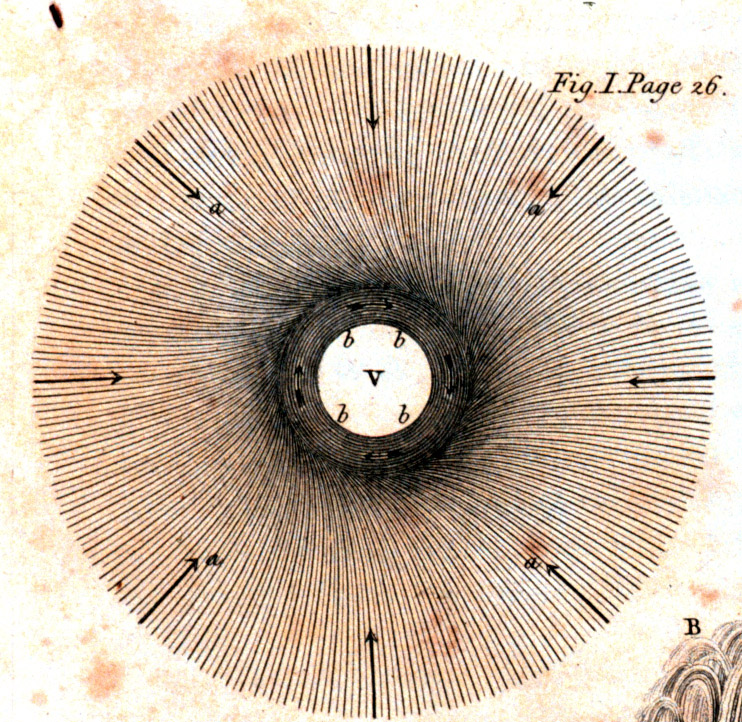
    Benjamin Franklin had long been thinking about waterspouts, going back at least to the early 1750’s, though he did not have an article about them in print until the appearance of “Physical and Meteorological Observations: Conjectures and Suppositions”  in the Royal Society’s Philosophical Transactions, LV (1765). The first image that I’ve been able to find of the waterspout occurs in 1774, though a prettier version of it is reworked a little, but with sharper delineations, in 1818:

    Waterspout detail

    Here’s the full image (with a magic square that related to another article in the volume):


  • Mark Rothko, 1870: Unidentified Pre-Modern Found-Modernist Art

    JF Ptak Science Books   Post 1895

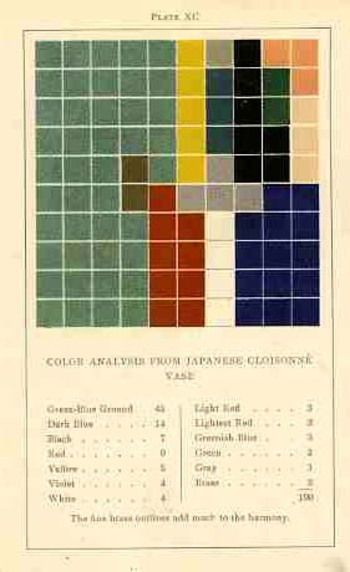
    This blog has long hosted a series of posts on “accidental” or “unintended” works of pre-modern modernist art found in displays of information and statistics in the sciences and mathematics, and even occasionally in art and design.  One such work–a 1904 triumph of accidental art issuing from an usunal work on color theory–belongs to an aesthetician named Emily Vanderpoel.  It is extraordinary in a narrower sense, and that extraordinary might not actually be positive for its original intent–the extra-intent of the book, what has come out of it for me, was something that was unintentionally accomplished by the author.  The images that she used to illustrate her color theory ideas–the basis of which are not really omprehensible to me–turn out to be artwork in themselves, a found art, the artistry of the images taking over the original intention for the arrangement of their color. She had introduced (though to no one, not really) a concept of beautifully arranged spatial color, artwork without a subject that could be recognized as any sort of natural object–non-representational art, finding publication several years before what is seen as the first inentional attempt at that genre, by Vassily Kandinsky in 1911. (Images below.) And when one strolls through the history of scientific illustration it becomes easier and easier to find such things, fabulous precursors to non-represnetational art, and Dadism, and Cubism and Surrealism. 

    Blogcolorvander_2poel_063These elements seem to be most populous in the illustrated sections of early encyclopediae, and dictionaries, and even encyclopedic dictionaries, where a number of different elements are displayed on the same page, different and generally unrelated images on the same engraved sheet, references for articles found in different parts of the book. 
    Here is a good example of that, with unintentional Surrealist images found in the image refernce pages of Horace Benedict de Saussure’s Voyages dans les Alpes….(published in Neuchatel in 1803):
    Unintentional surreal766
    [There are a number of other examples that I’ve written about on this blog:  here, for example, in “On the Paper Sculpting of Nothing”.]

    And then there are examples like Vanderpoel, where the entire image from one sheet is the pre-modernist image in question–to my experience this is the more uncommon occurrence. 

    Which brings us to today’s installment:  the infographic displays found in  Francis Walker’s  Statistical atlas of the United States based on the results of the ninth census 1870 with contributions from many eminent men of science and several departments of the government, which is the atlas of data to accompany the 9th Census of the United States, published in 1874.  This is a beautiful work, and a pioneering challenge.  Walker was one of the earliest to produce a statistical atlas, and was perhaps the earliest to display this huge and broad amount of data in so many different ways–it must have seemed a semi-miracle to see the information displayed so, like going froma  black & white television to color, or color to infared, and so on.  It may well have represented anentirely new way of looking at data.

     The first image (above) in this post is from the illustration showing proportions of the white/non-white population, and the following image shows a detail of that, offset against Mark Rothko’s 1959 Black on Maroon.

    Francis Walker’s statistical mapping, above, 1873; Mark Rotko,

    1959, below:  


     mark-rothko-black-on-maroon-1959

    [Black on Maroon (1959) by Mark Rothko, part of the Seagram mural series, via Tate Modern.]

    The first and third images are details from this full-page illustration:

    It is easy to see the similarities between the data display and the Rothko, though it would really not be within anyone’s power to identify the Walker diagrams as “art” in the modern sense for another five decades.  But it certainly seemed there, ready to be of influence and service, though I’m not aware offhand of artists being influence by these images as they were with, say etienne Marey’s photographs. I’m not sure that these statistics images ever came into the service of art in the beginning of the modern era.  And maybe that’s the biggest question here. 

    Sources:

    1. Guide to National Atlases: here.
    2. The Walker atlas for the 1870 census from the LC site: here.
    3. And an improvement on the Library of Congress presentation, by HandsomeAtlas (Brooklyn Brainery): here.


  • Vernacular Landscape–Found-Religious Signs, 1936

    JF Ptak Science Books   Quick Post

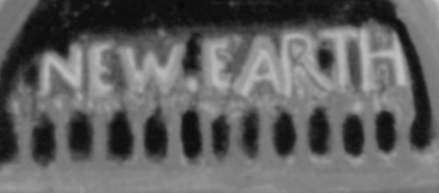
    New earth
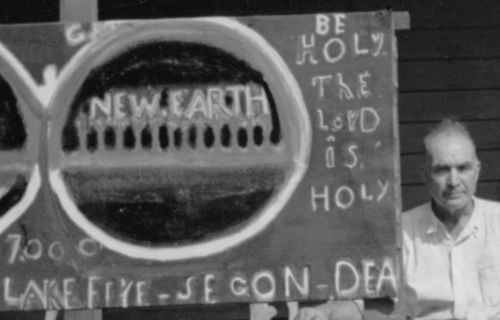
    Which is a detail from:

    FSA--signs--religious detail

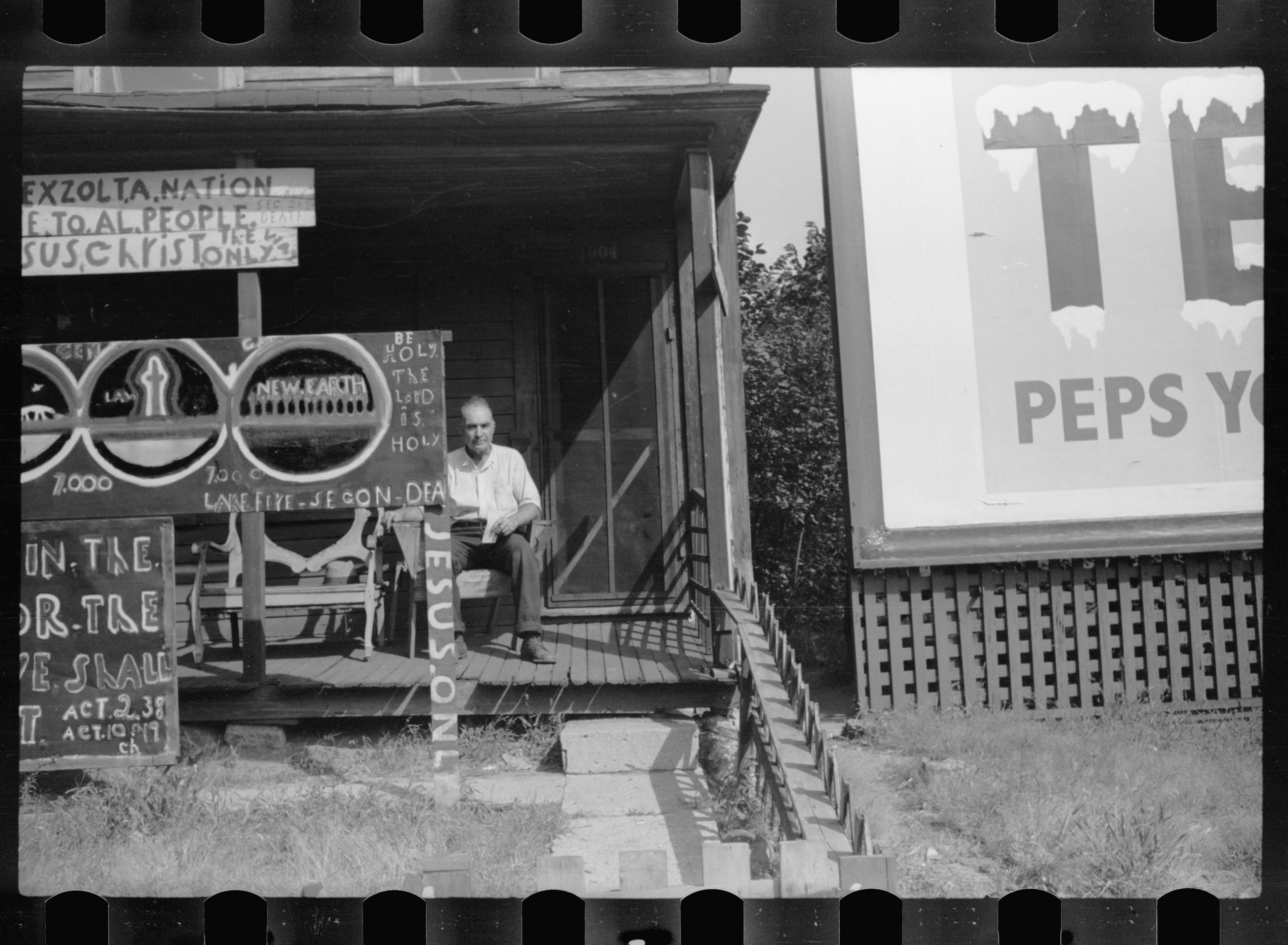
     Which itself is a detail from:

    FSA--signs--religious
    John Vachon; Religious Signs, Minnesota. 1936.

    Image, Source: digital file from intermediary roll film

     Vachon (1914-1975) was part (beginning in 1936) of one of the great groups of photographers in the history of American images: he worked for Roy Stryker in the FSA as part of the U.S. government’s attempt to record the good and ill of American poor.  That group included Esther Bubley, Marjory Collins, Mary Post Wolcott, Jack Delano, Arthur Rothstein, Walker Evans, Russell Lee, Gordon Parks, Charlotte Brooks, Carl Mydans, Dorothea Lange and Ben Shahn.  OF the many images recorded by Vachon, I liked the words in this one.


    ·Posted by :

    ·in:

    — — —