A Daily History of Holes, Dots, Lines, Science, History, Math, Physics, Art, the Unintentional Absurd, Architecture, Maps, Data Visualization, Blank and Missing Things, and so on. |1.6 million words, 7500 images, 4.9 million hits| Press & appearances in The Times, Le Figaro, Mensa, The Economist, The Guardian, Discovery News, Slate, Le Monde, Sci American Blogs, Le Pont, and many other places… 5000+ total posts since 2008.

Category: Perspective

  • From Blood Flow to Little Nemo–Sequential Illustrations of Ideas and Stories

    JF Ptak Science Books  Post 1786

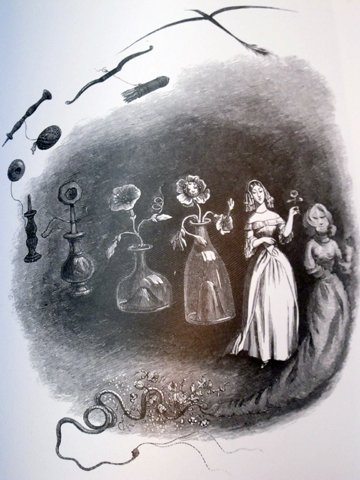
    It is intriguing to see ideas are communicated when drawn as a series of events on a single piece of paper–a single-panel, progressive illustration showing the sequential development of an idea.  This thought struck me while looking at some of the work of J.J. Grandville (above, “Les Metamorphoses du sommeil”, from his book Un Autre Monde, a proto-surrealist work printed in 1844) ) and caused me to think about how old this idea might be, how far back it stretched into the sciences and literature.  And right now, I really don’t have the answer.

    Again, what I’m thinking about is a single-sheet describing an action or thought–not like what might be the earliest example of the “comic book” the Histoire de M. Vieux Bois (1827) by Rodolphe Toepffer (Geneva, 1799–1846) but more like Little Nemo in Slumberland, by Winsor McKay (the following example from 1905).  The difference between the two in composition is simply that McKay in his Sunday comics efforts would develop the story on a single sheet of paper, so that you are in a way watching the story unfold as a motion picture would; and in the case of Toepffer, the story is told more in a conventional graphic novel way–in a book over dozens or hundreds of pages, with one illustration per page.  (I wonder about including Egyptian and Mixtec hieroglyphics, but I don’t think that they apply.)

    File:Little Nemo moon.jpg

    What seems like an early ready-made example of the sequential imaging of an idea on one piece of paper might be from the great William Harvey’s  De Motu Cordis et Sanguinis in Animalibus (On the Movement of the Heart and Blood in Animals), which was printed in 1628, and which in an iconic display shows Harvey’s demonstration of blood operating in a closed system, and circulated by the heart, and undergoing a “a motion in a circle”.

    Image from Exercitationes Anatomicae

    [Source:  this image from Exercitationes Anatomicae, De Motu Cordis & Sanguinis Circulatione.. Rotterdam: Arnoldus Leers, 1660..]


  • A Line in the Sand: a Note on Modernity, 1908

    JF Ptak Science Books   Post 1783

    Klimt3_edited-1
      Klimt2

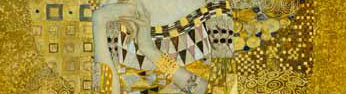
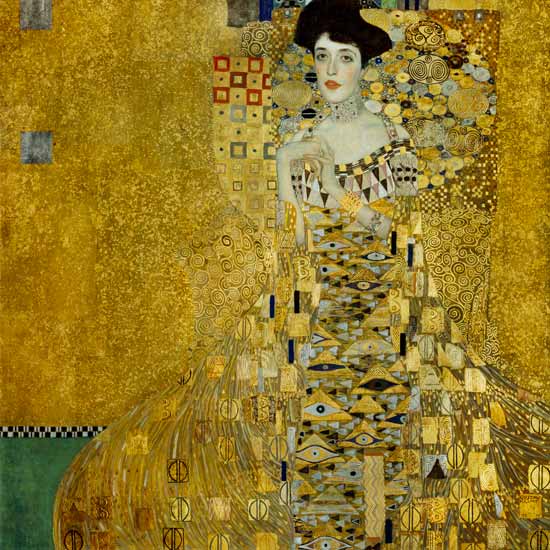
    Is this detail a peek at the boundary of The Modern?

    Are we seeing the boundaries of the new art? I’m not saying that this is the boundary, or the outermost, or the inner–but it is there, somehow, marking a line between the old and the revolutionary new, a line in the sand in the history of art.

    The 1907 portrait of Adele Bloch-Bauer by Gustav Klimt almost seems to be among the earliest images of a synthetic human, a human no longer solely interacting with its environment, but also now becoming a part of it, the subject losing a part of itself to be a segment of design.  The painting was also moving away from solely representational work, with Klimt allowing the expression of his painting to take over the recognizable subject. The subject and the idea of representational painting would disappear completely in just a few years’ time with the appearance of Kandinsky’s watercolor (Untitled) (1910).  Klimit himself would continue his experimentation with The Kiss, which he worked on from 1905-1908.

    Klimt

    It is interesting to me to see how the subject and environment of a painting become one, as in the work, for examples of  Ferdinand Leger, like his Nudes in the Forest (1909/10):

    Ferdinard Leger Nudes in the Forest

    and Jacques Villon Soldiers on March (1913)

    http://www.indiana.edu/~dws/dws_chapter_2/images/19.VillonSoldiers.jpg


    and Umberto Boccioni, States of Mind I (1911)

    http://www.shafe.co.uk/crystal/images/lshafe/Boccioni_States_of_Mind_The_Farewells_1911.jpg

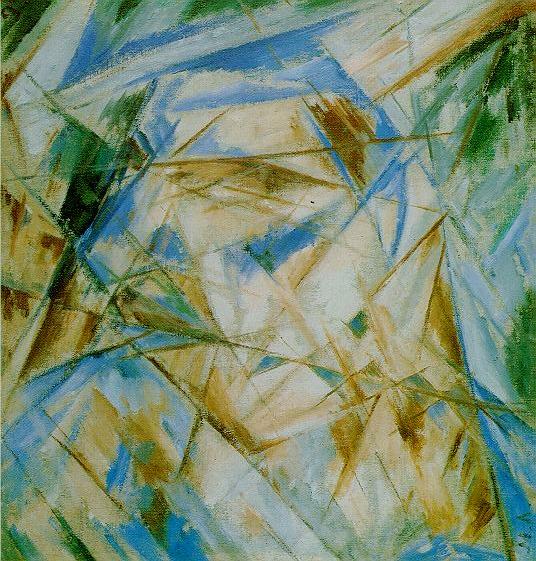
    annd Michael Lerionov Blue Rayonism (1912)

    http://myweb.rollins.edu/aboguslawski/Ruspaint/lario4.jpg

    Lyonel Feininger Umpferstedt I, 1914

    Lyonel Feininger, Umpferstedt I.

    These more so than the earliest non-representational artists, like Franz Kupka’s Noctures (1911), or Gino Severini Hierogyphic of the Bal Tabarin (1912); and not in the very suggestive work of  Vlaminck’s La Partie en Campagne (1905) or Matisse’s Joie de Vivre (1905) or even Picasso’s Les Demoiselles d’Avignon (1907).  The Klimt just seems to me a blending of subject and the rest of the painting, and not in a Cubist or Constructivist or non-representational sort of way.


  • Visualizing the Normally-Unseen: Roentgen, Marey, Malevich

    JF Ptak Science Books  Post 1775

    Pleasant_1bertha The 1895/1896 issues of Nature magazine are compliantly normal until the first weeks of 1896 when the first of a flood of articles is published about the astonishing discovery of 50-year-old Wilhelm Conrad Röntgen. The English-language popular science journal announcement of his December 28, 1895  “Ueber eine neue Art von Strahlen” (“On a New Type of Ray”), appearing 16 January 1896, began the introduction of a new state of human experience.  His experiments—built upon the work of J. Plucker (1801-1868), J. W. Hittorf (1824-1914), C. F. Varley (1828-1883), E. Goldstein (1850-1931), Sir William Crookes (1832-1919), H. Hertz (1857-1894) and the odious Phil Lenard (1862-1947 and who didn’t die soon enough)—revealed as much to humans as did the experiments and inventions of Hooke and Leeuwenhoek on the invisible worlds revealed by the microscope.  There are more than 150 articles on the Roentgen (and soon to be “X-“) Ray, all published within 12 months of the original announcement, almost all excitedly, trying to comprehend, elucidate, expand, verify, this new world. 
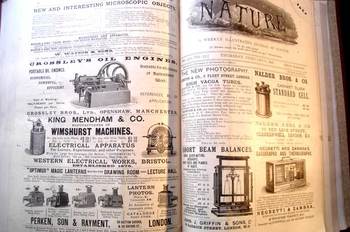
    Blogxraybigads_2 [The news of the discovery is first and most popularly reported in the January 6, 1896 London Standard:  “The noise of war’s alarm should not distract attention from the marvelous triumph of science which is reported from Vienna. It is announced that Professor Routgen (sic) of the Wurzburg University has discovered a light which for the purposeBlogxrayad of photography will penetrate wood, flesh, cloth, and most other organic substances. The Professor has succeeded in photographing metal weights which were in a closed wooden case, also a man’s hand which showed only the bones, the flesh being invisible”. By the end of the month the news was completely absorbed, worldwide.]
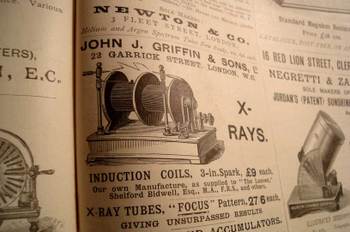
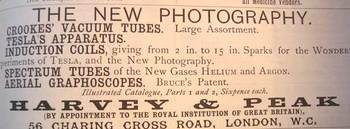
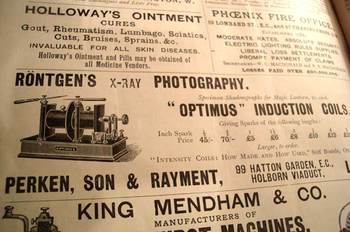
    I looked at the advertising in these issues (my copies of Nature for these decades generally have the original paper wrappers for the weeklies, complete with ad copy), looking for the first time that a Roentgen machine was offered for sale to the general public.  As it turns out, they popped up 12 March 1896 (once), 19 March (twice), and then about once a week for the rest of the year.  A little surprising, I think, a little light to my Monday-morning quarterback’s eye—I expected more; bigger, more, splashier.  But the ads are small and sedate, hardly similar to the discovery they represent. 
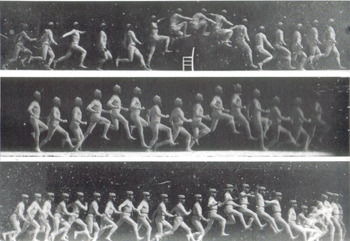
    Blogfeb_22marey The rest of the world, the rest of the advertising world, stayed the same–the Roentgen discovery and the enormous possibilities and promises of his “new photography” lived in their own unique sphere, unencumbered by their sassy new brother.   This mild response seems dimmer still when you compare it to that which greeted other (relatively) simple but still major advancements in the world of photography.  Take for example Etienne Marey, who was a technoid and physician who was able to capture motion of all sorts–he was able to develop a picture so to speak of the movement of blood in the body via his instrument to calculate blood pressure, and he also created a shotgun-style camera that made the Blog_feb_22_nude world’s first high-speed photographs of movement.  And so it cane to pass that in the late 1870’s and early 1880’s people were instantly able to see what a horse looked like when it galloped or what the body did *exactly* when jumping over a chair.  When you couple this with fourth-dimension material one wonders why it took several more decades to bump into these images in the art of 1907+. 
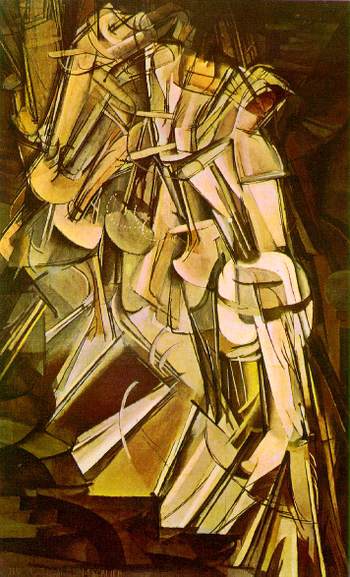
    (Duchamp Nude Descending series, 1915; above, Marey, 1881)

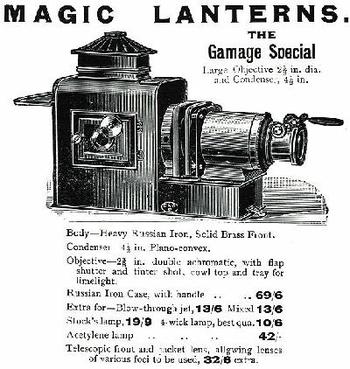
    And what indeed was normal in these pages?  Magic lanterns
    and magi lantern slides appearMagiclantern at all levels; the gorgeous Wimshurst machine gets heavily advertised; the redoubtable Negretti & Zambra advertised all manner of excellent scientific instruments (biographs, thermogrphs.  Nadeer Bros. advertised a pretty standard cell, and the ancient Crossley displayed their “new” oil engines, “suitable for all classes of agricultural work”.  J.H. Stewart was selling their semi-automatic electric arc lamp, while across the page was Newton & Company’s “Newtonian” arc lamps for lanterns (“self feeding and focus keeping”).  Microscopes and prepared slides abound, and Thomas Bolton advertises discretely and effectively for their “living specimens for the microscope”. 
    The Physical Review, the American upstart in the science world advertises that its third volume was available, while its distant cousin, the Psychological Review, advertised its own third volume.  Booksellers seem to take the most space, thank goodness. 

    Blogxrayepps There are a few medical throwbacks:  Epp’s Cocaine takes out occasional tenth-page ads for their “cocoa-nib extract, tea-like” selling its ‘gentile nerve stimulant”.  Right underneath is “Holloway’s Pills”, promising to cure biliousness, sick headache, indigestion, and all (?!) internal complaints.   These are brilliant simple samples of the skeleton of science in world-dominant Great Britain, in a world dominated at that time by H.A, Lorentz, Ernst Mach , Roentgen, Korteweg, de Vries, Bateson, Jean-Baptiste Perrin, Pierre Curie, Zeeman, Becquerel, Joseph Thomson,  Ernest Rutherford, Marconi, Ramsay, Fitzgerald.  And so on. 

    Nothing offered for sale here offered any significant clue to the pregnant world of modernity that was nearlyBlogxray3 there—the world would become ‘modern” almost immediately following Roentgen, with revolutionary, epochal changes in art (in non-representational form more so than Impressionism), theater, literature, music.  Just about everything changed (except politics).  But there is no hint to paradigm shift hidden in the ads, just as they were with the machines selling the promise of Roentgen’s “new photography.  There’s something about the fine glass, superb turning of the screw, and a perfectly oiled gear though that makes this sort of perfection seem so lonely in the world of larger change.  Bertha, Roentgen’s wife, sat for 15 minutes while her husband passed his rays through her hand; she ran from the room once she saw the results, revealing her very bones and no doubt a strong sense of the Blog_feb_22_malevich
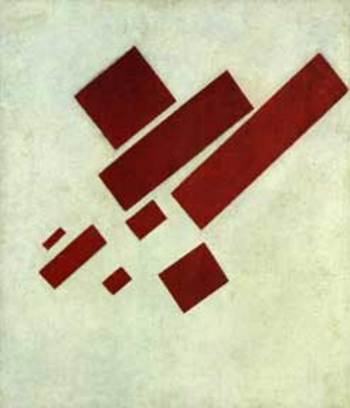
    fragility of life, and the strong presence of death.  Many had the same reaction to the Kandinsky’sBlogxrayad2 shapes and Malevich’s white circles and red rectangles and Ibsen’s drama and Einstein’s dancing dust and the rogue syncopation of jazz.  It is probably a very natural reaction to try and protect established memory—but memory should be more flexible than that, I think, to keep a healthy mind.

  • Geology of Images: Finding Pre-biotic, Neo-Dadaist Images in Antique Astronomy Prints

    JF Ptak Science Books  Post 1768Astro mictroscope--6b943

    Sometimes when you look hard enough you will see (if not actually “find”) what you’re looking for; determined to  make a discovery, you can sometimes force yourself into believing that what you’re seeing is what it was that was needed to be seen .

    The  microscopical world of astonomical antiquarian prints is an interesting one–and in some ways, modern ways, are  on the Robert Hooke/Micrographia magnitudes for the remarkable magnified worlds that their detail reveal–but mostly right now I’m interested in the odd/beautful designs that are hidden in larger scientifc engraved presentations.

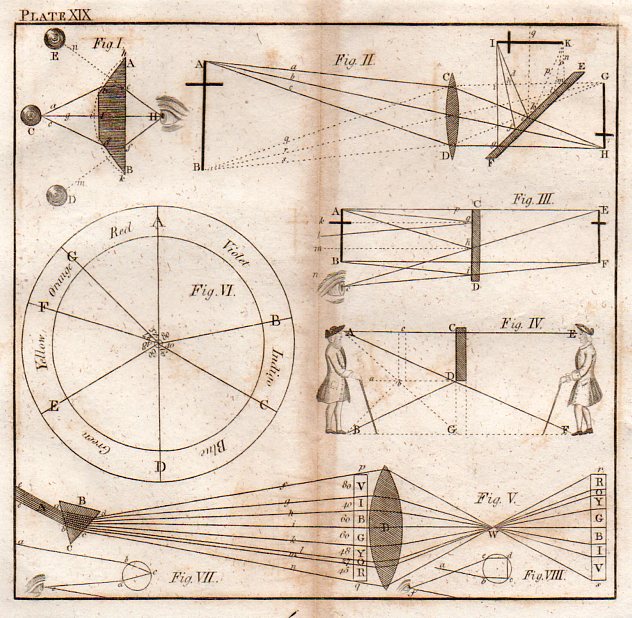
    Astro mictroscope--6942 [Even in fairly famous scientific images lke the one above–explaining the rainbow–there are all manner of unexpected artistic finds outside of their significant scientific contributions.]

    These images from the title of this post, on the other hand, are just simply “there”–all you need is a little magnification and some sharp vision, and the things come to life.  When looking hard at these images and seeing the teaming non-representational artforms that swim through so many of them it seems remarkable to me that these things weren’t seen as art before Kandinsy finally “discovered” this  artform in 1911.

    (For example Mr. Marey produced a very remarkable Nude descending-like series of photographs 40 years before Duchamp–but the Marey images were observed scientifically, and I’m unaware of anyone who ever wrote an artistic appreciation of that work before 1900.  [Marey left, Duchamp right.] But that is another story.)

    Blogfeb_22mareyBlog_feb_22_nude

    For us today with almost 100 years of Kandinsky/Klee/Duchamp/Braque/Malevich under our belts it is relatively easy to see the artfullness of the pieces and bits of these engravings–not so a hundred-plus years ago, and harder yet for 200+. 

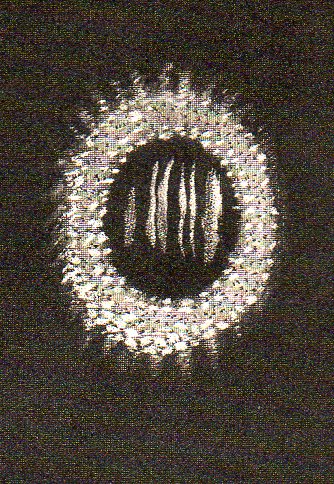
    For example, there are some things that take on an absolutely pre-biotic flavor, like material that we’d come to see a half-century ago, as in these details from an 1850’s  French lithograph on nebualae:

    Astro mictroscope--3b931


  • The Ouroboros and Infinity

    JF Ptak Science Books    Post 1762

    Ouroboros390
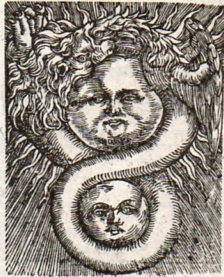
    The ouroboros–and in this particular case, the double, over-and-under ouroboros–is an interesting and ancient symbol.  In my experience, the single unit is to be expected, but the double seems uncommon. The symbol (“oura” or tail and “boros”, eating, in Greek, one who eats one’s tail) stretches back into the dim and dusty past, at least to the Egyptian Book of the Dead, and is Plato’s first living thing–its is the primordial unity, the rebirth of forever, death/life/birth/rebirth, continuing into infinity, the great world soul…a kind of Western equivalent of the Taoist Yin Yang.

    There’s much more to be said about this symbol, especially by such people as Erich Neumann and Carl Jung, but I’ll resist, mainly because it is just too complicated for me to make an intelligent statement. (I’ve tried to read the Great Mother as well as The Origins of the History of Consciousness by Neumann, but only made my way around the edges of the first, and picked through the interesting bits of the later.  Jung is someone I’ve never had much luck with.)

    The first symbol, and a gorgeous one it is, comes from the Theatrum chemicum (1659-1661, and published in six volumes by Lazarus Zetzner in Strasbourg), and shows the combination of what was supposed to be an alchemical highpoint:  the spiritual coming together of sulfur and mercury, elements of what the practioners believed were the basic constituents of all metals and minerals.  And of such stuff miracles were understood to be made, except that of course, they weren’t–the fact that this stuff never worked to produce something more substantial than mercuric sulfide wasn’t due to the theory or practice or thought but to the “fact” that the mercury and sulfur used in the process weren’t “pure” enough.  That said, the Theatrum was a very important work, the largest collection of alchemical works ever gathered and published together–it was also evidently much appreciated by Isaac Newton, who was said to consult it often and who owned the set in his library.

    A more classical appearance of the ouroboros (De Lapide PhilosophicoTriga Chemicum (Prague 1599) compiled by Nicolas Barnaud), depicting a dragon seizing the polarities of its soul, ultimately uniting them: 

    File:Ouroboros 1.jpg

    And in the discussion of the ouroboros and philosophical aspects of infinity it should be mentioned that there is some connection between it and the mathematical symbol for infinity, which seems to arise from (the remarkable and original) John Wallis’ De Sectionibus Conicibus, which was published in 1655.  Wallis employed the old Roman symbol for 1,000 to use for the mathematical infinity, which of course is the ouroboros on its side.  (Wallis it should be noticed was also among the earliest people to put into print the symbol for pi, as well.)

    ·Posted by :

    ·in:

    — — — —

  • WIlliam Herschel, Adam Smith, Sunspots and Wheat Prices

    Herschel253JF Ptak Science Books   Quick Post

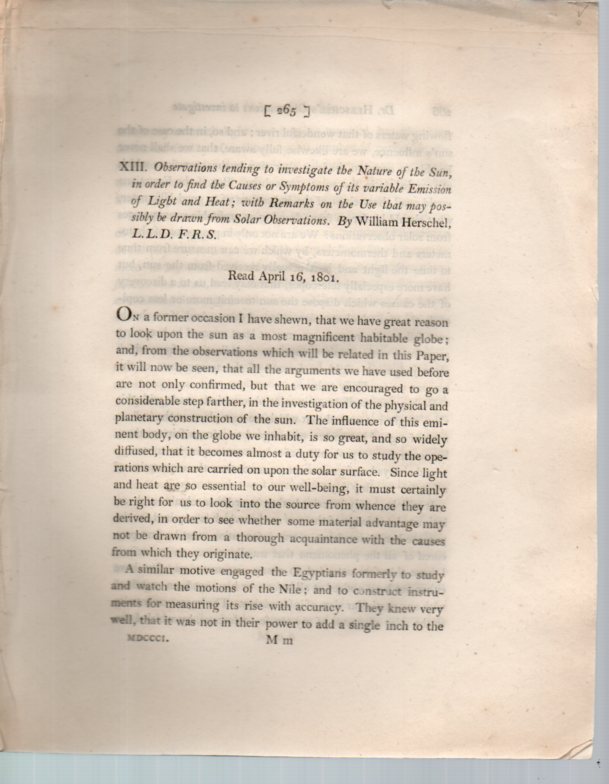
    While flipping through William Herschel’s 1801 Philosophical Transactions paper “Observations tending to investigate the Nature of the Sun in order to find the Cause of Symptoms of its Variable Emission of Light and Heat”, I thought it was a good early-ish paper on sunspots.  I was surprised to find a lengthy entry on the applied nature of his findings, and that on the variable nature of sunspots and agricultural yield as determined by wheat prices found in Adam Smith’s Wealth of Nations.  Honestly I was fully unaware of Herschel’s involvement with sunspots and seasonal growth and price fluctuations, but there it was.  And he does find a correlation, albeit a very cautious one where he says the subject deserves more study and more data.

    He writes: “it seems probable that some temporary scarcity or defect of vegetation has taken place, when the sun has been without those appearances which we surmise to be the symptoms of a copious emission of light and heat…”

    This must make Herschel–already a celebrity astronomer for his discovery of the first planet discovered since ancient times, Uranus, among many other things–one of the earliest (if not the first) astronomer to experimentally entertain the effects of solar disturbances on the Earth.  And this on sunspots years before Schwabe established the periodicity of sunspots (1846) or the electromagnetic connection with sunspots (that would come only with G.E. Hale in 1908).  Herschel (who left/fled Germany to reside in England) was a man of interesting sight: he discovered Uranus, identified new moons of Saturn, established that the previously-nebulous nebulae were collections of vast numbers of distant and faint clouds, drew a spectacular image of the Milky Way galaxy as an outside observer looking in, that there was a light from the sun that was beyond the visible spectrum, and also discovered in the micro-world found that coral were animals rather than plants.The business of trying to see if there were any correlations between solar activity and plant production on Earth was novel, and interesting. [The original paper is available for purchase through our blog bookstore, here.]

    In the Edinburgh Review for 1825 we find:

    ·Posted by :

    ·in:

    —

  • On Eclipses of Io and the Speed of Light: Ole Romer, 1676

    JF Ptak Science Books   Post 1730

    “When the father and creator saw the creature which he has made moving and living…, he rejoiced, and in his joy determined to…make the universe eternal, so far as might be. …Wherefore he resolved to have a moving image of eternity, and when he set in order the heaven, he made this image eternal but moving according to number, while eternity itself rests in unity; and this image we call time… Such was the mind and thought of God in the creation of time. The sun and moon and five other stars, which are called the planets, were created by him in order to distinguish and preserve the numbers of time… And for this reason the fixed stars were created, to be divine and eternal animals, ever-abiding and\ revolving after the same manner and on the same spot…” Plato, in which he wrote about the formation of the universe, among many other things, (Jowett. v. 2. Timaeus, p. 19), and spotted at the Linda Hall [Science] Library here

    Well, not exactly, but this was some pretty good thinking by Plato for his time, and beyond that–actually, the thinking was held for centuries.  But it was some very nice thinking by (Danish) Ole Rømer that pieced this part of Plato out, turning it around, and coming to terms with the use of “the order of heaven” to “preserve the numbers” of the speed of light, all through the observation of eclipses of Jupiter’s moon Io. 

    Horrebow249
    I should first say that today’s post came about via Peter Horrebow’s (1679-1764) Operum Mathematico-Physicorum… , a three-volume work published in Copenhagen in 1740-41.   Horrebow was a very accomplished astronomer in his own right (we’ll get to that in a moment), but what is of interest for me right now is the third volume of his book, as it (the Basis Astronomiae…) contains very detailed descriptions of the astronomical instruments and observatory of his fellow Danish astronomer Rømer (1644-1710).  Horrebow must have been a very gifted machinist and man-about-the-“lab”, as he was able to make his way through the educational system and then to the highest levels of academia even though beginning his life as a fish-seller’s son–an extraordinary accomplishment, really, as there were not many opportunities for people without some sort of privilege to succeed on this level.  And succeed Horrebow did, serving as the great Rømer ‘s assistant and charge, living in the man’s house for some time. (He didn’t stay for very long, as Horrebow was a father of twenty.)

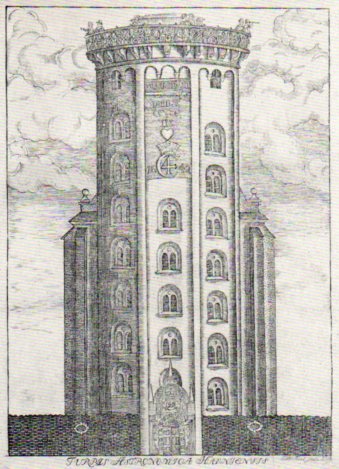
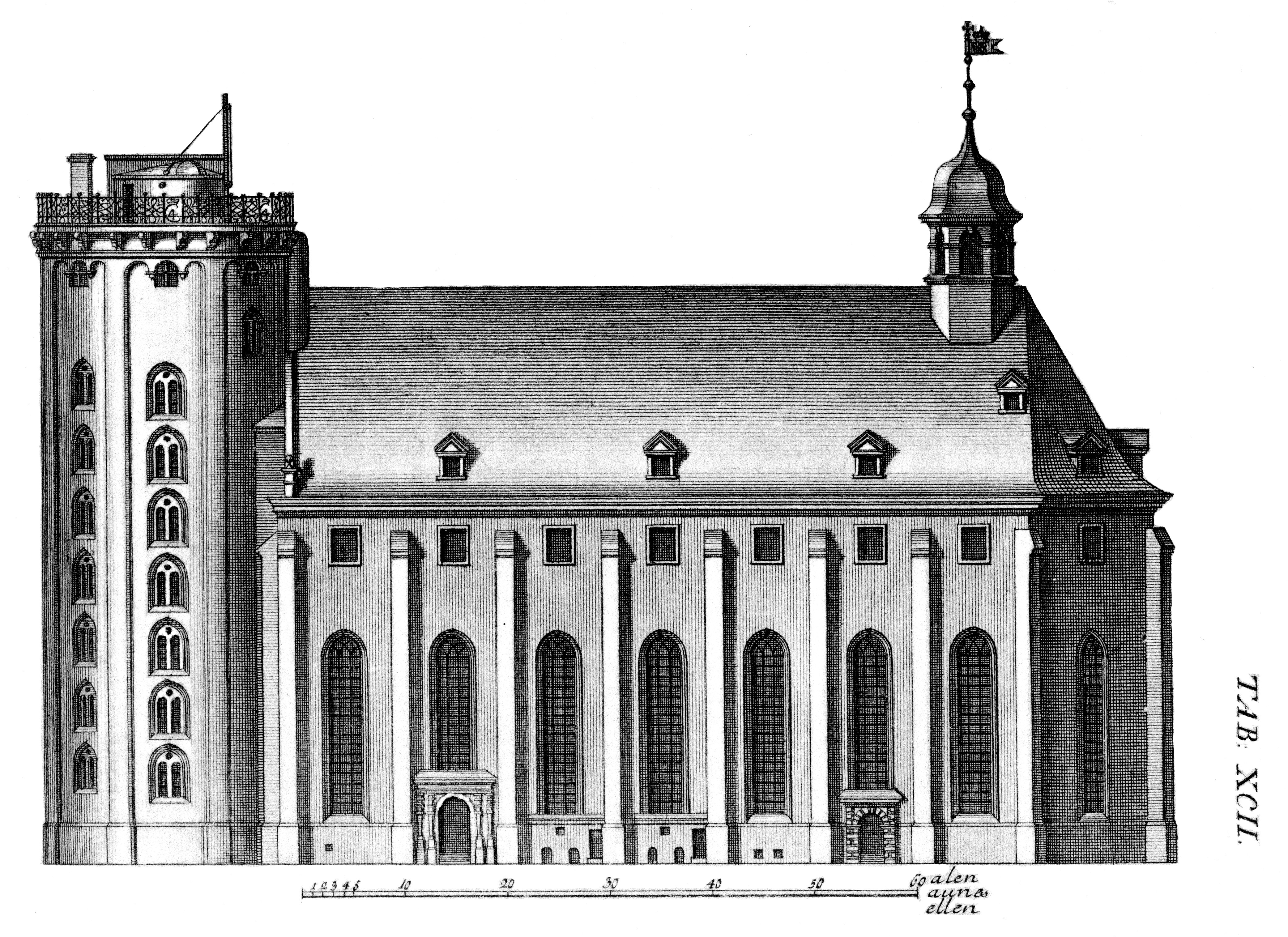
    There are some famous illustrations in this book–not the least of which is the depiction of Rømer at work on a transit in his observatory–but the image I like most of all is not one of the instruments, but a beautiful engraving of the observatory built by Charles IV.  The massive structure–called the Rundetam–was begun in 1637and finished in 1642; it is as its name suggests a “round tower” that rises 34 meters; it has no stairs using a 7.5-turn walkway instead. (It is a confusing thing, walking ’round to go up, and seems to me to have been much more than just seven turns; in a weird way by the top of the walk it felt as though one was going “down” somehow. Maybe I  just got dizzy.)  In any event the tower would be an observatory, with Rømer (and then, later, Horrebow) working from the roof as well as from some high windows, and was meant to replace the great Tycho Brahe’s demolished Stjeneborg

    File:Hafnia Hodierna Tab XCII Trinitatis Kirke.jpg

    [Cross-section of the observatory.}

    Rømer’s career was remarkable, but what I find particularly beautiful was his determination of the speed of light, and all from basically sitting there with his instruments in a window of a massive stone structure in the middle of a city, figuring out minute differentiations, making detailed observations of eclipses of the moons of a planet that had only been observed telescopically less than 67 years earlier (with the newly-invented instrument, the telescope). 

    The moons of Jupiter had been observed in 1666-1668 by Cassini and were a subject of intense study by him and Rømer, among others; Rømer in fact would travel to the Paris observatory and be an assistant to Cassini as the two worked together on the moons and eclipse observations. In this Rømer noticed a particular peculiarity in the changes of the times of these eclipses, becoming shorter when the Earth was closer to Jupiter and longer when farther away.  From this Rømer concluded that light was taking different times to reach the Earth, and from their calculated its speed.  He reported to the Royal Academy of Science on 22 August 1676:

    This second inequality appears to be due to light taking some time to reach us from the satellite; light seems to take about ten to eleven minutes [to cross] a distance equal to the half-diameter of the terrestrial orbit.

    What a jewel that was to give to the world!  It is difficult to imagine the impact of this sort of announcement in the first three-quarters of a century of the telescope, to be able to calculate something as elusive as the idea of the speed of light, and that coming from the observation of moons of another planet.  This was the first true quantitative measurement of the speed of light–there were earlier attempts (by Isaac Beekman  and Galileo), but while their ideas for measuring  were interesting and theoretically workable the instrumentation for recording minute differences in light flashes were not.  (For example in the Galileo experiment (measuring the differences in the light of exposed lanterns a  mile apart, the time was not measurable.  If it could have been measured the answer would’ve been 10 microseconds; at that time the idea of the “second hand” a clock had not yet come to be.)  Rømer established that the speed of light was finite, and gave a value that was within about 25% of the modern standard, or at least 220,000 km/sec. Galileo’s earlier best estimate was that light was at least ten times that the speed of sound. (HE was right, of course, light is at least 10x sound, but the capacity for more accurate observation and instrumentation were just beyond his age.)  This was a truly remarkable accomplishment.

    The observatory had a relatively short shelf-life, what with light pollution and the rumble and vibration of city traffic doing it in by the mid-18th century; so for its size and heavy fullness, the building lasted a little more than a century as a useful observatory. 


    ·Posted by :

    ·in:

    — —

  • On Recognizing Things: “Outsider” Art


    JF Ptak Science Books  Post 1684

    On an early use of the term, Outsider.

    Outsider b075

    Sometimes a word is just a word, and the elements of recognition sometimes inhibits that.  Except in this case that the word seems to be just what it is and also indicative of what it would become.

    Outsider074
    Outsider, or outside, outside the recognition of “official” art, of critiqued-art, is the English language equivalent/translator coined in 1972 (by Roger Cardinal) to illustrate the term art brut (“raw art”) created by Jean Dubuffet.  Dubuffet created with others Compagnie de l’Art Brut in 1948, which in some respect was a reaction to a new sort of displayed art that had begun its life in the early 1920’s, mainly as the efforts of doctors treating psychiatric patients who were expressing themselves through their art.  (Two famous examples include Dr. Walter Morgenthaler’s Ein Geisteskranker als Künstler (A Psychiatric Patient as Artist), published in 1921 on the work of perhaps the most famous people in the Outsider canon, Adolf Wölfli; and another being  Bildnerei der Geisteskranken (Artistry of the mentally ill) published a year later by Dr Hans Prinzhorn.)

    [Adolph Wolfi]

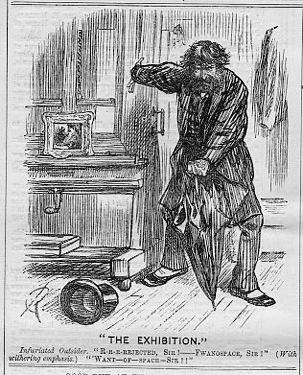
    Well, “outsider” as we  know it today in reference to the arts is definitely not what the editors of Punch magazine pursued in this cartoon for their issue of 6 May 1886.  The “infuriated outsider” was simply an artist left outside a show, whose work was not accepted for exhibition. (And from the looks of it, the small work on the huge easel, being rejected for the “want of space” might not have been the reason for the artist not making the list.)  

    Trenton Doyle Hancock, “AND THE BRANCHES BECAME AS STORM CLOUDS”, 2003, Mixed media on canvas. Photo courtesy James Cohan Gallery, New York and the American Folk Art Museum.

    [Henry Darger]

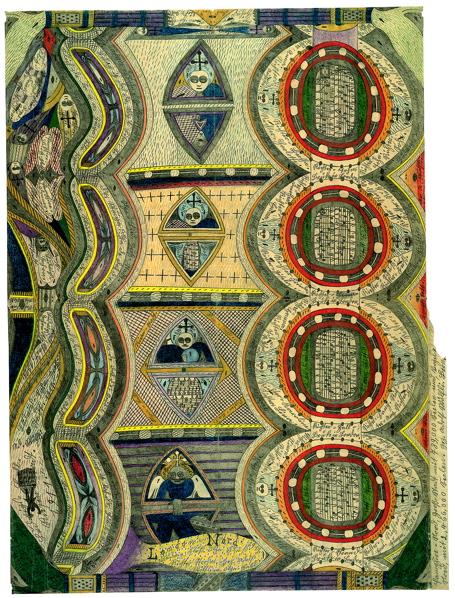
    This outsider was simply outside with probably-not outsider art.  Henry Darger (1892–1973), Martín Ramírez (1895–1963), Paul Gösch (1885–1940), Charles A.A. Dellschau (1830-1923), Willem Van Genk (1927–2005) and so on were Outsiders, their work being Outsider/Art Brut and also being left outside for a long time.  Far outside.  In the far-deep outsider, further and deeper outside than the more aesthete outsider varieties of “outsider” art–like Impressionist, Cubist, Dada, Constructivist, Futurist–ever got outside.  

    [Willem van Genk, detail]

    Anyway, I thought it curious to find the term stuck in the middle of a cartoon rant in an 1886 popular journal.


  • Some Lincoln Ephemera: Audio of the Voice of J.W. Booth, the Last Man to See Lincoln Shot (& on TV), and the Last Man to See Lincoln Dead

    JF Ptak Science Books  Quick Post  

    What did the voice of John Wilkes Booth sound like?  There are certainly a  number of testimonies to what his voice was like, but since he died a dozen years before it was possible, really, to have his voice recorded, nothing exists for us to listen to of him.  One could though stretch credulity a bit and say that he perhaps sounded similar to his brother Edwin–another actor–and there are recordings of him speaking.  So, by long extension, this may be what John Wilkes sounded like. 

    Edwin Booth:

    Somewhat related is this, a 1956 appearance on the television program “I’ve Got a Secret” by Mr. Samuel J. Seymour, who’s secret was that he was a witness to John Wilkes Booth assassination of Abraham Lincoln.  He was five years old at the time and his abiding memory was being concerned for the man who fell onto the stage from the balcony. Seymour evidently died two months later from complications of a fall he took while traveling to appear on the show.

    In another vaguely related historical bit, the last person to see Abraham Lincoln did so in 1902.  There had been a number of attempts to steal the body of the president–one of which came very close to completion–and so in the final move of Lincoln’s body to a burglar-proof resting place on 20 September 1902 his coffin was opened.  John Bowlus was there, and he related what he remembered as a nine-year-old boy viewing Lincoln 37 years after his death.

    Bowlus stated:

    “I can see his face as if it were yesterday,” Bowlus recalled. “Even in death he was an awe-inspiring figure.” A boy of 14 at the time, Bowlus said he had stood on tiptoe and gazed, awestruck, on the majestic features of Lincoln, almost too afraid to peer into the glass-topped casket. “The body was almost perfectly preserved,” Bowlus remembered. “The face was darker… he lay with his head and shoulders and tips of his hands visible where they were crossed on his chest.” It was awe-inspiring, almost frightening,” he said. “The beard appeared to have grown longer, but the dignity of the great man could almost be felt through the air-tight casket which had preserved his body,” Bowlus said. –“The Last Man to See Lincoln”, by Lance J. Herdegen, [source].

    I looked for a recording of Robert Todd Lincoln (who died in 1926) but could not find none.

    And just for the sake of it, a list of early recordings of U.S. Presidents:

    ·Posted by :

    ·in:

    — —

  • The Weight of Humanity in Images on Book Covers

    JF Ptak Science Books  Post 1651

    Blogaugust_27_crowds_stand456

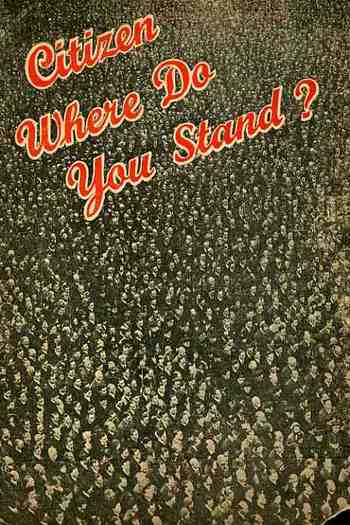
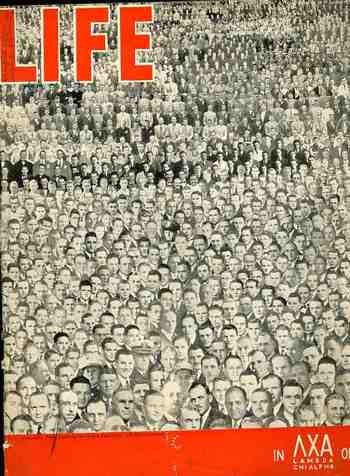
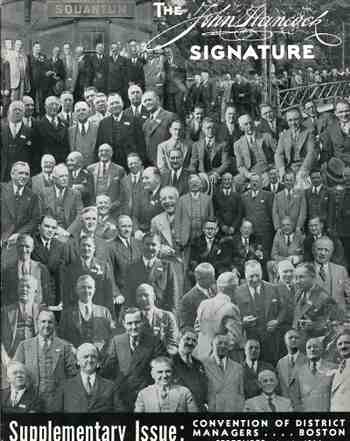
    I don’t often see covers of pamphlets featuring hundreds–or thousands–of people as a part of the design.  In my continuing role as finder and re-finder of things found I have re-surfaced four of these designs, and I feel I should post them before they’re captured in the un-finding process.  Again. Back to the design:  these are very striking, persuasive images, unavoidable in many ways, completely intriguing, beguiling.  People just have to look at these things.  Look:  I made a little experiment today placing ten  very interestingly-designed pamphlets on display, all with compelling and distinct merits, and including one with a big spread of humanity on the cover (the “Life” pamphlet. The very unscientific results is that people were generally first drawn to the complex people image, and stayed longer looking at it–by far–than any other image.  Perhaps its the same sort of reaction going on when you watch people walking in front of a mirror or reflective surface, with the vast majority of folks checking themselves out in it.  Maybe its just people looking for something familiar.  Maybe the faces are simply, strictly more interesting than just points o the page.  I’m not sure. 

    The first image is a one penny Labour Party publication coming from the National Executive Committee of the Labour Party, published in London in 1937; second is Life, the story of the fraternity lamda chi alpha, published around 1935; third, a program for the Liberal Party, published in London in c. 1938; lastly, fourth, a program for some course of semi-statistical study with the John Hancock life insurance company.  These beautiful designs were much more interesting than the very casual contents they covered, at least to me.

    Blogaugust_27_crowds_life459

    Blogaugust_27_crowds_socialist_mil4

    Blogaugust_27_crowds_hancock460