A Daily History of Holes, Dots, Lines, Science, History, Math, Physics, Art, the Unintentional Absurd, Architecture, Maps, Data Visualization, Blank and Missing Things, and so on. |1.6 million words, 7500 images, 4.9 million hits| Press & appearances in The Times, Le Figaro, Mensa, The Economist, The Guardian, Discovery News, Slate, Le Monde, Sci American Blogs, Le Pont, and many other places… 5000+ total posts since 2008.

Category: Perspective

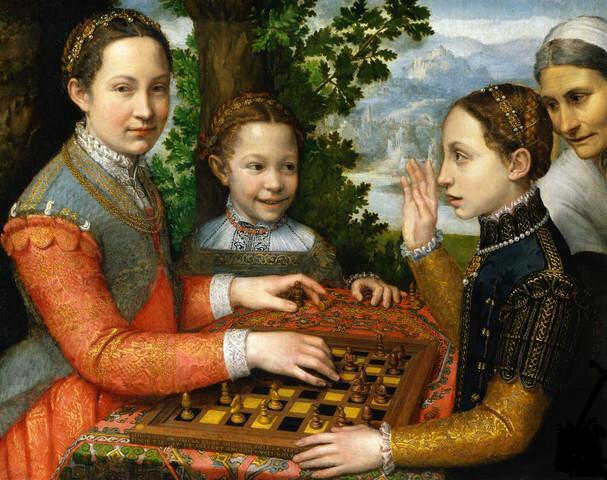
  • Anguissola and her Game of Chess, 1555

    JF Ptak Science Books   Quick Post

    “Anguissola has shown greater application and better grace than any other woman of our age in her endeavors at drawing; she has thus succeeded not only in drawing, coloring and painting from nature, and copying excellently from others, but by herself has created rare and very beautiful paintings.”–G. Vasari

    Chess game
    Sofonisba Anguissola is recognized as one of the leading women painters of the Renaissance, an interesting humanist who succeded in the face of restraint of prejudice.  She had great talent, obviously, and it seems as though that she gave a certain life to happy, common expressions in her subjects.  But what I focused on her in this chess game was how the player on the left got her bishop into the position at H1 with her pawn at G2. And why is the black square at H1?

    Also this:

    In his Libro de Sogni published in 1564, Lomazzo presents this following imagined conversation between Leonardo da Vinci, representative of modern painting, and Phidias, the artist from Antiquity:

    “I bring to your attention the miracles of a Cremonese woman called Sofonisba, who has astonished every prince and wise man in all of Europe by means of her paintings, which are all portraits, so like life they seem to conform to nature itself. Many valiant [professionals] have judged her to have a brush taken from the hand of the divine Titian himself; and now she is deeply appreciated by Philip King of Spain and his wife who lavish the greatest honors on the artist.”–An imaginary conversation between Phidas (representing the deep antiquity of art) and Leonardo da Vinci (as representative of the modern).  As seen in Giovanni Paolo Lomazzo (1534-1594), a busy mannerist painter and author of at least six books, including early and significant art criticism, in his  Libro de Sogni (1564, “The Book of Dreams”.


  • A History of Changing Sides, Part 1: a Half-Fascinating, Wholly-Horrible Biography of a Forgotten Man

    JF Ptak Science Books  Post 1642

    This is the first post in a new series on this blog on “changing sides”–that is, having a new allegiance, Adopting/acting on an something completely out of the mainstream of the personal experience, believing in the opposite of an established belief; to leave something, falling away or rejecting one thing for its opposite or something different, done with integrity or with the abandonment of honesty. 

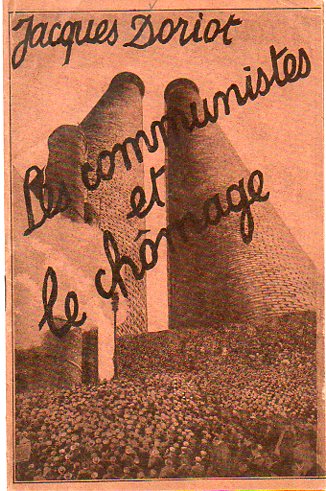
    Doriot953Jacques Doriot.That was the name on the pamphlet that I pulled out of a stack of pamphlets segregated for their cover art.  Les Communistes et le chomage was written by Doriot in the year after he became mayor of St. Denis, an ancient commune just north of Paris, in 1932.  That was years, of course, after Doriot returned home from being a POW of the Germans in WWI and found himself joining the French Communist Party (PCF), a group in which he rapidly succeeded.  HE went to jail for the violent protest of teh French occupation of the Ruhr, emerging into the political arena as mayor of St. Denis.

    At one point he was taken by the Communists, but a bitter debate erupted after which he was expelled from the Party (in 1934).  He abandoned thoughts of the communists and established a new ultra-nationalist Parti Populaire Français (PPF) in 1936.  From there things went downhill, but not yet downhill and on fire. 

    File:Bundesarchiv Bild 101I-141-1258-15, Russland-Mitte, Soldaten der französischen Legion, Fahne.jpg

    Doriot supported the idea of France becoming more like its Facsist neighbors Germany and Italy, and when the war rolled into existence in 1939, Doriot jumped on the foreign Fascist bandwagon.  In France.  He supported the occupation of the Nazi’s French occupation of the north, but when that proved to not be fascist enough for him, he toddled off to Paris where he found a better reception for his pro-Nazi sentiments among the Nazis themselves, what with the Vichy government providing too-soft a version of governance.  His transformation was in full blossom by that time, when in 1941–after having an Ezra Pound-like experience in espousing pro-Nazi beliefs on Radio Paris–he and Marcel Deat went almost all the way into the heart of the Fuhrer, creating the Legion des Volontaires Francais (LVF), which was a French force organized to fight with the Wehrmacht. (The French were hardly alone in this, with something like 350,000 soldiers in the Wehrmacht coming from places outside of Germany.  See the note below for troop strength numbers. 1 )

    Doriot954
    Not surprisngly the LVF was thrown into the Barbarossa meatgrinder, and was decimated, along with millions of German soldiers as well as more millions of Russian citizens and soldiers. (According to a wiki page, the LVF started out at regiment strength of about 2,400 when they went into battle in October 1941; by the spring of 1942, there were only two batallions left, comprising about 600-800 soldiers in total.2.) Doriot survived, and in what must have been the high point of his life, was awarded the Iron Cross in 1943. In coming back west he pursued other pro-Nazi activities, including what looks the support of German agents inside liberated France in 1944, which I think would leave an ordinary person completely vacant and a deranged one full of pride and fortitude.

    Somehow he made it almost to the end of the war, though had he survived it I am sure that he would have been visited with vengeance and retribution.  (It seems that most of the officers were tried and executed while the soldiers were either sent to jail or offered to work off their debt to the nation via service in the Foreign Legion.) Doriot was killed when the car he was driving in was strafed by a fighter plane on Washington’s birthday, 1945. 

    It is quite a remarkable, and horrible, little life that Doriot led, a life that actually has me feeling a little hollow as I write about it–very off-putting and upsetting in a dark, struggling way. 

    ·Posted by :

    ·in:

    — — —

  • Deceptive Perception: Giant Super Women of Pulpdom and High Art

    JF Ptak Science Books   Post 1617

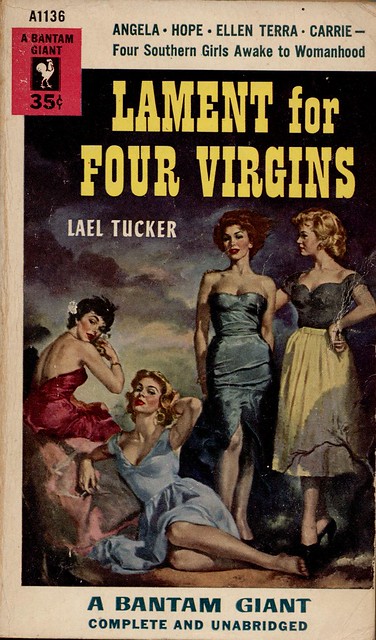
    Sometimes things are just not what they seem to be.  Sometimes they are deceptive and uncommon and somewhat hidden–and sometimes deceptive even to themselves. Sometimes the deception is intentional, and sometimes it is just a mistake, but a deceptive one. In the following cases, the deceptive elements are relating to size–kike the example below, in the cover illustration for the campy (“Southern” with names like those?) troubles of mid-1950’s “girls awakening into womanhood”:

    photo
    If you take a closer look at the reclining figure just abpve the word “giant”, you can see that she is one, unintentionally.  She’s just badly drawn, or something, a victim of foreshortening–we can see that her leg from her knee to her foot is as long as an entire keg of her companions, making this person about eight feet tall.
    On the heels of the eight-foot-tall woman comes one who is far more famous, ultra-famous, really.
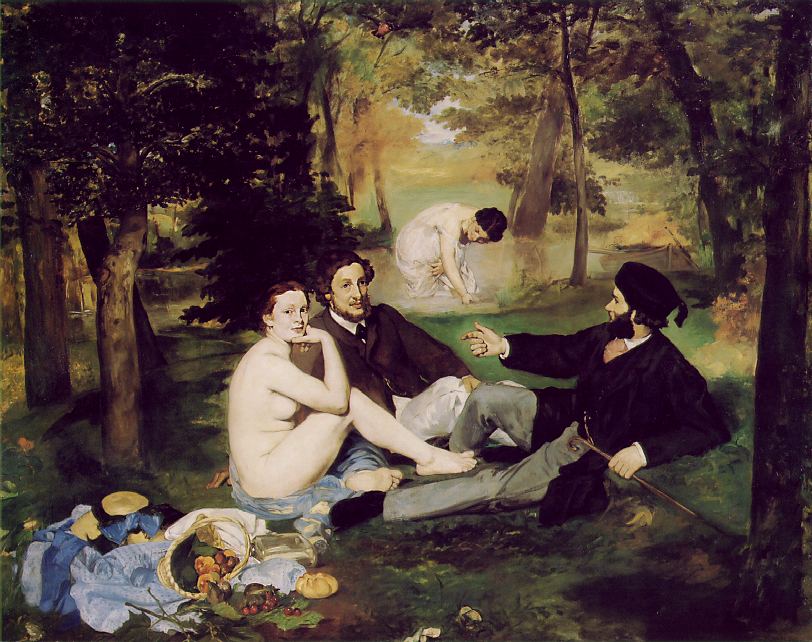
    Le Dejeuner was a scandal when it was exhibited in 1863—Manet painted what he wanted to, unbound by perspective, by color, by composition, and on and on. The folks in the painting were not connected to anything, really, and were unconnected to each other, no one paying any of the others any mind, even when the women were naked.  Nothing seems to be going on—the people are just simply there. 
    Blog--march 7--manet bathers
    This is in itself was a disconnect from previous practices, the vision in painting was about something, and was directed.  Light seems to be coming from a number of different places, and the shadows from the trees reflect this, simultaneously stretched towards and away from the light sources.  The bathing woman in the background, or what used to be background, had she been drawn using proper perspective, would’ve been about nine feet tall.  But what happens here is that there is no foreground or background in this painting, just middle.  It was this collection of abandonments, starting here in the Le Dejeuner in 1863, that ushered in the modern in art. 
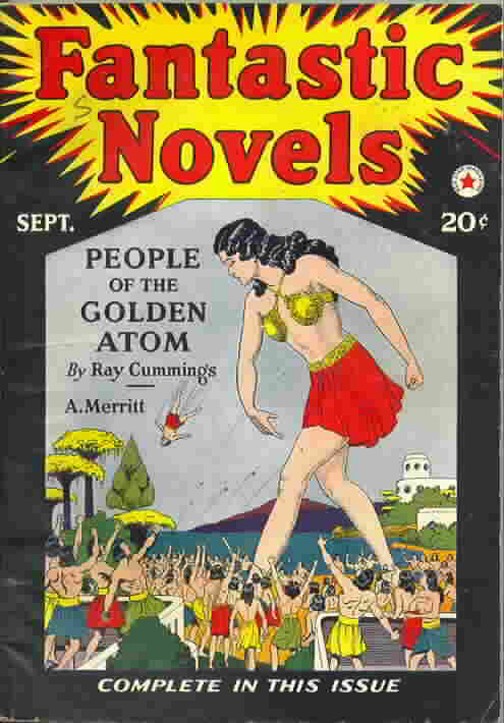
    Then there’s the fifty-foot-tall woman who really isn’t that tall in relation to the people around here. 
    There are times when even things that are made to look extraordinary and plainly, outrageously identifiable as what they are, simply aren’t–and sometimes they’re not even close.  For example, this cover of Fantastic Novels (1921?) seems to tell a straightforward story, but as it turns out the giant is giant but one living within a world in an atom of a gold wedding ring.  (I told a fuller version of the story of thiis here.)  So this giant is a giant but only so in her own world. 
    Man throwing

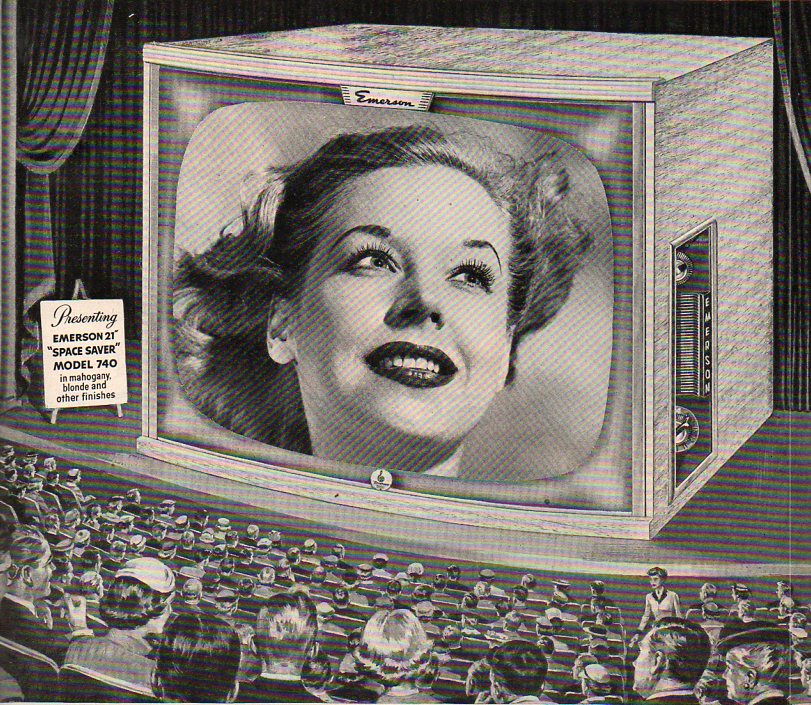
    Rabelais’ Gargantua and Pantagruel, Hobbes’ Leviathan, the Buddha at Yungang (Shanxi) and Melville’s whale were all pushed to their competitive monsterous edges in the 1950’s, when you were more likely to think of The Bomb and creeping Communism before thinking back to any of these great representations.  And it is also my general impression, having been paging through Life magazine for the 1950’s, that there are some other major, lesser heralds of gigantism, especially if you paid attention only to the advertisements. There were 1950’s colossal characters who were pale imitators of their earlier counterparts–the Amazing Colossal Man and Colossal Woman being two minor mirrors of older ideas–but they hardly contained the colossal ideas that were resident in the earlier creations. (Perhaps part of that is due to having just witnessed the demise of two enoromities in Hitler  Stalin.) But this woman seems to be the largest of the lot–I make her to be about 100 feet tall.  There’s really nothing deceptive about her, except of course that this giant is only a head. 

    Monumental television theatre446


  • Did Galileo Know That He Was Galileo?

    JF Ptak Science Books     Post 1610

    Here’s an interesting lead sentence I found in 3QuarksDaily via Salon:

      “Karl Marx did not know what we know: he did not know that he was Karl Marx.”

    The author suggested that Marx would’ve had a better time in his life had he known what influence he wielded in what he was writing–basically, Karl Marx didn’t know that he was KARL MARX.  It is an interesting–and frightening–idea to think of someone laboring like that laboring (as it were) away in relative obscurity, or at least relative to the monumental influence it would come to have.

    The real question is not how many people might be in this category of not knowing who we know them to be, but if everyone is in this category at one point or another, and how long it took for them to understand the lasting significance of their work.  But for right now I’m interested to know what people think of the following ten science personalities, and to answer (in a simple survey), if they knew the significance of their work.

    The survey is simple and fairly straightforward, and asks questions regarding Copernicus, Harvey, Galileo, Einstein, Maxwell, Newton, Turing, Darwin, Lucretius and John Von Neumann. 

    You’ll have a chance to view the survey results at the end.  Thanks!

    Follow this link to the survey.


  • Looking at Things Straight Down: Streets and Sunspots, 1868

    JF Ptak Science Books   Post 1608

    “Vision:  a device that belongs to those who have it. Far-reaching and fore-shortened, it is something that works best when used closely, loosely, finely and not at all. A gift-and-a-half and a half-a-bother.”  
    The imagined Devil’s Dictionary of Not Ambrose Bierce

    Straight down861

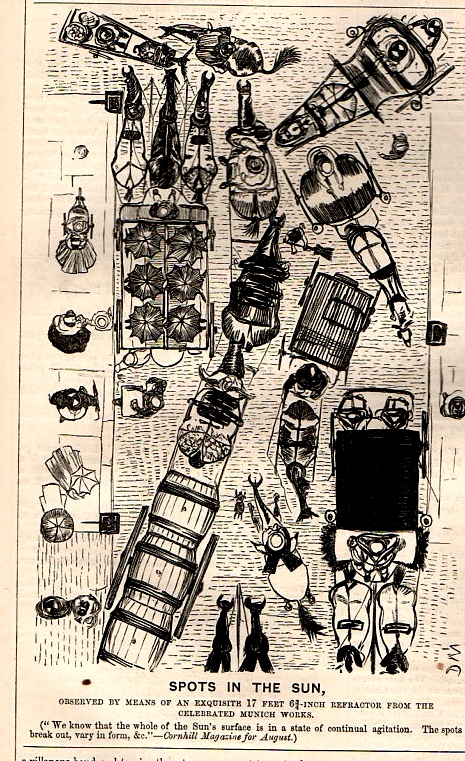
    In the many years that I have been looking at antiquarian prints, I must say that in the hundreds of thousands of them that it is very rare to see an image that looks straight down from a height upon its subject.  And that is exactly what struck me about this print in the 22 August 1868 issue of Punch, or the London Charivari magazine.  Straight down ti is that we’re looking, straight onto a busy city street, presented here as though it were the face of the sun, the hansom cabs and people in the thoroughfare being sunspots.

    [I’ve written earlier here on this and related topics, including:  Rare Antique Visions of Looking Straight Down at Things; Looking Straight Up, Down, Across and Through; Points of View, Outside-Looking-In and Inside-Looking-Out; and Looking Straight DOwn at Things as Found-Dadaist Objects.]

    The sunspot were in the mind of Mr. Punch the very life of the sun, and so too for the bits of humanity filling the streets.

    At first I wasn’t sure that “sunspots” were chosen for this cartoon for any particular part of their history in 1868–that is, if 1868 wasn’t a particularly big year for sunspots.  In general they were certainly known by this point for more than a thousand years, though the greatest recent attention with optical instruments occurred with Thomas Harriot, Johannes & David Fabricus and Christoph Scheiner all around 1610-1612, and then most famously with  Galileo who recorded them in 1612 in his Istoria e Dimostrazioni Intorno Alle Macchie Solari e Loro Accidenti Rome (or History and Demonstrations Concerning Sunspots and their Properties, published 1613).  And closer to this time (among other things) Heinrich Scwabe had published (in 1843) a major advance on the cycle of sunspots.  But as it turns out, though, the word “sunspot” had just entered the language in 1868, according to the Oxford English Dictionary, coming via Sir Norman Lockyer’s Elementary Astronomy (1868), arriving as “sun-spot”.  High delightful!  Punch was really quite on its toes on this one, employing a brand new word for a well-established astronomical phenomena to a rare view of looking straight down at a bustling street, cycles and all.  (Another sort of cycle would soon come to be applied in the next few years in the pages of Nature to sunspots from the brilliant logician (and other things) William Stanley Jevons–this bit of thinking done in trying to correlate sunspots and economic depressions.  This one wouldn’t hold, though it was a very interesting idea.)


  • Man is But a Worm–Darwin and Redon, 1881-1883

    JF Ptak Science Books   Post 1589

    http://cdn2-b.examiner.com/sites/default/files/styles/image_full_width/hash/b2/77/b277d4d3e88c41151d8a3c709696c8c8.jpg

    In the last tow years of his life Charles Darwin enjoyed some critical and popular success  with the publication of his The formation of vegetable mold, through the action of worms,  which was published by the steadfast John Murray in London in October of 1881.  It sold at a better clip even than On the Origin of Species, which had sold very well 22 years earlier.  By the time the cartoon (above) appeared in print by the relatively mid-brow Punch magazine (by Linley Sambourne, 6 December 1881) Darwin’s book sold about 7,000 copies, which for the time would make it a pretty good seller.

    Darwin only had a few months left to live at the time of the Punch publication (12 February 1809 – 19 April 1882), and I’m not too sure about what the old man would’ve felt in seeing it.  Actually, the Old Man wasn’t all that old, but at 73 and with a belly full of worms or whatever and a lifelong list of complaints real and imagined, Darwin was older than jis years.  After everything had been said and doen, and the tons of complaints heaped upon him from all quarters, I suspect that the cartoon would mean nothing to him.

    {Just for the record, we follow the evolution of worm-to-man in a trip one and a quarter times around the clock, starting with a big old (flat?)worm at bottom left, which develops counter-clockwised into a chimp-worm, then into a monkey-thing, then into a sort of comic-relief Darwin-ape-man, winding its course into Charles Darwin himself.  Not flattering to the man or the idea.]

    It would on the other hand be a curious thing to imagine Darwin meeting for a chat with the expansive evocateur Odilon Redon, who created some of the earliest (non-confrontational editorial) art based on Darwin’s Origin.  Redon (April 20, 1840 – July 6, 1916) published eight lithographs based on Darwin’s work in  Les Origine (Paris,  Lemercier and Cie), and they were unlike anything that I’ve ever seen regarding evolution–as a matter of fact (perhaps), Redon’s artwork in general was unlike most anything else that existed.  (Redon acknowledged this, of course, saying  “My drawings inspire, and are not to be defined. They place us, as does music, in the ambiguous realm of the undetermined.”)

    http://www.19thcenturypost.com/The%20Misshapen%20Polyp%20Floated%20on%20the%20Shores,%20a%20Sort%20of%20Smiling%20and%20Hideous%20Cyclops,%20Plate%203%20from%20Les%20Origines,%201883,%20by%20Odilon%20Redon,%20Museum%20of%20Fine%20Arts,%20Boston.jpg

     “The Misshapen Polp Floated on the Shores, a Sort of Smiling and Hideous Cyclops”, plate 3, 1883.

    But I don’t see that much being said between the two men, across a small table having tea–though I don’t have any hesitation saying that Redon would’ve had a lot of questions for Darwin.  My feeling is that Darwin wouldn’t have that many coming back. 


  • Hearing Patterns in Gases, 1894

    JF Ptak Science Books   Post 1530

    I was about to start a new series of posts on the History of Lines , something left out of this blog, oddly, given the different posts on the History of Dots and the History of Holes (and the History of Blank and Empty Things).  A lot of that–the History of Lines business–has to do with the interpretation of things on paper:  heart rate, “brain waves”, the motion of a bumble bee, navigation, and of course, words.  (The great Kickapoo tracker Famous Shoes  in Larry McMurtry’s Streets of Laredo, one of the Lonesome Dove tetralogy, found that the one thing he couldn’t track in this world were the marks on the pages of a book.)

    But I was distracted by the idea of seeing something in a different context, of associating something with a sense experience far beyond its origin, and so the History of Lines will wait just a little–something just a little beyond seeing some electrical function of the brain inscribed as a long line on a skinny piece of paper.  What I found was this–the invention of Mr. E. Hardy, whose “Formenephone” detected the presence of combustible fire-damp or any other gas in mines, and which would then emit sounds on the accompanying (small) organ pipe.  The apparatus would actually vibrate more rapidly as the gas content of the air increased.  At the time (the notice of the invention appearing in the Scientific American Supplement #945 for 10 February 1894) the only other means of detecting these gases was by the change of the glow of a candle. 

    Perhaps this is in a way like the application of musical notes to the numbers pi or tau, though actually useful.

    I’ll return to the History of Lines tomorrow.

    Notes:

    Formene, or marsh gas, is a “hydrocarbon which produces chloroform when the hydrogen in it is replaced with chlorine, loses hydrogen and yields anthracene”.


  • The Heaven of Disappeared Details

    JF Ptak Science Books   Post 1528   Part of this blog’s Blank, Empty & Missing Things series.

    What is the opposite of “the Devil is in the details”, without getting too terribly religious? Expressing detail in the history of art has been a progressive process, and perhaps in some sense that is what art was all about–adding detail, becoming more representational, more life-like, more expressive of the world and nature.   Perhaps that is what one essential element of art was all about for hundreds, or thousands, of years–a progression that marched its way through time with greater effectiveness and representation, for the most part, until relatively recently, when–in the early part of the 20th century–details began to disappear, until in some cases there were no details at all.  Or at least the details that people had been comfortable with for so long, like folds in dresses, or lustre in eyes, or thinness in clouds, or even the correct perspective in the re-invention of three-dimensional representation. 

    http://www.moma.org/collection_images/resized/042/w155h170crop/CRI_211042.jpg

    Detail changed with the  Romantics, and then definitely with the Impressionists, and then on into the the Cubists and the Abstract,  until the detail of what we would recognize as elemental objects would disappear altogether.  Corot, Cezanne, Gauguin, Whistler,  Seurat, Van Gogh, Picasso, Braque, Duchamp.  And then everything goes away with Kandinsky.  1911.  Details of references to the physical world slipping away into general sense impressions.

    It would probably make more sense to look at the Kandinsky at this point–I’d rather look at the Pierre Bonnard (1867-1947) and his La petite blanchisseuse (Roger-Marx 42, also known as the Small Washerwoman).  The wide expanse of her black working gown is a primary link to solid blankness, without detail of nearly any sort, missing parts of reality, allowed to go to Disappeared Detail Heaven.

    Photo

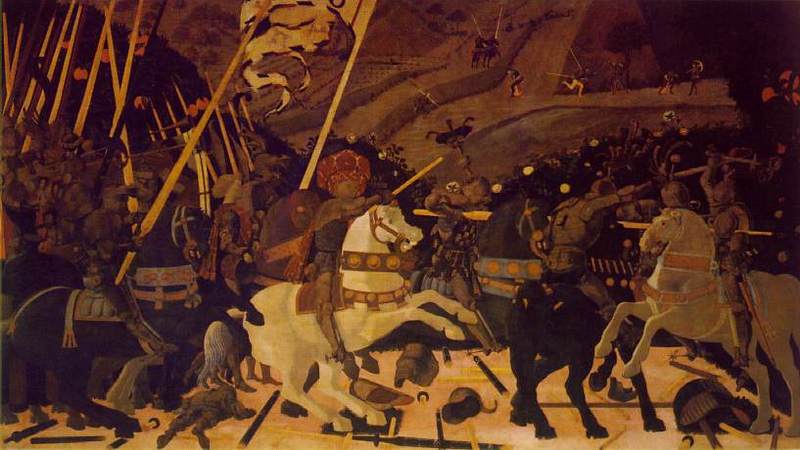
    The occupants of the Heaven was begun centuries ago, though the details banned there on purpose really only begins in earnest with the missing details of the solids in (Paolo)1 Uccello.  This great master (dissed terribly by Bernard Berenson I don’t know why) was one of the very few exceptions of artists who purposefully banned details from his work, just as the reality of the world crept deeper into the works of the late Siennese masters pointing out the details of their rediscovery of perspective. 

    There would be a long period in between Uccello and the other detail disappearers. 

    _____________

    1.  The phrase “the solids in Uccello” comes of course from the Great American Novel, William Gaddis’ The Recognitions, discovered and shared to my by the lovely Patti Digh. In some of his enomrous cnvases it is quite easy to find wide expaneses of nthing where detail should be…


  • Society of Consequences: the Value of Life and the Importance of Horse Manure, 1859

    JF Ptak Science Books    Post 1524

    In the epochal year of 1859 (Darwin’s Origin of Species is published) Philip P. Carpenter (1819-1877) contributed a very interesting article to The Canadian Naturalist and Geologist and the Proceedings of the Natural History Society of Montreal (the full article appearing here).  Among many things, the intriguing title “On the Value of Human Life in Different Parts of Canada” suggests something that might seem a translucent to the modern reader–that in the statistics, somewhere, is a Bell curve that might establish what the “average” person was.  The idea of the “average man”–a statistical impossibility at the time–was important in the sociological application of the statistical work of the early and very influential mathematician Adolphe Quetelet (1796-1874, fl. 1840’s), whose theorizing underneath his numbers was questionable and wincing, but Mr. Carpenter really doesn’t approach this–he has a much more current and applicable idea in mind.  He was interested in the positive and major consequences of relatively minor government investment in the health of the population and the upkeep of the basic infrastructure of a city.

    In collecting his data on birth/death/mortality rates in some major cities in Canada, Mr. Carpenter undertakes a cost-benefit analysis (of sorts) to show how much it would cost to prevent a certain percentage of those deaths, and that a very small investment in maintaining a city’s infrastructure would wind up saving lives and money as a result.  It is an elegant, interesting argument.

    He points to some statistics for the city of Munchen, establishing that the sewering and cleaning of 20 street there reduced the mortality  rate from 31 to 25  per  1000 (“that is, preventing 21 deaths and 588 cases of sickness in seven months”), saving the community the cost of caring for the ill and reducing the amount of time lost in the workplace.

    Basically, Carpenter establishes that adding sewers and just simply cleaning the streets–basic sanitary measures–is an economic benefit to the local community, arguing that “as the cost of sanitary measures is generally the greatest obstacle to their adoption, it may be well to inquire whether their neglect is not still more costly”.  And that it not only made a certain amount of intuitive sense to undertake these measures, Carpenter felt as though he had the numbers (later found to be very problematic) to display how much more “neglect” would cost.  For example:

    A key and simple element to defining health for Canadian cities was horse manure, which those cities seemed to be awash in  Carpenter makes a very simple case for simply using the manure for fertilizer rather than just throwing it into the river, and that the act of cleaning this waste not only was beneficial for the health of the community, but was also had value for cultivation..  This may seem trivial now, but in 1859, evidently, it wasn’t an obvious issue.  Carpenter concludes:

    This was a very satisfying read, and the author made a simple, solid and convincing economic case for “doing the right thing”.  It would turn out later in the 1860’s and 1870’s that Carpenter’s statistical methods were deeeply flawed, leading to him being abandoned by the association that he helped to create–a bitter pill, to be sure, since the overall conclusions about public health were correct, if not the numbers.  After all was said and done, Carpenter was out to save people (particularly the poor), more so than an actuarial table. 

    Notes:

    An interesting table showing the relative health of the cities in the countryside versus, say, the Gotham of Montreal:


  • Shooting Dodos, Square Holes/Round Bits, the non-Future of Movies, and the Race Where Everyone Wins

    JF Science Books   Post 1519

    In a world where everyone wins and no one loses, why can’t we cut a square hole with a round bit.  Or vice versa? Well, we can of course, its all just a matter of perspective.  The image (below) that started this thought thread down the rabbit hole is of a member of Great Britain’s ruling class, Sir William Houghton, appeared in Punch magazine in 1890 as an illustration in a debate over hunting rights for hares and other small critters, in what seems to have been an attempt to further control the access of the wide working class to certain freedoms.  To be honest I  haven’t looked at this debate, and I’m not sure why the liberal Sir William is shooting Dodos as rabbits, but the image–independent of what it was intended to represent–seems to be the inside-out, or the reverse-inside-out of what had been the situation with the bird. It would look “wrong” even if you didn’t know the history of the flightless and basically defenseless creature being hunted to extinction, standing in the place of the rabbit. It has an oddness to it, like a very high-pitched tone that floats above a piece of music, a slightly pungent odor coming from a nicely-executed painting. Perhaps it is the  the sense of expectation being thrown off just a bit with something like the unexpected-expected. 

    And then of course there’s the rabbit hole connection.  And Alice.  And the Dodo.
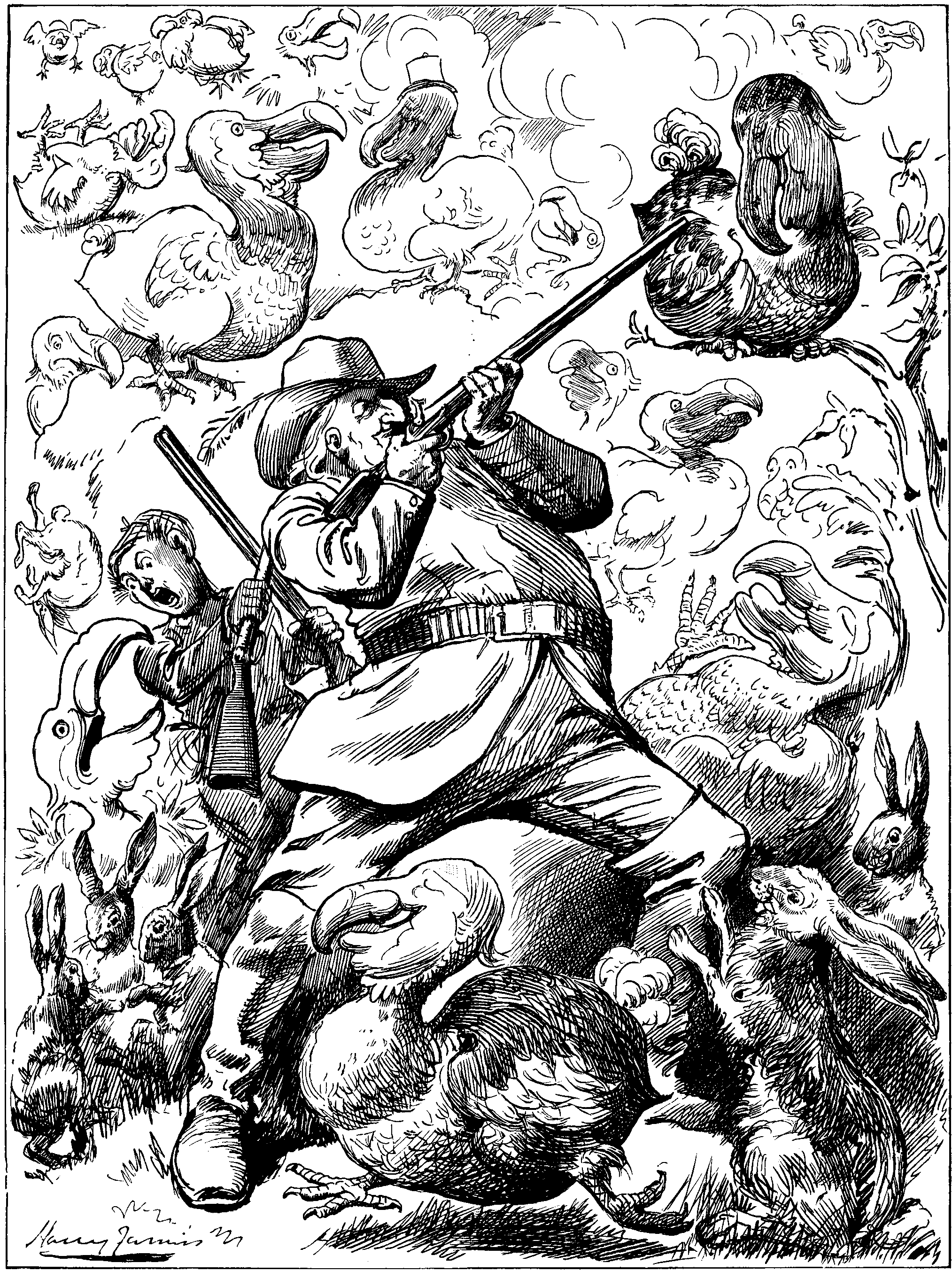

    From Report of Debate on Hares Preservation Bill, June 26.—”They (the other Members of Parliament) could not go out and kill 300 Dodos,”—but evidently he (Sir W.V. HARCOURT) could, and here he is—caught in the act…  [He reminds me of a peeing stallion–one of the most majestic poses a horse can strike]

    Lewis Carroll’s Alice gets right down to business in her adventures in Wonderland, right from chapter one (“Down the Rabbit Hole”), only a few hundred words into the story1–down she goes.  In one very memorable scene (in a book composed of memorable scenes) Alice meets a Dodo bird (which scholars say is a play on the stuttering Carroll’s real name, Dodgson, or Do-do-ogson), and <things happen> after which the Dodo suggests a “Caucus Race”, being a play on the legislative process in which the Dodo-shooting Sir William participated above. 
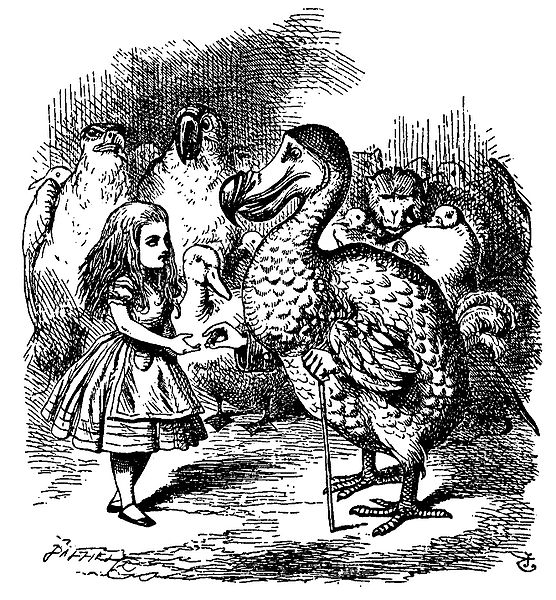
    File:De Alice's Abenteuer im Wunderland Carroll pic 10.jpgThe deal with the Caucus Race was that there was no set course, necessarily, for any one racer–everyone would run their own course as they chose; so in a self-defined course with no competitors and no rules, racing a race that the race liked, it would be hard to lose. Carroll writes:

    “First it marked out a race-course, in a sort of circle, (`the exact shape doesn’t matter,’ it said,) and then all the party were placed along the course, here and there. There was no `One, two, three, and away,’ but they began running when they liked, and left off when they liked, so that it was not easy to know when the race was over. However, when they had been running half an hour or so, and were quite dry again, the Dodo suddenly called out `The race is over!’ and they all crowded round it, panting, and asking, `But who has won?’

    “This question the Dodo could not answer without a great deal of thought, and it sat for a long time with one finger pressed upon its forehead (the position in which you usually see Shakespeare, in the pictures of him), while the rest waited in silence. At last the Dodo said, `EVERYBODY has won, and all must have prizes.”

    The rabbit hole was made by the cylindrically-gifted rabbit, though in Carroll’s world the rabbit could’ve been a square, a cube or cube2-something.  Or of course the rabbit could’ve made a square hole, or square-squared hole, which probably would’ve been more to Carroll’s taste, approaching a very early thought on square2.  But people in the three-dimensional world had been working on making square holes with round bits, though coming  a bit after Carroll’s time, as in this example:

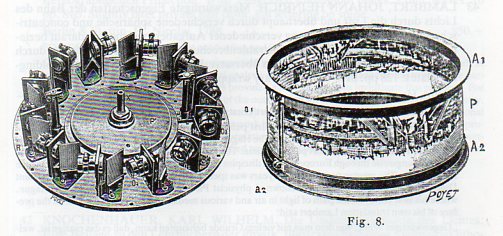
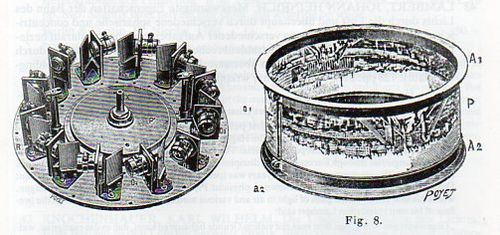
    The device at the bottom of the drill was made to follow and then restrict its cutting motion to that of a square, the device (considerably less wide than the diameter of the bit) cutting and scraping the round hole into a square.  Which in its own way reminds me of a motion picture depicted on a polygon, in a movie theatre for example, which began in a somewhat different way, filmed on a circular surface, or at least in one aspect of it. Auguste and Louis Lumiere began the new mass-medium, illustrated here from their Nouvel Appareil Photographique Panoramique Reversible le Photorama (which was printed in Lyon in 1895/6)
    Lumiere544

    The Lumieres claim for “first” as cinematographers is better understood in terms of the motion pictures being a new mass medium.  Whereas other inventors and experimenters were earlier–like chronophotography devices constructed by  Eadweard Muybridge, Étienne-Jules Marey and Ottomar Anschütz, which all produced forms of moving pictures in the decade prior to the Lumieres, but were decidedly not for public consumption.  The work of these men, as with that of Thomas Edison’s Kinetoscope (1891), was intended for scientific and academic consumption; or with the case for Edison, at least, for the amusement of the wealthy classes, as well as for educating the children of the rich. There were certainly others who worked in this area in the 1890’s, but none really fashioned an interest to their invention for the use of one-and-all as did the Lumieres.

    Which gets us back to our square rabbit hole.  Soon after the Lumiere’s introduced their fabulous new invention, they decided that there was no future whatsoever in the motion picture as a new medium, and abandoned it.  They undoubtedly felt a little bit like the square peg in the round hole of the needs of art, and moved on. 

    ___________

    Notes:

    1. “There was nothing so very remarkable in that; nor did Alice think it so very much out of the way to hear the Rabbit say to itself, `Oh dear! Oh dear! I shall be late!’ (when she thought it over afterwards, it occurred to her that she ought to have wondered at this, but at the time it all seemed quite natural); but when the Rabbit actually took a watch out of its waistcoat- pocket, and looked at it, and then hurried on, Alice started to her feet, for it flashed across her mind that she had never before seen a rabbit with either a waistcoat-pocket, or a watch to take out of it, and burning with curiosity, she ran across the field after it, and fortunately was just in time to see it pop down a large rabbit-hole under the hedge.”–Alice’s Adventures in Wonderland, Lewis Carroll.

    It is highly probable that no artist who ever depicted a Dodo actually saw one.