A Daily History of Holes, Dots, Lines, Science, History, Math, Physics, Art, the Unintentional Absurd, Architecture, Maps, Data Visualization, Blank and Missing Things, and so on. |1.6 million words, 7500 images, 4.9 million hits| Press & appearances in The Times, Le Figaro, Mensa, The Economist, The Guardian, Discovery News, Slate, Le Monde, Sci American Blogs, Le Pont, and many other places… 5000+ total posts since 2008.

Category: Astronomy

  • Seeing Vision: Examples of Light and Sight, Personified

    JF Ptak Science Books LLC  Post 976


    (On seeing the morning’s rising sun): “Looks like light to
    me.” SpongeBob SquarePants


    “All the fifty years of conscious brooding have brought me
    no closer to answer the question, ‘What are light quanta?’ Of course today
    every rascal thinks he knows the answer, but he is deluding himself.”  A. Einstein

    “Are not gross bodies and light convertible into one
    another, and may not bodies receive much of their activity from the particles
    of light which enter into their composition?” I. Newton, Opticks,
    1704, Query 30.

    Mar 12 #51

    Depicting the capacity of sight and nature of light has been
    both an easy and a knotty problem in the history of science. Over the
    successive theories on the basis of light the artistic presentation of the
    phenomenon has been generalized (generally) in a very simple way:  by straight lines.  There’s certainly nothing wrong with that,
    the lines are just parenthetic place-holders suggesting direction, not actual
    descriptors of what light “looks” like.

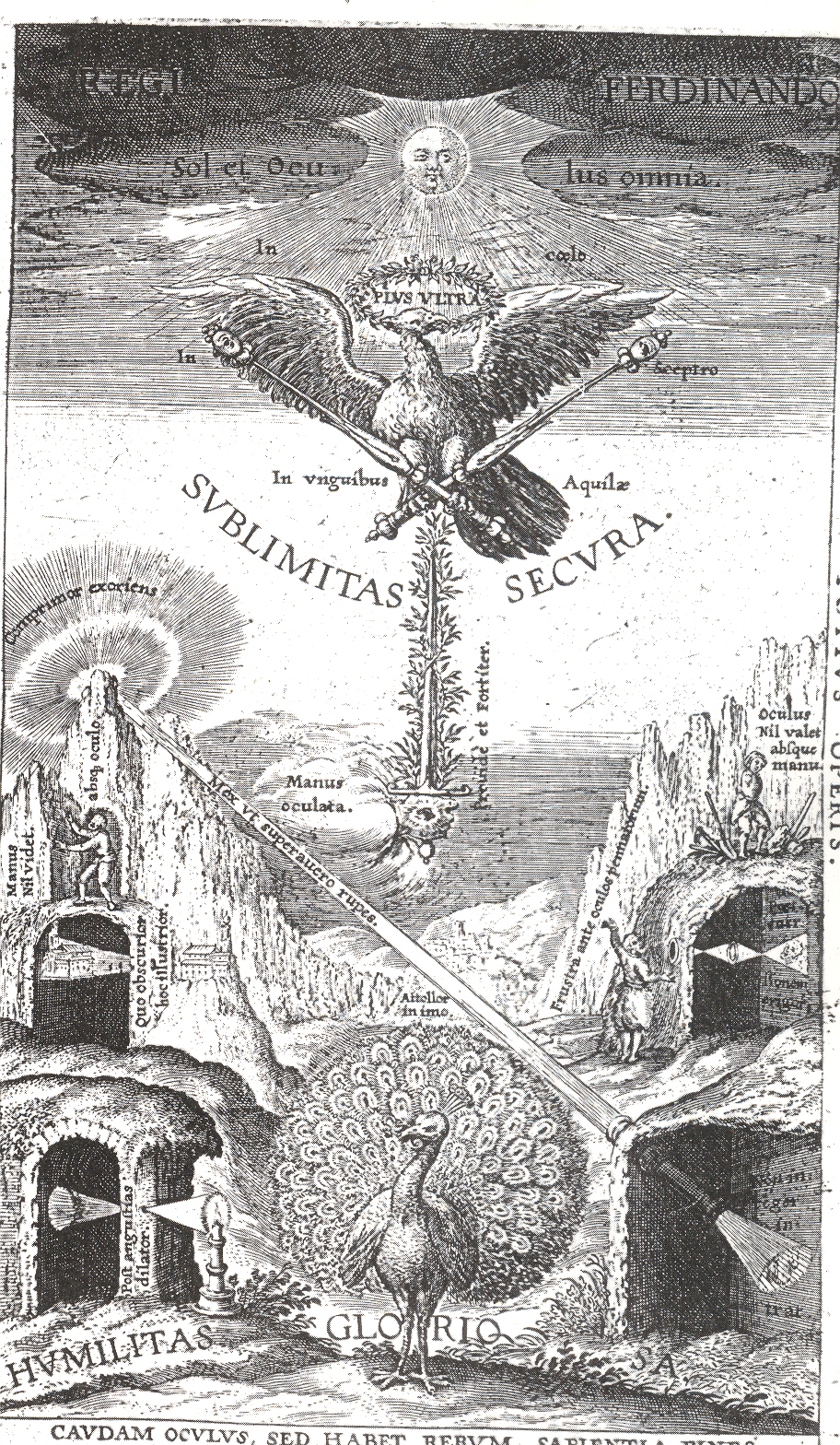
    There are literally hundreds if not thousands of images printed 1550-1850 to call upon to make this point, and I’ve selected but a few.  The first belongs to Jesuit astronomer Christoph Scheiner and which appeared in his  Oculusm hoc est: fundamentum opticum...,printed in Innsbruck in 1619. His work is an out-and-out landmark in the history of optics,  physiological optics and ophthahlmometry, and provided a springboard for two generations following him, not the least of whom was Rene Descartes. The illustration above is the book’s frontispiece, and features four camera obscuras demonstrating four principles of the eye, the middle ground of which is a beam of light 

    Rene Descartes depicted the interpretation (in his  Principles of Philosophy of 1644) of light and its physiological reaction in the brain as follows:
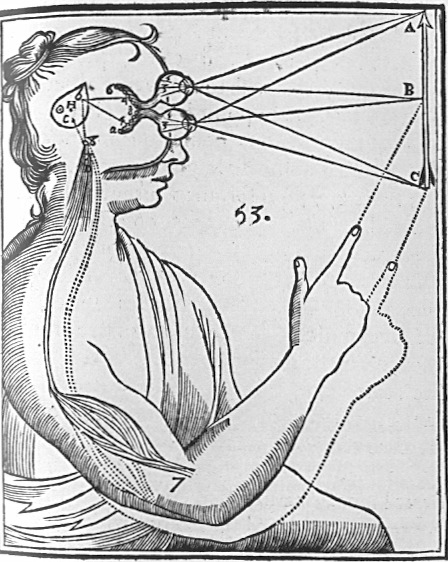
    Cartesian_Vision

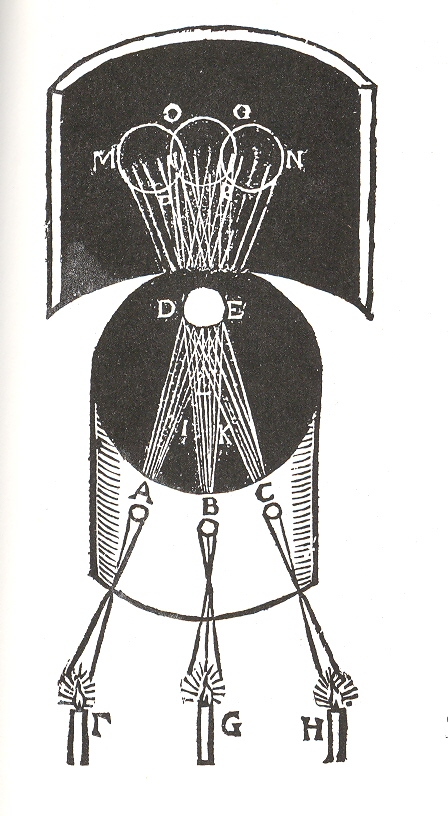
    the lines of sight depicting binocular vision, observed (and compressed) by the eye’s “particles” and processed by the pineal gland which in turn manipulate the “fluids” in the control of nerves and muscles. 

    Another example of even greater fame than the iconic image by Descartes is that of the diagram showing the connection between color and its reflective index by Isaac Newton, appearing in his Opticae of 1706.
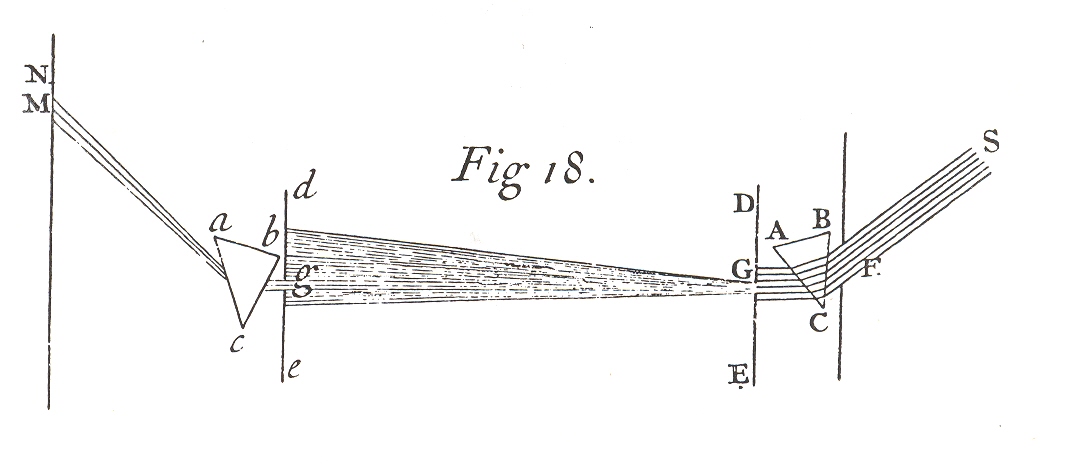
    Mar 12 newton 

    Another fine example comes from Zacharias Traber’s (1611-1679) beautifully illustrated classic of optics (and physiological optics) , Nervus Opticus sive Tractatus Theoricus..., published in Vienna in 1690.  Traber is a great collector and synthesizer of the work done during and before his time, using the work of Descartes, Kepler, Schott, Kircher, Scheiner and Aguilon (for example), and then further implementing their ideas especially in the areas of color theory  and light refraction.  The image certainly reflects Jesuit Traber’s religious training, depicting the holy source of light (originating with the almighty force) which directs it to the sun; the light then is left to the inquisitive and playful hands of cherubs who reflect and magnify it, as well as use it to start a fire (from the condensing lens) and observe it through a telescope. The main cherub empties a sack containing a number of different optical tools, no doubt for the playful brethern beneath. 
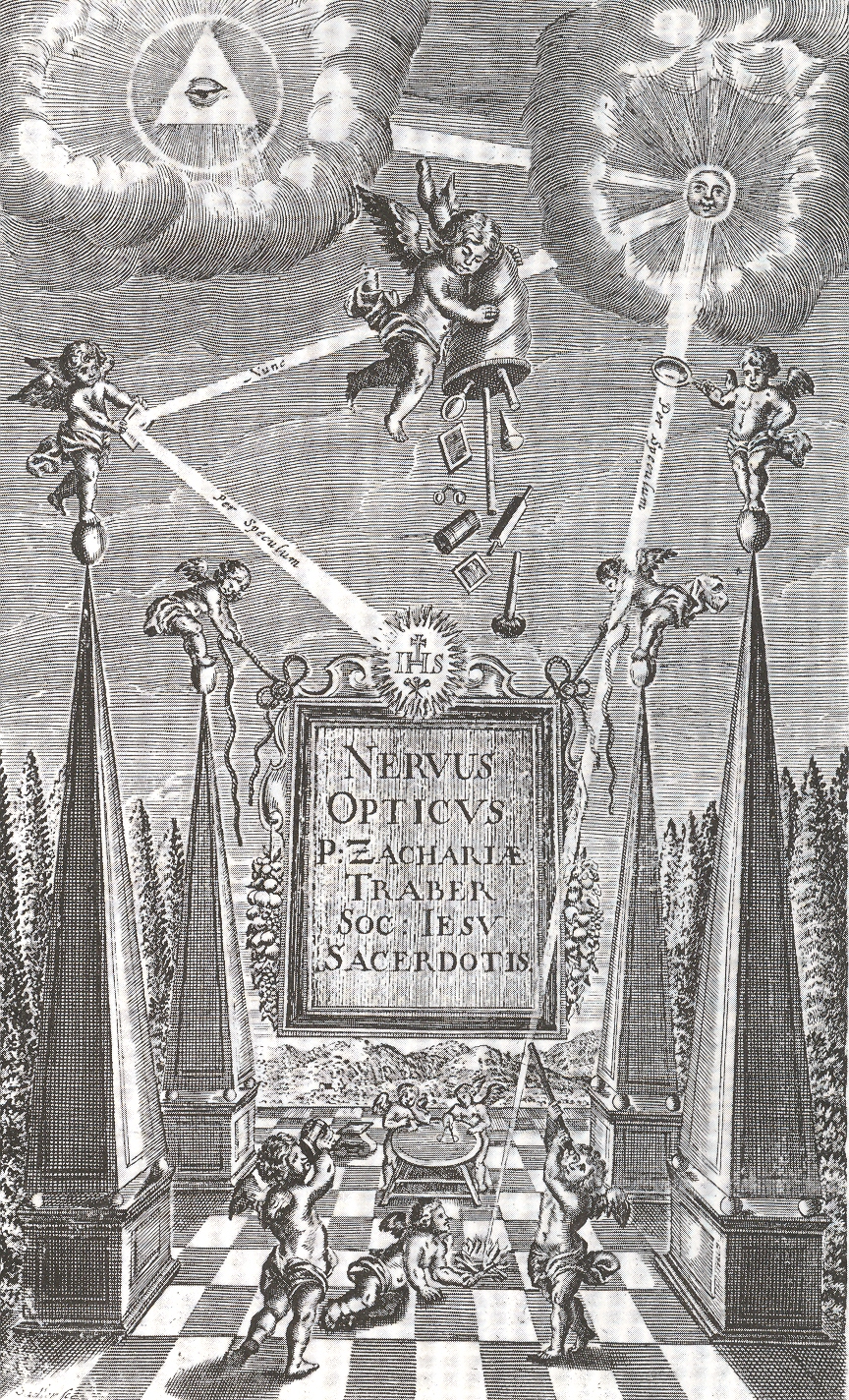
    Mar 12 trauber 

    And then of course there is the great, unstoppable, polymathic and sometimes incorrect Jesuit Athanasius Kircher.  This image appears in his masterwork Ars Magna lucis et umbrae, printed in Amsterdam in 1671, which deals with light and shadow, optical illusions, color, refraction, projection and distortion, sundials, mirrors, as well as astronomical subjects. Most of these subjects are clearly seen in the engraved frontispiece to the work (below), the source of all of the “rays” of light coming from the godhead, relayed through a telescope, reflected from a mirror, and gathered in a camera obscura. 
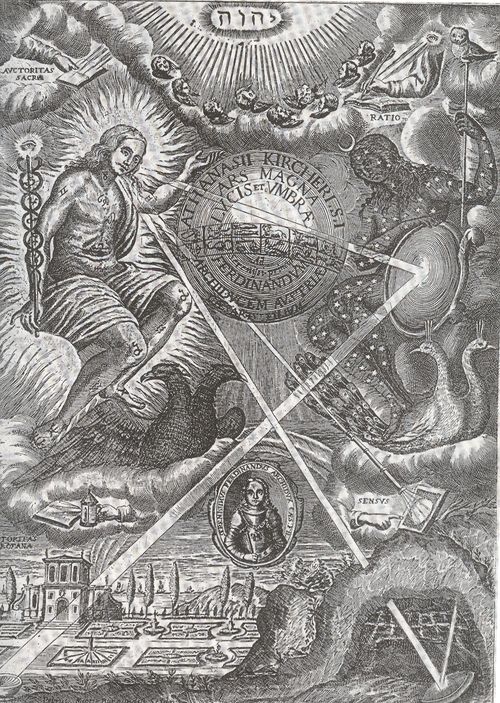
    Mar 12 kirch 

    Other interesting images from the Kircher include this spotlight.
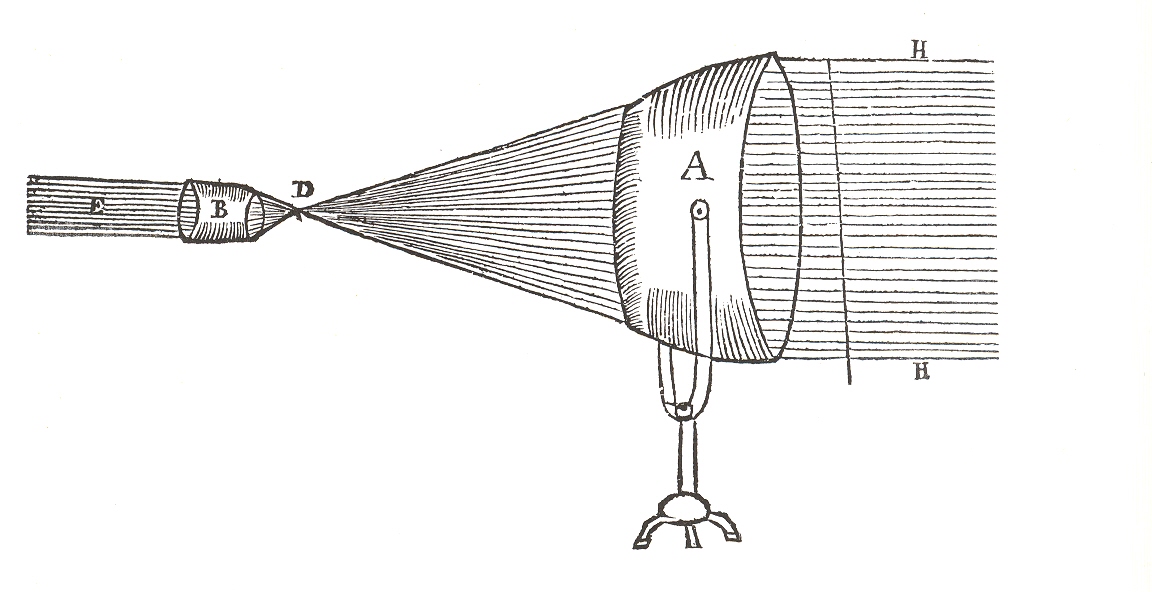
    Mar 12 krirch detail long

    Mar 12 krirch black detail


  • A Note on “Opposite Sameness” in the History of Dots

    JF Ptak Science Books LLC  Post 968 

    Part
    of the History of Dots series that I find so attractive is the dot’s great
    equalizing effect.  The dot has the
    potential of making everyone, everywhere, feel the wonder of mighty
    insignificance—the Earth, for example, depicted from far away, a dot in the
    cosmos, the solar system a dot in the galaxy, the galaxy a dot in the realm of
    galaxies.  And then back again, powering perspective
    back inside us, finding the common thread of humanity again at the cellular level,
    a dot of sameness.

    Mar 8--dot hereschel

    For
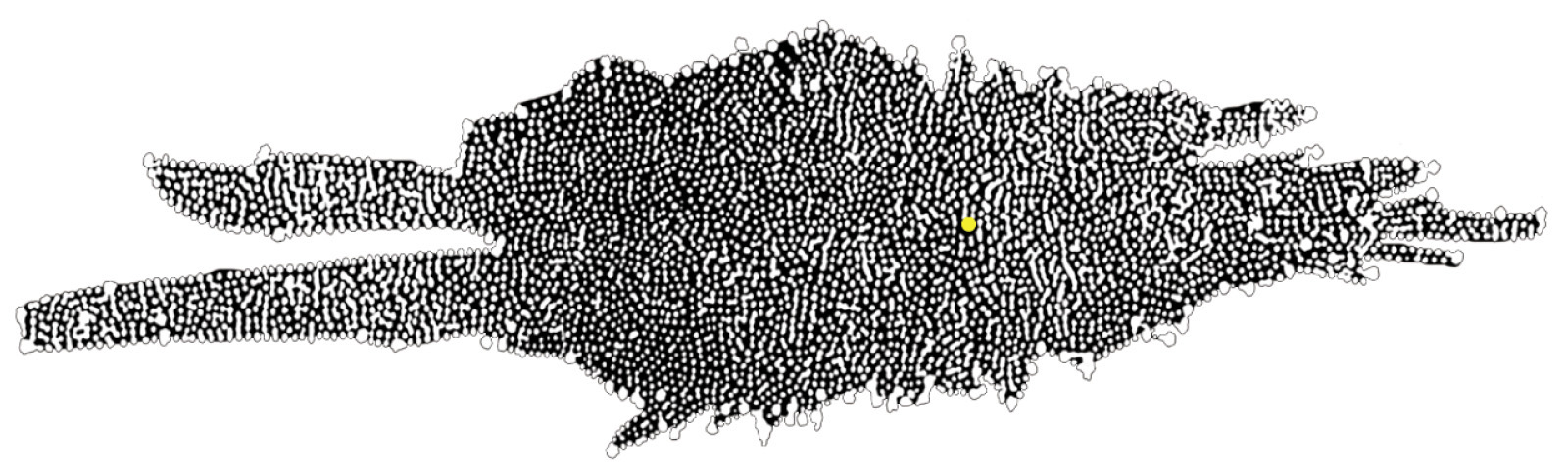
    example, the map drawn by Sir William Herschel must have been a staggering
    thing to see when it was first published in the Philosophical Transactions of the Royal Society in 1785–at least
    by the popular viewer.  The enormity and
    expanse of galaxies was not yet understood, and to see (at this time) our own
    sun relegated to a point of sameness in what he deduced to be a spiral-shaped Milky
    Way Galaxy among many others could well have been an astonishing experience to
    a first-time viewer.

    So
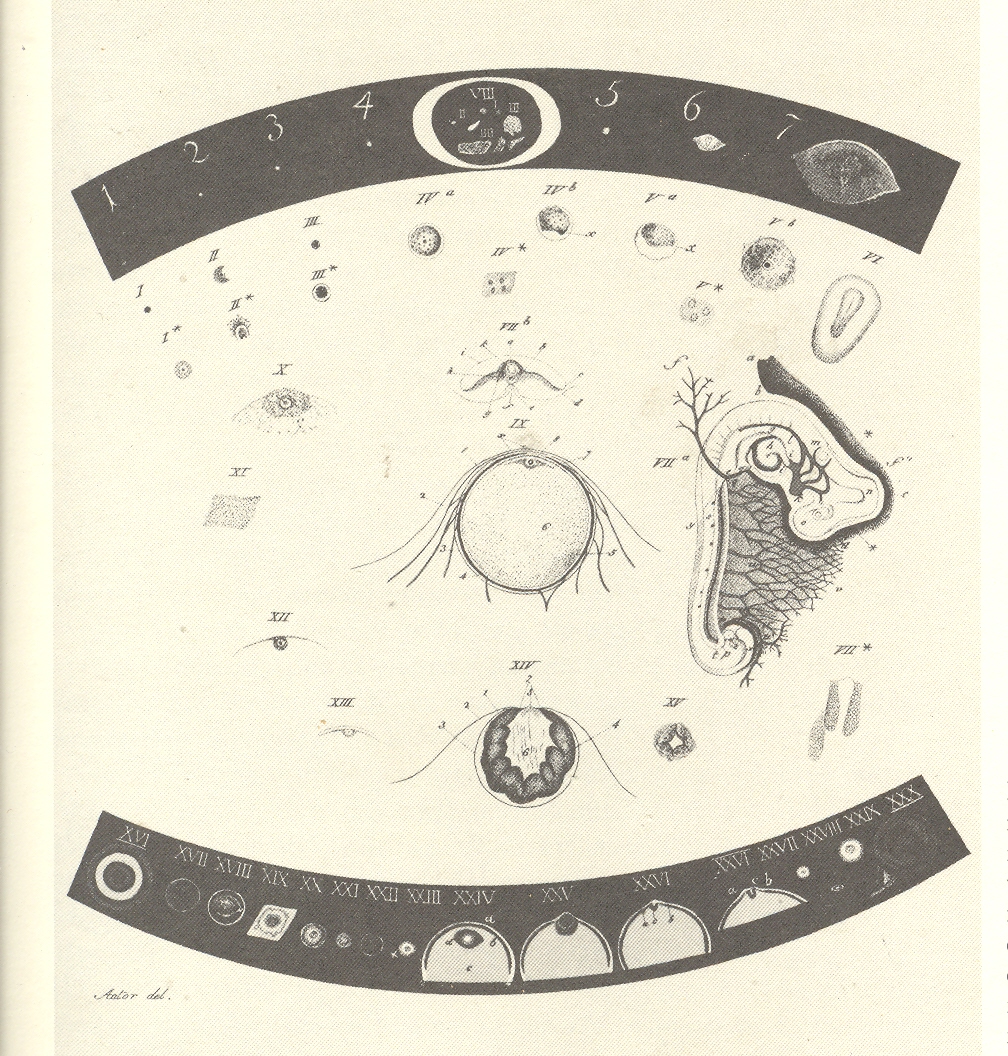
    to for at the other end of the spectrum with the embryological work of Karl
    Ernst von Baer (an Estonian educated in Germany
    who worked in St. Petersburg)
    as it was published in his De ovi
    mammalium et hominis genesi
    (1827). 

    Mar 8--med dots

    His work established beyond all doubt that the reproductive processes
    for all mammals were generally the same—or without fundamental difference—from other
    animals.  And since “mammals” included “man”,
    it came as quite a shock to the popular audience that the basic facets of
    reproduction were little changed between dominant predator and all the other
    stuff. At the professional level Baer’s work was of enormous importance in the development
    of cell theory which would lead to natural selection…and he also established embryology
    as a discipline. 

    And so the substance of dots at opposing ends of measurement, bringing about a similarity of recognition.  Dots.


  • Artistic Nothingness: Cosmic Panspermia, Spermatozoa and Neurons.

    JF Ptak Science Books LLC  Post 964

    In
    the history of life there is a virtual geology of buried ideas of how living
    things came to be.  The belief in
    spontaneous generation is ancient and evidently still holds a comforting sway
    (in a scrubbed-up way) among some moderns. There was a lot written on the
    subject over the centuries: for example, Virgil (Georgics) gives us directions
    on how to make bees, and the great mathematician Cardan/Cardano passed along
    instructions on how fishes are made of water, no doubt drawing on the more
    ancient moisture-related beliefs of Anaximander (600BCE).  Aristotle was more circumspect on the issue
    of

    March 6 sperm

    spontaneous generation, though he did cast a fairly wide and more cautious
    net:  “sometimes animals are formed in putrefying soil, sometimes in
    plants, and sometimes in the fluids of other animals.” Even the beautiful,
    polymathic and occasionally very wrong (but way ahead of his critics) Jesuit Athanasius
    Kircher stated (in his masterwork Mundus
    Subterraneus
    , 1646) that he had seen mice generated out of nothing but
    plants and water.  So it goes. 

    The
    more modern variations on this theme attract a varied collection of some very
    big names. Though the spontaneity now takes place in the extraterrestrial realm,
    with comets and meteors and such impacting with the earth with life debris from
    god knows where (literally), seeding life on earth—though the theories usually
    beg the question of where the stuff on the meteors and etc. came from.  These names include Svante Arrenhius, Lord
    Kelvin, the beautiful Hermann von Helmholtz, Fred Hoyle, and many others.

    Generally
    the more-modern view is attributed with the name of cosmic panspermia (it seems
    to my memory that the first of the most modern life-generating panspermia
    theories is published in the Comptes
    rendus
    in the id 1850’s but I cannot right now remember who it was that
    wrote it).  And it is this cosmic seed
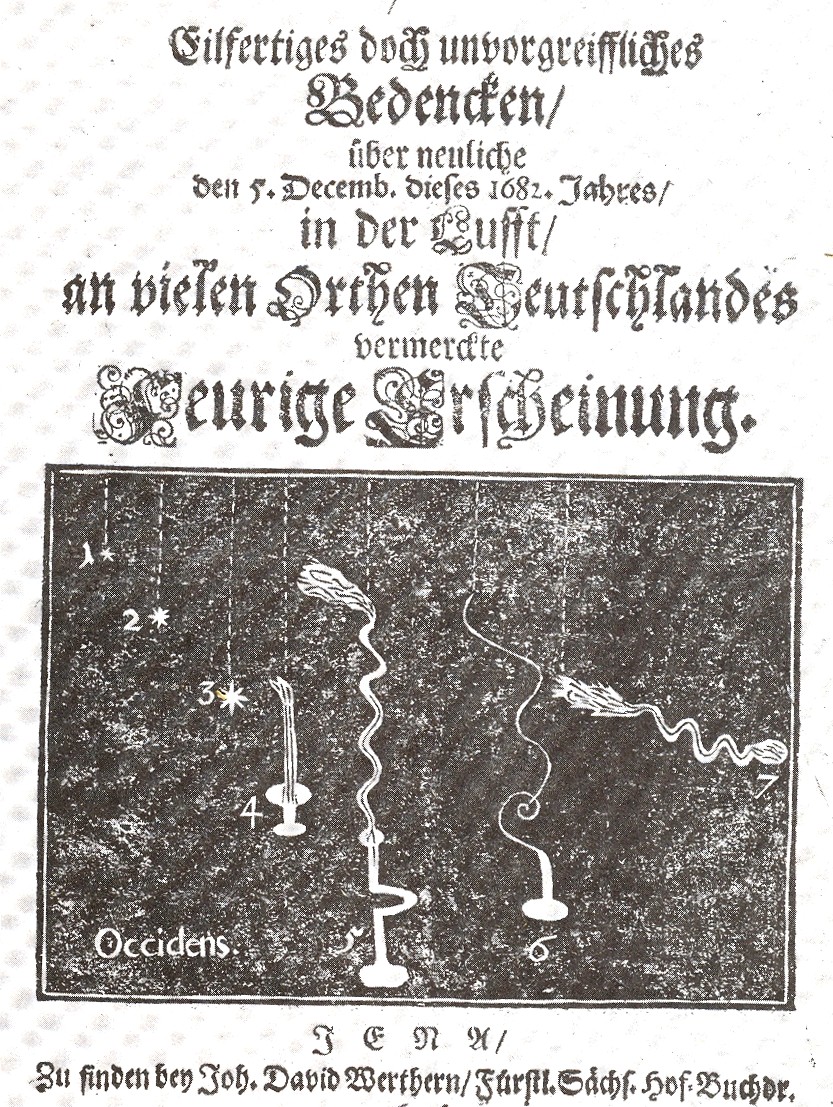
    bit that struck me when I first saw this title page (above) of a very rare work by
    Caspar Posner (1626-1700)—Eilfertiges doch
    unvorggreiffiches Bedencken…
    published in 1682.  It seems that Posner recorded these verities
    of “shooting stars” in Jena
    on the night of 5 December 1682, quickly writing this four-page work describing
    them.

    March 6 sperm leeuw

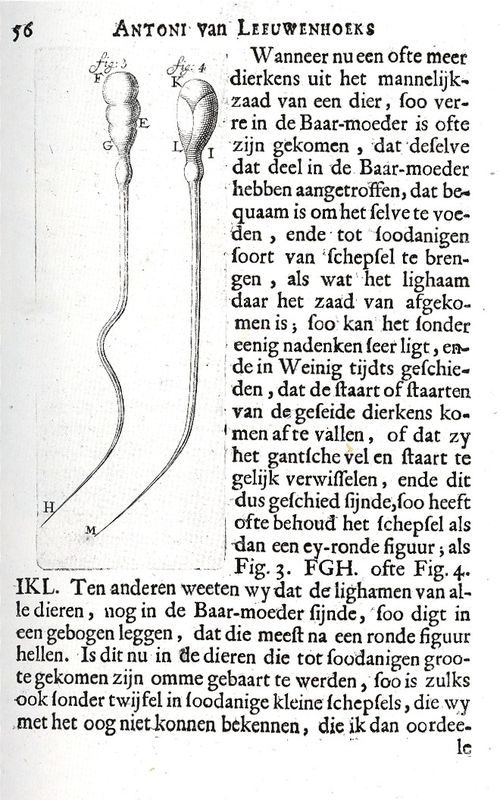
    The
    images reminded me instantly of the first spermatozoa images published by Anton
    von Leeuwenhoek (1632-1723)—and actually they were the first images of live and
    dead (left and right, respectively) dog spermatozoa.  He did absolutely superb work, a great
    pioneer working with a hand-held single-lens (barely recognizable as a) 200x
    microscope.

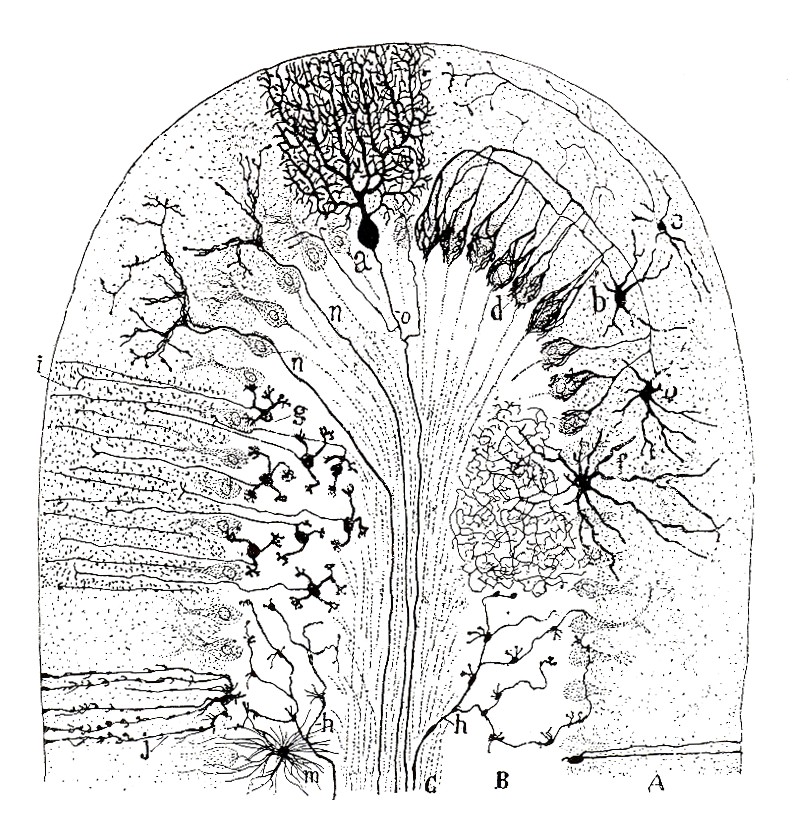
    And
    there too there’s the detail in this image by the great Santiago Ramon y Cajal
    ( 1852-1934), who drew the first accurate picture of nerve cells in the
    cerebellum (found in one convolution of a mammalian cerebellum), which helped
    formulate his theory that the basic structural unit of the nervous system as
    the neuron. 

    March 6 sperm cajal


    Perhaps
    it is a simple artistic fittingness to connect the 1682 meteorite shower with
    cosmic panspermia and Leeuwenhoek and Cajal; in a squinty-eyed way they look
    pretty good together.  On the other hand
    of course these are just random bumped-together thoughts having nothing to do
    with one another.  I vote for artistic
    nothingness.


  • The Church and the Telescope, 1610-1671

    JF Ptak Science Books LLC  Post 865 

    It is fascinating to consider the extent of change that took
    place between the time of Galileo’s first use of the telescope on the sky and
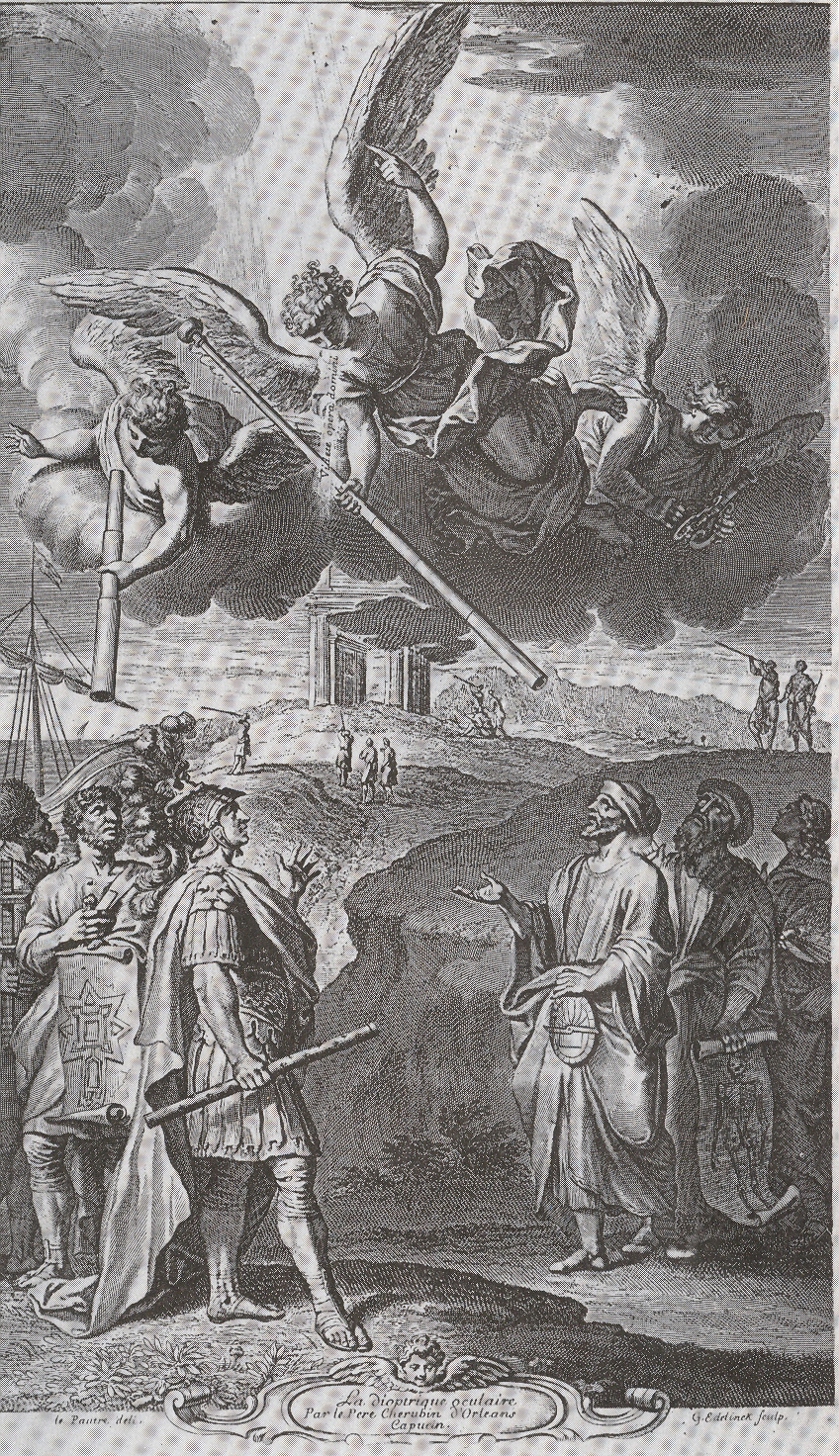
    the publication of this image in Cherubin d’Orleans (Francois Lassere), La dioptrique occulaire1…just 60-odd
    years later in 1671.  When Galileo’s Sidereus Nuncius2 was published in 1610
    he challenged the very foundations of theological belief by changing the face
    of the immutable heavens, saying that not only was the universe changeable, but
    it was much larger than ever thought. It was a stupendous series of
    announcements in the book, many of which caused grief to the Catholic
    Church.  I wrote in an earlier post here:”It
    is difficult today to estimate the impact Galileo’s innovation and the
    subsequent (and immediate) publication of Sidereus had on
    society.  The challenges to long-defined orthodoxy and the bending of
    theological constraints (though the church would have its turn on Galileo
    later); expanding the size and scope of the universe, applying mathematics to
    the study of physics, understanding the physics of motion, developing the
    telescope and the microscope and

    Cherubin other precision physical instruments, are all
    such deeply important changes that it is difficult to resize them in terms of
    21st century advancement.” 
    But it really the challenge, the change, to the perfection of God’s
    universe that upset religious folks the most—Galileo appeared in the interest
    of the Inquisition a number of times before he was finally placed under house
    arrest by it in 1633 (basically for some of his views regarding his very strong
    and elegant defense of Copernicanism in his 1632 Dialogue Concerning the Two
    Chief World Systems3)
    where he
    remained until his death in 1642.

    And when we come to Cherubin’s work, which shows the gift of
    the telescope alighting from heaven, a gift from the supreme being, it seems
    that this warfare between the Church and the early astronomers and Copernicans
    had been changed.  In many ways, I had
    not, but enough certainly changed under the enormous advances in theory and
    instrumentation–in that time, from Galileo in 1610, there was extraordinary
    improvement and innovation in the development of the telescope and optical
    theory.  (In fact, the telescope used by
    Galileo would soon be abandoned, replaced by more superior designs, the
    elements of which are still in use today.)

    The advances in the
    decades following Sidereus were enormous. The highlights briefly
    put:  Johannes Kepler came first in 1611
    with his Dioptrice, followed quickly by Niccolo Zucchi’s reflecting
    telescope of 1615.  Bonnaventura
    Cavalieri’s Specchio Ustoria was published in the same year as the Dialogo
    (1632), with Martin Mersenne’s Harmonie Universelle in 1636, Rene
    Descartes in 1637 and Anton Schyrle in 1644. Several major inventions cascaded
    after this: Christian Huygens invented the compound eyepiece in 1650, James
    Gregory perfected the Gregorian telescope in 1663, Newton made his reflector in
    1667, the great Laurent Cassegrain created his telescope in 1672, and then the
    longtime Royal Society captain and royal pain in Newton’s ____, Robert Hooke,
    created the clock-driven equatorial mount in 1673.  Many of these men were priests (and monks—and
    as a matter of fact the first telescopes that were delivered to North America,
    India and Japan were done so by priests) and so it came to pass that the Church
    provided the foundation which made many of these advances possible. 

    Even so it strikes
    me as just a little odd that these telescopes coming from heavenly hands and distributed
    to the near and far, that this instrument which so threatened the church just a
    few decades earlier,  would be seen so
    relatively soon as a gift from god.

    Notes:

    1.   The title in
    full:  La dioptrique oculaire ou, La theorique, la positive, et la mechanique,
    de l’oculaire dioptrique en toutes ses especes
     The entire work is located HERE.  http://echo.mpiwg-berlin.mpg.de/ECHOdocuView/ECHOzogiLib?mode=imagepath&url=/mpiwg/online/permanent/library/EH2Z7P3M/pageimgIn
    this vast work on optical theory and instrumentation Cherubin also describes
    the first screw mount microscope. 

    2.  The translation of
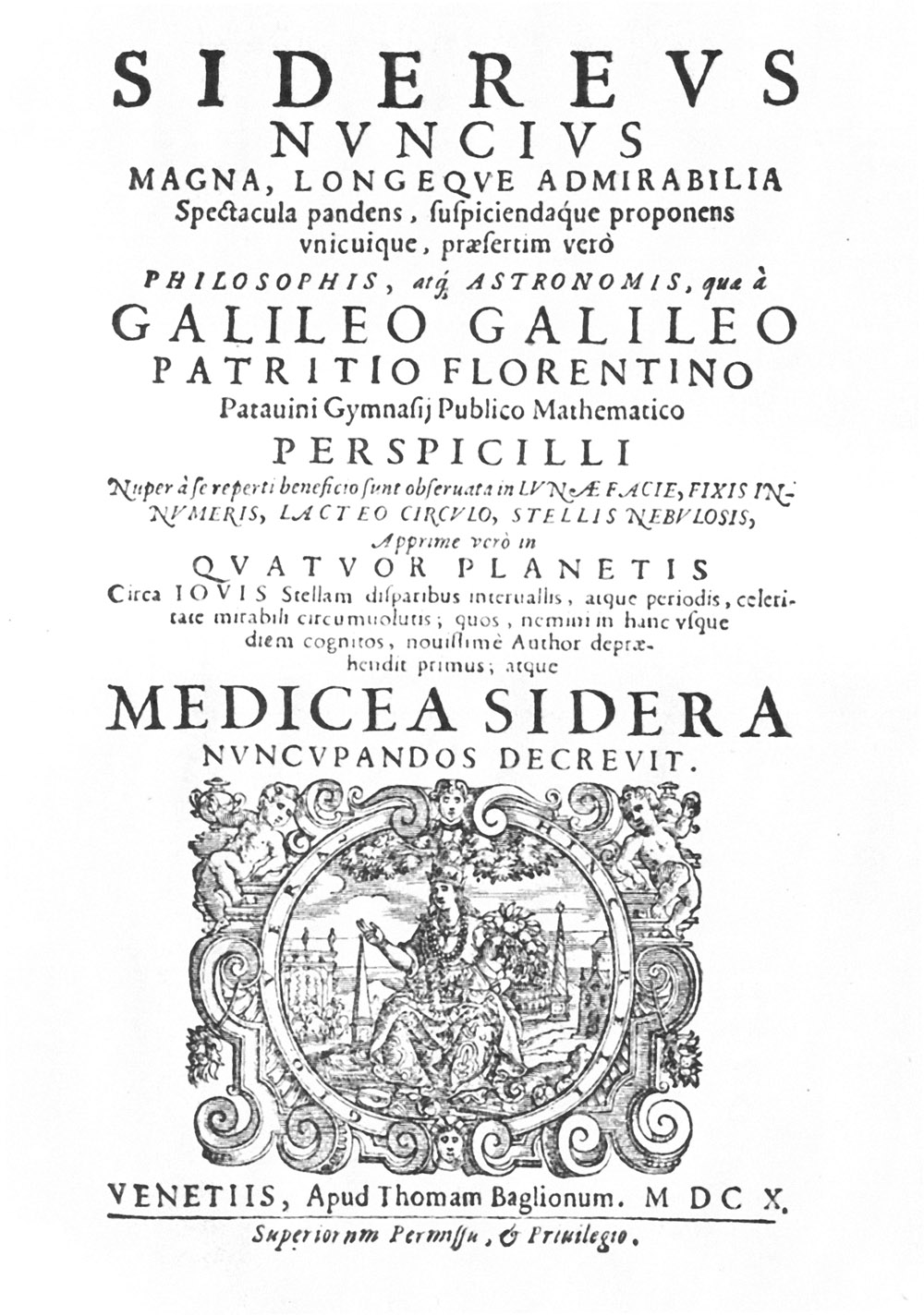
    the rest of the magnificently- and unusually-clearly-worded  title page continues as follows:  “…great and very wonderful spectacles, and
    offering them to the consideration of every one, but especially of philosophers
    and astronomers; which have been observed by Galileo Galilei … by the
    assistance of a perspective glass lately invented by him; namely, in the face
    of the moon, in innumerable fixed stars in the milky-way, in nebulous stars,
    but especially in four planets which revolve round Jupiter at different
    intervals and periods with a wonderful celerity.”

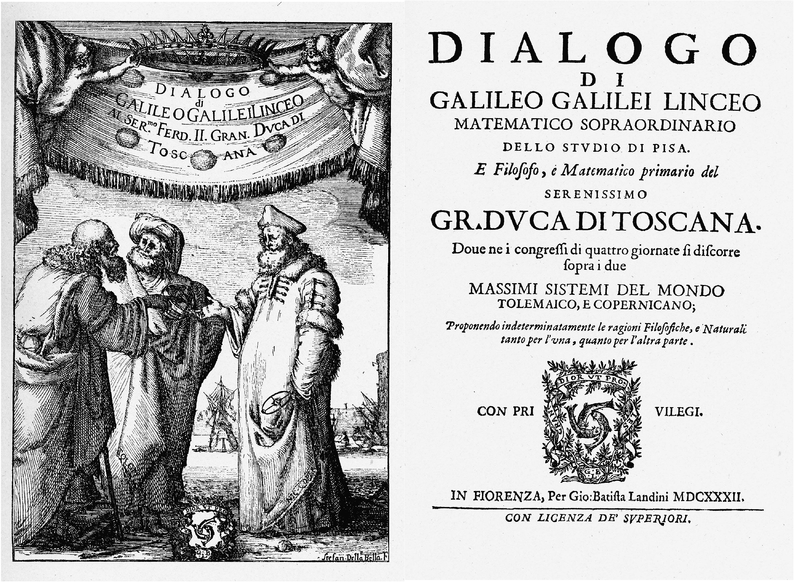
     Galielo dialogo

    3. The full title: Dialogue Concerning the Two Chief World Systems (Dialogo
    sopra i due massimi sistemi del
    mondo
    ), in which the Copernican and Ptolemaic systems are described and
    compared.  Galileo worked within the Vatican’s matrix necessitating a balanced
    presentation between the different systems, and evidently did so successfully
    (the book becoming  a best seller), but
    its ride on the list of the Vatican’s
    banned (“Prohibited”) books lasted until 1835. 


  • Another Major Wrinkle in God’s Perfect Plan: Lots of Dots

    JF Ptak Science Books LLC  Post 826  Blog Bookstore

    ++ blog nov 8 dits

    This installment of the continuing thread on the  history of dots questions the sublime machinery of the primum mobile in the work of Galileo, particularly in his The Siderreal Messenger (Sidereus nuncius) of 1610.   The reception of this extraordinary work was deep and profound, and the images of the “dots” were of extraordinary importance.

    The perfection
    of the Creator’s plan was being shown to be not-so-perfect in the late Renaissance, a major chink
    showing up in the work of the dead Copernicus in 1543, which showed that the
    Earth was not the center of the great cosmological eye.  In the same year the body was also shown to
    be not so much built in god’s image with its bitter working revealed in one of
    the greatest anatomy books ever written,
    Vesalius’ revolutionary  De Humani Corporis Fabrica . 

    Problematic bits
    started showing up regularly wrapped in scientific proof:  the existence of a vacuum, thought to be
    impossible given the perfection of creation, was shown to exist in 
    Otto von Guericke’s  Experiemnta nova (ut vocantur) Magdeburgica de
    vacuo spatio
    (Amsterdam,
    1672).


     The
    stupendous idea of additions to the night sky, which had been thought to be
    immutable and unchanging, came into being with Tycho Brahe’s 1572 discovery of
    a new star (Nova) in Cassiopeia and added to in 1602 by Kepler’s announcement
    of another new star—both events showing that the night sky was not complete and
    that it was actually changing.

    When you
    consider Galileo and his use of the newly-invented telescope it is usually a little
    far down on the list of accomplishments that his explosion of the night sky is
    considered.  In addition to everything he
    did (
    applying mathematics to the study of physics, understanding
    the physics of motion, developing the telescope and the microscope and other
    precision physical instruments and so on) Galileo pointed the
    not-yet-astronomically-used telescope to the sky and expanded the size of the
    universe by a factor of ten.  It was so
    utterly astonishing an idea I can hardly think how the not-prepared mind of
    1610 would’ve reacted to the idea. 
    Certainly it was not a happy acknowledgment coming from the Holy
    Father, though a simple defense could’ve been that this miracle was divinely
    revealed ,and that it was there all of the time but just unknown to humans, and
    so not threatening the orthodoxy of Christian belief.  But that wasn’t the case, and Galileo would
    soon enough be in trouble with the church and its inquisition in short order.

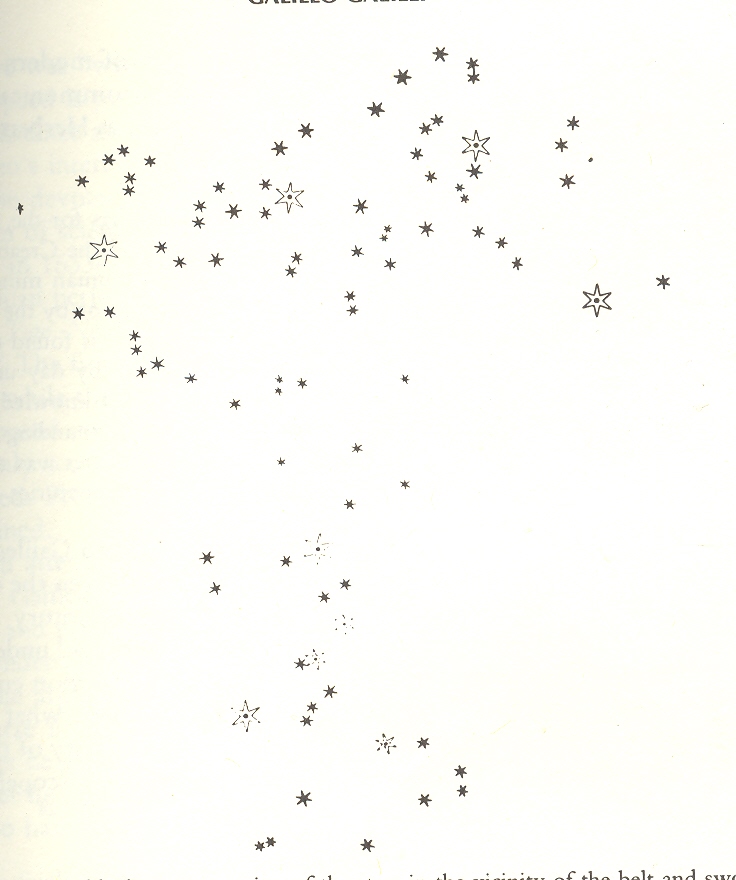
    The dots in this image are the dots of never-before-seen stars, part of an
    unobserved sky that was revealed only under magnification.  The size and scope of the new bigness of the
    universe was staggering, and of course opened the question immediately to the
    possibilities of yet a larger universe revealed under yet more
    magnification.  I don’t know the answer to
    this, and I wonder where Galileo might have publicly mused about how big the
    universe might actually be, and if he ever dreamed about the possibilities of
    telescopes that were 15 feet across rather than just two inches, and what those
    beasts might reveal.

    *I’ve looked at the use of the telescope in the hands of
    Galileo before HERE
    (The Telescope
    in Galileo’s Hands: the Expansion of the Universe, 1610).


  • Gathering Information, 17th Century

    JF Ptak Science Books LLC  Post 825  Blog Bookstore

    This image from
    Michael Lesy’s  wonderful Real Life, Louisville in the Twenties–a collection
    of interesting and naïve found photographs—has taken a life of its own.  It is probably a photo of a hosiery
    department (?) for a large clothing store taken during the great halcyon days
    of advanced hosiery as this is a very serious collection and display with what
    looks like waaay too many clerks to service god knows how many clients all
    buying hosiery at the same time.  Hosiery
    or not, whatever skinny thing it was in those flat boxes looks  as though whatever variety or size was needed
    by whatever verity or sized customer could be accessed in a minute or less,
    sending the customer on their way so that the next one buying unit could be
    serviced and dispensed, and so on into the night. 

    ++ blog nov 7 hosiery

    But I prefer to
    think of the stuff in the boxes as letters, or words, or just plain old
    data:  sat for instance instead of this
    place being a clothing store it was a department store for writing, and this
    was the Poetry Section, selling words by the order, one word at a time.  Or perhaps the boxes held images.  Or entire ideas—just not entire, finished
    works. 

    And why
    wouldn’t data and ideas have been stored and sold like this rather than hosiery
    or handkerchiefs?

    ++ blog Nov 6 Anonymous

    This got me thinking a little about the
    storage and dispensing of information in antiquarian times, about how some of
    the writers of great and high-erudite works were actually able to accomplish
    their efforts. Deep into the early and future-vision-primitive history of
    online digital exploration, it is difficult to imagine producing works of
    sustained viability using combinations of only (private) libraries,  memory palaces1, correspondence and notes.  Today the internet accounts for less than 1%
    of the time of advanced scholarship in all of 
    human history, but it has probably accounted for significant
    contributions to half of all the academic stuff that has ever been written–and
    we’re all probably terribly spoiled by the instant access to info in our
    datacentric existence.  

    My own digital addiction in mind, I marvel at
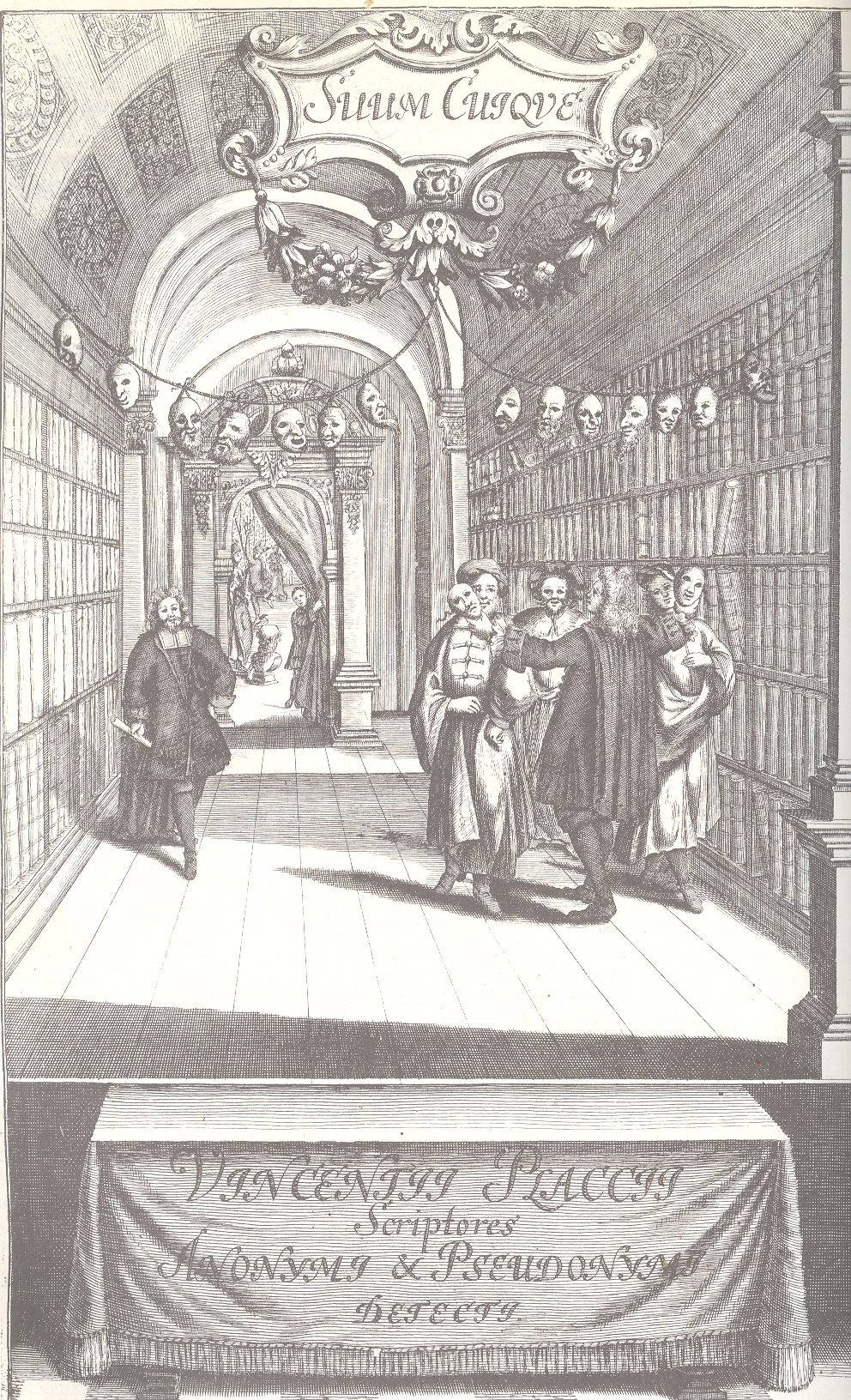
    the accomplishments of people like Vincent Placcius (1642-1699), a vastly
    learned guy who sorted out 2,777 anonymous publications in 1500 pa
    ges, somehow,
    three hundred years ago.  He wrote a
    monumental bibliographical work 


     (Theatrum Anonymorum et Pseudonynorum2) with superb references, and did so with what
    we would today deem relatively nothing.  Placcius
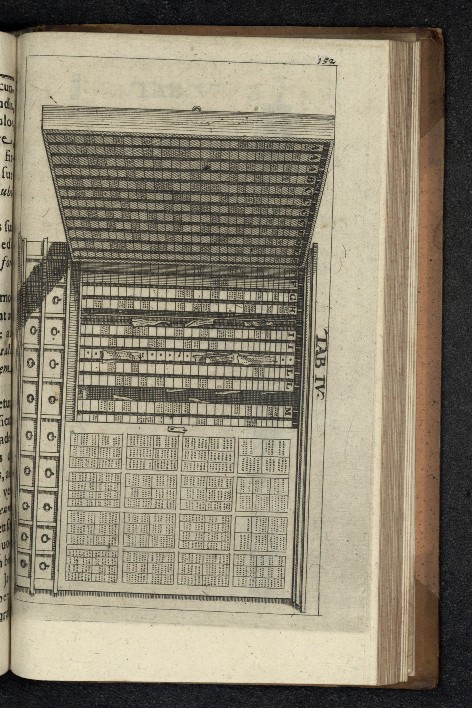
    did have some sort chest-like devices with rods and pins and god knows what
    that functioned in a way I don’t understand as a note-keeping/comparing
    device.  I’ve included images of the
    device (below) in the hope that someone out there might recognize and explain
    it.  In any event, this superb piece of
    scholarship—the first of its kind—had to have taken a lifetime of reading and understanding
    and investigation to reveal.  The
    frontispiece to the book shows the author in 
    a library unmasking two anonymous authors, the masks of other conquests
    linked above him on a chord. 

    ++ blog nov 7 cometarium ++ blog Nov 6 Placcius chest

    Another example in the how-did-they-do-it
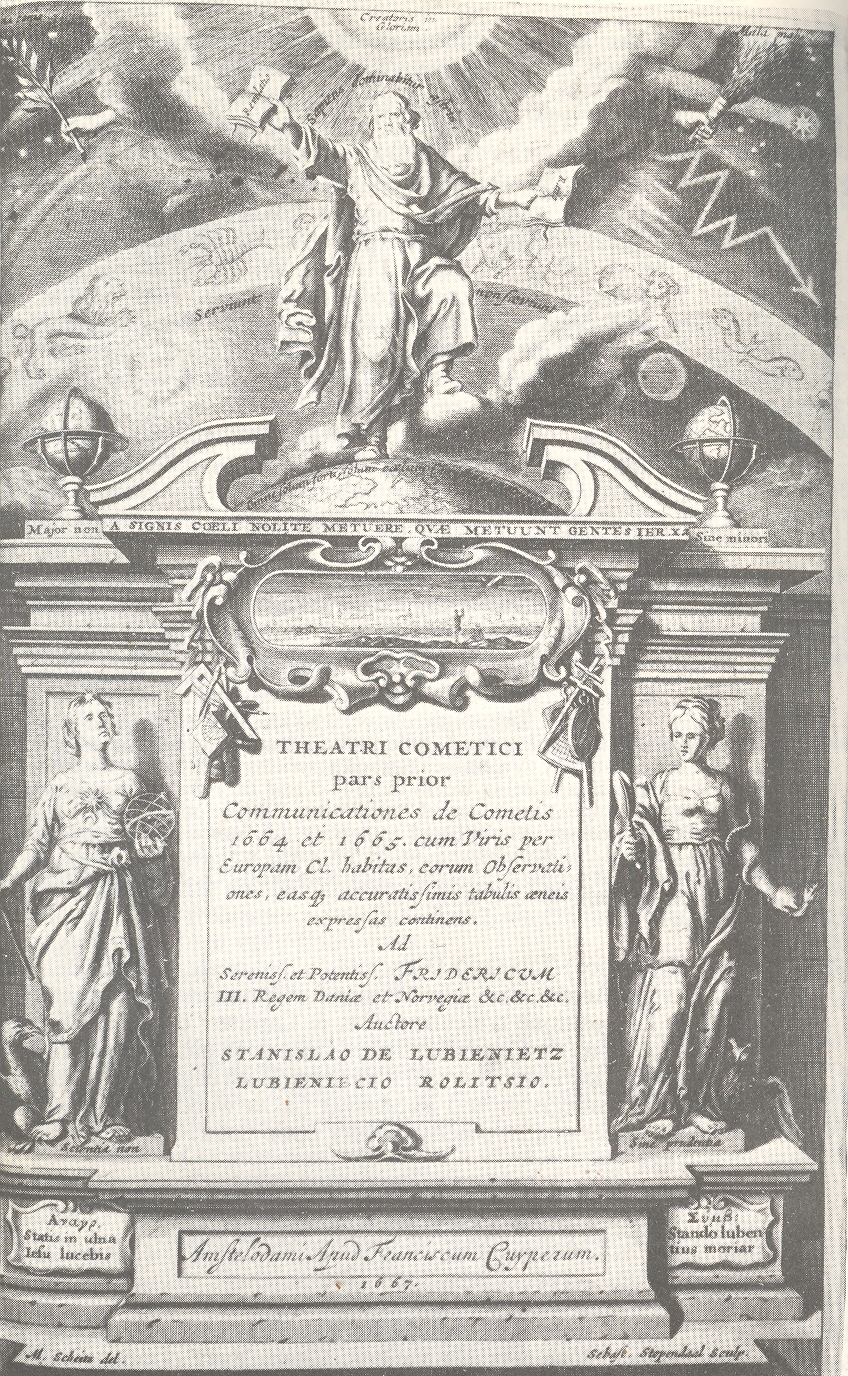
    category is Stanislaus Lubienitzky’s (1623-1675) Theatrum Cometicum…(1667), a powerhouse of data on all things
    cometary.  Lubienitzky recorded all
    manners of observations and reports of all comets ever recorded in extant
    chronicle or published work. Ever.  It is
    a vast and learned work of incredible determination.

    NOTES:

    1. See Frances
    Yates for the great standard on memory devices,
    The
    Art of Memory
    (1966).  And as
    long as we’re at it, her Giordano Bruno and the
    Hermetic Tradition
    (1964) and The Rosicrucian Enlightenment
    (1971) are also terrific works on a very high order. 

    2.  Theatrum Anonymorum et Pseudonynorum2, Ex Symbolis & Collatione
    Virorum Per Europam Doctissimorum Ad Celeberrrimorum, Post Syntagma Dudum
    Editum, Summa Beati Auctoris Cura Reclusum…
    1708


  • Dotting the “i” in Copernicus: Correcting Errors in Epochal Works

    JF Ptak Science Books LLC  Post 831  Blog Bookstore


    There’s nothing quite like writing a revolutionary work than
    correcting one—and correcting a work that actually needed it.  In the world of epochal efforts, that subset
    of work that was needed for substantial re-arrangement and correction of The
    Big Idea is a small one indeed.  In the
    period from 1875-1915 or so, when virtually every discipline in the West
    underwent groundbreaking change, none that I can think of offhand needed
    sweeping revisions, or revisions at all. 
    Granted, you can’t really “correct” Schoenberg or Strindberg or Joyce or
    Kandinsky for mistakes, but you can do that for Roentgen or Einstein or Planck
    or Boltzmann.  But it wasn’t necessary
    for the big thinking in the sciences. 

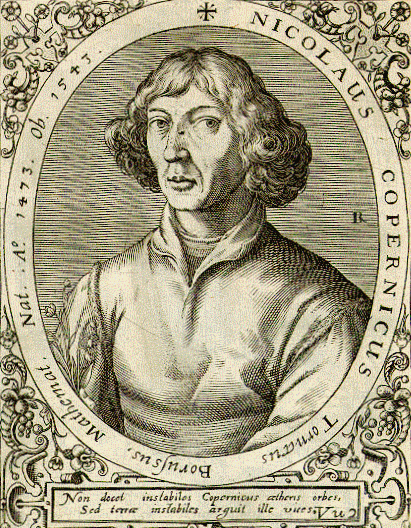
    This is what the today-little-known Erasmus Reinhold (1511-1553)
    knew needed to be done with Copernicus’ De
    Revoultionibus
    (of 1543)—as attested to so somewhat later by Johannes
    Kepler.  As a matter of fact, according
    to the Dictionary of Science Biography1,
    a vast and superb 20-volume keystone repository of necessary information,
    Kepler referred to the necessary corrections as 
    a “huge and disagreeable task”(vol XI, p 366)  but absolutely essential to make the work less
    cumbersome and slow and more handy and, well, useful.

    Copernicus-BoissardReinhold’s book, Prutenicae Tabulae Coelestium Motuum, was speedily done and shows
    the work of master mathematician, appeared in 1551, delayed as it was for a few
    years by war.  It instantly became an
    exceptionally influential book, computationally brilliant and even superior to
    Copernicus, with the Tables2
    replacing those of the master, and which were bettered only by those of
    Kepler’s own Rudolphine Tables3.

    Eramus’ book presented the first astronomical tables based
    on Copernicus’ work, but the work as a whole slipped by the heliocentric
    system, which Erasmus chose to not engage. But he certainly did the necessary
    corrections for De Revolutionibus4,
    further helping  Copernicus slay the
    astronomical monsters of ancient construction.

     
    The Principia is
    another issue…


    Notes:

    1. Owen Gingerich, who wrote the “Erasmus” entry for the DSB, 
    referred to him as the most influential astronomical
    pedagogue of his generation.  Erasmus also published a
    commentary on Georg Peuerbach's Theoricae Novae
    Planetarum
    in 1542 as well as one on the first book of Ptolemy's
    Almagest
    in 1549.

    2.  The Prutenic Tables were named for both
    Copernicus and the man who financed their publication, Erasmus supporter and
    benefactor Duke Albrecht of Prussia
    (whose influence seems to have been initially gained for Erasmus by Philip
    Melanchton).


    3. Johannes Kepler’s Rudolphine Tables(Tabulae Rudolphinae)  were
    published in 1627
    and cosnsited of a star catalog and planetary tables
    based on the extraordinary collection of data and observations of Tycho Brahe.


    4. The entire TRANSLATED work is located here.

    In the preface to De
    revolutionibus
    Copernicus takes on the ancient masters like Ptolemy and
    Aristotle with a steel glove:

     
    “But meanwhile they introduced a good many ideas which
    apparently contradict the first principles of uniform motion. Nor could they
    elicit or deduce from the eccentrics the principal consideration, that is, the
    structure of the universe and the true symmetry of its parts. On the contrary, their experience was just
    like some one taking from various places hands, feet, a head, and other pieces,
    very well depicted, it may be, but not for the representation of a single
    person; since these fragments would not belong to one another at all, a monster
    rather than a man
    would be put together from them. Hence in the process of
    demonstration or “method”, as it is called, those who employed
    eccentrics are found either to have omitted something essential or to have
    admitted something extraneous and wholly irrelevant. This would not have
    happened to them, had they followed sound principles. For if the hypotheses
    assumed by them were not false, everything which follows from their hypotheses
    would be confirmed beyond any doubt. Even though what I am now saying may be
    obscure, it will nevertheless become clearer in the proper place.”


    5. Copernicus also had some pretty strong stuff to say about the great
    early scholar Lactantius:

    “Perhaps there will be babblers who claim to be judges of
    astronomy although completely ignorant of the subject and, badly distorting
    some passage of Scripture to their purpose, will dare to find fault with my
    undertaking and censure it. I disregard them even to the extent of despising their
    criticism as unfounded. For it is not unknown that Lactantius, otherwise an
    illustrious writer but hardly an astronomer, speaks quite childishly about the
    earth’s shape, when he mocks those who declared that the earth has the form of
    a globe. Hence scholars need not be surprised if any such persons will likewise
    ridicule me. Astronomy is written for astronomers.”


    ·Posted by :

    ·in:


  • The Telescope in Galileo’s Hands: the Expansion of the Universe, 1610

    JF Ptak Science Books LLC  Post 672  Blog Bookstore

    It bothers me how
    long people had access to something like a telescope and used it as a toy, or a
    contrivance, or as an insurance tool or a gear in the machine of war before the
    instrument made its ways into Galileo’s mind. 
    There are many rivalries for the term of “inventor” of the telescope,
    with descriptions of undoubtedly very primitive telescopes going back to
    Egyptian and Arabian legend, to Chaucer, to Roger Bacon’s “glasses or
    diaphanous bodies”, to the theoretical accomplishments of Thomas Digges and
    terrestrial interests of Dr. John Dee. These investigations no doubt made their
    influence in the development of the telescope, but seem minor compared to great
    strides made in 1608, when the telescope seemed to be everywhere (at least in
    Germany and Holland and Italy and France) in advanced development.  But particular high distinction goes to Holland, with Jan Lippershey  and James Metius  who
    (was it in 1608?) filed petitions for the exclusive rights to sell their
    instruments for seeing things at a distance. 


    Sidereus

    But still, people
    were still not actually pointing these instruments “up”—and then there was a
    class of aristocrats and well-do-dos who were shown these optical tools as toys
    and pastimes.  But all of this changed monumentally
    when news of the telescope came to Galileo’s attention in May 1609—by August 29
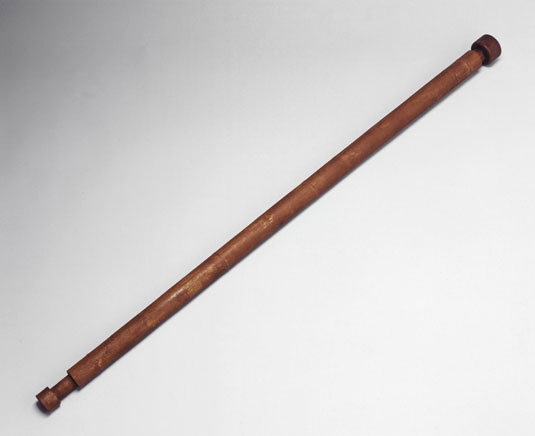
    he had fabricated one of superior quality and effect (three diameters and nine times
    larger), though the first public demonstration was used to spot ships’ sails
    over an horizon that was invisible to the naked eye.  By 1610 he had produced his fifth and most
    powerful telescope, allowing things one thousand times closer, which he
    instantly used and made enormous discoveries of such significance that they are
    hard to understand today in the context of early 17th century
    knowledge.

     With the exception of
    comets and eclipses the sky had remained immutable, a perfect score of the
    creator’s creation, until 1572, when Tycho Brahe noticed something new in Cassiopeia,
    something that was not a comet—a something that was a star. This was momentous
    because the night sky had been seen for centuries as being complete—a new star,
    the Nova of Brahe, contradicted this high belief, offering the possibilities of
    newness where there had not been one previously.  And so too with Kepler’s new star of 1602.


    One of the things
    that Galileo brought to the world was an entirely new sky, revealed to him
    through his telescope—so many stars that he could only guess (though Galleon
    reckoned that there was an order of magnitude more stars than previously known “stars
    in myriads, which had never been seen before….and which surpasses the old,
    previously known, stars by ten times”).


    Galileo's TelescopeAll of this was
    published in his fantastic Sidereus
    Nuncius
    on March 4, 1610—extraordinarily, the very title page1 of the book
    proclaiming some of the great discoveries of Galileo’s adventure.  Of course there was also his investigations
    of the Milky Way and the impossible discovery of four new “planets” (moons) around
    Jupiter, and the disruption of the happy belief in a smooth and luminous
    Moon. 

    It is difficult today to estimate the impact Galileo’s
    innovation and the subsequent (and immediate) publication of Sidereus had on society.  The challenges to long-defined orthodoxy and
    the bending of theological constraints (though the church would have its turn
    on Galileo later); expanding the size and scope of the universe, applying mathematics
    to the study of physics, understanding the physics of motion, developing the
    telescope and the microscope and other precision physical instruments, are all
    such deeply important changes that it is difficult to resize them in terms of
    21st century advancement. 

    1. The title page reads: “great
      and very wonderful spectacles, and offering them to the consideration of
      every one, but especially of philosophers and astronomers; which have been
      observed by Galileo Galilei … by the assistance of a perspective glass
      lately invented by him; namely, in the face of the moon, in innumerable
      fixed stars in the milky-way, in nebulous stars, but especially in four
      planets which revolve round Jupiter at different intervals and periods
      with a wonderful celerity.”

    ·Posted by :

    ·in:


  • Political Majesty at the Interior and Exterior of Creation (1588 & 1680)

    JF Ptak Science Books LLC  Post 742  Blog Bookstore

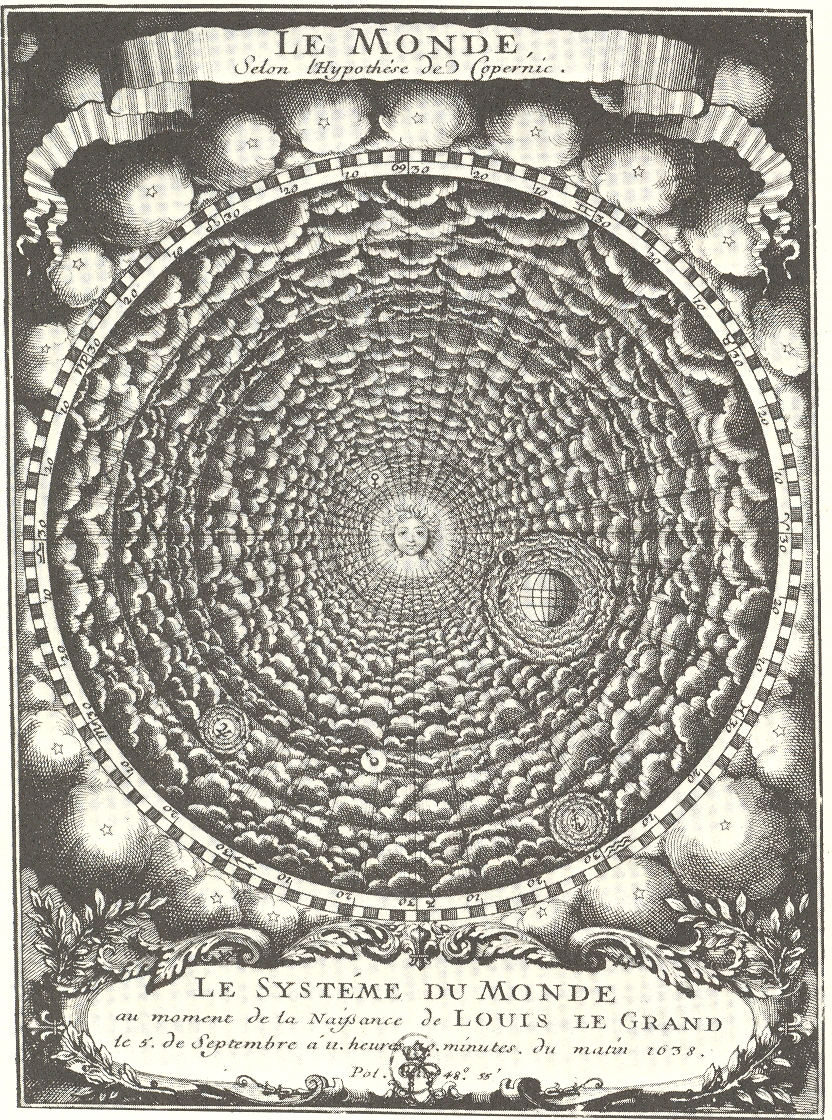
    This engraving Le
    Monde Selon l’Hypthese de Copernic. Le Systeme du Mondeau movement de la
    Naissance de Louis le Grand le 5 de Septembre 11. heures 20 minutes du matin
    1638
    , is a

    +++Louis Grand Universe singular representation of the universe at a singular moment in
    time.  And that moment in time was the
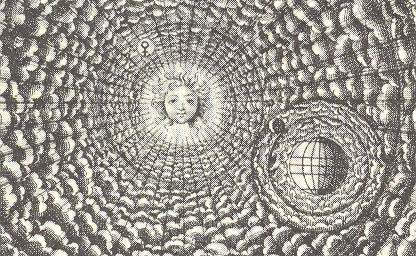
    birth of Louis le Grand, or Louis XIV, the Sun King, pictured at the moment of
    his birth at the center of the Copernican universe. The future (72-year-long
    reign) king smiles benignly at us from the center of the universe.

    +++Louis Grand Universe 2

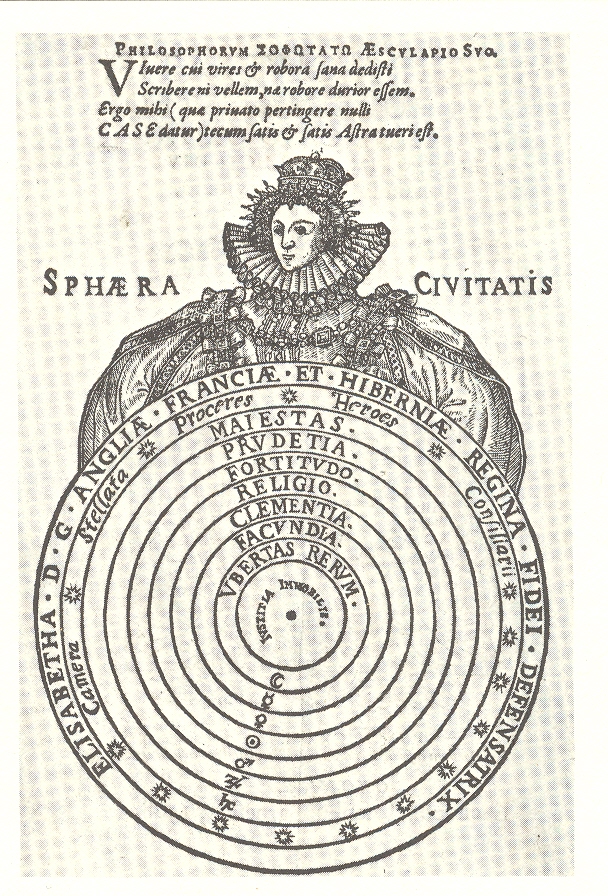
    On the other side of the coin is the all-reaching embrace of
    the deity-like Queen Elizabeth, who cradles the nine successive spheres of the
    universe.  The innermost sphere is
    occupied by the Earth, the center of all things, around which are labeled the
    seven spheres of the planets:  “urbetas
    rerum” (immovable justice) of the Earth, “facundia” (eloquence) of Mercury, “Clementia”
    (clemency) of Venus, “Religio” as the Sun, “Fortitudo” (fortitude) of Mars, “Pridetia”
    (prudence) of Jupiter, and “Majestas” (majesty) of Saturn.  Beyond the sphere of Saturn is that of the
    fixed stars (consisting of the Star Chamber, the nobles, Lords, Counsellors);
    and beyond that, in the last sphere, is Elizabeth.   


    +++Louis Grand Universe 3

    The image appears in John Case’s Sphaera Civitatis  (1588,
    The Sphere of the Commonwealth) who
    writes in his preface “How well civic machinery accords with heaven’s form, and
    how it is distinguished by like figures, our republic, unique, will declare on
    behalf of many. Do you see the stars, wheeling around in their alternating
    course, and Justice, who weighs causes in her balanced pans, the unchangeable
    center of our universe?” [Full text here.]


  • Bubble Cosmology: J.J. Grandville and a Soapy, Watery “Little Bang”, 1844

    JF Ptak Science Books LLC  Post 705  Blog Bookstore

    Finding the Big Bang in a bowl of soapy water.

    ==Blog August 5=primum

    Last year I wrote a little aboutJ.J.Grandville’s interplanetary
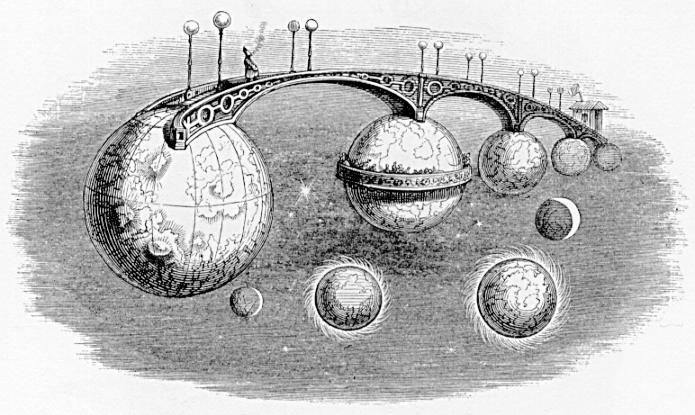
    bridge connecting some of the planets (and including a balcony constructed of Saturn’s
    ring [sic] in an early Victorian Grad Tour solar system walkabout.  Grandville (the pseudonym of Jean Ignace Isidore Gérard,
    born in 1803 and staggering too quickly out of life in 1847) was an extraordinary
    talent working somewhat out and ahead of his time; he had superb visions of the
    future, and of the past, and most of them were fantastic and fanciful, though
    not without some very stinging social commentary.  He has been called a proto-Surrealist and I’d
    have to agree, though for me he had a larger production of social commentary in
    his work than any of the “real” Surrealists of the 20th
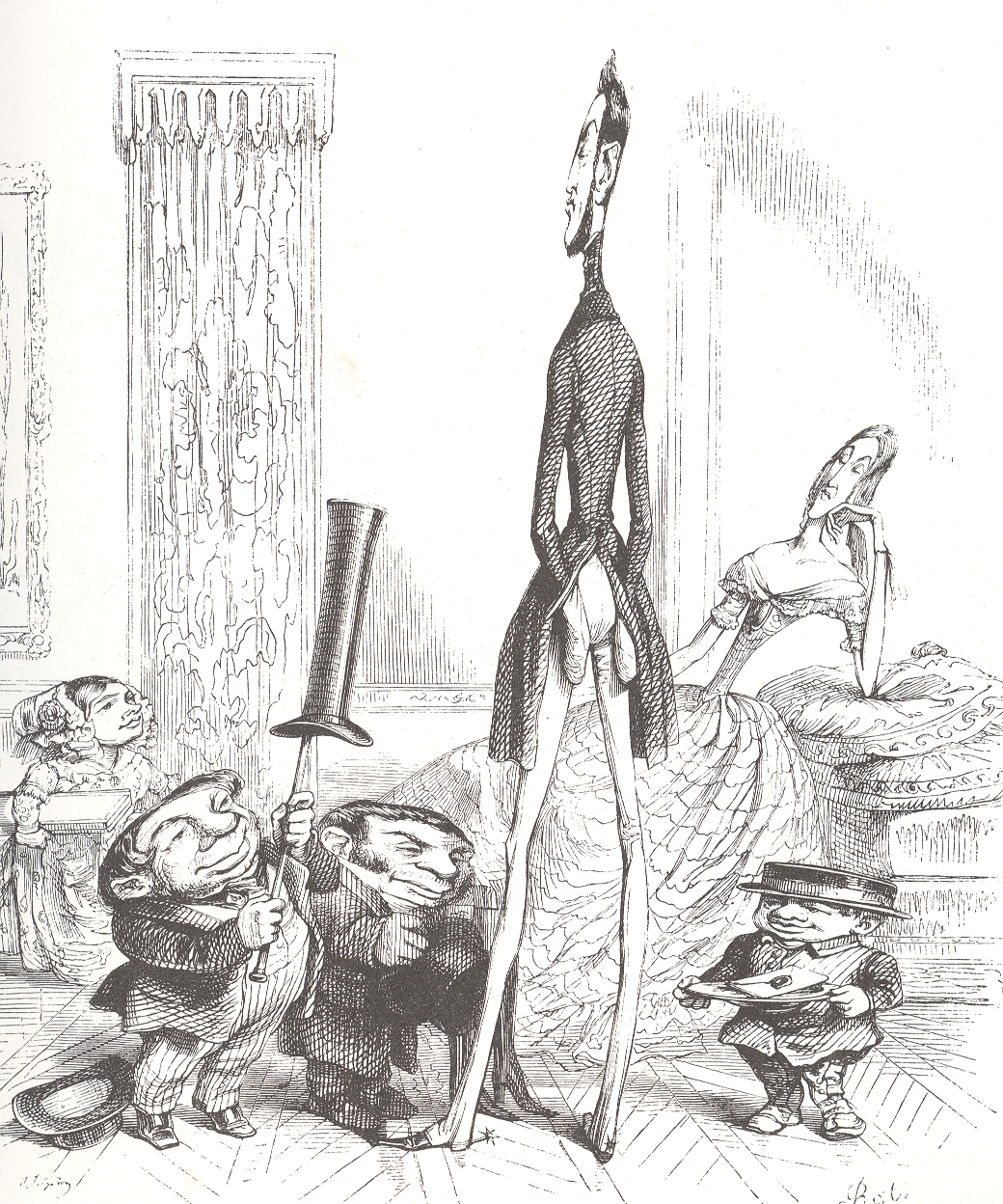
    century.  For example, in his Un Autre
    Monde
    (“Another World”) he depicts people’s 
    social stature literally—the taller and thinner, the more socially important;
    the shorter and stouter, the more disposable/replaceable; the images are funny,
    convincing and wincingly penetrative.

    Grandville-large

    This being said, I have a special interest in the
    astronomically-based images that he produced, and so far as I can tell, there
    weren’t many of them in his vast output. 
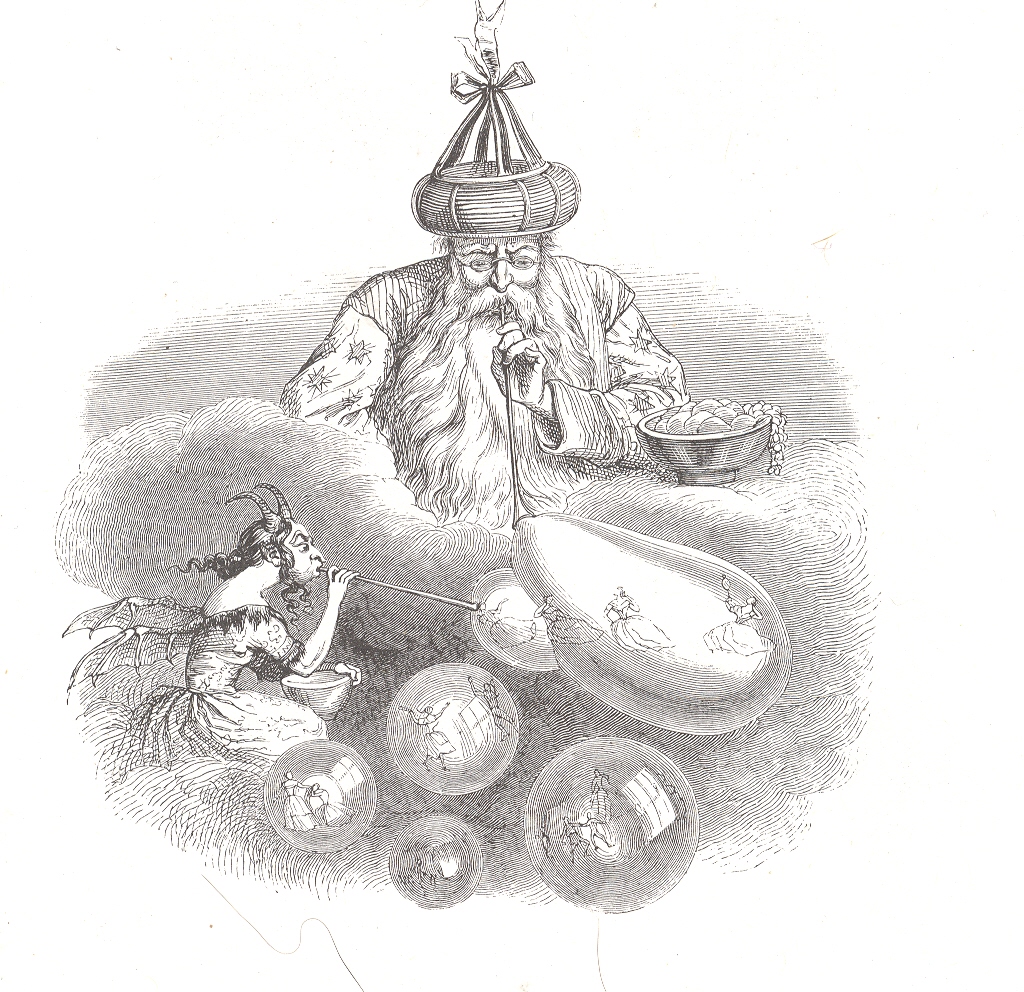
    In chapter 25 (“The Mysteries of Infinity”) of Un Autre Monde
    Grandville rolls out the great maker of the universe, the Primum Mobile, the
    Motive Force, the First Mover.   The old scamp was busy and on display for Grandville’s character Hahbble, who
    floats around in the cosmos, and comes face-to-face with what in the end is
    Einstein’s dice thrower, as much as the great physicist didn’t want him to be,
    nor is he subtle (Raffiniert ist der Herr Gott,  aber boshaft ist er nicht!)  The malicious (“boshaft”) part would be
    supplied by someone else looking intent and dangerous, while the great maker turns out to
    be a magician who is happily creating the matter of all stuff by making it all out of
    bubbles.

    (I feel relatively certain that Grandville is the first artist to propose the
    bubble theory of cosmology, and he is among a select and restrictive minority
    who allocated such a seemingly meaningless activity with the creation of creation.  I like its playful nature, though I wonder if
    his approach was seen as a deep mockery and perhaps heretically insulting to
    the religco-forces that helped and plagued the 19th century. Mostly it seems he was left behind int he appreciation part of acknowledgment, glory faded before his eyes; his work wasn’t necessarily prized during his lifetime, and
    he had his share of brutal reviews for his great adventures.  Paul St. Victor, art critic, wrote that
    Grandville “wanted to dance on the clouds in leaden shoes”and “tried to get to
    heaven on a bus”.  That’s a tough go. Death did bring him some fame as M. Grandville slept with the worms; publishers used his illustrations mostly without gratuity to any estate, the images showing up all over the place through the end of the 19th century.  His cuts were used again and again,the blocks being progressively degrade until the fineness of Grandville’s eye and incision were lost to overuse–it is easy to see the difference in crispness and clarity between the early printngs of his pictures with the later ones, his sharp edges getting rounded by greed and use and time.3)

    I imagine this magician to be “almost” infinitely large and
    small (what does “almost” infinitely mean?) , blowing bubbles on a large galaxy
    scale, the bubbles containing other 
    galaxies; or smaller yet, other solar systems; and smaller yet, other
    planets.  And taking it down to the other
    extreme, he could be sub-atomic, blowing bubbles of existence and shaping the bumpies
    of quantum foam in spacetime, letting loose the primordial bits that would
    become molecules that would or would not rise from the unpretty Dirac sea,
    living just on the other side of measureable in space and time, shaving
    barely-measureable slivers away from Planck length1 and Planck time2.  Or maybe the old man is putting the white
    into Schwarzchild wormholes. 

     Maybe he’s just blowing the bubbles of possibility and
    chance, and his unacknowledged accomplice is injecting the mote in god’s eye.

    Notes:

    1. The Planck length 1.616 x 10 -35 (meters) which is the
    smallest measureable space in the universe (comprised of Planck’s constant, the
    gravitational constant and the speed of light) which in turn leads to

    2.  Planck
    time, which is the amount of time it takes for light to traverse one Planck
    length in a vacuum,  5.39 x 10 -44 seconds),
    which is basically the smallest measureable unit of time, or for time that
    would mean anything. 

    3.  While ill with his own fatal bit, he composed
    his own epitaph;  Here Lies Grandville;
    he loved everything, made everything live, speak and walk, but could not make a
    way for himself”. 

    There’s actually quite 
    a nice turn of phrase in the wiki article on Grandville—quite nice,
    really—which I include here:  “Though the
    designs of Grandville are occasionally unnatural and absurd, they usually
    display keen analysis of character and marvelous inventive ingenuity, and his
    humour is always tempered and refined by delicacy of sentiment and a vein of
    sober thoughtfulness.” He evidently lived a hard-ish life, not the least of which
    were the deaths of his wife and two children in the early 1840’s.  

     Some of Grandville’s other interesting works include:

    Les petites miseres de la vie humaine (The Petty Sorrows of
    Human Life) 1843

    Un Autre Monde  1844

    Cent Proverbes  1845

    Jerome paturot 1846

    Les Fleurs animees (The Personified Flowers) 1847

      ==Blog August 5=tall