A Daily History of Holes, Dots, Lines, Science, History, Math, Physics, Art, the Unintentional Absurd, Architecture, Maps, Data Visualization, Blank and Missing Things, and so on. |1.6 million words, 7500 images, 4.9 million hits| Press & appearances in The Times, Le Figaro, Mensa, The Economist, The Guardian, Discovery News, Slate, Le Monde, Sci American Blogs, Le Pont, and many other places… 5000+ total posts since 2008.

Category: Astronomy

  • Things out of Place Department: the Moon

    JF Ptak Science Books LLC  Post 505

    Blog--things out of place
     This is a short entry in the “Things out of Place”
    department.  The image is lovely enough,
    and the depiction of the Moon is excellent, especially given the time of publication,
    which was 1683.  The Moon though, of course,
    is enormously out of proportion with the setting—I’m not sure why it needed a
    setting at all, but it has one, and it is odd. 
    The work is that of the prolific Manesson Mallet, who published this
    engraving as one of 677 in his massive Description de l’Univers, which appeared
    in five volumes.  I’m also not sure of
    how Mallet came to such greatness and capacity, as he started out his life
    (1630-1706) as a simple foot soldier under Louis XV, rising and rising in
    promotion and ability over the years until he became the chief inspector of
    forts.  He also wrote military books,
    including the three volume Les Travaux de Mars ou l’Art de la Guerre
    (1684), which he was somehow able to accomplish in the year after publishing
    his magnum opus.

    I really couldn’t figure out where to put his image, categorically speaking that is–it sort of fits into the small Extra Earth series, simply because the extra earths are big and way out of proportion.  But this is not “extra”, and not the earth, but it is out of proportion and belongs in the sky; and, taken out of context, the image is very unusual, in a naive surreal kind of way…


  • Blank and Empty Things, XXX: Maps of Lunar Nothingness; or, When Nothing is Something

    JF Ptak Science Books  LLC  Post 502

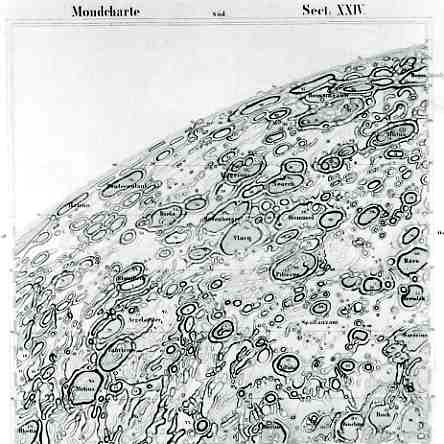
    0 blog feb 3 nothing scmidt515Actually, these maps are hardly maps of lunar nothingness–on the contrary, they are among the most detailed  maps ever produced (to their times)  of the lunar surface. The first, to the left, is by J.F. Julian Schmidt (1825-1894), who produced his monumental  opus to close observation and ultra-tidy detail in Mondkarte in 1878, a spectacular map of the Moon in 25 contiguous sections, which surpassed all other earlier maps–it shows riles, contours, valleys and thousands of new craters, not to mention the fact that Schmidt also calculated the heights of more than 1000 mountain peaks.  The map was produced with enormous precision by this careful observer, the lunar features presented in such a way as to be easily readable and extraordinarily detailed. It is this representation that gives the map an initially curious appearance of emptiness, when in fact the opposite is true.  (For a very useful and illustrated timeline of lunar history, see the blogsite of Chuck Wood.). 

    0 blog feb 3 nothing scmidt516

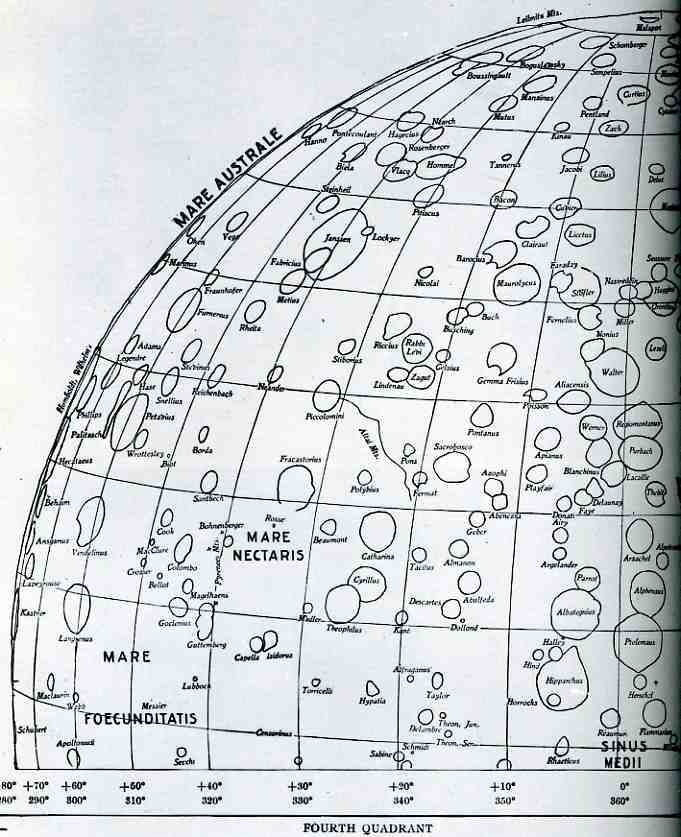
    The second example of nothingness is from William Pickering’s (1858-1938)  1903 index map of the Moon, which was constructed from his careful photographic surveys, and offers a very precise rendering of the major features of the lunar surface. It was made to accompany his exhaustive The Moon : A Summary of the Existing Knowledge of our Satellite, an atlas published in New York in 1903. The outline map is another example of something that appears to be somewhat empty while holding a vast amount of information.

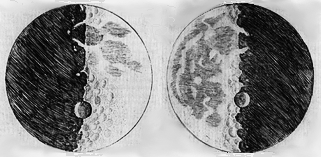
    A little beyond the scope of these two maps is that of Galileo Galilei (1564-1642), who in 1610 produced the first drawings* of the Moon made with the benefit of a telescope.  It was a shocking revelation for all those who saw it (when published in his Sidereus Nuncius, or “The Starry Messenger”, which was also the first published treatise on the Moon)  and I can only imagine what the common person with an average amount of scientific curiosity could’ve felt when seeing the image for the first time.  It was mostly a map of nothing, but the details present were extraordinary and fantastic–they revealed undisputed features of the Moon, images of contours that had been only rendered via considerable eyestrain for thousands of years. It also showed peaks and mountains and other jagged stuff, which disproved the running theory that the Moon was a perfect sphere devoid of such things. And then here, in 1610, was the first “close-up” vision of this complex object that had been followed by billions of eyes for thousands of years–it just had to be shocking. It was mostly nothing, but the bits of something that were present were a phenomenal vision.  

    1610-GalileoMoon *(Before people start writing in about the chronology of Galileo and the “first” claim, I know that the issue is a little knotty and a little more complex than old Galileo being the first on the scene.  William Gilbert–ultra-famous for things outside astronomy–drew an odd, wrong and surprisingly non-detailed map of the moon in 1603, though this wasn’t published until after his death and a lot of other lunar-related stuff happened in 1651.  There’s also some recently re-discovered telescopic renderings of the Moon made in 1609/10 or so by the Englishman Thomas Harriot which are of the same quality as Galileo’s. Within three years of the Galileo publication came the work of two astronomers on mapping the Moon: G. C. La Galla (publishing in Venice in 1612) and  P. Christoph Scheiner (in Germany) between 1611 and 1613.)


  • A Comet’s Tail in Eden: the Great Comet of 1680

    JF Ptak Science Books LLC  Post 301
    1blog_oct_7_wegelin781

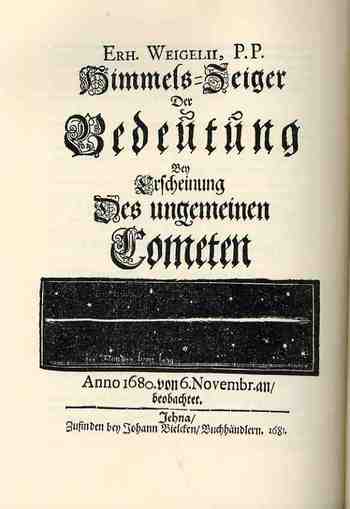
    The comet tail in this beautiful title page woodcut is
    hardly exaggerated—it was estimated that the tail was more than 30,000,000
    miles long, or better than 70 degrees, at its highest and brightest. It illustrates the work on the Great Comet of 1680 by Erhard Weigel entitled Himmels-Zeiger der Bedeutung bey Erscheinung des ungemeinen Cometen , published in Jena by Bielcke in 1681.  Weigel was a polymath (philosopher, astronomer, mathematician,  logician and teacher ) who made minute  and exact observations of  this very famous comet in a micro- and macro-cosmic framework.  He looked at the physical aspects of the comet (head and tail, brightness and shape, etc.) and described its path. He also wrote about the  philosophical and relational aspects of the comet as well, bearing on its influence upon the weather and man, as well as  its influence on the structure of astrology.

    The comet was actually discovered in November 1680 by Gottfried Kirch, and it was discovered in a novel, unique way: via the use of a telescope.  It was scientifically remarkable because it offered possibilities for the study of its path, which in turn could reveal the Larger Writ issues of teh clockwork universe in general.  .

    There were some earlier
    sources—including Edmund Halley (who was inaccurately described as the
    discoverer of the periodicity of comets)–that had this comet appearing in 44
    ACE, another time in the consulate of Lampaduis and Orestes, and another time
    in the reign of Henry I in 1106; that is, a period of 575 years. It was the
    unfortunate estimate, or opinion, of William Whiston (
    who was chosen by
    Isaac Newton to take over his chair of mathematics at Trinity College in
    Cambridge when Newton dedicated himself more fully to his role as president of
    the Royal Society**). that the
    1680 Comet had caused the flood of Noah and, perhaps more disastrously, brushed
    the Garden of Eden. Perhaps he was thinking of Cicero*,
    “from the remotest remembrance
    of antiquity it is known that comets have always presaged disasters.” (See Whiston’s “The
    Cause of the Deluge Demonstrated, being an Appendix to the 2nd edition of the New
    Theory of the Earth”
    (London,
    1708))

    The Great Comet of 1680 was the most extraordinary in the bright-comet-filled period of 1680-1682, and there’s certainly more to write about–I really just wanted to write on the comet woodcut because I think that it is odd and beautiful. 

    Notes:

    *Cicero, De Natura Deorum: “Ab ultima antiquitatis memoria notatum
    cometas semper calamitatum praenuntios fuisse.” The Pythagoreans
    believed that great comets appear at great intervals of time.

    ** For god only knows what reason(s) Whiston was later denied membership to
    the Royal Society, I guess with the knowledge of Newton; so he was good enough
    to teach in Newton’s eat but not good enough to be invited to the big boy table
    to eat.


    Descriptions from
    New York State and Manhattan of the Great Comet of 1680:

    Excerpt
    from The History of Kingston, by Marius Schoonmaker, 1888, at page 70
     

    “On the
    9th of December 1680, there appeared an extraordinary comet, which caused very great
    consternation throughout the province, with forebodings of dreadful happenings
    and divine punishments. It is described, in a letter dated January 1st, 1681,
    as having
    �appeared in the Southwest on the ninth of December last,
    about two o�clock in the afternoon, fair sunshine weather, a little above the
    sun, which takes its course more nort
    herly, and was seen the Sunday night, right after about
    twilight, with a very fiery tail or streamer in the west, to the great
    astonishment of all spectators, and is now seen every night with clear weather.
    Undoubtedly, God threatens us with dreadful punishments if we do not repent.
     The letter then suggested the
    propriety of proclaiming a day of humiliation and prayer. “

    An excerpt from The
    Encyclop
    edia of Geography
    , By Hugh Murray, Philadelphia., 1837, Vol 1 at page 115
    describes the visit of this comet also;

    “A
    very remarkable comet was seen in the end of 1680 and beginning of 1681. Its
    tail extended 70 degrees, and was very brilliant. This comet, of all those
    which have been observed, approaches nearest to the sun. Descending with
    immense velocity in a path almost perpendicular to his surface, it proceeded
    until its distance from his centre was only about 540,000 miles. Sir Isaac
    Newton computed that, in consequence of so near an approach to the sun, it must
    have received a heat 2000 times greater than that of iron almost going into
    fusion; and that if it was equal in magnitude to our earth, and cooled in the
    same manner as terrestrial bodies, its heat would not be expended in less than
    50,000 years.”


  • Images of Scientific Breakthroughs: Astronomy–Gallucci, Galileo, Kepler

    JF Ptak Science Books Post 276

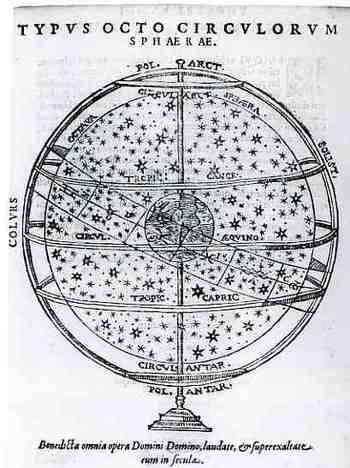
    A good heaping part of the vast beauty of printed scientific illustration over the last 500 years or so is occupied by luscious renderings of the constellations, night sky, and the general good works of the Primum Mobile. The woodcut to the left was published by Giovanni Paolo Gallucci in 1588, and is found in his Theatrum mundi. IT is a different sort of beautiful, not perhaps as beautiful as the earlier and more artistic efforts of other, but beautiful for being the first map of its kind to employ the use of stellar coordinates. Prior to this—and I mean for thousands of years—the imaging of the constellations was really an architecture of mnemonic devices, created so that there would be a memorable linkage and form, making the placement of the stars dependent on their connection/recognizable pattern to other stars.

    1blogsept_23_astro636

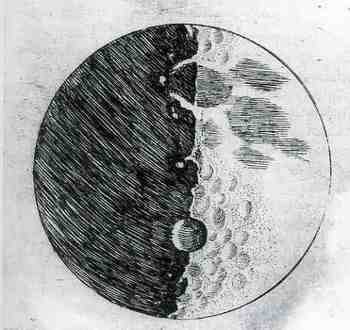
     The next two images really aren’t directly related to Gallucci and his predecessors, but there is a bit of slightly kindred spiritedness among them. The first image of the moon was really a sensation in the history of astronomy—it is the first published detailed map of the moon rendered by the use of the telescope, made by Galileo and published in his Siderius Nuncius in 1610. It was just a fantastic accomplishment—he even tried to show the relative heights of the mountains of the moon by giving them shadows of varying lengths.

    1ebay_sept_25_galileo_moon668 

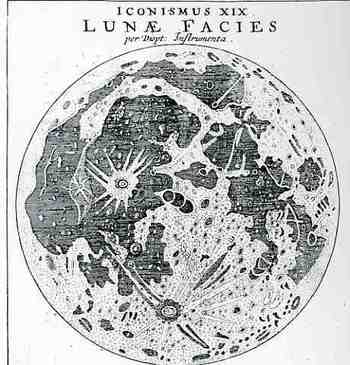
     In the very next year this monumental drawing was totally eclipsed by Johannes Kepler, who brought his own telescope to bear upon the moon and produced a map of prodigious detail, far surpassing the Galileo map. (I can only imagine how shocked people must’ve been when seeing this map, “Lunae Facies per Diopt Instrumenta” for the first time, which was found in Kepler’s Dioptrice of 1611.) The reason wasn’t that Kepler was a superior observer, but that he used convex lenses for the objective and eyepiece, giving him a far more dynamic, detailed and wider scope of field, resulting in this surprising modern map.

    1ebay_sept_25_galileo_moon_lunae669


    So these two sets of images really aren’t strongly connected, as I said, but they do show the significant, short-term effects of technical improvement and innovation in the illustrated depiction of the advancement of science. And of course they’re pretty.


  • Wordle Word Art: Copernicus’ De revolutionibus orbium coelestium (On the Revolutions of the Heavenly Spheres)

    JF Ptak Science Books LLC

    Wordlecopernicus
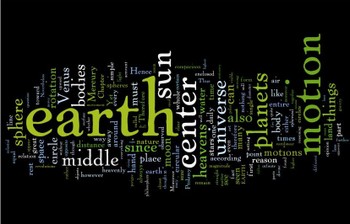
    Here again is another Wordle treatment—this time we’ve fed it
    the first 10 chapters of Copernicus’ De revolutionibus orbium coelestium (On
    the Revolutions of the Heavenly Spheres
    ). As usual Wordle offers a very interesting
    insight into word usage even though I was forced to limit the text selection to
    Book I and stop at the point where diagrams are used to illustrate the
    text. Be that as it may, even in this
    limited application, Wordle does surface some interesting bits from the
    relatively “popular” part of this revolutionary treatise.

    (Click on the image to enlarge and make clearer.)

    ·Posted by :

    ·in:

    —

  • Renaissance Wall Calendar, 1544–a Medical Quack’s Contribution to Astrological/Astronomical Prettiness

    JF Ptak Science Books  Post 203

    Calendar renaissance


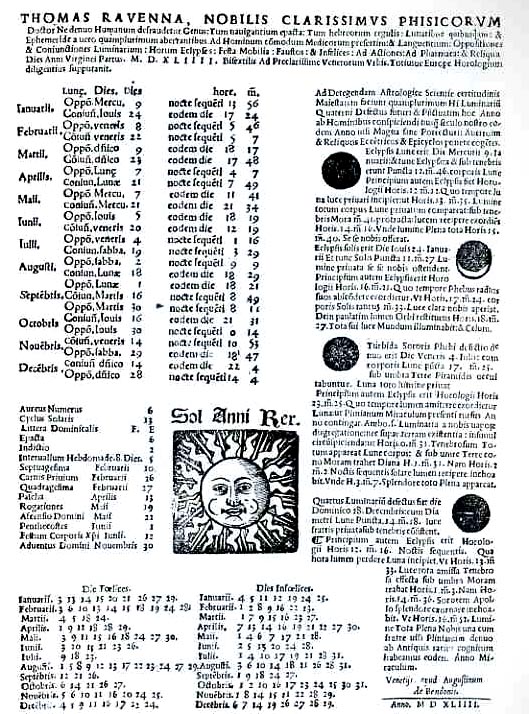
    This is one of the earliest wall-mounted calendars that I’ve seen.  Constructed by Tommaso Gianotti (1493-1577) and printed by Thomas Janothus in Venice in 1544, this astrological wall calender, exhibiting tables of the phases of the Moon, movable feasts, lucky and unlucky days, hours of the sunset, and so on, was a very large, lovely thing of real and soft information.. Gianotti, also know by his more aristocratic name of Rangoni, was a physician of sorts, a man of semi-medicines who practiced some sort of quacky healing arts in Venice.  He was well a very well paid practionner of the questionable arts, evidently surrounding himself with a mixture of mythological care and medicine–so well paid as a matter of fact that he was able to commission several works (on St. Mark) by none other than Tintioretto, paying his way, by the way, to have his own portrait included in the scene, painted by the great master himself. 
    Gianotti did make some minor contributions to medicine, and did study physics and the allied sciences, but his contributions were generally sugary flakes.  He  did make other social, architectural, liturgical contributions–paying for restoration work at the churches of San Guilliano and San Germinamo–though the cost of his generosity was usually a statue of bust of himself, perched above entry ways here and there,    His calendar though was pretty and useful. 


  • Blank People, Moonmen, and the John Herschel Hoax of 1835

    JF Ptak Science Books LLC Post 183

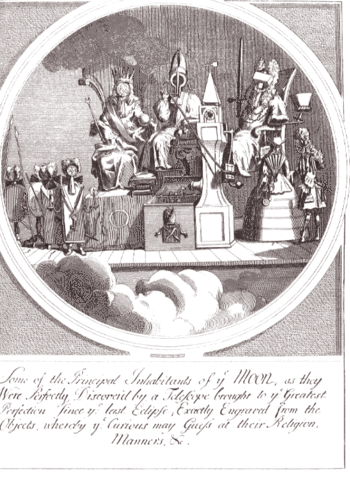
    July_28hogarth_moon

    In what seems to be a continuing post on the idea of blank people (I’ve posted on them twice before, here and here), that is to say, images of people with almost no attributes, people waiting to be “drawn in” or “filled up”, or completed in some way.  The image that I saved today is from William Hogarth,  whose witty attempt in displaying the hoaxing reports of life on the Moon depicts empty Moonpeople, “revealed during an eclipse, thanks to a powerful telescope, and faithfully reproduced afterwards”.  Machines and instruments during this time seemed to have improved much quicker than the fictional and fantastical thinking that may have used them–even so Umberto Eco, who I think misses this point, wrote that, in this particular case, the telescope “had not pout an end to fantasy….but it has often deprived it of discernment and moral commitment, reducing it to an ingenious and neurotic form of futuristic anticipation”.  (This is From Eco’s first book, printed in 1963 (!), The Picture History of Invention, written with G.B. Zorzoli.  In spite of its tragic title, the writing and appreciation of invention is very good.) 

    In a great prank/hoax of the 19th century, it was reported in 1835 that Sir John Herschel (son of a hugely important astronomer, Sir William, and who was of great importance in his own removed right) found some sort of living, humanoid-like beings alive, and seemingly thriving, on the Moon.  He did this with a 24-foot (diameter!!) telescope that “cost three hundred thousand dollars”, an amount funded by the King.  The whole thing was moved to the observatory at the Cape of Good Hope, where the discoveries were made.  Sir John was of course quite surprised to hear of his discoveries, though I’m sure he would’ve been happy to get his hands on the telescope, which would’ve been the largest in the world, by far, in 1835.  John’s father, the extraordinary Sir William Herschel, owned one of the world’s largest in the 18th century.  It was 48″ in diameter, and a monster for its time.  As a matter of fact in the first month or so of the announcement of the invention of photography John built his own camera and made a daguerreotype of his father’s instrument.  In one of the few true bits of the story, John Herschel’s telescope was famously located at the Cape of Good Hope (John having moved his family and his 20′ scope their in 1833). 

    The imaginary telescope wouldn’t  be the largest in the world, now, though—the Keck instruments in Hawaii (at 10 meters) and the Gran Telescopio Canarias (10.4 meters in the Canaries) would dwarf the unimaginably huge fictional creation of 1835.  The extraordinary price, too-an unreachable amount, actually, in 1835—would’ve been about a huge amount today as well:  the adjusted for CPI figure for $3000,000 1835 dollars would be around $7 billion 2008 dollars.  A lot, of course, but not an order of magnitude more, I think, than the cost of these things, and certainly not an impossible-to-imagine amount as the Sir John fictional scope. (It seems to me that the Anglo-Australian telescope named for John Herschel  with first light in 1987 cost 25 millions dollars.)
    Blogjuly_28blank_mirror359

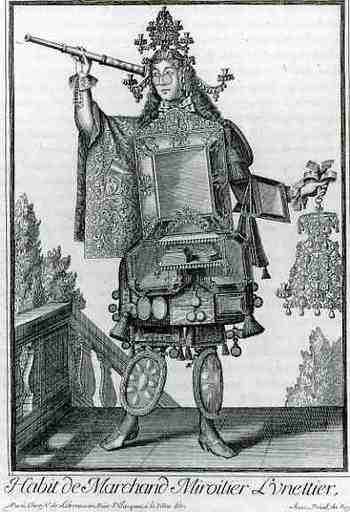
    On a different route altogether is the Mirror Man, who in some aspects is a blank person because he mirrors everything that is placed before him, a parable-like tabula rasa, writ on again and again.  (The legend reads “Habit de Marchland Miroitier Lunettier” by Nicolas de Larmessin III (1640-1725).  (This image was surfaced in Barbara Stafford and Frances Terpak’s Devices of Wonder, from the World in a Box to Images on a Screen, The Getty, 2002, page 258.)   The history of the mirror is really pretty interesting, and even by the time that this engraving was made the mirror was still an uncommon object–more so in the hands of the common folk.  (I wonder when it was that the majority of the working classes in the United States were able to have a good, long look at themselves in their own mirror at home?  When did most people in the U.S. have the luxury of being able to see themselves, in private, whenever they wanted too?  Like, when could they look at their own teeth in private?  Or see themselves naked?  My guess is that it is between 1800-1850.)


  • An Alphabetical Return to Fat:1920’s Fat (Reduction) Scams; Fat Soap, Strychnine Pills, and Sugar

    JF Ptak Science Books   Post 107
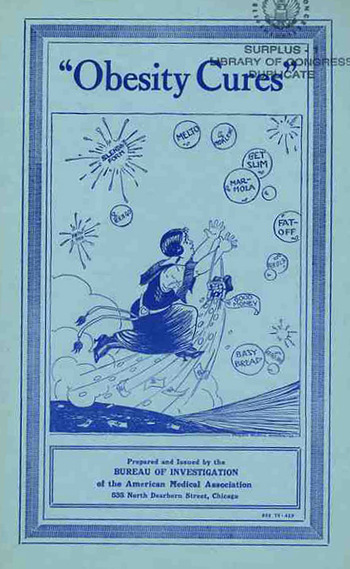
    Blogfatobesity_cures132
    Quackery in general has survived in spite of itself over many fields, not the least of which is astrology and creation science, cult religions and
    walking-with-the-dead.  In the U.S. in the 1910-1925 period however there was a attempt at investigating the most outrageous frauds in the medical profession by the American Medical Association, and of the many sorts of quacks and frauds-liver cures, neuralgia miracles, electro-vibrator hair restorers and lump removers, anti-droopy happiness pills, cocaine nervous system remedies, and so on-what I’d like to look at right now is concerned with “flesh reduction”, or, fat cures. 

    According to the AMA (in a 1934 retrospective) the chief stimulant to the obesity industry was the rise of womens’ fashions.  I think that the reasoning might wind itself around the growth of expendable money in the American rising middle class, where Americans, in general, had more money to spend on the non-essentials than any time in the history of the country.  That leads to more consumables, and that leads to more advertising, and that leads to more idealized images of what people should look like, and that leads to wanting to look like that, and that opens the door to scammers who offer a way to get to the not-actual ideal without effort and for little money.  And so in the ’20’s there was a spike in quack remedies for obesity, as there was little or no control over the content of what was being sold nor the claims about what the product did, medically speaking-there was general protection from fraud, of course, but the medical compliment for establishing what that actually was wasn’t quite yet in place. 

    There is a veritable alphabet (soup) of mondo bizarre cures that the AMA attacked and ripped apart during the 1920’s, publishing the findings of their labs on the ingredients of the cures and the possibilities of whether any of the hundreds (thousands?) of these things worked at all. 

    And what the AMA found was really pretty remarkable-lots of water, sugar, tartar, tinctures of useless this and that, desicated liver, seaweed, salt, lemon, and that sort of thing, none of which had any value for weight reduction whatsoever..  A major ingredient, for some reason, was focus vesiculosus, also known as bladderwrack, sea-wrack, kelp-ware and sea-oak-there was no indication of why this ingredient was so popular, especially since it was used in some farms as a pig feed to make the animals fat.
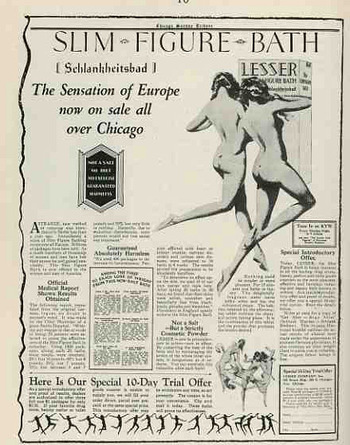
    Blogfat_slim_chicago133
     

    So, aside from the pig-fattening ingredient for human “flesh reduction”, we’ll have a quick alphabetical tour of some of the outrageous (and bizarrely-named) products and their components promising hope and physical happiness to the woman of 1925. (Let’s note that the following are just locally-applied or ingested cures-there’s an entire universe of external applications and devices that were used to solve the problem of fat.  For example, the Violet Ray Machine claimed that in addition to obesity it would cure “Problems with circulation of the blood, the heart’s action, bumps of the funny-bone, germ infections, weakness, the waste of the body, congestion, impaired physical development, pains and aches, complexion and skin diseases, facial and body blemishes, hair loss, headaches, inflammation of joints, muscles, nerves, Atrophy, circulatory disorders, constipation, deafness, goitre, high blood pressure, arteriosclerosis, insomnia (sleeplessness-Brain Fag), indigestion, dyspepsia, neuritis, nervousness, hysteria, melancholia, neurasthenia, neuralgia, obesity, pain, paralysis, prostate gland problems, scalp diseases, falling hair, dandruff, asthma, anemia, bronchitis, catarrh, hay fever, rose fever, colds and other inflammations of the upper air passages, and, of course, cancer.”  This quote with thanks from the Museum of Quack Meidcal Therapy Devices

    And so to the consumable and applied quack fat cures:

    A

    Absorbit Reducing Paste-one of my favorites.  This was a nighttime sleeping paste
    which was composed of 44% lard as well as beeswax, oil and milk.  After slathering
    yourself in this oily, waxy, milky fat cocoon (the sheets!) you were also supposed
    to ingest an accompanying night aid pill, which was 24% sulphur and 61% sugar.  So
    not only would you be oily milky waxy lardy, you’d also be stinky and, at the end of
    it all, hyper. 

    Allmans Anti Fat Anti Pon (?)).  According to its label, it was a “powerful and
    entirely harmless specific”, which the AMA revealed to be composed of citric acid,
    water and food coloring.  Sounds like Kool Aid. 

    Arbolone tablets.  These guys were made of desiccated thyroid, starch, lime and sugar.

    B

    Basy Bread was a “anti growth” bread which turned out to be just a course wheat bread

    C

    Clark’s Thinning Salts was almost entirely washing soda.

    D

    Dalloff’s Time Pills were made of lavender and bearberry.

    E

    Elfin Fat reducing Gum Drops (continuing its spectacular name by saying it was a
    product of the Pep-Giving Product Co., Inc.), was actually one of the only items
    that might have contributed to weight loss, if only for the fact that in addition to
    consuming its drops made of laxative and sugar you were supposed to adhere to a
    pretty regimented, difficult exercise routine.  Big sweat and potent laxative does
    in fact produce weight loss.  Maybe not a good weight loss, but aa weight loss
    nevertheless. 

    Elimiton (!) was a product made of caffeine and rhubarb.

    Every Woman’s Flesh Reducer promised a new figure with their mixture of Epsom salt
    and camphor.

    F

    Fatsoff, a soap product that you washed with, was not surprisingly made of soap.
    Fayro was another soap and washing flesh reduction “package” that asserted that by
    using their secret flesh reducing salve (i.e., “soap”), you would “open your pores
    to let the blood cells sweat off fat”.  I could just about see the AMA guy who was
    writing their description of this thing slamming his pen and screaming.

    Some other F’s included Fells Reducing Tablets (which were milk), Figurroids (salty
    baking soda), Floradona (sodium thiosulphate, the photographer’s “hypo”), and Folt’s
    Reducing Soap (which was, again, soap). 

    G

    Get Slim was a vile purgative of sugar, tartar and baking soda, plus perfumes.

    H

    Hall’s Tablet Triturates were ginger and a big shake of chalk; Hargreaves Reducing
    Wafers (bread and liquorice).

    J

    J.Z. Obesity tablets–were the same product as Absorbit which was the same as
    Zobeide (minus the ox mucus). 

    L

    LaMar reducing Soap (“to wash away fat”) was soap.

    M

    Marmola, “a thyroid-containing obesity cure” was composed of cornstalk, borax, baking
    soda and tartaric acid, with a special “constipation agent” (?), as well as a lot of
    salt. 

    Morlene would reduce goitersm neck fat, bust size and tumors, somehow, with the
    application of its cleansing elements (soap).

    N

    Neutroid seems to have been the most lethal of the hundreds tested, contaning bad
    dollops of magnesium carbonate and iodol, and was taken internally (where external
    application could prove fatal). 

    O

    Oil of Korein was pretty nasty stuff, containing sassafrass and about 75% petrolatum
    (a semi-solid mixture of hydrocarbons, or petroleum jelly), though it also offered
    some really good advice on foods to avoid if you didn’t want to actually gain
    weight. 

    P

    Phy-thy-rin was a calcium and sugar coated pill of iodine and dried thyroid, with
    plenty of sugar, and liquorice. 

    R

    Rusell’s Anti-Corpulent {reparation was a powdered added to water that would
    effectively produce orange Kool-Aid.

    S

    Sangra Bath Salts was perhaps the most outrageously simple, being just colored bath
    salt.  Slendaform (“just gently rub it in, and watch yourself get thin”), was a
    half-pound jar of oil of turpentine, white vinegar and milk curd.  Slyphine, which
    crowded its ads with tremendous claims to be “Absolutely The Best Weight Reducer
    Ever Discovered” and other very shouty claims (by somehow “attracting surplus
    fat”), was simply borax and talc. 

    V

    Dr. Vincent’s Anti-Stout Pills contained a pretty sounding mixture of aloes, jalap,
    cloves and bladderwrack.

    Y

    Mme. Yale’s Fertilizer Tablets-I’m not sure about the real use of “fertilizer”
    here.) was actually one of the earliest of these frauds to be attacked by the
    government, being charged with fraud by “misbranding” in 1909, as federal chemists
    could find no connection between weight loss and its sole ingredients of sugar,
    charcoal and cream of tartar. 

    Z

    Lastly, we offer Zobeude, which was just Absorbit Reducing Paste relabled for
    British consumption, though it seems to have contained an added ingredient of
    “purified ox bile”.  We are told in Bruce’s Materia Medica of 1884 that “Purified ox
    bile has the composition of fresh bile, less the mucus .”
    ·Posted by :

    ·in:

    — — —

  • The Beauty and Iconography of Title Pages: Frau Mauro’s Sphaera volgare novamente (1537) and a Very Early Glimpse of America on a Globe

    JF Ptak Science Books   Post #95
    Blogtpamerica105
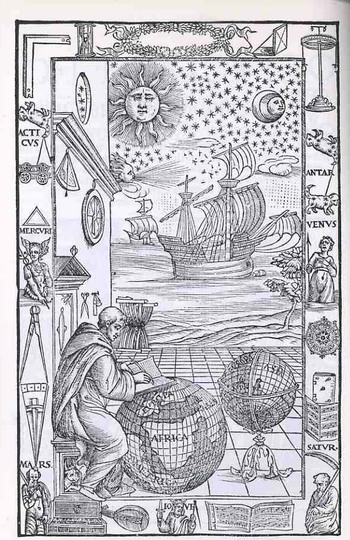
    This magnificent piece of tidy work was done for this new edition of Johannes de Sacrobosco’s Sphaera by Fra Mauro Fiorentino (1492-1556), and gives us all a chance to have a bit of fun reading late Renaissance iconography. The work is entitled Sphaera volgare novamente tradotta con molte notande additoni di geometria, cosmographia, arte navicatoria et stereometria (and so on), published in Venice in 1537, and as stated in the title this is an augmented edition of Sacrobosco with Mauro adding segments on geometry, cosmography, navigation and perspective.

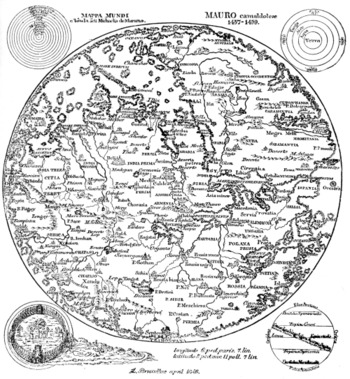
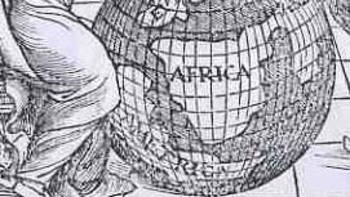
    The wood engraving is of particular interest because of the globe upon which Fra Mauro is writing—as you can more clearly see in the detail; shot (below) we can see a large continent labeled “America” just hundreds of miles off the coast of Africa.  The Americas still make only guest appearances on globes at this point, and seeing it here, as a bit of an afterthought, is a treat (considering how easy it is to overlook it).  There is another Fra Mauro, much more famous than our’s above, whose cartographic workshop produced a seminal, magnificent  map of the world in 1453, thus bringing the two Mauro’s together, if only slightly, via their maps (one great, the other incidental).
    Mauro_map

    Looking a little more closely at the elements of this image we find a number of interesting bits.  Working from the upper right hand corner across and down we find a right angle (for the architectural and building parts of the book), then a sand clock, a decorative laurel wreath with a pocket sundial (!) right next to it, ending with an object that looks as though it might be a physical sciences demonstration tool (I’m guessing).  Working down from the “what is it” we see the first cut of a three-times-repeated constellation that I think has nothing to do with the word “Antar” beneath it. 

    “Antar” probably refers to the famous Arab warrior-poet, subject of lots of attention over the centuries including two works by Bach and Rimsky-Korsikov (and also the name of Apollo as worshiped at Actium) Below Antar is an armed and clothed (?!) Venus, major domo goddess of love and beauty and for whom existed innumerable cults (witnessed by just some of the famous Venuses as Venus de Milo ,Venus de’ Medici, Capitoline Venus, Esquiline Venus, Venus Felix, Venus of Arles, Venus Anadyomene (also here), Venus, Pan and Eros, Venus Genetrix, Venus of Capua, Venus Kallipygos, Venus Pudica, and so on into the sweaty  night.)

    Blogtpamerica_detail

    Following Venus is, I think a complex compass rose, though it may also be a calendar—I can’t quite tell from the detail of the cut.  This is turn is followed by a heavily fortified book (actually this sort of bonding, meant for heavy use, was relatively common at this time)and a score of (5-line staff) music. 

    Returning to the right angle and moving down we se the same constellation under which hangs a very stable-appearing wagon, with a triangle beneath it , followed by a representation of Mercury, the messenger of the gods, who in turn is positioned over a large set of dividers.  On the wall over the head of Fra Mauro we see two precision instruments—a surveying tool and an astrolabe.  The two small tools near Mauro’s head seem to be a scale and a pair of scissors. 

    The central panel shows two caravans (approximately 100-footers?), being driven by a favorable wind to hospitable shores beneath a starry and benign firmament. 

    The bottom tier is the most emblematic of the set of images, as we see the related Saturn-Jove-Mars all together.  Saturn is also Kronos, which is why we see the old horned man caring the scythe of time’s reckoning; he is also the father of Zeus, also known as Jupiter (Juppiter Optimus Maximus Soter (Jupiter Best, Greatest, Savior)), also known as Jove, who stands here crowned and warning us with a sword and dividers.  Jove in turn was the father of Mars, who here doesn’t look terribly war-like at all.  Punctuating the spaces between these three are a keyboard instrument, a lute and a score of music.  I’m not sure that these lyrical/musical devices had anything to do with the three generations of super gods, but there you have it. 

    ·Posted by :

    ·in:

    —

  • Beautiful Circles in Science #1: the Astronomy and Cosmology of Fontenelle and the Plurality of Worlds, 1686.

    Blog26apfontenelleJF Ptak Science Books Post #69

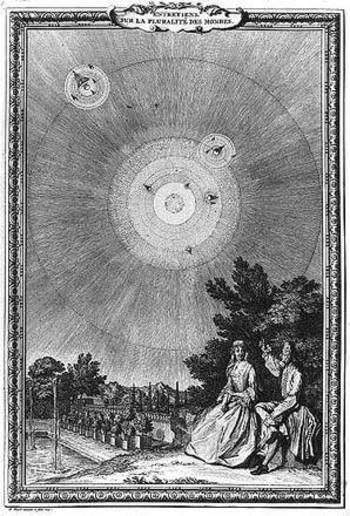
    This first lovely image belongs to Entretiens sur la
    Pluralitie de Mondes
    (Conversations on the Plurality of Worlds), written by the
    great French philosophe Bernard le Bouvier de Fontenelle in 1686 (just a year
    before publication of perhaps the greatest work in the history of science, Newton’s Principia
    Mathematica
    ). The Plurality was a
    best-seller by the best-selling Fontenelle. An excellent attempt by a rather
    restricted writer to engage the population-at-large, writing a high-pop book on
    what was basically the history of astronomy and cosmology of the preceding
    century. Copernicus was a major feature
    of his imaginary conversations with a muse as he wandered through a
    metaphorical garden of questions, with the observations of Galileo and Cassini
    also very prominently featured.

    Fontenelle’s Pluraltiy was amended, added to, and fattened
    up for a long time, the author adding material to it constantly for years to
    come—the book went through at least 33 editions during Fontenelle’s
    hundred-year-long life (1657-1757). This
    engraving was meant to be allegorical, illustrating a Copernican planetary
    system which was surrounded by galactic clouds comprised of other solar systems—prescient
    and forward thinking, as it wasn’t until the last 15 years or so that a solar
    system was discovered outside our own. (This until recently was a tremendously difficult
    feat to accomplish—instrumentation and practices now are advanced, but it is
    still an extremely difficult task to locate extra-solar system planets and
    systems.) 

    Plurality
    What makes this engraving so particular and attractive to
    me, and the reason why it is listed first in this series of scientific circles,
    is because of its beauty and “deep depth”. The artist certainly related the compound nature and depth of the
    universe, revealed to us from behind drawn curtains. Our solar system is featured prominently, with hosts of other solar systems borne on each puff of extragalactic clouds, reahcing, or descending, “all the way down Or up)”.  Fontenelle believed in the infinity of world
    and the enormous-by-reason possibilities of the universe, as we see in this
    extra from Plurality:

    I shou’d think it very strange, that the Earth shou’d be inhabited as it is;
    and the other Planets shou’d be so entirely desolate and deserted: For you must
    not think, that we see all the living Creatures that inhabit the Earth. For
    there are as many several species and kinds of Animals invisible as there are
    visible. We see distinctly from the Elephant to the Mite; there our sight is
    bounded, and there are infinite numbers of living Creatures lesser than a Mite,
    to whom, a Mite is as big in proportion, as an Elephant is to it. The late
    invention of Glasses call’d Microscopes, have discover’d thousands of small
    living Creatures, in certain Liquors, which we cou’d never have imagin’d to
    have been there. And it may be the different tastes of these Liquors, proceed
    from these little Animals, who bite, and sting our Tongues and Palates. If you
    mix certain ingredients in these Liquors, (as Pepper in Water,) and expose ’em
    to the heat of the Sun, or let ’em putrefie, you shall see other new species or
    living Creatures. Several Bodies, which appear to be solid, are nothing else
    but Collections or little heaps of these imperceptible Animals; who find there
    as much room, as is requisite for them to move in. The leaf of a Tree, is a
    little World inhabited, by such invisible little Worms:
    To them this leaf seems of a vast Extent, they find Hills and Valleys upon it:
    And there is no more Communication between the living Creatures on the one
    side, and those on the other, than between us and the Antipodes.
    And I think there is more reason, to believe a Planet (which is so vast a Body)
    to be inhabited. There has been found in several sorts of very hard Stones,
    infinite multitudes of little Worms
    ,
    lodg’d all over them in insensible varieties; and who are nourish’d upon the
    Substance of these Stones which they eat. Consider the vast Numbers of these
    little Animals, and how long a tract of Years they have liv’d upon a grain of
    Sand. And by this Argument, tho my Moon were nothing but a confus’d heap of
    Marble Rocks, I wou’d rather make it be devour’d and consum’d by its
    Inhabitants, than to place none at all in it.”

    CONTINUE:

    ·Posted by :

    ·in:

    —