A Daily History of Holes, Dots, Lines, Science, History, Math, Physics, Art, the Unintentional Absurd, Architecture, Maps, Data Visualization, Blank and Missing Things, and so on. |1.6 million words, 7500 images, 4.9 million hits| Press & appearances in The Times, Le Figaro, Mensa, The Economist, The Guardian, Discovery News, Slate, Le Monde, Sci American Blogs, Le Pont, and many other places… 5000+ total posts since 2008.

Category: Astronomy

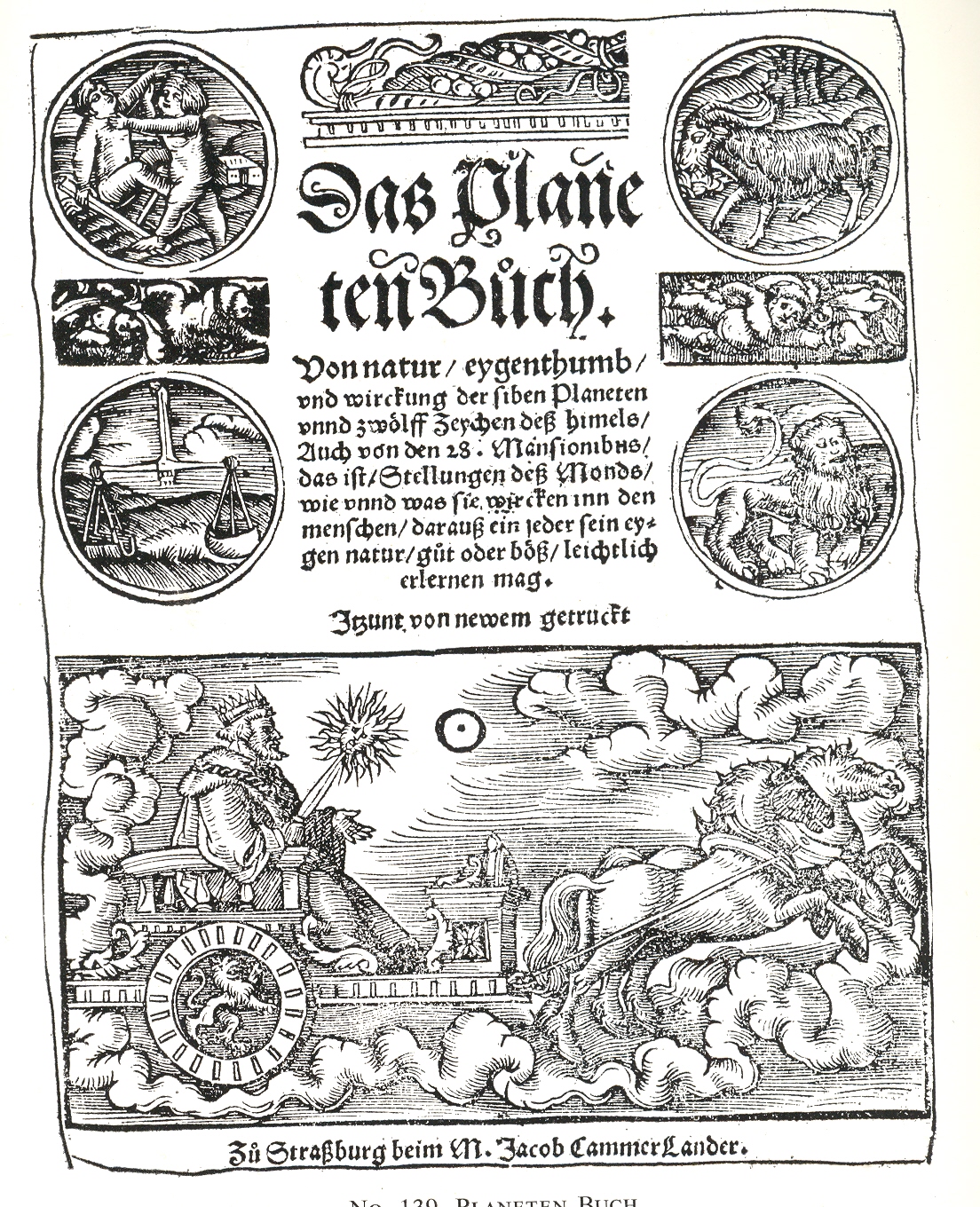
  • A History of Dots: the Black Sun of Das Planeten Buch, 1541

    JF Ptak Science Books LLC  Post 694  Blog  Bookstore

    History of Dots, Part 15

    Soft on the Heals ==Blog July 21=dotsof
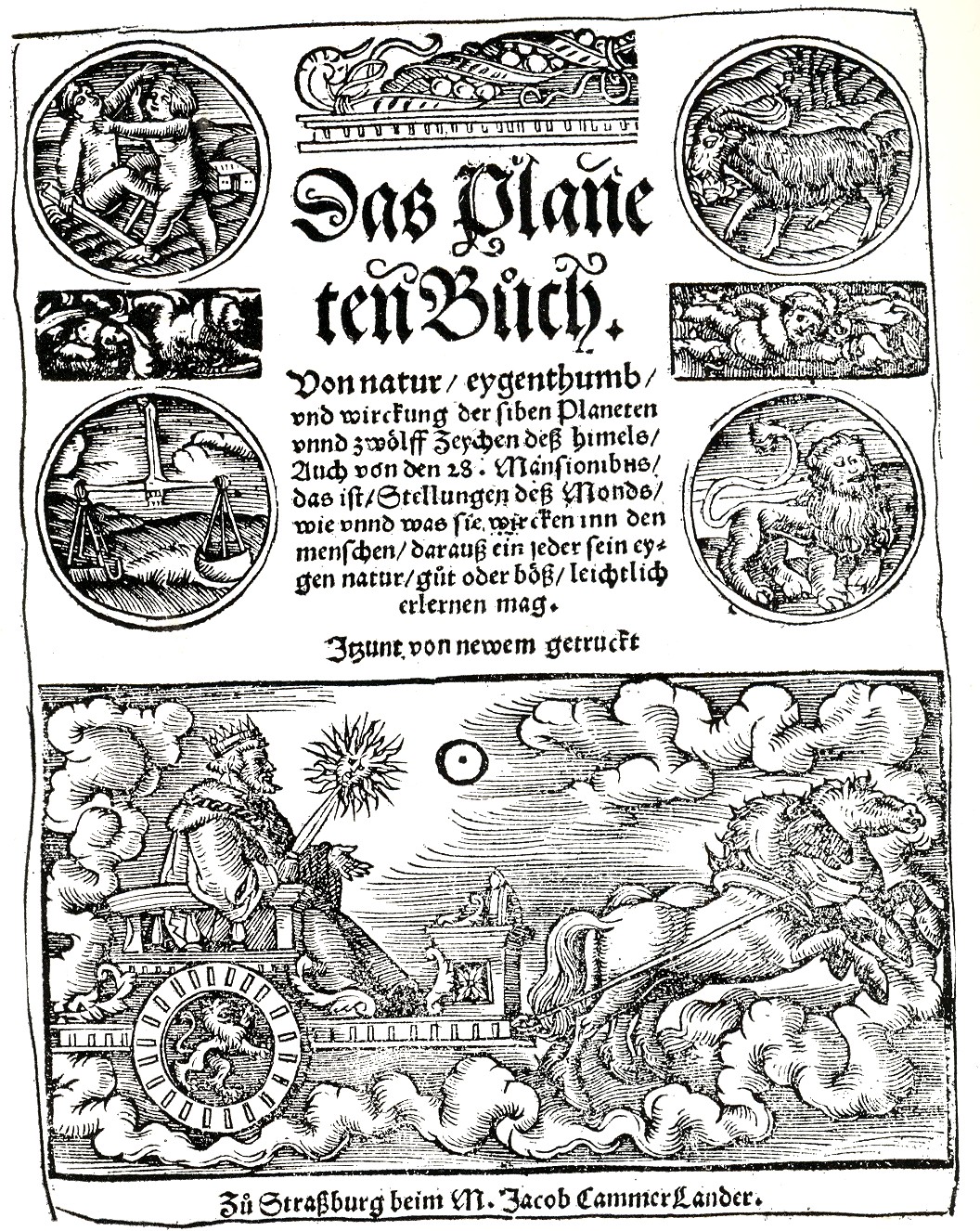
    the 1898 Planetary Visits post (earlier today) is this 1541 Books of the Planets (Das Planeten Buch.
    Von Natur, ey
    genthumb, und wirckung der siben Planeten…), which was published
    in Strassburg by Jacob Cammerkander..  It
    is a collection of medieval German accumulated astro-data and posie, cobbled
    together by an anonymous author, and strung together for the masses—it was
    evidently very popular, eager fingers pulling the many editions to pieces (and such), so that very few now exist. 

    The dot that I have in mind here is the standard astronomical depiction of the sun, and it appears brilliantly-n-black in the bottom panel close-by the image of Saturn racing across the sky. 


  • Vision: Looking Straight Up, Down, Across and Through–1525-1905

    JF Ptak Science Books LLC  Post 679  Blog Bookstore

    “Vision:  a device that belongs to those who have it. Far-reaching and fore-shortened, it is something that works best when used closely, loosely, finely and not at all. A gift-and-a-half and a half-a-bother.”  
    The imagined Devil’s Dictionary of Ambrose Bierce

    [See also my post Perspectives: Inside Looking Out, Outside Looking In]

     
     There is a BLOG==july 9--perspective Downsmall series of posts on this blog that deal with the perspective of lookinBLOG==july 9--perspective upg at things straight-on:  straight up, straight down, straight across.  As it turns out, in my many years of looking at prints and images, view that look directly up and down are pretty uncommon.  Some of the earliest straight-on images actually offered a new vision to people who were so long accustomed to not looking at things in this way.

    BLOG==july 9--perspective Down

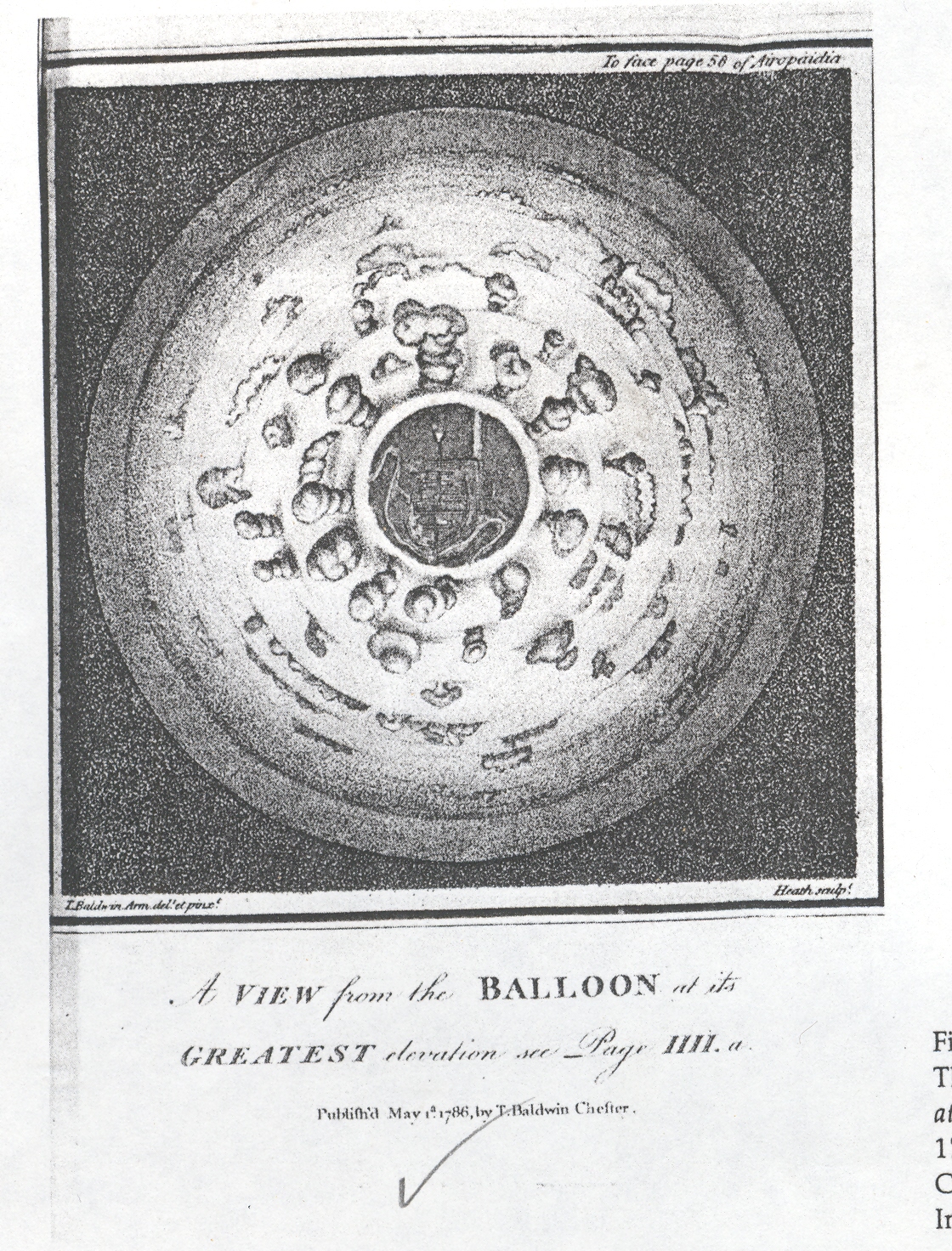
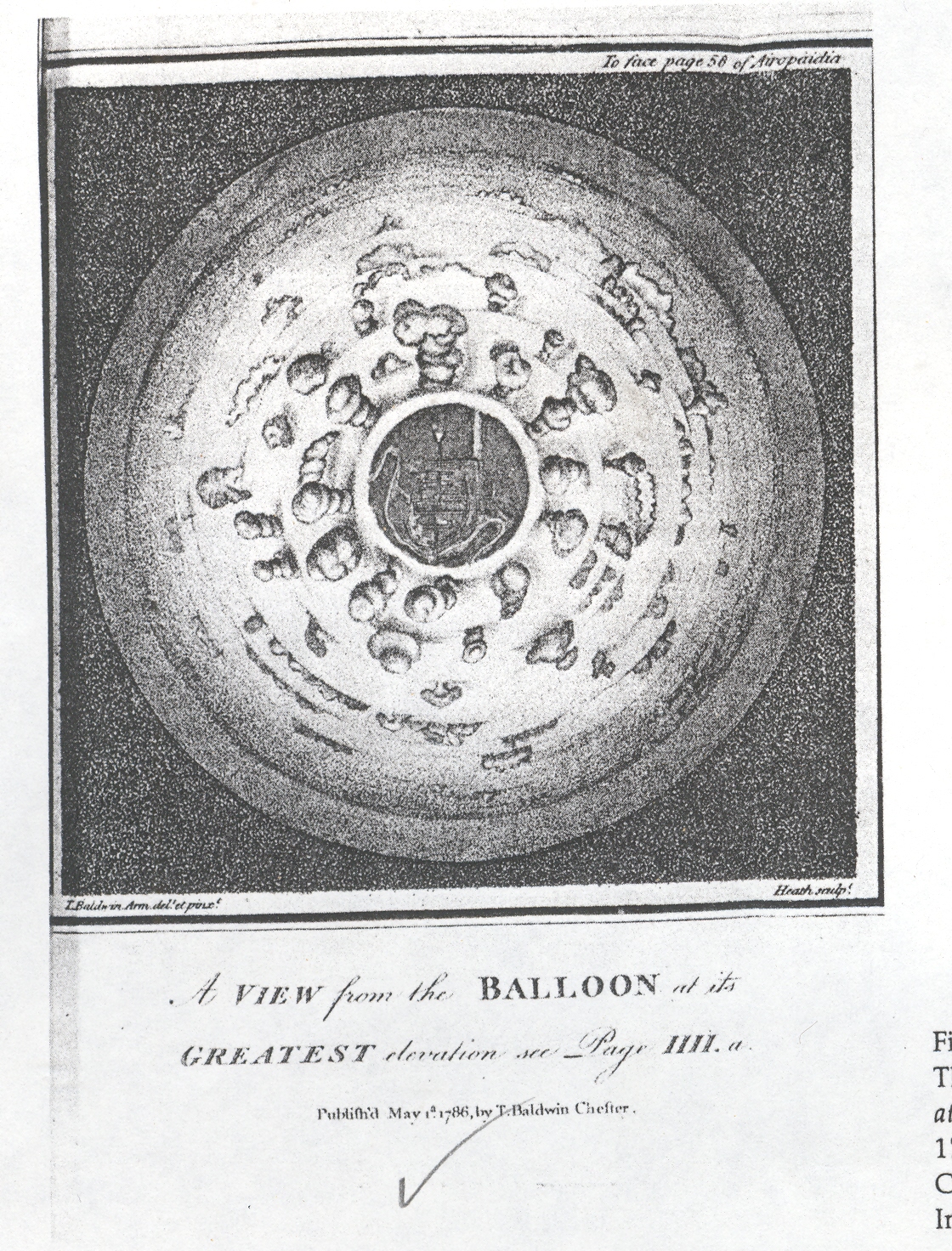
    And for a long time it was just not possible, not really, to look straight down at something from a height, or at least until the invention of flight at the hands of the Montgolfier brothers in 1783.  This first image offers a view looking straight down from a balloon through a bank of clouds and onto a town, and was drawn and published in 1786.  It must have been shocking to see this for the first time in that year, the image so unexpected and mostly not imaginable.  One of the other aspects here is that the viewer is looking obliquely down from the tops of clouds, the first time that this was ever done—so far as I can determine—with a scientific vantage point. 

    BLOG==july 9--perspective up

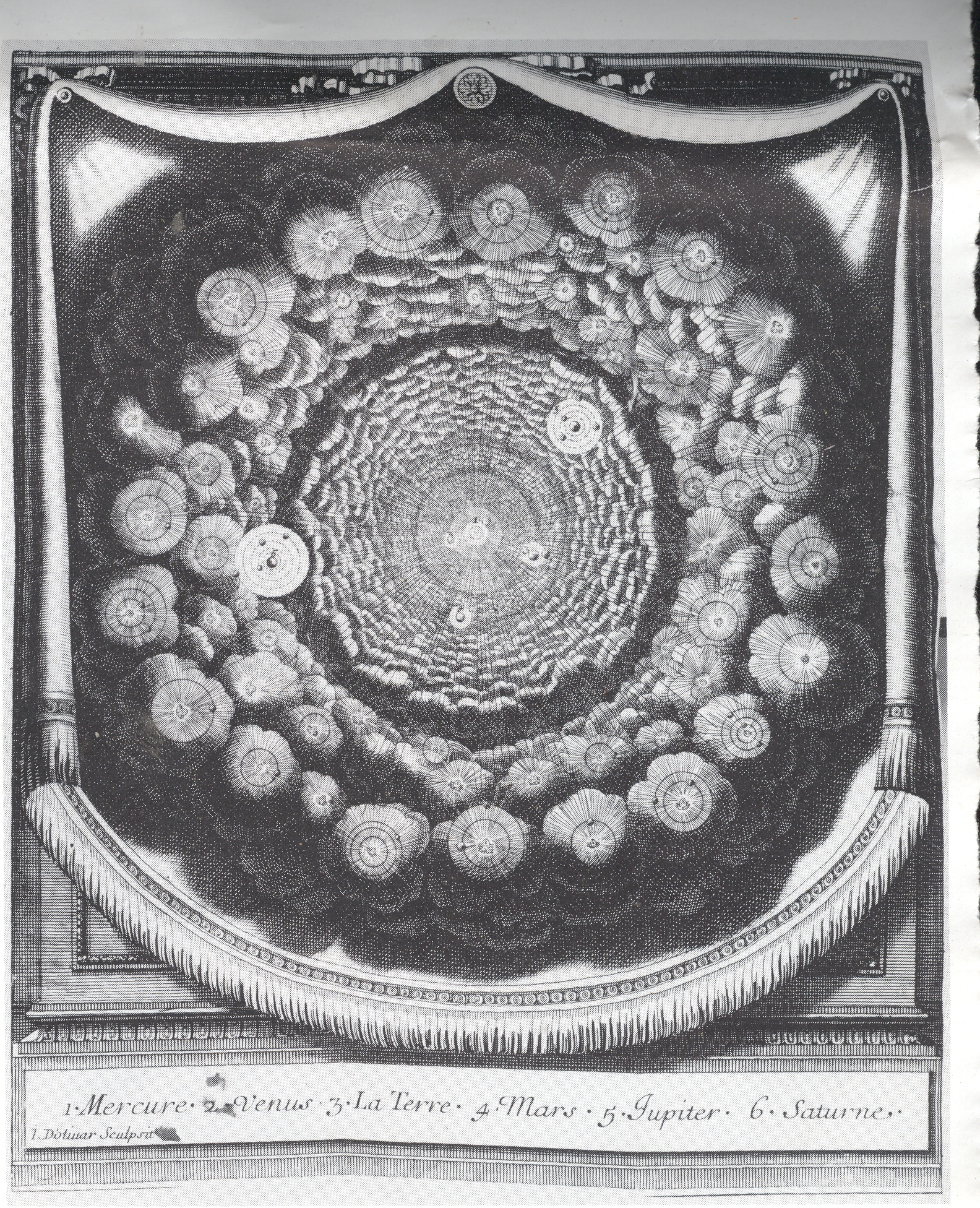
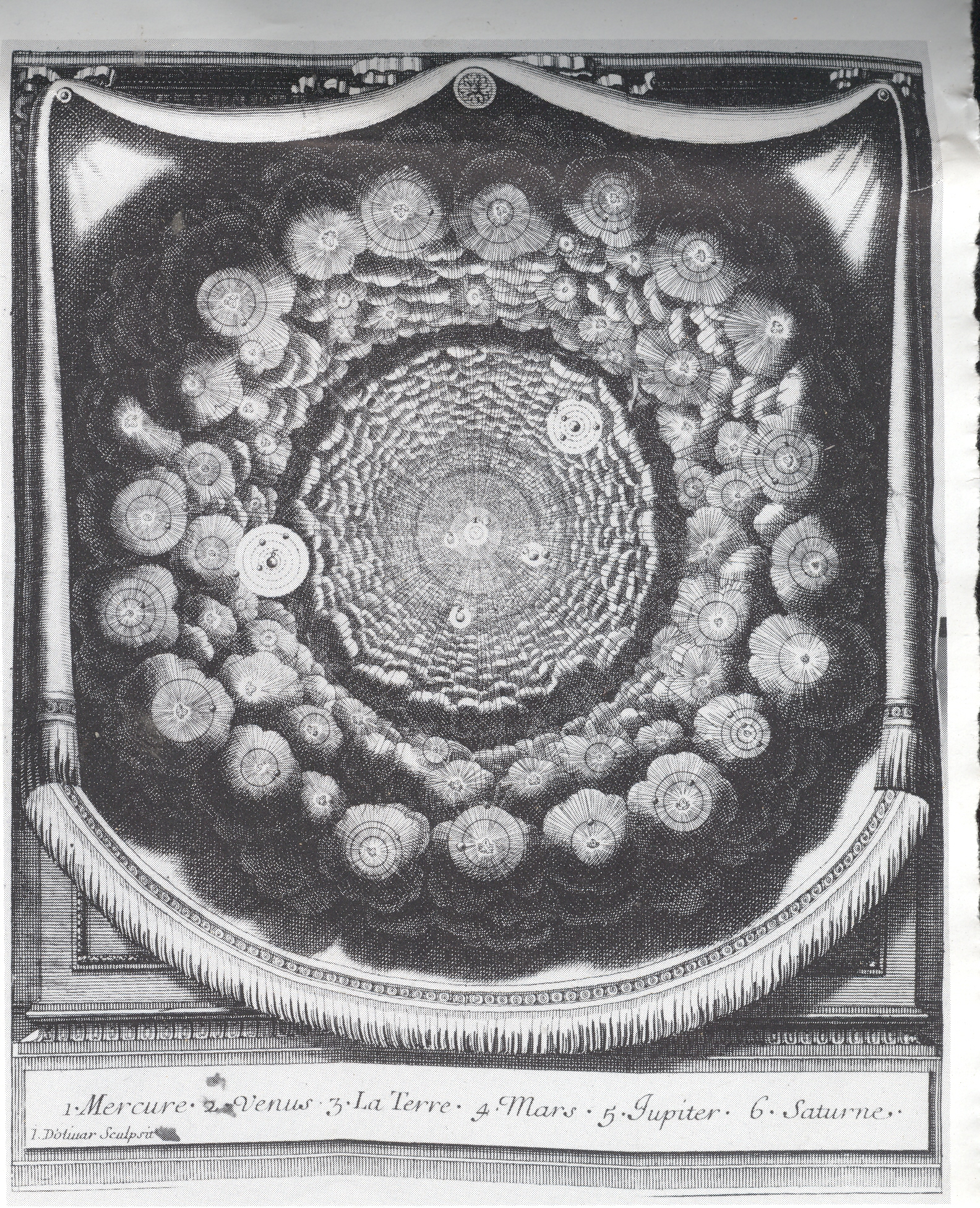
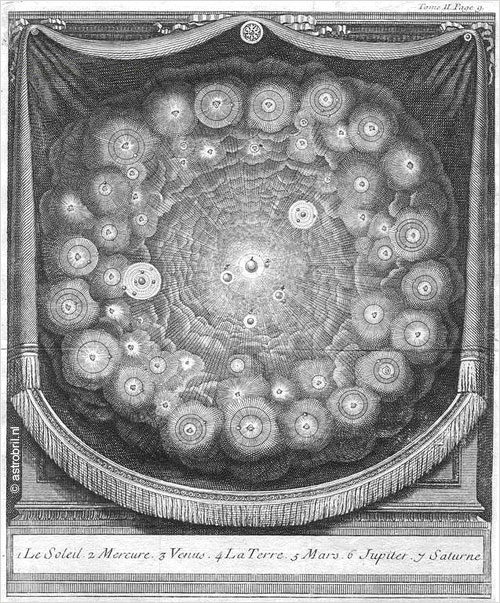
    The seeming complement to this image is from Entretiens sur la Pluralitie de Mondes (Conversations on the Plurality of Worlds), written by the great French philosophe Bernard le Bouvier de Fontenelle in 1686 (just a year before publication of perhaps the greatest work in the history of science, Newton’s Principia Mathematica). The Plurality was a best-seller by the best-selling Fontenelle. An excellent attempt by a rather restricted writer to engage the population-at-large, writing a high-pop book on what was basically the history of astronomy and cosmology of the preceding century. Copernicus was a major feature of his imaginary conversations with a muse as he wandered through a metaphorical garden of questions, with the observations of Galileo and Cassini also very prominently featured. But what interests me here is the great similarity between the two, the view from the balloon looking down, and the Fontenelle, looking up.  (Or what would pass for “up” in space.)  Except that the cloud-y looking things in Fonetenelle aren’t clouds at all, but solar systems.  This was a radical, church-pounding idea at the tiem, displacing the unique centrality of the human condition, offering the possibilities of other lives on other solar systems and other planets

    BLOG==july 9--perspective across . 

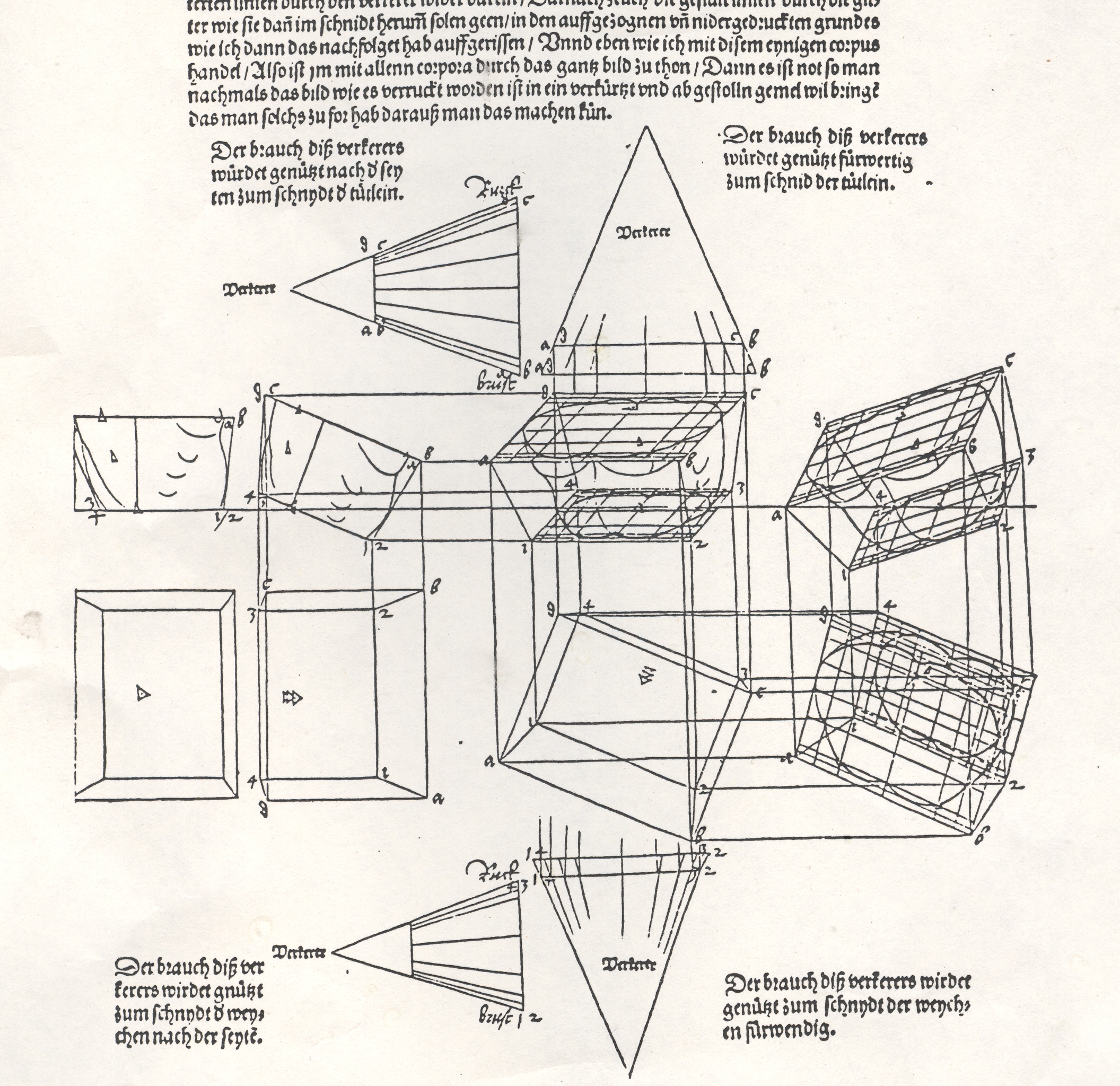
    Albrecht Durer’s (1471-1528) drawing of a geometrical man was an amazing–startling, even–object to the early 16th century consciousness. His Underwysung der Messung (“Treatise on Measuring”) written about 500 years ago (in 1525) set the stage for this next work–it is here that we find some of the most recognizable of Durer’s illustrations of the instruments that he employed to do his perspective work:   his …Symmetria partium…humanorum corporum (1537) was a masterpiece, and a key piece of revolutionary visionary thinking.  Durer–so far as I can tell–created an orthographically rotating human figures in three-dimensional trapezoids, creating incredibly human-like non-human forms.  Supra-human, perhaps; mechanized, calculated, structural. His use of stereometry, the science of measuring volume, was adapted to this study of human form and the relationship between that and movement.

    By doing this one could rotate the figures, pinch them, stretch them, and the proportions would remain exactly the same.

    They were in a sense a CAT scan.  And in this way the person in 1525, seeing this for the first time, would be experiencing something like the sensation of seeing an X-Ray for the first time in 1895 or a magnified flea in 1626.  It was a spectacular effort an a major key to understanding movement, and anatomy, and of course map making.

    This was a new way of thinking about the body, challenging the god-grace and ubiquitous church-inspired revelation of the body and how it worked.  This was not a necessarily easy time in which to picture humans in such a scientific way.  (In 1553 the physician and theological scholar Michael Severtus would be burned at the stake by John Calvin for his views on the Trinity, Nicean Creed and other related things, though his undeniably revolutionary idea of cardiopulmonary circulation was in itself a direct challenge to church teachings).

    Durer’s innovation accommodated empirical observation and allowed for proportional change.  Its importance in relational drawing, anatomical and  technical, cannot be understated, which I think trumped it as a subversive agent to orthodoxy.

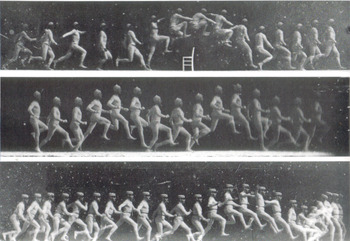
    Blog--july 9--marey Fast forwarding a bit there are the images of arrested time by Etienne Marey (who was a technoid and physician) and  who was able to capture motion of all sorts–he was able to develop a picture so to speak of the movement of blood in the body via his instrument to calculate blood pressure, and he also created a shotgun-style camera that made the world’s first high-speed photographs of movement.  And so it cane to pass that in the late 1870’s and early 1880’s people were instantly able to see what a horse looked like when it galloped or what the body did *exactly* when jumping over a chair.  When you couple this with fourth-dimension material one wonders why it took several more decades to bump into these images in the art world of the earliest part of the twentieth century.

    Blog--july 9--roentgen In 1895 50-year-old Wilhelm Conrad Röntgen’s ephochal discovery was announced (“Ueber eine neue Art von Strahlen”. “On a New Type of Ray”), built upon the work of J. Plucker (1801-1868), J. W. Hittorf (1824-1914), C. F. Varley (1828-1883), E. Goldstein (1850-1931), Sir William Crookes (1832-1919), H. Hertz (1857-1894) and the horribly odious Phil Lenard (1862-1947 and who didn’t die soon enough). The experiment revealed as much to humans as did the experiments and inventions of Hooke and Leeuwenhoek on the invisible worlds revealed by their microscopes. Bertha, Roentgen’s wife, sat for 15 minutes while her husband passed his rays through her hand; she ran from the room once she saw the results, revealing her very bones and no doubt a strong sense of the fragility of life, and the strong presence of death.  Many had the a similar reaction to the Kandinsky’s shapes and Malevich’s white circles and red rectangles and Ibsen’s drama and Einstein’s dancing dust and the rogue syncopation of jazz—these newnesses were threatening to all of the established ways of looking at physics, and art, and theatre, and listening to jazz.  It was a new perspective which challenged the firmly established vision of these things, upsetting the nature of comfort and acceptance.    It is probably a very natural reaction to try and protect established memory—but memory is made all of the time, and so should be relatively flexible…at least it is mechanically healthier to allow a little bending than to be rigid and brittle. 


  • Spectacular Gravitational Sculpture in the Rings of Saturn, 2009

    JF Ptak Science Books LLC  Post 651  Blog Bookstore

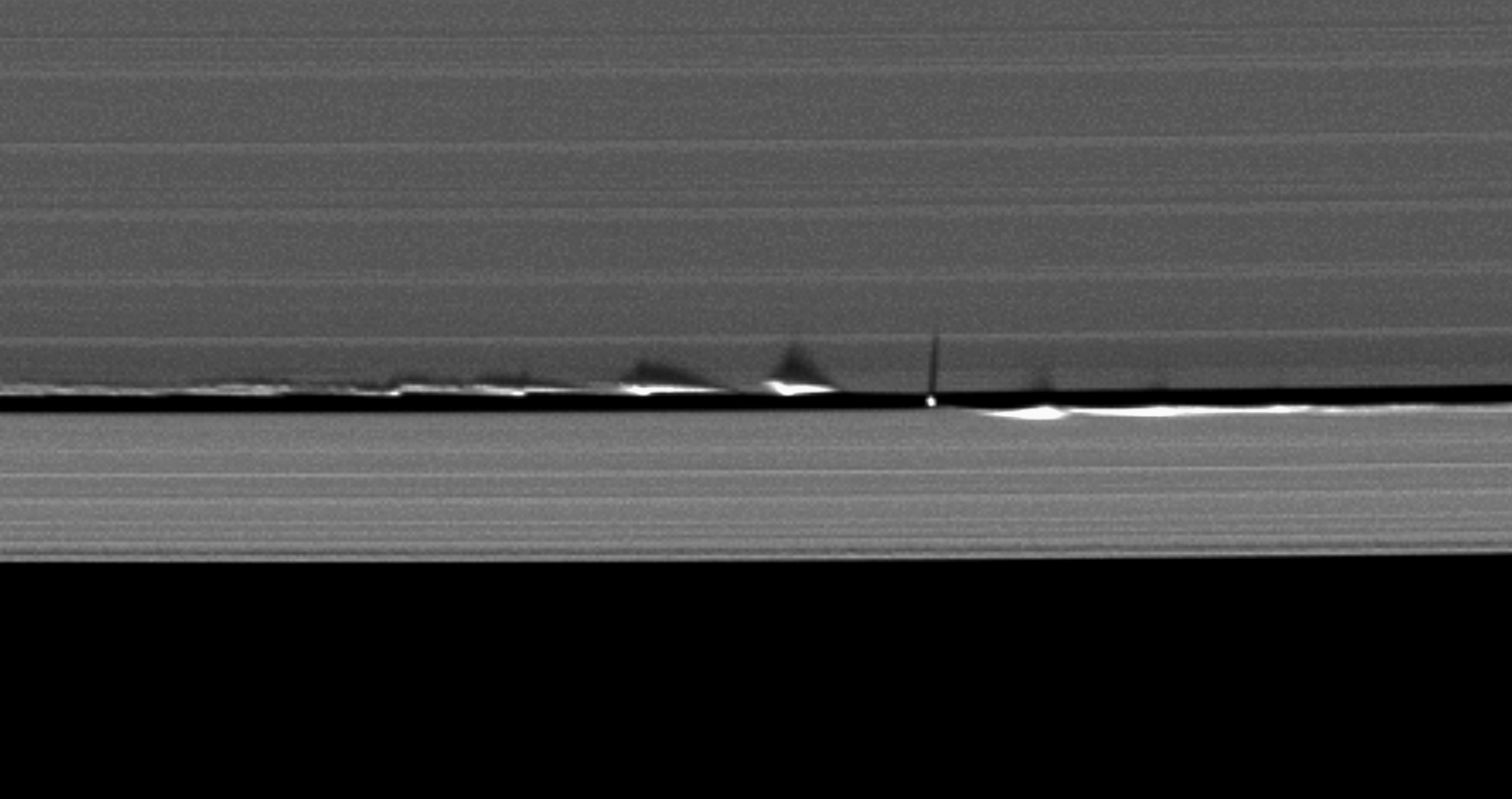
    These images, released on 9 June 2009, are from the Cassini Orbiter Imaging website (here for the press release of the photo) and were made by the international-effort Cassini voyager, launched 10 years ago in August.  The vertical structures (waves) that we see here in the rings of Saturn are cause dby the gravitational pull of Saturn’s 5-mile diameter moon Daphnis, which makes its home in orbit within the Keller Gap in Saturn’s outer A ring.  The news relsease says that the enormous strucutres–these bumps being beween 500-10,000 feet high–are the result of the gravitational pull of the moon perturbing the ring-edge partciles as it swings by.
    Blog--june 15--saturn rings det

    The photos are just stunning.  They are also the first evidences showing waves in the ring structure.  I think that they’re simply gorgeous. The little “ball bearing” type figure with the long shadow is Daphnis.  The JPL-managed spacecraft has produced remarkable photos throughout its long life–particularly in the cases of Jupiter and Saturn, where in my opinion no sci-fi or speculative artwork has ever come close to depicting the impossible beauty of those two planets as has Cassini.


  • On Learned Ignorance: George Hartgill’s Astronomical Tables

    JF Ptak Science Books  Post 620    Blog Bookstore

    According to negative theology, ‘there is not found in God anything other
    than infinity.’  (Cusa, De Docta Ignorantia, vol. I, § 26)

    “With respect to the intellectus, reason (ratio) is at the horizon…but with respect to the
    sense, reason is at the zenith, things that are within time and things that are beyond time
    coincide in reason.”(Cusa, De DoctaIgnorantia, vol. III, ch. 6, § 216


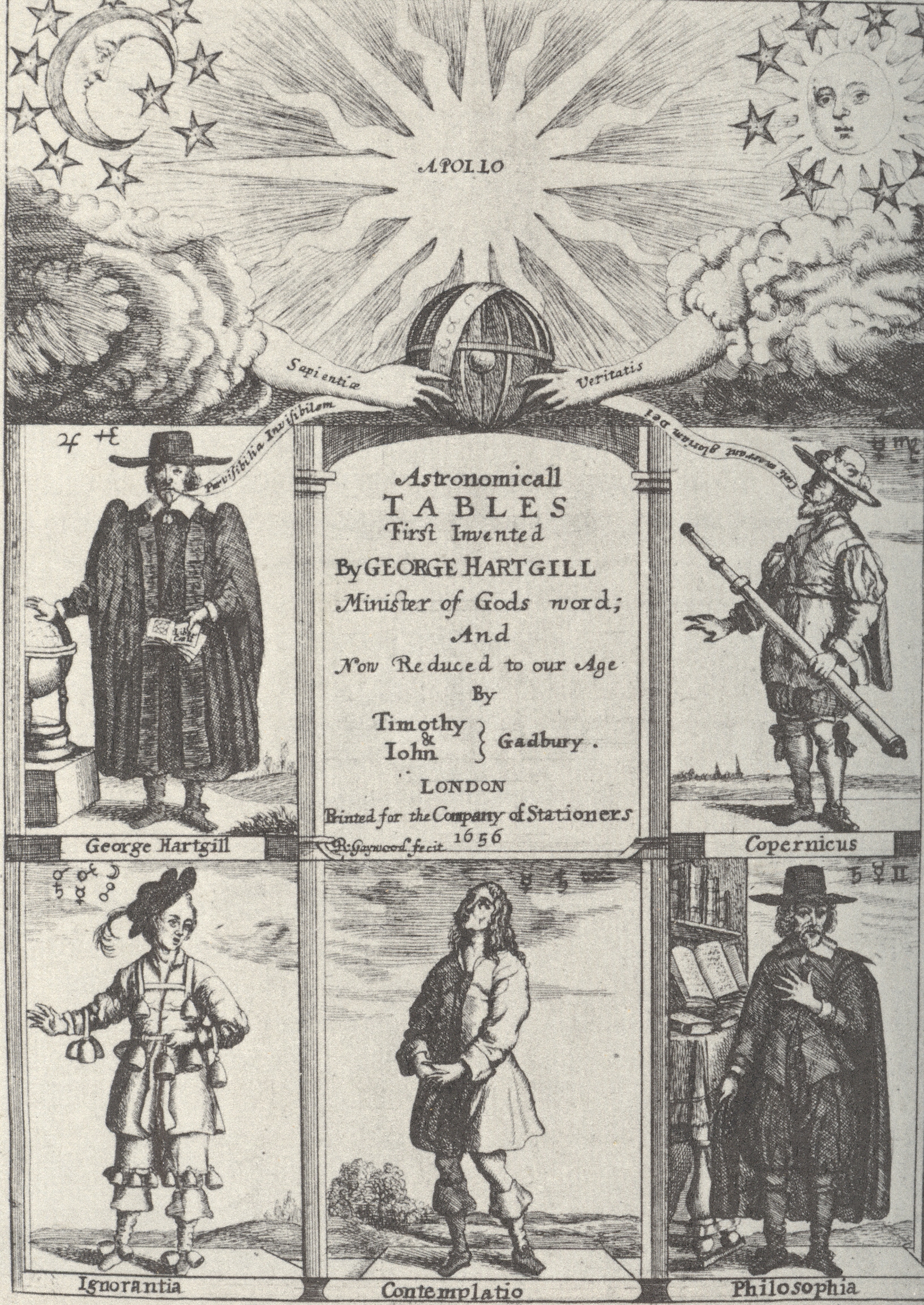
    Blog--May 20-hartgill In my imaginary Encyclopedia of Interesting Title Pages, the Astronomical Tables shewing the Declinations….* by  George Hartgill** is very much middle fare,  very interesting but not overly so (I say sniffily), but very much worthy of attention.  The initial bit that caught my attention was small and sort of trifling: it seemed that the writer possessed  the temerity to place his own portrait on the title page across from that of Copernicus.  As it turns out, the selection was obvious and logical, though I wouldn’t know that until I pieced together the symbolisms of the page.  Aside from that, there was a fair amount of action on the title page, and for all of that it retained a certain spareness, a lightness in spite of itself.

    The title page is an elegant call to synthesis of science, philosophy and religion in the understanding of astronomy. To start: at the top-center is the burning sun, “Apollo”, the great and perhaps most important of all the Olympians, the god of sun and light (among other things).  The arms of the heavens (signified by the arms reaching out from the Moon and Sun) embracing a globe of the earth within an armillary sphere. The arms carry the legends of “spientiae” (“wisdom”) and “veritatis  (“truth’).  Surrounding the title proper are five figures, the upper two being Hartgill and Copernicus.  The word balloon coming from Hartgill’s mouth says “per vidibilia invisibilem” or “ the visible and the  inivisible”, and touches the hand of wisdom; Copernicus’ balloon I can only partially read, but it seems to end “gloria dei” (to the glory of god), and ends under the arm of truth.  In turn these two figures rest on three others:  Ignorantia, Contemplatio and Philosophia. 

    Ignorantia here is depicted by an entertainer decked out in bells.  He isn’t necessarily “ignorant” per se: the “ignorance” comes in multiple forms: one is of the intelligent and educated person knowing the things that weren’t yet known; another in terms of a belligerent ignorance, insisting on the known and the comfortable in the face of compelling new evidence stating otherwise; and also of simple ignorance of not knowing and not caring.  Contemplatio and Philosophia pretty much speak for themselves.  The three of them seems to support the advanced “ignorance” of Hartgill and the mathematical/philosophical Copernicus, all of which are illuminated by the wisdom and truth of the source of all light.  Its simply a wonderful, well-designed title page.

    *Astronomical tables shewing the declinations, right ascentions, and aspects of three hundred sixty five of the most principall fixed stars and the number of them in their constellations after Aratus : as also the true oblique ascentions and descentions of all the said stars upon the cusps of every of the twelve houses of heaven according to their latitude….1656.

    **Granger’s Biographical History of England (1824), says of Hartgill: (he was)…”chaplain to the Marquis of Winchester, was a painful preacher, a reverend divine, and a most excellent mathematician, as appears by his ” Astronomical Tables;” which, according to the judgment of the best astronomers, could not have cost him Jess than seven years’ labour, considering the perfection of the work.”


  • Strange Things in the Sky Department: the Alchemical Cosmology, 1618

    JF Ptak Science Books LLC  Post 594       Blog Bookstore

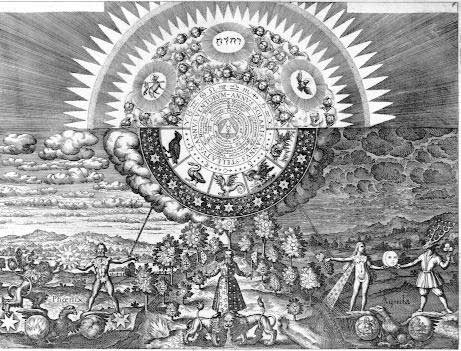
    Well.  There’s a simple ton of complexity going on in this difficult, famous print by the
    great Mathias Merian—its like a moving puzzle to me, complicated by the
    virtually changing size of its pieces.  There’s
    just too much in it that I don’t understand, too much archaeo-religico-alchemical
    bubbly going on for me to make much deep sense of it all.  I do like that it is all coming from the sky,
    though, which is why I’ve selected it for this continuing series

    BLOG--THINGS IN THE SKY--MYLIOUS  

    The engraving, Tabula Smaradina (“Emerald Tablet”) is
    Merian’s interpretation of the alchemical cosmology, a  schemata and representation of the order of
    things.  It appears (first) in Johann
    Daniel Mylius Tractatus III Seu Basilica Philosophica… (1618) and makes
    subsequent appearances in other works by the author, as well as in Lukas Jennis’
    Musaeum Hermeticum (1625, see below). 

    Basically, the Emerald Tablet shows the opening of a
    complex heaven and the delivering of the philosopher’s stone to the earth.  It is a magnificent effort and no doubt has a
    great power to alchemists, and I can understand only a bit and a piece here and
    there.  For example, in the bottom right,
    we see a couple of people holding a((n) eclipsed?) Moon, standing on the wings
    of an eagle which protects a double hemispheric representation of the
    constellations.  The figure on the right
    is a naked woman, who may well represent Luna:  her right breast is a star, and from her
    armpit is a streaming torrent of stars which comes close into contact with
    shrubs labeled with the astrological signs of the planets.  The cluster of grapes in her right hand and
    the stream that she is straddling must indicate a generation, or a birth, or
    rebirth, or time, or the universe.  Luna
    is connected via something to the heaven-element which in turn is connected on
    the left sign of the print to a man holding a sun, who I guess must be Sol.  Heaven and Earth, Brother Sun and Sister
    Moon, and so on.  From here it all gets
    away from me, no that it isn’t gone already. 
     

    ·Posted by :

    ·in:

    — —

  • Things Out Of Place Department: Ledoux’s Architecture of Multiple Planets

    JF Ptak Science Books LLC   Post 592              Blog Bookstore

    A Cosmology Seeded in Salt?

    It  is, I admit, mere imagination; but how often is imagination the mother of truth?–Sherlock Holmes

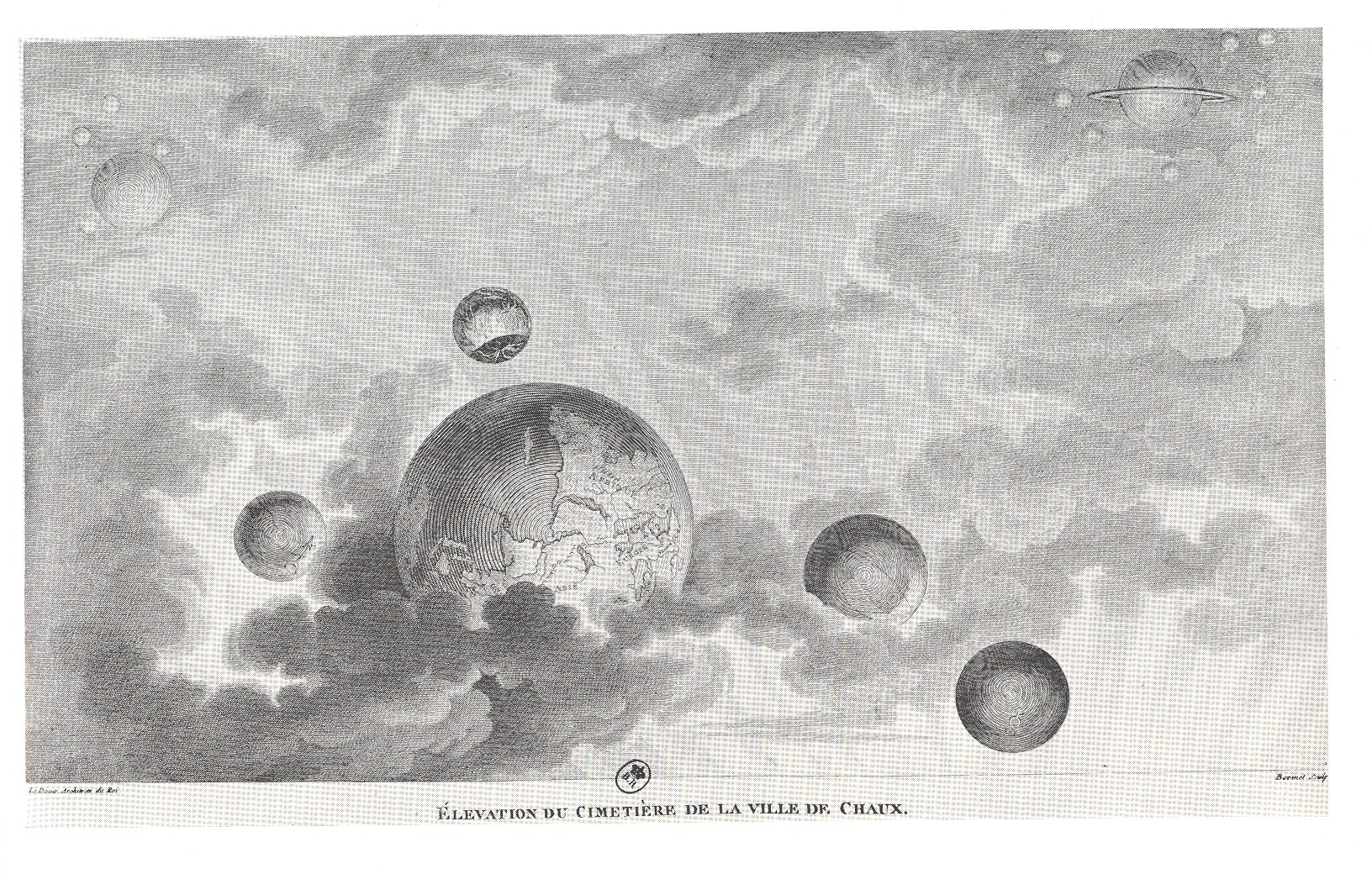
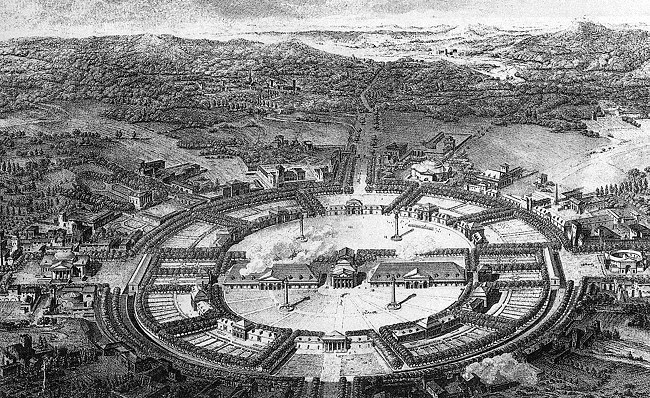
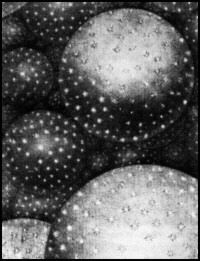
    I’ve written a little earlier in this blog about the beautiful Claude-Nicolas-Ledoux  (1736 —1806) being the 18th century Marcel Duchamp (or vice versa).  I was struck by this image by the master–a depiction of the Earth nestled in clouds amongst other  planets in exceptionally close proximity.  There was evidently very little explanation to go along with this idea, except that it was inspired by his utopian plan for the saltworks of the factory-village at Chaux. On the face of it there seems to be no physical connection between the two–it must be the philosophical connection that Ledoux was thinking about.  From my point of view the idea for the city of Chaux was of course idealistic, perfect, communal, with a vast sense of fairness and correctness, and of great sensibility.  It was a “gathering of brothers” as Ledoux wrote, a city of lodges of workers, gathered together for mutual profit.

    Blog--sphere--boullee

    Perhaps this vision of cushioned planets was a larger expression by Ledoux of heavenly gratuity?

    Anthony Vidler points out (in his book The Writing of the Walls) that Ledoux described his utopian Chaux as a “galaxy of…utopian forms” (page 101).  Since Ledoux also described the architect as the “delegate of the Creator”, perhaps he reverse-engineered a cosmology describing a mutually beneficial community of planets from a community of brotherhood gathered around the (admittedly important in 1780) production of salt. 

    Blog--ledoux--chaux

    Or perhaps not–this may just be way to simple and, well, just wrong.

    Blog--plurality of world fontenelle NOTE:  I do just want to point out here (and discuss at another
    time) that Ledoux was by no means the first to describe multiple-world
    systems.  One of the prettiest of the earlier attempts, for example,
    belongs to Bernard le Bovier de Fontenelle who published this
    delightful rendition of an extra solar-systemic galaxy in 1682 in his Entretriens sur la pluralite des mondes.  This
    sort of thinking was somewhat well-established by the time Ledoux
    offered his idea around the time of the turn of the 18th century.  

    Should we not come to the rescue of a cosmic phenomenon  trying to reveal itself in a sea of errors?  Peter van  de Kamp (1983)


    For a beautiful romp, have a look at Ledoux’s L’Architecture considérée sous le rapport de l’art, des mœurs et de la législatio. I’ve included a short list of projects (with links) in the expanded reading section below. 


  • The History of Dots and the Isotropic Universe: the Iconic Image of the Irregular, Dot-Filled Milky Way Galaxy of William Herschel

    JF Ptak Science Books LLC  Post 560

    Lucretius (95-55 BCE), in his Nature of the Universe, stated that  since there is nothing outside the universe, it must be infinite: “the universe stretches away…just the same in all directions without limit”;  it stretches far and wide into immeasurable depths.  All that is in it, he reasons, is distributed equally and in the same way.  But this is not the case, even in light of Edward Milne’s cosmological principle (1933),  stating that all  places in the universe is alike—which is true, except that there are vast disturbances in very large local areas that distinguish themselves from other places.  The work of Gamow/Alpher/Herman  (1939) and Penzias/Wilson in establishing the cosmic microwave radiation  (CMB)  shows that the observable universe to be very close to homogeneous and isotropic, and of course accelerating. (Suffice to say for this short post that there are models– Friedmann-Lemaître-Robertson-Walker (FLRW) model for example– which show the observable universe to be  “weakly” inhomogeneous and anisotropic; but generally and on average the isotropic models stand.) 

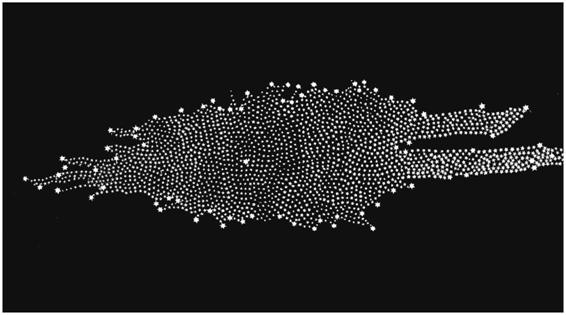
    Blog--herschel Perhaps the earliest published “bump” in the calm waters of the equal-distribution universe occurs with William Herschel (1738-1822), who in 1785 published a revolutionary image of the “Stellar System” (the Milky Way), showing its irregular pattern and the off-center placement of our sun amidst a panoply of other stars.(His image was remarkably and substantially correct, with the most grievous error being the placement of the sun too close to the center of the galaxy.) It was an image which bought the idea of a not-so-humano-centric idea into popular philosophy. This galacto-centric view remained until the work of Harlow Shapley’s globular clusters in 1918.

    Blog--wright, thomas

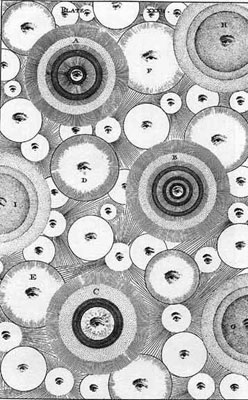
    This varied quite widely from the images of other astronomical observers and theorists such as Thomas Wright (1711-1786), who in his book An Original Theory of the Universe (1750) gives the Milky Way a friendlier, homogenous manner, overruling his earlier theory that the stars were “promiscuously distributed through mundane space” and delivering a theory of the stars organized in a regular pattern based upon a hierarchical center of some sort around which everything else was positioned.  He also provided this fabulous image of the centers of galaxies as an immutable, transcendent force, the eye of the creator, rather than the simple, positive dot.

    This idea was picked up by Immanuel  Kant (1724-1804) who in his own work, The Theory of the Heavens (1755), expanded on the multiple centers of creation(s) (an “endless immensity in an unlimited plenum of creations”) of cascading and separate galaxies, and detailed a vast system of disk-shaped galaxies which revolved around centers which in turn revolved around other centers, becoming far vaster, though all were centered on a dominant, universal center.

    Blog--kant But it was Herschel’s images of the dots that came closest, longest, to the most accurate and appealing depiction of the universe, especially with the location of our solar system’s principal dot seen as a dot among dots in a universe of dots. 


    ·Posted by :

    ·in:

    —

  • The History of Dots 6: the Kingly Dot of Copernicus, 1543

    JF Ptak Science Books LLC  Post 556

    “Diligent
    reader, in this new work you have the motions of the fixed stars and planets,
    reconstituted from ancient as well as recent observations, and embellished by
    new and marvelous hypotheses.

    Therefore buy, read, and enjoy this work.”  –Title
    page of
    The Revolutions of the Celestial
    Orbs
    ,by Nicolaus
    (Koppernigk) Copernicus,1566 (second edition)

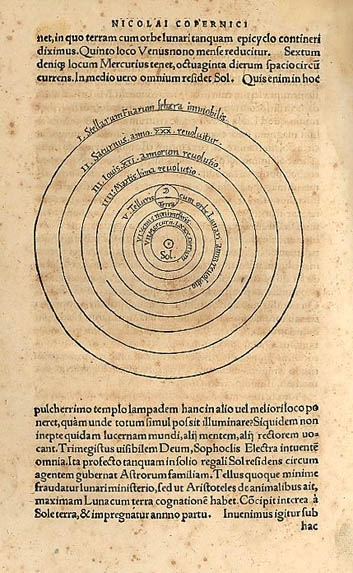
    Slim is the history of published books where authors directly beseech people–right on the title page–to buy their book.  But such is the case with the De revolutionibus orbium coelestium, which, when published, finally, in 1543, ushered in a new era of scientific explanation–it was perhaps the very beginning of what could be called “modern” science.  And the centerpiece of it all was a fine little dot that was the symbol of our sun.  It is also a little unusual that the standard symbol of the sun was presented so, even at this relatively early date for printing scientific treatises, as the sun was more often than not presented with the standard flaming circumference and human face.  (Earlier in this blog I made a word map of the first ten chapters of De revolutionibus.)

    Copernicus2
    Copernicus
    But the simplicity of the representation of the sun falls quite clearly within the author’s tendency of directness an plain speech.  He presented his theory with ease and a calm matter-of-factness (which included 100 pages of tables, and 20,000 tabulated numbers) which, considering it was overturning an entire world view and threatening a basic tenant of the church, was pretty astonishing.  It was actually quietly shocking at the time, both in how the theory was presented and how it was received.

    Copernicus states very simply that “the author of this work has done nothing to cause blame” in his revolutionary work.  He also states in the preface that he is not the first to work on the sun as the center of the solar system (and universe),  citing for example Philolaus the Pythagorean, Lysis and others. And he also widely recognizes that there was much more to come in the future, much in the line of the way of one of the very last lines of Kepler’s Harmonia:  “there is still much more beyond”.  

    Copernicus certainly did not stand for disagreement with his work, as he thought that anyone invested with a certain amount of mathematical knowledge could in no way disagree with him simple as that.  I quote a rather lengthy bit from the  early stages of the book:

    “Perhaps there will be babblers who claim to be judges of astronomy
    although completely ignorant of the subject and, badly distorting some
    passage of Scripture to their purpose, will dare to find fault with my
    undertaking and censure it. I disregard them even to the extent of
    despising their criticism as unfounded. For it is not unknown that
    Lactantius, otherwise an illustrious writer but hardly an astronomer,
    speaks quite childishly about the Earth’s shape, when he mocks those
    who declared that the Earth has the form of a globe. Hence scholars
    need not be surprised if any such persons will likewise ridicule me.
    Astronomy is written for astronomers.”

    But so much has been written about this fantastic book that I’ll not go
    into it here.  All I want to point out here in my tiny way is the
    urgency and importance of the solar dot–a simple representation of the
    sun, replacing the place of the earth in the primordial soup of the
    solar system, the very fabric of the  construction of the universe.

    ·Posted by :

    ·in:

    —

  • The History of Missing and Blank Things #35: The Disappeared Solids of Johannes Kepler

    JF Ptak Science Books LLC    Post 548

    (Continuing the thread on a History of Blank and Empty Things…)

    Spheres_Euclids5solidsKepler
    The great Joahnnes Kepler, conceived at 4:27 on the morning
    of his parents’ holy joining, was raised a disagreeable boy by disagreeable parents,
    and that in spite of being supremely gifted, mutually dependent on his
    hypochondria, intellect, and astrology. 
    He was perhaps one of the dozen most influential scientists of the last
    500 years, and had an over-assuming and awful disposition.  

    The man who brought about the final loosening of religion’s grasp
    on astronomy and the development of cosmology had a difficult time in his childhood,
    sounding lonely and exiled.  His father was
    irritable and irritating, but his mother, described by some as garrulous and quarrelsome
    and of a “vile disposition”, seems to have been in a class by herself, and left
    an indelible mark in her son.  The full
    truth of Kepler’s mother was that if you described her as being like  a ”witch”, you may have been correct:  the old woman, at 74, after years of being
    suspected of being a witch, was arrested, finally, and hauled away under this
    suspicion.  In a posthumously-published
    work called Somnulum, Kepler himself writes of his mother as being in contact
    with devils from the Moon (among many other things).  His childhood left a long shadow on his
    social life.

    It is remarkable to note his nearly alphabetical diatribe on
    his schoolday associates; I’m not o sure how you leave behind ideas and feeling
    like this later in life, and I suppose that you don’t.   It has nothing to do with his development as
    a scientific icon, but I

    He rattles off his chums as follows:

    “Holp openly detested me and on two occasions we got into
    fist fights….

    Molitor dislike me because I betrayed him…

    Kollin didn’t hate me, but I hated him…

    Braunbaum turned from friend to foe because of my
    boisterousness…

    Huldenbach became hostile because of my rash accusations…

    Seifer disliked because everyone disliked him…

    Kleber detested me because he thought I was a rival…

    Redstock was ticked off whenever someone praised my
    abilities…

    Husel tried to block my progress…

    Between Dauber and myself there was quite a jealousy…

    Lorhard would have nothing to do with me….

    After Jaeger had lied to me I was insulted for two years…

    The rector became my enemy because I did not accord him
    sufficient honor…

    Murr became my enemy because I reprimanded him…”

    And on and on.  Kind
    of incredible if you ask me, but from this did greatness come. 

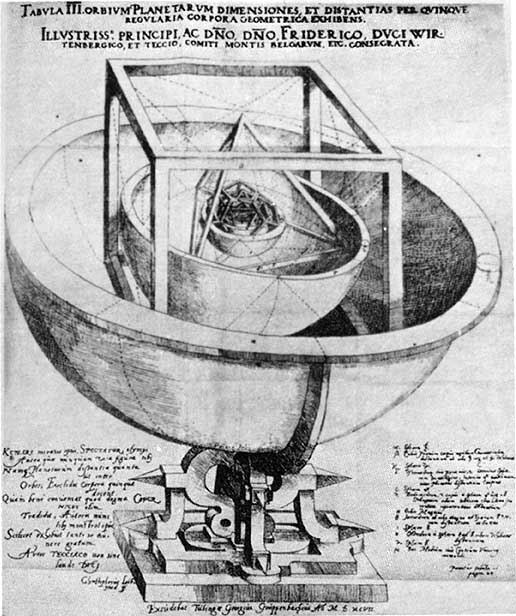
    On the way to restructuring the universe with his Harmonicae mundi and Epitome astronomiae, Kepler made a first
    abbreviated stop in his Mysterium Cosmographicum—it was an interesting work, but
    as substantial as it was it had as many flaws. 
    Galileo received a copy, and wrote politely back, but was very guarded
    in his opinion of the work.  Part of the
    problem was Kepler’s sustained interest in his astrological callings; another
    part came with his great reverence.  He
    thought that god was perfect, and that the universe he created as perfect, and
    so it all could be explained perfectly with a perfect method, which in this
    case was geometrical.  Explaining the proportions
    between the sun and its planets, Kepler devised a system in which spheres and
    squares and other objects were described within one another, separating the planets
    via distances determined by their points of contact.  It wasn’t a winning system, but it did abide
    the Copernican system, even as his forms disappeared into nothingness..  Kepler went on to
    bigger and greater things.

     Einstein, who much admired Kepler, said of the man: “[He]
    was one of the few who are simply incapable of doing anything but stand up
    openly for their convictions in every field.” 


  • Revolutions in the Color “Red”: Paul Gauguin and Edwin Hubble

    JF Ptak Science Books LLC  Post 531

    A circus passed the house—still I feel the red in my
    mind.
      Emily Dickinson, 1866

    Color expresses something by itself.  V. van Gogh

    Pure color!  You must
    sacrifice everything to it
    …  P. Gauguin

     
    Standing in my friends Lucy & Andy Archie’s store, standing near a
    window and catching some sun on a cold stinking day, a large red jar cast a
    long red shadow along the wall, causing me to think about the color. (It was a
    pretty nice shadow.)

    Red has turned up as an important color in terms of
    patriotic/vitriolic symbolism (as in the revolutions of 1848, Garibaldi,
    communism), Aztec cochinealial luxury,  important burial dress of the
    Cro-magnums,  signs of divine favor and
    condemnation, Roman red divine, Egyptian danger, royal cinnabar of China ,
    Indian bridal dresses, Japanese heroic figures, and on and on (into the lower
    realms of red tape, blood red, fire, blind anger, love/passion, evil, crushing
    impropriety,  and etc.)

    Red’s most important contributions, perhaps, at least in
    modern times of the past few hundred years or so, comes in the field of art and
    science—and its appearance really is pretty monumental, and weirdly
    coincidental in their placement in the chronology of Big Important Stuff.  The birth of impressionism (with Monet and
    the Salon des Refuses), the greatest change in the history of art since the
    rediscovery of perspective, and the solidification of spectrum analysis (Bunsen
    and Kirchhoff), both occurred around the period of 1859-1863—the great use of
    red for both of these developments would come somewhat later, though the red
    roots began here. 
    Img128
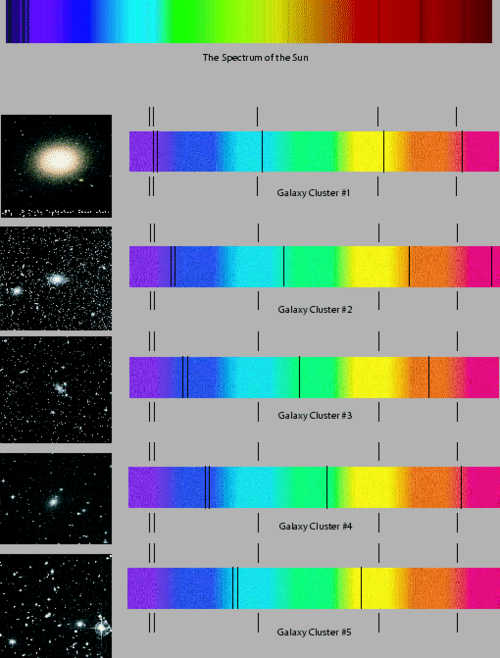
    The achievement of Bunsen and Kirchhoff, started in the
    epochal year of 1859 (the same year seeing the publication of the Origin), was
    nearly as spectacular as any other scientific achievement of that century.  The two men showed—and this would have been
    incredible to the mind of the 19th century—that individual atoms had
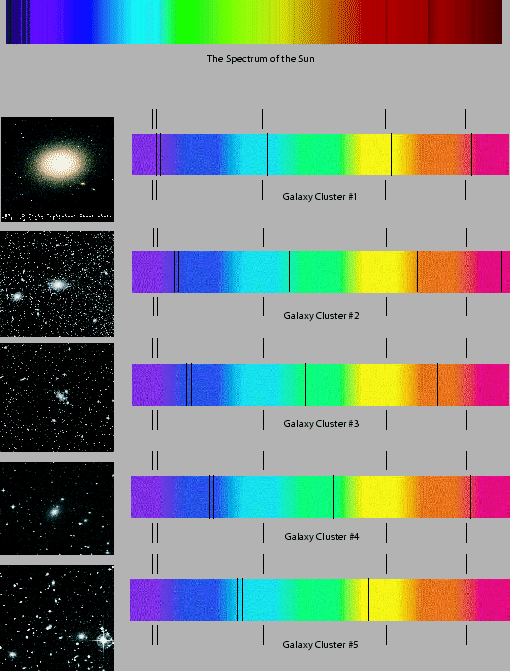
    their own spectral signature.  When the
    Englishman William Huggins absorbed their work, he realized immediately (as did
    Bunsen and Kirchhoff) that the spectroscope could be turned on the sun and all
    the rest of it—the results of the experiments of these three revealed the
    elements of what stars were made of, something that must’ve seemed like science
    fiction come true.  The second part of
    the second step* in this fabulous discovery and application came 65 years
    later, when American astronomer Edwin Hubble** theorized and proved  that the red shift that occur in the spectra
    of all galaxies actually (a phenomenon which had been observed for years but
    not understood) meant that they were all racing away (at a speed proportional
    to their distance, Hubble’s Law) from the Earth—the basis of the Big Bang.  Cosmological significances aside, this was
    also a big deal for the advancement of color, as it really hadn’t played a very
    major part at all in the history of science to this point (excepting the
    brilliant occasional bits like Newton’s
    Opticks). Color just wasn’t a part of
    the great systems and ideas of Plato, Pythagoras, Aristotle, Euclid,
    Kepler, Newton
    and so on—it just didn’t come into play. 
    Blog--gauguin

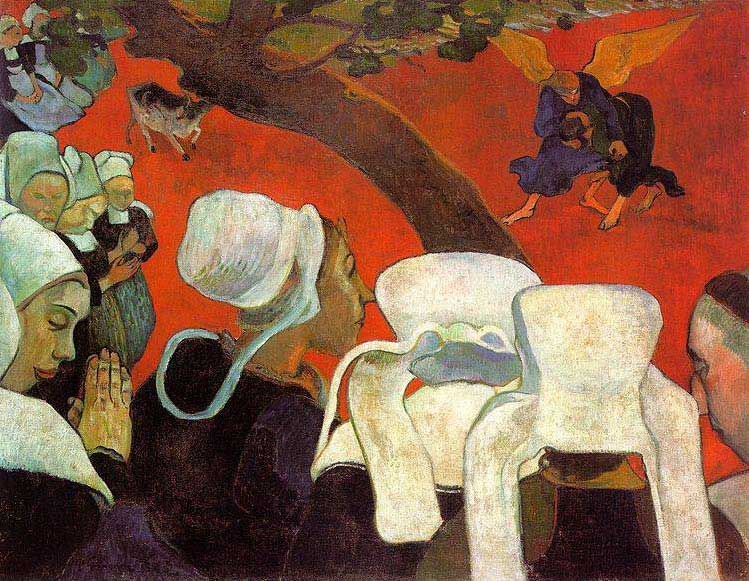
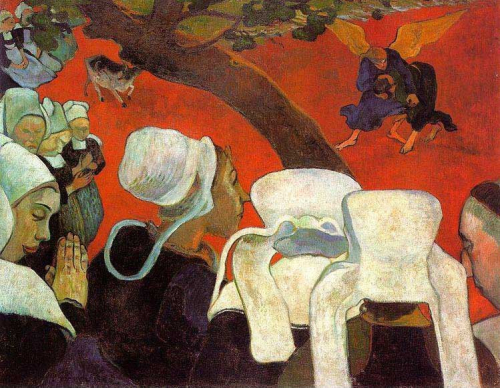
     Now, as to the importance of Red in art.  It comes for me with Gauguin.  Gauguin and his red grass.  Red grass doesn’t mean anything today, but in
    the early 1880’s, well, red grass was, simply, everything.  It was a revolutionary idea to make the idea
    of what grass”is” subject to the color that the artist thought was demanded by
    it subject, and that all of this was an artistic variable in the control of
    each individual interpretation.  It
    happened right there in the middle of the Impressionist movement, and was the
    beginning of the end for representational art, the final blow to which would
    not occur until 1911 with Mr. Kandinsky.


    This was a lot to blow through in under a thousand words,
    and undoubtedly I’ve slandered several good ideas—but I think overall that this
    is a reasonable idea, this importance of the color RED.  There’s much more to be said about the
    Impressionists and a whole bunch more on the absence of color in the history of
    science, but that’ll have to come later. 

    Of no importance but of some smiling interest is the notion
    that the paintings that were rejected for exhibition in juried salons (in
    France in the 1860’s) and which were used in a new movement and in new “juried”
    shows called Salon des Refuses, were all stamped with an “R” on the back of
    their canvases.

     _______

    *the first great advancement coming in the solving of the
    so-called “ultraviolet catastrophe”, arriving through the Maxwell equations of
    1873 and riding into the quanta of Planck in 1899/1900 (and then to quantum
    mechanics).

    **Hubble, Edwin, “A Relation
    between Distance and Radial Velocity among Extra-Galactic Nebulae
    ”
    (1929) Proceedings of the National Academy of Sciences of the United States
    of

    America

    ,
    Volume 15, Issue 3, pp. 168-173