A Daily History of Holes, Dots, Lines, Science, History, Math, Physics, Art, the Unintentional Absurd, Architecture, Maps, Data Visualization, Blank and Missing Things, and so on. |1.6 million words, 7500 images, 4.9 million hits| Press & appearances in The Times, Le Figaro, Mensa, The Economist, The Guardian, Discovery News, Slate, Le Monde, Sci American Blogs, Le Pont, and many other places… 5000+ total posts since 2008.

Category: Astronomy

  • The Tipping Point of Degeneracy: a Look Back at Robert Oppenheimer’s Black Hole that Wasn’t his Post War Existence

    JF Ptak Science Books   Post 1354

    Its easy to forget about the pre-Los Alamos Oppenheimer, especially for those who aren’t necessarily interested in the history of 20th century physics. I was preparing to write something about a very brief window that seemed to have been opened in the 72 hours or so after the second atomic bomb was dropped….or perhaps from the time of he Hiroshima bomb.  In any event, it was a short period, measurable in terms of dozens of hours, where people–even Robert Oppenheimer–had a sense of a sea-change regarding the bomb and peace, and that perhaps the thing was so terrible and so controllable that it might bring about the end of war.  But the gloom of the reality of the future of the weapon–and the future weapon systems–settled in, and that illusory window was closed, if indeed it was ever actually open, which it really wasn’t.  

    Not long after this, Oppenheimer was shuttled into the Oval Office to meet for the first time with President Truman–it must’ve been a worlds-in-collision moment, though it seems Oppenheimer was no quite himself, not quite as filled up as he should’ve been.  Depressed, I’m sure, after having just gone through a bit of rough business as to who would be controlling the future of the bomb.  Anyway, he met with Truman on 25 October 1945, in there with Truman for a 10:30 appointment, and things did not go well.  Truman “asked” (apparently rhetorically) Oppenheimer his opinion on when the Soviets would develop the bomb.  Oppenheimer simply said that he didn’t know.  Truman shot back “never”, that the Soviets would never develop the bomb.  I have no idea if Truman believed this or just was pissed with what he thought of his meeting with a “cry baby” Oppenheimer.  Truman evidently told a number of different versions of this story, but one thing was for certain:  he did say that he “never wanted to see that son of a bitch again”.

    If Oppenheimer wasn’t depressed when he went into the Oval Office at 10:30, he was when he was promptly shuttled out for Truman’s 11:00 meeting, which was with the postmaster of Joplin Missouri, Mr. Leslie Travis.  My feeling (completely unsubstantiated) was that equal weight was given by Truman to both the 10:30 and the 11:00.But the man was a definite force in the relatively short time he spent in the high community, from the late 1920’s to about 1942. 

    But just four years before, and the decade or so preceding it, Oppenheimer was a brilliant new force in the American physics community, a  remarkable, brilliant talent with a big insight.  And this is what brought m back to Oppenheimer on the first day of WWII.

    People tend to think of black holes as a Stephen Hawking-era phenomenon while the facts of the matter are that they began perhaps hundreds of year earlier, probably with Cambridge John Michell (1724-1793), back in the year of the end of the American Revolution, 1783 (and perhaps before).  His famous experiment (known as the “Cavendish Experiment”) was really only rediscovered in the 1970’s in Michell’s correspondence with Henry Cavendish.  In those pages he hypothesized that there may evolve a star so massive (which he referred to as a “dark star’ in Newtonian theory) that light itself might not be able to escape fro it, that the escape velocity for the light could never be reached, and that its phenomenal gravity would make the star impossibly dense.  This was very similar to the dark star hypothesis of Simon Pierre de Laplace in his epic Exposition du Systeme du Monde which was published in 1796. Karl Schwarzchild’s 1916 paper using Einstein’s relativity paper of the same year discussed the possibilities of singularity (the Schwazchild limit of the diameter of black holes), as did (the beautiful) Subrahmany Chandrasekhar (one of the last men able to know everything) in 1928. 

    In hunting for a number of Richard Feynman papers here at the warehouse I happened to find this extraordinary effort by J. Robert Oppenheimer and G.M. Volkhoff in the 15 February 1939 issue of America’s greatest journal contribution to physics, The Physical Review.  Here (along with a preceding paper by Richard C. Tolman, issued in the same issue just above Oppenheimer, which were the analytic analysis used by O+V to base their estimates of nuclear forces) was established the Tolman-Oppenheimer-Volkhoff limit, which stated that if the state of evolution of  neutrons forming a degenerate Fermi gas of extremely dense masses in neutron stars was more  massive than .07 solar masses that it would collapse into a black hole or exotic/quark star; if the mass was below that limit, the star would not collapse due to the degeneracy pressure of neutrons and the strong force.  The black hole part was left really to a second paper of 1 September 1939 (the day that the Nazis attacked Poland and the fighting began in World War II in Europe) when Oppenheimer teamed up with Hartland Snyder to write “On Continued Gravitational Contraction”, when the two wrote about the singularity of the event.  the paper met with little appreciation at the time, though the two papers today have lead to some of the most progressive ideas in 21st century astrophysics. (This paper is available at our blog bookstore, here.)
  • Antique Circles–Astronomical Prints

    JF Ptak Science Books  Post 1248

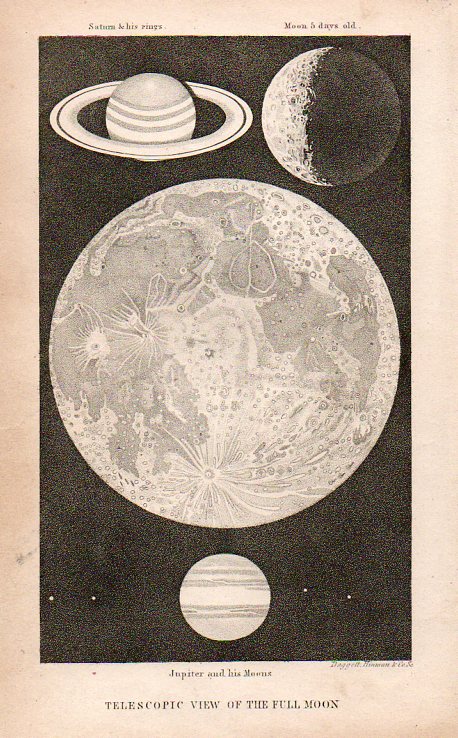
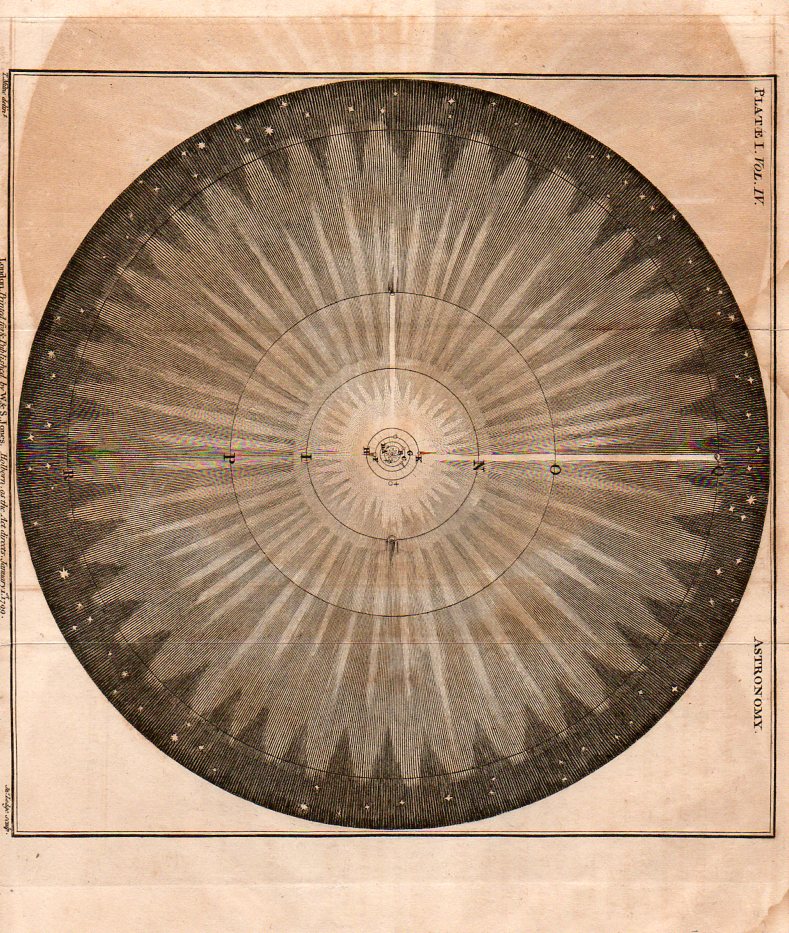
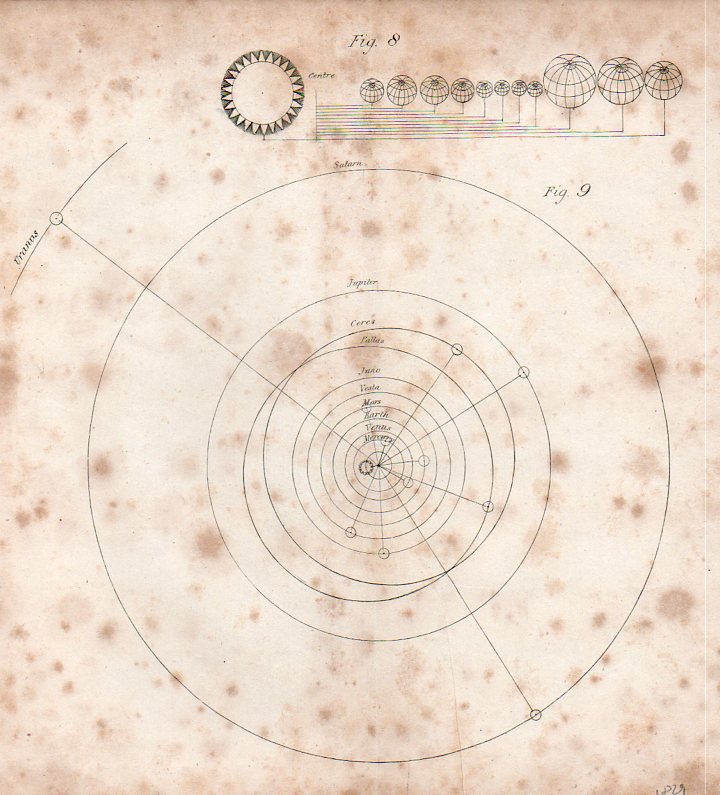
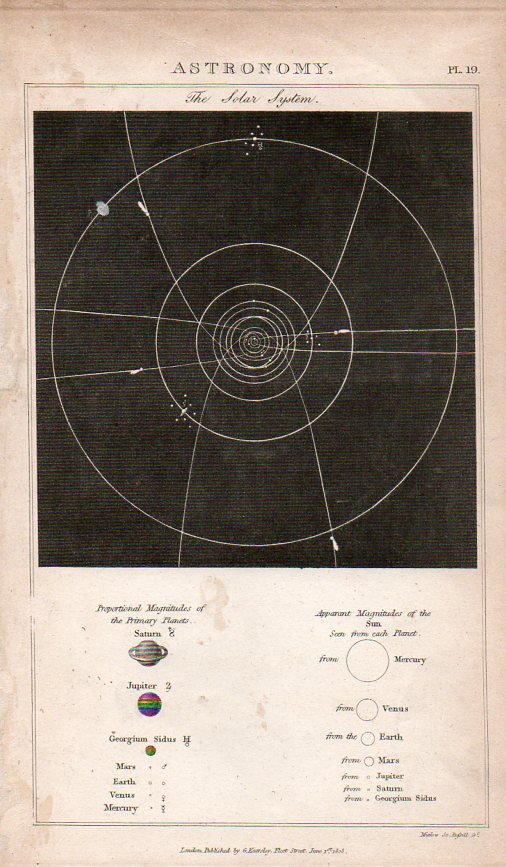
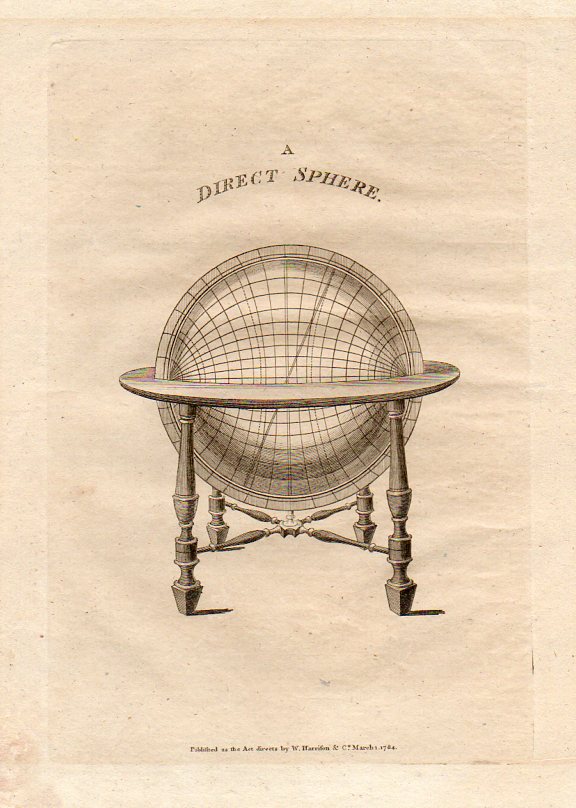
    Yes, the heavens are made of circles, somewhat, especially if you were observing a three-dimensional figure in two-space, where all spheres are circles.  But here we’re making those observations the other way ’round.  In any event, these are lovely images taken from a part of the history of astronomy images here in the bookstore–and I should say that they’re all available for purchase from the store as well.  But in the meantime, click away–you’ll find that almost all are expandable and mine-able for design elements.


    Circles--direct sphere911

    Armillary Sphere, 1784.
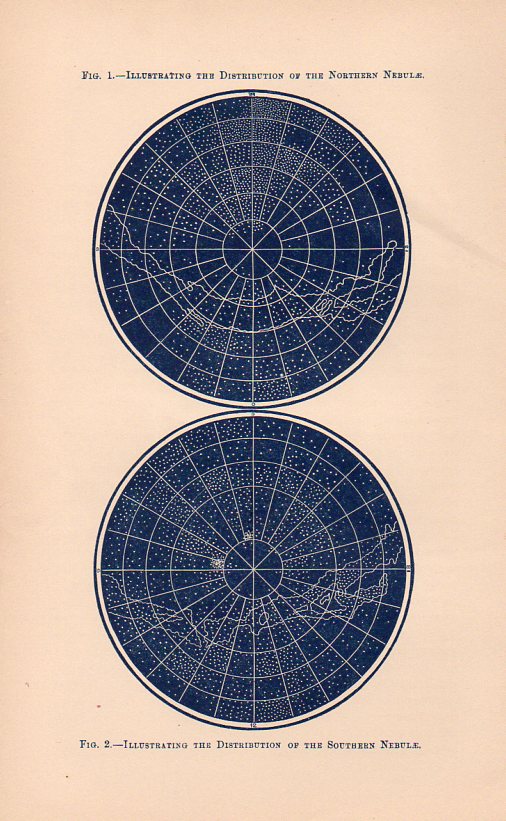
    Circles--distrib north nebulae918

    Distribution of the Nebulae, ca. 1860.
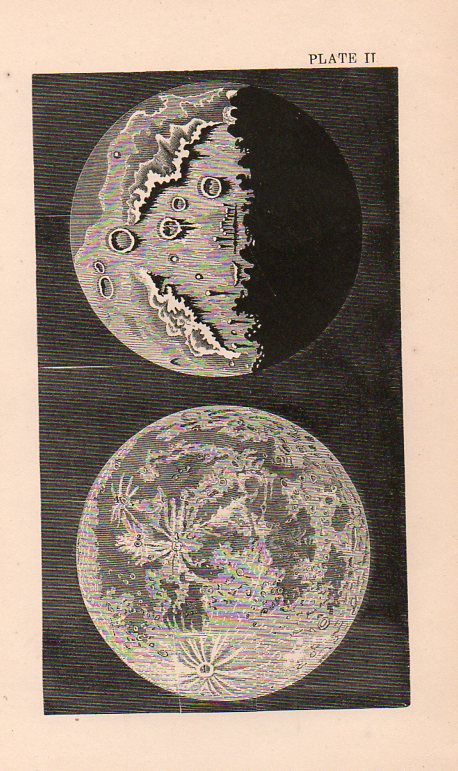
    CirclesDouble Moon908

    The Moon, ca. 1850.

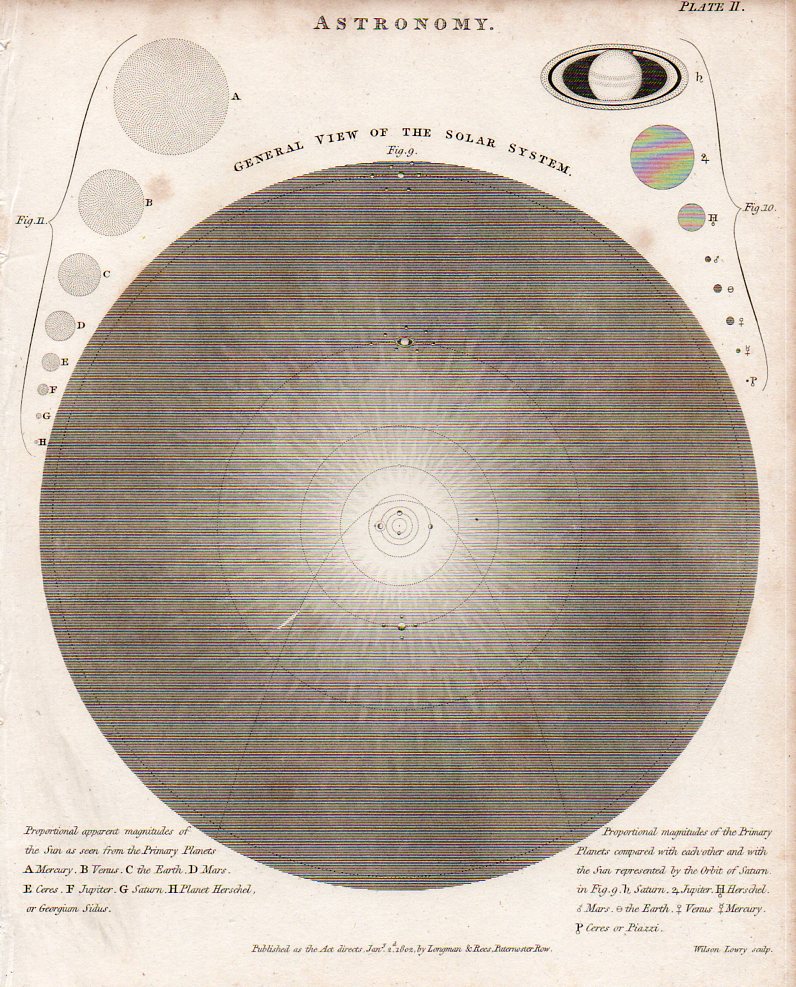
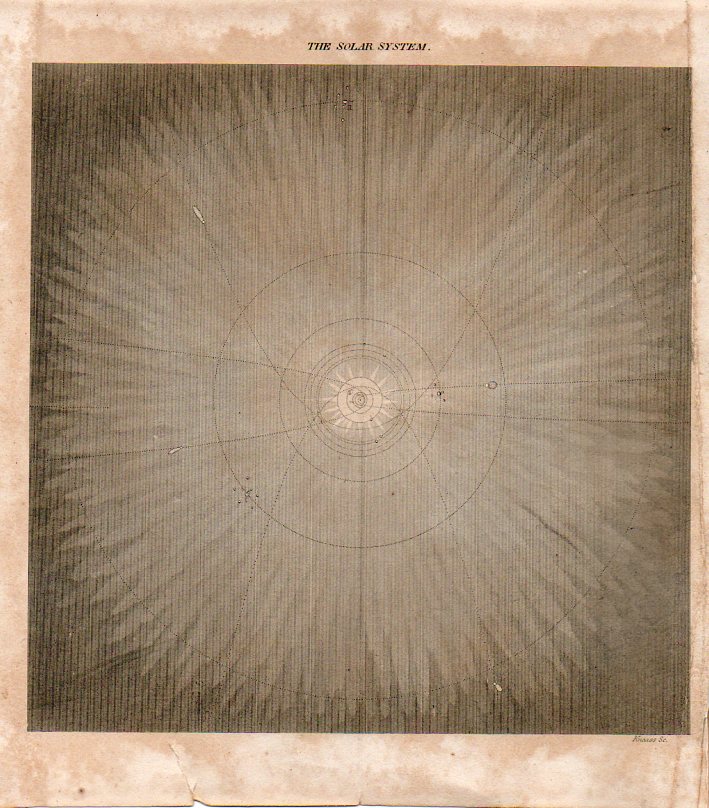
    Circles--general view solar ystem914

    The Solar System, 1804.

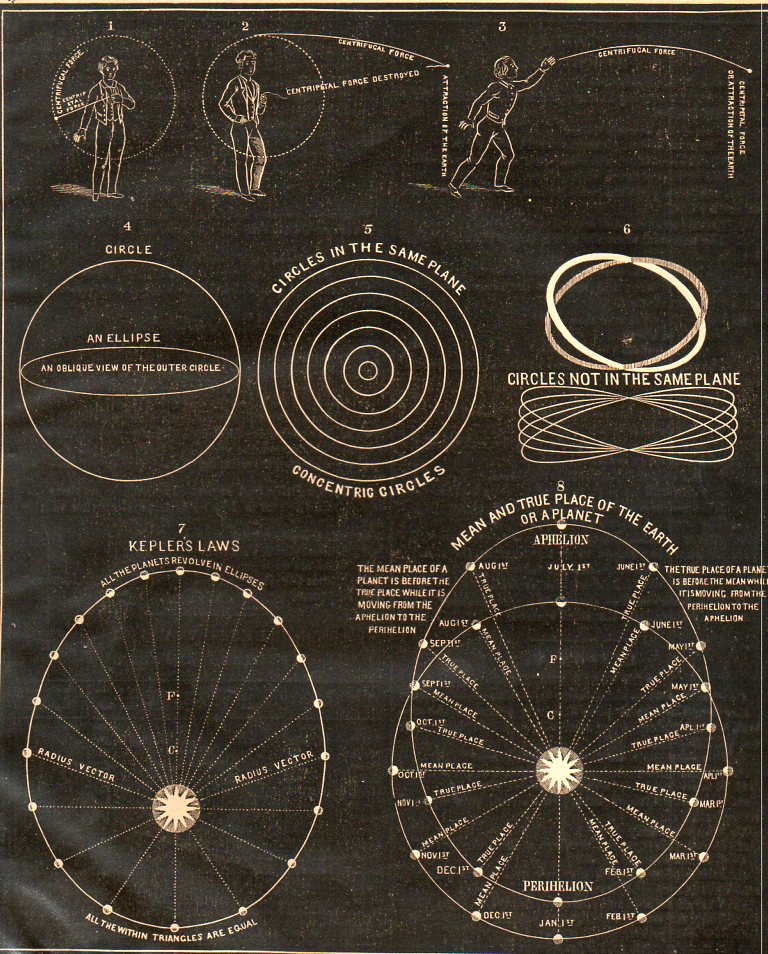
    Circles-in the same plane906

    1855.

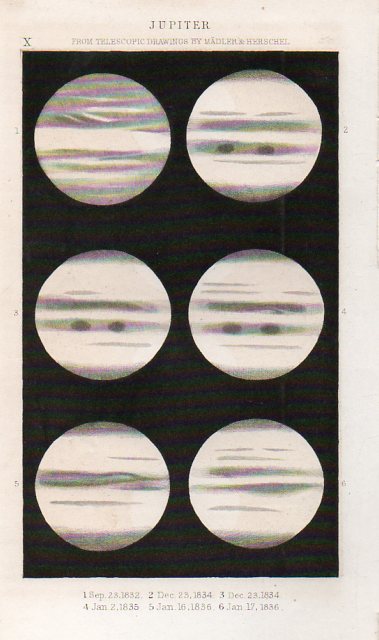
    Circles--jupiter921

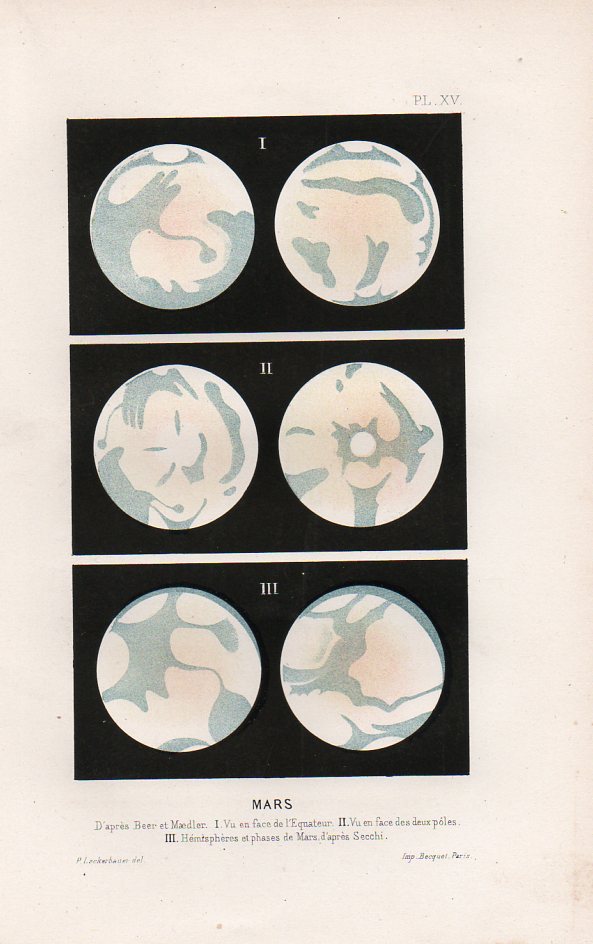
    Jupiter, 1864.Circles--mars913

    Mars, 1864.

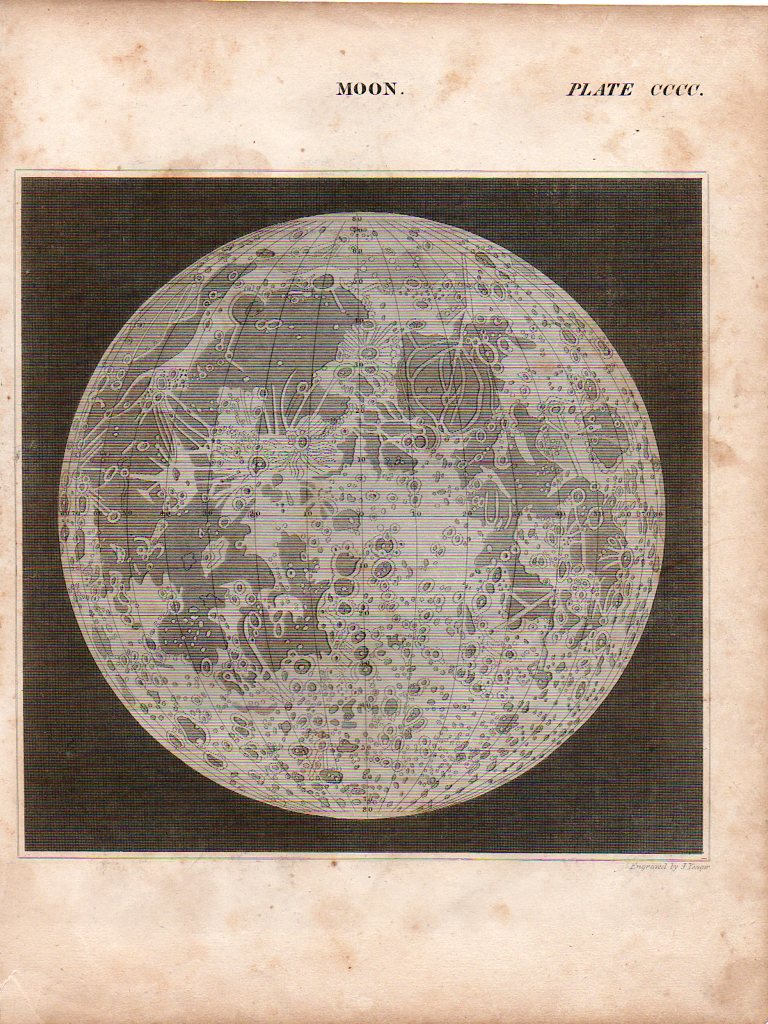
    Circles-Moon and saturn907

    Full Moon, 1836.

    Circles--solar system916

    Solar System, ca. 1820.

    Circles--solar system c919

    Solar System, 1823.

    Circles--solar systemb917

    Solar System, 1808.

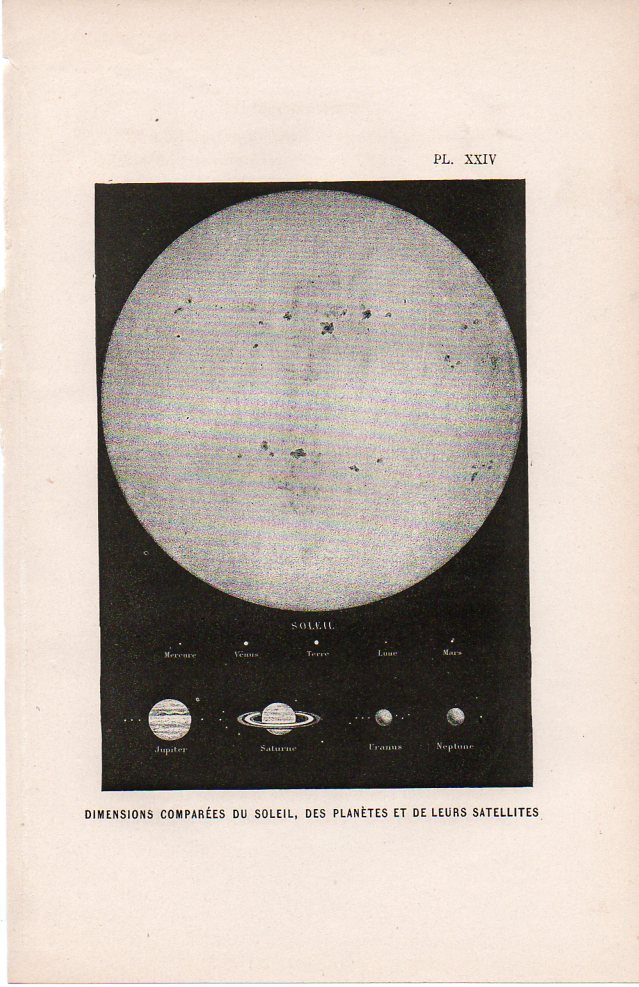
    Circles--sun planet comaprison size French902

    Dimension of the planets in comarison to the Sun, 1850.

    Circles-the Moon Reesd905

    the Moon, ca. 1810.

    Circles--the solar system912

    the Solar System, ca. 1825.

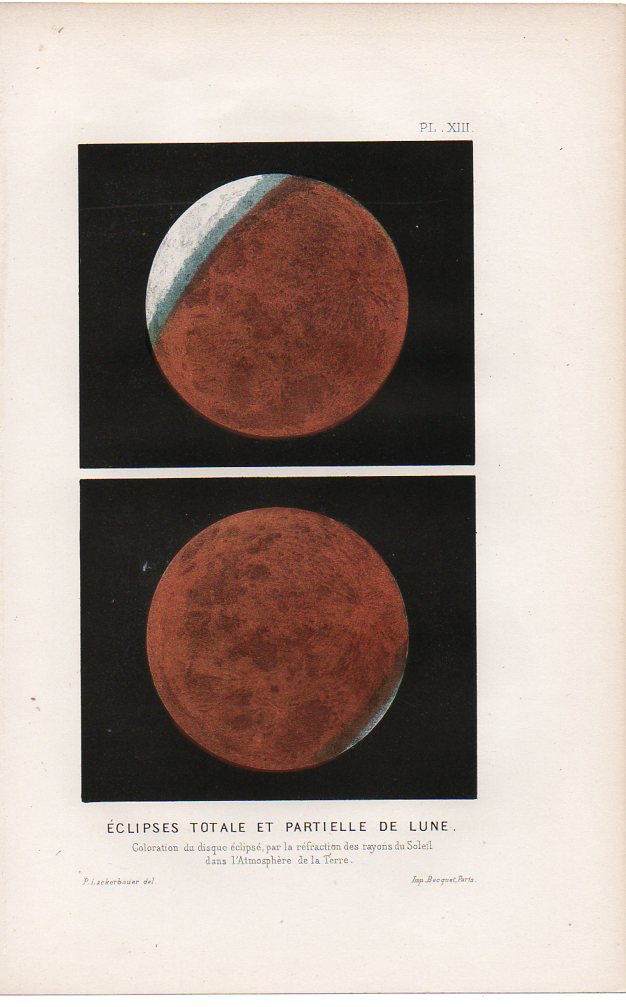
    Circles--toptal eclipse Moon900

    Partial eclipse of the Moon, ca. 1860.
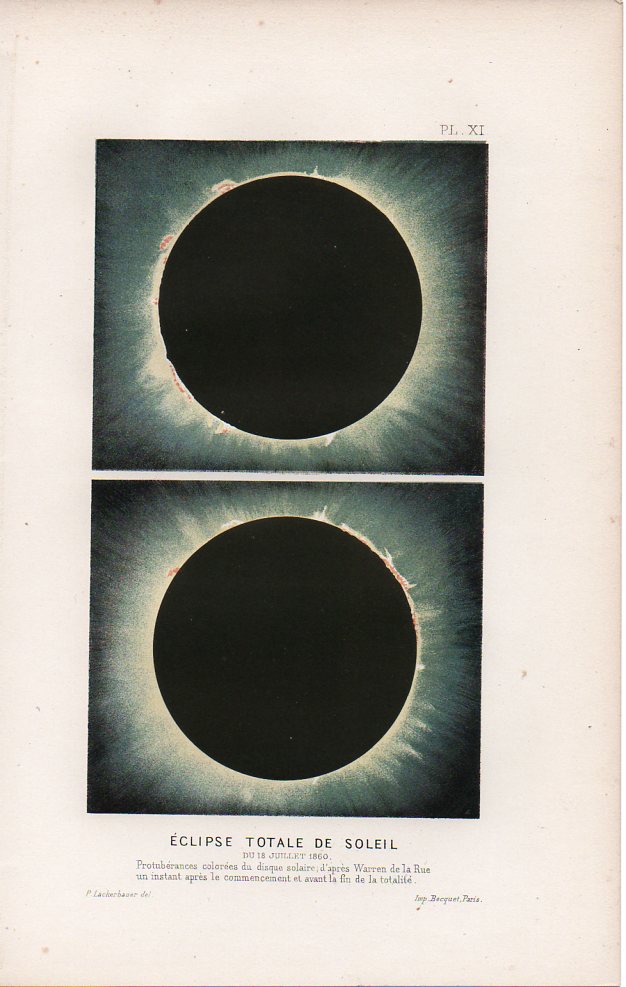
    Circles--toptal eclipse SUn901

    Total eclipse of the Sun, ca. 1860.

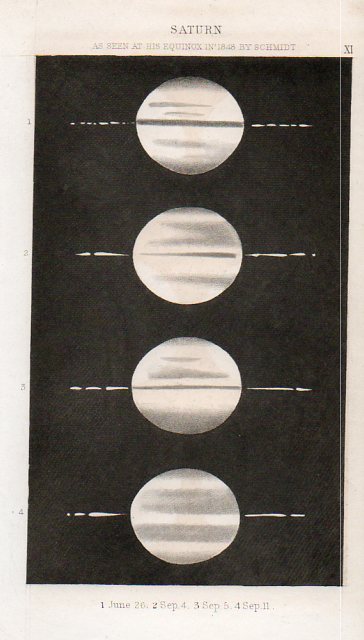
    Circles--saturn922


    Saturn, ca. 1870.

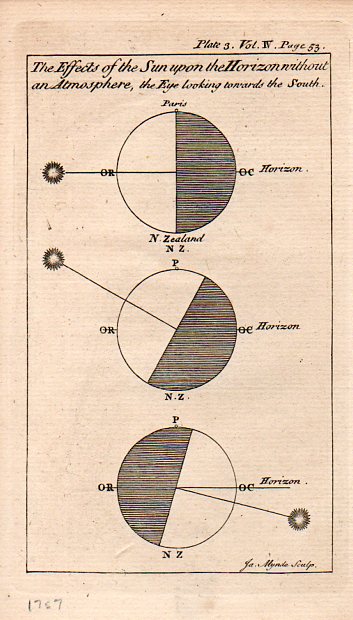
      Circles--effects of sun920
    1757.

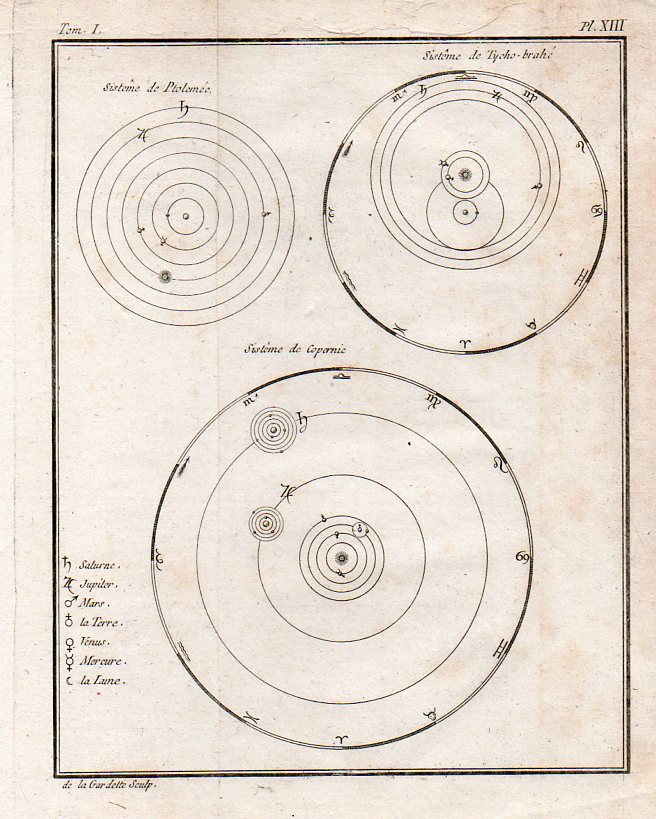
      Circles--comparative systems903

    Comparative cosmologies, ca. 1760.

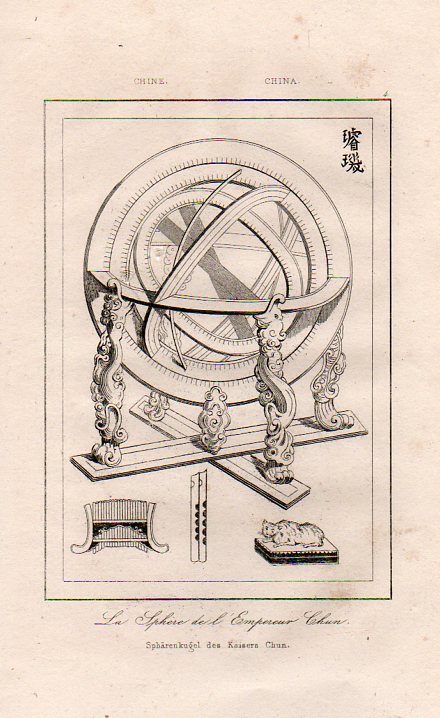
    Circles--chinese armillary910


    ·Posted by :

    ·in:


  • The Invisible Influence of the Highly Visible? Comets and Meteors in Astrology

    JF Ptak Science Books   Post 1176

    “When beggars die there are no comets seen; The heavens themselves blaze forth the death of princes.” – Shakespeare.

    “Threatening the world with Famine, Plague and War: To Princes, Death! To Kingdoms, many Crosses; To all Estates, inevitable Losses! To Herdsmen, Rot; to Plowmen, hapless Seasons; To Sailors, Storms, To Cities, Civil Treasons!” De cometis by John Gadbury, London, 1665

    It is unusual to me that in the long history of early astrology, some of the greatest elements of the night sky–comets and meteors–are little used, perhaps even unuseful outside of adding flavoring to readings given the time and place of their appearance. They had been seen for milennia–appearing in Gilgamesh and the Book of Revelation for two samples– as prognostic of future events, John of Damascus and Aritotle and Ptolemy and Albumasar all writing about that quality.

    Comets 5564
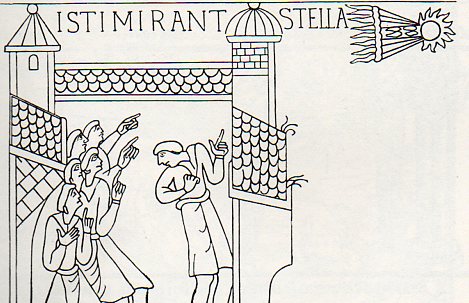
    [The Bayeux Tapestry illustrating the appearance of the comet of 1066, later to be known as Halley’s comet.]

    Comets and meteors didn’t really affect anything in the physical world, and in the astrological one their purpose was to perhaps predict a kingly death or the appearance opf warts on women. They were also seen by people like Aristotle to be atmopsheric events, living out their exsitence in close proximity to the Earth, incapable of having any undue affect on Earthly matters.  Meteors would appear and then disappear, comets were surprises and visible for just short amounts of time; the rest of the night sky remained the same, intact and unaltered after their appearances.  They were not understood, though they were seen by some as raging battles between forces of good and evil, personifications of the struggle between the angels of god and the elements of the devil. Meteors and comets were mysterious, unconquerable, unknowable, suspicious elements, and were evidently not useful to the early astrologers.

    Comets 1560
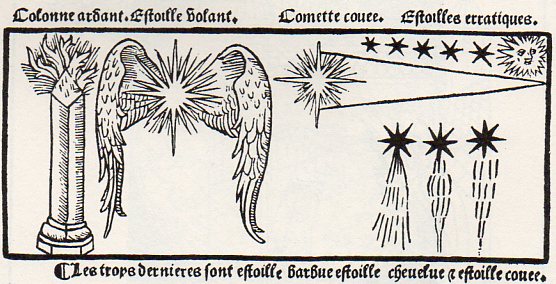
    [Nicolas Le Rouge, Le Grand Kalendrier et Compost des Bergieres, published in 1496 in Troyes. 

    The night sky is a mnemonic device, a place to store memory and a holder of the alphabet of myths and beliefs of all, a culture written large across the sky. Meteors and comets were not predictable, and could add nothing insofar as a consistent bit of storytelling was concerned, though they certainly created their own stories in each observed appearance; they could also add punctuation and exclamation to whatever constellation they appeared in. For example if one appeared in a juncture with Jupiter, a major event for royalty would possibly be foretold.   But as a permanent element to the visualization of the night sky, they had little power even though they seemed to be displays of fantastic energy and power in themselves.

    Comets 2561

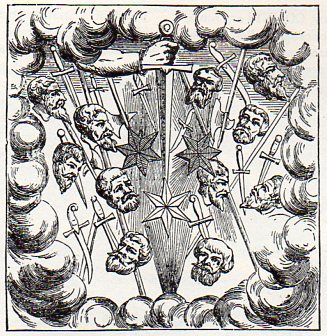
    [Amrose Pare illustrated the comet of 1528 in his Livres de Chirurgie (in a chapter titled “Des Monstres Celestes”), published in Paris in 1597. Even though Pare was a towering figure and great intellect, he still personified the wandering stars with human faces, with hair and beards, accompanied by swords and shields.  There were many other scholars who saw such things in comets and meteors, not the least of which was Maupertuis, who envisioned the tails as clusters of jewels; many others seeing many other things.

    Comets 3562
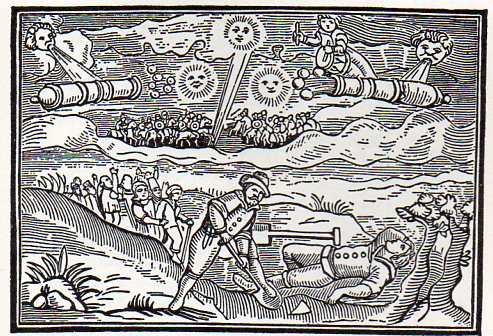
    [For some reason the celestial court, divided by sunlight and flanked by two other sources of light, have ofund it expedient to issue comets from the mouths of Heaven Canon.  I’m not sure what’s going on in the forground with the fellow working his spade next to the triangular blankness.  the man to his right seems to have been overtaken in fear (as have the group of people visible to the left over the shoveler’s shoulder).]

    Comets 4563

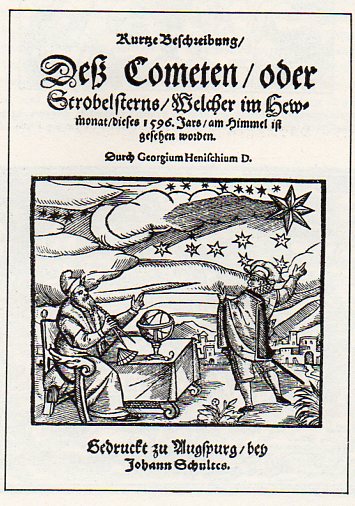
    [Halley’s comet appears again on the title page of this work by the Hungarian George Henischius, a prfoessor of rhetoric, mathematics and medicine at Augsberg.]


  • Catechizing the Sky–Writing on the Stars

    JF Ptak Science Books  Post  1166

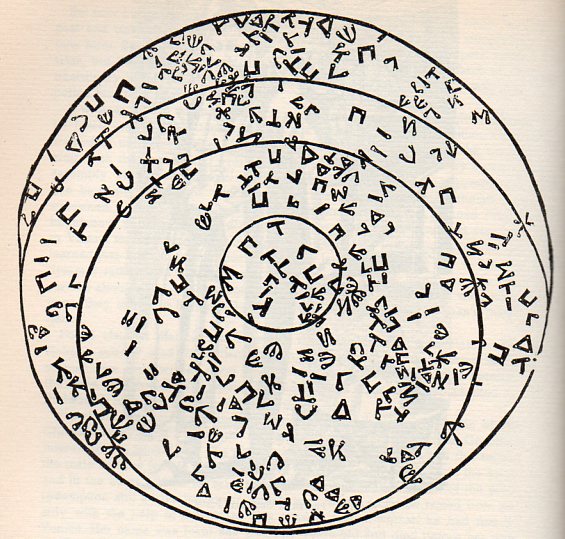
    Working on the next installment of cosmological images [and also a continuation of the series on writing systems] I put together a series on naming the stars, ideas providing the mechanics for naming the celestial kingdom, applying an alphabet for relative discussions of the heavens.  The most provocative of them all, I think, belonged to Guillaume Postel (1510-1581), a scholar who took flight in his imagination and who  established a world system which for him created  a harmony between all things that existed and the maker of the universe, and which basically was an attempt to move far past any identification system to a catechize the stars. Postel’s was a communication system between man and the beyond, not a coordinate system.  He incised the stars in his vault of heaven with Hebrew letters which would be the keys to understanding all things–and at the basis of all of this was his conception of a world unified religion which incorporated Christian ideas and values and to which all other religions would transpire. 

    Alphabet--stars  hebrew519

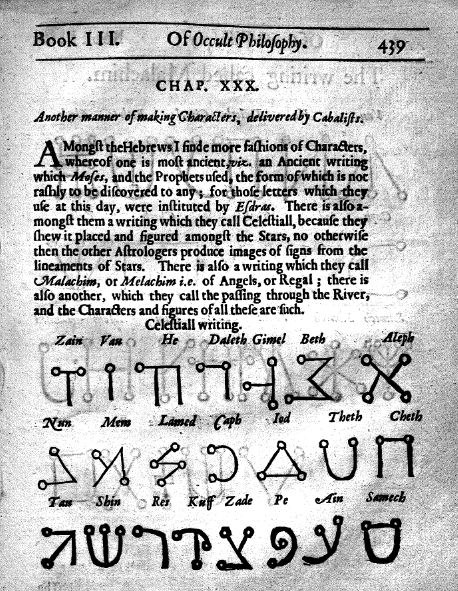
    There were numerous other attempts to establish divine alphabets, though none so far as I know were inscribed directly on the stars intended to serve as a means of transferring information and insight.  The extraordinarily accomplished (Renaissance man of the Renaissance, physician, astrologer, botanist, occultist, and general fill-in for whatever discipline needed help) Paracelsus’ Alphabet of the Magi also used Hebrew letters supplemented with magical alphabets for divination purposes, though not on the stars.  Heinrich Cornelius Agrippa (an astrologer/magician/theologian/occultist, 1486-1535) in the early 16th century came close to the Postel idea with his Angelic Alphabet, though this was used to communicate with angels and again was not incised on the stars themselves.  John Dee’s (a man of many and high accomplishments, a mathematician, occultist, astronomer, astrologer, alchemist and divine, 1527-1608) angelic alphabet was somewhat similar to Agrippa’s; his “Enochian” language used to communicate with angels.
    Alphabet--celestial

    Letters and numbers were of course used on stars but in general were used to identify the magnitude and position of stars in the constellations.  Johann Bayer (1572-1625) applied Greek letters to stars according to their relative luminosity in his revolutionar Uranometia (published in 1603).  John Flamsteed (1646-1719, and who was “The King’s Astronomical Observator” and  the first British Astronomer Royal)would come a little later and use an arabic numeral and Greek letter system, which would give the relative luminosity as well as the star’s position from the western-most edge of its constellation. 
                                       
    But it was this image by Postel which is the most astonishing, really, attempting as it did to read the heavens and the works of God without ever having to actually see the Creator (a thing most impossible, as stated in Exodus 33:20).

    ·Posted by :

    ·in:

    — — —

  • History of Blank and Missing Things: Telescope Tubes

    JF Ptak Science Books  Post 1127

    One of the greatest missing things in the history of astronomy thankfully never came to be.  When the Hubble space telescope was having its very early problems, Senator Barbara Mikulski (D, MD) suggested and pursued the idea for bringing the Hubble down and end the program rather than repair it–for financial reasons, or something, I dunno.  It was an toweringly bad idea that keep itself alive for too long (and was just so bad that NASA I recall had a hard time getting their head around such a bizarre problem-solving approach to a fixable problem)–Mikulski went on to not think about other things, the Hubble was fixed, resulting in a simply astonishing amount of discoveries and data that could absorb astronomers worldwide for generations. (In another part of the wanting-to-make-things-disappear is House Speaker Dennis Hastert, who wondered why exactly in the days after Katrina if we should rebuild New Orleans.  But that’s another story.)  Hubble is still there; so is Mikulski, who now is the champion of “the people’s telescope” and who chairs the committee responsible for NASA’s funding. 

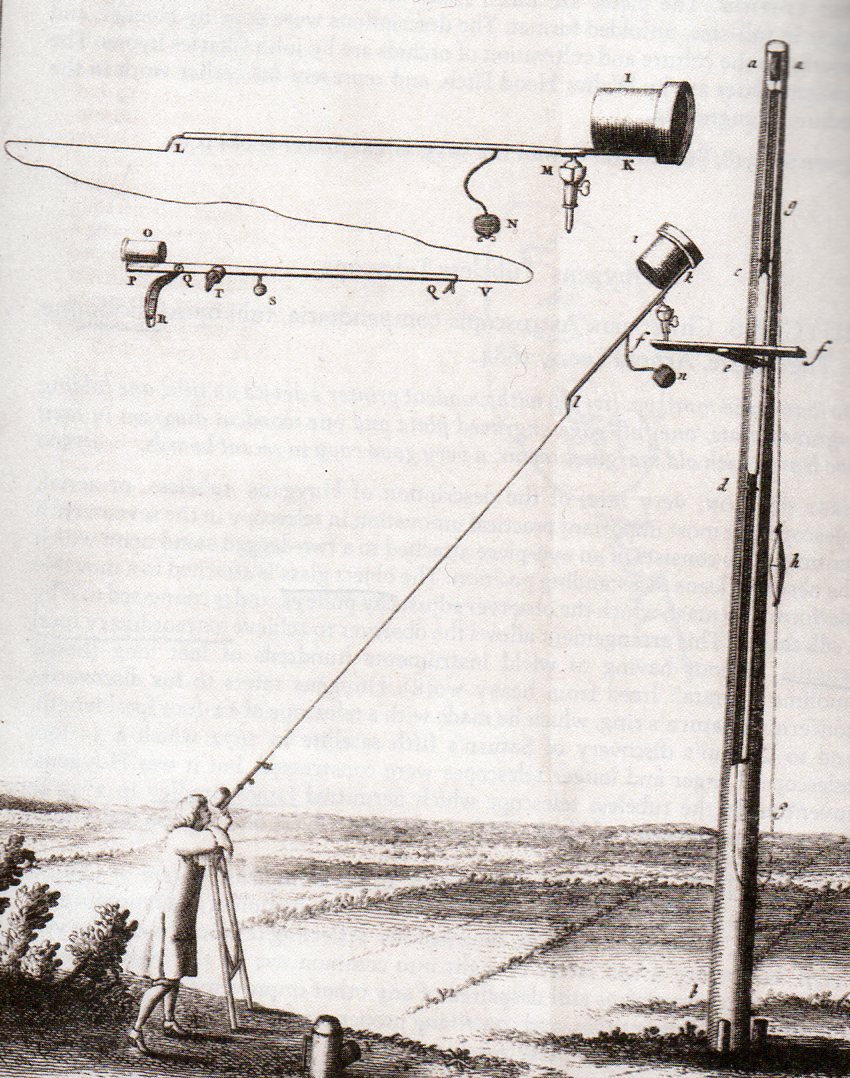
    One of the most powerful blank/missing or empty things in the history of astronomy that did come about may very well be Christiaan Huygen’s telescope1 without a telescope tube. Presented to the Royal Society in 1691, Huygens instrument (also known as an “aerial telescope”) was meant to perform the world’s most powerful optical observational instrument, having a focal length of 122′.  Monster telescopes were not practical at that time given the weight and flexure and movement of what would be a massive multi-hundred-foot-long telescope tube.  And so Huygens came up with the idea of doing away with the cumbersome part of the large telescope.

    Huygens was a very smart man, and one of very few people acknowledged in Newton’s Principia (along with “Dr. Hollis” and Christopher Wren, the three referred to as “the greatest geometers of our time”)), a man who Newton found to be “the most elegant of any mathematical writer of modern time”. He was extraordinarily accomplished, almost so as much as the half-forgotten Robert Hooke…Huygens was by far Hooke’s superior in mathematics, but Hooke was probably more accomplished across a wider variety of fields, which is saying mounds because Huygens did about everything..  In any event, Newton found Huygens to be an extraordinary scientist, even though Huygens didn’t really quite ever get Newton’s universal gravitation–a high elevation, perhaps among the highest, coming from the cranky Newton. 
    Blog--huygens347

    Getting back to the telescope–its missing section was perhaps one of the most important developments in astronomy in the second half of the 17th century.  Its arrangement was very elegant, and simple–the mast held the object glass whose position could be changed with a series of simple pulleys and pulls; the eyepiece was placed on a table, aligned with string and rope.  And that was it.  By the first third of the 18th century, James Bradley was able to construct a telescope of this type with a focal length of 212 feet, and used it to measure the diameter of Venus.

    Technology would soon catch up to the Huygens invention, but not really for another 75 years. 

    Notes.
    See:  “Christian Huygens and the Development of Science in the Seventeenth Century”, by E. N. DA C. ANDRADE, in Nature 162, 472-473 (25 September 1948). 

    1. Astroscopia Compendiaria tubi optici molimine liberata (compound telescopes without a tube), published 1684.


  • Unfathomable Dots–324,198 Stars and Knowing the Structure of the Milky Way, 1873

    JF Ptak Science Books  Post 1107 (Appended April 27, 2015)
    [A continuation of our History of Dots  series.]

    Stars--vivible stars 2 det304


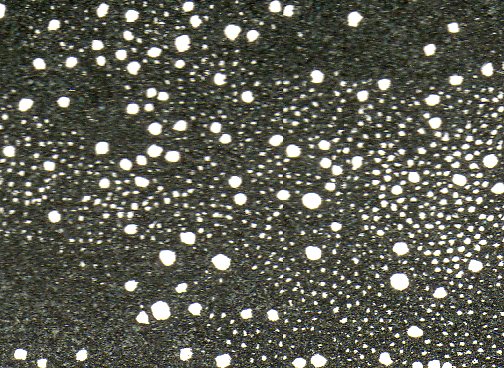
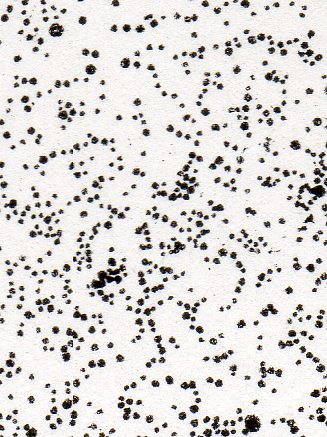
    The history of dots must have some fair share of its content filled with a very varied history of astronomy, which just goes to show that even within the seeming-sameness of microscopic investigations of dots that its subcategories could be so vast and differentiated. (The image above is a small detail from the following image, below.)

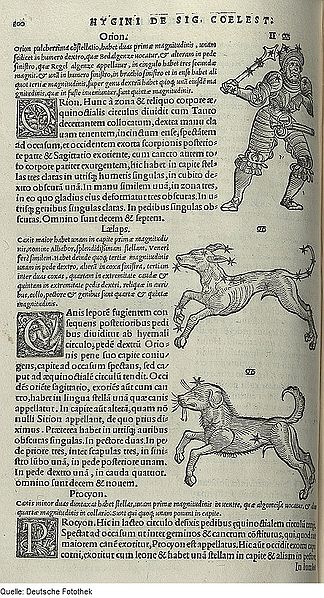
    Dots aren’t necessarily just dots–even in representing the stars, dots have a rich history. The first star-dots published in the West appear in 1482, taken from the work of the first century astronomer and philosopher Hyginius1, and is a book that contains maps of the constellations composed of such beautiful light-encrusted bits.  There wouldn’t be another work like this one, strangely, for another 75  years. Alessandro Piccolomini’s2 work of 1559 (which would be the first true star atlas), and again we see the familiar representation. 

    Galileo’s dots were very aggressive.  By 1610 he had produced his fifth and most powerful telescope, allowing things to be seen one thousand times closer, using it to make enormous discoveries–discoveries so big in fact that their towering significance is a but hard to understand today in the context of early 17th century knowledge. It was all published in his fantastic Sidereus Nuncius on March 4, 1610—the extraordinary  very title page3 of the book proclaiming some of the great discoveries of Galileo’s adventure.

    One monumental outcome of Galileo’s work was expanding the number of stars in the sky, which was basically mucking around with the perfect plan of the creator–formerly a cornerstone for the existence of a divine being.  With the exception of comets and eclipses the sky had remained immutable, a perfect score of the creator’s creation, until 1572, when Tycho Brahe noticed something new in Cassiopeia, something that was not a comet—a “something” that was a star. This was momentous because the night sky had been seen for centuries as being complete—a new star, the Nova of Brahe, contradicted this high belief, offering the possibilities of newness where there had not been one previously.  And so too with Kepler’s new star of 1602.

    One of the things that Galileo brought to the world was an entirely new sky, revealed to him through his telescope—so many stars that he could only guess (though he reckoned that there was an order of magnitude more stars than previously known “stars in myriads, which had never been seen before….and which surpasses the old, previously known, stars by ten times”).
       
    Which brings me to the images that I stumbled on today from “Statement of Views respecting the Sidereal Universe”4which was  the work of the astronomer and great popularizer,  Richard A. Proctor (“B.A. (Cambridge), Honorary Fellow of King’s College, London”).

    Proctor’s dots challenge all dots that have come before so far as theorizing on the structure (and extent) of the Milky Way is concerned.  Proctor refers to William Herschel’s5–the man who first gave the Milky Way its shape and who fixed our own sun in an inferior and not-particualrly-special place inside that map–statement that the extent and constitution of the Milky Way is “unfathomable”. 
     
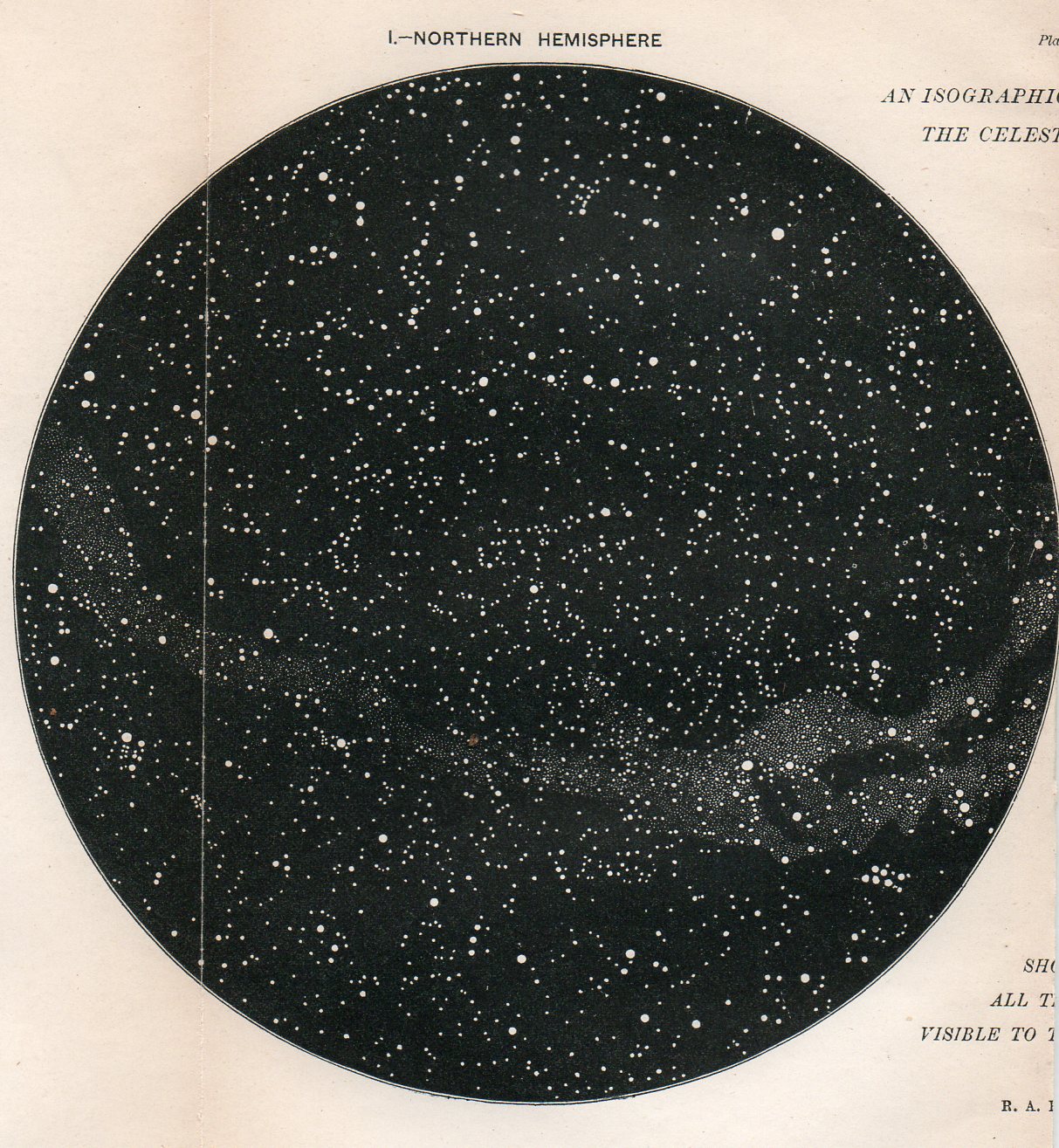
    Proctor gets there by presenting a map of the night sky with stars visible to the naked eye:

      Stars--vivible stars 2303
    And then the double hemisphere map of the northern and southern skies “We have here the first step towards just views of the constitution of the Milky Way, or rather the next step beyond the great, but little noticed, discovery of Sir W. Herschel’s, that the bright clouds of the Milky Way are for the most part spherical clusters of stars.”(Page 546.)

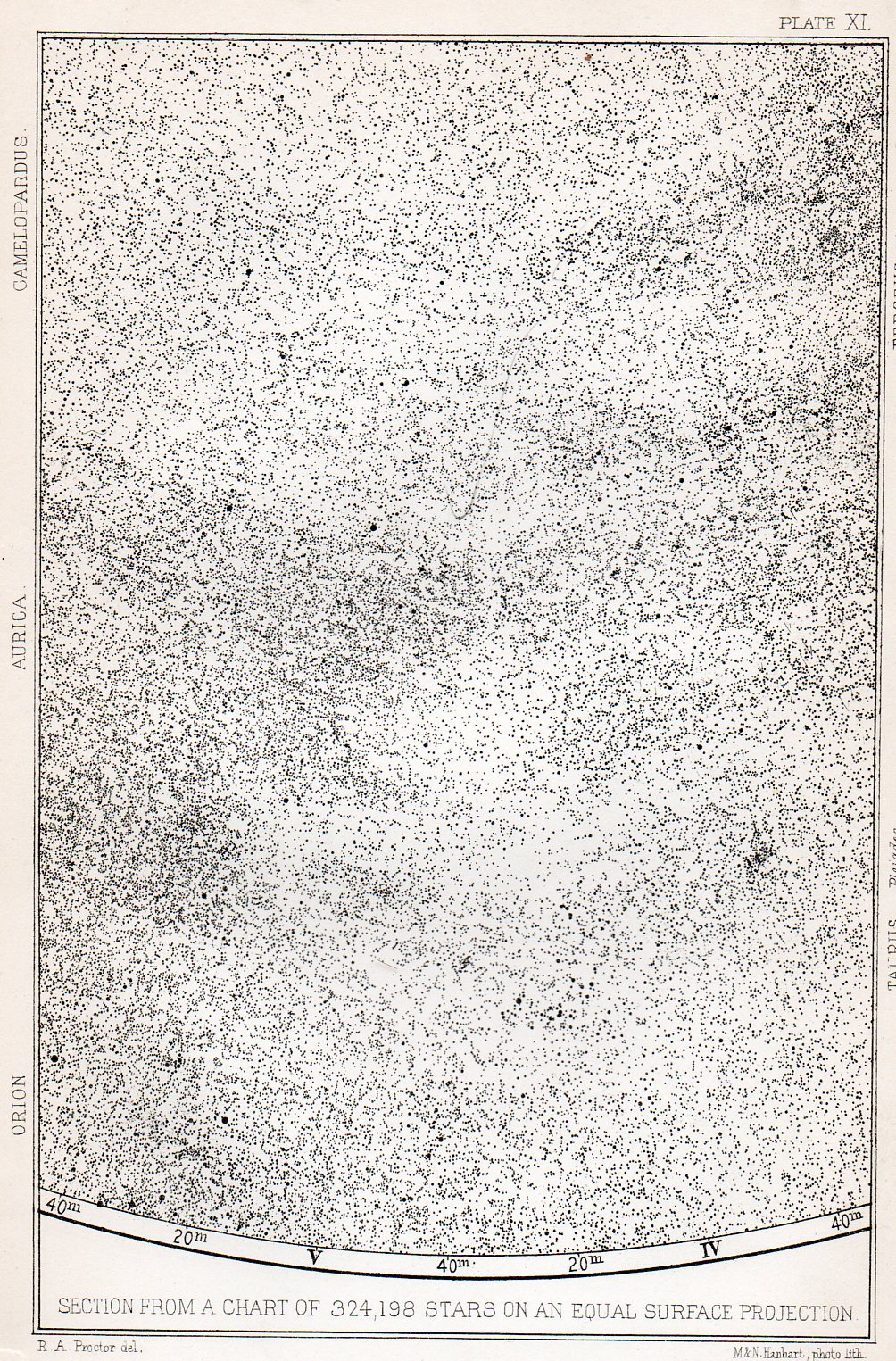
    Finally is the crux of the matter: two sections of an fantastic map displaying 324,198 stars visible via a 2.5 inch aperture telescope.

    Stars--324k300
    (The following being a small detail in the above section:)

    Stars--324k deyt301
    He comments:“I assert, without the slightest fear of contradiction by any possessing such knowledge, that the broad teaching of the equal-surface chart. 0/3 24,000 stars disposes finally of all theories of the constitution of the sidereal universe which had previously been enunciated. The chart does not definitively indicate a new theory—rather it suggests the idea that the constitution of the sidereal universe is too complex to be at present ascertained. But it completely negatives (i), the stratum theory (even in the modified form apparently retained by Sir W. Herschel) ; (ii), the flat-ring theory of Sir John Herschel ; and (iii) the infinitely extended stratum theory, with condensation towards the mean plane, which Struve adopted.” (Page 547)

    I think that for 1873 the verbose Mr. Proctor got his point across.     

    Notes

    1. Hyginius Mythographus (fl. 1st century A.D.). Poeticon astronomicon. Edited by Jacobus Sentinus and Johannes Lucilius Santritter. Venice: Erhard Ratdolt, 14th October 1482. The first star atlas per se, standing alone in its field for a century.

    2. Piccolomini, Alessandro.  De la Sfera del Mondo.  1559                              

    3.  Galilei, Galilei  Sidereus Nuncius (known in English as Starry Messenger), published 1610
    The title page reads: Great and very wonderful spectacles, and offering them to the consideration of every one, but especially of philosophers and astronomers; which have been observed by Galileo Galilei … by the assistance of a perspective glass lately invented by him; namely, in the face of the moon, in innumerable fixed stars in the milky-way, in nebulous stars, but especially in four planets which revolve round Jupiter at different intervals and periods with a wonderful celerity.

    4. Journal of the Royal Astronomical Society, Paper, Abstracts and Reports of the Proceedings of the Society from Niovember 1872 to June 1873, vol XXXIII, London, printed by John Strangeways, 1873.                    

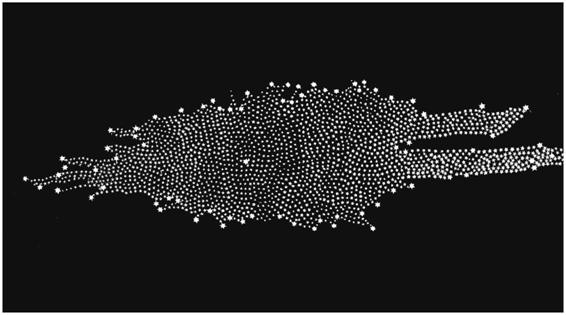
    5. It seems that few people now remember Frederick William Herschel as a great discoverer of alternative existences, but, well, that’s pretty much what he did–and he did it during a time that must’ve made his astronomical discoveries seem like science fiction .For example, in 1785 Herschel published a revolutionary image of the “Stellar System” (the Milky Way), showing its irregular pattern and the off-center placement of our sun amidst a panoply of other stars.
    (His image was remarkably and substantially correct, with the most grievous error being the placement of the sun too close to the center of the galaxy.) It was an image which bought the concept of a not so humano-centric idea into popular philosophy, and that our sun was a star among stars in a sea of stars.

    Herschel


  • Horse Poop and the Stars: Robert Hooke, 1673 (No, it Wasn’t Pegasus)

    JF Ptak Science Books   Post 1097

    Horse constellation Had there been no Newton every school child would know the
    name of Robert Hooke (1635-1703) in its place—he was polymathic, totally
    energized, big-thinking non-sleeping experimentalist and theoretician who
    worked across numerous disciplines (physics and astronomy, to chemistry,
    biology, and geology, to naval technology), not the least of which was
    architecture (having helped Christopher Wren in the design of the new St.
    Paul’s).  Hooke was a superb instrumentalist and inventor who also (for the most part) introduced humanity to the previously-unseen microscopic world (in his gorgeous and revolutionary Micrographia1..) .He was
    an enormous figure who was also never below a fight or argument, and whose
    grasp of his own very considerable accomplishments never seemed to be limited
    by what he had actually done in spite of his own tremendous and prodigious output.  Some people lay the blame for Hooke’s obscurity upon Newton’s great and tireless
    vindictiveness against Hooke, but that’s by far from the whole story of Hooke’s
    troublesome personal legacy.  Not only is
    his portrait not on the coin of the realm (like Newton’s) nor hanging everywhere in the halls
    of academia, but there is no known lifetime surviving portrait of the man, and the exact location of his burying place is not known. He came a little close to Newton’s
    enormity, and in the absence of  Jupiter and Saturn even the Earth starts to
    look a little bit big.among the rest of the planets.

    In addition to high genius and a man largely responsible for keeping together (and moving forward) the Royal Society, Hooke was also a hypochondriacal, meanish, semi-miser prone to receiving insults real or imagined, always very well aware of his place in history of of history’s possible sleights against him, and also prone to vindictive attack if the mood moved him. Newton too could be as sharp as sand in the eye, but he survived as a person, and Hooke sorta didn’t.  I’m not sure why, really, he seems so mostly-forgotten nowadays, priggishly envious idea-appropriating vindictive Despicable Me character or not–his swath of accomplishments was wide and deep as almost anyone else coming out of Britain for 200 years, which should be enough to send a lot of the historical personal detritus into the lost memory bin…but it doesn’t, or something else, but popular history just doesn’t work for the man.
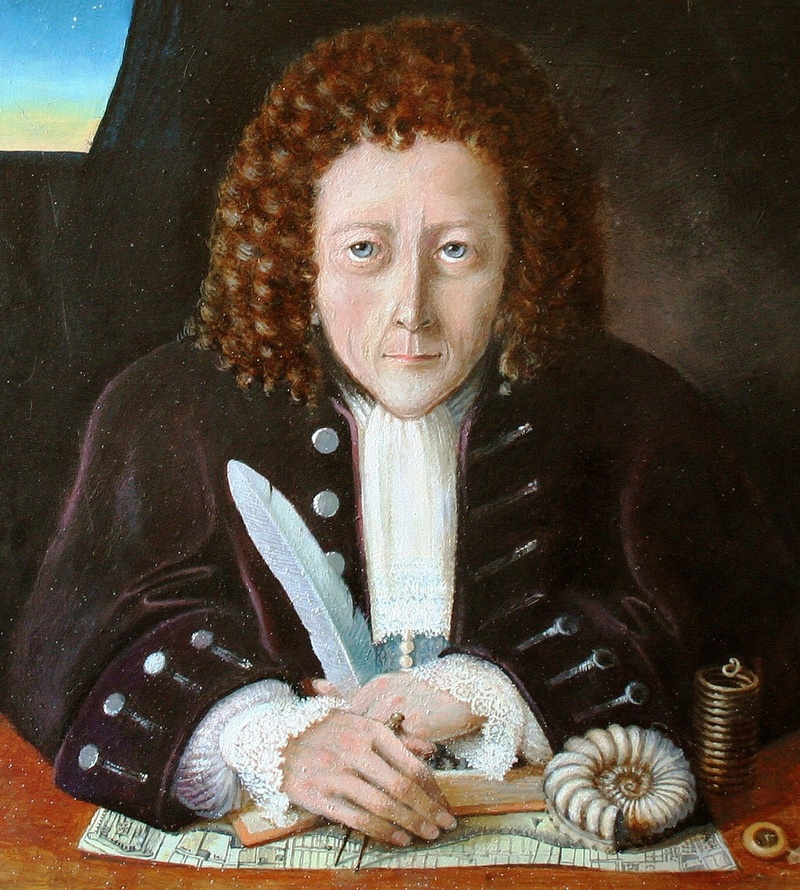
    13_Portrait_of_Robert_Hooke

    Stephen Inwood’s The Forgotten Genius recalls the 1673 letter that Robert Hooke wrote to the Council of the Royal Society, complaining of a new wrinkle in his ever-wrinkling private life:  the garden that had been just outside his rooms had been converted into a “coaching inn and stables”, meaning that there were mounds of festering summertime horse poop within nostrils’ reach.  He wrote to the Council that he needed a new accommodation, to “free himselfe from sitting as he now doth in the suffocating stink of the stables hors dung and Jakes [privy], which hath bin a great cause of his late illness”. [The portrait is supposed to be that of Hooke, which is fine by me–I like this one.  It shows a very thin man under the wig and bulky clothing, clear blue eyes, tight mouth, translucent skins, surrounded by the implements and directions of his thought, not the least of which is the night sky over the sitter’s shoulder.]

    The changes were agreed to, but not quickly, and it was still December 1673 or so that Hooke got his hands on Johannes Hevelius‘ new Machina Coelestis, a book which contained what Hooke saw to be germinal flaws, fatal flaws to the advancement of astronomy–and of course varied affronts to his own innovations in astronomical instrumentation–but which were preventable. By him. Hooke had it within himself to attack anything or anyone, and so it came to be Hevelius’ turn, monumental stature or not. (Newton’s turn would come soon after.)

    Now there is only contrived evidence that the horse dung and suffocating stink threw Hooke over the edge–but I do like the idea of this being the case, and though probably no real historian would go this way, I like to think that it was this High Stink that helped Hooke in his large attack upon Hevelius.  Of course Hooke needed no pushing or prodding from outside sources, even if those outside  sources were already sort of within him.  But I do like the image of his pen and razor-sharp mind fueled by the poop mounds and privies.  

    I can imagine his knuckles turning an easy white as he read the book that charged against his superior optical method of sighting instrumentation for astronomical work, Hevelius clinging to some methods of the 16th century.  They fought, of course, and for the most part it was a lonely (if correct) fight by Hooke, his possible benefactors and allies at the Royal Society  turning out not to be so given personality clashes and such.  But I can imagine the Hevelius, and the knuckles, and the wrongness of it all, all brewing in the stank of late summer swelter of horse dung mounds, filling Hooke’s nostrils and wigs and everything else with a rage for a rage that already existed.

    And here’s a line I won’t very often get to use to close anything out:  the poop couldn’t’ve hurt..

    Notes:

    1. The 28-year old Hooke published the results in a gorgeous
    and revolutionary book, Micrographia (a lovely e-text edition appears at Gutenberg, here) in 1665, which became an instant
    best seller and highly praised and valued. (Samuel Pepys, perhaps among the
    shiniest stars whose imprimatur was like a royal blessing, said the book (was)
    “the most ingenious book that I ever read in my life.”) There is no
    telling what the people of the mid-17th century thought of seeing
    such incredible discoveries in the little semi-invisible stuff that made up
    their normal, daily lives.  The only thing that somewhat equates to this
    would be if the first images of the Hubble were those of Earth-bound objects
    whose detail had previously been unknown.  Hooke’s observations and
    drawings of things like the common flea were just an astonishment—that such a
    creature of “low order” could have such intricate detail and design was a
    complete revelation.  The drawings of the fly’s eye, too, was an
    inescapable wonder, an incredible object to consider as having any
    detail pre-microscope, and then revealed to have unimaginable design and elegance.


  • Picturing Almost-Nothingness–When Nothing Was Something

    JF Ptak Science Books  Post 1092

    The Great Nothing–a History of Blank, Empty and Missing Things #79

    Perhaps the biggest, blankest, most missing-est thing that we have presently is the universe, or rather the universe before the universe was created.  I can talk about the universe in that way because I’m talking about the one that is most classically conceived as such by much of the Western world:  a deep, multi-thousand-year-old belief that the universe came into being via the hand of a creator. 
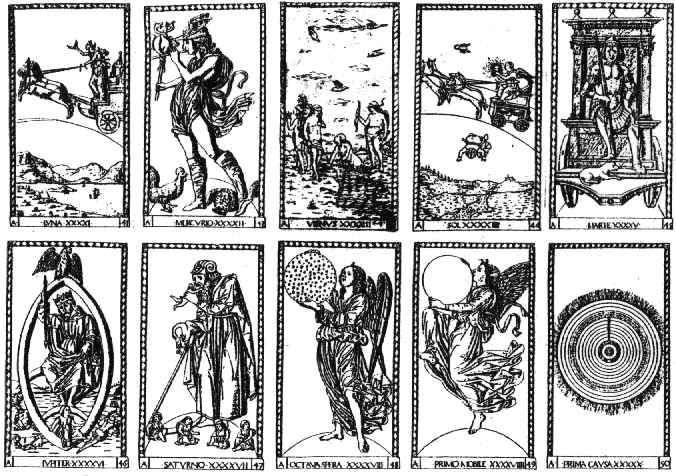
    Mantegna--tarocchi_a

    The universe in question is the one in the hands of the Primum Mobile (pictured above, bottom row, fourth image), one of 50 images depicted in a series known as the Mantegna Tarocchi, drawn and engraved by artists unknown ca. 1465, though it was once believed to be the  work of the great master Andrea Mantegna (and later the possible work of Bacci Baldini).1


    Mantegna vacuum von guer
     From my reading of this image, the universe is held  in the hands of the primum mobile, a spherical container of not-quite-nothing, waiting for the creator to breathe life into it.  The possibility of absolutely nothing was seen as an impossibility, a perfect vacuum, a space of certain nothingness, was a violation of theological belief.  That the sphere existed was a proof that–in the 15th century–you simply couldn’t have a container of nothingness. The very presence of the sphere confirming that there was something being contained by it.

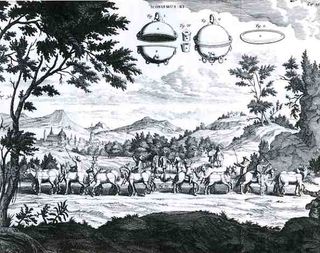
    As a matter of fact the issue of nothingness was very contentious, with the concept of its possibility and the display of a vacuum not achieved until 1672.  This beautiful illustration is from one of the greatest experimental physics books of the 17th century, coming as it does from Otto von Guericke’s  Experiemnta nova (ut vocantur) Magdeburgica de vacuo spatio (Amsterdam, 1672).  (In another minute department, this one is also I guess the greatest book ever written by a Mayor of anywhere (as von Guericke (1602-1886) was mayor of Magedeburg for 33 years).)  The image shows the greatest of von Guericke’s efforts, and one of the greatest (or most important) experiments in experimental science–the dramatic demonstration of the vacuum, showing here that teams of horses could not pull apart two halves of an evacuated sphere, and of course the efficacy of air pressure operating against it (um, the vacuum). The “floating” bits in the sky were an exploded view of the sphere that was the subject of the experiment. 
                   
    What was more important though, and what the general reader today might easily miss, was that von Guericke created something that many scientists and philosophers said didn’t, and couldn’t, exist:  the vacuum.  In modern times, Copernicus depicted the universe as a vast void; Descartes came in the back door (following the ancient and interesting though incorrect theory of Aristotle*), not liking the idea very much, and claiming that such empty space couldn’t exist.  Von Guericke provided the proof that the vacuum, that nothing, did exist.2

    Ultimately the Tarocchi was providing the Standard View of the creation, and did so before t he great assaults on the celestial kingdom got underway at the hands of Copernicus and Galileo, and of course many others–but that was all still 80 years away. 

    Notes: 
       
    1. The series as I said consists of 50 cards, all of which were teaching aids for the richer kids, dividing society, making a hierarchical display of the different levels of society. There were five series, each with ten engravings; the first series displayed the stages of social man,  beginning with the beggar and working through to the pope. [Series E* contained the Beggar, Servant (Fameio), Craftsman (Artixan), Merchant (Merchadante), Gentleman (Zintilomo), Knight (Chavalier), Doge (Doxe),King (Re), Emperor (Imperator) and finally ending with the Pope (Papa).] Series D displayed Apollo and the nine Muses; Series C was dedicated to philosophy and the sciences (showing the seven liberal arts plus astrology, philosophy and theology); Series B showed the seven virtues plus the Genius of the Sun, Time and World (Iliaco, Chronico and Cosmico, repectively).  Series A, composing the last 10 images (numbers 41-50) displayed the heavy hitters, the real weight: the Seven Spheres of the  solar system (the greatest part of the structure of the universe of te time) with the paths of the five planets plus the sun and moon, surrounded by the Octava Spera (the Eighth Sphere) and then by tghe Primum Mobile and Prima Causa (the last, card 50, being the god). 

    In the corners and bottom of the decorative borders is the classification system: the name and Roman numeral are first located along the bottom edge, with the group’s lettrer (E through A) and the group Arabic number located on the corners.

    2. Aristotle (384-322 BCE) theorized that as air became thinner objects moving through it would move faster, which is true; he further speculated that if there was no air at all, that if vacuums did exist, then objects would move infinitely fast, which he correctly assumed was not possible, and thus the vacuum could not exist.


  • Resolving Dots into New Worlds & Discovering Multiple Shadows

    JF Ptak Science Books   Post 1054    The  History of Dots series

    [Thanks to Randall Rosenfeld of the University of Toronto for sparking this post!]

    It seems that few people now remember Frederick William Herschel as a great discoverer of alternative existences, but, well, that’s pretty much what he did–and he did it during a time that must’ve made his astronomical discoveries seem like science fiction .For example, in 1785 Herschel published
    a revolutionary image of the “Stellar System” (the Milky Way), showing
    its irregular pattern
    and the off-center placement of our sun amidst a panoply of other stars.


    Herschel

    (His
    image was remarkably and substantially correct, with the most grievous
    error being the placement of the sun too close to the center of the
    galaxy.) It was an image which bought the concept of a
    not so humano-centric idea into popular philosophy, and that our sun was a star among stars in a sea of stars1.

    Not only that, but Herschel also made observations on double stars that showed that Newton’s laws of gravitation extended throughout the universe, and that it was possible for the stars themselves to submit to these laws and react to each other.  After constructing his mammoth four-foot telescope, Herschel expanded the observable sky multifold, showing that there was a possible 75 million stars now available for study.  And if the stars were behaving like planets then the actions of our own solar system seem perhaps to be not so unique; and with all of these new stars the possibilities for new planets and new solar system (and with that the possibilities for other life forms) seems a greater possibility.  

    And on these new worlds in these new solar systems there was therefore the possibility of two or more suns, meaning that there could be sets of shadows cast by anyone/thing on the surfaces of any of these new worlds.  

    In fact Herschel was able to show that our own Sun was following a prescribed path through the Milky Way, making Sol much less of spectacular enigma of mythical importance and more of just another starry dot in a sea of dots.  And while he was making the Sun into a starry dot he was also resolving those other starry dots into something of greater understanding and significance, bringing them into a systemic mechanism of the universe.

    Herschel also made an alpha/omega kind of discovery, as well–he marveled at  nebulous “holes”2 that he was finding in the Milky Way, thinking that, perhaps, he was looking into the very soul of the universe, at the place where stars were born. 

    This is extraordinary stuff coming to use from 200 years ago.  Few people have made such enormous and concrete contributions with such far reaching intellectual and philosophical implications.  So hats-off tonight to Frederick William Herschel, a man with big eyes.

    Notes:

    1. This
    galacto-centric view remained until the work of Harlow Shapley’s
    globular clusters in 1918.

    2. Specifically his famous and luscious “Coalsack” nebula.

    ·Posted by :

    ·in:

    —

  • History of Dots Series: Missing the Beginning of the Stars as Dots

    JF Ptak Science Books     Post 1029

    Dots--hyginus

    [History of Dots series]

    I was wondering when it was that stars began to appear as dots in celestial atlases or astronomical works–dots rather than starry stars, decorated spheres with crusty circular fire rings about them.
    I felt that at some near point in the history of astronomy that t he conventional antiquarian way of representing a star would fall away with magnification, or clarity, just as has been the opposite case with the magnification of simple dots to reveal complex structures, say with the amplification of the flea eye…even a graphite pencil’s period at the end of a sentence on a piece of paper will turn itself from a dot into something as complex as the coastline of England (given enough magnification).
    Dots--siderus The first star atlas published in 1482 after the work of the first century astronomer and philosopher Hyginius1 contains maps of the constellations composed of such beautiful light-encrusted bits.  There wouldn’t be another work like this one, strangely, for another 75  years. Alessandro Piccolomini’s2 work of 1559 (which would be the first true star atlas), and again we see the familiar representation.  I thought that this would change with the invention of the telescope, so I checked out Galileo’s3 beautiful account (pictured at left) of his discoveries in the Sidereus–again the same complicated, sawblade stars. 
    Dots--hevelius
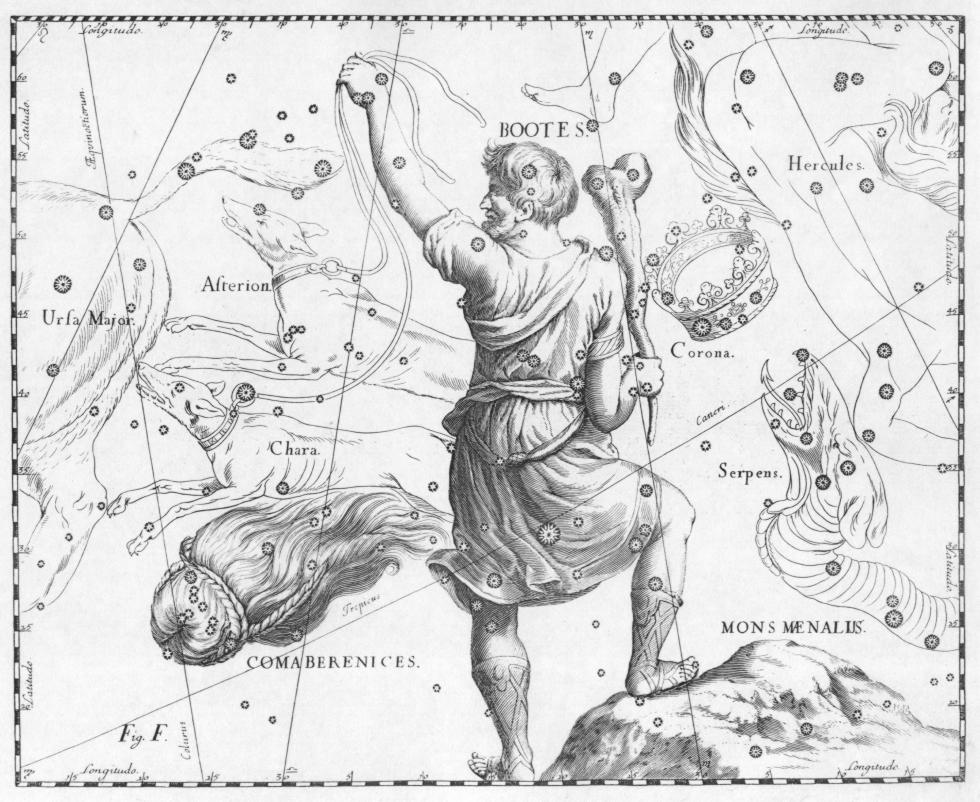
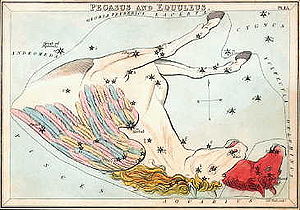
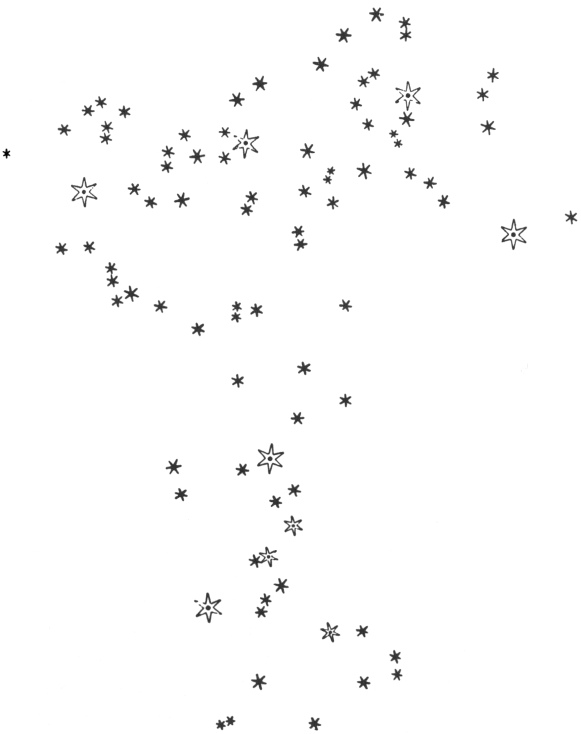
    This has not been a very scientific search thus far, only checking handy notes and images that I’ve made.  But the same result has been true for the star images in Bayer4, Cellarius5, Hevelius6(at right), Coronelli7, Flamseed8,  Doppelmayr9 and Bode10. Even William Herschel’s fabulous map of the galaxy is a collection of these pointed stars.  I think that I’ve just missed what is normally seen by regular folks as a conventional reassignment of star images to something more “modern”–and if that’s the case it has simply passed me by. (It seems though that among all of these that Hevelius comes closest–he inverts the familiar star pattern to the interior of a sphere.)  And I continue to miss it.  I’ve worked my incomplete survey now pretty close to the end of the 18th century, and I simply do not have a close answer..If anyone out there does have it, please let me know.  
    Notes:
    1. Hyginius Mythographus (fl. 1st century A.D.). Poeticon astronomicon. Edited by Jacobus Sentinus and Johannes Lucilius Santritter. Venice: Erhard Ratdolt, 14th October 1482. The first star atlas per se, standing alone in its field for a century.
    2. Piccolomini, Alessandro.  De la Sfera del Mondo.  1559                               
    3.  Galilei, Galilei  Sidereus Nuncius (known in English as Starry Messenger), published 1610
    4.  Bayer, Johann.  (1572 – March 7, 1625) Uranometria 1603, which was the first atlas to cover the entire celestial sphere.
    5. Cellarius, Andreas  (c. 1596 – 1665): Harmonia Macrocosmica (1660, 1661, 1708).
    6. Hevelius, Johannes (1611 – 1687): Firmamentum Sobiescianum, sive Uranographia (1690).
    7. Coronelli, Vincenzo (1650 – 1718):
    8. Flamsteed, John (1646 – 1719): Atlas Coelestis (1729, 1753).
    9. Doppelmayr, John Gabriel (1677 – 1750): Atlas Coelestis (1742).
    10. Bode, Johann Elert (1747 – 1826): Vorstellung der Gestirne auf XXXIV Tafeln (1782).