A Daily History of Holes, Dots, Lines, Science, History, Math, Physics, Art, the Unintentional Absurd, Architecture, Maps, Data Visualization, Blank and Missing Things, and so on. |1.6 million words, 7500 images, 4.9 million hits| Press & appearances in The Times, Le Figaro, Mensa, The Economist, The Guardian, Discovery News, Slate, Le Monde, Sci American Blogs, Le Pont, and many other places… 5000+ total posts since 2008.

Category: Astronomy

  • Flotation Mounting for one of the World’s Largest Telescopes, 1889

    JF Ptak Science Books  Quick Post

    Telescope floatation456

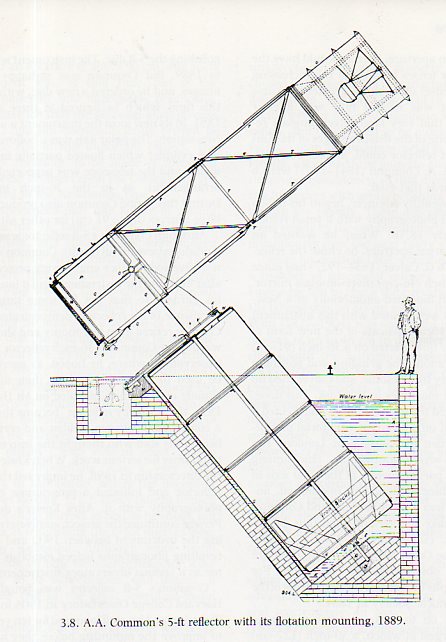
    I found this illustration browsing Owen Gingrich’s (editor) Astrophysics and twentieth century astronomy (Cambridge 1984) , and found it fascinating. The telescope was designed and built by Andrew Ainslie Common (1841-1903, a wealthy engineer and amateur astronomer), and it was a 155 cm/5-foot reflector, and had a flotation mounting.  This sort of mounting seems at least unusual to me, though one of Common’s earlier telescopes used a mercury flotation system. It was finished in 1889 and replaced a very fine 91cm instrment, both of which were constructed mostly for astrophotographical service. The 155cm didn’t really perform, ever, whereas the earlier and smaller instrument certainly did. (Following its service with Common, the 91cm went on to Edward Crossley in 1885m and was then used by James Keeler in 1893, and then by Charles Perrine.) I found the large-ish reservoir in use for keeping stutter and vibration away from the telescope to be very intriguing. It was purchased by Harvard University around 1905, and was moved and again a flotation mounting was employed. (The article on the telescope’s purchase is located below, taken from the Harvard Crimson of 5 April 1905.)

    ·Posted by :

    ·in:

    —

  • Renaissance Engravings of the Influences of the Planets

    JF Ptak Science Books   Post 1804

    The theme of the children of the planets was a relatively popular one,  and depending upon the planet, stretches back pretty deeply in western European time.  For example, for Children of Saturn, the children born under the astrological influence of the planet, was a subject of artwork reaching back at least into the 14th century, and then finding particular favor (or so it seems to me) among Flemish  (like Hemessen, Saenredam) and German  (Burgkmair, Pencz) painters. 

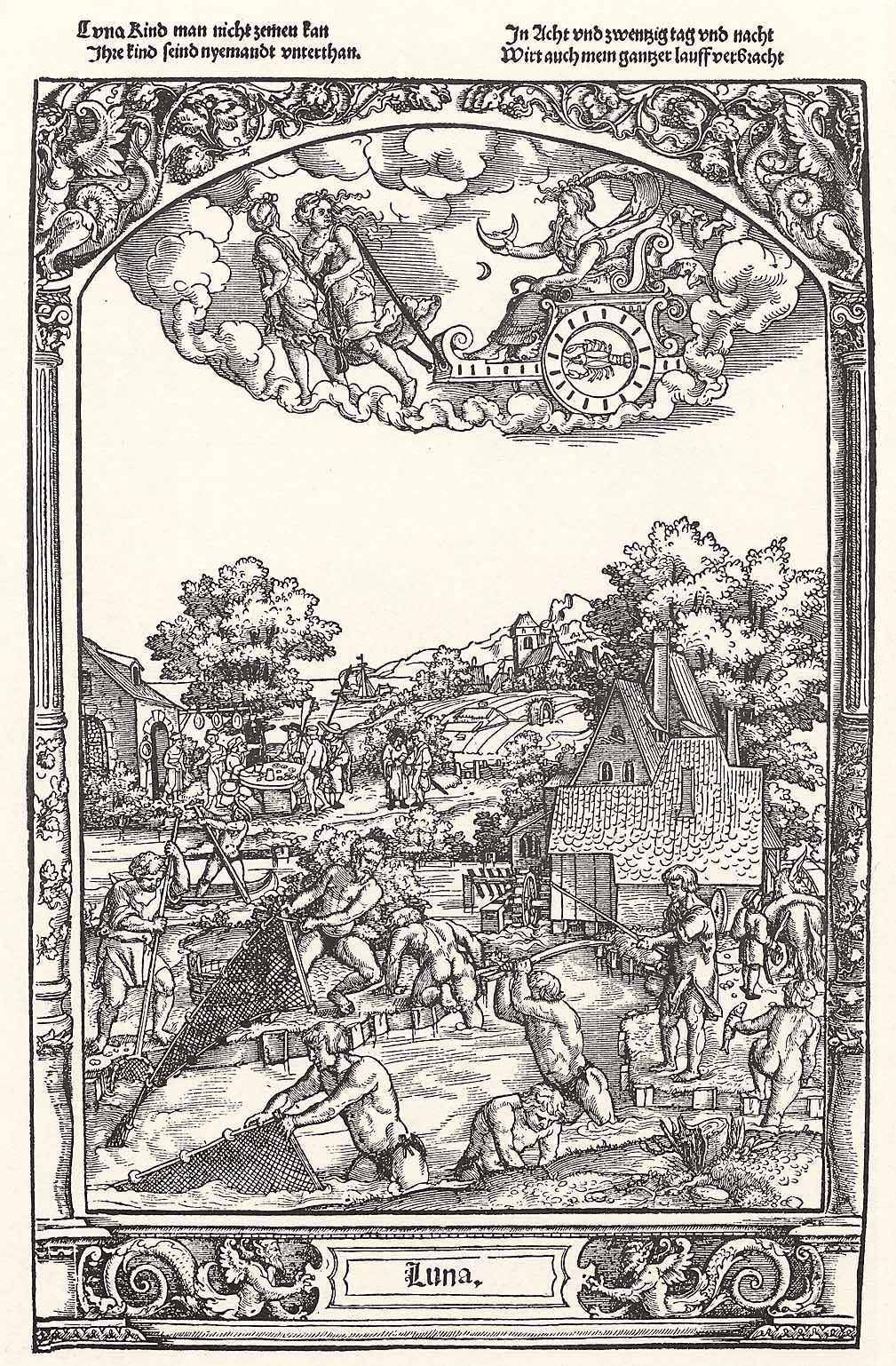
    I was attracted to the following wood engravings by Georg Pencz (ca.1500-1550) and the work published by Gabriele Giolito de Ferrari (1508-1578) because of their detail, and also because of the closeness and similarity in their design.  Giolito was an important publisher, and put out some of the earliest works in Italy in the vernacular.  I know more about Pencz, though, who is more attractive to me because of his extremely find hand and the size (or rather lack of it) of his work.  He was one of the so-called “Little Masters”, the artists who were influenced by Albrect Durer and whose work showed it, and who also worked very, very small ( as with Albrecht Altdorfer (1480-1538), Sebald Beham (1500-1550), and  Barthel Beham (1502-1540), for example).  He may have been a pupil and/or worker in the studio of Durer, or maybe not–but his work certainly showed the influence of the great artist.  His later work, too, I think shows the influence of the Italian painters, and Pencz may or may not have visited Italy to study them, the case being not so very clear.  In any event, whether he traveled to Italy or not or worked directly with Durer or not, his work certainly shows the influence of both even if there is no proof of a paper trail. 

    The Life of the Children of the Sun, published by the Italian publisher Gabriele Giolito de Ferrari, and said to be in the year 1533.  I’ve not yet been able to find the book’s title or the author’s name–a task that on the face of it seemed simple–and hope to be able to do this, soon. The other images are from Folge der Planeten in which the wood engravings of Georg Pencz appear.

    And so the series of images depictng the children of the Sun, Moon, and Chaldean planets Mercury, Venus, Mars, Jupiter and Saturn, as they progressed towards their middle-life, and in their chosen professions as mythologically influenced by their planet.

    Life of the Children of the Moon, by Georg Pencz (1500-1550), in the Folge der Planeten.


    Pencz, Georg: Folge der »Planetenbilder«, Mond


    ·Posted by :

    ·in:

    —

  • The Moon Made of Brick, 1869

    JF Ptak Science Books   Post 1795

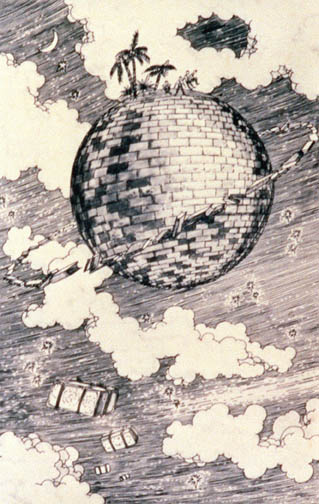
    In 1869 Edward Everett Hale (author of “A Man WIthout a Country” in 1863 and also one of the earliest pieces of fiction regarding alternative worlds in”Hands Off” in 1883) wrote a piece of speculative fiction called “The Brick Moon”, a story told int he form of a journal of Capt. Frank Ingham, relating the story of the launching of a satellite that was to be an aid to navigation.  The construction was fantastic–a sphere made of concentric rings of brick enclosed by an outer layer of brick, reaching 200 feet in diameter, to be hurled into space by two gigantic flywheels on a polar orbit 4,000 miles high, providing a new bright shining star as a means of determining longitude.

    “Any section through any diameter looked like an immense rose-window, of six circles grouped round a seventh. In truth, each of these sections would reveal the existence of seven chambers in the moon,—each a sphere itself,—whose arches gave solidity to the whole; while yet, of the whole moon, the greater part was air. In all there were thirteen of these moonlets, if I am so to call them; though no one section, of course, would reveal so many. Sustained on each side by their groined arches, the surface of the whole moon was built over them and under them,—simply two domes connected at the bases. The chambers themselves were made lighter by leaving large, round windows or open circles in the parts of their vaults farthest from their points of contact, so that each of them looked not unlike the outer sphere of a Japanese ivory nest of concentric balls. You see the object was to make a moon, which, when left to its own gravity, should be fitly supported or braced within. Dear George was sure that, by this constant repetition of arches, we should with the least weight unite the greatest strength. I believe it still, and experience has proved that there is strength enough.”   [Full story here.]

    illustration from Hale's Brick Moon

    [Image source: here, from the Encyclopedia of Science website.]

    Getting the enormous and fantastically heavy “moon” not only off the ground but into space would be an enormous and fantastic mystery–solved here by Hale by the thing being “left to its own gravity” and the two giant flywheels. 

    It was in this story, published in serial form in the Atlantic Monthly, that the idea of the artificial satellite was introduced.  Actually, it was also more than that, because a foul-up caused an early launch of the sphere, launching it into orbit with people on board, making it the first space station.  And it was certainy the first collection of space bricks. Of course this took an enormous leap of imagination and insight, and Hale’s effort must be applauded as a visionary work.


  • Antique Board Games for Astronomy

    JF Ptak Science Books  Quick Post

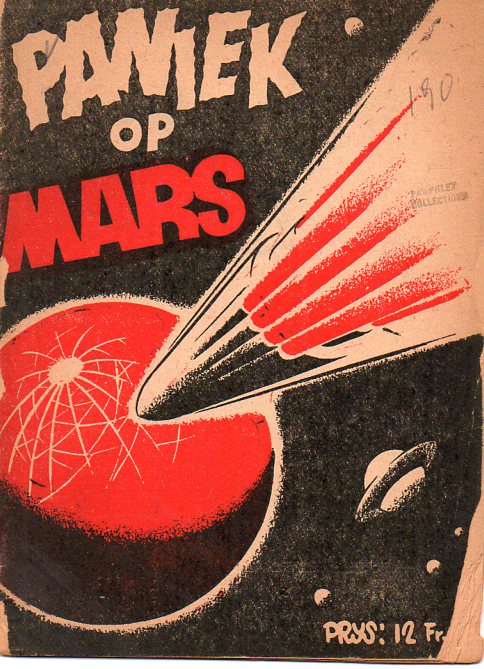
    This slender 1946 Dutch publication proved a little irresistible–the cover looked very loud, very red, and very accelerating-y, and was the only thing about the booklet that I could understand, though I really don’t understand that, either. 

    Mars panic457
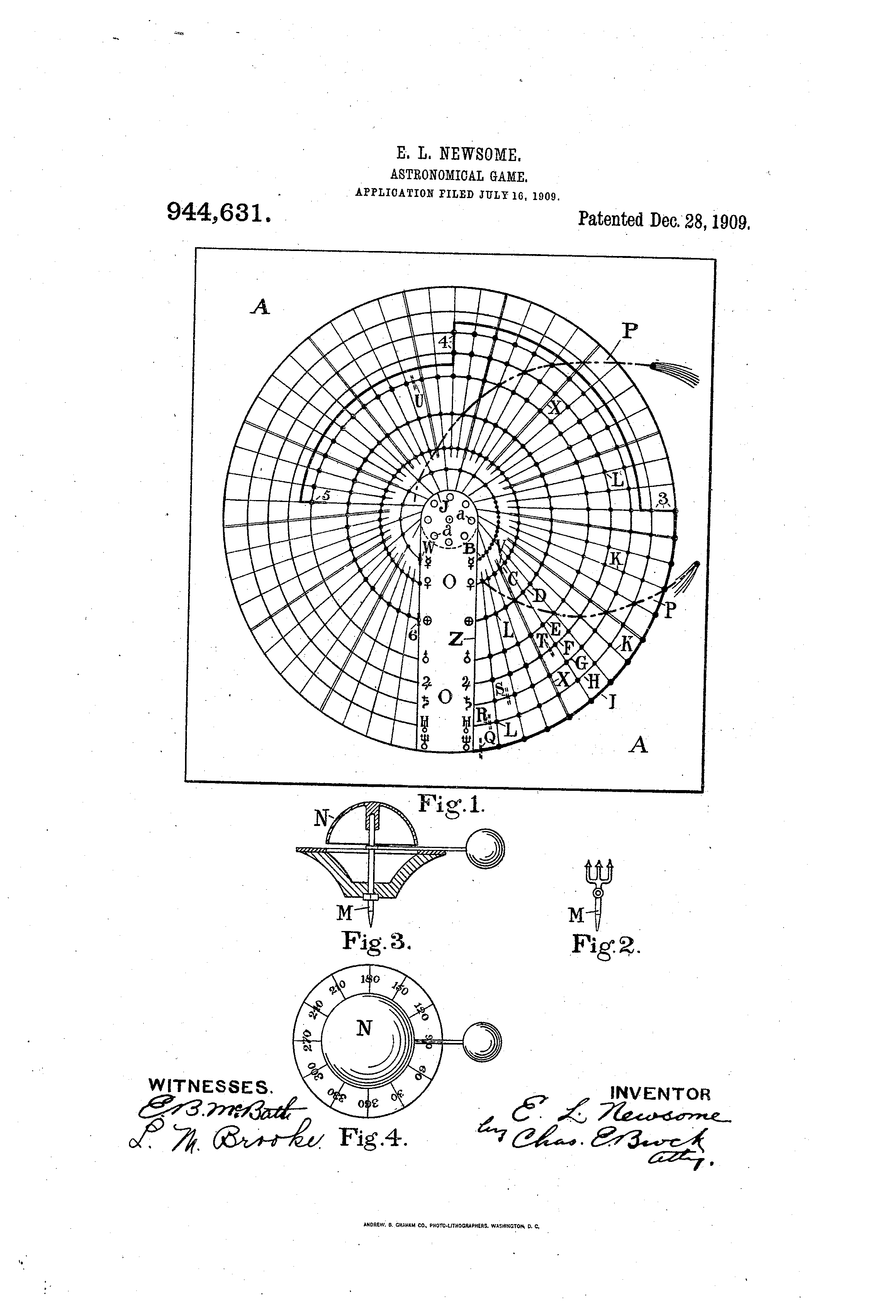
    I went over to Google Patents to see what a “Mars” search might unveil, and it lead me not necessarily logically to the following patent, which seems to me to be quite a playable astronomy game, with all of the necessaries found in the text of the document.  I’m not so sure that the game would be “fun” per se, but, well, it could be played.  And perhaps someone might learn something from it.  [Source:  U.S. Patent and Trademark Office, here.]

    Games astronomical patent office

    ·Posted by :

    ·in:

    —

  • Strange Things in the Sky Department: Disintegratging Moon and Lunar Nuclear Alien Space Nazis

    JF Ptak Science Books  Post 1767

    In a post last week in the Strange Things in the Sky department: the Exploding Moon, I mentioned that images of the Earth’s Moon actually exploding seem to be quite uncommon. The ever-observant  Ray Girvan wrote to say that the Moon does just that in the 2002 remake of H.G. Wells’ The Time Machine, when Earth’s lunar mining operations disrupt it so that it makes the Moon disintegrate, raining parts of itself on Earth. 

    Strip Mining Shatters the Moon

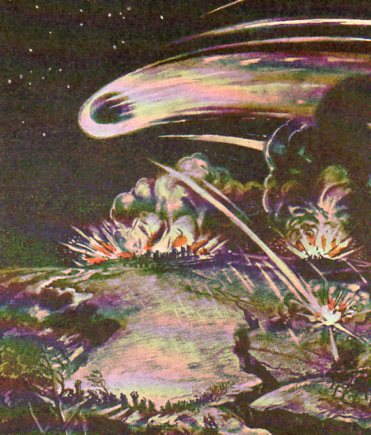
    And it just so happens that I stumbled on another odd image of the Moon coming to its end:  a mention of a drawing by Thomas Voter, showing the Moon disintegrating under the force of the Earth’s gravity.  It appears in the November, 1939 issue of Popular Mechanics in the “Explorers of Space” article. 

    Moon explode407
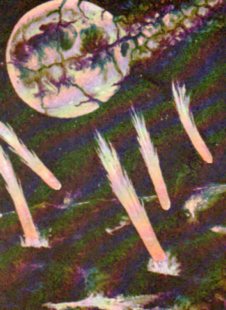
    And then, on the next page of the magazine appears another image of the breaking Moon by Wallace Favereau, this also showing bits of the Moon slamming into the Earth.

    Moon explode408
    Thomas Voter’s illustrations led me to his image showing Boy Scouts flying on their odd destiny to the Moon for a rendezvous with Post-War Moon Nazis in what is a surprising juvie novel by Robert Heinlein, Rocket Ship Galileo (1947).  [Image courtesy of the excellent Roborant site, well worth a visit and bookmark, here.]  The three boy-rocket-experimenters are on their way their with their Nobelist uncle, piloting a thorium-fueled mail rocket that the Manhattan Project Uncle was able to rig up for interplanetary adventures, which gets them to a nuke-war-ravaged-Moon with victorious commanding Nazis over whom the intrepid travelers eventually triumph.  This really has nothing to do with exploding or disintegrating Moons, but finding a reference to Moon Nazis does classify as a strange-thing-in-the-sky. evidently the story is much disparaged by modern readers, though the author of Roborant feels as though there is a much greater depth to the story that the possible high-comic storyline implies. 

    It looks like there is a sub-genre for Evil Alien Space Nazis in books and film, but I just can’t go any further with the topic.


  • Strange Things in the Sky Department: the Exploding Moon.

    JF Ptak Science Books    Post 1763   [Part of the Strange Things in the Sky Department.]

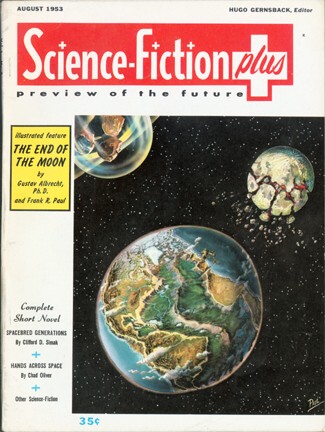
    Moon exploded[Cover art by the great Frank R. Paul for the August 1953 issue of Science Fiction Plus.]

    In my experience of Strange-Things-in-the-Sky Department,the idea of the exploding Earth is far more popular and more illustrated than that of the Exploding Moon.  So far as I can recall Moon doesn’t explode in most cases of early sci fi, including the earliest case of Lucian’s Icaromenippus and his great True History (a satire on outer space travel and interplanetary warfare between the kings of the Moon and the Sun over possession of the Morning Sat (Venus).  Nor does the Moon explode in the other very early efforts of de Bergerac (1657), Francis Godwin (Man in the Moone, 1632, where Our Hero gets to the Moon on a goose-powered aerial something), Johnannes Kepler (Somnium, 1634) and others.  The Moon gets into trouble enough, but not so much trouble to lead it to blow up. 

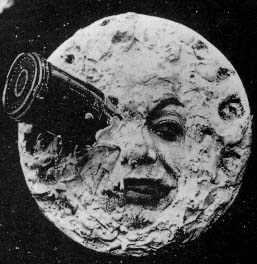
    File:Le Voyage dans la lune.jpg

    (I can’t leave this without mention of Robert Heinlein, who wrote many short stories addressing the Moon, many with fantastic titles and even better story lines:   “Columbus Was a Dope”,  1947;  “Gentlemen, Be Seated!”, 1948, about a lunar tunnel;  a Boy Scouts on the Moon, “The Black Pits of Luna”, 1948;  “The Man Who Sold the Moon”, a 1949    “Nothing Ever Happens on the Moon”, 1949 (future Boy Scouts on the Moon);     “The Menace From Earth”, 1957, (Lunar teenager angst and a muscle-powered space ship); “The Moon Is a Harsh Mistress” (1966), (and a Lunar penal colony)–lovely titles for some superior writing.

    The Moon certainly takes abuse here and there, ranging from cloud attack (in Lucian) to colonization to this very memorable (and frightening/disturbing, as I found as a child)  as in the case of the Man in the Moon being shot in the eye with a space ship (George Melies, Le Voyage dans la lune (A Trip to the Moon) (1902)). 

    Frank Rudolph PaulAnd of course there’s always the runaway Moon and the havoc that it would soon cause to the Earth, though then again this is not an exploding Moon, except it seems as though it might soon be so. 

    And so in a bit of rambling about the Moon that has gone on in this blog, there are no other mentions of the Moon exploding, though there are some other strange things going on there.  Just not “exploding” strangenesses.

    And especially not Laurie Anderson’s “The Exploding Moon“.


  • Big G’s: Grim & Gross Saturn: Grandville, Goya, Galileo and the German Gnostics

    JF Ptak Science Books  Post 1752

    Blogsaturn_large
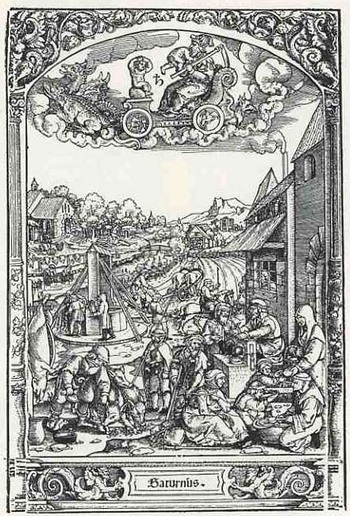
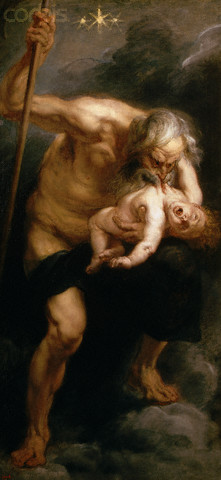
    I was getting ready with what was supposed to be the real post for today when I stumbled upon this woodcut of the Roman god Saturnus.  What makes this image so terrifically compelling is how benign it is—in its weird, mechanical, disinterested observational manner the artist conveys almost nothing about the act that we witness as the god plots his way across the sky in its celestial chariot.  Saturn (equated with the Greek Kronos, and the Titan father of Zeus, and also the name of the gaseous oblate six planet) commits acts of horror, and becomes, again and again, perhaps the greatest coward of the Roman pantheon of questionable deities. 

    It begins with Saturn being told his future:  that at some point in his life his son or sons will supplant him, catch him, replace him and kill him.  And the best thing that Saturn can think to do is to methodically eat his children, and he does manage to consume all but one—Zeus—who then fulfills the prophecy; but then again, who wouldn’t?  There is really very little like this in mythology—and, really, why should there be?
    Blogsaturn_ldetaileating

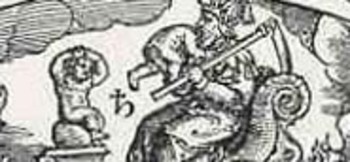
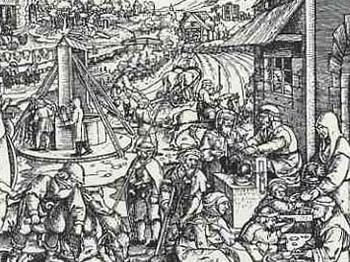
    Our artist—or engraver—is George Pencz (1500-1550), alive and dead very neatly at the century and half-century mark, and his work (“The Life of the Children of the Planet Saturn”) is illustrated in Folge der Planeten .  The image of Saturn racing along with his son’s head in his mouth looks naive compared top the rest of the illustration, which is a very lively, if quiet, depiction of the industry that his dead sons would have applied themselves to if they hadn’t been consumed by their father.  The illustration of Saturn is very disturbing to me, particularly when you notice the son-in-waiting, who is watching his father eat his brother, and in an incredibly pathetic and heart-breaking way is trying to protect himself by holding his head.  I think it is so very moving because it is a perfectly logical (from a child’s point of view) reaction to an unimaginable terror, and perhaps this is how Pencz can best deal with the vile god.
    Blogsaturn_ldetailallegory

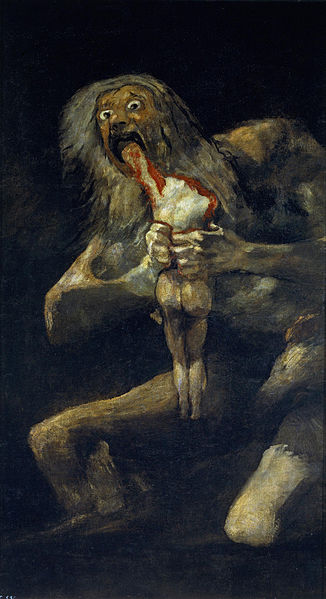
    Images of Saturn really are legion, but there are a host-and-a-half that are pretty upsetting, like the one above, and the one coming, below. I think that the one that is the test against which all others are measured is by Francisco Goya, who during his “black period” painted the truly terrifying image of Saturn devouring his child right on the wall of his house in 1824 (or thereabouts). It really is bad stuff. The scene as painted by Peter Paul Rubens isn’t much better.

    Saturn goya Saturn rubens


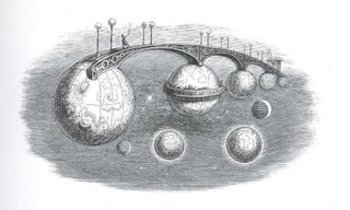
    Admittedly, J.I.I Grandville (1803-1847) didn’t conceive of this series of bridges as a plausible means of interplanetary travel and is in all probability an allegorical creation, but the image does–in an odd way–allow a dialogue on the idea of moving from planet to planet, which was still pretty solitary thinking in the mid-19th century. Although this didn’t have a direct effect on the perception of man’s place in the solar system, it did have a great and direct impact upon a vast number of illustrators and cartoonists who followed in his considerable wake.

    BlogfuturegrandvilleThis image comes from Grandville’s Un Autre Monde, published in 1844.

    In addition to an interplanetary bridge that there is another singular creation here in Grandville’s cosmos–a balcony constructed of the rings of Saturn (if indeed this was supposed to be Saturn–it is as advantageous as not to think of it in this way) and if we think of a balcony being a place to watch and observe, then we are brought instantly to W.G. Sebald’s Rings of Saturn, which is a textural masterpiece, and mostly I guess a novel about everything that Sebald observed in his walk through Suffolk.  (Another Saturn-related work of fiction is Sirens of Titan, by Kurt Vonnegut,  a very mature and insightful 1959 novel which really has nothing to do with anything here; I just needed to throw that in, what with him being a master storyteller, crank and human-caricaturist-observer and all…)  And so by 1844 it comes to pass that one French caricaturist/imaginist comes to draw an extraordinary and impossible land/space bridge between the planets only 234 years after Galileo  first glimpsed Saturn’s “handles”–give the optics of his telescope Galileo didn’t see the rings of Saturn as such, seeing rather two “extra bodies” on either side of the planet  It would take another 65 years and accumulations of observations by some of the greatest names in the history of astronomy (Galileo, Casini, Hevelius, Huygens) to show that the disk (singular) on Saturn was actually a series of rings.  (I should add that the first photograph of Saturn’s rings is not made until 1883.

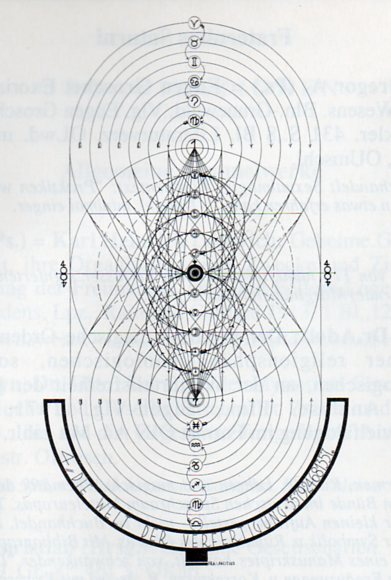
    Saturn gnosis303
    Which somehow brings me to the troubled world of the “Saturn Gnosis”, the Fraterniti Saturni.  Actually the only place I’m getting to here is a picture (above), which I tried to understand before I realized what it was, and how much of an expanding hocus-pocus (otherwise defined as  “woo woo” in the words of James Randi) rabbit hole of diminishing returns it leads to, a dizzying history of competing complexities and nonsense.  But the image (found in a book edited by Eugen Grosche, (Offizielles Publikations-Organ der deutschen Gross-Loge Fraternitas Saturni Orient Berlin,  1929), comes from a psycho-sexual-astrological-magical group (one of a number of such associations in Germany and particularly Berlin in the 1920’s), and seems no less a part of reality as does Grandville’s Saturn.  Sameness ensues when you try to approximate the volume of limitless emptiness, or belief.

    ·Posted by :

    ·in:

    — —

  • Titanic Understatement on (1) “A” Big Bang and (2) “The” Big Bang

    JF Ptak Science Books   Post 1748  (An expansion of an ealier post from 2008)

    The soft-sell of the generally recognized and understood propositions, stepping well around the main, central, controlling issue, hinting broadly along its perimeters, defining the emptiness by its shell, left to an undistinguished recognition, is what we’re hunting here.

    I have two examples of extreme examples of understatement occurring at the beginning and end of things—all things.

    The first understatement–“the” Big Bang of the title–that we will look at here belongs in the last paragraph of the seminal paper by Edwin Hubble and Milton Humason, writing an extension and refinement (and adding much more data) on the “discovery” of the Big Bang as they defined the Red Shift, which was actually a roughly proportional increase of distance traveled to red shift. They plotted a trend line for 46 galaxies and in 19291 formulated the empirical Redshift Distance Law of galaxies, which is today known as Hubble’s Law, which was consistent with the solutions of equations of GRT. (This momentous discovery was cheered by the normally non-cheering astronomy community in unusually verb-y ways, such as with the statement made by W.S. Adams, (director of the Mt. Wilson Observatory), who said that thee Hubble/Humason effort was “the most ambitious project astronomy has ever undertaken…maybe (the) research will reveal the very edge of the universe”2.
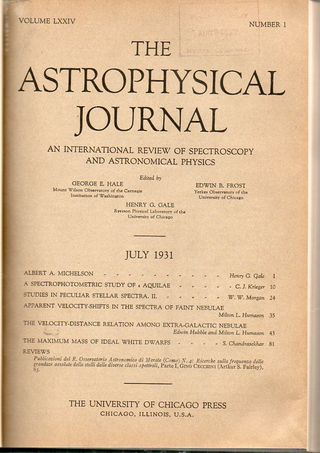
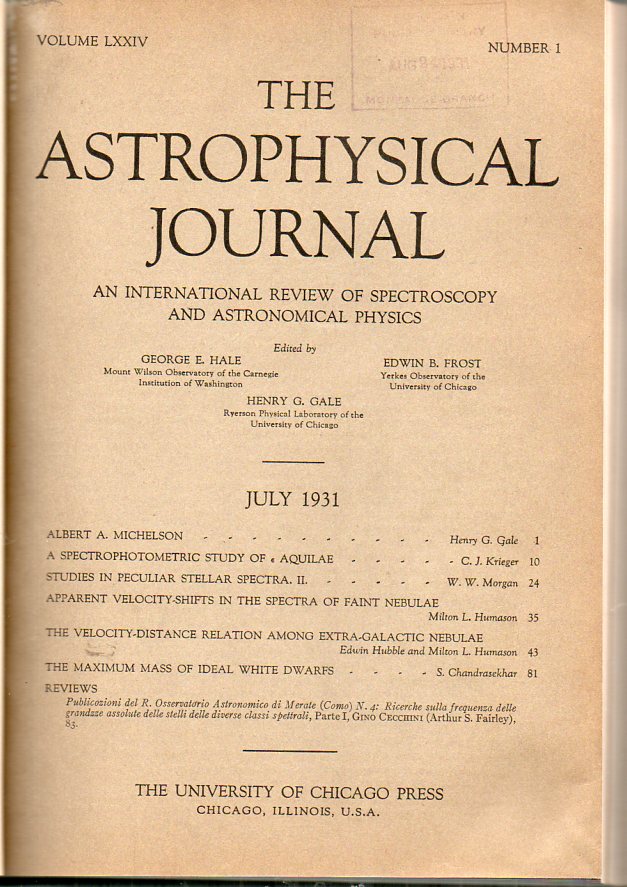
      Hubble358It is in a further report on their studies in The Velocity-Distance Relation Among Extra-Galactic Nebulae (The Astrophysical Journal, July 1931, full text here) that Hubble and Humason react to and answer questions that arose from their 1929 paper, and also incorporate much new data.  As a matter of fact, they managed to “spectacularly extend the linear relationship”3 to a speed of 20,000 kps, and also to an estimated distance of about 100 million light years, this by using many more points in the 1931 diagram.  This was the further proof needed to strengthen the existence of a linear redshift-distance relation, and it appeared in this “promised sequel”4 of the 1931 paper. 

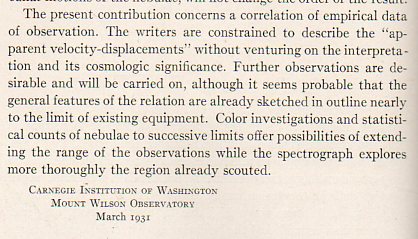
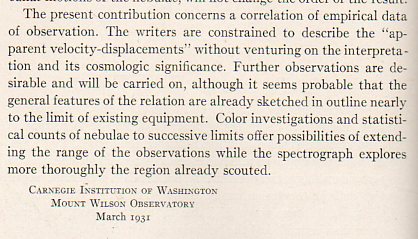
    It is in the 1931 paper that Hubble and Humason make their stupendous understatement: regarding their understanding of the phenomena and the expanding universe. They take many steps back, and say in the concluding paragraph “the writers are constrained to describe the apparent velocity-distance displacements without venturing on the interpretation and its cosmological significance”. They basically lay out the functioning of the universe and the best understanding of how we got to where we are in the cosmos (Vesto Slipher notwithstanding), and how according to their understanding that the universe is expanding and is consistent with all known laws, that they decide to not say anything, um, philosophical.
    Hubble357
    And so, in the last paragraph of this paper discussing the Great Alpha, the authors decided, in their modest and terrifically understated Bartlebian way, to not comment.

    The second example of tremendous understatement occurs in a report discussing the Great Omega, and how in the end the end might actually be avoided. Written by Joseph Coker, Chief of the National Resource Evaluation Center in the Office of Emergency Planning in Washington, D.C. in April 1965 (100 years to the month after the end of the U.S. Civil War), “NREC Programs for Gaming the Logistics of National Survival” is by its very title and appearance a startling looking and sounding document. Coker and his NREC worked within the Executive Office of the President (LBJ at the time), and his paper concentrated on a succinct appraisal of the existing gaming programs looking at survival of all aspects of the national life in the days following nuclear end-game.

     

    Blogalphaomega_2025  

    In general the document is as dry and cardinal as bagel toast—it warms quickly and invisibly, however, and that bagel toast becomes a burnt and invisible cinder via Coker’s prose.

    The document wastes no time in getting directly to vast understatement, and stays there. In chapter one “Logistics of National Survival”, the second chapter opens:

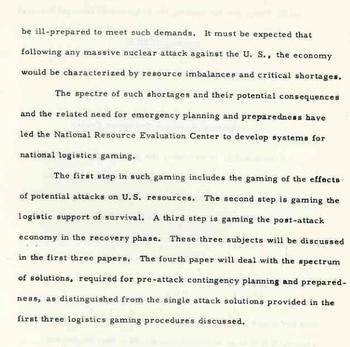
    “Because of recent changes in the technology and potential tempo of war and because of the base power of force is in being (including equipment and supplies), there is general recognition that any future war in which the United States is engaged, especially if it is an unlimited nuclear war, may be decided without significant additional military demands upon the nation’s industrial economy.” Hmm. He continues: “That is not to say, however, that the post-attack economy would not face enormous logistical support problems.” There is no human element of this equation. “The logistic requirements of survival and recovery would present very heavy demands.”
    Blogalphaomega_3_2026

    “Very heavy demands” reaches a very great height of understatement. How high is high? I don’t know. Remember: Mr. Coker was Chief of this division and working within the Executive Office. This was thinking at a very high level.

    He continues in this same paragraph: “Furthermore, the post-attack economy may be ill-prepared to meet such demands”. The paragraph ends in a tremendous horizontal soar: “It may be expected that following any massive nuclear attack against the U.S., the economy would be characterized by resource imbalances and critical shortages (italics our’s). 

    Coker’s papers meant to remedy the approaches to these “imbalances”. The NREC was up and running with ideas and computing fire—in the form of the CD 3600 computer and FORTRAN—to develop a “damage assessment system” called READY that would replace the existing programs named, with no evident imagination, JUMBO, STREAK and DART.

    Throughout this entire document there is no mention of overwhelming, catastrophic death and/or obliteration of the social structure, except that it must be implied that there must be “someone” to operate the essential industries that must be brought back on line.

    Curiously there is a discussion about the survivability of the Federal Reserve and the banking system. My guess is that in the ensuing giga-tons of holocaust of flame that paper money didn’t burn along with its human holders.

    Notes:

    1.  Hubble & Humason,  A Relation Between Distance and Radial Velocity Among Extra-Galactic Nebulae…  Mount Wilson Observatory,  1929.    Contributions from the Mount Wilson Observatory No. 427

    2.  David Harland, The Big Bang, Springer, 2003. 

    3. R.W. Smith.  “The Origins of the Velocity-Distance Relationship”, in Journal for the History of Astronomy, volume 10, p. 133, 1979. 

    4.  _____.  Page 136.
    ·Posted by :

    ·in:


  • On the Center of Everything (continued)

    JF Science Book

    Continuation of  Visual Chronology of Cosmology Part 1 and Visual Chronology of Cosmology Part II,.

    I started out in this post to write about the scholar pictured in Andrew Borde’s book, The Breuiary of Healthe, for all maner of syckenesses and diseaes, Expressynge the obscure terms of Greke, Araby, Latyn, and Barbary, in Engluish concernying Phisicke and Chierurgerie…., which was printed in London in 1556.  Underneath this rather long title is perhaps the earliest “modern” work on hygiene–or at least (in a real test of qualifications) it was the first book written by a medical man on hygiene that was originally written and published in English.  In its way it is a wonderful book, being a compendium, really, of 384 short chapters on the this-and-that of medicine, all alphabetically arranged, which made it a simpler book to compose than a full treatise on the subject arranged in a medically-logical way.  But what I liked in it was the contrasting image of the scholar, which to me is the very picture of ennui, laid side-by-side with the chief element by which this book is probably best remembered, which is “Myrth is one of the chiefest thygnes in physicke” (or “humor is the best medicine”).  Borde’s scholar may not be taking his own medicine, here.   

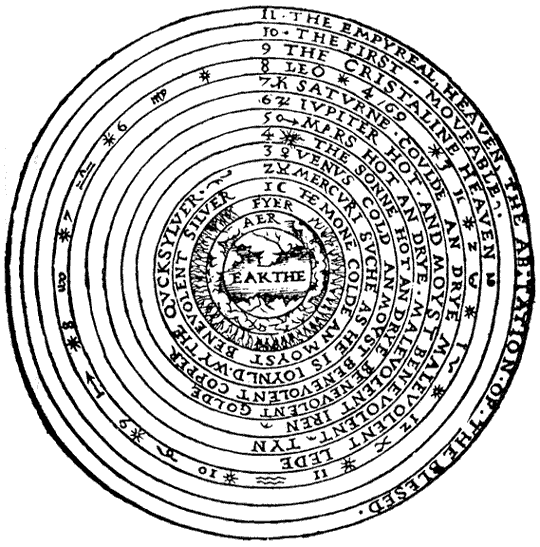
    In looking for the text for this fine book I came across something else, Borde’s Aristotelian celestial spheres in his  The First Book of the Introduction of Knowledge, printed in 1542, the year before the publication of Copernicus‘ De Revolutionibus. It is a magnificent woodcut, and tells the story of a vision of mankind that would soon come to vast change. 

    Ptolemaic Universe
    Source:  the Luminarium, here.

    The image shows us the geocentric universe, the creation, and eleven-sphere unit that follows the Earth at center and the four subluminaries (earth wind air fire), followed by the orbit of the Moon and Mercury and Venus, after which comes the Sun, followed by the rest of the planets.  These spheres are followed by the fixed stars/the starry firmament), and ultimately by the Primum Mobile, divided into the crystalline heaven, the first mover, and the Empyrean.  Its a beautiful image. 

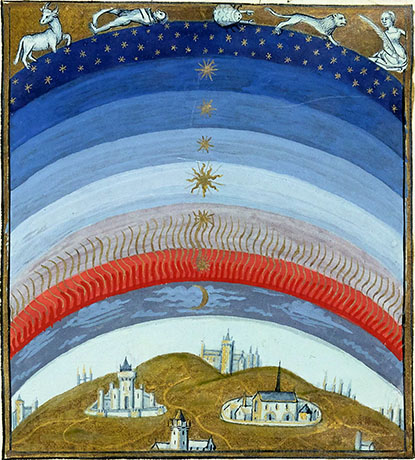
    The following is in a sense a cross-section of the Borde image, which shows pretty much the same information (with the Sun being in the fourth sphere).  This is manuscript is more than a hundred years earlier than the Borde, and accurately represents the elements of cosmology of the time.

    Image source:  Luminarium, here; From Les Echecs amoureux (“Amorous Chess”) Manuscript made for Louise of Savoy, 15th c.  Bibliothèque nationale de France, département des Manuscrits; Mss.fr.143, fo 20.

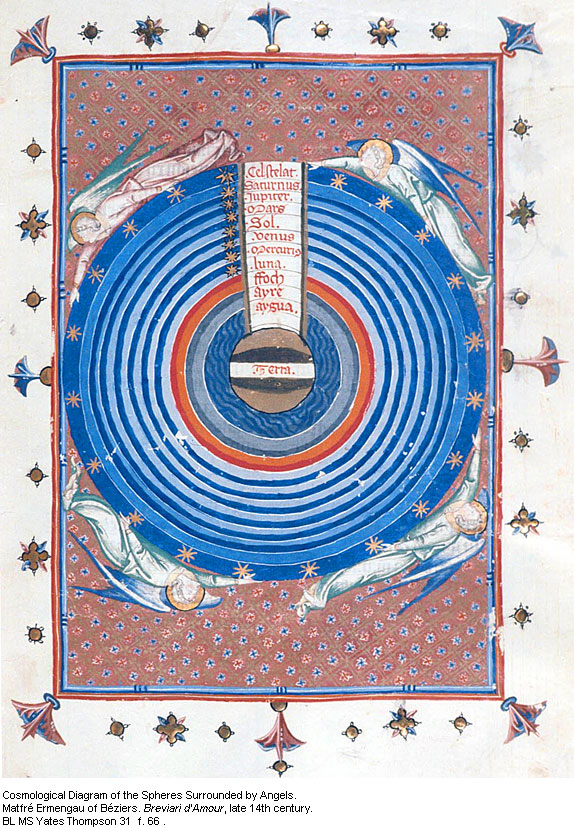
    An even earlier version of this more-or-less static image, the perfect image of the perfect creation in which all of the stars in the visible sky were always there, in some perfect number, in the configurations for all time. (This idea of course would be one of the greatest disfigurers of ancient thought that the telescope of Galileo  would provide.)

    Spheres of angels
    Source:  Spheres Surrounded by Angels, Brevari d’amour, late 14th c

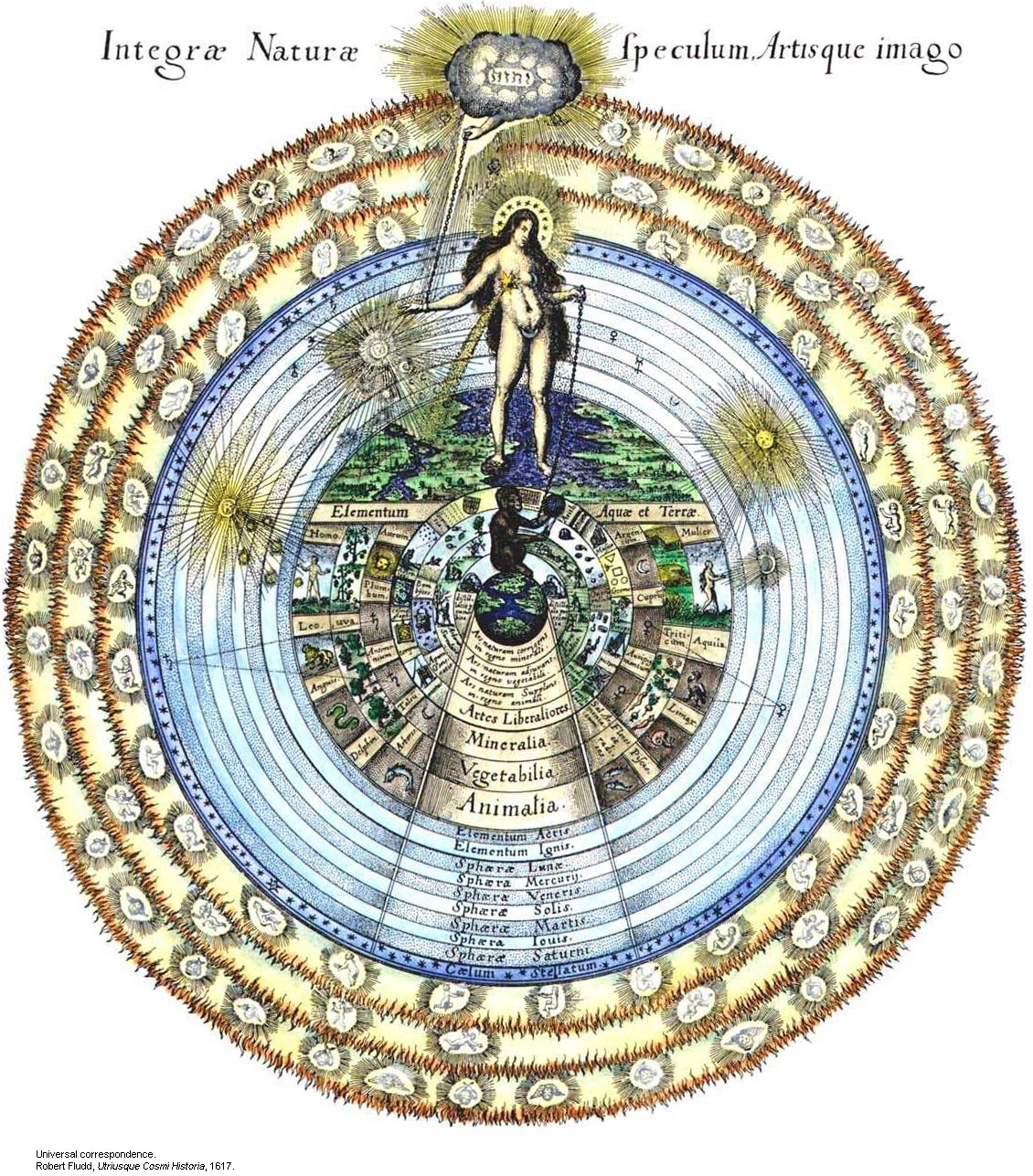
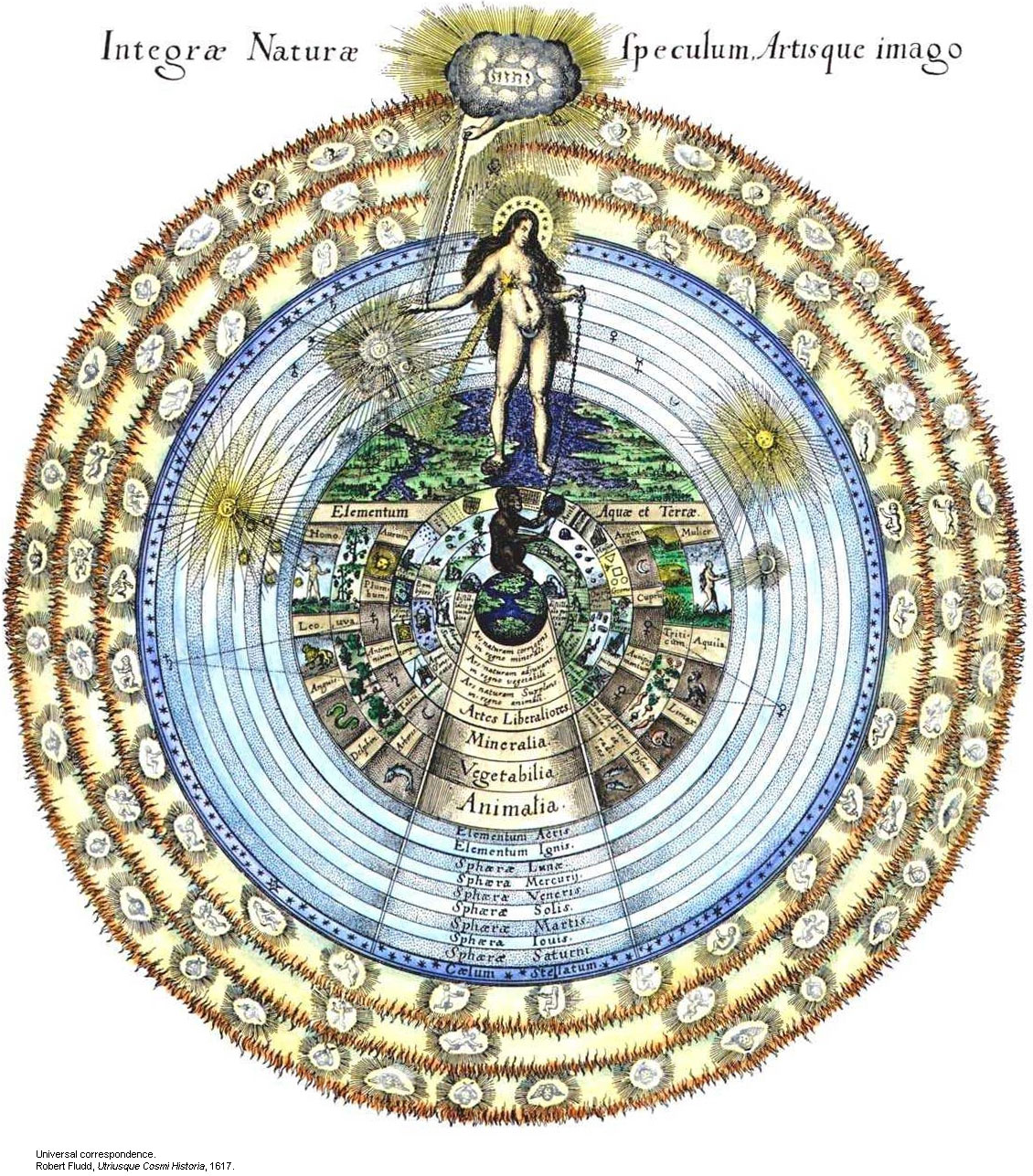
    Robert  Fludd, a visionary of a different sort, as his celestial sphere will show:

    Spheres--robert fludd
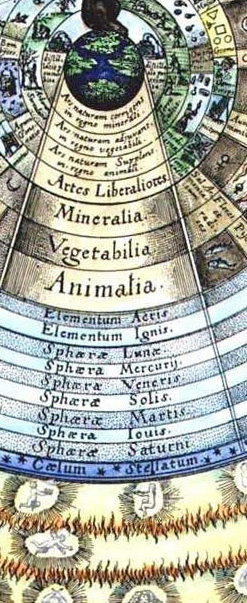
    And here in detail:

    Universal Correspondence from Fludd’s Utriusque Cosmi Historia, 1617.Rob

    Spheres--robert fludd det

    Fludd’s (1574-1637)  features a complicated astrological existence well beyond the point of Copernicus.  In addition to everything else, real and imagined, Rosicrucianism and astrology and puffy-birds, Fludd, who was  an English physician, delved deeply into the real stuff of the world in this book in addition to all of the other make-believe–optics, the musical intervals, perspective drawing, hydraulic engineering, construction of lifting machines, military engineering and many other interesting, physical science topics.  But this drawing, right there on the title page, reveals Fludd’s real interests and shows what governs what he does.  Everything else, the math and and the physics, services this need.  Of course the image is beautiful, which is why it is here, but it is also a deeply personal, exploitative, cover-all for the things that Fludd *wanted* to find.


  • WIlliam Herschel, Adam Smith, Sunspots and Wheat Prices

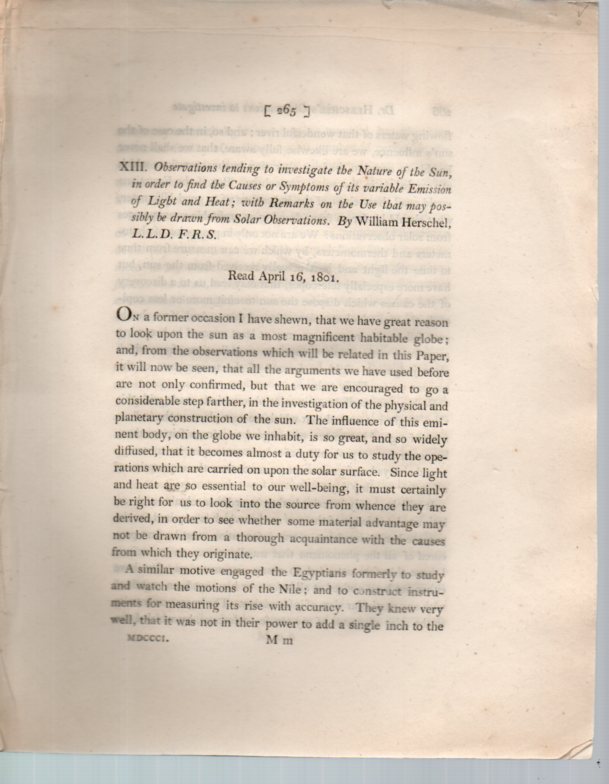
    Herschel253JF Ptak Science Books   Quick Post

    While flipping through William Herschel’s 1801 Philosophical Transactions paper “Observations tending to investigate the Nature of the Sun in order to find the Cause of Symptoms of its Variable Emission of Light and Heat”, I thought it was a good early-ish paper on sunspots.  I was surprised to find a lengthy entry on the applied nature of his findings, and that on the variable nature of sunspots and agricultural yield as determined by wheat prices found in Adam Smith’s Wealth of Nations.  Honestly I was fully unaware of Herschel’s involvement with sunspots and seasonal growth and price fluctuations, but there it was.  And he does find a correlation, albeit a very cautious one where he says the subject deserves more study and more data.

    He writes: “it seems probable that some temporary scarcity or defect of vegetation has taken place, when the sun has been without those appearances which we surmise to be the symptoms of a copious emission of light and heat…”

    This must make Herschel–already a celebrity astronomer for his discovery of the first planet discovered since ancient times, Uranus, among many other things–one of the earliest (if not the first) astronomer to experimentally entertain the effects of solar disturbances on the Earth.  And this on sunspots years before Schwabe established the periodicity of sunspots (1846) or the electromagnetic connection with sunspots (that would come only with G.E. Hale in 1908).  Herschel (who left/fled Germany to reside in England) was a man of interesting sight: he discovered Uranus, identified new moons of Saturn, established that the previously-nebulous nebulae were collections of vast numbers of distant and faint clouds, drew a spectacular image of the Milky Way galaxy as an outside observer looking in, that there was a light from the sun that was beyond the visible spectrum, and also discovered in the micro-world found that coral were animals rather than plants.The business of trying to see if there were any correlations between solar activity and plant production on Earth was novel, and interesting. [The original paper is available for purchase through our blog bookstore, here.]

    In the Edinburgh Review for 1825 we find:

    ·Posted by :

    ·in:

    —