A Daily History of Holes, Dots, Lines, Science, History, Math, Physics, Art, the Unintentional Absurd, Architecture, Maps, Data Visualization, Blank and Missing Things, and so on. |1.6 million words, 7500 images, 4.9 million hits| Press & appearances in The Times, Le Figaro, Mensa, The Economist, The Guardian, Discovery News, Slate, Le Monde, Sci American Blogs, Le Pont, and many other places… 5000+ total posts since 2008.

Category: Astronomy

  • On Eclipses of Io and the Speed of Light: Ole Romer, 1676

    JF Ptak Science Books   Post 1730

    “When the father and creator saw the creature which he has made moving and living…, he rejoiced, and in his joy determined to…make the universe eternal, so far as might be. …Wherefore he resolved to have a moving image of eternity, and when he set in order the heaven, he made this image eternal but moving according to number, while eternity itself rests in unity; and this image we call time… Such was the mind and thought of God in the creation of time. The sun and moon and five other stars, which are called the planets, were created by him in order to distinguish and preserve the numbers of time… And for this reason the fixed stars were created, to be divine and eternal animals, ever-abiding and\ revolving after the same manner and on the same spot…” Plato, in which he wrote about the formation of the universe, among many other things, (Jowett. v. 2. Timaeus, p. 19), and spotted at the Linda Hall [Science] Library here

    Well, not exactly, but this was some pretty good thinking by Plato for his time, and beyond that–actually, the thinking was held for centuries.  But it was some very nice thinking by (Danish) Ole Rømer that pieced this part of Plato out, turning it around, and coming to terms with the use of “the order of heaven” to “preserve the numbers” of the speed of light, all through the observation of eclipses of Jupiter’s moon Io. 

    Horrebow249
    I should first say that today’s post came about via Peter Horrebow’s (1679-1764) Operum Mathematico-Physicorum… , a three-volume work published in Copenhagen in 1740-41.   Horrebow was a very accomplished astronomer in his own right (we’ll get to that in a moment), but what is of interest for me right now is the third volume of his book, as it (the Basis Astronomiae…) contains very detailed descriptions of the astronomical instruments and observatory of his fellow Danish astronomer Rømer (1644-1710).  Horrebow must have been a very gifted machinist and man-about-the-“lab”, as he was able to make his way through the educational system and then to the highest levels of academia even though beginning his life as a fish-seller’s son–an extraordinary accomplishment, really, as there were not many opportunities for people without some sort of privilege to succeed on this level.  And succeed Horrebow did, serving as the great Rømer ‘s assistant and charge, living in the man’s house for some time. (He didn’t stay for very long, as Horrebow was a father of twenty.)

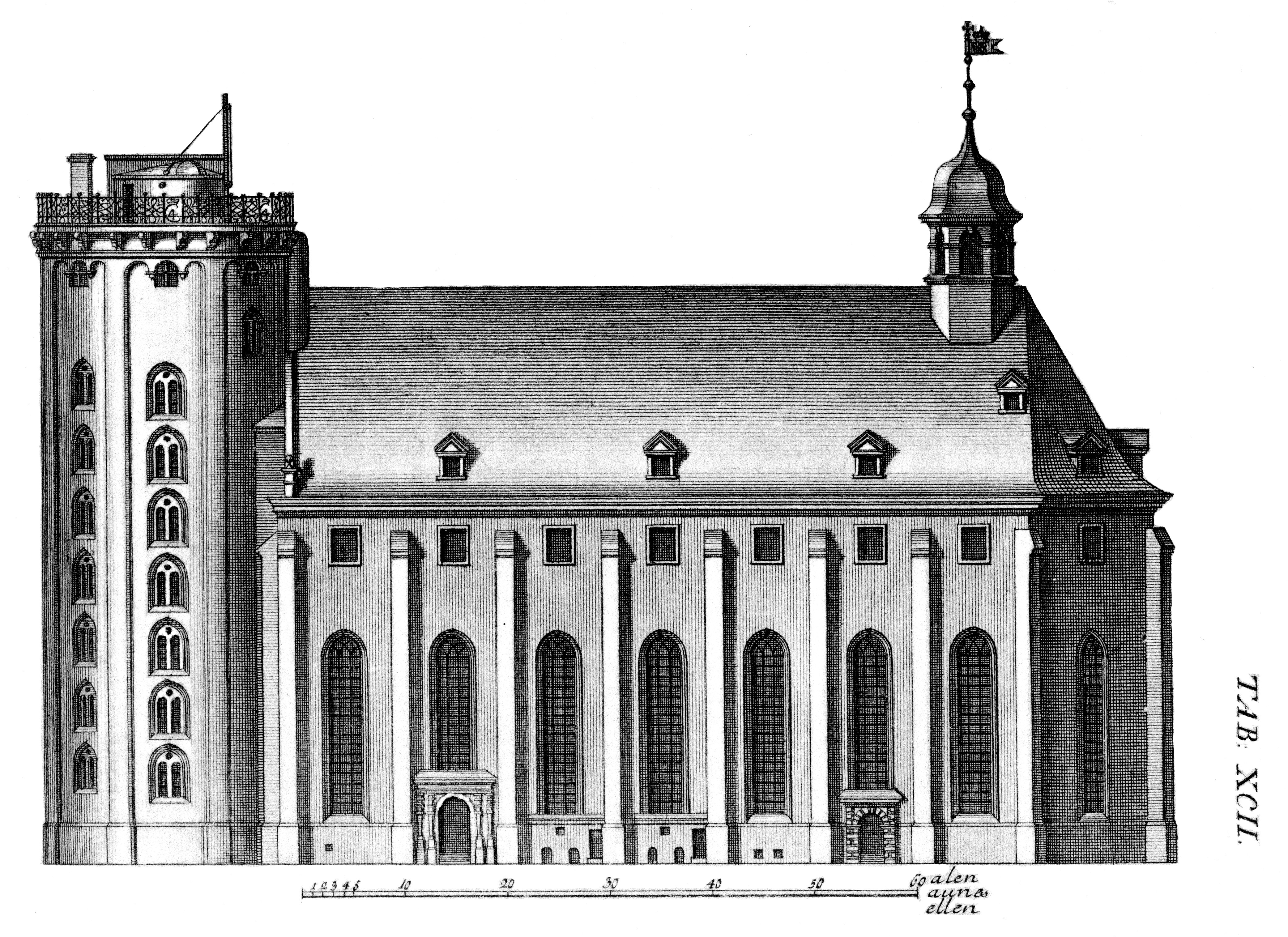
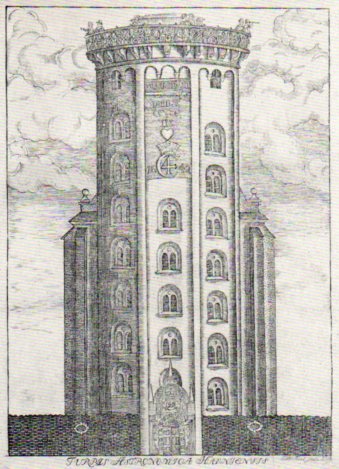
    There are some famous illustrations in this book–not the least of which is the depiction of Rømer at work on a transit in his observatory–but the image I like most of all is not one of the instruments, but a beautiful engraving of the observatory built by Charles IV.  The massive structure–called the Rundetam–was begun in 1637and finished in 1642; it is as its name suggests a “round tower” that rises 34 meters; it has no stairs using a 7.5-turn walkway instead. (It is a confusing thing, walking ’round to go up, and seems to me to have been much more than just seven turns; in a weird way by the top of the walk it felt as though one was going “down” somehow. Maybe I  just got dizzy.)  In any event the tower would be an observatory, with Rømer (and then, later, Horrebow) working from the roof as well as from some high windows, and was meant to replace the great Tycho Brahe’s demolished Stjeneborg

    File:Hafnia Hodierna Tab XCII Trinitatis Kirke.jpg

    [Cross-section of the observatory.}

    Rømer’s career was remarkable, but what I find particularly beautiful was his determination of the speed of light, and all from basically sitting there with his instruments in a window of a massive stone structure in the middle of a city, figuring out minute differentiations, making detailed observations of eclipses of the moons of a planet that had only been observed telescopically less than 67 years earlier (with the newly-invented instrument, the telescope). 

    The moons of Jupiter had been observed in 1666-1668 by Cassini and were a subject of intense study by him and Rømer, among others; Rømer in fact would travel to the Paris observatory and be an assistant to Cassini as the two worked together on the moons and eclipse observations. In this Rømer noticed a particular peculiarity in the changes of the times of these eclipses, becoming shorter when the Earth was closer to Jupiter and longer when farther away.  From this Rømer concluded that light was taking different times to reach the Earth, and from their calculated its speed.  He reported to the Royal Academy of Science on 22 August 1676:

    This second inequality appears to be due to light taking some time to reach us from the satellite; light seems to take about ten to eleven minutes [to cross] a distance equal to the half-diameter of the terrestrial orbit.

    What a jewel that was to give to the world!  It is difficult to imagine the impact of this sort of announcement in the first three-quarters of a century of the telescope, to be able to calculate something as elusive as the idea of the speed of light, and that coming from the observation of moons of another planet.  This was the first true quantitative measurement of the speed of light–there were earlier attempts (by Isaac Beekman  and Galileo), but while their ideas for measuring  were interesting and theoretically workable the instrumentation for recording minute differences in light flashes were not.  (For example in the Galileo experiment (measuring the differences in the light of exposed lanterns a  mile apart, the time was not measurable.  If it could have been measured the answer would’ve been 10 microseconds; at that time the idea of the “second hand” a clock had not yet come to be.)  Rømer established that the speed of light was finite, and gave a value that was within about 25% of the modern standard, or at least 220,000 km/sec. Galileo’s earlier best estimate was that light was at least ten times that the speed of sound. (HE was right, of course, light is at least 10x sound, but the capacity for more accurate observation and instrumentation were just beyond his age.)  This was a truly remarkable accomplishment.

    The observatory had a relatively short shelf-life, what with light pollution and the rumble and vibration of city traffic doing it in by the mid-18th century; so for its size and heavy fullness, the building lasted a little more than a century as a useful observatory. 


    ·Posted by :

    ·in:

    — —

  • Beauty in Shades of Gray of Stellar Spectra, 1863

    JF Ptak Science Books  Quick Post

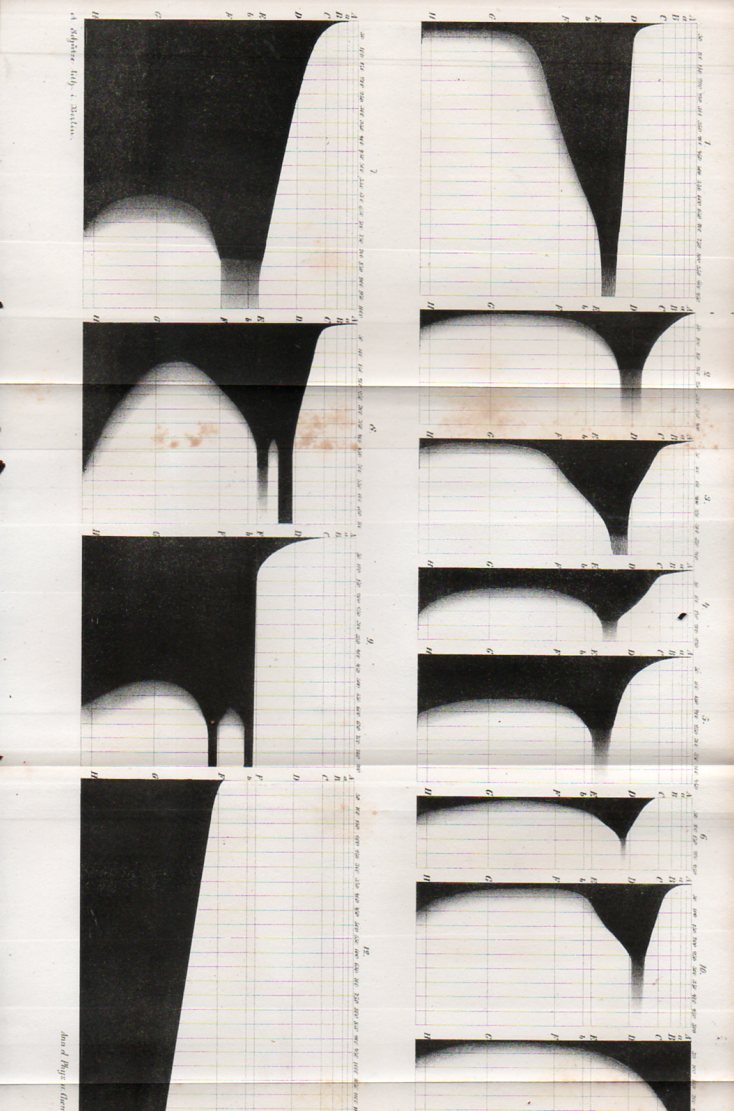
    This very quick posting is made in relation to a book just posted to the blog’s bookstore (Gustav Kirchhoff’s  “Zur Geschichte der Spectral-Analyse under der Analyse der Sonnenatmosphaere”(On the history of spectral analysis and the analysis of the solar atmosphere)–or at least in relation to another object in the 1863 Annalen der Physik volume.  And that other object is this, this beautiful series of diagrams illustrating “Ueber das Verhalten einiger Farbstoffe im Sonnenspectrum” by J. Haerlin, on elements in the spectrum of the Sun that appeared in teh same volume, tucked away at the end of the journal–art in science.

    Grayscale133


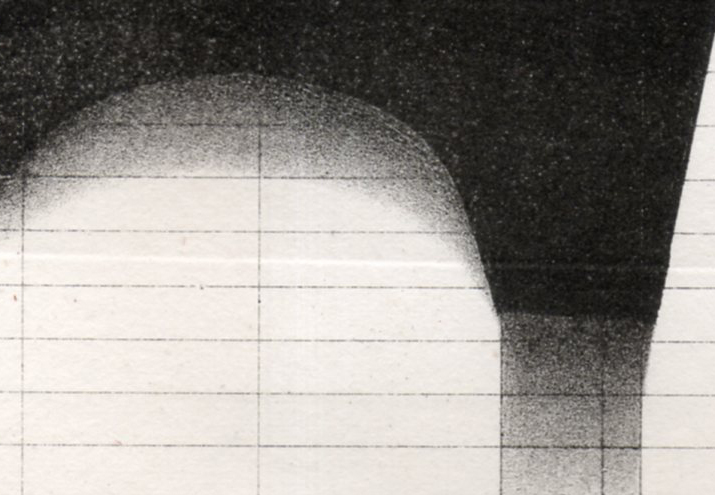
    And this, a bit of detail into the grays:

    Grayscale134


  • The Beautiful Lunarium: Black Walls/White Stars, 1516

    JF Ptak Science Books   Quick Post

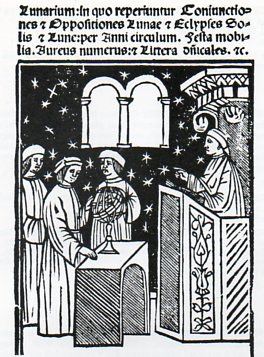
    The following are some beautiful images from a rather popular ephemerides by Bernardus de Granollachs, printed between 1484 and 1515.  The slender (16-page) work, Lunarium: In quo Coniunctiones & oppositiones Lunae… was published first in Spanish in 1484 and was then picked up and reprinted in a number of other languages over the next few decades.

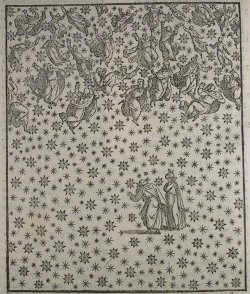
    The image most interesting to me comes from the Rome edition of 1516, simply because of the magnificent black wallsemblazoned with stars (which occurs on the title page):

    Lunarium 1516052

    The image did remind me very slightly of another gorgeous thing which I wrote about earlier in this blog (here):

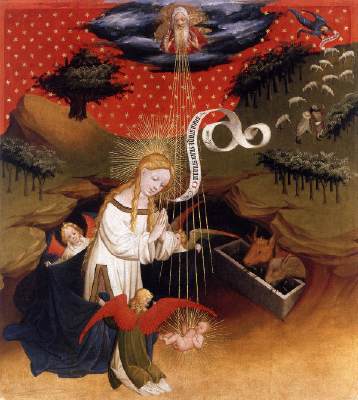
    Red sky

    Some other variations in the Granollachs can be seen below:


    ·Posted by :

    ·in:

    —

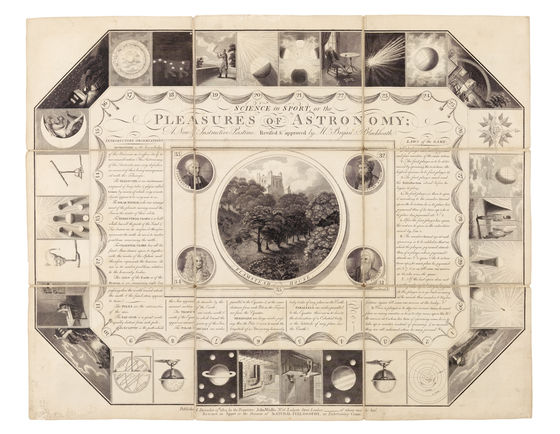
  • The Pleasures of Astronomy–the Game, 1804

    JF Ptak Science Books  Quick Post

    –-“Whoever first arrives here is to take the title of Astronomer Royal‘”–end point of the game The Pleasures of Astronomy

    Astronomy board game I’m not sure how early the earliest board game featuring a scientific game might be, but I do know that this one–Science in Sport, or the Pleasures of Astronomy; A New & Instructive Pastime. Revised & approved by Mrs. Bryan; Blackheath–seems to be very advanced for its age.  Made in 1804 by John Wallis on London, the game such as it is isn’t very “game-y”–the gaming aspect of it isn’t very interesting or involved–mostly the mostly-representative aspect so the game is to just expose the young players to select aspects of the history of astronomy. As a pedagogical tool, the game probably works pretty nicely. 

    The game board, or the course of the game, is relatively standard, though the subject matter is not. The object was to arrive at Flamsteed House1, and by the course of victory the young player would become acquainted with elements of morals, ethics, natural philosophy (although Wallis did in fact produce a very similar game for that topic alone) plus of course some basics of astronomy. 

    Notes:

    1. “Flamsteed House, the original Observatory building at Greenwich, was designed by Sir Christopher Wren and Robert Hooke and built in 1675-76.”  See here for more information.

    ·Posted by :

    ·in:


  • On Missing Antique Atlases of Imaginary Places and the Sameness of Alien Math and Music: Huygens’ 1698 ETs

    JF Ptak Science Books    Post 1458  [With thanks to Rich Lewis, Dickinson College, who found and suggested some remarkable cartographical curiosities!

    I was thinking about the history of atlases of imaginary places [in Western culture] composed before, say, 1900, and I had a hard time coming away with any.  Lowering the sites to a series of maps relating to the same idea didn’t help–its only when you get down to the single-map level that I found some results.  But even there, at the basic representational level of an imaginary place, there aren’t really that many examples, at least compared to the rich narrative life of created space.

    I wonder why that is? 

    If you widened the scope a bit you might look at the night sky as being a sort-of map locating ancient deities, but the sky is really just a picture book with dislocated images without very much to do with one another. 

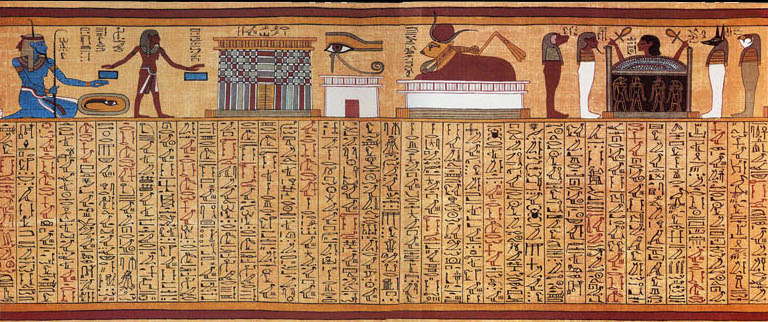
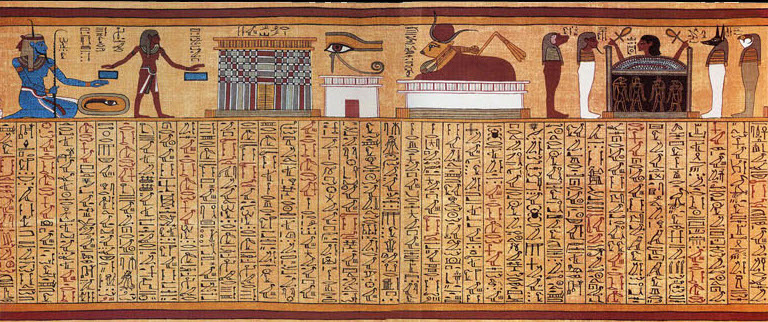
    Books of the Dead1 kind of fit the bill, but how come there aren’t any surviving ancient maps of Olympus, or
    Bookofthedeadspell17
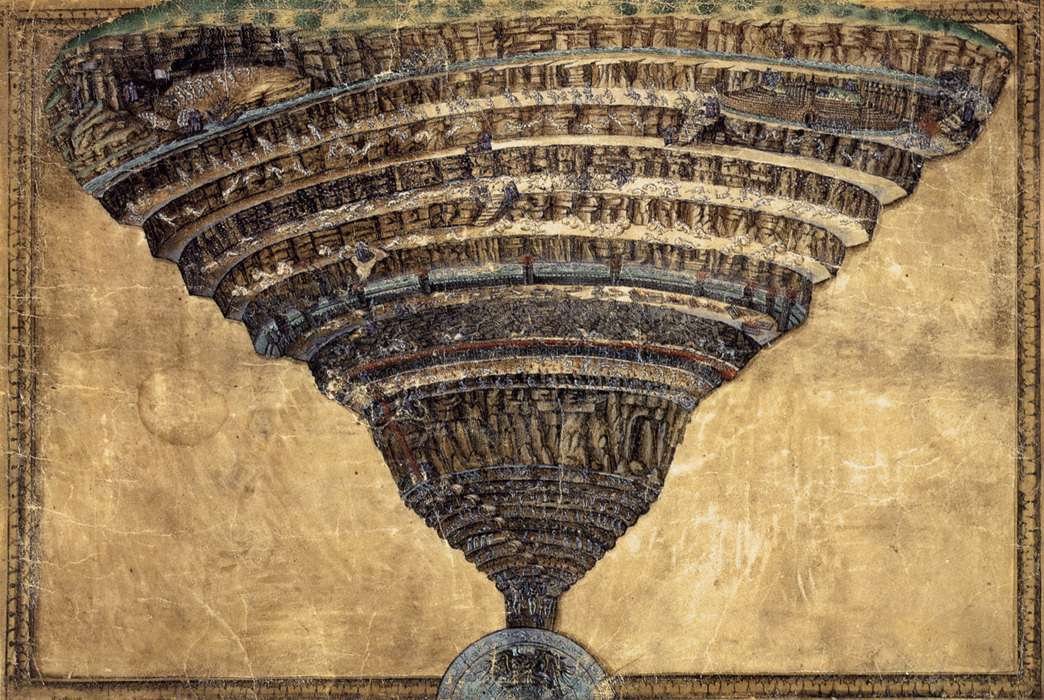
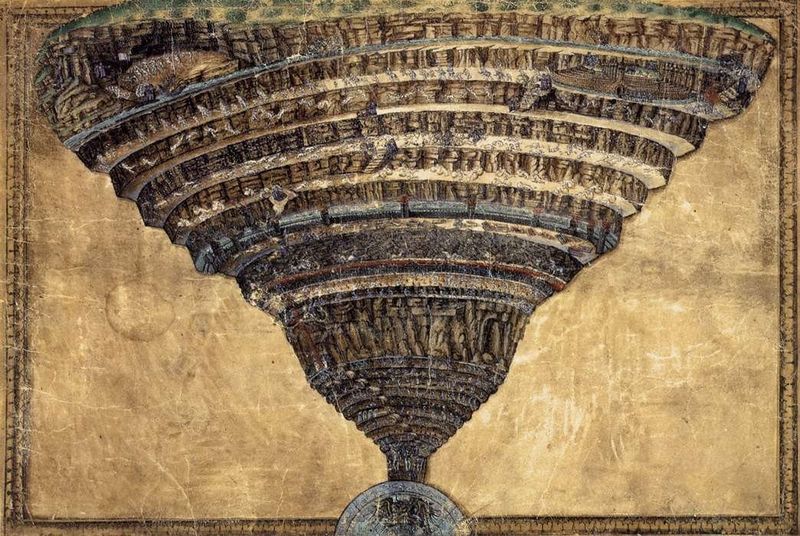
    Heaven for that matter?   The Heaven, and Hell, and Purgatory part does get mapped and mapped pretty heavily after Dante reaches the scene–there are at the very least dozens of cartographic/pictographic representations of the worlds that he surveyed in the Divine Comedy.  For example, there is this spectacular effort by Sandro Botticelli (being a drawing on parchment executed ca. 1480-1495):
    Hell_its_representation_through_the_ages

    The Botticelli is a scary accomplishment, frightening and heavy–you can almost feel the very burden of Hell coming down upon you. (Here’s a good link for a zoomifying version of this map so that you can see its elements in detail.)

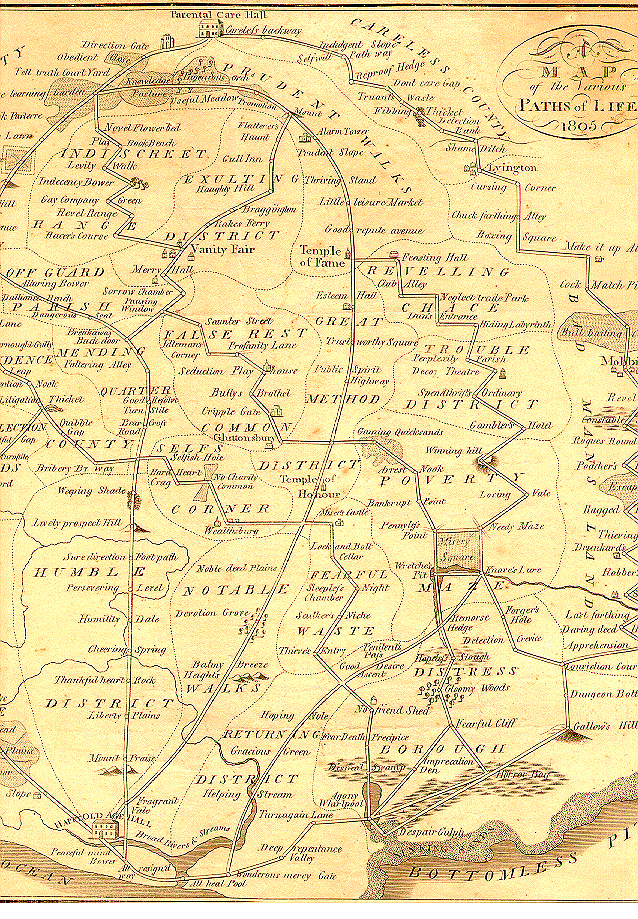
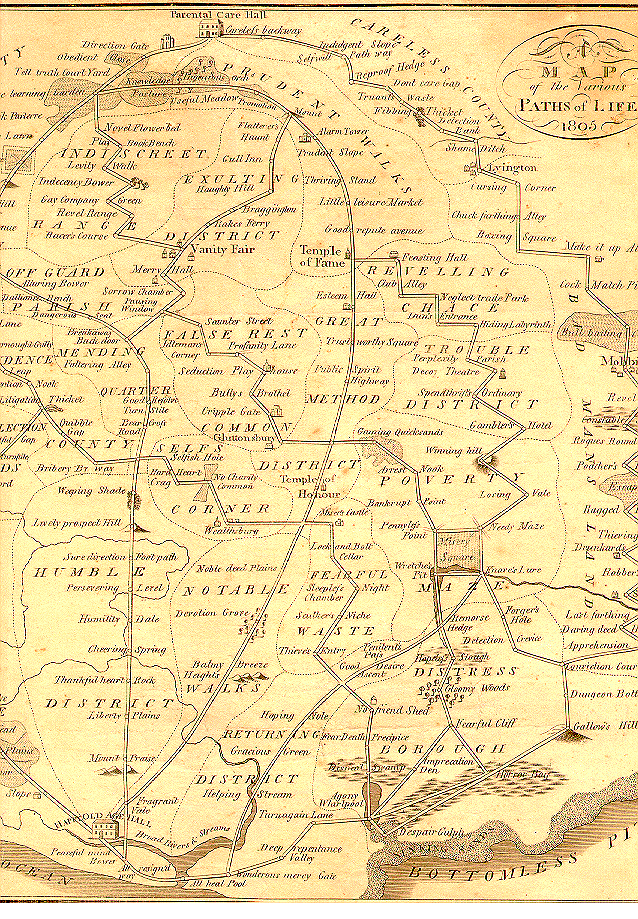
    Then there are allegorical maps that show the stages and stations of life, the progress of the arts and sciences.  A fine example here is a work by B. Johnson, who in 1805 published this fantastic map of the possible paths for living one’s life:
       Maps of Imagination
    which seems to tell the reader to keep away from the southeast. Another  map, this one earlier, printed in 1777, is by J.G.I. Breitkopf, Das Reich der Liebe (The Kingdom of Love):

    Maps of the imagination--
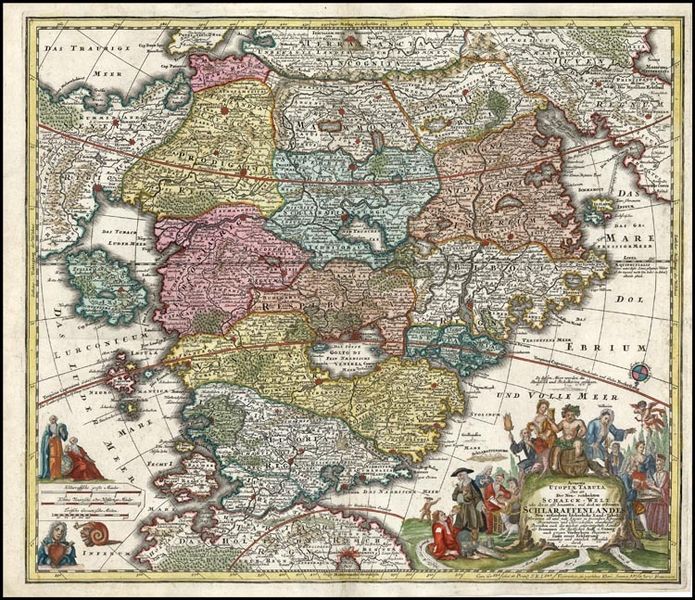
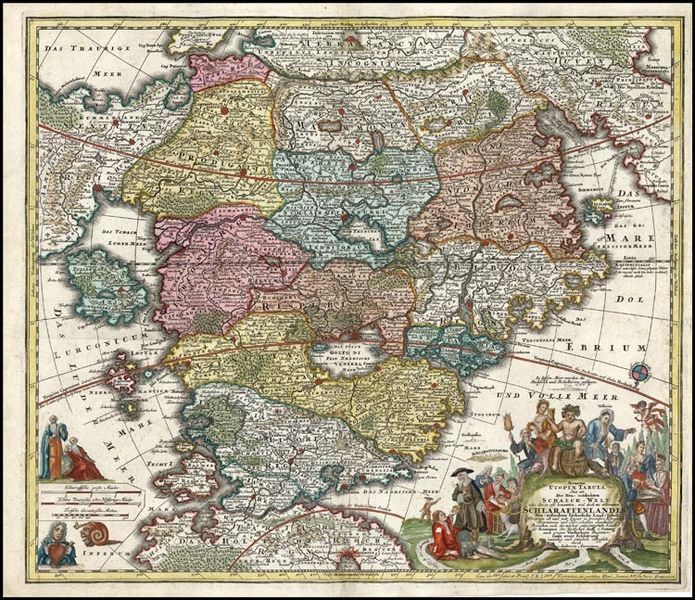
     Another fantastic example of mapping the imagination is found in Matthaus Seutter’s Accurata Utopiae Tabula. Das ist Der Neu entdeckten Schalck Welt, oder des so oft benannten und doch nie erkannten Schlarraffenlandes, published in 1730.  It depicts a Utopia of sorts, though not the world of Thomas More–this is like a pyrite of utopias, a fool’s gold, a fools’ paradise:
    Maps of imagination  utopia

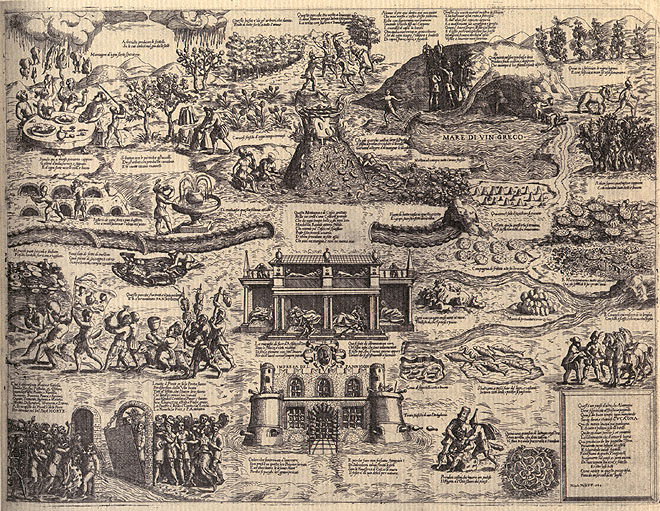
    This land is much like the land of Cockaigne, a mythical Medieval/Renaissance place of plenty, which is pictured below in an image made by Niccolop Nelli in 1564:
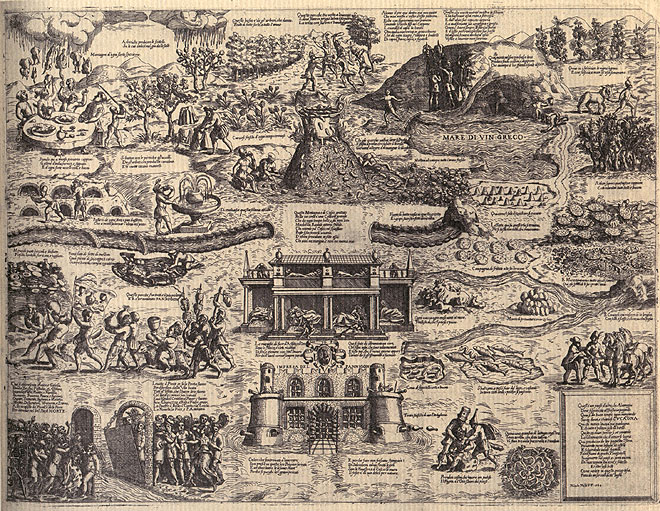
    Cockaigne1
    (It is interesting to picture these places of plenty and sloth in conjunction with some 20th century songs of the Great Depression and earlier, where the land of plenty is far, far simpler–as in the land of the Big Rock Candy Mountain–but that is a different story.)


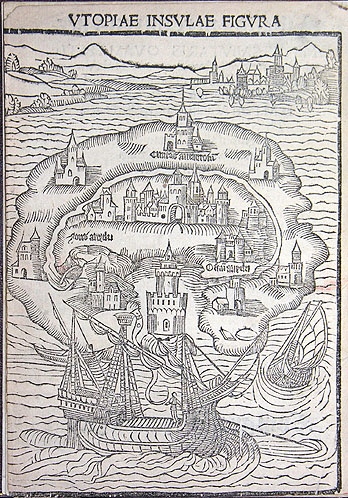
    As long as we’re mentioning Utopia, here’s a 1516 representation of More’s hopefullness, from the first edition of his work:
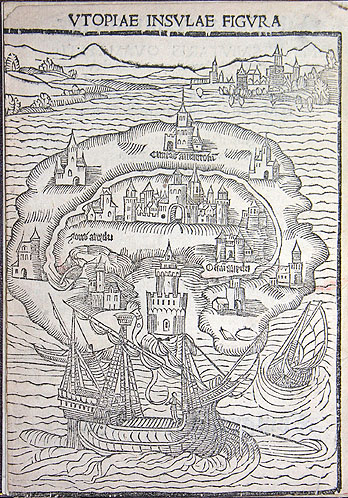
    Maps imagniation More's utopia 1515

    And another represntation, two years later:

    Maps Imagination more's utopia

    There are more recent examples, but not that many, not so far, anyway.  There are editions of Pilgrims Progress (1678) that contain maps of the travels; there are also a number of charts showing the progress of Mr. Gulliver from the Swift book (1726);  Robinson Crusoe also contains a small sketch map opposite the title-page, and, more recently, R.L. Stevenson’s Treaure Island (1882) contains a map of that place.

    But given the extraordinarily rich tapestries of mythical/mystical places that have been created since the beginning of people telling stories, why weren’t there, well, tapestries (or something) illustrating what the whole of these places looked like?  Why for sample when we meet up with a map of the very pronounced extra-terrestrial wanderings of Cyrano de Bergerac (in his ancient-advanced science fiction work on traveling to other inhabited worlds)?  Taking the antiquarian thought on extra-terrestrials as a case study, why don’t we see more of that sort of thinking illustrated in some way?  The idea of extraterrestrial life is very old, stretching far back into Hindu cosmology, and even deep into the (eighteen worlds) of the Talmud.  Thales, Anaximander, Democritus, Aristole, Ptolemy all thought about and agreed on the possibilities of life being lived on places other than the Earth–infintely more life, in the case of Epicurus. Bruno, Copernicus, Fontenelle, Henry More–were all there, but without visual aids, and certainly without maps.  Except for Fontenelle–Bernard le Bovier de Fontenelle–who almost but not quite gets there in his 1682 book Entretriens sur la pluralite des mondes.

    Blog--plurality of world fontenelle :  

    It seems to me that as a representative of extraterrestrial imagination not being illustrated its hard to beat the case of the beautiful and polymathic Christian Huygens.  Huygens (1629-1685) worked across many fields, including astronomy, biology, math and physics, and was extraordinarily productive, making numerous contributions in the physical and theoretical areas, as well as being a prolific author and correspondant.  But towards the end of his relatively short life (he died at age 56) Huygens embarked down the science fiction road in pre-science fiction days, writing a wonderful and provocative book entitled Cosmotheoros, The Celestial World Discover’d: or, Conjectures Concerning the Inhabitants, Plants and Productions of the Worlds in the Planets3, where he establishes the possibilities of life being lived on worlds other than that of Earth. He developes a detailed fabric for these new heavens,m so much so that he can also establish samenesses for the ETs and humans, stating here his belief in the eternal/cosmoloigcal abilities of mathematics and music:

    “It’s the same with Musick as with Geometry, it’s every where immutably the same, and always will be so. For all Harmony consists in Concord, and Concord is all the World over fixt according to the same invariable measure and proportion. So that in all Nations the difference and distance of Notes is the same, whether they be in a continued gradual progression, or the voice makes skips over one to the next. Nay very credible Authors report, that there’s a sort of Bird in America, that can plainly sing in order six musical Notes: whence it follows that the Laws of Musick are unchangeably fix’d by Nature, and therefore the same Reason holds valid for their Musick, as we even now proposed for their Geometry”pg 86

    Huygens holds close to the immutable nature and close association of music and mathematics,m which would be the same here and everywhere (everywhere else, the ET communities, being referred to here as “other Nations”). 

    “For why, supposing other Nations and Creatures, endued with Reason and Sense as well as we, should not they reap the Pleasures arising from these Senses as well as we too? I don’t know what effect this Argument, from the immutable nature of these   Arts, may have upon the Minds of others; I think it no inconsiderable or contemptible one, but of as great Strength as that which I made use of above to prove that the Planetarians had the sense of Seeing.” pg 86/7

    Huygens is so sure of this that he is willing to tak a bet with long odds that not only do ETs enjoy the possibilities of muic but that they have also created instruments:

    “But if they take delight in Harmony, ’tis twenty to one but that they have invented musical Instruments. For, if nothing else, they could scarce help lighting upon some or other by chance; the sound of a tight String, the noise of the Winds, or the whistling of Reeds, might have given them the hint. From these small beginnings they perhaps, as well as we, have advanced by degrees to the use of the Lute, Harp, Flute, and many string’d Instruments. But altho the Tones are certain and determinate, yet we find among different Nations a quite different manner and rule for Singing; as formerly among the Dorians, Phrygians, and Lydians, and in our time among the French, Italians, and Persians” pg 87

    Huygens then continues to make a beautiful distinction between the musics of Earthling and ETs, in that it may not sound anything like any music we have on Earth, but–since the laws that govern math and music are the same, everywhere–it still might be “very good”.  And not only that, the alien music might be better than our’s:

    In like manner it may so happen, that the Musick of the Inhabitants of the Planets may widely differ  from all these, and yet be very good. But why we should look upon their Musick to be worse than ours, there’s no reason can be given; neither can we well presume that they want the use of half-notes and quarter-notes, seeing the invention of half-notes is so obvious, and the use of ’em so agreeable to nature. Nay, to go a step farther, what if they should excel us in the Theory and practick part of Musick, and outdo us in Consorts of vocal and instrumental Musick, so artificially compos’d, that they shew their Skill by the mixtures of Discords and Concords? pg 88

    And so on.  But why I wonder with all of the great images painted for us in his text is there no venturing into a visual artform?  There’s enough information in the Huygens work to allow for a map, but then there are none, not even something along the images of de Bergerac, who was perhaps among the greatest visionary of techno-anthropormorphic human flight.  Before he was the object of Edmund Rostand’s 1897 play, de Bergerac was a massively creative author, producing, among other things, the book Histoire des Etats et Empires de la Lune (History of the States and Empires of the Moon, published posthumously in 1657), followed by Histoire des Etats et Empires du Soleil (History of the States and Empires of the Sun, again, published further and deeper into his life’s surrender, 1662), both eventually collected as L’Autre Monde (Other Worlds).  Bergerac introduces us, the humble reader, to one of the most important concepts in the history of literature–namely that we humans were not only not alone in the universe, but that we were not even the dominant culture, and indeed we were actually hated by some of the other more advanced species.

    The foundations for structuring a visual habitat for the ideas of Huygens are abundant, as you can see easily in the table of contents (which is like an annotated table of contetns for a modern book) as seen in footnote #4–the signs for a road map are there, mostly–there’s just no road, but there are plenty of suggestions for one.

    So I bring this part of this open discussion to a close—I do ask forgiveness here in the likely case that I’ve left out some obvious examples, this is a Thinking-Out-Loud piece which takes place in the cultures west of the Urals–thinking about where the maps and images weren’t.  Finding almost nothing when you think there’s nothing there is easy to do, especially when you can hold yourself to a porous definition of “nothing”–the next step is harder, finding out how close people came to making these maps, or diagrams, or images.  

    And having said this about finding nothing I cannot let this piece go without mentioning The World’s Most Beautiful Map:  Lewis Carroll’s map from The Hunting of the Snark, an Agony in Eight Fits, and occurs in the Bellman’s tale, starting the second fit. It begins:

    The Bellman himself they all praised to the skies-
    Such a carriage, such ease and such grace!
    Such solemnity too! One could see he was wise,
    The moment one look in his face!
    He had bought a large map representing the sea,
    Without the least vestige of land:
    And the crew were much pleased when the found it to be
    A map they could all understand.
    “What’s the good of Mercator’s North Poles and Equators,
    Tropics, Zones, and Meridian Lines?”
    So the Bellman would cry: and the crew would reply,
    “They are merely conventional signs!
    “Other maps are such shapes, with their islands and capes!
    But we’ve got our brave Captain to thank”
    (So the crew would protest) “that he’s bought us the best-
    A perfect and absolute blank!”
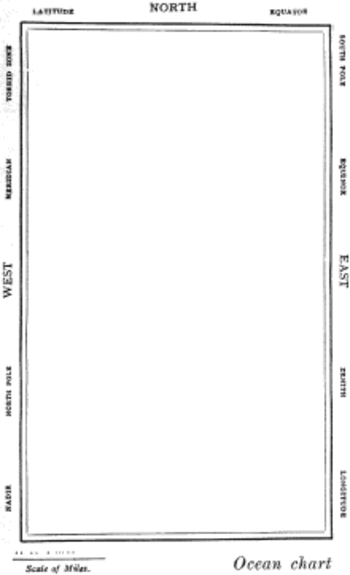
    Snarkmap

    Sometimes there is nothing so fine as something that beautifully illustrates the nothing that isn’t there, and this lovely map, unencumbered of all of the elements and details that define the mapness of something,  perfectly explains the origin of its need.

    Notes:

    1.  They’re not really the Book of the Dead, but collections of papyrus that each contain a unique set of instructions and magic spells and such to assist its dead reader of getting fromthe dead place into the light, into the afterlife.  This image is a rather famous one, pictured and described in the following Wiki bit:  “The mystical Spell 17, from the Papyrus of Ani. The vignette at the top illustrates, from left to right, the god Heh as a representation of the Sea; a gateway to the realm of Osiris; the Eye of Horus; the celestial cow Mehet-weret; and a human head rising from a coffin, guarded by the four Sons of Horus.“

    2.  Here’s another version of the Dante structures placed in context to the Earth, this image by A. Ritter. 

    3. Following the edition of 1698 translations appeared in English (1698) and in Dutch (1699). In the following years, translations also appeared in French (1702), German (1703), Russian (1717) and in Swedish (1774)
     
    4.  The table of contents (with links) is extremely interesting and tells much of the story of the book:

    Book 1

    • Some have already talk’d of the Inhabitants of the Planets, but went no fartherThe Objections of ignorant Cavillers prevented
    •   This Enquiry not overcurious
    • Conjectures not useless, because not certain
    • These Studies useful to Religion
    • Copernicus’s System explain’d
    • Arguments for the truth of it
    • The Proportion of the Magnitude of the Planets, in respect of one another, and the Sun
    • The Lamell more convenient than Micrometers
    • The Earth justly liken’d to the Planets, and the Planets to it
    • Arguments from their Similitude of no small weight
    • The Planets are solid, and not without Gravity
    • Have Animals and Plants
    • Not to be imagin’d too unlike ours
    • Planets have Water
    • But not just like ours
    • Plants grow and are nourish’d there as they are here
    • The same true of their Animals
    • Great variety of Animals in this Earth
    • And no less in the Planets
    • The same in Plants
    • Rational Animals in the Planets
    • Vices of Men no hindrance to their being the Glory of the Planet they inhabit
    • Reason not different from what ’tis here
    • They have Senses
    • Sight
    • Hearing
    • A Medium to convey Sound to the Ear
    • Touch
    • Smell and Tast
    • Their Senses not very different from ours
    • They have Pleasure arising from the Senses
    • All the Planets have Fire
    • The bigness of their Creatures not rightly guest at by the bigness of the Planets
    • In the Planets are many sorts of rational Creatures as well as here
    • Men chiefly differ from Beasts in the study of Nature
    • They have Astronomy
    • And all its subservient Arts
    • Geometry and Arithmetick
    • And Writing
    • And Opticks
    • These Sciences not contrary to Nature
    • They have Hands
    • And Feet
    • That they are upright
    • It follows not therefore that they have the same shape with us
    • A rational Soul may inhabit another Shape than ours
    • The Planetarians not less than we
    • They live in Society
    • They enjoy the pleasures of Society
    •    They have Houses to secure ’em from Weather
    • They have Navigation, and all Arts subservient
    • As Geometry
    • They have Musick
    • The Advantages we reap from Herbs and Animals
    • And from Metals
    • From the discoveries of our Age
    • The Planets have, tho not these same, yet as useful Inventions 

    Book 2

    • Kircher’s Journey in Ecstacy examin’d
    • The System of the Planets in Mercury
    • In VenusIn Mars
    •  Jupiter and Saturn the most eminent of the Planets both for bigness and attendants
    • The proportion of the Diameter of Jupiter, and of the Orbs of his Satellites, to the Orbit of the Moon round the Earth
    • The periods of Jupiter’s Moons
    • And Saturn’s
    • This proportion true according to all modern Observations
    • The apparent magnitude of the Sun in Jupiter, and a way of finding what light they there enjoy
    • And in Saturn
    • Always the same length
    • They see the fixt Stars just as we do
    • The appearances of the Ring in Saturn
    • Very little to be said of the Moon
    • The Guards of Jupiter and Saturn are of the same nature with our Moon
    • The Moon hath Mountains
    • But no Sea, nor Rivers, nor Clouds, nor Air and Water
    • The Conjecture of its Plants and Animals very dubious Jupiter’s and Saturn’s Moons turn always the same side to them
    • The Astronomy of the Inhabitants of the Moon
    • This may be applied to the Moons about Jupiter and Saturn
    • The immense distance between the Sun and Planets illustrated
    • No ground for Conjecture in the Sun
    • The Faculty in the Sun not easily seen
    • By reason of its Heat no Inhabitants like ours can live in the Sun
    • The fix’d Stars so many Suns
    • They are not all in the same Sphere
    • The Stars have Planets about them like our Sun
    • A way of making a probable guess at the distance of the Stars
    • Every Sun has a vortex round it, very different from those of Cartes 
     

    See: 

    “This Is Not a Map”, by Max Byrd, The Wilson Quarterly  Vol. 33, No. 3 (Summer, 2009) (pp. 26-32).

    John Pickles, A history of spaces: cartographic reason, mapping and the geo-coded world,  (London and New York, Routledge, 2004)

    Katharine Harmon, editor, You are here: personal geographies and other maps of the imagination. (New York, Princeton Architectural Press, 2004).

    Giuliana Bruno. Atlas of Emotion: Journeys in Art, Architecture, and Film (New York, Verso, 2002).

    Denis Wood, ‘Map art’, Cartographic perspectives 53 (2006), pp. 5–14: p. 11.

  • Strange Things in the Sky Dept.–Dante and Beatrice and the Vault of Stars

    JF Ptak Science Books    Post 1457

    There is a developing thread on this blog relating to strange things in the sky. Sometimes the images are extraordinary, impossible, beyond fiction:  multiple/duplicate Earths, flying buildings, horses in balloons, extra-human missing souls downloaded to the Earth from extra-Moons, and so on.  And at other times, the images are more subtle, questioning, ambiguous, as in the example of some 16th century prints that show the sky opening to reveal the Creator, who is in turn pictured against, say, a completely blank background, suggesting an enveloping nothingnesss of Heaven; or a field of beautiful stars filling a Renaissance sky of deepest red, at night.  A gigantic foot shown floating in the sky in a 17th century image might be ambiguous, and it also wildly so;  both it and the more subtle ambiguities–for example early representations of caves-over-mountains that give them an inside-out appearance–are welcomed sights.

    Perhaps some of the most beautiful of the Strange Things in the Sky department might belong to the skies of  Dante–they can be extraordinary, straightforwardly unusual and–when the narrative is presented pictorially–beautifully strange and with little ambiguity.  They are presentations of ideas of time and space, fantastic adventures in imaginary environments, as much an internal journey as Milton’s Paradise Lost is an external one1.

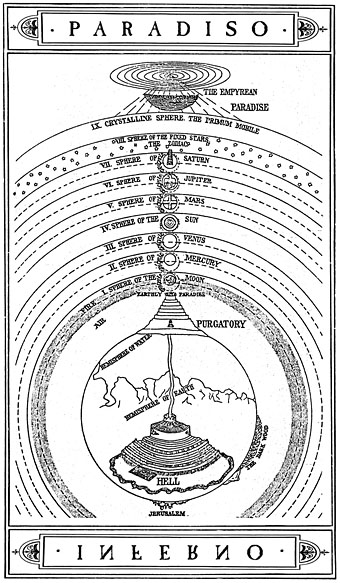
    Dante’s celestial exploration and the foundation that he provides have led to the possibility of an entire atlas of maps of paradise, hell and purgatory.  Here’s an interesting map2 constructed by Michelangelo Caetani (1804-1882) showing the structure of the Comnedia:

    Dante comedia
    I’ve presented this map just to give a context for the placement of the following images, though I do like the Caetani because it presents a good overview of the entire placement of Dante’s work, though necessarily having to leave out almost all of the detail of what is actually going on in each level. 

    Nearly all of the images below are from La comedia di Dante Aligieri con la nova espostione di Alessandro Vettlutello, published in Venice in 1544 by Francesco Marcolini (or Marcolino)3.  For the present collecting/browsing purposes I’m just going to go over the images lightly rather than try to launch into an ill-advised exegesis on a subject that I don’t know very well at all.

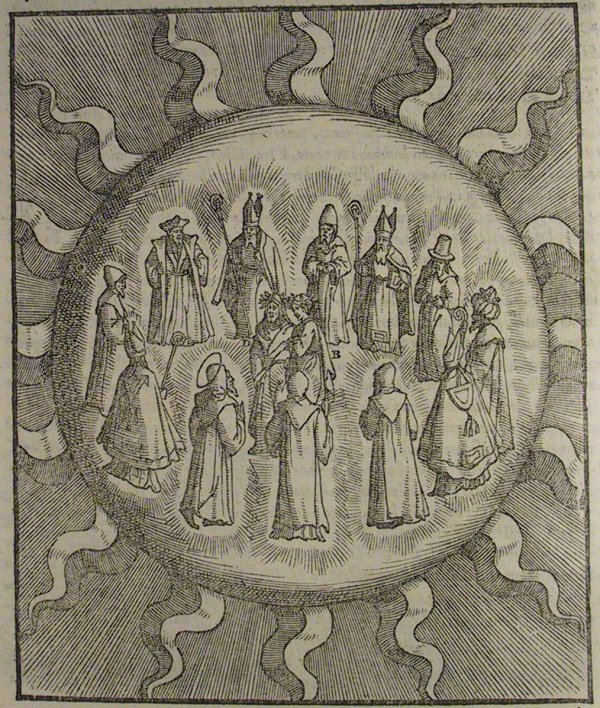
      Dante sun big
    In the Sphere of the Sun Dante and Beatrice among the wise and the learned, hearing them all (eleven) named so by Thomas Aquinas.  They include Albertus Magnus, Gratian, Peter Lombard, Solomon, Dionysius the Areopagite, Orosius, Boethius, Isidore of Seville, Bede, Richard of St. Victor, Siger of Brabant. Paradiso X

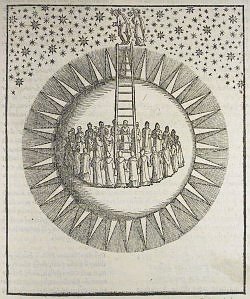
       Dante fixed stars
    Dante and Beatrice entering the sphere of the fixed stars, using a ladder of contemplation, mythically suggesting stairs and in this case a stairway to god. 

    Ante--empyrean

    The souls ascent to the Empyrean, with Dante looking down to see the Earth (“the little patch that makes us so vicious”), and to trace the (“mad”) voyage of Ulysses, and to see perhaps how far he has traveled (Paradiso XXVII).  Dante listens to St. Peter, and Beatrice, who describe the place, which is basically the mind of god and which is the envelope surrounding the final sphere:

             “The nature of the universe which holds
              The center still and whirls the spheres around it
              Takes from this region here its starting-point.
     
              “And here this heaven has no other where
              Than in God’s mind, where there flames up the love
              That spins it, and the power it pours down.
     
              “Light and love enclose it in one circle
              As it does all the rest, and this enclosing
              He alone who circles it can comprehend.

    Beatrice and Dante


    Beatrice and Dante together with Saint John and Saint James,  Paradiso XXV.

              “My body is still earth within the earth
              And will remain there with the rest until
              Our number equals the eternal tally.
     
              “Only those two lights who have ascended
              Wear their two robes here in the blessed cloister,
              And this word you shall bring back to your world.”
     

    Woodcut illustrating Paradiso II
    I couldn’t resist straying a bit to show this fantastic 1491 woodcut (published in Venice by Petrus de Plasiis) illustrating Dante and Beatrice surveying and then entering the Moon.  The scene is described in  Paradiso II:

              “Turned toward me, as glad as she was lovely,
              And said, “Direct your mind with thanks to God
             Who here has made us one with the first star.” –-[the Moon is described and identified as a star.]
     
              I thought we were enveloped in a cloud,
              Shining, solid, dense, and highly polished
              As a diamond struck by the sun would be.
     
              The timeless pearl took us inside itself
                In the same way that water can receive
              A ray of light while it remains intact”
    Again, my apologies to those among you who know Dante–I really was just trying to get at the luxuriant strangeness of these images and display them–much more so than talk about them. 

    Notes

    1. “The difference is that the visual phantasy bequeathed by Dante was mainly a congeries of intense and intricate symbolisms of his own personality,” Masson explains, “whereas that offered by Milton was mainly a sublime version of an independent objective tradition.” 12. David Masson, The Life ofJohn Milton: Narrated in Connexion with the Political, Ecclesiastical, and Literary History of His Time, vol. 6, 1660-1674 (1880; reprint, New York,
    1946), p. 522.

    2.  Michelangelo Caetani, La Materia della Divina Commedia di Dante Aligherie (1855).

    3..   Francesco Marcolini (or Marcolino), a typographer born in Forlì, also published the first book of cartomancy, or telling the telling of the future and fortune through the use of a deck of cards, in his 1540 Le sorti intitolate giardino d’i pensieri (“The oracle called garden of thoughts”).


  • Revolutionary New Way of Astronomical Observation: Radio Astronomy, 1932.

    JF Ptak Science Books  Post 1395

    “At the age of just twenty-six, Karl Jansky had become the first person to detect and identify radio waves coming from outer space, a truly historic discovery… The true significance of Jansky’s breakthrough surpasses even the momentous discovery that the Milky Way emits radio waves. His accomplishment was to establish the science of radio astronomy and to demonstrate that astronomers could learn a huge amount about the universe by looking beyond the narrow band of electromagnetic wavelengths that are visible to the human eye… He announced his result in a paper entitled ‘Electrical Disturbances Apparently of Extraterrestrial Origin’ –Simon Singh, The Big Bang.

    “In conclusion, data have been presented which show the existence of elctromagnetic  waves in the Earth’s atmosphere which apparently come from a direction that is fixed in space.”  Karl Jansky, (1932), page 1398.

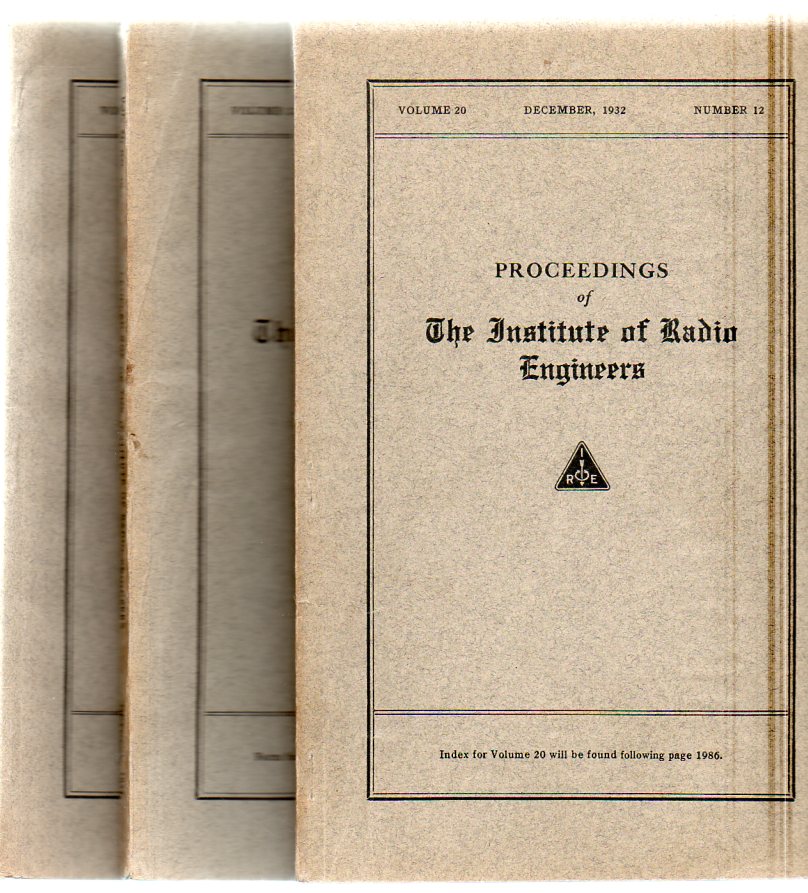
    Found in these three papers (below) is the description of the discovery of an entirely new astronomy, a brand new way of looking at the universe.  Instead of using telescopes operating at optical wavelength of about 10-5 cm and gathering information visible to the eye, Karl Jansky used a technology that had previously been employed in transoceanic communication.  It was in the communication field that Jansky was working (for Bell Labs), trying to identify an interfering hiss, in which he came to realize (and displayed in this series of papers) that this long radio wavelength interference was something extraordinary, publishing his first results in 1932.1  It was later in 1933 that he published his findings that this “hiss” was not “local”, and the serendipitous discovery came from a source outside our solar system, which was a tremendously significant finding2, “his revolutionary claim that the hiss static seemed to have its origin in our Milky Way galaxy, with a maximum in a direction that pointed close to the galactic center” (American National Biography). His third paper of 19373 discusses further problems of interference in the short-wave systems.   (These three papers are offered for sale at our blog bookstore, here.)

    Jansky183
    But it wasn’t so significant to most of the rest of the astronomy world, because, well, no one rushed out to replicate his findings.  At least no one until Grote Reber, who (necessarily) built his own equipment (a 9m parabolic  radio telescope ) and set up shop in his backyard around 1937, publishing his results and confirming Jansky’s efforts in the Astrophysical Journal in 1944.  Also it should be noted that J.S. Hey (a British Army officer) detected radio waves emitted from the sun for the first tome on 27 February 1942. 

    Jansky was interested in pursuing this work in astronomy, but Bell Labs took him away from this area, giving him other assignments, leaving the rest of the new world of radio astronomy for others to operate in.  Subsequently, radio sources were found in stars and galaxies, and were emitted from entirely new classes of objects like quasars, pulsars and radio galaxies.   And in fact the discovery of the cosmic microwave background radiation which came through a series of surprises to Penzias and Wilson and which offered compelling evidence in support of the Big Bang (the background radiation of which had earlier been theorized by Gamow and Alpher and Wilson but which was evidently not known to P+W and therefore not referenced), was made in a similar way, via sweet serendipity, while the pair was working on something else for Bell Labs. 

     Karl Guthe Jansky, born 22 October 1905, died of a heart condition at age 44, 22 October 1950. 

    Notes:

    1) “Directional Studies of Atmospherics at High Frequencies.” In: Proceedings of the Institute of Radio Engineers, vol.20, no.12 (Dec.1932), pp.1920-1932.

    In fact Nickola Tesla and Oliver Lodge had previously attempted to detect radio emissions coming from the sun, but both failed, mainly due to the inhibitions of their equipment.

    (2) “Electrical Disturbances Apparently of Extraterrestrial Origin.”. In:  Proceedings of the Institute of Radio Engineers, vol.21, no.10 (Oct.1933), pp.1387-1398.

    (3) “Minimum Noise Levels Obtained on Short-Wave Radio Receiving Systems.”  In: Proceedings of the Institute of Radio Engineers, vol.25, no.12 (Dec.1937), pp.1517-1530.

    All published in the Proceedings of the Institute of Radio Engineers, Menasha, Wisconsin. : Institute of Radio Engineers, the three papers published 1932-1937.  All in their original printed wrappers. Very nice copies.  Very scarce. 

    See also:  Lang and Gingerich, A Source Book in Astronomy and Astrophysics, 1900-1975, Harvard, 1979, pp 30-31, paper #6. (The authors use Jansky’s paper of 1935, “A Note on the Source of Interstellar Interference”, published in the Proceedings of the IRE as the chief paper, though noting that the 1932 paper was the “first report on these studies”.   In this 1935 paper Jansky of course references his “former papers” (our #s 1+2 above).


    ·Posted by :

    ·in:


  • A Great Anniversary: Identifying the Telescope as a True and Not-Deviating Instrument, 24 March 1611

    JF Ptak Science Books   Post 1385

    Celebrating the 400th anniversary of recognizing that sense enhancers–like the telescope–do detect “real” things: Galileo and the Collegio Romano, March 24, 1611. 

    Is it possible that there are private realities for things, seeable by only one observer? Can the instrument that allowed such observations possible also provides them, the stuff existing purely for the instrument and nothing else?  To some degree this is what was thought of Galileo and his revolutionary discoveries with the telescope, at least in the early days of verifying his work.  Galileo’s work was problematic for the Church because it provided yet more evidence for  ancient and incorrect assertions of Ptolemaic astronomy, separating the distance between what was written in the scriptures about nature and the knowledge of the world and its physical and biological systems, and what actually existed int he world.  It was an especially hard blow for Galileo to have revealed far more stars than anyone had thought possible, in the West at least–the stars int he Heavens had been a perfect assembly for many generations, and for their to be nearly an order of magnitude more  observable stars through the telescope ran directly in the face of church doctrine.  There was also the unwholesome bit about the Copernican system and our’s being  a heliocentric system, which was an old debate being lashed at still by the church even after many decades of superior evidence that could in no way support an Earth-centric system.  Evidence and logic united to banish the Church’s cosmology into a belief system.

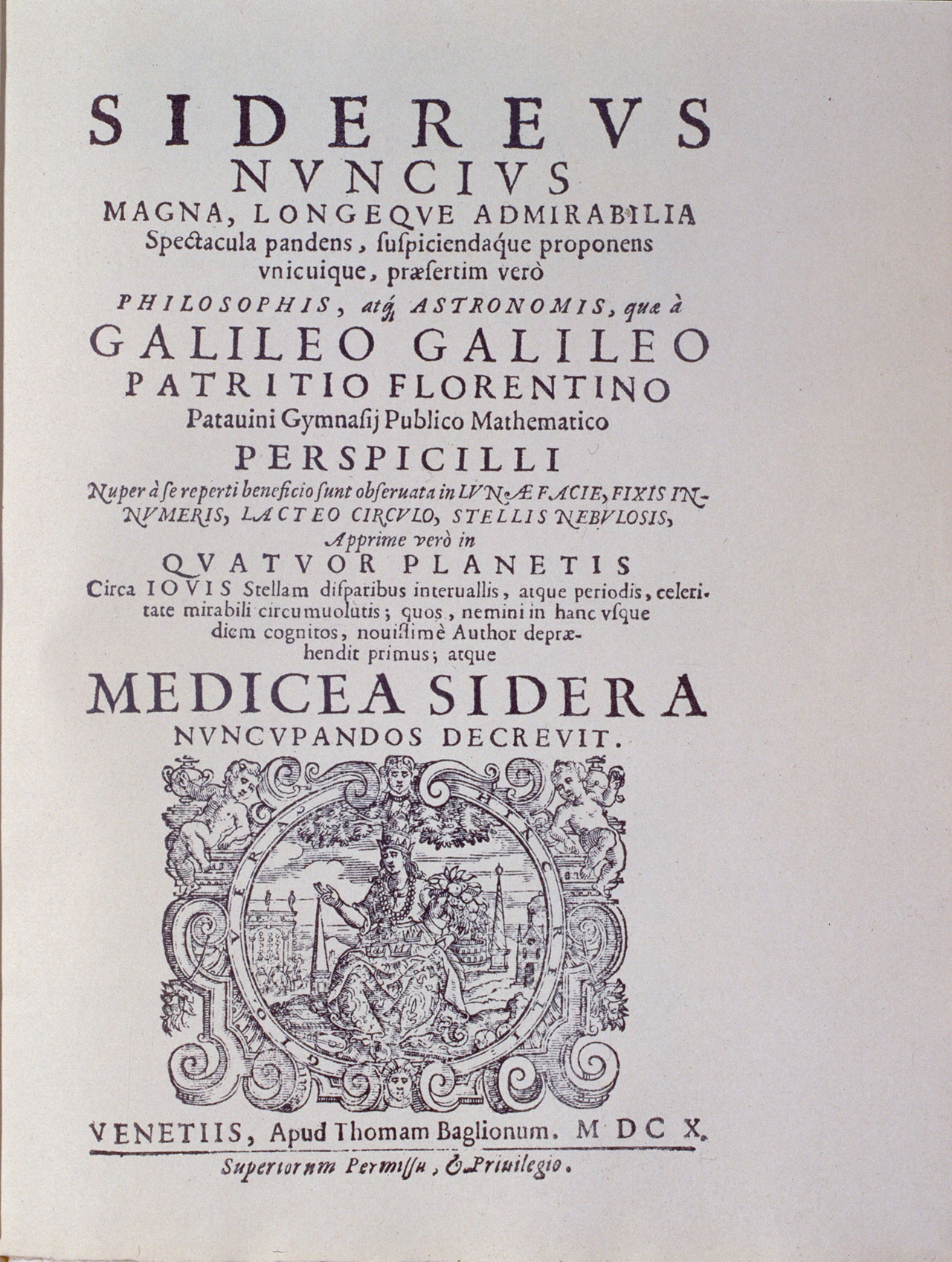
    Frontispiece of Galileo's Sidereus Nuncius

    It seemed to some as though the new stars that for the first true time expanded the celestial vault existed only within the slim optical tube with which their observer–Galileo–saw them.  Ditto the moon of Jupiter.  It came to pass within the confining walls of Vatican-recognized astronomy that the only verifiable and comprehensible observations of the heavens could be made with the naked eye.  Galileo’s instrument was difficult to use1 but it seemed also that when his contemporaries could see his discoveries that they simply wouldn’t.  Early in 1611 Galileo wrote to Kepler about the fantastic reluctance of his colleagues to be able to see what he saw:  “What do you think of the chief philosophers of our gymnasium who, with the stubbornness of a viper, did not want to see the planets, the moon, or the telescope, even though I offered them the opportunity a thousand times?”  Galileo was convinced that they needed not to see nature, but rather tried to reconcile the idea of what was being said was being seen with existing ideas and ideologies,  saying that their “…truth is to be sought not in the world and in, nature, but in comparison of texts (as they call it)”.  (“Stress in the book of nature: The supplemental logic of Galileo’s realism”. MLN 118(3), 557-585, by Mario Biagioli.)

    Galileo’s 1610 discoveries were published later that same year in his Sidereus Nuncius (The Starry Messenger)2, but there was no real independent verification of his work for nearly another twelve months.  The business end of the question, the lens that focused the entire issue so to speak, wasn’t necessarily the issue of more stars or a craggy moon or Jupiter having moons or the Copernican system–it had to do with whether the telescope, but the very virtue of its placing a piece of glass between the human observer and nature, was altering the very perception of nature itself.  Was the tube an imaginarium?  Did it create the images seen by the observer?  Did it materially change the things that the observer saw?  Was the nature of the observing unit the thing that was changing nature rather than by showing it closer? 

    These questions really didn’t receive an official answer until 24 March 1611, when four Jesuit mathematicians at the Collegio Romano reported to Cardinal Robert Bellarmine (1542-1621, and the church’s chief defender of orthodoxy) that, yes indeed, Galileo’s discoveries were real, that he had reported them accurately.  The collision of the scholastic and humanist world views represented by the Catholic Church and Galileo wasn’t a  happy one, and  this didn’t mean that the Church necessarily accepted what Galileo had to say–far from it, as they wound up pursuing the old man, taking him to trial finally in 1633 (when he was 69 years old, following by 17 years the admonition and false injunction of 1616), convicting him of violating an injunction on teaching, discussing and writing about the Copernican system, and placing him under house arrest for the stuff he thought and wrote about.  He died blind and still under house arrest  at his villa in Arcetri, just north of Florence, in 1642.

    But it is this business of the optics found to be not physically or theologically objectionable by the Collegio in 1611 that seems so incredibly important to me right now–that the telescope was found to be an instrument, that the human eye could be aided, and that this tube was not a place in which imaginary things happened or in which reality was bent, that was so very important.

    The Inquisition’s ban on most of Galileo’s writings was lifted by the Church in in 1718, though his Dialago remained untouchable and condemned, a prohibition which remained mostly in place in 1758, when a lightly censored version of the book appeared and the general prohibition of works on heliocentrism was mostly dropped.3 It really wasn’t until 1835, more than 225 years after the first publication of the Sidereus, that all traces of prohibition vanished from the registry of the Catholic Church.

    It is a little odd to think about the Collegio and the telescope in the light of the invention of the microscope.  There seemed to be no vestigial growth from the Church into the microscopic world or with the microscope itself, though most of these developments did come much later…except for the work of Hans and Zacharias Janssen, who did manage to make the first microscope in 1590, twenty years before Galileo’s observations were published.  But the monumental year for the microscope came twenty-five years after Galileo’s death, with the publication of the spectacular Micrographia of Robert Hooke in 1667.  And then in 1675 came Anton van Leeuwenhoek, who made close, micrographic investigations of blood, and who saw more deeply into the small world of humanity (being the first to describe cells and bacteria) than anyone ever before.  But the Church seemed little interested in this or the instrument, hardly seen Hooke/Leeuwenhoek as a new, threatening Galileo or the microscope as the invasive telescope.  But I do see where a similarity could exist.

    NOTES

    1. The telescope was a tough one to operate, though Galileo himself was a skillful practioner.  The ‘scope was big (more than three feet long), its field of view very narrow, and its aperture dropped down to a few centimeters. And of course there was the steadiness question.  All in all, not an easy instrument to bring to bhear on your subject. 

    2. This was also of course the first scientific treatise on astronomy using the obervations obtained with a telescope.  In it were also reported the very rough appearance of the surface of the Moon, the differences in the appearanes of the stars and the planets, the moons of Jupiter and the large number of never-before-seen stars. 

    3. Uncensored versions of the Dialogo and De Revolutionibus were still prohibited. 


  • The Problem of the Expanding Universe, 1943

    JF Ptak Science Books    Post 1368

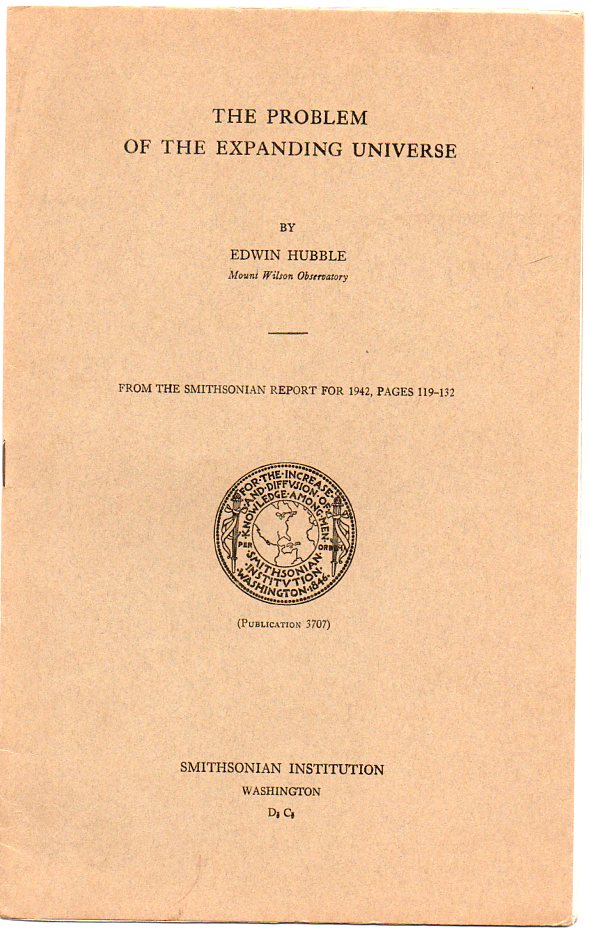
    Hubble expanding052 In his great summary (The Problem of the Expanding Universe) of the development of the velocity-distance relation, the Big Bang and all that,  Edwin Hubble offers concise appraisal of the research to this point (in which Hubble and his assistant Milton Humason were prominent members of its founding studies). Hubble provided the first experimental data supporting the expanding universe theory of Georges Lemaitre’s cosmology (the “hypothesis of the primeval atom”), Einstein’s GRT and the mathematical equations of Alex. Friedmann, finding that the distance of galaxies were proportional to their redshifts (Hubble’s Law, 1929).  The whole thing enjoyed a bigger, more explosive life once it had been given its  more provocative and user-friendly name by Sir Fred Hoyle, who called the idea “the Big Bang” in 1949.  (Sir Fred was actually attacking the idea and must’ve thought his tag was to be demeaning, but as a proponent of the steady state theory, Hoyle’s plan backfired, a proof that irony exists.) The steady state model was more or less put to sleep when the cosmic microwave background radiation (first proposed by George Gamow, Ralph Alpher and Robert Herman in 1939) was “discovered ” in 1964 by Penzias and Wilson, this providing further experimental confirmation for the Big Bang hypothesis. 

    In his characteristic way, Hubble summarized the whole package so, in the conclusion of the 13-page paper [the original of which is available for purchase from our blog bookstore]:

    “Meanwhile, on the basis of the evidence now available, apparent discrepancies between theory and observation must be recognized. A choice is presented, as once before in the days of Copernicus, between a strangely small, finite universe and a sensibly infinite universe plus a new principle of nature.”

    It is an excellent approximation for a semi-general-public speech (to the Smithsonian Institution crowd during the war in 1943), and reminds me of one of his other, similarly spot-on statements, one of the greatest understatements in 20th century astrophysics The statement appears in a further report on Hubble/Humason studies in The Velocity-Distance Relation Among Extra-Galactic Nebulae  (Mount Wilson Observatory,  1931) ,  a regarding their understanding of the phenomena and the expanding universe, the authors take many steps back, and say in the concluding paragraph:

    “…the writers are constrained to describe the apparent velocity-distance displacements without venturing on the interpretation and its cosmological significance”.

    They basically lay out the functioning of the universe and the best understanding of how we got to where we are in the cosmos (Vesto Slipher notwithstanding), and how according to their understanding that the universe is expanding and is consistent with all known laws, that they decide to not say anything, um, philosophical, in the light of disrupting the idea of the creation of all things.

    Hubble did have a way with words, his own way, though he was able to communicate a difficult series of ideas simply, as we can see in the opening of his Expanding Universe paper: 

    “Mathematicians deal with possible worlds, with an infinite number of logically consistent systems. Observers explore the one particular world we inhabit. Between the two stands the theorist He studies possible worlds but only those which are compatible with the information furnished by observers. In other words, theory attempts to segregate the minimum number of possible worlds which must include the actual world we inhabit. Then the observer, with new factual information, attempts to reduce the list still further. And so it goes, observation and theory advancing together toward the common goal of science, knowledge of the structure and behavior of the physical universe.”

    And this lovely summation:

    “Current theory starts with two fundamental principles : general relativity and the cosmological principle. General relativity states that the geometry of space is determined by the contents of space, and formulates the nature of the relation. Crudely put, the principle states that space is curved in the vicinity of matter, and that the amount of curvature depends upon the amount of matter. Because of the irregular distribution of matter in our world, the small scale structure of space is highly complex. However, if the universe is sufficiently homogeneous on the large scale, we may adopt a general curvature for the universe, or for the observable region as a whole, just as we speak of the general curvature of the earth’s surface, disregarding the mountains and ocean basins. The nature of the spatial curvature, whether it is positive or negative, and the numerical value, is a subject for empirical investigation.”

    “The second, or cosmological principle is a pure assumption – the very simple postulate that, on the grand scale, the universe will appear much the same from whatever position it may be explored. In other words, there is no favored position in the universe, no center, no boundaries. If we, on the earth, see the universe expanding in all directions, then any other observer, no matter where he is located, will also see the universe expanding in the same manner. The postulate, it may be added, implies that, on the grand scale, the universe is homogeneous and isotropic – very much the same everywhere and in all directions.”

    “Modern cosmological theory attempts to describe the types of universes that are compatible with the two principles, general relativity and the cosmological principle. Profound analysis of the problem leads to the following conclusions. Such universes are unstable. They might be momentarily in equilibrium, but the slightest internal disturbance would destroy the balance, and disturbances must occur. Therefore, these possible worlds are not stationary. They are, in general, either contracting or expanding, although theory in its present form does not indicate either the direction of change or the rate of change. At this point, the theorist turned to the reports of the observers. The empirical law of red shifts was accepted as visible evidence that the universe is expanding in a particular manner and at a known rate. This arose the conception of homogeneous expanding universe of general relativity.”

    I like Hubble.

    Notes:

    The paper begins:

    “I PROPOSE to discuss the problem of the expanding universe from the observational point of view. The fact that such a venture is permissible is emphatic evidence that empirical research has definitely entered the field of cosmology. The exploration of space has swept outward in successive waves, first, through the system of the planets, then, through the stellar system, and, finally, into the realm of the nebulae. Today we study a region of space so vast and so homogeneous that it may well be a fair sample of the universe. At any rate, we are justified in adopting the assumption as a working hypothesis and attempting to infer the nature of the universe from the observed characteristics of the sample. One phase of this ambitious project is the observational test of the current theory of the expanding universes of general relativity. ” [The entire paper is located here.]

    ·Posted by :

    ·in:

    — —

  • History of Anticipation–a Note on Not Discovering Deep Sky In England (pre-Galileo)

    JF Ptak Science Books  Post 1365

    “‘Tis all in pieces, all cohaerennce gone”–John Donne1

    I wonder why it was that the telescope didn’t get trained at the sky in Great Britain.  Its one of those “things/non-events” when everything is in place for something very big to happen, when the pieces are there and sorted, when the theory has been thought out, when the practical applied work has been done–and then, a turn-away is made, a drifting occurs, and the big thing doesn’t happen.  A deep reluctance sets in–and since it is the anniversary of Darwin’s (and Lincoln’s) birthday, it seems natural to include Darwin in a history of anticipation category, since it took him so very long to come to enough of a comfort level to actually publish his Big Idea, and that seems to have been done on the intersession of an editor and thought leader (Huxley) and the fact that someone else was going to beat him to publication (Wallace).

    But what I’m talking about here is John Dee’s work with “perspective glasses”–the telescope–in the 1560’s and 1570’s and the idea of which he writes about in his Description of Caelestiall Orbes, thirty full years before Galileo’s epochal Sidereus Nuncius of 1611.

    The promise of the telescope is also seen in the work of Dee’s pupil Thomas Digges (half of the Digges’ brother scientific team, the other brother being Leonard), who writes of it in his Alae sue Scalae MAthematicae, 1573; and again in the Treatise on the A treatise on the properties and qualities of glasses for optical purposes, according to the making, polishing, and grinding of them by WIlliam Bourne (see here) where among other things claims to have uised his instrument to see things seven miles away (beautifully put so “not only discovered things farre off, read letters, numbered pieces of money…but also seven myles of declared what hath been  doon at that instante in private places”, meaning that he was able to discern print at some distant and to also see what would have been private things from an unthinkably distant distance)2. 

    And as Marjorie Nicholson  observes in Science and Imagination (Cornell, 1956), this point is again made by yet another Englishman, Thomas Hariot, who is best remembered today for his beautiful and early work on the American southeastern coast, published in 1691 (A Briefe and True Report of the New Found Land of Virginia), in which he describes his own telescope, “a perspectiue glasse whereby was shewed manie strange sightes”. 3

    It seems though that among all of this accomplishment that the telescope–as had been the early case with Galileo, and who had also overcome the instrument’s horizontal hold–was used laterally, more an instrument for navigation and the field commanders of armies.  Why it was not pointed to the sky, I do not know, but it does seem as though Donne’s words were waiting more for Galileo than for anyone else. 

    Notes:

    1.  This is from Donne’s AN ANATOMY OF THE WORLD, Wherein,by occasion of the untimely death of Mistress Elizabeth Drury, the frailty and the decay of this whole world is represented THE FIRST ANNIVERSARY:
    “And freely men confess that this world’s spent,
    When in the planets and the firmament
    They seek so many new; they see that this
    Is crumbled out again to his atomies.
    ‘Tis all in pieces, all coherence gone,
    All just supply, and all relation…

    2. Bourne did come very close, but his work was to stay in manuscript and not published, even though he was a known scientific quantity in his day (and found in the  Philosophical Magazine, 1839):

    3. A Briefe and True Report of the New Found Land of Virginia : of the Commodities and of the Nature and Manners of the Naturall Inhabitants : Discouered bÿ the English Colonÿ There Seated by Sir Richard Greinuile Knight In the ÿeere 1585 : Which Remained Vnder the Gouerenment of Twelue Monethes, At the Speciall Charge and Direction of the Honourable Sir Walter Raleigh Knight Lord Warden of the Stanneries Who therein Hath Beene Fauoured and Authorised bÿ Her Maiestie and Her Letters Patents / This Fore Booke Is Made in English by Thomas Hariot seruant to the Aboue-Named Sir Walter, a Member of the Colonÿ, and There Imploÿed in Discouering ; CVM GRATIA ET PRIVILEGIO CÆS. MATIS SPECIALIi. Francoforti ad Moenvm, Typis Loannis Wecheli, Svmtibvs Vero Theodori de Bry anno CIC IC XC. Venales Reperivntvr in Officina Sigismvndi Feirabendiii

    he entire text, with the tremendous John WHite illustrations, is located here.

    On page 27 we see:
    “Most thinges they sawe with vs, as Mathematicall instruments, sea compasses, the vertue of the loadstone in drawing yron, a perspectiue glasse whereby was shewed manie strange sightes, burning glasses, wildefire woorkes, gunnes, bookes, writing and reading, spring clocks that seeme to goe of themselues, and manie other thinges that wee had, were so straunge vnto them, and so farre exceeded their capacities to comprehend the reason and meanes how they should be made and done, that they thought they were rather the works of gods then of men, or at the leastwise they had bin giuen and taught vs of the gods. Which made manie of them to haue such opinion of vs, as that if they knew not the trueth of god and religion already, it was rather to be had from vs, whom God so specially loued then from a people that were so simple, as they found themselues to be in comparison of vs. Whereupon greater credite was giuen vnto that we spake of concerning such matters.”