A Daily History of Holes, Dots, Lines, Science, History, Math, Physics, Art, the Unintentional Absurd, Architecture, Maps, Data Visualization, Blank and Missing Things, and so on. |1.6 million words, 7500 images, 4.9 million hits| Press & appearances in The Times, Le Figaro, Mensa, The Economist, The Guardian, Discovery News, Slate, Le Monde, Sci American Blogs, Le Pont, and many other places… 5000+ total posts since 2008.

Category: Astronomy

  • A Small Mystery Solved: the Large Telescope on Santa Catalina Island in 1923

    JF Ptak Science Books   Quick Post  

    WWI--Doggie photo detail029

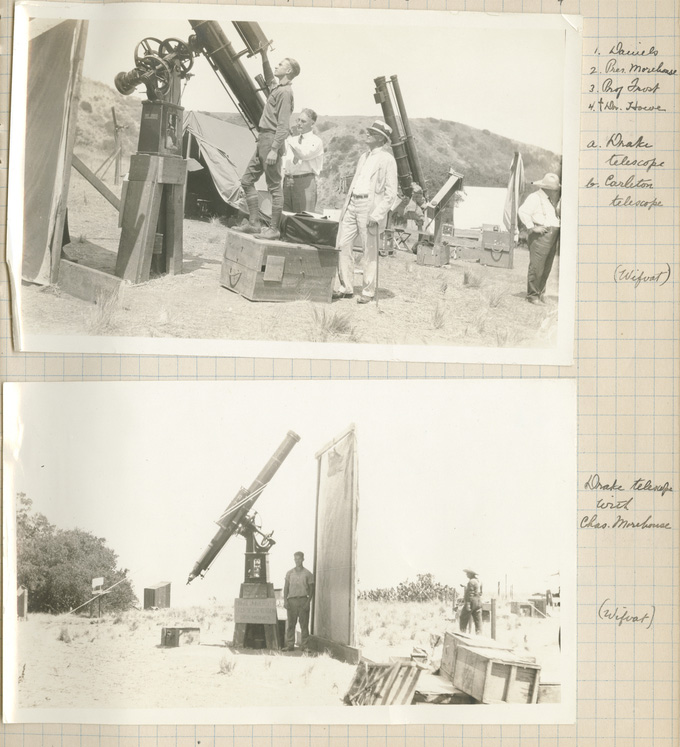
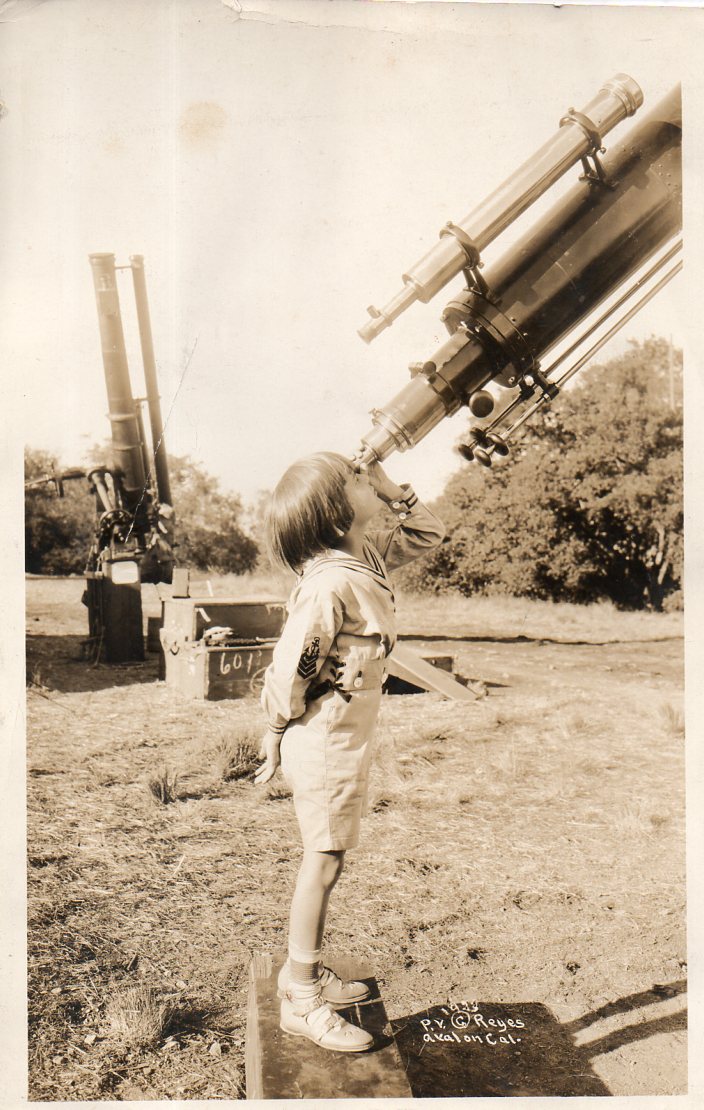
    Many years ago in D.C. I bought part of the estate library of Parmelee C. Daniels–the books had been passed down to the next generation, and after their passing some of those books came into my bookstore. Among them was this wonderful photograph, made by P.V. Reyes of Avalon California in 1923.  But it wasn’t until tonight that I could easily put together the history of the image. (And when I said “small mystery solved” I meant that it was a small mystery to me–no doubt there will be many others who will identify this instrument on first light). 

    I found that the photograph was made during the 1923 Solar Eclipse Expedition to Santa Catalina Island at Camp Wrigley, and was attended by Daniels and a host of the Big Names of astronomy of the 19-teens and ‘twenties.  Daniels was a professor at Drake University in Des Moines, and the school’s telescope was packed up and made the trip to the Pacific. I do believe that this is the 8.5-inch refractor that was the gift to the school of General Drake in 1893, although I could be wrong. 

    Here’s the image of the  telescope (with Daniels standing on the box, President of Drake University and astronomy professor Dr. Morehouse, and Prof. Edwin B. Frost.  The image comes  from the University of Chicago:

    Drake telescope
    [PC Daniels photo on the solar eclipse expedition  of 1923 via the University of Chicago, http://storage.lib.uchicago.edu/ucpa/series6/derivatives_series6/apf6-03446-031r.jpg]

    And so the story of this photograph gained some life tonight by me simply plumbing the intertubes for information.  Unfortunately I do not know the identity of the boy in the sailor’s suit. 

    I received the following information on the telescope, generously supplied by Bart Fried of the Antique Telescope Society: 

    8 1/4″ Brashear/Warner&Swasey refractor, 1894. (Curiously, in a
    dedicatory  article in the 1922 issue of “Popular Astronomy” it is
    described by the chief astronomer at Drake University,  Daniel Morehouse
     as a 9″ telescope). According to Kirby-Smith (U.S. Observatories, Van
    Nostrand Reinhold), it has an interchangeable front flint element for
    visual or photographic work, and has a 5″ doublet Brashear camera and a
    polarizing solar eyepiece. Possibly also, a filar micrometer and a
    spectroscope.


    ·Posted by :

    ·in:

    —

  • The Black Sun and Red Earth, 1862

    JF Ptak Science Books  Quick Post

    Follow Me on Pinterest


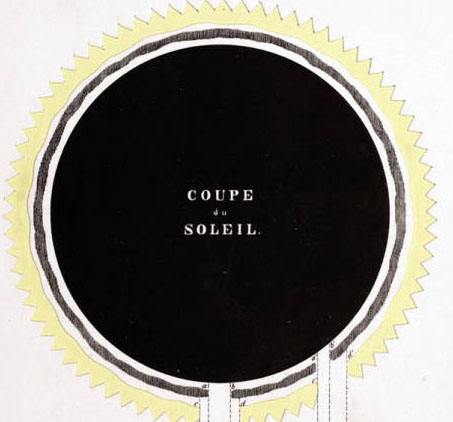
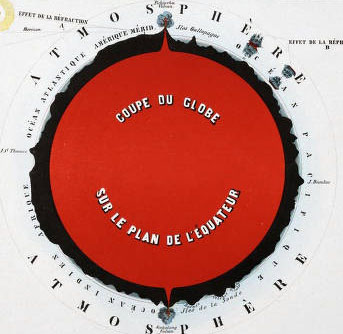
    These compelling images belong to Astronomie Populaire ou Description des Corps Célestes, Avec Atlas en Tableaux Transparents, à l’usage des Gens du Monde, which was published in Bruxelles in 1862.  The book is surprising, with several of the engravings being laid in, with holes for the interiors of stars and glassine on the back of the plate so that the image can be held up to (candle) light for a better effect of looking at the night sky.

    What I’ve selected though from this beautiful work are the cross sections of the Sun and the Earth. [Also of interest: an earlier post on this blog, Earths Inside the Earth, a Note on Interior Civiizations.]


    ASTRONOMY--sun_edited-1

    Source: Linda Hall Library

    And the Earth:

    ASTRONOMY EART_edited-1

    These are details from the following:


  • Looking at the Sun (Winter Solstice, 2012)

    JF Ptak Science Books   Post 1948
    Follow Me on Pinterest 

    Astro art943

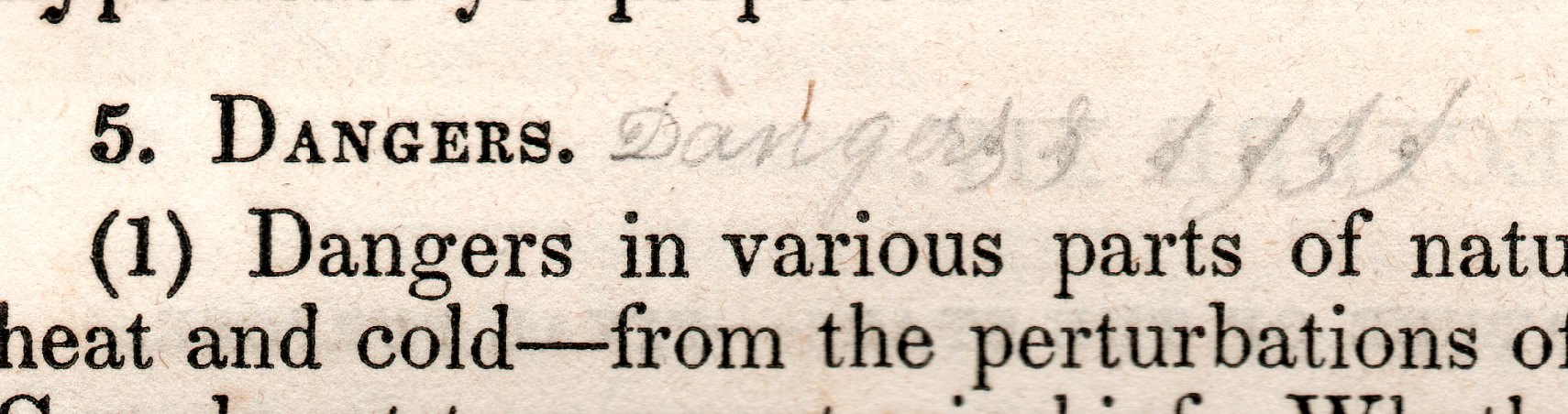
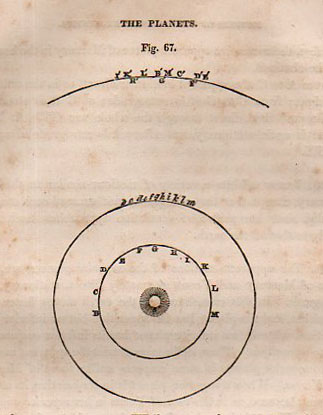
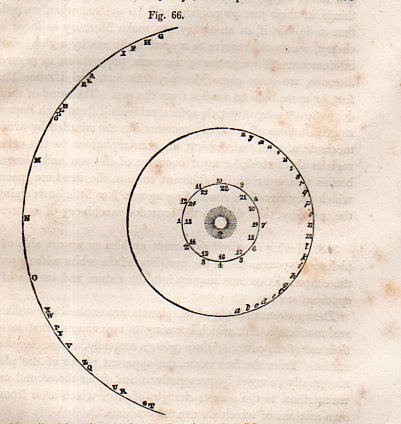
    Given that today is the winter solstice I thought to have a look at some artwork or imagery depicting the sun.  I went to bookcase where there were some astronomy books and plucked out one at random–it turned out to be Denison Olmsted’s (1791-1859) Practical Astronomy  textbook sort of written for his 12 students at Yale in 1839 (and bound with Ebenezer Porter Mason’s Introduction to Practical Astronomy, which was a supplement published ten years later).  Its a fine not-big/not-little book (320 pages plus Mason’s 135 pages), and it still reads pretty well. (There’s also a very sweet 16-page outline of the course he taught, breaking the lectures down into fairly small chunks.  There’s an interesting part of lecture XII entitled “DANGERS” which addresses heat and cold and bad business that could come from “perturbations of the moon and planets” and comets, of course, particularly the one like the “threatening circumstances attending the great comet of 1843”.  As it happens the only annotation made by the 19th century owner of this book was right here, in the danger section, where they wrote the word again followed by five check/whatever  marks.

    Astro art944
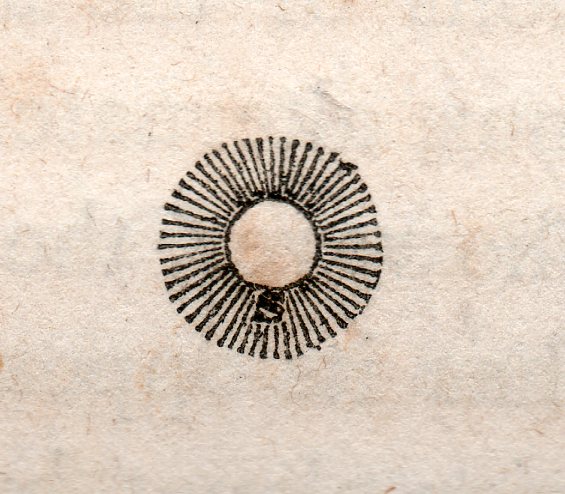
    There would of course be images of the sun in the book, and so was found this lovely small woodcut within the astronomical image (above), measuring in real life at about 5mm.  There are a lot of lines on the circumference of this tiny circle.

    The “S” stands for Sun. 

    Astro art det
    And another beautifully-design illustration from the same source: 

    Astro art945


  • What the Eye of God Sees: Gassendi’s Vision, 1658

    JF Ptak Science Books   Post 1938
    Follow Me on Pinterest


    Gasseni eye of god det_edited-1
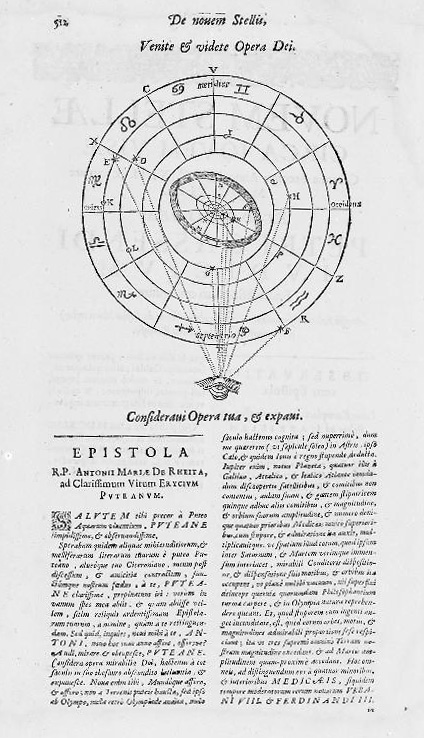
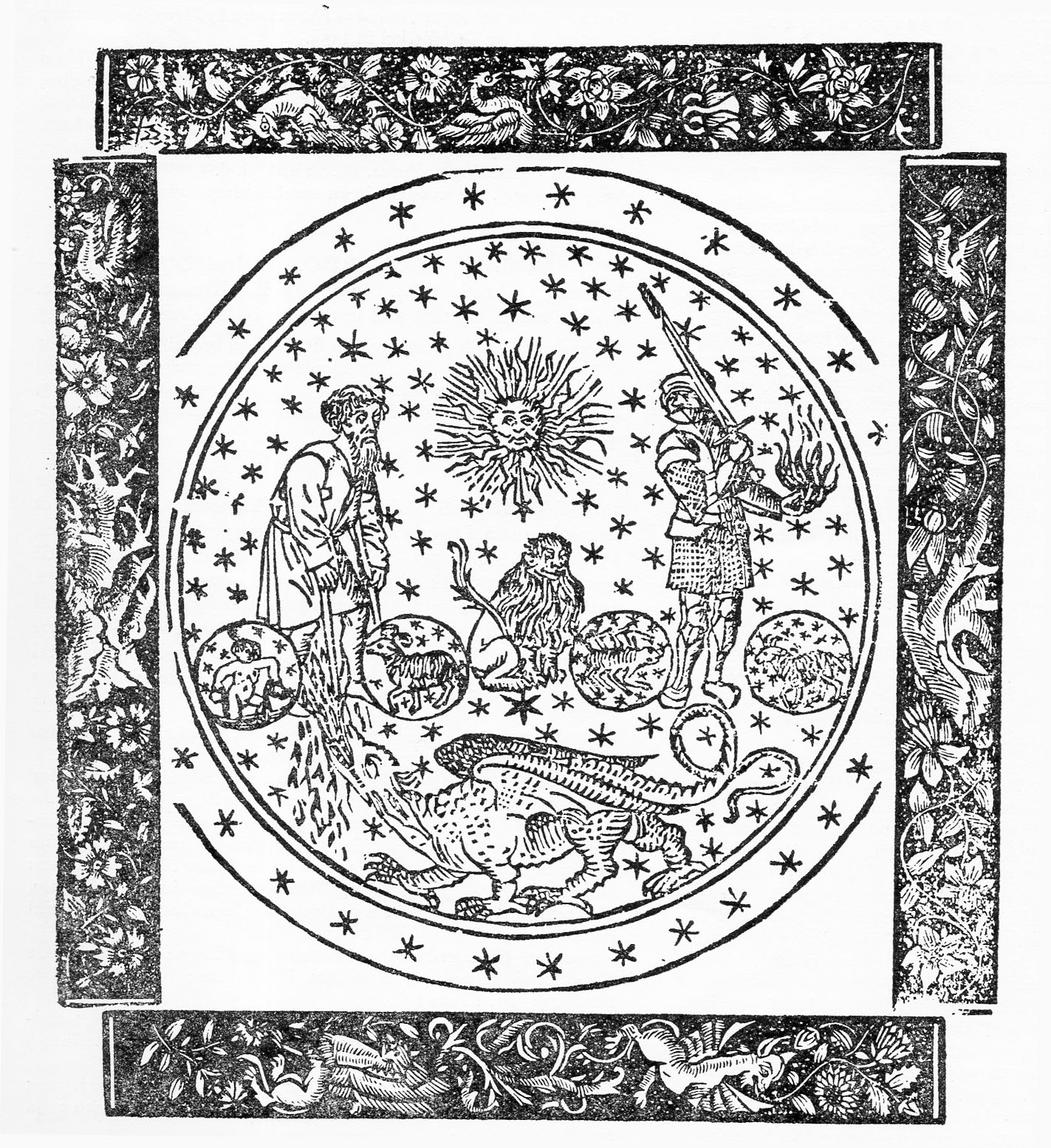
    Pierre Gassendi (1592-1655) published this God’s-eye-view of creation a few years after his death in the fourth volume (Astronomica) of his six-volume Opera Omina.  His friends and supporters of course saw to the publication of this mathematician/philosopher/logician’s work1 back there in 1658, so Gassendi–a very prominent thinker from a long-line of thinkers nearly on the verge of great discovery here and there and certainly a witness to it–made his greatest adventure in publishing only in death. 

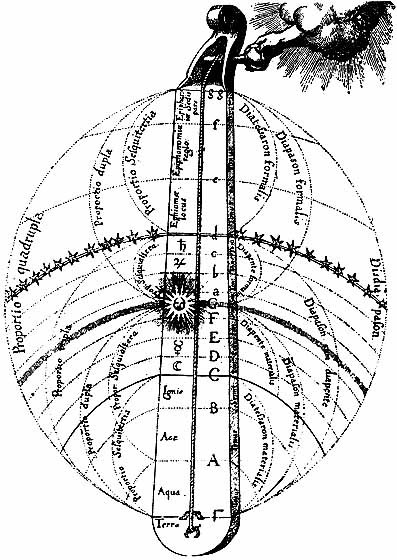
    Imaging a physical god is a tricky business in the history of the printed book. Bits of the creator of the universe turn up in book illustrations over hundreds of years, though I am not sure when the very first picture of a part of god appears.  The hand of the creator (generally seen as the Primum Mobile) is not terribly uncommon in images of a scientific nature in the 17th and 18th centuries, and is perhaps best exemplified by Robert Fludd’s famous Monochord:

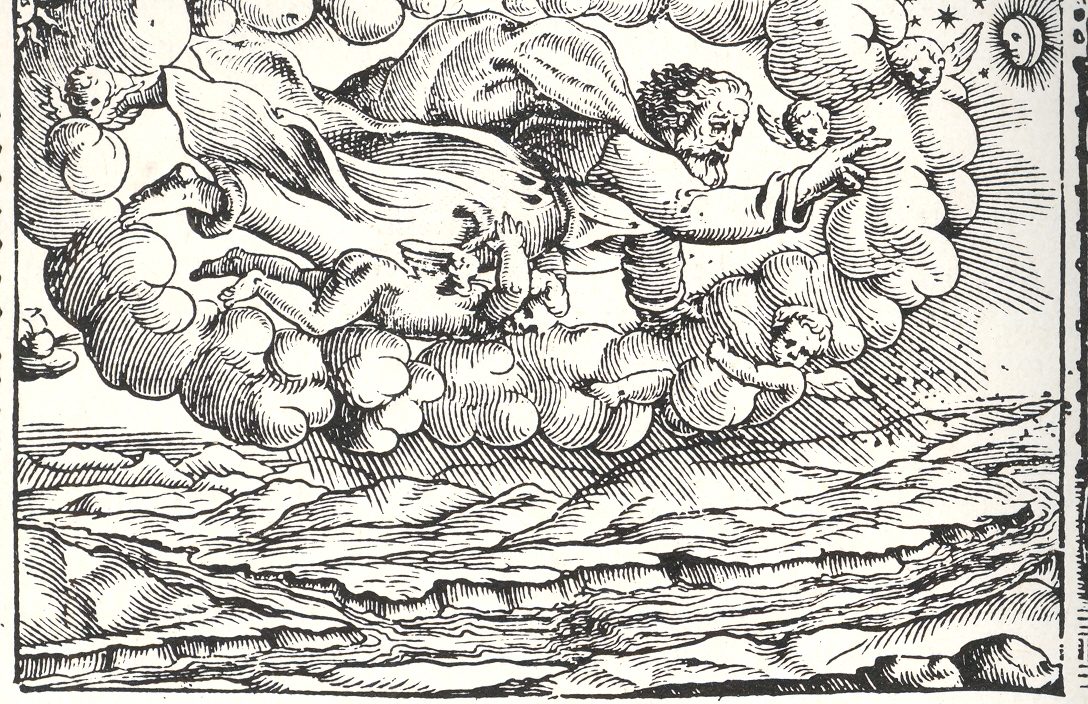
    Robert fludd celestialOf course there are many instance of the full-bodied god being seen through a break in the clouds, though in all the instances of this that I have seen the tantalizing peak into whatever region it is that this god exists is left entirely blank, a small white space. As so:

    God in the sky

    (Title page is for the narrative poem Le Metamorfosi, Ovid’s  Metamorphoses,
    translated into Italian by Gioseppe Horologgi, and published in Venice in 1563. See an earlier post on this blog, A History of Blank and Empty Things: God in a Hole in the Sky, here.)

     The eye of god is also not very uncommon, and is represented by an eye and also in a sacred triangle.  Less common though are images like Gassendi’s, which in a way, in an odd and almost offhand way, give the reader a sense of what it is that god might be seeing in  agodly-lineof-sight  Perhaps this is incorrect–but in judging his image with others in my experience it seems to me that the representation is a little more “personalized” here than just about anywhere else.

    Gasseni eye of god

    Notes:


  • Finding Death on the Moon, 1834

    JF Ptak Science Books   Post 1932

    “That those spots and brighter parts which by
    our sight might be distinguished in the Moon, do show the difference between
    the Sea and Land of that other World… The spots represent the Sea, and
    the brighter parts Land… That there are high mountains, deep valleys,
    and spacious plains in the body of the Moon… That there is an atmosphere,
    or an orb of gross vaporous air, immediately encompassing the body of
    the Moon… That it is probable there may be inhabitants in this other
    World, but of what kind they are is uncertain…”–
    Discovery of a New
    World in the Moone
    (1638). by astronomer John Wilkins

    Reading about the rover Curiosity taking bites of the Martian surface to analyze brought to mind an early and elegant piece of reasoning which put to rest the claims of life on the Moon. Belief in Lunar life is ancient, stretching back (for example) to Pythagoras, Plutarch and Lucian (who wrote perhaps the earliest piece on flying off to another non-celestial sphere). In more recent times bigger scientific names get thrown into that selenite melting pot:  Carl Friedrich Gauss was a believer int eh possibilities of life there, as were the astronomers Helevius, Bode and (later on)  Olbers, Littrow and Gruithausen.  (Franz von Paula Gruithuisen [1774-1852]  published his findings of urban structures in the very rough terrain above the Schroeter crater; his Wallwerk was quickly discredited though by astronomers with more powerful telescopes.)

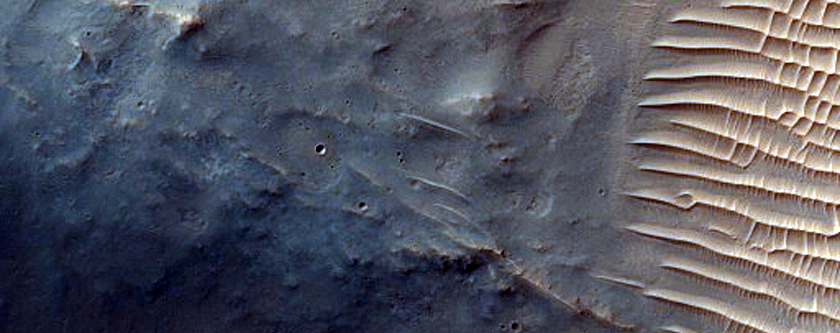
    Schroeter crater
    [The seat of the problem for Gruithuisen–the complex structures at left thought by high in observation a low-powered refracting telescope to be streets and buildings. Source: NASA/JPL/University of Arizona, University of Arizona’s HiRISE (High Resolution Imaging Science Experiment).]

    In addition to the improvements in telescope resolving power–which provided better/more accurate maps of the lunar surface, particularly in the 1830’s by Beer/Maedler and Lohmann–there was a major piece of thinking by Friedrich Bessel (1784-1846).  Bessel was a superb observationalist and contributed vastly to the field with his work on stellar distance and identification, publishing his Fundamenta Astronomiae in 1818 and consequently constructing a star catalog of 63,000 objects. In 1834 he established that given the very sharp occulations that the Moon’s diameter was found to be not very much smaller at all in relation to its measure by direct observation, meaning that the starlight was not deviated by atmospheric reaction, because the atmosphere of the Moon such as it was was 1/2000th of the density of that on Earth. Therefore: no perceptible atmosphere, no respiration, no life as it was understood to be “living”.

    Very pretty.

    It is odd that given that work and the very barren maps being produced in the 1830’s and the higher-powered telescopes that showed masses of scarred surface that there was a flurry of pro-Lunar-life stuff to hit the popular newsstands just a few years later. A famous (and first?) case of this was with Edgar A. Poe’s  “The Unparalled Adventures of One Hans Pfall” which appeared in the Southern Literary Messenger in June 1835 and which detailed the story of a debt-ridden Pfall who takes off to the Moon in a hot air balloon for it more debt-free climate, and who then sends back a Selenite messenger on another balloon, and, well, nothing really happens. A much ore effective hoax was perpetrated in the New York Daily Sun for six days in August 1835 in a story attributed to the great astronomer William Herschel about find vast and complicated life on the  Moon.  (In real life Herschel was a believer but I think never published on it.)

    It is odd that such a fair amount of activity–something which was also the modern beginnings of ET-based storytelling of fear and hope–would begin a year after Besell’s thinking.  And in a reutn-to-home0again, the crater nearby the Wallwerk of Gruithuisen (who also claimed that the whitish polar icecaps of Venus were caused by fire ceremonies by practicing Venetians), named Schroeter, was done so in the honor of  the astronomer Johann Schroeter (1745-1816), for whom Besell worked as an assistant. (Surveyor 2 landed about 100km from the Schroeter crater, as well.)


    ·Posted by :

    ·in:

    —

  • Portraits of Scientists & Philosophers on Baroque Title Pages

    JF Ptak Science Books    Post 1930

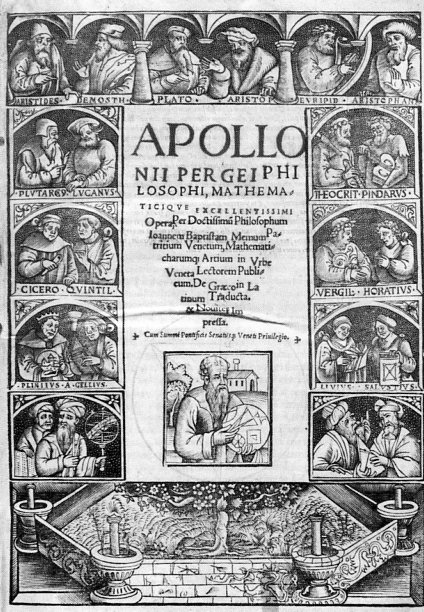
    In the 16th and 17th centuries it was not terribly uncommon to decorate a title page of a scientific/philosophical work with the portraits of standard-bearers and significant people in the field.  This is particularly true in the Baroque era, when so much more of the title page seems to be decorated.  I should have kept closer memory of examples of these works, but for right now two will suffice–they are rather good. The first is the work of Pergaeus Apllonius (ca. 260-200 bce) in the Opera, per doctissimum philosopphm Iohannem Memum, printed in Venice in 1537, which contains the first appearance in print of Apollonius’ Conics.

    Ortraits scientisits apollonius882Around the title of the book we find the half-length portraits of Pliny, Cicero, Quintiliius, Plutarch, Lucan, Aristotle, Demosthenes, Plato, Aristides, Euripedes, Aristophanes, Pindar, Theocritus, Vergil, Horace, Livy, Sallustius/Sallust and Apollonius–a big cast with differing shadows.

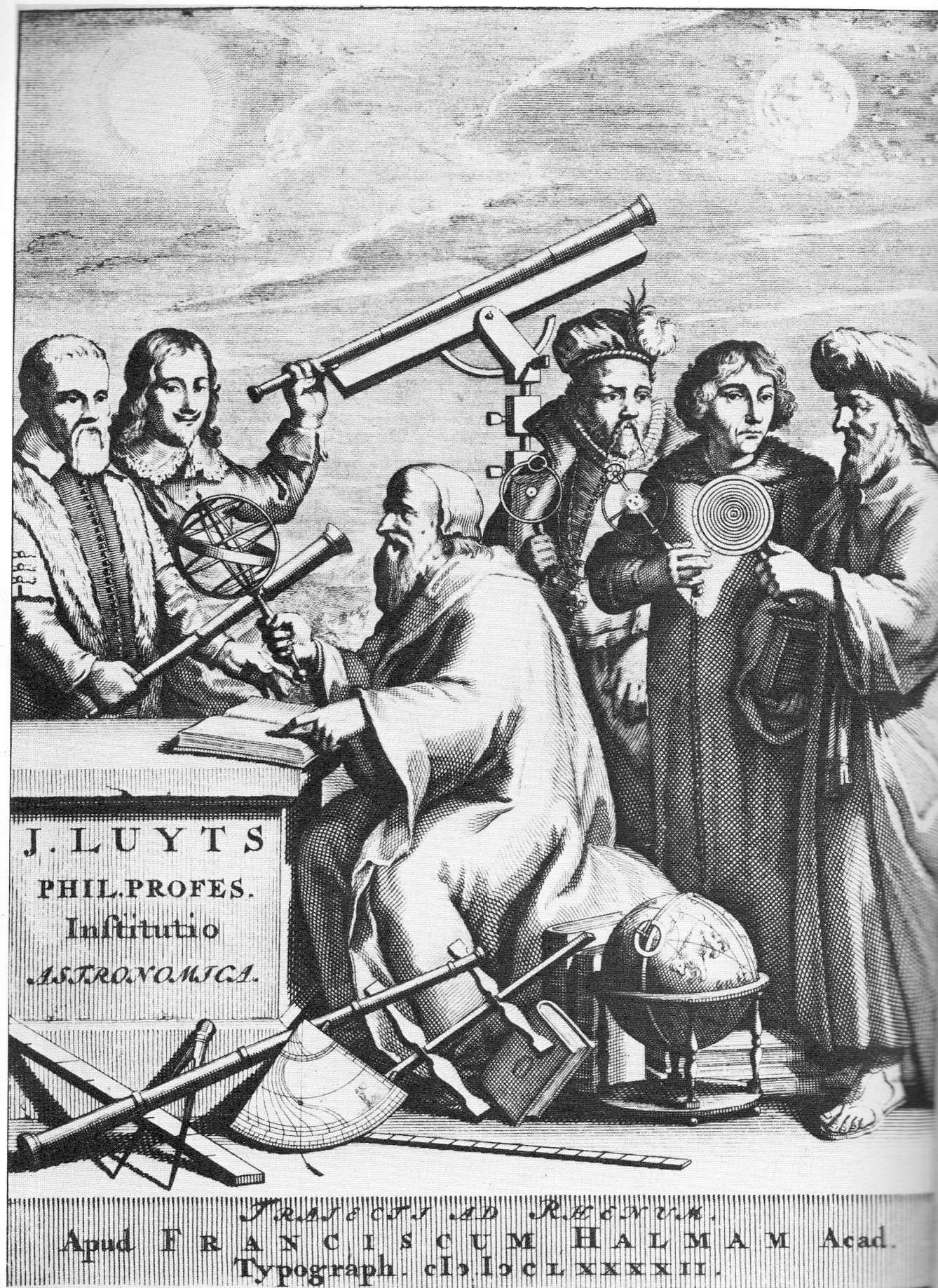
    A great example of a title page dedicated to astronomers is that for Jan Luyts’ (1655-1721, an instructor in maths and physics at Utrecht), text Astronomica Institutio, in qua Doctrina Sphaericaa atque Theorica… printed in Utrecht in 1692. It features a “action shot” of five major figures in astronomy:  (from left to right) Galileo (who is rarely seen actually holding a telescope and here is brandishing one like a club, holding the instrument very weirdly), a ham-handed Hevelius looking slyly over Galileo’s shoulder (though it sort of looks like Kepler in a way, I’m pretty sure that Galileo is Galileo), with  Brahe, Copernicus and Ptolemy each holding elegant demonstration devices for their own particular model of the solar system.  I’m not sure who the central figure is–perhaps just a generic philosophe.

    Ortraits scientisits luyts887

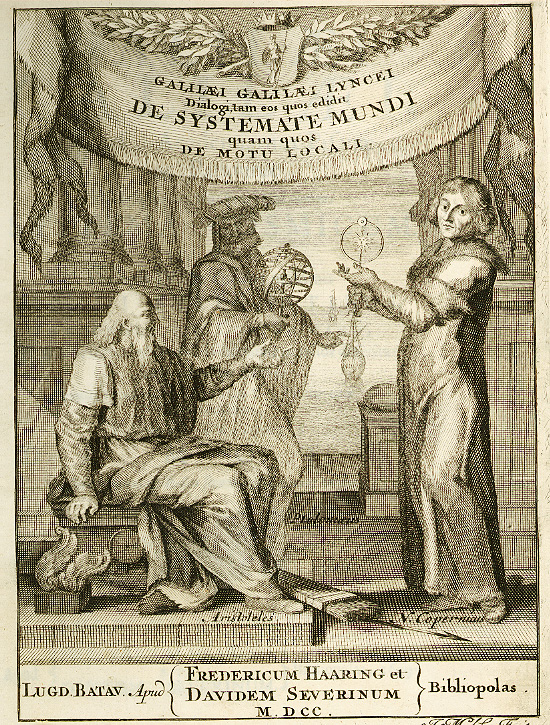
    Here’s the frontispiece to Galileo’s   which features Copernicus at right and the seated figure as Aristotle, which bears some fleeting resemblance to the figure above.

    Galileo two world systems[Image source University of Sydney]

    In this 1641 edition there are some slight alterations:

    [Image source and full text here.]

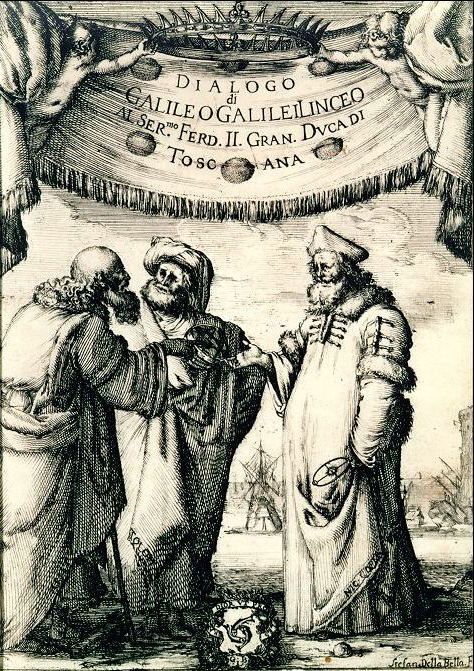
    Galileo’s Dialogo (1632) was the open invitation to trouble that Galileo no doubt expected and then famously received, the work being a defense of the Copernican system which at the time of regressive church wisdom posed a direct threat to Catholic belief systems.  In the frontis to this work we again see some old friends, finding Aristotle, Copernicus and Ptolemy beautifully (and with realistic old-man slumpiness) portrayed by Stefan della Bella. 

    Galileo dialogo SYdney
    (The full title of the Dialogo: Dialogue Concerning the Two Chief World Systems (Dialogo
    sopra i due massimi sistemi del
    mondo
    ), in which the Copernican and Ptolemaic systems are described and
    compared.  Galileo almost worked within the Vatican’s matrix necessitating a balanced
    presentation between the different systems, and evidently did so enough for the book to become a best seller, but
    its ride on the list of the Vatican’s
    banned (“Prohibited”) books lasted until 1835.

    Details of the portraits in “continued reading” section below.


  • Great & Lost-in-the-Dust Books: Anti-Astrology (1523)

    JF Ptak Science Books  Quick Post

    Scepper anti astrology773
    Cornelius Duplicius Scepper (1500-1555) not only presented a beautiful book for publication in 1523–it was a work of deep scholarship, and it was edgy. Not skeptically-edgy, but a scientific-presentation-edgy, dismissive-via-the-facts-edgy. 

    The book (only two copies of which are found in libraries worldwide–at Brown and Oxford–though an online version is found here), Assertionis fidei adversus astrologos, sive signicationibus  coniunctionum superiorum planetarum anni millesimi quingentesimi vicesimi quarti, was published in Antwerp for Franc. Byrckman on  16 May 1523.  (The colophon at end describes the publication data so: “Symon Cocus, & Gerardus Nicolaus … excudebant. Anno salutis humanæ  MD.XXIII die xvi Maij. Impensis honesti viri Francisci Byrckmā …”)

    The book evidently takes great and scholarly pains to point out any number of errors in miscalculations by astrologers, the weight of which and the diligence in historical presentation amounted to the book being a refutation of the claims of astrology. Among his many refutations is one that is quite simple and elegant: Scepper figures out that the starry firmament is at least 65 million miles from Earth, which means that the great vault is deeper and bigger still, and so given the size and the distance and the number of elements involved, it would be asking quite a bit of common sense to believe that all of that was having an effect upon the individual lives of Earthlings.  Pretty good stuff for almost 500 years ago.

    And just for the fun of it, here’s a compilation video of tasty astrology debunkers, including Sagan, Dawkins, Tyson, Nye and Randi. Actually the James Randi part at about 4 minutes is absolutely priceless. 


    Notes:

    Scepper also wrote a biography/history of Charles V: Rerum á Carolo V. Caesare Avgvsto in Africa bello gestarum commentarij elegantissimis iconibus ad historiam accommodis illustrati. Authorum elenchum, è
    quorum monumentis hoc opus constat, sequens pagella indicabit in 1555.

    The colophon:

    Scepper colophon


  • “This Enquiry Not Overcurious”: Huygens on the Laws of Extraterrestrials, 1698

    JF Ptak Science Books   Post 1894

    “…stars…Numerous, and every star perhaps a world Of destined habitations”–Milton, Paradise Lost (1668)

    In spite of a fairly long (if not light) and ancient history, it seems as though Christian Huygens might have thought more to the shaping of extraterrestrial life than any writer to his time.  [The idea of extraterrestrial life is very old, stretching far back into Hindu cosmology, and even deep into the (eighteen worlds) of the Talmud.  Thales, Anaximander, Democritus, Aristole, Ptolemy all thought about and agreed on the possibilities of life being lived on places other than the Earth–infintely more life, in the case of Epicurus. Bruno, Copernicus, Fontenelle, Henry More, and Cyrano de Bergerac.] In a way, in a Asimovian way of rules, Huygens may have laid out the first real template for describing what life-not-on-Earth might look like.  And in the long run, he finds that the possibilities for life Elsewhere are enormously high (and not in doubt in any way), and that it should in no way be any lesser life-formed than what we know here on Earth–and that includes “life” in all of its great complexities.

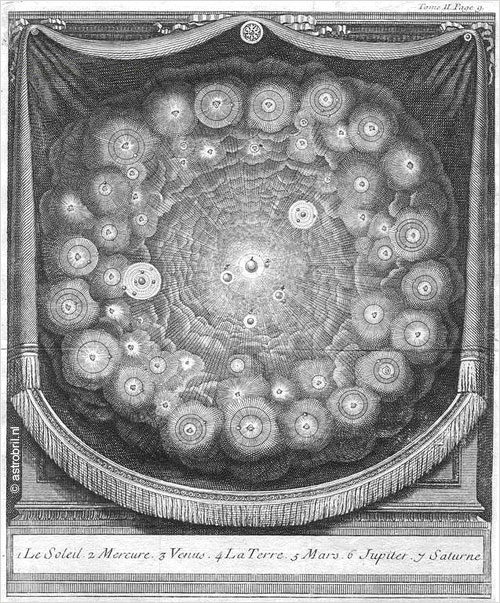
    [One of the few images made during this time or earlier on the possibilities of world systems outside our own appeared in Bernard le Bovier de Fontenelle–who almost but not quite gets there in his 1682 book Entretriens sur la pluralite des mondes, as follows, though it really has not much at all to do directly with Huygens:]

    Blog--plurality of world fontenelle

    Huygens (1629-1695) worked across many fields, including astronomy, biology, math and physics, and was extraordinarily productive, making numerous contributions in the physical and theoretical areas, as well as being a prolific author and correspondant.  But towards the end of his relatively short life (he died at age 56) Huygens embarked down the science fiction road in pre-science fiction days, writing a wonderful and provocative book entitled Cosmotheoros, The Celestial World Discover’d: or, Conjectures Concerning the Inhabitants, Plants and Productions of the Worlds in the Planets (available online in English here) where he establishes the groundwork of this extraterretrial life. (The book was nearly published during Huygens’ lifetime, but it didn’t quit ework out; left to his brother to published, he, too died before the book was finally in print in 1698. Shortly after the Latin edition of the Cosmotheoro was published by the The Hague publisher Adriaan Moetjens, translations appeared in English (1698) and in Dutch (1699). In the following years, translations also appeared in French (1702), German (1703), Russian (1717) and in Swedish (1774).)

    Hugens set out his description by arguing that extraterrestrial existence of life is perfectly in keeping with the Bible, and that his”conjectures are not useless” or “overcurious”, and that are justified in and of themselves as a useful pursuit because of the display of logic in his arguments.  He states that the inherent sinfulness and “villany” of man on Earth does not perclude life elsewhere, and these lifeforms coul dbe everywhere else, and no different from our own, with no differences in ability to reason and explore.  Lifeforms exist much like us, with at least five senses (and here Huygens makes an interesting play for more-than-give senses, though he doesn’t understand what they might be), and are capable of all of the supporting capacities for enjoying astronomy, and logic, mathematics, physik, arithmatic, and all of the rest, including all possible skills that could be called upon in the production of instruments of science necessary to pursue any endeavor, and all enjoyed in a society as expectently rich as any on Earth, enjoying all of their plants and animal lifeforms, all of their own creations and the rest of the creations of Nature, all while listening to a universe-wide application of music (“everywhere immutably the same”, which Huygens states beautifully here:)

    “It’s the same with Musick as with Geometry, it’s every where immutably the same, and always will be so. For all Harmony consists in Concord, and Concord is all the World over fixt according to the same invariable measure and proportion. So that in all Nations the difference and distance of Notes is the same, whether they be in a continued gradual progression, or the voice makes skips over one to the next. Nay very credible Authors report, that there’s a sort of Bird in America, that can plainly sing in order six musical Notes: whence it follows that the Laws of Musick are unchangeably fix’d by Nature, and therefore the same Reason holds valid for their Musick, as we even now proposed for their Geometry”–(page 86)

    Cosmotheoros’ pages are filled with such reasoned arguments–remarkably so for the end of the 17th century, barely 90 years after the great publication of Galileo and 40 aftre the work of Hooke (in exploring infinities at the other end of the optic scale).

    I’ve included some interesting parts from Book One of the Cosmotheoros; the subject/section headings are in red, and the page number (which usually appears mid-sentence) is related as [23]. Huygens occasionally referes to the other non-Earth life forms as “Planetarians”.  Here’s a sample:

  • Great Books & their Titles: Galileo’s “Sidereus Nuncius”, 1610

    JF Ptak Science Books   Quick Post

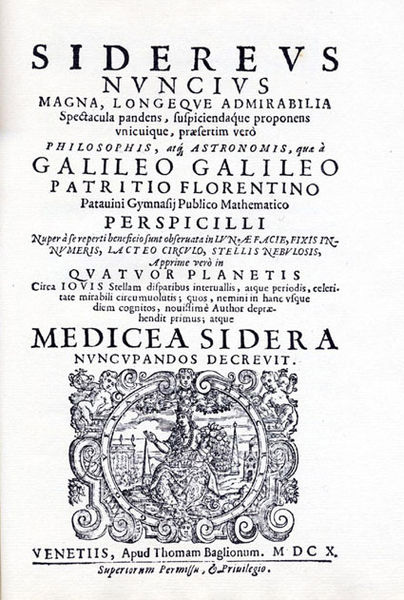
    By 1610 Galileo had produced his fifth and most powerful telescope, allowing things to be seen one thousand times closer than ever before, using it to make enormous discoveries–discoveries so big in fact that their towering significance is a bit hard to understand today in the context of early 17th century knowledge. It was all published in his fantastic Sidereus Nuncius on March 4, 1610—the extraordinary tale told in the very title page of the book, proclaiming some of the great discoveries of Galileo’s adventure.

    One monumental outcome of Galileo’s work was expanding the number of stars in the sky, which was basically mucking around with the perfect plan of the Creator–formerly a cornerstone for the existence of a divine being.  With the exception of comets and eclipses the sky had remained immutable, a perfect score of the creator’s creation, until 1572, when Tycho Brahe noticed something new in Cassiopeia, something that was not a comet—a “something” that was a star. This was momentous because the night sky had been seen for centuries as being complete—a new star, the Nova of Brahe, contradicted this high belief, offering the possibilities of newness where there had not been one previously.  And so too with Kepler’s new star of 1602. But it is with Galileo that all of this newness really finds a firm footing, challenges to the religious basis for belief in the heavens and all, not to mention the great amount of new scientific data presented in the pages of Sidereus Nuncius–it was the first time any scientific data had been published that was collected through the use of a telescope, and pictured such extraordinary things as the mountainous surface of the Moon, a view of our Milky Way, several moons of Jupiter, and other fantastic wonders. 

    The very full title page reads: The Starry Messenger, great and very wonderful spectacles, and offering them to the consideration of every one, but especially of philosophers and astronomers; which have been observed by Galileo Galilei … by the assistance of a perspective glass lately invented by him; namely, in the face of the moon, in innumerable fixed stars in the milky-way, in nebulous stars, but especially in four planets which revolve round Jupiter at different intervals and periods with a wonderful celerity.

    Galileo siderus[Galileo Galilei. Sidereus Nuncius (known in English as Starry Messenger), published 1610.]

    ·Posted by :

    ·in:


  • Images of the Quick and the “Still”: Trouvelot’s Sparks and Stars, ca. 1890

    JF Ptak Science Books     Post 1827

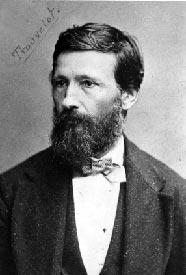
    Etienne Leopold Trouvelot. Trouvelot Figure. Photographic print, c. 1888.

    Etienne Leopold Trouvelot (1823-1895) was an ex-pat Frenchmen who settled in Medford (“Don’t Pronounce the First D”) Massachusetts, and who became a very highly accomplished and deeply skilled astronomical observer and astro-illustrator.  (I’ve included a suite of fifteen of his most accomplished works below, all found in greater detail via their links from their source at  the NY Public Library Digital Collections.)

    Trouvelot covered the spectrum in his art and photography–in addition to making photographs of the deeply settled but still open-to-mystery astronomical objects, he also was the photographer of extremely intransient things.  Among the later are some fantastic images that he made of high-voltage electrical discharges (images of which I found initially at the blog  Translinguisitic Order). 

    The image above is an example of that work, despite it looking like something rather deep-space-y, it is decidedly terrestrial–it is an image that he made of a discharge from either a Ruhmkorff coil or Wimshurst machine, and was produced ca, 1888/9.  It was a signature accomplishment, like photographing lightning or making an atlas of clouds, a watermark of sorts in a decade of photographic highpoint contributions in the sciences. (Some of these accomplishments were found in the work of Etienne Marey, who was able to isolate action in a continuous series of photographic still images, which for its time revealed shocking results.  Not only did the Marey work display the magnificence of motion, it also provided just about the first opportunity in the history of people to show the action in reverse.)

    File:Trouvelot.jpg

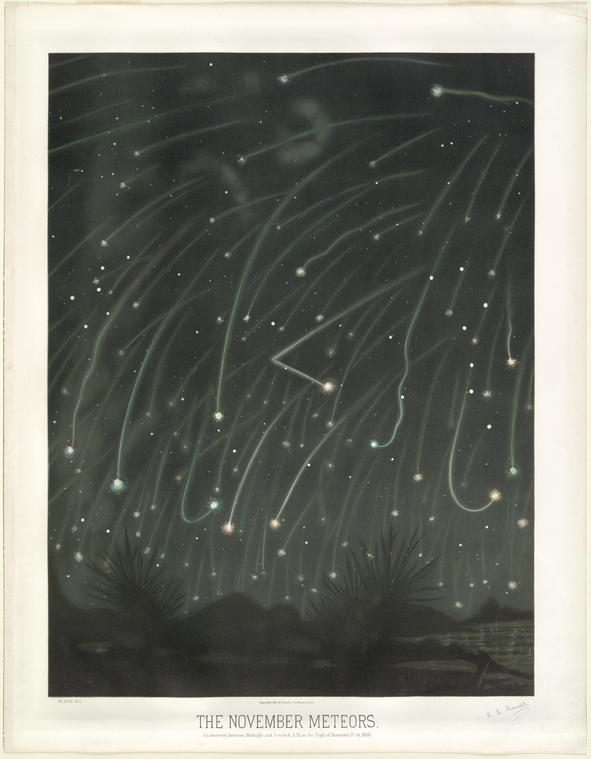
    Trouvelot’s drawing of a meteor shower, which I know has a very certain biological feel to it:

    The November meteors. As observed between midnight and 5 o'clock A.M. on the night of November 13-14 1868.

    Caption from NYPL: “Image ID: trouvelot_012. The November meteors. As observed between midnight and 5 o’clock A.M. on the night of November 13-14 1868. (1881-1882)

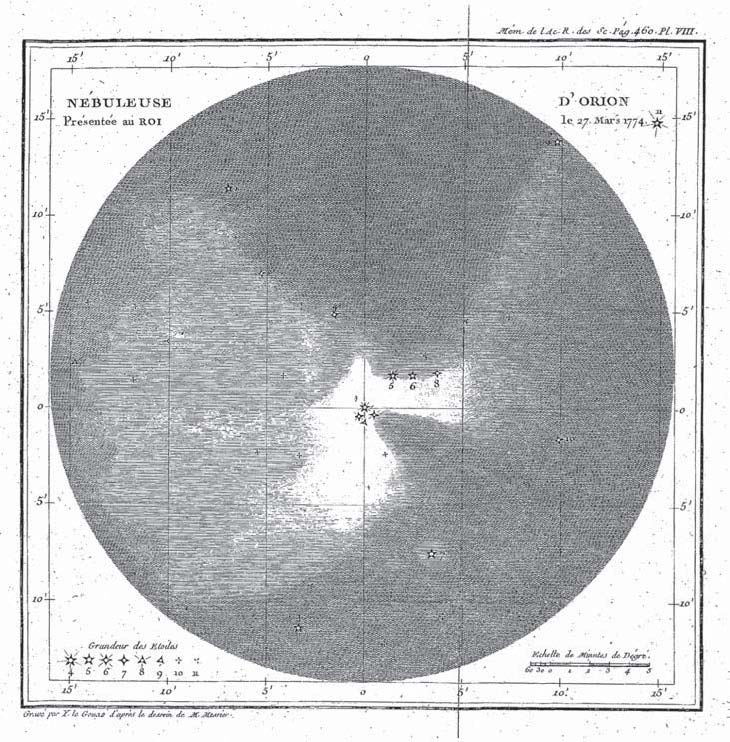
    And this spectacular image of the “Great Nebula in Orion” as it used to be called in some textbooks, now better known as Messier 42 or M42 or NCG 1976, which was and probably still may be one of the closest scrutinized things in the sky. It was recognized first perhaps by Niclas Claude F de Peirsec in 1610, with the first published account following in 1618 by Cysatus of Lucerne, though it didn’t get any real traction until it fell into the hands of Christian Huygens (1656) who also published the first image of the big bright spot in the middle of the sword of Orion in 1659.  (This is a little off-target but I like the historical end of the story.)

    The great nebula in Orion. From a study made in the years 1875-76.
    And just for the sake of it, the Messier drawing:
    File:M42m.jpg
    And Andrew Commons’ photograph of the nebula in 1883 was a great improvement over our old friend Henry Draper’s 1880 groundbreaking attempt:

    File:Orion-Nebula A A Common.jpg

    It is still a little bit of a mystery to me that it took another two decades or so for people to consider that first photo (above) as “art”–perhaps it was the classification of the work as “scientific” and therefore not-necessarily-art, but folks surely made use of this and the Marey and other scientific photography of the 1880’s in their art of the 19-teens.  Trouvelot never lived to see it, though; and perhaps it wouldn’t’ve made sense to him.  I just don’t know. 
    It is also amusing that for this great “finder” the root of the first half of his name in French is “find”.
    The full suite of fifteen images by Trouvelot, below, all thumbnails from NYPL: