A Daily History of Holes, Dots, Lines, Science, History, Math, Physics, Art, the Unintentional Absurd, Architecture, Maps, Data Visualization, Blank and Missing Things, and so on. |1.6 million words, 7500 images, 4.9 million hits| Press & appearances in The Times, Le Figaro, Mensa, The Economist, The Guardian, Discovery News, Slate, Le Monde, Sci American Blogs, Le Pont, and many other places… 5000+ total posts since 2008.

Category: Astronomy

  • Astronomical Stero Cards, 1913

    JF Ptak Science Books   Quick Post
    Follow Me on Pinterest

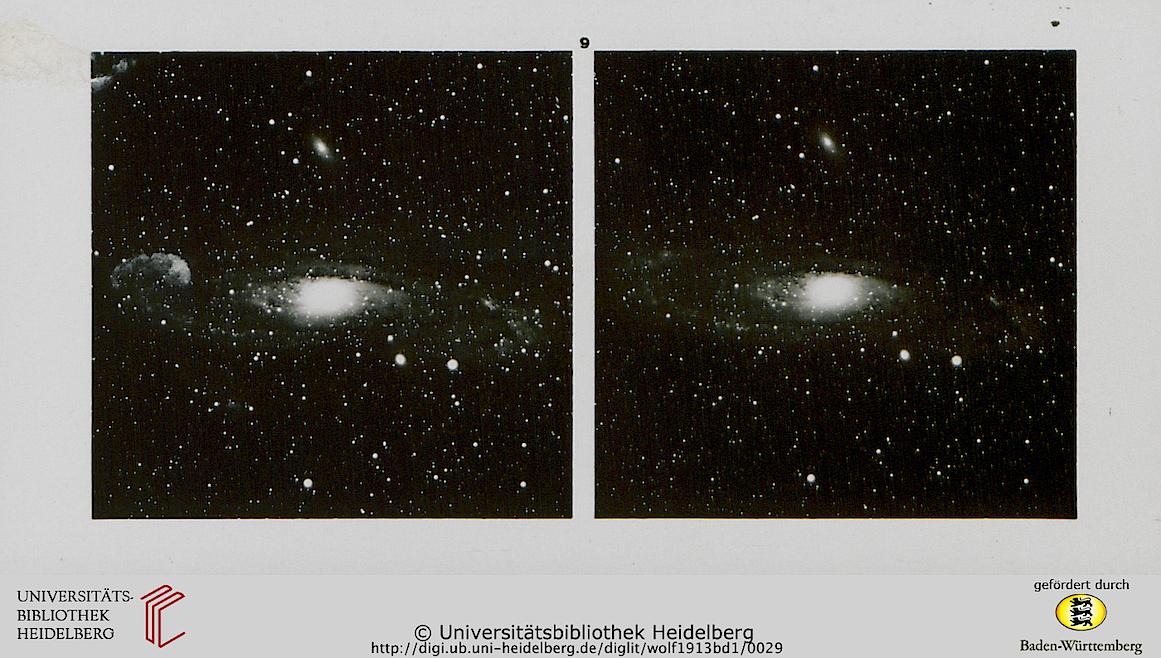
    I own this series of stereoviews but they have yet to surface in our recent move–I did bump into them online at the beautiful University of Heidelberg site, nicely reproduced, though without the the rich glossy blacker-than-black finish in the originals–but these will work nicely. 

    Max Wolf, Stereoskopbilder vom Sternhimmel (1. Serie), Leipzig, 1913.

    ·Posted by :

    ·in:


  • A Note on Luther and Copernicus

    JF Ptak Science Books  Post 2106

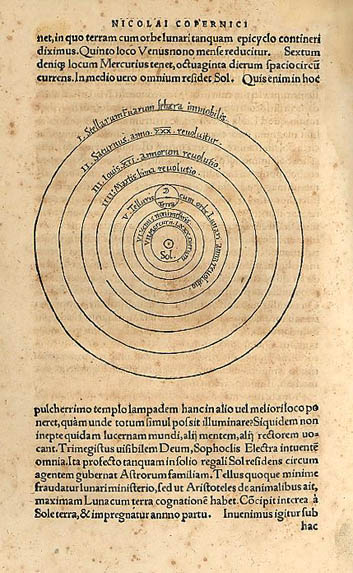
    Like many religious leaders and clerics, Martin Luther in 1539 took a dim and critical view of Copernicus and his new and substantiated theory of planetary motion and placement–he was also among the earliest important criticisms of the work, unable to provide any harmony between the new ideas and the overwhelming authority of the Bible. How did Luther come to say these things about a work that wasn’t published until 1543 (as De revolutionibus orbium coelestium  or On the Revolutions of the Heavenly Spheres)?  As it turns out Copernicus’ book was largely finished a decade or so before it was finally published, being constantly revised and amended and corrected, with parts of the work presented for review and comment to such people as Pope Clement VII (who came to believe in the book and who volunteered to pay for its printing but dying before this could be set into place). 

    Copernicus de revo
    The work was discussed for ten years before publication, with part of the theory finding its way into a small but select circulation in Copernicus’ 40-page summary of his major work, Commentariolus1,  which would have been passed hand-to hand and which itself would not see publication for another 400 years (as the De Revolutionbus was the mature version of what the Commentariolus summarized)–though few copies existed, people did lecture on the work, which is probably where Pope Clement came into contact with its ideas. So it is entirely plausible for Luther to have come into contact with these ideas before publication.

    Luther stated:

    “There is talk of a new astrologer who wants to
    prove that the earth moves and goes around instead of the
    sky, the sun, the moon, just as if somebody were moving in a
    carriage or ship might hold that he was sitting still and at
    rest while the earth and the trees walked and moved. But that
    is how things are nowadays: when a man wishes to be clever he
    must needs invent something special, and the way he does it
    must needs be the best! The fool wants to turn the whole art
    of astronomy upside-down. However, as Holy Scripture tells
    us, so did Joshua bid the sun to stand still and not the
    earth.” And there was more.2

    Even still Luther never did issue  a retraction for his statement, and
    the Catholic Church designated the book to its list of prohibited books,
    in spite of a vetting element that took place prior to publication–it should also be noted that the
    book was also respectfully dedicated to Pope Paul III, leader of the Catholic Church, which was somewhat ambivalent to the work for several decades.

    ·Posted by :

    ·in:


  • The Endless Immensity and Finite View of the Infinite of Thomas Wright, 1754

    JF Ptak Science Books   Post 2064
    Follow Me on Pinterest

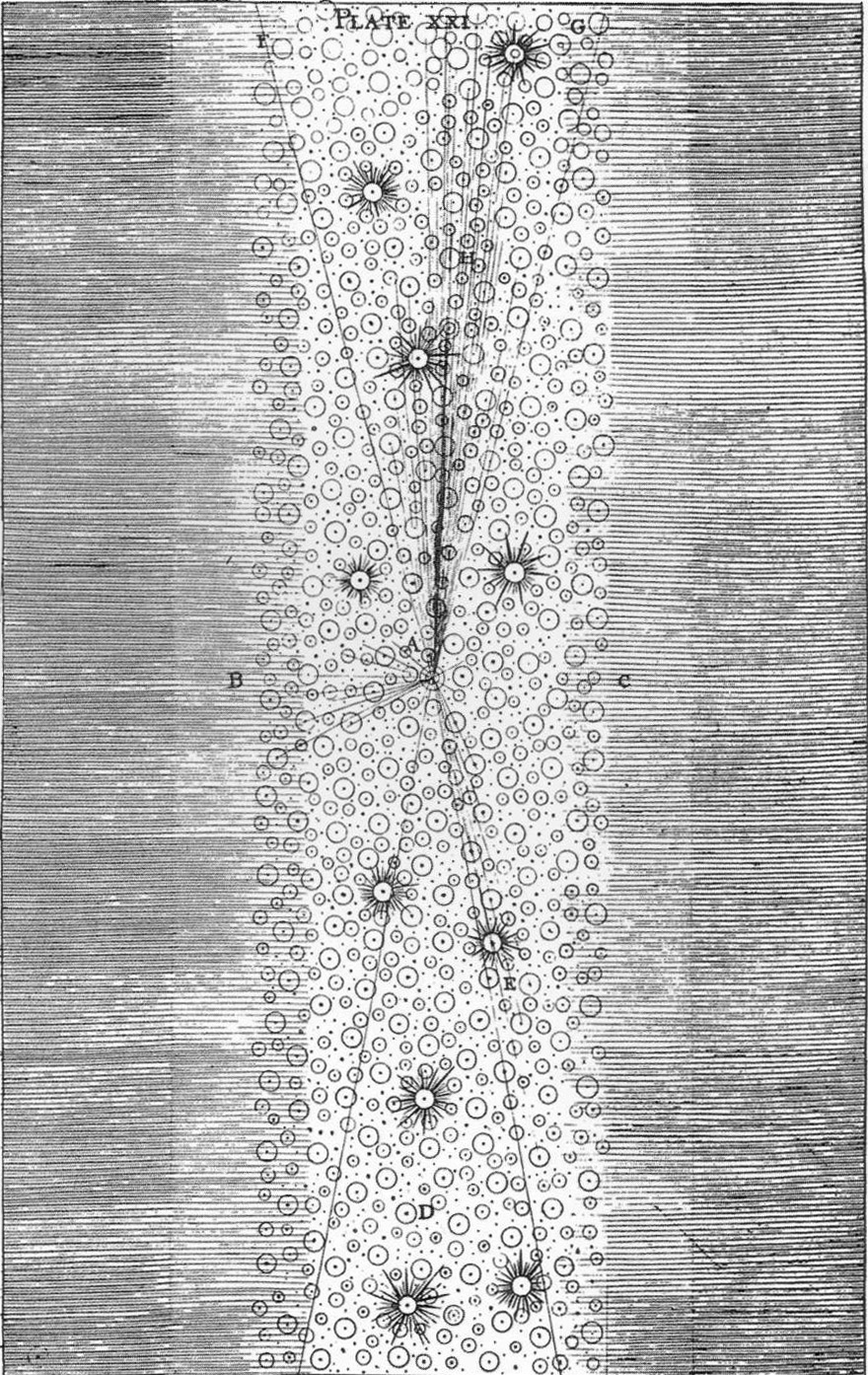
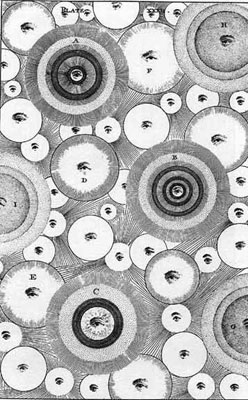
    Thomas Wright (1711-1786) saw about as deeply into the deep as just about anyone else–he looked into the night sky and pretty much saw all of it. In his book, An Original Theory or New Hypothesis of the Universe, Founded upon the Laws of Nature1, he described a version of the universe that was influential in the thinking of Kant and Herschel, finding a rectangular/squashed “finite infinity” of stars, “a vast infinite Gulph, or
    Medium, every Way extended like a Plane,
    and inclosed between two Surfaces”.
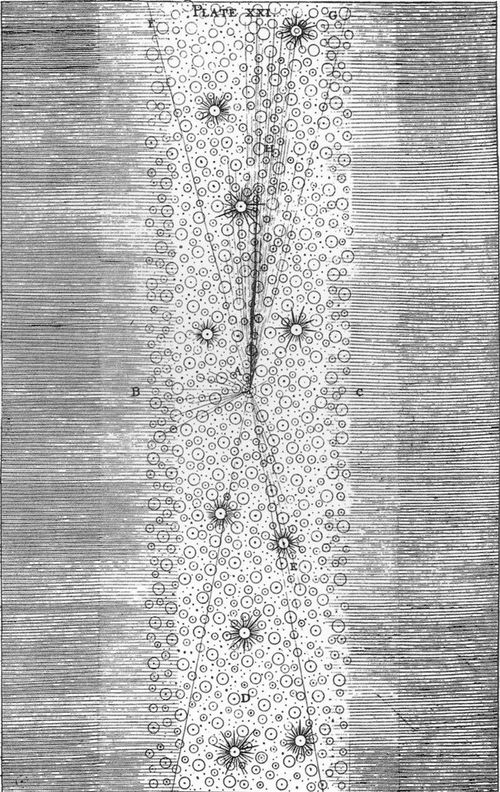
     
    Wright thomas [plate 23

    Our Milky Way, which at the time was thought to be the entire universe rather than a galaxy as it was later discovered to be–one galaxy in a seemingly endless sea of galaxies–was presciently seen by Wilkins as being but one assembly of stars in an “endless immensity” of stars:

    “And farther since without any impiety; since
    as the creation is, so is the Creator also magni-
    fied, we may conclude in consequence of an in-
    finity, and an infinite all-active power; that is
    the visible creation is supposed to be full of si-
    derial systems and planetay worlds, so on, in
    like similar manner, the endless immensity is an
    unlimited plenum of creations not unlike the
    known Universe.”–page 143. (Again, the “Universe” eferred to here is the Milky Way galaxy.)

    Wright’s vision of this plethora of Universes, in which each creation is one like the Milky Way–a radical thought in 1750:
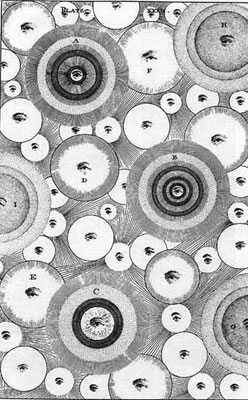

    Wright 32

    [Part of me wants to include the first Wright engraving in this blog’s series on the History of Lines, seeing as how they represent the great Something that seem to be infinitely binding the infinity of universes…]

    Wright also writes on the minuteness of the human condition, of the perfect sense of nothingness that is the Earth in a sea of infinite possibilities of other earths and earthy creations, which was definitely an outpost of thinking in 1750:

    “In this great celestial creation, the catastro-
    phe of a world, such as ours, or even the to-
    tal dissolution of a system of Worlds, may pos-
    sibly be no more to the great author of nature,
    than the most common accident in life with us,
    and in all probability such final and general
    doom-days may be as frequent there, as even
    birth-days, or mortality with us upon the Earth.
    This idea has something so cheerful in it, that
    I own I can never look upon the Stars without
    wondering why the whole world does not be-
    come Astronomers; and that men endowed with
    sense and reason, should neglect a science they
    are naturally so much interested in, and so ca-
    pable of enlarging the understanding, as next to
    a demonstration, must convince them of their
    immortality, and reconcile them to all those lit-
    tle difficulties incident to human nature, with-
    out the least anxiety.”–page 132


    Notes

    1.  The full title:  An Original Theory or New Hypothesis of the Universe, Founded upon the Laws of Nature, and solving by Mathematical Principles the General Phenomena of the Visible Creation ; and particularly the Via Lactea. Comprised in Nine Familiar Letters from the Author to his Friend. And illustrated with upwards of thirty graven and mezzo-tinted Plates by the best Masters. London, MDCCL.” Full test, here.

     2. An odd note about Thomas Wright’s personal history, from Science, 1902: “A word, in passing, about Wright. Like many another, so unfortunate as to live ere the
    times were ripe, he has been consigned to unmerited oblivion. Even the writer of the entry upon him in the ‘ Dictionary of National Biography ‘—a work so uniformly accurate — is unaware of the sources from which information could have been obtained, and so has nothing to tell, — does not even know the dates of his birth and death, or why he was called ‘of Durham.”–[Science, N. S. Vol. XIII. No. 321. 2-22-1902

    An interesting poem by Rafinesque to start of his edition of Wilkins:

    “Where ends the range and limits have been set
    To mortal eyes, there mental sight begins
    To fathom space, and worlds invisible
    Surveys, admires
    The mind must feel that space can have no bound*,
    Whatever number be of things or thoughts
    Others may be beyond—and thus behind
    The Nebulas and Belts, our Galaxies
    Of stormy clouds and oceans
    There stands the central land and throne
    Of our wide Universe, the home of Angels,
    The seat of Love Divine”
    Rafinesque, Poem on Instability, found at the beginning of Rafinesque’s 1837 American edition of Wright’s 1750 work. 

  • Our Galaxy is Not Alone, 1925

    JF Ptak Science Books  Post 2027  
    Follow Me on Pinterest

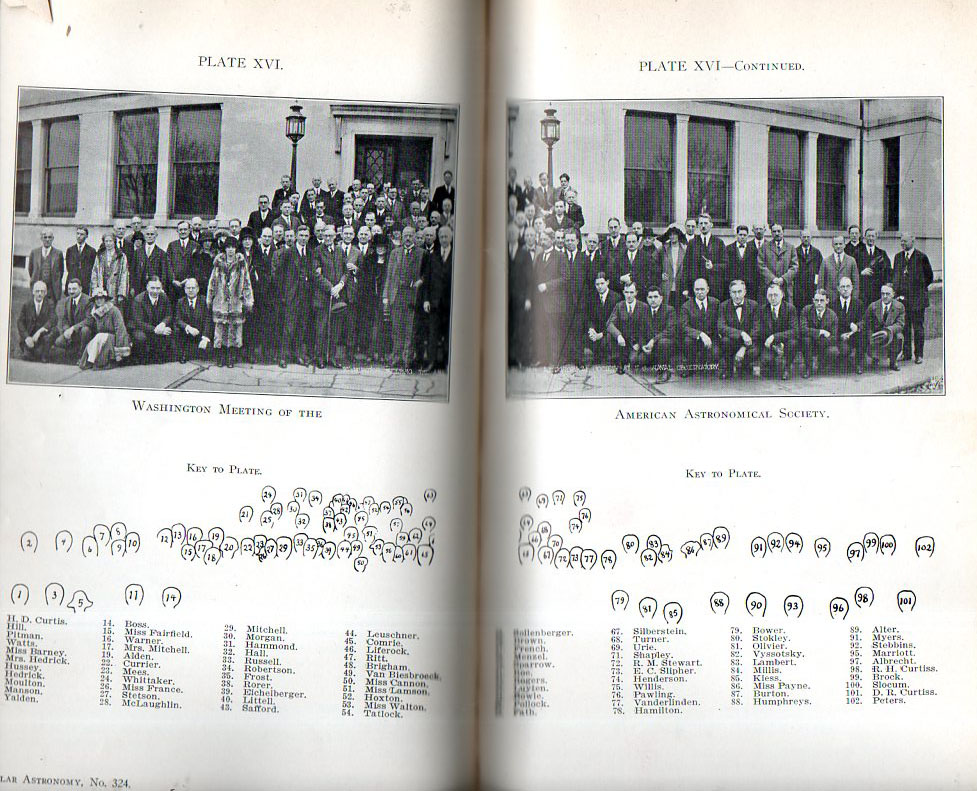
    I was about to post this great image of the attendees of a significant meeting of the American Astronomical Society taken during the meeting in D.C. over New Year’s 1924 (Dec 30 1924-January 1, 1925–certainly no one for many years has thought about holding a professional meeting on such a date!1) but I cannot let it pass that the paper on the other side of the photo was one of very high importance.  

    First, the photo, which I have not yet been able to locate easily online:

    Aas 1925305
    [More detailed closeups are available in the continued reading section, below.  Source:  Popular Astronomy, volume 33, April, 1925.]

    The paper directly opposite the slick reverse of the photo spread is Edwin Hubble’s “Cepheids in the Spiral Nebulae”–it was reported in the issue of Popular Astronomy for the 1924 meeting, though Hubble himself wasn’t actually there.  No matter–he was a meticulous and methodical man, and it seems he was at odd in pressing his results into print too quickly because it contradicted established thinking, which called for caution.  (The results of his findings had been earlier presented in the New York Times in November 19242.) But the paper–to paraphrase my brother-in-law Mickey Digh–“was what it was”, and (using Shapley’s calibration for the period-luminosity relation, published in the Astrophysical Journal in 1918) announced the discovery of Cepheid variable stars in the nebulae M 31 and M 33, placing them at vast distances, well outside our galaxy.  This in effect established that the belief of our galaxy being the only galaxy in he universe was incorrect, and that the Great Debate arguing these points on the nature of the nebulae and begun decades earlier was settled.

    In the next year, 1926, Hubble would contribute a paper on the classification of the nebulae (“Extra-galactic Nebulae”, in the Astrophysical Journal, volume 64, pp 321-369) which was highly adaptable and proved to be iconic.  Three years later, continuing on the theme of the 1925 paper, Hubble published what has been seen by many as the great astronomical paper of the century, the 1929 Velocity-distance relationship, with Hubble’s Constant.  So not only were there galaxies existing outside of our own as he had demonstrated in 1925, but that these galaxies were moving, and quickly, away from each other, everywhere.  This was the establishment of the expanding universe–the Big Bang stuff (famously put forward in the April 1 Alpher-Bethe-Gamow paper by Alpher, Gamow and Herman but no Bethe, a bit of nerd humor to get ABC out of the initials of the authors of the paper on April Fool’s Day, 1939) would come about to explain what the 1929 paper established. 

    Anyway, the 1925 paper is a major step in the history of cosmology, and perhaps the greatest effort in observational cosmology of the 20th century.  

    The other odd thing about this issue is that contains another “first”–not as significant as the Hubble, but still very interesting.  It is a short paper by L.J. Comrie–an early visionary and practicioner of the use of the calculator and computer–on the application of the electric calculator to solving problems in astronomy.  It looks like this may be the first paper on the use of the electric calculator to solve complex computation problems in astronomical issues.  If this isn’t the first paper on the subject, it is close to being so–I haven’t yet figured that out. 

    ·Posted by :

    ·in:


  • Timeline of the Big Bang

    JF Ptak Science Books  Quick Post

    Here’s an interesting, short timeline that I found and and which I reprint below–it was part of the appendix to the book by J.-P. Luminet,  L’Invention du Big Bang (Editions du Seuil, Paris), which was printed in 1997.  “Ce texte est l’introduction de l’ouvrage A. Friedmann, G. Lemaître : Essais de Cosmologie , traduction et notes de J.-P. Luminet et A. Grib, Le Seuil, collections ‘Sources du Savoir’ “. 

    ·Posted by :

    ·in:

    —

  • On Learned Ignorance

    JF Ptak Science Books   Post 2015Follow Me on Pinterest

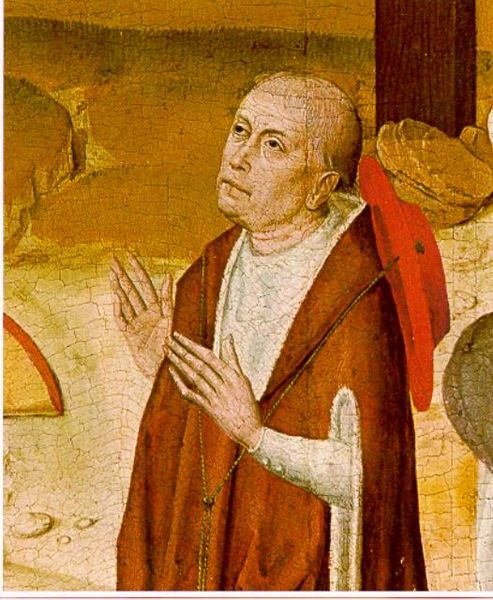
    Nicholas CusaIn keeping with a post earlier today on a Medieval jewel of scholarship (Sacrobosco’s Sphaera) is this short note on Nicolas of Cusa’s beautifully-named de docta ignorantia, or On Learned Ignorance. Nicolaus (1401-1464, Nicholas Cusanus/Kues) was a philosopher, mathematician, theologian, astronomer, cardinal, and mystic, a product of the University of Padua (1423) and then the University of Cologne, and “arguably the most important German thinker of fifteenth century” (Stanford Encyclopedia of Philosophy, here). He was deeply intuitive, a visionary, and in his Learned Ignorance he presented a way of the human mind to release itself to learn the mind of god (among many other things). [Image: detail in Meister des Marienlebens, located in the hospital at Kues (Germany), showing Nicolas of Cusa.]

    In this work is something really amazing–here’s this wide thinker at the end of the Medieval period, writing on advanced theological issues, finding time to stop and smell the astronomical/cosmological roses long enough to think about the unending nature of the universe, about infinity, about the stars being suns for other planets, about the Earth spinning on an axis and circling the Sun. And all of this done without observations, and without calculation, and without a theory–its just a bunch of the big thoughts of modernity found in a small tract about knowing the Creator. Very curious.

    The astronomical views of the cardinal are scattered through his philosophical treatises. They evince complete independence of traditional doctrines, though they are based on symbolism of numbers, on combinations of letters, and on abstract speculations rather than observation. The earth is a star like other stars, is not the centre of the universe, is not at rest, nor are its poles fixed. The celestial bodies are not strictly spherical, nor are their orbits circular. The difference between theory and appearance is explained by relative motion. Had Copernicus been aware of these assertions he would probably have been encouraged by them to publish his own monumental work.–Catholic Encyclopedia, 1913

    Indeed! But I doubt that last sentence–Nicolas’ work was entirely theoretical, and Copernicus was very heavy and deeply laden with data. Even though Nicolas was never considered a heretic–though it must have been a close call here and there–an earlier confrontation by Copernicus with his De Revolutionibus on anything but his death bed would probably have been received with a closed fist.


  • A Long-Lived Medieval Astronomy Text

    JF Ptak Science Books Post 2014

    Sacro Busto, or Sacrobosco (also called John or Johannes Halifax, Holyfax, Holywalde, Sacroboscus, Sacrobuschus, de Sacro Bosco, or de Sacro Busto) was a member of the Order of St. Augustine and a professor of mathematics and atronomy/astrology at Paris ca. 1230. (There are many places attributed to be his birthplace, but it seems fairly certain that he at least was educated at Oxford.) He became a celebrated member of the intelligensia, with his fame in the later centuries coming via three of his surviving works, each an elementary textbook on mathematics and astronomy:  De algorismo, the De computo, and De sphaera.

    [Source for this image and the third, fourth and fifth, below, come from a 1531 edition of the Tractatus viewable in full via Google Books, here.]

    I think it is accurate to say that the Sphaera was the most famous of his works–it is a very long-lived fundamental textobok on astronomy (and the second astronomical text everprinted, in 1472) and went through 24 editions to 1500, and then another 40 editions from 1500 to 1547.  The book was still in use in the mid-17th century but far less so, until it finally was superceded and fell away into the aniquarian dust.  It was a short work–basically about 35 pages–and concisely written, even elementary, but it did receive some close attention by some of the great early thinkers in astronomy and mathematics who contributed commetaries, including Michael Scot (between 1230 and 1235), John Pecham (prior to 1279), and by Campanus of Novara between (1265 to 1292).

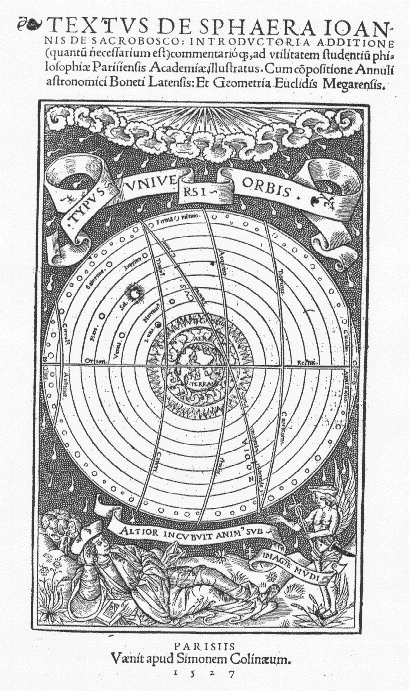
    It may seem a little trifling after this to concentrate on the interesting aspect of the images in his Sphaera, but that is what brought me to Sacrobusto today.  For example, this is the beautiful title page, showing (via an early metal engraving process utilizing little punches making those fine small dots) the structure of our existence:

    Sacro bustoThe work (29 cm tall and as I  said 35 pages long) is called (in full) Textus de sphaera Ioannis de Sacrobosco. Introductoria additione (quantu necessarium est) commentario[que], ad vtilitatem studentiu philosophiae Parisiensis Academiae illustratus. Cum copositione Annuli astronomici Boneti Latensis: Et Geometria Euclidis Megarensis, which was printed in Paris (Parisiis) by Simonem Colinaeum in 1527, while Sacrobusto was a professor there.  

     [Source: Johannes de Sacrobosco – Editions of the Tractatusde Sphaera – home, Roberto de Andrade Martins  http://www.ghtc.usp.br/server/Sacrobosco/Sacrobosco-ed1.htm.]

    There are a number of beautiful and small woodcut illustrations throughout the book in its various editions, for example:

     And:

    And this:

    And so:

    Meanwhile in Sacro Busto’s Vberrimum sphere mundi comētū intersertis etiā questionibus dñi
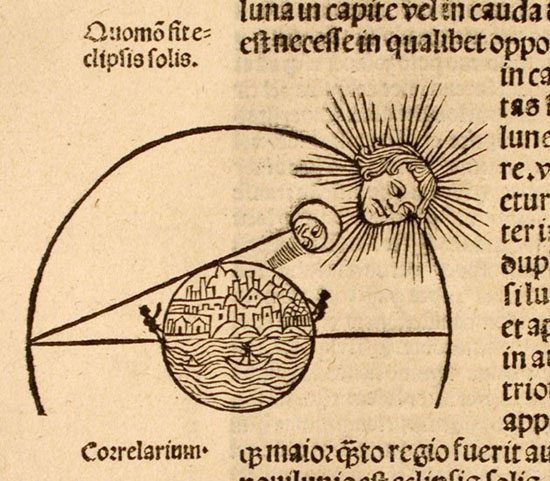
    Petri de aliaco …[Paris, Guy Marchand for Jean Petit, February, 1498-99.] we find this beautiful illustration of a solar eclipse–finding again those curious stick-figure humans under a very Martin-Luther-like Sun:

    Solar eclipse
                                                                          [Source: Lilly Library, Indiana University, here.]


  • The Positively Enormous Skyscraper Plant Eyeballs of Mars, 1912

    JF Ptak Science Books   Post 1988 

    People get stuff wrong.–(could’ve been said by) R.P. Feynman

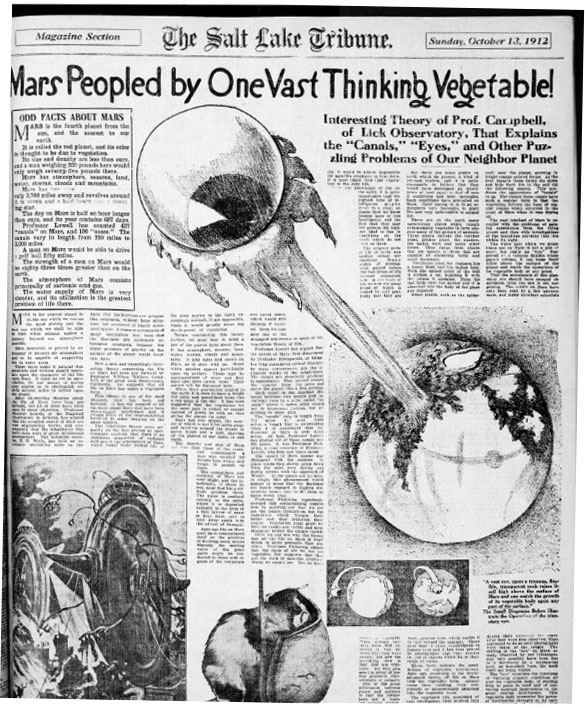
    Maras eyeball2_edited-1[Source: via Chronicles of America series at the Library of Congress, here, and first seen via the interesting Pinterest collection of Trevor Owens, here.]  

    Some  five years after Percy Lowell filed his Gigantic Situation of intelligent life on Maris in 1906, and 14 years after H.G. Wells’ octopusian Martian invasion, the Salt Lake Tribune published this limb-numbing story on solar-flare-sized plant eyeball creatures who were said to inhabit Mars. Rather they lived of Mars–the eyeball plant was thousands of miles big, growing along the surface of Mars, and then rising up above it to survey itself and its dominion via an unlashed and unlidded eggy eyeball of stupendous size mileage.

    But when you squint and feel the whole scenario out, you can sort of see how someone might’ve come up with this solution to the Martian canals. Or canali, as they were first described in in 1877 in Italian by the very busy and very astute G.V. Schiaparelli–it was unfortunate that the need for mistranslating the word from Italian into “canals” rather than ‘channels”, but wicked imagination must’ve taken hold of Lowell, and he ran with the idea that the markings on the surface of the planet were of intelligent design.  (I’m sorry that Schiaparelli is remembered mostly for this particular contribution to astronomy in the popular mind–he was really a pretty extraordinary scientist and historian of science, and in his exceptional biography in the 1910 volume of the Astrophysical Journal there is a long and lauditory appraisal of his life and career, without a peep/mention of the infamous canali).

    And by “squinting” acknowledgement I mean squinting very hard–at least it could account for the changing seasonal forms of the canals, as their positions would change if the thing was alive.  Of course, the whole “living planet” deal doesn’t work out so well physically and biologically, though it is a smashing good idea for a scifi story, especially one appearing in 1912. Lowell had a very difficult time explaining the movements of these figures, because–according to his theory–the Martians would’ve been constructing positively enormous canals that stretch across the planet which were also wide enough to be visible via telescope from Earth–with changing positions, that would mean, possibly, that the Martians would fill these things back up again at the turn of the season, and then build and fill the next, and so on. It would be an interesting calculation to see how much real estate was being moved on Mars every year. 

    Lowell did come up with an explanation for this seeming motion–turgidly, he felt that the canals themselves didn’t actually moved; rather, it was a huge movable biomass on the canals at were changing so much the activity could be seem fro space.  There were many problems with the theory, as very ably pointed out by the great Alfred Russell Wallace, who eviscerated Lowell and his intelligent Martian life idea (published in his Mars and its Canals published in 1906 which was followed by Mars as the Abode of Life in 1909)  in his own book, Is Mars Habitable? (1907).  The Mars business eclipses Lowell’s other very capable work, or at least so it seems–when the man died in 1910, he was buried on Mars Hill at the observatory in Flagstaff.

    The Giant All-Seeing Eyeball was hoisted high in the Tribune, given supposed life by the very highly capable astronomer W.W. Campbell (1862-1930, with his biography here at the National Academy of Science), who is quoted by the paper as being the source of this preposterous theory.  Campbell was not pleased by this–not at all.  And I can well imagine why. 

    I can’t consider the Salt Lake paper’s story a hoax (as in the case of the great Moon hoax perpetrated in the pages of the New York Sun in 1835), mainly because it is surrounded by other crazy/funny stories–and it didn’t try to present the story as a piece of non-fiction, as is classically the case with hoaxes. The Tribune followed up this story on the very next page with one on how the English aristocracy was turning into gorillas. 

    ·Posted by :

    ·in:


  • The Moon as an Aeroplane, 1914

    JF Ptak Science Books  Quick Post 

    Follow Me on Pinterest


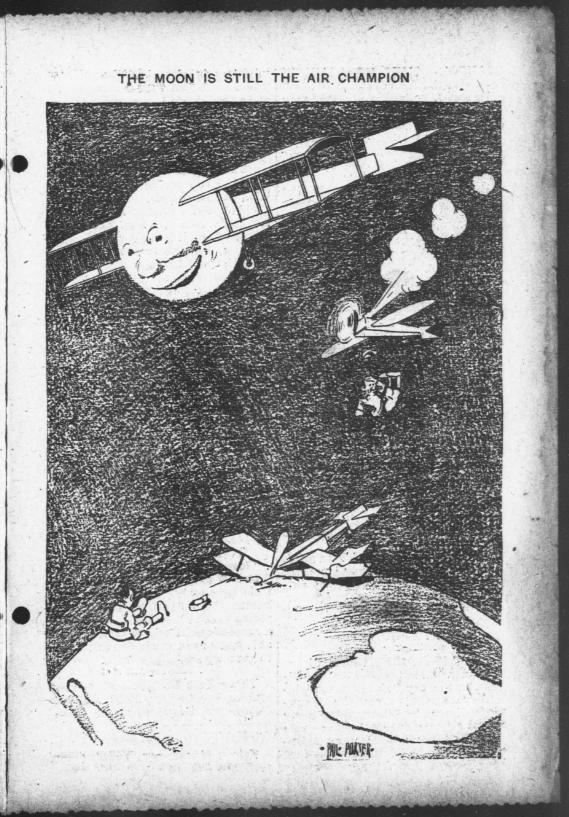
    Moon is still champion


    The iconography of the Moon is certainly wide and vast, but I’m thinking that this may be a very good candidate for the first time that the Moon appears as an airplane. I found this lovely image depicting the champion of the air, the great and all-knowing height-highness, the Moon. In 1914, eleven years after the first powered heavier than air flight of the Wright brothers, the development of more sophisticated was appreciating at a high rate, and there were newer higher records for (fixed wing) altitudes. (In 1908 the altitude record was about 360′; in 1910, it stood at 8,000′–balloons had achieved loftier records, around 40,000′ in 1912.)  This was a sly way of pointing out that try as they may and try as they might, the inhabitants of Earth wouldn’t come quite so close to the Moon as they would dream.  And that was true until Apollo 8 found itself on the far side of the Moon, only 56 years later.   [Source: The Day Book, Chicago, March 24, 1914. Image provided by University of Illinois at Urbana-Champaign Library, Urbana, IL. Persistent link: http://chroniclingamerica.loc.gov/lccn/sn83045487/1914-03-24/ed-1/seq-31/]

    ·Posted by :

    ·in:

    —

  • Mystery of the Sun’s Missing Smile

    JF Ptak Science Books   Post Expanding a Lost Earlier Post (#67)

    Blogsunfacesdetailtwo

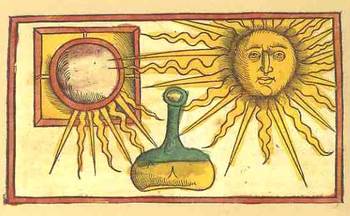
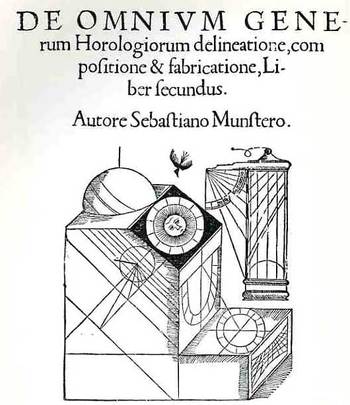
    Where did the smile of the Sun go?  Anthropomorphic images of the Sun
    have appeared in books in the West for several hundred years, and in
    almost every case where the Sun has a face, it is usually
    expressionless, its mouth drawn into a mid-Western farmer/Abe Lincoln
    horizontal, a tightly drawn nothing.  Two thin lips, firmly repulsing
    all emotion.  The face of the Sun was insurmountable, a tabula rasa, showing perhaps that there was nothing there at all inhabiting this
    iconographic image of The Creator to give the poor observer a glimpse
    into the depths of the future.


    Blogsunfacescolor


    Blogsunfaces2048

    This observation  seems to stand for Sun Gods and Goddesses as well, even the ones who are being tugged or pulled or charioted across the vaults of the heavens—the Nordic Sól, Greek  Helios , Roman Sol Invictus, Vedic Surya and of course Elijah ascending to Heaven in a Chariot of Fire, all seem pretty intractable.  But in general images that we see of Sun deities like Apollo, Greece and Rome; Freyr, Norse; Garuda, Hindu; Huitzilopochtli (Uitzilopochtli), Aztec; Inti, Inca; Liza,West African; Lugh, Celtic and Re (Ra) and Isis, and on and on, show a small, set pair of lips, if they have a mouth at all, and this going back beyond the Sumerians (Shamash). 

    When the Sun really loses its human personae in the 17th century (the scientific sun and stars beginning much earlier, as in for example Allessandro Piccolomini’s Della Sfera del Mondo, 1552, with simple star maps unadorned by icons and written in the vernacular), it is replaced with starry images which seem to somehow have more emotional authority than the sun images with faces.  Perhaps the sun was meant to have this Delphic, blank-mirroring quality, given its importance as a giver (and taker) of things,
    Blogsunfacedetailone

    and that it was not within human capacity to understand it as an emotive entity, especially during bad times.  But in those times of Good and Bad it wasn’t necessary to see a frown or a smile on an image of the Sun, I guess because of the complaints of redundancy.

    Blogsunfaces047

    No matter, though, as the modern astronomical text took care of the Sun and its missing buckets of smiles in due course—until more modern times, when the Sun is made to have a matching disposition, a result of kinder modern artists. 
    Blogsunfacedetailthree
     

    Now the Moon, well, that’s another matter…

    ·Posted by :

    ·in: