A Daily History of Holes, Dots, Lines, Science, History, Math, Physics, Art, the Unintentional Absurd, Architecture, Maps, Data Visualization, Blank and Missing Things, and so on. |1.6 million words, 7500 images, 4.9 million hits| Press & appearances in The Times, Le Figaro, Mensa, The Economist, The Guardian, Discovery News, Slate, Le Monde, Sci American Blogs, Le Pont, and many other places… 5000+ total posts since 2008.

Category: Absurdist, Unintentional

  • Bad Ideas Department: Pool Vodka and Cigarette Wallpaper 1947-1953

    JF Ptak Science Books   Post 1153

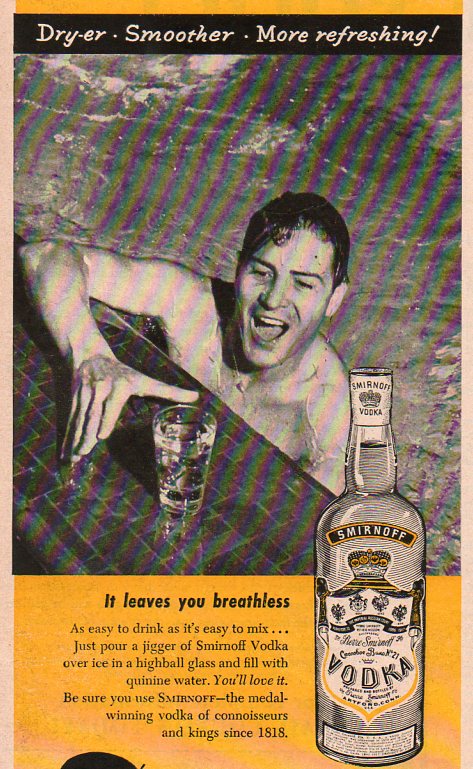
    Things we dont need vodka swim464 I just can’t leave this week’s string of five posts on stuff that I found in Life magazine without adding a little to the Bad Ideas category.  Generally this is the place  to collect the really odd, little material that I stumble upon that is noteworthy but not necessarily a good  fit for a general, stand-alone post.  So comes this installment to Bad Ideas–Things We Don’t Need.

    For example I just couldn’t wrap any sort of integrating or creative bow around this image (left) to present it as anything more than what it is.

    I could think of almost no other thing that I’d rather drink after a swimming workout than a glass of vodka with no ice. 
    I mean, really–it gives me a headache to just think about popping out of a cold pool, a little out-of-breath, and grabbing four fingers of room-temperature Smirnoff. I get that it is a “dry” juxtaposition, but all this looks like to me is a man with a pretty big problem.

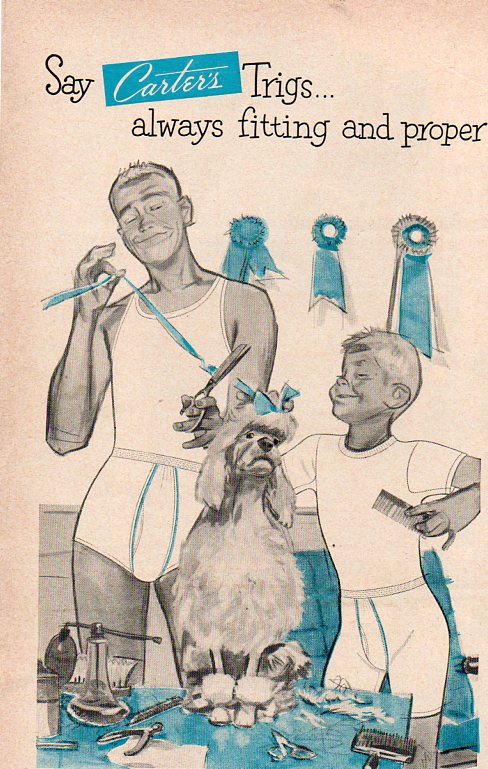
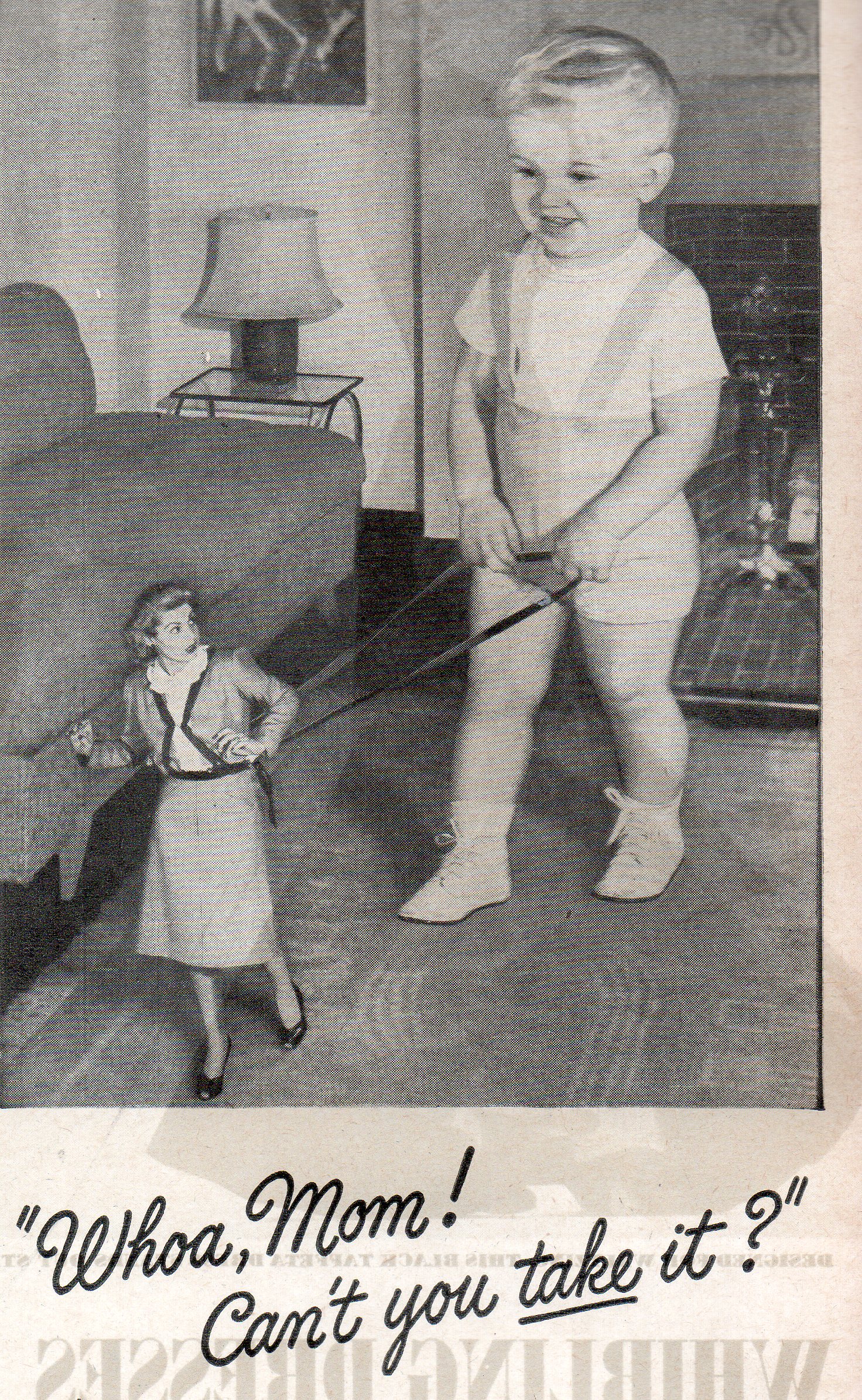
    Things we dont need underwear dog463

    And then the next picture–there’s simply  no good need to be posing in your underwear with a small boy in his underwear while grooming a French poodle.  There’s just no conceivable need to do it, period, especially with such oddly satisfied smiles.

    And then  there’s this ad that is utterly demeaning to almost everyone–a wall of Old Gold unfiltered ciggies that are about life-sized with a vague suggestion that you smoke them for fun rather than some sort of medical benefit (?)  With a little editing you could construct a wallpaper out of this photo–and I mean a wallpaper for a room rather than a computer, a wallpaper composed of cigarette butt ends..  Just for the record, I figure that a 1.5 pack a day smoker would smoke the equivalent of this image spread over the four walls of an average-size bedroom in about four years.  Its conceivable that you could paper a decent-sized house with the wallpapered equivalent of every cigarette smoked by the smoker in a lifetime, or for as long as the cancer could be tricked to stay away.

    And so this is the beginning of this category–I hope it will be entertaining.

    Things we dont need cigs462

    ·Posted by :

    ·in:

    —

  • Mr. Mole, the Stationary Busby Berkeley of Mass Crowd Installation Photographs, 1918

    JF Ptak Science Books Post 1185

    I’ve long enjoyed these massively organized, captured moments of time and effort–large caliber photos of concentrated efforts of tens of thousands of people, all of their motion and utility directed to produce this one moment in time.  Perhaps the greatest practioner of this artform was Arthur S. Mole (1889-1983), the stationary Busby Berkeley of Big Organized Crowd Efforts (BOCE).  (He led an interesting life, coming from Scotland with his family to be part of a Utopian community led by John Alexander Dowie–a faith healing visionary, self-reported precursor to the second coming of Christ, and leader of the Christian Catholic Apostolic Church–at City Zion, Illinois. Dowie was a problematic man not without good and interesting qualities, though his to-the-death prayer duel with a rival visionary is an interesting story to be left for another time.)

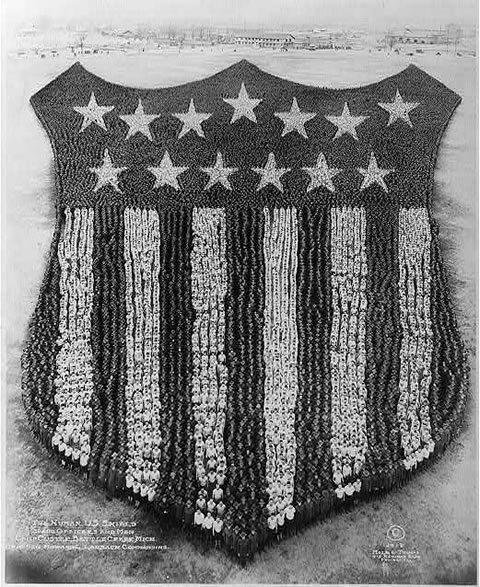
    I’ve always enjoyed this photograph  in particular–it was made from a 70′-tall platform with a 11×14″ view camera using a wide angle and a deep oblique angle, along with 30,000 soldiers from Camp Custer, Michigan.   It was made in 1918 by Mole, along with the evident and very capable choreography of John D. Thomas, who was the Doctor of Persepctive and Motion for the pictures.

    [Note: most of the images below are extremely clickable/zoomable.]

    Arthur-mole-human-us-shield

    Most of the soldiers are used to make the field at the top of the stripes–so near as I can tell (from the resolution image that I had to work with), there are about 300 men in each stripe (except for the outer two), meaning that there between 3,000 to 5,000 in the collected stripes, which puts something like 25,000 troops in the stars and their field. The middle stripe I reckon to be 150′ long; my guesstimate for the star field is 600′ deep and 1250′ wide, making a triangular collection of men 750’x1250′. That takes a little bit of planning to accomplish to ensure that everything is kept in perspective, and which also means that a lot more folks are needed at the top of the constructed image than at the bottom.

    Another excellent example is this photo made of the U.S. Marine Corps emblem using 6,000 marines at Paris Island in 1920.

    http://redtreetimes.files.wordpress.com/2010/05/arthur-mole.jpg


  • Unintentionally Modern Art: Found Dadaist, Abstract Images

    JF Ptak Science Books  Post 1144

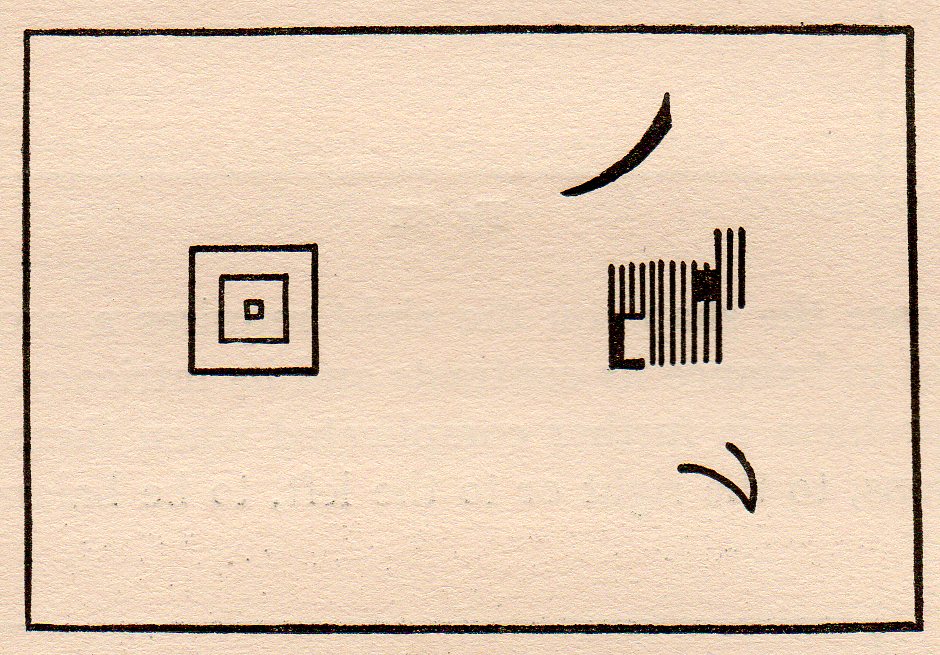
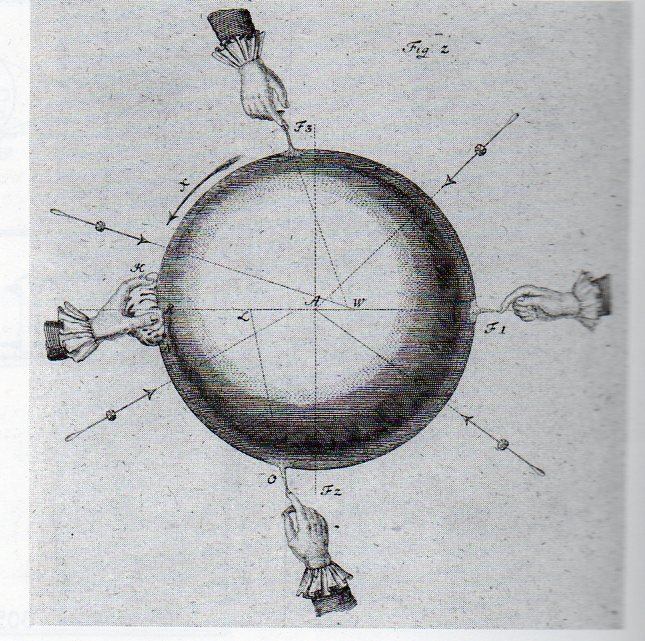
    I’ve written several posts here about unrecognized unintentionally unrevolutionary unmodern art on this blog, bits of works on color theory or design or architecture or medicine where the resulting imaging looks very much like a piece of abstract or Dadaist or nonrepresntational art–only decades or centuries too early.  This is an admittedly long-term project, backed-filled with intermittent finds. That’s just necessarily so–I just add this bits as I find them, and, hopefully, at the end of the road, there’ll be hundreds of nice examples.

    Today’s entries include one image from a design book and two from mid-18th century works on electricity:

    This image comes fro, Denham Ross‘ A Theory of Pure Design, Harmony Balance, Rhythm. published by Houghton Mifflin in 1907

    Unintentional ROss382 

    And from Jacob Waitz’s Abhandlung von der Elektricitat...(printed in 1745)

    Unintentional art ball379 

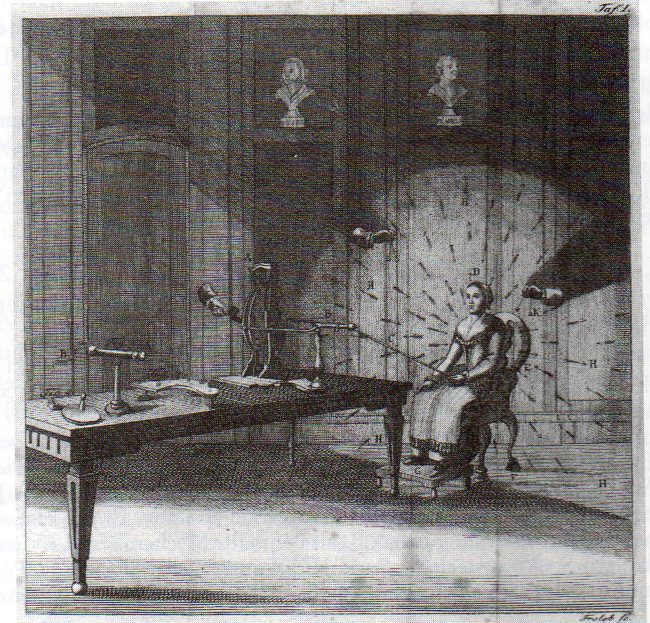
    And from Wilhelm van Barneveld’s Medizinische Elektrizitat (1787)

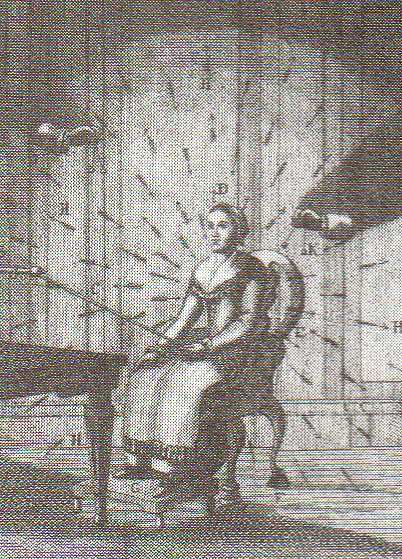
    Unintentional lady arrow det381
    Which is a detail from the following engraving:

    Unintentional lady arrow380

    ·Posted by :

    ·in:


  • The First X-Ray of an Atomic Explosion Inside of a Person (1964)

    JF Ptak Science Books  Post 1140

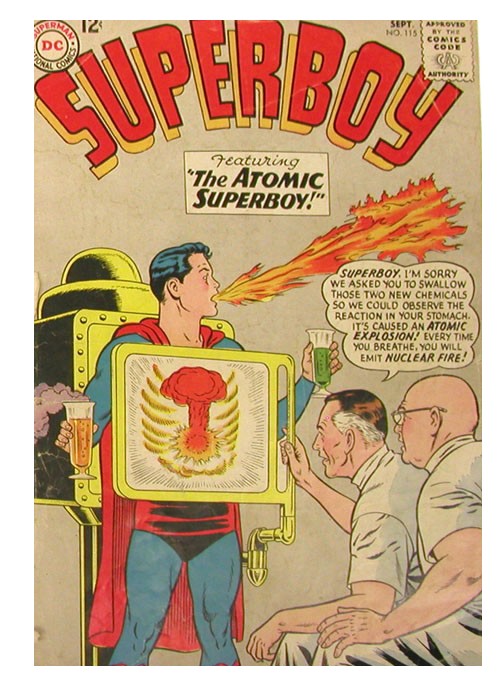
    I don’t know why, but I cannot remember ever having seen an x-ray of an atomic explosion taking place inside of a person, before today.  I guess that Superboy’s body is susceptible to x-rays but is also at the same exact time capable of preventing a nuclear explosion from escaping his body–all except for the “nuclear fire” coming from his mouth.Now that’s some sort of body control! The men in white seem pretty confident, being so close to the Trinity-like action and all.

    Atomic explos superboy
    Superboy evidently needs fewer ribs than humans, and it looks like the detonation point is right on the transpyloric plane, taking out kidney, liver, gall bladder and just about everything else.  And his spine doesn’t show up, either–along with a lot of other innards.

    Atomic explos superb deta 

    The original (published in September 1964) comes from the Oak Ridge Associated Universities, and they point out that this issue comes right after the signing of in-air nuclear weapons testing ban (after a speech by JFK in June 1963, marked by a memorial that was about 10 feet away from where I used to practice the shot put in D.C.)


  • Radioactive Suppository Sex Aids & Radium Toothpaste: Shining Lethal Nonsense

    JF Ptak Science Books  Post 1139

    Radium chemical co385

    “Radium was what was bad and worse
    a shiney and shining curse,
    till we stuck uranium in there,
    to make me have my ‘splodin’ hair…”–Lyrics to the nonexistent song “Satan’s Tooth in Me”, (1946),  by Blending “Loose Tooth” Bender

    If this was 15 May 1915, we could all be attending the Illinois State Medical Society’s annual meeting at the Masonic Temple in Springfield, Illinois.And if we went to booth 18, we could’ve bought some fine, newish radium-based products that would be enjoyed drinking or bathing in.  And all for the cause of human progress, the radium-based nonsense promised cures for all sorts of ills:  rheumatism, dandruff, dull teeth, gout, sexual problems, general malaise, and on and on. 


    The exceptionally important discovery by the Curies was made 17 years before this event, with the medically-unknown problems of radium waiting in the wings for another decade or so after this.  In the meantime, there were many companies that took advantage of the unknown qualities of radium (as happened with the use of X-Rays for all sorts of quack applications) using it as a shining addition to dozens of products.

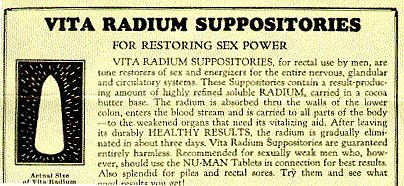
    Many of these companies employed the real stuff, affecting thousands of people, radium-based cure-alls being ingested, injected, applied and bathed-in. For example, there were numerous companies distributing ‘radium water” (such as “Radithor” by William J.A. Bailey’s company), radium suppositories (“in a cocoa butter base”), toothpaste (“Doramad”, distributed by Doramad Radioaktive Zohncreme during WWII, to Germans), cosmetics (“Tho-Radia”), and many different varieties of radium-enriched healing belts (to be worn or slept on).  There were plenty of other products that used the “radium” name but didn’t actually use the substance itself, further selling the idea of its usefulness on the individual level.  There was radium beer, nail clippers, starch, cigars, polish, headache tablets, razor blades, butter and of course, condoms.

    Radium--suppositories

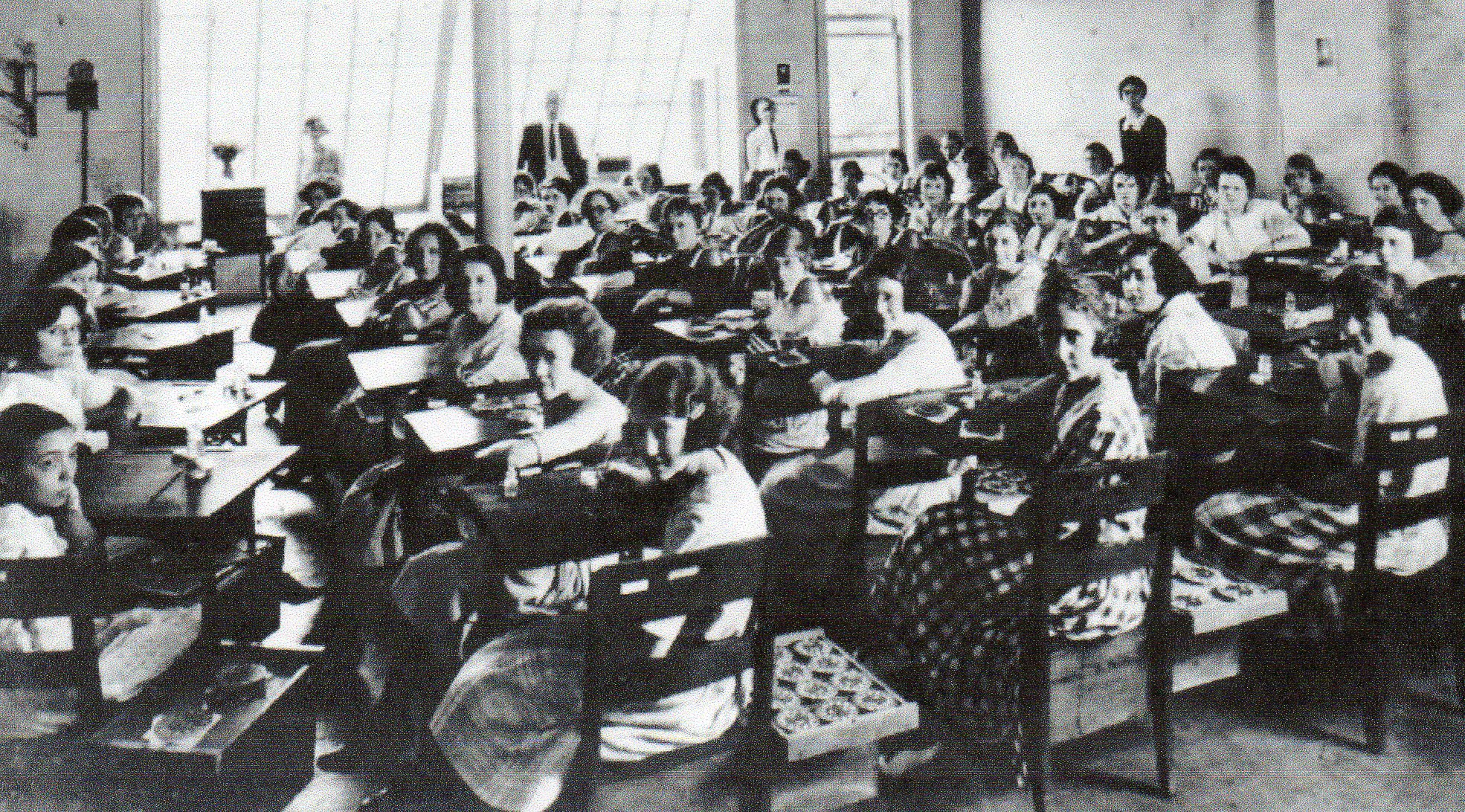
     Perhaps the most famous case of misguided application of radium was in the case of the radium dial painting women, more than 1200 employed by four companies1 during the ‘teens and ‘twenties (and some later) to apply radium-laced paint to make watch face/dials luminous in the dark.  It wasn’t necessarily the radium in the paint that got to so many of these women and killed them–it was the fact that they would generally put their paint brushes on the tips of their tongues to get a better painting point with the camel hairs.  Ingesting the radium paint like that was

    Radium women 2384
    [Image: Oak Ridge Associated Universities, radium dial painters, ca. 1920.]

    the killer.  The manufacturers said, basically, that they “tried” to discourage this behavior, but there was nothing that they could do about it, and so the brush-to-mouth to cancer/necrosis continued until people started dying.  It was then that the whole connection between radium and cancer was discovered.  Of course some of this continued into the ‘forties and ‘fifties, with “safeguards” in place, but, well, something else just needed to be done.  

    I guess that the point of telling this story is that we can shake our heads at this sort of behavior now, but it is assured that entire populations will be shaking their quizzed-up collective noggins with what we practice now (that is deemed to be “safe” or “appropriate”), and all in just a few short decades.  This is always the case.  Its just hard, sometimes, to identify what these practices are while they’re happening, and then have the willingness to do something about it. 

    Notes

    1. The four main companies included Radium Dial Company (with 213 such workers), Waterbury Clock (with 404), US Radium Company (with 73), and Luminous Processes (with 608).


  • History of Blank and Missing Things: Who is Albert Einstein?

    JF Ptak Science Books   Post 1137

    Einstein patent [Part of the History of Blank, Empty and Missing Things series.]

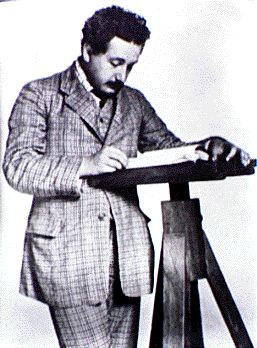
    There was a time when this was a real question, even though the subject of that question was in the process of changing physics. One of the most enigmatic strings of 12 words and numerals in the history of science, “Bern, June, 1905″ appeared at the end of Albert Einstein’s special relativity paper, setting the question in motion..

    This difficult publication–one of the most revolutionary in the history of physics–was written by a mystery man.  Its author was basically unknown–when readers tried to find Einstein, they went to the universities in Bern, naturally, but of course didn’t find him there.  No one would have guessed that he was a patent office grunt, one window at work to call his own.  There were no clues in the paper about the other, not really–not even a footnote.  An invisible man was changing the face of physics. 

    1905 was, well, “busy” for Einstein.  Perhaps no one person has ever had a year like this, in any discipline. His four papers delivered during this time was nothing short of miraculous.  To start,  Einstein turned 26 on 14 March, and sent his magnificent  photoelectricity paper1 to the Annalen der Physik  three days later.  At the end of April, Einstein sent in his doctoral dissertation to the University of Zurich2 (the paper accepted and approved in July  and degree formally awarded on 15 January 1906). A few weeks later (a) his son Hans Albert celebrated his first birthday and (b)he got his big idea on the special theory.  Also in this same extraordinary month of May he sent the Annalen his Brownian Motion paper3, and then, a little more than a month later, Einstein sent his SRT 4 paper in to the same Annalen, and saw it published 26 September.

    As Einstein’s great paper awaited publication he returned from a short vacation with his family and sent in his (a)  dissertation (on 19 August, and which is published in February 1906) and (b) his mass-energy equivalence paper5 (E=mc2). I can think of no other time for any other scientist in the history of the sciences who had so much fabulous stuff up in the air at the same time. Impossible, really.  And then, after most of the papers are published and appeared in the orange-wrappered physical journal Annalen der Physik, Einstein got a part-time job tutoring a student.

    At the end of 1905 Einstein was becoming less Blank, but considering the power of his publications, I can’t think of anyone of equal power who was unequally unknown. 
       
    Notes   

    1. “On a Heuristic Point of View concerning the Production and Transformation of Light.” published June 9.
    2. “A New Determination of Molecular Dimensions.” (Published in 1906.)
    3. “On the Movement of Small Particles Suspended in Stationary Liquids Required by the Molecular-Kinetic Theory of Heat.” published July 18.
    4. “On the Electrodynamics of Moving Bodies.” Received June 30, published 26 September.
    5. “Does the Inertia of a Body Depend upon Its Energy Content?”


  • Center of Attention–a Map of Women’s Visual Exploration of Men (1941)

    JF Ptak Science Books Post 1136

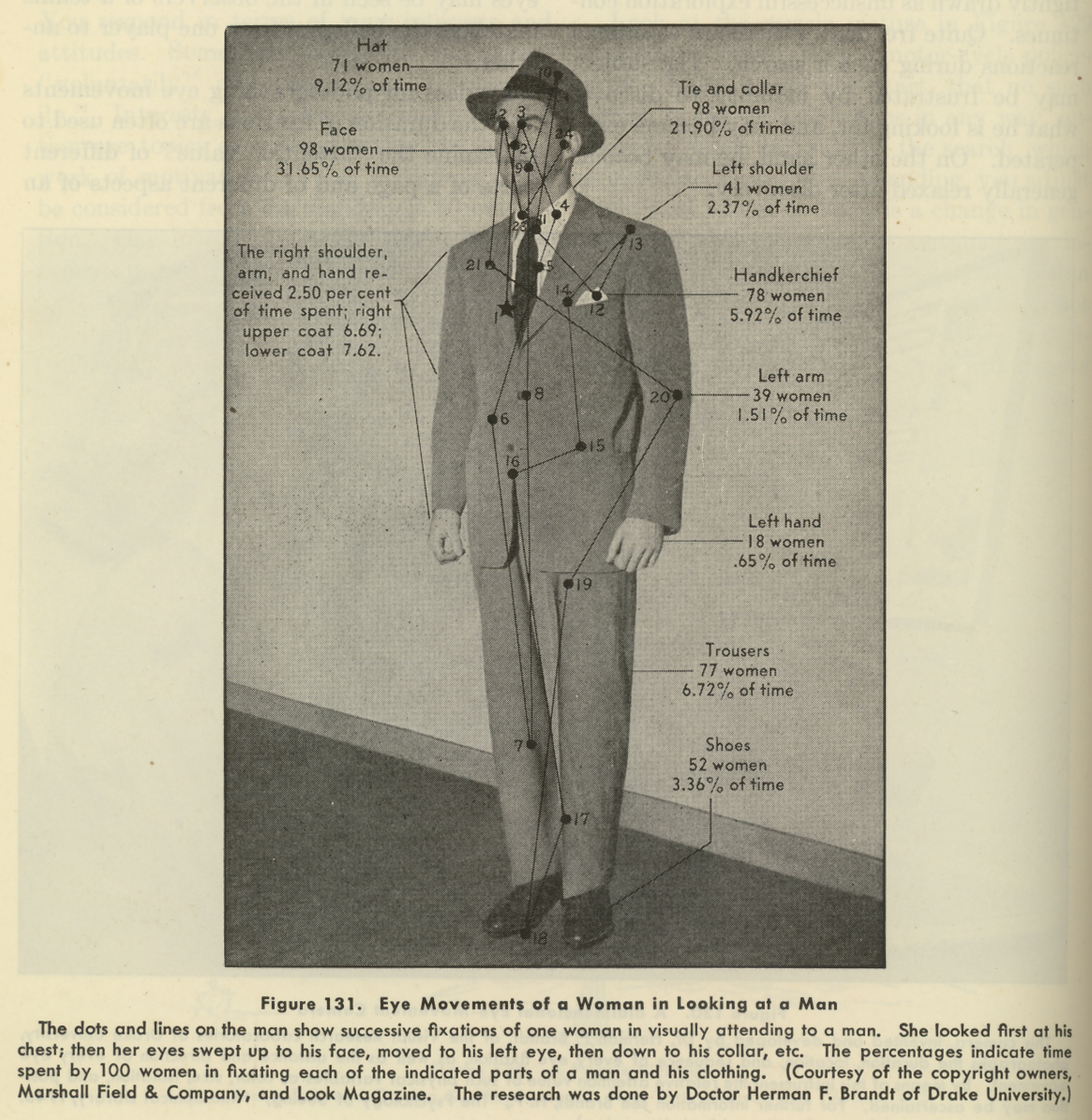
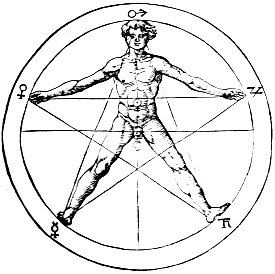
    The eye leads the brain, or the brain leads the eye, and from there, who knows where anything goes, especially when involved with a qualitative survey of a complex entity. This is more-or-less what we are dealing with here, in this image below, found on page 74 of a 1941 issue of Life magazine. (It is related in some way to an earlier post on this blog, a post called “The Center of Levity..”1 , though perhaps not really.)  It is hardly a map of the macrocosmos incised with Pythagorean precision on the body of man2, nor an astrological  or Kabalistic or Vitruvian perspective representation of humanity.  It is just a 1940’s  eye-trail map of where women looked at a man, a non-mathematical treatment of vague interest.

    Eye fixations

    It turns out that the seduction of a man’s body to a woman’s gaze–as difficult as that might seem from this photo–is fairly measurable, and was so even in the 1940’s, when the researcher Herman F. Brandt (Drake University, Iowa) produced this image.  And what it is, basically, is a map of where women looked when their eyes were tracked as they looked at this man.  Brandt had a long career investigating ocular fixation, and (I think) developed a camera that would track the reflection of beams of light on the corneas of his subjects, recording eye movement in horizontal and vertical planes, as they drank in this fine figure of manhood.  In any event his research was of interest to a wide variety of people, from neurologists to fashion designers–I’ve got no idea of how that interest was manifested, or if it turned out to be valuable information.  I do know that the Brandt work utilized by Marshall Field & Co. did produce a remarkable photograph open to all sorts of interpretation.   Visual stimulus point #19 was left uninterpreted and unmentioned, though the great majority of visual hits was above the waist, and above the neck.

    Notes:

    1. One of the images from the Center of Levity post:

    Mar 23 center of levity cvr det 2

    2. For example, this classic from Agrippa von Nettesheim, De Occulta Philosophia (1533):

    Agrippa


  • Christmas Gift Porn: Reagan, Santa, Cigarettes and (Lots) of Booze. Giving Ideas, 1954

    JF Ptak Science Books  Post 1135
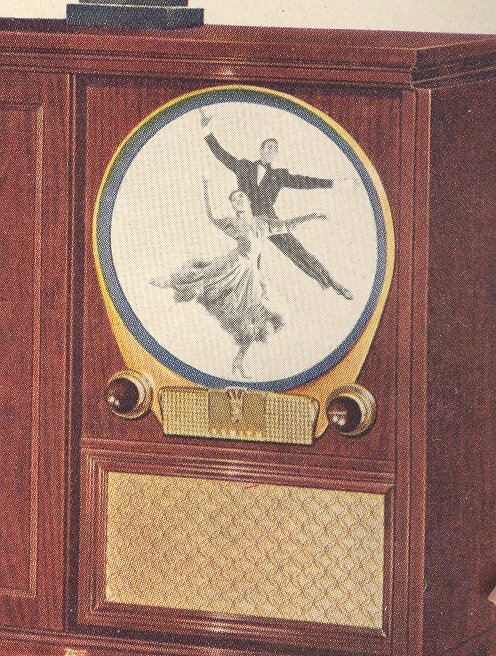
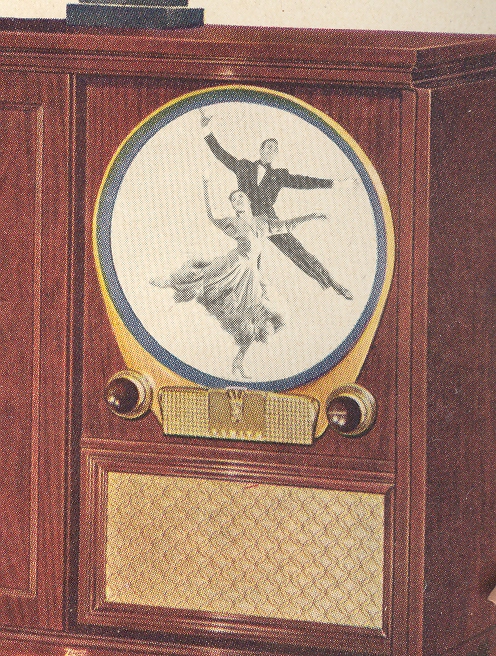
    Tv 1954 Some time ago I wrote a post here on the images displayed in tvs in television ads from the 1950’s as small windows into societal attractions and expectations.  My thinking was that the exploding television industry would try to lure buyers with the seductive promises of these pictures, that seeing them displayed would entice  people to buy the televisions so that they could see them at home.  Or perhaps not–perhaps they were only placeholders so that the screen wouldn’t be dark and blank, though I feel otherwise.  The selection of these images tells us a tiny bit of something about the working person’s dreams–I admit it’s a slippery slope and not a blunt diagnostic tool, but it is interesting.

    So too with Christmas advertising.  Looking for something else in a volume of LIFE magazine for 1954 (an article on workers using irradiated paint to apply highlights to glow-in-the-dark wristwatches) I was struck by the goods being advertised for Christmas gift-giving. Pro-phyl-Ac-Tic Brush Company was selling brushes, and Santa was pushing Playtex pillows and Hoover vacuums and irons and MEAT and waffle makers.         Christmas lited cig b370
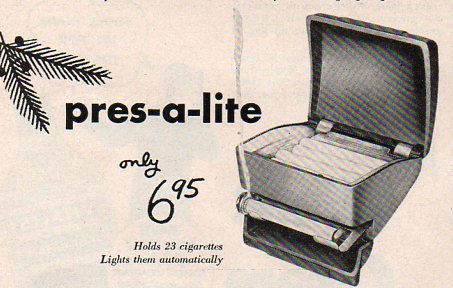
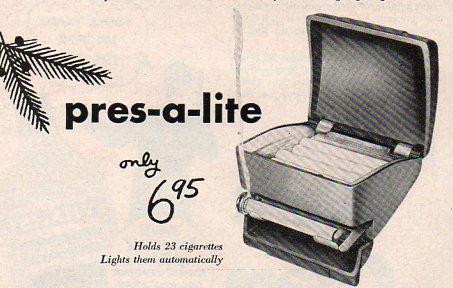
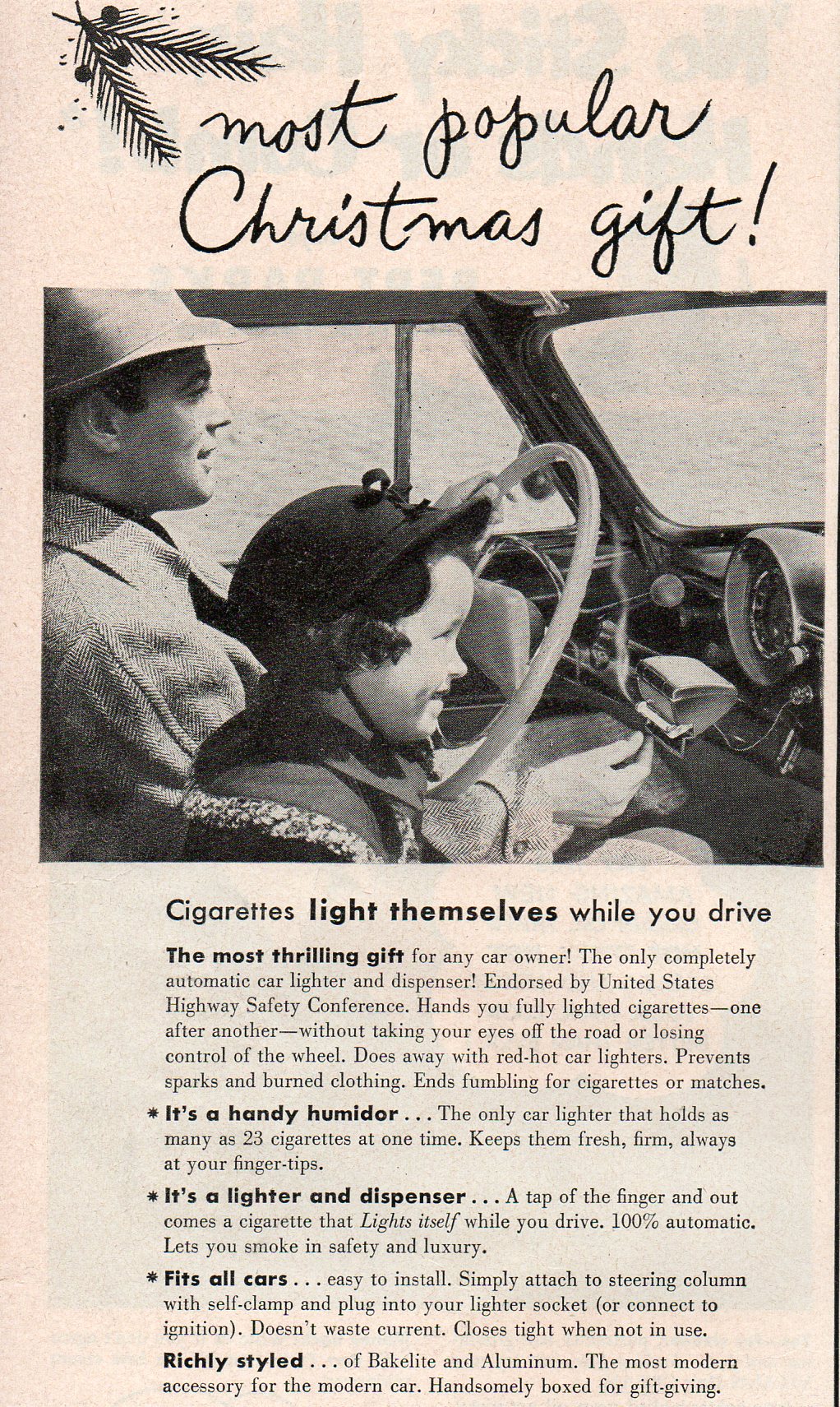
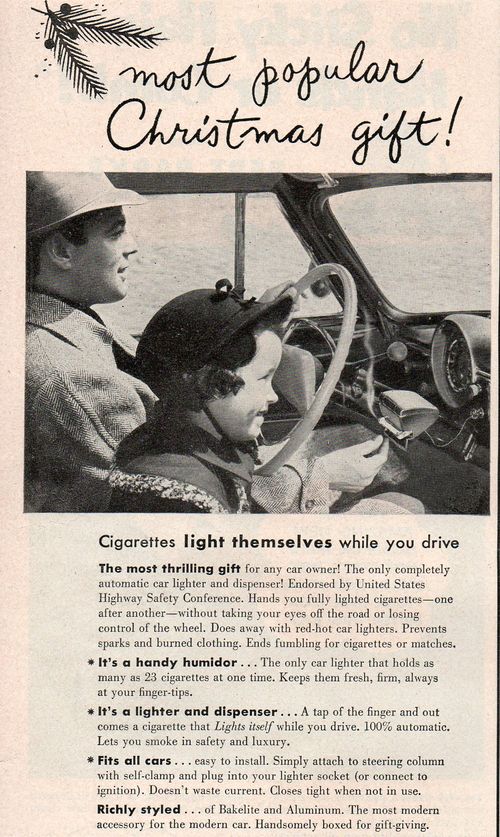
    And then there was the automatic lit-cigarette dispenser for the automobile.  Push a button–out rolls a burning ciggie.  The heated air and the rolled-up windows must’ve made for an extra-pleasurable experience for the girl sitting next to daddy.
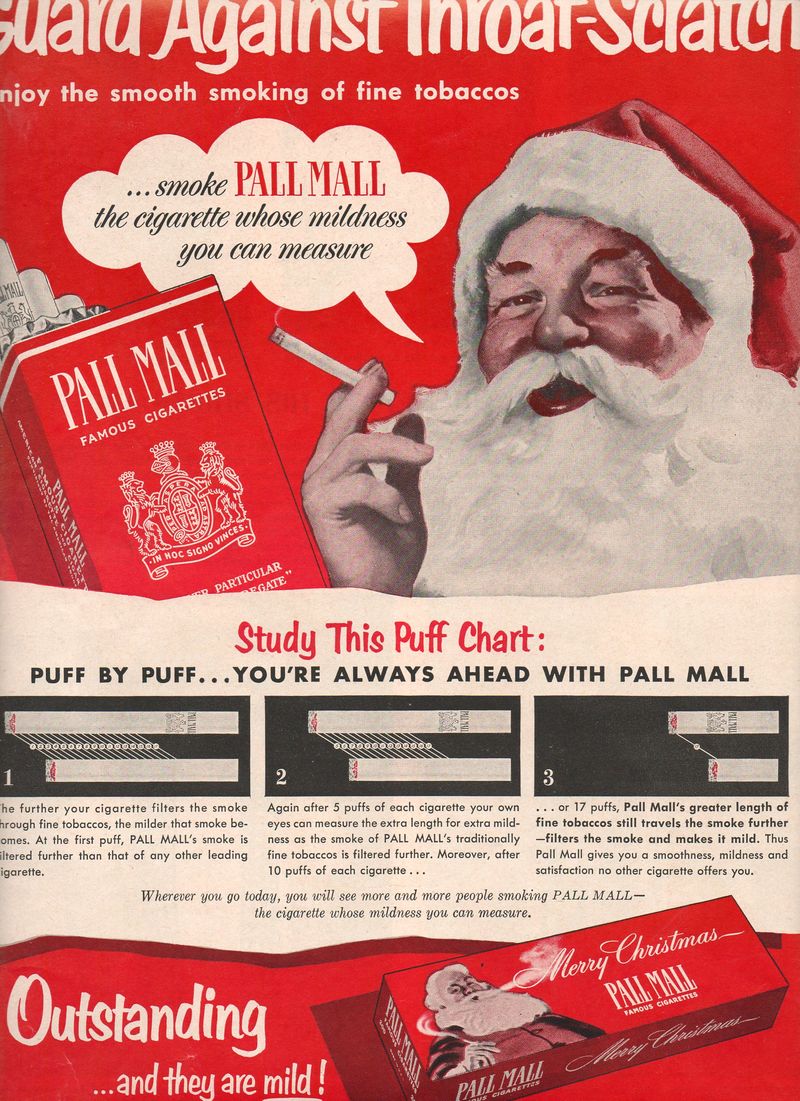
     

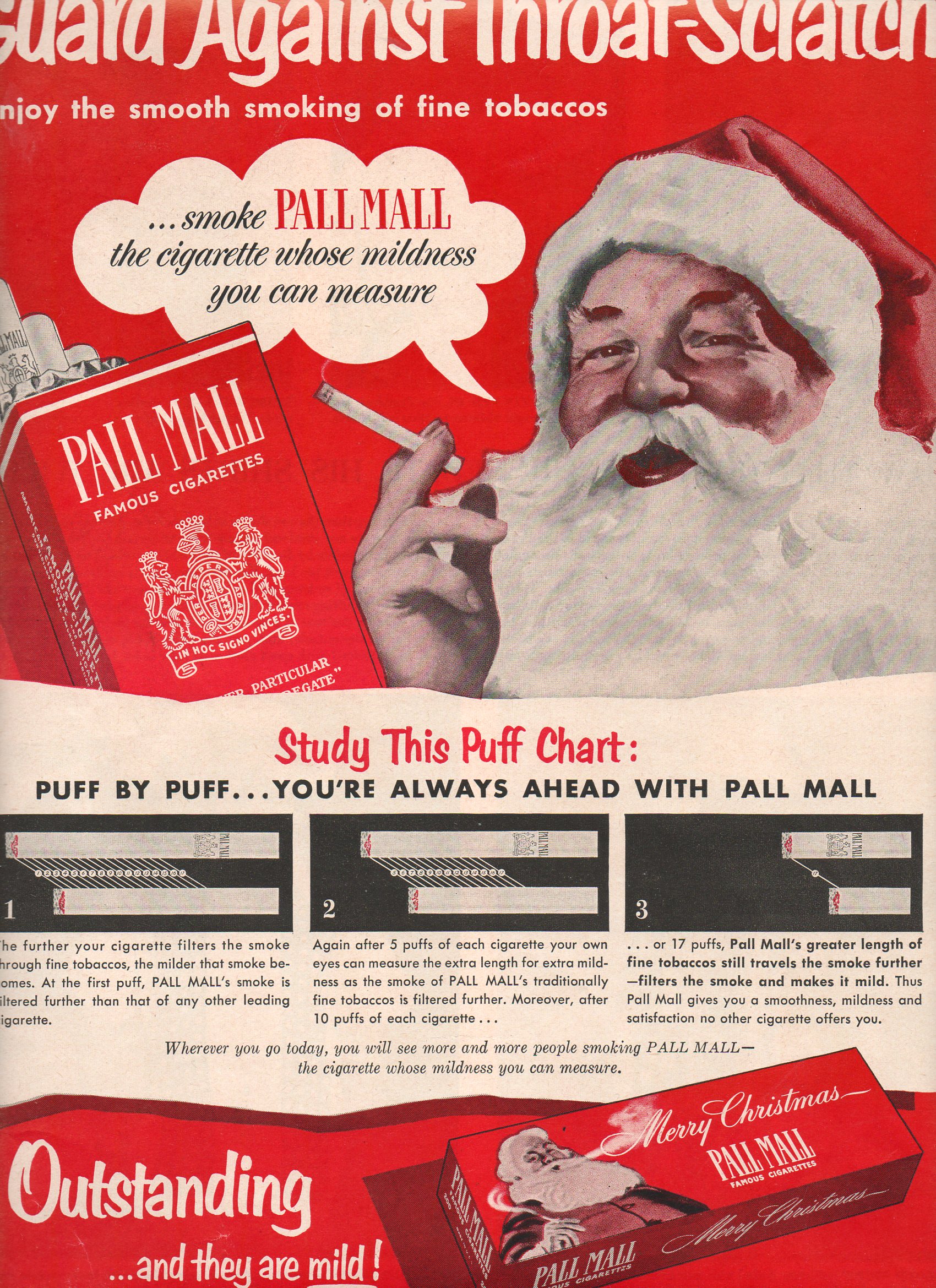
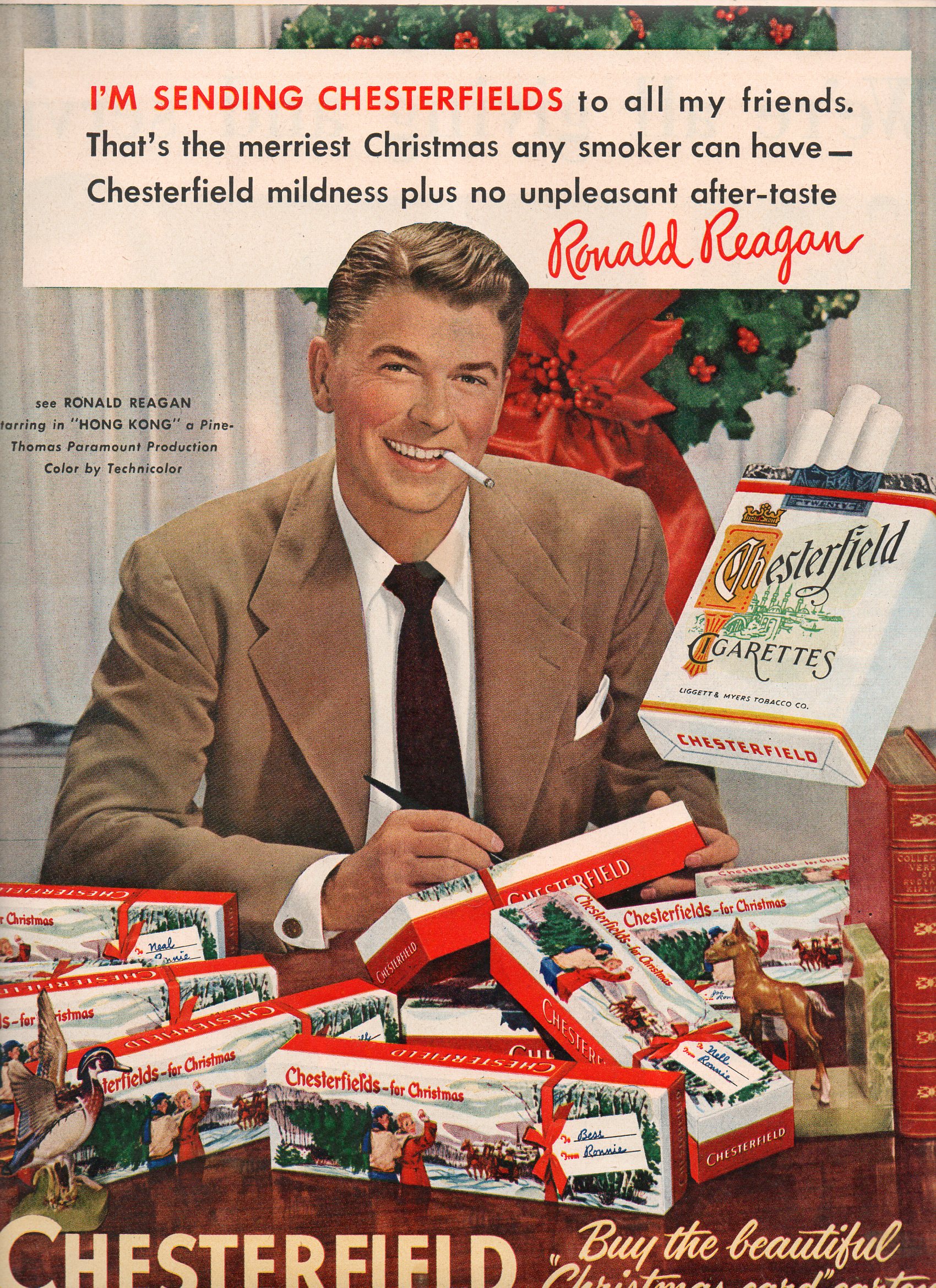
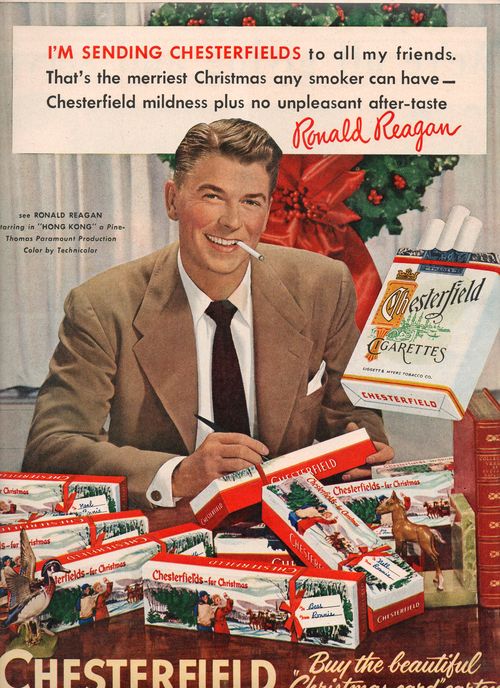
    Christmas Santa ciggies367 But it was the pictures of Santa selling cigarettes as Christmas gifts that got me–again (this story on the worst Christmas advertisements appeared earlier in this blog).  There were bunches of Santas selling smokes, including one de-bearded impostor selling Fatima cigarettes.  There were bunches of other folks, too, trading in on the smoking bit–they were excitedly opening wrapped/ribboned gifts of boxes of smokes, or hanging packs on the tree, or kissers kissing with boxes of newly-gifted smokes in their hands behind their lover’s neck.  And of course there was Ronald Reagan, who 26 years later would sell his flat forehead and broad grin to the American people as presidential lumber. (He seems to be writing on the carton in this picture.)
    Christmas RR366  

    And we’re not just talking Camels here.  In four issues of LIFE prior to Christmas 1954, the following cigarettes were advertised in full-page placements, looming suggestions for expressions of a “smokey” (which would later read “coughy/spitting/deady” for many of the buyers and receivers) love: Old Gold, Lucky Strikes, Fatima, Camel, Pall Mall and Chesterfields; also included were Robert Burns and White Owl cigars, plus Keywood pipes.  More often than not, each one of these products was featured in each of these four issues of LIFE. 

    Booze was featured very prominently as well, more so, really, than the cigs.  The ads included: Schlitz, Seagrams, Arrow Brady, Fleischman’s Gin, Haig and Haig, Old Forester, Paul Jones Whiskey, Sunny Brook Whiskey, Heublein Whisky, Seagrams Whiskey, Gilbey, Calvert, Medly, Black and White, Old Grand Dad, Pabst, Schenley, Four Roses, and Coronet.    

    LIFE was running about 175 pages per weekly issue at the time, so the full page ads for cigarettes and alcohol were actually eating up a bit of total display space per issue.

    What about the “regular” stuff?  There were surprisingly few toys, and so far as I can tell only two big ads for Schwinn bicycles. The 3/4-page/full page ads featured Whtiman Chocolates, toasters, light bulbs, cologne, televisions, Samsonite luggage, NUCOR oleomargarine, fountain pens, Zipo lighters, razors, meat, Van Heusen shirt, socks, lingerie, Green Giant peas, Coke, A & P coffee, refrigerators, pillows, Kodak cameras, cedar chests, washing machines, irons (“to show her you love her”), waffle irons, Hoover vacuums (“to show her you care”), and a couple of ads for Plymouths and Fords.

    So. Pretty utilitarian stuff, overall: buy mother chocolate, margarine, a lady razor, green peas, meat, coffee, pillows, lingerie, washing machine, and an iron; maybe a refrigerator if you had the extra cash, and an assortment of oils and perfumes for later on, when she was not working.  Dad gets cologne, a tv, fountain pens, a shirt, a tie, a high-beam spotlight for the Ford, simonize, some socks, and maybe a car for the family.  There was a two-page, double-page spread for kids’ toys, all o fit wrapped up in to display, showing 40 or so things from Santa, but in general the images for goods for children was very slim. Maybe everyone just knew to go to the toy store, or Macy’s toy department, or Gimbel’s, or Wanamaker’s. But at least for this year, in this magazine, the ads for children were very slim.

    Christmas Sunny Brook368What does all of this say?  Was there little money for working class fancies for Christmas in 1954?   I guess this all depends upon what you compare it to–slated against ads from the 1902’s, the selection looks pretty good; against the turn-of-the-century, better yet.  I’m not sure how early “Christmas advertising” gets,. But I have a feeling that it doesn’t precede Thomas Nast’s Santa by very much at all–seems to me that by 1954, real advertising for Christmas was only a couple of decades old; overall, it seems that advertising Christmas purchases is a definite 20th century invention.
    Christmas lited cig369
    That said, all of this looks like a nearly-null set compared to now, when seemingly everything and anything can be purchased at any time, especially around the Holiday season.  I wonder how this sort of consumerism can be maintained?  There’s always a fallout in super-saturated solutions, and it seems that we must be near that point.  Then again, the folks in 1954 might’ve been saying the same exact thing. 
     

    ·Posted by :

    ·in:

    —

  • Creating Bad-Hand Female Trouble, 1954–an Imaginary Reconstructed Filmstrip

    JF Ptak Science Books

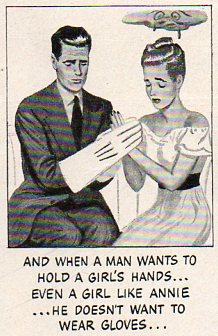
    Girl trouble 7360 Retroist excursions like this into the land of social propriety from not so long ago is a bittersweet thing–its concerns can remind of of how far away from something we seem to be, when in reality that distance in time and space just isn’t very far away at all; it is just slightly different,  renamed and repackaged.  For example, this advertisement from LIFE magazine for Trushay hand softener (1954) delivers pretty much the same message as most similar products today, except for the change in packaging and less obvious message.  The message may seem outdated but I think only in so far as the images and clumsiness of the delivery is concerned.  Products like this have increased by orders of magnitude, the target audiences age seems to have dropped considerably, and most of the time the pursuit of this 1954 end-result stays pretty much the  same. Exercises like this are peculiar, and can show us that the people who we are laughing at may very well be us. 

    The reconstructed ad is below.


  • Images from Our History of Women Series

    JF Ptak Science Books 

    I was looking for some of these images from this blog’s History of Women series and thought that I’d post them all to one page. Seeing them out of context is odd, but interesting.   Enjoy!


    File0505

    .
    000 women on a leash012
                                                   

    1 april 26 women king+queen 00--shooting strip tease042