A Daily History of Holes, Dots, Lines, Science, History, Math, Physics, Art, the Unintentional Absurd, Architecture, Maps, Data Visualization, Blank and Missing Things, and so on. |1.6 million words, 7500 images, 4.9 million hits| Press & appearances in The Times, Le Figaro, Mensa, The Economist, The Guardian, Discovery News, Slate, Le Monde, Sci American Blogs, Le Pont, and many other places… 5000+ total posts since 2008.

Category: Absurdist, Unintentional

  • Attacking Darwin’s Descent of Man in The London Times, 1871.

    JF Ptak Science Books   Post 1225

    “But with regard to the material world, we can at least go so far as this—we can perceive that events are brought about not by insulated interpositions of Divine power, exerted in each particular case, but by the establishment of general laws.” W. WHEWELL: Bridgewater Treatise.

    “To conclude, therefore, let no man out of a weak conceit of sobriety, or an ill-applied moderation, think or maintain, that a man can search too far or be too well studied in the book of God’s word, or in the book of God’s works; divinity or philosophy; but rather let men endeavour an endless progress or proficience in both..” BACON: Advancement of Learning.

    The quotes above stand alone, the first things that the readers see, sitting on the half-title page of  Charles Darwin’s On the Origin of Species (first published in 1859 in an almost-immediately sold out run of 1250 copies) an extraordinary, epochal book that was a lightning rod for reception both good and bad, heaven and hell, the Boschian hells of which were clearly not deserved, then or now.  (It is easier to understand a poorly-reviewd Origin in 1859 or through the 1860’s or even through the rest of the 19th century or even somehow through the early twentieth, but not afterwards.)

    Twelve years after the first edition of the Origin (and two years after the appearance of the Origin in its fifth edition) came his elegant and formibible The Descent of Man, and Selection in Relation to Sex

    The Times of London gave such an awful review of the book that a review of this review was published in the April edition of Nature [(Darwin),  Charles.  REVIEW of Review: The Descent of Man.  London:  Nature,  1871, volume 3, 20 April 1871].   It was Thomas Stebbing who wrote the response to The Times‘ incitful, hateful attack upon the Descent of Man. The Times saw Darwin’s work as an attack upon society,  accusing him of undermining authority and principles of morality, opening the way to “the most murderous revolutions”.  A “man incurs a grave responsibility when, with the authority of a well-earned reputation, he advances at such a time the disintegrating speculations of this book.” Stebbing’s review of the review is drippingly sarcastic, pointing out obvious errors in specific and the tone of the article in general in the defense of the book. Darwin’s “facile method of observing superficial resemblances” (says The Times) incites Stebbing to issue the following: “they may fancy that truth is worth discovering , even when it seems to involve some contradictions to our pride and some loss of comfort to our finer feelings…” (What a great line!) The article runs about 1000 words, and is a two-column, 1-page bit. [This issue of Nature may be purchased from our blog bookstore, here.]

    “No one ought to feel surprise at much remaining as yet unexplained in regard to the origin of species and varieties, if he makes due allowance for our profound ignorance in regard to the mutual relations of all the beings which live around us.” Darwin, leading the last paragraphs of the end of the introduction to the Origin, page 7.


  • Cyborgs and Robots, 1920’s: Man as Machine and Machine as Man.

    JF Ptak Science Books   Post 1217
    [Also see my post on producing the geometrical man “Durer’s Beautiful Monster”, here.]
    I’ve written earlier in this blog about the advent of robots and human machines, and I’d like to add these two images to that thread.    Both are male, which is not horribly surprising since the earliest creation of a female robot belongs to the fertile Fritz Lang, who used his creation in his extraordinary movie Metropolis in 1927.  (Male robot-like creations go back fairly deeply into the 19th century; so perhaps the creation of female robots was verbotten because of the possibilities for unacceptable sexual fantasies in the high- and post-Victorian world, struggling under the weight of many and multiply-applied public inhibitions. Perhaps it was because of the possibility of sexual relations with an inanimate object that was the cause for one-gendered robots, or perhaps it was a fear of a powerful, intelligent, unstoppable, superior creation that was also “womanly”.  I don’t know.)
    Robot human machine817

    [Both of these images are available from our blog bookstore.]
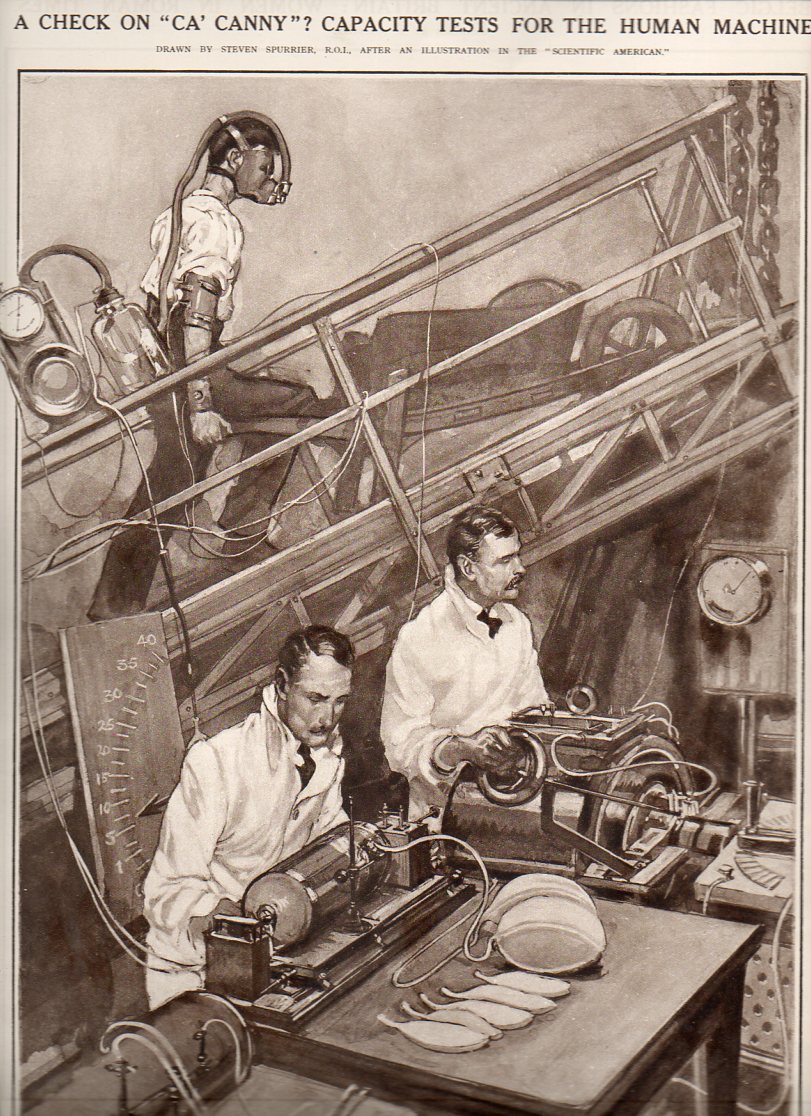
    The first is an image of the “human machine”, a cog-like adaptation of human workers in a Frederick Taylor-like The Principles of Scientific Management study, automatizing and industrializing people.  Though many people had written and worked around Taylor’s 1911 semi-revolutionary book (and not necessarily a good revolution, but one nevertheless), I’m not certain that I’ve seen the worker trussed up so before this, encumbered by so many technical testing elements as to make him look like a cyborg (though that term would still be a while coming into the vocabulary. 

    This image is actually testing a person’s energy expenditure while pushing a wheelbarrow on an incline, and utilizes the newly-created equipment of the French physiologist Langlois, which in 1921  may well have measured for the first time  the real-time changes in the rhythm of the heart and blood pressure, changes in body temperature and lung capacity of humans in an activity.  I have no doubt that the results would have been very interesting to cardiologists, and probably didn’t mean a thing to industrialists like Henry Ford, who would’ve plowed ahead with their demands on their workers regardless of what tests said, schedules being schedules and all. 

    Robot steam816

    (I’m no tsure where this experiment fits in, historically speaking, even within the context of biological advances for that very year.  Frederick Banting was able to do some pretty nasty stuff to dogs in a basement lab somewhere at the University of Toronto and come up with a successful treatment for diabetes mellitus–insulin, which would save the lives of millions and earn Banting a Nobel two years later.  In the quasi/fake biological arenas came two biggish events: Jung’s creation of the concepts of introvert and extrovert, and Hermann Rorschach’s one-way conversational device for detecting psycho-pathological conditions (in people).  I suspect that the Langlois data would fit in there somewhere along the rough edge of Jung and Rorschack, if only because the data was real.         

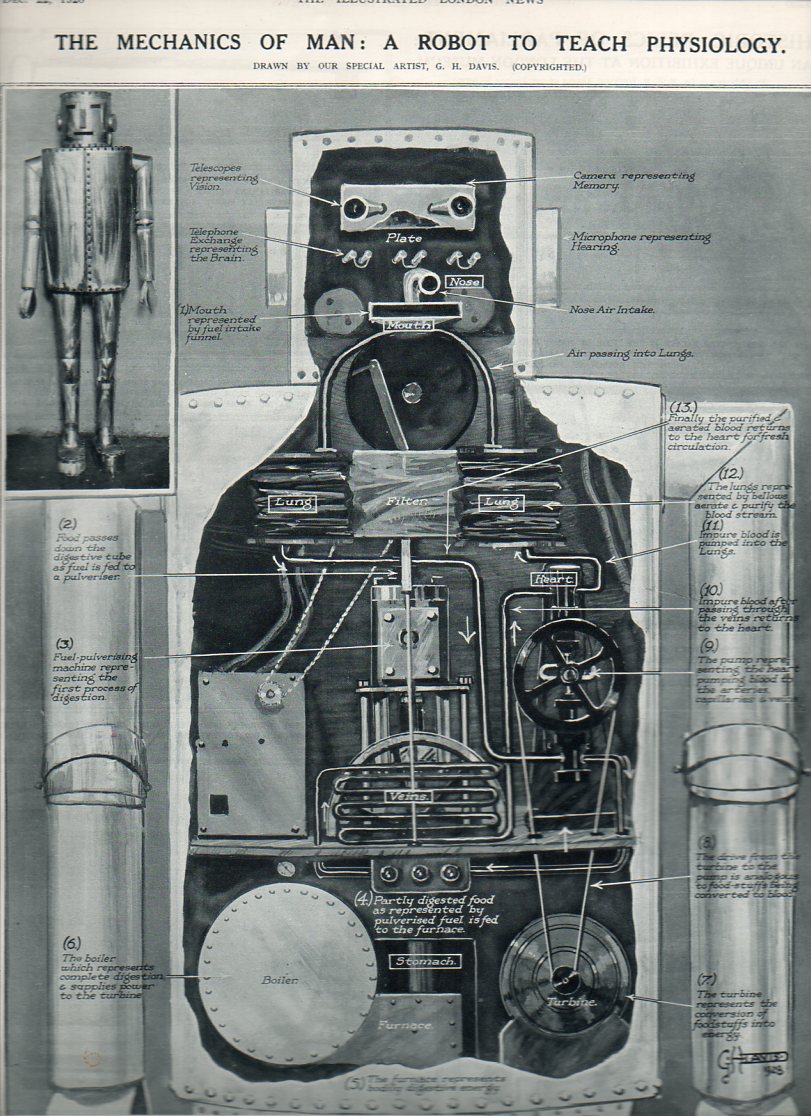
    The second image is in a way a reverse sequence of the preceding–an out-and-out robot that was being used to teach human physiology.  In this case, the robot was a steam engine, constructed for the Schoolboys’ Exhibition at the New Horticultural Hall for 1928, perhaps under the  influence of Karel Capek’s newly published drama R.U.R., which coined the term “robot”. The biological functions of humans were reinterpreted along a more user-friendly vocabulary of the steam engine, using pumps, boilers, hinges, belts, pulleys, filters, compressors and a furnace to explain the functions of respiration and circulation.   It was an interesting approach to show these functions on their most basic level–and in less than 75 years, many of these mechanically represented organs were actually replaceable by real mechanical units performing the same task as the biological (as in the heart), while others could be replaced (via transplant).

    Man as machine and machine as man.


  • Bad Ideas Department: Pool Vodka and Cigarette Wallpaper 1947-1953

    JF Ptak Science Books   Post 1153

    Things we dont need vodka swim464 I just can’t leave this week’s string of five posts on stuff that I found in Life magazine without adding a little to the Bad Ideas category.  Generally this is the place  to collect the really odd, little material that I stumble upon that is noteworthy but not necessarily a good  fit for a general, stand-alone post.  So comes this installment to Bad Ideas–Things We Don’t Need.

    For example I just couldn’t wrap any sort of integrating or creative bow around this image (left) to present it as anything more than what it is.

    I could think of almost no other thing that I’d rather drink after a swimming workout than a glass of vodka with no ice. 
    I mean, really–it gives me a headache to just think about popping out of a cold pool, a little out-of-breath, and grabbing four fingers of room-temperature Smirnoff. I get that it is a “dry” juxtaposition, but all this looks like to me is a man with a pretty big problem.

    Things we dont need underwear dog463

    And then the next picture–there’s simply  no good need to be posing in your underwear with a small boy in his underwear while grooming a French poodle.  There’s just no conceivable need to do it, period, especially with such oddly satisfied smiles.

    And then  there’s this ad that is utterly demeaning to almost everyone–a wall of Old Gold unfiltered ciggies that are about life-sized with a vague suggestion that you smoke them for fun rather than some sort of medical benefit (?)  With a little editing you could construct a wallpaper out of this photo–and I mean a wallpaper for a room rather than a computer, a wallpaper composed of cigarette butt ends..  Just for the record, I figure that a 1.5 pack a day smoker would smoke the equivalent of this image spread over the four walls of an average-size bedroom in about four years.  Its conceivable that you could paper a decent-sized house with the wallpapered equivalent of every cigarette smoked by the smoker in a lifetime, or for as long as the cancer could be tricked to stay away.

    And so this is the beginning of this category–I hope it will be entertaining.

    Things we dont need cigs462

    ·Posted by :

    ·in:

    —

  • Mr. Mole, the Stationary Busby Berkeley of Mass Crowd Installation Photographs, 1918

    JF Ptak Science Books Post 1185

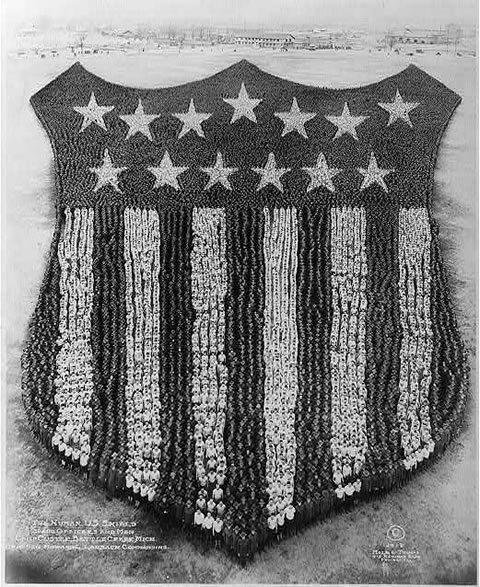
    I’ve long enjoyed these massively organized, captured moments of time and effort–large caliber photos of concentrated efforts of tens of thousands of people, all of their motion and utility directed to produce this one moment in time.  Perhaps the greatest practioner of this artform was Arthur S. Mole (1889-1983), the stationary Busby Berkeley of Big Organized Crowd Efforts (BOCE).  (He led an interesting life, coming from Scotland with his family to be part of a Utopian community led by John Alexander Dowie–a faith healing visionary, self-reported precursor to the second coming of Christ, and leader of the Christian Catholic Apostolic Church–at City Zion, Illinois. Dowie was a problematic man not without good and interesting qualities, though his to-the-death prayer duel with a rival visionary is an interesting story to be left for another time.)

    I’ve always enjoyed this photograph  in particular–it was made from a 70′-tall platform with a 11×14″ view camera using a wide angle and a deep oblique angle, along with 30,000 soldiers from Camp Custer, Michigan.   It was made in 1918 by Mole, along with the evident and very capable choreography of John D. Thomas, who was the Doctor of Persepctive and Motion for the pictures.

    [Note: most of the images below are extremely clickable/zoomable.]

    Arthur-mole-human-us-shield

    Most of the soldiers are used to make the field at the top of the stripes–so near as I can tell (from the resolution image that I had to work with), there are about 300 men in each stripe (except for the outer two), meaning that there between 3,000 to 5,000 in the collected stripes, which puts something like 25,000 troops in the stars and their field. The middle stripe I reckon to be 150′ long; my guesstimate for the star field is 600′ deep and 1250′ wide, making a triangular collection of men 750’x1250′. That takes a little bit of planning to accomplish to ensure that everything is kept in perspective, and which also means that a lot more folks are needed at the top of the constructed image than at the bottom.

    Another excellent example is this photo made of the U.S. Marine Corps emblem using 6,000 marines at Paris Island in 1920.

    http://redtreetimes.files.wordpress.com/2010/05/arthur-mole.jpg


  • Making Tubes of out Holes–the History of Holes, Extended

    JF Ptak Science Books  Post 1184  [Part of this blog’s History of Holes series.]

    Taking inspiration from Edwin Abbott’s Flatland1 (a superb book  excursion into perception and difficult envisioning in which a two-dimensional world tries to comprehend three-dimensional objects) I’ve decided to extend my History of Holes section with their extruded, cylinderized extension cousin–the tube.  After all, If you take a hole by its edges, shack it out, rough it up, reposition and throw some sides on it you wind up pretty much with a tube, which could be seen as elongated holes with (generally) defined beginings and endings. Sometimes.  This is a natural continuation of my series on dots, which can be regarded as holes, or points, and thus into tubes.  “Spots” on the other hand really doesn’t work into the dot/hole thing, as spots can be irregularly-shaped, and I like the dots/holes to be more rounded than the potentially jagged spot, or blotch.

    When you start thinking of tubes, though, they turn up everyhwere: from gigantic cannon, to impossible flying machines, to telescopes, pneumatic railways and delivery systems, test tubes, subways, pressurized health restorers, television screens, and so on.

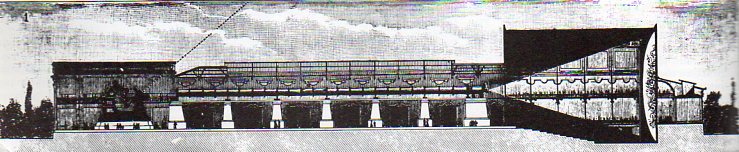
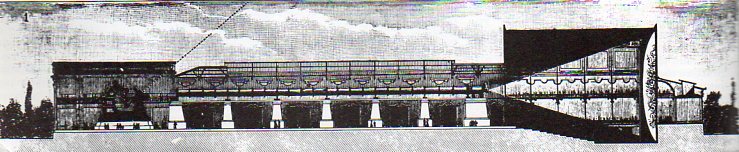
    I’m not sure where this idea came from–perhaps in the post on massive tubeless telescopes (here), reminding me of the most massive tubed telescope, the longest telescope with a tube, belonging to James Bradley, who produced a monster over 200′ long. Connecting the tubeless and tubed telescopes was the image that I had in mind; the hole following naturally from that. Anyway the Bradley  tubed construction–antithetical to the DNA/carbon/membrane nanotubes–were enormous for their time, and as moveable tubes are still very impressive.  Another massive telescope was constructed on speculation for the Paris Exposition of 1900 {the cross section of which is depicted below)–it was 187′ long, spectacularly made and exhiited, and could find not a single buyer.  Positioning the scope of course would’ve been very problemtaic. 
    Tube 1500 ft telescope621
    There are other, more massive and mobile tubes, like, say the smokestacks of the Titanic (which were 24×19 feet, with a fall of 150′ from the top of the smokestack’s sweep to the boilers)–these weren’t mobile in and of themselves, but they did move, if only for a short time (laterally), and then for a very short and cold time (vertically).

    http://www.titanic-titanic.com/pic/funnel_bogie.gif

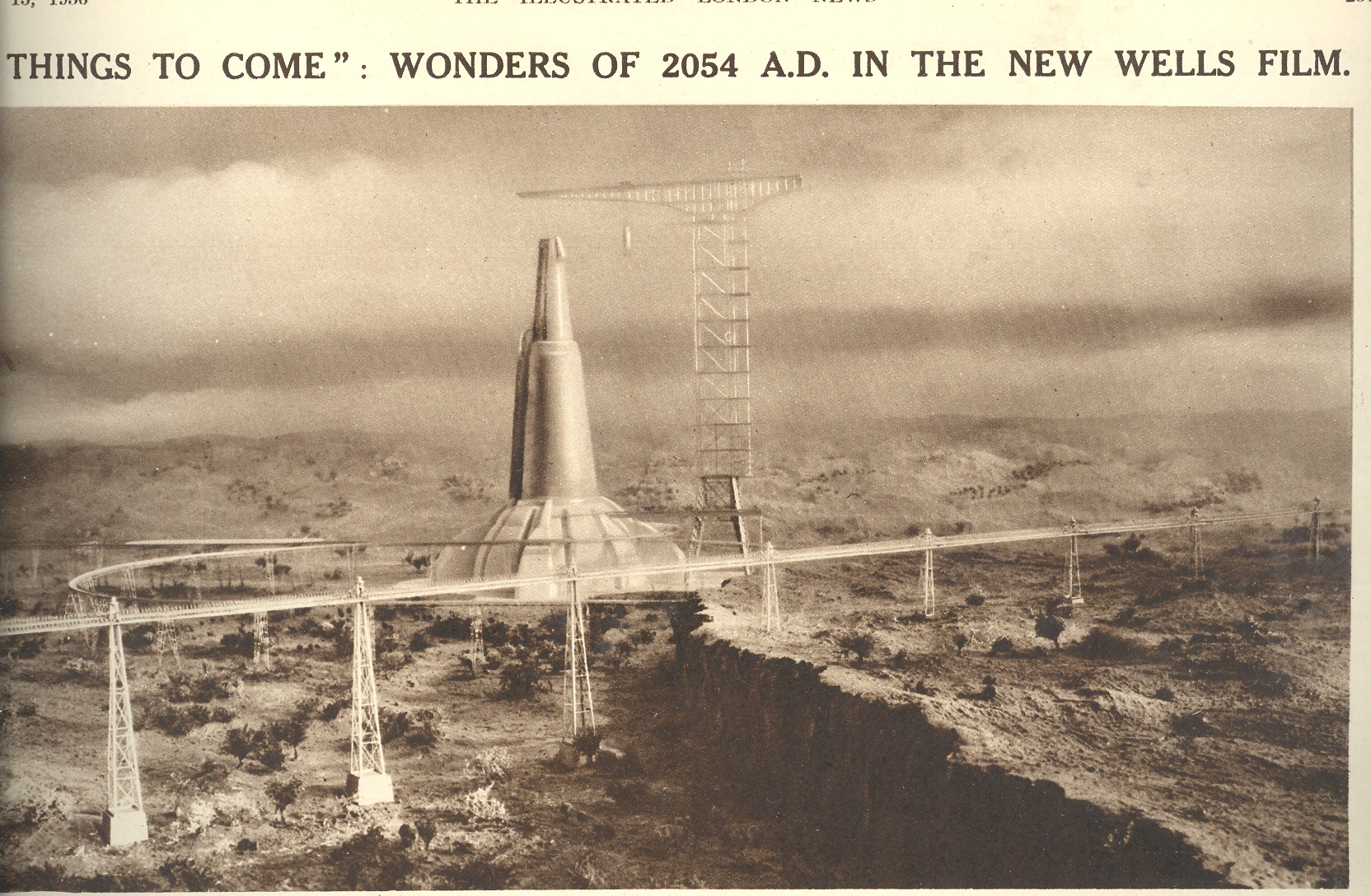
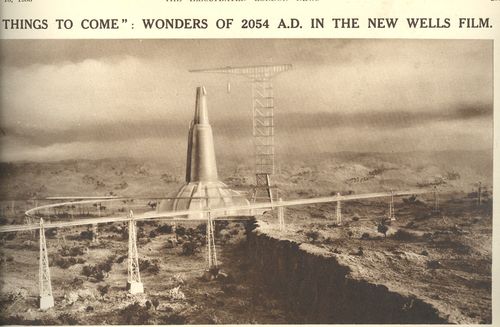
    Massive, monster canons have existed for many years in idealized and theoretical, speculative worlds, like Tom Swift and his Monster Canon.  In the history of early imaginary big gun tubes H.G. Wells’ Babel-like cannon (pictured below in a still from the movie Things to Come (1936), an adaptation his The Shape of Tings to Come (1931)) is fabulous–1500 feet tall, with I figure a  750′ base, it launched a 75′ tall capsule beyond the Earth’s
    Blog jan 6 wells

    gravitational pull with a spectacular explosiveness that would’ve made its occupants into instant jelly.  (Paul Drye points out that one of the biggest sci-fi guns comes to us via Arthur C. Clarke, who had his Lunar inhabitants fashion a gun by drilling into the Moon’s surface until they reached a depth where it would tap and “shoot” molten rock at attacking space ships.  This is more of a hole than a tube, and as such probably ranks it as the biggest hole gun ever constructed, even in science fiction. In the same veinish vein is Robert Heinlein’s railguns, seen in The Moon is a Harsh Mistress.  It has been suggested that E.E. Smith may have concocted gravitational weapons enabling planets and entire galaxies as wepaons, but I’m not sure about this, and they’re definitely not tubes.)

    Just to round out the Solar System cannonry a bit, here’s an example of a gigantic tube coming from the fabulous Frank R. Paul for Stanley D. Bell’s “Martian Guns” found in the January 1932 issue of Wonder Stories.  There’s really no way to determine how big the gun is except to say that it is probably “big”–there’s just nothing to place the thing in perspective, as the figures in the foreground, being Martian, don’t have a specific height.  They could be 6′ tall, or 60′–perhaps they’re only 1/10 of an inch tale, and the projectile they’re firing to the earth is so devastatingly powerful that size doesn’t matter.

    Strange things in sky--martian guns

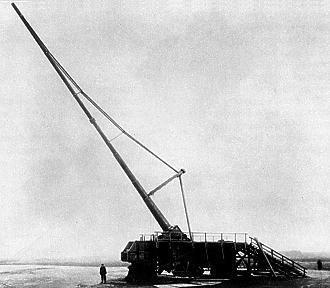
       Back here on Earth and in the real world,  the Kaiser Wilhelm gun (or “Paris Gun”, the Kaiser Wilhelm Geshutz) was
    http://farm4.static.flickr.com/3169/2951816593_c2d2e5c875_o.jpg


    a long-barreled, light shelled monster: its 92′ long barrel (plus a 20′ extension) launched a 94kg shell about 130 km, reaching a maximum height of 40km (about 25 miles) high. For all of its mass (the gun weighed 256 tons without the railway cars) the shell that it fired didn’t weight much at all….though the shell did reach an extreme height. (Ironically, the gun was built for attacking the deepest of the deep bunkers of the fortresses along the Maginot Line; it was never needed for that, as the Maginot Line was simply left behind in the Nazi assault on France.)  The British Ordnance BL 18 inch howitzer (below) was developedjust as WWI was enidng, but did not enter service until nearly two years after the war ended.

    File:BL 18 inch Howitzer Ashbury Station WWII.jpg

    The Schwerer Gustav was a 1350 ton beast which fired a 14,000 pound shell (!) about 20 miles. A  little later came the Nazi V-3 (the lesser known of the V-weapons), the Vergeltungsewaffe 3, a 130 metre (!) long, 150mm gun built alongthe side of a hill, launching a 140 kg shell. The Iraqi Big Babylon gun was sort of like this one, though never built–it was to have a 500′ barrel and would be supported by a hillside. Then there was the Nuclear Tube: the Atomic Annie (M65) cannon, which was another bruiser, being an enormous 85′ cannon that delivered the worst punch of all cannons, a nuclear warhead.  The weapon was test-fired in 1953 at Frenchman Flat at the Nevada Test Site and delivered a 15kt explosive device to a target seven miles away. There were 20 of these made, but given their diffiult-to-deploy-and-keep-secret status, and the nature of the shells, and the development of more sophisticated weapons, the M65 was obsolete almost as qickly as it was introduced, but was removed from the frontline only in 1963. 

    VWM240mmAtomicAnnie01.jpg

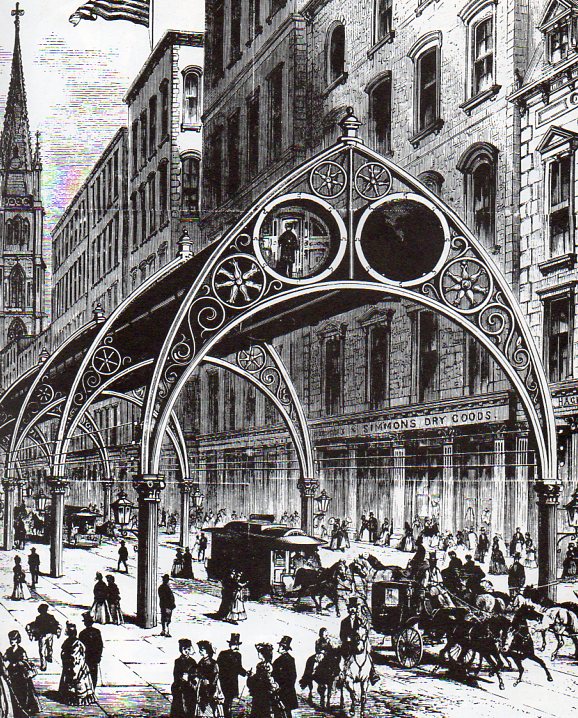
    I guess what people think of first though in regard to tubes in “The Tube” in London, though a more tubey tube was presented here in the pages of the Scientific American for the NewYork City subway:
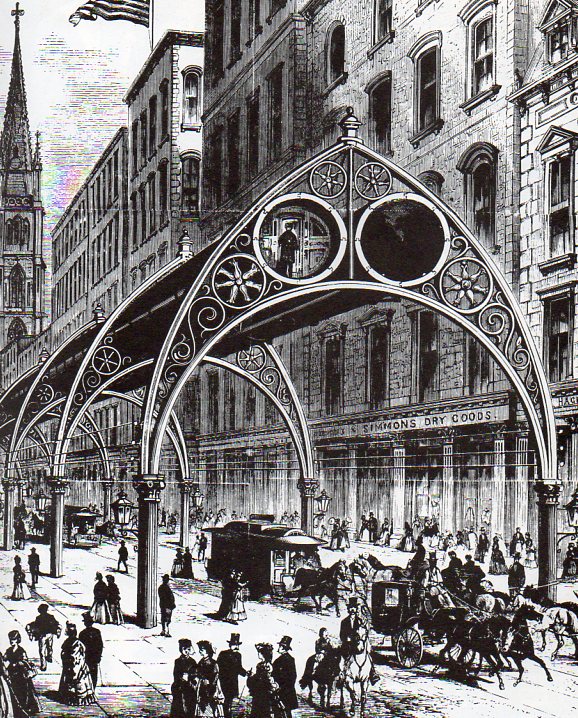
    Tube nyc623

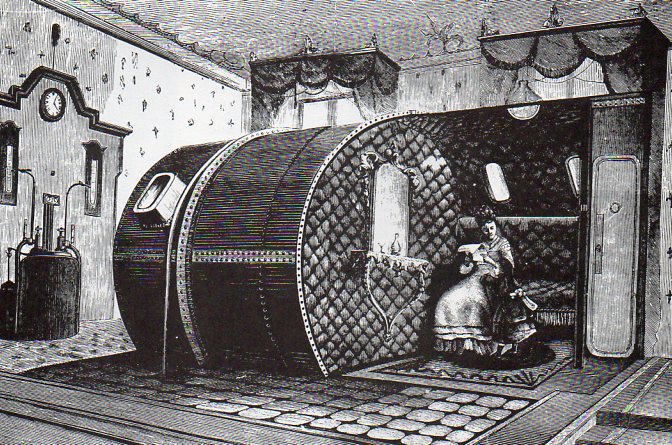
    Here’s yet another strange tube, this a tube-within-a-rectangle, an aerotheraphy device that was supposed to cure people of whatever they needed curing for, just like any other good quack device, though this may well have been the heaviest of them all.  Cushioned, well-appointed, and with a hint of luxury, this burst of fresh air was inteneded to render diseases and other complaints harmless–only for a lot more money than electro-shock or beer cures or massive purgatives or bleedings or copper amulets or whatever else you can come up with.  It does make a nice image, though:
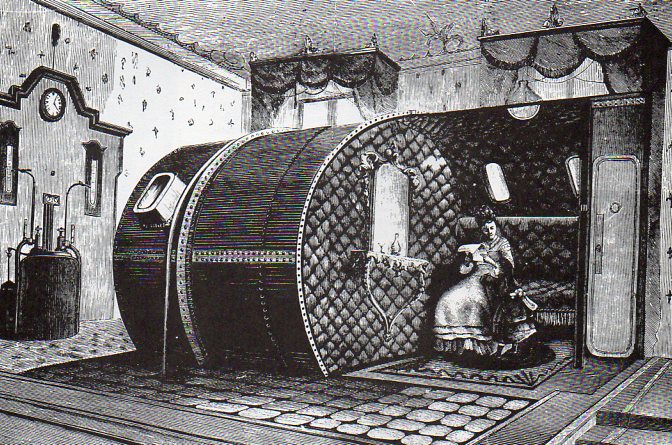
    Tube aerotherapy625

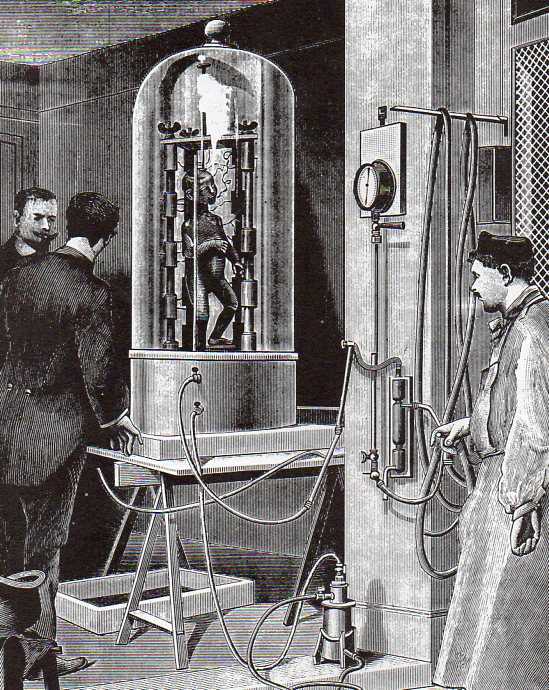
    The tube below may well have been the largest glass tube to hold the body of a dead person–and in this case, a dead child.  It was design for a practice that was evidently not practiced–electroplating the dead.  Someone thought it might make a good practice to deposit a one millimeter coating of copper on the skin of a cadaver, and published their success (and image) in the Scientific American for November, 1891.  The practice didn’t catch on.
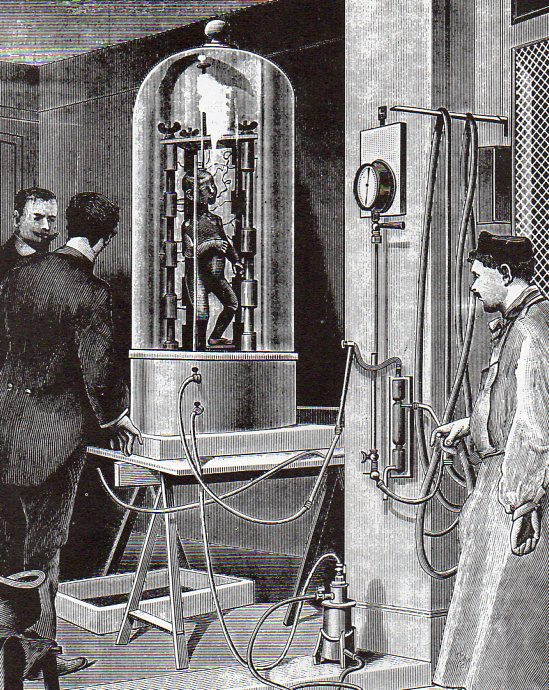
    Tube test tube dead622

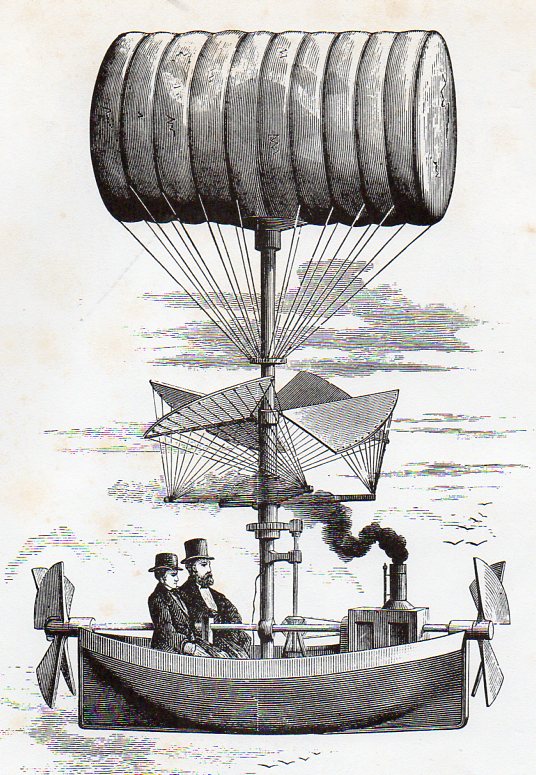
    Then of course there are submerged and flying tubes; submarines have certainly become a long-established part of the technological landscape, and the flying tubes, not. 
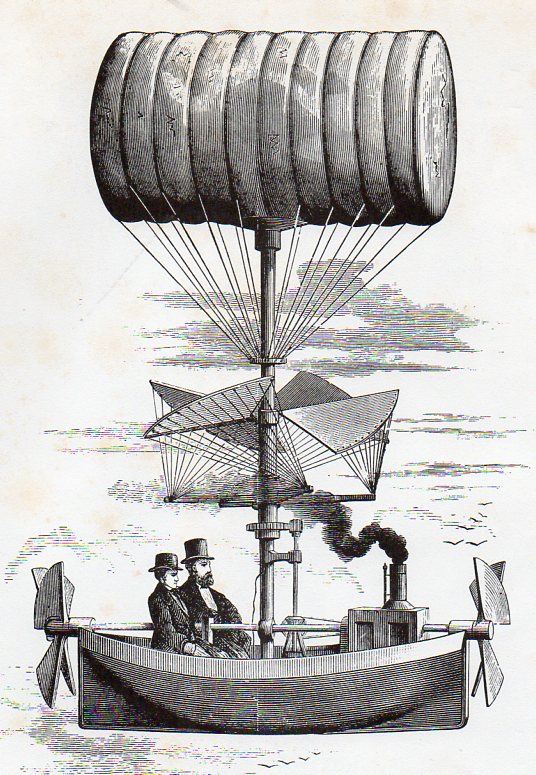
    Tube  flying620
    Still, the steam-driven helium-filled flying tube boat looks dignified and lovely, if impracticable.

    There were proposals in the late 19th and early 20th centuries for pneumatic railroads and pneumatic people movers (in one case in the 1930’s, for a plan to move individuals from New York to Philadelphia in chair-like objects in one of these tubes), but for all intents and purposes the closest that these plans came to fulfillment were pneumatic operations like thoe found in R.H. Macy in New York.  It was in the massive department store where you could find miles of pneumatic vacuum tubing that connected department tellers to a main counting office, where little cylinders were filled with cash and receipts and sent along for accounting.  The logical outocme of Macy’s tubular world for Terry Gilliam was seen in the director’s masterpiece dystopic flic, Brazil, where we see a world crowded with gargantuan and suffocating nothinness, filled with bazillions of miles of ductwork whose purpose is a mystery, making for a cold and disturbed world. 

    Brazil screen capture

    End part I of Making Tubes of out Holes–the History of Holes, Extended.

    Notes
    l. Edwin Abbott’s slender Flatland is perhaps one of the best books ever written on perception and dimensions, a beautifully insightful book that was quick and sharp, and in spite of all that was also a best-seller.  Written in 1884 when Abbott was 46 (Abbott would live another 46 years and enjoy the book’s popular reception), it introduces the reader to a two dimensional world with a social structure in which the more sides of your object equals power and esteem.  Thus the lowest class would be a triangle (three sides) while the highest (priestly) class would be mega-polygons whose shape would approach a circle.  Abbott’s magistry comes in explaining to the three-dimensional reader what it was like to be in a two-dimensional world.

  • Young Communists: Service with a Smile, ca. 1922

    JF Ptak Science Books   Post 1179

    This dapper young man with the sharply snapped salute is a communist, and as he tells you, he’s at your service.  But the Young Communist League (of the United States) in the 1920’s–when this pamphlet was printed–was a semi-underground organization with few members who wanted to serve you and which was also “devoted to the interests of all young people and is dedicated to the revolutionary cause of the working class of our country, the transformation of the United States through mass democratic struggle into a socialist society”. 

    Young communists583

    So the YCL service venture may have been more helpful to someone with Communism in mind than anything else.  It did have a diffident bit of patriotism in the design of the pamphlet’s covers, but they wanted a United States that wasn’t the United States that very many other people wanted.

    Perhaps the October Revolution wasn’t what the people of Russia wanted, either. They certainly wanted their freedom from Tsarist rule, but the revolution orchestrated in the name of freedom was hardly that. Significant American thinkers and writers on the plight of the people in Russia at the end of the 19th century–including George Kennan, author of the still very readable and absorbing Siberia and the Exile System (1891)–pretty much jumped off of the bandwagon by WWI.  I can understand a haphazard interest in the Communist Party and the idea of socialism in the United States in the 1920’s and even the support of the still relatively new Soviet Union, but this was a period in which the member in the cascade of three-letter acronyms of Communist political affiliates and parties had a weak draw.  Interest in them picked up in the United States in the 1930’s, though this was also the period during which the atrocities of the monster Stalin were being discussed.  I’m not sure why this popularity grew in the light of these revelations–I just don’t know the history.  (Even though this was supposed to be Stalin’s quote but wasn’t, it fits quite well: “death of one man is a tragedy, death of a million is a statistic”–as a murderer of millions of people, he was very well versed in statistics of genocidal sadism.) 

    In any event, I simply liked the public face that the YCL engraved for themselves–it looks much like any other face you’d see in any other magazine hawking coats or cigarettes or Dunlop tires.  A face like any other. 
    ______
    Notes
    Kennan wrote in 1923: “The Russian leopard has not changed its spots… The new Bolshevik constitution … leaves all power just where it has been for the last five years–in the hands of a small group of self-appointed bureaucrats which the people can neither remove nor control.”


  • Science Noir and Steampunk–the Magic Lantern and Major Kong

    JF Ptak Science Books   Post 1177

    I wonder if there is any such thing as Science Noir? There is certainly science fiction noir, and Cyber Noir and associated reaches, but, well, what about a purely Science Noir?  Scary, off-center, distracted, chilling, nightmarish science?  I’m not so sure if this is even a real question, but when I think about arguments made for the cultural and supposed artistic impacts in the creation and direction of some aspects of scientific development, I wonder if it makes any sense at all to think of science in terms of the noirish aspects of culture.

    Emma Alvarez Gibson made the suggestion to me that Science Noir might be a version of Steampunk, and she may well be correct, although the frightening aspects of vast machinery shrouded in noise and smoke and shadow–the very definers of Steampunk and massive Victorian-era machinery–may be itself one version Science Noir.

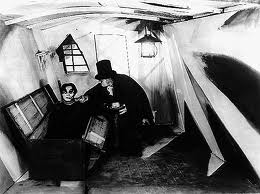
    But what comes first to mind of course is film noir, the edgy use of cinema that came about during the late stages of the Expressionist movement and the early stages of motions pictures.  Expressionism comes just after the first real influx of motion pictures, around 1910 or so, and it seems a little surprising to me that such a huge developmental leap was taken in film so quickly after the first initial mass public success of the film industry.  Perhaps it is incredible that a movie such as The Cabinet of Dr. Calgari–seen as the first adventure into Film Noir and an enormous leap of creativity in film–came so quickly: after all, the first NYT film review appears in 1909, the first movie magazine (Photoplay) appears in 1912, the first animated cartoon (the great Windsor McKay’s Gertie the Dinosaur) in 1914, the same year as the first appearance of the Little tramp.  And then five short years later, almost a decade into the Expressionist movement, comes the Cabinet.         

    Science noir--caligari
    Film Noir was a new experience in motion pictures–it tested reality, coming to the audience in a shadow, fractured, sharp angled crossed line existence, dark, potentially unreal, teasingly chaotic, establishing a waking nightmare.  The mood was questioning, the atmosphere sharp and highly contrasted. It was scary–especially in the case of the deeply creepy Dr. Caligari the deeply disturbing sets continuing to stay as existence in the film even after it is revealed that everything that had happened previously was a dream…except that the dream’s landscape was not relieved. 

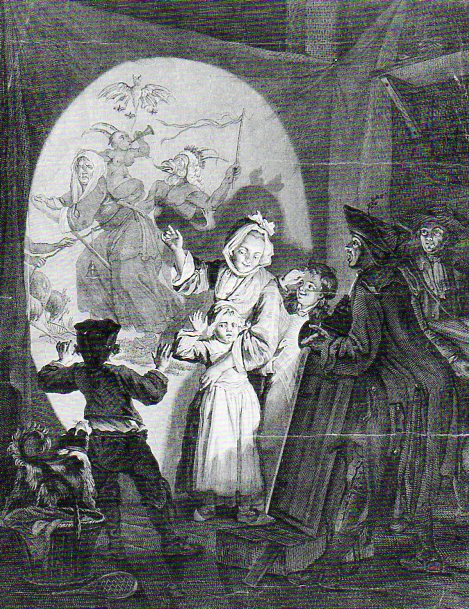
    Perhaps the earliest brush of Film Noir was Science Noir.  The earliest removed images in real time that were seen moving eerily across the probable clay/adobe walls of a camera obscura must have seen fantastic to the first observers.  The earliest projected images from the magic lantern–seen here in the engraving La Lanterne Magique by Jean Orvrier and published around 1770–included many frightening portrayals of witches and demons in addition to their general stable of scientific, technical, literary and travel images. I am quite sure that the earliest viewers of these scenes must have felt as though they were witnessing something extra-ordinary, something beyond simple optical amusements shown on white cloth, something more real than not–particularly since it seems that many people were exposed to these images by traveling magic lantern itinerants more so than scientific lectures. The images of spectres and demons may well have felt to be the things themselves.

      Science noir--magic lantern565

    Perhaps the magic lantern is the first bit of Science Noir, the Steampunk without the steam.  And metal. The noirsh aspects of this science was in projected light and the imagination, leaving the worst effects of the  visual aspects of this fear to the imagination. 

    But I think that Ms. Gibson is correct, and that the most vivid aspects of Science Noir are left to Steampunk, the threat of metallic enormities of power and noise simply overwhelming the viewer.  I suspect though the  greatest science noir of the 20th century would best be seen through the eyes of Stanley Kubrick’s Dr. Strangelove, a masterpiece of black humor layered in incredibly stark, high-contrast black and white scenes, the threat of entire annihilation made to feel somehow ridiculous, humorous and possible, the viewer laughing  as Major Kong rides the nuclear weapon “Hi There” all the way down in Nukepunk cowboy glory through five minutes of an insistent “When Johnny Comes Marching Home” soundtrack. And then, suddenly, the silent, brilliant flash, and the laughing stops, and there’s nothing left but cold heat. 

    I guess that’s my first take on the vision of modern Science Noir. 

    (The except below from Dr. Strangelove is longish, about five minutes,  but it is well worth the buildup.)


    _
    Notes
    The oldest extant magic lantern-like machine comes to us from Christian Huygens from about 1656.  Huygens is a scientist of enormous energy and capacity and genius, and more often forgotten than not nowadays, at least in popular culture


  • Thinking Deep about St. Paul’s and the Eiffel Tower–Presenting the Depths of the Oceans in Plaster and Steel,1910

    JF Ptak Science Books   Post 1173

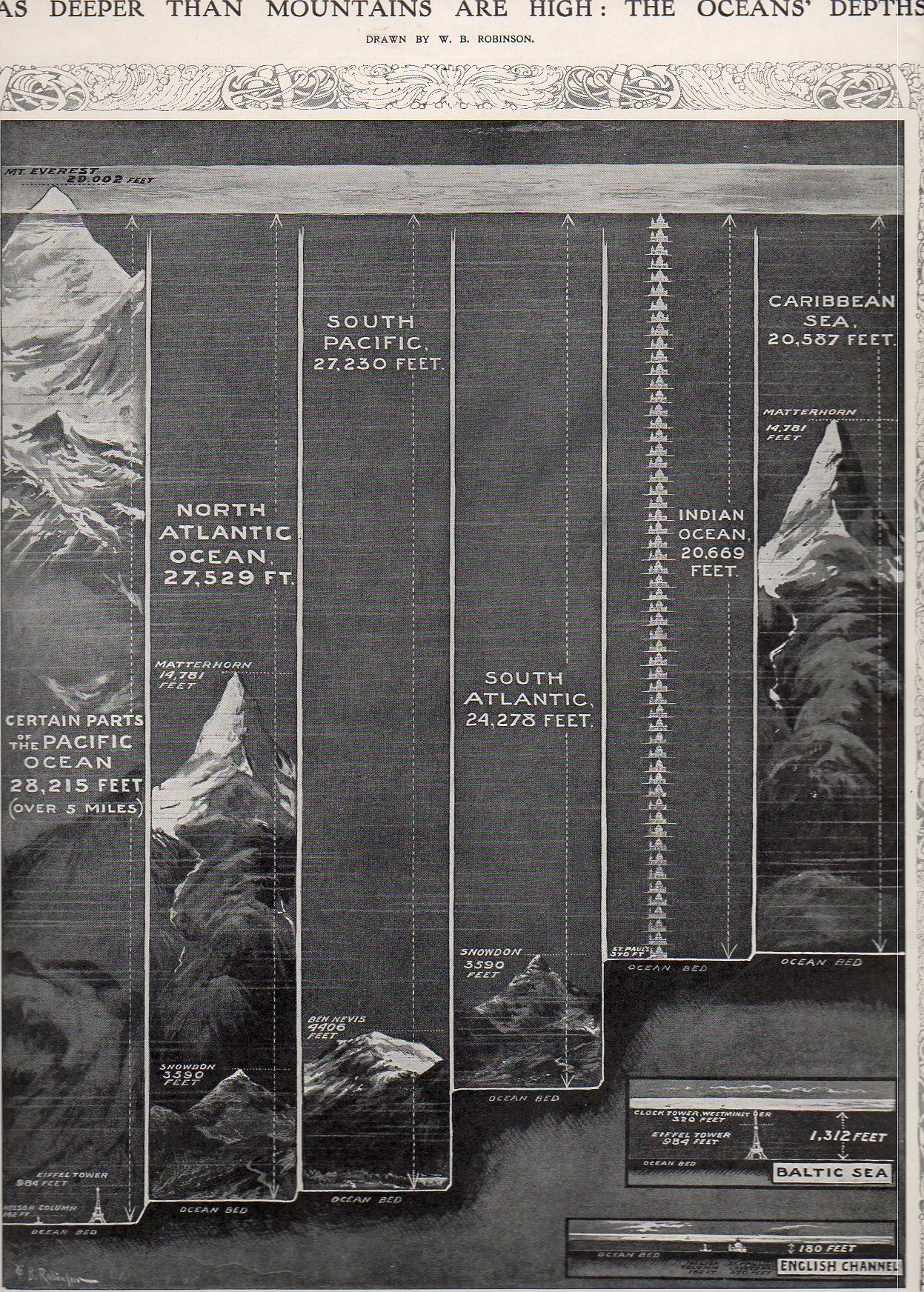
    Although maps showing the depths of the oceans existed from about the mid-19th century (through the pioneering work of the American father of oceanography, Virginia’s Matthew Fontaine Maury1) few casual readers would have ever seen a more approachable representation of information than what appeared in the Illustrated London News for 8 October 1910. Although Maury’s maps are elegant, they didn’t receive nearly as wide a distribution as this ILN image–also they weren’t nearly quite as relational as the 1910 version.

    Sea depths533

    Granted, the 1910 comparison chart only displays one statistic–the supposed greatest dept of five oceans, two seas and the English channel–it does so in such a way as to make those numbers immediately approachable to any reader, which is always an issue in relating scientific information to the general reader.

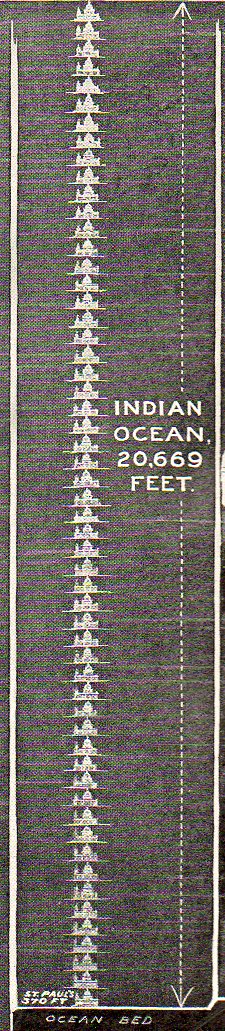
    Sea depths ist pauls537 {One of the standard unit of measurement for the purpose of this display was St. Paul’s Cathedral.]


     What W.B. Robinson presented was a way of looking at an invisible entity through very visible means–comparing depth to the heights of things that everybody in 1910 knew: the Eiffel Tower (relatively newly constructed out of 18,000 prefabricated highly-engineered pieces) and St. Paul’s Cathedral. So rather than stating that the Pacific Ocean is 28,000 feet deep, Robinson chose to replace feet with Nelson’s Column–174 of them. Or 29 Eiffel Towers. The 20,000-foot deep Indian Ocean was actually 56 St. Paul’s deep, while the Baltic Sea was deep enough to not quite cover one Eiffel Tower with one Westminster Bell Tower on top (ha!); and the English Channel at its deepest wouldn’t quite cover St. Paul’s.

    This is really the way to display data in my book, especially to kids.  This is one of the few ways of making the information accessible and understandable across almost all age ranges. 

    Notes:
    1.  Actually the work goes back a century before Maury with Buache, who produced this map of the English Channel in 1737–the data points are veyr numerous, but this is the very first time that such information was available on a map.

    Sea depths idouth pacific536 Sea depths indian535


    NOAA Photo Library Image - map00004

    And Maury again with this first map of an oceanic basin, published in 1853:

    NOAA Photo Library Image - map00001

     And in 1752, Philippe Buache produced this fantastic and first-of-its-kind map for the depths of the English Channel:

    NOAA Photo Library Image - map00186

    Here’s an extraordinary cross sectrion of a part of the ocean floor produced in 1857 by the HMS Cyclops in preparation for laying the Atlantic Cable:

    NOAA Photo Library Image - map00010


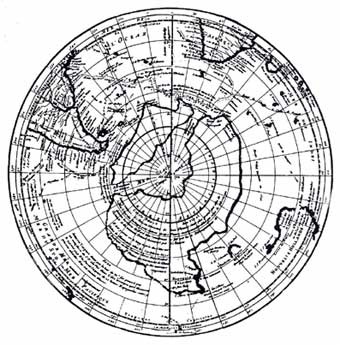
    Its also interesting to note here Buache’s work on this map of Antarctica, published in 1737.  Buache put together all of the known (to him) information about the mass in the South, bits taken from other maps, and accumulated them into what was the best-possible guess on what was down there in the Antiopode.  Pretty good detective work given the amount of material that he could work with.


  • Note on the History of Eating: the Quiet Magnificence of the Soda Fountain

    JF Ptak Science Books   Post 1162

    A soda fountain banner 497
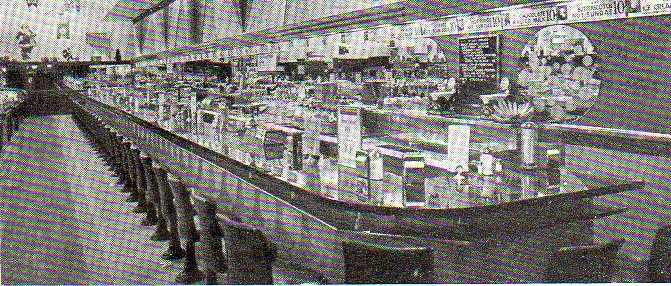
    In the U.S. perhaps there have been few things of soft luzury so reachable to so many than the soda fountain.  For a small fraction of a daily persistence-existence income, a person could go into one of these restaurants and enjoy a cup of coffee and a donut.  Not only that, the soda fountain was approachable to younger people, including A soda fountain cvr486 teenagers–perhaps the first time in this country when children and adults could indpendently visit a social place (that did not include organized religion) for paid entertainment, a sure sign if any indicating the growth of a real middle class, realish dispersal of capital* and a real sense of leisrure time. 

    For a while in the 30’s and 40’s and 50’s the soda fountain occupied what might have been a real keystone position in the panoply of American entertainment.  It seemed to be everywhere, in every city and town, in reality and in the imagination–it made a big appearance in literature and art and in the movies, a staple of average in the average American’s life.

    Of course there were taverns and saloons and wayside inns and restaurants, but these institutions were different, more removed from the population of “everyone” that the soda fountain drew on, and in.  Even the idea of the “leisure time” that it took to enjoy such a place, a place in public that involved consuming products for money, an entertainment, was still sort of new.  For example the idea of travel for the sake of leisure and entertainment was virtually unknown in the U.S. in  he 18th century, and only started somewhat in the 1830’s/40’s, but even then under the guise of movement for hygiene or health benefits, taking the water (as in spas and hot baths, hyrdotherapy) and–a little later on–the airs. Vacation as we know it today would have still be almost entirely unfamiliar to Americans at the late 19th century and even into the early ‘teens of the twentieth.  Mass production and inventions like the automoble (and a decent income) really gave birth to the idea of leisure time, which would’ve preceded the soda fountain by a decade or two. 

    A soda fountain man stand496

    Somehow, I can’t help but thinking about Henry James and the Soda Fountain. No doubt due to the remarkable Larry McMurtry’s Walter Benjamin at the Dairy Queen, though what I’m thinking about is different, about what  the brahmin James would’ve thought about the new development had he been around to see it. .  Mostly this idea comes from James’ obervations on NYC after his return from being abroad for decades, seeing the city in the Gilded Age unseen for so many years, and thinking of it all in terms of being “wasteful”, putting him a in a funny category that would include folks like Thorstein Veblen and T.S. Eliot.  Whereas I’m sure the later two (especially with Mr. Eliot) would see the development of such an affordable bit like the soda fountain as a Wasteland, I have a feeling that James would appreciate it as the small haven for new social activity that it was, if only he could have seen one (as he died in 1916).  (I’m only slightly familiar with James, but this sentiment seems right to me, coming from the man who never wrote a bad sentence (or so Mr. McMurtry has sorta said). I think that he would have enjoyed its appearance.  For others.)

    A soda fountain display a490
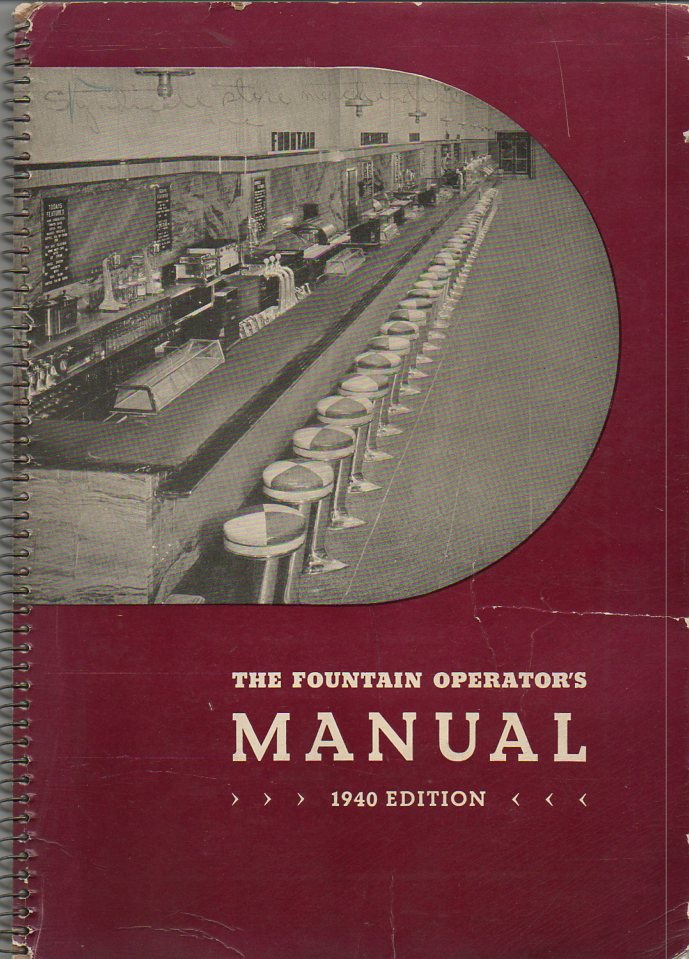
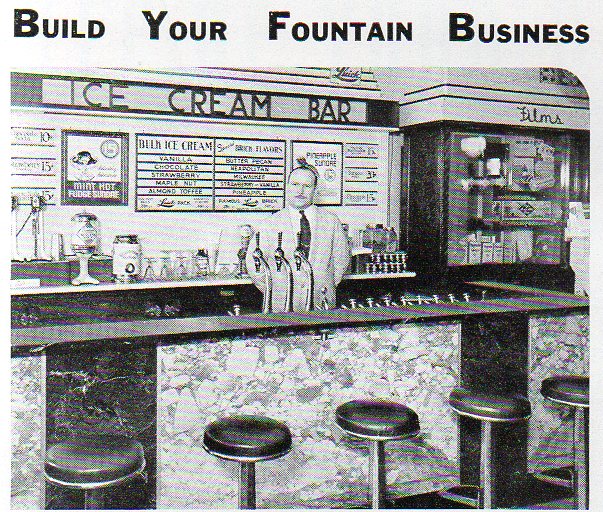
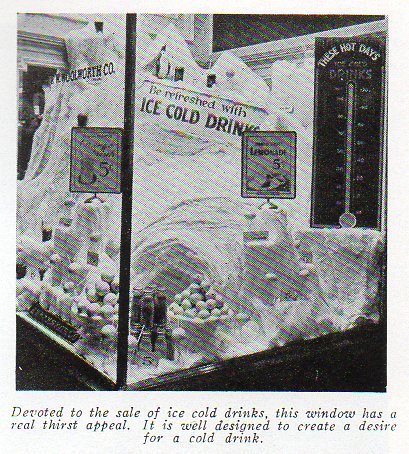
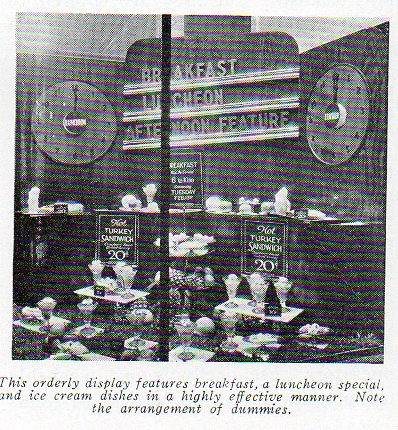
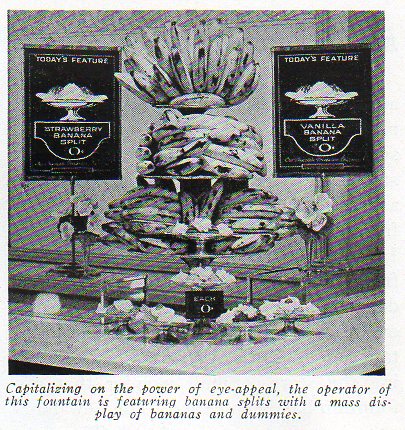
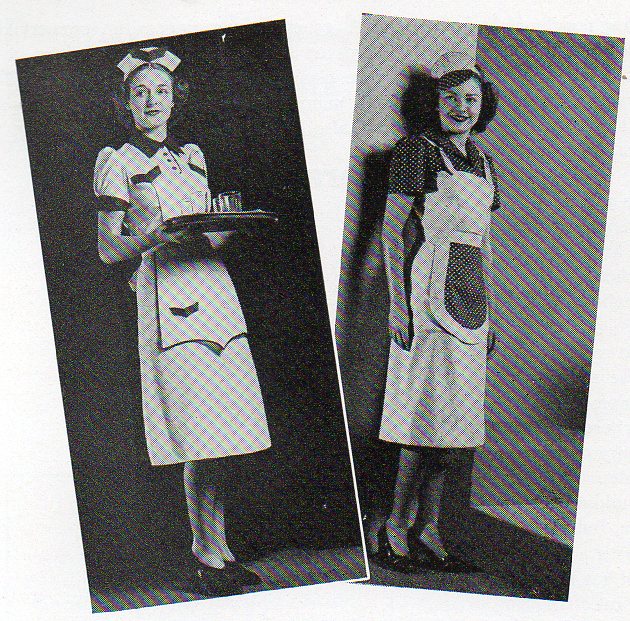
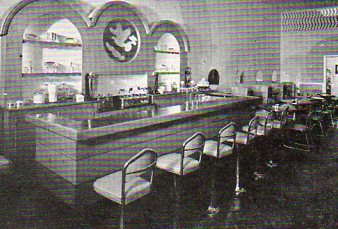
    All of this came about from reading a bit of the pamphlet (pictured above) the Fountain Operator’s Manual (1940), a lovely and crisply written how-to for folks interested in operating their own soda fountain (and the source for all of these images).  It contains advice on set-up, menus, figuring cost of foods, the beast preparations for the least amont of expense, trreatment of customers, advertisemet, and the like.  It couldn’t be edited out to anything finer than what it is–a simply refreshing, highly commendable job of writing.  And through it all it builds such an anticipation of want, and paints such a glorious picture of life in a soda fountain, that I wish I could be in one, right now.  Even if that “now” was 1940.

    A soda fountain display b491

    Notes

    * I’m just talking about little “c” capital here; I don’t mean at all that there was a significant distribution of wealth from the  top 1% or 5% or 10% to the other classes.  Just that there was a middle class, and that there was such a new thing as bona fide leisure time that reached so far down that non- or semi-working kids could go out and pay for food at a restautrant alongside adults. 

    A soda fountain ladies495

    A soda fountain menu492

      A soda fountain display c493

      A soda fountain setting494
    A soda fountain uniforms499

    A soda fountain view 1487
    A soda fountain view 2488
    A soda fountain view 3489


  • A Note on the History of Bad Chairs

    JF Ptak Science Books   Post 1161

    There are all sorts of famous seats:  seats of wisdom, of power, of lameness, of government, of discontent, of honor, of learning, of war; there’s the hot seat, the best and worst seats, a seat on the board, a seat on the bench, a seat at the bar; there are captain’s chairs, endowed chairs, and famous chairs (like architectural gems/mules of Mackintosh, Wright, Saarinen, van der Rohe, Eames, Gehry, LeCorbu) and famous seats (at the original Yankee stadium or a Roman coliseum). 

    The Rush Chair / Restraining Chair

    There’s another side to this–the History of Bad Chairs.  It is certainly easy to spot the grossly offensive examples–chairs for torture, the working chair of Adolf Hitler, the chairs Bluto used to clobber Popeye with, the terrible captain’s chair that belonged to Capt. Kirk, the offensive seating in Anthony Burgess’ Korova Milkbar in A Clockwork Orange, the final aspect of the condemned as they witnessed the bad aspect of St. Peter’s judgment chair, (and for the Red Sox fan, the chair into which Bucky Dent’s home run fell), and so on.   Then of course there’s the electric chair, the battleground of not only the philosophically opposed sides for its use, but its earlier fight as well when it was used as field fodder for the war between Thomas Edison and Nikolai Tesla for the adoption of their opposing electricity delivery systems. 

    But there’s a subcategory for the subcategory of the History of Chairs and the History of Bad Chairs– the unintentionally bad chair.  Benjamin Rush–for all of his good work, for all of his American Founding Fathers heritage and background, for all of his wide humanitarian work–has committed an ignoble applicant to this category.  Actually, his ranks among the leaders for unintended gruesomeness, a consequence of his attempt  to do good, but just gone wrong.

    Rush’s (1745-1813) name is on the Declaration of Independence, and he is also one of the founding fathers of American psychiatry.  A medical doctor, his background is very deep in care and ethical treatment, a social liberal who was against slavery and capital punishment, and who was determined to improve the condition and treatment of the mentally ill.  Unfortunately, in using the tools at hand and operating with a deep understanding of the contemporary knowledge of neurology and mental disorders, Rush sought to treat the severely deranged (or most institutionally uncorrectable) with his own creation–the tranquilizer chair.  Once certain calming measures had been exhausted, Rush described how to retrain combative patients reeking in misbehavior and keep them from ruining their clothing, or harming the handlers, or ruining the furniture of their cell, introducing the use of his immobilizing chair.  (There was an associated “mad shirt”, similar to what we know as a straight jacket, that was also invented and employed by Rush.)
    His invention, ironically,  was very high corporal punishment, what wound up being a torture device for what good it did and the cost it extracted from the person who was to sit in it. 

    + blog 10.25 rush 1

    As we can see Rush also commented that the application of cold water and ice would be facilitated with the tranquilizing chair.

    A practice that continued at least into the deep 19th century was the dunking chair, whose intent was to “shock” the misbehaving “patient” into docility or normalness.  Here we see

    Hydrotherapy

    some poor sot being drenched from above and also being hosed from the side prior to being dunked into a vat of cold water.  No telling how long one might be submerged or how calm the waters must be from bubbly interruptions before being hauled out. 

    Circulating Swing

    On par with these other instruments was the rotating chair, which was supposed in some way to confuse madness into something not-mad–that, or subdue an unruly patient, whichever came first.  

    Then there is the dentist-like chair used in Terry Gilliam’s Brazil, where the subject–Sam Lowry, accused of crimes against a mega-dystopic state–is tortured into a catatonic state, and in that thin wall between being conscious an dnot so lives in a utopian existence in his mind far from the reach of his captors. 

    brazil-torture-cell-1.jpg

    There are of course all sorts of obvious, different chairs in which torture was committed upon people, but I really don’t need to picture them here, everyone knowing what they were, or are:  spiked chairs, garroting chairs, spine compressors…you get the picture.  Nasty, terrible chairs. Intentionally bad.

    Notes:

    In addition to the tranquilizing chair, Rush recommended a host of other approaches to controlling the “raving lunatic”.  The founder of American psychiatry made the following suggestions:

    –Place “noisy” patients into total darkness, (keeping “madmen” for 24 hours or more as required)

    –Cold shower baths, slowly, for 20 minutes to four hours

    –Solitude; keeping the patient alone, in teh dark, with no visits, no speech, nothing; an “indispensible necessary” to securing correct behavior.

    –Bloodletting, with “the quantity of drained blood should be greater than any other organic disease” (page 189), and should “draw 20-40 ounces of blood unless fainting is induced”.

    –“Low diet”, which was actually starvation, having the patient fast for one to three days, and then feeding “just” vegetables, “of the least nutrious value”.

    –Freezing, in addition to cold shower baths, as in placing the patient in the middle of the night outside in freezing cold.  Ice could also be used on the head, but not before the head is completely shaved, as the effect of hair on the brain and madness “we know not”.

    –Blistering, which is not a known process to me, except that blisters be induced on the ankles rather than on the head or neck.

    There was also treatment via purging, emetics, and the employment of small amounts of opium “to waste the excitability” and reduce fatigue to keep the patient awake.