A Daily History of Holes, Dots, Lines, Science, History, Math, Physics, Art, the Unintentional Absurd, Architecture, Maps, Data Visualization, Blank and Missing Things, and so on. |1.6 million words, 7500 images, 4.9 million hits| Press & appearances in The Times, Le Figaro, Mensa, The Economist, The Guardian, Discovery News, Slate, Le Monde, Sci American Blogs, Le Pont, and many other places… 5000+ total posts since 2008.

Author: JF Ptak

  • Boullee, Lequeu and Ledoux: Reposts of Two Musical Slideshows

    JF Ptak Science Books LLC  &   Blog Bookstore

    (1) The Fantastic Self-Portraits of the Visionary Architect, Jean-Francois Lequeu

    I guess it is easy to want to call M. Lequeu (1757-1825 (?)) an outsider, though
    he was hardly that.

    He was an exceptional talent who was exceptionally well-trained (and who won
    the highest awards offered by his school), and started out in a staid and
    brilliant way, a successful draftsman in his own right, and student of
    Scoufflot, helping to design ancient-inspiration buildings for the super
    rich. He was at the pinnacle of the drafting trade, though not so on the
    designing end.  Along came the Revolution
    and away went his architectural career—he wound up a surveyor and a
    cartographer until his retirement in 1815, after which he enters social and
    historical oblivion, until he finally dies in total obscurity ten years later
    (or so, the date is unclear).  His post-revolutionary vision was as
    phenomenal as his success in selling his ideas were dismal.  Well, this is
    really a cheap shot—his imagination was shockingly large, enormous, his designs
    fantastic and beautiful, and completely unexpected, and they seemed to grow
    larger/loftier and more interesting as time wore away at him. But he was far in
    front of the curve so far as popular (public) opinion was concerned.  Even among the other visionaries of the time
    (like Ledoux and Boullee) it was Lequeu who staked out the furthest reaches of
    architecture, and also with great depth and virtuosity.

    I think that as Lequeu was cleaved away, cell by cell falling through the
    floorboards of his single rented room, he reached further into time and deeper
    into space than almost any architect of that hundred-year period.   I
    also think that he was very well aware of his genius being seen as pure
    eccentricity—his half-dozen or so self portraits are among the most reaching
    that I’ve seen (in the pre-modern era). 

    If Lequeu’s visions existed at all in the world of French architecture it
    was in the Deep Underground—a place that he may have founded.  He was certainly, at the very least, its
    geologist.

    His
    self portraits are striking, but perhaps not so much more so than those
    by Rembrandt–he was certainly exploring modes of expression (Raphael’s
    series of engravings on the emotion of the human face is a good example
    of this study)–Lequeu though seems to always manage to suggest that he
    is an observed inmate somewhere.  There is a great undercurrent of
    “otherness” and great remove to them–something that makes places the
    self portraits into a different–empty, lonely–class.

    (2) Etienne Boullee, Images with Music

    I’ve been collecting images by some of  the great, visionary
    architects of 18th century France:  Etienne Boullee (1728-1799),
    Claude-Nicolas Ledoux (1736-1806) and the semi-impossible Jean-Jacques
    Lequeu (1737-1825).  It was a tough time for these architects to see
    far into the future at the time of the Revolution, as people who were
    even less deserving than these men lost their heads.  In any event I’ve
    compiled a short three minute video exhibiting some of their works,
    using the music of Wim Mertens for Peter Greenaway’s love poem to M.
    Boullee called The Belly of an Architect. 
    I couldn’t but help using this music in this context, sorry to say–it
    just goes perfectly with these images.  (Also, I’ve written about M.
    Ledoux here.)


  • The Coming Sex War of 1919

    JF Ptak Science Books LLC  Post 920
    Blog jan 27 women votes
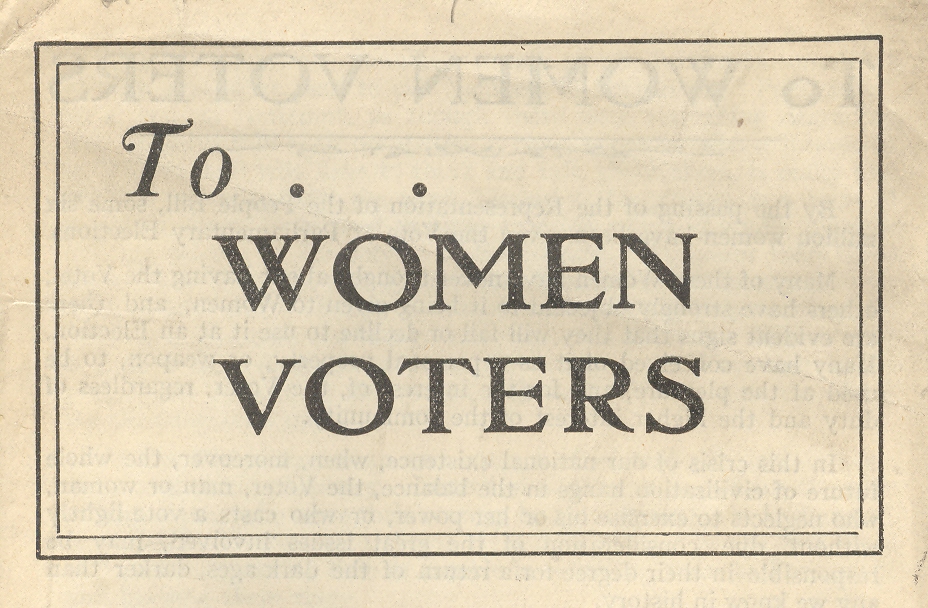
    This slight, four-page pamphlet was a flare to the newly enfranchised women of Great Britain1,  a very-shakily congratulatory bit with wide, sniffy overtones of vast male superiority.  The author takes the intended (female) reader at a very slow, almost-stopped pace about what voting is all about, turning down the rhetoric to explain what a vote “is”.  Not only that, but the following as well:
    “It seems, therefore, important to give as simply as possible a brief sketch of:
    (1)    What Politics are. [Politics is the Science of Government.] (2) The Duties of Citizenship. (3) Coalition Government”.

    Just because women got the vote (or partial vote:  they had top be over thirty years of age and have property or be
    married to a man with property; full voting rights devoid of property requirements didn’t come in until 1928) didn’t
    mean that they enjoyed a relaxation of their inferior social caste. The social consciousness of the status of women may have been slightly fragmented in 1918/19, but only enough to introduce them to the world of politics as you would a child—at least as far as this pamphlet is concerned2.

    But this work comes around a bit, retracting its insulting narrative somewhat by the end of the pamphlet, as what the writer really wanted was to snag a bunch of these women to vote for the Coalition Candidate, Mr. Lloyd George, in the General Election of December 1918.  Their votes were definitely wanted, and the need was addressed, if not without a little fear that women would retract themselves and form their won party. The pamphlet states:

    “If the Voters are mean and corrupt, they will get what they deserve…There is a movement among women at the present time, especially among those who were most active in working for the Vote, to refuse to join any of the old political Associations, but to form a Women’s Party or Federation of Women. Such a step is to be very much regretted, for it will certainly lead to a sort of sex war, men and women being divided into opposite camps, each fighting for their selfish ends.” 

    Assuring women of what a “vote” and “politics” are, and demanding that the priorities of “women’s political parties” would lead to a “sex war”, the author blandly asks his (!) readers to vote for Lloyd George.

    Notes

    1. The countries granting partial or full voting
      rights to women prior to the U.S (1920) include:  New Zealand (full voting privileges),
      1893; Australia, 1902 (partial); Finland, 1906; Norway (able to stand for
      election); Denmark (1915); Iceland (1915); Canada (1917); Austria, Estonia,
      Georgia, Germany, Hungary, Ireland, Kyrgyzstan, Latvia, Lithuania, Poland,
      Russian Federation, United Kingdom (partial) (1918);  Belarus, Belgium , Luxembourg, Netherlands,
      Ukraine (1919); Albania, Czech Republic, Slovakia, United States of
      America (1920).
    2.  As
      beautiful a thinker as
      Darwin
      was his mind regarding women of the mid-Victorian age was pretty modest,
      treating his own wife as a sort of advanced child.  She never did get a key to the key
      cabinet at
      Downs…

    (I should point out an earlier post that I made about the coming equality of women in voting and lung cancer, “Deathly Equality: Liberty, Lung Cancer and Women’s Rights“.)

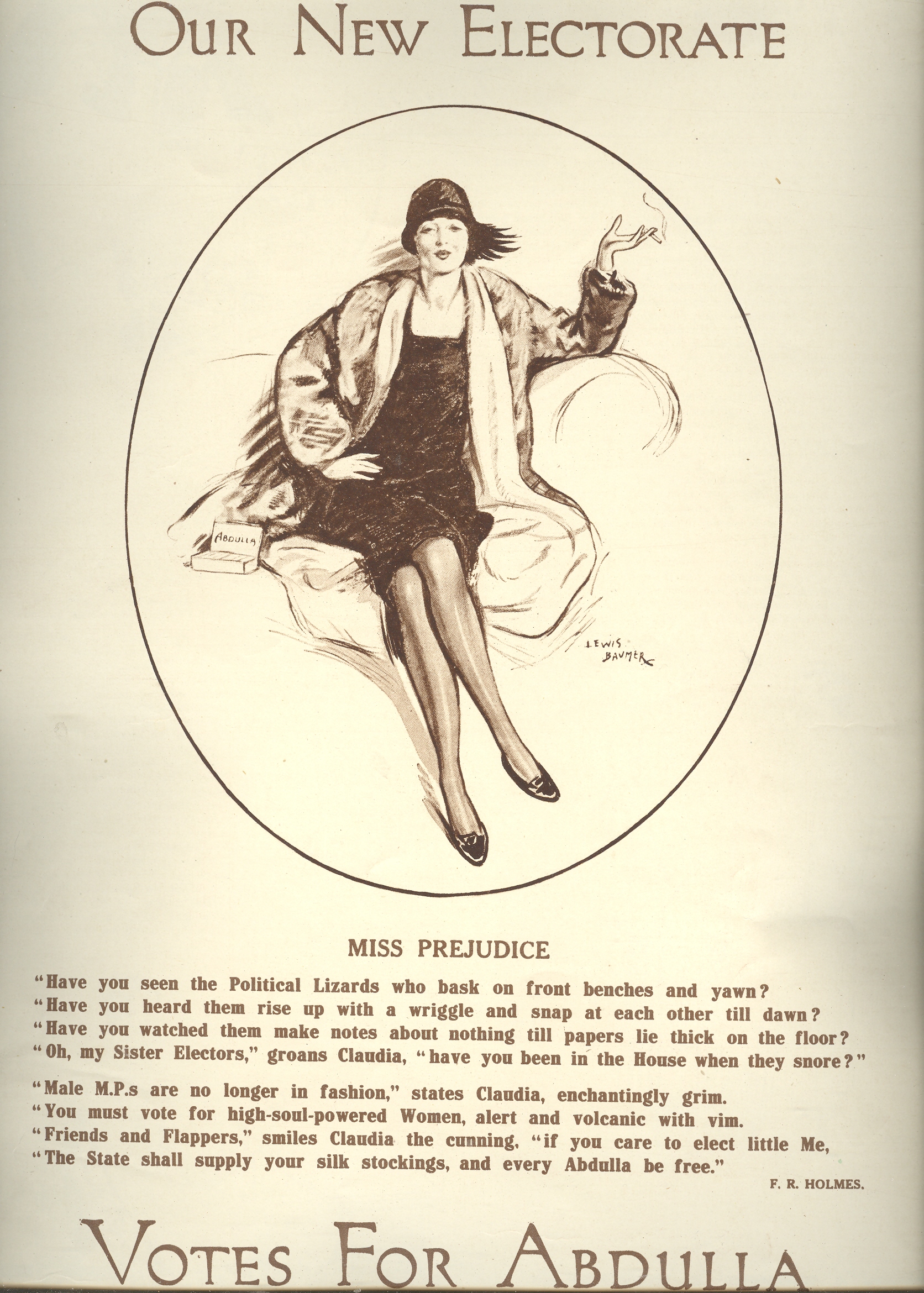
    Blog--june 23 electorate


  • Killing London with the Future: City Planning with the Bressey Report, 1937

    JF Ptak Science Books   Post 920

    Sir Charles Bressey
    didn’t really try to “kill” London, of course, though parts of his Greater London plan for redirecting and accommodating increasing vehicular traffic certainly would’ve destroyed some great beauty had some of his suggestions been implemented.

    Blog jan 25 traffalgar

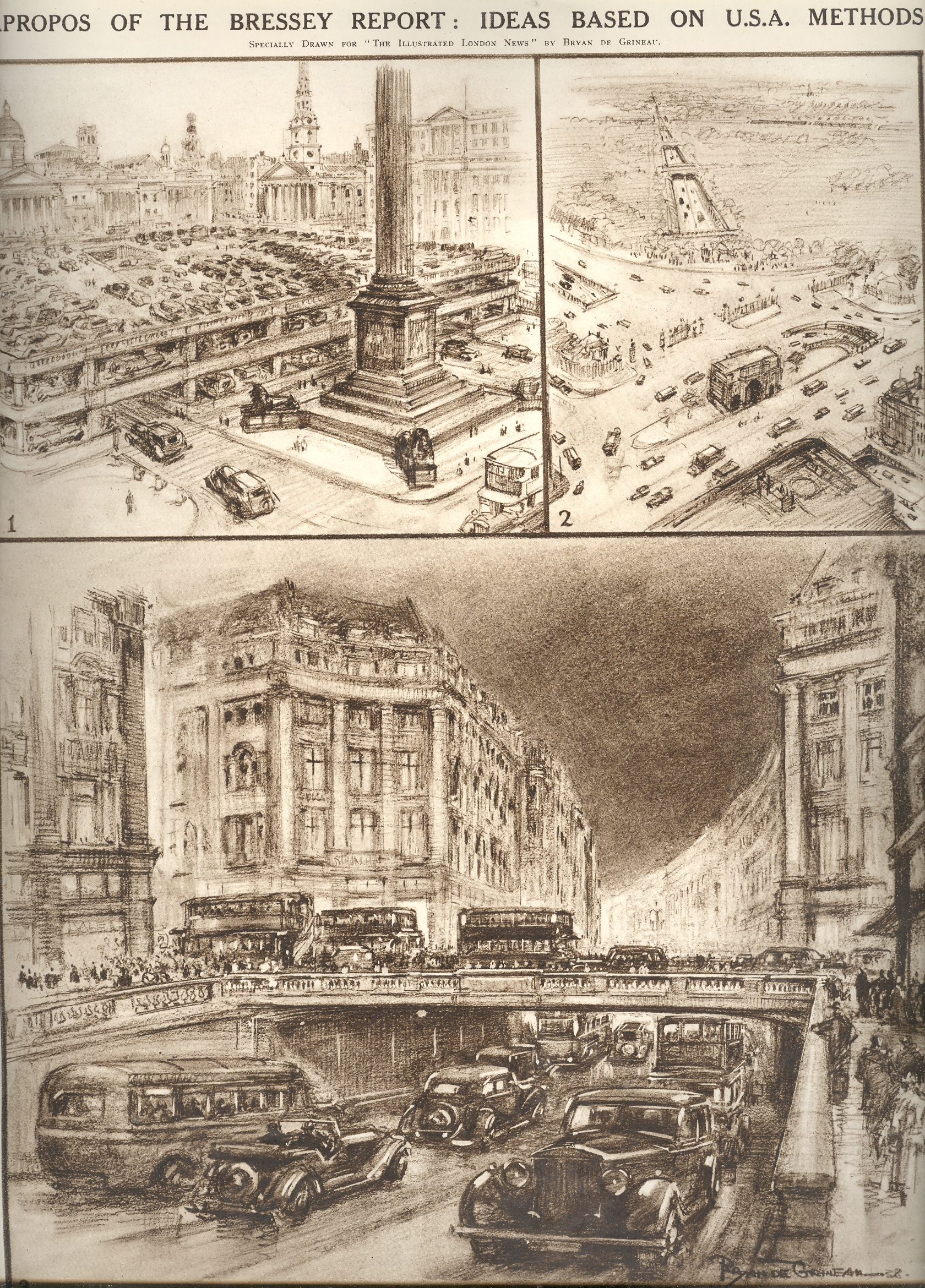
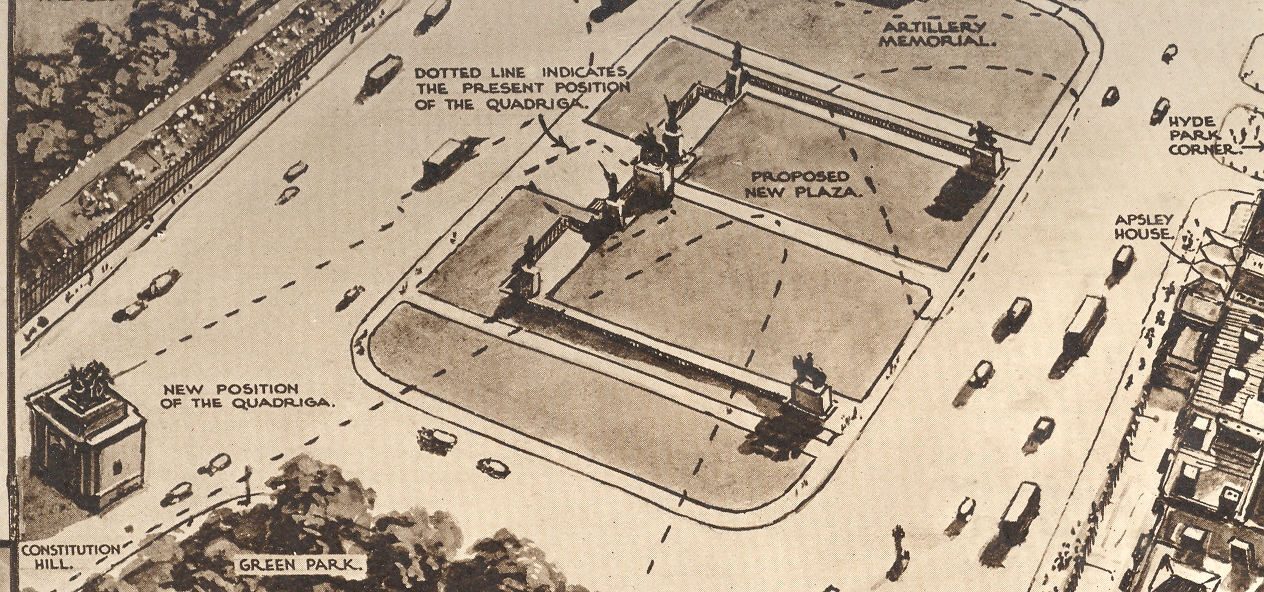
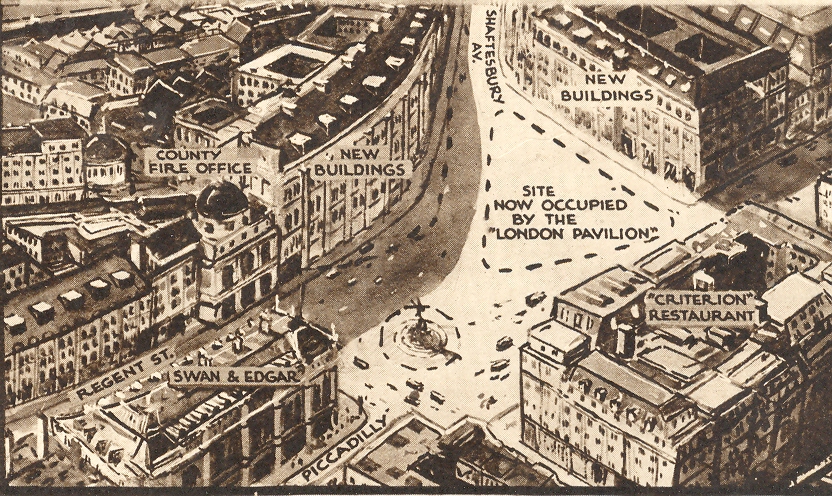
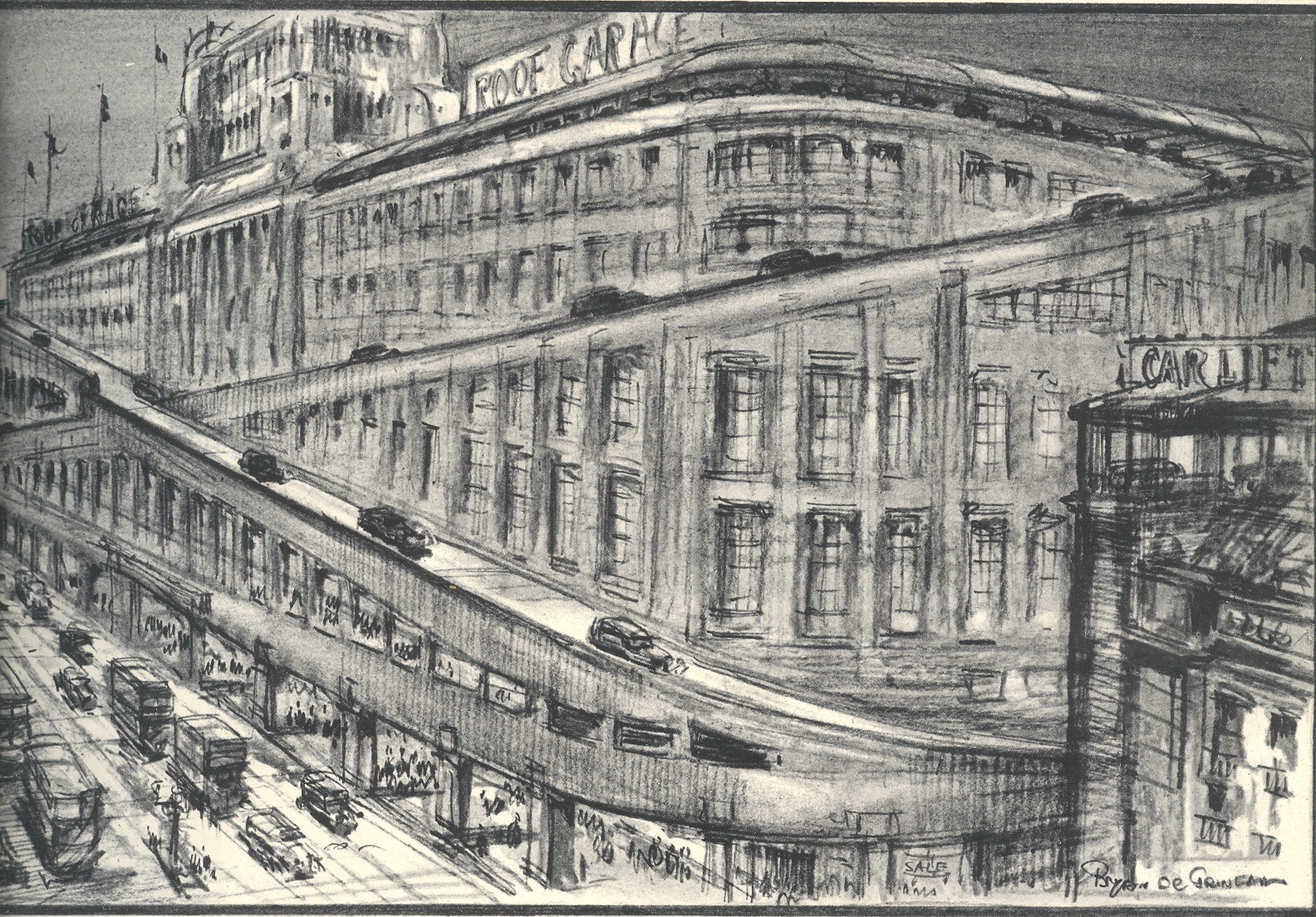
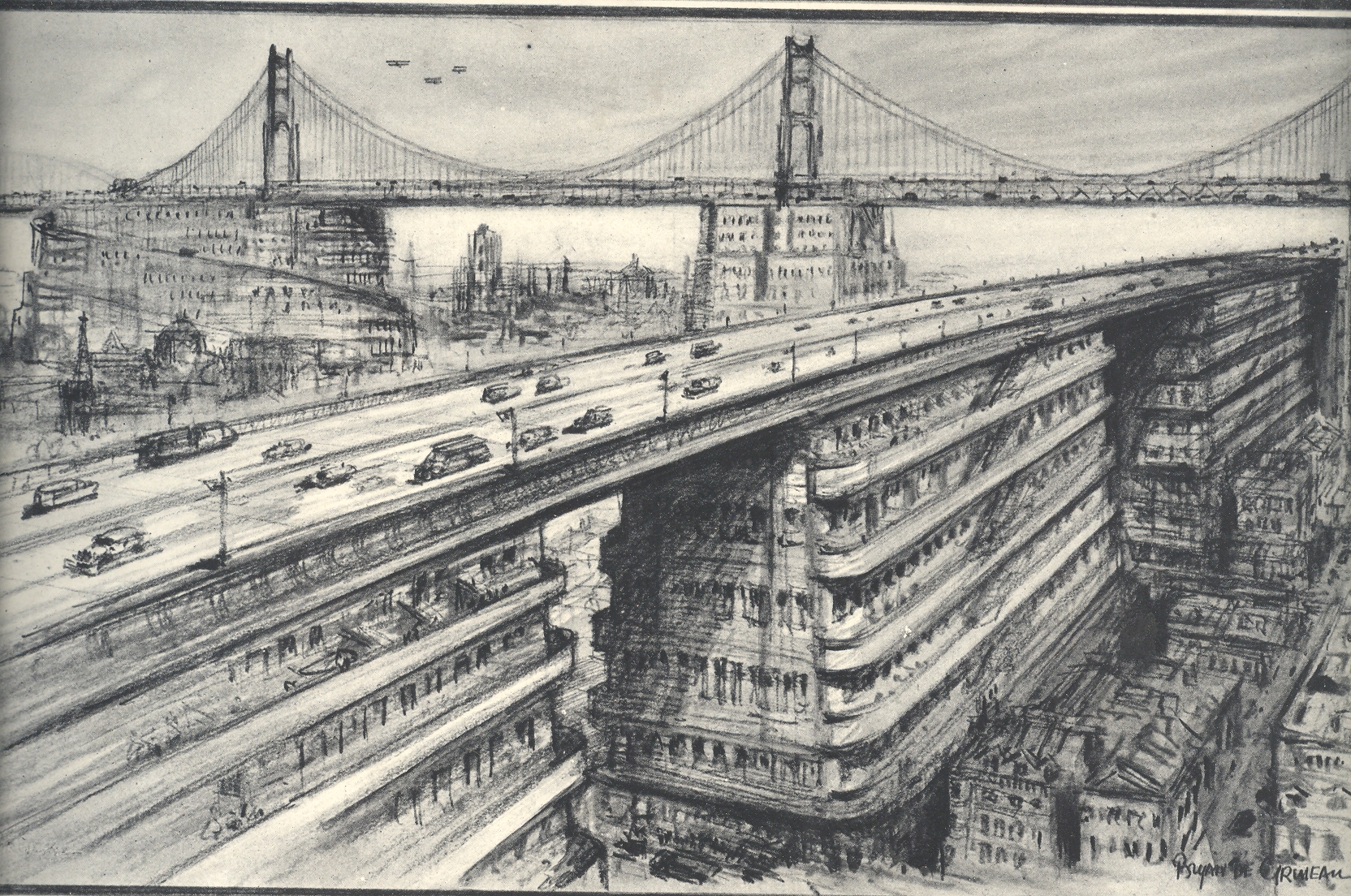
    I have no doubt that Sir Charles was on the right path to something, here and there, but all I have access to regarding his work appears as an article in The Illustrated London News (28 May 1938), and much of it looks like a absurdo-horror/sci-fi setting for a film by Terry Gilliam or Tim Burton.  I can hear the noise of this city, and it ain’t pretty:  a road through Hyde Park, floating pontoon car parks in the Thames, , elevated highways sitting on top of apartment buildings, removing Piccadilly “Circus”, removing the “park” part of Hyde Park, and so on.

    (Very slightly related is this post from 2008 featuring a self-defence plan that would semi-encapsulate London (1938))

    And so I’ll pass along these images of “traffic improvements” without too much comment, letting them speak for themselves.

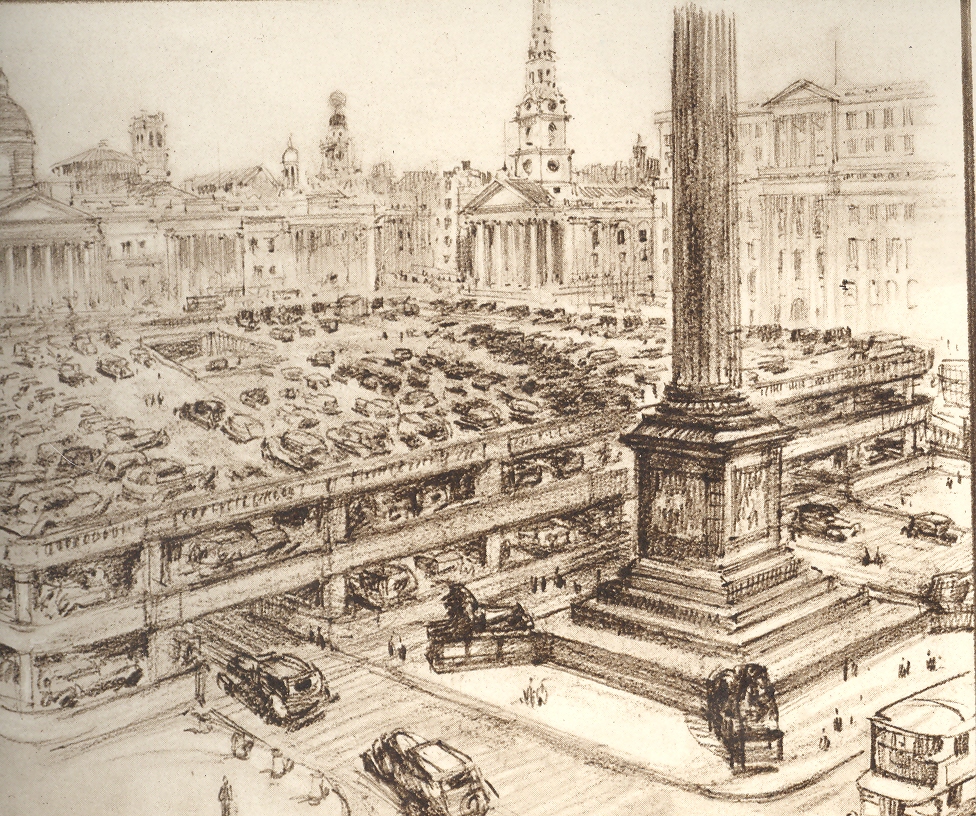
    Trafalgar Square as a triple-decker parking deck. (What can one say?)

    Blog jan 25 traffalgar det


    Hyde Park, with a semi-submerged road cutting through the heart of the place.

    Blog jan 26 lhyde park

    Blog jan 26 lpicadi circus 


    Blog jan 26 london bottom right

    Blog jan 26 london bottom left 


  • Flying Wing Aircraft, 1930

    JF Ptak Science Books LLC  Post 919

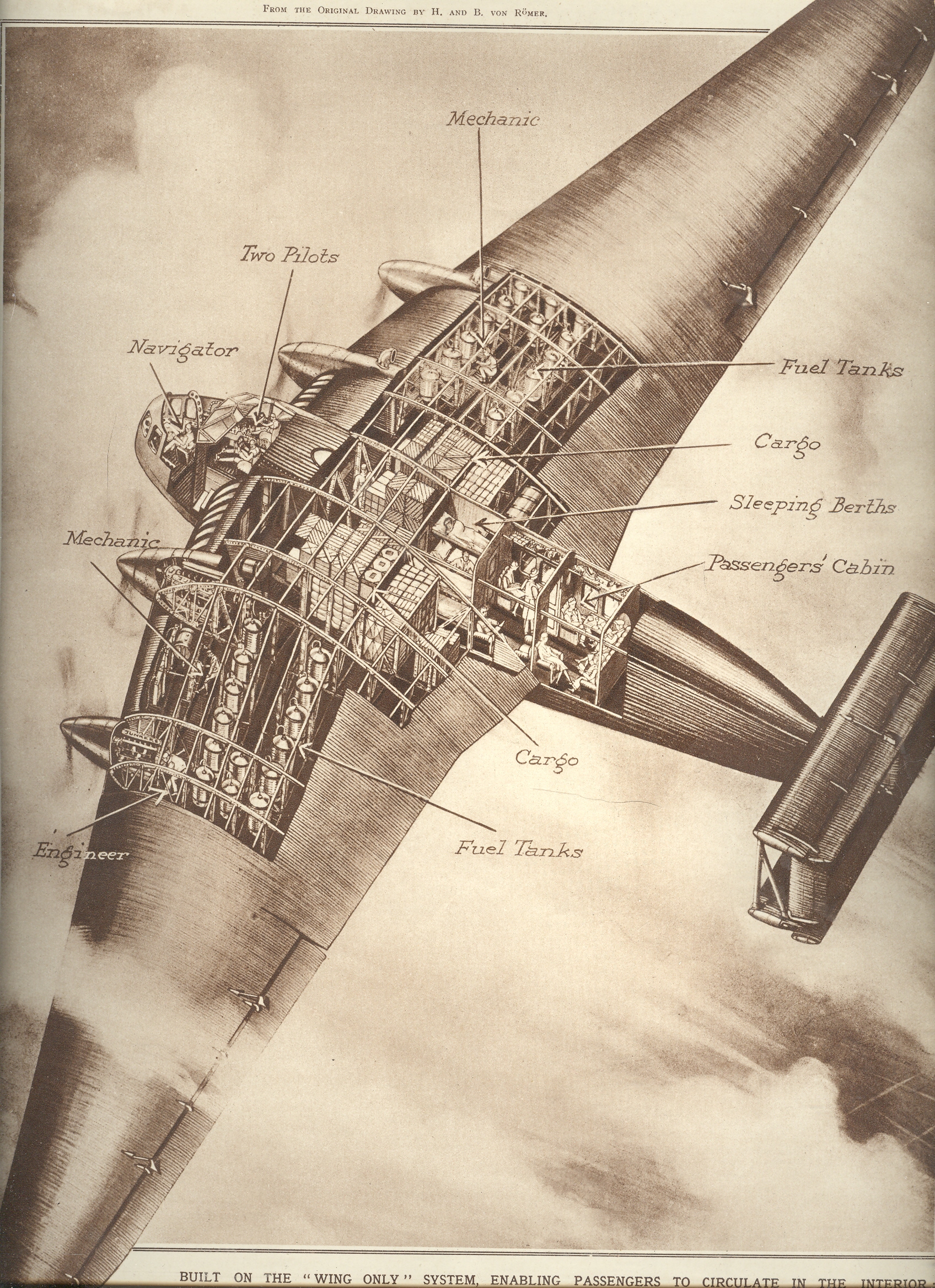
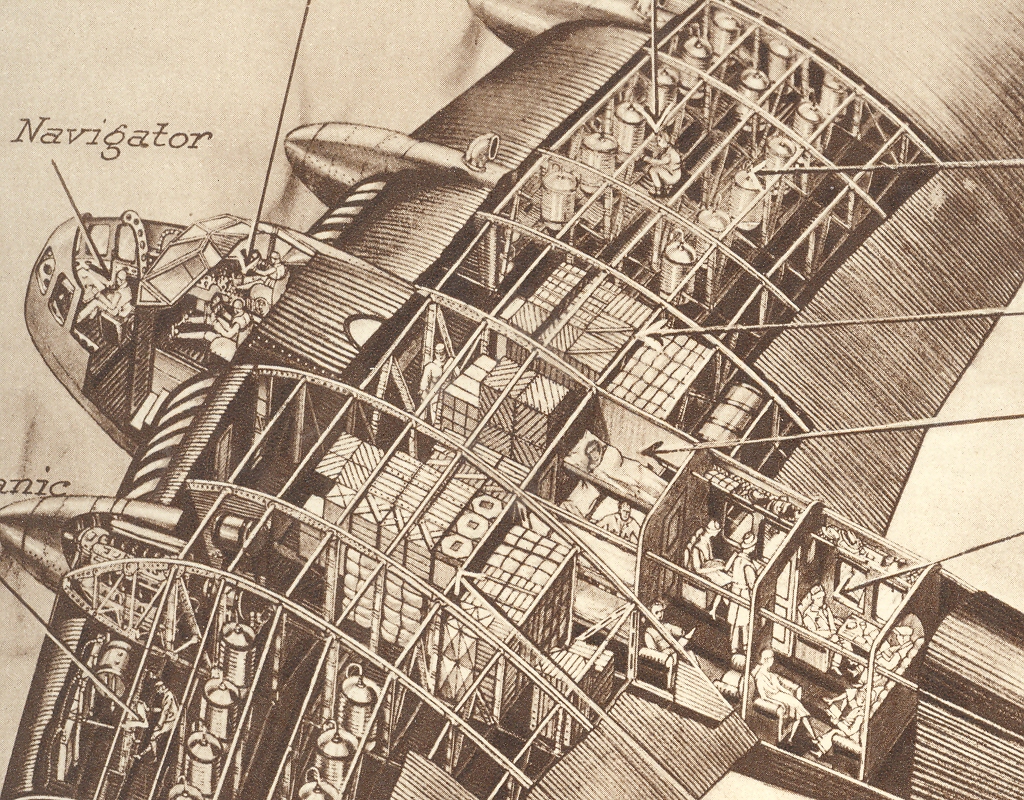
    Blog jan 24 flying wing det title What can I say?  I just like the flying wing. Also I should point out that the Illustrated London News is an excellent resource for schematic cut-aways like this–I think that I have 125 or so of them here for the 1910-1945 period.

    Junkers built this fabulous flying (“inhabited”) “wing only”
    aircraft, sending it up for commercial service in 1929 as the largest airplane
    in the world. Only two were built (though a Japanese military knock-off ran to a production quantity of six), and I imagine that it was quite expensive making the Berlin-London flight, cruising in around at 109 mph.

    Blog jan 24 flying wing

    I would like to know what the artist was thinking about when he decided to draw a standing man in the sleeping compartments. Not only that, the fellow is looking straight at the artist…perhaps it is a sly, tiny self-portrait?

    Blog jan 24 flying wing man

    Blog jan 24 flying wing det


    Notes


    1.  Plane specifications:

    Crew: Seven (including a full-time engineer who could
    service the plane’s four engines from inside the plane).

    Capacity: between 30 and 34 passengers, depending upon
    variation of the aircraft.

    Length:  75 ft

    Wingspan:
    144 ft

    Height: 23 ft

    Wing area: 3,122 sq ft

    Empty weight: 32,893 lbs

    Loaded weight: 52,900 lb

    Max takeoff weight: 46,826 lb

    Maximum speed: 140 mph

    Cruising speed: 109 mp

    Range: 2,150 miles

    Service ceiling: 12,100 ft


  • Missing “Dots” and Not Seeing the Discovery of Platelets, 1842

    JF Ptak Science Books LLC  Post 918

    {This post continues some new and unusual cross-categories in this blog, like Missing Things Making Holes; Bombs as Breads.  Today’s bit combines the “Blank, Empty and Missing Things” with “The History of Dots” categories.]

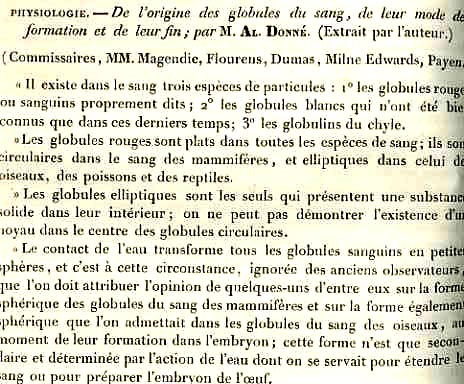
     blog 13 donne703Alfred
    Donne (1801-1878), physician, experimenter, microscopist and
    photographer, is best known for things other than what he should
    probably be best known for:  his discovery of the third element of the
    blood, platelets.  Donne had a wonderful vision, and was among the very
    first on the scene to write about and employ the spectacular invention
    of the daguerreotype in chemistry and microscopy.  As a matter of fact,
    Donne, along with his collaborator Leon Foucault,  produced the very
    first engraved images of photomicrographs for his cytology paper of
    1840. (He was also the first to use electricity in producing a medical
    illustration, and was among the first modern physicians to write on the
    great efficacy of mothers using their own milk in breast feeding their
    children.)  The discovery of platelets paper of 18421–preceding two
    other works published in the same year–does indeed identify the new
    object, but actually fails to make a methodological examination of the
    new body, calling the new units “globulins du chyle” (or small globules, derived
    from plasma).  He also fails to make a drawing of what he saw; so, the
    combination of these two important elements asked the reader to accept
    his findings on faith, the tools of reproduction of his observations
    not being present. 

    And so we remember Donne for some other significant
    things, and less so for his lightly-interpreted and un-illustrated, and missing, “dots”.

    Notes
    1.Donne, Alfred. De l’origine des globules du sang, de leur mode de formation et de leur fin. Comptes rendus de l’Académie des Sciences, Paris, 1842, 14: 366-168. 

    (Overall the history of the
    discovery of platelets is complicated: 
    Leewenhoek (1675) and Henson (1782)  were the first to fully describe the “undefined”
    particles of the blood; Donne’s work was then more fully described by Beale in
    1850, and then again (identified as “small corpuscles” by Zimmerman in 1860 and
    then again by Schultze in 1874 and Laptschinski (also in 1874). William Osler
    then enters the scene in 1880, followed by Giulio Bizzozzero who was the
    first, in the years 1881 -1882, to establish central role of platelets
    not only in physiological haemostasis, but also in thrombosis.  Anyway it is a longish and not-clear-to-me
    history.)


  • Missing Things Making Holes: Soviet Bread-not-Bombs in Finland, 1940

    JF Ptak Science Books LLC   Post 917

    [This post is a hybrid category bridging “Blank and Empty
    Things” and “A History of Holes”—it is really an entry for blank and missing
    things making holes]

    1.  The Soviet Union’s foreign minister Molotov1 wanted to make it very clear
    to the rest of the world that his country was not bombing civilian targets in Finland during
    the winter war of 1939/1940.

    Blog jan 23 bomb

    2.  Molotov insisted that targets that were being bombed near
    Finnish cities were actually airbases.

    2.1   Also, since the
    complaining FDR was over 4000 miles away there was no way that he could “see”
    what was being bombed.

    3.  If there were civilian targets that looked as though they
    were being bombed, then

        3.1   they weren’t being bombed; and

        3.2   if anything at all was going on the Union of
    Soviet Socialist Republics was  dropping
    bread on the town’s/city’s starving inhabitants.

    4.   So far as
    undefended, non-military targets were concerned, the Soviet
    Union
    redefined “bomb” as “bread”.

    5.   Therefore, what
    we’re seeing in this image above are not bombs, but bread; that, or the houses
    were airbases, which would turn the bread back into bombs.

    Molotov insisted that no civilians were direct targets of
    Soviet bombing campaigns in Finland.  Also, if there were people being killed in
    these bombing raids they would necessarily and by definition be aircraft
    workers or air bases support staff or other military personnel.  

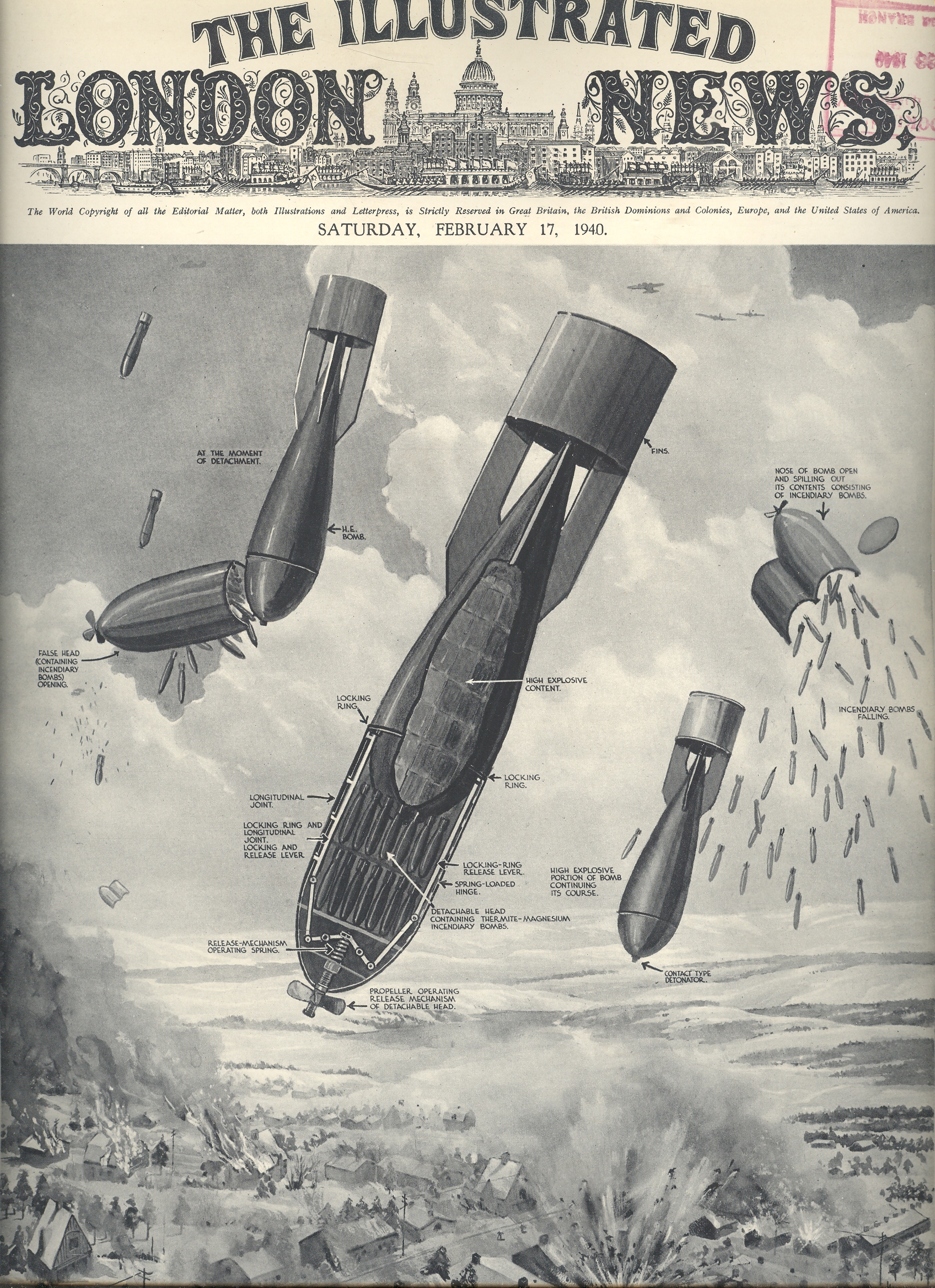
    This strikingly designed image is from the 17 February 1940
    issue of The Illustrated London News;
    the design is by G.H. Davies, the phenomenal ILN draftsman, and elegantly (and forcefully) depicts the innards
    of the bomb and its effect on its target.

    It is a spectacular and brilliant presentation of the
    new(ish) Soviet hybrid terror bomb that was being used in the non-existent
    attacks on Finnish cities.  [The 5’ bomb
    was made to be deployed in two sections: 
    the front end of the bomb inside the false nose cone contains dozens of
    incendiary bombs, released by a revolutions-generated cap propeller, which fall
    away from the main section of the bomb, which contains a high explosive.]

    Since the non-existent bombs that were not being used against
    non-military installations and were actually bread, the Finns gave the weapons
    the nickname of “Molotov’s Breadbaskets”.

    This was just a down-right nasty bomb, and the illustration
    shows it falling on and destroying a quiet town with no visible military
    advantage. The town not being bombed was called Sortavala, which—after numerous Soviet
    attacks in December 1939—was in actuality destroyed by Soviet air power on 2
    February 1940.

    The man ultimately responsible for this campaign and the
    murder of millions of his own countrymen through means of induced starvation,
    disappearances and ruthless killings—Joseph Stalin—was post mortem dispatched
    in much the same manner as the reasoning listed above.  Stalin was ignored to the point of
    non-existence, de-Stalinized and  left
    entirely out of the 50-volume second edition of the Great Soviet Encyclopedia2  published just a few years after his 1953
    death. Stalin executed his brutal and long-time political compatriot Lavrentii Beria, (1899 – 1953)
    right before his own death, ordering that people who owned the GSE to physically cut out the
    Beria entry
    . It is unfortunate that Stalin could not have been denied his
    existence 30 years earlier.

    Molotov, on the other hand, in spite of his enormous sins
    against humanity (as principle architect of the Great Terror, the extermination
    of millions of Ukranians, and etc.) was finally removed from government
    following Khrushchev’s de-Stalinization campaigns (i.e. by 1962)  and managed to live out the rest of his life
    alive, not dying until 1986 at the age of 96.

    (The “Molotov Cocktail” by the way was not named for him by
    Soviet soldiers or freedom fighters or whatever fighting for the USSR—it was
    named for the petrol bomb used by Finnish soldiers and civilians fighting
    against the Soviets invading their country  in 1939/11940 and again in 1943/4)

    Notes

    1. In 1940 Molotov was the foreign minister of the Soviet Union, and had just completed negotiating the
    Non-Aggression pact with Nazi Germany. 
    This gave the USSR free range for its relations (read “occupy/annex”)
    Estonia, Bessarabia, Latvia and the Ukranian/Belorussian-occupied section of
    Poland (to the Curzon Line), and to also conduct its war with Finland.  The fierce Finns never lost their
    independence, though they did lose a part of their country. 

    2. The GSE had a somewhat complicated publishing history,
    winding up with 65 volumes over its two editions, constructed with very
    questionable state-controlled X-Ray communist vision spectacles. There is so much in these volumes that is wrong/sanitized/fiction that I have no idea how a non-specialist might be able to use the thing.


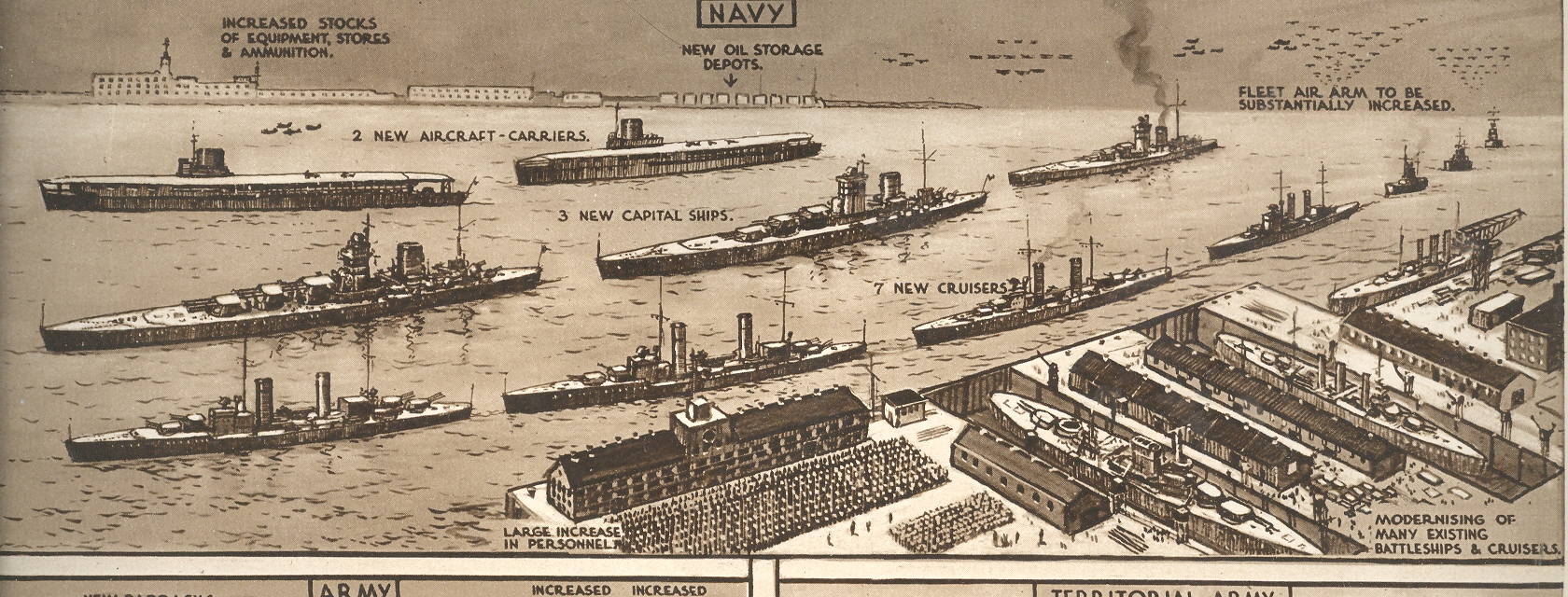
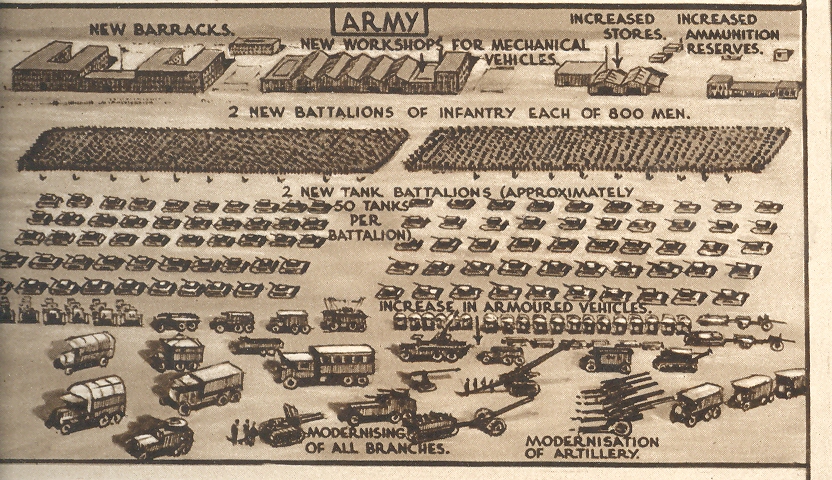
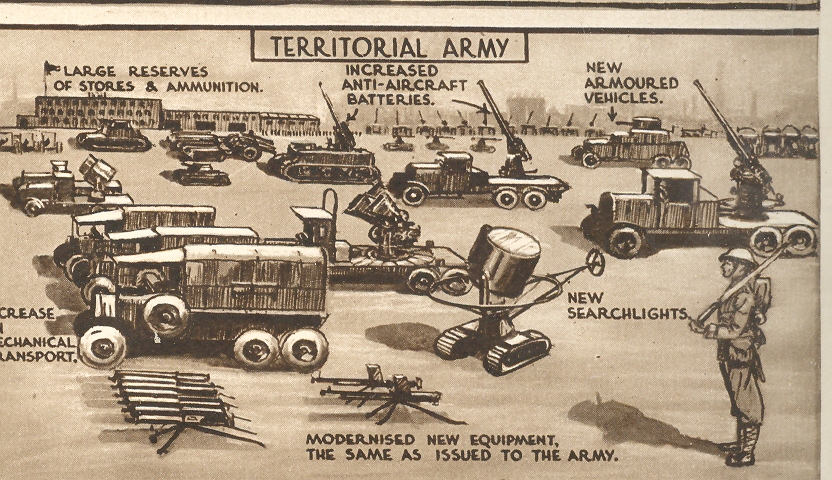
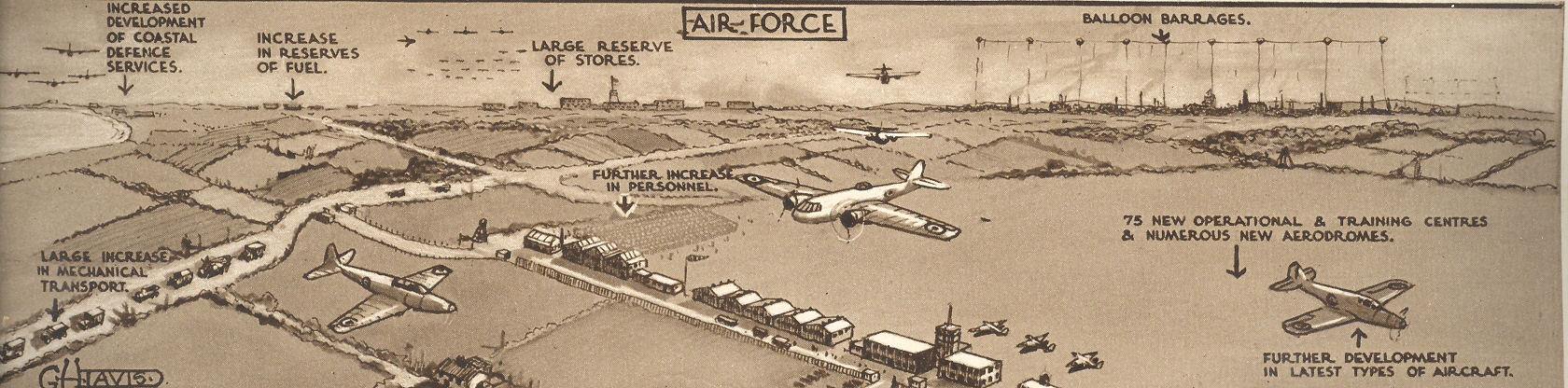
  • What 1.5 Billion Pounds Bought the Military in 1938: Finding a Gem Inside a Great Graphic

    JF Ptak Science Books LLC  Post 916Blog jan 22 Brit Mil overview

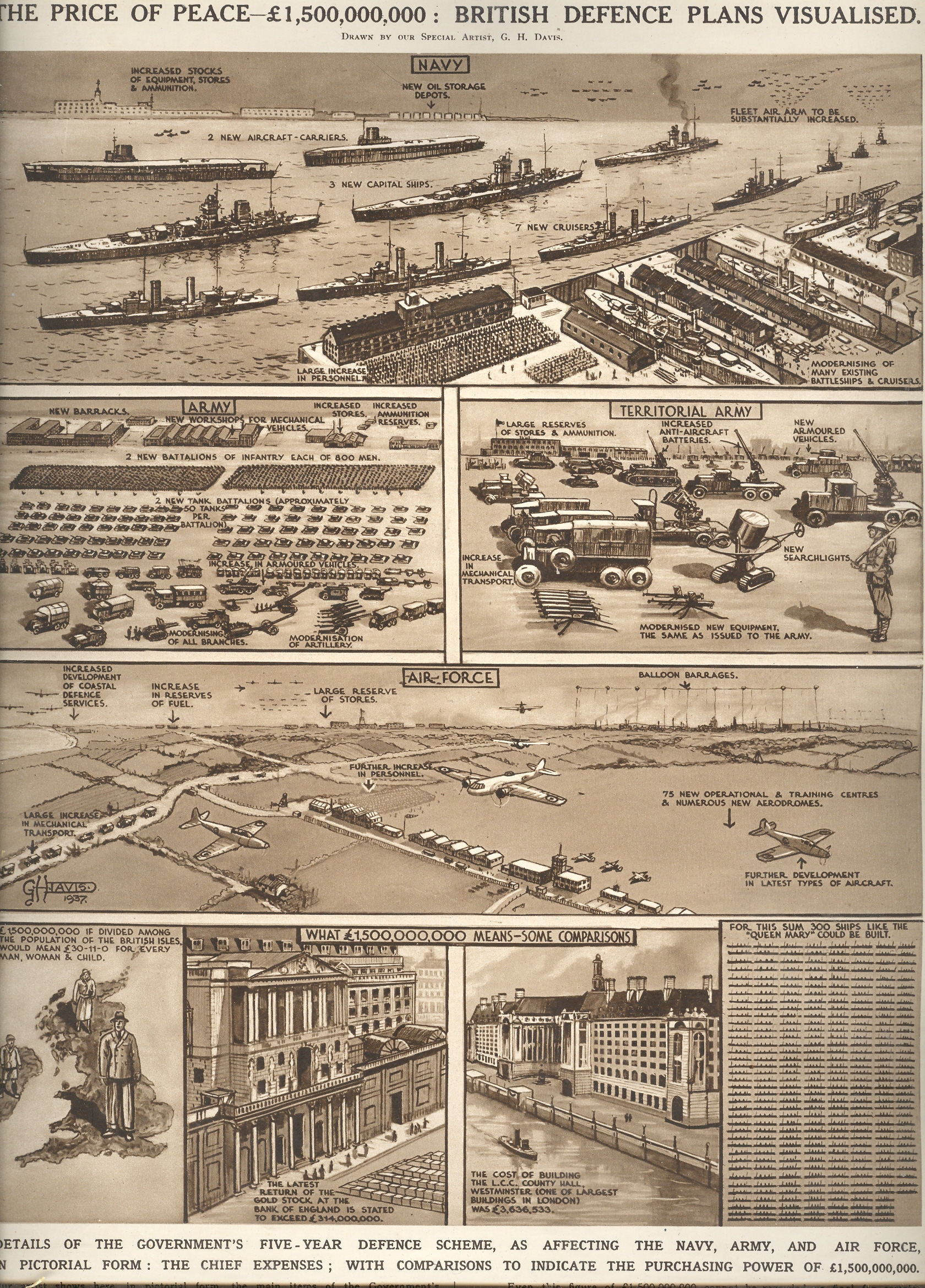
    The Illustrated London News for 27 February 1937 hosted a brilliantly designed graphic illustrating the ways in  which the British War department could/should spend 1.5 billion pounds (or about $100 billion in 2009 dollars, sort of) over a five-year period as the price of keeping the peace.  Of course they wouldn’t make it but a quarter of that distance as Austria fell to Czechoslovakia which fell to Poland and the end.  The full-page pictorial effort is to the right:

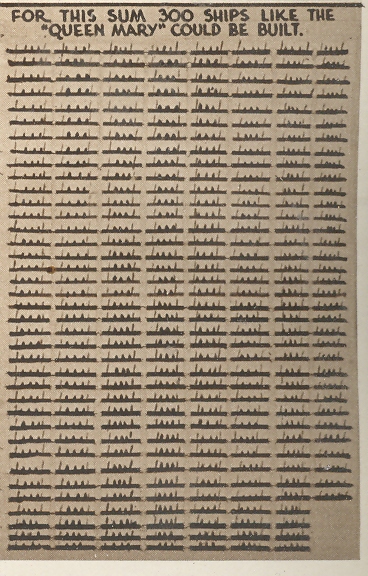
    Nestled in the corner of this page–at about 2×1 inches–is this lovely little graphic, showing that 1.5 bil could purchase 300 Queen Marys, which this delightful little design showed to great effect, and a hidden gem inside of a gem. First is a detail of this detail,

    Blog jan 22 Brit Mil bot right det 

    Followed by the full smidgen of the overall page of comparisons and analogies:

    Blog jan 22 Brit Mil bot right

    Then there’s the semi-standard presentation of what the Navy could purchase:

    Blog jan 22 Brit Mil top

    And then the Army:

    Blog jan 22 Brit Mil middle l

    And of course the Territorial Army:

    Blog jan 22 Brit Mil middle r

    And the Air Force (which if you look closely includes a balloon barrage  facility at upper right):

    Blog jan 22 Brit Mil middle bot

    By far the most interesting to me is the hidden gemoid of Queen Marys, all produced by the fabulous G.H. Davies, who did many hundreds of such images and sectional cutaways and plans and technical drawings for the ILN over a 25-year period.  M.r Davies may well be my favorite technical artist of this period.


  • When Civilians Aren’t Civilians: Blowing Up Bomb-Proof Cities, 1927-1934.

    JF Ptak Science Books LLC  Post 915

    We’re a few days past the 95th anniversary of the
    first aerial bombing of a city, the first in the long and unhappy calculus of
    eliminating things and people in civilized settings  by dropping high explosives (and etc.) on them
    from the air. 19 January 1915 saw the first bombs dropped from an airship
    during WWI, two German Zeppelins lighting up Great Yarmouth, Sheringham and
    King’s Lynn in the U.K.—the
    physical and strategic outcomes were minimal; the psychological and
    intellectual aspects were not.

    Blog jan 21 bomb rproof 1927 attack The effectiveness and temerity of bombing escalated
    exponentially–virally by the end of WWII. Aerial bombing’s future
    effectiveness and devastating potential was recognized by the early 1920’s, particularly
     in the form of the Hague Conference
    (1924), where the bombing of cities and civilians was theoretically controlled,
    if not outlawed.  Blog jan 21 bomb rproof 1927 attack det

    Of course the definitions of “bombing” and “cities” and “civilians”
    and “non-combatants” were very loosely writ and were completely open to
    (completely) wide interpretation in practice, and were especially liable to
    racist necessities. I should also add that the concepts of “defended” and “undefended”
    cities were—somehow—nebulous. Blog jan 21 bomb rproof 1927 gas cleaner

    An encyclopedia could no doubt be written on nothing but the
    these awful bits of bombing.  And for another example of this I turn to
    the French, who can supply more than their share, per capita, pound-for-pound,
    to this equation. No, not the French return to Indochina in 1945 (after having
    done business with the occupying Japanese forces for the entire war) and their
    resurgent colonialism as practiced against the Vietnamese, or the heinous
    practices against the Algerians just prior to that country’s
    independence:  it is their bombing practices in Damascus. Not the Syrian bombings of 1945
    (which also included many other places like Aleppo,
    Hama and etc.) but the French civilian bombings
    of Damascus in
    1925.  For it was in that year that the League of Nations found that the
    French really weren’t bombing and killing civilians indiscriminately when they
    were doing so; they were, ironically, bombing themselves, and so their actions
    were not illegal.  (It was problematic, identifying “civilians”, as the
    League didn’t necessarily grant the same sort of “humanness” to all human,
    finding categories for barbarians and savages.  It was acceptable to bomb
    those later two categories, but not the first.) So the French sought to subdue
    a rebellion against their oppressive rule in that country, identifying the
    Muslim population centers in Damascus
    as probable hotbeds of activities for the “bandits” that were causing them
    their problems.  October 18, 1925 is when this particular outrage
    occurred; the Syrians protested, and the League considered.

    Blog jan 21 bomb rproof 1935

    And that was
    about the size of the story for the Syrians, because as it turns out, the
    French were just maintaining an order that for them was a simple police action;
    civilians populations could not be bombed in the eyes of international law, if
    the bombing was being done to a foreign people; since the French were there and
    occupying the country, they were conducting a police action, and in a sense
    were merely bombing themselves, loosening them from the barriers of whatever
    international law could be applied to their actions by the League of Nations. 

     Blog jan 21 bomb rproof 1935 detail

    These are just a few examples from the French; there are
    plenty more for other countries for every decade, every year.  (The Brits in Teheran in 1924, the Italians
    at Harar in 1935, Franco/Luftwaffe in Guernica
    in 1937, the Japanese against Shanghai/Beijing/Tianjin (etc.) in 1937, and on
    and on.)

     Blog jan 21 bomb rproof 1927 pt 2

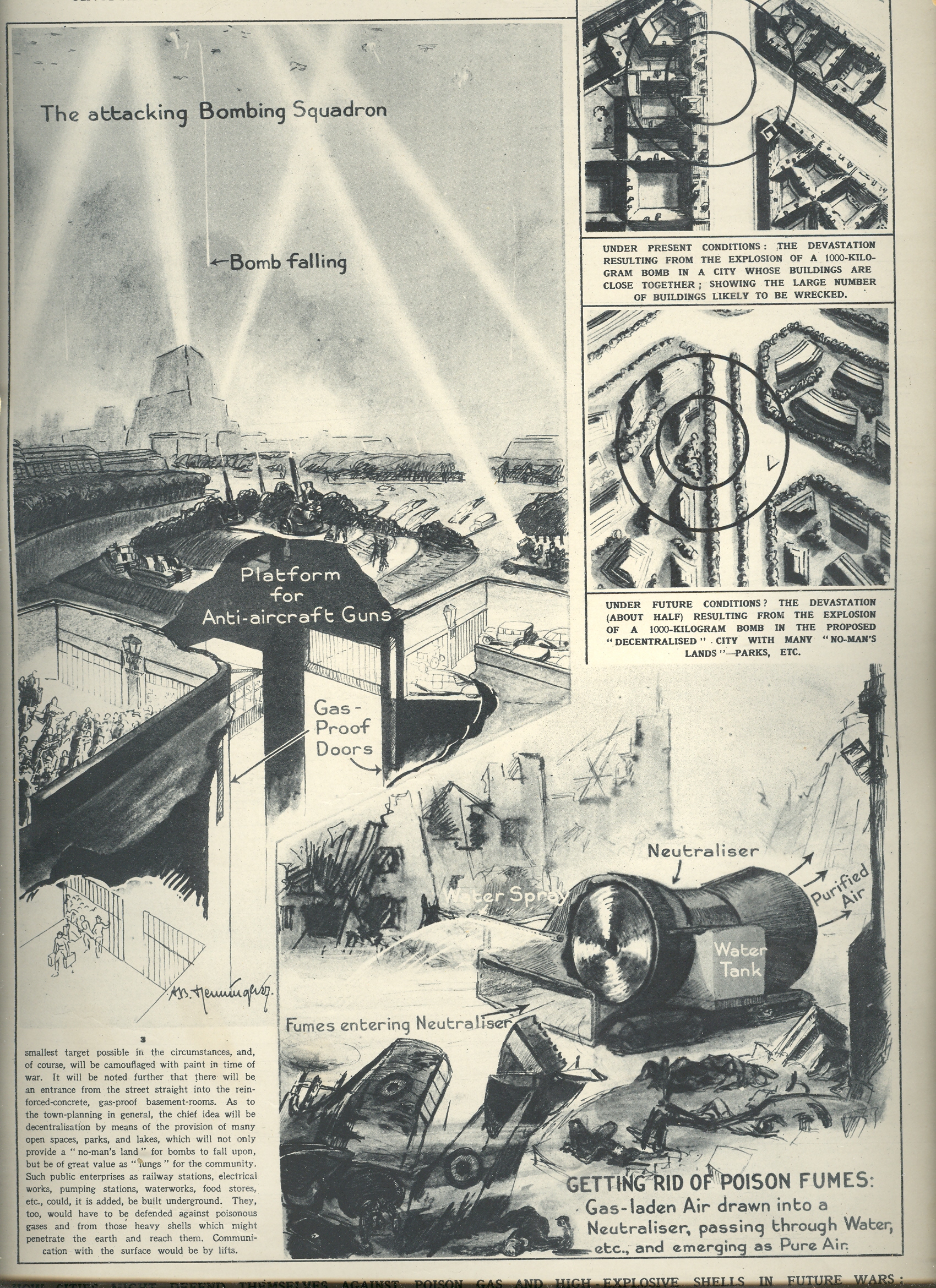
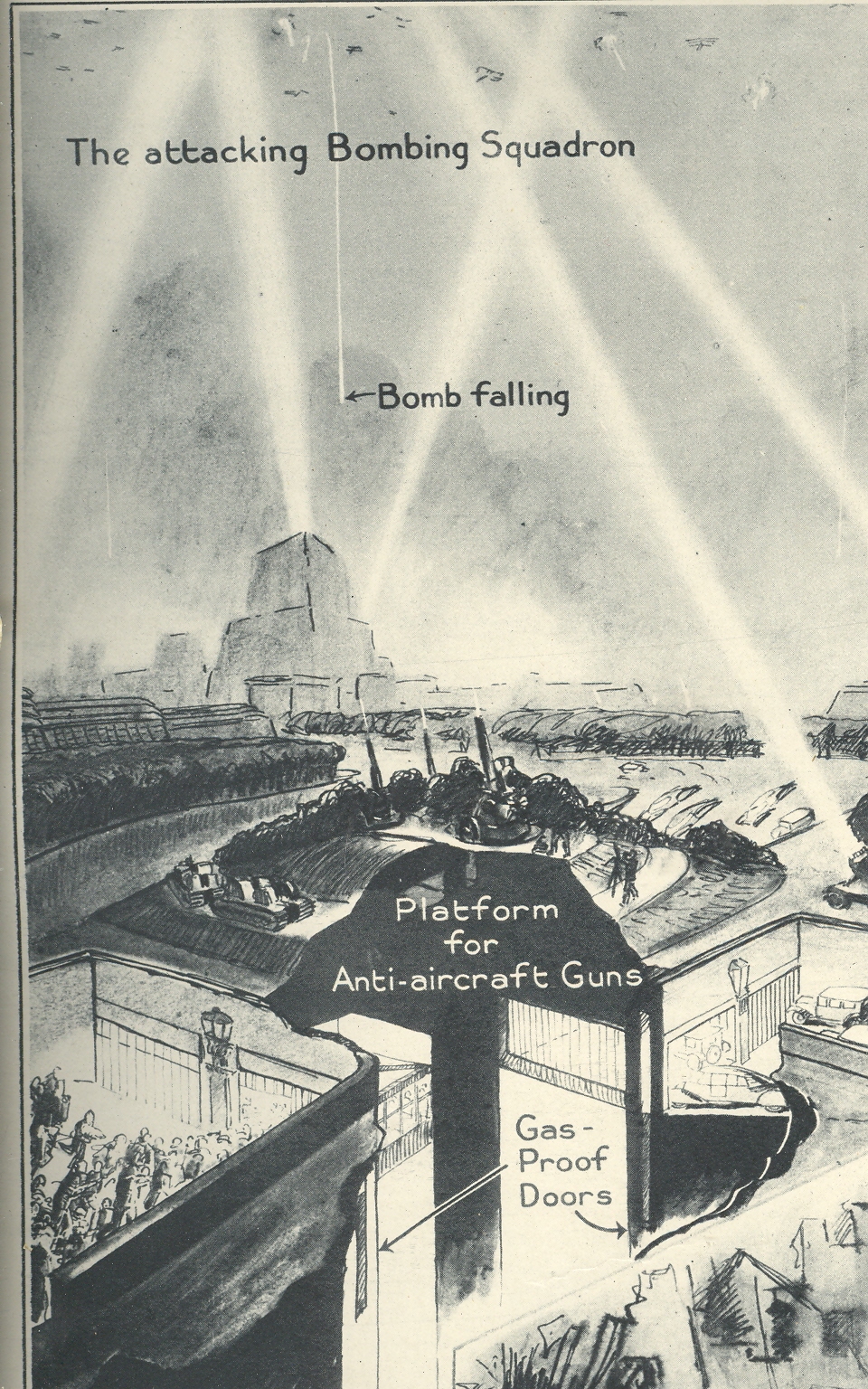
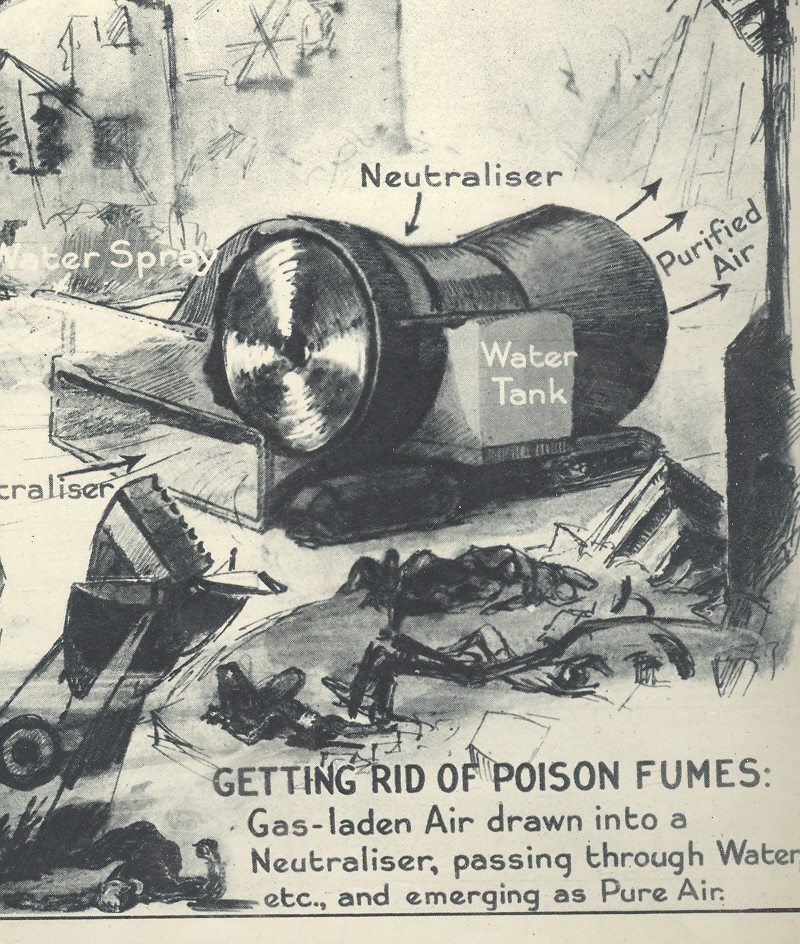
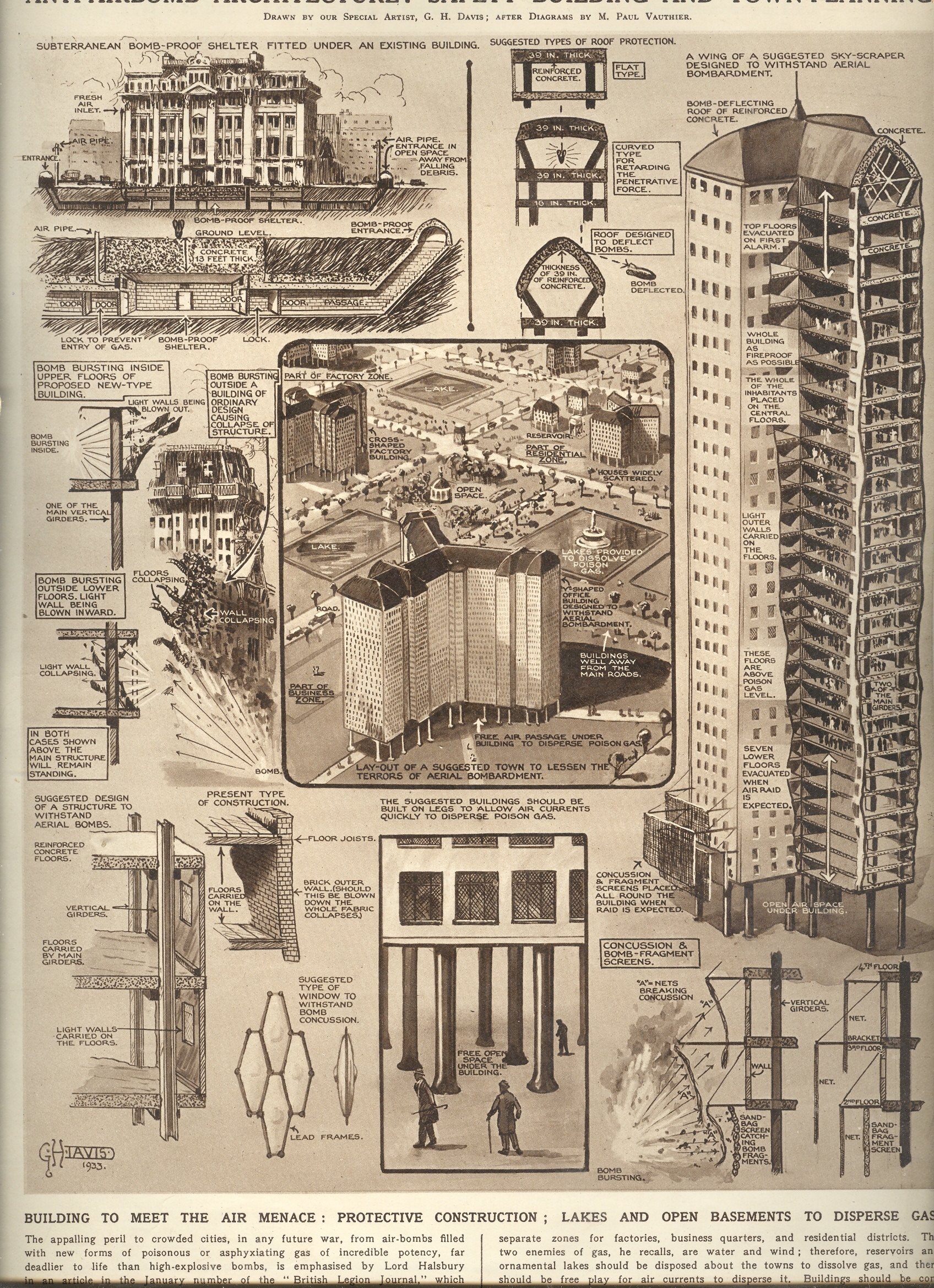
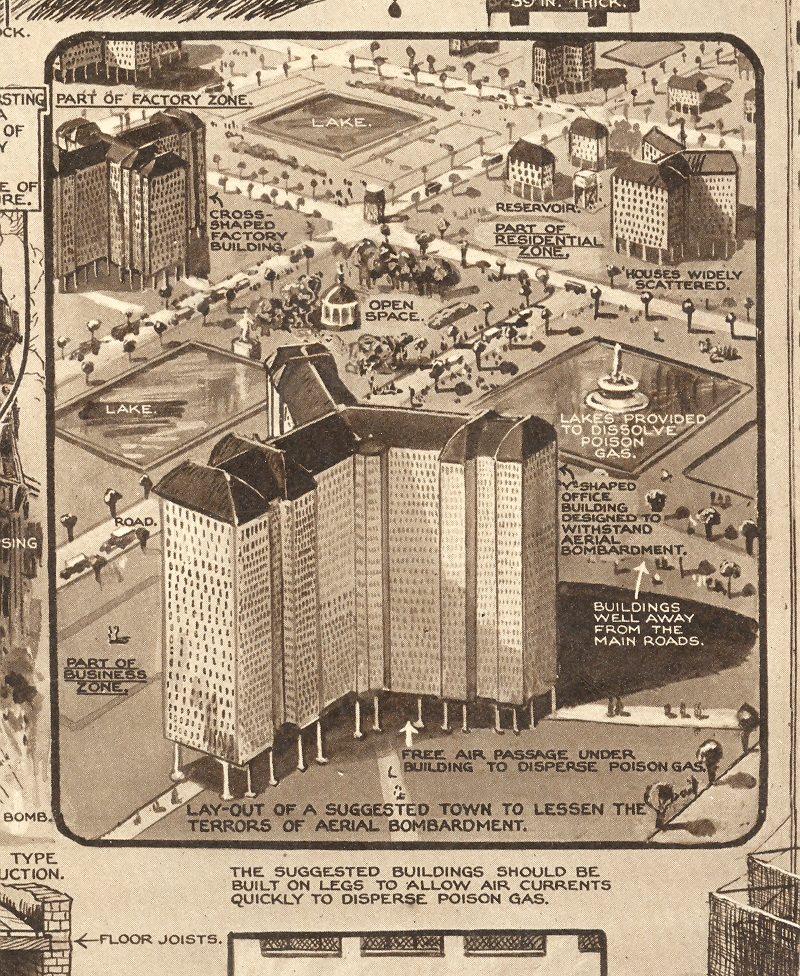
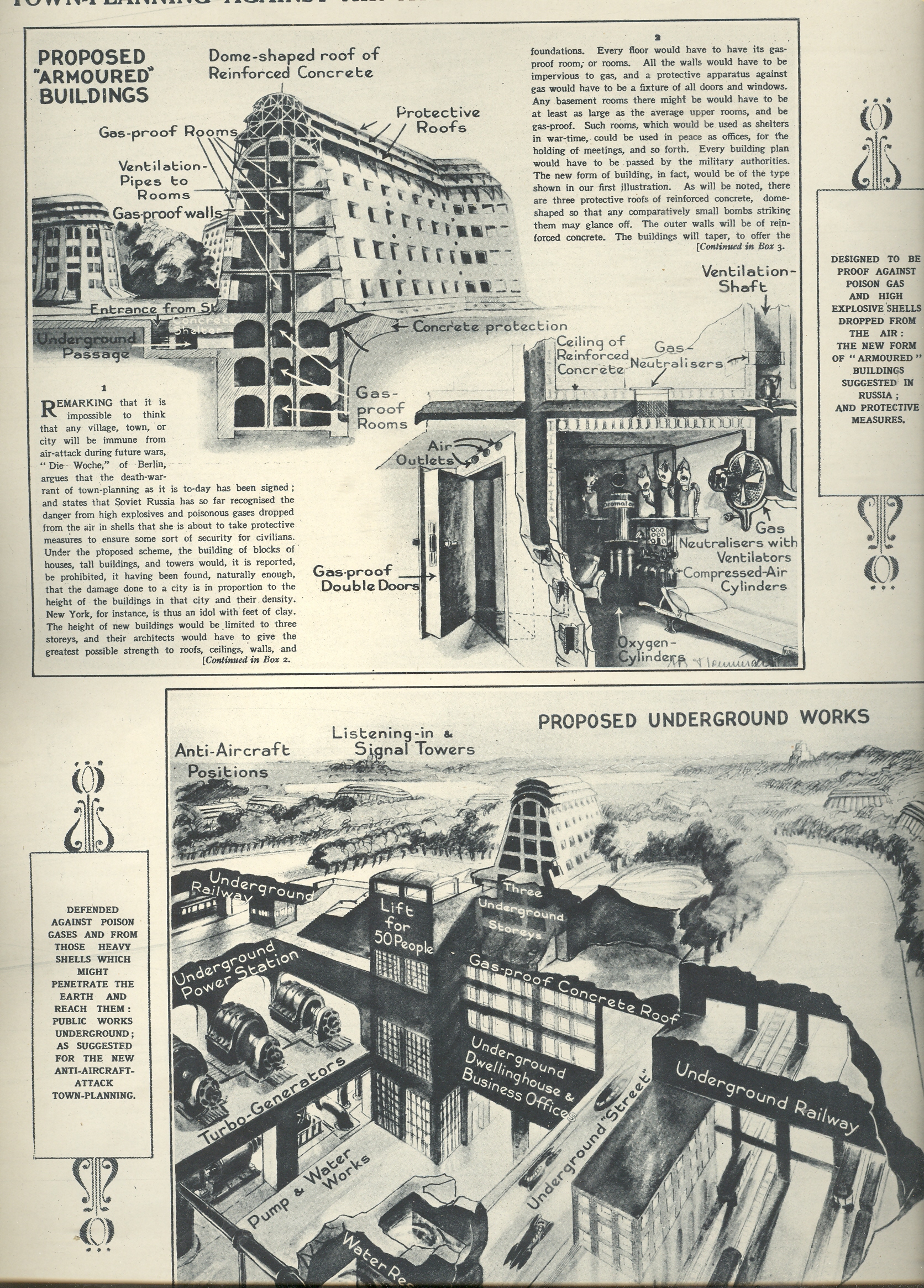
    The Big Fear of bombing from the air and the need to protect
    the populations of cities led to all sorts of anti-bomb/bomb-proof
    architectural plans, most not very good and not very practical.  Such is the price of trying to make your
    people happy.  I happen to have

    a few in
    my files, which are seen above  and below. (The top images were printed in the Illustrated London News in 134; the bottom in 1927.) The results of the plans were no doubt intended to pursue a common belief that cities could be constructed to be bomb-proof, that the future that national leaders were dragging their subjects into wasn’t necessarily as dire as the possibilities of aerial bombings hinted things might be.  Of course the resulting buildings would be massive and impossibly expensive; the prospect for underground cities (and roads!) was just a non-starter.  And these future-views would all be obsolete in less than 15 years what with the development of enormous firepower.  And I’m not talking atomic.  


  • “The First Thing is to Find Some Men” How to Get a Boy-Date, 1941

    JF Ptak Science Books LLC  Post 914

    [Continuing the posts “What Makes Human Robot Girls, 1941” and The Missing Pieces of Women, Pope Joan and the Proper Girl]

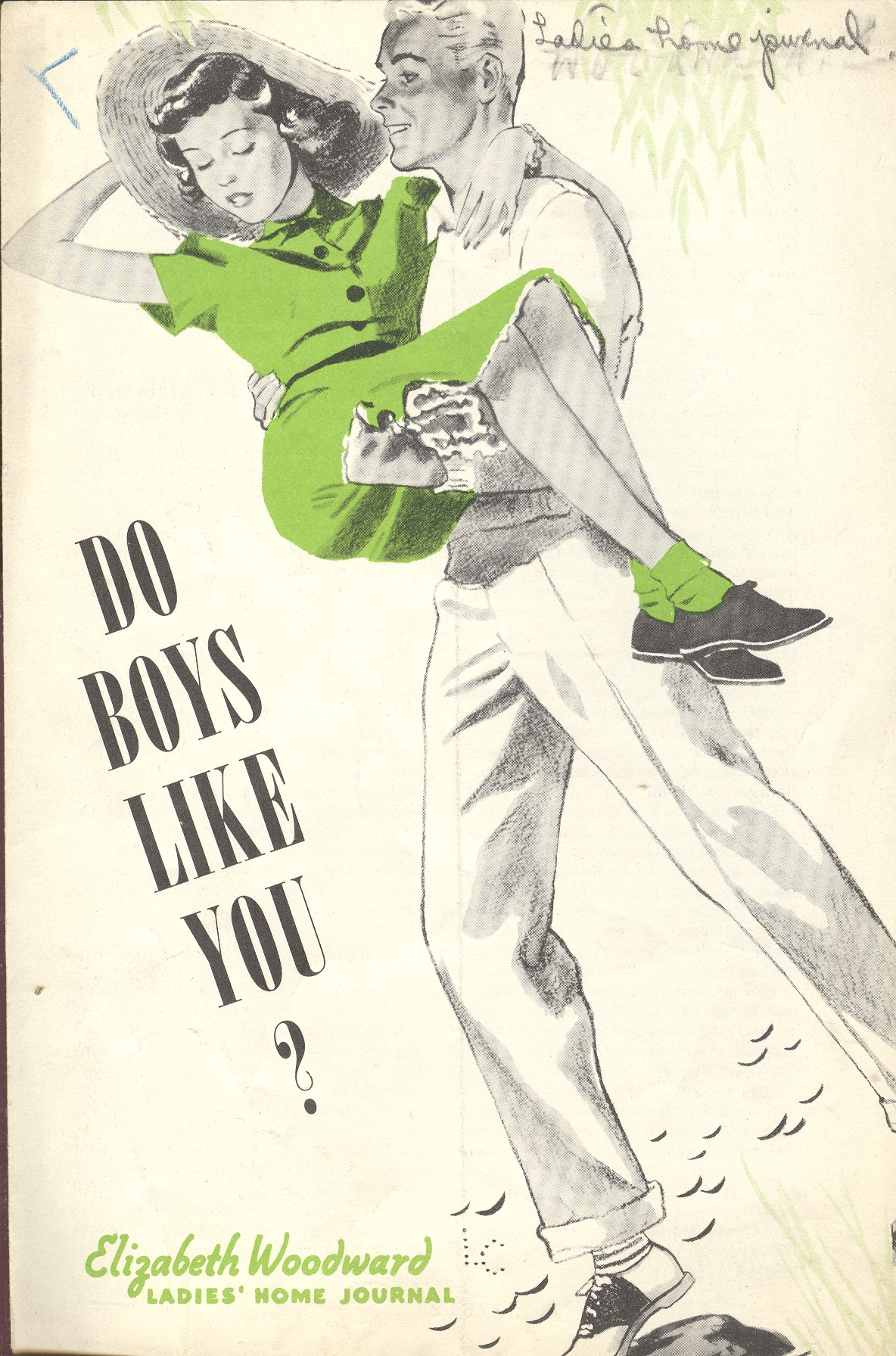
    Do Boys Like You? is
    the name-of-the-game for girls, evidently (“set out to make yourself worthy of a boy’s
    affection.  Just one boy—any boy…”),
    brought to you as a part of a long, continuing series by Elizabeth Woodward in
    the Ladies’ Home Journal in the early
    1940’s. Blog jan 20 boys like you

    This installment is about getting a boy for a date, and how to make
    oneself getable and datable and boy-friendly, all while maintaining the
    thinnest veneer of self-acknowledgment (“be adaptable as a chameleon”) as possible while staying true to “yourself”.  It is a cocktail of overall old-lady sense
    and deep ruffled bows writ by the hand of gender entrapment and not-so-subtle
    subjugation. Let’s get to it with some of the more archaeologically-interesting
    statements of this social-norms-establishing pamphlet:

    Paragraph: (Intro):

    “Do boys like you, or don’t they? Its as easy as that!  Either you have dates and go places with lots
    of boys, or they don’t pay any attention to you at all.”

    Paragraph: “A Female World”

    “…the first thing is to find some men.” (Which is odd
    because “men” is used only one other time beyond this reference—its all boys
    and nothing but boys.)

    “Short of throwing yourself on their (boys’) mercy, see if
    you can’t wrangle an introduction out of the girls who do know boys…”

    “Your parents could invite their friends over for dinner and
    ask them to bring along their son. And you do a good job on him!” (I’m not sure
    what that “job” is.)

    “They (boys) can’t find you if you’re packed away in a mob
    of females.”

    Paragraph: “A Rank Outsider” (on being the new girl in a
    community):

    “The girls have things under control and they don’t want any
    interference from you.”

    “You might know more than they do, and you just might talk
    down your pug nose at them.”

    “…you’d better get accustomed to traveling alone…”

    “Give them every chance to find out that you aren’t high
    hat, that you like the same things they do, that you aren’t out to sniggle
    their men away…”

    “When they (the girls) accept you, the boys will too…”

    Paragraph: “an Old Story”

    “(Boys) are so used to looking at you that they think of you
    as furniture.You’ve got to be new!”

    “If you’re fat and pudgy, make yourself lean, sleek and
    smart.”

    Paragraph “Take it Easy”

    “…its going to take practice to make boys like you. Take it
    easy. Set out to make yourself worthy of a boy’s affection.  Just one boy—any boy…”

    Paragraph “A Few Gentle Hints” (Seems that we’ve gone way beyond this by now.)

    “Don’t run around with girls who are dud.”

    “Don’t go in pairs with a girl who is overwhelmingly popular…Better
    pick a girl who will give you an even break.”

    “Don’t languish for some local ‘hero’ who is sought after by
    all the girls in town.  He may be
    good-but he’s far out of reach…”

    “Don’t pick on a lad who has never had a date with a girl.”

    “Don’t be careless or sloppy when you’re talking with boys…”

    “Don’t expect (or even hope) that every boy you meet will
    ask you for a date.”

    And (not quite) lastly, but should’ve been:

    “Don’t go around thinking about boys constantly.”

    But lastly thus:

    “Act as though you are having fun. Be alive, gay and enthusiastic. Be interested in what’s going on. Be sweet, tactful, and adaptable as a chameleon. Have definite likes and dislikes, but don’t be so rigid
    that you are stubborn, opinionated and difficult to get long with. Be carefree,
    casual, easy, willing to play and fun to play with. And don’t be shy about
    liking the boys.

    THEN THE BOYS WILL LIKE YOU! [Emphasis in the original.]

    My poor mother would’ve been reading this…

    (Thanks to Jeff Donlan for pointing out that the chap on the
    cover carrying the girl away has joined the fabric of her skirt to (1)  hold
    onto and steady her and (2) make sure her skirt doesn’t fly up and out and is not actually touching her thigh…)


  • Red Sky in the Renassiance: the Reverse of Geometry

    JF Ptak Science Books LLC  Post 913

    What
    if our eyes worked in the “opposite” way? 
    What if we somehow broadcast the lines of reality from our eyes1 rather
    than receive photonic emissions from the physical world, that we didn’t specify
    the wavelength and frequency of light, and that somehow electromagnetic rumblings
    in the “visual range” didn’t apply to our sense of sight?

    Blog jan 17 francke

    This
    would certainly make for an interesting  existence
    if somehow the elements around us weren’t necessarily so.  Perhaps this is sort of replacement reality
    is just what has been going on in the entire history of humans, altering the
    landscape to make it more suitable for our existence, a long history of
    painting the physical landscape with something more “suitable”, an
    individualized creation. 

    This
    all came up wondering about this fantastic sky, produced 475 years before
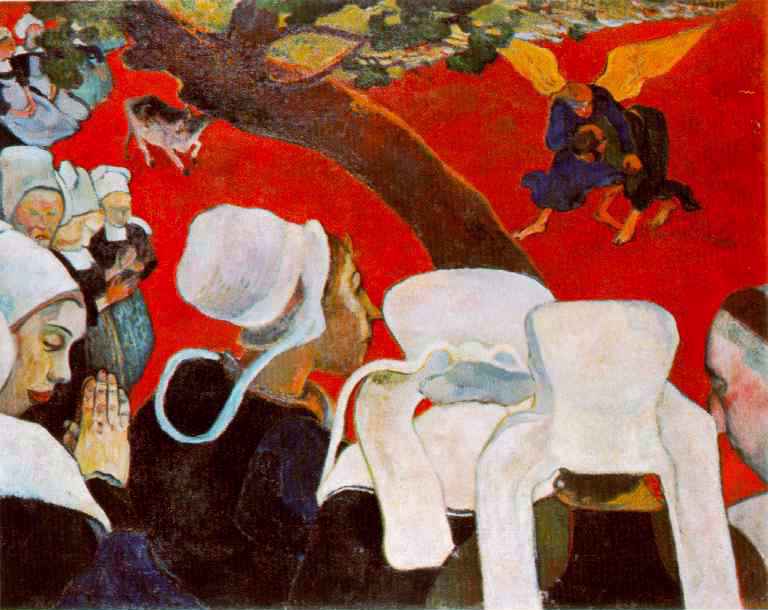
    non-representational art and 455 years before Gauguin started applying big blankets of red2 :  it seems to me
    in a distant impression that it is a representation of vision that is more a projector
    than a camera..  The end result of this
    emission and wayward thought is the fabulous red sky in the painting Nativity by Master Francke3 (ca.
    1424-1436) is a fantastic red sky with lustrous stars.

    The
    painting is otherwise filled with the common reliables of Renaissance iconography
    concerning the nativity:  the place of “birth”
    (a stable or barn-like building, also sometimes appearing as a classical ruin
    or cave), a flock of sheep, a stand of trees, and the watch sensate gazes of the near by
    beasts.  Mary is ecstatic in the same ways
    that Joseph is usually not—to me, he usually seems pretty detached from the
    whole deal, lost in another space.  The
    baby Christ is again just a little man (and not a baby) laying there on the barren
    ground.  [I’ve wondered about Joseph’s
    detachment:  perhaps the whole scene is
    nothing but mysterious, a complexity far removed from his reach and
    understanding, a notion of an act that is so phenomenal that there is no
    retrievable reaction for it, and so he looks away.  Later on in the history of Mary and Joseph,
    and deep into the 19th century when the Immaculate Conception—that is,
    the sexless conception of Mary the mother of Christ which she would later accomplish
    for her own baby—the issue of Joseph’s own virginity comes up, mounting the
    confusion no doubt in Joseph’s already-full head.]

    But
    back to the sky:  certainly skies and
    backgrounds of pure gold and blue painted by the masters in Sienna
    and Florence
    abound during this time, but red is quite unusual.  The sky is accented by the terrific red of
    the wings of the angels and more softly so in the hair of the (long-fingered) Madonna. 

    There
    is also the issue of the hole in the sky, revealing the large-handed Creator with glimpses
    of the alternate, higher, existence visible in the background, a taste of the
    alpha (or omega?) part of the long arch of Earth-borne humanity.

    Notes

    1.The discussion of optics and vision is one of the most spectacular conversations ever held in the history of science and philosophy (along with “time”, “motion” and “the void”.  I think that Leonardo would’ve come closest in relatively-modern times to understanding vision if he had the real capacity of dissecting the eye (which in spite of many approaches to experiment) would always go flat, leaving him with an unsatisfying mess.

    In Aristotle’s Physics (Book II, Part II) we find the following fascinating thought:

    “Similar evidence is supplied by the more physical of the branches of mathematics, such
    as optics, harmonics, and astronomy. These are in a way the reverse of geometry. While
    geometry investigates physical lines but not qua physical, optics investigates
    mathematical lines, but qua physical not qua mathematical”

    A classical position of the emission theory of optics is stated by Hero in his Definitions:

    “Optics does not deal with physical questions and does not study whether given rays
    flowing out from the eyes go forth to the boundaries of objects or whether images that are
    detached go forth from corporeal objects [and] enter the eye along a rectilinear path or
    whether the intervening air is stretched or contracted by the ray-like pneuma from the
    eye. It is only concerned whether, at each reception (of an image) the right direction of
    movement or tension is maintained as well as the requirement that the convergence to a
    point occurs at an angle when objects are seen that are larger or smaller than the eye.”

    (My thanks to Dr. Kim Veltman for these quotes from her Continuity and Discovery in Optics and Astronomy, Studies on Leonardo da Vinci http://www.sumscorp.com/books/contin/title.html)

    2. I had Gauguin’s 1888 “After the Sermon/Jacob Wrestling the Angel” in mind for an example of this.

    Gauguin.sermon

    3. Master Francke active (c. 1424 –
    36 ), Nativity, in the Kunsthalle, Hamburg; oil on oak,
    39×35 inches.
    Hamburg, Kunsthalle. “German painter who worked in Hamburg, where in 1424 he painted a huge altarpiece for the company of merchants who traded with England, the so-called ‘Englandfahrer Altar’, originally placed in their chapel in the Johanniskirche (remnants in Hamburg, Kunsthalle). When closed, the double-winged altarpiece displayed four scenes from the life of S. Thomas Becket, the patron saint of the company, above four scenes from the life of the Virgin (e.g. Nativity;).
    Opened, the altarpiece showed scenes from the Passion of Christ.
    Francke was a leader of the northern German version of International
    Gothic
    . He had close links with French book illumination (he may
    have worked in
    Paris for some time) and the
    paintings of the
    Rhineland, especially those
    of
    Conrad van Soest
    , though it is not known where he received his training.”

    Other Nativity scenes as follows:

    ·Posted by :

    ·in:

    — — —