A Daily History of Holes, Dots, Lines, Science, History, Math, Physics, Art, the Unintentional Absurd, Architecture, Maps, Data Visualization, Blank and Missing Things, and so on. |1.6 million words, 7500 images, 4.9 million hits| Press & appearances in The Times, Le Figaro, Mensa, The Economist, The Guardian, Discovery News, Slate, Le Monde, Sci American Blogs, Le Pont, and many other places… 5000+ total posts since 2008.

Author: JF Ptak

  • How Long is the Coastline of Great Britain?

     JF Ptak Science Books  Post 1193

    [This pamphlet may be purchased from our blog bookstore site, here.]

    This is the first of a few short essays of the idea of pre-historic appearances of important ideas. I use the word “pre-historic” in its literal sense—that is, these papers were published before the concepts that they discussed were recognized and published, later, in more complete form and of course to greater fame. One will certainly be Gregor Mendl’s paper (Versuche über Plflanzenhybriden ) published in the obscure Verhandlungen des naturforschenden Vereines in Brünn, (Brno), and to be resurrected at the hands of Gregory Bateson thirty-odd years later to much acclaim. Another example is Vannevar Bush’s “As We May Think”, published in The Atlantic Monthly in June 1945, and which was a now widely recognized definite intellectual precursor to the construction of what we know  today as the Internet.

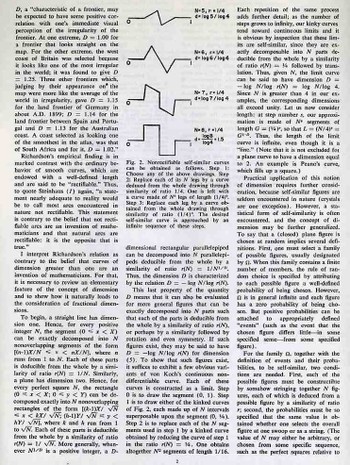
    Blogmandelbrot217_2Right now, though, I’d like to look at the pre-birth of fractals in Benoit Mandelbrot’s precursor (1967) paper (and in a weird, probably not-correct way, scooping himself) to his more famous effort of 1975, in which he coins the term and fully describes “fractals”, showing the measurement of the coastlines behave like a fractal over a range of measurement scales.

    The seminal paper, How Long Is the Coast of Britain? Statistical Self-Similarity and Fractional Dimension, published in Science magazine in 1967, is an introduction to the concept of fractals (which Mandelbrot would name later in 1975). The kernel of it all is found in the Lewis Fry Richardson graphs and more so in the small illustration on page three of the paper—the peek into the future world of fractals, seeing a fractal before it was named so.

    Richardson (a kind of Jevons, or Marey-like American figure on the history of 20th century science) did some very good thinking about the elusive nature of naming such a thing as the lengths of coastlines and other natural constructions: namely he determined that their measured length was dependent upon the scale of measurement. That is to say the measured length, L(G), is ruled the scale of G, approximating the function as L(G)=M(G)1-0 

    Mandelbrot moves on to discuss the coastline in terms of it being a self-similar object, which is something that is nearly exactly similar to a part of itself, or the whole having the same shape of one or more than one of its parts, and regresses. 


    ·Posted by :

    ·in:

    —

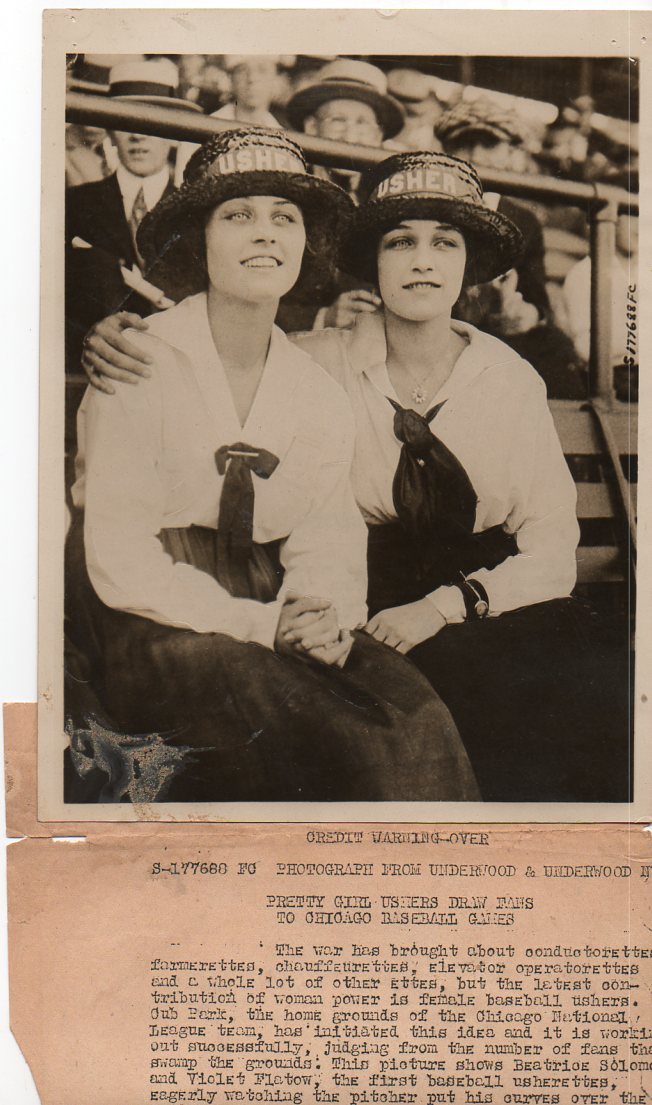
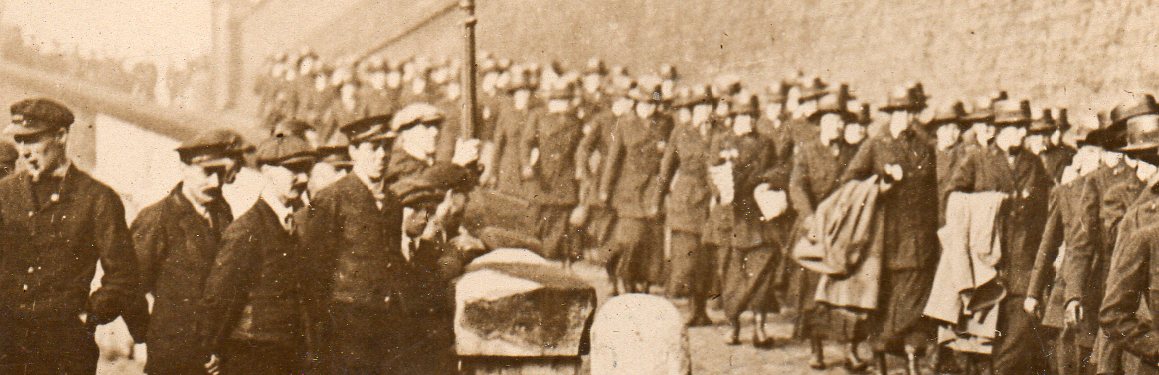
  • Women in World War I–Rare Photographs, 1918

    JF Ptak Science Books  Post 1190

    WWI--e--women ushers684

    [All of the images below are available for purchase; see our blog bookstore for details.]

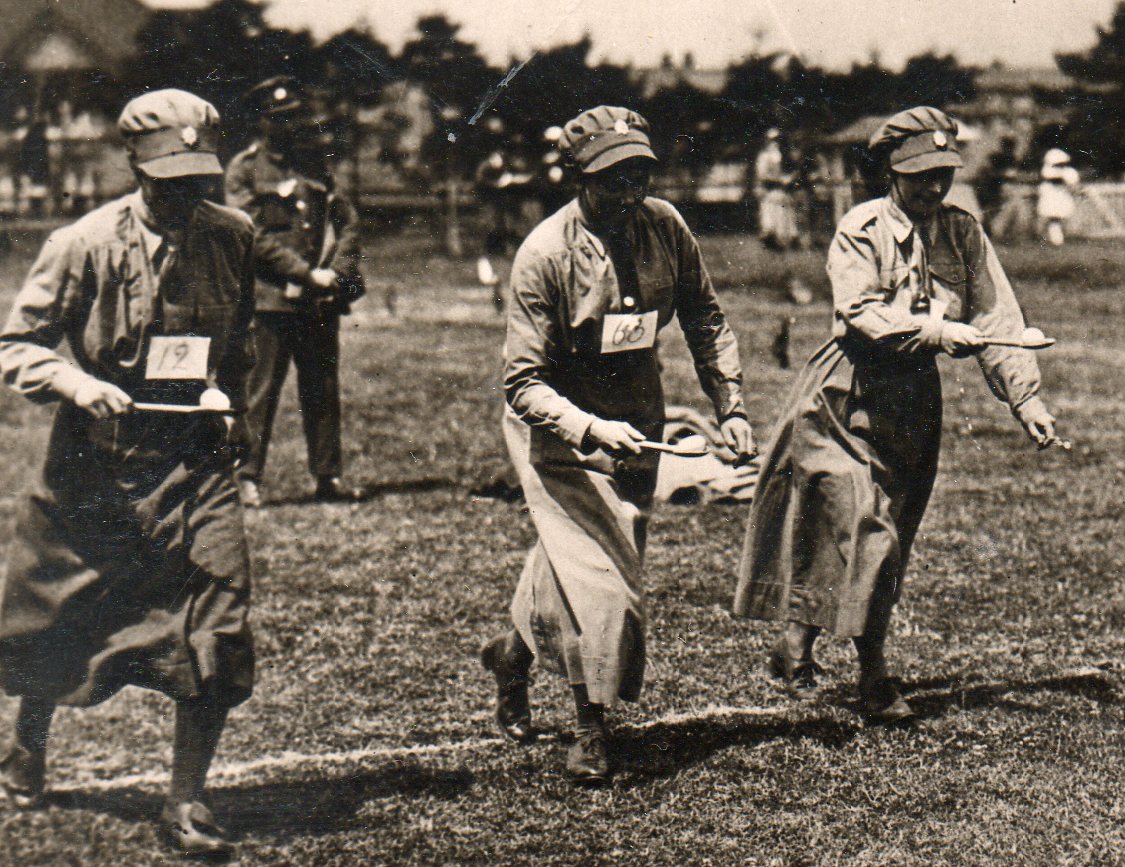
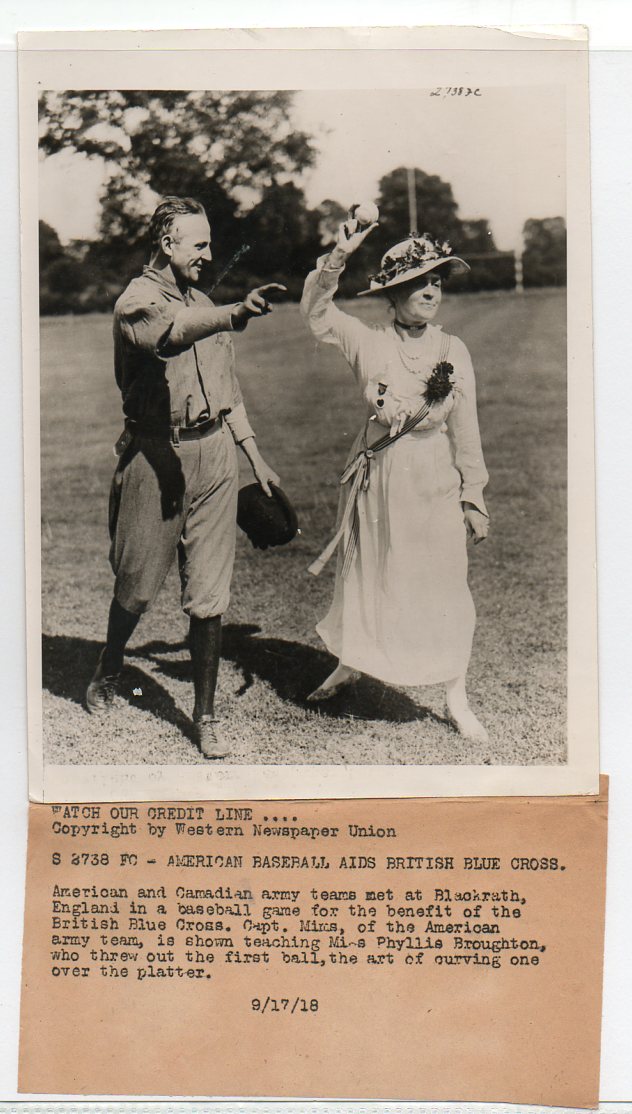
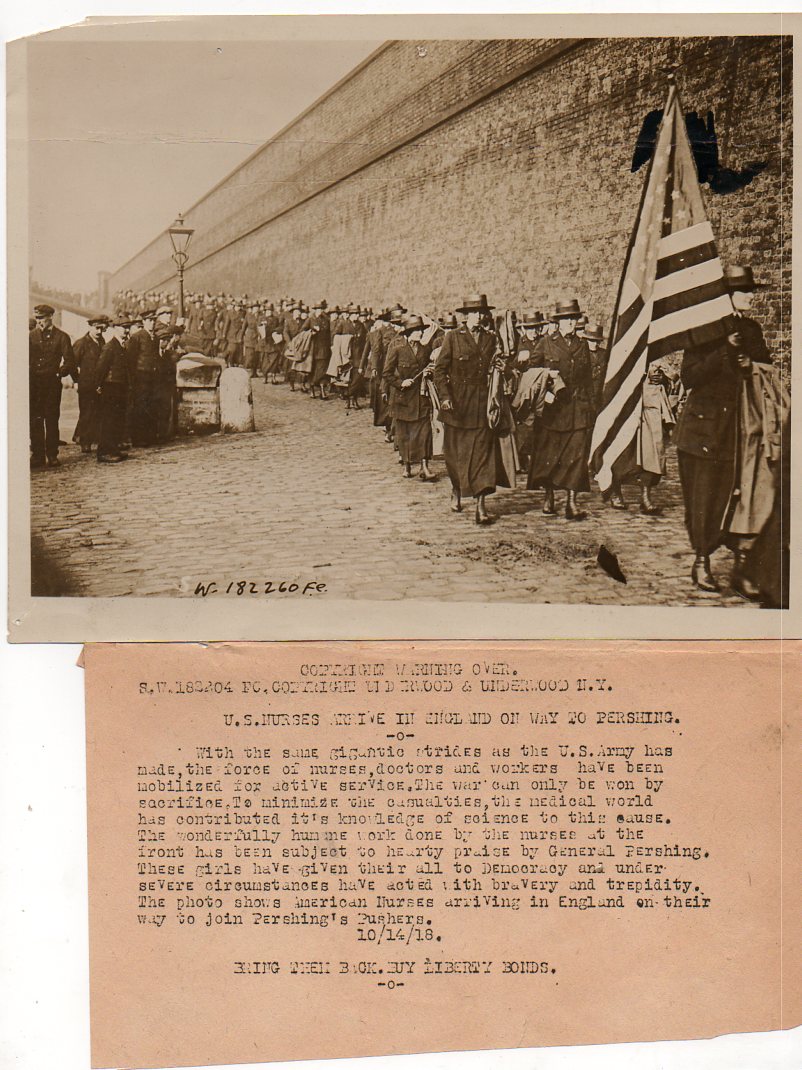
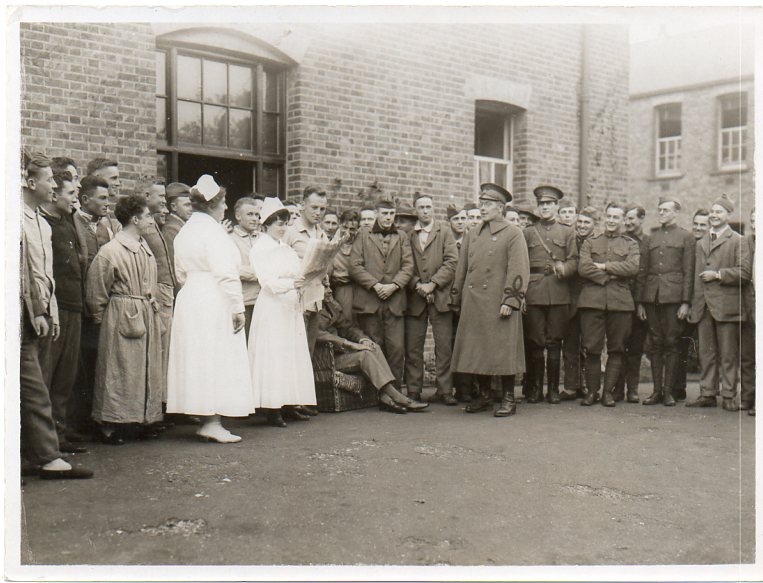
    This is another in a series of posts on images from my News Service Photographs of WWI collection.  All thousand or so of them were made in the last half of 1918 (save for a very few made in 1919) , in the last months of the grueling conflict, and were intended to be used by newspaper and magazines to illustrate stories about the war. An editor would send off a request to one of these agencies for, say, a photograph of marching American nurses, and the agency would send one back (for a fee) along with a caption.   There’s really no way for me to determine if these photos were ever published, and there is never an attribution for the photographer. 

    Most of the images have an accompanying descriptive text–this was to be used by whomever published the photograph, along with the attribution for the source of the photo. 

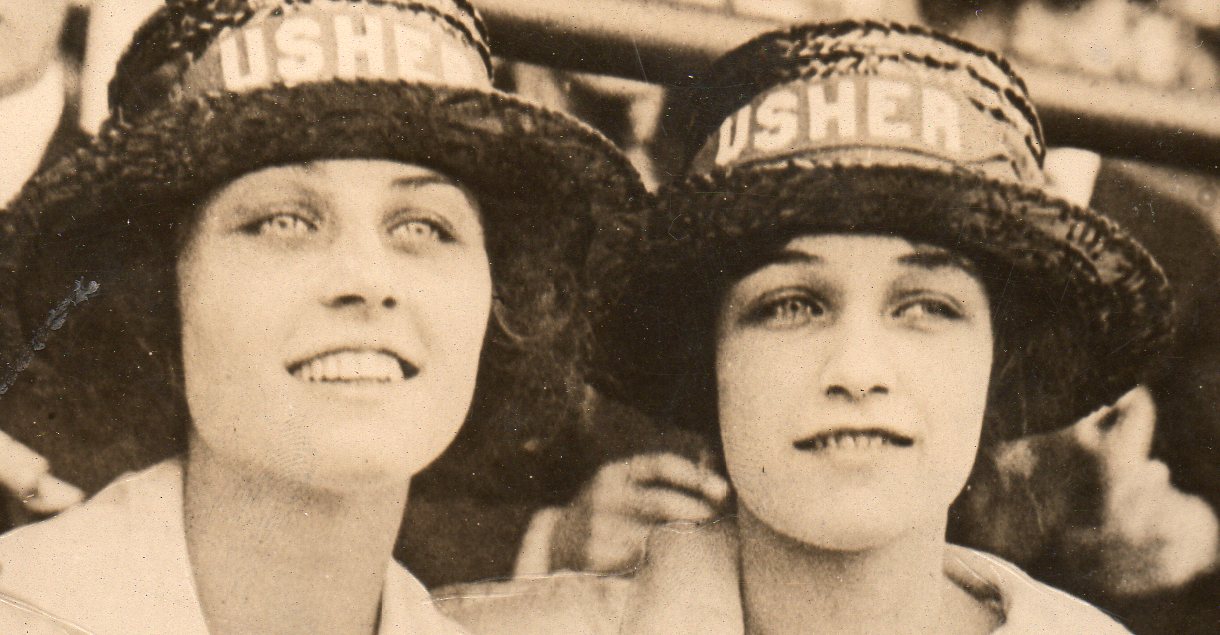
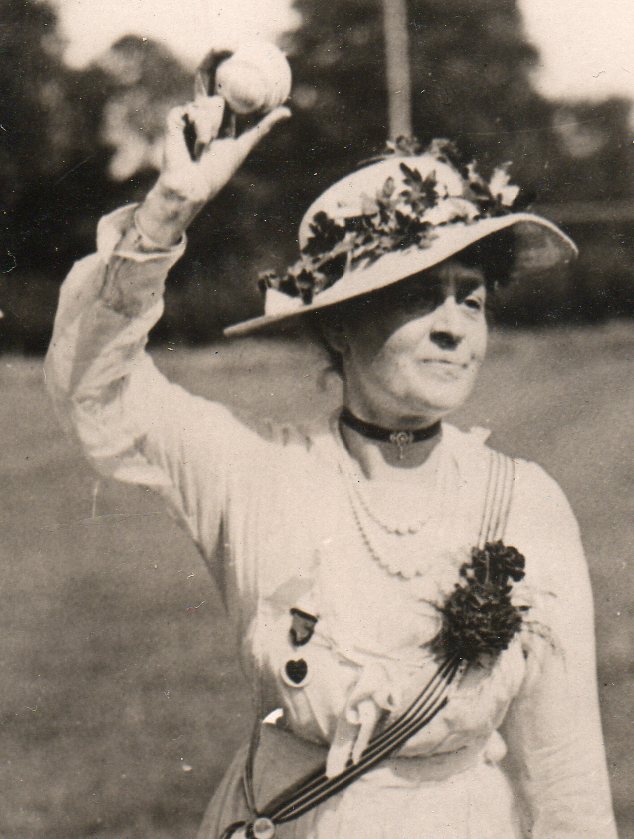
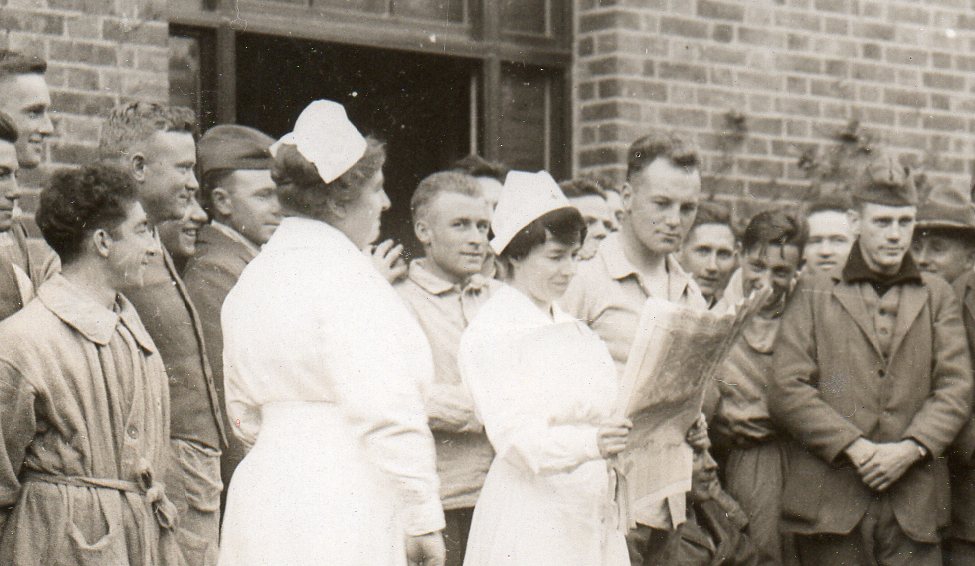
    In almost every case I supplied a detail of the image, hopefully of something that you’d want to see a detail of. 

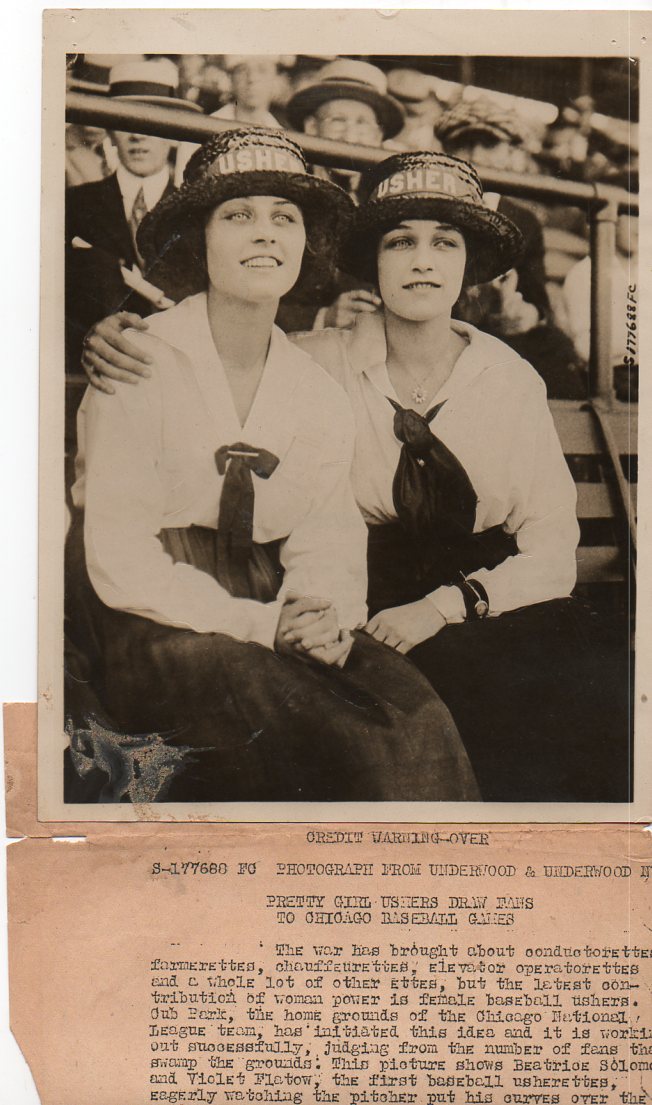
    WWI--e--women ushers684
    WWI--e--women usher dets685

    ORIGINAL Photograph, 1918.  8×6 inches.  Very good condition.  $150

    WWI--e--women--egg race det664
      WWI--e--women-baseball672

      WWI--e--women-baseball det673

    WWI--e--women--nurse pershing653

    WWI--e--women--nurse pershing det654

    WWI--e--women--nurse reading paper659

      WWI--e--women--nurse reading paper det660


  • Japanese-American Response to Removal and Internment, April 1942. The Tolan Report.

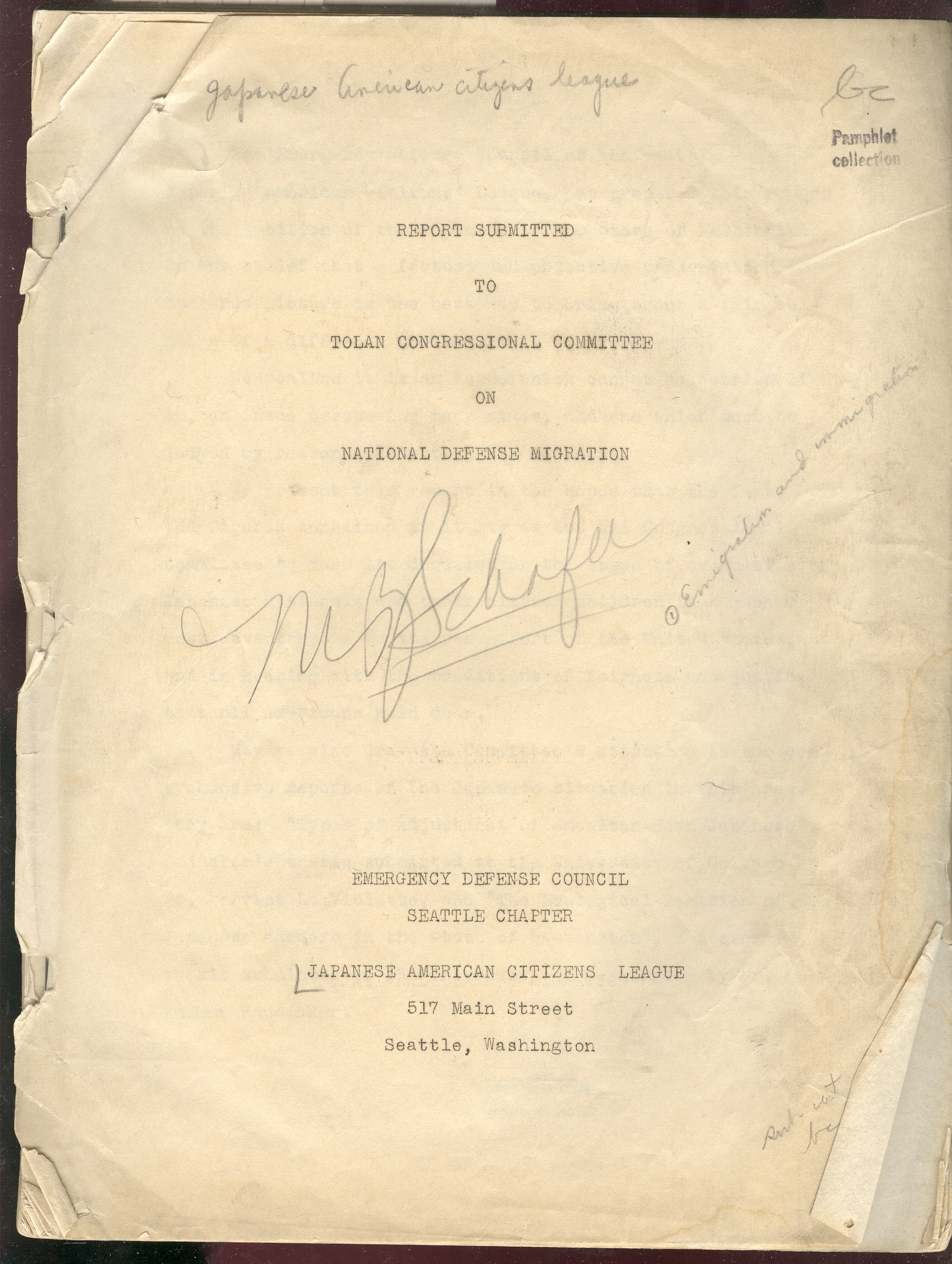
    “We Are Americans”: Japanese American Citizens Respond to Internment and Removal, April, 1942. 

    [Original document available for purchase at our blog bookstore site.]

    “….there must be a point beyond which there may be no abridgement of civil liberties and we feel that whatever the emergency, that persons must be judged, so long as we have a Bill of Rights, because of what they do as persons We feel that treating persons, because they are members of a race, constitutes illegal discrimination, which is forbidden by the fourteenth amendment whether we are at war or peace.”– A. L. Wirin, Counsel for the Southern California Branch of the American Civil Liberties Union, speaking on the internment of Japanese-Americans, 1942

    000--tolan

    “We make these statements, not because we fear evacuation, but because we believe, to the bottom of our hearts, that the best interests of the United States, our nation are to be served by being permitted to stay, work, fight, and die for our country if necessary here where we belong.“–Response by the Japanese American Citizens League to Internment Camps, 1942

    This excruciating, heart-rending 1942 document was submitted by the Japanese American Citizens League (of Seattle, Washington) to the Tolan Congressional Committee with recommendations, proposals and requests in the event of the removal of Japanese citizens from “sensitive” areas in western America  It is an exceptional report, a well-reasoned response to the developing and calamitous American fear of Japanese fellow-citizens; a fear which was swiftly leading itself to xenophobic actions the result of which was the internment of 120,000 American citizens in non-lethal concentration camps…

    Continue reading at bookstore link.

    ·Posted by :

    ·in:


  • Women in World War I–Vermeer of the Tars, 1918

    JF Ptak Science Books

    [This original, vintage image maybe purchased from our blog bookstore, here.]

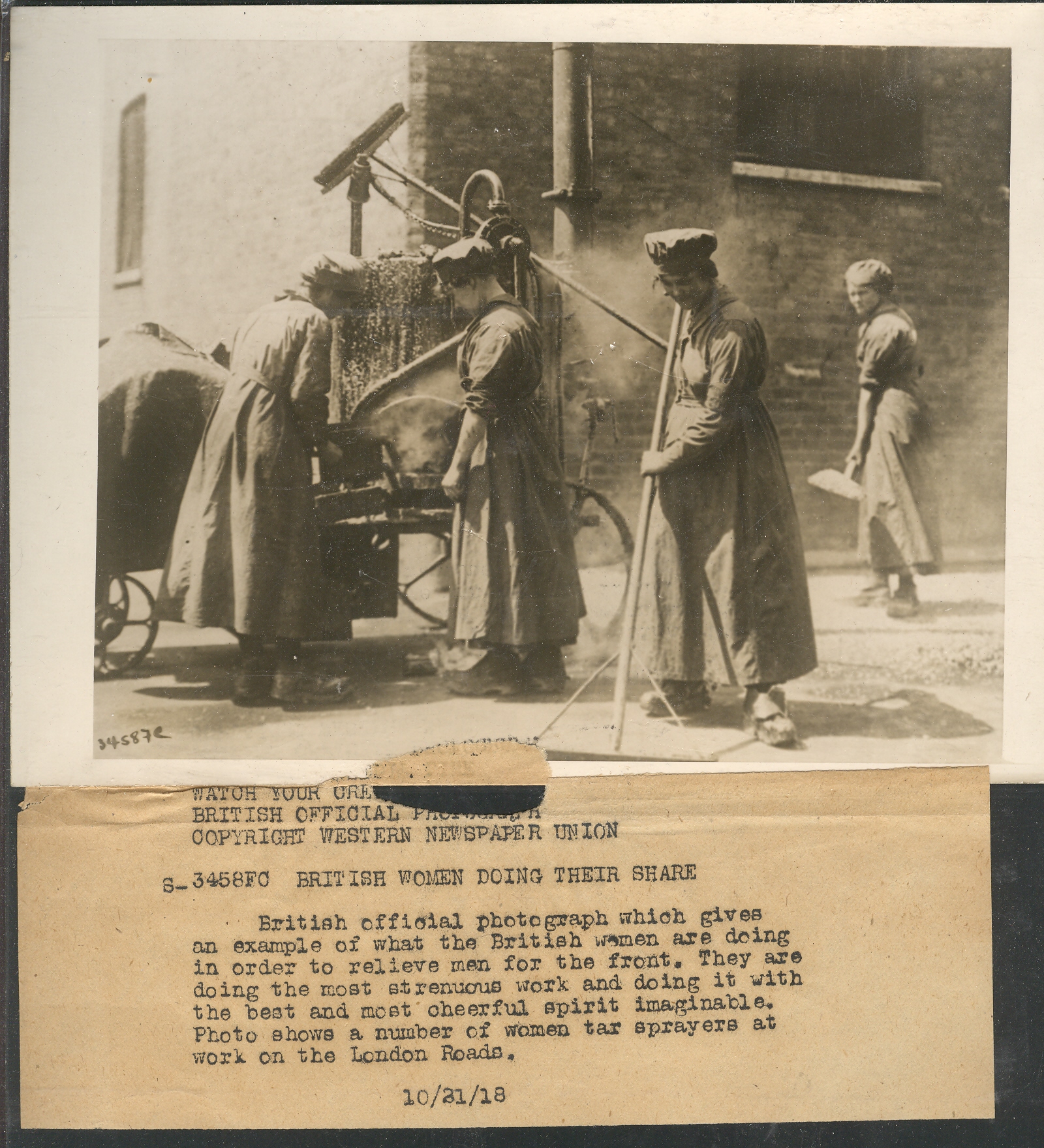
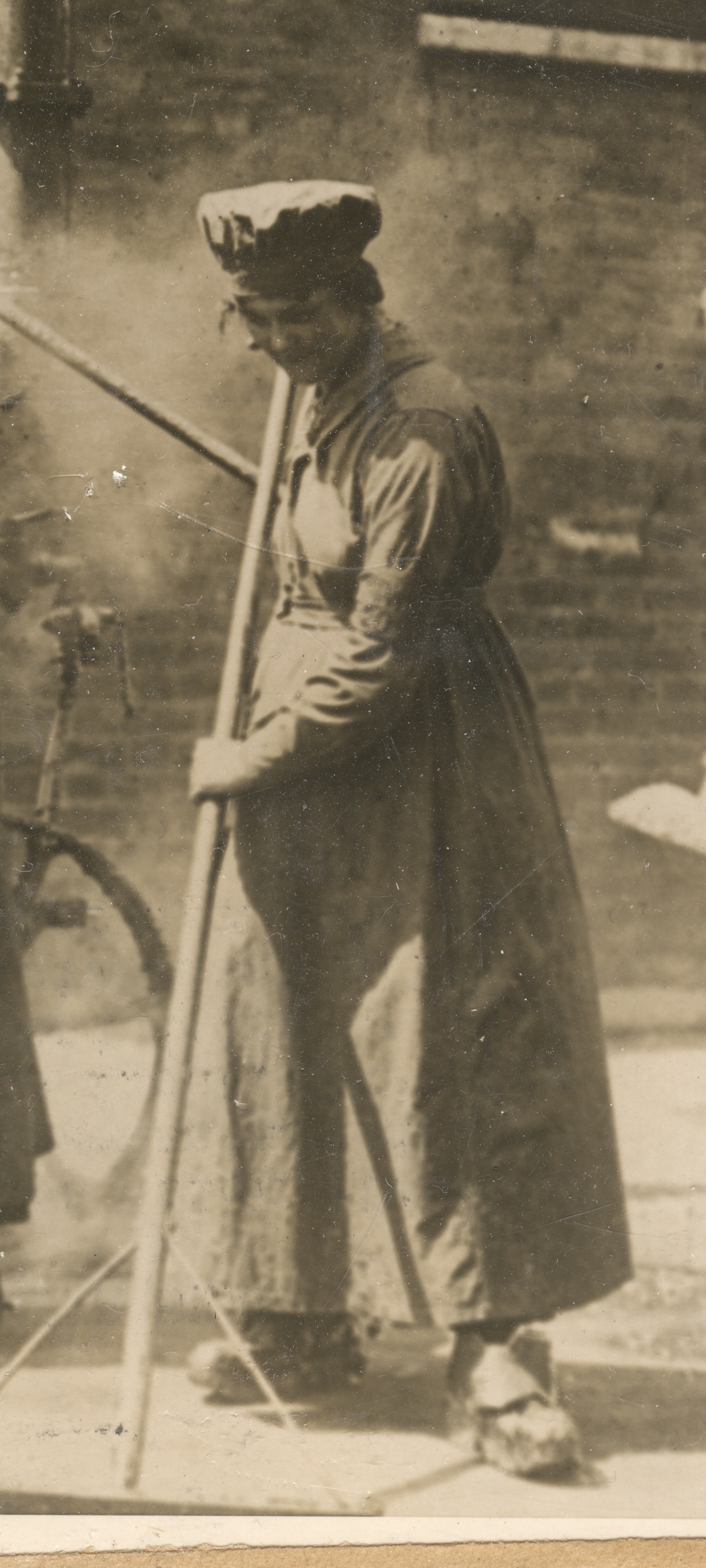
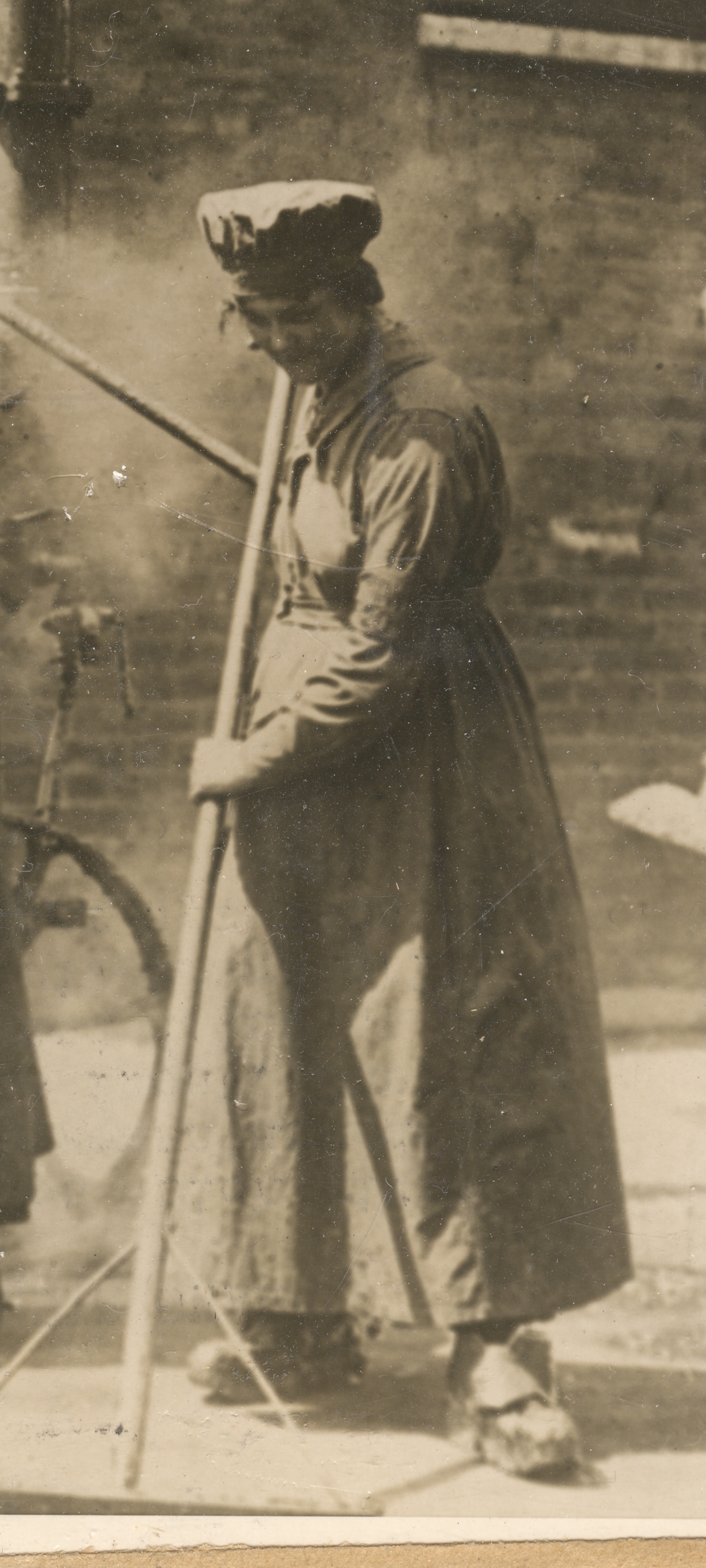
    0 ebay nov 20 WWI Vermeer In England, women were welcomed to the (paid) workforce during the years of the First World War (1914-1918)—their employment in traditionally male positions enabled those they replaced to go out to the front and die for their country.  Thus the women seen here in the News Photo Service Agency photograph (taken in 1918), working at spraying tar in the streets of London, were appreciated, and tolerated.  For women in England the War blasted away the contrivances of formally scheduled employment:  something like 12% of fall women in England were working as servants and house cleaners.   Come the War, women were offered jobs of revolutionary stature in a wide range and variety of work.  The Civil Service employment for women went from 33,000 in 1911 to 102,000 in 1921, and trade union membership rose 160% (357,000 in 1914 to 1,000,000 in 1918 (with men showing a 44% increase at the same time); for the most part, though, employers took advantage of the situation, and the women still generally earned less than half of the salary as comparable male workers did (or the men they replaced). 

    When the end of the War came, so did the appreciation for the women replacement workers—there was bitter feelings in the post-war period because of the weak British economy and a scarcity of jobs.  So the women who took the jobs of men to help the country’s war effort and free up hundreds of thousands of men for war service became an atavistic action, “taking” the jobs of men who had gone out to fight for their country. This of course cost many women their jobs, but the damage had already been deeply done to the pre-1914 British world of the sexual politics of business-being-done, though it would take World War II to really ingrain the appearance of women in the workforce into the national psyche.

    I’ve liked this photo for a long time, seeing things differently in it over the years.  It struck me just yesterday that the woman in foreground-right–whose close-up reminds me too of a Madonna, a Mona Lisa of the Tars–looks like a Vermeer character from 400 years ago.  Or at least the position of her body does.

    0 ebay nov 20 WWI Vermeer 001 

    0 ebay nov 20 WWI Vermeer 001 0 blog nov 20 vermeer water

    ·Posted by :

    ·in:

    —

  • World War I Photographs–German Prisoners, Mass Crowd Scene, 1918

    JF Ptak Science Books


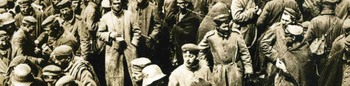
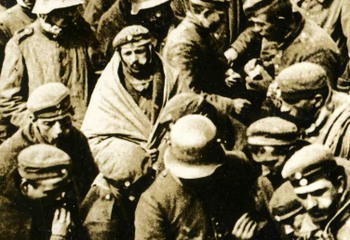
    Blogcrowdsphoto_ww1249_2 This image comes from a collection here of First World War news service photographs,  showing German prisoners being readied for transport home, and dated 20 November 1918.  This group had evidently surrendered just before the armistice was signed, and was sent directly and instantly  to a staging area for transport back to the Fatherland.  The way that many newspapers obtained the war images that they published in their papers was via a semi-centralized pool of war images.  The newspaper would request, say, a photo of German prisoners, and would contact one of these photographic agencies—in this particular case, it was the Central News Photo Service of 26-28 Beaver Street, NYC—and purchase the rights for republication, and then print it in the newspaper along with the story.  In almost every case the photo would be accompanied by a caption mimeographed onto an attached piece of cheap paper, and in this case it reads:  “Waiting to Return Home/a photo just received showing a batch of enemy troops who surrendered just before the signing of the armistice, joyously discussing the coming of peace and the opportunity of returning home to their families.”
    Blogcrowdsphoto_ww1_detail_long251I seriously doubt that the copy editor could read the minds of either the photographer or the troops in the photo.  I would imagine that they were definitely joyous about going home ALIVE to their families, but when looking really closely at the picture the thing that seems to dominate the actions of the people is food.  Or cigarettes.  But mostly when looking hard at the faces in the photo, the men just look tired.
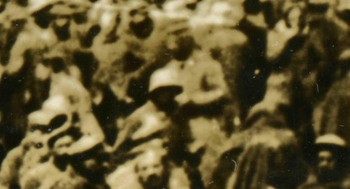
    Blogcrowdsphoto_ww1_detail_super253
    Looking very closely at these types of images has always been fascinating; look close enough, under high magnification, and the large photo becomes composed of dozens of smaller photos.  The whole is an assemblage of vignettes, each in themselves a work of art.

    Continuing in a more odd tone, I’m also reasonably convinced that after looking at hundreds of faces in a photo like this that you’ll find a picture of yourself.

    Blogww1_crowd258_2

    I did.  This section is a 3200 dpi scan of a 15×10 mm section, and I am undoubtedly and unquestionably the bald bearded man (one of the few people in the image without a hat) at center-bottom.

    ·Posted by :

    ·in:

    — —

  • Airwar over Gallipoli–New, Massive Aeroplane-delivered Bombs, 1915

    JF Ptak Science Books

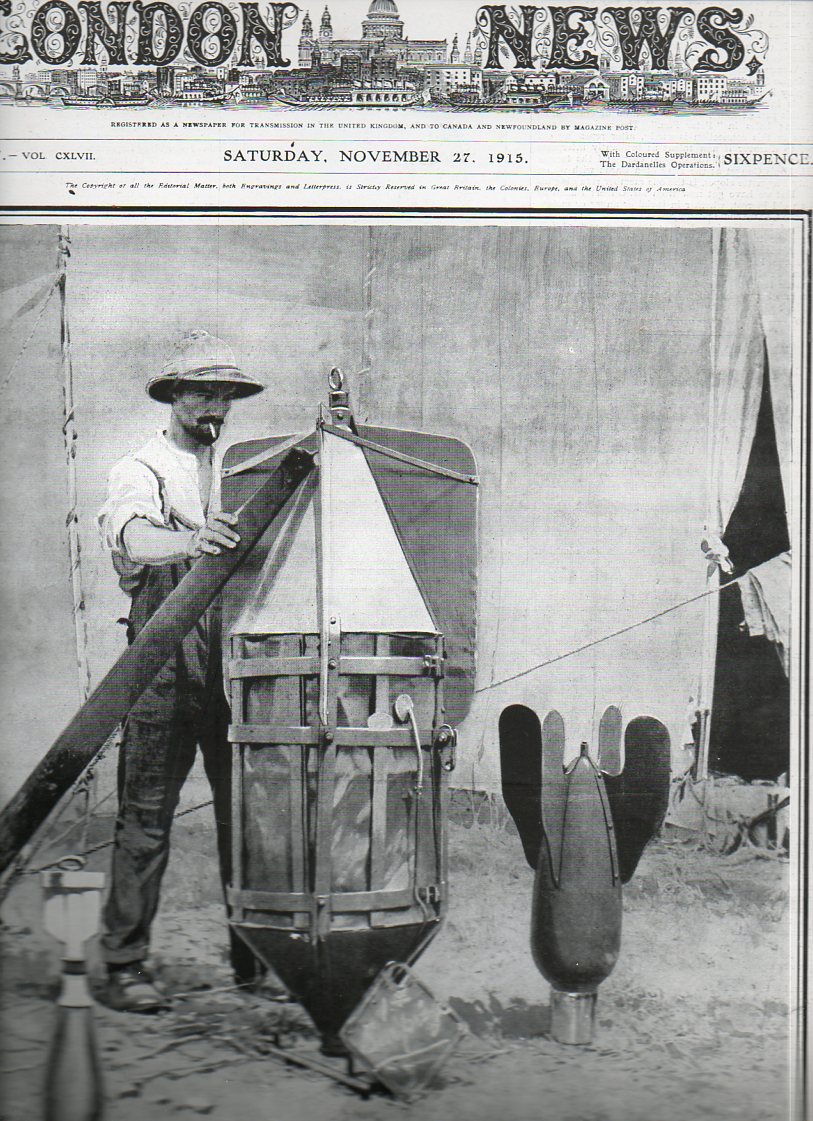
    War Images “Almost as Tall as a Man!  Great Bomb Used by the Allies Airmen at Gallipoli”, as seen on the front cover of The Illustrated London News for 27 November 1915. The campaign at Gallipoli was more than half done, more than half-way closer to the finish, which found the Allies retreating in the midst of high misery, gallant action, and broad death and destruction, with more than 390,000 soldiers from both sides being killed or wounded during the 10 months of the campaign. It was a miserable experience–hot in the summer, cold in the winter, with frostbite, rotting corpses, dysentery, bad food, poor sanitation, supply difficulty, and ultimately a costly stalemate which was supposed to have ended up in an Allied route to Russia. 
    WWI--e---aerial bomb642

    The use of bombs by airborne craft was still in its infancy at this point, the idea coming into use just a few years before the beginning of the war in 1914–the practice was quickly adapted after 1915.  (The first use of bombs dropped from airplanes is widely seen as having taken place by the Italians in 1911 and then in Mexico during the revoultion in 1912.) This image shows the development of an enormous bomb, though its details and destruction force “are left to the imagination of the reader”; I’m pretty sure that the bomb (if it was real and if it wasn’t just a piece of propaganda) would’ev been hauled aloft and dropped from a dirigible rather than an airplane. 
    See: Airwar over Gallipoli/Dardenelles   and here for a general look at aviation udring the early part of WWI.

    [We offer the weekly issue of the Illustrated London News for sale here.]

    ·Posted by :

    ·in:

    — —

  • War Ads, 1915–Gallipoli and Soap, Tires and Zeppelins, 1915

    JF Ptak Science Books

    [These items are available for purchase on our Blog Bookstore, here.]

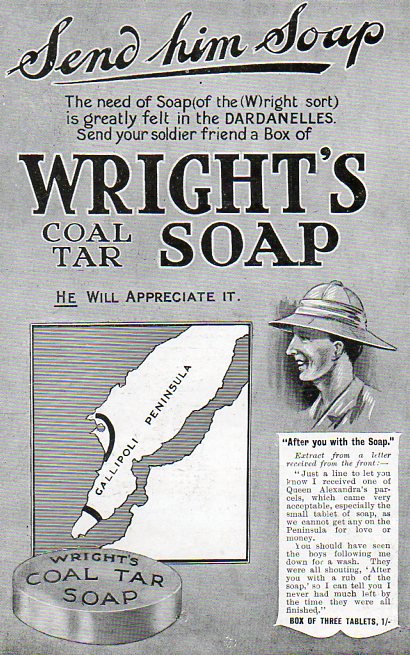
    These ads are interesting and take a bite, both ways.  For example, the first–for Wright’s Coal Tar Soap–uses the background of the enormous struggle in Gallipoli to sell itself.  The ad appears in the 9 October 1915 issue of The Illustrated London News, and stresses the fact that the troops were badly in need of, well, soap, among other things,

    WWI--e---galipolli640

    not the least of which was forward motion, or victory.  But the fact of the matter is that this relatively cheery image of the actions at Gallipoli looks entirely misplaced, especially at this point in the campaign when things were going badly.  The battle took place at Gallipoli peninsula in Turkey from 25 April 1915 to 9 January 1916, and the conditions were deplorable: massive heat, rotting corpses, poor sanitation, dysentery, flooding and then frostbite and bitter cold in the winter–that, plus the killing part, with 392,338 killed and wounded on both sides of this one campaign.  There’s much more to this campaign, of course–especially for my New Zealand and Australian friends– but this is not the place for it.   I was just taken by the spectacularly mundaneness of this ad for selling soap on the back of a terrible campaign.
    WWI--e- german dirigible639

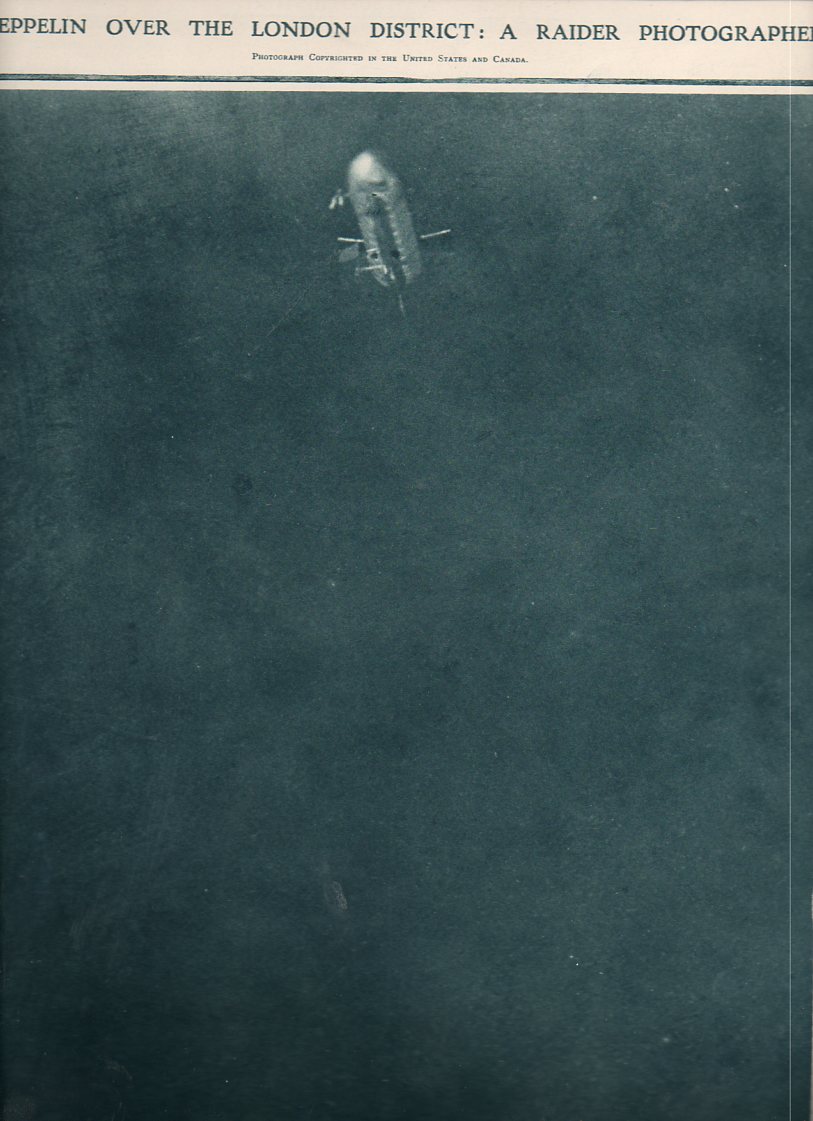
    The second ad sells British nationalism, of course, screaming to its readers to avoid purchasing German rubber tires, “made in the same factory as the fabric for Zeppelins”.   This appeared in The Illustrated London News for 23 October 1915.  The Zeps had definitely appeared over London by this point, and the ad drives the point home by showing an exploding shell over Westminster Clock Tower (from 9 October 1915 issue).

    WWI--e---zeppelin london641


  • What is It? Stinky Pete, the 8086 Processor, Vernacular Construction and Mies van der Rohe

    JF Ptak Science Books Post 1186

    Stinky pete Years ago I played a little game with our older daughter, Emma, with a Toy Story character called “Stinky Pete”.  Stinky was almost round, with little legs about 1/10 the size of his plush spherical body, so it was almost impossible to tell (when handled the right way) if Stinky Pete was standing or sitting, ’cause you really couldn’t see any perceptible change.  There was very little difference, and most of that was imagined.  We called the game “Sitting or Standing?” and it used to make Emma laugh and laugh.

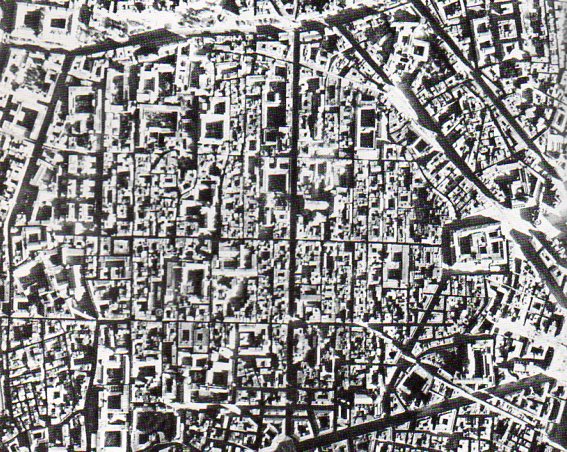
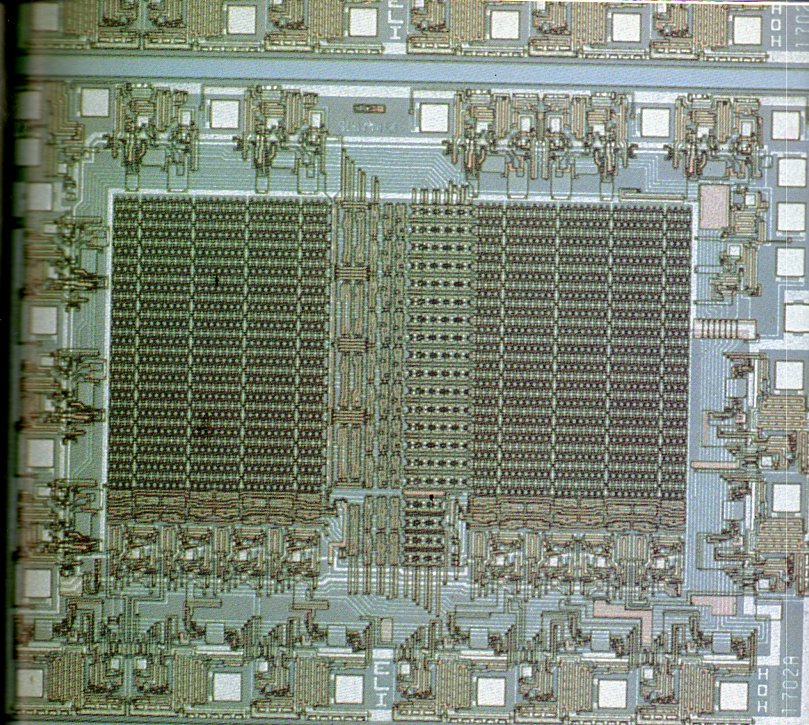
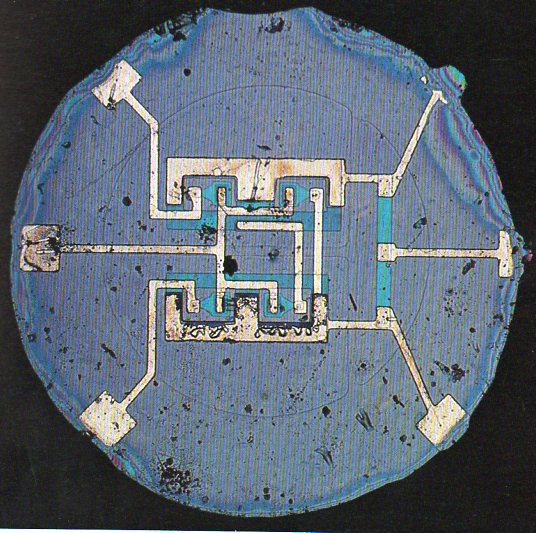
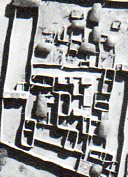
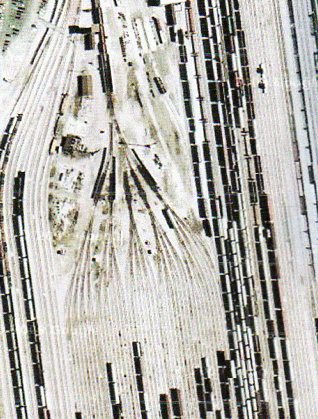
    And in that same veinish vein I wonder how easy or difficult it is to tell what the follwoing figures are, whether they’re city plans or biological units or integrated circuits or microelectric machines or skin. Sometimes its a close call.  And what that means I’m really at a loss of what to say on whether there is some deep underlying trap of relational woowoo.

    And so, what is it?  (Admittedly these could be made more difficult by using confusing details of a segment of each image, but this is good enough.) Answers at end.

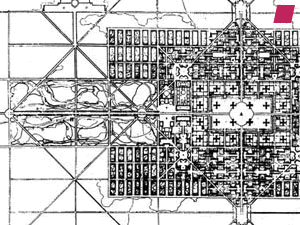
    1.  City plan or integrated circuit?

    'Ville Contemporaine' by Le Corbusier - 1922, from 'Urban Utopias in the Twentieth Century: Ebenezer Howard, Frank Lloyd Wright, and Le Corbusier' by Robert Fishman - 1977


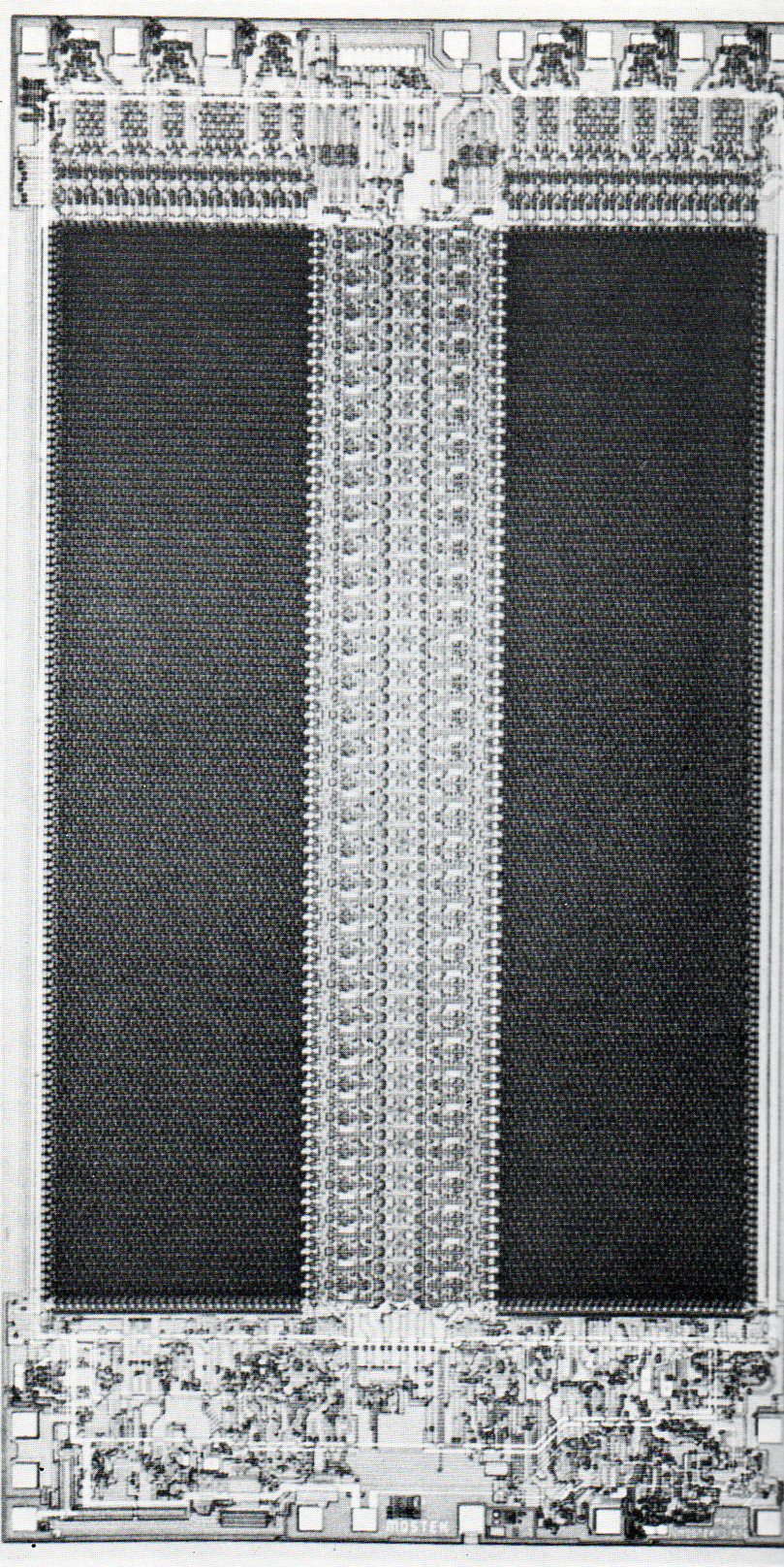
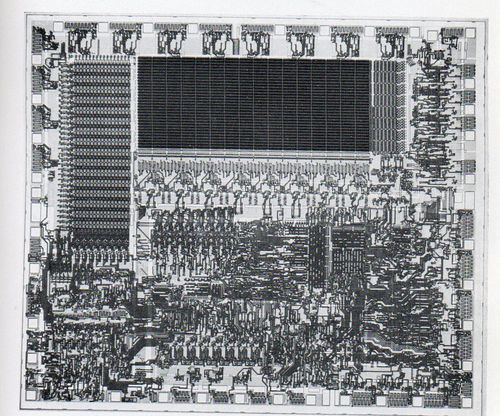
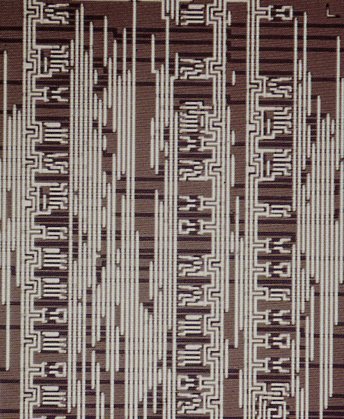
    2.  Integrated circuit or palace plan?

    Fontana microprocessor 2210

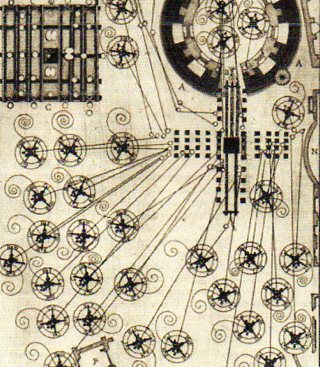
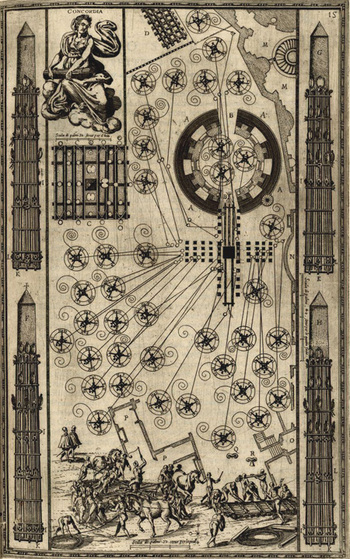
     3. Clockwork interior or renaissance engineering diagram?

     
    City plan-fontana635

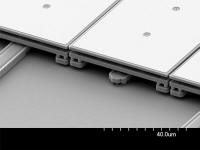
    4.  Plan for a Lunar city or micro mirror?

    MEMS Mirror


    https://historyofideasblog.com/a/6a00d83542d51e69e20133f2411ef6970b-500wi

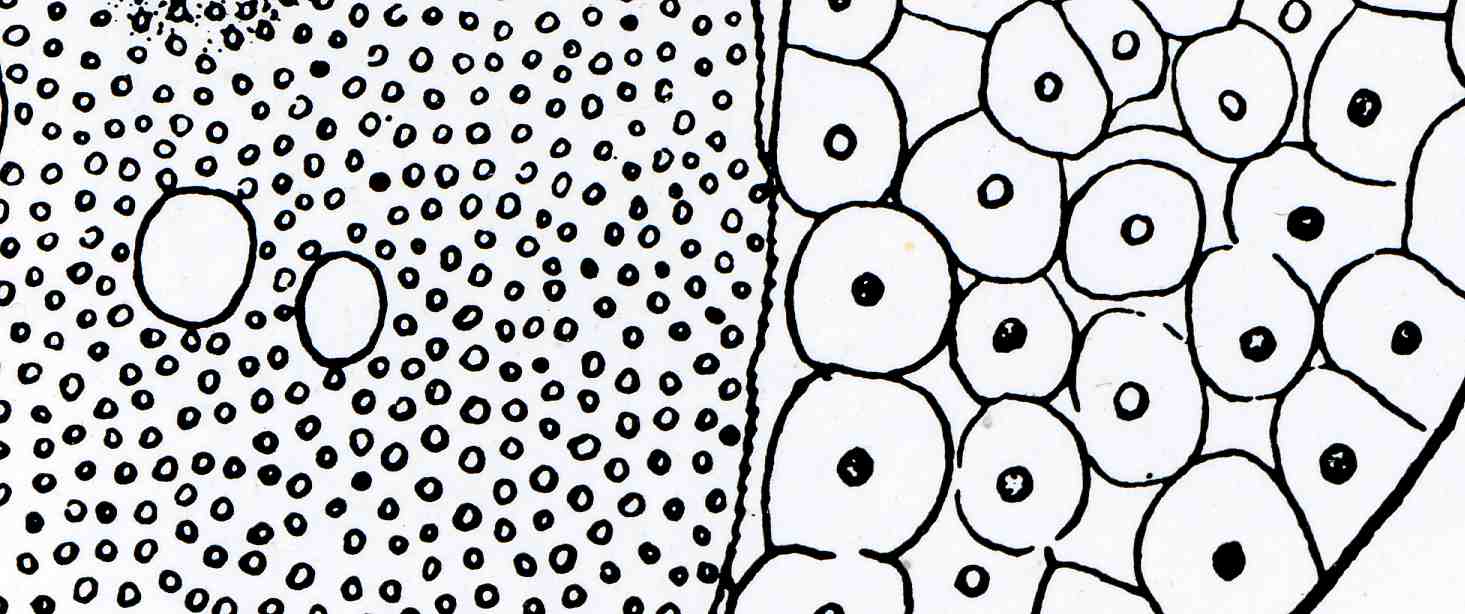
    6.  Drawing of aboriginal village or human blood cells?

    0 blog feb 3 dots518

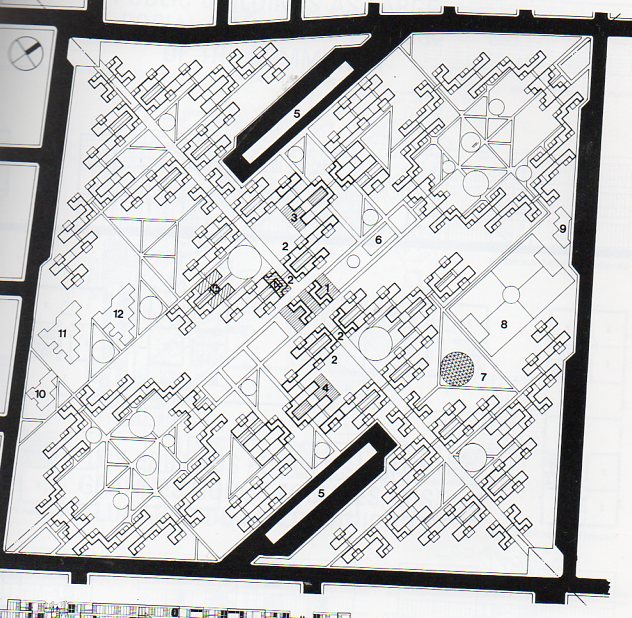
    7.  Integrated chip or city plan?

    City plan--roca632

    8. Integrated chip or city plan?

    City plan--naples633

    9. Integrated chip or satellite parking plan for football stadium?

    City plan--IC 1701634

    10. Early integrated chip or floor plan?

    City plan--library plan630

    11. Integrated chip or sci fi space colony bubble?

    City plan-planar IC636

    12.  Microphotograph of 1959 integrated chip or village plan?

    City plan--arch wo architects631

    13.  Railway switching yard or cross section of human skin showing hair roots?

    City plan-rr yard637

    14.  Buckeyballs or skin?

    Buckyballs could keep water systems clear

    15. Microphotograph of carbon or particle collisions?

    photo

    16. Farmlands or nanotubes?

     
    17.  Model for Chicago bridgeworks or micro mirrors?


    18. Elevator plans for the Dubai Tower or integraetd chip?

    City plan-rr yard IC638


    Answers: 

    1.  Le Corbusier’s plan for his “Ville Contemporaine”, 1922.

    2. Photograph of the 1971 16k bit random access memory chip (via Mostek Corporation).  On the other hand  I can see a vast palace at the top of the picture, with a long, columned entrance with manicured gardens on either side.  The image offers an elevation and a plan–that is, the top and bottom images of the buildings are seen in a deeply oblique view, while the central part of the image is a straight-out plan.  At least that’s what I see, its imaginative possibilities more appealing than the physical realities (though that’s where the extraordinary value is/was).

    3.  The engraving appearedinDomenico Fontana’s  masterpiece Della trasporatione dell’obelisco Vaticano…(published in Rome by Bassa in 1590) and illustrated  one of the greatest engineering feats of the Renaissance. The full image:

    Blogfontana_moving


    4.   Springs for a mechanical electrical machine positionable mirror, a few microns across.

     6. Human blood cells, described by me in an earlier post in this blog: “In 1837 the hemispheric frontal lens for the compound achromatic microscope developed by Giovan Battista Amici (1786-1863) vastly improved magnifying power to open an entirely new submicrospic world–this somewhat on the order of the introduction of Robert Hooke’s (1635–1703), investigation in Micrographia (1655).  G.C. Ehrenberg (Die Infusiontheirschen als volkommene Organismen, Leipzig 1838) was among the first to use this new development, showing almost immediately that infusoria was not what was seen to be as Buffon’s “organic molecules” (or unified wholes) but something far more complex…”

    7  Architect Migeuel Angel Roca, San Pedro Housing Project, January, 1974.  Source: Miguel Angel Roca, Academy Editions, London, 1981.

    8.  Perpendicular view of Naples, ca. 1938.

    9. Intel 1702 integrated circuit, the first erasable, programmable, read-on memory (EPROM), 1971.   Actrual size:  0.147x 0.161 inches.

    10. Plan for a library and office space at the Illinois Institute of Technology, Chicago, by Mies van der Rohe, 1944. (Source:  Colin Rowe, The Mathematics of the Ideal Villa and other Essays, MIT, 1985.

    11. As much as I like the idea of an energy ball existing in negative space (or some such thing), this image shows the Fairchild (first time ever) planar integrated circuit, from the ripe year of 1961.

    12.  Village of Logone-Birni, Cameroon.  Source: Bernard Rudolfsky, Architecture without Architects, Doubleday, 1964.

    13.  Railway switching yard, Chicago area, 1940.

    14. Buckyball-treated membrane.

    15.  Simulation of particle collisions. “A single super-massive collision produces a discrete universe of four particle types. Particles draw their positions over time resulting in the construction of oddly familiar patterns.”

    16. Microtubes. “Microtubules can be seen in a bundle in this negatively stained preparation.  Recall that negative staining starts by immobilizing the preparation on plastic on an electron microscopic grid. Then heavy metal stain is deposited around the structures, delineating their structure. This preparation may allow you to see the tubulin molecules in the protofilaments.” (Taken from Bloom and Fawcett; Textbook of Histology)

    17.  Scanning electron microscope photograph of a MEMS mirror array.  “The device has a closely packed, one dimensional array of mirrors. These are piston mirrors, capable of vertical displacement only. This piston motion can be used to adjust the phase of optical signals, allowing correction of chromatic dispersion. The mirrors are made of polycrystalline silicon, and are coated with a thin layer of gold to improve reflectivity…”

    18. Fairchild’s first IC made with computer aided design, 1967, which was about .15 inches square.

    IC image sources are all from Stu Augarten’s  State of the Art, a Photographic History of the Integrated Circuit, Ticknor & Fields, 1983.


  • Mr. Mole, the Stationary Busby Berkeley of Mass Crowd Installation Photographs, 1918

    JF Ptak Science Books Post 1185

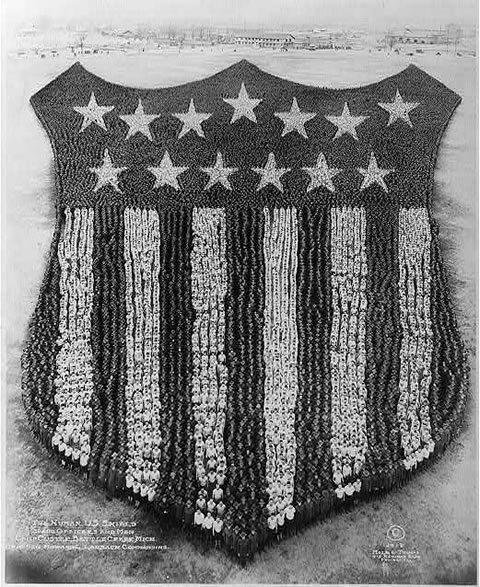
    I’ve long enjoyed these massively organized, captured moments of time and effort–large caliber photos of concentrated efforts of tens of thousands of people, all of their motion and utility directed to produce this one moment in time.  Perhaps the greatest practioner of this artform was Arthur S. Mole (1889-1983), the stationary Busby Berkeley of Big Organized Crowd Efforts (BOCE).  (He led an interesting life, coming from Scotland with his family to be part of a Utopian community led by John Alexander Dowie–a faith healing visionary, self-reported precursor to the second coming of Christ, and leader of the Christian Catholic Apostolic Church–at City Zion, Illinois. Dowie was a problematic man not without good and interesting qualities, though his to-the-death prayer duel with a rival visionary is an interesting story to be left for another time.)

    I’ve always enjoyed this photograph  in particular–it was made from a 70′-tall platform with a 11×14″ view camera using a wide angle and a deep oblique angle, along with 30,000 soldiers from Camp Custer, Michigan.   It was made in 1918 by Mole, along with the evident and very capable choreography of John D. Thomas, who was the Doctor of Persepctive and Motion for the pictures.

    [Note: most of the images below are extremely clickable/zoomable.]

    Arthur-mole-human-us-shield

    Most of the soldiers are used to make the field at the top of the stripes–so near as I can tell (from the resolution image that I had to work with), there are about 300 men in each stripe (except for the outer two), meaning that there between 3,000 to 5,000 in the collected stripes, which puts something like 25,000 troops in the stars and their field. The middle stripe I reckon to be 150′ long; my guesstimate for the star field is 600′ deep and 1250′ wide, making a triangular collection of men 750’x1250′. That takes a little bit of planning to accomplish to ensure that everything is kept in perspective, and which also means that a lot more folks are needed at the top of the constructed image than at the bottom.

    Another excellent example is this photo made of the U.S. Marine Corps emblem using 6,000 marines at Paris Island in 1920.

    http://redtreetimes.files.wordpress.com/2010/05/arthur-mole.jpg


  • Making Tubes of out Holes–the History of Holes, Extended

    JF Ptak Science Books  Post 1184  [Part of this blog’s History of Holes series.]

    Taking inspiration from Edwin Abbott’s Flatland1 (a superb book  excursion into perception and difficult envisioning in which a two-dimensional world tries to comprehend three-dimensional objects) I’ve decided to extend my History of Holes section with their extruded, cylinderized extension cousin–the tube.  After all, If you take a hole by its edges, shack it out, rough it up, reposition and throw some sides on it you wind up pretty much with a tube, which could be seen as elongated holes with (generally) defined beginings and endings. Sometimes.  This is a natural continuation of my series on dots, which can be regarded as holes, or points, and thus into tubes.  “Spots” on the other hand really doesn’t work into the dot/hole thing, as spots can be irregularly-shaped, and I like the dots/holes to be more rounded than the potentially jagged spot, or blotch.

    When you start thinking of tubes, though, they turn up everyhwere: from gigantic cannon, to impossible flying machines, to telescopes, pneumatic railways and delivery systems, test tubes, subways, pressurized health restorers, television screens, and so on.

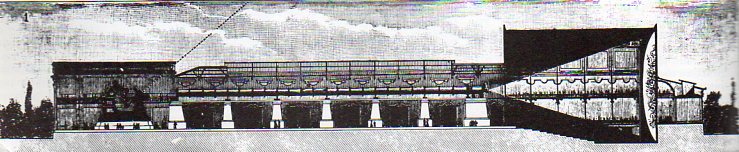
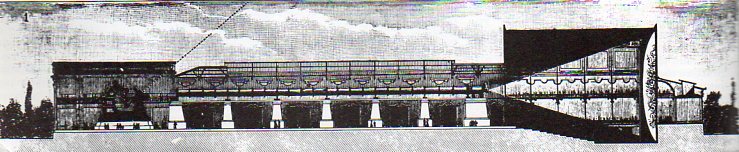
    I’m not sure where this idea came from–perhaps in the post on massive tubeless telescopes (here), reminding me of the most massive tubed telescope, the longest telescope with a tube, belonging to James Bradley, who produced a monster over 200′ long. Connecting the tubeless and tubed telescopes was the image that I had in mind; the hole following naturally from that. Anyway the Bradley  tubed construction–antithetical to the DNA/carbon/membrane nanotubes–were enormous for their time, and as moveable tubes are still very impressive.  Another massive telescope was constructed on speculation for the Paris Exposition of 1900 {the cross section of which is depicted below)–it was 187′ long, spectacularly made and exhiited, and could find not a single buyer.  Positioning the scope of course would’ve been very problemtaic. 
    Tube 1500 ft telescope621
    There are other, more massive and mobile tubes, like, say the smokestacks of the Titanic (which were 24×19 feet, with a fall of 150′ from the top of the smokestack’s sweep to the boilers)–these weren’t mobile in and of themselves, but they did move, if only for a short time (laterally), and then for a very short and cold time (vertically).

    http://www.titanic-titanic.com/pic/funnel_bogie.gif

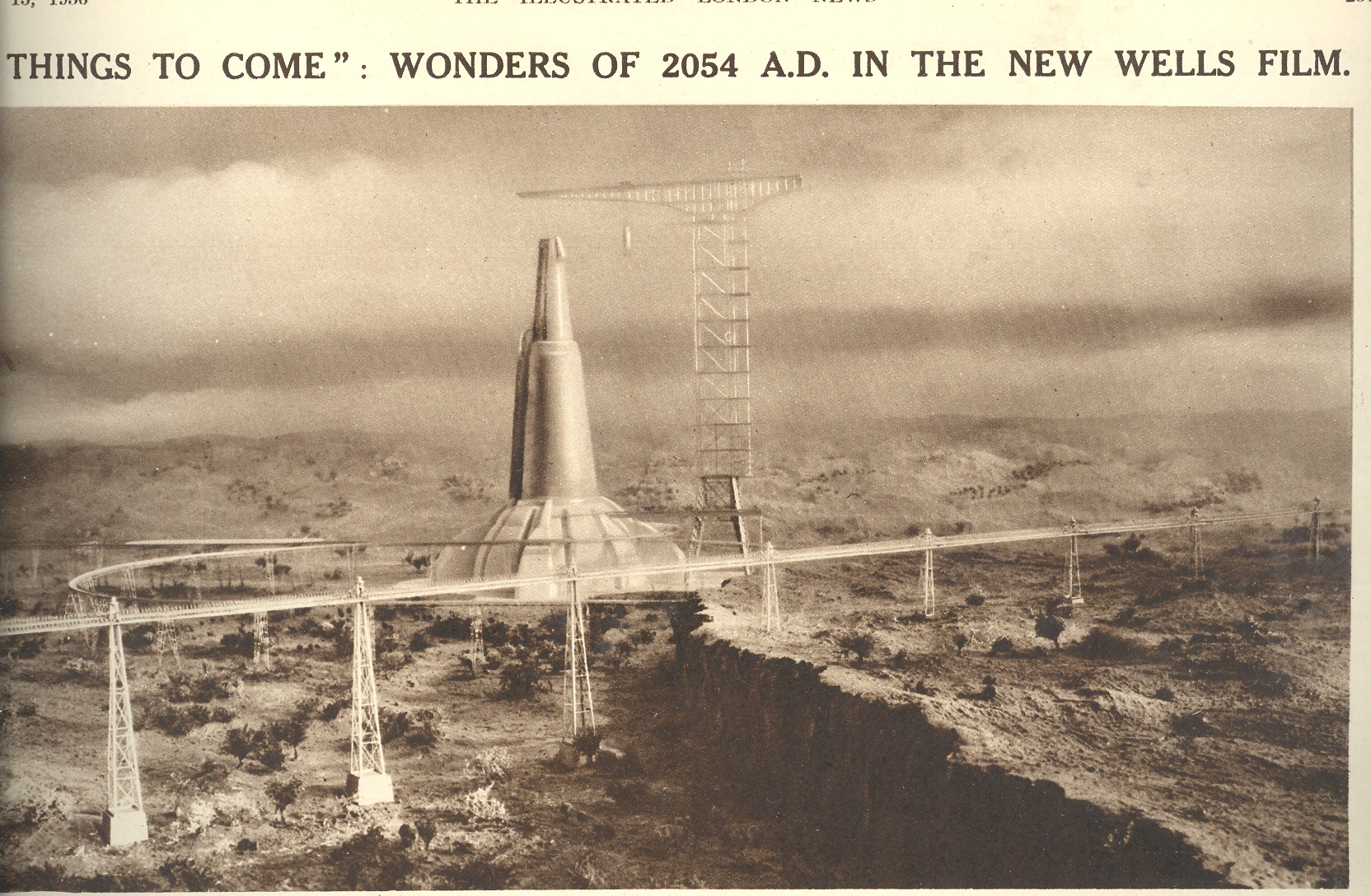
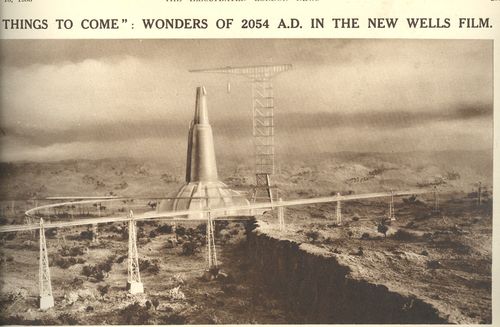
    Massive, monster canons have existed for many years in idealized and theoretical, speculative worlds, like Tom Swift and his Monster Canon.  In the history of early imaginary big gun tubes H.G. Wells’ Babel-like cannon (pictured below in a still from the movie Things to Come (1936), an adaptation his The Shape of Tings to Come (1931)) is fabulous–1500 feet tall, with I figure a  750′ base, it launched a 75′ tall capsule beyond the Earth’s
    Blog jan 6 wells

    gravitational pull with a spectacular explosiveness that would’ve made its occupants into instant jelly.  (Paul Drye points out that one of the biggest sci-fi guns comes to us via Arthur C. Clarke, who had his Lunar inhabitants fashion a gun by drilling into the Moon’s surface until they reached a depth where it would tap and “shoot” molten rock at attacking space ships.  This is more of a hole than a tube, and as such probably ranks it as the biggest hole gun ever constructed, even in science fiction. In the same veinish vein is Robert Heinlein’s railguns, seen in The Moon is a Harsh Mistress.  It has been suggested that E.E. Smith may have concocted gravitational weapons enabling planets and entire galaxies as wepaons, but I’m not sure about this, and they’re definitely not tubes.)

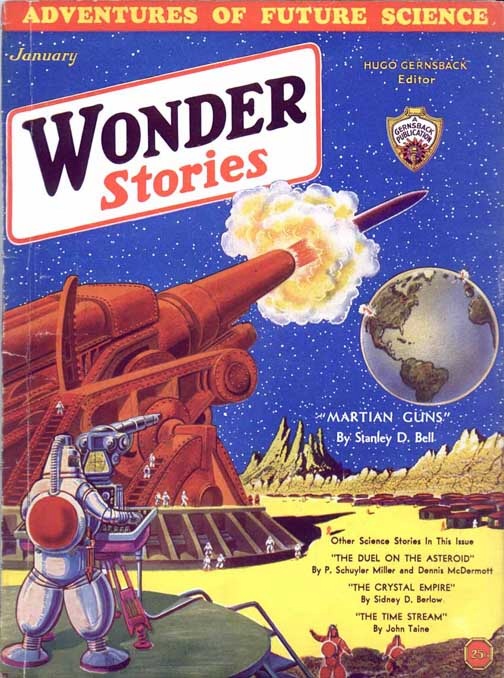
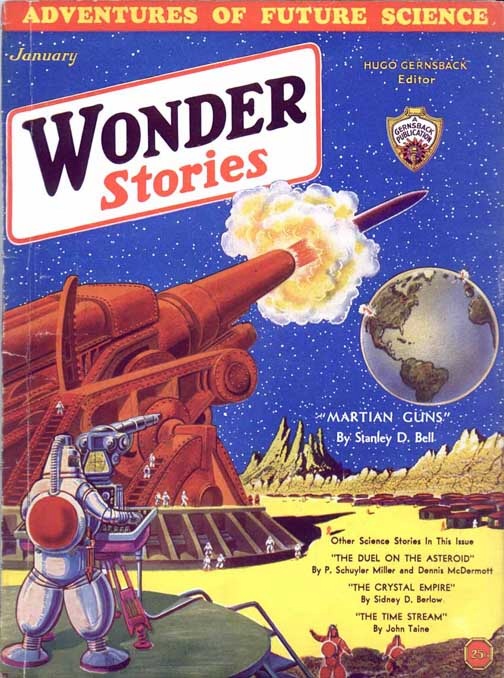
    Just to round out the Solar System cannonry a bit, here’s an example of a gigantic tube coming from the fabulous Frank R. Paul for Stanley D. Bell’s “Martian Guns” found in the January 1932 issue of Wonder Stories.  There’s really no way to determine how big the gun is except to say that it is probably “big”–there’s just nothing to place the thing in perspective, as the figures in the foreground, being Martian, don’t have a specific height.  They could be 6′ tall, or 60′–perhaps they’re only 1/10 of an inch tale, and the projectile they’re firing to the earth is so devastatingly powerful that size doesn’t matter.
    Strange things in sky--martian guns

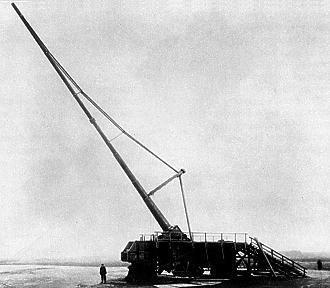
       Back here on Earth and in the real world,  the Kaiser Wilhelm gun (or “Paris Gun”, the Kaiser Wilhelm Geshutz) was
    http://farm4.static.flickr.com/3169/2951816593_c2d2e5c875_o.jpg


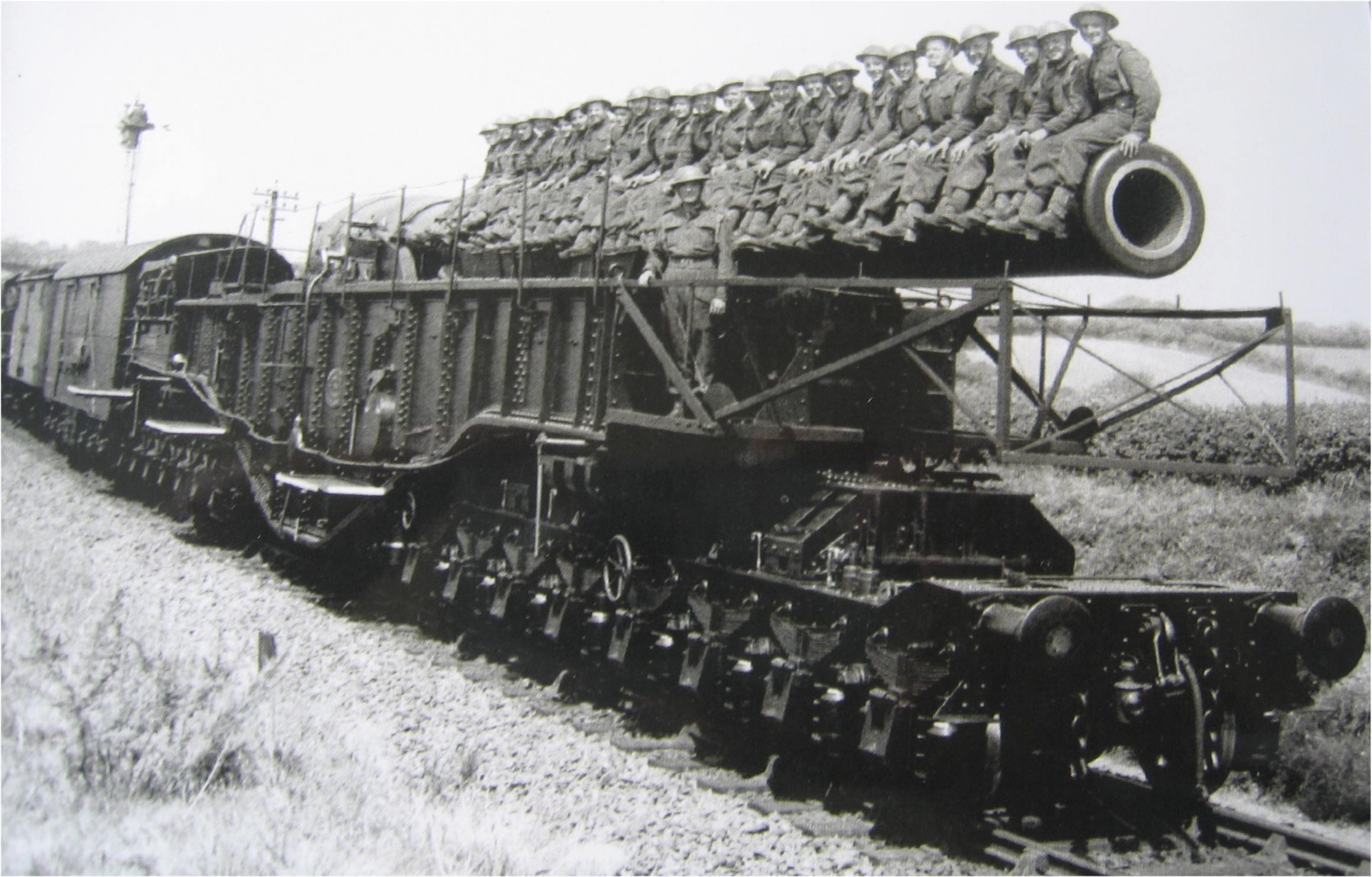
    a long-barreled, light shelled monster: its 92′ long barrel (plus a 20′ extension) launched a 94kg shell about 130 km, reaching a maximum height of 40km (about 25 miles) high. For all of its mass (the gun weighed 256 tons without the railway cars) the shell that it fired didn’t weight much at all….though the shell did reach an extreme height. (Ironically, the gun was built for attacking the deepest of the deep bunkers of the fortresses along the Maginot Line; it was never needed for that, as the Maginot Line was simply left behind in the Nazi assault on France.)  The British Ordnance BL 18 inch howitzer (below) was developedjust as WWI was enidng, but did not enter service until nearly two years after the war ended.

    File:BL 18 inch Howitzer Ashbury Station WWII.jpg

    The Schwerer Gustav was a 1350 ton beast which fired a 14,000 pound shell (!) about 20 miles. A  little later came the Nazi V-3 (the lesser known of the V-weapons), the Vergeltungsewaffe 3, a 130 metre (!) long, 150mm gun built alongthe side of a hill, launching a 140 kg shell. The Iraqi Big Babylon gun was sort of like this one, though never built–it was to have a 500′ barrel and would be supported by a hillside. Then there was the Nuclear Tube: the Atomic Annie (M65) cannon, which was another bruiser, being an enormous 85′ cannon that delivered the worst punch of all cannons, a nuclear warhead.  The weapon was test-fired in 1953 at Frenchman Flat at the Nevada Test Site and delivered a 15kt explosive device to a target seven miles away. There were 20 of these made, but given their diffiult-to-deploy-and-keep-secret status, and the nature of the shells, and the development of more sophisticated weapons, the M65 was obsolete almost as qickly as it was introduced, but was removed from the frontline only in 1963. 

    VWM240mmAtomicAnnie01.jpg

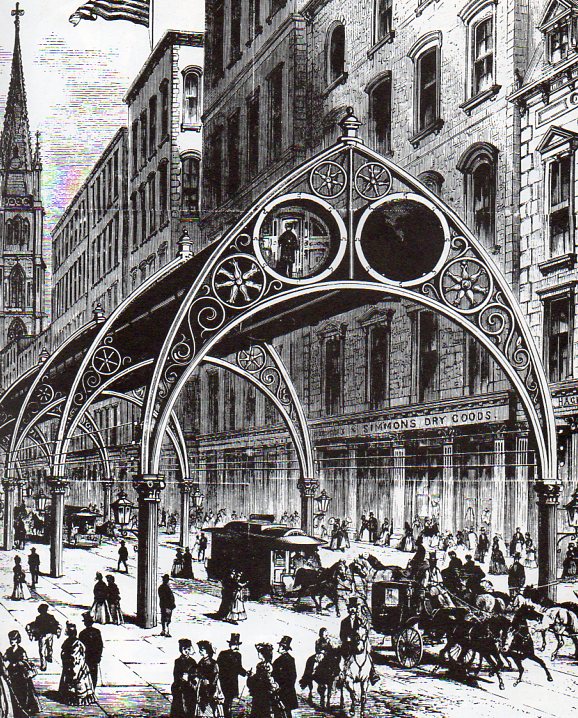
    I guess what people think of first though in regard to tubes in “The Tube” in London, though a more tubey tube was presented here in the pages of the Scientific American for the NewYork City subway:
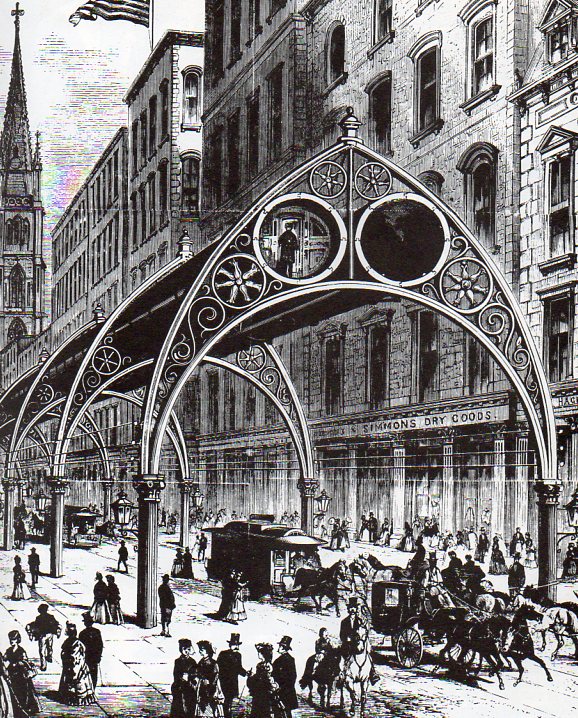
    Tube nyc623

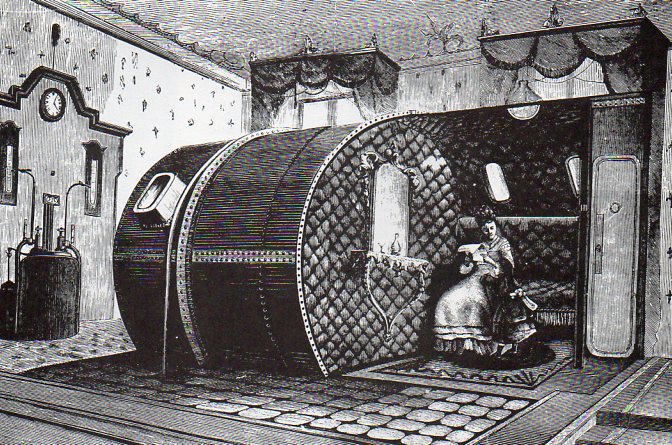
    Here’s yet another strange tube, this a tube-within-a-rectangle, an aerotheraphy device that was supposed to cure people of whatever they needed curing for, just like any other good quack device, though this may well have been the heaviest of them all.  Cushioned, well-appointed, and with a hint of luxury, this burst of fresh air was inteneded to render diseases and other complaints harmless–only for a lot more money than electro-shock or beer cures or massive purgatives or bleedings or copper amulets or whatever else you can come up with.  It does make a nice image, though:
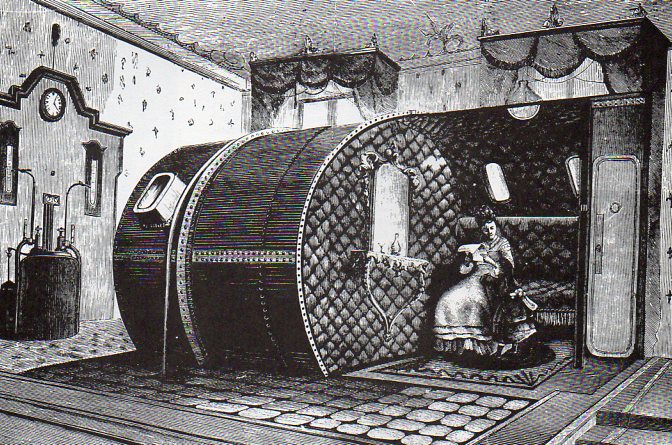
    Tube aerotherapy625

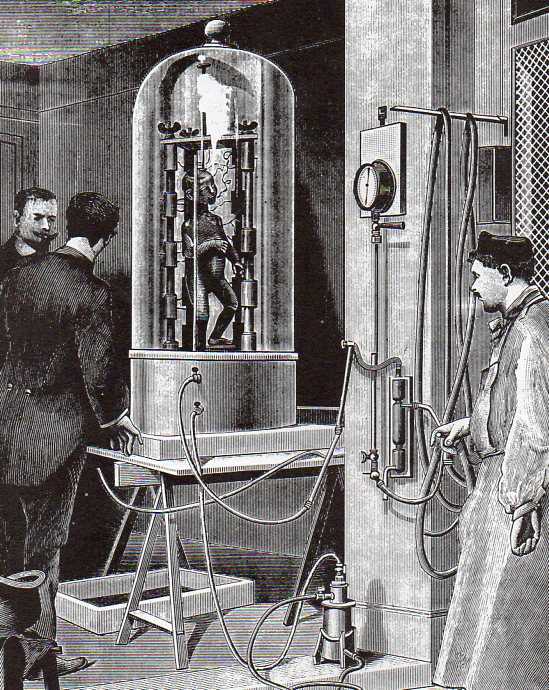
    The tube below may well have been the largest glass tube to hold the body of a dead person–and in this case, a dead child.  It was design for a practice that was evidently not practiced–electroplating the dead.  Someone thought it might make a good practice to deposit a one millimeter coating of copper on the skin of a cadaver, and published their success (and image) in the Scientific American for November, 1891.  The practice didn’t catch on.
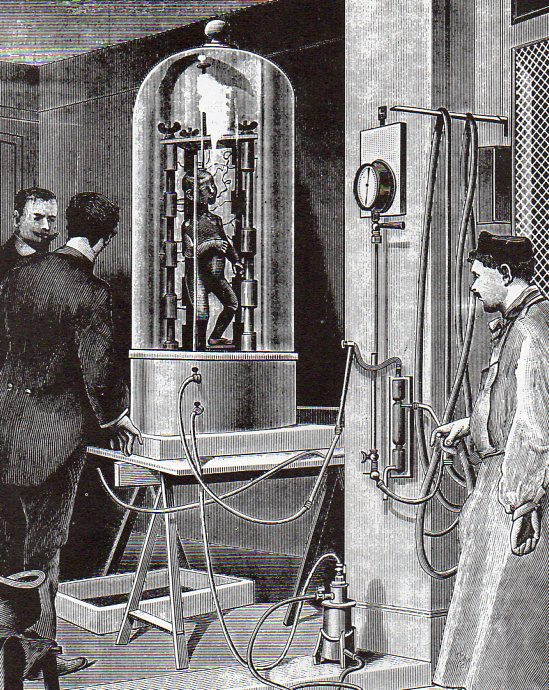
    Tube test tube dead622

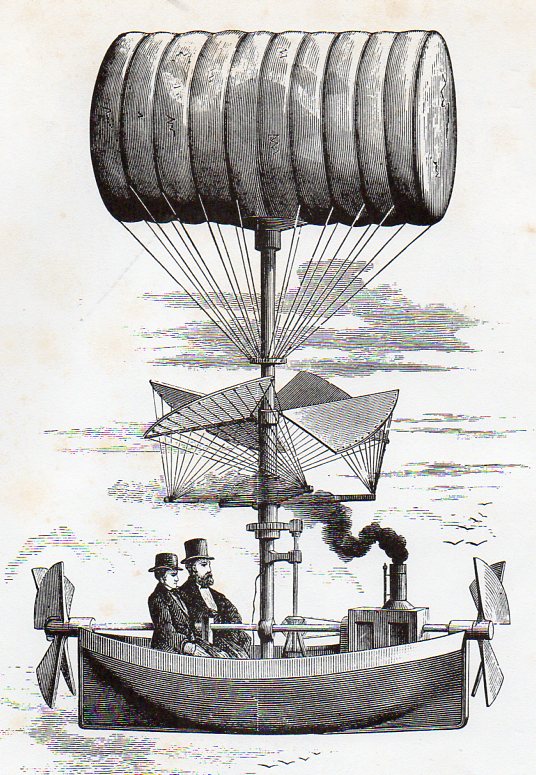
    Then of course there are submerged and flying tubes; submarines have certainly become a long-established part of the technological landscape, and the flying tubes, not. 
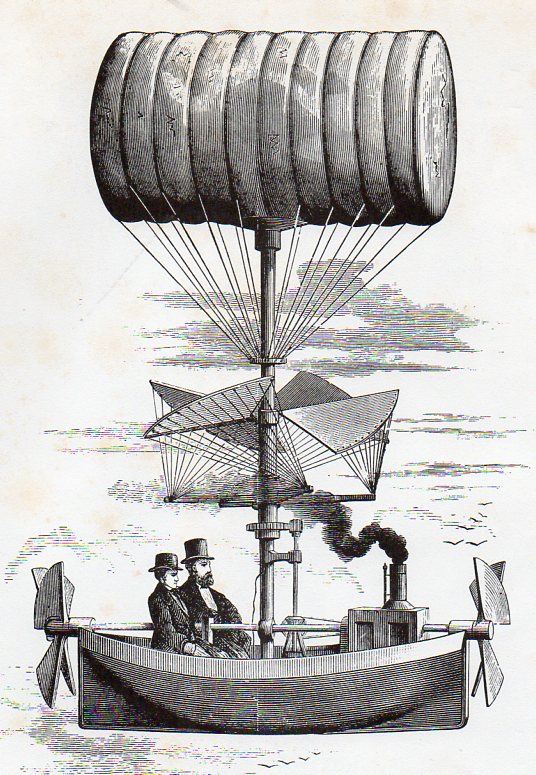
    Tube  flying620
    Still, the steam-driven helium-filled flying tube boat looks dignified and lovely, if impracticable.

    There were proposals in the late 19th and early 20th centuries for pneumatic railroads and pneumatic people movers (in one case in the 1930’s, for a plan to move individuals from New York to Philadelphia in chair-like objects in one of these tubes), but for all intents and purposes the closest that these plans came to fulfillment were pneumatic operations like thoe found in R.H. Macy in New York.  It was in the massive department store where you could find miles of pneumatic vacuum tubing that connected department tellers to a main counting office, where little cylinders were filled with cash and receipts and sent along for accounting.  The logical outocme of Macy’s tubular world for Terry Gilliam was seen in the director’s masterpiece dystopic flic, Brazil, where we see a world crowded with gargantuan and suffocating nothinness, filled with bazillions of miles of ductwork whose purpose is a mystery, making for a cold and disturbed world. 

    Brazil screen capture

    End part I of Making Tubes of out Holes–the History of Holes, Extended.
    Notes
    l. Edwin Abbott’s slender Flatland is perhaps one of the best books ever written on perception and dimensions, a beautifully insightful book that was quick and sharp, and in spite of all that was also a best-seller.  Written in 1884 when Abbott was 46 (Abbott would live another 46 years and enjoy the book’s popular reception), it introduces the reader to a two dimensional world with a social structure in which the more sides of your object equals power and esteem.  Thus the lowest class would be a triangle (three sides) while the highest (priestly) class would be mega-polygons whose shape would approach a circle.  Abbott’s magistry comes in explaining to the three-dimensional reader what it was like to be in a two-dimensional world.