A Daily History of Holes, Dots, Lines, Science, History, Math, Physics, Art, the Unintentional Absurd, Architecture, Maps, Data Visualization, Blank and Missing Things, and so on. |1.6 million words, 7500 images, 4.9 million hits| Press & appearances in The Times, Le Figaro, Mensa, The Economist, The Guardian, Discovery News, Slate, Le Monde, Sci American Blogs, Le Pont, and many other places… 5000+ total posts since 2008.

Author: JF Ptak

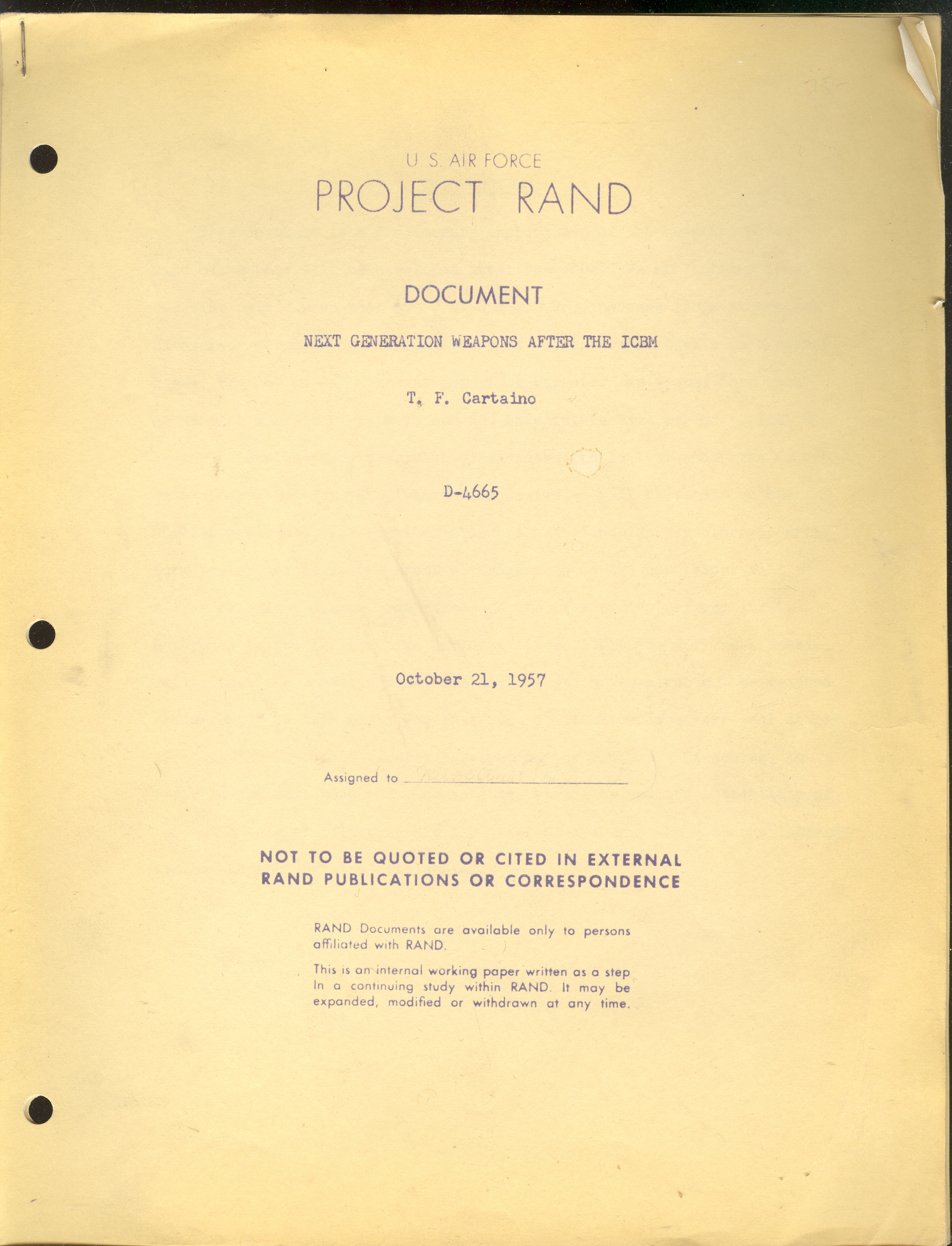
  • The “Non-Violent” Ultimate Weapon Successor to the IBM? RAND Report, 1957

    JF Ptak Science Books LLC  Post 1218

    +()+ebay icbm The RAND Corporation (Research And Development) is a think tank originally formed in 1946 by the US Army Air Force as part of a contract to the Douglas Aircraft Company.  After 1948 RAND Corp was funded by a number of different sources, private and governmental, and left the sphere of being a direct arm of the  U.S. military. (Maybe.)  It still did enormous amounts of work on behalf of the military, and seems to have been their chief  theoreticians during this period.  It was also the time that the policy of Mutually Assured Destruction (MAD) was formulated at , partially under the direction of we’ll-see-him-again-down-the-road Robert McNamara.  And of course much else.  [This pamphlet is available for purchase from our blog bookstore.]

    This publication is an internal RAND document, not meant for the eyes of the outside world, at least in 1957.  I own a number of these reports, and I must say that this one is odd—it is rather flippant, sometimes oddly and darkly (dare I say it?) funny.  It is also short (four pages) and gets to the very meaty part of the issue immediately.  The author(s) assume that the US and the USSR will have achieved a point of stasis such that it would make absolutely no sense for either actor to actually employ their arsenal (and excluding “the possibility of the button pusher ‘flipping his lid’ “.  The paper attempts then (“let’s jump right in and assume we find ourselves in this stalemated period”) to envision the next kind of war in which the ICBM would not be an active factor. “We therefore postulate here that the kind of war we will be engaged in…in the period of nuclear stalemate of the non-violent war, the opening phase of which has been called the cold war.”


  • Cyborgs and Robots, 1920’s: Man as Machine and Machine as Man.

    JF Ptak Science Books   Post 1217
    [Also see my post on producing the geometrical man “Durer’s Beautiful Monster”, here.]
    I’ve written earlier in this blog about the advent of robots and human machines, and I’d like to add these two images to that thread.    Both are male, which is not horribly surprising since the earliest creation of a female robot belongs to the fertile Fritz Lang, who used his creation in his extraordinary movie Metropolis in 1927.  (Male robot-like creations go back fairly deeply into the 19th century; so perhaps the creation of female robots was verbotten because of the possibilities for unacceptable sexual fantasies in the high- and post-Victorian world, struggling under the weight of many and multiply-applied public inhibitions. Perhaps it was because of the possibility of sexual relations with an inanimate object that was the cause for one-gendered robots, or perhaps it was a fear of a powerful, intelligent, unstoppable, superior creation that was also “womanly”.  I don’t know.)
    Robot human machine817

    [Both of these images are available from our blog bookstore.]
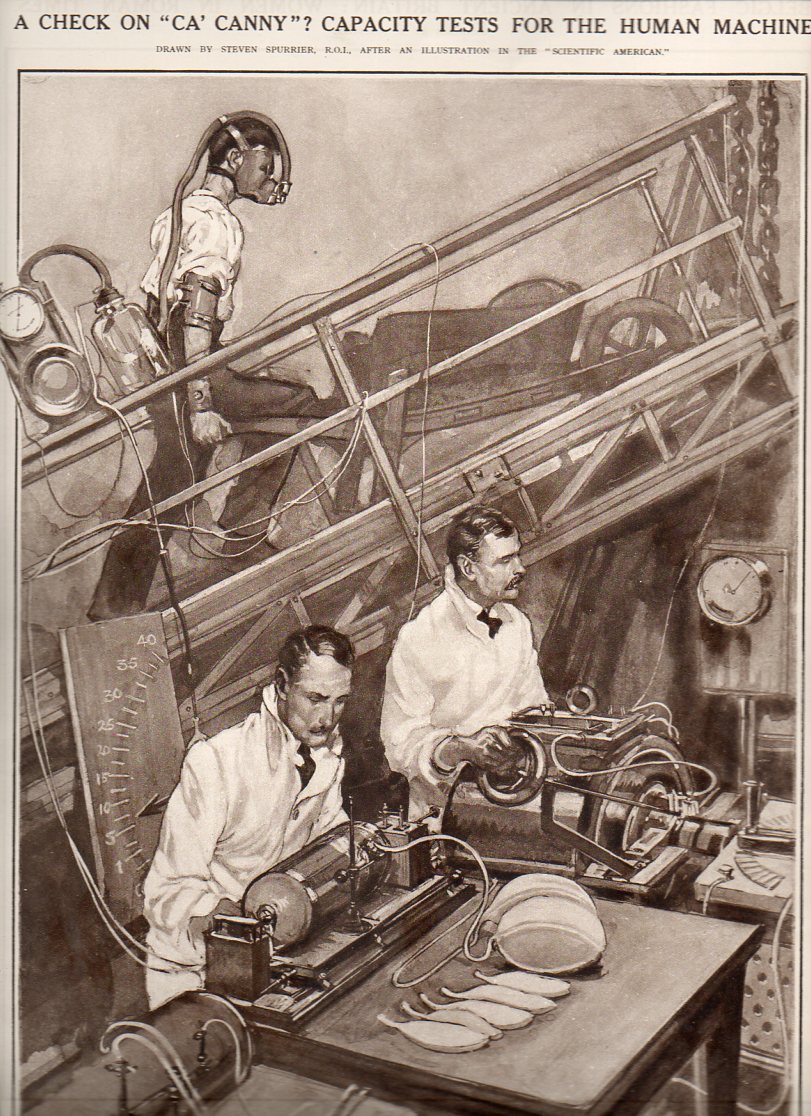
    The first is an image of the “human machine”, a cog-like adaptation of human workers in a Frederick Taylor-like The Principles of Scientific Management study, automatizing and industrializing people.  Though many people had written and worked around Taylor’s 1911 semi-revolutionary book (and not necessarily a good revolution, but one nevertheless), I’m not certain that I’ve seen the worker trussed up so before this, encumbered by so many technical testing elements as to make him look like a cyborg (though that term would still be a while coming into the vocabulary. 

    This image is actually testing a person’s energy expenditure while pushing a wheelbarrow on an incline, and utilizes the newly-created equipment of the French physiologist Langlois, which in 1921  may well have measured for the first time  the real-time changes in the rhythm of the heart and blood pressure, changes in body temperature and lung capacity of humans in an activity.  I have no doubt that the results would have been very interesting to cardiologists, and probably didn’t mean a thing to industrialists like Henry Ford, who would’ve plowed ahead with their demands on their workers regardless of what tests said, schedules being schedules and all. 

    Robot steam816

    (I’m no tsure where this experiment fits in, historically speaking, even within the context of biological advances for that very year.  Frederick Banting was able to do some pretty nasty stuff to dogs in a basement lab somewhere at the University of Toronto and come up with a successful treatment for diabetes mellitus–insulin, which would save the lives of millions and earn Banting a Nobel two years later.  In the quasi/fake biological arenas came two biggish events: Jung’s creation of the concepts of introvert and extrovert, and Hermann Rorschach’s one-way conversational device for detecting psycho-pathological conditions (in people).  I suspect that the Langlois data would fit in there somewhere along the rough edge of Jung and Rorschack, if only because the data was real.         

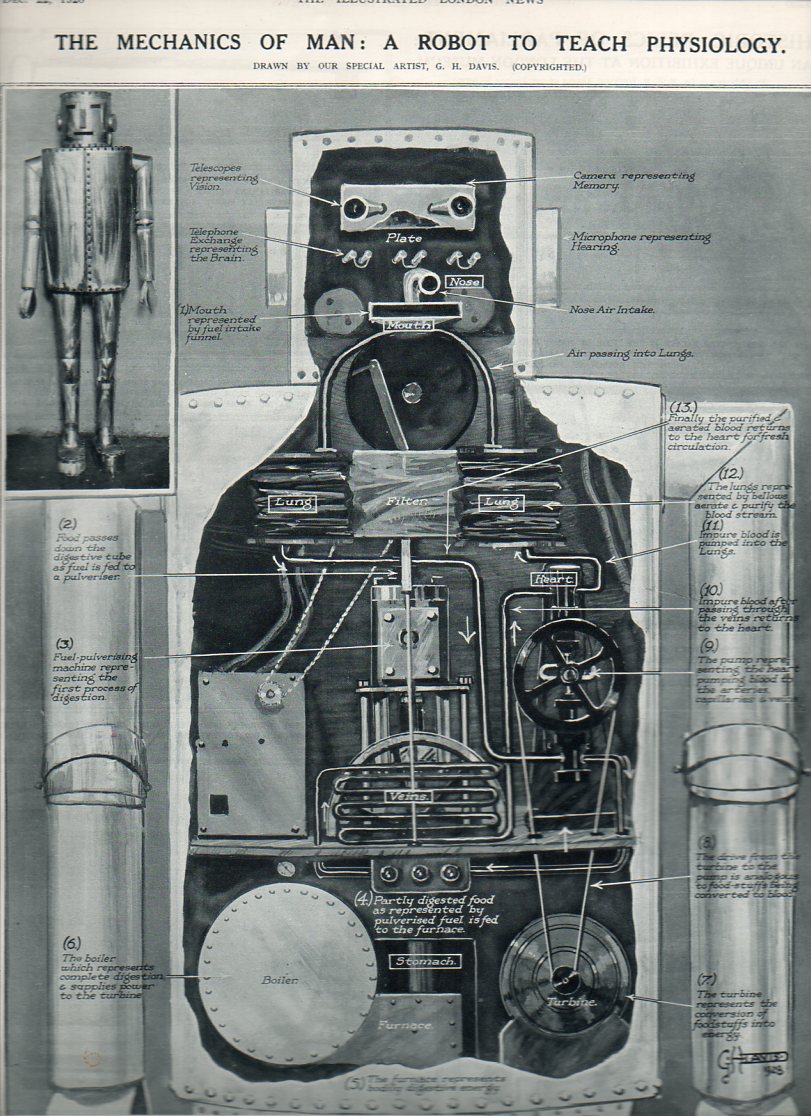
    The second image is in a way a reverse sequence of the preceding–an out-and-out robot that was being used to teach human physiology.  In this case, the robot was a steam engine, constructed for the Schoolboys’ Exhibition at the New Horticultural Hall for 1928, perhaps under the  influence of Karel Capek’s newly published drama R.U.R., which coined the term “robot”. The biological functions of humans were reinterpreted along a more user-friendly vocabulary of the steam engine, using pumps, boilers, hinges, belts, pulleys, filters, compressors and a furnace to explain the functions of respiration and circulation.   It was an interesting approach to show these functions on their most basic level–and in less than 75 years, many of these mechanically represented organs were actually replaceable by real mechanical units performing the same task as the biological (as in the heart), while others could be replaced (via transplant).

    Man as machine and machine as man.


  • Quiet Images of Great Loss and Heroism–British Navy Losses, 1945

    JF Ptak Science Books  Post 1216

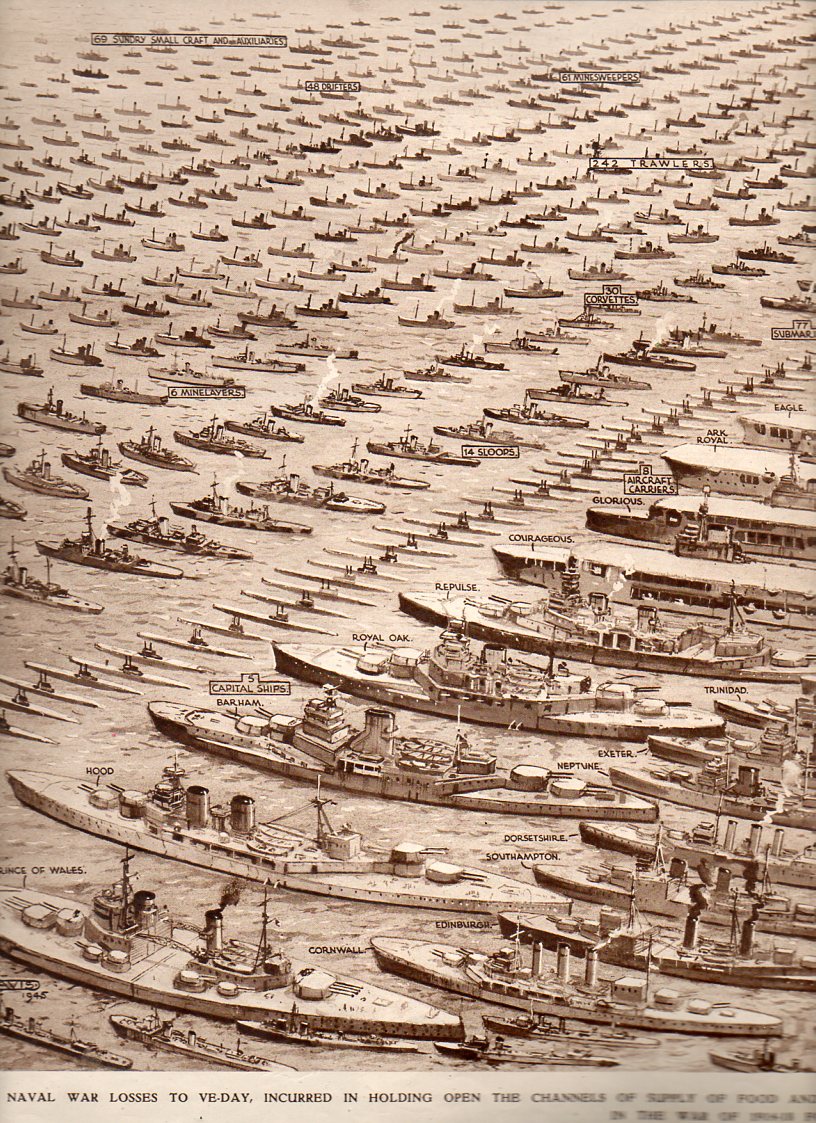
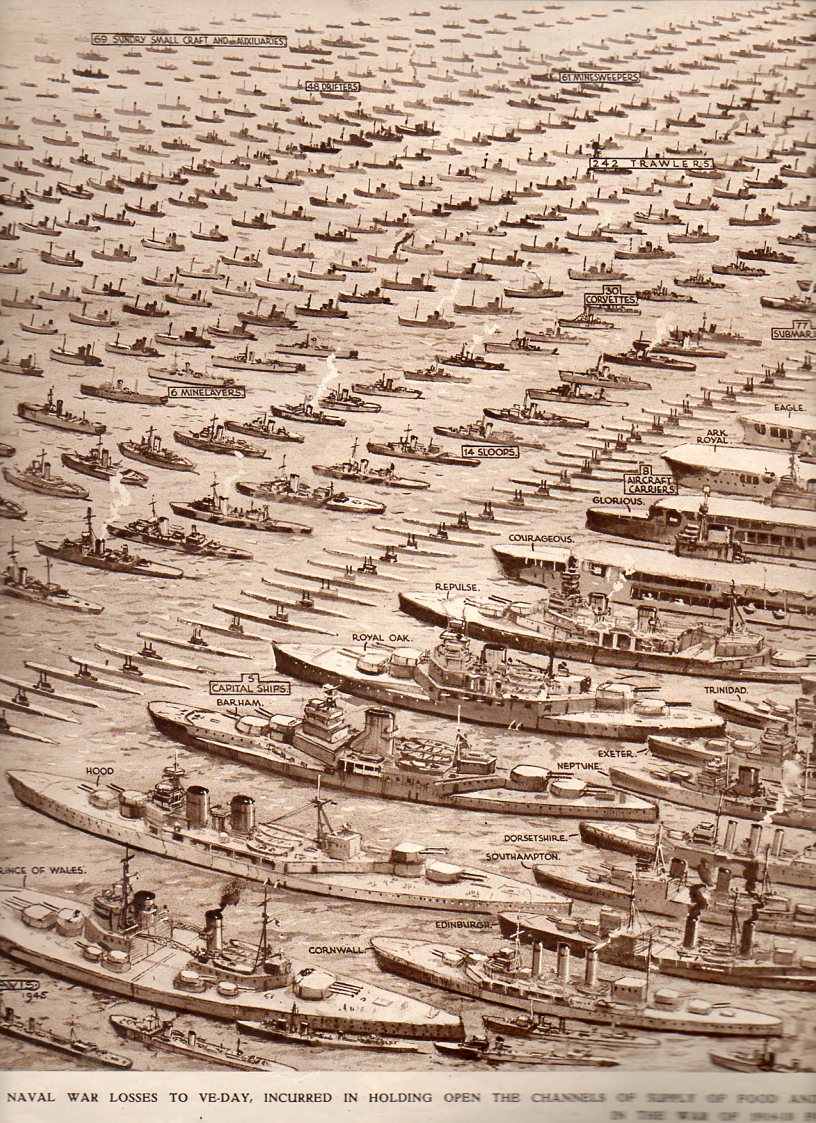
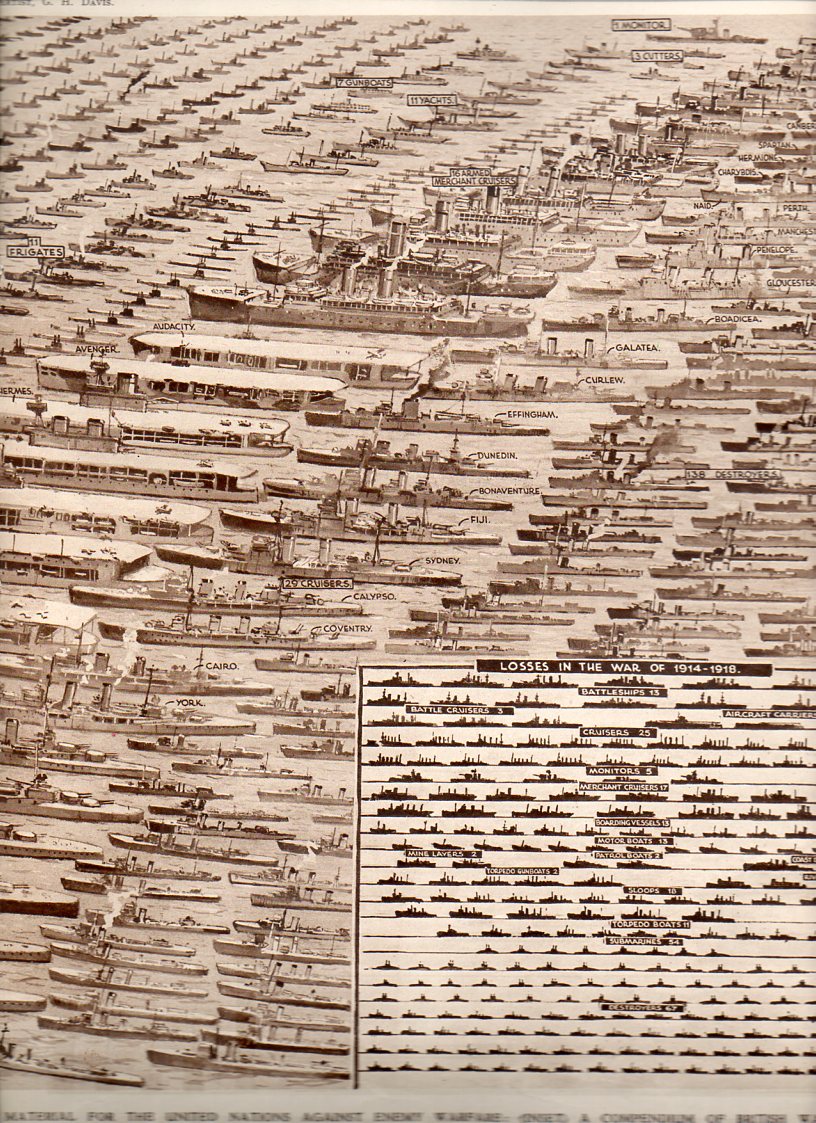
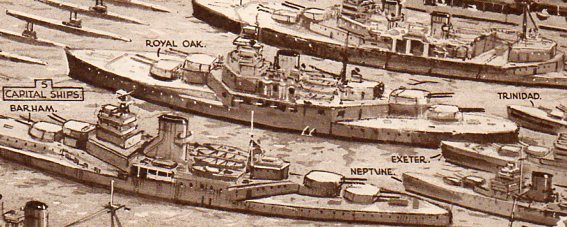
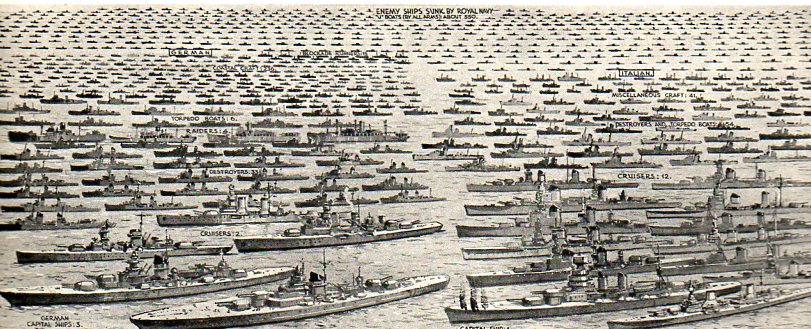
    This enormous, quiet image appeared in The Illustrated London News on 23 June 1945, just weeks after the termination of WWII in Europe.
    Navy Losses--left796 Navy Losses--right795

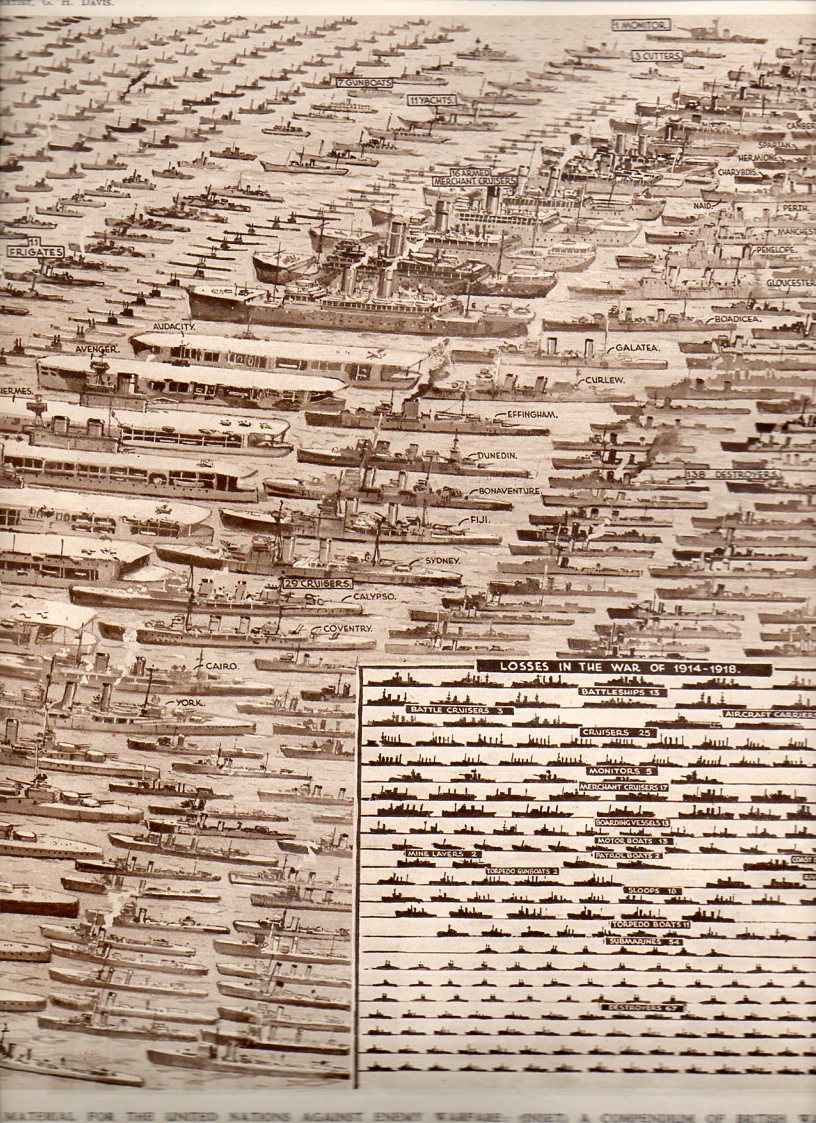
    It graphically presents every ship lost by Great Britain in the defense of “holding the seas against the Axis Powers…holding open the channels of supply and food and war material” from the outbreak of the war to VE day. The inset narrative states that there were on average nearly 3000 British and Allied ships at sea at any given moment, with the Royal Navy patrolling an aggregate  of 80,000 miles of trading routes, day in and day out
    Navy Losses--left796
    [This image is available for purchase–in the original and in a 30×40″ poster–at our blog bookstore.]

    It is a symbol of loss, of heroism, of lives not lived, of lives saved, of valor, of greatness, of will, of the cold black sea, of burning oil, of red waves, and above all, of sacrifice. Of splendid behavior.

    It is a terrible picture of what victory demanded of bravery.       

    It is as much an image of a military graveyard as anything else, a Remembrancer, especially for  those who were never recovered.  It is a grid, a finding aid, a visualizer, for all of those sailors lost in a sea that is indifferent to particular memory.

    Navy Losses--right795
    I can’t imagine how this image was received by the Illustrated London News reader on that day.  Did they suck their breath in at the scope of it, of the gigantic reminder of what all of those ships represented?  Was it the sort of image-reading that was forced, a white-knuckle, vacant-chested feeling of sweeping loss?  Of loss and gratitude?  Of gratitude and finding purpose for all of those sacrifices to the island nation?  I suspect that all of those words were in the minds of those readers in 1945–and also for emotions that have no words. 
    Navy Losses--left detail797

    Notes:
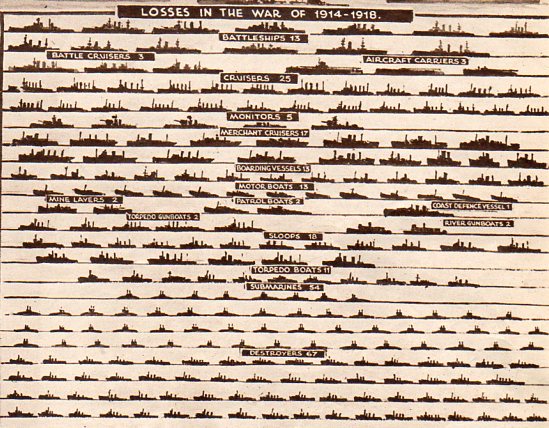
    There is also a small inset that shows in comparison the Royal Navy losses for WWI, 1914-1918. 

    Navy Losses--wwi798

    There is also this, an incredible single-page display of British merchant-marine war losses of 2570 ships.
                Navy Losses--merchant marine799

    Both images are the work of the incredible G.H. Davis, who provided cut-aways, cross-sections, maps, diagrams an all manner of information to the ILN readers throughout the war.  HE was an inexhaustible man of excellent design sense.


  • Virtuosic Apocalypticism: Maps and Charts of Nuclear Exchange, 1964

    JF Ptak Science Books LLC  Post 1214

    “…our choice of path may be delayed too long… “  Dante, Divine Comedy, Inferno, Canto XII, line XIII, 2nd level of Hell (envy).

    [This item is available for purchase from our blog bookstore, here.]

    March 3--cvr

    The NATO Conference on Damage Assessment Summary Report (May 5-6, 1964) was not one written for its outcome, necessarily, but the means of getting there. The outcomes were highly differentiated levels of sameness, a strategic tour of Dante’s creation cataloging the layers of deep destruction like those of his funneling pit.

    Professionally  the paper dealt with several different ways of computing nuclear exchange scenarios (given names of understated inelegance like Jumbo, Brisk, Frisky, Dart and Dusk) with lots of smokily mirrored hocus pocus, the necessary ingredient of the philosophical technology of Mutually Assured Destruction. MAD.  Somehow it all worked out without any exchange ever happening. (The principal contributor here was James Coker, chief of the National resource Evaluation Center, Office of Emergency Planning, Executive off of the President, who I wrote earlier about here.)

      March 3--20 mt blast“Which utterly with sadness had confused me,  New torments I behold, and new tormented Around me, whichsoever way I move,  And whichsoever way I turn, and gaze.”  Dante, Divine Comedy, Inferno, Canto VI, third circle, gluttony.

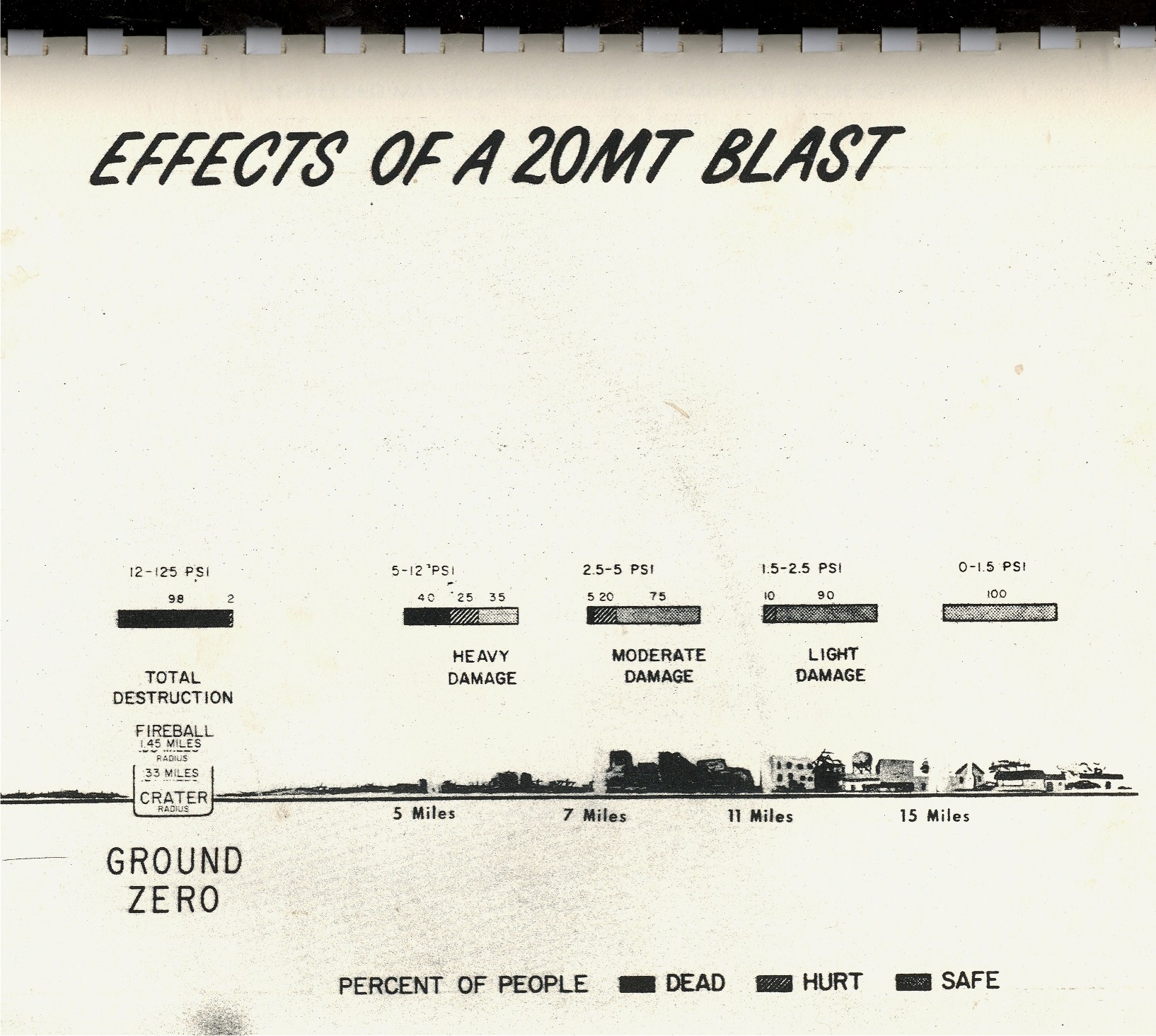
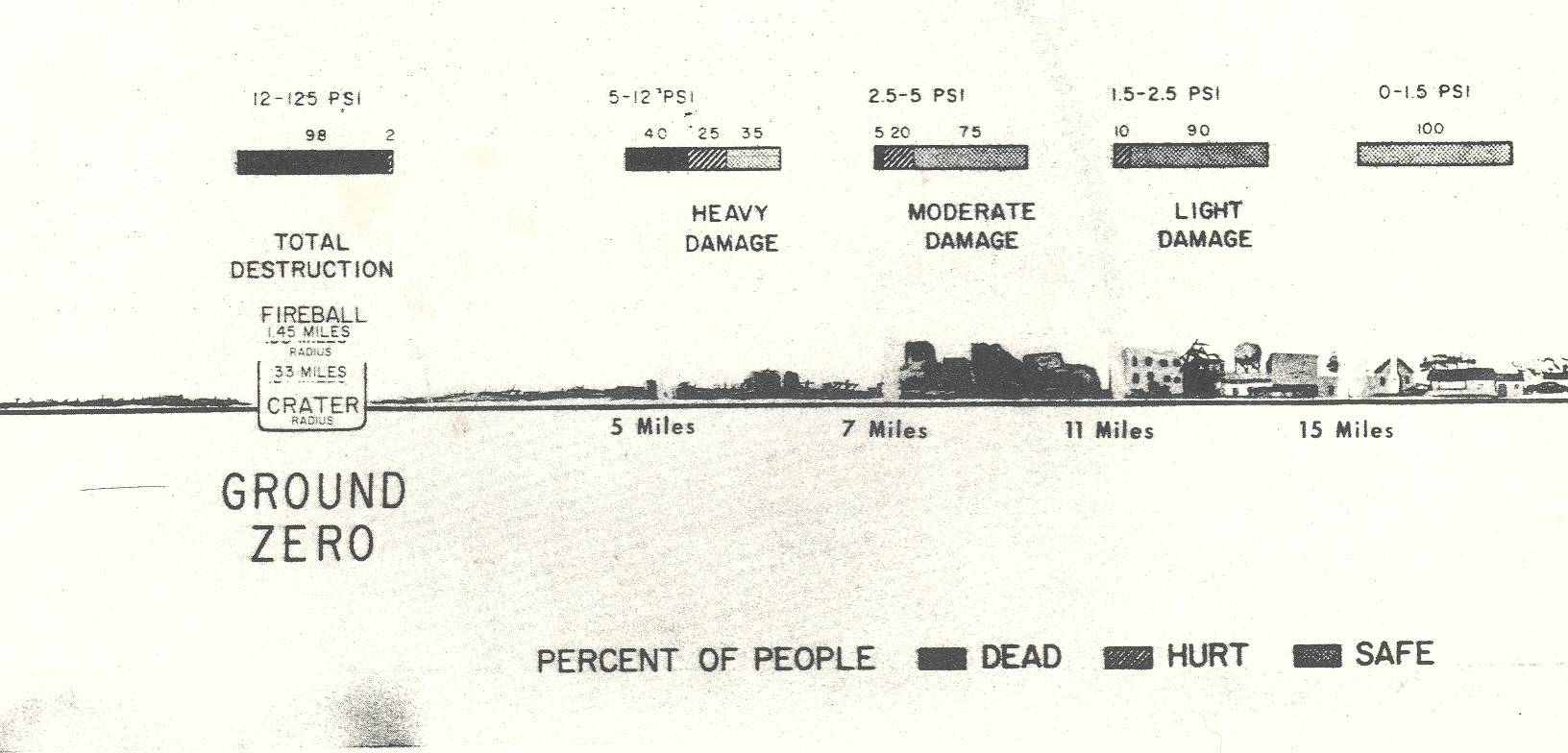
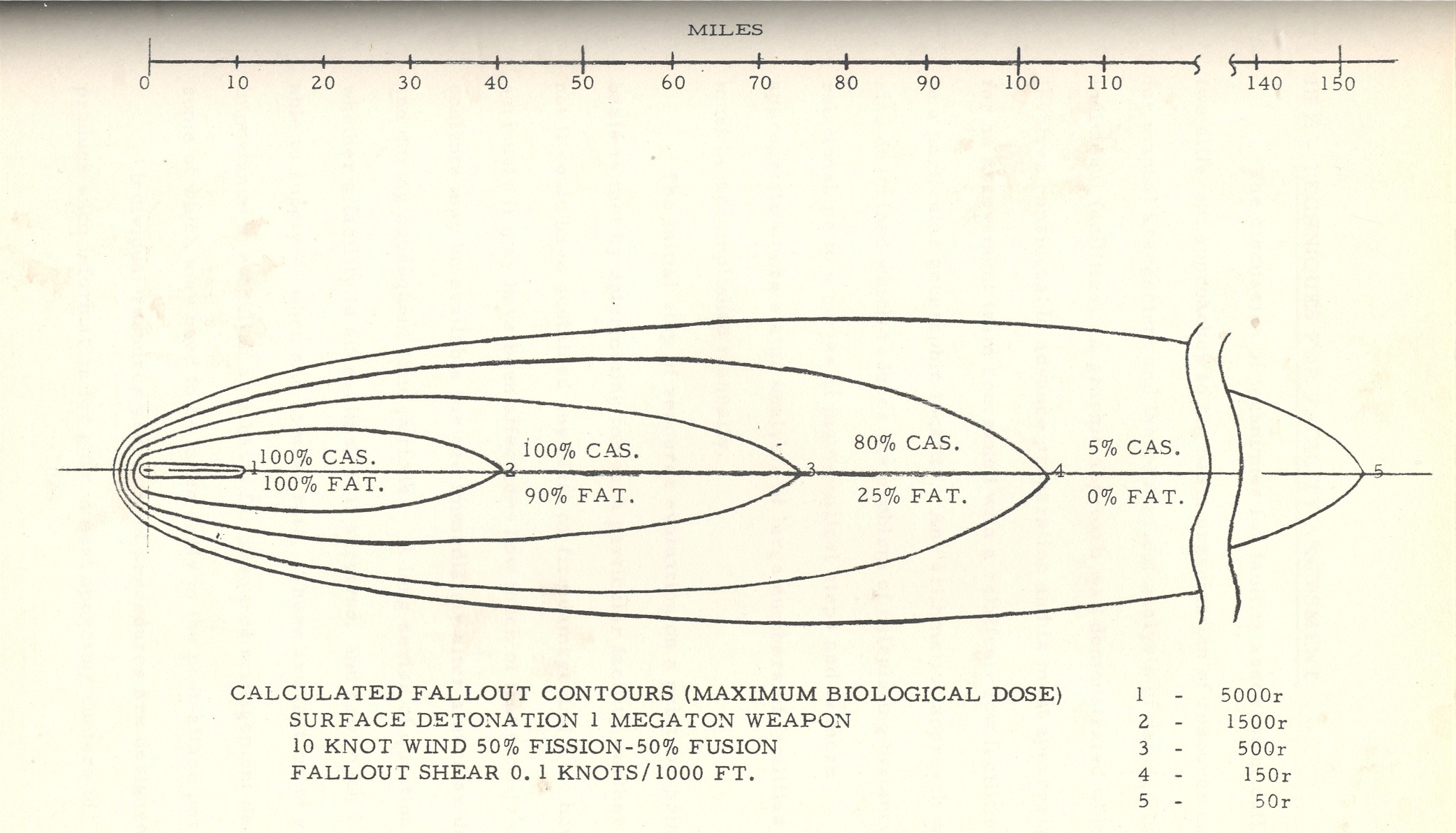
    The first image shows the effects of a 20 megaton nuclear blast detonated in in a city, presenting an incredible picture of absolute destruction, reaching out from ground zero for more than 11 miles.    

    This doesn’t begin to measure the overall damage inflicted by radiation, which is deeply, extraordinarily, severe.  This again is the effect of one weapon, the 100%  fatality rate eventually reaching out 12 miles; 90% reaching over 40 miles.  General casualties extend to 80% up to 70 miles from ground zero. 

    March 3--20 mt det blast
    March 3--spear


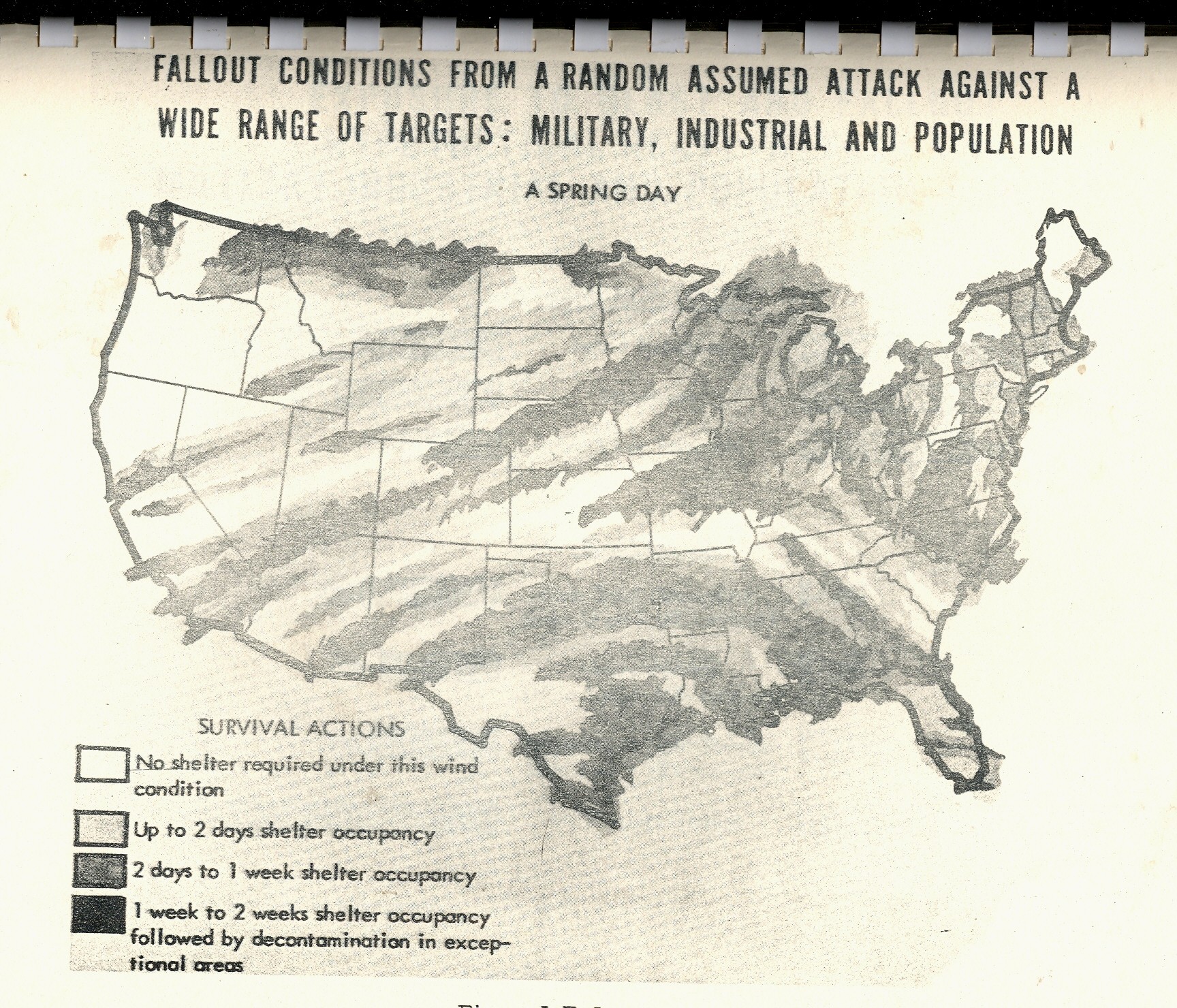
    The emergency planning end of the paper comes in at about this point.The fallout map of the U.S. shows a possible situation of an unspecified (though wide-ranging) attack (on a “spring day”) and its effects on the population as it is housed in various shelters and bunkers, suggesting the amount of time needed to “survive” the attack by staying inside the fail safe habitation.

    March 3--spring day

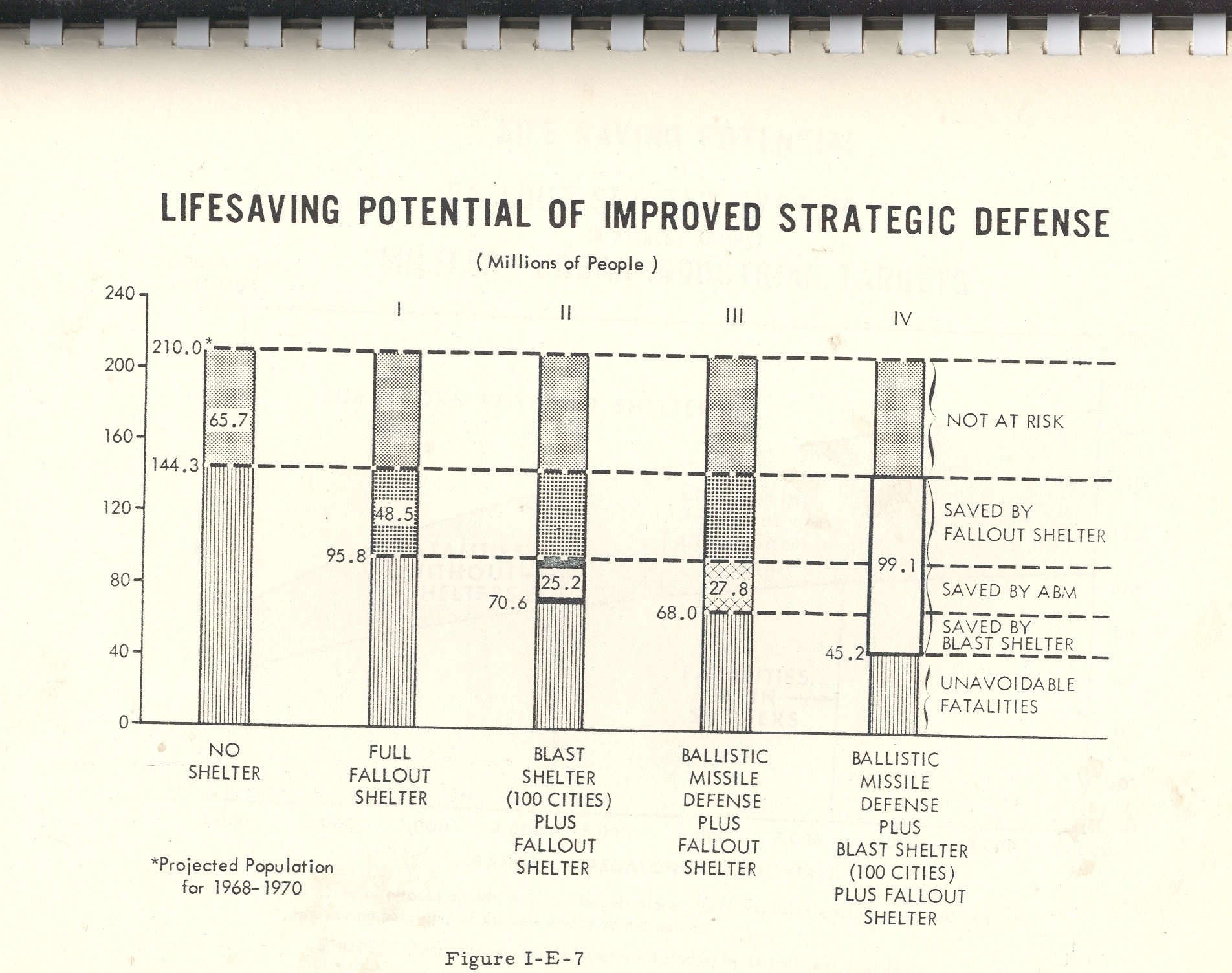
    The following chart, “Lifesaving Potential of Improved Strategic Defense” (in millions of people) shows the effect of the installation of the shelters and bunkers.  In this scenario, in  a massive strike, the fatality rate in the U.S. of an unprotected population was 65%, or 144 million.  On the other end of the extreme was “ballistic missile defense plus blast shelters plus fallout shelters”, or a massively- protected population of fictional expanse shows that in spite of all precautions 45.2 million people would die (as “unavoidable fatalities”). 

    “These have no longer any hope of death;  And this blind life of theirs is so debased,    They envious are of every other fate.” Canto III, Vestibule of Hell, the Opportunists.
    This document is nothing if not a death sentence had the massive strike ever been launched.  In the dozens of such reports that I’ve seen, there hasn’t been one with the Really Big One with thousands of euphemistically-named “exchanges”, which I assume would make all  of these others pale by comparison.

    March 3--life saving potential

    ·Posted by :

    ·in:


  • Unusual Shadows in Prints, 1861

    JF Ptak Science Books   Post 1213

    [This is another in a long thread of posts on this site relating to shadows–simply enter “shadow” in the google search box at left for a listing.]

    “Pulvis et umbra sumus” (“We are but dust and shadow”)–    Horace       

    Depicting the capacity of sight and nature of light has been both an easy and a knotty problem in the history of science. Over the successive theories on the basis of light the artistic presentation of the phenomenon has been generalized (generally) in a very simple way:  by straight lines.  There’s certainly nothing wrong with that, the lines are just parenthetic place-holders suggesting direction, not actual descriptors of what light “looks” like.   

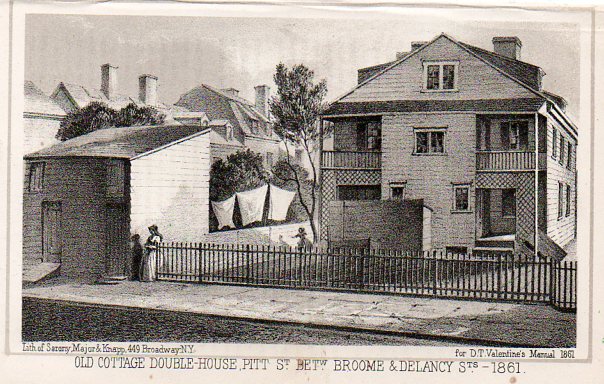
    Shadow valentine836
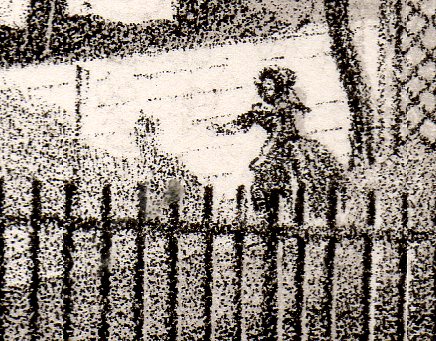
    But what about shadows? Light and its effects are the basis of art, but what about light, “interrupted”?  Or, really, how old is the depiction of the shadow in the history of western art?  The shadow predates the modern re-discovery of classical perspective by a thousand years—little bits of shadows pop up here and there in deep antiquity, certainly way before Uccello and Alberti and the rest came along.  On the other hand shadows do escape notice of many painters in the 15th century (and during the period of being very comfortable with the century-old realignment of perspective), which is odd, unless all of those works were depicting scenes at high noon or thereabouts.
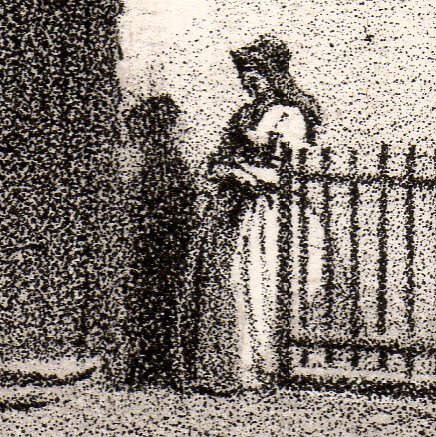
    Shadow valentine det girl837
    Which brings to mind this lithograph from one the 1861 edition of Valentine’s Manual for the City of New York.  What strikes me is the low oblique angle of the sun–setting or rising–throwing the shadows of the two figures in the image very high up on the receiving surface. Odd things like this are interesting to me, and to be frank about it,. I’ve not noticed such a hard angle with shadow in too many prints.

    Shadow valentine detb girl838


  • Defeated but Alive–German POWs, 1945. A Remarkable Photograph.

    JF Ptak Science Books   Post 1212

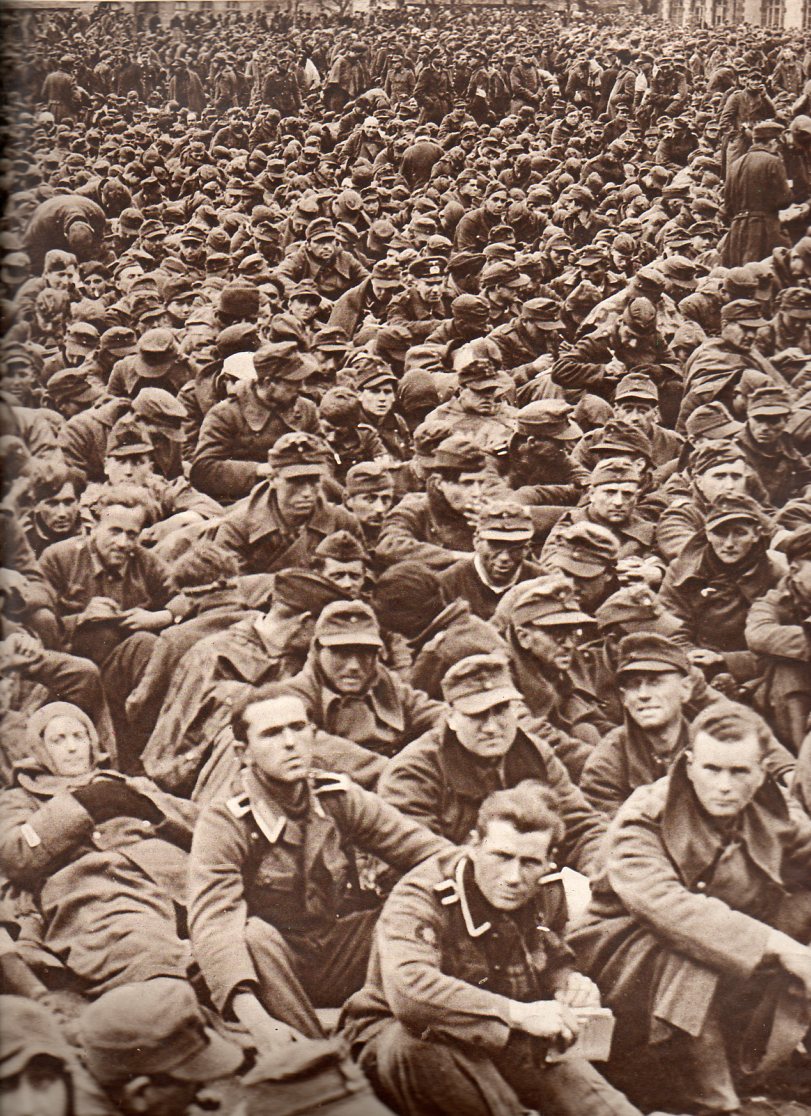
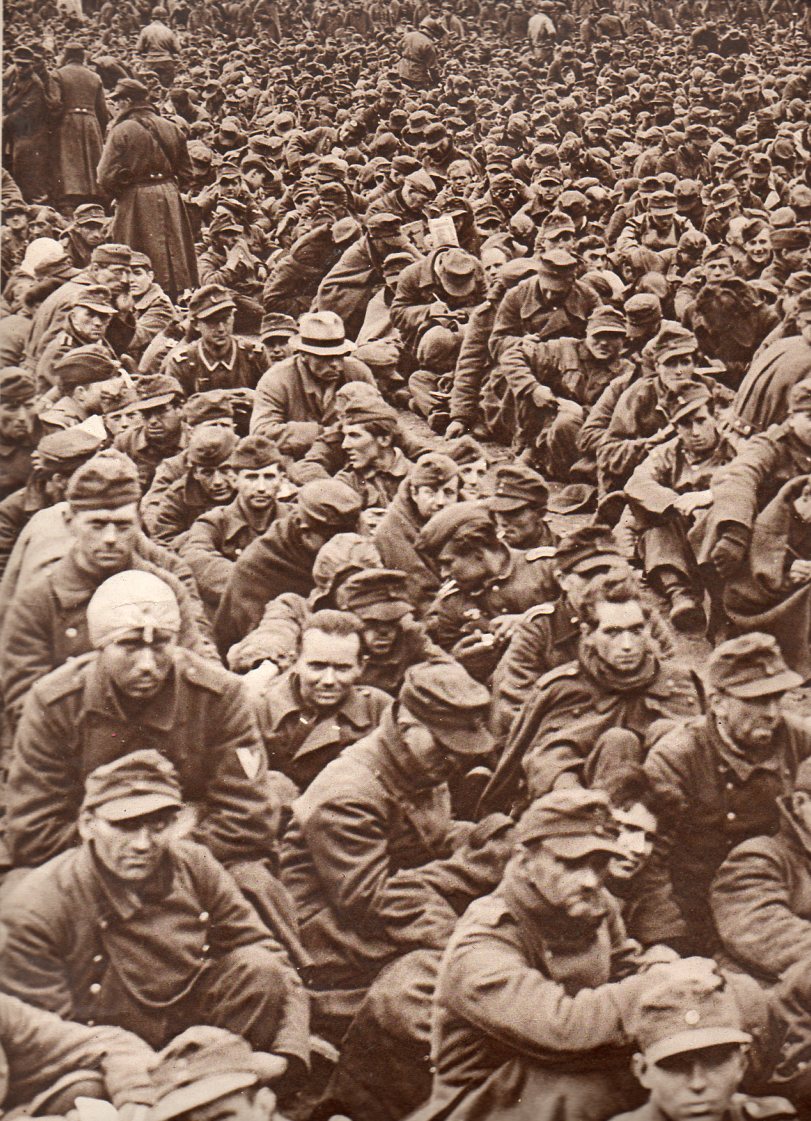
    Crowds--German prisoners-right-804 Crowds--German prisoners-left800

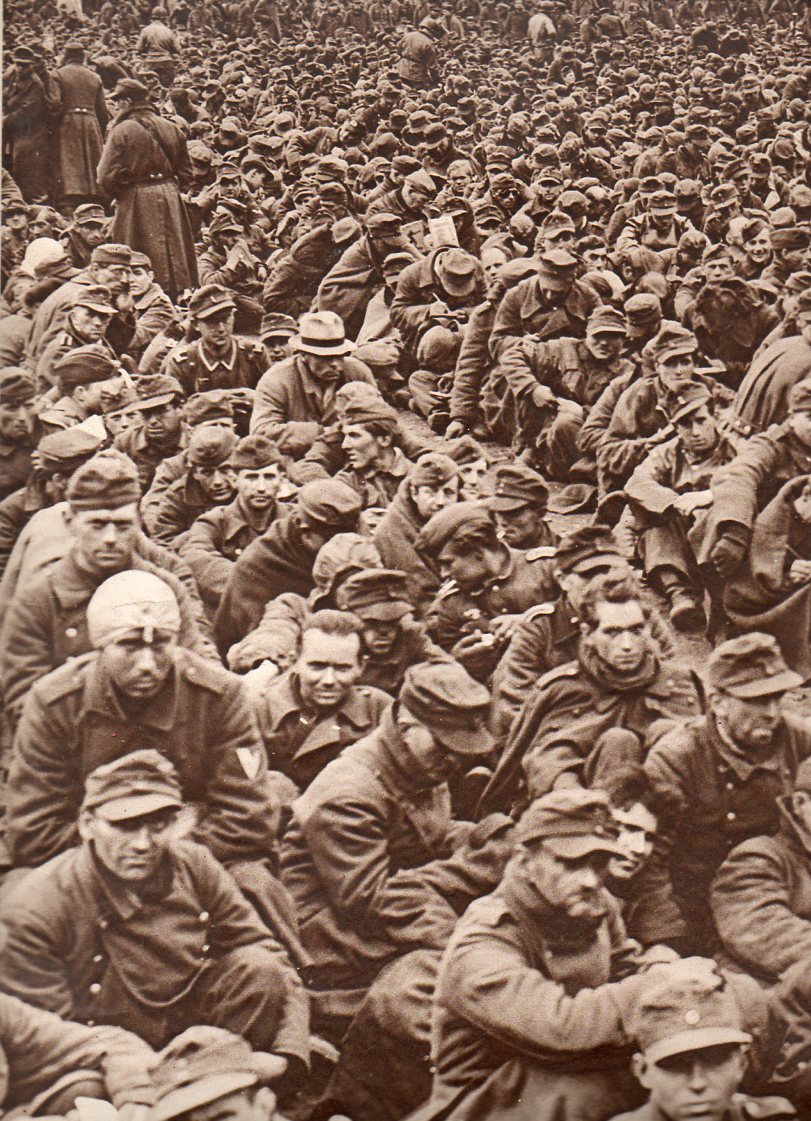
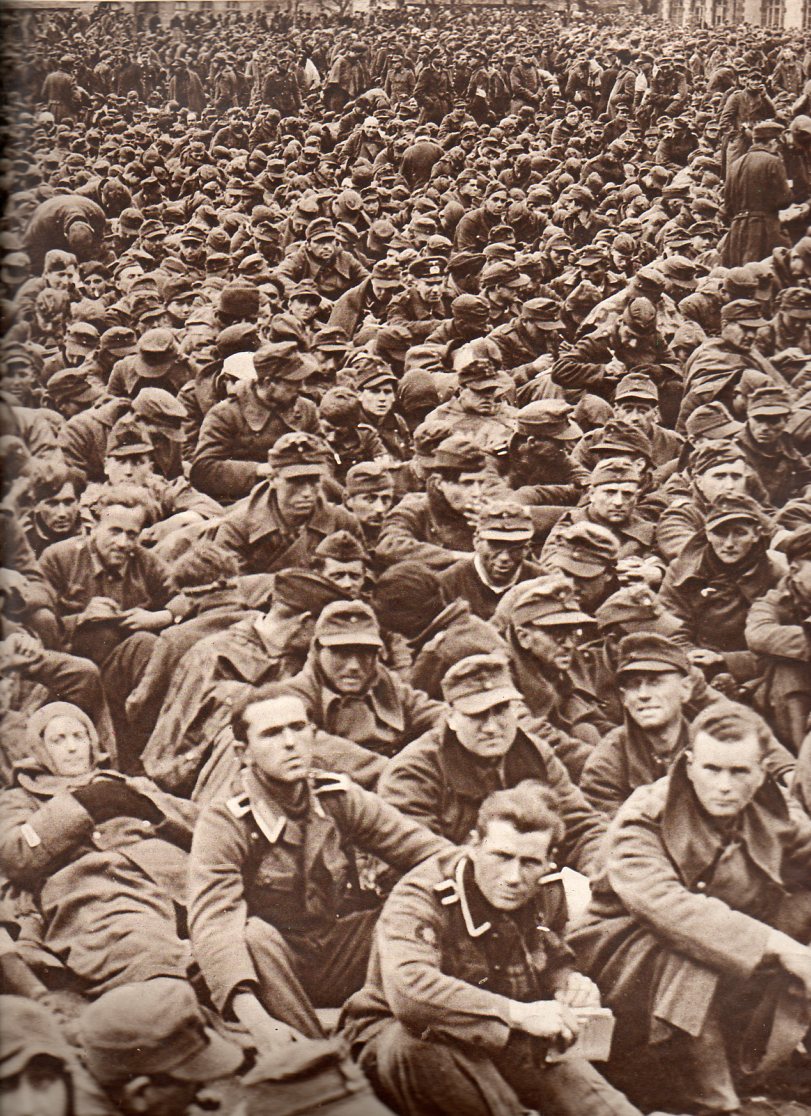
    By April 21, 1945–the date that this photograph was published–I should think that those left fighting in the Wehrmacht would have thought that it was time now to be taken prisoner by the British or the Americans, and to not be taken by the Soviet Army.  Thousands of German soldiers made their way west at the tail end of the war, trying to evade capture by the Russians, to find some sort of respite from the fear of being taken away by the Red Army to work and disappear somewhere inside the heart of Mother Russia.  There was a heavy dose of vengeance being unleashed on the captured German forces in the east in partial payback for the devastating assault on the Soviet Union (Operation Barbarossa) by the Nazis beginning on 22 June 1941, and which caused millions of citizens and soldiers their lives.  (Barbarossa was to have been a multi-month long campaign to secure the minerals and farm lands and forests of the Urals and Siberia and the Ukraine, but it lasted for more than three years along an 1800-mile front.  The initial operation was very successful for Germany, but the Blitzkrieg ended quickly, and a long slogging campaign began, one which would be decided not only by weather, but by massive production of Soviet materiel and overwhelming army strength.)

    Crowds--German prisoners-left800

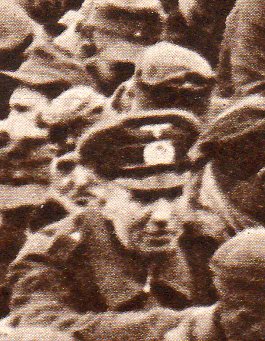
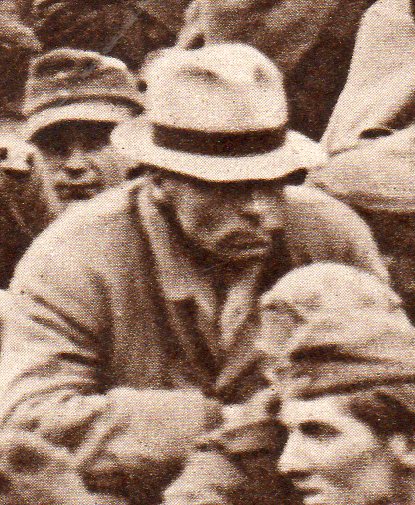
    The caption of this Illustrated London News photograph states that this is but a small fraction of the 2,000,000 prisoners then held by the Allied Forces.  Shortly before this it was estimated that the Nazis held some 1.7 million Allied prisoners, which meant that in early 1945 more than 4 million soldiers were held as POWs in Europe.  This enormous figure is exclusive of Japanese prisoners (estimated at about 150,000 in early 1945, with this number being exclusive of any Chinese prisoners), and the number of prisoners held by the Soviet Union. 

    Crowds--German prisoners-right-804

    Crowds--German prisoners-right-det802
    Te return rate of German prisoners from Allied camps was very high; that same rate for Germans in possession of the Soviets was very low, something along the lines of 20%.  The Nazi campaign through the Soviet Union showed small mercy and great cruelty; the Soviets reciprocated with the German soldiers they captured.

    Crowds--German prisoners-left-detaul801
    Overall, this is a tough photograph.  The soldiers were evidently awaiting delousing before being sent onto trains to deliver them to more formal detention facilities. At least when these soldiers got on those trains with what sound like hgih-tin whistles, they mainly survived their ordeal, and the showers that they were going to receive were using water, and not zyklon-B.


  • Determining the Particular and Peculiar for Ladies, 1941

    JF Ptak Science Books   Post 1211

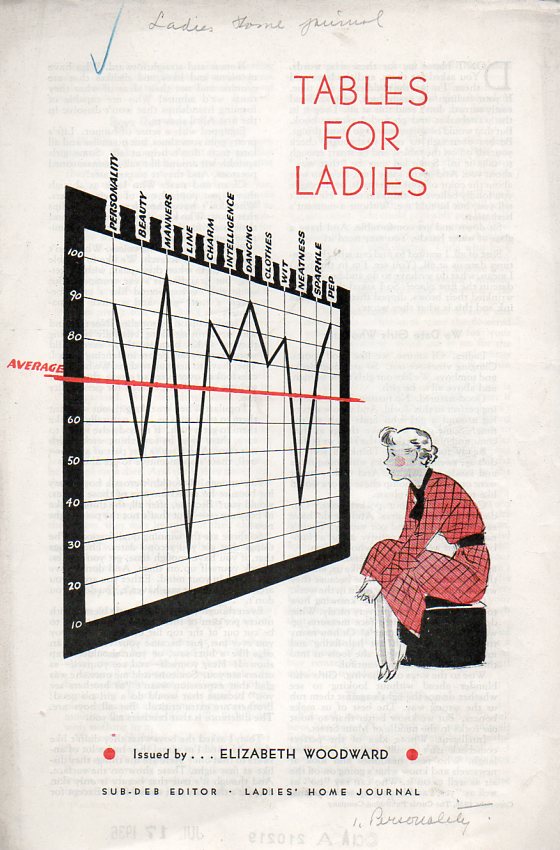
    Girl stuff--tables for ladies828I must admit that I like the first of these two “lady tests” (separate publications from The Ladies Home Journal), cautionary tales as they are, like being able to select your own villainous wardrobe for a creepy (or loud or not) 1940’s version of a Brother’s Grimm fairy tale–instructive, occasionally delightful, often wincing.  It seems that the dividing line between being particular and being peculiar displays its fair share of the miracle of capilary action. 


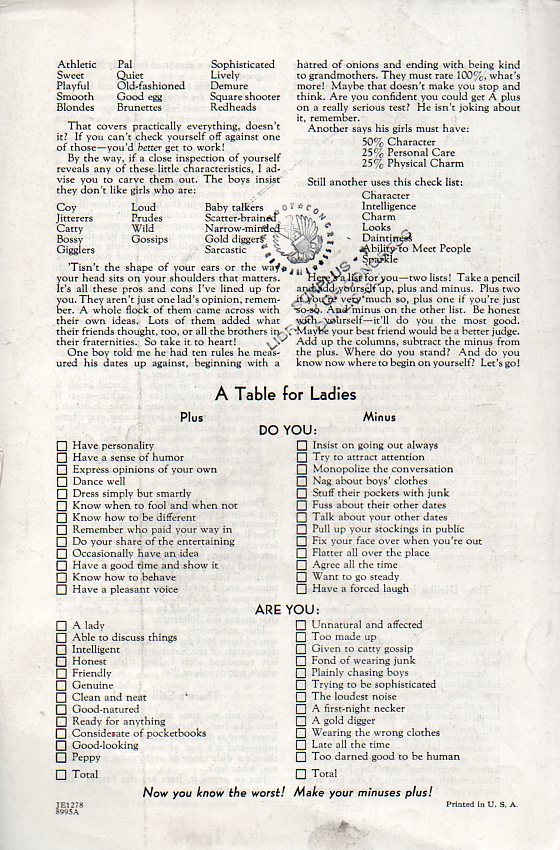
    For example,  in Tables for Ladies (1936), the failing grades (minuses) actually look mostly like, well, problematic personality quirks.  I get the “too made up”, “late all the time” and “gold digger” parts–also the character who has a forced laugh, agrees all the time, and is endlessly flattering while putting on makeup and pulling up stockings and monopolizes the conversation (simultaneously?)–and then wants to “go steady” right away while complaining about her (and his) former dates, does not make for an interesting time out. [Both Tables for Ladies and How Ya Doin’ are available for purchase at our blog bookstore.]
    Girl stuff--tables for ladies test831

    I’m not sure what “too darned good to be human” and “occasionally have an idea”  mean, nor the failing grade for having too much stuff in your pocket.  A lot of the other stuff looks okay to me: intelligent, honest, friendly, genuine, good natured–basic things that translate just fine into 2010.  But then there are those servile, squinty-eyed parts that just give you a coppery feeling in your mouth for how restrictive they are.

    Of course there’s stuff there indicative of the time, just like the awful racism that creeps into Babar or Bugs Bunny from th 1940’s, or the rank use of racial epithets that populate some regional maps of the south (I can easily attest to the very broad use of the n-word in more than a dozen places in a large 1932 map of my own Buncombe County, all gone today), or the portrayal of subservient women in 1950’s common culture–but for the most part, the overall reach of this little pamphlet seems not-terrible.

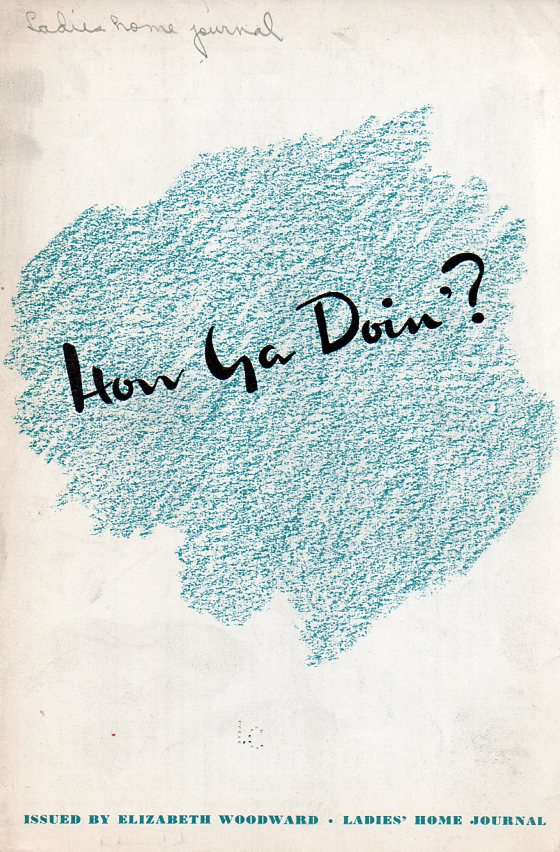
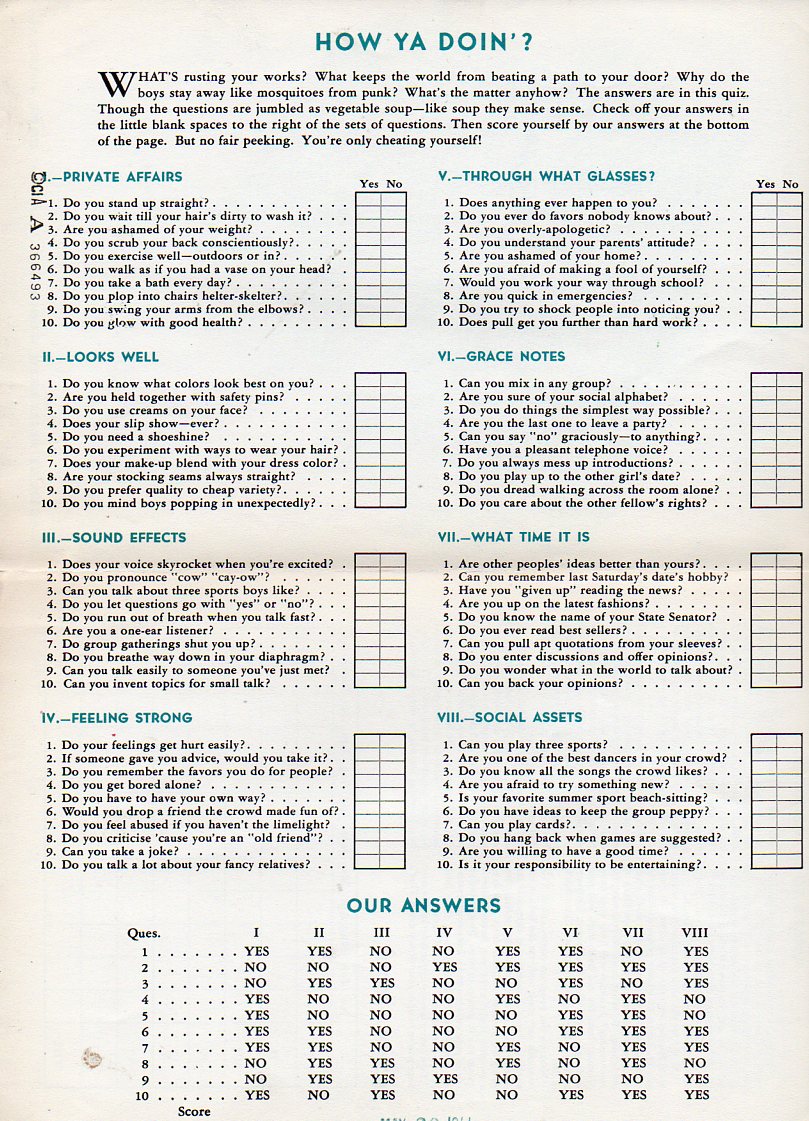
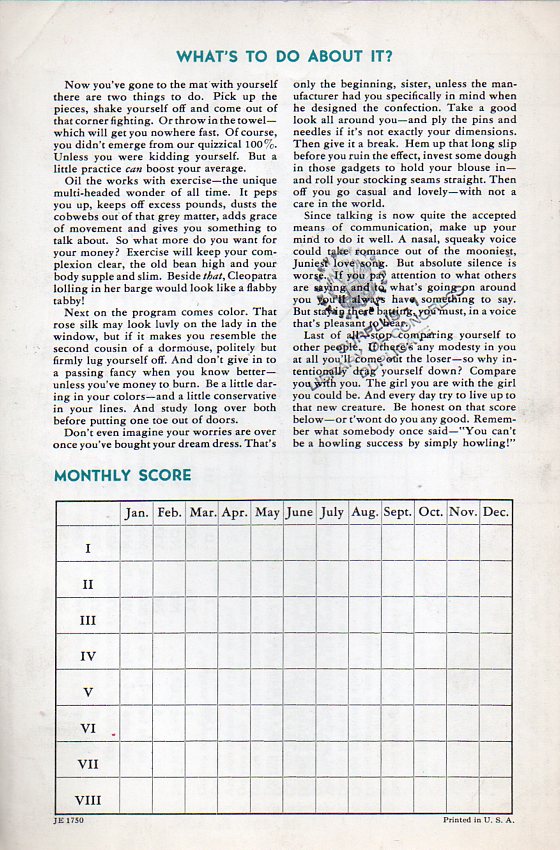
    Girl stuff--how ya doin cvr825 The second little test, How Ya Doin’ (1941), verges more on the need for the mass produced Stepford woman, only this one comes from an earlier period, the mother of Stepford.  Some number of the questions seem less significant but more important, many feeling annoying and trite–many of the graded areas are so unexpected (here in 2010) but were in 1941 thought of as being socially important and, well, marketable. 

    It was important to say “yes” to the questions “do you scrub your back conscientiously?”, “do you walk as if you had a vase on your head?”, “does your make up blend with your dress color?”, “are your stocking seams always straight?”, “can you talk about three sports that boys like?”, “do you breathe way down in your diaphragm?”, “does anything ever happen to you?”, “can you play three sports?”, “do you know all the songs the crowd likes?”, “is it your responsibility to be entertaining?”, and so on.

    Girl stuff--how ya doin test826
    Girl stuff--how ya doin ttest back827
    Not all of the questions feel so sharp and stinging–there are many good qualities (or good qualities from the 2010 mind) that are listed here as well–not to abandon your friends, believing in yourself, inspecting and supporting your opinions, knowing how to decline graciously, feeling good about where you live, being kind, expressing concern, and the like. 

    The quizzes are not without quality.

    In the same vein you might also enjoy these earlier posts in this blog

    What Goes into Making Human Robot Girls 

    How to Look Smart, or Pretty, but Not Both

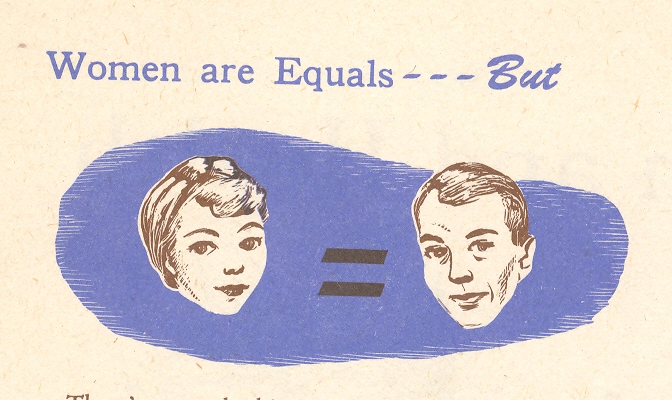
     Maintaining Women as a Subclass: Major Reinforcements from Minor Non-sequitors

    Missing Pieces of Women: Pope Joan and the Proper Girl of the Ladies Home Journal

    How FDR Made Women (1) Nervous and thus (2) Older. An Appeal to Vote Republican, 1936

    The Coming Sex War of 1919

    Mar 25 women equals but


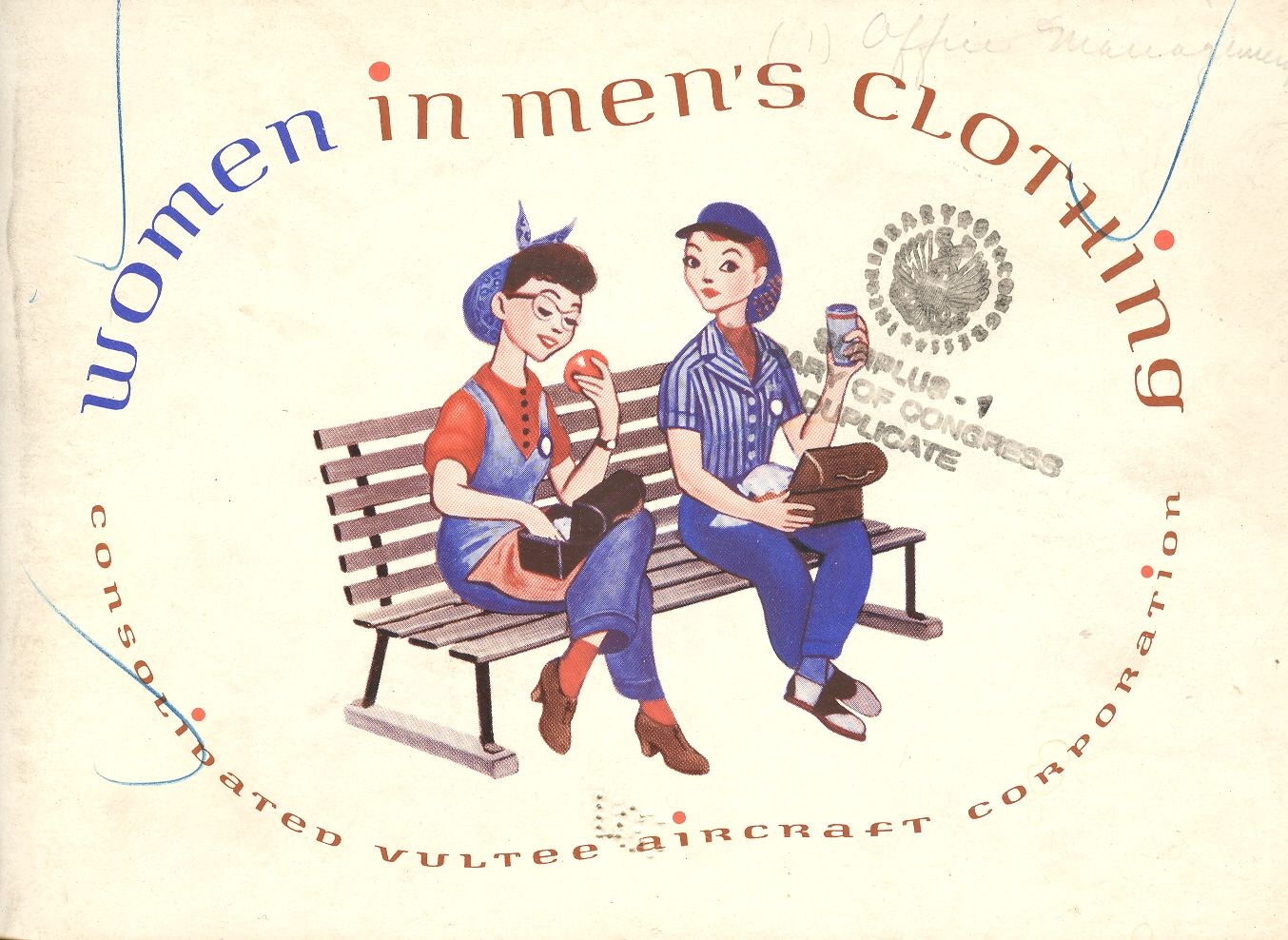
    Mar 25 women are humans cvr


  • A Do-It-Yourself Paper Digital Computer, 1959.

    JF Ptak Science Books    Post 1210

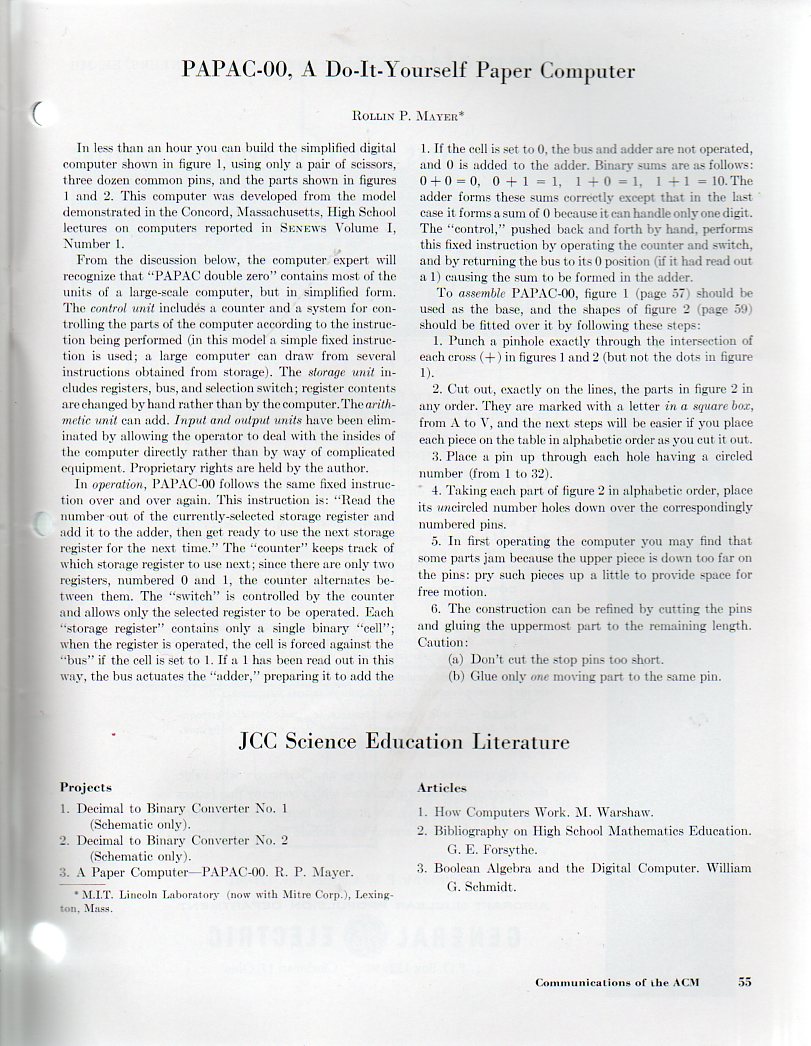
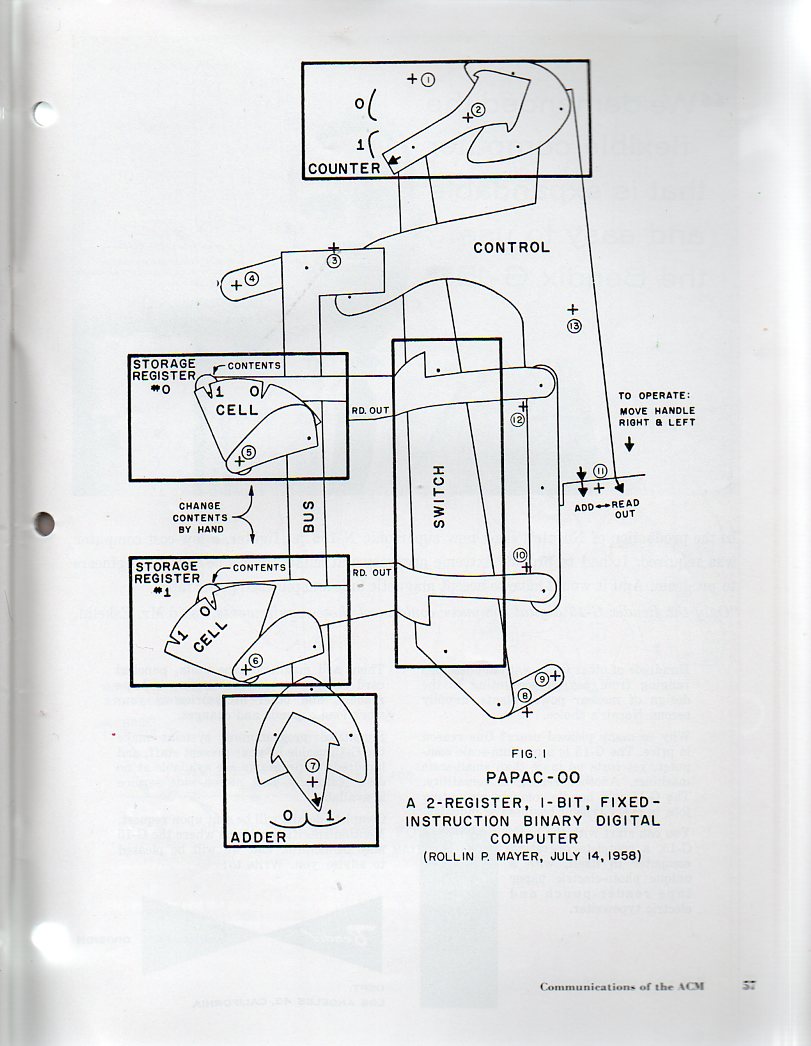
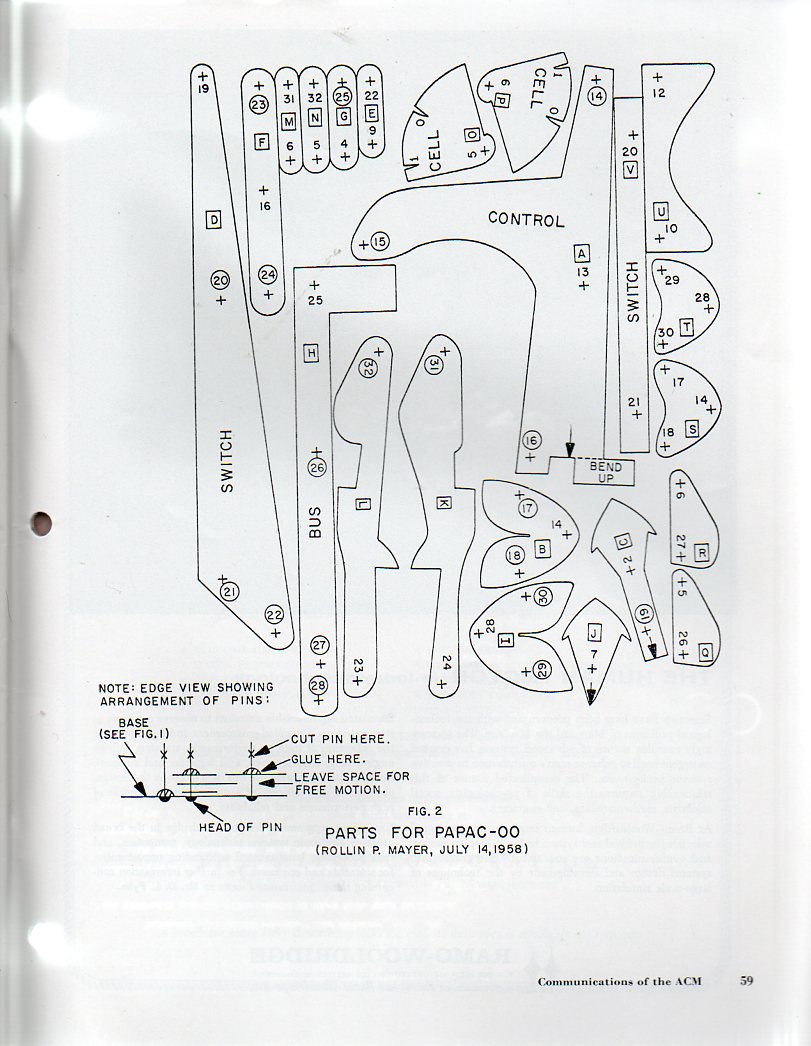
    Computer, paper832 This wonderful cut-away and paste-up template for a digital computer comes to us from the Communications of the Association for Computing Machinery, volume 2, issue 9 for September 1959.  The PAPAC-00 is a “2-register, 1-bit, fixed-instruction binary digital computer” and was submitted to the journal by Rollin P. Mayer (of the MIT Lincoln Lab).  There’s a hunk of me that wants to make this thing really big–cut out the individual pieces and then crash them out to 50″ widths, pasted on found bits of cardboard packing from the neighborhood frame shop, and then piece the thing together as the world’s largest pre-1960 1-bit paper computer.  Or maybe not.  In any event I thought to share this with readers here who might actually print out these templates and try to construct the thing themselves–warning: you’ll need t be able to cut pins in order to make the model work properly. Computer, paper833

    Mayer also wrote an interesting article on including children in the scope of the computer industry…in 1956–something I find to be a very early piece of thinking on Little Humans and Big Computing.  His abstract identifies the three main points of his paper: “(1) That the digital computing field needs, and will continue to need, not only more people who are capable of designing and programming digital computers, but more people who understand the basic limitations and potential uses of digital computers; (2) that the computer industry should take an active interest in providing a basic computer training to the largest number of people, in addition to more extensive training to those who show an interest in designing and programming computers; and (3) that the typical 12-year-old youngster has the interest, skill and basic knowledge necessary to build and understand simple working models of practically anything”. –“A proposal for training youngsters in digital computing techniques” in Proceeding ACM ’56 Proceedings of the 1956 11th Annual Meeting.

    Lastly I should also mention that in this same monthly issue (which ranged all of 52 pages) was an article by Julien Green, “Remarks on ALGOL and Symbol Manipulation”, a three-page paper that comes from the near-dawn of the ALGOL (short for ALGOrithmic Language). (It can be argued that the beginnings of ALGOL were about 1955, but for the sake of simplicity here I’ll note that the first committee appointed to study the matter for the ACM was in September, 1957, and the first group to formalize it met at the ETH Zurich in 1958, producing the language’s first version, known as ALGOL 58.  Julien Green was a member of the 13-person panel that created the ALGOL 60that met in Paris in January 1960.   And so the Green paper did appear within the first few years of institutional study in America, and it was written by one of the six American members of the ALGOL 60 team.)

    Computer, paper834


  • Death from Above–the Fear of Aerial Bombing and Gas Attacks, 1932

    JF Ptak Science Books  Post 1209

    Aerial bombing from heavier-than-aircraft comes to a big anniversary soon, on 1 November 2011, a century after the Italian Lt. Giulio Cavotti dropped the first bomb from a plane on oasis-encamped Libyan troops at Tripoli.   Of course things rapidly in the few years following that, so that by the end of WWI people got a good taste of what it meant to controlling pieces of property without actually occupying them, raining chaos and destruction from

         Air attack iillus lond cvr778

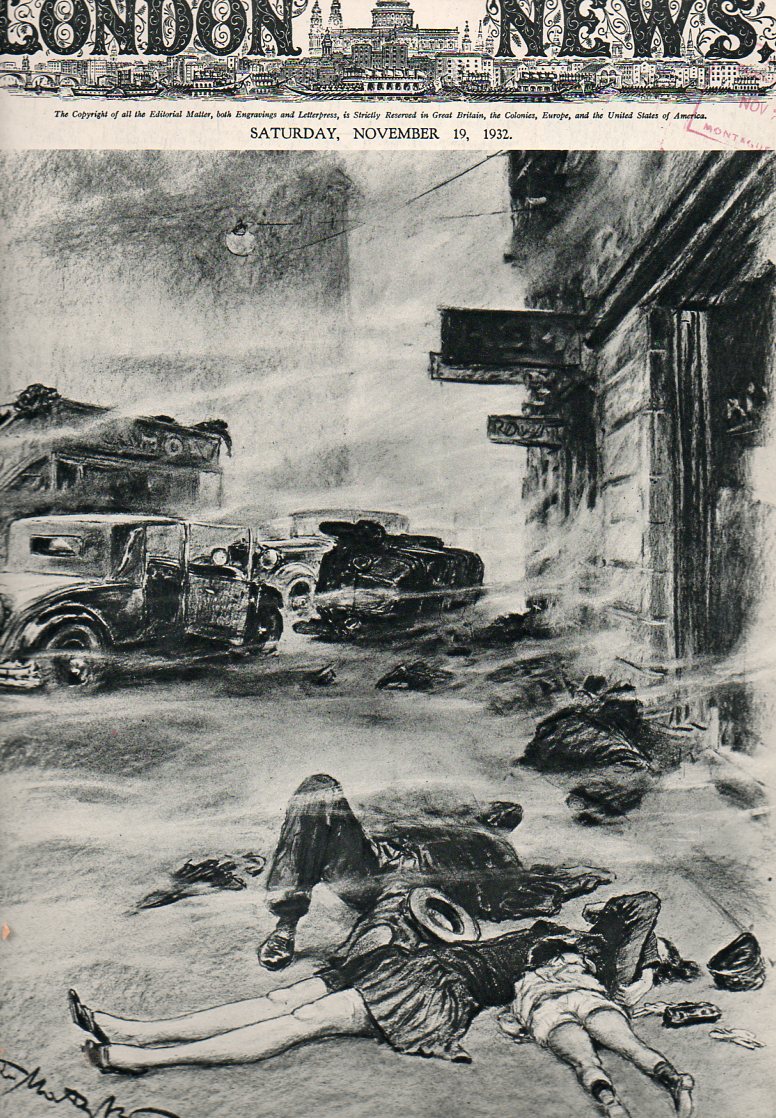
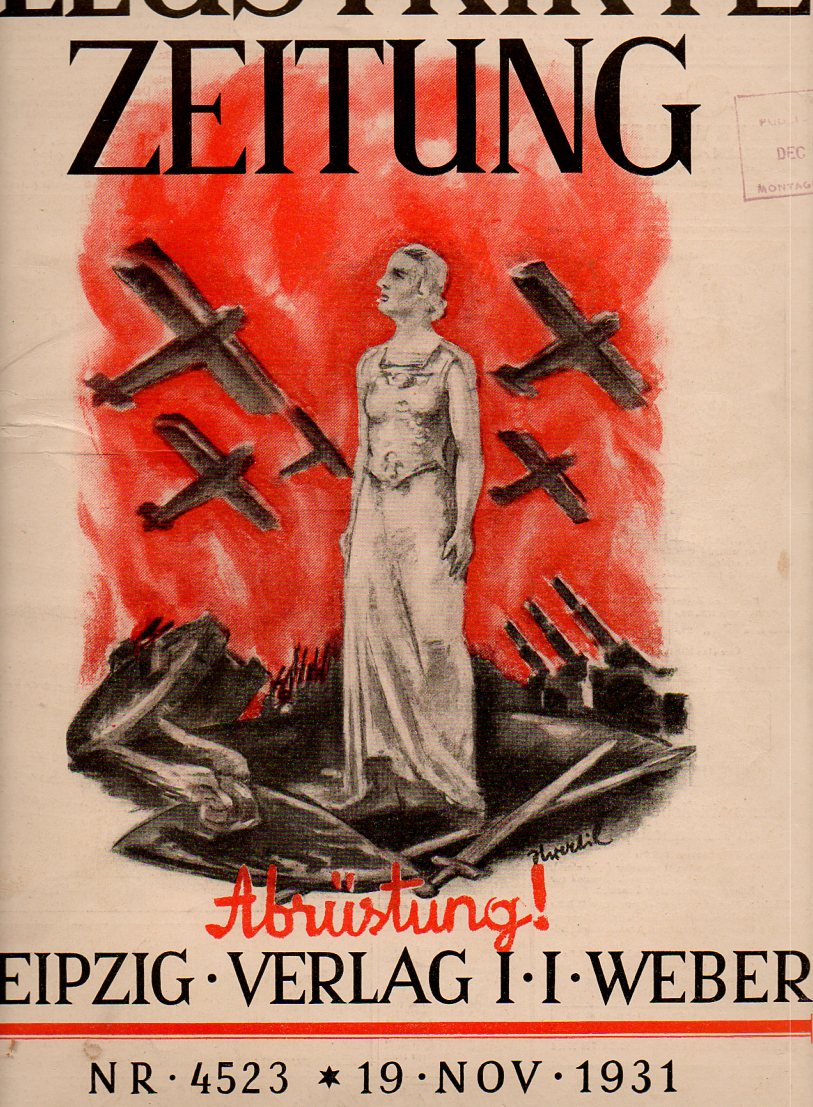
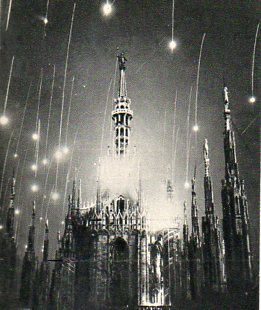
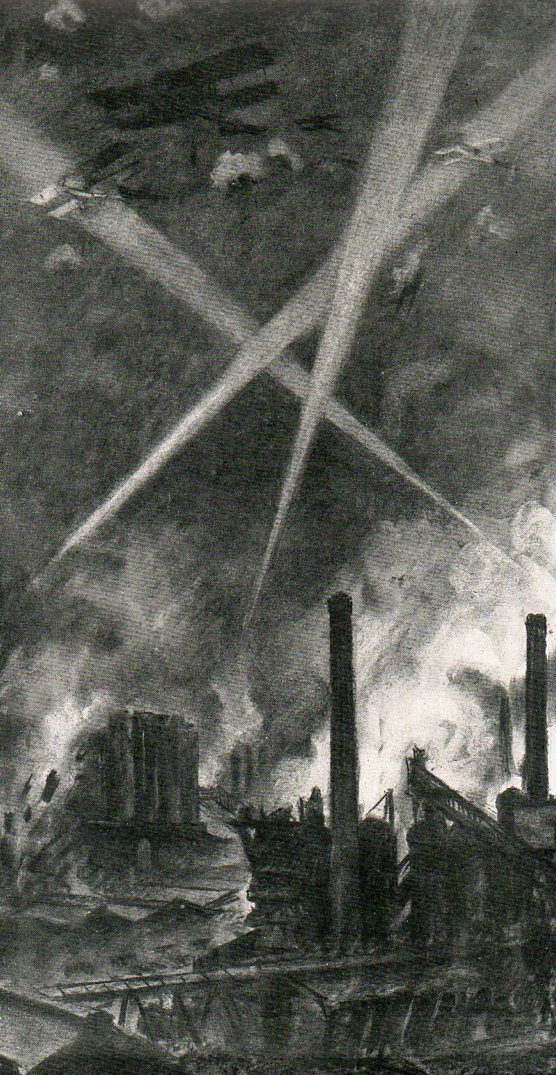
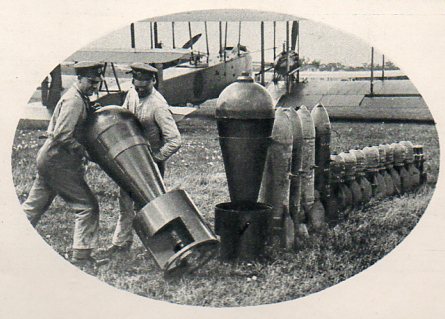
    above.  20+ years later, in the early 1930’s bombing became more sophisticated, including a new arsenal of poison gas weapons.  The threat from this weapon was agonizing and palpable–the results of gas attacks upon armed combatants in WWI and  the gassing of civilians in the 1920’s and early 1930’s  made a hard strike into the social fabric, an enormous gapping new hole to be filled in the heart of fear. [And of course this fear was felt everywhere, from London to New York to Leipzig to Moscow to Milan, as we can see in these few examples below. ALSO: these images may be purchased rfom our blog bookstore, here.]

    Air attack776
    And this interesting image of a mock (or “mimic” as it was called in the report) attack on Milan in August, 1931:

    Air attack madrid779
    There were a number of interwar aerial bombings that took place that kept the issue of mass destruction alive and well.  For example,  Britain used its air arm  very convincingly in Iraq, bombing many places including Bagdhad  in 1923; the Spanish bombed civilians into submission in Morocco, near Tetuan, in 1925, and the French crippled and destroyed  their opponents–both military and civilian, it made no difference–in Damascus, Syria, also in 1925.

    Air attack industrial777
    Fiction also harnessed the possibilities of air war, not the least of which included Armageddon-like scenarios for the semi-End of Days through the use of poison gas and “atomic” weapons.  For example, deadly gas used in Anderson Graham’s The Collapse of Homo Sapiens (1923) and Neil Bell’s Valiant Clay (where the poison gas kills 1.5 billion) and Dalton’s Black Death (1934), while Reginald Glossop’s The Orphan of Space (1926) created an alien atomic spaceship which delivered holocaustal death to Soviets and Chinese and Communists in general.  There were many more stories like this, not the least of which were the non-fiction strategy works, like Giulio Douhet, author of Dominion of the Skies (1921), legitimizer of the “strategic” bombing of civilian populations (in spite of the Hague Conference of 1907*), and  JFC Fuller’s The Reformation of War (1923) which emphsized the new importance of air war and power and which also allocated the use of gas, justifying that morality  because it could cause less harm than a conventional attack.

    [Image below from :Mr Baldwin on Aerial Warfare”, The Illustrated London News for 19 November 1932, illustrating the sort of aerial bombs that could threaten the population of London.]
    Air attack bomb780

    The fear was real, and the capacity to cause mass death (espcially from poison gas) was substantial, even if in a still-developing form.  Eight years hence, though, it would almost all come true (except for the poison gas part, at least for WWII), and in ways that weren’t quite imaginable in 1932–500 B-29s flying criss-cross over Tokyo would’ve seemed more fiction than science to the 1932-person, even though that technology was only a dozen or so years away. 

    Notes

    * This is where the bombing of civilian areas was specifically outlawed; what wasn’t defined, however, was what “civilian” meant–turns out that it was pretty loosely defined in the 20’s and ’30’s.


  • The Atomic Bomb Art of William Shockley, 1945.

    JF Ptak Science Books   Post 1208

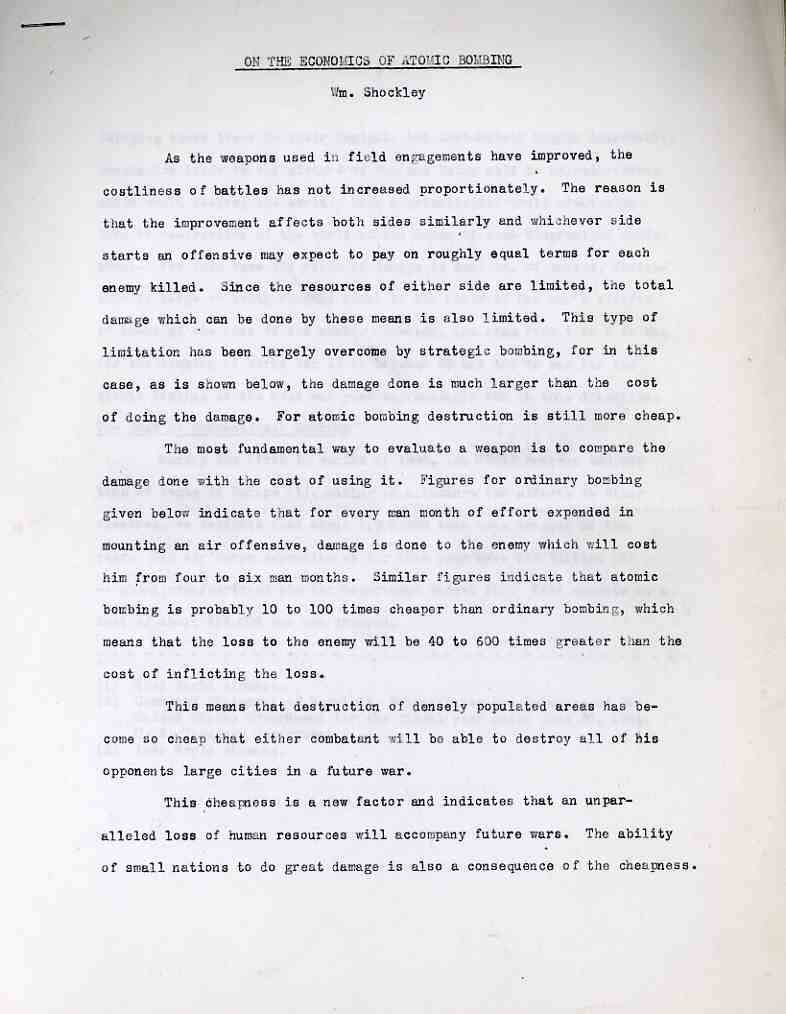
    “For atomic bombing destruction is still more cheap”–WIlliam Shockley1.
    Shockley atomic
     (Click image to enlarge; the other four pages are located in the “Continue Reading” section, below.This is also available for purchase via our blog bookstore.) 

    This paper is one a small archive of background and draft papers and proposals by the Vannevar Bush group working on the question of the control of atomic weapons and the formalization of the American position regarding the use and control of atomic weapons, October 1945-February 1946. This archive consists of 38 documents relating to the development of U.S. atomic policy, with  contributions by President Harry Truman, Secretary of State James Byrnes, Dr. Vannevar Bush, (future AEC director) Carroll Wilson, Alger Hiss, I.I. Rabi, William Shockley, Frederick Dunn, Joseph E. Johnson, Leo Pasvolsky, Philip Morrison, Col. Nichols, William McRae, Admiral W.H.P. Blandy, George L. Harrison, and others.

    I have written elsewhere on this site about Vannevar Bush and the coming atomic/nuclear arms problem–as perhaps one of the pre-eminent scientific minds in the Roosevelt/Truman administrations, Bush and others foresaw the development of the atomic arms race in 1943, and by 1945 Bush became a  fundamental thinker and advocate on the problem. The items in this archive are low-formal background papers, drafts of proposals, informal studies, as well as mature statements of thought that would become implemented in the core of U.S. policy regarding the spread and control of atomic weapons. They are generally carbon typescripts and necessarily of extremely limited distribution, generally have no letterheads, occasionally carry the authors’ full names (although sometimes only initials are used).

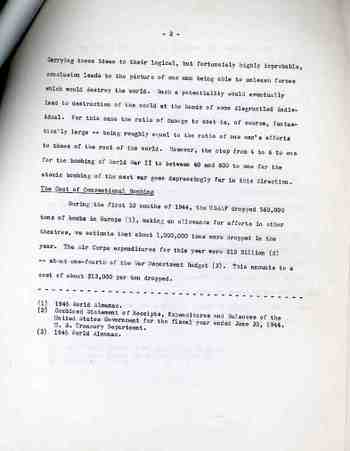
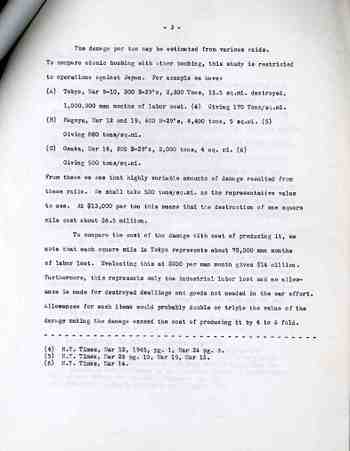
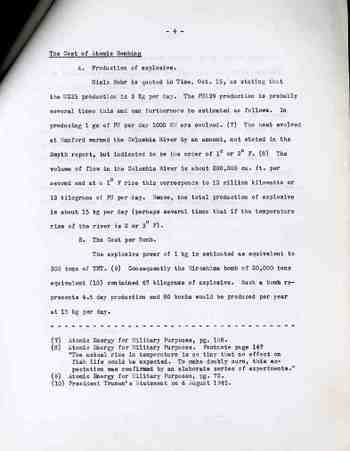
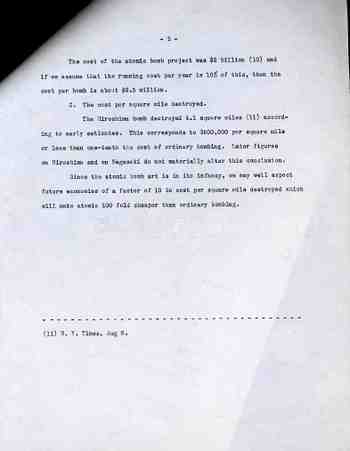
    The William Shockley paper was written towards the end of 1945 and is on five pages and runs about 1500 words, and is an extension of work he had already been doing for Henry Stimson with Quincy Wright on evaluating the combinations of casualties that would lead the Japanese to surrender3.  He begins this paper with a logical statement of the issue of the economics of conventional and atomic bombing, ending with the sentence “For atomic bombing destruction is still more cheap”.  What Shockley is getting to is the overall cost of the amount of destruction caused per square mile, and the conclusion that he draws over these five pages is the destruction caused by the atomic bomb is 1/100th the cost of conventional bombing per square mile destroyed (“atomic bombing is probably 10 to 100 times cheaper than ordinary bombing”).   

    Shockley also recognizes that the problem in the near future will be the increasing cheapness of producing atomic (and greater) weapons, and their developing accessibility to small nations.  “This cheapness is a new factor and indicates that an unparalleled loss of human resources will accompany future wars.  The ability of small nations to do great damage is also a consequence of the cheapness.”  He writes further that taking this thinking to its “logical conclusion”, that at some point in the future a single individual will be able to use this new technology to destroy the world.  The main point though that he was making in this line of thinking was the dispersion and proliferation of the new technology–that an arms race would occur, and that it would be dangerous, and that it could be very very bad.  Shockley has of course nothing to say about any of that or the implications of his finds as that was not his charge. 

    After figuring that the cost of destruction by the atomic bomb was about $600,000 per square mile (compared to $6,500,000 per square mile for conventional bombing), Shockley concludes that “since the atomic bomb art is in its infancy, we may well expect future economies of a factor of 10 in cost per square mile destroyed…”

    Shockley on the likelihood of casualties during the final invasion of Japan. 

    (The following three paragraphs are taken entirely from CASUALTY PROJECTIONS FOR THE U.S. INVASIONS OF JAPAN, 1945-1946: PLANNING AND POLICY IMPLICATIONS by D. M. Giangreco in the Journal of Military History, 61 (July 1997): 521-82 

    “As for Dr. Shockley’s initial report to Dr. Bowles, it was not submitted until after Stimson had left for Potsdam. He proposed that a study be initiated “to determine to what extent the behavior of a nation in war can be predicted from the behavior of her troops in individual battles.” Shockley utilized the analyses of Dr. DeBakey and Dr. Beebe, and discussed the matter in depth with Professor Quincy Wright from the University of Chicago, author of the highly-respected A Study of War; and Colonel James McCormack, Jr., a military intelligence officer and former Rhodes Scholar who served  in the OPD’s small but influential Strategic Policy Section with another former Rhodes Scholar, Colonel Dean Rusk.  Shockley said:

    “If the study shows that the behavior of nations in all historical cases comparable to Japan’s has in fact been invariably consistent with the behavior of the troops in battle, then it means that the Japanese dead and ineffectives at the time of the defeat will exceed the corresponding number for the Germans. In other words, we shall probably have to kill at least 5 to 10 million Japanese. This might cost us between 1.7 and 4 million casualties including [between] 400,000 and 800,000 killed.”–W. B. Shockley to Edward L. Bowles.2  .

    No accurate total of German military and civilian deaths was available at the time he prepared his report, but the number was eventually set at roughly 11,000,000. was not invaded and finished the war with just over 7,000,000 casualties, most of them from its armed services on the Asian mainland in fighting from September 1931 to September 1945.

    Notes: 

    1. The brilliant Shockley’s story is difficult and problematic: from the way in which he misused his interaction with the rest of his team at Bell Labs in the discovery of the junction transistor to his sinful racial and eugenic (and dysgenic) public persona later in life–it is a hard and long one to tell, and I’ll not try to do it here. (I should point out that his attacks started in 1966 when he “delivered the first of a series of controversial papers to the National Academy of Sciences (NAS) in which he called for a renewed focus on racial biology, synthesizing under the title of eugenics the compulsive element of population control with the targeting of the dysgenic fertility of the black population”.[From “Confronting the Stigma of Eugenics: Genetics, Demography and the Problems of Population” by : Ramsden, Edmund in Social Studies of Science, Vol: 39 Issue: 6, 12/2009 pages: 853 – 884.] Suffice to say that I’m very aware of the very long shadows, and I think that other people should at least be aware of them as well, regardless of the staggering importance of “his” (with the wonderful Walter Brattain and John Bardeen) monumental discovery. 

    2.  21 July 1945, “Proposal for Increasing the Scope of Casualties Studies,” Edward L. Bowles Papers, box 34, Library of Congress.

    3. For a detailed look at Shockley’s work in this area see Predicting the Termination of War: Battle Casualties and Population Losses, by Frank Klingberg in The Journal of Conflict Resolution, Vol. 10, No. 2 (Jun., 1966), pp. 129-171. Dr. William B. Shockley (later a joint winner of the Nobel Prize for his work in developing transistors) was an expert consultant to the Secretary of War, engaged in part in gathering and organizing information bearing on the problem of casualties in the Pacific war. He believed that historical studies of casualties might be helpful &dquo;for consideration in connection with the total casualties to be expected in the Japanese war, the rate at which land invasion should be expected in the Japanese war, the rate at which land invasion should be pushed
    ahead in Japan or held back while attrition by air and blockade proceeds, and the relativeapportionment of effort between the Army Air Forces and the Army Ground Forces…”
    The cointinuation of the Shockley paper, pp 2-5.   
    Click on any image to enlarge it.   

    Blogaug_6shockley_2362

    Blogaug_6shockley_3363

    Blogaug_6shockley_4364_2

    Blogaug_6shockley_4365_2