A Daily History of Holes, Dots, Lines, Science, History, Math, Physics, Art, the Unintentional Absurd, Architecture, Maps, Data Visualization, Blank and Missing Things, and so on. |1.6 million words, 7500 images, 4.9 million hits| Press & appearances in The Times, Le Figaro, Mensa, The Economist, The Guardian, Discovery News, Slate, Le Monde, Sci American Blogs, Le Pont, and many other places… 5000+ total posts since 2008.

Author: JF Ptak

  • Ueber-Spectacular Understatement Department: the Happy Post-Apocalyptic America and the “Awkwardness” of Holocaust, 1962

    JF Ptak Science Books    Post 1206

    Self- and purposefully-deceptive belief in spectacular and unsupportable scenarios espoused by governmental leaders which affect the lives of hundreds of millions of people deserve their own Dante-esque categorization:  and that’s one that I haven’t come up with yet.   This post is one of a continuing thread on the history of atomic weapons. {Incidentally, the pamphlet described here is available for purchase  from our blog bookstore, here.]

    I wonder how it was that we humans didn’t blow ourselves into melty dissolving bits during the Cold War.  Somehow all of those thousands of megatons of disastrously radioactive explosives that were completely and reliably deliverable didn’t get launched—not even by accident, not even during all of those hot itchy-finger DEFCON 2 situations.  Did MAD (Mutually Assured Destruction ) actually work?  Did the attempt at making a winnable nuclear confrontation keep people from actually trying to do so?  Did the overwhelming and insane buildup of weaponry actually have so much enormous and foul intellectual weight that no one could actually make the decision to use the weapons for fear of snuffing out all human life? 


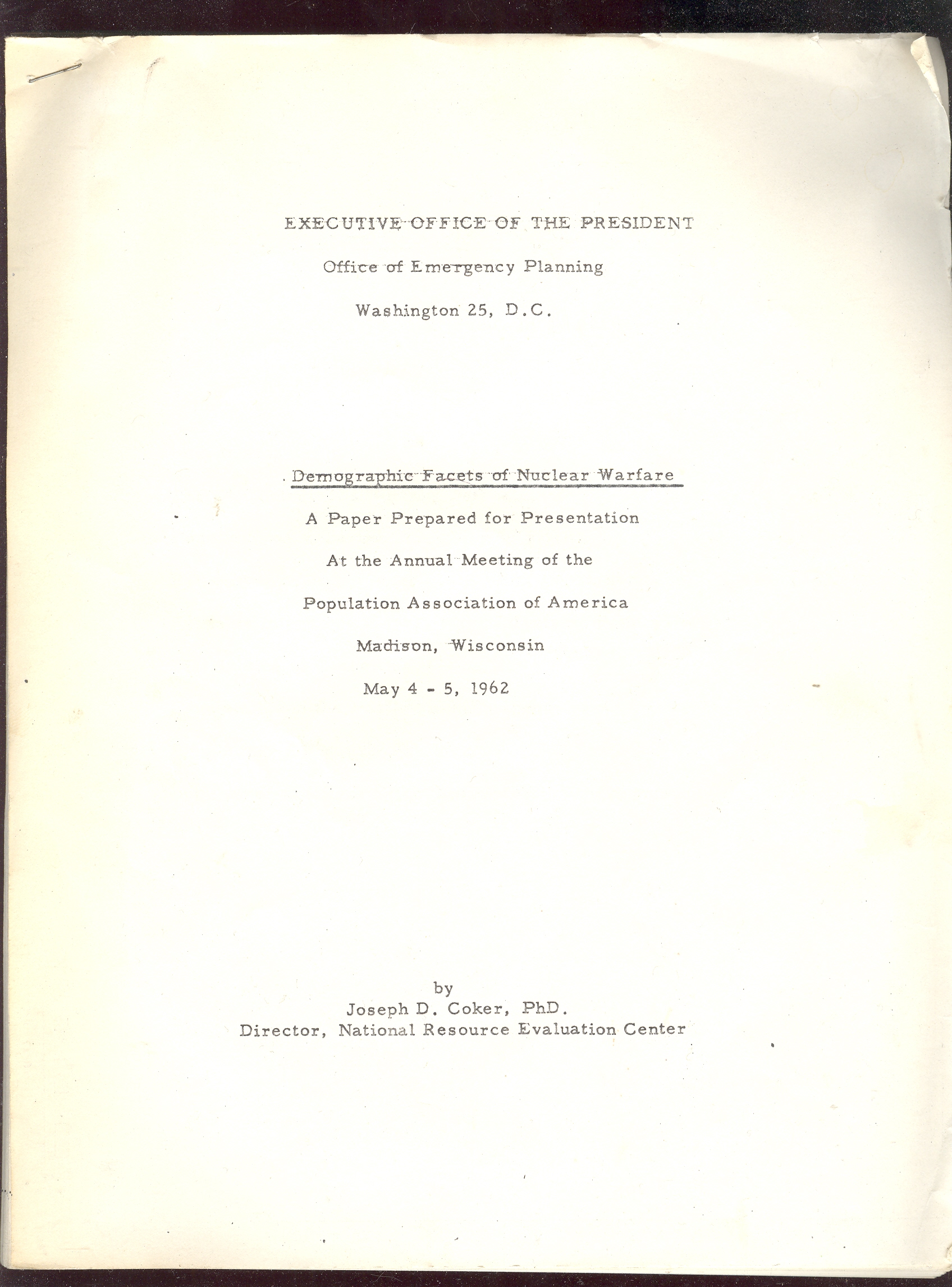
    Here’s an embarrassingly shining case in point:  Dr. Joseph D. Coker’s paper to the Population Association of America representing the thinking of the Office of Emergency Planning and the Executive Branch in general, which freely discussed the survivability of the United States following even a post-massive nuclear exchange. Dr. Coker was the director of the National Resource Evaluation Center, which tried mightily to figure out how/where /what/how the essential ‘stuff” of America could be saved/stored/allocated after the end of the world.  Actually, Dr. Coker said that the big attack wouldn’t be the end of the world, so we needed to plan for surviving.
    ++ blog nov 11 coker tp

     A few cases in point, some of which, I must warn you, are breathtaking and Strangelovian in their myopia: 

    Since Dr. Coker was addressing the Population Studies people, he related much of what he had to say (regarding national resources) to the American people.  He found that millions of people could be saved if they built a blast shelter (not a fallout shelter) that was covered with mounds of heavy material and outfitted for an extended stay of two to 22 days.  The unfortunate part of this scenario, Coker says, is that these shelters work best when 10 miles or more away from a detonation zone.  And since these zones were all over the country targeted by thousands of warheads, very few people (especially in cities) would be outside the 10-mile ring, which made the blast shelter basically useless. 


    Coker notes that if an attack of 1000 megatons [a limited exchange] was aimed exclusively at U.S.air bases, “total fatalities will approximate 10% of the U.S. population”.  If this attack was aimed at population centers rather than the air bases, it would kill 40% of the population. A 5,000 megaton attack on air bases would produce 50% overall fatalities in the U.S.; if that amount was centered on large populations, the number would jump to 80% of the population.  10,000 megatons would yield 75% and 95%, respectively.  “A 50,000 megaton attack would kill almost all U.S. citizens under either targeting assumption”.  These figures didn’t include radiation deaths.

    A big variable here not controlled for was the distribution of population at the time of attack.  The numbers that were used were compiled by the census and counted folks who would be at home.  So, the numbers above worked if and only if the Soviets attacked after dinner when everyone was at home for the night.  Since it would make sense to attack when people were at work at their industry or job or whatever during the day—thus maximizing the effect of the bomb—the casualties would actually be higher.

    And what does that mean?  Dr. Coker relates this gem (on page 21): “The post-attack labor force available thirty days after the attack probably will represent a significantly lower fraction of the population than does the preattack labor force….” And this: “A nuclear attack can be expected to alter the occupational composition of the labor force.” 

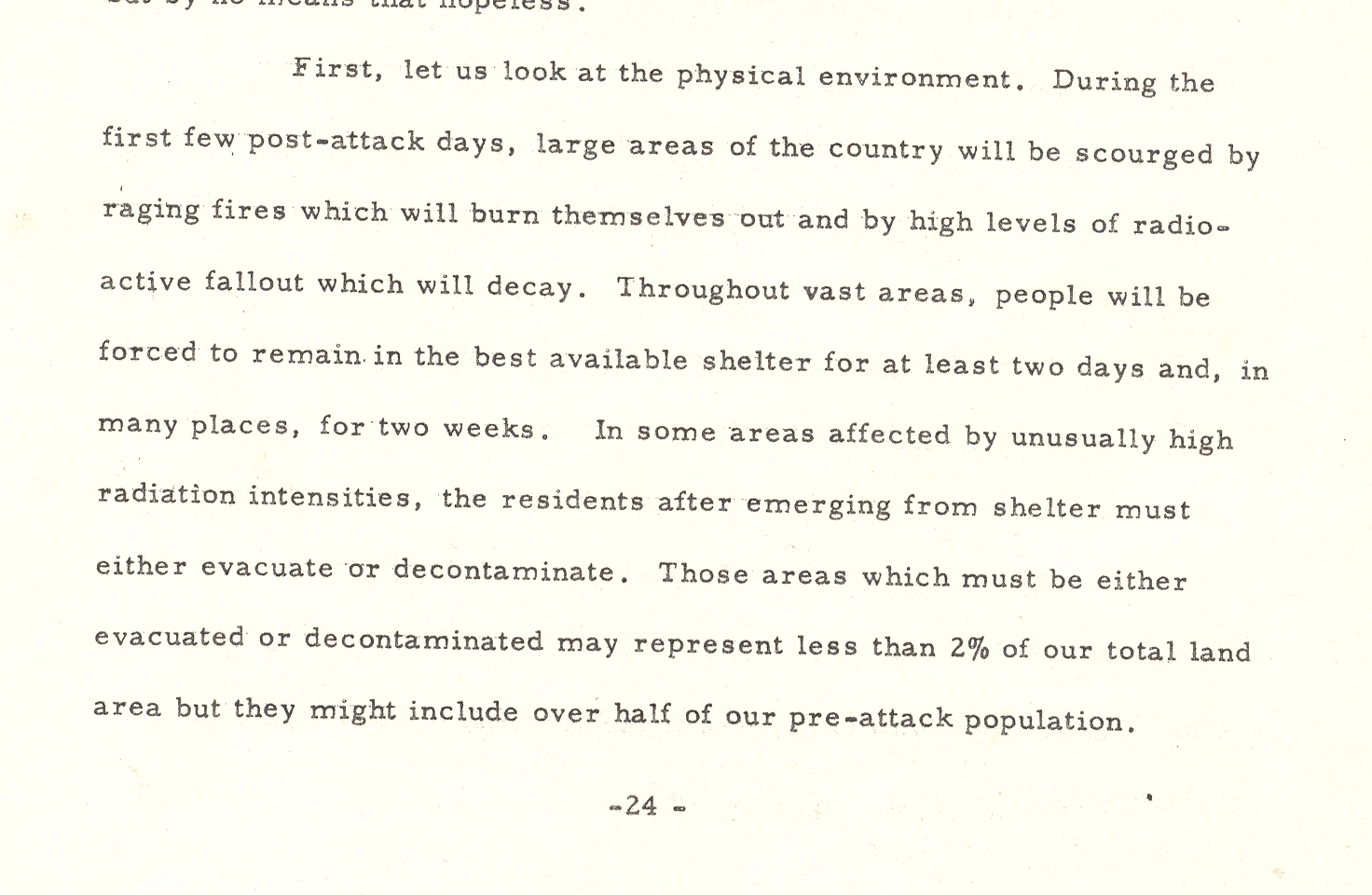
    This sort of thinking overtakes the factual aspects of massive attack, with Coker stating on page 24 “I wish to say  emphatically that it [post-attack America] will not be anything like that depicted in Neville Shute’s On the Beach.  It will be bad enough, but not that hopeless.”
    ++ blog nov 11 coker pg 24


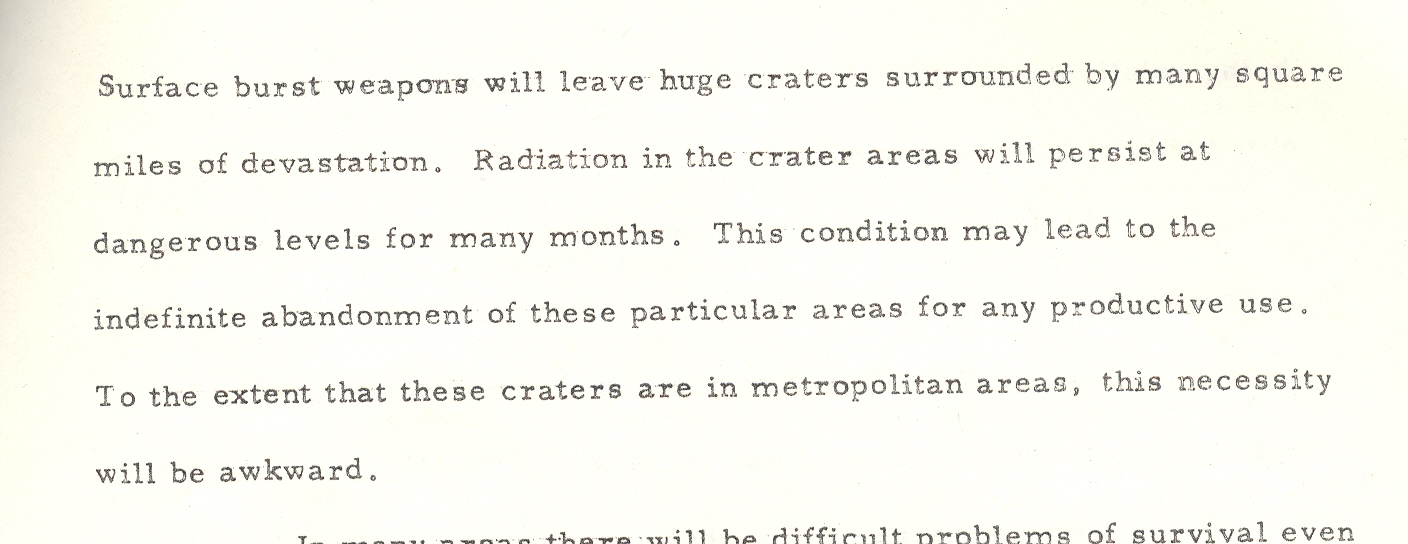
    And this absolutely incredible/horrendous and perhaps worst-use-ever of the word “awkward”:
     

     ++ blog nov 11 coker pg 25

    For the love of King Neptune’s Pants:  Awkward?  How in the name of _______ could someone in such a high position and authority relate massive attacks on every major American population center which would cover the area in fire and thousands of gigantic highly radioactive craters in which a city used to exist be called “awkward”?  How great a sin was this, to influence opinion on holocaust via pathetic and unreasonable means?

    And then this, on the survivability of our governmental and economic institutions:

    “The post attack institutional environment will depend on the continuity, resourcefulness and general effectiveness of our leadership and the survival and resilience of pre-attack institutions…”

    Hm?  The post-attack institutions will depend on themselves?

    This of course is followed by a major plug for Dr. Coker’s own work, because the preparations undertaken by the NREC will directly affect the survivability of post-attack America.  So don’t stop the funding.  “The more complete and realistic our preattack [sic] planning and preparations have been and the more effectively the government is at all levels in inspiring and retaining the confidence and support of the population, the less drastic institutional changes will be.”  So it is the mealy aspect of inspiration that will direct the survivability of whatever it is that makes America so. 

    I should point out that Coker’s use of “post attack” and “pre attack” appear as two words, one word and a hyphenated word, depending on nothing. This is only a forty-page document.

    Another nugget on the post-Armageddon future on the distribution of wealth, mostly hinging on blast shelters:  “Per capita wealth in material terms may or may not be reduced by attack.”  There will be a relatively proportional number of  people who emerge from the smoking holes to staff surviving industry, and so per capita wealth will stay about the same.   If, on the other hand, people build more blast shelters, then the proportion of surviving workers to factories will increase, and “the surviving plant capacity will be spread more thinly among them”. It is left unstated, but what that means is that more successful implementation of blast shelters would mean a reduction in per capita wealth. Dr. Coker also forgets what he said earlier that the blast shelters really didn’t work unless they were more than ten miles from a target.  Considering that the industrial workers would be living close to, um, industry, they will no doubt be (in 1962) in a ten-mile radius to where the blast would be.  Then of course there would probably be more than one bomb, so the blast area would be more than a ten-mile circle, and so on and so forth.


    In the following paragraph, Dr. Coker somehow draws all manner of feel-good high-probables around him, encasing himself like a sandman in a thin layer of improbability, to come to the following conclusion:

    “…few of the analysts who have studied carefully these post-attack [sic] survival and recovery problems take any stock in the oft-repeated theory that the survivors will envy the dead.  On the contrary, after a very rough year or two, the surviving population, if it so chooses, can begin to enjoy the advantages of a social structure and a physical environment not so very different from those which prevailed before the attack.” [Emphasis mine.]

    This is an astonishing work of incredible deceit, and may be the worst quote of the lot.  But it is so difficult to choose between unacceptable bits of thinking like this, raking out the horrible from the terrible.

    Here’s another deceit that was absolutely better understood in 1962 than the writer acknowledges:  “The long-term effects of radiation are subject to much less understanding and certainty than are the short term effects.  There is some evidence that increased radiation exposure results in reduced life expectancy and increased evidence of leukemia and various degenerative diseases…”  And this:  “Genetic effects are more controversial.”  Than what?! And this: “Studies of the Hiroshima and Nagasaki experience are said thus far to be inconclusive.”  Honestly this was very well understood in 1962, and statements like these were enormously irresponsible if the data were actually misunderstood and criminal if they weren’t.

    There are many more examples—I’d say actually that the entire paper was at the level of Apocalypse Fairy Tale—but I’d like to close with just one more, this one using another fanciful version of the possible post-nuclear future and another highly insulting euphemism.  On transportation:  “We hope in the near future to develop a family of network and transportation models to estimate capabilities to move surpluses into deficit areas in order to cover deficits during each time period and to support the use of more ambitious resource management techniques focussed [sic] on recovery problems.”  Aside from bad sentence structure and misspellings I could hardly imagine sitting through a presentation where a person thought this stolen undercooked tripe.  What we have arrived at here at the end of the paper is references to smoke-in-a-hole cities being “deficit areas”, and the successful removal of human consideration from the conversation—strange as Dr. Coker was addressing the Annual Meeting of the Population Association of America.  (I’d love to know what the association members thought of the talk afterwards.)

    And so what can we draw from the experience of knowing thinking like this?  Is it as sterile as it might seem, so distant from our experience?  The scenarios have changed, as have the leaders and delivery systems, but the insatiable stupidities have evolved and morphed  into our own time.  Its easy to raise our eyebrows now on the whole MAD approach and the writings of people like Dr. Coker.  The truth of the matter is that we have plenty of this sort of thinking going on right now, big head-waggers that will loom in our futures with the attached questions of “how could this have happened?”.  WMD is one of the many examples of this, a Big Lie that was repeated for years and which ultimately cost the lives of many thousands of people and a great perpetuator of the culture of fear.  President Bush drove that one into the ground and so far as I know still employs it when necessary, threatening listeners with fear of those three letters like they were a practice hand grenade.  (I recall that a far-right radio personality  filled with afterbirth blood and urine eyes said that he would resign his show “in a year” if WMD were not found in Iraq; that was five years ago, and of course he is still there, bloated and ponderous and mostly violently wrong as ever.)  The Savings and Loan debacle.  The deathly ambitious practices leading to our recent depression.  The billion malnourished and desperate children in the world.  And so on. The point is that there is no paucity of thinking displayed by Dr. Coker in the past, and there is definitely no lack of it right at this very moment.  The problem is seeing it for what it is in the present and to not have to wait for the future to get to the truth of the matter.

    [And how can I end this discussion without a bit more of Stanley Kubrick’s magnificent Dr. Strangelove.., who pointed out these absurdities better than,perhaps, anyone?]


    Ah, don’t fret! The ending is just below (and just when you are about to laugh (“Mein Fuhrer, I can WALK” the other and last shoe drops.).

  • Badly Written but Pretty Atomic Death Ray Steampunk, 1935

    JF Ptak Science Books  Post 1206

    Mar 29 vooa big

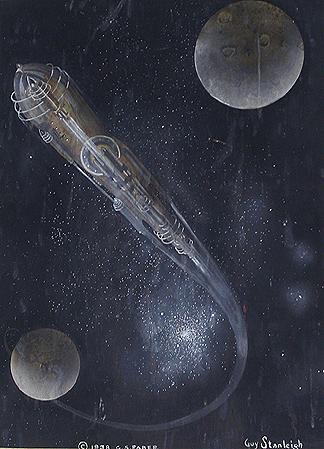
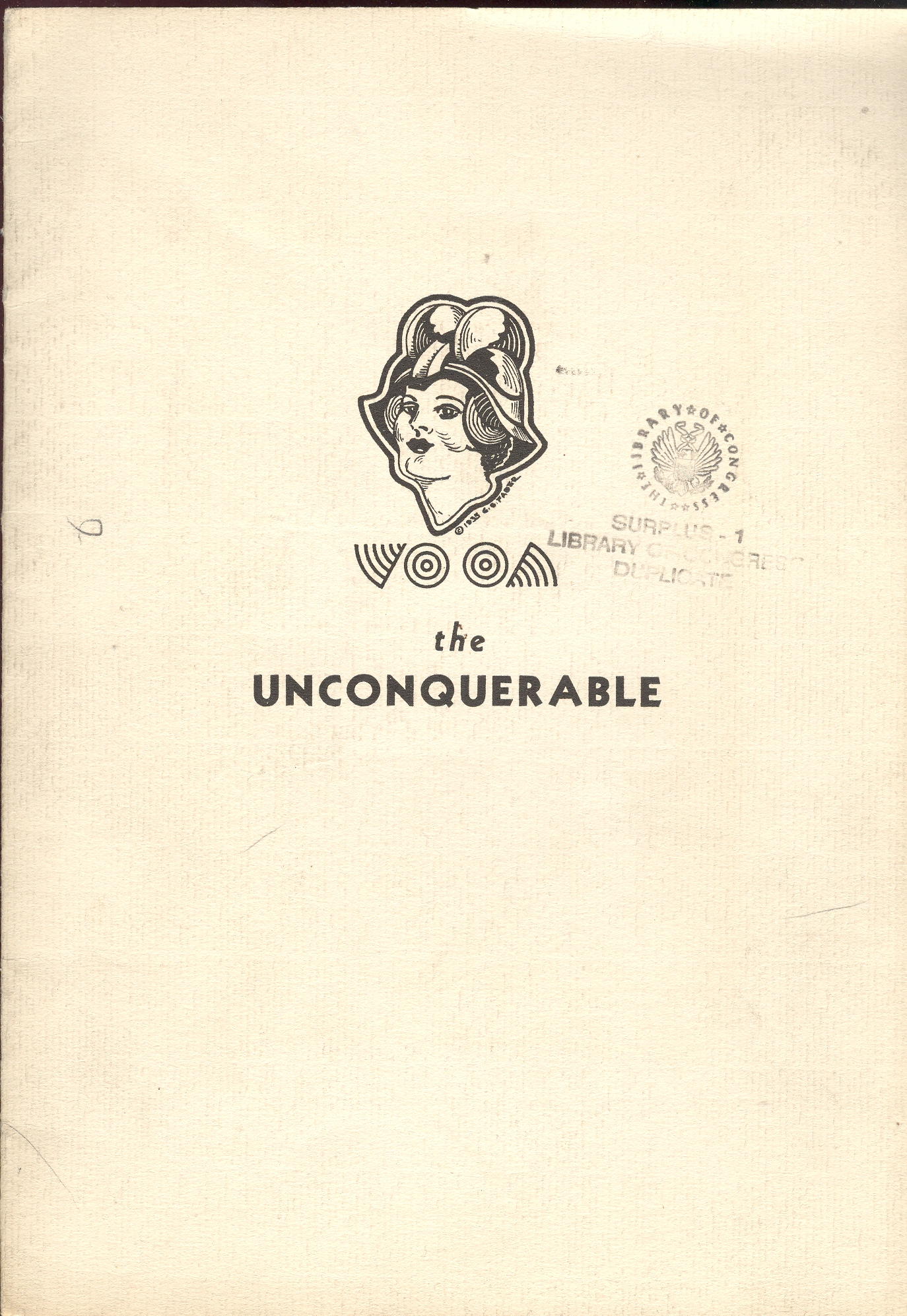
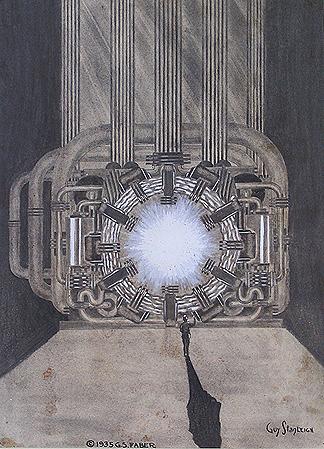
    Sonos the Conqueror and Vooa the Unconquerable were two sorts of a sort, two flits in a fit, the products of the mumbley imagination of Guy Stanleigh.  Actually Stanleigh (not “Stan Lee”) was an interesting scifi artist if not a writer. Well, he was really nowhere near being a writer, if writing had anything to do with writing and not drawing.  His written word was the sort that vicious litcrit folks wait for in the bushes for on Friday nights so that they can catch and chew on them over the weekend before Monday’s deconstructionist deadline.   I’m surprised that after 72 years the letters on the pages of his work haven’t yet slipped off.  

    Mar 29 vooa big det[Both items are available for purchase at our blog bookstore.] His drawings though are an entirely different matter–they are accomplished in a naive way, and are big, and Botero-esque/bulbous, and unusual, and filled with a fair amount of imagination.

    Stanleigh

    My favorites in his novelettes (Sonos the Conqueror and Vooa the Unconquerable, both of which stretch out to 16 pages, combined, which were undoubtedly vehicles for his artwork, if nothing else) were of a machine called the Atronic Ray energizer (“a concentrated collection of teh rays given off by the planets of the universe, a few of which (were) absorbed…circulating over the universe via inductive and repulsed forces….the primary or positive induced force emanating between and from an anode and biode…” Anyway, it was a terminus of fantastically great power that could either engender universal peace or destroy humanity. Life/death aside, its a pretty picture, and figure’s long and very sharp shadow relates a visceral feeling of hot energy.  

    Stanleigh 2


    ·Posted by :

    ·in:


  • Veterans Day

    Remembering.

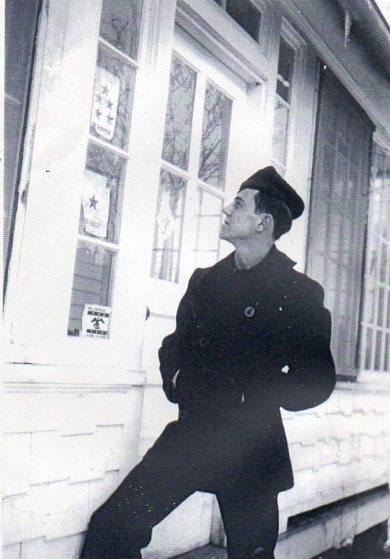
    This is my great uncle Stanley, my father’s uncle, one of six brothers who served (USA, USAAF, USMC, USN) in WWII. And Uncle Pete, 1942-1945, USMC.

    Veterans day772

    Veterans day773

    ·Posted by :

    ·in:


  • Towering Classics of Lost Logic: the Japanese War Lords, Kaiser Wilhelm, U.S. State and Justice Depts as the “True Kidnappers” of the Lindbergh Baby

    JF Ptak Science Books  Post 1204  [Part of our Bad Ideas series.]

    Sometimes things aren’t what they seem, and then sometimes they’re not what they seem not to be, and then there are these things, below.  These small pamphlets are very reaching examples of finding gold or silver or muffins or whatever in a sow’s ear, finding a hope for belief where there wasn’t room for any, logically speaking.  But there’s always room for belief and faith, which takes on myraids of appearances, from believing in paper money to believing in heaven–in these cases, our writers believed in the unbelievable, creating and then believing in “innermost secrets” where there were no secrets and were no insides. 

    Lindbergh771

    Both of the examples below relate to the kidnapping of the 20-month-old son of Charles Lindburgh in 1932.  The crime was an extraordinarily national event, with seemingly everyone in the country following the case  During the two-month hunt for the baby and the subsequent trial and execution of the man who was seen as responsible for the child’s kidnapping and murder, there were fantastic numbers of claims from people who had solutions to the mystery, or had been in contact with the kidnappers, or some other sad, imaginary relationship to the event.  The examples below [both of which are available for purchase at our blog bookstore] claim to have incredible insight into the real nature of the crime, which of course goes blindingly beyond the simple matters of the case and on to include massive colusions between the U.S. State and Justice Departments, “international bankers”, F.D.R., Kaiser Wilhelm, and “the Japanese government”.  And more.

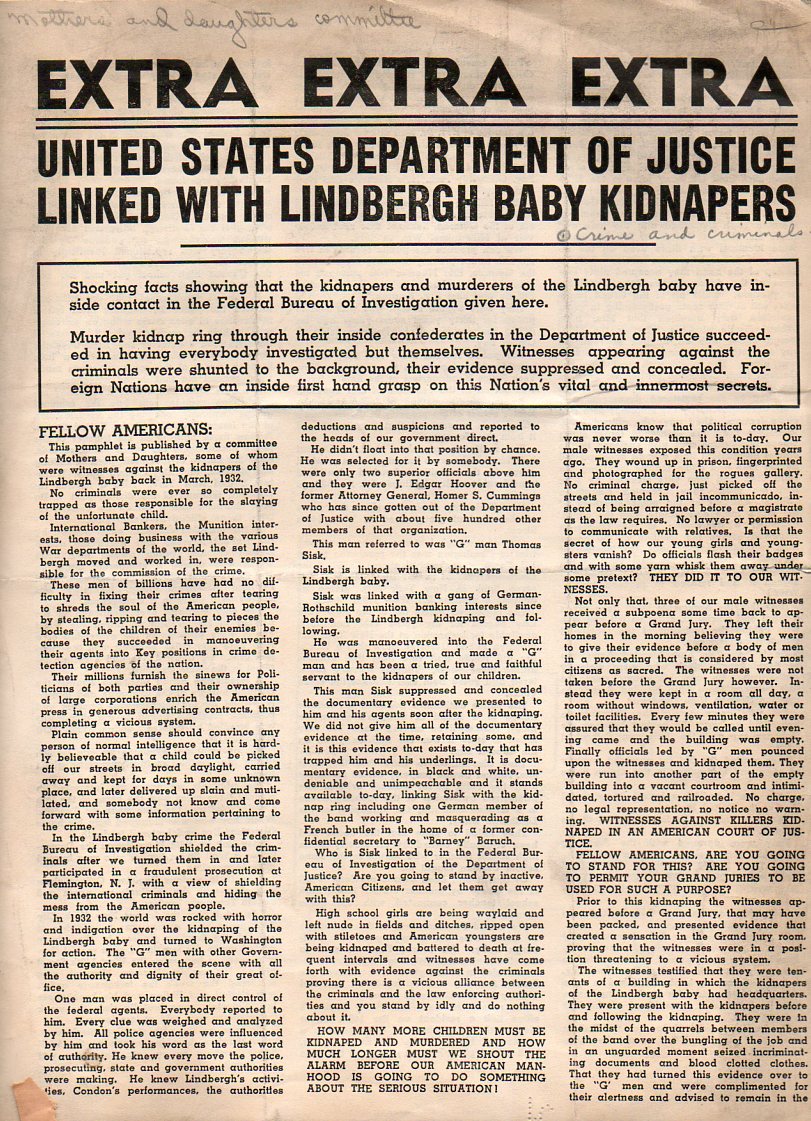
    The first example was published in 1942 by something called “The Mothers and Daughters Committee”.  This group used the address of  280 E. 21St Street, Brooklyn, New York, which today is a six storey building with 96 apartments, and I suspect that the MADC back there in ’42 was nothing more than a crank in apartment inthis building. The thinking is too confusing and the references too many amnd too busy to actually do this thing justice by de-threading it, but suffice to say it claims that the F.B.I. was shielding “the international criminals”who were truly responsible for the crime–I’m not sure how F.D.R. works his way in there but it has something to do with “international bankers”, communist conspirators, traitors in the State Department, and “needy” lawyers, all brought together in a choking confluence to do harm somehow to American society and morality.

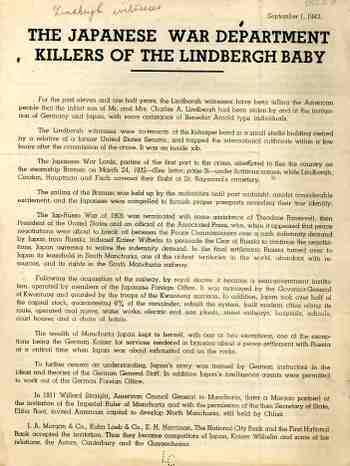
    Lindberh_japanese168 Now our second towering example is this four page pamphlet, received by the Library of Congress (and probably nobody else) on 1 October 1943, which divines the origins of World War Two and the kidnapping of the Charles Lindbergh baby to a complex and impossible cabal of Japanese “War Lords”, Kaiser Wilhelm of Germany, the assassination of Leon Trotsky, the League of Nations, Elihu Root,  “3 cent gallon kerosene”, the South Manchurian Railway, and some sort of “historical documents of posterity countersigned by Tokyo and Berlin” in the possession of Mrs. Renee Valentine (“Secretary”) of Staten Island, New York. 
    The entire affair began with “co-tenants of the kidnappers band in small studio building owned by a relative of a former U.S. Senator” under the instigation of “Germany, Japan and certain Arnold Benedicts types” brought about by the end of the “Jap-Russo” War of 1905.

    We are told it was an “inside job”.

    Somehow Teddy Roosevelt gets involved with Kaiser Wilhelm in arranging for the Russians to pay indemnity to the Japanese in terms of a land agreement of Southern Manchuria, opening the way to exploitation of China by the Japanese.  Something else happens, the South Manchuria Railroad gets thrown in as well as four competing U.S. banks and Elihu Root and a failed League of Nations agreement which upsets a balance of power and brings “the Astors, Canterbury and the Guggenheims” into competition with the Japanese and Kaiser Wilhelm, doing something to the Treaty of Washington.

    After this incredible and unconnected and partially non-existent series of events is both untangled and entangled before our eyes, the writer reaches the lonely and very solitary conclusion that “the necessary documents to prove these charges (??) could be secured through the kidnapping of the Lindbergh baby”.  I was waiting for the  author to make a case for Lindbergh’s real-life (and long held) Nazi sympathies, but that just didn’t happen. 

    I really have no idea of what the writer is talking about, but the failure of making any connection whatsoever with any of the “facts and circumstances” is magnificently appalling, and has moved itself from the realm of being so bad that it isn’t even “bad” anymore.  It is that singular sort of “badness” that makes the printed words seep into the paper and disappear before your very eyes, and the only thing that you can say is “wow”. 


  • The Most Important Menu in Computing History? Johnny von Neumann, Herman Melville the NORC & the MOBIDIC

    JF Ptak Science Books  Post 1202

    “There is no mystery about these machines[computers]. The mystery is how the human brain has been able to develop them. These devices are merely small tools which men have devised to help them do a better job.“–Thomas J. Watson, chairman of the board of IBM, 1954
    Here is something that one doesn’t get to say very often:  this is perhaps the most important menu in the history of computing1. And if there’s another menu out there of the same or greater significance, then I offer that this is perhaps the most important menu tassle in the history of computation–that seems safer.

    In the history of odd bits of historic computeriana ephemera, this tassle joins the ranks of other one-percenters, like this:  the world’s first portable computer had a gun rack.  This was hardly a laptop though it was portable, and very well lived up to its Herman Melville-inspired acronym:  MOBIDIC.

    The Mobile Digital Computer was intended to be a transistorized van-mounted computer used to store and route data as part of the U.S. Army’s Fieldata system.  The machine was indeed built and deployed by 1959–as were the MOBIDIC A,B,C,D,E and 7a by the early 1960’s–and it was a successful component, even though the overall network was not successful.  Fieldata was supposed to integrate all manner of information and distribute it to battlefield recipients. My friend (Dr.)  Carl Hammer (1914-1904), who I knew from being in the neighborhood in Georgetown, was a delightful man who had long and significant history in the development of the modern computer.  He told me one afternoon–stopping in to visit on his constitutional–in his sly and amusing way about working on the MOBIDIC while he was at Sylvania. (He had just finished heading up Remington Rand’s UNIVAC European Division before going to Sylvania.) Anyway he started his story about the MOBIDIC by telling me that it was the world’s first portable computer (sitting in a 42-foot-long semitrailer) and that it had gun racks.  The reason for the gun racks was simple–if something was made by the U.S. Army, and it had wheels, then it had to have a gun rack.  Case closed.

    Norc--von n groupNow let’s get back to the NORC.

    [This item is available for purchase at our blog bookstore.]

    This is the luncheon menu for the dedication of the NORC “Calculator” (the Naval Ordnance Research Calculator) a computer which was constructed principally with IBM parts and built at the Watson Scientific Computing Laboratory at Columbia.  The NORC was the world’s first supercomputer, and the most powerful computer on the planet for about ten years (from 1954 to 1963, until it was surpassed by Seymour Cray’s CDC 6600 in 1964). 

    The NORC was an astonishing accomplishment, difficult to summarize simply, really, though a very good example is that provided by Dr. Paul Herget, the director of the Cincinnati Observatory.  Dr. Herget used the NORC in 1956 to make precise calculations of the earths orbit for the 1920-2000 period.  Dr. Herget said: “We used nine hours of running time and completed more computations than had ever before been done at one time in the history of astronomy.’”

    Outside of celebrating the accomplishment of the NORC, the luncheon was also  important for the remarks of the principal speaker, John von Neumann.  Von Neumann of course was perhaps the most expansive mind of the century–a thinker of phenomenal proportions and the father of the modern computer.  His brain was impossibly big.  Impossible. 

    During the luncheon von Neumann made prescient and extraordinarily wide remarks on the future utility of the computer.  Some of the highlights (from the entire address, included below):

    –it is now “practical and feasible” to forecast, with the NORC, the weather for an entire hemisphere thirty or sixty days ahead

    –calculation of the tidal motions of all the oceans, the marginal movements near the continents as well as the main motions of the oceans

    –the hydrodynamics of the earth’s fluid core

    –“In the statistical field, dealing with matters which are not wholly mechanical, such as troop operations and logistic operations which involve purely accidental factors like the prevailing weather during the operation, command decisions which have not yet been officially made can be stipulated and various solutions for various alternatives calculated. This has been done before on a minor scale but it takes too long to do on a large scale. “In this field the importance of NORC is enormous…”

    –in the first four hours of operations the NORC  performed more work than any calculator of ten years ago has performed in its entire lifetime. He termed this performance “completely fantastic; I doubt if it has ever been done before.”
    Norc--von n group menu

    The last section of von Neumann’s comments that were made at the dinner:

    “The last thing, which is very important, is said in fewer words, but I think that it is none the less important. And it is this: In planning new computing machines, in fact, in planning anything new, in trying to enlarge the domain of parameters with which one can work, it is of course customary and very proper that one should consider what the demand is, what the price is, whether it will be more profitable to do it in a bold way than in a cautious way, and so on. This type of consideration is necessary — the world would very quickly go to pieces if these rules were not observed in 99 cases out of a hundred.

    “It is terribly important that there should however be one piece in a hundred where it is done differently.

    “And that one uses the definition which Dr. Haven (?) pointed out 20 minutes ago, namely to occasionally do what the U. S. Navy did in this case and what IBM accepted in this case: to write a specification essentially to build the most powerful machine that is possible in this day with the present state of the art. I just hope that this will be repeated very soon and will never be forgotten.” Source.  

    It may be the last statement that is the most important–pressing those of the present and future to perform.

    Notes:

    1.  The importance of this menu was described to me in a lovely and painterly fashion for the first time by P.J. Mode.


  • Mundane Images of Necessities of War–Found Bullets and the Battle of Pots and Pans

    JF Ptak Science Books   Post 1201

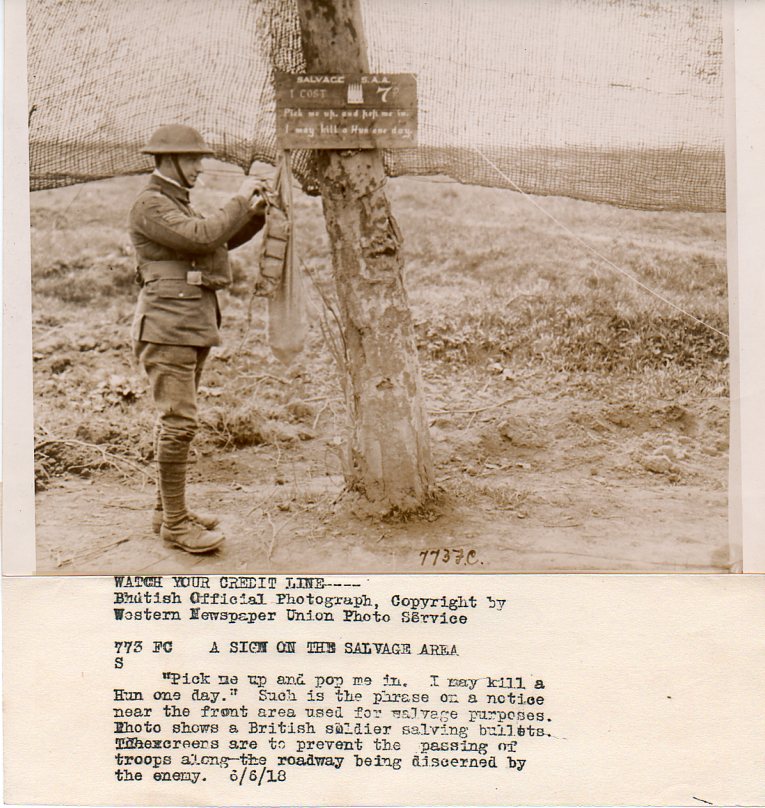
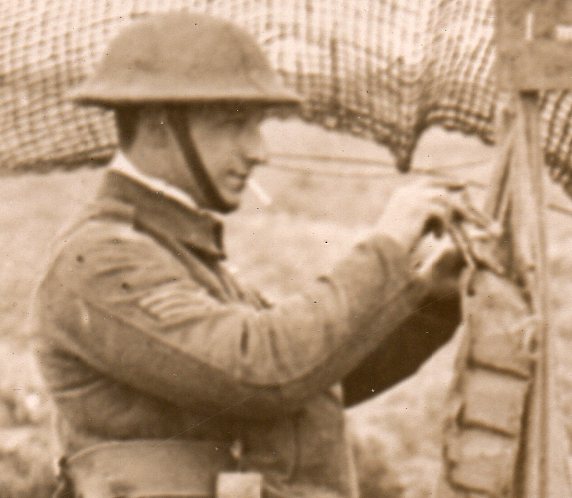
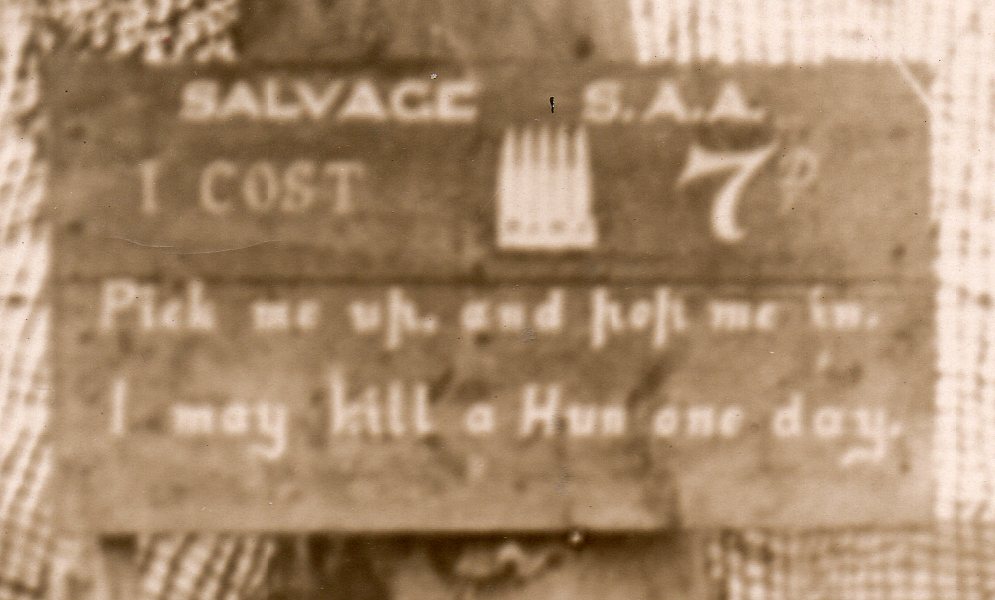
    A little went a long way, sometimes, in collecting the ends and bits of a campaign or a retiring column or from the attics and basements of village houses, or in scrapyards or dustbins or abandoned yards and buildings. Scrap has sometimes contributed greatly to major war efforts; and sometimes it has contributed just a few hundred rounds of ammunition, gathered from the sick or dying or forces on the move, that have told the tale of change in battle.  When you can only carry so much in a campaign where shooting can be an endless process, you can by definition never really carry enough bullets when you’re already carrying enough of everything else.

    [These images may be purchased from our blog bookstore here.]

    WWI--salvage719
    WWI--salvageb720

    WWI--salvagec721

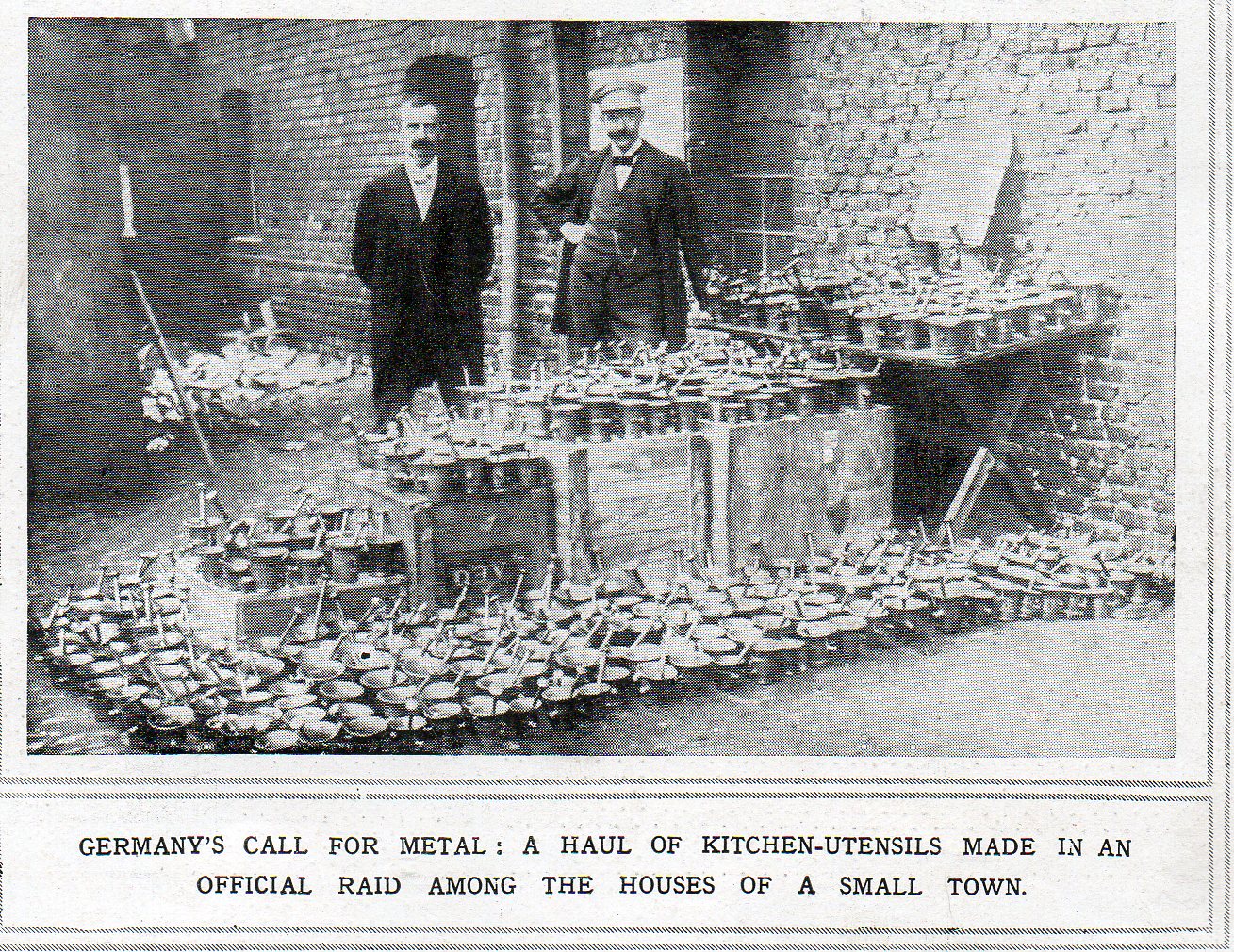
    On the other side of the line, the Germans were tyrying to utilize every bit possible as well–here’s an example of a round-up of metal goods taken from the kitchens of a small town (looking ,mostlly like mortar and pestel sets).  In towns throughout France, on the other hand, church bells were collected and stored away, hidden from possibel capture and melting by German troops. 

    WWI--raid on pots and pans694


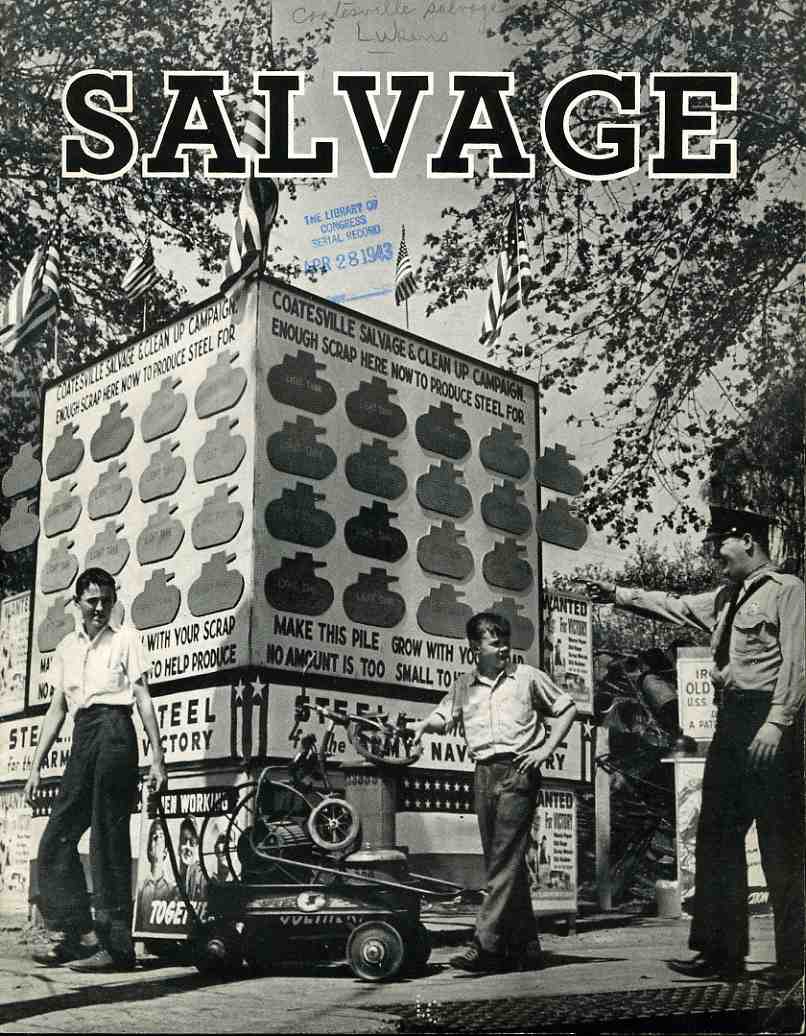
    00-blog-Oct 25 salvage922:Now for an example from WWII: Salvage (1943) is just simply brilliant!  It is a superb  design, getting its inelegant point elegantly across to the reader, making the collecting of junk  a bona fide war effort, triumphant, superior; it delivers the message gorgeously.  Who wouldn’t want to rush out and look for some metal scrap and bits and grow a neighborhood junk yard so that the community could build a tank?  Certainly these two boys–under the watchful guidance of a smiling cop in a black tie–couldn’t resist, and from the looks of the progress billboard behind them, nor could anybody else in the neighborhood, as the community collected enough metal junk for 14 tanks.  (Or at least pieces and chunks for fourteen tanks.)

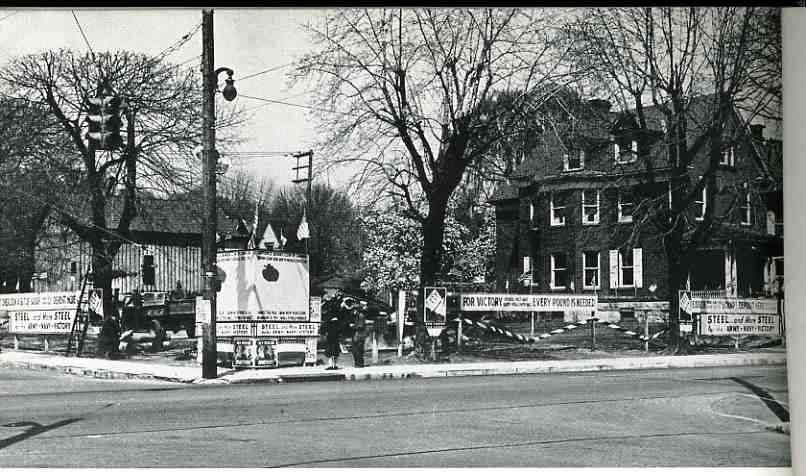
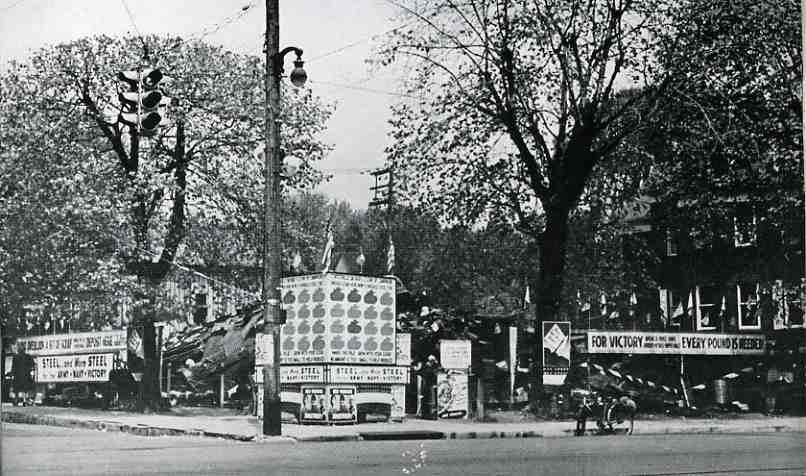
    The community was Coatesville, Pennsylvania, and they certainly did their collecting-best.  The two photos below show (top) the scrap yard after two days of collecting, and (bottom) the end of the campaign two months latter.

    “One pound of fat contained enough glycerin to make a pound of black powder, enough for six 75-mm shells. Twenty three hundred old nylon stockings contained enough nylon to make one parachute.
    Thirty thousand razor blades contained enough steel to make fifty 30-caliber machine guns.”   (Lingeman, Richard R. Don t You Know There Is a War On? The American Home Front, 1941-1945. New York: G.P. Putnam’s Sons 1970, 254-55).  When you have an entire town doing this, you can build tanks; when you have millions of people throwing together to collect this “junk”, then you get part of a war effort.  It is also part of a giant propaganda hearts/minds machine, especially for the U.S., which was (and I use this word with some hesitation) cushioned from the effects of the war by two oceans–it reminded people who hadn’t contributed a life to the war that there was actually something tangible going on, and that they could do something to help.  It kept peoples’ minds in the game.  Rubber was another big concern, as was silk (the controlling exporter of both coming largely from overseas, and in the case of silk, the exporter was Japan.)  Of course there was the introduction of synthetics for both silk and rubber, but the point in fact was that there was indeed a shortage, and the donated and salvaged stuff was necessary. 

    Here’s a beginning picture for the burgeoning community scrapyard:                                                                                                                                              00-blog-Oct 25 salvage before923

    Some interesting works relating to salvage drives:

    Barringer, Edwin C. The Story of Scrap. Washington D.C:Institute of Scrap Iron & Steel Inc., revised edition, 1954.

    Cohen, Stan. V for Victory: America’s Home Front During World War II. Missoula Montana: Pictorial Histories Publishing Co., Inc., 1991.

    And afterwards:

    00-blog-Oct 25 salvage after924

    Hoopes, Roy. Americans Remember the Home Front: An Oral Narrative. New York: Hawthorn Books, 1977.

    Lingeman, Richard R. Don t You Know There Is a War On? The American Home Front, 1941-1945. New York: G.P. Putnam’s Sons, 1970.

    O’Neill, William L. A Democracy at War: America’s Fight at Home and Abroad in World War II. New York: The Free Press, 1993.

    And here’s one I’d like to see (the cover of):

    Wolf, Howard. The Story of Scrap Rubber. Akron, Ohio: A.
    Schulman, Inc., 1943.


    ·Posted by :

    ·in:

    —

  • Propaganda and Surrender Tickets, World War II, 1943-1945.

    JF Ptak Science Books  Post 1200

      Propag--25753

    A part of the payload dropped on German and Japanese forces were not metal and explosive, but paper. Hundreds of thousands of pieces of paper with real and imagined information, tickets to surrender, reminders of the coming of the end of the war, passages to a prisoner of war camp somewhere that would ensure the soldier’s survival of the Blogpropogwhere_are099rest of the war.  Convincing someone to surrender, or making it easier for them to not fight too hard and to surrender, is sometimes easier than to confront and kill them.
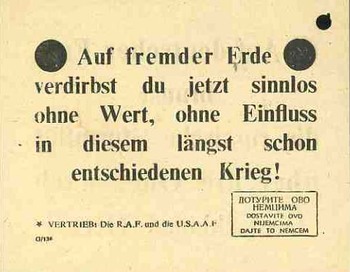
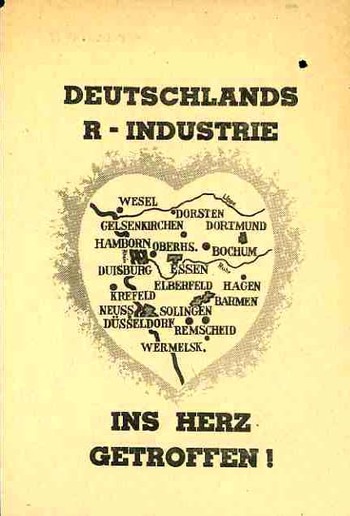
    For the most part these were distributed in a combination effort between the U.S. Army Air Force (USAAF) and the Royal Air Force (RAF), while the other major segment was done by the Supreme Headquarters of the Army Expedition Force (SHAEF) and the 8th U.S. Army.  There pieces of directed information were very persuasive, but of course they were hardly new—not even the delivery system (via aircraft) was an innovation. 

    These leaflets were more or less an “information” service relating factual events and presented in such a way to persuade and convince whomever picked them up that their cause was at this point futile.  In just about every case in the 150 items in my small collection as far as I could determine all of the statements made were indeed correct and accurate.  Leaflets were dropped by the ton during the war that were pure fabrication, intended to confuse the scare the recipient into surrender, deceiving them;  but not these. (For example, a famous use of deception in major confrontations was Operation Quicksilver and the creation of the First United States Army Group (FUSAG), a non-existent fighting enemy that was supposed to distract the Germans while real preparations were underway elsewhere for the invasion of Europe (D Day).
    Blogpropogon_german_soil100  
    There was a distinct threat of terror in many of these leaflets, though the terror would never come from the Americans or Brits—the Russians, however, were another story. (Remember that the U.S. gets into the war at the end of 1941; the British had been fighting since 1939; and the Russians, well, they had been fighting too since 1939 [starting out without chivalry and with cold malice against the Finns], but they did fight against the Nazis once they had been completely deceived by them,  losing 20 million people in the process.  The Germans had much more to fear from them than anything on earth. And rightly so.) The use of terror in propaganda is probably as old as warfare itself—for example the Mongol leader Tamerlane built a pyramid of 90,000 human heads in front of the walls of Delhi to persuade the inhabitants to just forget about fighting, and leave.   The British employed a terror tactic in the use of the Gurkas and their curved and menacing Kukri to great advantage; the Americans had the Phoenix Program in Vietnam (for the assassination of leading Viet Cong and their supporters), and so on, into the sunset.
    Blogpropogpunctured101
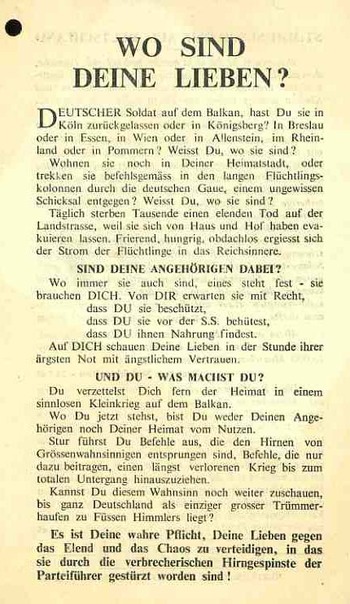
    I do not intend to try and write a thousand-word history of wartime psychological operations here—I just wanted to share some of the extreme emotions and humanity that surfaces in some of these leaflets.  The first (above), for example, translated, asks “Where are your loved ones?” (Sprint, 1945), and hammers away at the soldiers memories of home and family, and about what might be happening to that family now that the war is just about won by the Allied forces, and that the Russians were on their way to Berlin.  These family-driven, hollowing, haunting, nervous questions went, I suspect, to the very heart of anyone who picked it up.
     
    The second, “Auf fremder Erde (etc.)” (Spring 1945), roughly translated, called the attention of the German soldier again to the Russians, “On German soil the Russian Deluge is Raging across the Oder toward the Heart of Germany!”  And “On foreign soil you are perishing relentlessly, without value, without influence, on this war which has long been decided!”

    The third leaflet, “Deutschland R-Industrie…” (3 April 1945) informs the German soldier that the hear of the German industrial region has been punctured and given up, and that supplies to soldiers in the field would no longer occur—that the fighting man was basically adrift, lost, forgotten, unreachable by everyone except the enemy.
    Blogpropogceased102_2
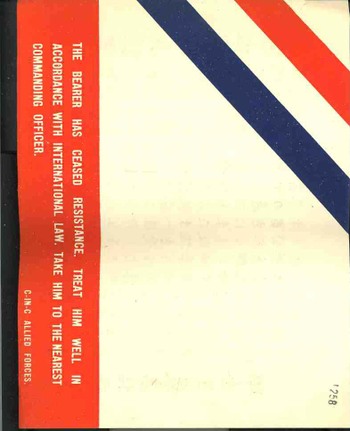
    The next example is a 10×8 inch surrender pass that was dropped on Japanese soldiers in the early spring of 1945, and tartly signed “C-in-C [Commander in Chief] Allied Forces”.  There is a very full explanation in Japanese on the back of the ticket, which has not been translated.  It seems rather remarkable to me that this was so well designed, and so attractive, and so large, and that it was dropped from a plane on thousands of Japanese troops.  As were they all, really—just about every one of the leaflets in y house are extremely well written and designed—epistles from a plane to induce surrender to a defeated, tired, dying set of armies.

    ·Posted by :

    ·in:

    —

  • The Sense and Nonsense of Success–the Pulitzer Prize, A Saturday Mornng Quiz

    JF Ptak Sdcience Books   Post 1198

    Can you spot what the similarity is in these books–besides being published works?  It is a list of Pulitzer Prize winners, but what else?  One work got the prize, the other didn’t.  Can you tell the winner from the loser? 

    Here’s the hint–its not the title whose writer almost everyone can identify.         

    That’s correct–it is a list of famous losers.  All of the winners of the Pulitzer for that year are listed first; the losers (well, those not selected) are second. (Yes I’ve mixed drama in with the fiction–this is a very quick study.)

    1919.  The Magnificent Amerbersons and  My Antonia

    1921.  Age of Innocence and  This Side of Paradise.
                       
    1923   Icebound and The Hairy Ape.   

    1924  Hell-Bent Fer Heaven (by Hatcher Hughes) and No! No! Nanette.

    1926.  Arrowsmith and The Great Gatsby

    1927.  Early Autumn and The Sun Also Rises.

    1929.  Street Scene and Strange Interlude

    1930.  Laughing Boy and The Sound and the Fury and A Farewell to Arms and Sartoris

    1931. Years of Grace and As I Lay Dying

    1932.  Of Thee I Sing and Mourning Becomes Electra

    1933.  The Store and Light in August

    1935. Now in November and Tender is the Night

    1936. Honey in the Horn and Of Time and the River

    1938. The Late George Apley and Of Mice and Men

    1939.  Abe Lincoln in Illinois and Our Town

    1943.  Dragons Teeth and The Moon is Down

    1944. Journey in the Dark and A Tree Grows in Brooklyn

    1946. State of the Union and The Glass Menagerie.

    1952. The Shrike and Requiem for a Nun and Darkness at Noon and The Rose Tatoo and The King and I.

    1959 The Travels of James McPheeters and Lolita.       

    1965. The Keepers of the House and Herzog.

    And so on. 

    I’m not saying that the winners of the Pulitzer for that year are bad works–I’m just pointing out that they just might not be good.  In any case I think that if you were given the chance to be the writer of one or the other, my guess is that 99.9% of folks would chose the work in column #2.

    “The nature of winning and losing is not a win-win situation…” the opening line for one of these winners might have read.  The vagueries of success is a disorganized system but a system nonetheless, and sometimes it just makes no sense; and sometimes when it actually does make sense the sense it is is nonsense.  

    So it goes.

    ·Posted by :

    ·in:

    —

  • Odd Person Out–Large Crowds and the Singular Person in Photographs

    JF Ptak Science Books  Post 1194

    [These images are all available for purchase from our blog bookstore, here.]

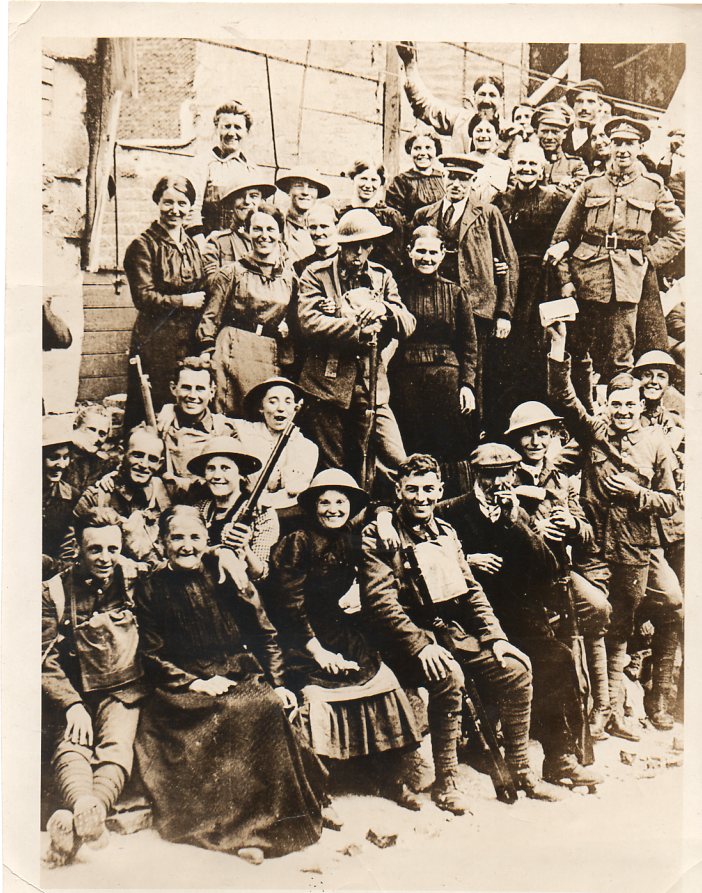
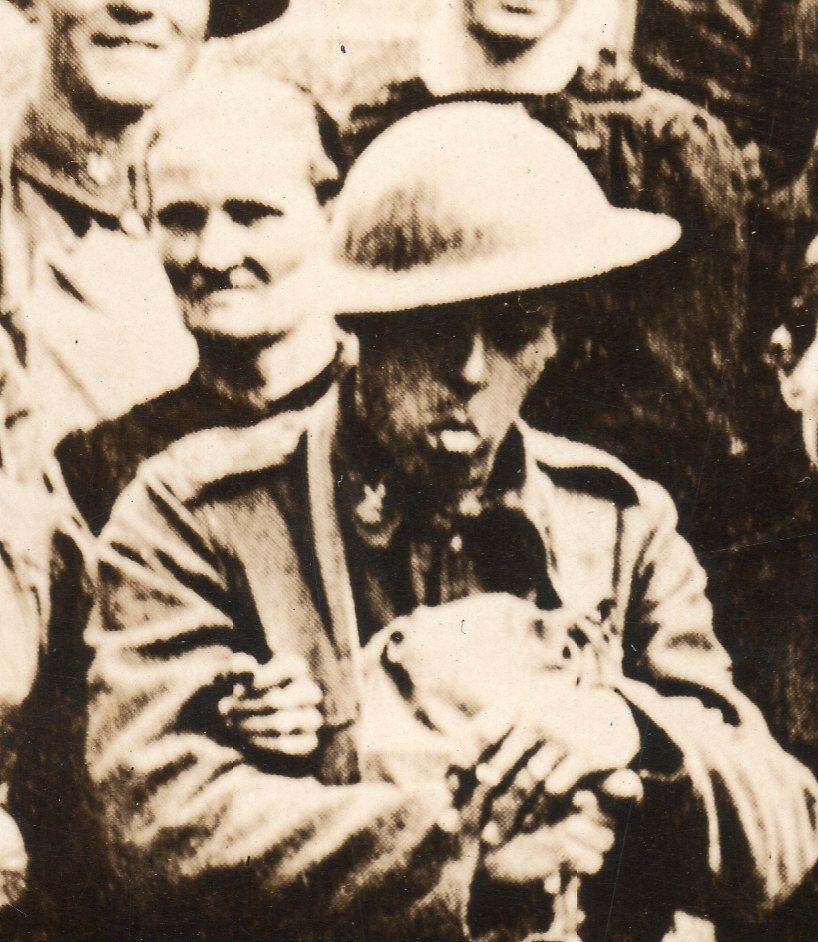
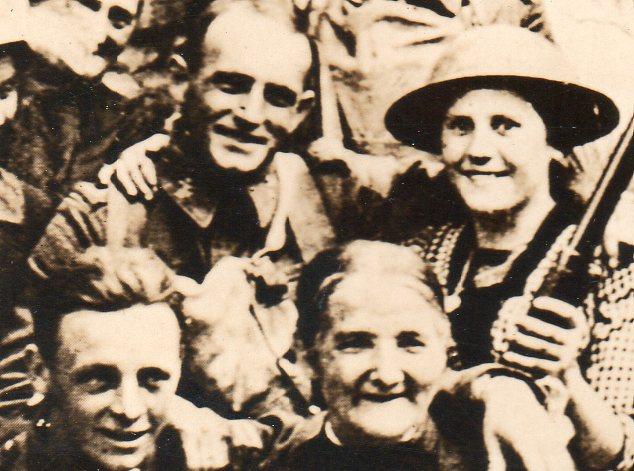
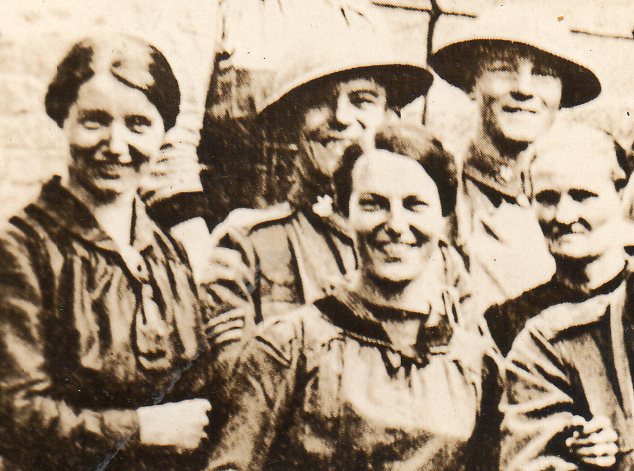
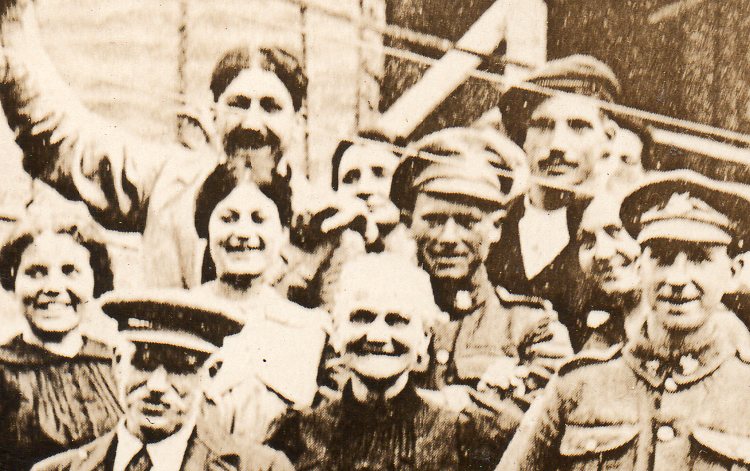
    (1) The Composition of Relief and Happiness–Minus One.  Free France, 1918.

    This remarkable photograph shows the joy and relief of the townspeople of Saudemont, France (20 kilometers south-east of Arras), after just having been freed from German occupation after four years of captivity. 

    WWI--crowds--free town701
    Saudemont had evidently suffered greatly over the four years, and seemed as though the population of the entire town was going ot be removed along with the Germans–but they weren’t, and teh town was simply abandoned, found and recaptured by these Canadian forces.

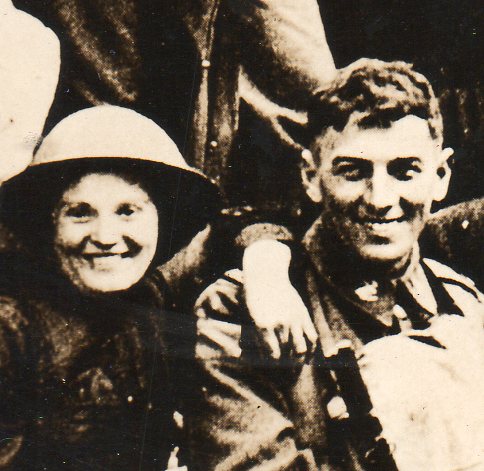
    The images of overwhelming joy are (almost) everywhere:

    WWI--crowds--free town detb703

    Except of course for the man at the fulcrum of the image (and the woman behind him), who remained, well, stolid:

    WWI--crowds--free town deta702
    But so far as everyone else is concerned:

    WWI--crowds--free town detc704
    WWI--crowds--free town detd705
    WWI--crowds--free town dete706
    WWI--crowds--free town detf707

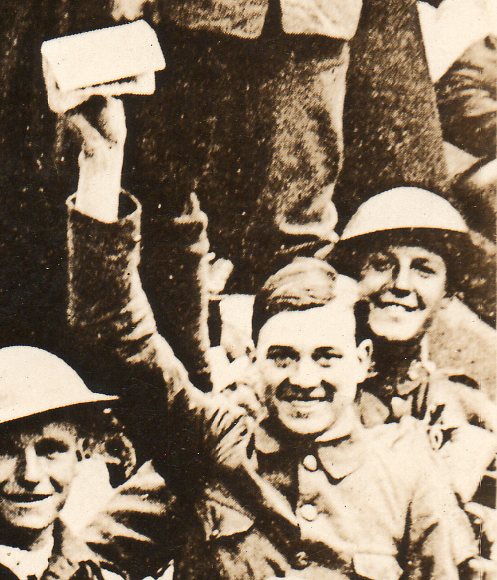
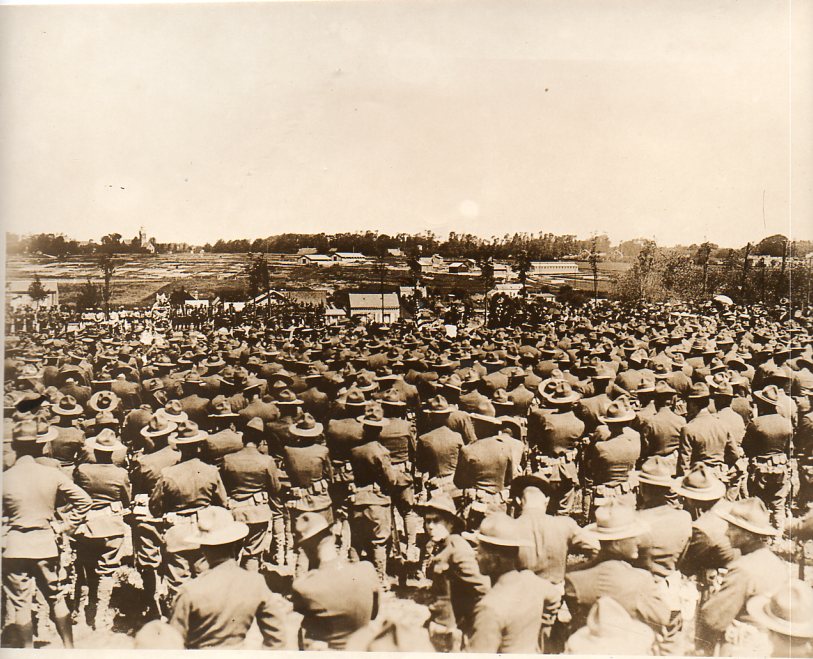
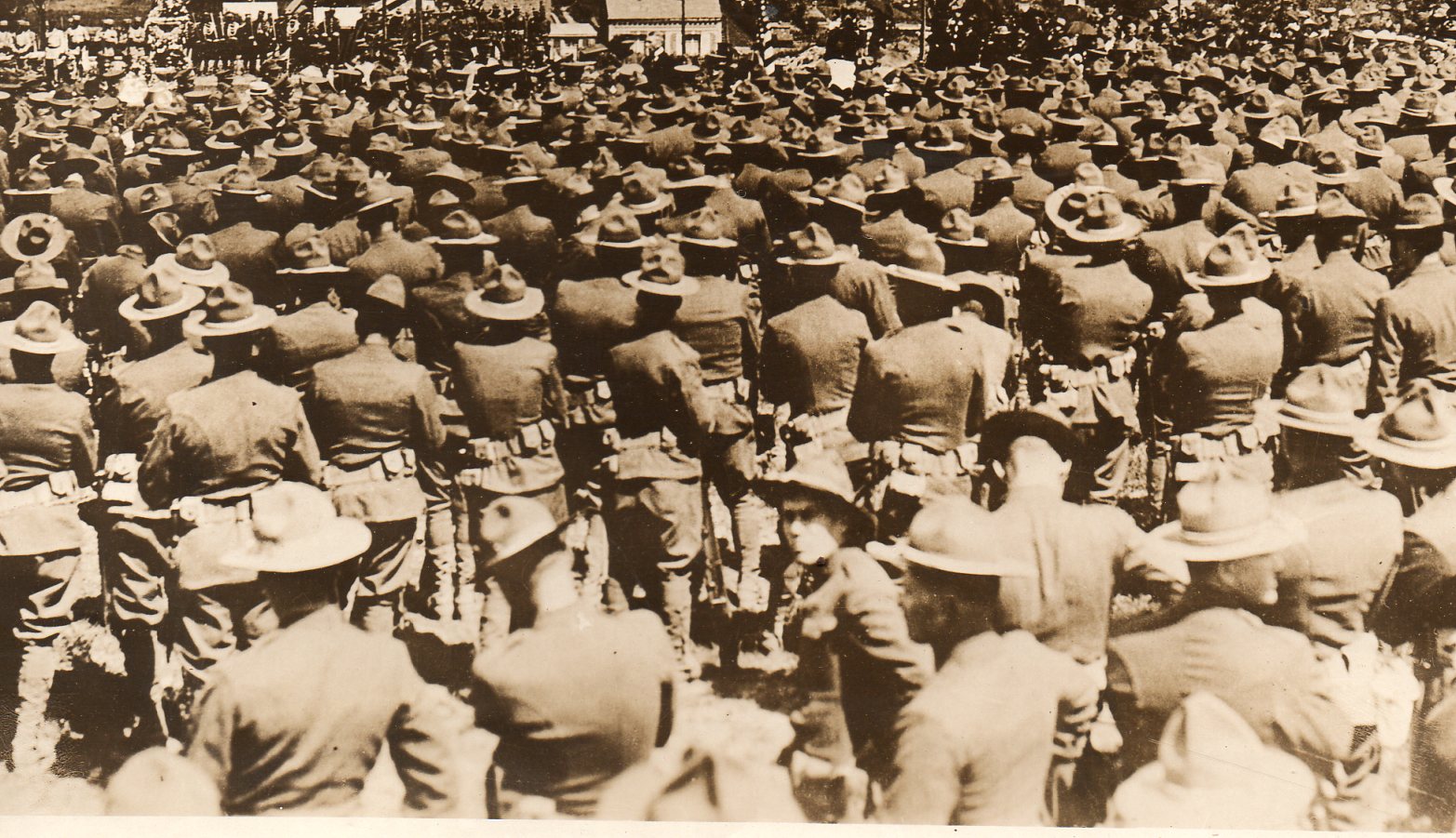
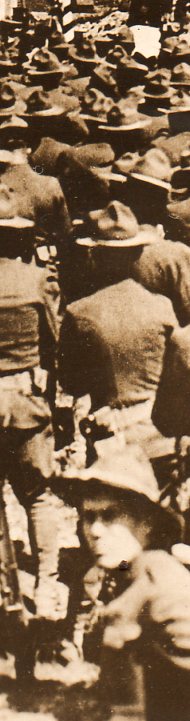
    (2) In this second photograph, taken of American troops at a ceremony at the cemetery of St. Marie, Havre, France in November 1918, the massive crowd (the largest funeral service held in France) is almost entirely focused on the proceedings–except this one serviceman in front, lathced onto the photographer.

    WWI--crowds--cemetery708
    WWI--crowds--cemeteryb709
    WWI--crowds--cemeteryc710

    (3)

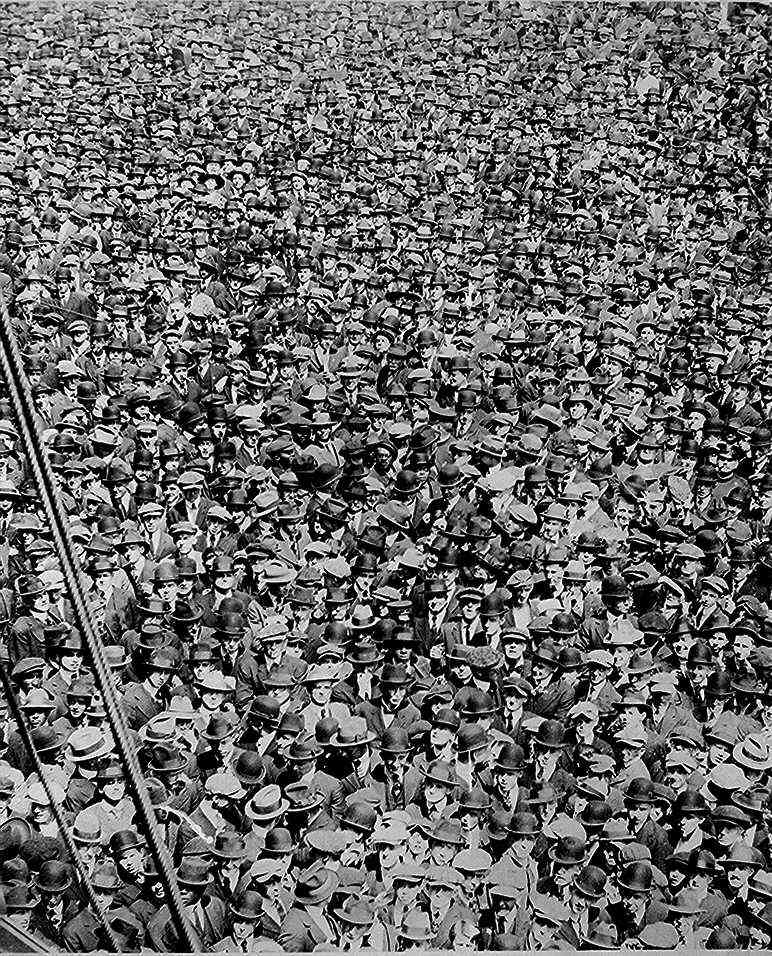
    Hatsdetail Another extraordinary image of pressed-together humans, of a human sea, a carpet of hatted men.  And believe me, every person in this image of (I’d say) approximately 5000 men has got a hat on.  There are hundreds of folks in the photo who re aware of the photographer and who are looking right at the camera, but there is only *one* person who is lifting his hat to the photographer. 

    Hats


  • Gas Masks and Poison Gas, World War I, 1915

    JF Ptak Science Books   Post 1191

    In the long line of potent and horrible weapons, few are as so superbly bad as chemical and poison gas.

    WWI--gas mask full pg696

    [This image is available for purchase at our blog bookstore, here.]

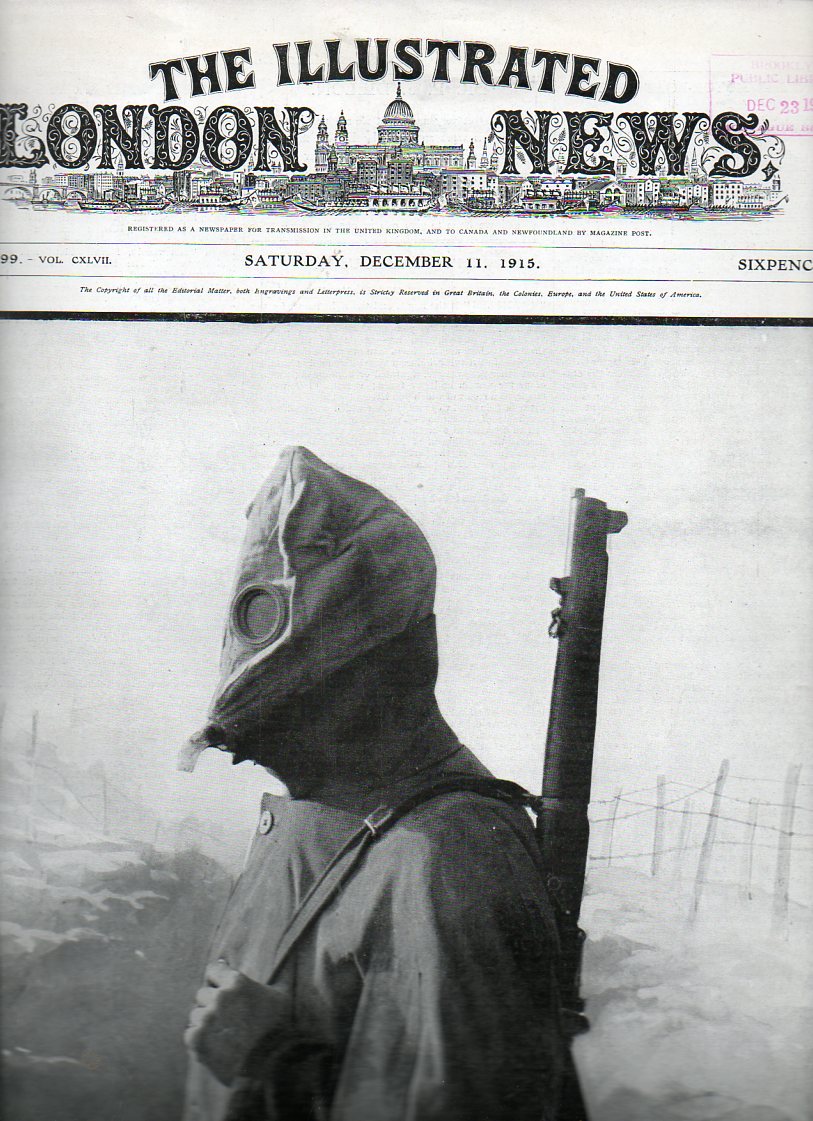
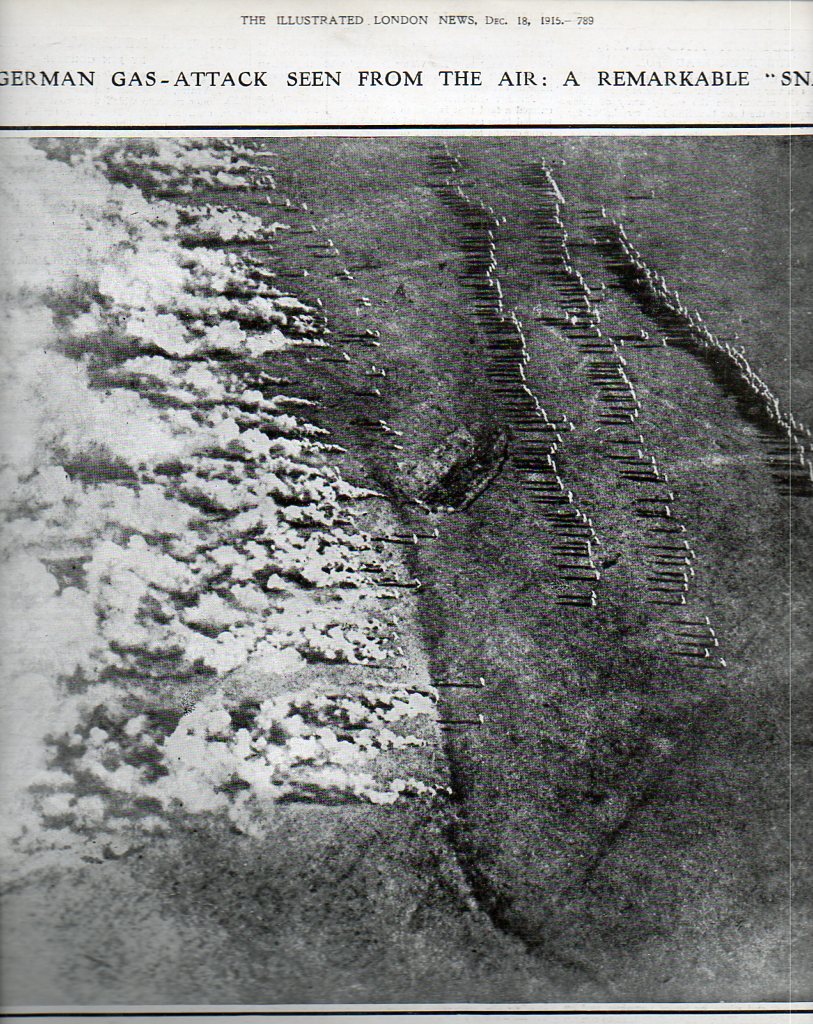
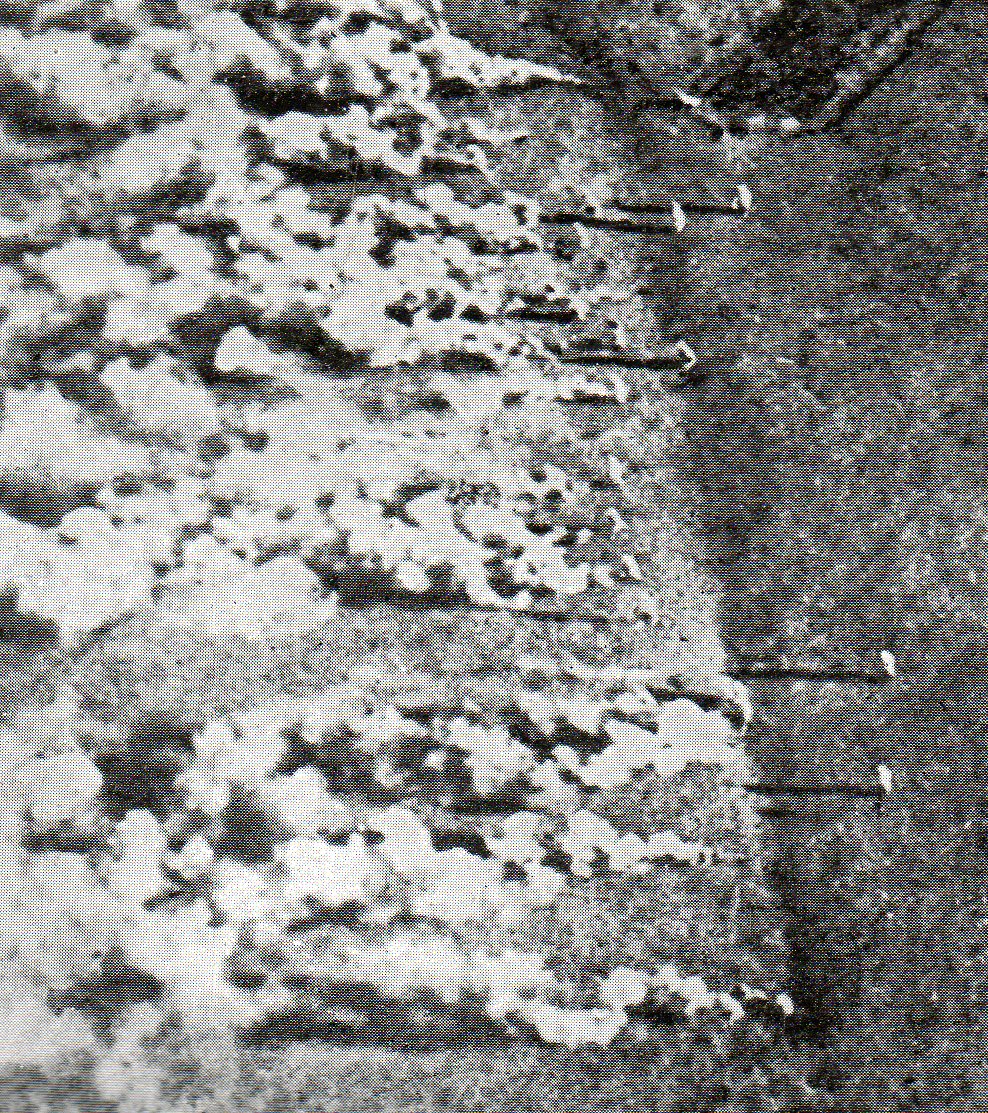
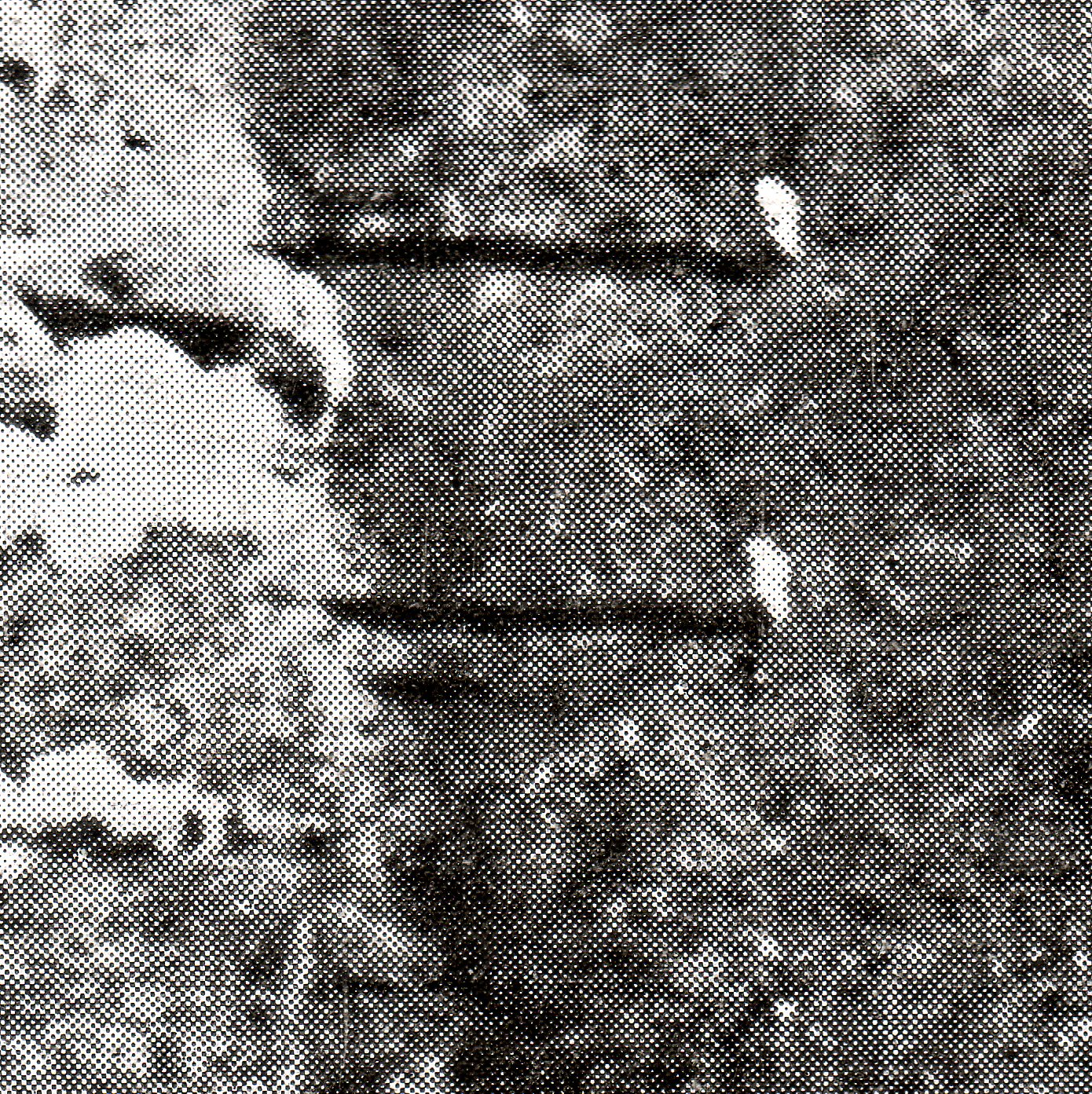
    The heading of this full-page photo from The Illustrated London News for 18 December 1915 really is quite understated—“remarkable” really doesn’t quite cover it.  First of all, photographs from moving airplanes were not common; secondly, this is one of the earliest images ever made of a poison gas attack in progress, just eight months after the initial use of German poison gas at Ypres (a first-hand account of which can be seen here http://www.firstworldwar.com/diaries/firstgasattack.htm  The experience of poison gas in warfare was still “new”–newer still for the Russians, who were at the receiving end of this unnamed  Eastern Front attack.

    The story on this goes as follows: during the night the German enemy forces crawled with metal and glass canisters of the poison gas to the very front of the Russian lines, or at least to the outer edges of the barbed wire perimeter.  The crawler would retreat, and then the whole of the attacking force would wait until daylight and a favorable wind condition at which time rifelmen would discharge at the canister, a direct hit mixing the contents fo the vials, producing the desired gas.  The wind would then pick up the gas and disperse it, the Germans waiting for the first leg of their attack to take effect on the poor soldiers in the trenches, and then attack once the gas had mostly cleared.

    WWI--gas attack697

    And the associated

    WWI--gas attack det b699

    And this solitary figure:

    WWI--gas attack detc700

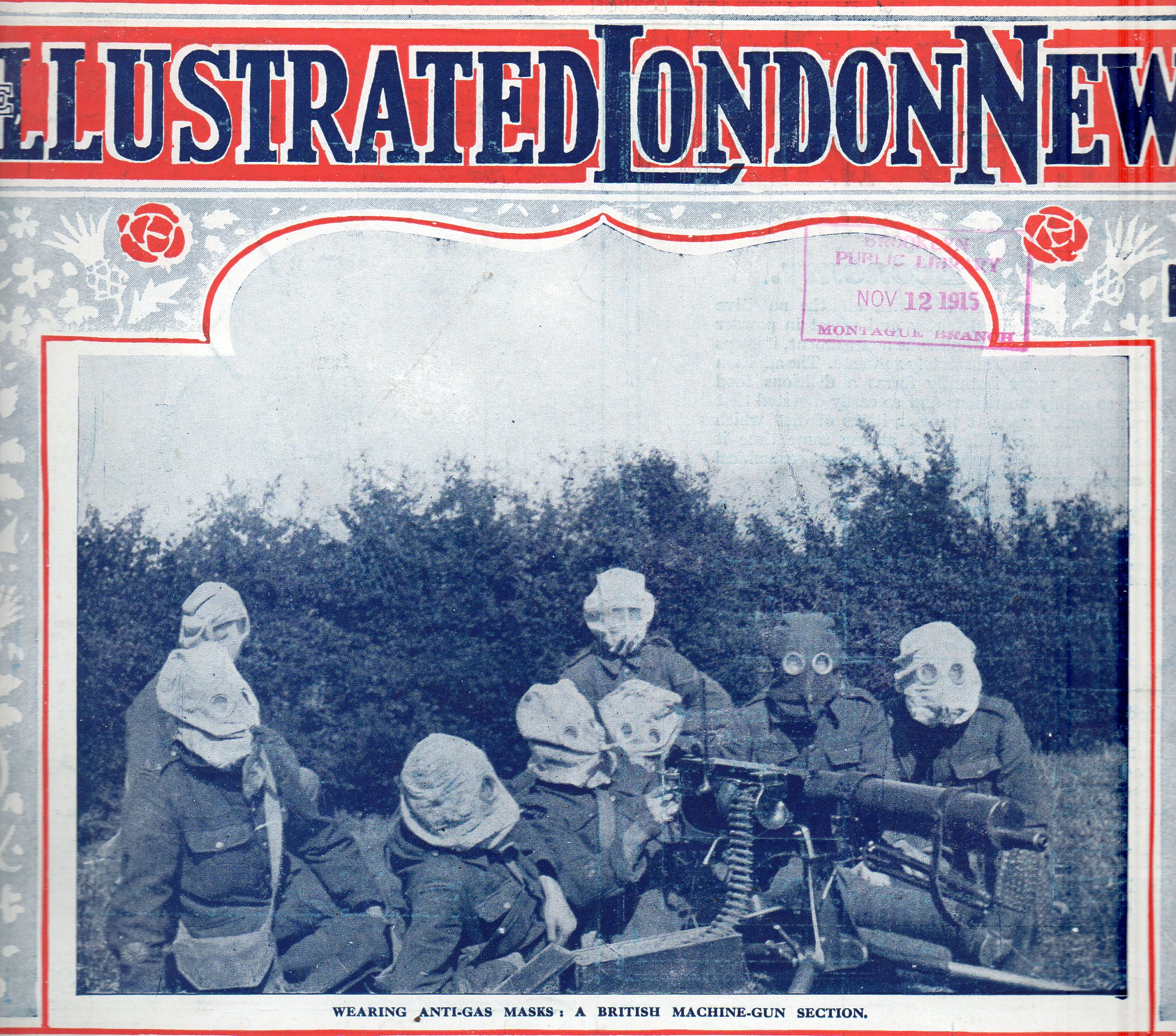
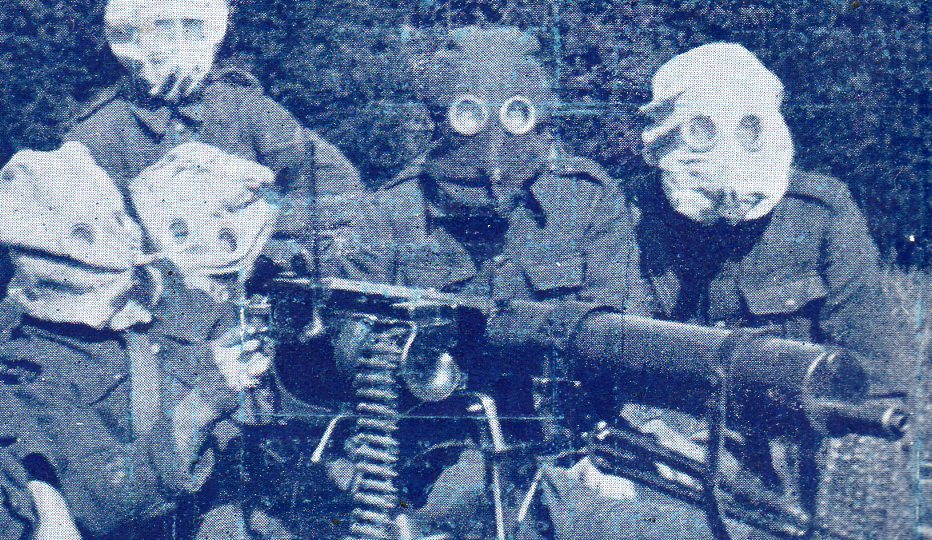
    The masks devised to deal with the attacks were soemtimes effective, sometimes not–actually, they were occasionally enhancers.  The earliest masks were creepy, unworldly, Coraline-like burlap-and-button-faced affairs–I’d hardly wnt to imagine seeing thousnads of these guys come running up to me with rifles and grenades in their hands attacking my position. 

    WWI--gas machine gun711
    WWI--gas machine gunb712