A Daily History of Holes, Dots, Lines, Science, History, Math, Physics, Art, the Unintentional Absurd, Architecture, Maps, Data Visualization, Blank and Missing Things, and so on. |1.6 million words, 7500 images, 4.9 million hits| Press & appearances in The Times, Le Figaro, Mensa, The Economist, The Guardian, Discovery News, Slate, Le Monde, Sci American Blogs, Le Pont, and many other places… 5000+ total posts since 2008.

Author: JF Ptak

  • What I Learned from Johnny Cash’s 1949 Report Card

    JF Ptak Science Books   Post 1181

    This great relic of Americana–the report card of Johnny Cash from Dyess High School in 1949 –is the stuff of deep emotion.  It means that John R. Cash walked this (“Pupil’s Individual Subject Report Card”)  English report card home to his parents for review, the 17-year-old wondering about how they might react to his not-great grades in English and “effort”.  Or perhaps he wasn’t worried at all, perhaps he didn’t care.  He missed very few classes, and was never late.  He received straight A’s in conduct from his teacher, John C. Gramble.
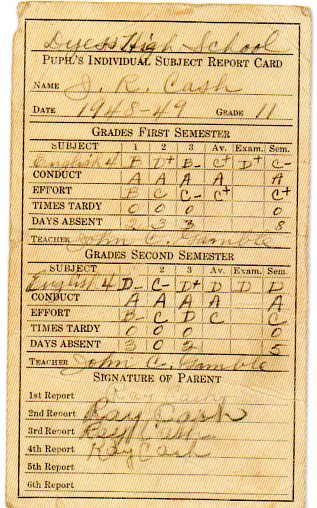
    Johnny cash report card584
    [Image source: Cash, by the editors of Rolling Stone Magazine, 2007.]

    So, the young Cash, who had grown up lyrical, with music and words swimming in his head, was unmoved by “English” (which was probably more like “composition” than what we think of it today) and was not interested in trying to overcome his disinterest, overly.  Be that as it may, even though he was a D student, he was respectful of the class and teacher and classmates, always getting A’s in conduct.

    Mr Cash signed the report card each time, and I suspect that he knew exactly what was going on with J.R. in spite of the grades.

    Only six years later, in 1955, Johnny Cash had his first national hit in “Cry Cry Cry”.

    And so where was Dyess High School?

    As it turns out, Johnny Cash lived in a place in his early youth that owed its life to deep government intervention in the lives of its citizens.  The short story is that people–almost entirely farming families–who had lost everything in the Great Depression and the resulting drought were given an advance1 of money to buy a house and land and a chance to start life anew.  Ray Cash, Johnny’s father–born in 1897 in Rison, Arkansas–entered his family on the relief rolls and was one of 500 families selected  to settle a 15,000 timber-cut swath of Arkansas bottom land up in the north-east corner of Arkansas in Mississippi County, basically due north of Memphis Tennessee just this side of the border.
           
    The program brought to bear on this situation was the Federal Emergency Relief Agency (FERA), which was administrated on the national level by Harry Hopkins and in Arkansas by Alabama-born former teamster William R. Dyess.  The farms and farmland was administered through the Rural Rehabilitation program, which under Dyess’ direction in Arkansas started the “Colonization Project No. 1″ in May 1934.

    Ray Cash and family moved into House 266 on its 20 acres in 1936, one of five families selected from Cleveland County, and the same year in which Colonization Project No. 1 was incorporated as Dyess Colony.  In a short period of time construction in the new Colony included  “an administration building (and a )…town center (which)  included a community bank, beauty salon/barbershop, blacksmith shop, café, cannery, cotton gin, feedmill, furniture factory, harness shop, hospital, ice house, library, theater, newspaper (the Colony Herald), post office, printing shop, service station/garage, sorghum mill, and school. Members of the colony often performed community tasks on a cooperative basis, though the farms were worked individually.”2   
    ________
    Notes

    * “Criteria for the all-white community included that applicants be destitute from the economic crisis, come from the lowest poverty level, be of “good moral background,” and that husband and wife each have the physical ability to clear the land and farm their acreage. Each farmer would draw a subsistence advance to buy twenty to forty acres of land and one of the new five-room houses, plus a mule, a cow, groceries, and supplies until the first year’s crop came in. All were expected to pay back the advance. The town would operate as a cooperative in which seed was purchased and crops were sold communally.”Encyclopedia of Arkansas History and Culture.

    2. Encyclopedia of Arkansas History and Culture.

    Dyess had population of 2500 in 1936, now a town of 550 or so.  I cannot see any remnants of the wagon-wheel design of the farm houses that were built there in 1934/5 from Google satellite images.

    An excellent reference for the movement of families into the Mississippi River bottomlands is The final frontiers, 1880-1930: settling the southern bottomlands, by John Solomon Otto.

    And now for this musical video about Dyess:


  • Young Communists: Service with a Smile, ca. 1922

    JF Ptak Science Books   Post 1179

    This dapper young man with the sharply snapped salute is a communist, and as he tells you, he’s at your service.  But the Young Communist League (of the United States) in the 1920’s–when this pamphlet was printed–was a semi-underground organization with few members who wanted to serve you and which was also “devoted to the interests of all young people and is dedicated to the revolutionary cause of the working class of our country, the transformation of the United States through mass democratic struggle into a socialist society”. 

    Young communists583

    So the YCL service venture may have been more helpful to someone with Communism in mind than anything else.  It did have a diffident bit of patriotism in the design of the pamphlet’s covers, but they wanted a United States that wasn’t the United States that very many other people wanted.

    Perhaps the October Revolution wasn’t what the people of Russia wanted, either. They certainly wanted their freedom from Tsarist rule, but the revolution orchestrated in the name of freedom was hardly that. Significant American thinkers and writers on the plight of the people in Russia at the end of the 19th century–including George Kennan, author of the still very readable and absorbing Siberia and the Exile System (1891)–pretty much jumped off of the bandwagon by WWI.  I can understand a haphazard interest in the Communist Party and the idea of socialism in the United States in the 1920’s and even the support of the still relatively new Soviet Union, but this was a period in which the member in the cascade of three-letter acronyms of Communist political affiliates and parties had a weak draw.  Interest in them picked up in the United States in the 1930’s, though this was also the period during which the atrocities of the monster Stalin were being discussed.  I’m not sure why this popularity grew in the light of these revelations–I just don’t know the history.  (Even though this was supposed to be Stalin’s quote but wasn’t, it fits quite well: “death of one man is a tragedy, death of a million is a statistic”–as a murderer of millions of people, he was very well versed in statistics of genocidal sadism.) 

    In any event, I simply liked the public face that the YCL engraved for themselves–it looks much like any other face you’d see in any other magazine hawking coats or cigarettes or Dunlop tires.  A face like any other. 
    ______
    Notes
    Kennan wrote in 1923: “The Russian leopard has not changed its spots… The new Bolshevik constitution … leaves all power just where it has been for the last five years–in the hands of a small group of self-appointed bureaucrats which the people can neither remove nor control.”


  • Science Noir and Steampunk–the Magic Lantern and Major Kong

    JF Ptak Science Books   Post 1177

    I wonder if there is any such thing as Science Noir? There is certainly science fiction noir, and Cyber Noir and associated reaches, but, well, what about a purely Science Noir?  Scary, off-center, distracted, chilling, nightmarish science?  I’m not so sure if this is even a real question, but when I think about arguments made for the cultural and supposed artistic impacts in the creation and direction of some aspects of scientific development, I wonder if it makes any sense at all to think of science in terms of the noirish aspects of culture.

    Emma Alvarez Gibson made the suggestion to me that Science Noir might be a version of Steampunk, and she may well be correct, although the frightening aspects of vast machinery shrouded in noise and smoke and shadow–the very definers of Steampunk and massive Victorian-era machinery–may be itself one version Science Noir.

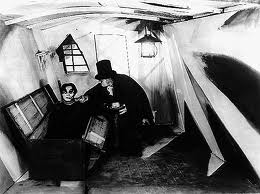
    But what comes first to mind of course is film noir, the edgy use of cinema that came about during the late stages of the Expressionist movement and the early stages of motions pictures.  Expressionism comes just after the first real influx of motion pictures, around 1910 or so, and it seems a little surprising to me that such a huge developmental leap was taken in film so quickly after the first initial mass public success of the film industry.  Perhaps it is incredible that a movie such as The Cabinet of Dr. Calgari–seen as the first adventure into Film Noir and an enormous leap of creativity in film–came so quickly: after all, the first NYT film review appears in 1909, the first movie magazine (Photoplay) appears in 1912, the first animated cartoon (the great Windsor McKay’s Gertie the Dinosaur) in 1914, the same year as the first appearance of the Little tramp.  And then five short years later, almost a decade into the Expressionist movement, comes the Cabinet.         

    Science noir--caligari
    Film Noir was a new experience in motion pictures–it tested reality, coming to the audience in a shadow, fractured, sharp angled crossed line existence, dark, potentially unreal, teasingly chaotic, establishing a waking nightmare.  The mood was questioning, the atmosphere sharp and highly contrasted. It was scary–especially in the case of the deeply creepy Dr. Caligari the deeply disturbing sets continuing to stay as existence in the film even after it is revealed that everything that had happened previously was a dream…except that the dream’s landscape was not relieved. 

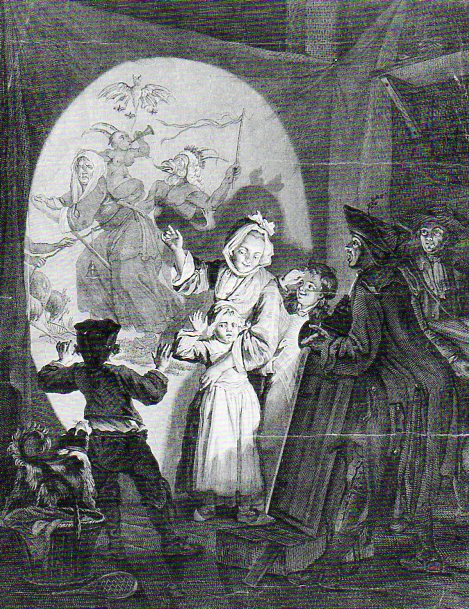
    Perhaps the earliest brush of Film Noir was Science Noir.  The earliest removed images in real time that were seen moving eerily across the probable clay/adobe walls of a camera obscura must have seen fantastic to the first observers.  The earliest projected images from the magic lantern–seen here in the engraving La Lanterne Magique by Jean Orvrier and published around 1770–included many frightening portrayals of witches and demons in addition to their general stable of scientific, technical, literary and travel images. I am quite sure that the earliest viewers of these scenes must have felt as though they were witnessing something extra-ordinary, something beyond simple optical amusements shown on white cloth, something more real than not–particularly since it seems that many people were exposed to these images by traveling magic lantern itinerants more so than scientific lectures. The images of spectres and demons may well have felt to be the things themselves.

      Science noir--magic lantern565

    Perhaps the magic lantern is the first bit of Science Noir, the Steampunk without the steam.  And metal. The noirsh aspects of this science was in projected light and the imagination, leaving the worst effects of the  visual aspects of this fear to the imagination. 

    But I think that Ms. Gibson is correct, and that the most vivid aspects of Science Noir are left to Steampunk, the threat of metallic enormities of power and noise simply overwhelming the viewer.  I suspect though the  greatest science noir of the 20th century would best be seen through the eyes of Stanley Kubrick’s Dr. Strangelove, a masterpiece of black humor layered in incredibly stark, high-contrast black and white scenes, the threat of entire annihilation made to feel somehow ridiculous, humorous and possible, the viewer laughing  as Major Kong rides the nuclear weapon “Hi There” all the way down in Nukepunk cowboy glory through five minutes of an insistent “When Johnny Comes Marching Home” soundtrack. And then, suddenly, the silent, brilliant flash, and the laughing stops, and there’s nothing left but cold heat. 

    I guess that’s my first take on the vision of modern Science Noir. 

    (The except below from Dr. Strangelove is longish, about five minutes,  but it is well worth the buildup.)


    _
    Notes
    The oldest extant magic lantern-like machine comes to us from Christian Huygens from about 1656.  Huygens is a scientist of enormous energy and capacity and genius, and more often forgotten than not nowadays, at least in popular culture


  • The Invisible Influence of the Highly Visible? Comets and Meteors in Astrology

    JF Ptak Science Books   Post 1176

    “When beggars die there are no comets seen; The heavens themselves blaze forth the death of princes.” – Shakespeare.

    “Threatening the world with Famine, Plague and War: To Princes, Death! To Kingdoms, many Crosses; To all Estates, inevitable Losses! To Herdsmen, Rot; to Plowmen, hapless Seasons; To Sailors, Storms, To Cities, Civil Treasons!” De cometis by John Gadbury, London, 1665

    It is unusual to me that in the long history of early astrology, some of the greatest elements of the night sky–comets and meteors–are little used, perhaps even unuseful outside of adding flavoring to readings given the time and place of their appearance. They had been seen for milennia–appearing in Gilgamesh and the Book of Revelation for two samples– as prognostic of future events, John of Damascus and Aritotle and Ptolemy and Albumasar all writing about that quality.

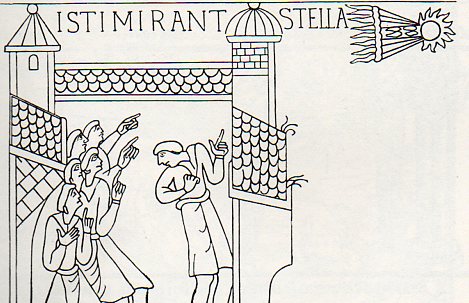
    Comets 5564
    [The Bayeux Tapestry illustrating the appearance of the comet of 1066, later to be known as Halley’s comet.]

    Comets and meteors didn’t really affect anything in the physical world, and in the astrological one their purpose was to perhaps predict a kingly death or the appearance opf warts on women. They were also seen by people like Aristotle to be atmopsheric events, living out their exsitence in close proximity to the Earth, incapable of having any undue affect on Earthly matters.  Meteors would appear and then disappear, comets were surprises and visible for just short amounts of time; the rest of the night sky remained the same, intact and unaltered after their appearances.  They were not understood, though they were seen by some as raging battles between forces of good and evil, personifications of the struggle between the angels of god and the elements of the devil. Meteors and comets were mysterious, unconquerable, unknowable, suspicious elements, and were evidently not useful to the early astrologers.

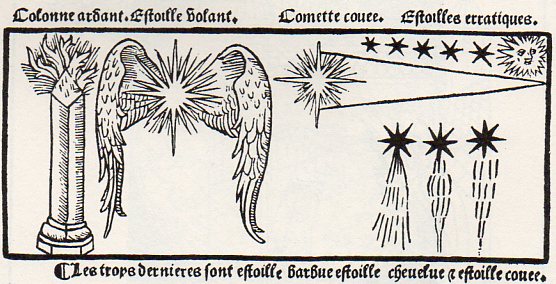
    Comets 1560
    [Nicolas Le Rouge, Le Grand Kalendrier et Compost des Bergieres, published in 1496 in Troyes. 

    The night sky is a mnemonic device, a place to store memory and a holder of the alphabet of myths and beliefs of all, a culture written large across the sky. Meteors and comets were not predictable, and could add nothing insofar as a consistent bit of storytelling was concerned, though they certainly created their own stories in each observed appearance; they could also add punctuation and exclamation to whatever constellation they appeared in. For example if one appeared in a juncture with Jupiter, a major event for royalty would possibly be foretold.   But as a permanent element to the visualization of the night sky, they had little power even though they seemed to be displays of fantastic energy and power in themselves.

    Comets 2561

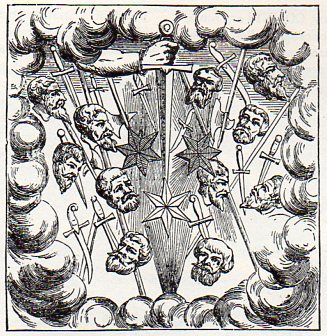
    [Amrose Pare illustrated the comet of 1528 in his Livres de Chirurgie (in a chapter titled “Des Monstres Celestes”), published in Paris in 1597. Even though Pare was a towering figure and great intellect, he still personified the wandering stars with human faces, with hair and beards, accompanied by swords and shields.  There were many other scholars who saw such things in comets and meteors, not the least of which was Maupertuis, who envisioned the tails as clusters of jewels; many others seeing many other things.

    Comets 3562
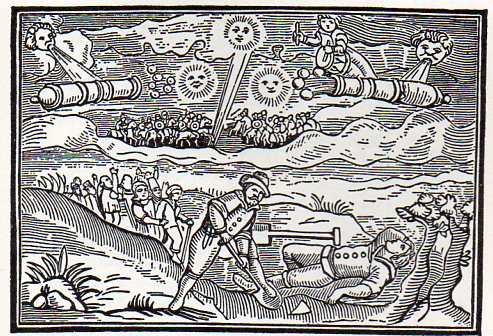
    [For some reason the celestial court, divided by sunlight and flanked by two other sources of light, have ofund it expedient to issue comets from the mouths of Heaven Canon.  I’m not sure what’s going on in the forground with the fellow working his spade next to the triangular blankness.  the man to his right seems to have been overtaken in fear (as have the group of people visible to the left over the shoveler’s shoulder).]

    Comets 4563

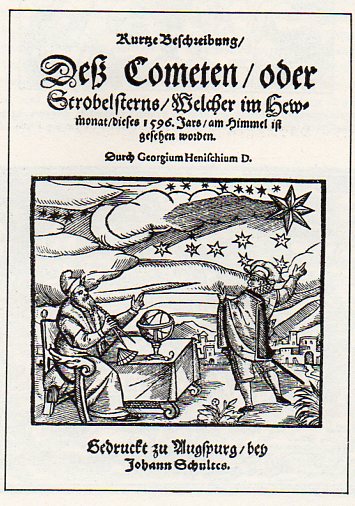
    [Halley’s comet appears again on the title page of this work by the Hungarian George Henischius, a prfoessor of rhetoric, mathematics and medicine at Augsberg.]


  • Artists in/and their Studios: Bacon, Braque, Kandinsky, and others.

    JF Ptak Science Books   Post 1175

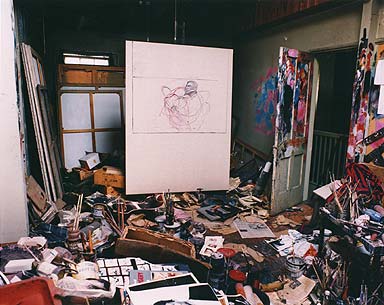
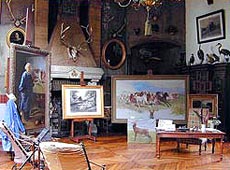
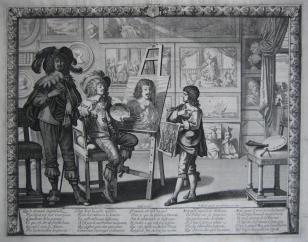
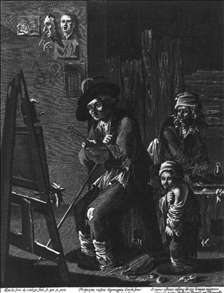
    I.m not sure what sent me scurrying around for images of artist’s studios–iniitally I was looking to see what was on the walls of the artist’s workspaces, but there were so many that it couldn’t be done in my allotted time.  For now I just want to simply post these images of 30 studios and continue later on as a page with more images and  detail on the artists.  For now, I’ve included images of the studios of Bacon, Bonheur, Bonard, Braque, Cezanne, Chagall, Derain, Chase, Friedrich, Kandinsky, Le Corbusier, Mondrian, Remington, Teixidor, Villon, and Vlaminck. (The majority of these images are drawn from Alexander Liberman’s The Artist in his [sic] Studio, 1960; there’s much of interest in that book, including vivid observations and descriptions.)  The other, older, images are depictions of the generalized artist’s workshop and studio.  Enjoy.

    Francis Bacon studio

      Studio--farancis bacon

    Rosa Bonheur studio

    Studio--rosa bonheur
    Abraham Bosse, depiction of  a studio.

    Studio--abraham bosse
    Both, Andreas (depiction of a poor artist’s studio)

    The Poor Painter in His Studio


    ·Posted by :

    ·in:

    —

  • Nazi Propaganda–the Big Lie and Germany Surrounded, 1933

    JF Ptak Science Books  1174

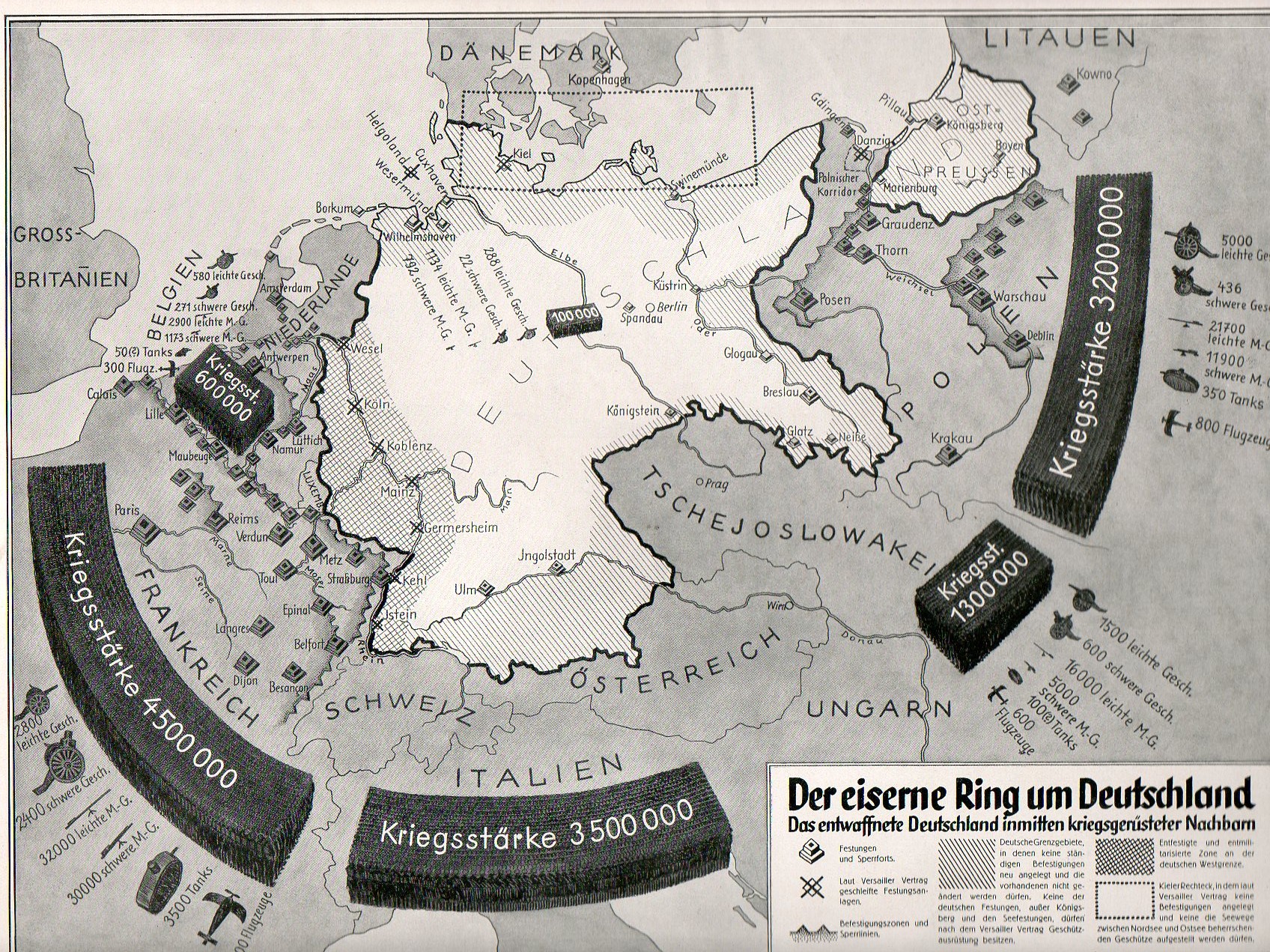
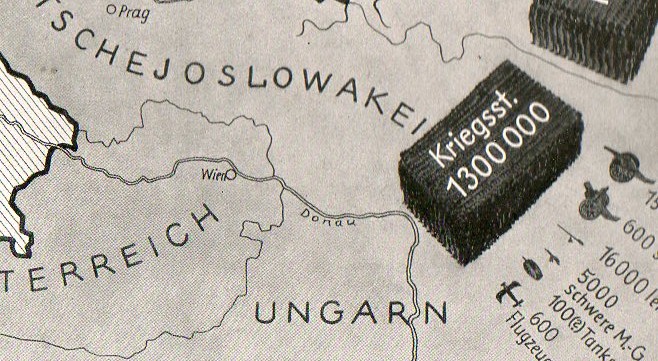
    The newly-elected NSDAP government lost little time in putting forward a case to the German people that the Treaty of Versailles left Germany in a defenceless postion, surrounded by forboding armies and air foprces of its neighbors, the forces of France, Italy, Czecholovakia, Belgium and Poland forging a tight and formidible strangelhold on the weakened Germany.  This image comes from the late November 1933 issue of the Illustrite Zeitung1 (Leipzig), and its relates to the casual and general reader the de-militarized and tenuous situation of the country–its design is effective enough so that the voice of he illustrations is well heard even if no on actually bothered to stop and read its legend–it was all about threat and impending doom, and the words for those emoptions weren’t necessary in this artwork.

    Nazi Prop surrounded538

    Campaigns like this were a first step in the Nazi consolidation of the public spirit, attempting to unify the population under Hitler and the NSDAP by presenting a threat so common that it could not help but to draw everyone into the big tent.  This was a simple message of natural survival, a wide threat to the German state, a threat that was so simple and so devastating and so opaque that there would be virtually no resistence to unifying against it. (J.W. WHeeler-Bennet wrote about this in his superb and still-classic book The Nemesis of Power, the Germany Army in Politics, 1918-1945, published in 1954.)

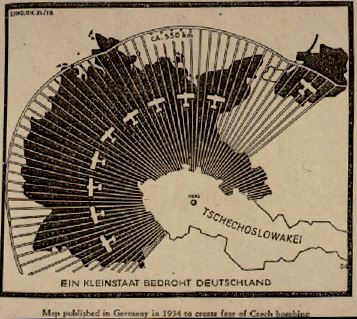
    Here’s another example from about the same time, again showing the devastating effects of imagery–this displays the non-existent threat from Czechoslovakia:

    Blog jan 3 czech air


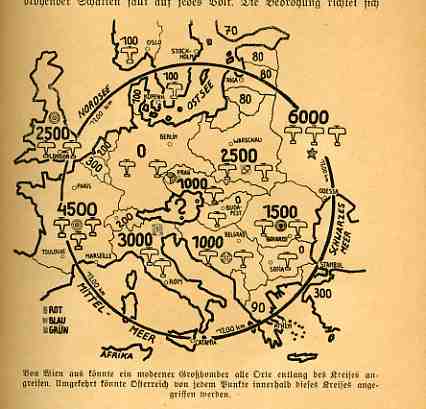
    And another, showing the encircling imagery again:

    https://historyofideasblog.com/a/6a00d83542d51e69e20120a7a04f7a970b-pi

    Getting back to the first image–curiously Great Britain and Russia don’t make the Enelmies Liest here, though in 1933 they certainly loomed as an enemy as much as any other.  (Well, perhaps not neessarily so for the Soivet Union, but close.)

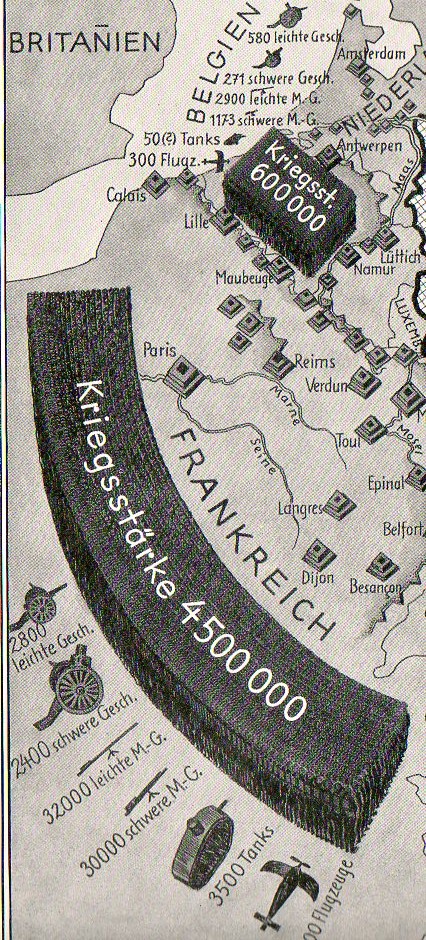
    Someone who actually read the article and looked closer at the full-page ilustration would see the details of t he European threat, like this for France (and Belgium), with bloated figures for WWI-era ordnance and an extremely effectively articiulated represntation of what was seen as the standing army:

    Nazi Prop surrounded france539

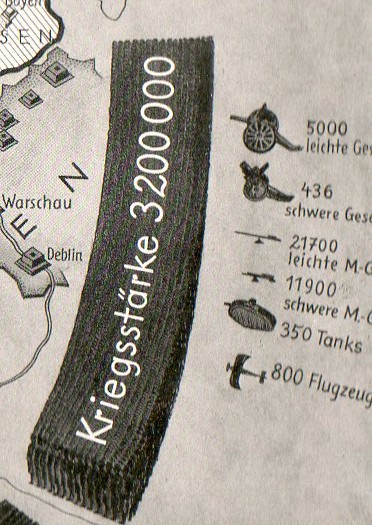
    And this for Poland:

    Nazi Prop surrounded poland542

    And of course, Czechoslovakia: Nazi Prop surrounded czech541

    Among other things the signing of the Treaty of Versailles in 1919 limited the German armed forces to less than 100,000; limited the Navy to 15,000; prohibited the manufacture of submarines, armed aircraft, tanks, armored cars, Maxim guns and of course poison gas. There was assignment of guilt, heavy reparations (in what today would translate into something like a half-trillion dollars, without though translating buying power), and much more that was aimed at keeping Germany vanquished if not somewhat pastoral.  Many have seen the Treaty as being the bridge and greatest impetus to WWII, an opportunity lost and squandered by the Allies–maybe so. A year after the end of the incredibly violent and ripping four-year onslaught in which millions were killed and so much destroyed it would’ve been difficult for all parties to the Treaty to have a great forward vision in how to best deal with Germany.

    The Treay did provide a unifying front for Hitler; the Nazi Party using choice aspects of it in hearts-and-minds propagandizing methods like the one above:  the military restrictions were true, but the portrayed threat of attack from Poland and Czechoslovkia and Belgium and Italy and even France were part of the building of the Big Lie.  The “Big Lie” was something that Hitler identified in his 1925 Mein Kampf, and then used in his own terror campaigns–it is a lie so colossal and so impudent, so fantastic, that it is perceived as being true because no one would lie so gigantically.  As  George Orwell put it in his 1948 novel 1984, the Big Lie was “…to tell deliberate lies while genuinely believing in them, to forget any fact that has become inconvenient, and then when it becomes necessary again, to draw it back from oblivion for just so long as it is needed….”  The perception of imminent threat was one of the starting points for the Big Lie; the mechanics and people behind the manufacture of the invasion, of the Treaty of Versailles, of the German economic meltdown, and so on was already laid down in Hitler’s ridciulous book, and much of that lay at the feet of the Jewish people. 

    But first the Nazis needed to address the issue of their entirely weak and vulnerable military position by proposing the threat from much of the rest of Europe, this in order to rail against Versailles and break the German obligations to non-militarism.  The foundations for rebuilding the German war machine started in earnest in 1933; by 1935 most of the restrictions of Versailles had been broken, and Germany (which in 1933/4 had bene secretive about it) had gone public with its new obligations to itself (introducing the Luftwaffe to the rest of the world in March1935).  Reactions from the Allies to generating the new war machine were weak, and Germany rolled right into WWII. 

    Notes:

    1. I’ve written many times here about the Illustrirte Zeitung–it was basically the German equivalent of the Illustrated London News, Paris Match, and LIFE magazine, a better, mid-level weekly magazine that was well-written, very-well illustrated, approachable and affordable to folks of nearly all classes.  It was an expedient way of sending across the government’s message from te beginning of the Nazi ouccpation of German politics.


  • Thinking Deep about St. Paul’s and the Eiffel Tower–Presenting the Depths of the Oceans in Plaster and Steel,1910

    JF Ptak Science Books   Post 1173

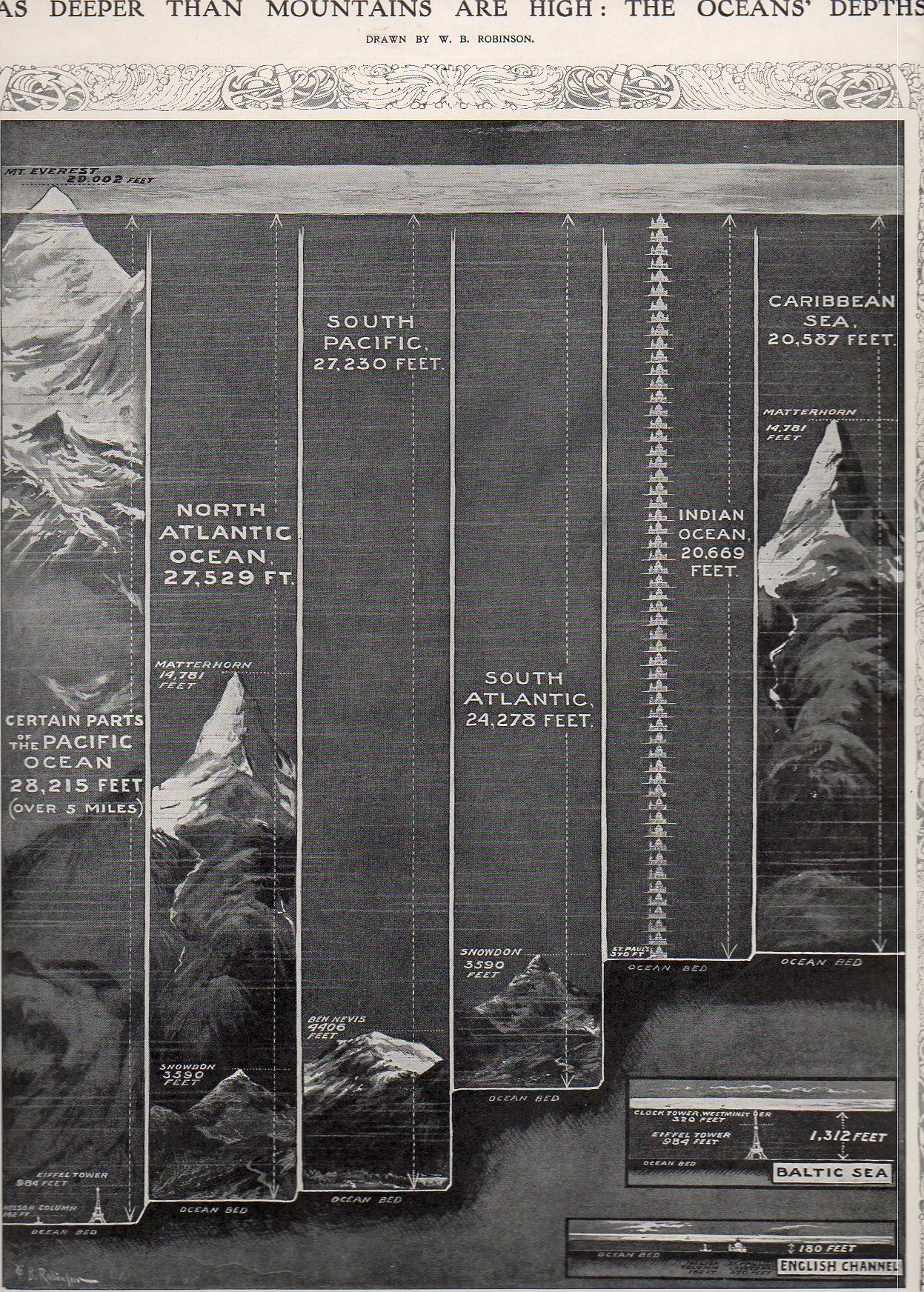
    Although maps showing the depths of the oceans existed from about the mid-19th century (through the pioneering work of the American father of oceanography, Virginia’s Matthew Fontaine Maury1) few casual readers would have ever seen a more approachable representation of information than what appeared in the Illustrated London News for 8 October 1910. Although Maury’s maps are elegant, they didn’t receive nearly as wide a distribution as this ILN image–also they weren’t nearly quite as relational as the 1910 version.

    Sea depths533

    Granted, the 1910 comparison chart only displays one statistic–the supposed greatest dept of five oceans, two seas and the English channel–it does so in such a way as to make those numbers immediately approachable to any reader, which is always an issue in relating scientific information to the general reader.

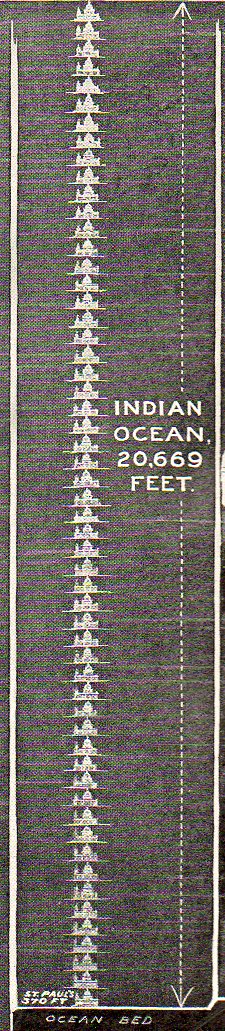
    Sea depths ist pauls537 {One of the standard unit of measurement for the purpose of this display was St. Paul’s Cathedral.]


     What W.B. Robinson presented was a way of looking at an invisible entity through very visible means–comparing depth to the heights of things that everybody in 1910 knew: the Eiffel Tower (relatively newly constructed out of 18,000 prefabricated highly-engineered pieces) and St. Paul’s Cathedral. So rather than stating that the Pacific Ocean is 28,000 feet deep, Robinson chose to replace feet with Nelson’s Column–174 of them. Or 29 Eiffel Towers. The 20,000-foot deep Indian Ocean was actually 56 St. Paul’s deep, while the Baltic Sea was deep enough to not quite cover one Eiffel Tower with one Westminster Bell Tower on top (ha!); and the English Channel at its deepest wouldn’t quite cover St. Paul’s.

    This is really the way to display data in my book, especially to kids.  This is one of the few ways of making the information accessible and understandable across almost all age ranges. 

    Notes:
    1.  Actually the work goes back a century before Maury with Buache, who produced this map of the English Channel in 1737–the data points are veyr numerous, but this is the very first time that such information was available on a map.

    Sea depths idouth pacific536 Sea depths indian535


    NOAA Photo Library Image - map00004

    And Maury again with this first map of an oceanic basin, published in 1853:

    NOAA Photo Library Image - map00001

     And in 1752, Philippe Buache produced this fantastic and first-of-its-kind map for the depths of the English Channel:

    NOAA Photo Library Image - map00186

    Here’s an extraordinary cross sectrion of a part of the ocean floor produced in 1857 by the HMS Cyclops in preparation for laying the Atlantic Cable:

    NOAA Photo Library Image - map00010


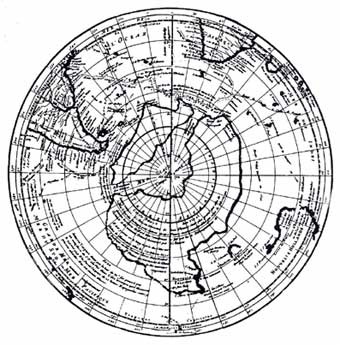
    Its also interesting to note here Buache’s work on this map of Antarctica, published in 1737.  Buache put together all of the known (to him) information about the mass in the South, bits taken from other maps, and accumulated them into what was the best-possible guess on what was down there in the Antiopode.  Pretty good detective work given the amount of material that he could work with.


  • A Note on American Two-Way Border Wars

    JF Ptak Science Books  Post 1171

    Porosity  is a measure of spaces-in-between, voids in a material’s total volume.  Some things certainly have visible porous elements, like a cotton shirt or netting, and others–like rocks and soil–don’t.  Other elements are measurable but less visible and experimental than fluid flow though still experiential,  like truth and falsity, or the concepts of good and evil, good taste and bad, love, generosity, felicity.  Ideas like “god” are very porous, as are the prospects of salvation and redemption, and (getting into) heaven and hell. 
                               
    Skin is also porous because it is composed of, well, pores. We don’t think of things like skin being permeable, as it holds in the vast amounts of liquids that make up the majority of the human body (for example).  Football has porous defenses, a necessary design to the process of the game, because years of 0-0 games just won’t work so well as paid entertainment.  Poromechanics in real and abstract bits is all a matter of degree.  And direction.         
    http://blog.selfportrait.net/blog/wp-content/uploads/2010/07/frances-flora-palmer-for-currier-and-ives-across-the-continent-westward-the-course-of-empire-makes-its-way-1868.jpg
    The American border is fairly well porous–much less now than it used to be of course.  There’s 3,987 miles of border (excluding Alaska) with Canada, and another 1969 miles between the U.S. and Mexico (1241 of those shared with Texas), so there’s a lot of room for room–for people trying to get into the country.  The flow of people through/over the borders weren’t always gong one-way–the expansion of the country is a history of the mythic pioneer/settler moving into space contiguous  to property that was owned by the U.S.  (Actually, it wasn’t all contiguous, adventurers and “explorers and entrepreneurs and filibusterers reaching far and wide.)  It would be interesting to know how many miles of variable borders within the U.S. we have slipped through over the last few centuries–my offhand guess is that it is an order of magnitude greater than what we have right now.

    Before we constructed massive walls and armed our borders, before we started to erase the incised sentiments on the base of the Statue of Liberty, the border wars of the United States were being fought going the other way ‘round.  The borders of the country were extended in many different ways, not the least of which were what we would call “pioneers”–plus of course politicians and the military, all deeply at work in establishiung the sactions of expansion.

    For example, in the 1800-1850 period, there were 21 major attempts to access foreign properties to become part of the United States.  Ten of these were attempts made to purchase the land outright–only Louisiana (and that is a gigantic “only” was wholly successful, with Sonoma being half-successful.  Five of  the other cases– East Florida, West Florida, Texas, New Mexico  and Alta California–came to us via wartime acquisition.  Attempts to buy and bully Mexico for Baja didn’t work; Yucatan and Cuba escape our proposals for annexation and purchase as well, while Chihuahua resisted purchase, invasion and annexation. 

    All of this excludes Indian lands, of course, a list of the tribes involved in the 709 seizures1 can be found in the continued reading section, below.  (That’s the number of “transactions” for the 110 year history between 1784 and 1894, which extends beyond the 1800-1850 slice of our expansionist pie; there were still a hundred or so motions against the Indians during this time, not to mention the dreadful Southern Removals of the Five Civilized Tribes as well as the disastrous removals in Indiana.)

    Conquest and purchase has been the name of the game in moving the Americans through our borders, an exercise of great regularity and incredibly high return.  Again putting aside the Indian question, had we not pushed up against the owners of these lands in the first place and absorbed them in the second, instead of having California, Utah and Texas we may well have had the Republics of California and Texas and the entity of Dereret, not to mention a wide swath of the southwest (including New Mexico, Nevada and part of Colorado) reaching up nearly to SLC that still belong to Mexico.

    And what it all boils down to after the borders have been passed through and moved forward, again, are the people that wind up staying–pioneers, farmers. The log cabin came to symbolize this spirit in the 19th century, a picture of progressive civilization and stability, of spirit, of achieving Manifest Destiny.  In my own collection of images of log cabins (prior to the Civil War), there are very few of these structures that show people in or near them.  More often than not, the pictures are silent; every now and then, there is a woman in the doorway or inside looking through a window–a symbol of innocense and felicity. There are images with the log cabin in the background, the foreground filled with pulled stumps and men plowing the fields (with and without horses) I don’t own a single image that shows a man with a gun.  (I’ve not done a survey on this issue, but that’s my overall impression over the years.) A subtle message I think was definitely being sent.
     
    Even the name “America” proved to be exceptionally porous.  At one point it stood to include North and South America, and then  it changed to exclude South and Central, and then Canada, and then Mexico–it really only related to the United States during the period of greatest nation building.

    This is just an interesting thing to think about now when we discuss closing our borders–those lines had to get to those positions somehow over the last 500-odd years.

    Notes:

    1. Indian Land Cessions in the United States,1784-1894, United States Serial Set, Number 4015; this is the  second part of the two-part Eighteenth Annual Report of the Bureau of American Ethnology to the Secretary of the Smithsonian Institution, 1896-1897.  “The Schedule of Indian Land Cessions subtitle notes that it indicates the number and location of each cession by or reservation for the Indian tribes from the organization of the Federal Government to and including 1894, together with descriptions of the tracts so ceded or reserved, the date of the treaty, law or executive order governing the same, the name of the tribe or tribes affected thereby, and historical data and references bearing thereon.”

    Sometimes just seeing hte extent of a list of names gives you a much greater appreciation for the numbers involvewd than the sheer number itself:
    Acoma Pueblo
    Alabama
    Alsea et al
    Apache
    Apache (Eastern bands)
    Apache (Jicarilla bands).
    Apache (southern).
    Apache (Southern).
    Apache (Western bands)


  • Phantom in the Opera: Questions about Darwin and Einstein and Music

    JF Ptak  Science Books   Post 1170

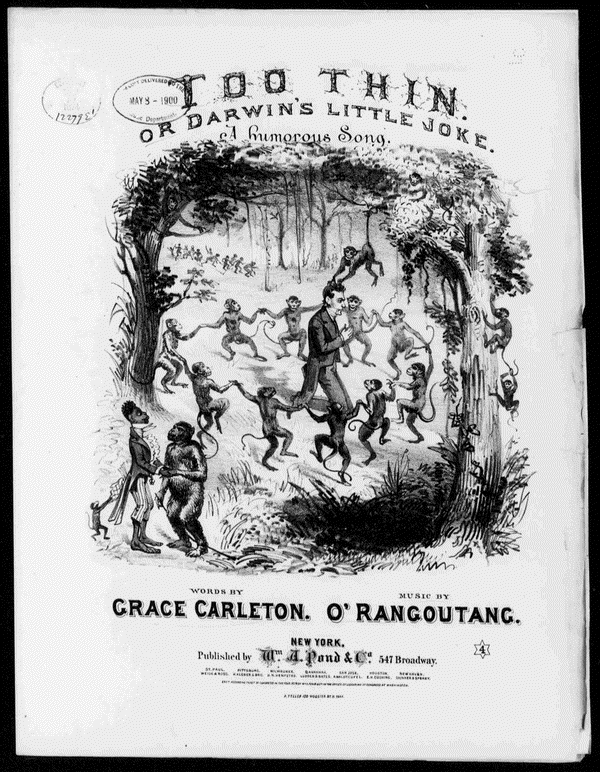
    There are unending missing pieces for me in the works of the greats (literal “phantoms” in the Latin phrase for their collected works, “opera”), one of which came bubbling up reading the excellent piece by Michael Barton (Dispersal of Darwin blog) on Darwin in caricature.  It  put me in mind of Darwin and music, or, really, Darwin caricature in music In the 19th century.  There doesn’t seem to be much to it, at least for the old stuff–there’s plenty of modern music, but it seems that there aren’t very many old notes.  There is this example that I found at the Library of Congress site, though:

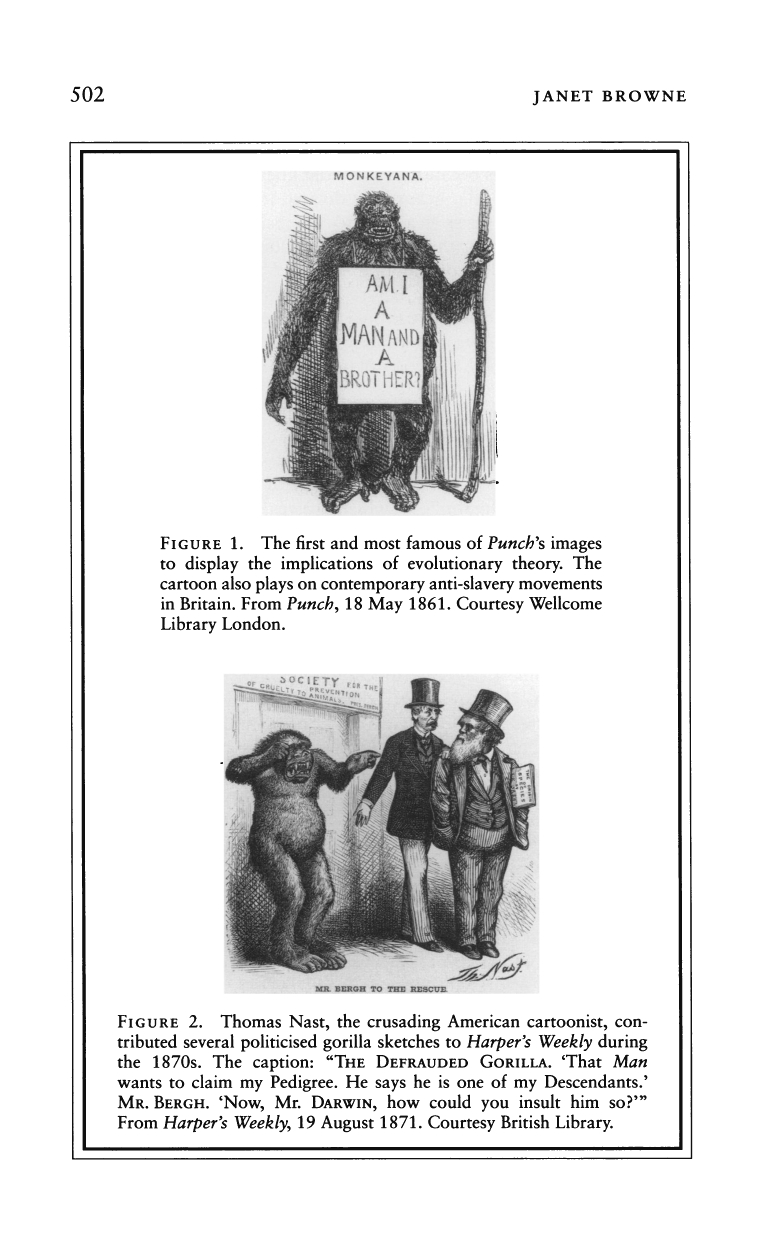
    “Too thin; or, Darwin’s little joke by O’Rangoutang”published in New York by William A. Pond, 1874, which came 13 years after the appearance of the first Darwin caricature (in London’s Punch magazine, 14 May 1861, seen below).

       Darwin sheet music

    This does bring up an interesting issue for me, though it is one frankly that I do not understand, about the relationship between Darwin and music. It is also somewhat related to an interest in Einstein and music, though for different reasons.  With Einstein, it has bothered me a bit that he was seemingly uninterested in any of the new forms of music that appeared in the revolutionary period of 1895-1925.  And, for that matter, Einstein’s artistic tastes were also quite classical and conservative.  Given the enormous changes in the fields of music and art and literature, and that all entered revolutionary periods during this time, and that Einstein brought his own revolution to bear on the world during the same period,  it is a little odd to me that his tastes were so restricted by an earlier time. 

    The issue with Darwin’s relationship to music is different, the tone-deaf Darwin applying his interest in music to the theory of sexual selection in animals and (perhaps) humans.  This idea seems to have first made an appearance in a posthumously-published 1844  (“The Essay of 1844″) work in Francis Darwin’s Foundations of the Origin of Species, published in 1903, but more specifically in his Descent of Man (1871):
               
    “The capacity and love for singing or music, though not a sexual character in man, must not here be passed over. Although the sounds emitted by animals of all kinds serve many purposes, a strong case can be made out, that the vocal organs were primarily used and perfected in relation to the propagation of the species. ” (Darwin, C. (1871) The Descent of Man . John Murray: London p. 587)

    “All these facts with respect to music and impassioned speech become intelligible to a certain extent, if we may assume that musical tones and rhythm were used by our half-human ancestors, during the season of courtship, when animals of all kinds are excited not only by love, but by the strong passions of jealousy, rivalry, and triumph. From the deeply-laid principle of inherited associations, musical notes in this case would be likely to call up vaguely and indefinitely the strong emotions of a long-past age. As we have every reason to suppose that articulate speech is one of the latest, as it certainly is the highest, of the arts acquired by man, and as the instinctive power of producing musical notes and rhythms is developed low down in the animal series, it would be altogether opposed to the principle of evolution, if we were to admit that man’s musical capacity has been developed from the tones used in impassioned speech. We must suppose that the rhythms and cadences or oratory are derived from previously developed musical powers. We can thus understand how it is that music, dancing, song, and poetry are such very ancient arts. We must go even further than this, and, as remarked in a former chapter, believe that musical sounds afforded one of the bases for the development of language.” (Darwin, C. (1871) The Descent of Man . John Murray: London p. 593)       

    As I said, I’m not sure at all about where music lives in the works of Darwin, or, for that matter, where it lived in his head.  It is interesting that music may play some role in the history of humans and animals, though it seems that Darwin had a distanced relationship with music itself.  He would certainly listen–his wife was an excellent player–though it seems as though Darwin didn’t have a musical sinew in his body.  I’m not saying that you have to be able to “bend” a soccer strike like Beckham in order to explain it; I’m just curious about the great man’s relationship to music.  I’m afraid I haven’t anything more than questions on this.

    Two interesting items for consideration:

    Charles Kivy, Charles Darwin and Music, Journal of the American Musicological Society
    Vol. 12, No. 1 (Spring, 1959), pp. 42-48

    Darwin in caricature: A study in the popularisation and dissemination of evolution
    Author: Browne, J. PROCEEDINGS OF THE AMERICAN PHILOSOPHICAL SOCIETY 12/2001 Volume 145 Issue 4 Pages 496 – 509
      

    And the first caricature (I think) from the London Punch

    Darwin punch 18 may 1861


  • The Kryha Cipher Machine. 1929 [Quick Post]

    JF Ptak Science Books  Post 1169

    [I wrote an earlier post on this blog on ciphers here: Books of Shadows—”Trithemius, Bacon, Porta, & Falconer vs. a Make-Believe Derrida on How to Make Something Unintelligible. Secret Writing and Ciphers”.]

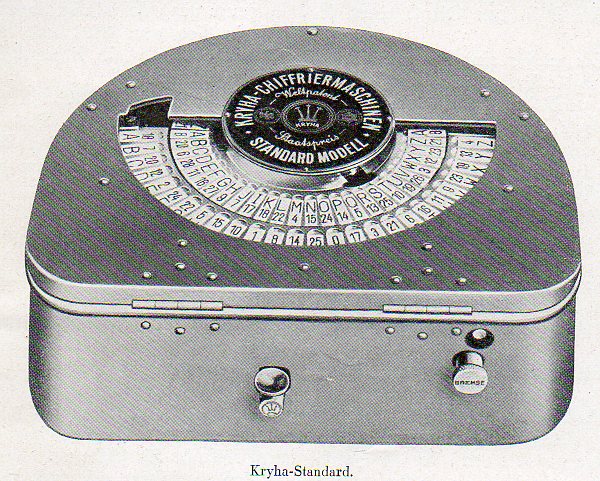
    The Kryha ciphering/enciphering machine was invented by Ukranian Alexander Kryha (d. 1955) and was capable of coding about 350 characters a minute.  It was used to enforce secrecy in business transactions, and was used in conjunction with (at least) Siemens telegraphic equipment.  I found these images (except for the patent drawings) of the Kryha machines in several issues of the Illustrirte Zeitung (Leipzig) for 1929, all of which are unusual and evidently not findable as good copies online–and so I’m simply reposting them here.

    Kryha big527

    Kryha  529