A Daily History of Holes, Dots, Lines, Science, History, Math, Physics, Art, the Unintentional Absurd, Architecture, Maps, Data Visualization, Blank and Missing Things, and so on. |1.6 million words, 7500 images, 4.9 million hits| Press & appearances in The Times, Le Figaro, Mensa, The Economist, The Guardian, Discovery News, Slate, Le Monde, Sci American Blogs, Le Pont, and many other places… 5000+ total posts since 2008.

Author: JF Ptak

  • A Great Anniversary: Identifying the Telescope as a True and Not-Deviating Instrument, 24 March 1611

    JF Ptak Science Books   Post 1385

    Celebrating the 400th anniversary of recognizing that sense enhancers–like the telescope–do detect “real” things: Galileo and the Collegio Romano, March 24, 1611. 

    Is it possible that there are private realities for things, seeable by only one observer? Can the instrument that allowed such observations possible also provides them, the stuff existing purely for the instrument and nothing else?  To some degree this is what was thought of Galileo and his revolutionary discoveries with the telescope, at least in the early days of verifying his work.  Galileo’s work was problematic for the Church because it provided yet more evidence for  ancient and incorrect assertions of Ptolemaic astronomy, separating the distance between what was written in the scriptures about nature and the knowledge of the world and its physical and biological systems, and what actually existed int he world.  It was an especially hard blow for Galileo to have revealed far more stars than anyone had thought possible, in the West at least–the stars int he Heavens had been a perfect assembly for many generations, and for their to be nearly an order of magnitude more  observable stars through the telescope ran directly in the face of church doctrine.  There was also the unwholesome bit about the Copernican system and our’s being  a heliocentric system, which was an old debate being lashed at still by the church even after many decades of superior evidence that could in no way support an Earth-centric system.  Evidence and logic united to banish the Church’s cosmology into a belief system.
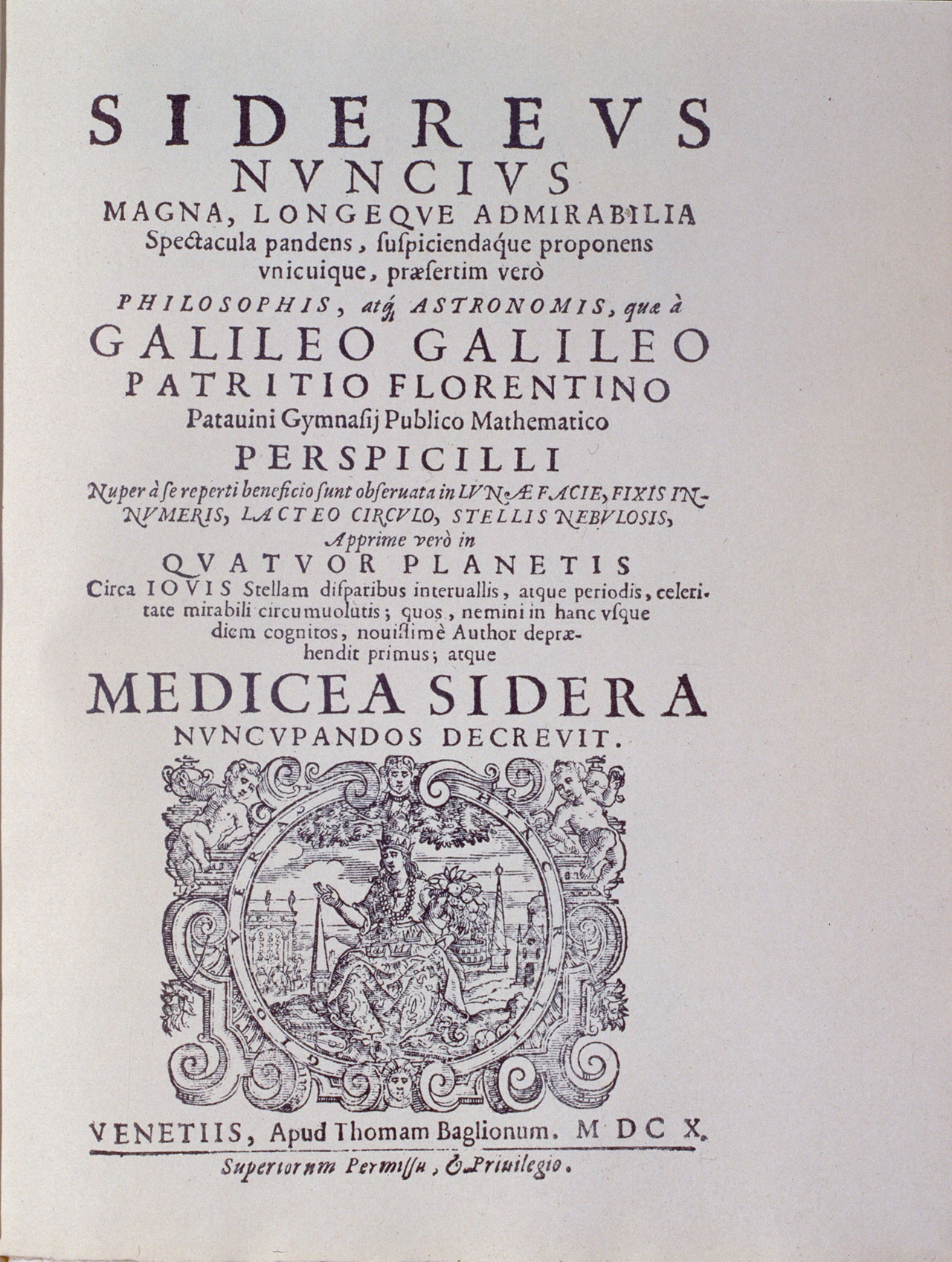
    Frontispiece of Galileo's Sidereus Nuncius

    It seemed to some as though the new stars that for the first true time expanded the celestial vault existed only within the slim optical tube with which their observer–Galileo–saw them.  Ditto the moon of Jupiter.  It came to pass within the confining walls of Vatican-recognized astronomy that the only verifiable and comprehensible observations of the heavens could be made with the naked eye.  Galileo’s instrument was difficult to use1 but it seemed also that when his contemporaries could see his discoveries that they simply wouldn’t.  Early in 1611 Galileo wrote to Kepler about the fantastic reluctance of his colleagues to be able to see what he saw:  “What do you think of the chief philosophers of our gymnasium who, with the stubbornness of a viper, did not want to see the planets, the moon, or the telescope, even though I offered them the opportunity a thousand times?”  Galileo was convinced that they needed not to see nature, but rather tried to reconcile the idea of what was being said was being seen with existing ideas and ideologies,  saying that their “…truth is to be sought not in the world and in, nature, but in comparison of texts (as they call it)”.  (“Stress in the book of nature: The supplemental logic of Galileo’s realism”. MLN 118(3), 557-585, by Mario Biagioli.)

    Galileo’s 1610 discoveries were published later that same year in his Sidereus Nuncius (The Starry Messenger)2, but there was no real independent verification of his work for nearly another twelve months.  The business end of the question, the lens that focused the entire issue so to speak, wasn’t necessarily the issue of more stars or a craggy moon or Jupiter having moons or the Copernican system–it had to do with whether the telescope, but the very virtue of its placing a piece of glass between the human observer and nature, was altering the very perception of nature itself.  Was the tube an imaginarium?  Did it create the images seen by the observer?  Did it materially change the things that the observer saw?  Was the nature of the observing unit the thing that was changing nature rather than by showing it closer? 

    These questions really didn’t receive an official answer until 24 March 1611, when four Jesuit mathematicians at the Collegio Romano reported to Cardinal Robert Bellarmine (1542-1621, and the church’s chief defender of orthodoxy) that, yes indeed, Galileo’s discoveries were real, that he had reported them accurately.  The collision of the scholastic and humanist world views represented by the Catholic Church and Galileo wasn’t a  happy one, and  this didn’t mean that the Church necessarily accepted what Galileo had to say–far from it, as they wound up pursuing the old man, taking him to trial finally in 1633 (when he was 69 years old, following by 17 years the admonition and false injunction of 1616), convicting him of violating an injunction on teaching, discussing and writing about the Copernican system, and placing him under house arrest for the stuff he thought and wrote about.  He died blind and still under house arrest  at his villa in Arcetri, just north of Florence, in 1642.

    But it is this business of the optics found to be not physically or theologically objectionable by the Collegio in 1611 that seems so incredibly important to me right now–that the telescope was found to be an instrument, that the human eye could be aided, and that this tube was not a place in which imaginary things happened or in which reality was bent, that was so very important.

    The Inquisition’s ban on most of Galileo’s writings was lifted by the Church in in 1718, though his Dialago remained untouchable and condemned, a prohibition which remained mostly in place in 1758, when a lightly censored version of the book appeared and the general prohibition of works on heliocentrism was mostly dropped.3 It really wasn’t until 1835, more than 225 years after the first publication of the Sidereus, that all traces of prohibition vanished from the registry of the Catholic Church.

    It is a little odd to think about the Collegio and the telescope in the light of the invention of the microscope.  There seemed to be no vestigial growth from the Church into the microscopic world or with the microscope itself, though most of these developments did come much later…except for the work of Hans and Zacharias Janssen, who did manage to make the first microscope in 1590, twenty years before Galileo’s observations were published.  But the monumental year for the microscope came twenty-five years after Galileo’s death, with the publication of the spectacular Micrographia of Robert Hooke in 1667.  And then in 1675 came Anton van Leeuwenhoek, who made close, micrographic investigations of blood, and who saw more deeply into the small world of humanity (being the first to describe cells and bacteria) than anyone ever before.  But the Church seemed little interested in this or the instrument, hardly seen Hooke/Leeuwenhoek as a new, threatening Galileo or the microscope as the invasive telescope.  But I do see where a similarity could exist.

    NOTES

    1. The telescope was a tough one to operate, though Galileo himself was a skillful practioner.  The ‘scope was big (more than three feet long), its field of view very narrow, and its aperture dropped down to a few centimeters. And of course there was the steadiness question.  All in all, not an easy instrument to bring to bhear on your subject. 

    2. This was also of course the first scientific treatise on astronomy using the obervations obtained with a telescope.  In it were also reported the very rough appearance of the surface of the Moon, the differences in the appearanes of the stars and the planets, the moons of Jupiter and the large number of never-before-seen stars. 

    3. Uncensored versions of the Dialogo and De Revolutionibus were still prohibited. 

  • Balloons and the Defense of London, 1938

    Bloglondonballoon

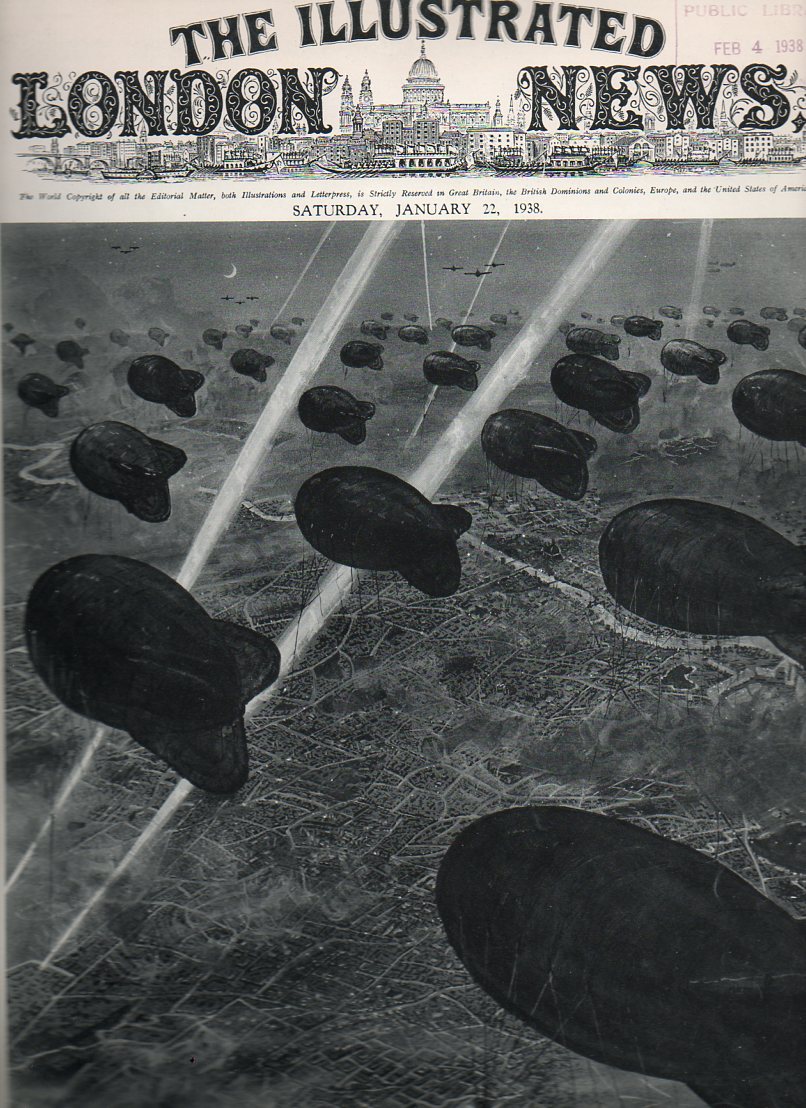
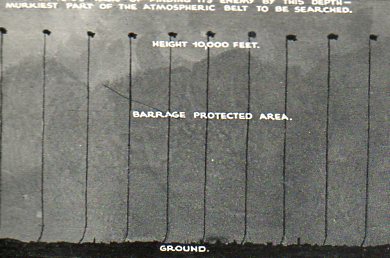
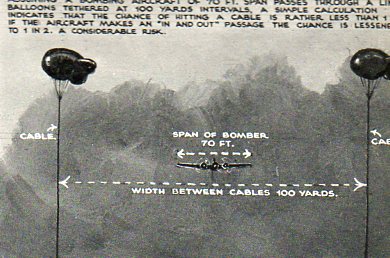
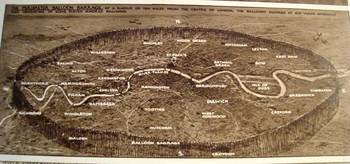
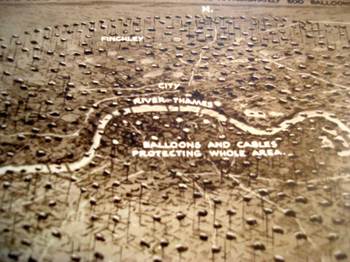
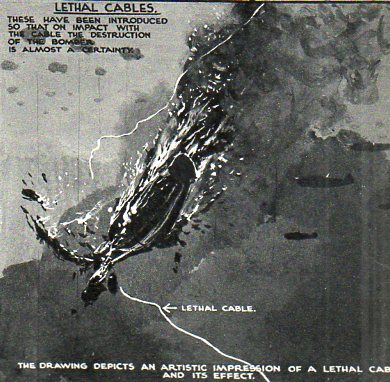
    This series of drawings, published in the Illustrated London News 22 January 1938 (available hrough our blog bookstore),  by the incredibly prolific and detail-oriented G.H. Davies depicts one segment of the city defense program being formulated by the British government in the last year  or so leading up to the beginning of the European end of World War Two. (I own 150 or so of these images by Davies–he never fails to provide the detail where you need it.)   The overall plan for defending major British cities consisted of anti-aircraft guns, searchlights, R.A.F. fighter squadrons and interceptors, and the “Balloon Barrage”.  London and suburbs are featured here, all to be protected by a series of ten squadrons of fifty balloons each, handled by a crew of ten.  The thinking was that it would make low-level bombing by fighter aircraft impracticable, and force any aircraft attempting such an approach to a higher altitude where they would be theoretically susceptible to the interceptor squadrons. 

    Balloon defenses155

    BloglondonballoonbottomI’m not terribly sure why the thinking was against low altitude attack, but my best guess is that the planners were thinking about the He-111Bs and Ju52s or other such aircraft that the Nazis checked and tested out against the Spanish Republicans during the Civil War. Perhaps freshest of all memories of the German operation Feuerzauber (Magic Fire) was the Guernica raid, just a year or so before the publication of these images, where that militarily insignificant town was attacked from the air in twenty minute intervals over three hours, destroying it in a terror blitz.  If I was sitting around a big table at 10 Downing, I’d have that picture in my head.  .

    Bloglondonballoondetail

    Be that as it may, the “air mine field” looks terribly inefficient and vulnerable to me, sort of like an exposed Maginot Defense Line, but without the very deep misunderstandings that went along with the highly questionable French effort. 

    Explanation of the Images:

    a)    The first image shows the iBloglondonballoonsbottoncredible perimeter defense network, which extended ten miles around St. Paul’s; the balloons were moored at 100 yard intervals, making for 1100 or so balloons to “fence” the perimeter.
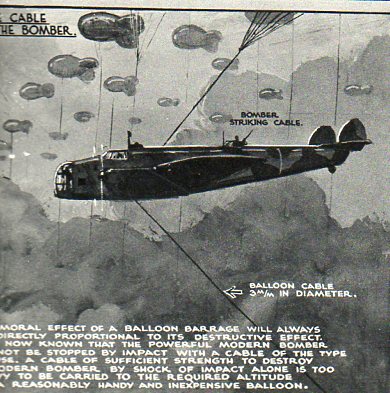
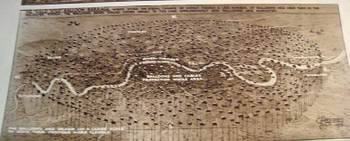
    b) The second image shows  London center and immediate suburbs, with another 500 balloons in a smaller circle inscribed in the larger.
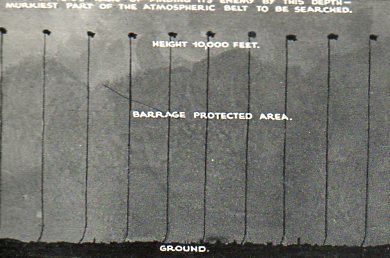
    c)  The third image  is a close-up of the balloons, looking down;  seems as though they were tethered at about 2000 feet or so
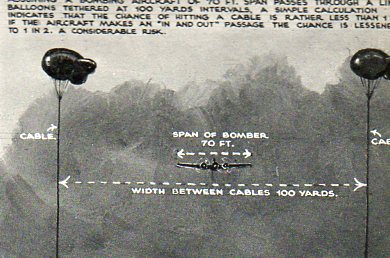
    d)  The last image is a close-up of London center.


    Balloon defenses158
    Balloon defenses159
    Balloon defenses156 Balloon defenses157


  • Floating Transoceanic Airport Network, 1930’s

    JF Ptak Science Books  Post 1384

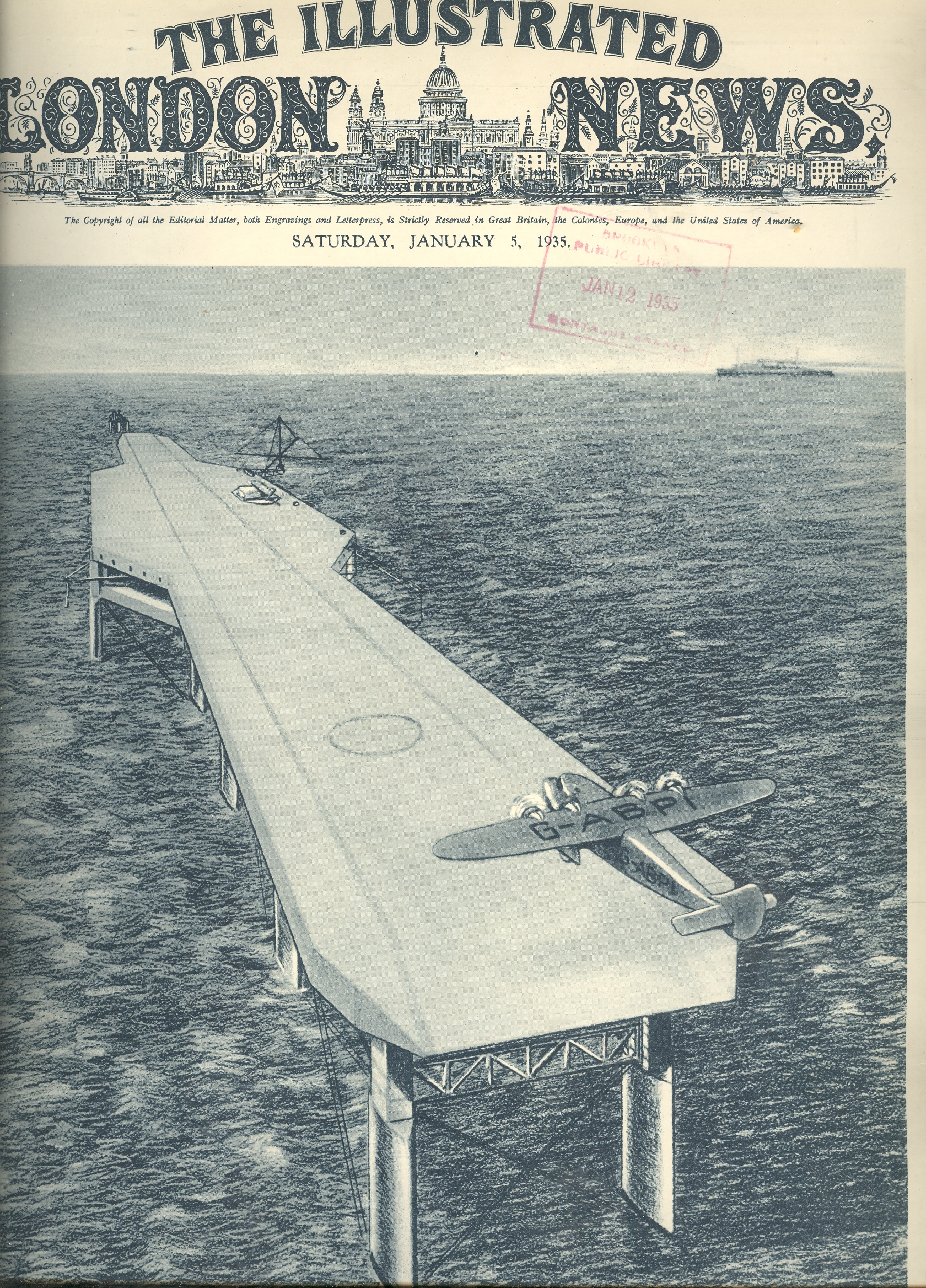
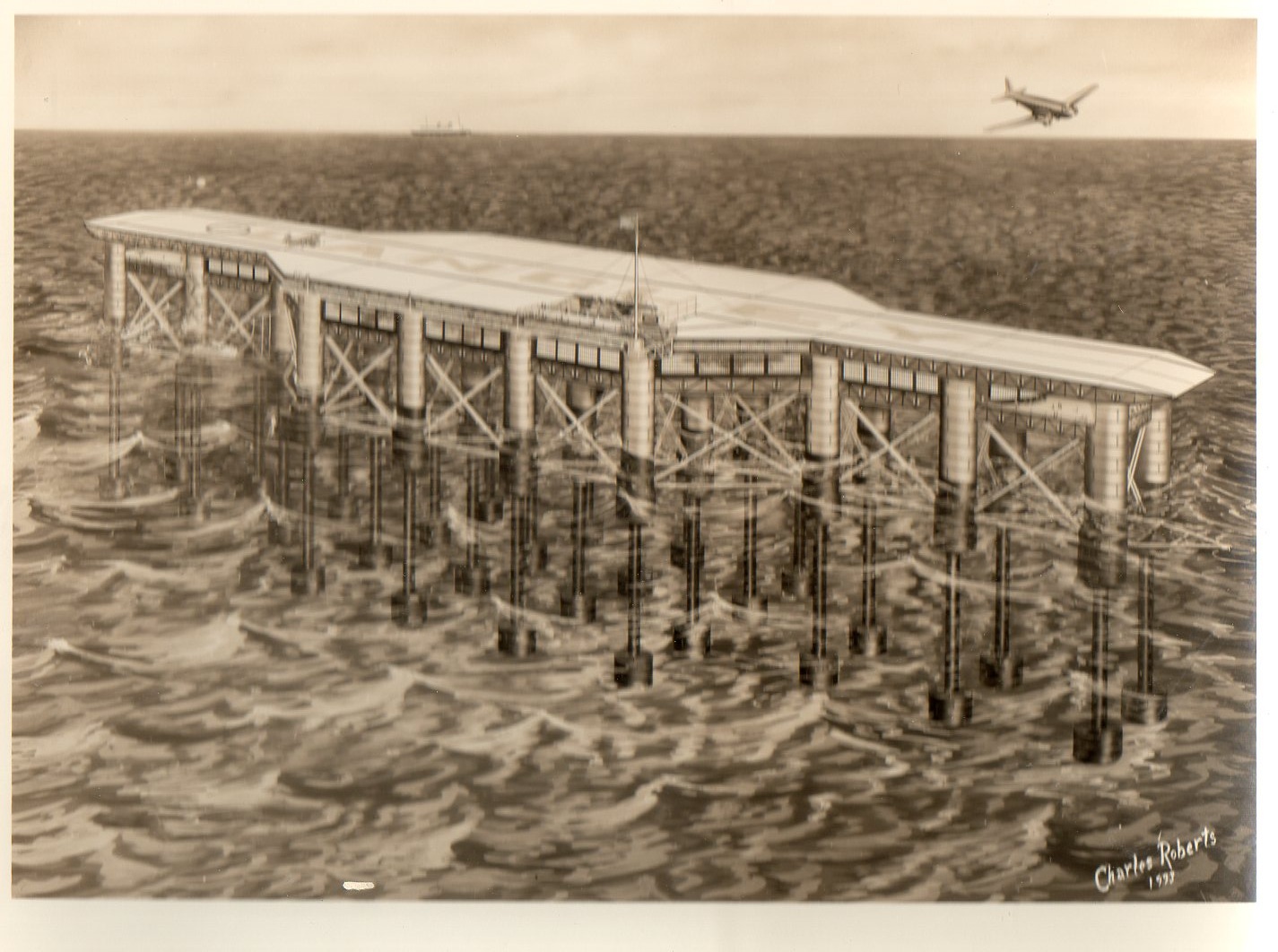
    This short shelf-lived idea was that of Edward R. Armstrong (1880-1955), who in 1927  first published his plan for a series of ocean-moored 1200’x200’ floating platforms standing 100′ above the waves for refueling and whatnot for transcontinental flights.  These five-acre stations—named the “Langley” in honor of Samuel Pierpont Langley1— would be placed every 375 miles across the ocean.  Or perhaps there would be just five of these floating emplacements–the data changes. It doesn’t look like a very practical (or good) idea, but Armstrong received a $750,000 piece of development change from du Pont and GM, which was major dollars in 1929. 
     Blog jan 9 sea airport
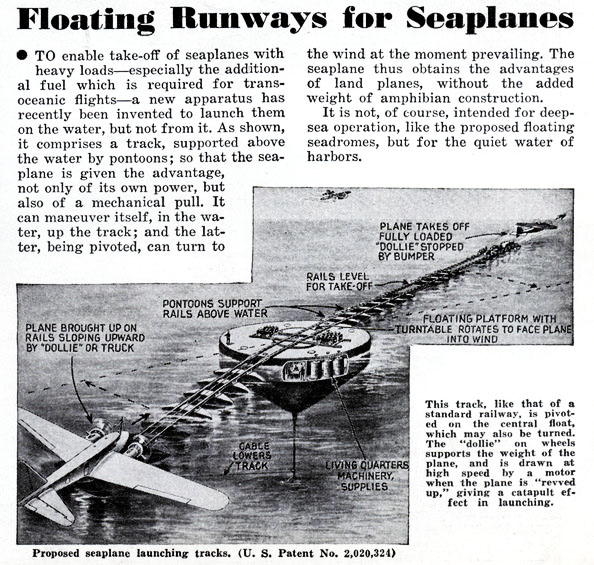
    Armstrong’s idea would get major play in the popular press from time-to-time, his project renamed “The Seadrome” and discussed as a series of floating islands.  Armstrong himself would organize the Seadrome Ocean Dock Corp. in the late 1930’s, his pretty but enormously impractical idea (reported by Time Magazine2 in 1933 as little more than “a perennial gift to Sunday feature editors”)  finally grinding to a salty end with greater fuel capacity and efficiency in transatlantic aircraft. 

    An even worse idea appeared in the pages of Science and Mechanics in 1936:

    Blog jan 9

     
    Notes:
    1. A Time Magazine article published 28 October 1929 [a day before the market crashed!] about the Langley oddly states that Langley was the “designer of the plane which, except for accidents, might have flown before the Wrights’ plane did in 1903”.  Tough potatoes. What the magazine didn’t state was that Langley, who was the president of the Smithsonian Institution at the time with access to major money and benefactors simply went about the flight problem incorrectly, and produced an airplane (or “aerodrome”, as he called it) that did not and would not fly. Not flying because of accidents means, well, not flying.  The Wrights’ approach to problem solving was elegant and beat Langley by miles.  Langley deserves credit for his other (many) achievements, but not for this aircraft.
     
    This same article only references Armstrong as a “swarthy engineer” (the article is reprinted below).
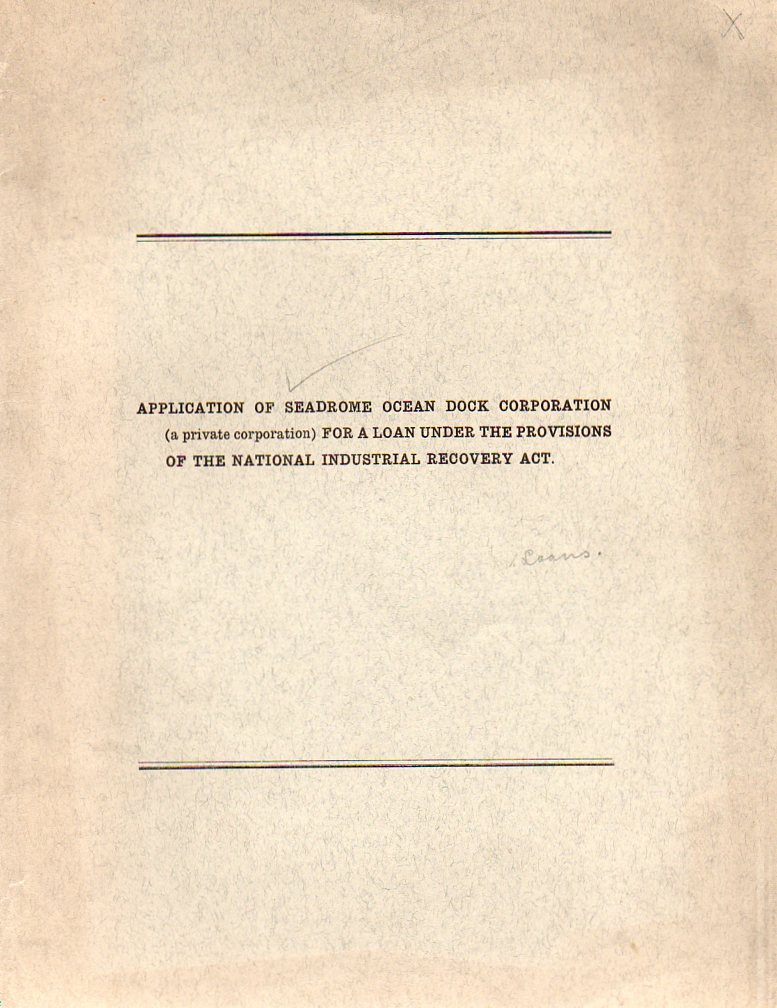
    The following document, Application of Seadrome Ocean Dock Corporation (a private corporation) for a Loan Under the Provisions of the National Industrial Recovery Act (ca. 1933) asks the federal government for a loan of $30 million (depression) dollars to undertake the construction of the five  floating airport transoceanic network.  “It will require the work of approximately 10,000 men per month for a period of twenty-four to thirty months”.  The labor figures did not nclude that necessary to produce all of the material necessary for the project ( for reasons unknown).  The palnes would have been to make it across the ocean in 18 to 36 hours.  (We are offering this item for purchase at our blog bookstore, here.)
     
    Seadrome154 The members of the Seadrome Corporation estimated that the entire 30 million would be paid back by 1945,  and that the corporation would be completely debt-free.  Perhaps all of  this made sense when Armstrong first developed the plan in 1913; but even by 1933 it was becoming quite obvious that non-stop transoceanic flight was coming, and coming soon.  That would of course make an investment in the Seadrome project superfluous, like building an antique, though an unnecessary one. The first transatlantic non-stop flight was made by John Alcock and Arthur W. Brown in 1919–by the early 1950’s jet aircraft would be making the trip with regularity, which means that  for most of the life of the completed Seadrome it would have been unnecessary.  I feel certain that the Seadrome–which was supposed to be paid off by 1945, though in 1933 there was no inkling on the part of the Corporation members who wrote the request for hte money that a war was looming and that there would have been almost no way for them to have been made at any time betweem 1939 and 1945–would never have been paid for. 
    Seadrome152

    ·Posted by :

    ·in:


  • Found: Children’s Advice for Life, 1825

    JF Ptak Science Books   Post 1383

    Manuscript Vanity det151

    Manuscript Vanity det148

    I have a small collection of 18th and 19th century notebooks–ciphering books, tally books, keepsakes–kept by children and young adults.  These books are remarkable for their contents, empty scratchbooks filled with whatever was necessary, whatever was important, whatever was trivial.  There are notes about who-owes-what, provisions purchased, goods borrowed; mathematics problems, poesie, miniature observations, memorized bits.  Signatures made over and over again, looking exactly like what children do nowadays, practicing writing their names, perfecting a signature, identifying themselves to themselves in private.  These notebooks are far less formal say than a diary–they caught all sorts of ephemera of the day, stray information, all manner of stray bits. (This notebook is also available from our blog bookstore, here.)

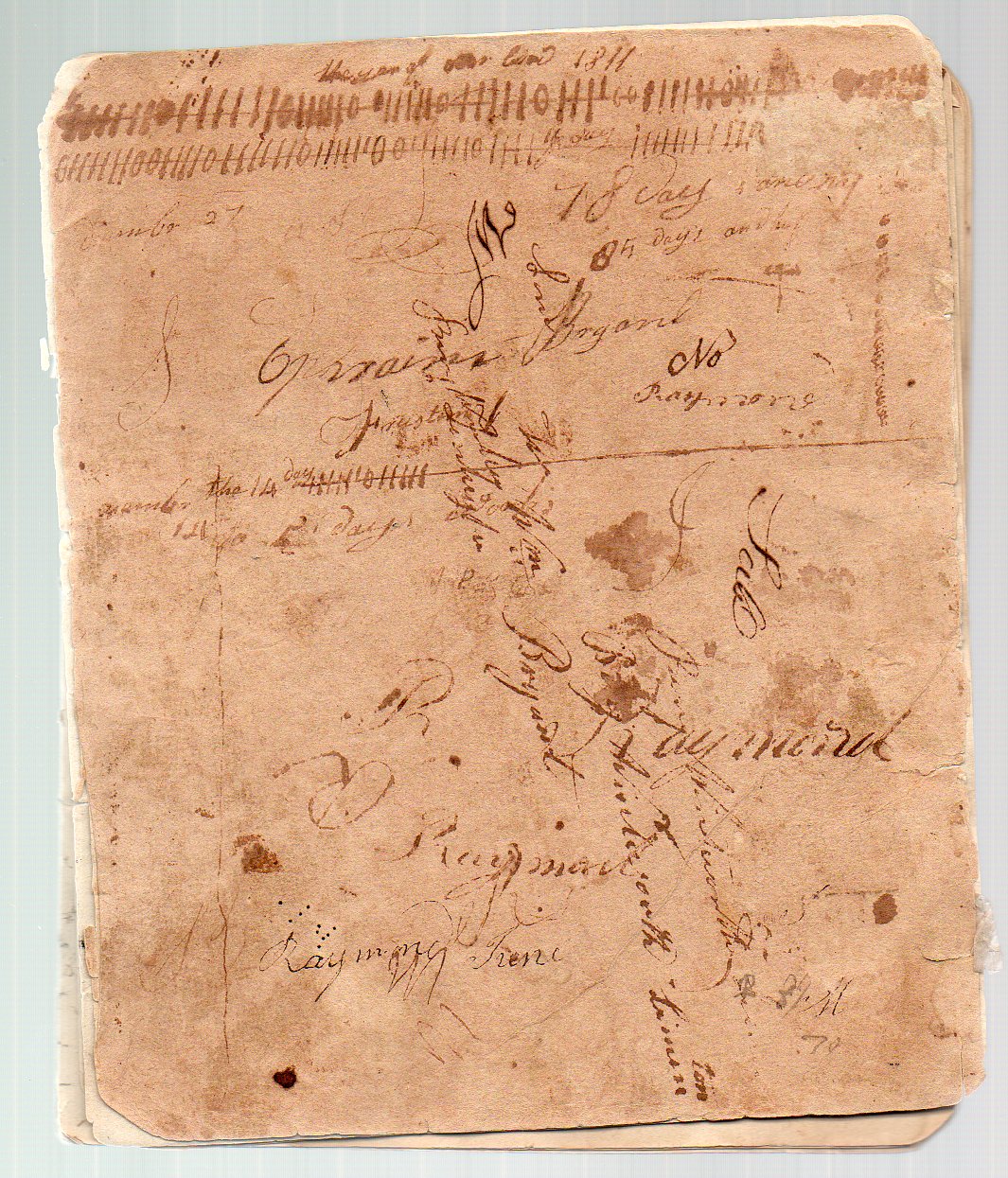
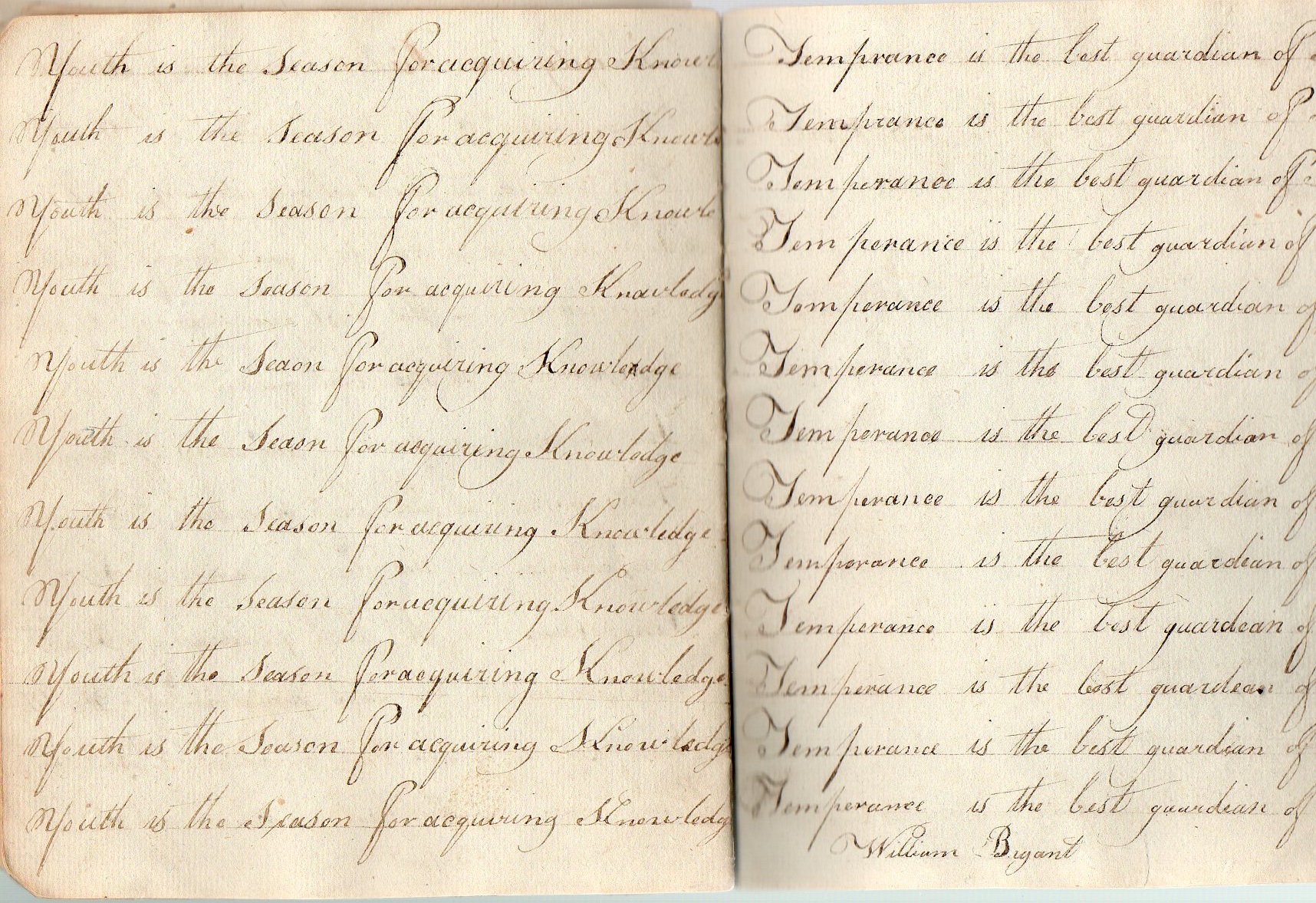
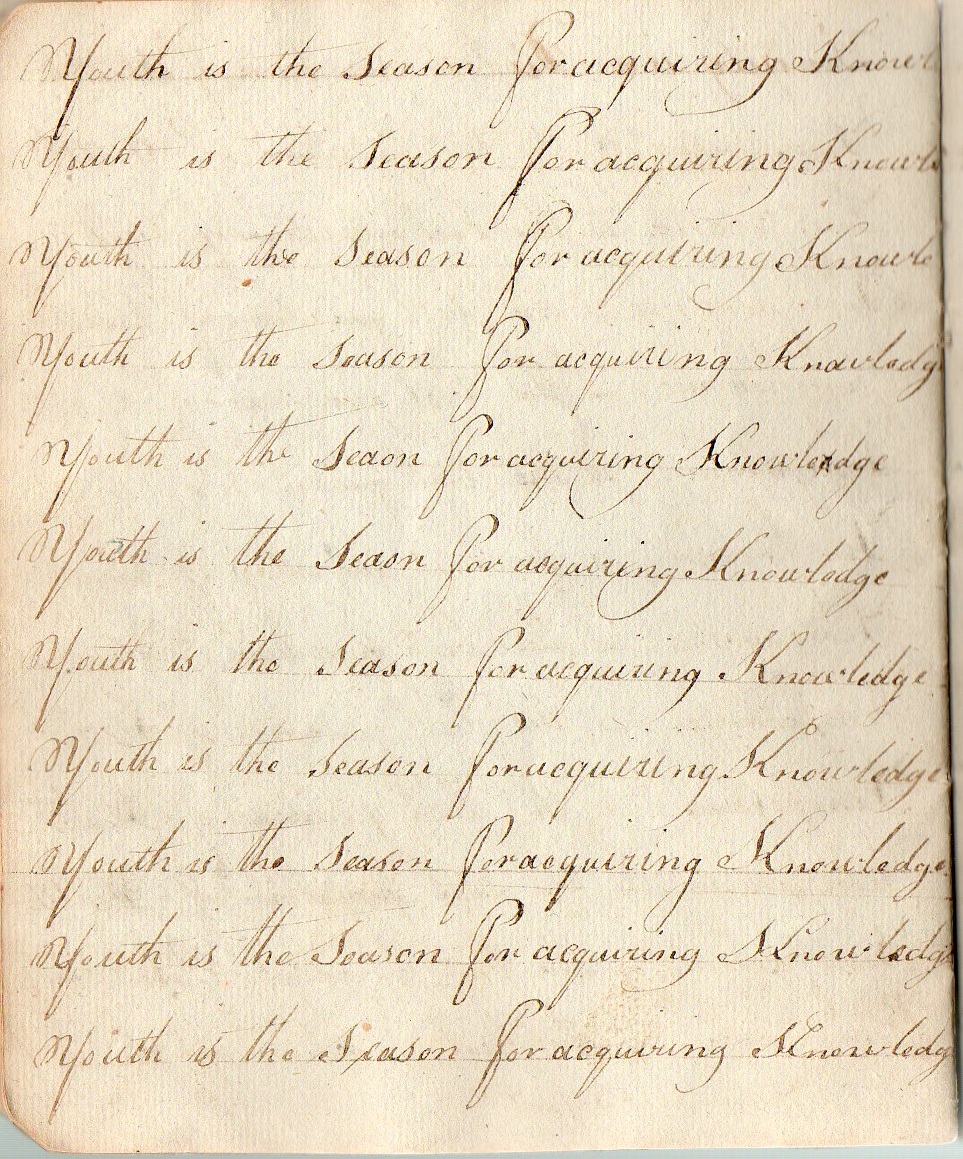
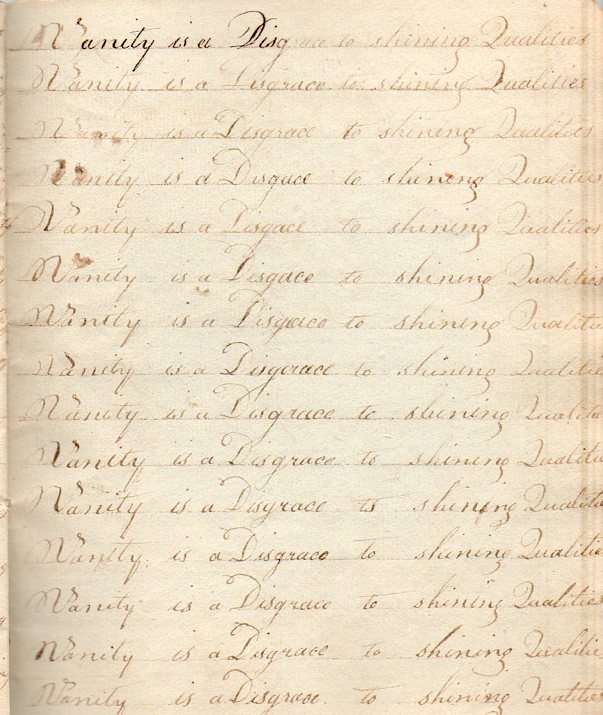
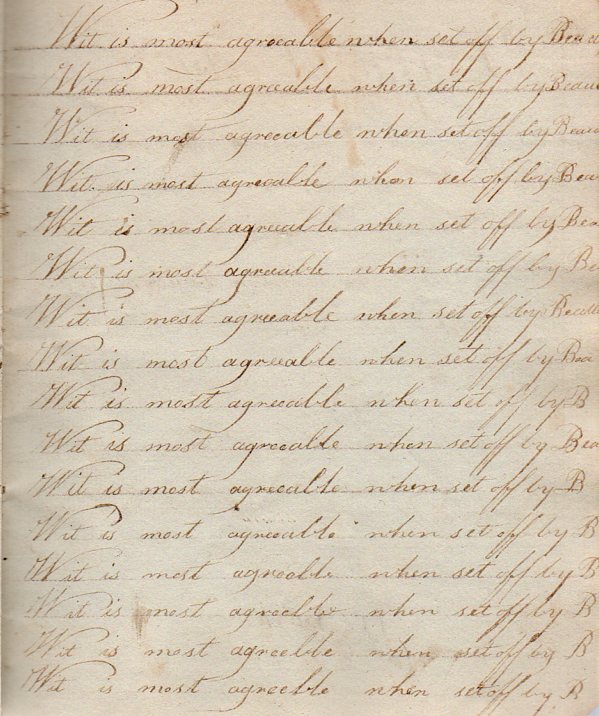
    In this notebook, used between 1811 and 1836, there are also repeated personal lessons and life’s aphorisms, generally one page each, written over and over,  practicing penmanship by repeating the advice, 

    “Youth is the season  for acquiring knowledge” and “Temperance is the last guardian of health”:

    Manuscript Vanity det149
    Manuscript Vanity det150

    I find it remarkable that this small item–about 8×5 inches, and having no more than 30 pages–survived in somewhat haphazard and occasionally directed use for more than 25 years.  Then again, paper wasn’t all that terribly common among the working poor in the United States at this time, so it is very understandable that this notebook would’ve been kept, and carefully so, as an important household object–and possibly a significant family-history document.  For those of us today this looks like disposable information, ephemeral knowledge–evidence would say that this was definitely not the case when this book was still being used. 

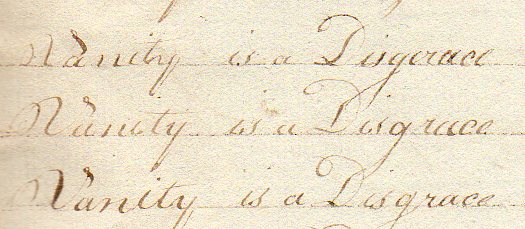
    “Vanity is a Disgrace to shining Qualities”:

    Manuscript Vanity147

    “Wit is most agreeable when set off by beauty”:

    Manuscript WIT146

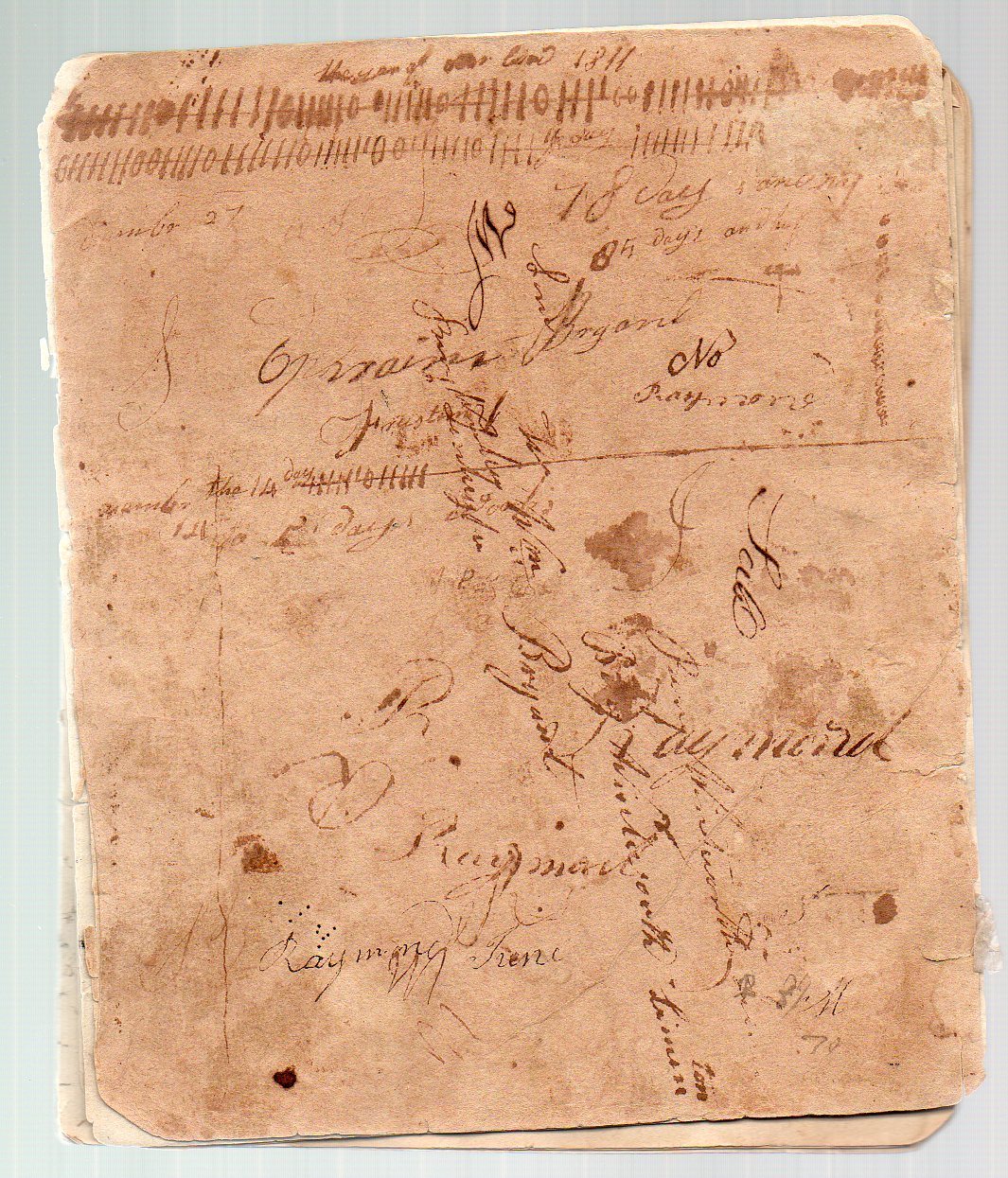
    And the cover:, which is a curious thing, as someone kept track of “days” on a number of occasions here, not the least of which ran across the top of the book:
    Manuscript Vanity det151

    The record of items purchased, of money charged for labor, allows us a peep into the daily working life during the first part of the 19th century:

    Purchases made included 2 pounds of butter (15 cents), six pounds and a half of veal ($2.00), a gallon of molasses (30 cents), “half a berril of flower” (3 dollars), a pound of wool (12 cents), plus pork, potatoes, tea, salt, corn, rye

    The labor is also of interest:  renting the services of two yoke of oxen for one day seems to have cost one dollar, “tapping in a pair of boots” (30 cents), “one day’s work on shaving hoops” (50 cents), and then many entries for “one days work a planting” and “a mowing” which seems to have been 50 cents; “hauling wood one day” was also 50 cents.  It seems as though you could exchange a day’s labor for two pounds of butter, a pound of wool, and two pounds of potatoes–at hose rates, I suspect that these people would’ve considered the veal to be a luxury meal. 


  • An Episode in the History of Holes: Electricity, Punched Cards and the Computer, 1878.

    JF Ptak Science Books  Post 1382 [Part of our series in The History of Holes.]

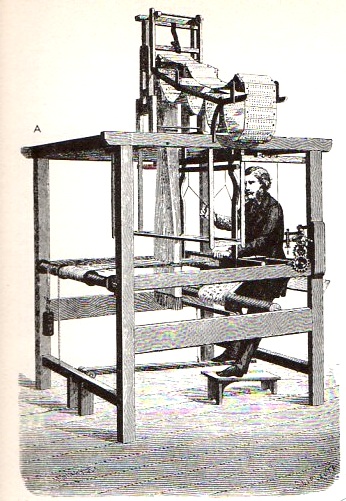
    Jacquard loom142 Kepler saw music in his study of planetary motions; Newton saw it too in relation to optics and the foundation of color–I wonder if the early people working with punched cards and tape saw a similarity between horizontal versions of their work and musical scales as well?  Did Jacquard or Hollerith see something through their holes to points beyond?  Well, I doubt the later, though there is no doubt that there are true relationships between music and the work of Kepler1 and Newton.  Perhaps one could make a score by arranging the punched holes of computer tape or a series of Jacquard loom cards, though they have less a relationship to what we identify as music than transcribing hundreds of resting pigeons as notes on a five-line utility pole.

    The idea of automatic control comes way before M. Jacquard (1752-1734) and the punched cards that he used to control his loom (which began about 1805), though I must say that Jacquard’s man-in-the-machine design does have a great, far-reaching elegance to it.  Even in his own field here were predecessors: Jacques de Vaucanson, for example, and Basile Bouchon (1725) and M.F Falcon (1728).  But it was with Jacquard that the idea of the punched card for design control took hold, and just seven years after the loom was introduced there were more the 10,000 Jacquard machines in operation in France alone. 

    Alfred Barlow2 wrote a splendid history of weaving in 1878, and in that books later pages–and I suspect much overcome with the recent developments in the electrical field (not the least of which were the newly invented light bulb and telephone)–Mr. Barlow waxes considerably on the application of electricity to the Jacquard process:

    He writes, “It is scarcely to be wondered at that men acquainted with the application of electricity to telegraphy and other purposes should have believed it equally serviceable in some of the operations of weaving.  As it might be expected, the Jacquard apparatus seemed to offer and excellent opportunity for the needles [reading the holes ion the loom punch cards] to be worked, not by the direct pressure of a card, but by the connecxion of a series of electro-magnerts.  By this means it was believed that paper may be substituted fir the cards, and the magnets might operate upon the needles through the perforations in the paper, or by passing a current of electricity through the medium of a metallic conducting surface on a sheet of paper or cloth representing the design to be woven, and thereby acting without the use or need of perforations.” (Pages 424-5)   It was certainly a capital idea.  Barlow may have been referencing the work of Alexander Bain and his punched-tape telegraph of 1841, though he does not mention him specifically.  Barlow does mention several inventors from the 1850’s who managed to make improvements with electricity in Jacquard-style machines, though none with the great effectiveness which he described here.  The real, great advancement in computation waited for quite some time, even beyond the great innovations of Hermann Hollerith (who began his tabulating successes in the 1880’s, coming into international recognition with his work on the 1890 U.S. Census.  But Barlow’s imagination here is quite full,  and just a little beyond his time. 

    [This work by Barlow is available for purchase here.]

    Notes

    1. Kepler used the ratios between the velocities of the planets at their closet and furthest distances from the sun to construct musical intervals, which do work.  What an enormously encompassing feeling this must have been to set the motions of the celestial spheres into polyphonic tones that fit right inside the octave!  Newton’s seven colors could be set side-by-side with seven notes of the octave, color in music, giving them the notes A, B, C, D, E, F and G. 

    2.  The excellent Mr. P.J. Mode first brought this reference to my attention 15 years ago.  The work:  Barlow,m Alfred:  The History and Principles of Weaving by Hand and by Power.  London; Sampson & Low, 1878, xii, 443, iv pp, illustrated throughout with text illustrations. 


  • Engineering Art: Cross Sections of the HMS Olympic (1909) and Mauretania (1906)

    JF Ptak Science Books  Post 1382

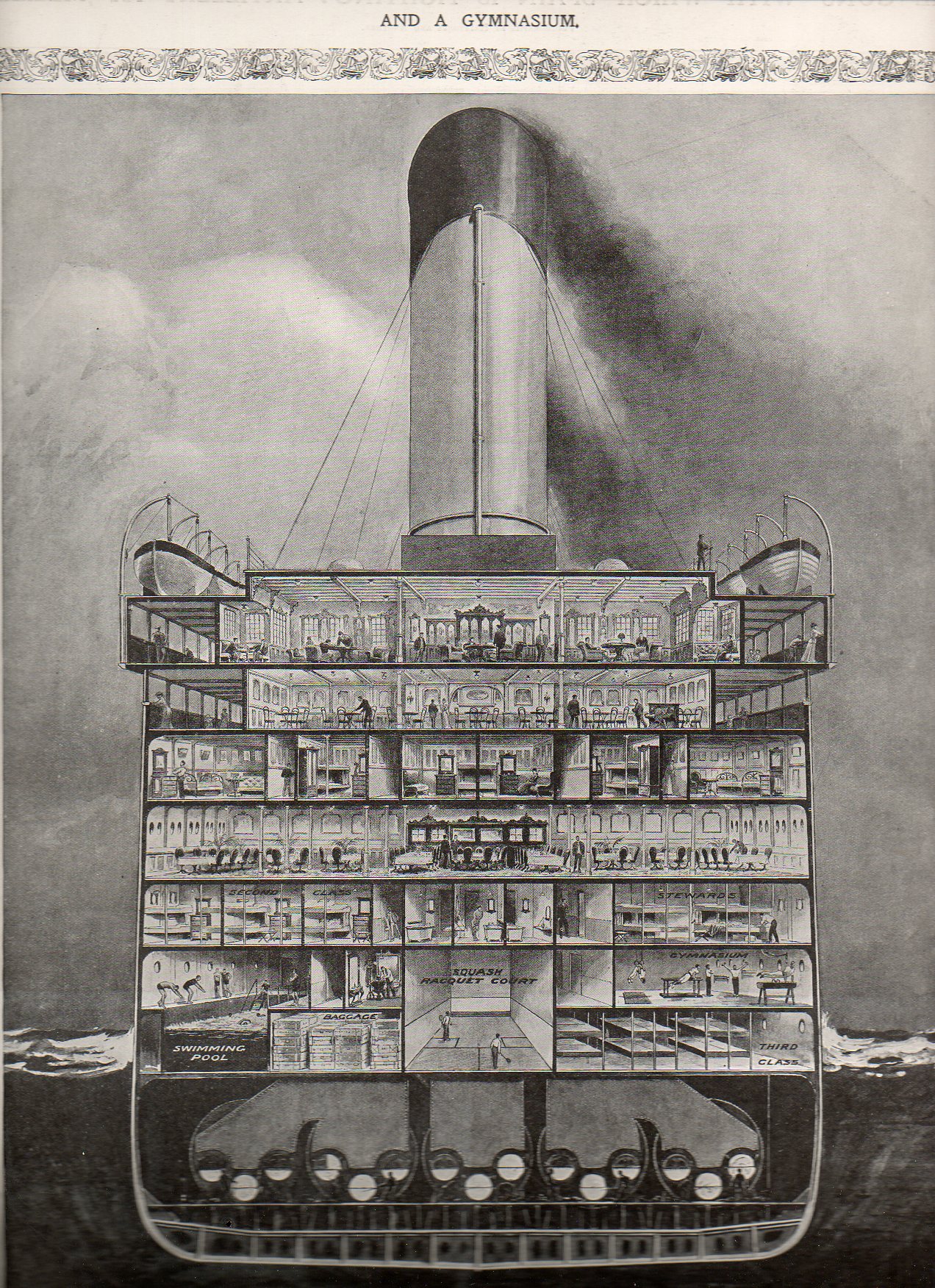
    “...And a Gymnasium.”

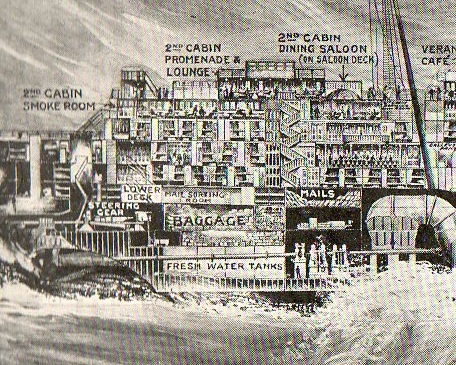
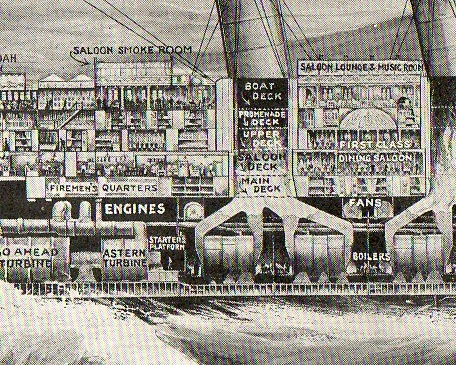
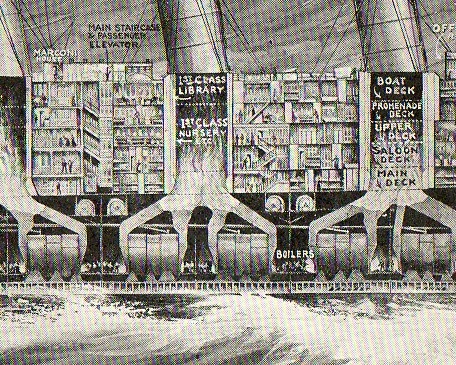
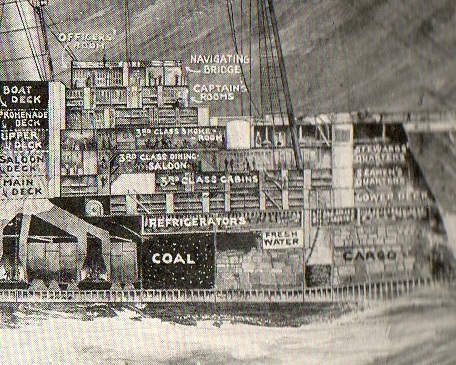
    Resting comfortably in-between this blog’s Cross Sections and Looking-At-Things-Straight-On series is this straight-on cross section of the midship section of the HMS Olympic.

    Cross-sectionship131
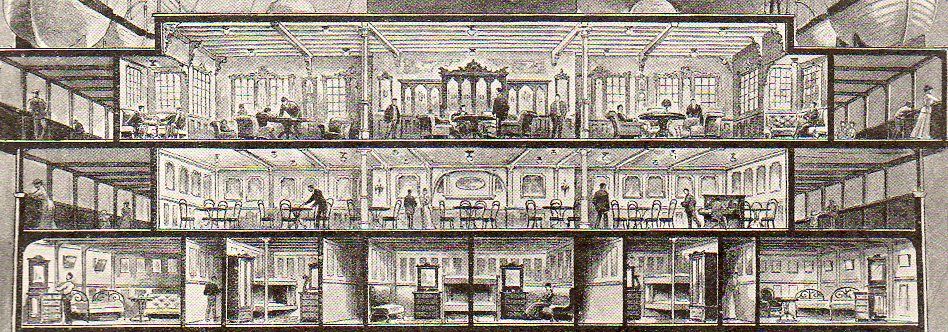
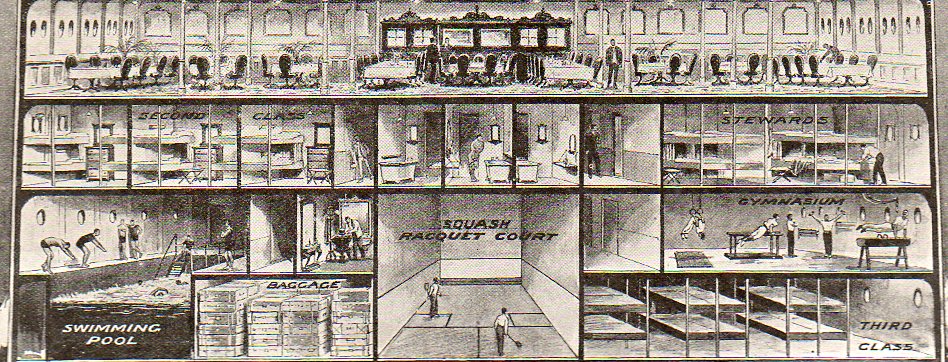
    This cross section appeared in the 14 August 1909 issue of The Illustrated London News, just six months or so after she was laid down. The Olympic was finished in 1911 and sailed through until 1935, a considerably much-longer career than her two sister ships, the Titanic and the Britannic.  The Titanic of course was launched in 1911 and went down on 12 April 1912; the Britannic lasted a little longer, though this ship never really had much of a career, launched just before the beginning of WWI and then used immediately as a hospital ship, striking and being sunk by a mine in 1916.  The three ships were beasts, about 882 feet long and about 53,000 tons displacement. The viewer certainly gets a good idea of the scope of the ship from this image.   [The original image of the Olympic and also of the Mauretania are available for purchase from our blog bookstore.]

    Cross-sectionship132
    Cross-sectionship133

    Third class looks pretty rustic, a no-bones approach to ocean travel, stuffed into the space next to the squash courts and under the gym. 

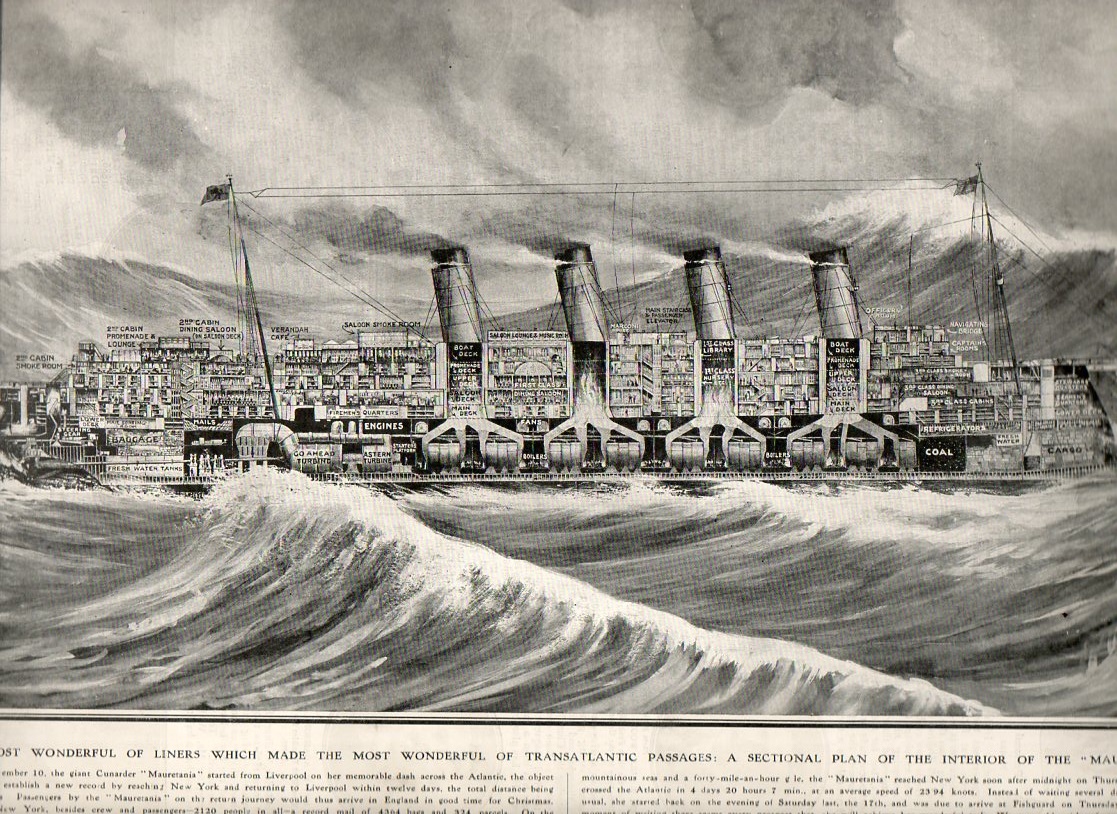
    Next comes the HMS Mauretania, again form The Illustrated London News right at the time of its record-setting speed attempt to cross the Atlantic in November 1907.  The ship was long (almost 800 feet) and about the fastest ocean-going ship in the world,. crossing and re-crossing the Atlantic in 12 days.

    Cross section mauretannia137

    Cross section mauretannia138
      Cross section mauretannia139
    Cross section mauretannia140

    Cross section mauretannia141


  • Using Children and Shoes as Metaphors for Naval Strength-the Display of Quantitative Information Series.

    JF Ptak Science Books  Post 1380

    Display Qunat Data126
    It is a hallmark in displaying ideas and information that brevity, design and clarity carry the day.  For this reason we have the Pie Chart (happily invented by a very ingenious and polymathic idea-experimenter in the form of William Playfair in 18011), and not the Enormous Cake Chart, which had been baked previously for hundreds of years in the ovens of Raymond Lull2 (and those he influenced) and then to a lesser degree by Giordano Bruno. The entwined, overlapping combinatorial diagrams that were initiated by these folks didn’t really start to get straightened out until the ideas were in the hands of Leibniz and Euler, and then prettily and usefully, finally, by Playfair.  It was through the 19th century that the pie chart began it great ascent in the hands of Guerry and Lalanne and Nigthengale, and then on to Jevons, and then on into modernity.  But the thing that made these contributions significant was the amount of information they were able to easily and cogently display.

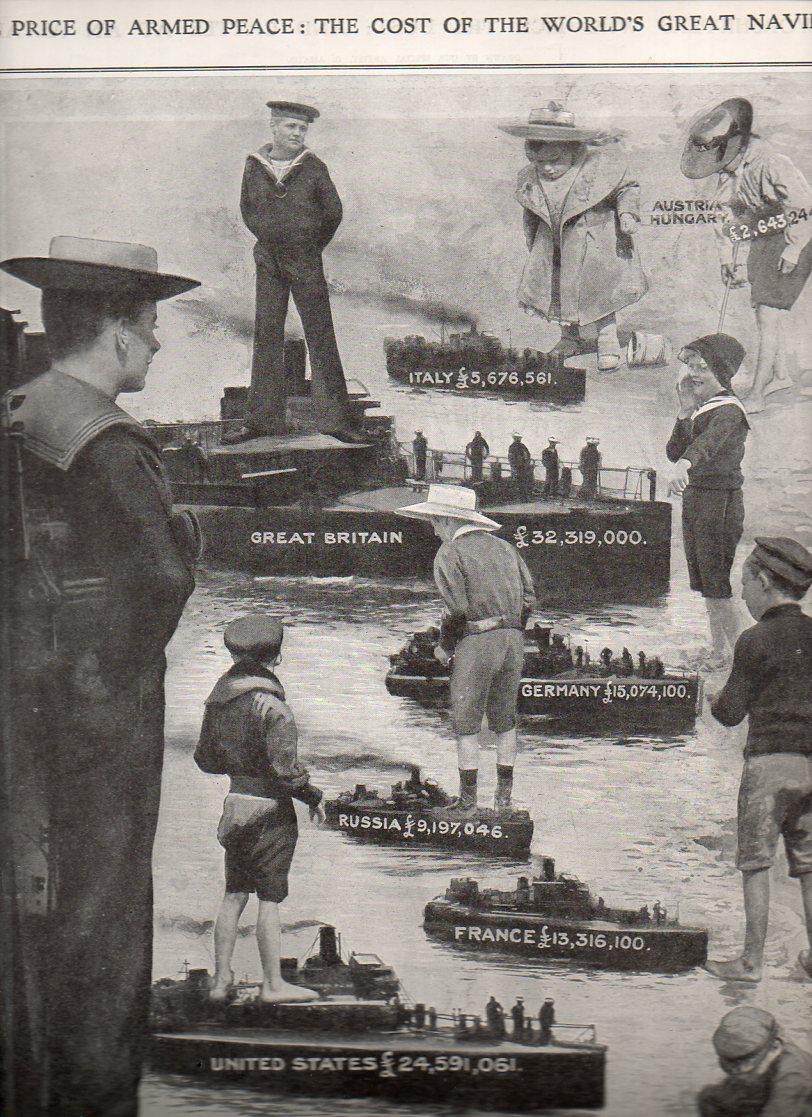
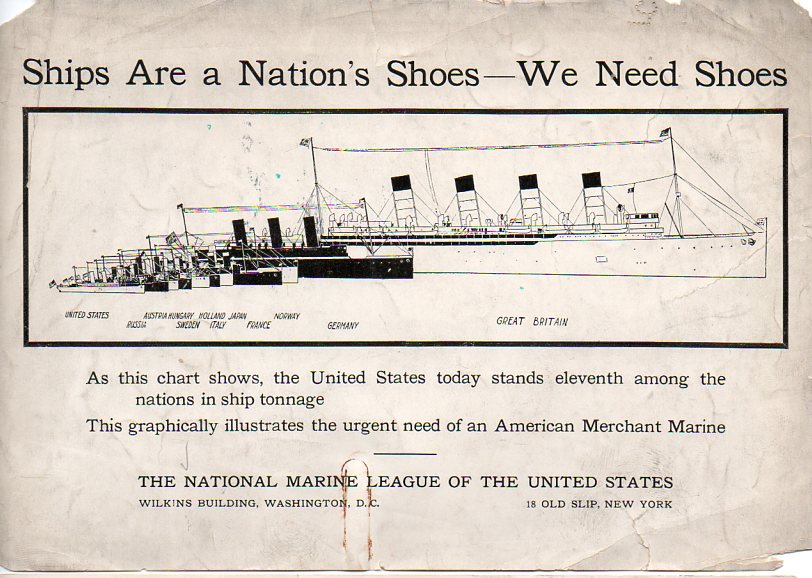
    The pie chart could definitely have been used in these two displays, below–the information was certainly simple enough, and the comparisons easy.  But there was a certain genius to displaying the data using children and shoes that enabled the information to ride along with its viewer deeper into the future than if it had simply been encrusted in circles.

    DIsplay QUnat Data127

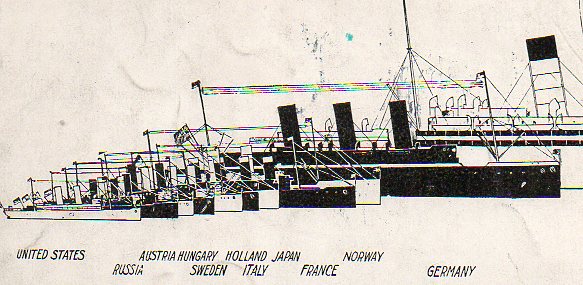
    For example, in the first image, a full-page illustration from The Illustrated London News for 21 August 1909, “The Price of Armed Peace, the Cost of the World’s Great Navies”, displays the size of expenditure on leading navies in terms of children’s toy boats.  I am positive that the lasting image here would’ve been the size of the German toy gunboat compared to the dreadnaught of Great Britain.  Likewise the ships/shoes comparison of the next image, published by the National Marine League of the United States,  a sort of PAC for the merchant marine.  They simply state that ships are the nation’s shoes, then interlace a graphic showing the paltry showing of American ship tonnage compared to 10 other leading maritime nations, and then simply state that “we need shoes”.  The graphical display shows vividly that the United States’ total ship tonnage was tiny–eleventh of eleven powers–but the bit that would no doubt stay in the heads of any readers was the shoe part, which would then be associated with the diagram, which on the face of it was a little muddled and not clear.  This was a smart sales job, delivering a brisk message that would not be befuddled by numbers–it wasn’t that the U.S. ranked 11th in total maritime tonnage against other leading powers, it was that we needed shoes. 

    DIsplay QUnat Data129


    Notes

    1.  Playfair wrote his Statistical Breviary in London in 1801. 

    2.  For example in his logic machines as seen in the Ars Magna.


  • A Note on Some Important Punches of Post-War America, 1952. The IBM 519.

    JF Ptak Science Books  Post 1379

    “Gang punches, summary punches and reproducing punches….such are the guts and glory of all good punch dreams”–No one, ca. 1957. 

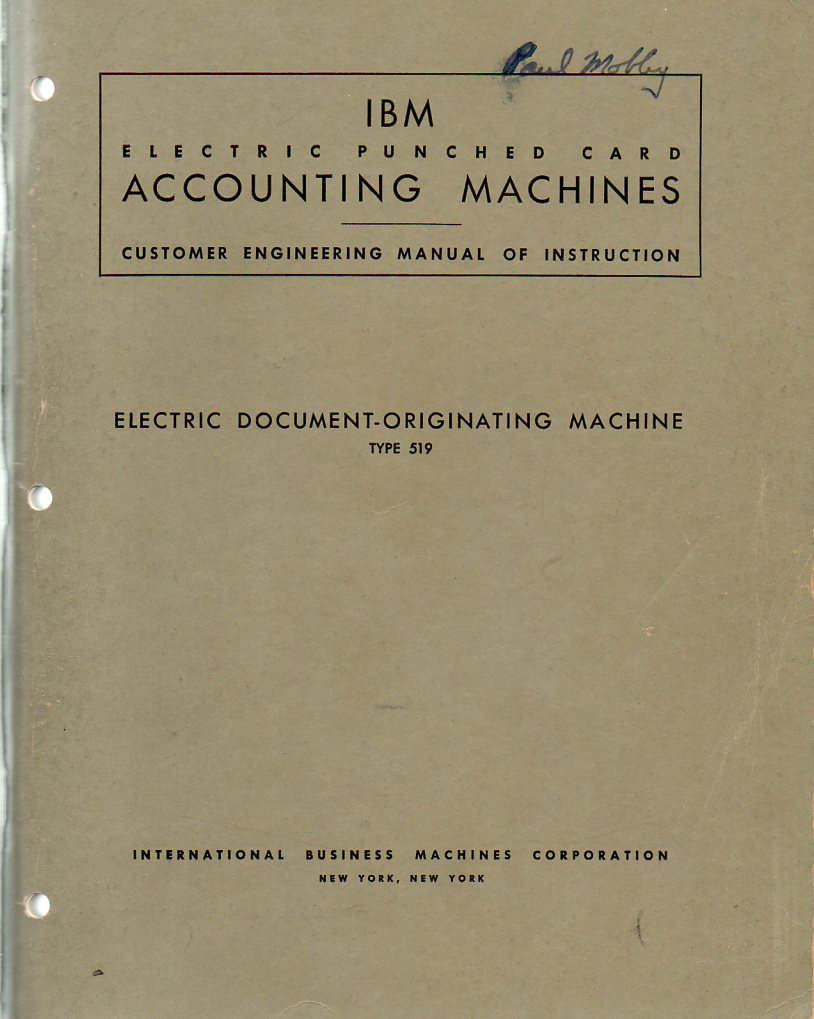
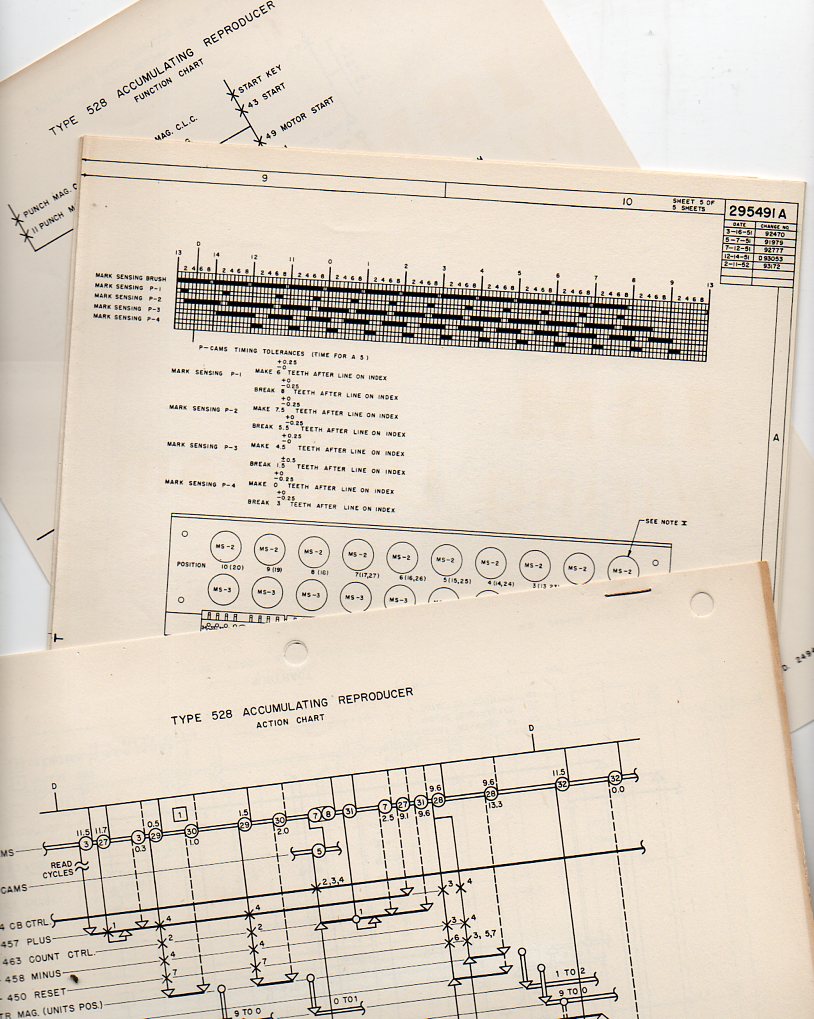
    IBM 519121 This story has to do more with Jacquard than with Marciano.  One of the mainstays of the pre-computer computer room, the ubiquitous instrument as prevalent then as the desktop is now, was the unit record machine,  which operated with punched cards for program entry and data storage. This machine–like the IBM Type 5191 Electric Document-Originating Machine (1952) described below–functioned to read and reproduce the mainstay of the calculating instrument of the 1930’s to the early 1950’s.  

    Their functions included lots of punching:  gang punch, which would produce a large number of identically punched card; reproducing punch,   which “could reproduce a deck of cards in its entirety or they might just reproduce selected fields…a payroll master deck might be reproduced at the end of a pay period with the hours worked and net pay fields blank and ready for the next pay period’s data. Computer programmers who created their programs in the form of punched card decks used these to make backups”; a  summary punch, which were attached to tabulating machines and could punch new cards with details and totals from the tabulating machine;  and the mark sense reader, “which could detect pencil marks on ovals printed on the card and punch the corresponding data values into the card”.

    The IBM 519 was one such punching machine, sitting in command of vast legions of data that had previously been exceptional if not impossible to corral.  Improvements like this, these sorts of technological breakthroughs, allowed for the nervous system of the second industrial revolution to occur.  Of course one needed electricity, and then the machines that would be powered by them, and then the distribution capacities to get the electricity to the millions of end-users who would in turn purchase the new electrical goods–all of this was necessary.  However, without the ability to get this electricity paid for by it subscribers, without the power company being able to collect revenue, this stuff doesn’t happen.  And the way that the power company collects is by sending out an ocean of bills, which means that the ocean needed to be controlled in some way, all of the data handled and audited, which means that there was a new, mechanical way of dealing with the vast transfer of data.  And that’s where machines such as the Grunts and Gruffs come in. Like the 519.  IBM 519122

    (These IBM manuals are available for sale at our blog bookstore, here.)

    This thought bubbled to the top while I was looking through a user’s manual for the 519, an updated 1952 version of the first edition of 1943. It is a beautiful work, filled with all of the information that a user would need to operate the machine as well as the specs necessary for the engineer to maintain the thing.  It was bound in a heavy, plasticized flexible cover, intended for wear and tear, and also came with an additional six pamphlets ,mostly wiring diagrams, one of which–the wiring diagram for the 519–unfold its 11 inch height out to five feet in length, a gorgeous panorama of organized and directed electricity.  It has two mates,a pair  not quite as long–four feet or so–in the wiring diagram for the 519’s reproducing punch,  lovely things in and of themselves. 

    The documents just have a satisfying feel ot them, manuals for maintenance and repair for machines that could be maintained and repair.  IF they were still needed, I’m sure that they would be running today. 

    Notes:

    1. “Early computer installations used punched cards for program entry and storage. A typical corporate or university computer lab would have a room full of keypunch machines for programmer use. An IBM 407 Accounting Machine might be set up to allow newly created or edited programs to be listed (printed out on fan-fold paper) for proof reading. An IBM 519 might be provided to reproduce program decks for backup. The 519 could also punch sequential numbers in columns 73-80 of COBOL or Fortran program decks. Those languages and others did not use those columns; the use of only 72 columns is a convention tracing back to the IBM 704 computer’s card reader, the 711, which could only read 72 columns (selectable by a plug-wired control panel). An IBM 80 series sorter would be used to put things back in order if a sequenced deck was dropped. A quicker, but less effective, protection against dropped card decks was drawing a diagonal line across the top of the deck with a marking pen.”–from Wiki on the IBM 519.”

    And from WorldLingo comes this:

    “The IBM 519 Electric Document Originating Machine, introduced in 1946, was the last in a series of unit record machines designed for automated production of punch cards. It could reproduce all or parts of the information on a set of cards; copy the information from a master card onto a group of detail cards; printing up to eight digits on the end of the card; compare two decks of cards, punch summary information provided by an accounting machine. It could operate at 100 cards per minute.”

    “Optional features allowed the 519 to read pencil marks on cards and punch the data they contain, and to number cards consecutively. The 519 was programmed by wiring a removable control panel. IBM called the operation of converting cards marked with pencil marks into punched cards “mark sensing.” Mark sensing allowed a person to enter data to be used in punched-card data processing without using a key punch machine. It was used for tasks like recording long distance calls and meter readings. Unlike other types of IBM unit record equipment, the 519 fed cards face down 12 edge first. The advantage of this was worn out decks from other equipment (which fed cards face down 9 edge first), having frayed 9 edges would still feed reliably through the reproducer, allowing a fresh copy to be made.”

    2.  The Electric Document-Originating Machine Type 519, IBM Electric Punched Cards Accounting Machine, Customer Engineering Manual of Instruction.  IBM, NYC: 1952.  1×8 inches,  124pp, illustrated. 


  • World War I Photographs–Full Metal Jacket, 1917

    JF Ptak Science Books       Quick Post

    WWI Photos Blindfold077

    WWI Photos Blindfold078

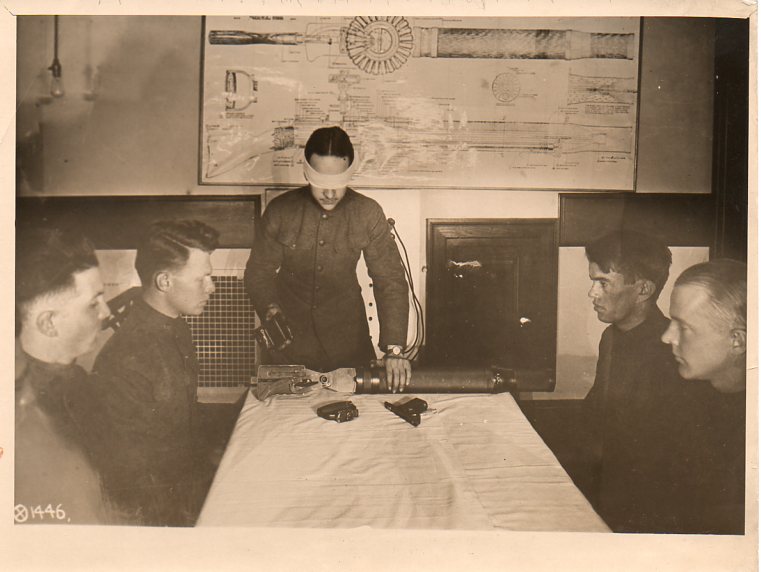
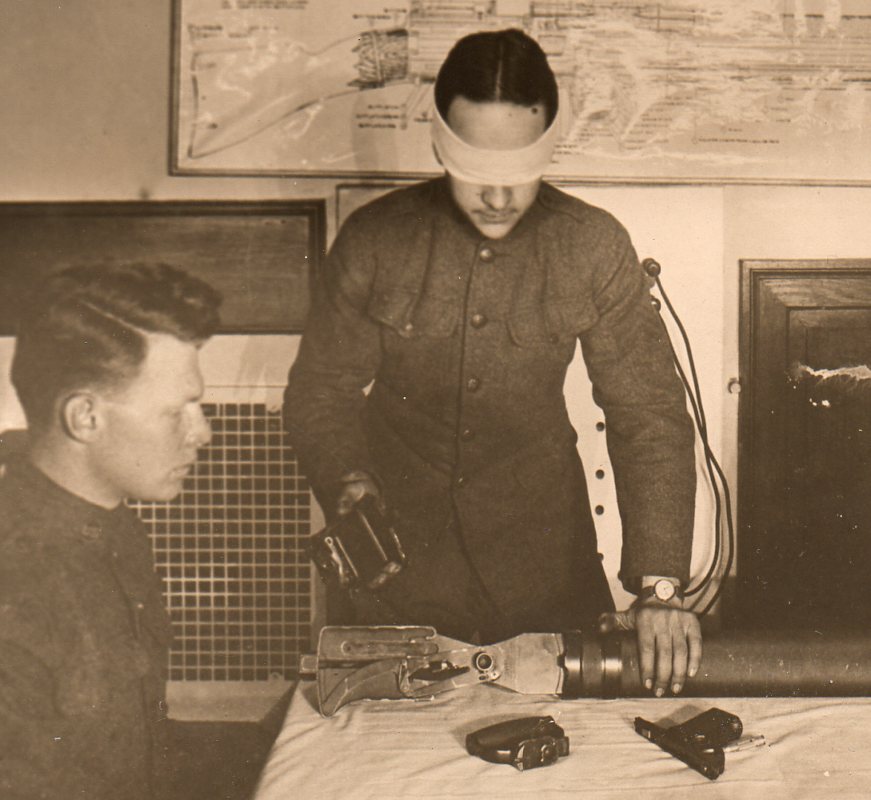
    I do believe that this is a Lewis Machine Gun, one of the most popularly-used automatic weapons by the BEF (and of American design). It was a gas-operated weapon firing a .30-06 Springfield at 500/600 rpm with an effective range of about a half-mile.  The drum magazine (not present here so far as I can see) held 47 and 97 rounds.  These soldiers were all business.

    The original is available here.


  • How YOU Can be One of the 97% of Americans Who Survive Nuclear Holocaust, 1961

    JF Ptak Science Books  Post 1378

    Books_004

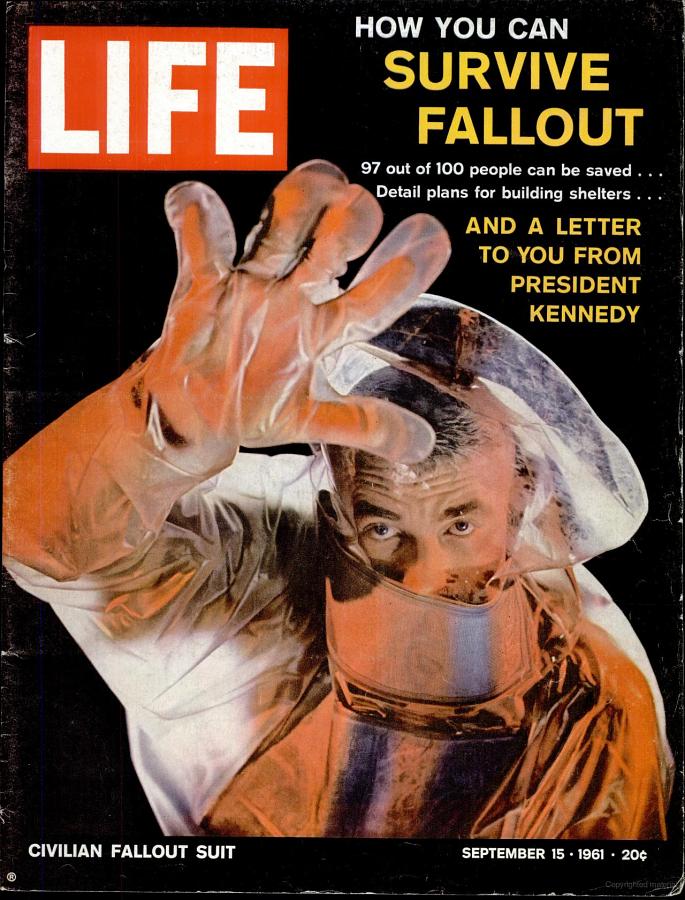
    Well, I’d think that this issue of LIFE magazine would’ve sold in the hundreds of millions with the promise it makes here–right on the front cover–that 97 out ot 100 Americans could survive a nuclear slugfest–if only they were to follow the instructions of this article.

    We only get to the marrow of the issue after wading through a few articles and ads for Hires Root Beer, Maiden bras, silk skin girdles, Bayer aspirin, Schlitz beer, Old Taylor Whiskey, Ge “telephone color” night table clocks, scotchguard raincoats, Lanolin Plus Hair Spray Net, Marja bras, Red Rose cologne, nylon carpet, Maidenform girdles, NY Life, Sealy mattresses, Metrecal, Corn Flakes, Hammond organ, John Hancock Life Insurance, Friskies dog food, Cahmpion spark plugs, Budweiser, BF Goodrich tires, Tang, RCA, Anacin, Speedstick deodorant, Castro convertibles, B+W Whiskey, Kodak and  Vista TV.  Probably I missed a few. When you get to the big ad for Royal Crown Colas with the white-hatted BBQ cook getting a kiss with a big wiener on a stick, you’ve arrived at the article on saving the life of your family and your country.

    If only we could build enough shelters–and by “we” I mean “you”, and build them properly, and outfit them, and are able to get to them in the 14 minutes that you might have to get to your destination, and you stay down long enough and the attack light enough, then probably some people will survive.  How these folks got the 97% number is an issue of faith–I think that they must’ve steeped themselves in mystical prayers to secretly reformulate the percentage “23” into “97” without actually telling anyone.  I figure that this was the key to survival.

    I’ve written many times on this theology of survivability (see the series on atomic and nuclear weapons on this blog, here) but seldom does one see such an incredible, indefensible claim such as this, and splashed across the cover of America’s most popular picture magazine, accompanied by a letter of support from Camelot.  Somehow in the great looming nuclear confrontation that actually comes to pass, somehow “only”3% of the population doesn’t make it.  Of course if there was a natural catastrophe in which 3% of the country was killed–that would be about 4.5 million in 1961 population or about 9 million in 2011–it would be an absolutely phenomenal tragedy. (Ofcourse there were many European countries that lost more than 3% of their populations during WWI and WWII, but that’s another story).  But to escape nuclear Armageddon in this country with 3% loss is much better than other government figures published around the same time that predicted casualty rates exceeding 100 million. 

    But hearts and minds are won abroad and at home, so the homefires must have been stoked to prevent a colossal depression from befalling the country, which of course goes hand-in-hand with the policy of Mutually Assured Destruction, with all policies somehow making it possible for the rush to the abyss to be the one thing that was keeping us (in a Zeno-ish paradox) from falling into it. 

    But 97%?  You can read the article here from page 95 for the full story.