A Daily History of Holes, Dots, Lines, Science, History, Math, Physics, Art, the Unintentional Absurd, Architecture, Maps, Data Visualization, Blank and Missing Things, and so on. |1.6 million words, 7500 images, 4.9 million hits| Press & appearances in The Times, Le Figaro, Mensa, The Economist, The Guardian, Discovery News, Slate, Le Monde, Sci American Blogs, Le Pont, and many other places… 5000+ total posts since 2008.

Author: JF Ptak

  • Electro-LUXurious, 2: Electrical Anti-Masturbation Device for Horses,1894

    JF Ptak Science Books   Quick Post

    This is the second in a new series of posts on interesting, early applications of electricity, most of which are taken from the archives of the U.S. Patent Office. 

    Electrical Anti-Masturbation Devices for Horses, 1894


    Be it known that I, Geoger. King, residing at Dallas, in the county of Dallas and State of Texas, have invented a new and Im5 proved Electrical Appliance, of which the following is a specification.

    My invention relates to an electric appliance, adapted for use on stallions, to stop and cure the habit of masturbation, and such invention consists; in the peculiar and novel combination of parts, hereinafter fully described in the specification, and particularly pointed out in the claims, reference being had to accompanying drawings in which—

    Figure 1 is a perspective view of the appliance. Fig. 2 is a similar view thereof with the upper plate detached, to illustrate the electric generating devices, and Fig. 3 is a view illustrating the appliance as applied to the animal. Referring to the accompanying drawings, A indicates a suitably constructed box or receptacle, preferably of the shape shown, the side and end walls a a’ of which are formed of hard rubber or some other non-conducting material.   B indicates the bottom plate of brass or other metal, which projects beyond the end walls a’, as at ~b b, and provided with slots VV as shown.  C indicates the electric generating devices which are held in the box A, and which may be of any well known construction:, one terminal of which contacts with the lower plate…

  • Electro-LUXurious 1: Electrical Advertising Signs

    JF Ptak Science Books   Quick Post

     This is the first in a new series of posts on the history of the invention of early applications of electricity to, well, whatever.  This first example, far from being the first patent granted for an electrical apparatus, is interesting because of how relatively modern its outcome looks–if we defined “modern” at about 1975.  Digital displays have replaced most signage whose basis was formed in this patent, though various palm readers, “loose” gold buyers and tent revivalists continue to use the things.  But for the times in which machines like this were new commodities, they were sensational–not only did they actually utilize electricity (many things advertised during this period were named “Electric _____  or  _____” but had absolutely nothing to do with the application of a current–they were simply using the name in a fad for brand recognition, much like Atomic Bakery and Nuclear Toasties did) seeing the electrically-lighted words must’ve felt a little like the exhilaration in seeing your first television.  [An earlier post on this blog on very early electrical signs appears here.]


    The patent reads (below):


  • The First Woman to Fly in an Airplane Was When?

    JF Ptak Science Books   Quick Post

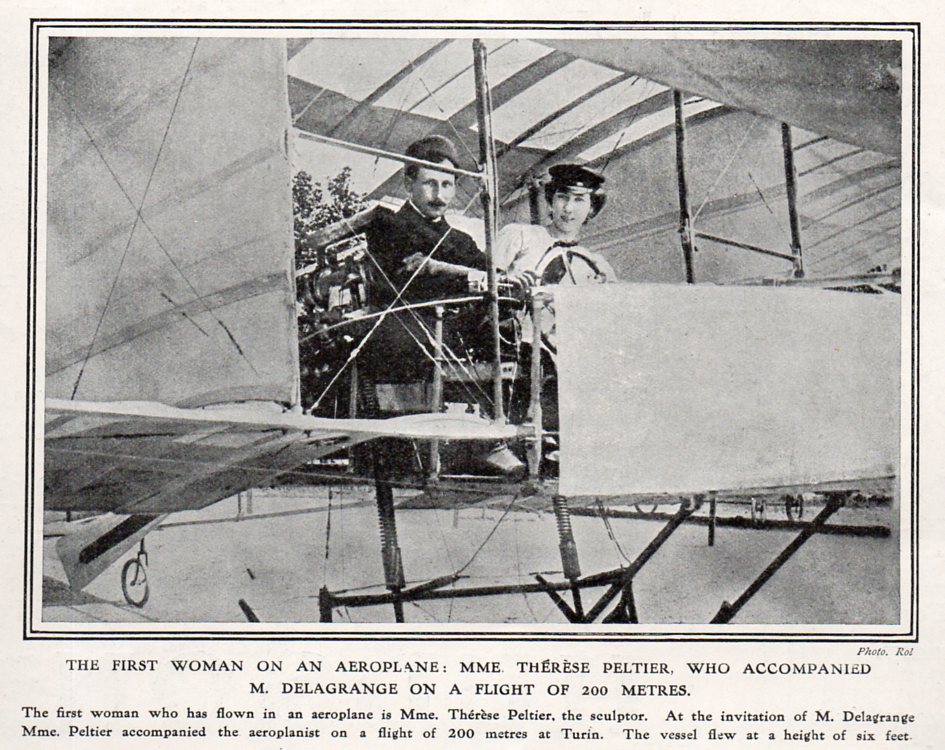
    I wondered about how long after the Wright’s first powered flight (17 December 1903) that it took for a woman fly in an airplane, either as passenger or pilot.  I was a little surprised–when I found my answer, my glasses weren’t quite up to seeing the date on the top of the page very clearly, and on closer inspection I was a little taken aback to see how wrong my assumption was.  It didn’t take five weeks or five months, but five years before this happened.

    Aviation--first woman502

    It seems as though this honor belongs to Therese Peltier, who on 8 July 1908 was a passenger in the aircraft of her significant other, Leon Delagrance, flying a distance of about 700 feet1.  An earlier great name for the history of women in aviation, E. Lillian Todd, was the first to design and build an airplane, though she was not able to fly the unflyable aircraft.  A half-dozen or so women aviators appear in 1909, and by 1910 the course for women in aviation expands dramatically. (An interesting chronology of “firsts” for women in aviation can be found here; another site, Women in Aviation Web Magazine, can be found here.)

    The image above, from the Illustrated London News for 25 July 1908 (the original issue of which is available at our blog bookstore), shows Ms. Peltier getting ready for the flight.  It is interesting to note that the picture and story occurs in a section of the magazine called “Chronicle of the Car”

    Aviation--first woman503

    which is where reporting on aeroplanes and flight occurred, the subject not quite at the point where aviation deserved its own category.  Of course the automobile was new, then, too, so it makes a little sense to have them lumped together…but not much.  The “Chronicles” part of the magazine was a half-page affair, the last page before the advertisements began, the last leaf before the rear cover. 

    Notes:

    1.  It seems as though there is debate on this, mostly over the Delagrance aircraft was indeed “modern” enough to be considered a modern heavier-than-air airplane, this over the way the control of the plane was handled.  I’d say we just left Ms. Peltier alone on this one.

    From the Smithsonian Institution, National Air and Space Museum site


  • Tree Rings of Soldiers’ Uniforms, 1918

    JF Ptak Science Books   Quick Post

    WWI german uniforms500

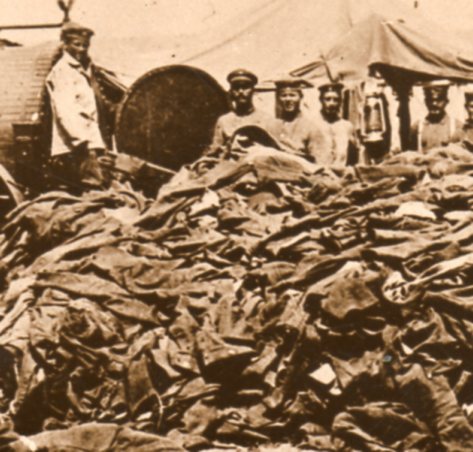
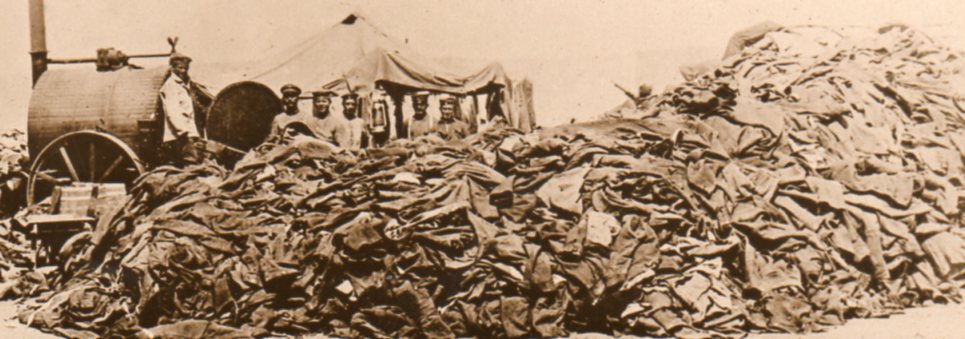
    Aside from the strong impact that this 1918 image [the original available at our blog bookstore, here] makes, the enormous mounds of clothing of captured German solders that were routinely handled as part of their processing, it struck a deeper chord to an older image still (that we’ll see below).  The photograph seems threatening to me, even though the action taking place in it wasn’t, it was mundane–the men, who I believe are German POW’s, are processing the clothing for disinfection and cleaning.  But the size of the mound reminds us of the magnitude of the numbers of the dozens of millions who were killed during WWI, as well as the millions who were taken prisoner.  What remains to be said about this image is how often that pile of clothing was replaced:  is it a monthly, or weekly, or daily pile?  My guess is that it was more daily than anything else, if for no other reason than there is an enormous oil lamp in the background of the photo, suggesting that the process went on all day and into the night.  My initial reaction is that this pile was replicated often during any given month….

    WWI german uniforms499
     
    WWI german uniforms498

    And the image it reminds me of are those made of the enormous mounds of buffalo hides, piles readied for shipment away from the Plains by rail. 

    Buffalo-Hides-lg

    I am in no way suggesting that the prisoner were skinned like the buffalo, not in any way.  But they do bear a resemblance in the way that thousands of men or buffalo could be represented in such a compact space, flattened husks of the living thing, gross representations of big numbers. 


  • Nazi Propaganda on Propaganda: on British “Atrocity Propaganda” (1938/9)

    JF Ptak Science Books   Post 1490

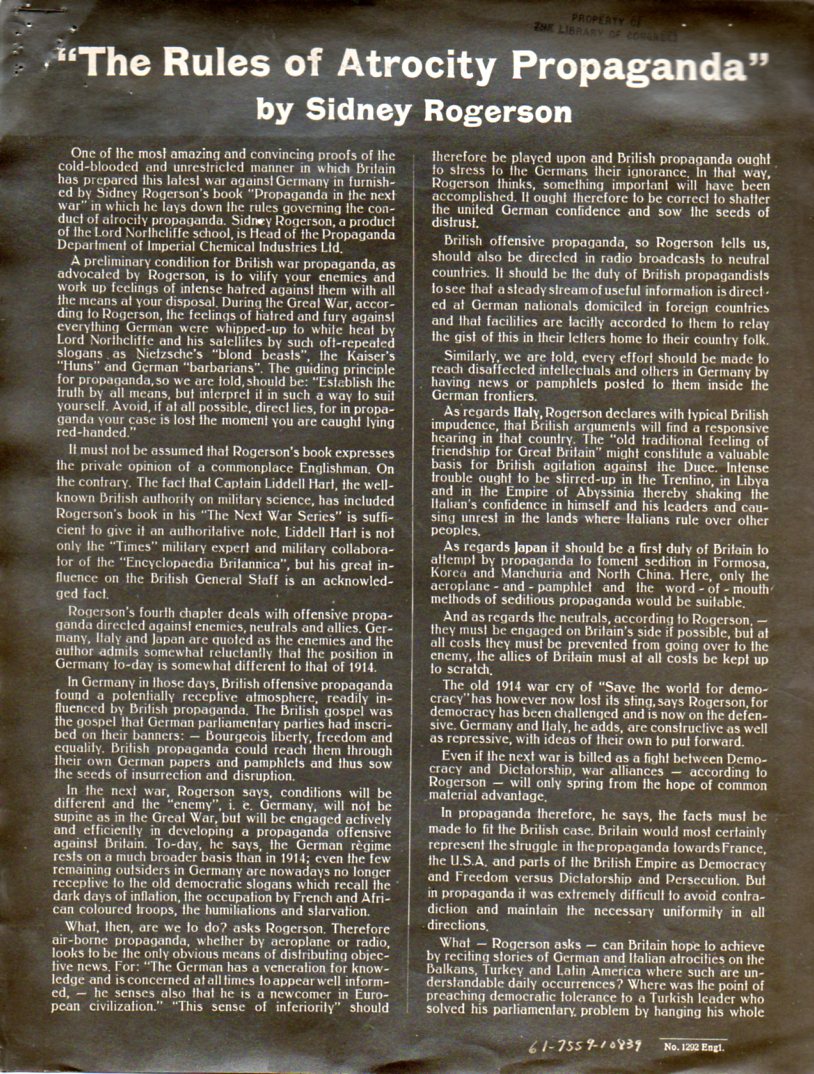
    As a small cog in the machinery of the Nazi Big Lie, this short sheet (supposedly written by a ” Theodore Kesselmeier”1), outlines a campaign of British anti-Nazi psychological warfare, and was written around 1938/9.  It is written in a book review format whose aim was the 1938 publication by Sidney Rogerson2,  Propaganda in the Next War, which was an alert (described as “brilliant” by John A. Pollard in The Public Opinion Quarterly for Autumn 1945) to the British government to establish central coordinating offices for information and communication for what the author felt to be the impending war with Germany.  In many ways Rogerson was responding to an enormous flood of information coming out of Germany about its own impending future, from the election and seizure-of-power by Adolf Hitler, to books like Ewald Barnse Raum und Volk im Welkriege (translated into Germany Prepares for War) of 1933, and on and on, a growing high tide that was without end. (Even from the most base popular study of Germany’s desires, for example, looking at every issue of the Illustriete Zeitung (Leipzig) from 1933 to 1939 as I have done, it is overwhelmingly obvious that Germany was preparing for the next war.  ThNazi propagandae case is made constantly and boldly in the magazine, which served in a way as Germany’s version of LIFE magazine.) [This item is available for purchase through our blog bookstore, here.]

    But the “reviewer” finds  the Rogerson work insulting and militaristic, hateful; an attack upon Germany.  He/they write(s) that the book is an offense, and part of an effort of  “the cold-blooded and unrestricted manner in which Britain has prepared this latest war against Germany”.  This part is odd because even at this late date, and given what the knew about the German war aims, Great Britain had done very little about preparing for war even until Munich. 

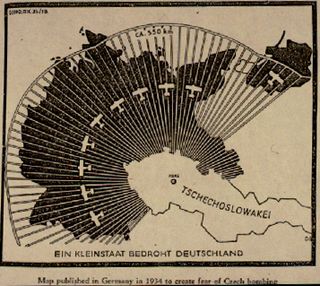
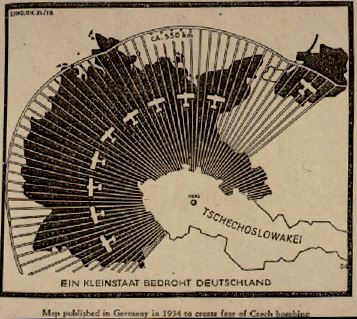
      I have aNazi prop number of these propagandistic pieces that came out of Germany at this time, some of which have been written about on this blog, and it seems no surprise now to see how many of them paint Germany as a victim of the war aims of the countries nearby:  Poland and Czechoslovakia were both presented as late as 1938 as having designs on Germany. This is just one of many examples of Nazi propaganda on propaganda, issues of lies within lies to the secret house of even-more-inner lies.  For example, this incredible map showing the Czech threat to Germany, above [source] and the shrinking  pamphlet, left [source].


               Rogerson496


    [page 2 is in the “continued reading” section, below.]

    Notes:

    1.  I suspect that “Kesselmeier” was the nom de plume of a section of writers laboring away in the dream factory of the psych-ops part of the Nazi war machinery.  It is much easier to produce reports when you have an entire group of people working on the project without need for the benefit of proof–or, for that matter–of truth. 

    2. Rogerson’s entry in Who’s Who:  “Publicity and Public Relations Consultant and author. Born 22nd of October 1894. Son of the Reverend S. Rogerson. B.A. in Modern History 1916; Served in the European War;

    ·Posted by :

    ·in:

    — — —

  • Spaghetti Map of the Army-McCarthy Hearings, 1954

    JF Ptak Science Books   Post 1489

    Some things are complex, and complicated and pretty–you don’t realize that they are this involved, exactly, because of the elegant way in which they are presented.  An anti-gravity undertaking by Brunelleschi, in creating his dome, was an enormous challenge,  solved with circles within circles, a series of nine of them enclosed in a polygon, the result being one of the most beautiful and iconic achievements in the history of architecture (and engineering).

    And then sometimes things are complicated and complex and look and behave that way, their messiness outdistancing their own necessities.

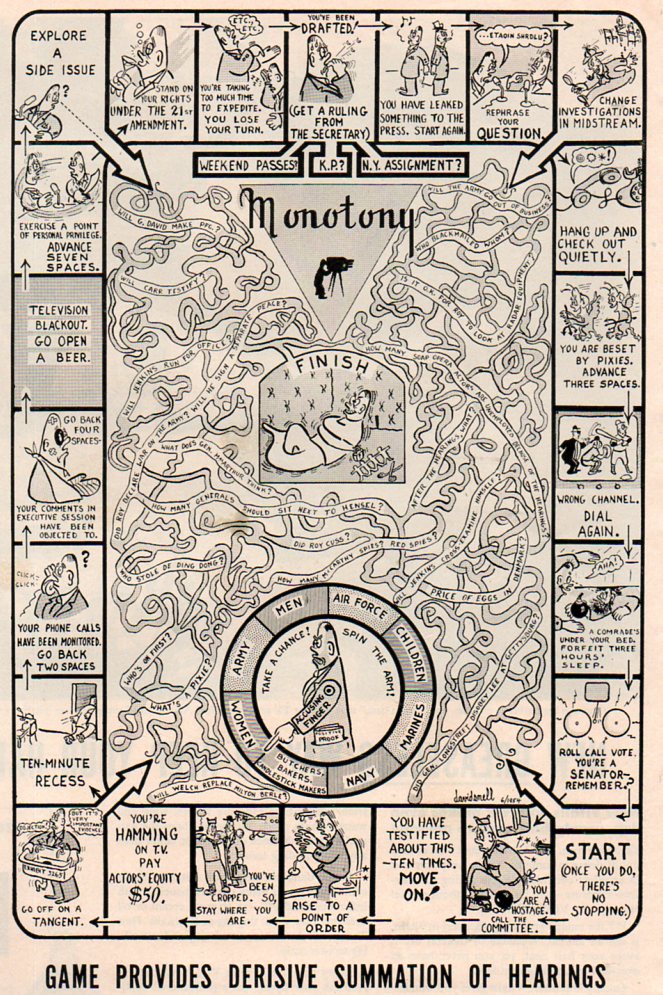
    Which gets us now to this game, a mass of entwined spaghetti, which was a tongue-in-cheek poke at the Army-McCarthy Hearings of the spring of 1954, a popular review in the tradition of Thomas Nast that is very effective.. The “Army” was the U.S. Army, and the “McCarthy” was Senator Joesph McCarthy, of Appleton, Wisconsin, a man who was about at the end of a short, meteoric career of vast unsubstantiated accusation, discord, lies and fraud. The hearings were supposed to sniff out Communists in the Army and the defense industry, because that’s what McCarthy did, being a rabid impersonator of a man with a decent mission. The hearings were long, involved, and traveled nowhere fast although much ground was covered.

     The bottom line to the whole affair was that as the first televised Senate hearings, McCarthy drew a huge audience, estimated at some 80 million people over the course of the event. And what happened was that “Tail-Gunner Joe” (an appellation he gave to himself that among many other things in his personal and public life were exaggerations) found out that he was seen better int eh minds of Americans when he was not being televised. In short, he was outed for many as a crude, threatening liar, and his career of ruining people in his quixotic quest for deeply-rooted Commies was about over when the last lights in the hearing room went out.

     Joe McCarthy would be dead in about three years, his liver failed, evidently (as his biographers say) from too much drink. He was a dangerous and divisive man, but one who had many friends and supporters to keep him re-elected and in power. (He was a darling of the Kennedys, being a favorite of Joe Kennedy, the godfather of Robert Kennedy’s first child, and one who dated two of the JFK’s sisters. Being Catholic and a vehement Commie-hunter went a long way with Joseph Kennedy, who had his own set of issues with power and rule.)

    McCarthy hearings495

    [Image source:  LIFE magazine, 21 July 1954, page 42.]


  • Graphical Display of Information: Identifying Ships from the Air, 1942

    JF Ptak Science Books  Quick Post

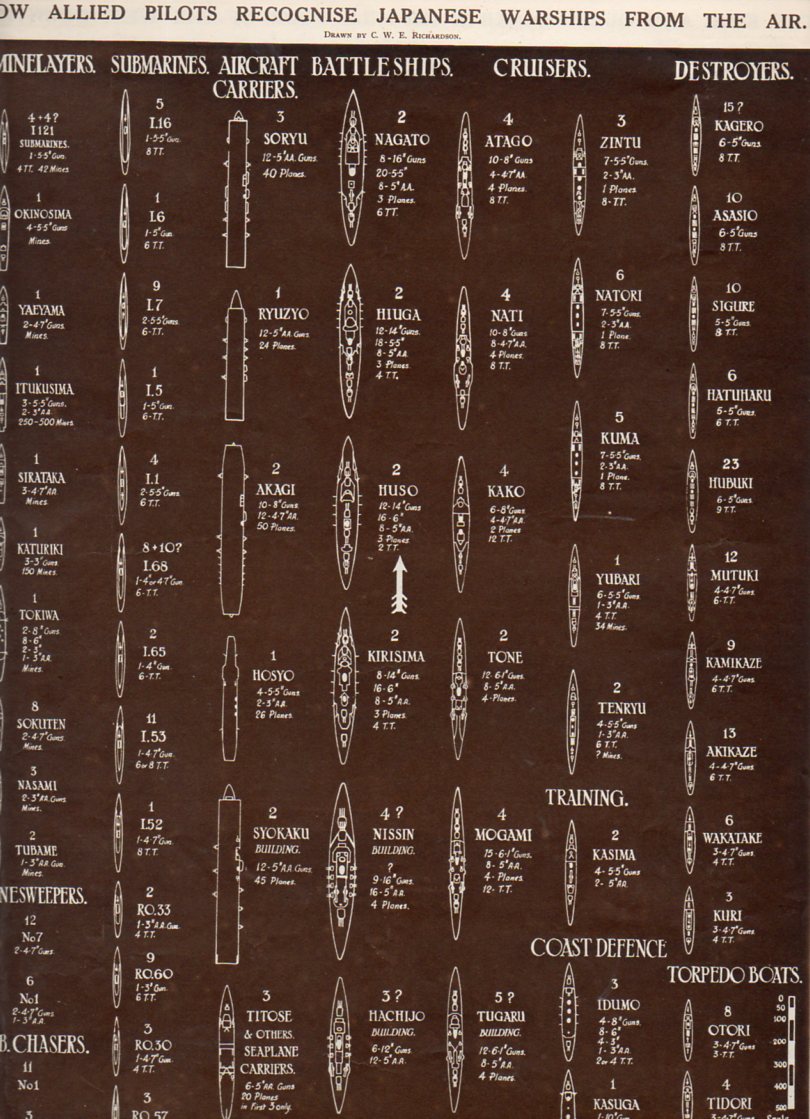
    Aircraft regonition494

    “How Allied Pilots Recognize Japanese Warships from the Air”, a graphic that appeared in The Illustrated London News on 16 May 1942, displayed in silhouette the different sorts of Japanese warships that might be targets of allied planes.  There’s a lot of data on this one long sheet of paper, showing minelayers, submarines, aircraft carriers, battleships, cruisers, destroyers, subchasers, torpedo boats, training vessels and coastal defense ships–65 in all.  It is a great display, presenting a great amount of data in limited space, clearly and concisely, and very easy to distinguish and read. 


  • An Alphabet of Anatomical Emotions and Feelings–Installment 1

    JF Ptak Science Books   Post 1488

    In a developing thread on oddly-represented alphabets on this blog, this one is a little harder to fill than it seems.  The rules are that all images must be some level of dissection (with the exception of the anatomical Durer), and not a simple artistic study of emotion, and that the images be at least 200 years old.  Part I of this alphabet of emotion and feelings includes awe, burdensome, contempt, disappointment, empathetic, fear, guilt, hope, intrigue, joy, lonesome, majesty, pride, resentment, surprise, trust, vulnerability and wonder.

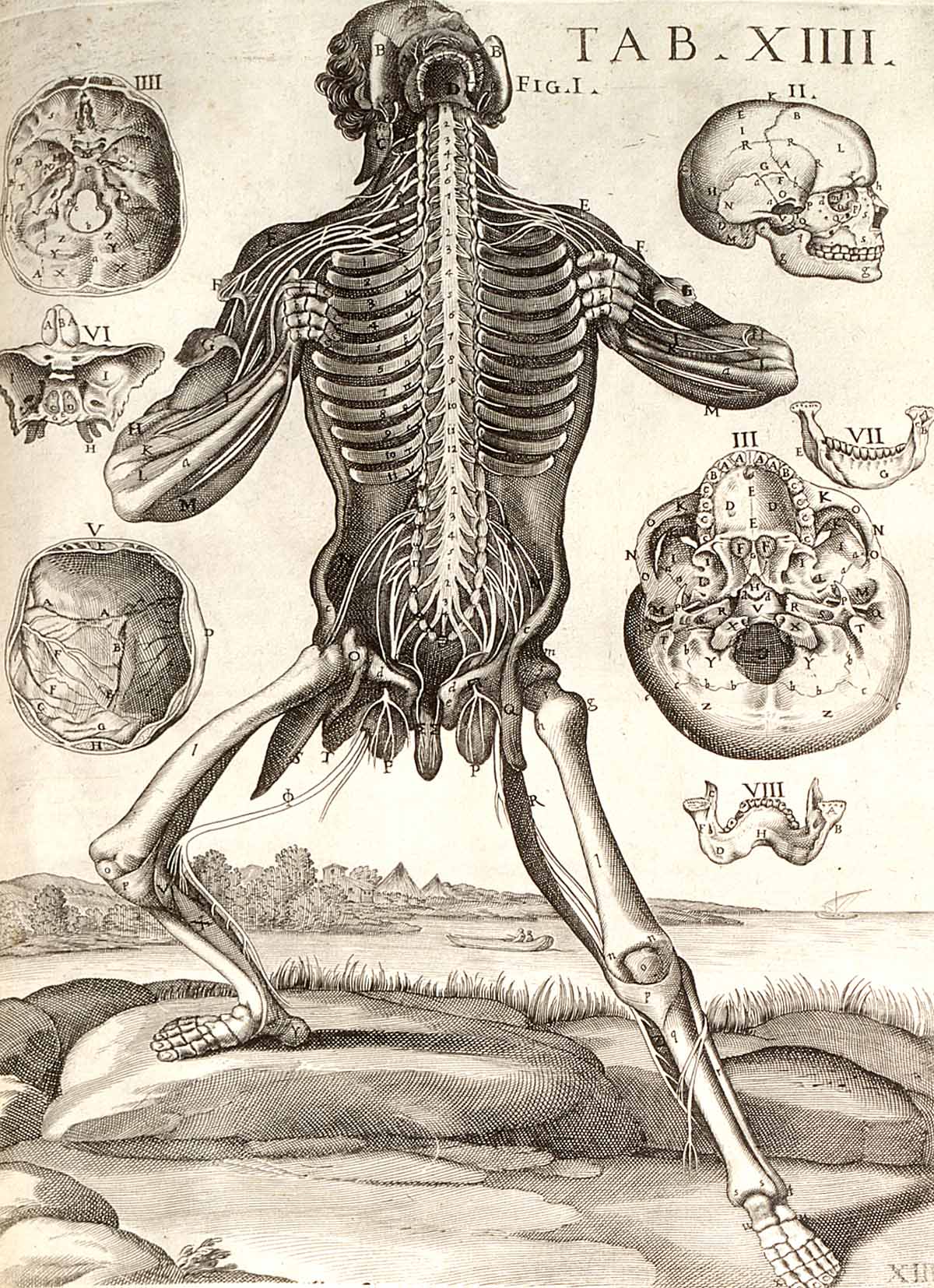
    Awe

    Tabulae Anatomicae... by Giulio Casserio and Odoardo Fialetti

    Giulio Casserio (ca. 1552-1616, anatomist) and Odoardo Fialetti (artist), Tabulae Anatomicae, published in Venice in 1627.

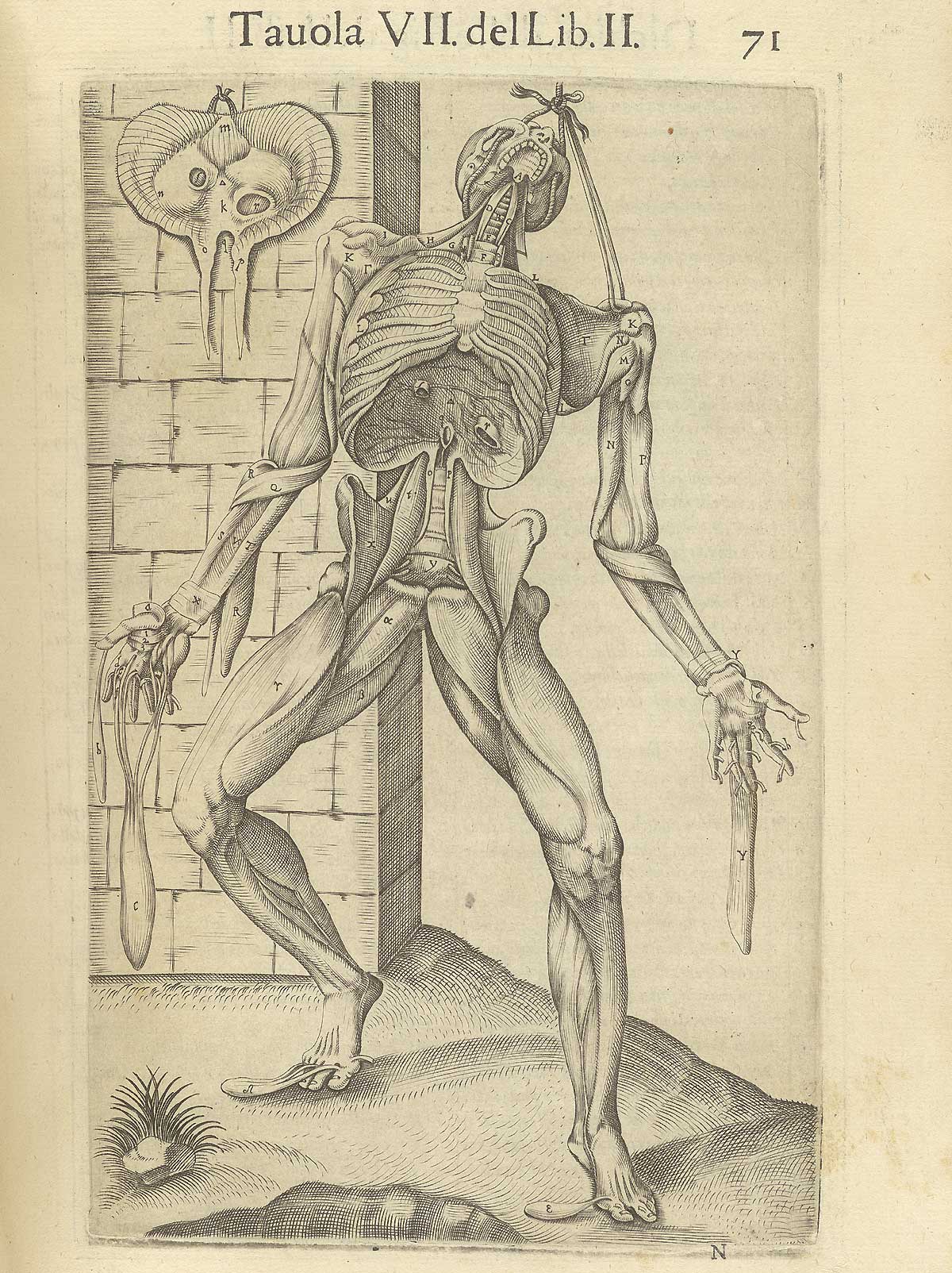
    Burdensome

    http://www.nlm.nih.gov/exhibition/historicalanatomies/Images/1200_pixels/valverde_p71.jpg

    Juan Valverde de Amusci (ca. 1525-ca. 1588), Anatomia del corpo humano, printed in Rome in 1560. 


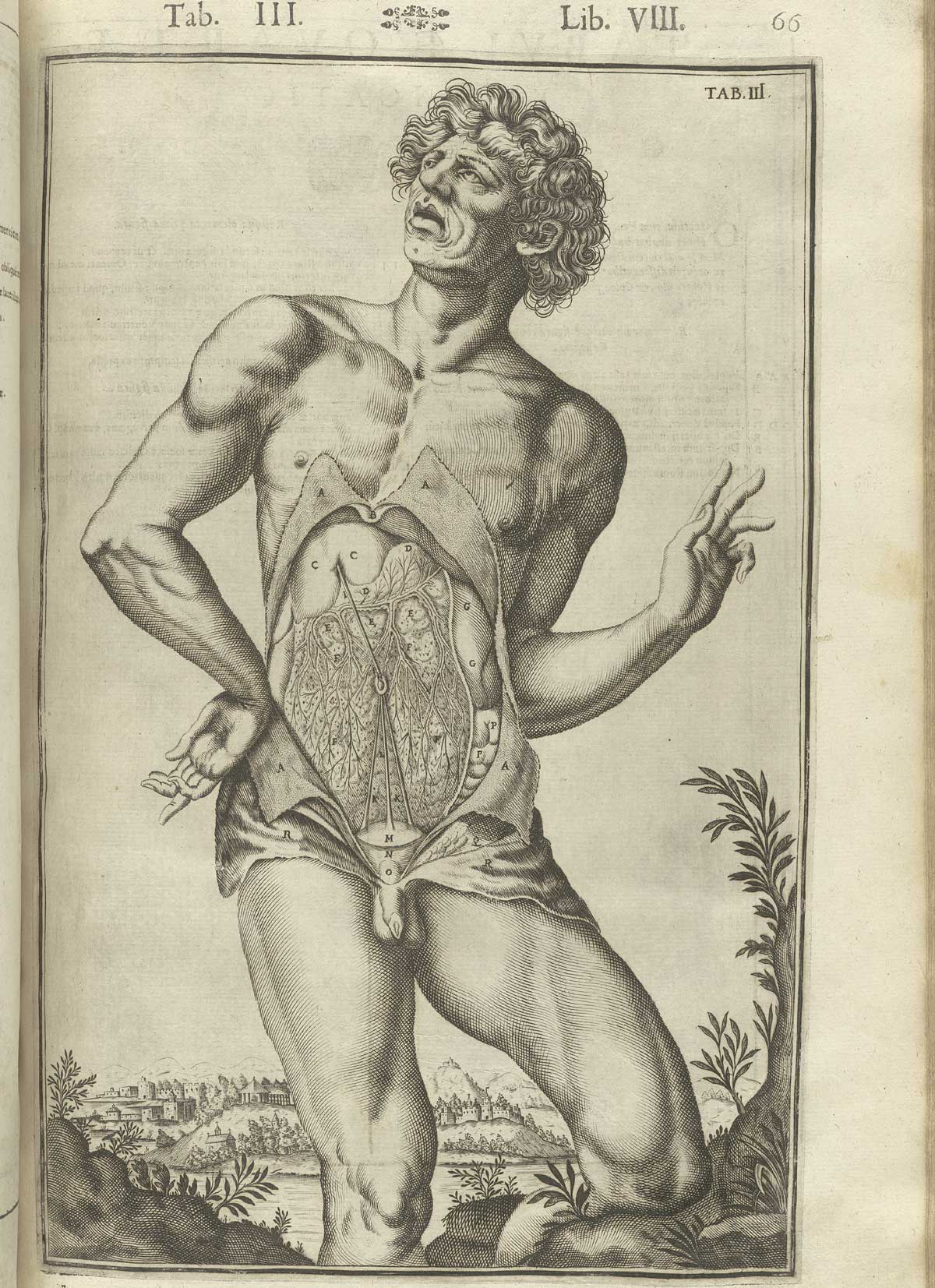
    Contempt

    Casseri_p66  dandy

     Giulio Casserio (ca. 1552-1616, anatomist) and Odoardo Fialetti (artist), Tabulae Anatomicae, published in Venice in 1627

    Disappointment 

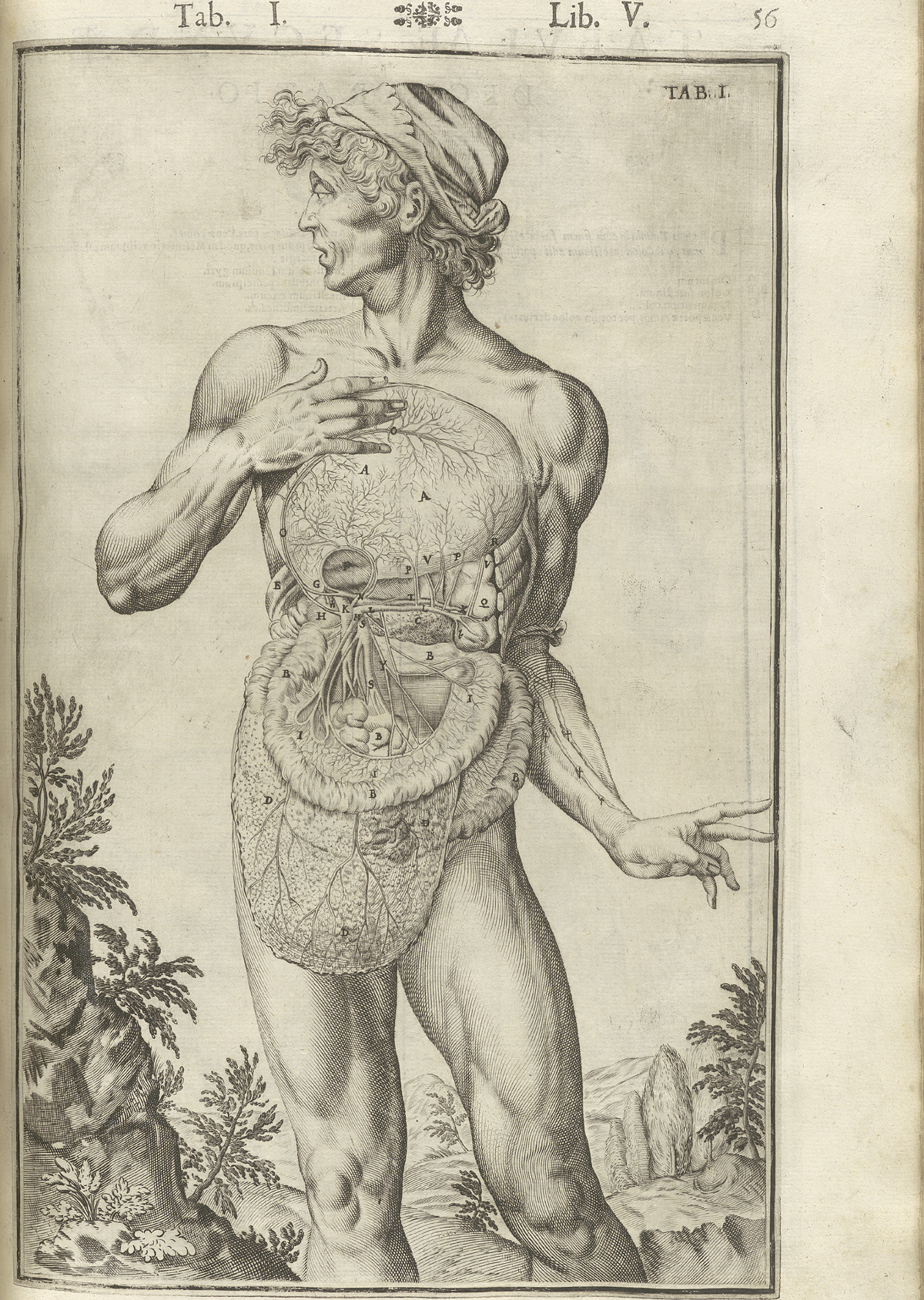
    Casseri_p56 surprise

    Giulio Casserio (ca. 1552-1616, anatomist) and Odoardo Fialetti (artist), Tabulae Anatomicae, published in Venice in 1627.

    Empathetic

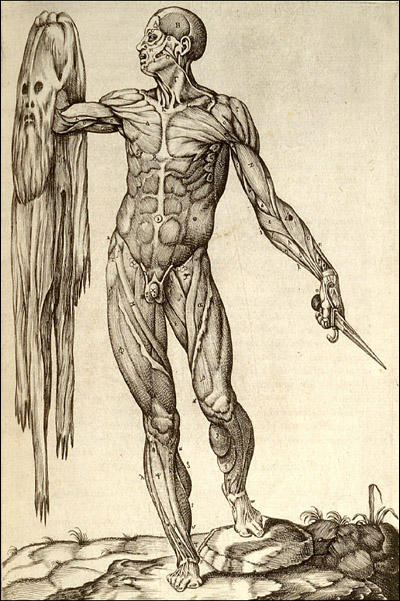
    Missing skin c
    Juan Valverde de Amusci (ca. 1525-ca. 1588), Anatomia del corpo humano, printed in Rome in 1560.

    Fear

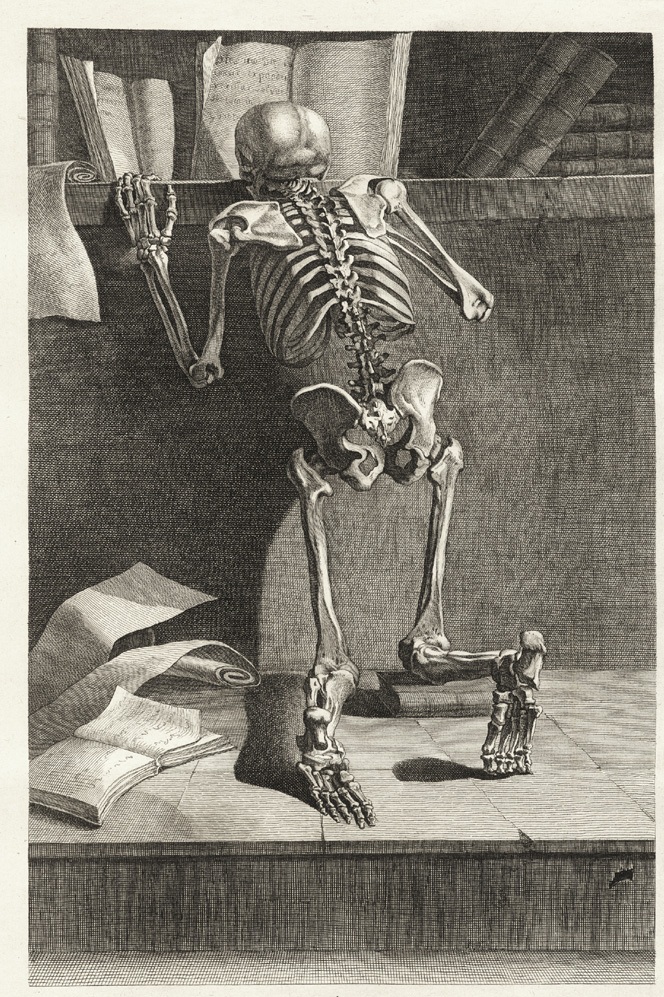
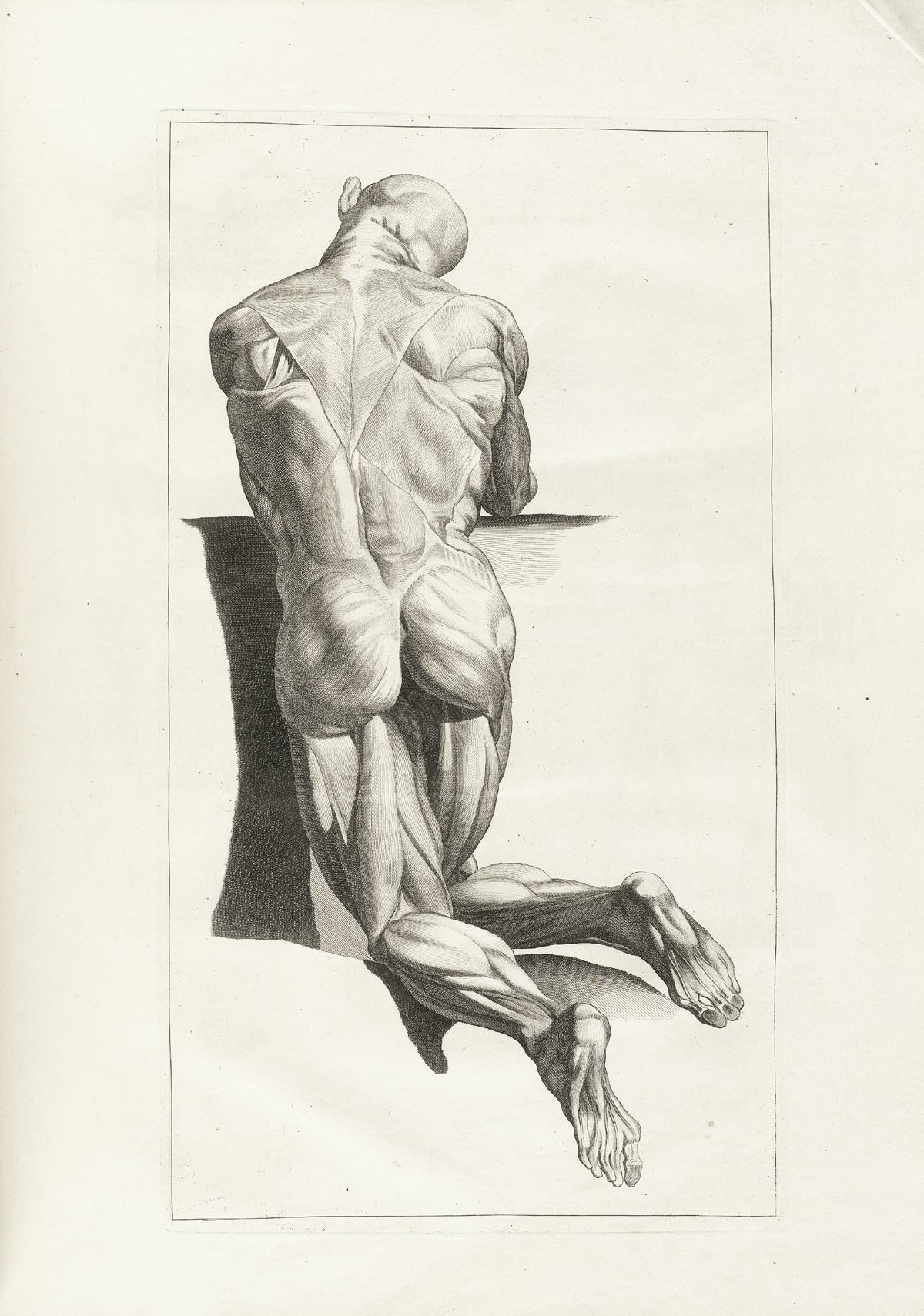
    Gamelin1_t02 Jacques Gamelin (1736-1803), Nouveau receuil d’ostéologie et de myologie, published in Toulouse in 1779.

    Guilt

    Gamelin1_t11
    Jacques Gamelin (1736-1803), Nouveau receuil d’ostéologie et de myologie, published in Toulouse in 1779.

    Hope

    http://www.nlm.nih.gov/exhibition/historicalanatomies/Images/1200_pixels/gersdorff_p21v.jpg

    Hans von Gersdorff (d. 1529),  Feldtbůch der Wundartzney : newlich getruckt und gebesser, published in Strassburg in 1528.  

    Intrigue

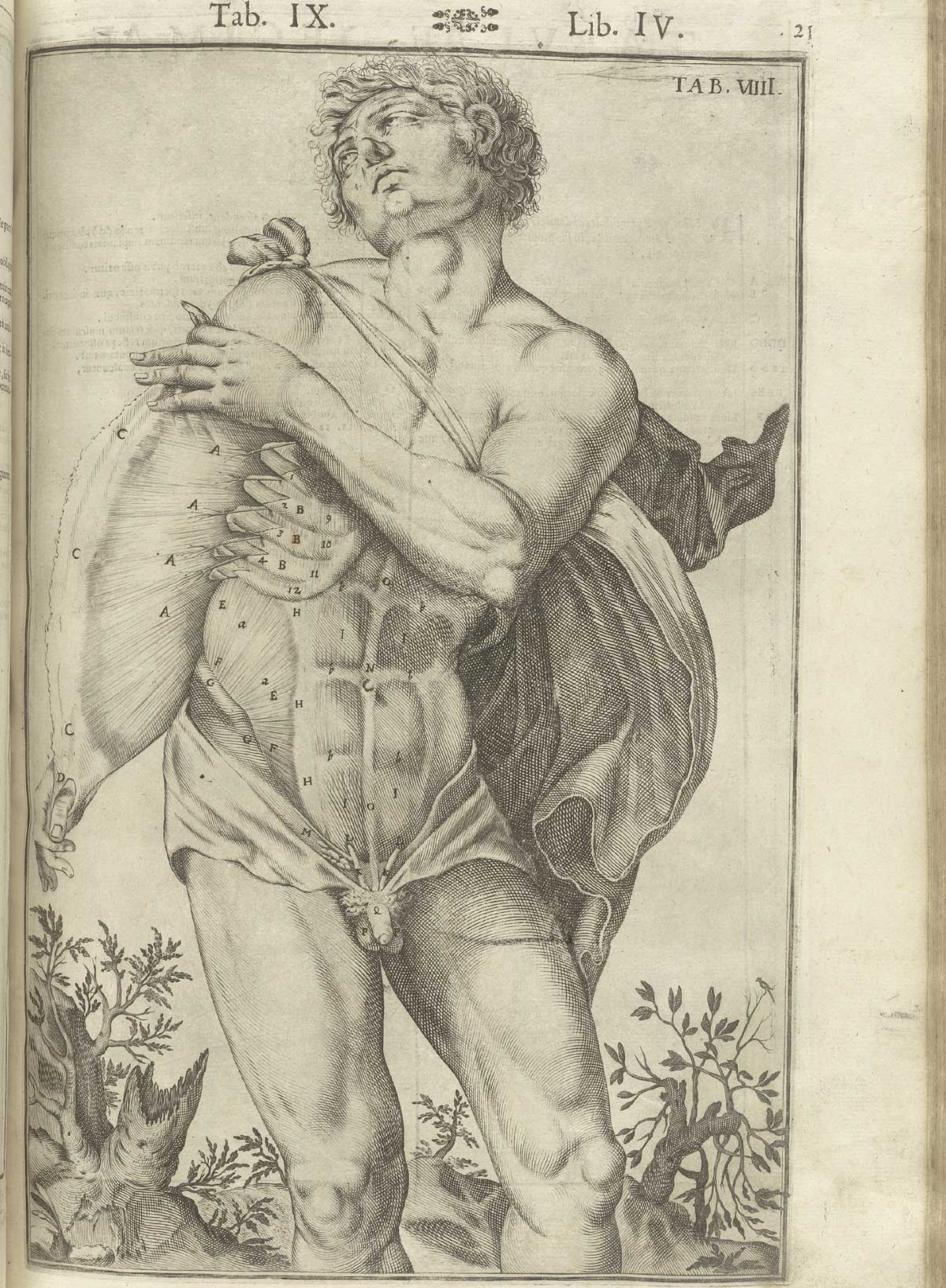
    Casseri_p21 bored

    Giulio Casserio (ca. 1552-1616, anatomist) and Odoardo Fialetti (artist), Tabulae Anatomicae, published in Venice in 1627

    Joy

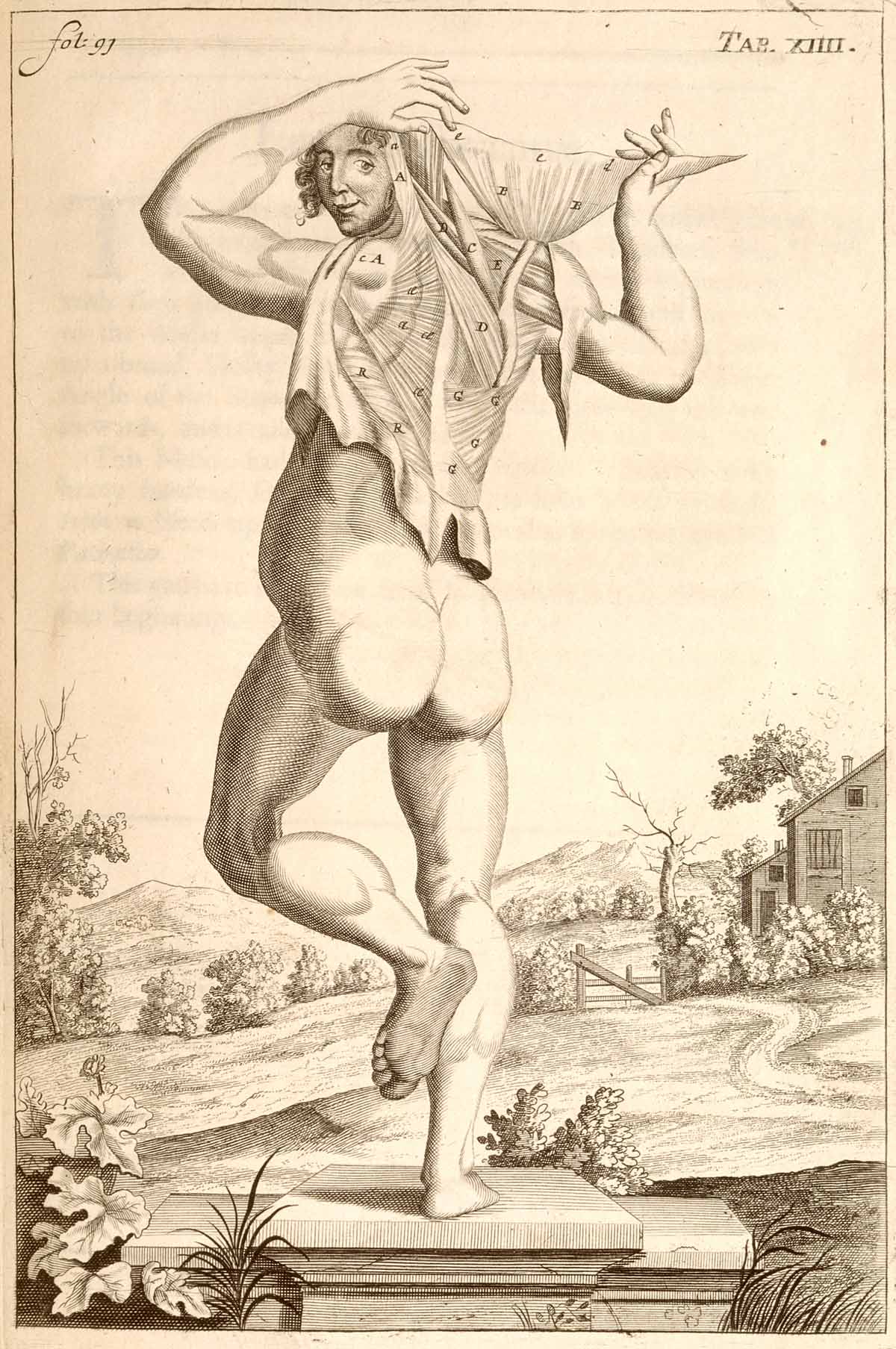
      Anatomy john brown dancing

    Lonesome

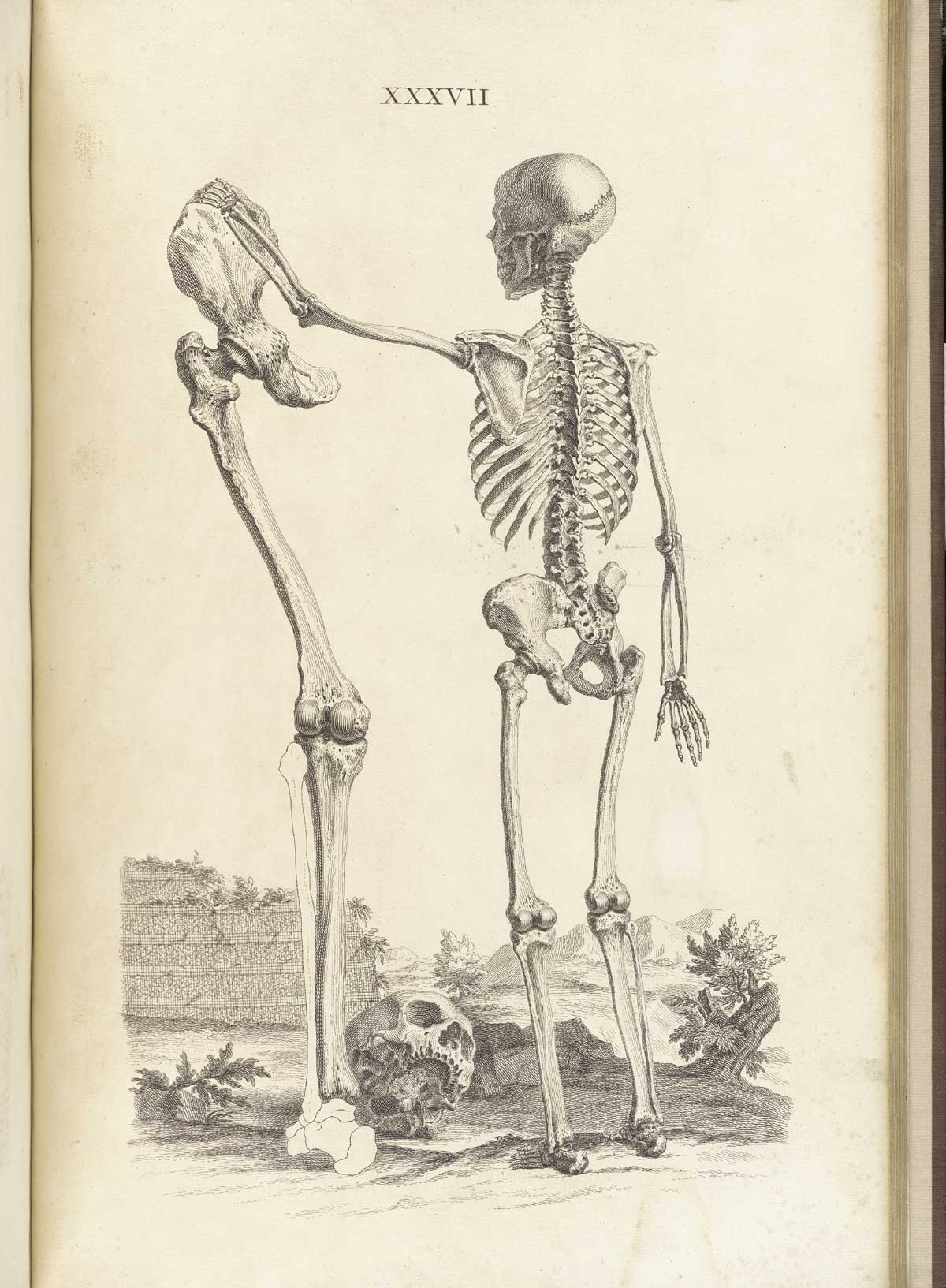
    http://www.nlm.nih.gov/exhibition/historicalanatomies/Images/1200_pixels/cheselden_t37.jpg

    William Cheselden (1688-1752), Osteographia, or the Anatomy of Bones, published in London in 1733.

    Majesterial

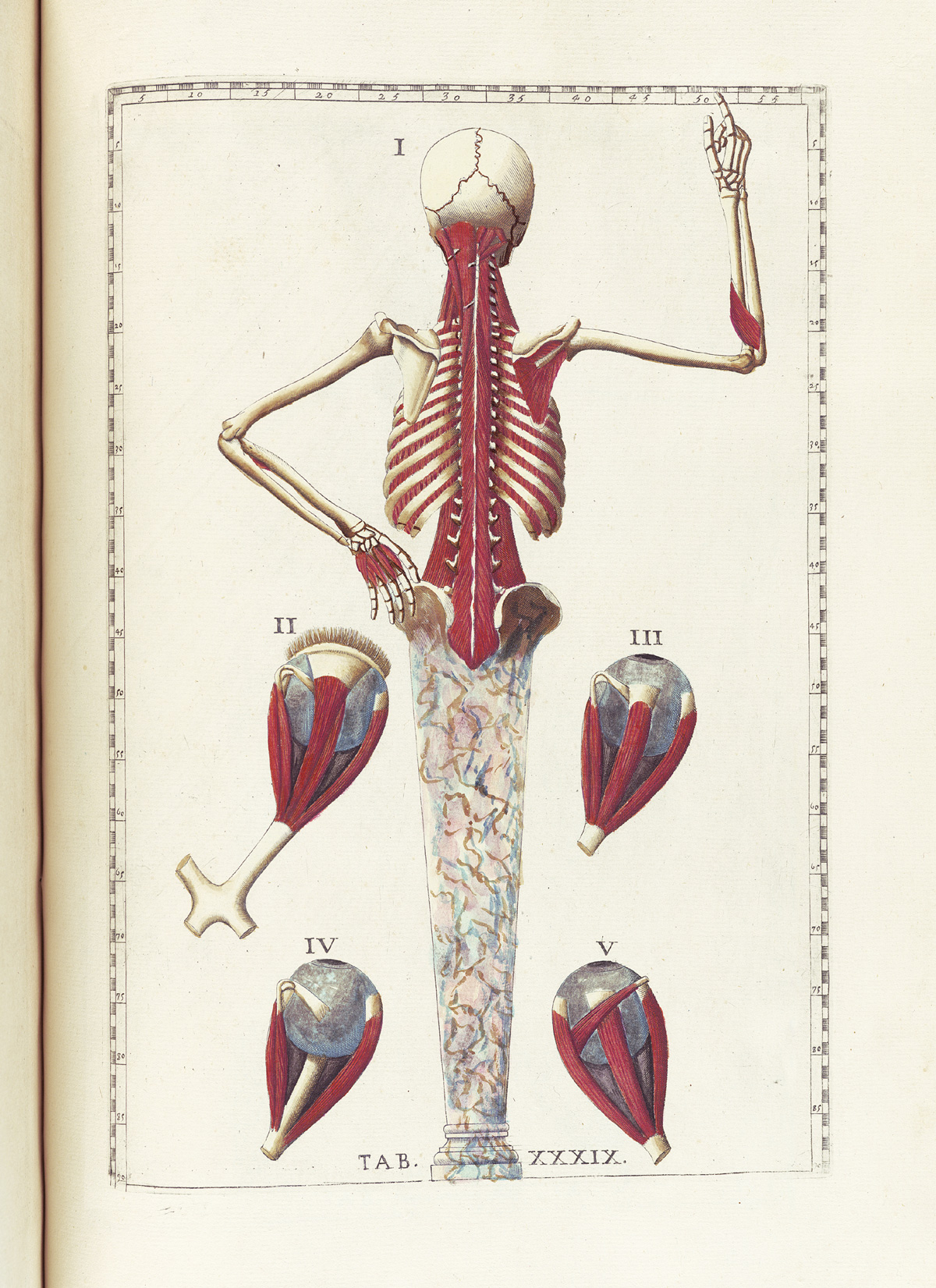
    http://www.nlm.nih.gov/exhibition/historicalanatomies/Images/1200_pixels/Eustachi_t39.jpg

    Bartholomeo Eustachi (d. 1574), from Tabulae anatomicae, printed in Rome in 1783.

    Pride


    Anatomy performers

    In the category of “Holy Crap!” anatomical illustration surely Pietro Berrettini da Cortona (1596-1669) must be among its patron saints.  His images are incredible, yelling and screaming for attention as they demand their space onthe printed page.  Further, the man actually accomplished all o fthis in the early 17th century, his work no tbeing published for another 130 years or so. [Source:  Tabulae anatomicae..., Rome 1741.]

    Resentment

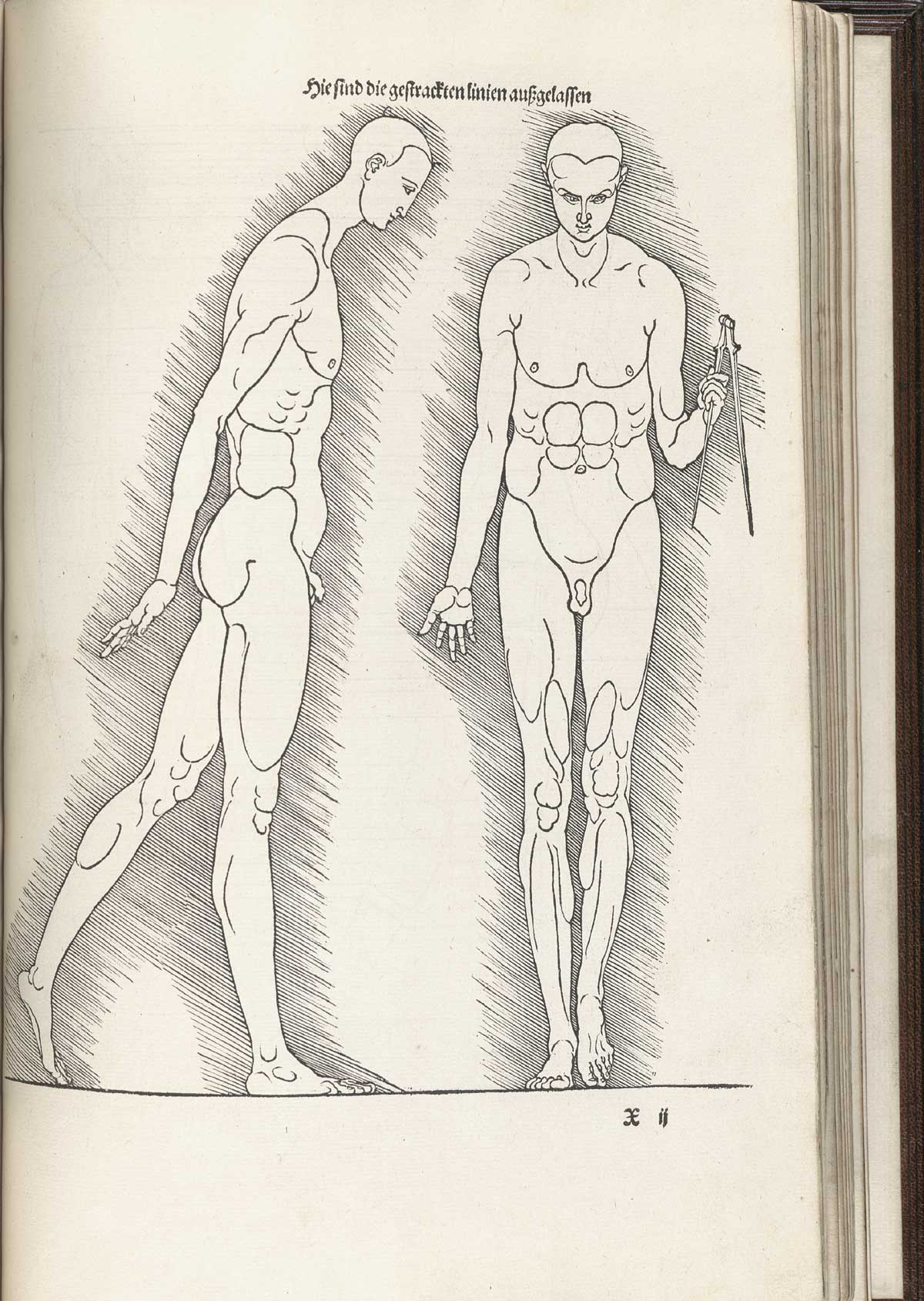
    http://www.nlm.nih.gov/exhibition/historicalanatomies/Images/1200_pixels/durer_pg-233.jpg

    Albrecht Durer (1471-1528), Vier Bücher von menschlicher Proportion, published in Nuremberg in 1528.


    Surprise
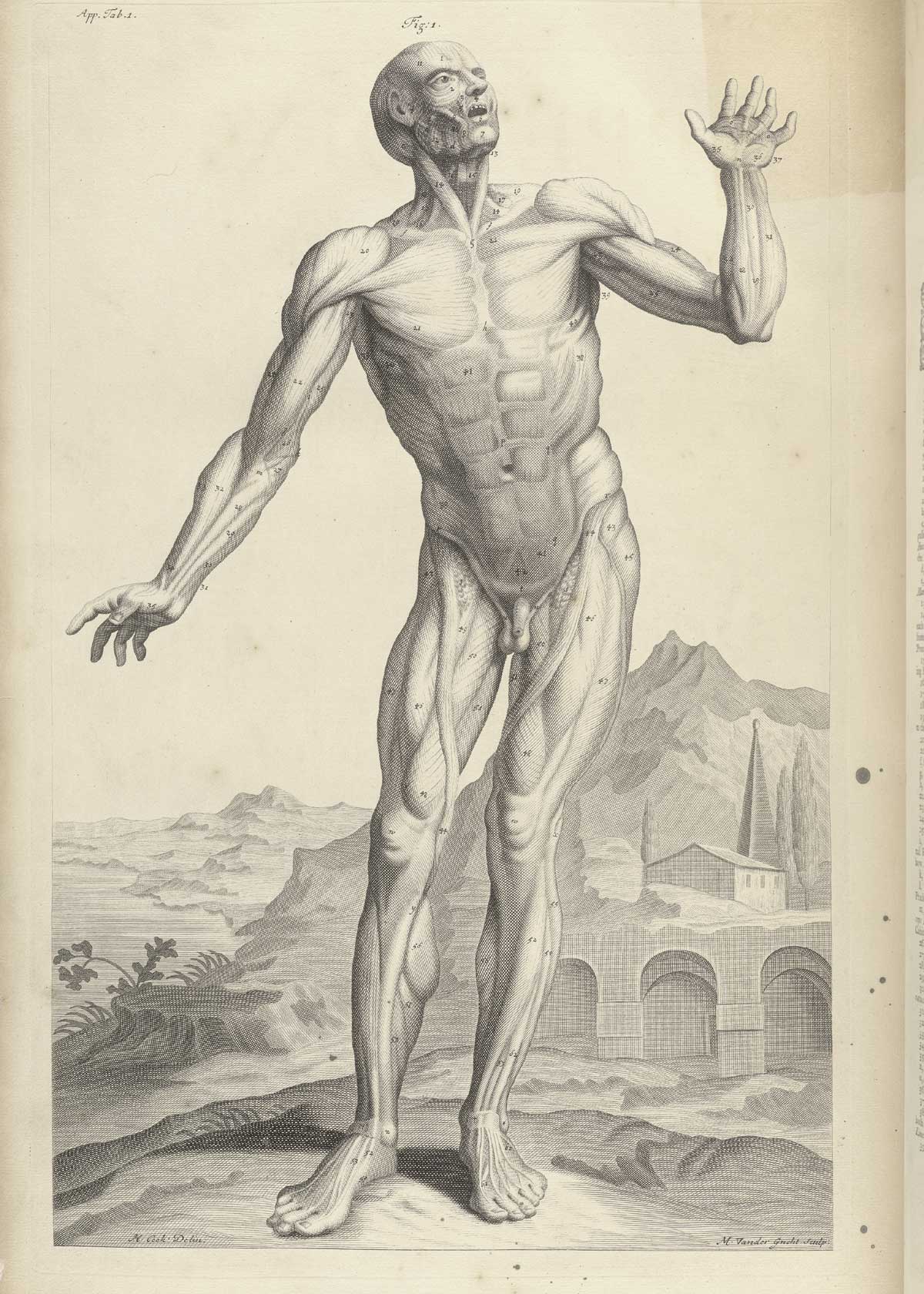
    http://www.nlm.nih.gov/exhibition/historicalanatomies/Images/1200_pixels/cowper_t01.jpg

    William Cowper, The anatomy of humane bodies, printed in Oxford in 1698.


    Trust


    http://www.nlm.nih.gov/exhibition/historicalanatomies/Images/1200_pixels/cheselden_t36.jpg

    William Cheselden (1688-1752), Osteographia, or the Anatomy of Bones, published in London in 1733.

    Vulnerable

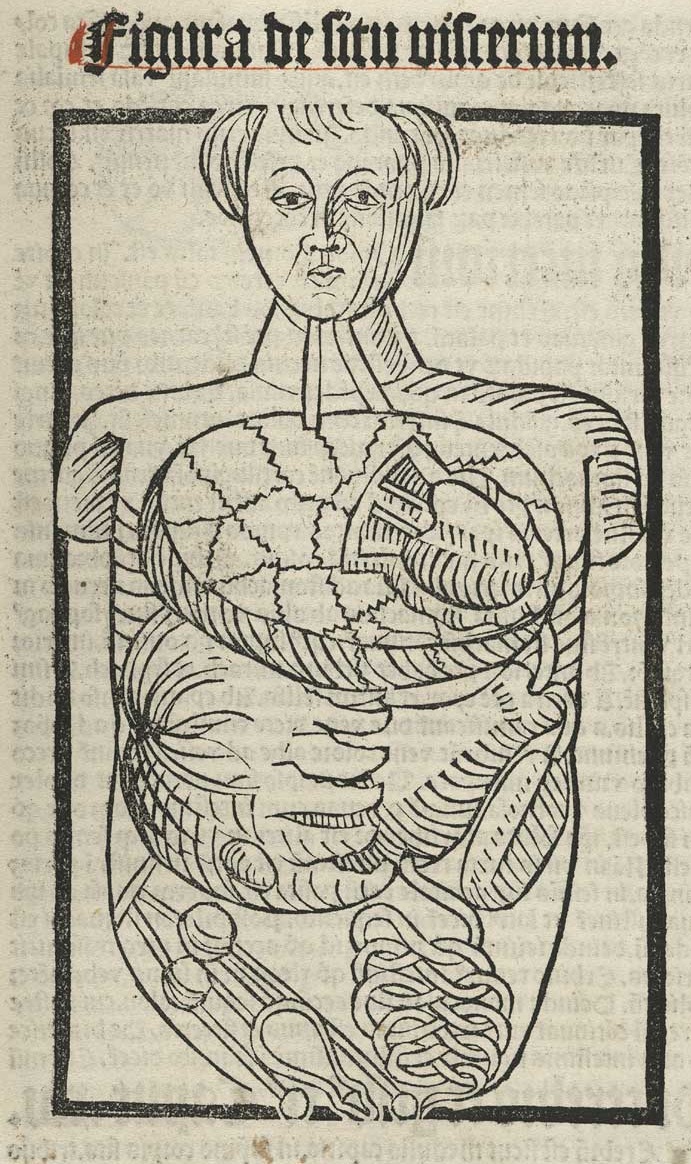
    Hundt_p119

    Magnus Hundt (1449-1519),  Antropologium de hominis dignitate…, printed in Leipzig in 1501 by Wolfgang Stoeckel. 

    Wonder

    http://www.nlm.nih.gov/exhibition/historicalanatomies/Images/1200_pixels/Estienne_p043.jpg

    Charles Estienne (ca. 1504-1564), De dissectione partium corporis humani libri tres, published in Paris and printed by Simon Colinaeus in 1545.


  • Atomic- , Vacuum- , & Solar-Powered Dirigibles with Built-in Airports–Bits of a Bad Historic Future

    JF Ptak Science Books   Post 1487

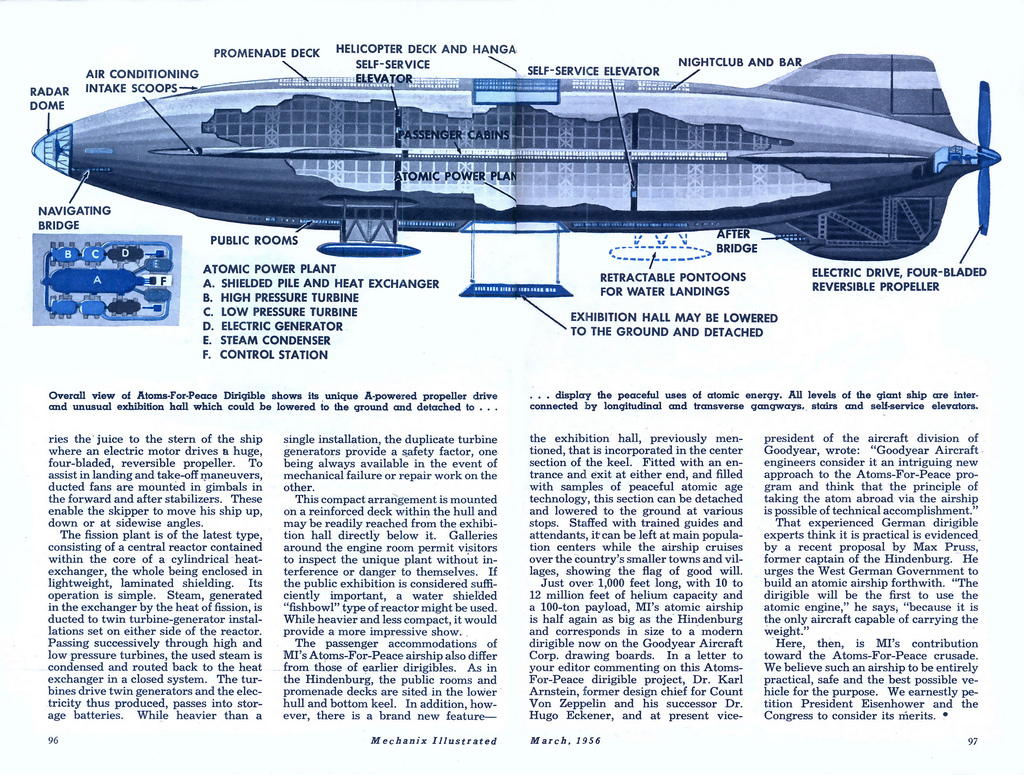
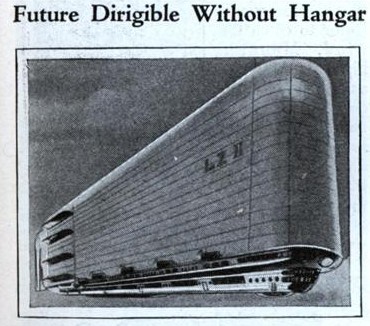
    A post (“Nuclear Everything”) over at Dark Roasted Blend that featured a magnificent and stodgy atomic-powered zeppelin pushed me into this short visual note on differentially-powered airships, and then in general about airships with airports on them. (There’s a whole other category for planes-of-tomorrow that were so enormous that they had landing strips on their wings, but that’s another story.)

    And they remind me of things that just aren’t “right”, because these things just weren’t.  I’m not sure why, but I’m drawn into an old story about the legendary Charlie Goodnight, Texas pioneer, one of the creators of the idea of the cattle drive (the Goodnight-Loving Trail), a man who lived an extraordinary and powerful life.  He lived for a long time, too, from 1836 to 1929 (almost to the year of the birth of Larry McMurtry, who told a version of Goodnight’s story so spectacularly well in Lonesome Dove), well into a future so far advanced from the year of his birth that he could scarcely have imagined it.  Anyway, towards the end of his life, in 1916, Goodnight had the idea of making a movie of the Old West that included a “final” Indian buffalo hunt.  I’ve seen the film, and it is a fascinating, heartbreaking, wonderful/awful thing, that somehow might appeal to almost no one.  It certainly didn’t appeal to the folks at the time looking for a cowboy film, because much like Mr. McMurtry’s cowboys, Goodnight’s reality didn’t much resemble the cowboys that the public wanted to see.  In a sense Goodnight lived beyond the history that he so much helped to create, and that his old, passed “present” was something that the people in his future really didn’t want to recognize. Then of course one of the things that made it all seem “not right” to me was seeing a vignette of Goodnight entering into one of the scenes, in  a car, making the whole thing a little spooky.

    First up is this mammoth flying advertisement to both peace and war, a nuke-powered dirigible proposed by Eisenhower in 1953 as part of the Atoms-for-Peace push, a move which by this point was already entirely too late.

    Atom everything zep for peace

    For some reason it was seen as a good idea to have a detachable convention hall built for the airship. \

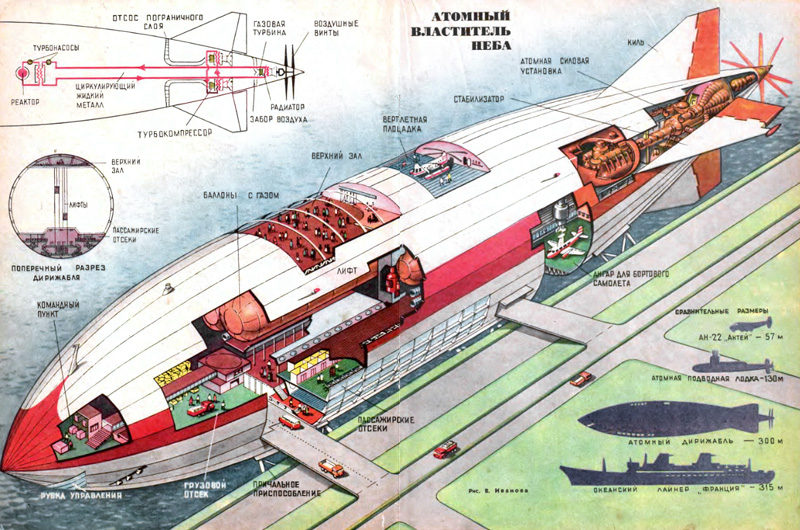
    And of course there is no greater element of a Something-for-Peace anything unless there was a competing idea, as seen in this mammoth Soviet atomic zeppelin, a ship completely absorbed in being bigger than the big thing that it already was:

    Atom everything zep

    At 300 metres this monster had room enough for virtually anything, though it didn’t have the retractable/detachable convention hall–it did however have a small airport. 

    Another dirigible approached the airport-on-board idea, but preferred solar power for its energy source.


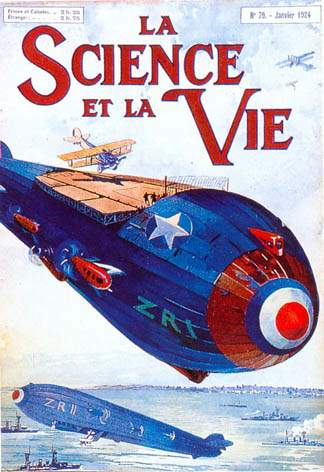
     The magnificent possible, 1924, saw another kind of airborn airport:

    https://historyofideasblog.com/a/6a00d83542d51e69e2012875ea3636970c-pi

    Guido Tallei’s 1932 Diri-Disk was a combination airplane/dirigible, and looked as though it could harbor an expansive airport on its NCC-1701-like wing, but didn’t, alas:

    Konstantin Eduardovich Tsiolkovsky (1857-1835), the Russian/Soviet space pioneer who was nearly without peer (and who somehow survived the bloodlust of Stalin which sucked up and murdered so many of his scientific colleagues),  stepped outside his spaceflight bubble to write about this monster with collapsing sheathing:

    https://historyofideasblog.com/a/6a00d83542d51e69e20128769ed30d970c-pi

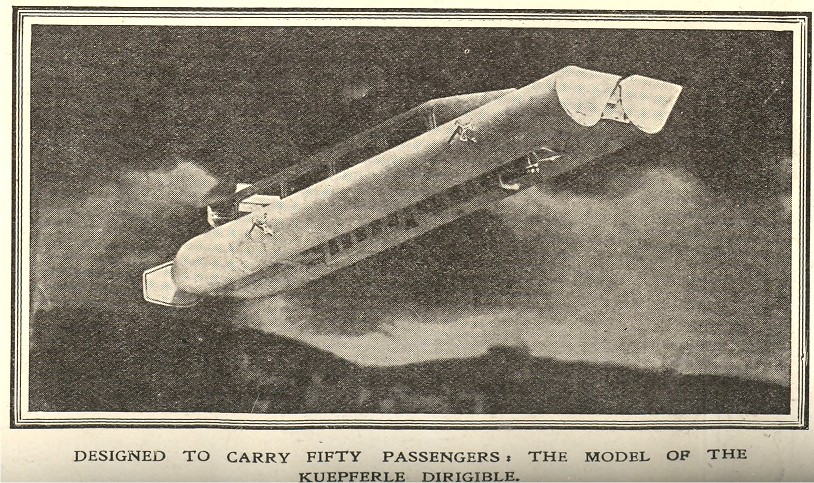
    The Kueperle dirigible, planned in 1909, was nothing if not pretty, and pretty is pretty much what the whole thing consisted of:

    https://historyofideasblog.com/a/6a00d83542d51e69e2012875ea2c87970c-pi

    And lastly, this example of the tracked airship–this must have been a popular notion because I’ve seen perhaps 15 different plans and I don’t spend much time at all reading in this area.  But harnessing the power of the balloon or dirigible or (kite!) whatever to a track system seemed to be a good idea, once upon a time:


  • Strange Things in the Sky Department: the Sky-borne Seat of All Wisdom in the 12th century

    JF Ptak Science Books   Post 1486

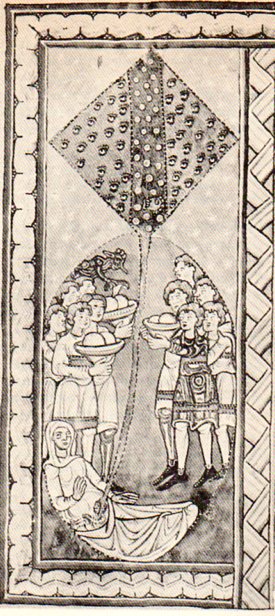
    Hildegard of Bingen (ca. 1098-1179) was a polymathic religious visionary1, composer and writer who was a well-know intellectual whose work attracted the attention of people at all levels, not the least of which were several popes  In one version of the manuscript of her 150,000-word work, Scivias (Scito vias Domini, or “Know the Ways of the Lord” ) we find the following illumination, which is basically an image of the object that contains the nameless stuff of the human soul:

    Sky strange hildegard492
    The image above—from the Wiesbaden manuscript and unfortunately only in a black-and-white, and found in Charles Singer’s From Magic to Science (1928)2–shows Hildegard’s vision of the soul entering the body. (There’s a wide range of opinion concerning how much influence Hildegard had on these images—some say that she sketched out the outlines, or directed the illuminator, or had some sort of hand in the construction of the image, all with varying levels of involvement.3)

    Sky strange hildegard493

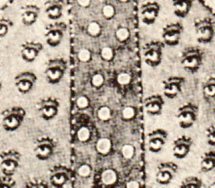
    It is an extraordinary thing, trying to represent what gives the human-ness to people as seen from a 12th-century perspective, and in Hildegard’s version/vision it is the soul, the very essence of the birth and death cycle of human nature.  It is resident as we see within a special place in the sky, the “the wisdom of god” (Singer page 226), and it passes from the vault of heaven into the fetus while still within the mother’s womb.  It is in this square, evidently, that the essential matter of the creator can be found, and within that structure can be seen the essence of the stuff of human nature that is about to pass into the developing fetus through the tube-like connection. As Singer writes, quoting (loosely?) from the manuscript: “down this [the tube] there passes into the child a bright object, described variously as ‘spherical’ and as ‘shapeless’ which ‘illuminates the whole body’ and becomes or developes into the soul.” (Singer, p. 226).

    In the frontispiece to another ms of Scivias, we see Hildegard herself sitting and making a sketch on a wax tablet (a sort of Medieval chapbook, or hornbook, or slate/charcoal sketchpad that could be reused), showing that the images she created were the product of a higher source, of light from another metaphoric vault:

    Strange sky--hildegard

    Notes

    1. Hildegard said that she had these vision,s from a very early age, beginning at about 3.

    2. This manuscript was removed from Wiesbaden during WWII and “sent to Dresden for safekeeping”, where it subsequently “disappeared”. “Destroyed” is more like it, as Dresden of course was the scene of an enormous firebombing campaign in the last days of the German involvement of WWII. There are still hopes that the ms lives somewhere in someone’s grandfather’s attic, perhaps taken in the third week of February 1945 as war booty, and then forgotten. “You guys burnt the place down, turned it into a single column of flame. More people died there in the firestorm, in that one big flame, than died in Hiroshima and Nagasaki combined.” –Kurt Vonnegut, Jr

    3. Historian of science Charles Singer and medical anomaly writer Oliver Sacks have both made strong cases for Hildegard to have been a migraine sufferer, though they do explicitly state that given that as the case it does not necessarily affect the vision that she had.

    As found in the Wikiu article on Scivias:” Some authors, such as Charles Singer, have suggested that the characteristics of the descriptions of the visions and the illustrations, such as bright lights and auras, imply they may have been caused by scintillating scotoma, a migraine condition.[25] Oliver Sacks, in his book Migraine, called her visions “indisputably migrainous,”[26] but stated that this does not invalidate her visions, because it is what one does with a psychological condition that is important.[27] The resemblance of the illuminations to typical symptoms of migraine attacks, especially in cases where it is not precisely described in the text, is one of the stronger arguments that Hildegard herself was directly involved in their creation.[28]

    It has also been suggested that the visions may have been due to hallucinogenic components present in ergot, common in that area of the Rhineland, at certain times of the year.[29]”

    The contents of Scivitas: