A Daily History of Holes, Dots, Lines, Science, History, Math, Physics, Art, the Unintentional Absurd, Architecture, Maps, Data Visualization, Blank and Missing Things, and so on. |1.6 million words, 7500 images, 4.9 million hits| Press & appearances in The Times, Le Figaro, Mensa, The Economist, The Guardian, Discovery News, Slate, Le Monde, Sci American Blogs, Le Pont, and many other places… 5000+ total posts since 2008.

  • Five Scarce Works by W.Edwards Deming

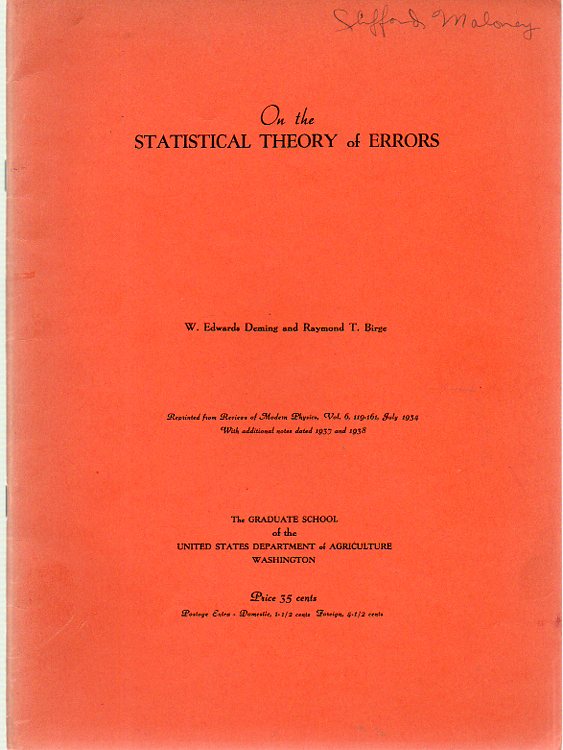
    Deming with Raymond T. Birge, “On the Statistical Theory of Errors”, offprint from Reviews of Modern Physics, volume 6, pp 119-181, July 1932, with additions and corrections dated 1937 and 1938.  “Summary. Long recognized as a leading proponent of statistical sampling and approaches to quality improvement, Deming led major efforts to bring statistical approaches and methods to bear on problems in government, science and industry.”

     Deming612

    • “In 1934, Deming published, jointly with the UC Berkeley Physicist Raymond T. Birge, an influential paper “On the Statistical Theory of Errors.” This review paper brought the methods of Fisher, Neyman and Pearson (q.v.), and Jeffreys (q.v.) to a broad audience of American physical Scientists. It was reprinted with additional notes in 1937 by the Graduate School of the USDA, and it served effectively as a textbook for over a decade. In correspondence with Deming, Fisher was generally quite complimentary, although in a 1940 letter to Maurice Frechet (q.v.) about Deming and Birge, Fisher complained that he found “these writers very often obscure.” This material also made its way into Deming’s mimeographed lecture notes on least squares which first appeared in 1938, which he later turned into the 1943 book on the adjustment of statistical data.”–Stephen E. Fienberg and Stephen M. Stigler, “W. Edwards Deming”, from StatProb, the Encyclopedia sponsored by the Statistics and Probability Societies

    Deming, W. Edwards and Raymond J. Jessen, et al. “On a Population Sample for Greece”. Offprint: Journal of the American Statistical Association, September 1947, vol 42, pp 357-384. Original printed wrappers. Very Good.  Describes a landmark effort to ascertain the fairness of the 1946 Greek elections through statistical means (this begun with the “report of the Allied Mission to Observe Greek Elections” US Dept of State, publication 2522, 1946). 

    Douglas Scates and Deming. “Education in Statistics for Participation in Current Affairs”. Offprint: The School Review, vol LVI, May 1948, pp 262-9. Yellow wrappers. Former owner’s name rubber stamped twice on cover.

    Deming and Willard Simmons. “On the Design of a Sample for Dealer’s Inventories”. Offprint: Journal American Statistical Association, March 1946, vol 41, pp 16-33. Original wrappers. VG/Fine.

    AND: sample survey–”Agenda for Meeting with XYZ Railway”. (“Problem…re-stated by statistician”: what will be the annual loss that will accrue if railways merge?. 11X8.5”, 3 leaves, offset from typed originals. Letterhead of Deming, “Consultant in Statistical Surveys” from his upper NW D.C. home address. VG.

    The five:  $600

    ·Posted by :

    ·in:

  • An Early and Full Computing Bibliography by a Computing Pioneer, 1954

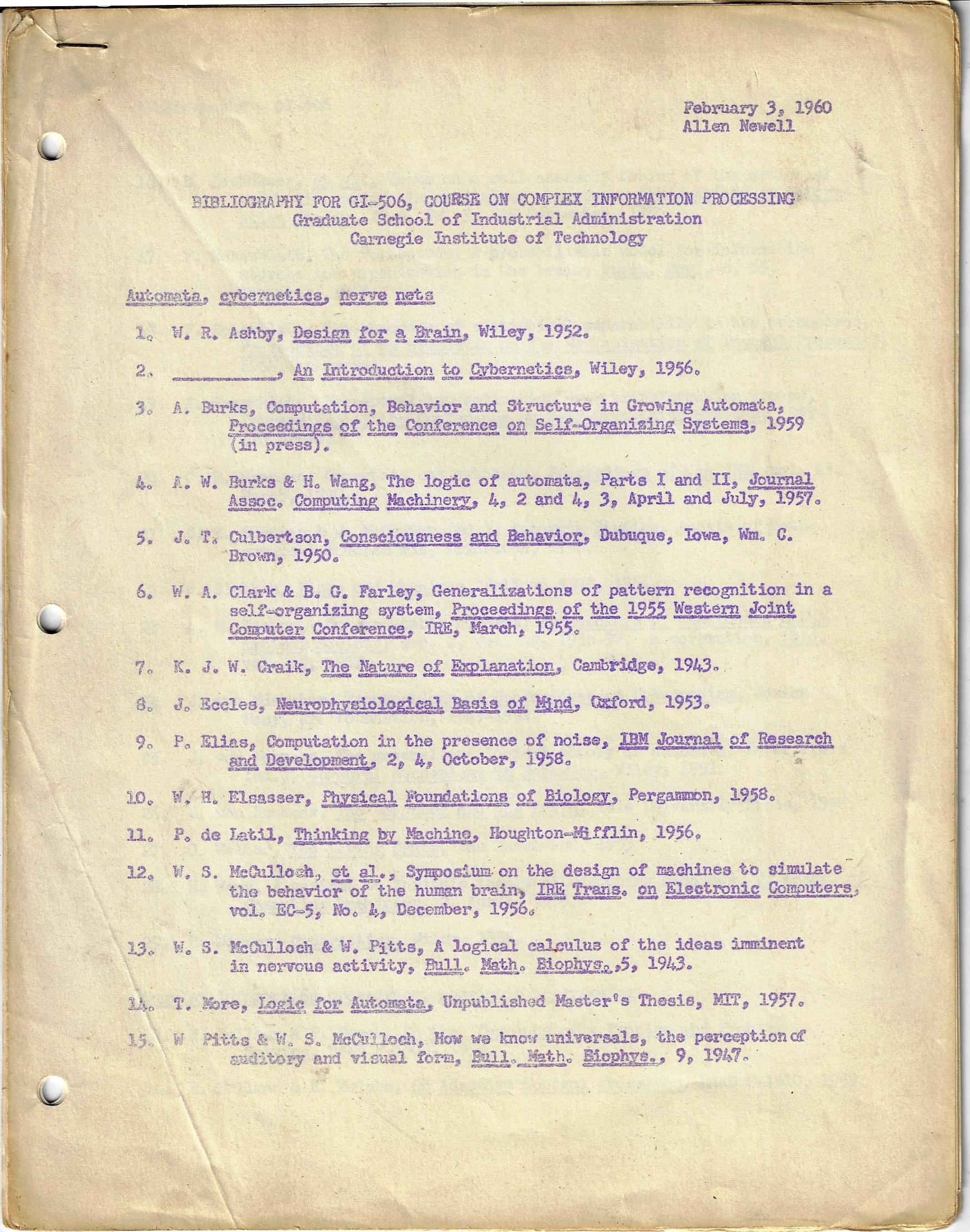
    (Allen Newell) “Bibliography for GI-506, Course on Complex Information Processing, Graduate School of Industrial Administration, Carnegie Institute of Technology”, February 3, 1960. 11×8.5″, mimeographic product, 12pp, This document is a rather full bibliography of 191 items, which for my reading through this period is pretty impressive.  Staple-bound, three-ring punched. Scarce.  SOLD


    Newell

    “Allen Newell (1927 – 1992) was a researcher in computer science and cognitive psychology at the RAND Corporation and at Carnegie Mellon University’s School of Computer Science, Tepper School of Business, and Department of Psychology. He contributed to the Information Processing Language (1956) and two of the earliest AI programs, the Logic Theory Machine (1956) and the General Problem Solver (1957) (with Herbert A. Simon)…[He founded] the artificial intelligence laboratory at Carnegie Mellon University and produced a series of important programs and theoretical insights throughout the late fifties and sixties.” –Wiki

    Some of the awards bestowed on Allen Newell include:

    • 1975 — A. M. Turing Award (with Herbert A. Simon), Association for Computing Machinery for their basic contributions to artificial intelligence and the psychology of human cognition

    • 1976-77 — Guggenheim Fellowship, John Simon Guggenheim Memorial Foundation

    • 1980 — First President, American Association for Artificial Intelligence

    • 1981 — Charter recipient of the Computer Pioneer Award from the IEEE Computer Society


    ·Posted by :

    ·in:

  • Gilbreth on Making U.S. Hospitals More Efficient: “the entire structure upon which hospital management is built is wrong” (1914)

    Three rare papers by Frank Gilbreth and (the second) Gilbreth and his wife, Lillian .M. Gilbreth (Ph.D.). The three papers: $800

    First paper:

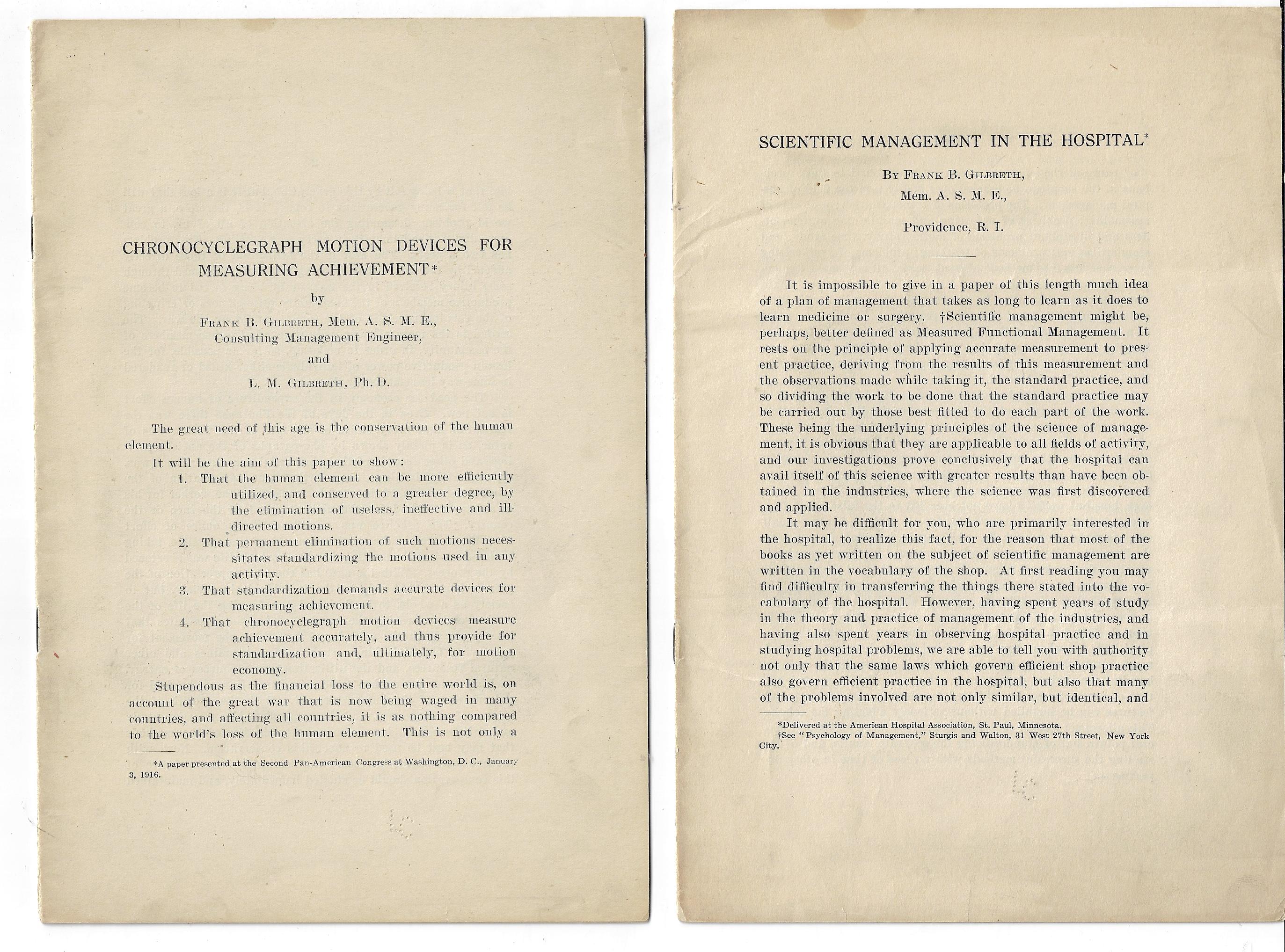
    Frank B. Gilbreth, “Scientific management in the hospital.” (“Delivered at the American Hospital Association, St. Paul, Minnesota”). 1914  (Scott Goodwin, in Mapping the Path to 21st Century Healthcare: The Ten Transitions Workbook, notes this paper as being published in 1914),  9.75 x 6.5″ , 10pp, paginated (1)-10. Original self-wrappers , with no “cover” per se. Condition:  There are two very old horizontal folds in the pamphlet, the indentation from which are almost indiscernible. Provenance: Library of Congress, with their 6mm “LC” perforated stamp on the front page, and the LC surplus/duplicate rubber stamp on the rear page. here is also a very faint and small rubber stamp on the bottom of page 2 stipulating “Gift/Author/[illegible]/191(6?)   There is no indication as to who published this paper, though I suspect it was by the Transactions of the American Hospital Association, vol. 16, for their Sixteenth Annual Conference, and printed on pp 483-492. This offprint version is mostly the same as the version that would be printed in the journal, except that the journal version has an organizational chart, and this paper does not. Overall, near-Very Good.  Scarce. 

    Gilbreth paper

    Frank Gilbreth was a pioneer in scientific management–some think of him (and later, Gilbreth and his wife) along similar lines as F.W. Taylor, though the major difference that I can see is that Taylor would measure efficiency differently, using his methods to make the worker more effective by controlling his action; Gilbreth looked more at the methods and materials, and tried to achieve more or less the same results in efficiency though in a more worker-friendly attitude. 

    In this paper, Gilbreth makes a very very wide statement on how U.S. hospitals could benefit from his motion and materials analysis. His assertion was sort of remarkable, made in the closing sentences of the paper: 

    “Scientific Management will cause elimination not only of waste of materials, but of waste of human effort, which is, in the final analysis, the most pitiful waste of all.
    When your management becomes a science, there will result greater efficiency in you as individuals, and in the great work of the hospitals to which you all devote your lives.”

    “We have been very fortunate in obtaining the attention and interest of such well-known leaders as your President, Dr. Howell, and some of the other leading surgeons of this and other countries; but we have not, as yet, been able to obtain any action to amount to anything, because of the fact that the entire structure upon which hospital management is built is wrong. As the incentive, so will the result be, sooner or later. The incentive necessary to adopt the best from the industries does not exist at present.”

    Also from the Gilbreth paper:

    • ‘There are several concessions you must make at the outset before you can expect to do any valuable work in introducing the science of management into the hospitals. The first is you must submit to having accurate measurement applied to your present methods and practices. The second concession that must be made is the willingness to allow a man not trained in surgery to apply the measurement and determine the resulting standard. We can show you pictures which illustrate plainly the fact that standardization such as used under scientific management is today practically unknown…especially in the operating room.”
    • ‘When your management becomes a science there will result greater efficiency in you as individuals and in the great work of the hospitals to which you devote your lives’’.

    “The Gilbreths’ primary focus was on work performance and worker satisfaction. They conducted pioneering research in the fields of time and motion study. This covered the livelong search for ‘‘The One Best Way’’ in organising and executing work flows and processes…”  See: Frank and Lillian Gilbreth: scientific management in the operating room A Baumgart,1 D Neuhauser2 http://citeseerx.ist.psu.edu/viewdoc/download?doi=10.1.1.1023.2409&rep=rep1&type=pdf

    Second Paper:

    Frank B. Gilbreth and L.M. Gilbreth, “Chronocyclegraph Motion devices for Measuring Achievement” (“A Paper presented at the Second Pan-American Congress at Washington, D.C.m January 3, 1916″). 9.75 x 6.5”, 14pp.  Original self wraps (as above). This paper was written with Gilbreth’s wife, Lillian, who had just been awarded a doctorate in psychology and who was also one of the first women to practice in the U.S. with a doctorate in that field.) Condition:  There are two very old horizontal folds in the pamphlet, the indentation from which are almost indiscernible. Provenance: Library of Congress, with their 6mm “LC” perforated stamp on the front page, and the LC surplus/duplicate rubber stamp on the rear page. here is also a very faint and small rubber stamp on the bottom of page 2 stipulating “Gift/Author/[illegible]/1916”. 

    • “In the early 20th century, efficiency expert Frank Gilbreth used still and motion-picture cameras in place of a stopwatch to try to improve the efficiency, and thereby the effectiveness, of surgery.
    • “ One of its key figures was the industrial efficiency expert Frank Gilbreth (who) employed still and motion-picture cameras in his measurements, and he expanded his visual efficiency services — dubbed “motion study” — from industrial settings to the medical profession in the early 1910s. When he gained access to hospitals, Gilbreth transformed their operating rooms into efficiency laboratories, covering all available surfaces with gridded lines, and requiring the masked surgeons and nurses to don numbered or lettered caps to aid in his analysis of their movements across the axes of the surgical space…”
    • “Surgeons saw in motion-based efficiency study the potential to reduce, through faster operating procedures, their patients’ exposure to what was at the time a leading cause of patient deaths: ether. Furthermore, they found in the process both the challenge and assurance that the outcome of a surgical intervention lay quite literally in their hands. Improving the efficiency and precision of the surgeon was as important as ensuring the quality of the tools he held.”
    • Quotes from: Gainty, Caitjan, “Mr. Gilbreth’s Motion Pictures — The Evolution of Medical Efficiency”.The New England Journal of Medicine; Boston Vol. 374, Iss. 2,  (Jan 14, 2016): 109-111. 

    Third paper:

    Frank Gilbreth and Lillian Moller Gilbreth, “Motion Study and Time Study Instruments of Precision”. 9×6″, with 11 illustrations of the equipment and film samples. Printed 1915. Provenance: Library of Congress, with their 6mm “LC” perforated stamp on the front page, and the LC surplus/duplicate rubber stamp on the rear page. here is also a very faint and small rubber stamp on the bottom of page 2 stipulating “Gift/Author/[illegible]/1916”. 

  • A Great Second Volume of the First “Popularly-Published Computer Magazine (1953)

    Computers and Automation, published by Edmund C. Berkeley & Associates, NYC. 10.75×8.25″, 8 issues for 1953, complete. 338pp, illustrations, advertisements.  Bound in cloth. Provenance: U.S. Air Force AEDC Library, and then the Library of Congress. Tight copy, with a few internal stamps from the USAF and a LC surplus/duplicate rubber stamp/ VG copy. Includes significant contributions by G.M. Hopper, E. Berkeley, George Boehm, Fletcher Pratt, and many others.  Scarce.  SOLD

    Computers and Automation, the brainchild of Edmund Berkeley, was the first popularly-published  magazine published regarding the computer, its applications, it programming, and really just about everything else.  (It appeared seven years after the Mathematical Tables and Aids to Computation  was published in 1943, almost entirely to the mathematics and engineering communities.) CAC was published by Edmund Berkeley & Associates in NYC, beginning its publishing journey as The Computing Machinery Field, its name changing to Computers and Automation in February 1953 (in volume 2, number 2).   All issues have some fair space devoted to advertising, even though the issues generally ran between 32 and 40pp. Berkeley was a  mathematician, engineer and computer pioneer, but he also had a pretty large taste for making these interests pay–which was essential, as the original prxcint runs were not very large, though his advertisers were impressive. (According to the first issue, approximately 1200 people were on the mailing list for the journal, with around 2000 issues being printed each number. All told, this is not a large print run, and thus not many of the early issues have survived.)  He was not averse to being somewhat outre with his journal—in addition to having contributors like Grace Hopper and Alton Householder, he also had Fletcher Pratt and Isaac Asimov writing some pretty arresting pieces from the SciFi/Futurama point of view.    
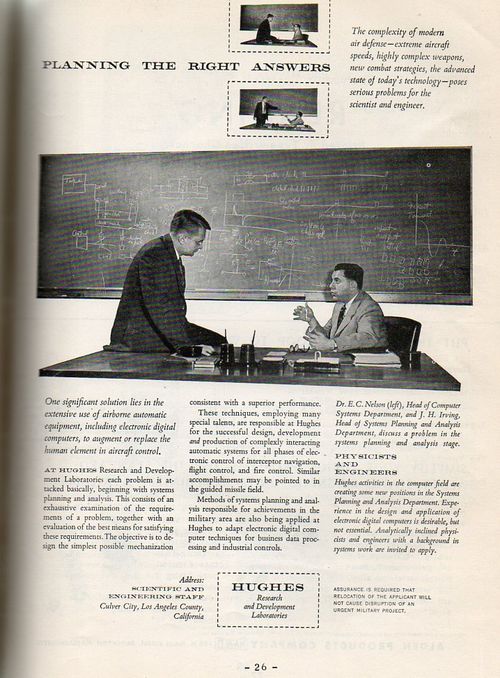
    Computer history083

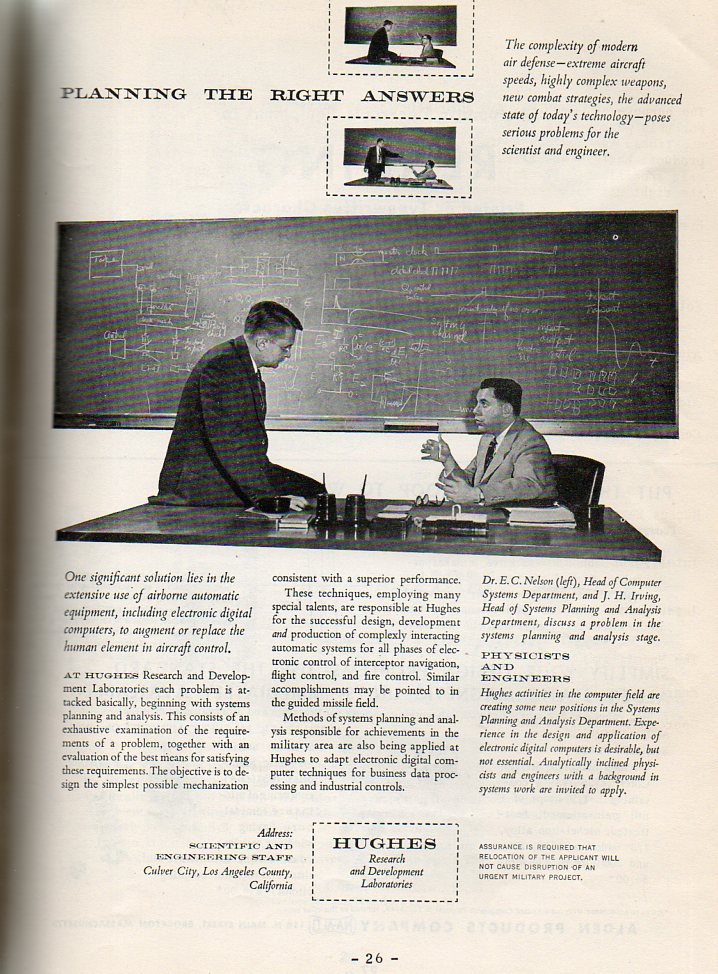
    A Note on the Advertisements: in short, they’re wonderful. For example, on the back cover of vol2/1 is Edmund Berkeley & Associates “SMALL ROBOTS”, advertising “Simon, the Mechanical Brains”, “Squee, the Robot Squirrel”, and other gadgets. To give you an example the other ads in this issue alone are for “The Circle Computer”, “General Ceramics Ferramic Cores”, “Magnetic Metals Co. Amplifier Cores”, Ross Ashby’s “Design for a Brain”, Consolidated Engineering’s SADIC System, Monroe Calculator’s Monrobot Electronic Calculator, George Philbrick’s “Computor (sic) products”, and a lovely two-page spread for Remington Rand. Further into the year are ads for Burroughs, IBM (604 ands 607), Electronic Associates Inc, Prokar capacitors, and many others.

    Some of the subjects include: The ERA 1103 computer, NIMWIT, Applications of the Computer, what the computer *is*, Admiral Grace Murray Hopper’s compiler, mechanical translation, Harper’s subroutines, the cost of coding, computer “self-repair”, automation at Ford, and so on.  Also includes perhaps the earliest announcement of the first all-transistor computer (October 1954, IBM’s “new experimental transistorized computer” , the earliest (?) printing of Asimov’s Three Laws of Robotics in a scientific journal, and more.

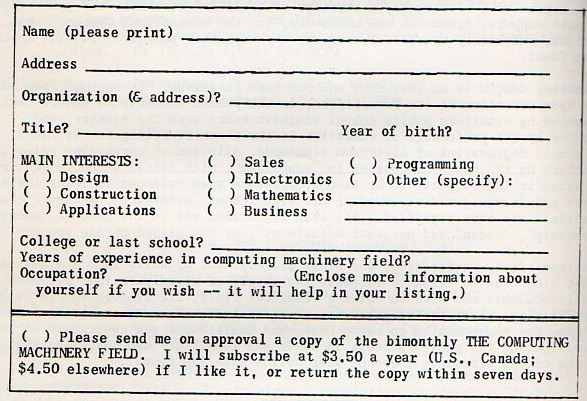
    Each section generally has three of the following categories (per issue) : computer glossary, roster of member organizations, who’s who, an annotated books and journal section, and other aligned concerns.  For example, there’s this bit, an application (cut-out) card for “Who’s Who in the Computing Field for December 1952”–utterly simple, it seems as though anyone who filled out the card was in, the “who’s who” part of this that we normally celebrate with fame or achievement really was just telling the rest of the people in the field who was exactly who.
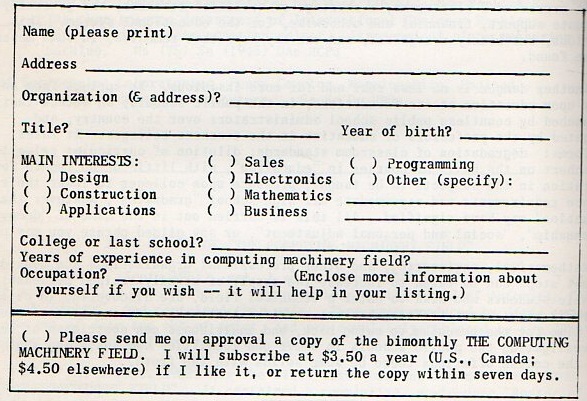
    Computer history084

    The contents:

    Volume 2/1, January 1953. 45pp.

    Householder, A.S. Brains, Electronic and Otherwise; Williams, S.B. (President, ACM) What Computers Do; Murphy, E.F. and E.C. Berkeley. Automatic Computers on Election Night.

    Volume 2/2 , March 1953. 37pp.

    Boehm, George A.W. Gypsy, Model VI, Claude Shannon, Nimwit and the Mouse; Paynter, Henry. Water and Computers; and the editor Berkeley, The Concept of Automation, and Berkeley (with Neil Macdonald, Berkeley’s other name). The ERA 1003 Automatic Computer

    Volume 2/3, April 1953. 40pp.

    Fletcher Pratt, The Art of Solving Secret Ciphers and the Digital Computer; Berkeley, Avenues for Future Development in Computing Machinery;  Gene Hegedus, Hungarian Prelude to Automation..

    Volume 2/4. May 1953. 33pp.

    Grace Murray Hopper,  Compiling Routines; A.D. Booth, Mechanical Translation; Marshall Stone,  Medical Diagnosis.

    Volume 2/5. July 1953.

    Yehosuha Bar-Hillel (the great logician),  Machine Translation; George Boehm, Robot Traffic Policemen; Rudolf Flesch,  How to Talk to Computers.

    Volume 2/6. September 1953.

    Tommaso Fortuna,  The Soviet Union: Automatic Digital Computer Research.; Wainwright, Lawrence Wainwright,  Digital Computer Questionnaire; and a general DISCUSSION: “How to Talk About Computers”, with GG Hawley, Samuel Scharff, C.B. Crumb, and EC Berkeley.

    Volume 2/7. October 1953. 36pp.

    Brown, David W. Brown Computers in the Factory; Neil (Berkeley) Macdonald,  The Flood of Automatic Computers. 

    Volume 2/8. November 1953. 40pp.

    John W.Carr  III. Who Will Man the New Digital Computers?; E.F. Cooley,  Electronic Equipment Applied to Periodic Billing; Glenn.Hagen,  Air-Floating: a New Principle in Magnetic Recording of Information.

    Volume 2/9 December 1953. 36pp.

    Clippinger, Richard Clippinger, How a Central Computing Laboratory can Help Industry; R.T. Wiseman, “Combined” Operations in a Life Insurance Company instead of “fractured operations”.

    These are the contents for 1953; the volume for 1954 bulks up a little, but is still under an inch thick.   The MTAC journal stays quite slender throughout its pre-1960 life (it has virtually no advertisement and is entirely academic), and there are more and more computer articles appearing in old stand-by associated journals like the Proceedings of the Institute of  Radio Engineers (which by 1959 will published a massive supplemental volume called “the Computer Issue” which I’ll talk about soon.  For the time being, I just wanted to make an inroad into this journal–I’ll expand on he articles in just a bit. 
    ·Posted by :

    ·in:

  • The Mechanization of Thought, featuring a Significant article by W. McCulloch (1958)

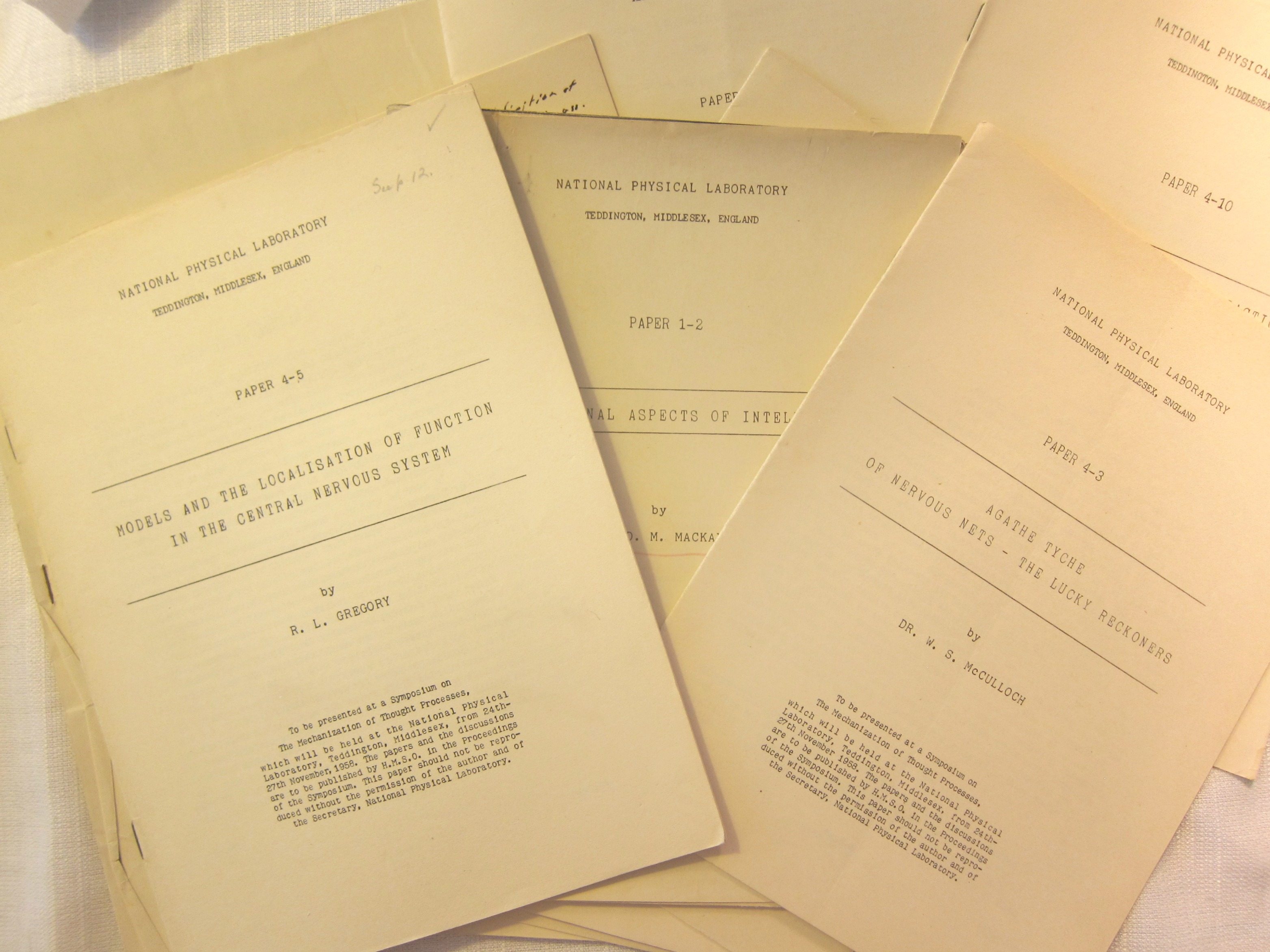
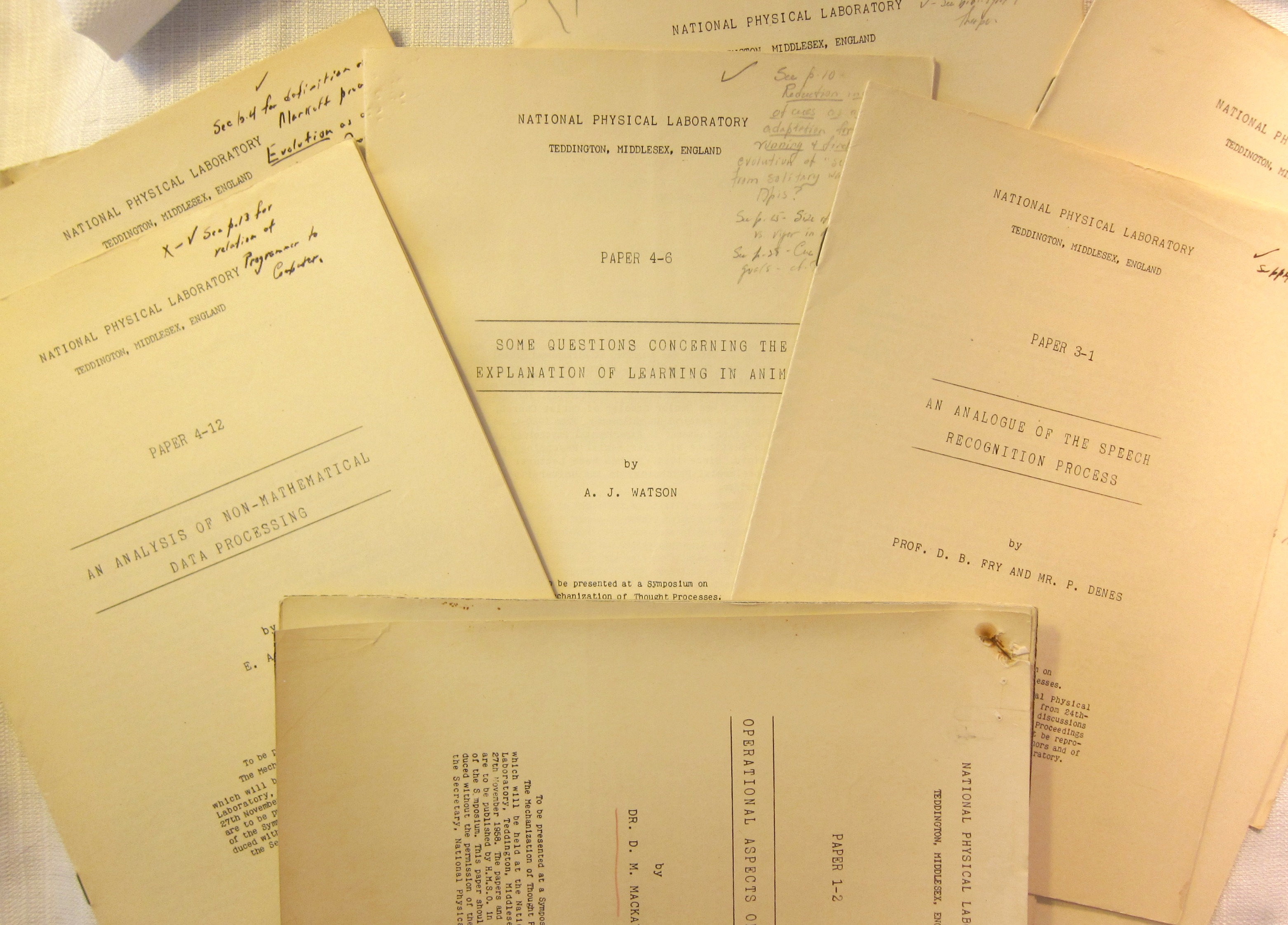
    The Mechanization of Thought Processes, Teddington, National Physical Laboratory. A collection of 12 preprints for papers presented at the symposium for November 27, 1958. No doubt these were distributed to attendees, to be read before the symposium began, as well as to all interested parties (I guess, though I’m not sure). Every paper here has some sort of notation on the front wrapper, usually in pencil but sometimes in ink; there are also notes in the papers themselves. I cannot recall the source for these papers, so I cannot say who the notes were made by, which is unfortunate, because they seem interesting to me (more so if we knew the author). VG condition overall. SOLD

      McCulloch

    Richard L. Gregory, In his book Odd Perceptions (Routledge, chap 6), remember this 1958 conference as the one which “launched a new way of thinking about brain functions and mind, in terms of neural nets and computing”, and mentioning papers by Minsky, McCarthy, Rosenblatt, Uttley, Selfridge. When Gregory got to the McCulloch paper (above), he calls it “the most memorable of them all”.

    Gregory wrote his recollection of Warren McCulloch, about to give his talk at the symposia and whose paper is offered below), asking his audience how many people had read his paper—with that, only a few hands were raised. Given the complexity of the paper and the newness of the ideas, McCulloch evidently was pissed enough to simply throw his lecture sheets in the air and abandoned his subject. )

    On the paper wrapper cover of each is printed “to be presented at a symposium on the Mechanization of Thought Processes”, National Physical Laboratory, Teddington. They would be published in Mechanization of Thought Processes: Proceedings of a Symposium Held at the National Physical Laboratory, London, Her Majesty’s Stationery Office, November, 24-27 1958, in two volumes, in 1959.

    • There were 32 papers overall from the symposium. Note: the notations for “Paper 3-6” relates to the section/paper number of the printed version of the symposium published in two volumes in 1959.


    The papers:

    McCulloch W.S., “Agatha Tyche: of nervous nets the lucky reckoners”, 24×17.5cm, 15pp. The cover has an old vertical crease, otherwise VG.

    “A magnificent piece of work called Agathe Tyche: The lucky reckoners offers a fair overview of muchof his philosophy with respect to ways of building reliable machinery from unsafe components. The classic by Cowan called Reliable Computation in the Presence of Noise and almost all of his later work on reliable computing was the result of McCulloch’s expansion of Von Neumann’s original concept.”–Roberto Moreno-Díaz (Instituto Universitario de Ciencias y Tecnologías Cibernéticas Universidad de Las Palmas de Gran Canaria), Neurocybernetics and Artificial Intelligence.

    “It took me 5 years to develop probabilistic logic sufficiently to handle two things: first, circuits which, like the respiratory mechanism, keep working despite common shift of threshold even under surgical anaesthesia, and second, by a proper segregation of the possible errors, circuits which suffered random but limited perturbations of excitation, threshold, and local synapsis, and to show in them a nonzero rate of error-free operation. You will find these tricks described in “Agathe Tyche”  “ McCulloch, in referencing von Neumann “ Probabilistic logic and synthesis of reliable organisms from unre­liable components” (1956). –McCulloch W. S., ”Reliable systems using unreliable units”, in: David McKenzie Rioch. & Edwin A. W. (eds.) Disorders of communication, 1964, p. 24.

    McCulloch _2_

    Also included:

    A.M. Andrews, “Learning Machines”, 24×17.5 cm 31pp., “Paper 3-6”. Very Good.
    H.B. Barlow, “Sensory Mechanisms, the Reduction of Redundancy, and Intelligence”, 24×17.5cm, 25pp, “Paper 4-1”.

    D.B. Fry and P. Denes, “An Analogue of the Speech recognition Process”, 24×17.5cm, 10pp, “Paper 3-1”. Near-fine copy, save for a note in pen on the front cover, and some extensive notes on two pages (6-7) also in pen.

    S. Gill, “Possibilities for the Practical Utilization of Learning Processes” 24×17.5 cm, 9pp

    R.L. Gregory, “Models and the Localisation of Function in the Central Nervous System”. 24X17.5cm, 13pp. “Paper 4-5”. VG

    P. Ladefoged, “The Perception of Speech”, 24×17.5cm, 13pp, “Paper 3-2”. Near-fine save for some notes in pen on the front cover (“evolution as a Markoff Process”.

    D.M. MacKay, “Operational Aspects of Intellect”, 24×17.5 cm, 16pp, “Paper 1-2”. This is no doubt an early photographic reproduction of the original paper, printed on one side only, and stapled at top-left. There are several ms notes through the text. Good.

    Newman, E.A. “An Analysis of Non-Mathematical Data Processing”, 24×17.5cm, 12pp., “Paper 4-12”. Notes in pen rather than the usual pencil, otherwise a VG copy.

    A.W. Uttley, “Conditional Probability Computing in a Nervous System”, 28x20cm. 27pp., Paper 1-5. Uneven tear in the cover at right-edge middle. Good.

    A.J. Watson, “Some Questions Concerning the Explanation of Learning in Animals”, 24×17.5cm, 30pp, “Paper 4-6”. Very Good.

    Whitfield, “Sensory Mechanisms and Sensations”, 28x20cm, 10pp, “Paper 2-6”. VG copy if not for ink underlining on page 9.

    ·Posted by :

    ·in:

  • Weighing the Earth in 1799

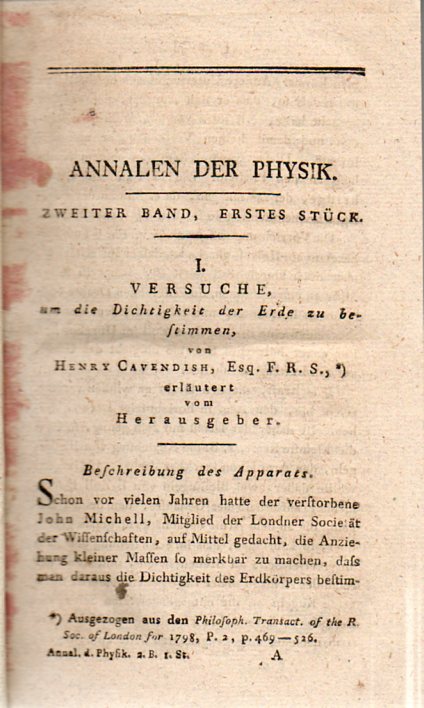
    CAVENDISH, Henry. “Versuche über die Dichtigkeit der Erde zu Bestimmen.” 1799, and published  in Annalen der Physik,edited by von Ludwig Wilhelm Gilbert, series I, volume 2.  120pp in this section, 488pp overall in in the entire volume, with 9 plates.  Cavendish’s paper occupies pp 1-62, with two plates  (the torsion balance of Michell shown on the plates). Condition:  Ex-libris Deutsche Akademie der Luftfahrtforschung, then Wright Patterson Field Library (USAF), then Library of Congress.  Library markings:  small gilt-stamped “Akademie der Luftfahrtforschung”, page edges stamped “Wright Field Library/Dayton, Ohio” on top and bottom. Contents quite nice.  $450

    Cavendish131

    In this experiment–the first appearance in German following the original paper “Experiments to determine the Density of the Earth” that appeared in the Philosophical Transactions in 1798.–the great and somewhat mysterious (and odd) Henry Cavendish determined to, of all things, weigh the Earth.  Now there are certain remarkable things to be achieved in the 18th century, and of course the idea of measuring the weight of the Earth was a high intellectual achievement.  He set off to measure the force of attraction between large and small lead balls using his dead friend John Michell’s torsion balance (which he had created in 1783), and using of course Newton’s laws showing that the force of gravity between two objects depends on their masses as well as the distance between them.  Michell had thought of the experiment years before but died before he could present; Cavendish carried on and up, and out. Mind he wasn’t the first on the spot, or the first with the idea–he was the first to complete it, though, taking the difference in the measures on the very sensitive balance from a distance using a telescope so as to not disturb the readings.  It was a lovely idea, and  a fantastic piece of work. 

    “Henry Cavendish had fitful habits of publication that did not at all reveal the universal scope of his natural philosophy. He wrote no books and fewer than twenty articles in a career of nearly fifty years. Only one major paper was theoretical, a study of electricity in 1771; the remainder of his major papers were carefully delimited experimental inquiries, the most important of which were those on pneumatic chemistry in 1766 and 1783–1788, on freezing temperatures in 1783–1788, and on the density of the earth in 1798.” (D.S.B. III, p. 155).

    ·Posted by :

    ·in:

  • On the Mechanical Handling of Statistics, 1926

    Victor Johns, “On the Mechanical Handling of Statistics”, an article in The American Mathematical Monthly, volume XXXIII, Number 10, December 1926.  Published by the Mathematical Association of America. 

    • The article occupies pp 494-502, with 10 small text photo illustrations of tabulating machines, and appears in the issue of pp 485-544.  Offered in the original printed wrappers. There is a small previous owner’s name rubber stamp on the top of eh front wrapper (F.A. Brandner”). A reference to this paper appears (with a short abstract) in B. Randall’s The Origins of Digital Computers: Selected Papers, as “an illustrated account of punched card machinery”. Also noted on pg 313 of James W. Cortada’s Before the Computer: IBM, NCR, Burroughs, and Remington Rand…

    Very Good condition.SOLD

    ·Posted by :

    ·in:

  • A Fundamental Paper in the History of Quantum Mechanics


    Bose-Einstein Statistics

    BOSE, S.N. “Plancks Gesetz und Lichtquantenhypothese”, (Planck’s Law and Light Quantum Hypothesis) in Zeitschrift für Physik , vol. 26, issue 1, pp. 178-181, 1924. Offered in the full volume, bound with volume 27, comprising 401+395pp.   Very pretty copy, in period cloth and marbled boards with cloth tips; institutional bookplate, and faded rubber stamp on the title page. About a fine copy. $1150

     “Discovery of new statistical counting rules for light quanta and a new derivation of Planck’s radiation law. Known as Bose-Einstein quantum statistics for particles with integer spins.” —Particle Physics: One Hundred Years of Discoveries

     “…the work is of the uttermost significance. As Bose himself put it when writing to Einstein:

    “Respected Sir, I have ventured to send you the accompanying article for your perusal and opinion. You will see that I have tried to deduce the coefficient .. in Planck’s law independent of classical electrodynamics.’

    “Not only did Bose try, but he succeeded spectacularly, deriving the law from which quantum mechanics sprang without any recourse to classical physics.

    “When Einstein then extended this idea to describe the monoatomic ideal gas, he deduced the existence of an exotic state of matter that is now know as Bose-Einstein condensate.  Neither Bose nor Einstein would live to see this confirmed experimentally.  It took until 1995 for technology to catch up to the theoretical insight of these titans of physics.”–from the Wavewatching website, http://wavewatching.net/lost-papers

    BOUND WITH:

    • FERMI.  “Uber die Wahrescheinlichtkeit der Quantenzustande”, vol 26, pp 54-57
    • HEISENBERG. “Uber den Einfluss der Deforierbarkeit der Ionen auf optisch und chemische Konstantin III.” Pp 196-204
    • HEISENBERG. “Ueber eine Abanderung der frmalen Regeln der Quantentheorie…” Pp 291-308
    • BORN. “Uber Quantenmechanik”. pp 379-395.
    • Plus other contributions by Hhn/Meitner, Meitner, Gerlach, Frenkel, Freundlich, Schottky, and many others.
    • ALSO bound with, in volume 27:
    • EINSTEIN. “Zur Theorie der Radioemterkrafte”, pp 1-6. 
    • And other contributions by Geiger, Nordheim, Lande, Gans, Bose and others.  

    ·Posted by :

    ·in:

    —
  • Early Work on Color and Music


    TAYLOR, Sedley. “Analogy of Colour and Music”, in Nature, volume 2, February 24, 1870, in the letters to the editor section, p. 430, with two figures and a table. On the harmony in color and the harmony in music. In the original wrappers, removed from a larger bound volume.  Very crisp copy. Fine. $175   In 1875 Taylor published his work on this subject in a book, Sound and Music. According to Cyril Rootham (1920):

    “Sound and Music,” was… the earliest general exposition in short compass by a writer competent on both sides of the subject. An event which his characteristic energy rendered prominent was his invention of an apparatus which he named the phoneidoscope. It consisted essentially of a resonant cavity, with an aperture over which a soap-film was stretched: when the operator sang to it a note nearly in unison with the cavity, the aerial vibrations revealed themselves visibly in whirling movement of the coloured striations of the liquid film.”–quote via Wiki article on Taylor

    Taylor also translated Helmholtz’s 1862 sensation of tone, publishing it in 1875. 

    ·Posted by :

    ·in:

  • Submarine Anti Warfare Balinski Michel Et Al Final Report A Study Of Optimal Patrol And Transit Strategies In A Rect

    [SUBMARINE, Anti-, Warfare] Balinski, Michel, et al. Final Report. A Study of Optimal Patrol and Transit Strategies in a Rectangular Barrier Zone Using Mathematical Games. Written and produced by Mathematica, prepared for the Office of Naval Research, 1967. 77pp.

    • “The strategies available to a patrol sub seeking to maximize the probability of detecting a transistor in a rectangular zone are analyzed…” (Keywords identified: Bowtie Patrols, Matrix Games, Stationary Patrols, Optimal Straight Line transits.) WorldCat OCLC locates only one copy. $150 “Three classes of models are treated (1) fixed shape patrol patterns (e.g., Bow Tie with crossover angle to be optimized), (2) linear patrols with delays at a finite number of stations, optimization being over the delay time distribution, and (3) linear patrols with optimization over speed. In all the games analyzed, transitor strategies were also optimal for a suitably restricted class of transit lanes and speeds. The problem of securing first detection is considered where appropriate. The payoff function for most of the games is probability of detecting the transitor during the time interval necessary for a complete transit through the zone. Fixed radius of detection is assumed in the first two classes of model; dependence on speeds of both subs is assumed in the third. All three sets of assumptions point to the strategic merit lf linear patrols which have at least two widely differing speeds: in geometric terms the patrol pattern should be a sequence of localized delay patterns joined by high-speed straight-line segments.”-_WorldCat Identities.

    ·Posted by :

    ·in:

  • Rare Work by One of the Most Important Contributors to Modern Statistics

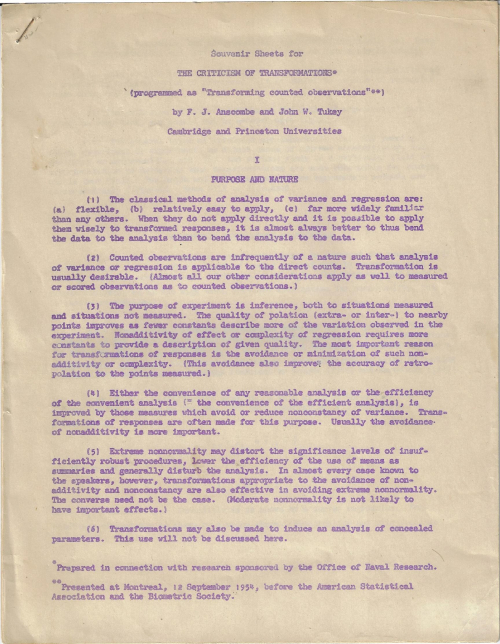
    John W. Tukey and F.J. Anscombe, “Souvenir Sheets for The Criticism of Transformations” with the continued title “(programmed as “Transforming Counted Observations”), “Souvenir Sheets” appeared for a talk at the American Statistical Association and Biometric Society, Montreal, September 12, 1954, the 114th annual meeting of the American Statistical Association. 11×8 1/2″, mimeographed sheets, stapled at top-left, 9 sheets, including two sheets of graphs. Very Good.  $250

    John Wilder Tukey (1915-2000) was a significant and prolific emeritus Princeton professor, and was considered to be one of the most important contributors to modern statistics.

    “He probably made more original contributions to statistics than anyone else since World War II,”– Frederick Mosteller, retired professor of mathematical statistics at Harvard University.

    “I believe that the whole country — scientifically, industrially, financially — is better off because of him and bears evidence of his influence,”–John A. Wheeler

    Tukey

    ·Posted by :

    ·in:

Recent Posts

Archives

Categories