A Daily History of Holes, Dots, Lines, Science, History, Math, Physics, Art, the Unintentional Absurd, Architecture, Maps, Data Visualization, Blank and Missing Things, and so on. |1.6 million words, 7500 images, 4.9 million hits| Press & appearances in The Times, Le Figaro, Mensa, The Economist, The Guardian, Discovery News, Slate, Le Monde, Sci American Blogs, Le Pont, and many other places… 5000+ total posts since 2008.

  • Otto Lilienthal and his Fabulous Ornithopter

    LILIENTHAL, Otto.  “Lilienthal’s Experiments in Flying”, in Nature, 12 December 1894, pp 177-179, with four photographic illustrations; offered in the weekly issue of pp 169-192.  Removed from a larger bound volume, with the scarce original printed wrappers (and ads).  Nice copy.  $150

    Lilienthal was an international authority on human flight, and was known to many as The Flying Man, and The Father of Flight, because, well, he flew. And he flew more often and with more recorded/documented successes in his non-powered flying machines than any other aviation pioneer of the time. In fact, he had a major influence on the Wright brothers (though not necessarily for his experimental data, which they abandoned after a while to create their own in their wind tunnel), with Wilbur Wright saying: “Of all the men who attacked the flying problem in the 19th century, Otto Lilienthal was easily the most important. … It is true that attempts at gliding had been made hundreds of years before him, and that in the nineteenth century, Cayley, Spencer, Wenham, Mouillard, and many others were reported to have made feeble attempts to glide, but their failures were so complete that nothing of value resulted.” (From the Wikipedia article on Lilienthal.)

    Lilienthal was well into making successful jumps/flights by this time, but would suffer his fatal fall in about two more years, dying August 10, 1896, after a series of 850′ flights.

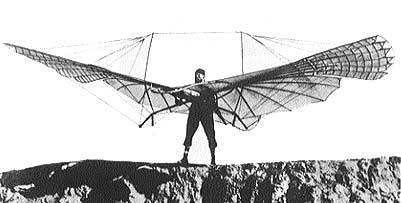
    This is an early appearance of Lilienthal in English, and also includes the famous picture of him with his ornithopter. 

    Lilienthal

  • The First Continental Review of Newton’s “Principia Mathematica…” AND the First Appearance of Locke’s “Essay Concerning Human Understanding” (1688)

    A Wonderful and Significant Double-First

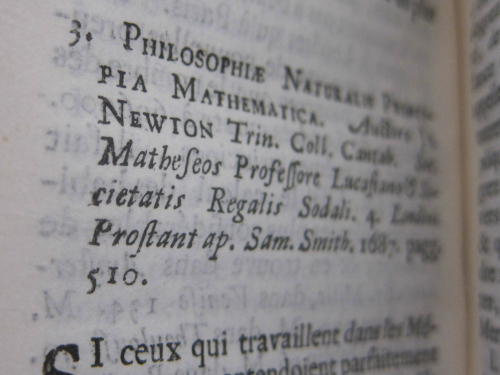
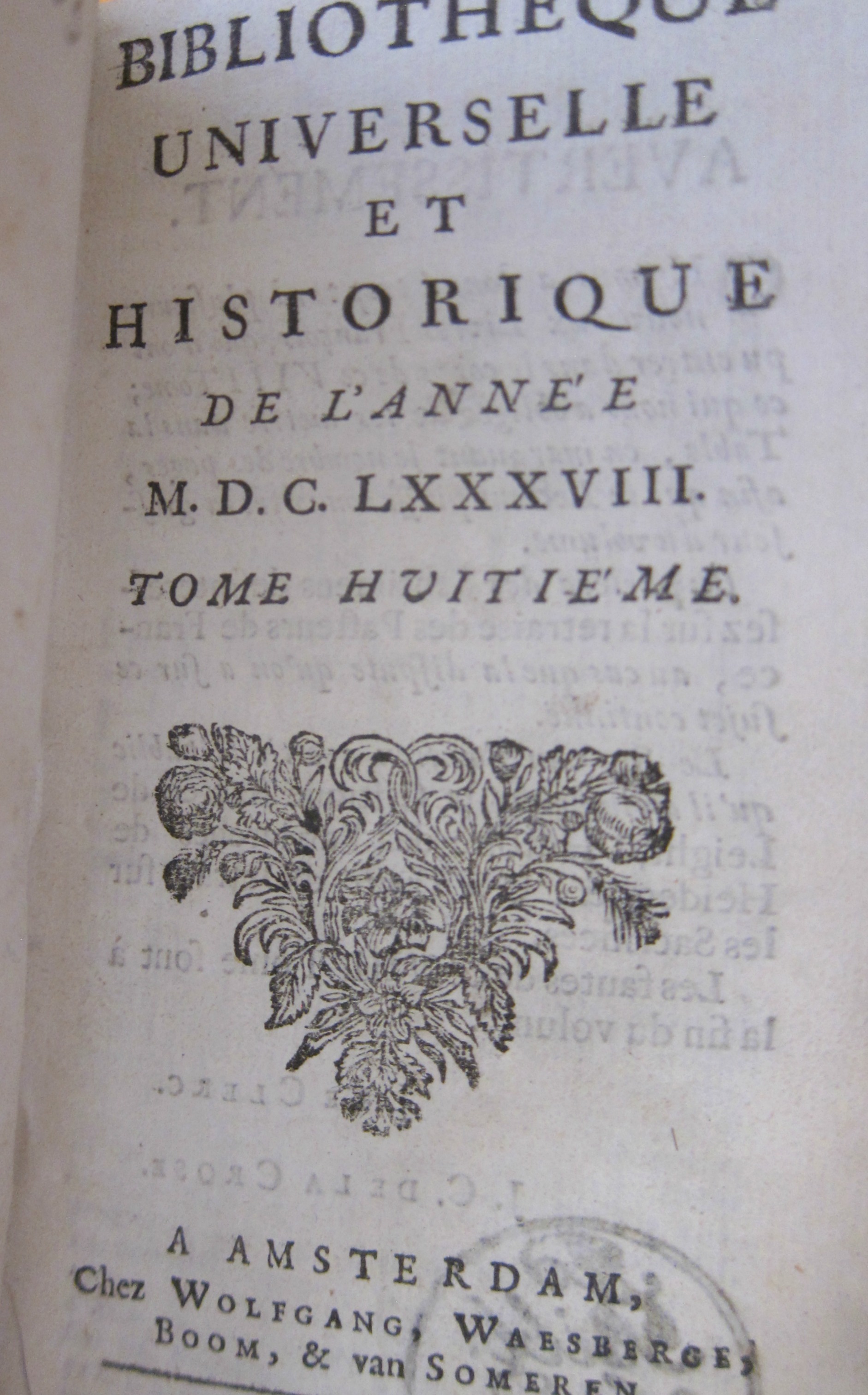
     [Newton, Issac]  Review of the Principia Mathematica, almost certainly by John Locke, “Philosophiae Naturalis Principia Mathematica. Auctore Js. Newton Trin Coll Cantab…”appearing in Jean Le Clerc and Jean Cornande de al Crose,  Bibliotheque Universelle et Historique de l’annee M.D.C. LXXXVIII. Amsterdam, Wolfgang Waesberge, Boom, and van Someren, 1688, volume 8. 144x85mm, (ii), (viii), 538, (xxii), (ii). The review of the Principia appears on pp 436-450, and runs about 2000 words.

    • First edition (or edition “i”,  meeting all points for the somewhat complicated printing history of the Bibliotheque, as found in  J.R. Milton, “Locke’s Publications in the Bibliothèque Universelle et Historique”, British Journal for the History of Philosophy, 05/2011, Volume 19, Issue 3). 
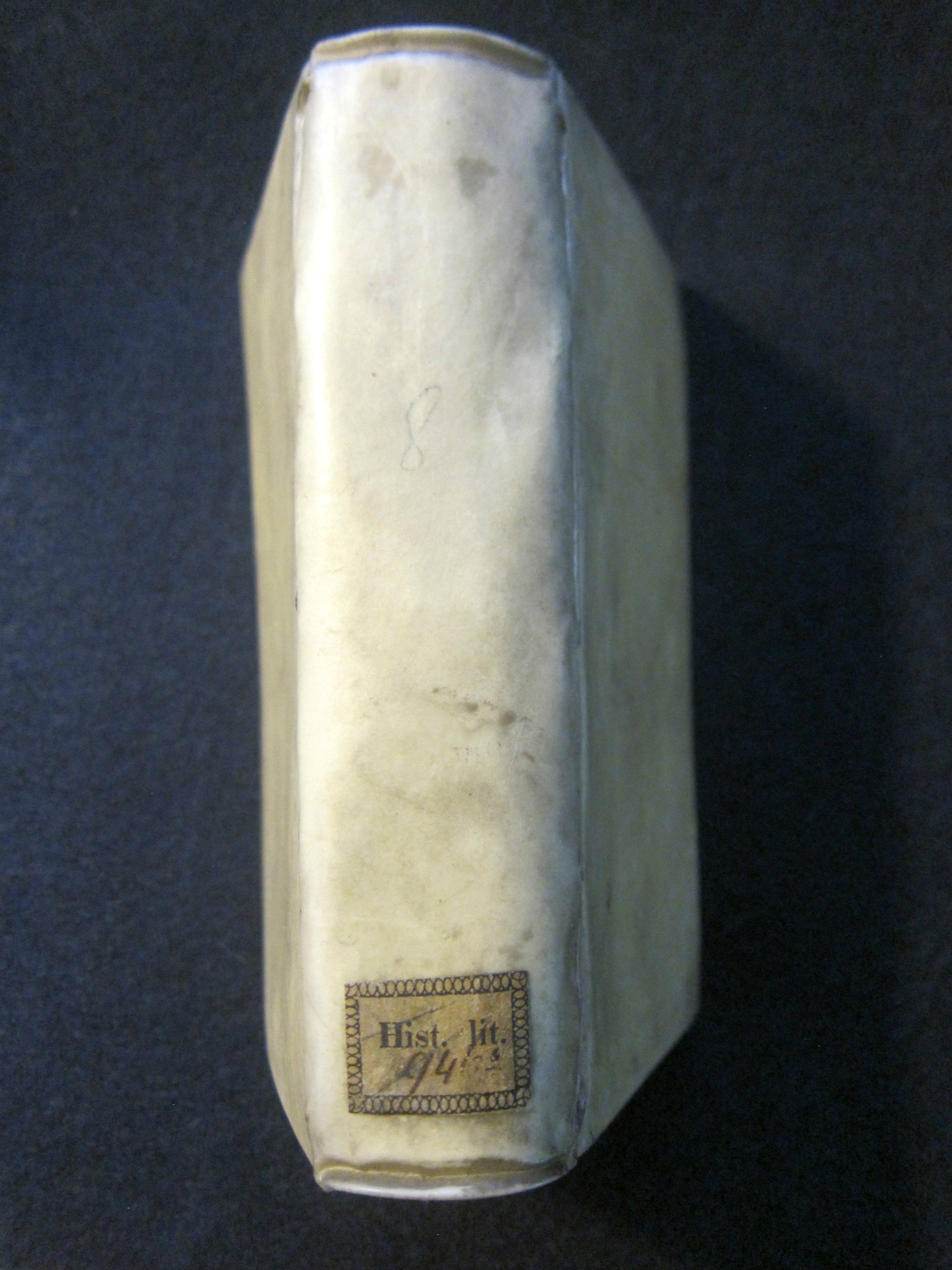
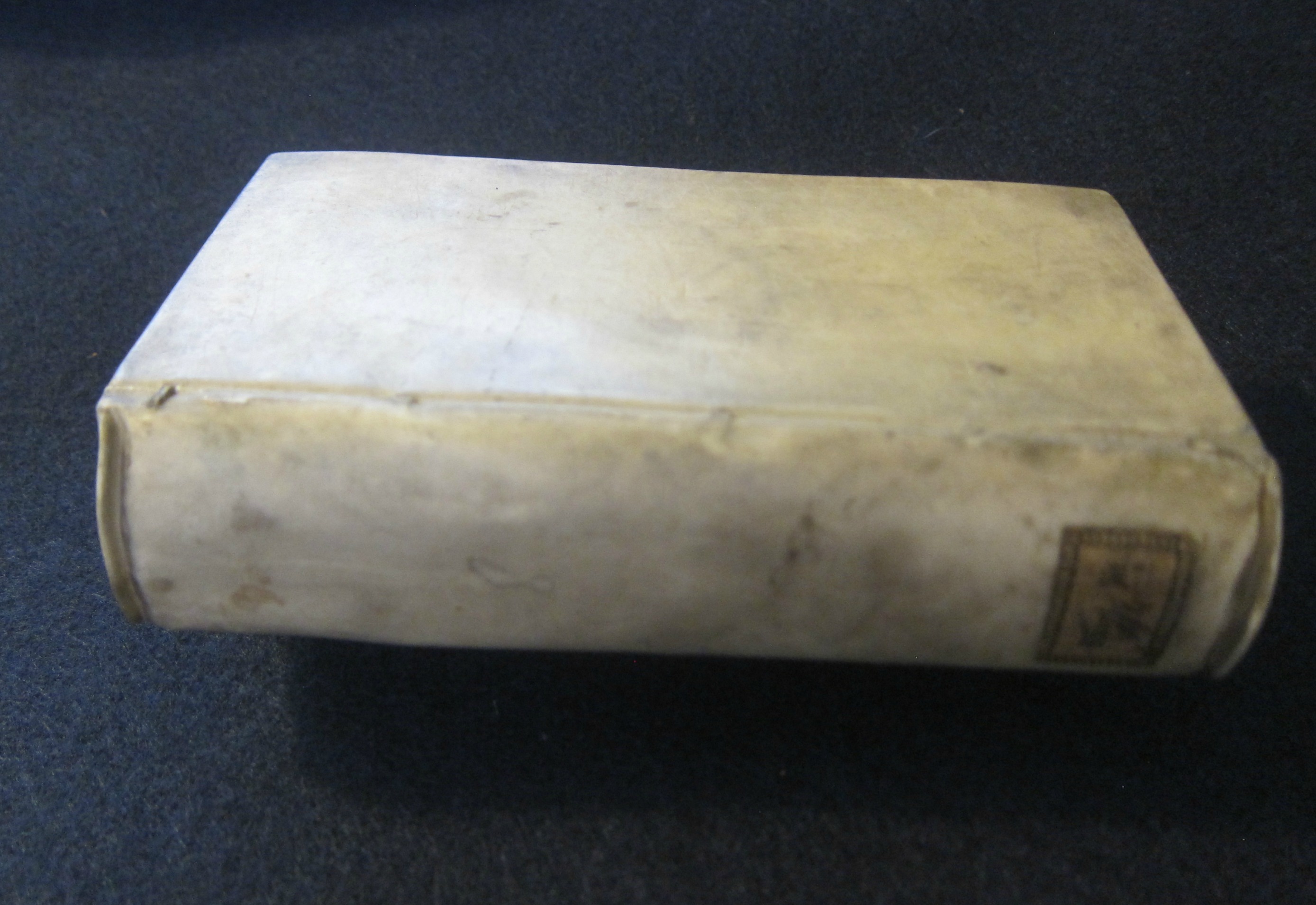
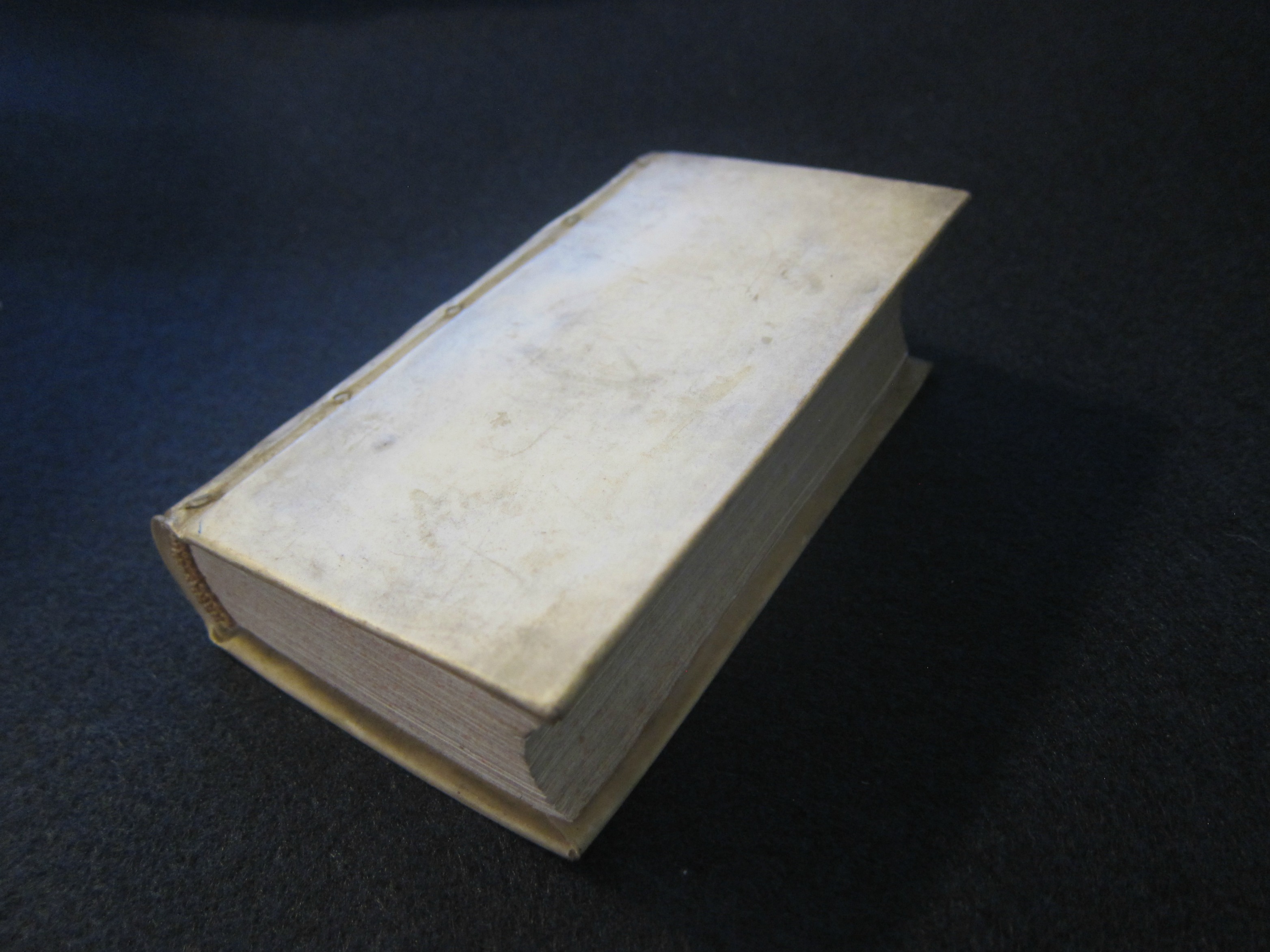
    • Bound in vellum. Some old smudging to the covers and spine, and one very old 20x10mm paper (personal?) library stamp on the spine heel, and two lines of antiquarian notes on the front paste down; also, there are two small ownership stamps at the bottom of the rear of the title page. The text is clean and crisp, and I would say that this is a lovely copy,  FINE.  $SOLD 

    (“Like its great rival, Pierre Bayle’s Nouvelles de la re´publique des lettres, it [the Bibliotheque…] was a source of information and means of communication for members of the nascent Republic of Letters. It was also one of the remote ancestors of the modern academic journal, though much less specialised than most of its successors.”–see J.R. Milton.) 

    Bibliotheque newton princia


    According to sources, this is the first review of Newton’s Principia printed on the Continent. Edmund Halley’s  notice and review of the work that he saw through publication appeared in Philosophical Transactions in September 1687.  There were only three other notices made in the first year (1688) following publication: they appeared in the Bibliotheque (which appeared in March),  the Acta Eruditorum  (in June, pp 303-315, and evidently written by Christoph Pfautz, according to Bernard Cohen) and the Journal des Scavans in (a one-page review in August). According to Hans Botts, this volume 8 appeared in January 1688 and the Newton article in March 1688. (Hans Bots, “Bibliotheque Universelle et Historique (1686-1693)” entry in Dictionnaire des journaux, 1600-1789 .)

    The Bibliotheque article seems to scholars to have been certainly written by John Locke:

    • “The publication in July 1687 of Newton’s Principia mathematica gave rise to only four reviews in the European periodical press. The first was Edmond Halley’s pre-publication notice in the Philosophical Transactions. Then a year elapsed before the Bibliotheque Universelle, the Acta Eruditorum, and the Journal des Scavans, approached the book. Of these reviews that which appeared in Jean Leclerc’s widely read Bibliotheque Universelle has received least attention from historians. This is unfortunate because, of several merits, two in particular are important for the intellectual history of the period: it was written specifically for the large and growing intellectual class of western Europe who for the most part were interested in the new physical sciences, but were untrained in the mathematics necessary to understand many of the newest advances in them. And the author of this review, which was the first independent account of Newton’s book to reach this Continental (largely French-speaking) audience, was John Locke, then a voluntary political exile…”–James L. Axtell, “Locke’s Review of the “Principia”, Notes and Records of the Royal Society of London, Vol. 20, No. 2 (Dec., 1965).
    • “(Bibliotheque Universelle…) was the only journal only journal in the Dutch Republic that had published a review of the Principia, anonymously written by John Locke.”–“Newton through the eyes of an amateur”, University of Utrecht website
    • The Locke Digital Bibliography project also attributes this review as a work of Locke’s.

    As J.R. Milton writes on Locke’s work on the Principia:

    • “This is anonymous, and has generally been assigned to Locke on the basis of a considerable overlap with the notes Locke himself made while reading the Principia. Some writers on Locke and Newton have firmly attributed it to Locke, while others have been rather more cautious. The question of its authorship is, however, settled by a remark – hitherto overlooked – that was made by Le Clerc in 1714 in his own review of the second edition of the Principia: ‘The first edition of this book appeared in 1687 and we published a small extract, composed by Mr Locke, in volume VIII of the Bibliotheque universelle.’ “–J.R. Milton, “Locke’s Publications in the Bibliothèque Universelle et Historique”, British Journal for the History of Philosophy, 05/2011, Volume 19, Issue 3.

    And by the way the Journal des Scavans anonymous review was “hostile and derisive”:

    • The University of  Florida Newton Timeline makes the following note: “1688 – An anonymous reviewer for the Journal des scavans (Paris 1688) raises objections concerning Newton’s Principia, suggesting quite pointedly that the Englishman should now write a second book where he finally addresses the ‘true motions [of the planets] instead of those that he [merely] assumes’ [JS, August 1688: 128].”– http://users.clas.ufl.edu/ufhatch/pages/13-NDFE/newton/05-newton-timeline-m.htm 
    • Bernard Cohen remarks that this anonymous person may have been Pierre Silvain Regis, “a strict Cartersian” and “a hostile critic” (Cohen, Newtonian Revolution, p 96.
    • Martin Schonfeld in his The Philosophy of the Young Kant: The Precritical Project notes the JdS review as “critical and derisive” (pg 254).

    ALSO in this volume: 

    Locke, John, “Extrait d’un livre anglois qui n’est pas encore publié, intitulé Essai Philosophique concernant L’Entendement ou l’on montre quelcertainer, et la maniere dont nous y parvenons. Communique par Monsieur Locke.” Bibliothèque Universelle et Historique 8 (1688) 49-142. 

    This abridgment is the first appearance of Locke’s not-yet-finished Essay Concerning Human Understanding, which would appear in book form in 1689.  (“Locke’s monumental An Essay Concerning Human Understanding (1689) is one of the first great defenses of modern empiricism and concerns itself with determining the limits of human understanding in respect to a wide spectrum of topics. It thus tells us in some detail what one can legitimately claim to know and what one cannot.”–Stanford Encyclopedia of Philosophy.)

    •   “…This abridgment, Le Clerc who was naturally proud of having been the first to introduce his friend’s bold arguments to the world said long afterwards pleased a great many persons and made them desirous of seeing the work at large …”–Henry Richard Fox Bourne, The Life of John Locke, 2876, Volume 2, pp 99.
    • [The first certain extract]”…est là dans la Bibliothèque universelle que paraît d abord certain extrait d un livre anglais qui n’est pas encore publié intitulé Essai philosophique concernant entendement communiqué par M Locke…”–Joseph Texte, Jean-Jacques Rouseeau et les Origines du Cosmopolitisme Litteraire etude sur les relations littéraires de la France et de l Angleterre au XVIIIe siècle. Hachette, 1895, pg 21.
    • “(The e)xtract preceded publication of the first English edition, based on extract supplied by Locke, who was [thus] first known as author on the Continent.”–George Watson, Ian R. Willison, eds; The New Cambridge Bibliography of English Literature, Volume 2, pg 107
    • “John Locke’s earliest significant publications appeared between 1686 and 1688 in the Bibliotheque universelle et historique. They were a translation of his New Method of a Commonplace Book, an abridgment of his (as yet unpublished) Essay Concerning Human Understanding, and two reviews, of a medical work by Robert Boyle, and Isaac Newton’s Principia.”–Milton, J.R., “Locke’s Publications in the Bibliothèque Universelle et Historique”, British Journal for the History of Philosophy, 05/2011, Volume 19, Issue 3.
    • “Indeed the reports or extracts of books are the most numerous, but at the same time there are original contributions from some correspondents, such as The Philosophical Essay Concerning the Mind of John Locke, inserted in this journal [offered here] two years before publication of the book same (v. VIII, Jan. 1688, pp. 49-I42)”–translated from Hans Bots, “Bibliotheque Universelle et Historique (1686-1693)” entry in Dinctionnaire des journaux, 1600-1789.
    • “Our author’s great work, the ‘Essay concerning Human Understanding,’ he had been employed about for some years, and he finished it in Holland about the end of the year 1687. He made an abridgment of it himself, which his friend Mr. Le Clerc translated into French, and inserted in one of his ‘Bibliotheques’ [referenced for January 1688].This abridgment was so highly approved of by all persons of understanding, and sincere lovers of truth, that they expressed the strongest desire to see the whole work.” The Works of John Locke, printed for C. and J. Rivington, et alia, London, 1824, 9th edition.

    Note: editors and contributors of the Bibliotheque from start to finish included: Jean Le Clerc et Jean Cornande de al Crose, vols 1-9; Jean Le Clerc, 10, 12, 14-19; Jean Cornand de La Crose, vol 11; Charles le Cene and Jean Le Clerc, vol 13; Jacques Bernard and Jean Le Clerc, vol 20; Jacques Bernard, vols 24-5. The journal was published every 4 months in vols 1-3; every 3 in 4-19, and then twice a year for 20-25.

      Bibliotheque spine

    I inspected versions of the title page and head- and tail-pieces in other versions of this volume online, and there is a very clear distinction in the crisp quality in printing  (and registration) of this volume and the others (which are described as “other editions” and “reprints”)–there is a very sharp difference.

    Bibliotheque spine
    Bibliotheque spine
    Bibliotheque spine


    ·Posted by :

    ·in:

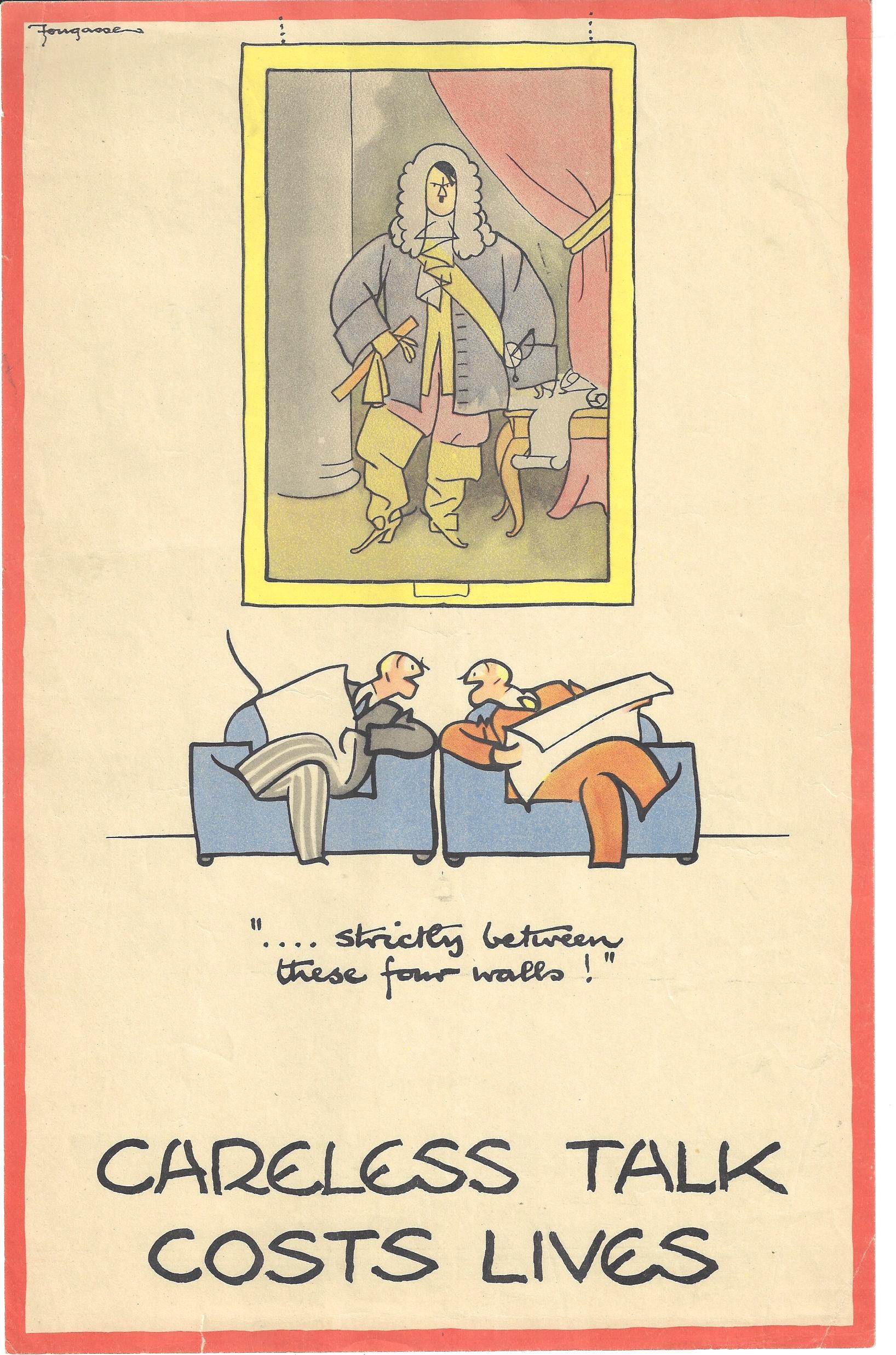
  • Iconic WWII Propaganda Posters–the United Kingdom, 1940

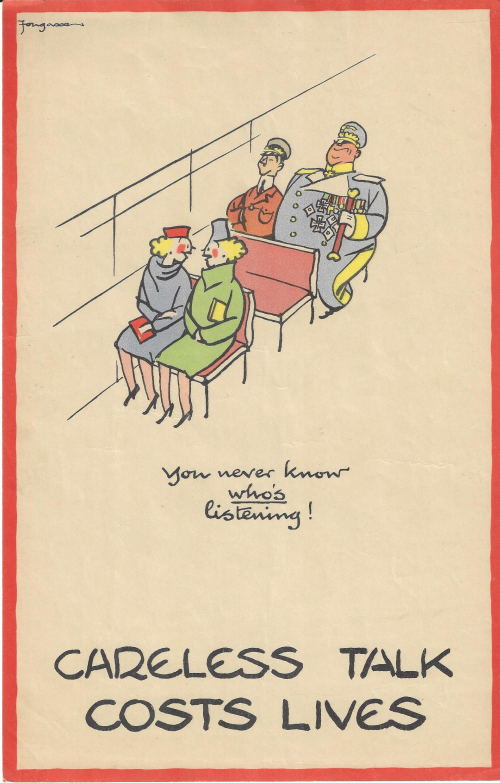
    “Original WWII Poster by “Fougasse”

    Fougasse – Cyril Kenneth Bird, (1887-1965), illustrator for Punch (from 1937 to 1949, and a wounded vet of Gallipoli in the First War)” “Careless Talk Costs Lives”.

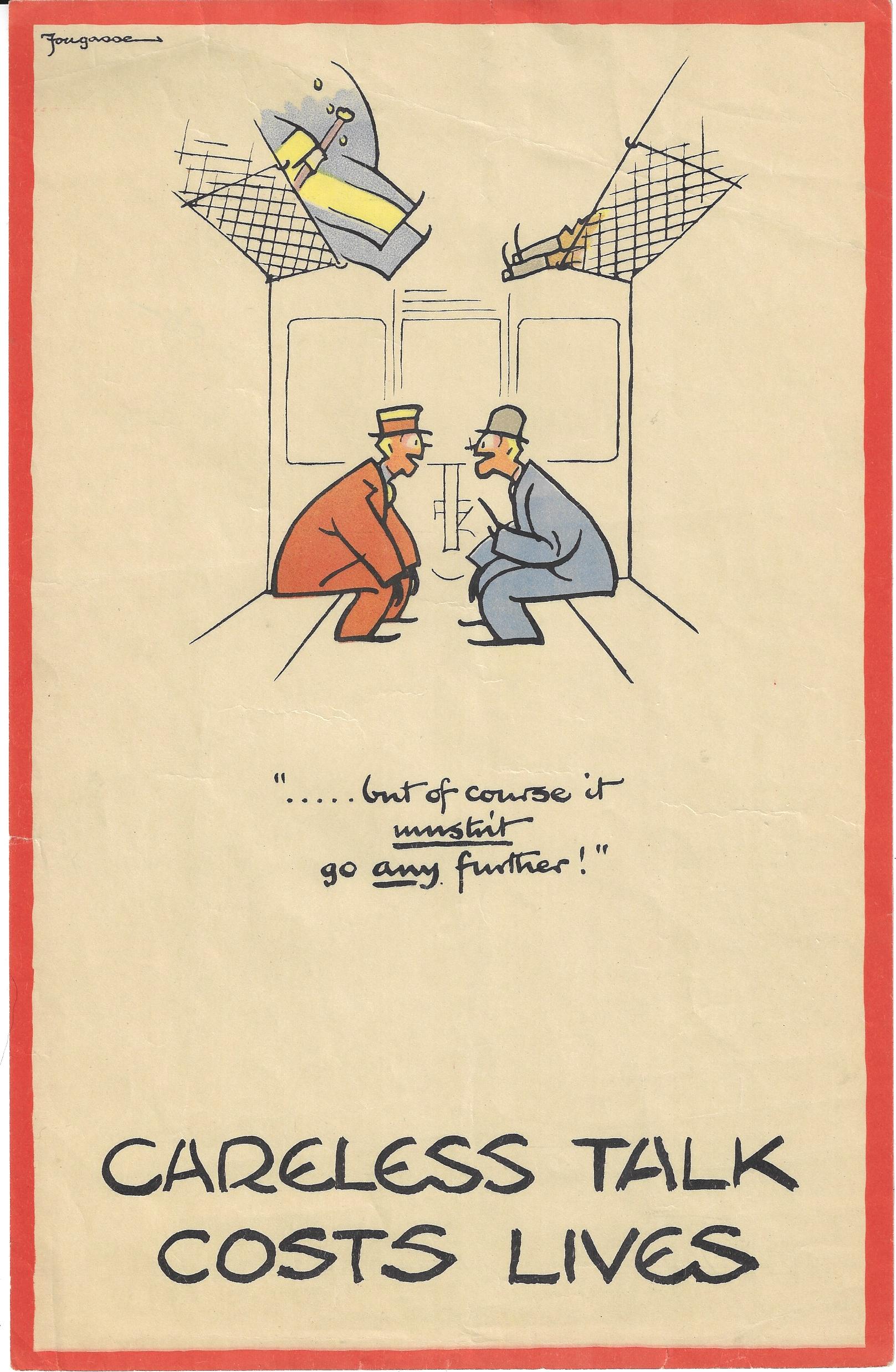
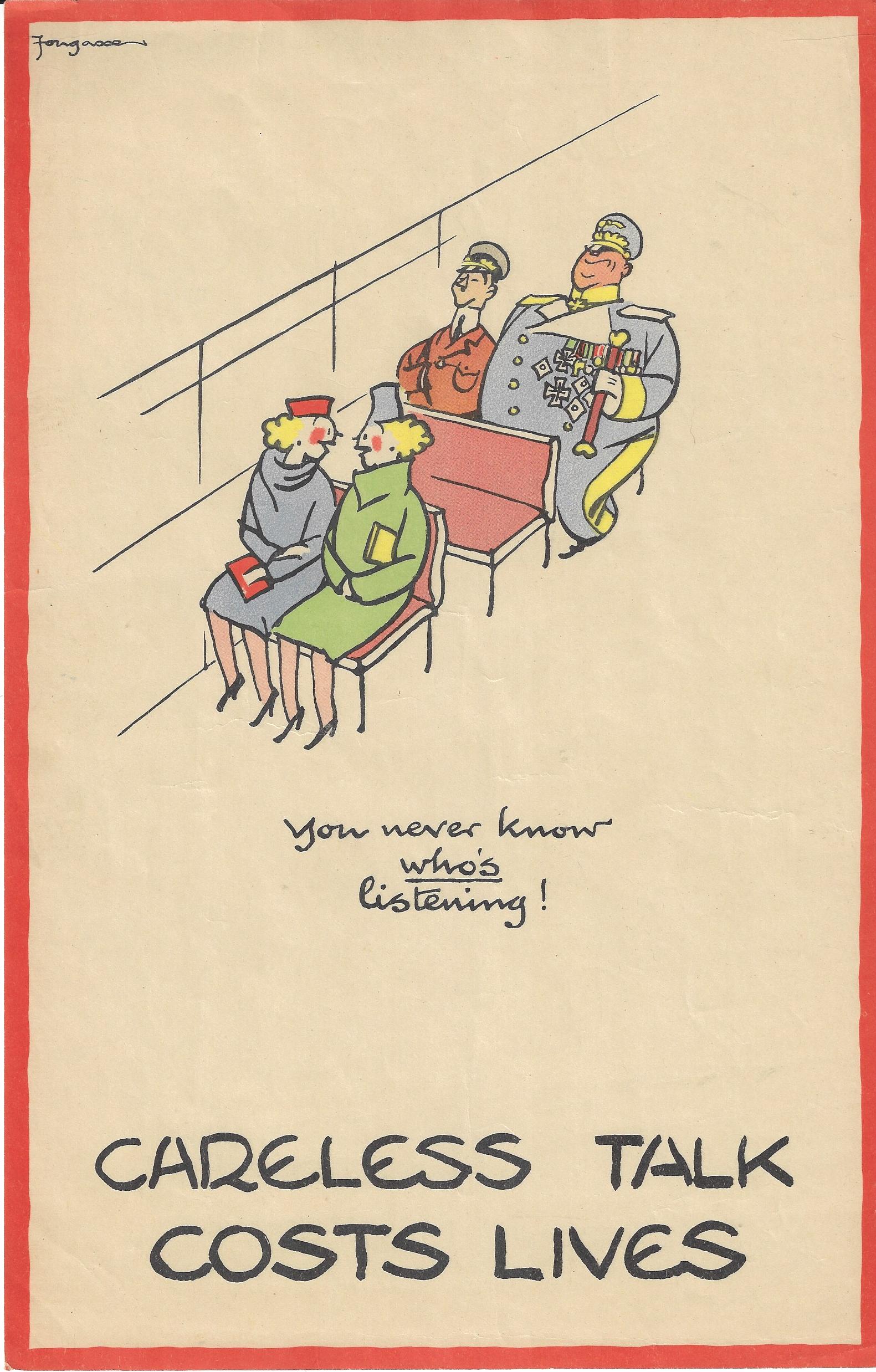
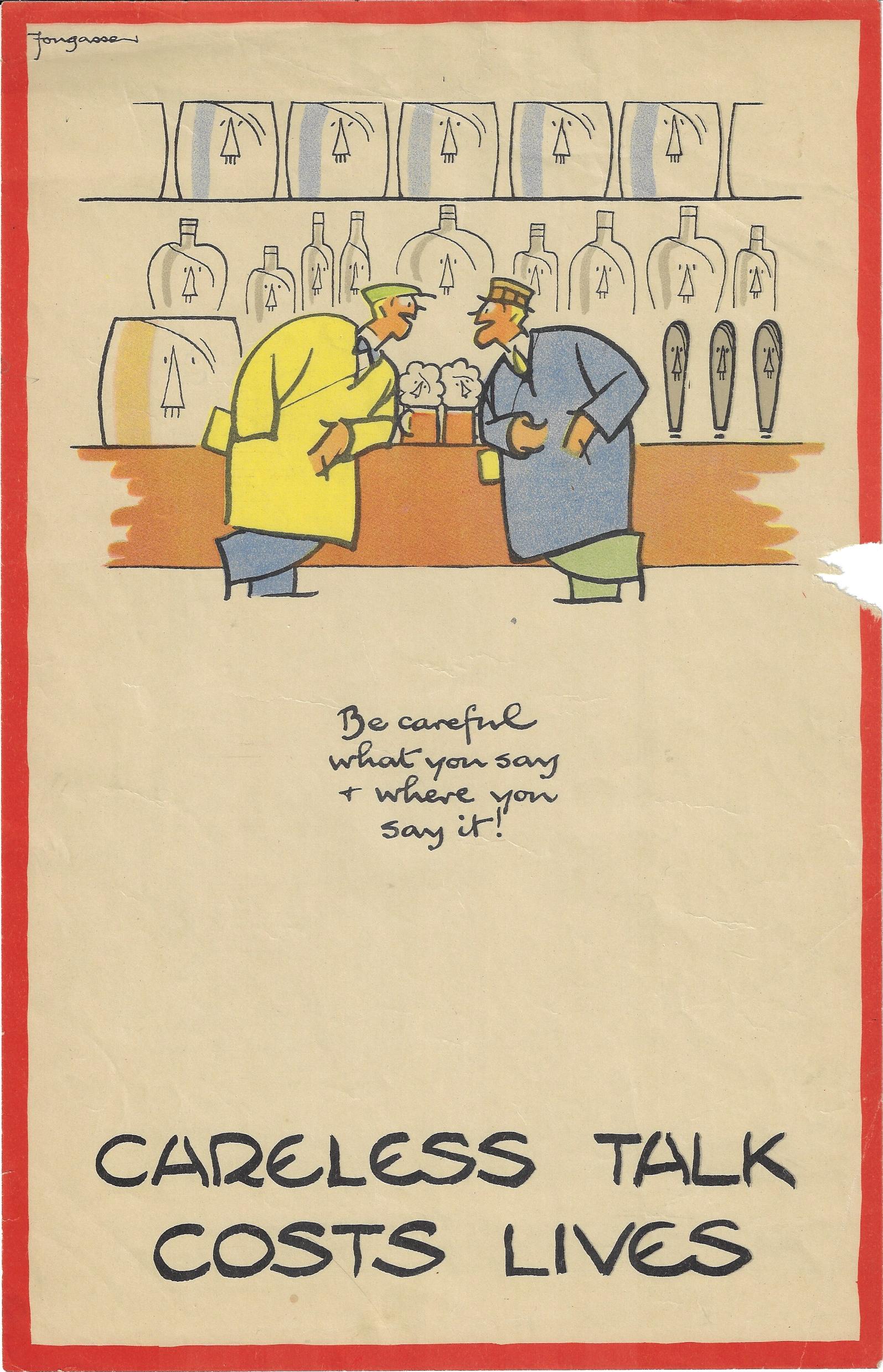
    This is one of eight posters in the very popular “Careless Talk Costs Lives” wartime propaganda series issued by the Ministry of Information and printed in the year of terrible and great struggle in Great Britain, 1940. 32x22cm, color lithograph, and printed on paper (though some were originally issued affixed to cardboard or another stiffer board).

    The series in general depicts people sharing a piece of possibly sensitive information that in the wrong hands and together with other pieces of info could reveal devastating secrets—and in each case there are figures lurking/loitering/disguised in the background waiting to collect the data, and generally a poorly disguised Hitler or Goering or both. Fougasse was able to make his message immediately memorable and understood because I think of his understated over-the-top visual humor. The images were funny, but the message was deadly serious. Also, you really didn’t even need to read the text to understand the message. (This is in the same vein as some of Thomas Nast’s finest work, conveying social content and a political message to the illiterate, making his devastating (and usually highly textual) cartoons understandable without needing to read them.) 

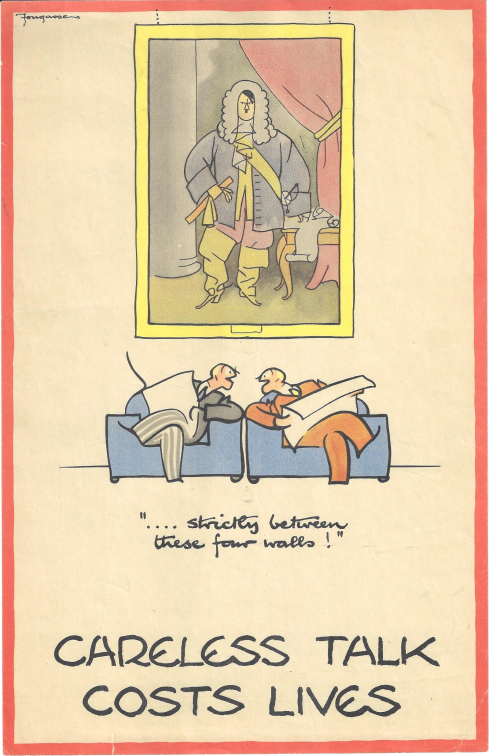
    (1) “Strictly Between Four Walls”.  In this poster (made a convenient size to be useful in virtually any small area and also abiding the wartime paper shortage) we see two men in big club chairs about to share some bit while the artwork-ensconced Hitler waits to hear the interesting parts. Fine condition. 1940. 32x22cm, color lithograph, and printed on paper $175

    Fougasse but of course it mustnt


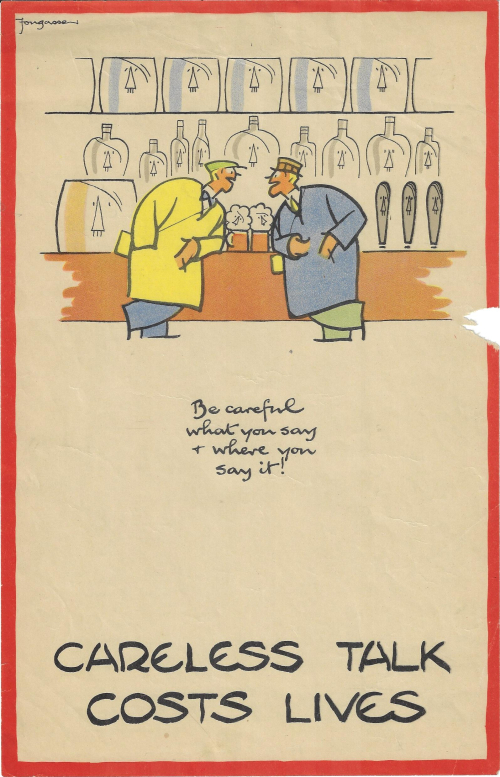
    (2) “Be Careful What You Say and Where You Say It!” 1940. 32x22cm, color lithograph, and printed on paper. Here two chaps share suds in a Hitler-infused pub. Unfortunately there is a 15x15mm chip out of the image at middle-right edge, otherwise this is a nice crisp image.  $100

    Fougasse but of course it mustnt

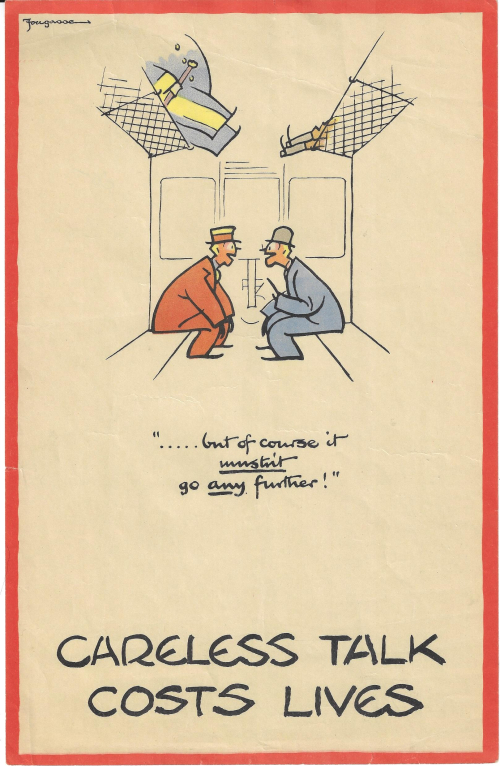
    (3) “But of Course it Mustn’t Go Any Further!”, say two blokes in a 2nd class railway cabin, the feet and legs of Goering and Hitler dangling over them as they share their unsharable war information. Fine copy.  1940. 32x22cm, color lithograph, and printed on paper.  $200

    Fougasse but of course it mustnt

    (4) “You Never Know Who’s Listening!”. Two ladies on a bus share some wartime news while Hitler and Goering sit aloof and patient, absorbing all.  1940. 32x22cm, color lithograph, and printed on paper. Fine condition.  $200

     Fougasse but of course it mustnt

    ·Posted by :

    ·in:

    —
  • William Huggins and Stellar Spectra (1880)

    William Huggins, “On the Photographic Spectra of Stars”, in Nature, January 22, 1880.  

    This is a short two-page abstract of the 21-page version of this significant work on stellar spectroscopy that appeared in the Philosophical Transactions at nearly the same time as the Nature publication. It is commendable that Nature reprinted the folding plate of the spectra of sevens stars here as a full page length image (one full column of the two-column page).  This paper is an extract of the weekly issue from a larger bound volume, complete with the scarce outer wrappers.  Very Good copy. $40

    ·Posted by :

    ·in:

  • A Highlight of Circular Ships, 1880.

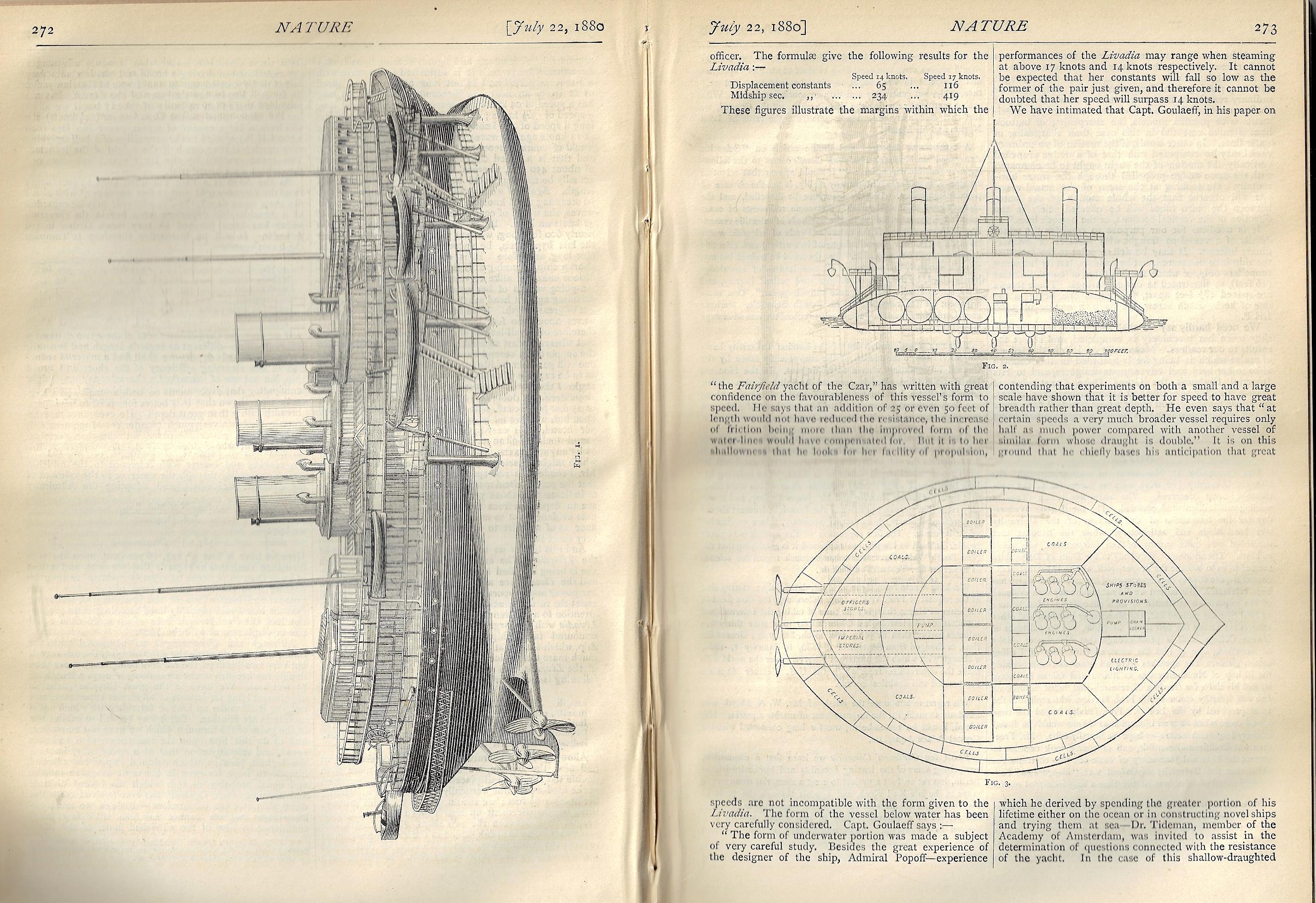
    “The Russian Imperial Yacht, ‘Livadia’”, an article in Nature, July 22, 1880, appearing on pp 270-274, with several large illustrations, including an elevation and a plan of the ship.  Offered in the weekly issue of Nature, with the (scarce) original front and rear wrappers, removed from a larger bound volume.  Very crisp copy, and an interesting assessment of this odd-looking ship.  Very Good copy. $45

    Nature 1880 Lividia

    “The Livadia was an imperial yacht of the House of Romanov built in 1879–1880…intended for service on the Black Sea…a radically novel ship conceived by Vice Admiral Andrey Popov, designed by naval architect Erast Gulyaev and built by John Elder & Co. of Govan on Clyde. The Livadia continued Popov’s line of circular shipsalthough this time Popov sacrificed geometrical perfection for seagoing capabilities. She had a beam of 153 ft (47 m) against overall length of only 259 ft (79 m). An extreme example of tumblehome architecture, she sported a conventionally shaped superstructure mounted on a wide, flat-bottomed, turbot-shaped submerged hull or pontoon. The Livadia turned out a surprisingly maneuverable and stable ship with a respectable maximum speed of 15.7 knots and her efficiency was comparable to conventional ships. Her performance at sea trials surprised most naval architects and was attributed to the favorable placement of the propellers.”–Wikipedia

  • Bell’s Photophone–a Technology Decades Early from its First Practical Use (1880-1881)

     [Bell,  Alexander Graham.]  On the invention of Bell’s great invention, the photophone, as it was described in four issues of the journal Nature from 1880-1881 (including the weekly issues for  September 23,1880, November 4 & 18, 1880,  and February 10, 1881:

    (1) The Photophone, page 481, in the weekly issue of Nature, September 23, 1880;

    (2) Bell’s Photophone, pp 15-19,  in the weekly issue of Nature, November 4, 1880, with illustrations of the apparatus, running approximately 3000 words.

    (3) Shelford Bidwell, “Bell’s Photophone”, in in the weekly issue of Nature 18 November 1880, pp 58-9, approximately 1750 words.

    (4) “Photophone Experiments”, in  in the weekly issue of Nature 10 February 1881, page 354, approximately 400 words, two illustrations.

    These are among the earliest articles on Bell’s fantastic invention utilizing his discovery of the photoacoustic effect–basically, transmitting wireless telephone conversations on a beam of light, a feat that would not be utilized until the last two decades of the 10th century. Offered here are the four issues, the first in its original wrappers, cleanly removed from a larger bound volume with only trace elements of the removal visible at their spines. Nice copies. $450

    Alexander Graham Bell was already mega-famous by the time he unveiled what he considered to be one of his greatest inventions.  Working at his L Street lab as well as from his home (which was just a few blocks away from my store in Georgetown, which was at the 34th & Volta Place, also just a few doors away from Alger Hiss’ old place, and a few doors the other way from Warren Christopher’s house where he slipped and fell on his last day in DC on his snowy steps) he developed the photophone.  In the day, in 1880, when it was completed he considered the work so substantial and filled with so much potential that he left his plans on deposit in a sealed something-or-other until he announced the results for real, which came at a public lecture on August 27, 1880.  (This perhaps for the big taste of legal trouble he got into with his telephone–troubles and contentiousness that would continue for years. Also there was something in the air about this, so to speak, with an article in Nature attesting to rivals of the ingenious invention coming in the 23 May issue of the same year.) In any event, he found this invention to surpass his telephone and phonograph–except that few people today recall the instrument, much less what it did.

    It was a fantastic thing, an elegant device utilizing his discovery of the photoacoustic effect–basically, transmitting wireless telephone conversations, transmitting speech on light rays, a feat that would not be utilized until the last two decades of the 20th century, a precursor to fibre-optic communication–it was just decades away from practical application.  

    In his article in Nature of September 23, 1880, electrical pioneer Sylvanus Thompson writes (opening that weekly issue) that “sounds can be transmitted from one station to another wherever a beam of light can be flashed; …we may expect the slow spelling out of words in flashing signals of the heliograph to be superceded by the more expeditious whispers of the photophone” (page 481). Actually it seems that this paper beat the sponsor organization of Bell’s August address into general print, though The Electrician seems to have bested them both with an article on September 18.

    Bell was happy.  According to Ben Richmond (at Motherboard) Bell wrote a lovely note to his father on his success: 

    “I have heard articulate speech by sunlight! I have heard a ray of the sun laugh and cough and sing! …I have been able to hear a shadow and I have even perceived by ear the passage of a cloud across the sun’s disk.”

    • “The photophone is a telecommunications device that allows transmission of speech on a beam of light. It was invented jointly by Alexander Graham Bell and his assistant Charles Sumner Tainter on February 19, 1880, at Bell’s laboratory at 1325 L Street in Washington, D.C.”–Wiki
    • “Imagine a solar-powered telephone, and you’re close to understanding the important gadget Alexander Graham Bell invented on June 3, 1880, four years after he had patented the telephone. Bell considered the photophone one of his most important inventions. He’s probably right, since the technology behind the photophone led to the technology that helps computers send information around the world today…”–America’s Library
    • “Bell would have to modulate sound waves like electricity. The telephone transmitted sound through the modulated electrical current sent through telegraph wires. The Selenium receiver would then act like an optic version of the electric coil in a telephone receiver, converting the modulated light back into sound waves…Bell was absolutely correct. In February of 1880, using nothing more than a diaphragm attached to metal grating and a rudimentary selenium receiver, Bell listened as assistant Charles Sumner Tainter’s a cappella version of Auld Lang Syne came blaring through his headphones, transmitted through a single beam of sunlight.”–Inverse dot com
    •  “The photophone was in fact the World’s first device for wireless communications.  So optical wireless communications came first and wireless radio communications appeared some years later.  Bell did not just invent and patent the concept, he also built the Photophone and demonstrated it transmitting speech over distances of several hundred meters.”–Visible Light Communications dot com


    Bell’s photophone transmitter


  • The Golgi Apparatus and other Papers by Golgi

    The Golgi Apparatus (Golgi Body)

    (1) Camillo Golgi. “Sur la structure des cellules nerveuses”, in Archives Italiennes de Biologie, Turin, Hermann Loescher, 1898, vol 30 pp 60-71 in the volume of vii, 496pp. Each of the three fascicles has the original front wrapper bound in at rear. (with 5 plates, 3 of which are folding). (This article printed November 1898, and first published in Boll. d. Soc. Medico-chirurgica di Pavia, 19 April 1898.)

    And bound with:

    “Sur la structure des cellules nerveuses des ganglions spinaux”, printed 27 December 1898, pp 278-286 (published in Boll. d. Soc. Medico-chirurgica di Pavia, 15 July 1898.)

    And offered with:

    Golgi. “Une methode pour la prompte et facile demonstration de l’appareil reticulaire interne des cellules nerveuses”. In Archives Italiennes de Biologie, Turin, Hermann Loescher, 1908, vol 49, pp 269-274 in the volume of viii, 458pp.

    These volumes are rebound in black library cloth, with the gilt-stamped call number at spine bottom, below which is “SI Library” (“Smithsonian Institution”). The binding is very sturdy and relatively recent (within the last 50 years); the quality of the paper used by the journal is not high, and it suffers some tenderness and browning around the page edges. This volume gets a conservative “Good” though it may be closer to “Very Good”. Three papers in two volumes: $500

    • “The GA is named after its discoverer Camillo Golgi, who first described the complex apparato reticolare interno in 1898…”–Mironov A.A., Pavelka M. (2008) “The Golgi apparatus and main discoveries in the field of intracellular transport”.. In: Mironov A.A., Pavelka M. (eds) The Golgi Apparatus. Springer, Vienna 
    • “On April 1898 Camillo Golgi communicated to the Medical–Surgical Society of Pavia, the discovery of the “internal reticular apparatus”, a novel intracellular organelle which he observed in nerve cells with the silver impregnation he had introduced for the staining of the nervous system. Soon after the discovery it became evident that this cellular component, which was also named the “Golgi apparatus”, was a ubiquitous structure in eukaryotic cells.”–Mazzarello Paolo,Garbarino Carla and Calligaro Alberto(2009), How Camillo Golgi became “the Golgi”, FEBS Letters, 583, 
    • “Golgi also reported the observation, on the surface of the nerve cell, of ‘a special very delicate covering, made of a substance clearly differentiable from that of the cell body’ (Golgi, 1898a). The existence of these perineuronal nets was forgotten until recently when it attracted great interest in neurocytology”–Paolo Mazzarello, “Camillo Golgi’s Scientific Biography” Journal of the History of the Neurosciences, 1999, Vol. 8, No. 2, pp. 121–131.


    Also offered:

    (2)  Camillo Golgi (1843/4-1926, Italian histologist), “Considerations Anatomiques sur la Doctrine des Localisations Cerebrales, (Resume de l’auteur)”, in Archives Italiennes de Biologie, Turin, Hermann Loescher, 1882, volume II, vi, 448pp, 20 plates (mostly folding), with the Golgi occupying pp 237-253.

    Bound with:

    Golgi. (1843/4-1926, Italian histologist), “Considerations Anatomiques sur la Doctrine des Localisations Cerebrales” (“Suite et fin”), occupying pp 257-273.

    The volume rebound in black library cloth, with the gilt-stamped call number at spine bottom, below which is “SI Library” (“Smithsonian Institution”). The binding is very sturdy and relatively recent (within the last 50 years); the quality of the paper used by the journal is not high, and it suffers some tenderness and browning around the page edges. This volume gets a conservative “Good” though it may be closer to “Very Good”.  $175.00

    On Malarial Fevers and the Parasites that Caused Them

    (3)  Camillo Golgi. “Sur le cycle evolutif des parasites malariques dans la fievre tierce. Diagnosis differnetielle entre les parasites endoglobulaires malariques de la flevre tierce et ceaux de la flevre quarte.” pp 81-100, and one plate.  

    BOUND WITH: 

    “Sur les felvres intermittentes malariques a long intervalles. Fondeemtns de la classification des flevre malariques”, pp 113-132.

    Both papers are bound in Archives Italiennes de Biologie, Turin, Hermann Loescher, 1891, vol 14, vii, 443pp., 11 plates. $175

    The volume rebound in black library cloth, with the gilt-stamped call number at spine bottom, below which is “SI Library” (“Smithsonian Institution”). The binding is very sturdy and relatively recent (within the last 50 years); the quality of the paper used by the journal is not high, and it suffers some tenderness and browning around the page edges. This volume gets a conservative “Good” though it may be closer to “Very Good”

    • “Camillo Golgi, an Italian neurophysiologist, established that there were at least two forms of the disease, one with tertian periodicity (fever every other day) and one with quartan periodicity (fever every third day). He also observed that the forms produced differing numbers of merozoites (new parasites) upon maturity and that fever coincided with the rupture and release of merozoites into the blood stream. He was awarded a Nobel Prize in Medicine for his discoveries in neurophysiology in 1906.”–CDC site on the history of malaria. 
    • “In the years 1886-1892, Golgi provided fundamental contributions to the study of malaria: he elucidated the cycle of the malaria agent, the Plasmodium, in red blood cells, and the temporal coincidence between the recurrent chills and fever with the release of the parasite in the blood. Golgi also studied the efficacy of the administration of quinine during the disease.”–Nobel Prize site, biography of Golgi.
    • “Between 1885 and 1892–a period in which great advances have been made in techniques and practice of the young science of microbiology–Camillo Golgi provided a notable contribution to malariology. Continuing studies and researches of Roman malariologists Ettore Marchiafava (1847-1935) and Angelo Celli (1857-1914), on the malarial parasites–described by the French military physician Alphonse Laveran–he studied the reproduction cycles of the Plasmodium in human blood (Golgi cycles) and elucidated the temporal coincidence between the recurrent chills and fever with the rupture and release of merozoites into the blood stream (Golgi law).”–Tognotti, E. “Camillo Golgi and the contribution of the Italian scientists to the development of the malariology in the last quarter of the nineteenth century”Med Secoli. 2007;19(1):101-17, Med Secoli. 2007;19(1):101-17.
     

    ·Posted by :

    ·in:

  • Airborne RADAR, 1945.

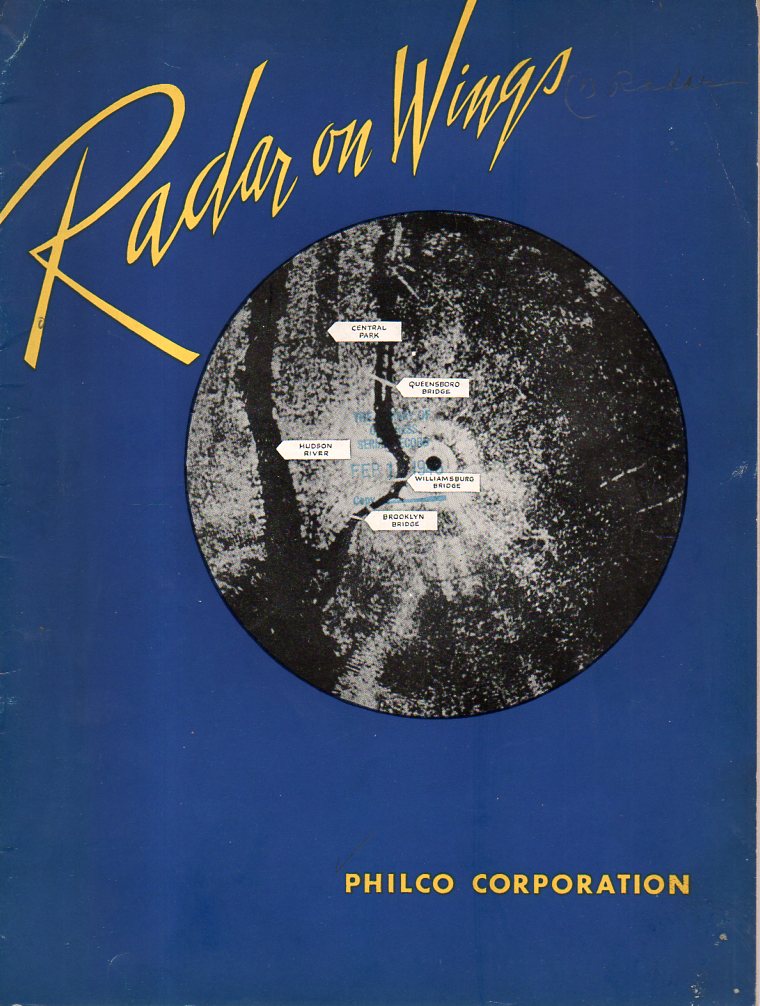
    RADAR on Wings, Philco, 1945.  10×8″, 30pp (unpaginated) with lots of photographs and an occasional schematic. Original wrappers.  Fine copy. Provenance: Library of Congress, with their very faded surplus/duplicate stamp on the front cover.  Only 7 copies located in WorldCat/OCLC.  $50

    Radar map nyc

    The history of RADAR (RAdio Deection And Ranging, and something I’ve always written in caps, for whatever that is worth) is absolutely not what I’m thinking about now–that is a long story with lots of twists and turns, complicated, complex–and it ranges depending upon location as for the most part RADAR (from the 1930’s anyway) was developed in secret, kept as a military secret.  And that’s because it was a very important development, with the victor of the Battle of the Beams being the possible victor, period.  

    Radar246

    All I want to do presently is note the significance of this particular pamphlet in the history of RADAR. This work was printed by PHILCO Corporation, (and dated January 4, 1946), and has an inserted leaflet stating that this “makes public for the first time the salient facts about the Corporation’s development and production of airborne radar equipment for the United States Army and Navy”.  PHILCO and other companies made significant contributions to the war capacity of the Allied forces, and–for this company in particular–much of that went unknown for quite some time afterwards, and of course there are some stories that just won’t get told. But for PHILCO the story gets told here.  

    This is also a fabulous nighttime map of NYC–produced by RADAR.  


    ·Posted by :

    ·in:

    —
  • Early Work on the Telephone (1878)

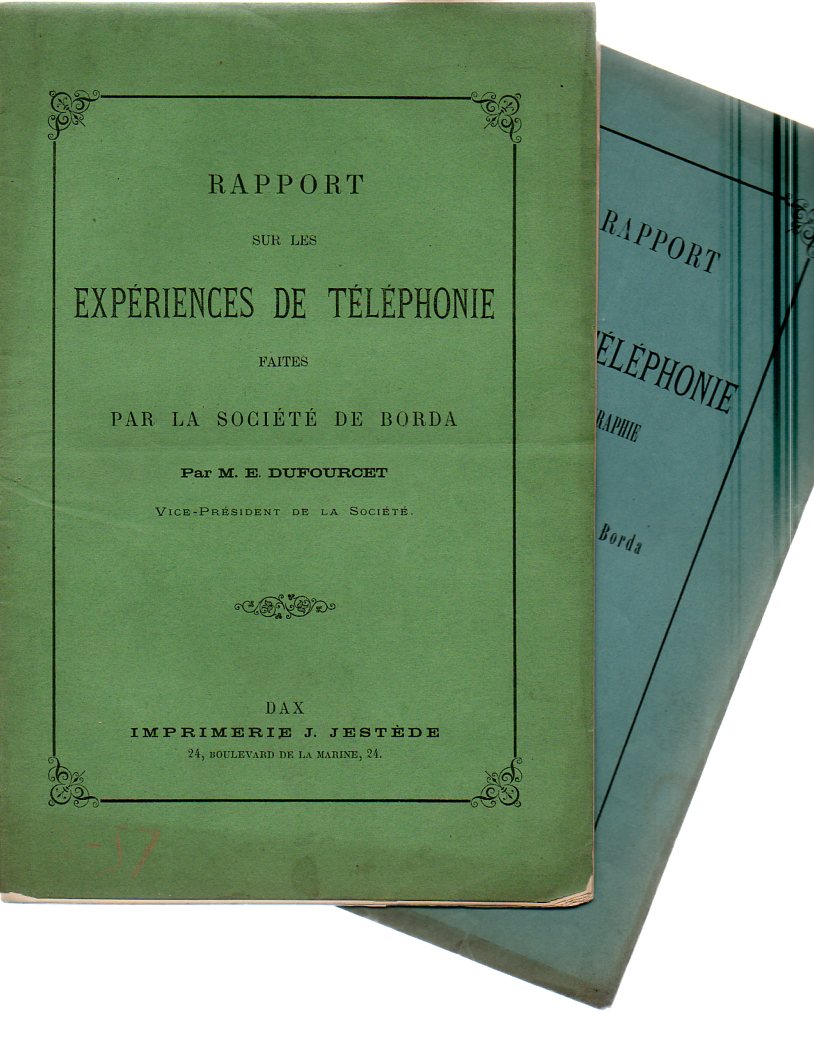
     DUFOURCET, Eugene. Two very early papers on the telephone:

    Dufourcet218

    _____. Rapport sur les Experiences de Telephonie…Dax, Imprimerie J. Jestede.  Printed ca. 1878.  14pp.  23x16mm.  Original printed wrappers. 

    with:

    _____. Deuxieme Rapport sur les Experiences de Telephonie, de Microphone et de Phonographie.  Dax:  Imprimerie J. Jestede,  ca1878.  1st edition. 23x16mm,  24pp, 2 plates.  Printed wrappers.  Very good copy; some evidence of a small tax stamp on front cover; small rubberstamped owner’s mark on rear wrapper.  Very scarce, early treatment on Bell’s telephone. Faites par Quelques Membres de la Societe de Borda.

    Both are signed presentation copy from Dufourcet, President of the Societie de Borda.  Nice copies, in Very Good condition.  

    Neither copy is located in WorldCat.   $750.00

    ·Posted by :

    ·in:

  • On Not Being Able to See Martians (Because We Can’t See Them) (1944)

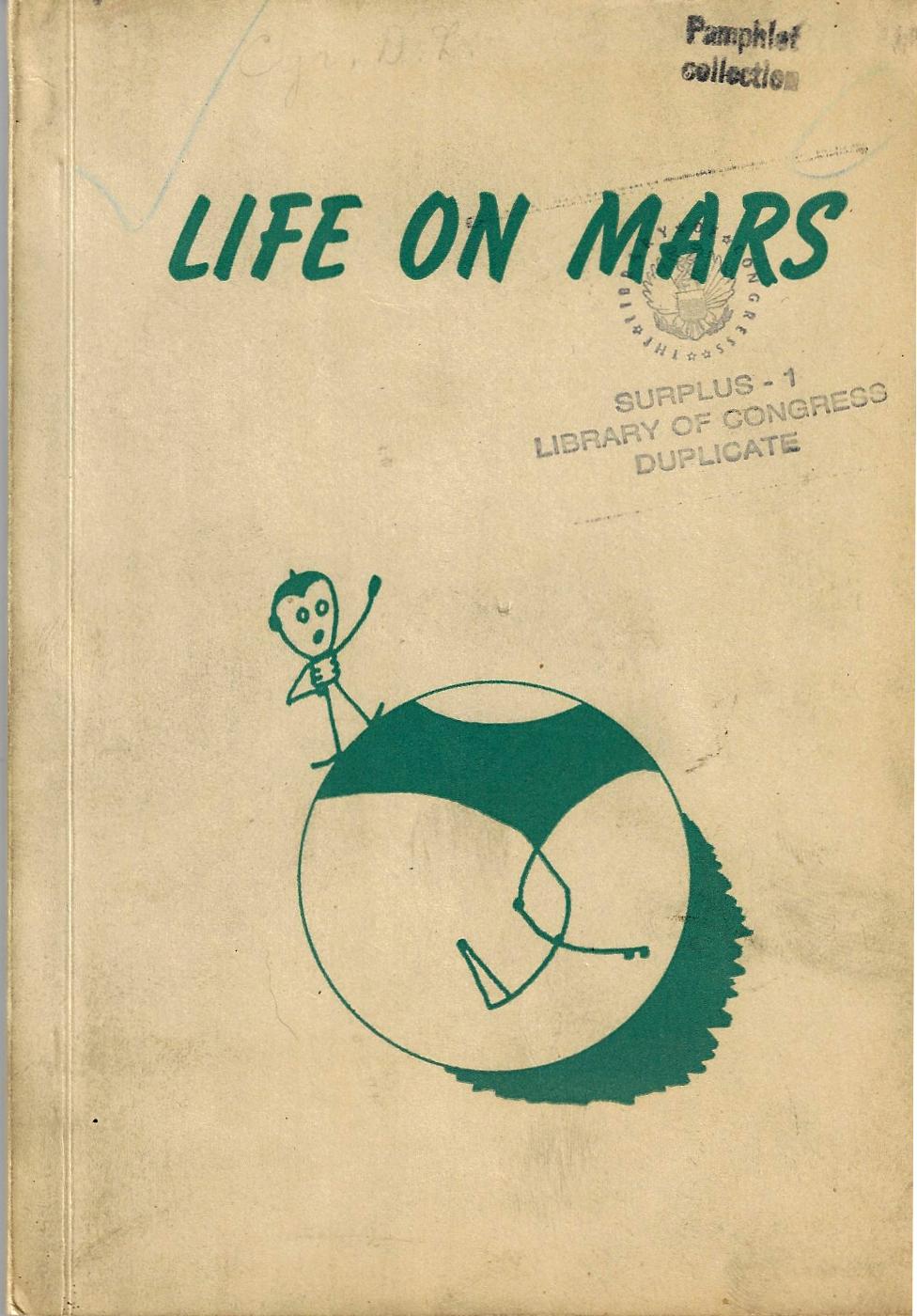
    MArs life on 1944Donald Lee Cyr. Life on Mars, printed by the Desert Magazine Press of El Centro, California, and I believe self-published by the author.  7×5″, 50pp. occasionally illustrated with drawings and maps. Original print wrappers, perfect bound. Provenance: Library of Congress, no doubt the recipient of their copy from the author. Condition: there is a 6mm “LC” perforated stamp on the title page, as well as a LC “surplus/duplicate” rubber stamp on the front cover.  But for these marks a Very Good copy. Surprisingly there are only four copies located in WorldCat/OCLC. $75

    Mr. Cyr made some very wide and radical remarks and observations in this pamphlet on life on Mars, which he is convinced exists, and on an advanced level. The problem is that we can only see the results of the civilization, and not the society itself. The Martians, I read (quickly) can’t be seen because they can’t be seen (“like atoms”), “only the collective efforts of Martians are visible”.  The canals (which run 1000′ deep and cross the planet) also cannot be seen but not because they are so small as to be invisible, but rather it is due to the vegetation growing on their walls that obscure the structures themselves. The canals are also filled with water, or they are canyonlands, with animals using them as a highway. In another found paragraph we are told that “two or more craters near each other have an economic effect on Martian inhabitants”.  And in my last bit of random reading, I saw that the canal networks of Ascraeus Lucas are more than likely built upon earlier trails, and that “the only comparable highway network on earth [sic] is that radiating outwards from Indianapolis”. 

    It seems that Mr. Cyr was an observer of Mars, and then went well beyond the observable to make his deeper observations.  

    He liked this work enough to expand it in 1959.


    ·Posted by :

    ·in:

    —
  • A Scientific/Industrial Vision of the Future City (1842)

    JF Ptak Science Books  

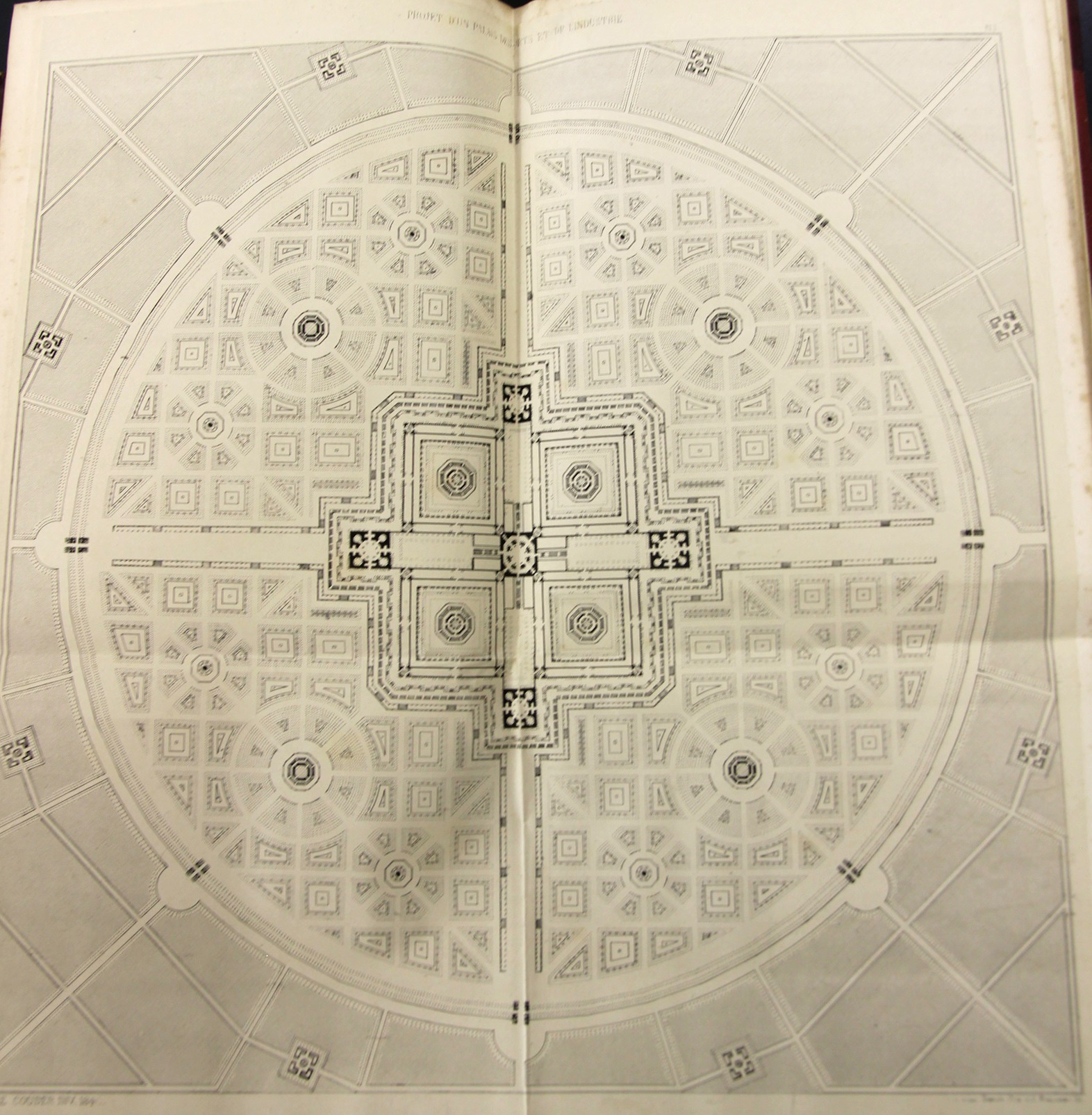
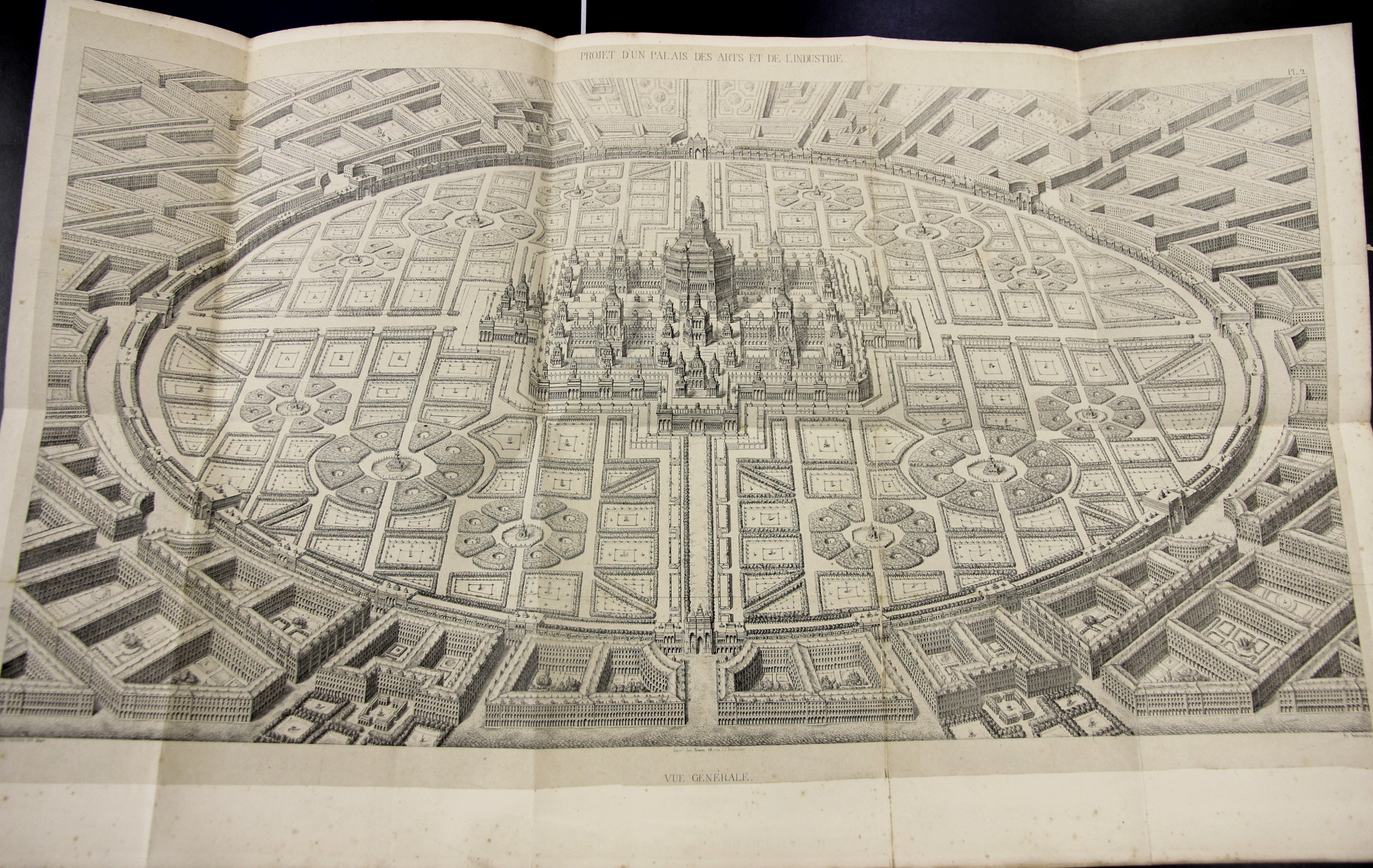
    Amedee Couder, L’architecture et l’industrie comme moyen de perfection sociale, published by Brockhaus and Avenarius in Paris, 1842.   13 x 10 inches, 52 pp, 9 plates, including 4 large folding architectural plans.  Large-margin copy, signed presentation by Couder on the title page.  Bound with a decorated calf spine, pebbled cloth boards with tips.  From the Julius Frank library, given to the Brooklyn Public Library, and then deaccessioned.  There are a few old library markings on the title page, as well as two bookplates, plus an old (19th c) card holder at back.  A nice, solid copy, with beautiful images. Scarce. $325

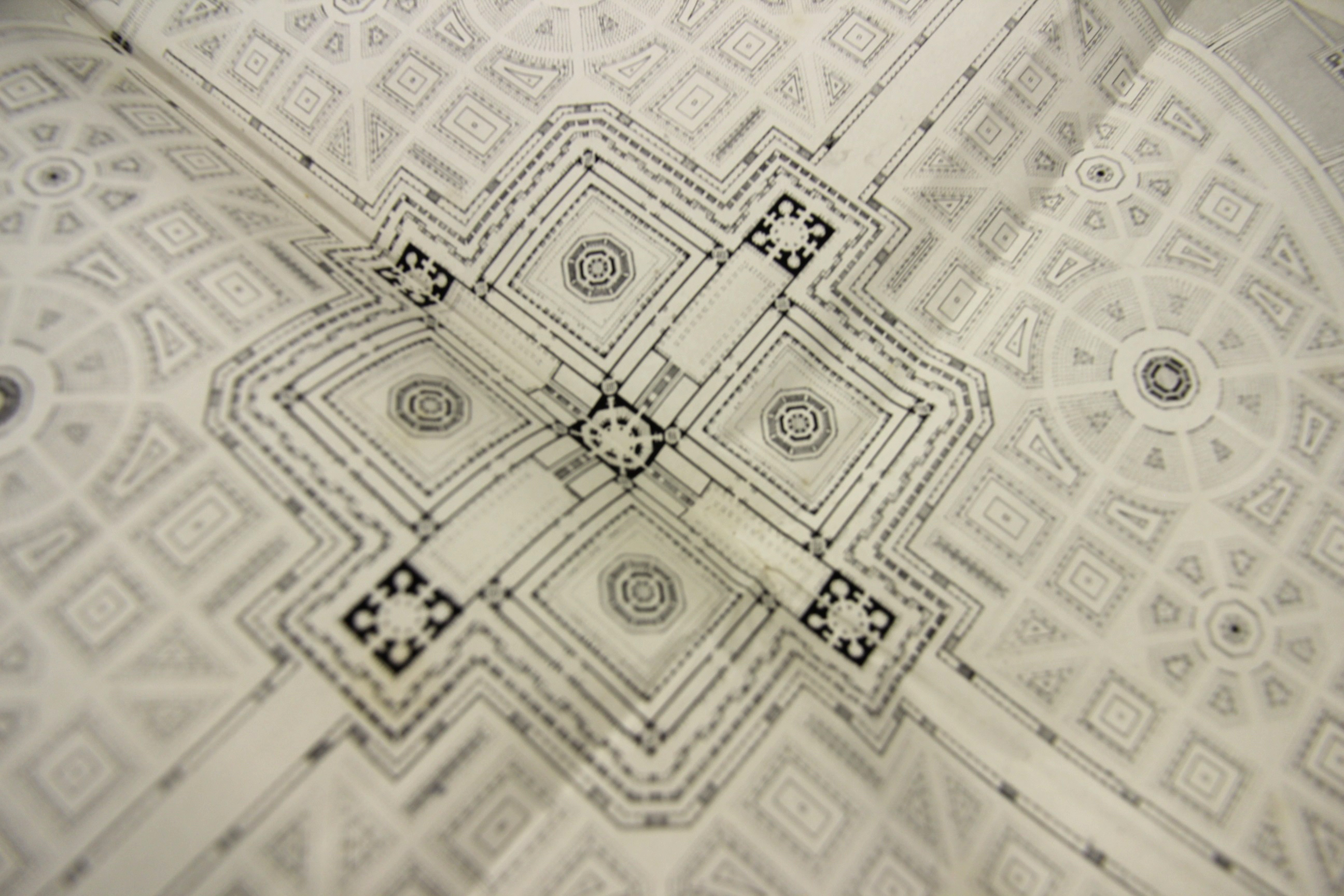
     Amedee Couder wrote L’Architecture et l’industrie comme moyen de perfection sociale, a fine work that was published in Paris (by Brockhaus et Avenarius) in 1842.  The work presents Couder’s rather stroing visionary plans for a perfect city of industrial and scientific harmony, laid out in suggestively-fractal harmony, with the suggestions of a Renaissance-laden snowflake design. Whatever it was, it was beautiful to look at, at least on paper, though I’m not so certain that I’d care to live in the canyonlands of stone and shadow on the other side of the garden wall of the perfect scientific-industrial conclave. 

    Couder 1

    Couder 2 detail

    Couder 5

    ·Posted by :

    ·in:

    —

Recent Posts

Archives

Categories