A Daily History of Holes, Dots, Lines, Science, History, Math, Physics, Art, the Unintentional Absurd, Architecture, Maps, Data Visualization, Blank and Missing Things, and so on. |1.6 million words, 7500 images, 4.9 million hits| Press & appearances in The Times, Le Figaro, Mensa, The Economist, The Guardian, Discovery News, Slate, Le Monde, Sci American Blogs, Le Pont, and many other places… 5000+ total posts since 2008.

  • Interplanetary Navigation in Regards to Space Flight (1960)

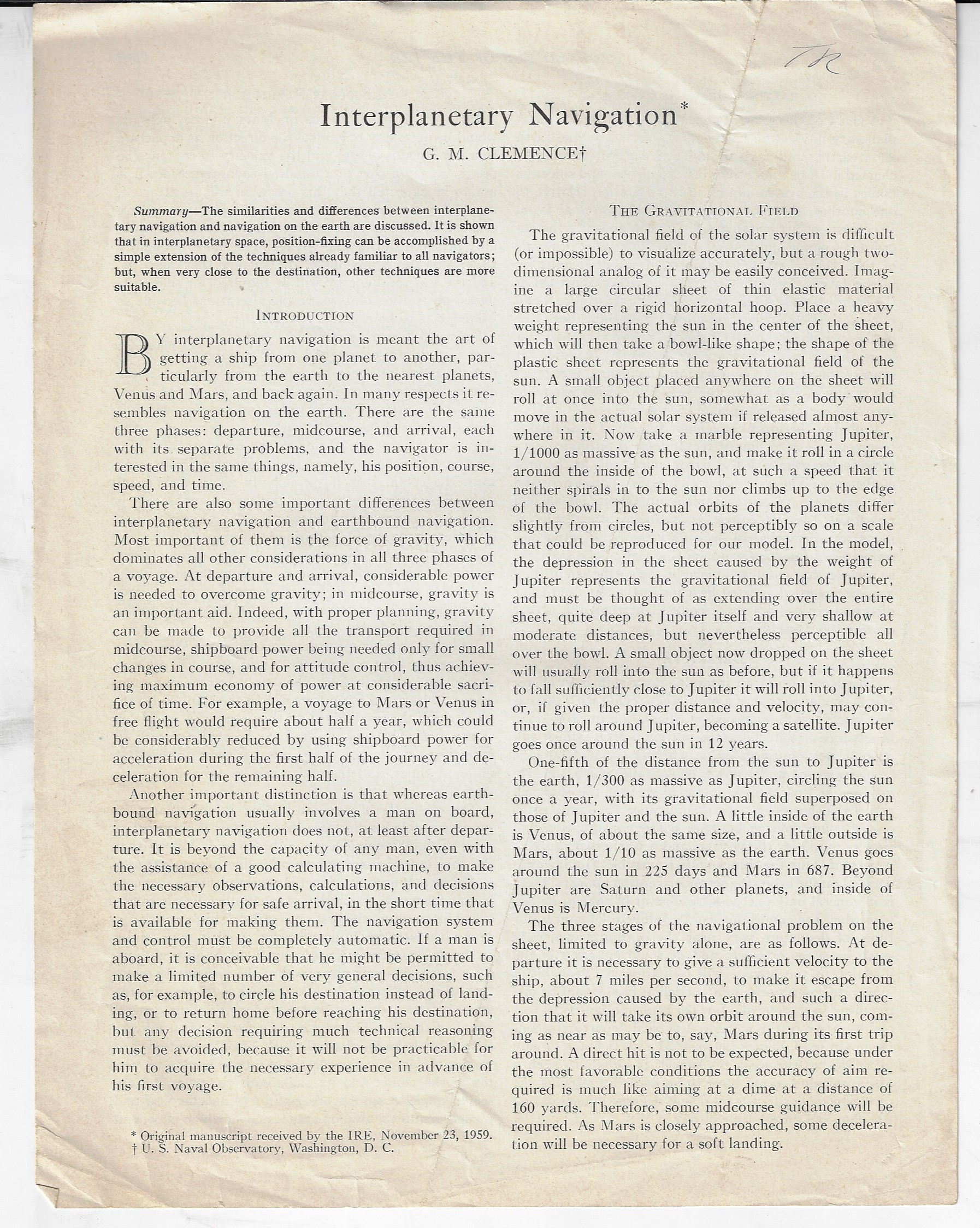
    Clemence Interplanetary G.M. Clemence, “Interplanetary Navigation”, an offprint from Proceedings of the IRE ( Volume: 48 , Issue: 4 , April 1960 ), pp [497]-499

    “Summary: The similarities and differences between interplanetary navigation and navigation on the earth are discussed. It is shown that in interplanetary space, position-fixing can be accomplished by a simple extension of the techniques already familiar to all navigators; but, when very close to the destination, other techniques are more suitable.”

    Original self wrappers. Old fold running vertically across the pamphlet. VG copy, and scarce.  $95 

    ·Posted by :

    ·in:

    —
  • Early Geological Map (1823)

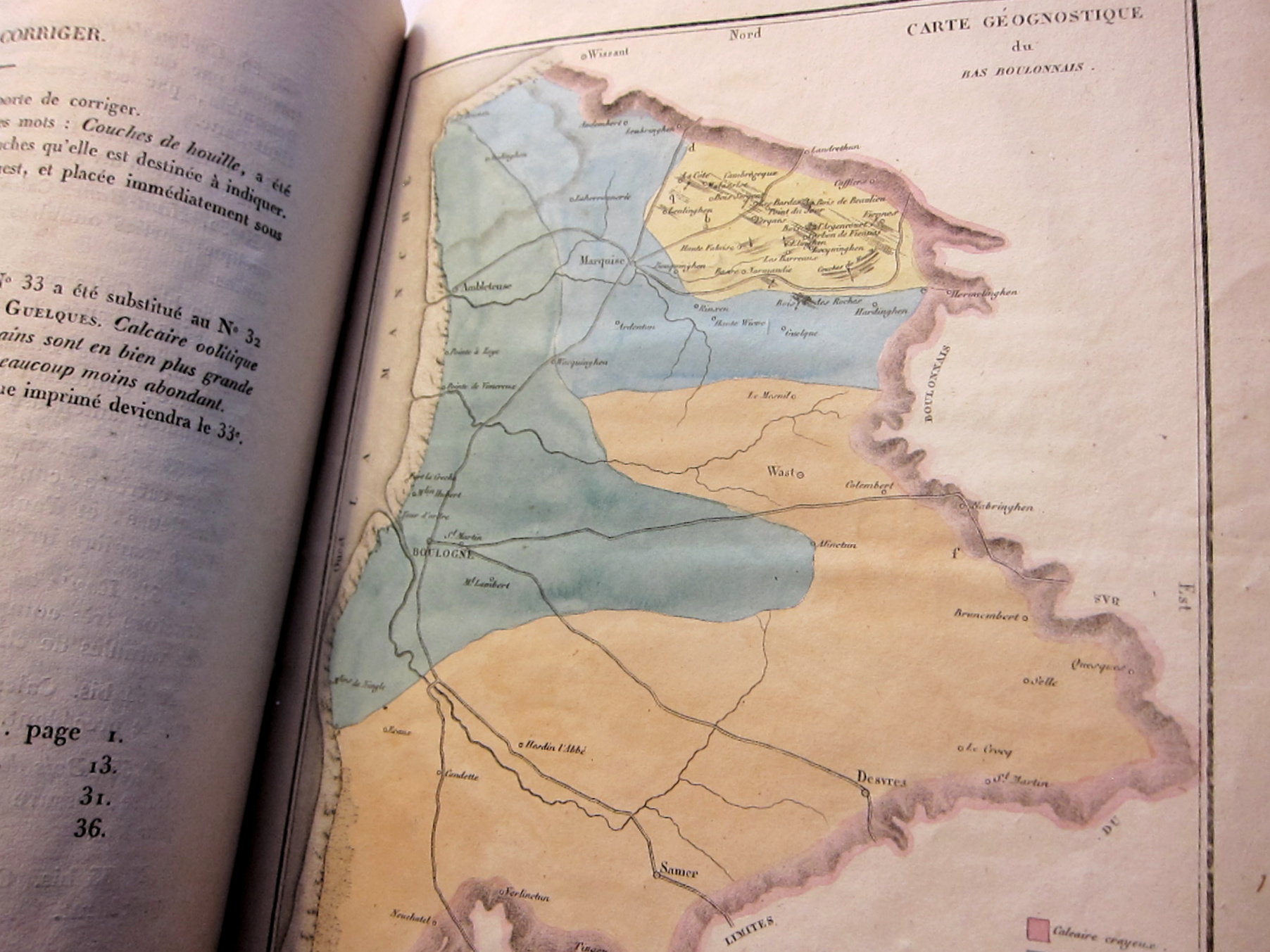
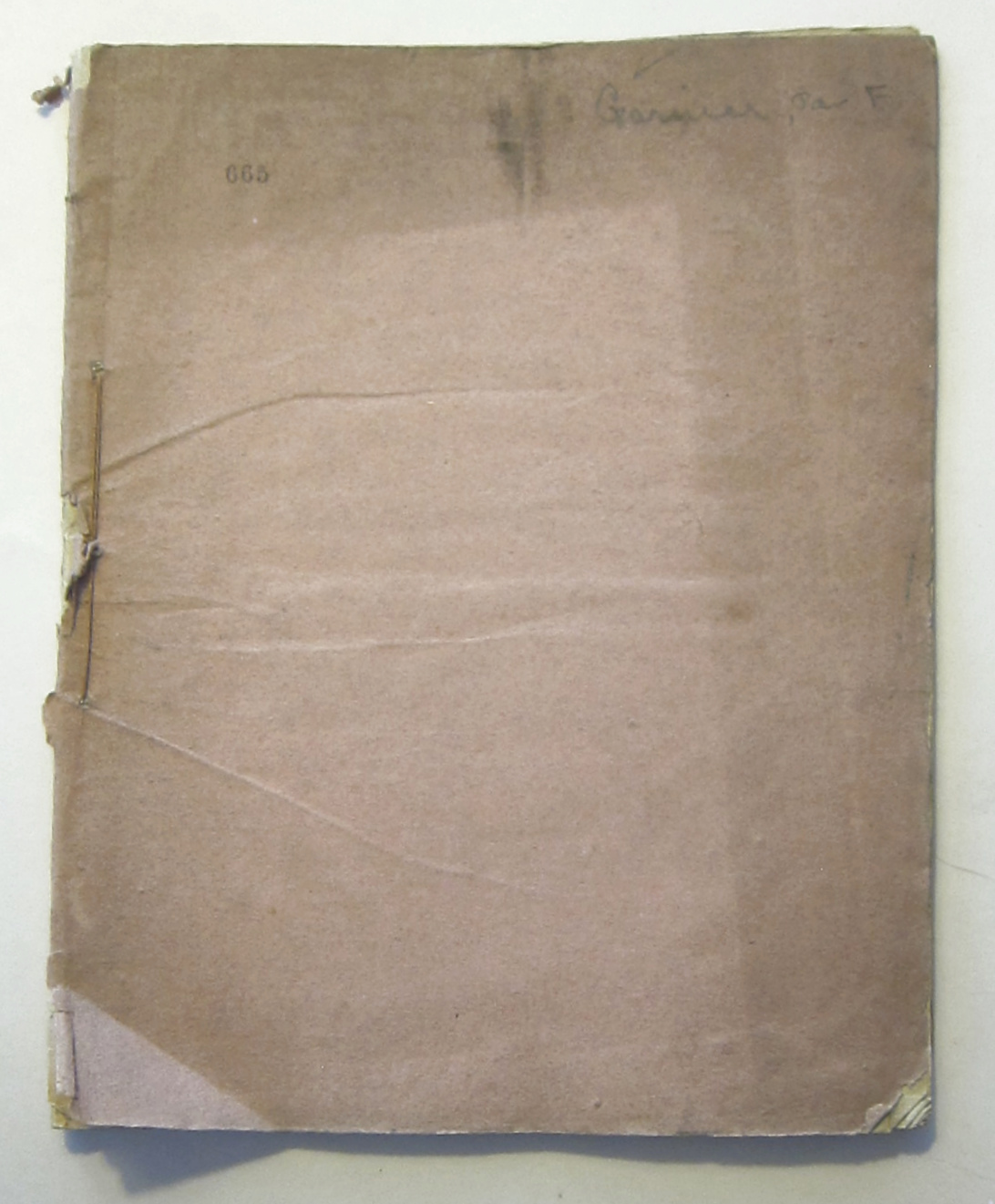
    Garnier, F. Memoire Geologique sur les Terrains du Bas-boulonnais et particulierement sur les Calcaires Compactes ou grenus qu’il Renforme. Boulogne sur Mer, published by P. Hesse, 1823. From an address at Boulonge in July 1822.  Original wrappers. Dusty. Rubber stamp ownership mark on rear wrapper.  Very Good condition. SOLD

    10×8”, 39pp, with a full-page geological map of the region, which is evidently an early geological (“Geognostique”) map of the region, and appears (as with some others) 18 years before the publication of the first full-country geological map of France (1841. Dufrenoy, PA and de Beaumont, E, Tableau d’Assemblage des six feuilles de la Carte de la France.)Maps france boulonge geo

    Book arts knot march 2019 _3_

    ·Posted by :

    ·in:

    —
  • The First U.S. Mention of Underwater Photography

    [William Thomson] “Photography Under Water”, one longish paragraph reporting on the May 1856 announcement in London Mechanics Magazine of the first underwater photographic adventure—and this only 17 years after the announcement of Daguerre’s invention. Found in the August issue of: Journal of the Franklin Institute, Philadelphia, Vol 32 (third series), volume 62 (overall), August-December 1856, 447 pp.,with text illustrations.  Half-calf, with raised bands. Ex-library, with some scuffing on the spine; also a few stamps on the title page. Nice copy.  $250

    From the article on Thomson:

    “The camera was placed in a box with a plate-glass front, and a movable shutter to be drawn up when the camera was sunk to the bottom. The camera being focused in this box on land for objects in the foreground, at about ten yards, or other suitable distance, was let down from a boat to the bottom of the sea, carrying with it the collodion plate, prepared in the ordinary way. When at the bottom the shutter of the box was raised, and the plate was thus exposed for about ten minutes. The box was then drawn into the boat, and the image developed in the usual manner. A view was thus taken of the rocks and weeds lying.in the bottom of the bay. Mr. Thompson anticipates that it will be a ready and inexpensive means of arriving at a knowledge of the condition of piers, of bridges, piles, structures, and locks under water.

    Also in this volume:

    Sanderson, “Mr. Bessemer’s Discovery”, pp 273-5 (from the London Mechanics Magazine).

    “Experiments on Iron made by Mr. Bessemer’s Process”, pp 349-351.

    Howson, “Description of H. & W. Brown’s Ice Boat”, (with three drawings, a design for a boat to break up ice and clear a channel).

    ·Posted by :

    ·in:

  • Journal of the Franklin Institute, 1828-1910, a running and working list

    Journal of the Franklin Institute of the State of Pennsylvania, devoted to the Mechanical Arts, Manufactures, General Science, and the Recording of American and other Patented Inventions, 1828-1920 —assorted volumes with major and minor contributions in physics and chemistry, and also in many in the earliest phases of tech fields like photography, telegraphy, television, recorded sound, and etc.

    This is a running list with material added every week—so far there are about 60 volumes in the list of 200+ volumes to come. 

    1828

    John James Audubon, “Notes on the Rattlesnake”, pp 32-37. (Audubon would later paint a ferocious scene of a rattlesnake attacking a Mockingbird nest with the Mockingbirds viciously protecting themselves.) In:  Journal of the Franklin Institute, Philadelphia, 1828; volume 2 (new series) and volume 6 overall, with text illustrations and four plates, 430, 8, pp. Half-calf, with raised bands. Ex-library, boards detached, spine worn and chipped, also a few stamps on the title page, and a library card pocket at the rear endpaper. The text though is in VG condition.  Overall: Fair condition.  $125

    Michael Faraday, “Directions for bending, blowing, and cutting of glass, for chemical and other purposes. Extracted from Chemical Manipulation”, pp 92-99, 145-150, 217-222, 301-306, 361-367 (concluded). 

    “Prognostics of the Weather”, indicators of the coming of weather found in nature and their interpretation. For example, we are told of how the certain actions of ants and asses predict the coming weather, as with human aches and pains; these are followed by dozens of examples.  pp 99- 107, 175-184 (concluded);

    “History of the Telegraph”, pp 51-54;

    Wonder description (with illustration) from the patent section of “Mrs. Siebe’s tap for cutting hollow screws”

    And many others.

    1829

    Journal of the Franklin Institute, Philadelphia, 1829; volume 3 (new series) and volume 7 overall, with text illustrations and four plates, 438pp Half-calf, with raised bands. Ex-library, with some scuffing on the spine; also a few stamps on the title page, and a library card pocket at the rear endpaper. Good/Very Good. $145

    Cumberland, “On the Origins of Air Balloons” pp 20-24.

    “On improvements in Marbling the edges of Books and Paper”, pp 246-249, (from the French, which also has been reprinted in limited editions);

    Followed by:

    “On Morocco Leather Dressing”, pp 250-254 and 297-302;

    “An Historical Account of Lithography…” pp 279-282 and 302-306;

    George Cayley, “On the Natural Zero, according to Fahrenheit’s Scale”, pp 389-392;

    William Howard, “Specification of a patent for an improved Rail-way Carriage”, pp66-68, with three copper plate engravings;

    “Observations upon Rail-roads, and the Adaptation of Carriages in such as are curvilinear”, pp 68-70

    Mark Watt, “Abstract of a Memoir…on the Principles of Attraction and Repulsion in the Lunar Rays”, pp 24-29

    “On the Natural History of the Honey Bee”, pp 36-42 and pp 81-92;

    “An Account of the Fire of St. Elmo”, pp 111-113;

    “Observations on the connexion of Mechanical Skill, with the highest attainments in Science…”, pp 153-159, and

    “On the Rotary Steam Engine”, pp 179-184;

    And of higher interest:

    John Fleming, “On the Value of the Evidence from the Animal Kingdom, tending to prove the Arctic Regions formerly enjoyed a milder climate than at present”, pp 382-389 (or rather the “insufficiency” of evidence that is).

    And here we go:

    “Innocuous Nature of Putrid Exhalations”, p. 35

    “On the Art of the Liquorist”, pp 369-375

    “On the Spontaneous Combustion of the Human Body”, pp 31-34.
    ·Posted by :

    ·in:

  • Modern Stained Glass Windows, 1937

    Mallet-stevens _5_

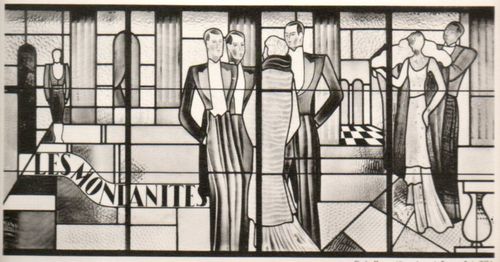
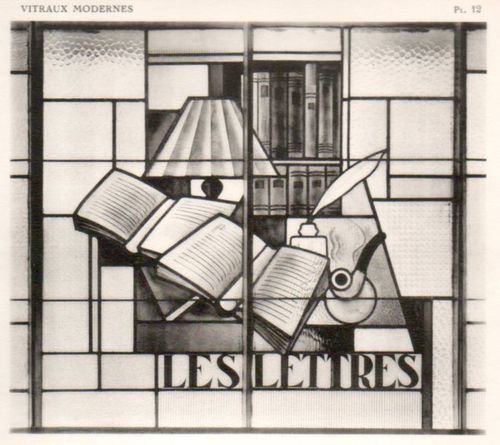
    MALLET-STEVENS, Robert. Exposition internationale de 1937. Vitraux modernes. Avant-propos de Paul Léon. Paris: Charles Moreau, 1937. Portefeuille in-4 (320 x 250 mm). 48 fine plates reproducing the work of  Décorchemont, Maumejean, Cingria, Robert Delaunay, and others.

    14×10 inches, portfolio, with original ties.  Most plates have their original tissue guards. 

    Nice copy:  very slightly ex-library, with bookplate, a perforated stamp of ownership in the bottom-right corner, and small inked numerical stamp on the back of each plate’s bottom corner.  A nice, fresh copy.  $350

    “L’Exposition de 1937, qui nous montre la ‘généralisation’ de l’architecture moderne, nous offre quelques vitraux de tout premier plan… Quand l’architecte voit dans l’espace des volumes bien ordonnés, le peintre verrier trace des lignes et oppose des couleurs heureuses… Je n’oserai dire que l’architecture moderne est en plein progrès, mais je puis affirmer que le vitrail ‘va très bien’!” (Robert Mallet-Stevens, Introduction).


    Mallet-stevens _5_

    ·Posted by :

    ·in:

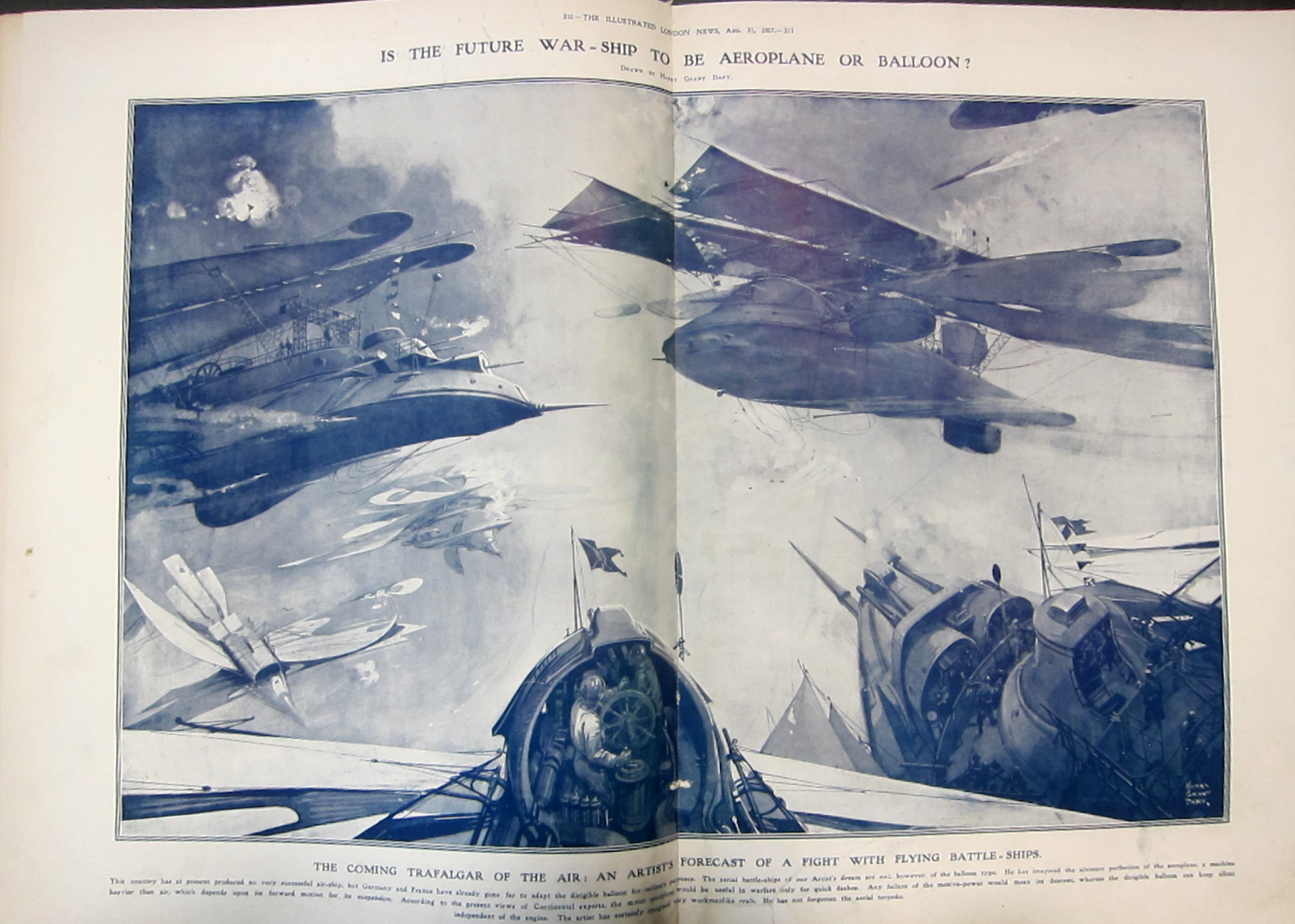
  • A Trafalgar of the Air—the Flying Battleship of the Future (1907)

    “Is t he Future War-Ship to be Aeroplane or Balloon?”, a glorious 2pp (16” x 23”) illustration in the Illustrated London News, August 31, 1907, pp 293-328. 16” x 11.5”. Original wrappers, removed from a larger bound volume Good condition. $100

    This image was drawn by Harry Grant Dart only four years after the wrights’ powered flight at Kill Devil. It features four images of enormous aircraft as well as two smaller images, none of these seem to be the balloons in question in the title of the artwork, the artist seeming to have come down on the side of the aeroplane. That said, these aircraft are massive—iterating by the figures on deck the plane was close to 50’ tall with wings that must’ve been 100’ wide. Everything seems to be massively heavy, looking more like steam-fired ships (“flying battle-ships”) than anything else…except for their resemblance to birds and dragonflies.  Also of note in the upper right corner is a missile—an “aerial torpedo—fired at one of the aircraft.

    Harry Grant Dart (1869-1938) was a correspondent, artist, and cartoonist who worked for the New York World, Life, and Judge, whose specialties seem to involve techno-future-vision. 

    ILN Ap 31 1907


    ·Posted by :

    ·in:

    —
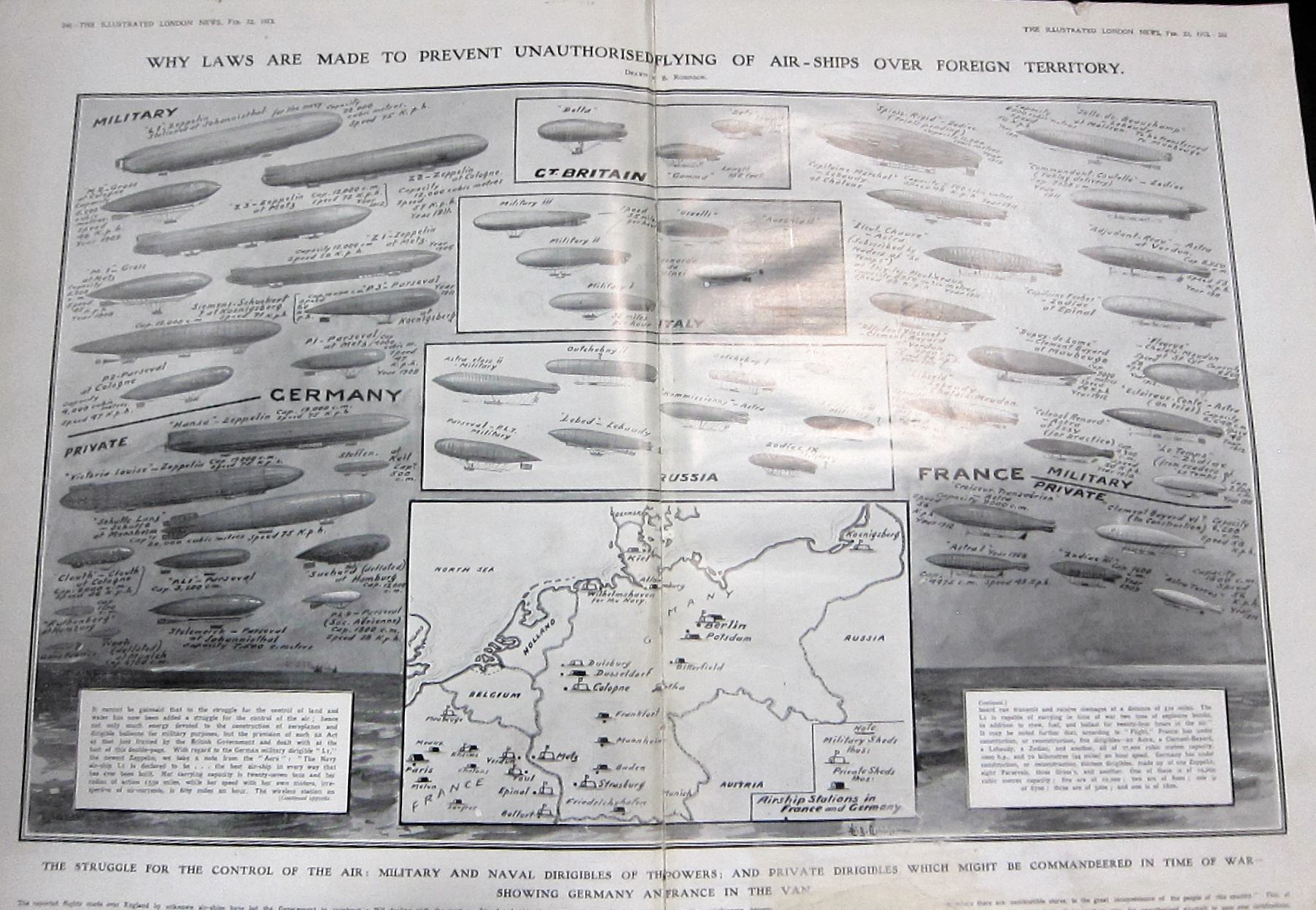
  • Skies Filled with Airships, 1913

    “Why Laws are Made to Prevent Unauthorized of Air-Ships over Foreign Territory”, in Illustrated London News, February 22, 1913, the two-page illustration on pp 240-241 in the issue of pp 229-264, with a “supplement” section of 9pp. 15.75” x 16.25”, illustrated throughout with drawings and photos. Removed from a larger bound volume, with signs of the extraction showing along spine. Fantastic image! $95

    ILN 1913 Dirigible laws

    ·Posted by :

    ·in:

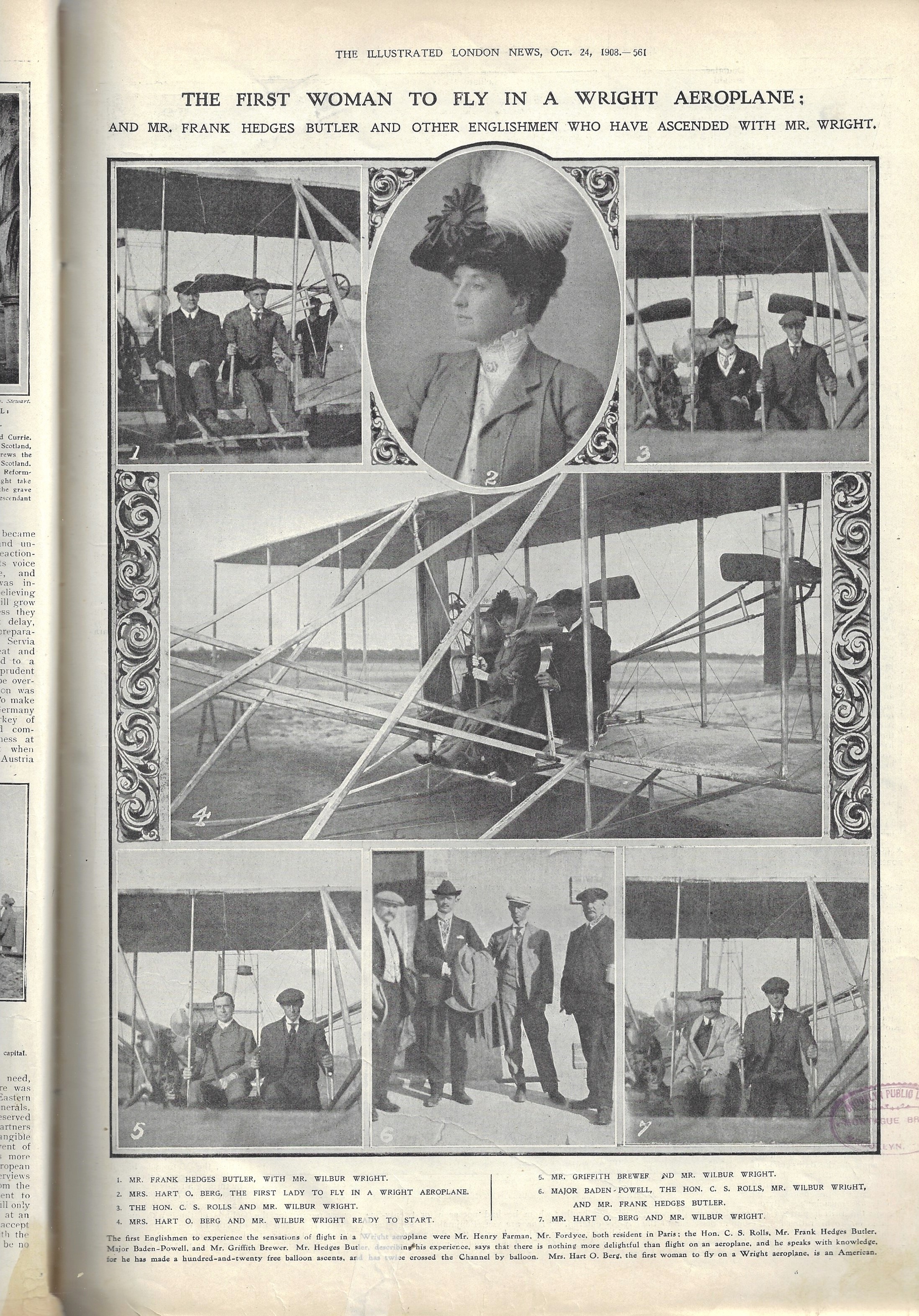
  • The First U.S. Woman to Fly as a Passenger in a Plane (1908)

    “The First Woman to Fly in a Wright Aeroplane”

    ILN 1908 wright flyer Mrs bergFull-page picture article “The First Woman to Fly in a Wright Aeroplane: and Mr Frank Hedges Butler and other Englishmen who have Ascended with Mr. Wright”, in Illustrated London News, October 24, 1908 issue (No. 3627 vol 133). The weekly issue of 30 pp printed on a heavier, semi-gloss paper, removed from a larger bound yearly volume, with the spine showing signs of the removal; also a small oval rubber stamp on page bottom right corner from previous owner. G-VG copy, otherwise.  $125

    The main subject here is Edith Berg, wife of Hart O. Berg, the European rep of the Wright’s  business interests  (and who helped Wilbur personally through his long stay on the continent). She was the first American woman to fly as a passenger in an airplane, and the first woman in Europe to fly in a Wright airplane. Lovely 6-photo full-page story on pg 561.

    “When Mrs. Hart O. Berg watched Wilbur Wright demonstrate the Wright Flyer at Le Mans, France, she was so thrilled by the performance that she asked Wilbur for a ride. Thus, in September 1908, she became the first American woman to fly as a passenger in an airplane, soaring for two minutes and seven seconds.”—National Air and Space Museum

    ·Posted by :

    ·in:

    —
  • Alfred Tarski ÜBer Den Begriff Der Logischen Folgerung Inactes Du CongrèS International De Philosophie Scientifique

    Alfred Tarski, “Über den Begriff der logischen Folgerung”, in Actes du Congrès International de Philosophie Scientifique, fasc. 7 (Actualités Scientifiques et Industrielles, vol. 394), Paris: Hermann et Cie, , 72pp, the Tarski in pp. 1–11. Original printed wrappers; there’s a little chip missing from the bottom half-inch of spine. Largely unopened. VG copy. $75

    (Published in English as: Tarski, A. “On the Concept of Logical Consequence.” In Logic, Semantics, Metamathematics. 2d ed. By A. Tarski. Edited by J. Corcoran, 409–420. Indianapolis, Indiana.)

    Tarski’s presentation of his theory of logical consequence as universal truth-preservation over interpretations of the non-logical constants. This is a widely used translation of the 1936 German version. (Original title of the 1936 German version: “Über den Begriff der logischen Folgerung.”)–Oxford Bibliographies

    Introduced as a “Classic”, translated from the Polish and German by Magda Stroika and David Hitchcock

    “In (1936), Tarski presented for the first time, in German, his new semantic definition of logical consequence and logical truth. He starts to motivate his definition
    by critizicing traditional syntactic definitions. “–Gerhard Schurz, “Tarski and Carnap on Logical Truth — or: What Is Genuine Logic?”

    ·Posted by :

    ·in:

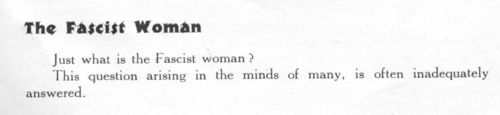
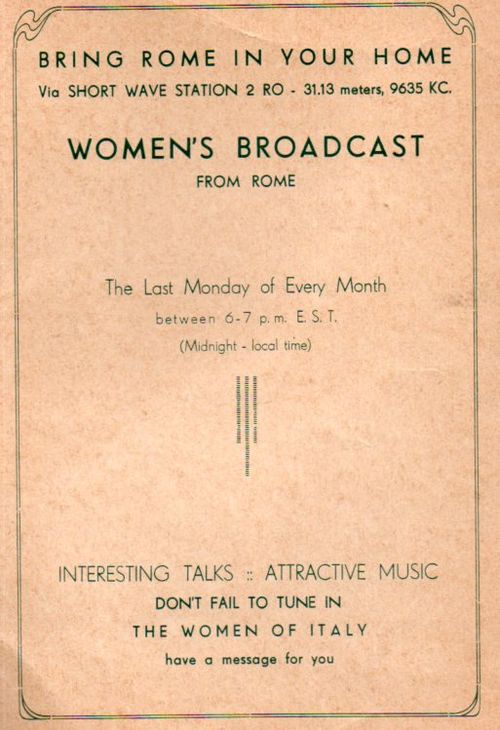
  • “Bring Rome in Your Home”–Fascist Women of Italy Radio Broadcasts, 1937

    Women of facism103

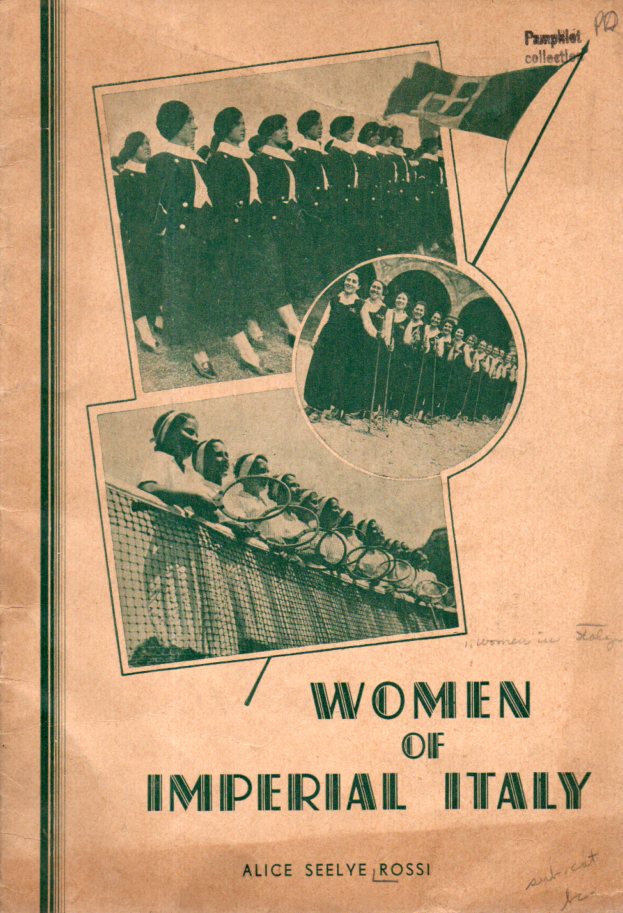
    Women of Imperial Italy, by Alice Seelye Rossi; printed in Rome, 1937, by Stamperia Romana. 8″x5″, 20pp, numerous photo illustration. Printed wrappers somewhat dusty. Ex-libris stamp on rear cover. Scarce title: WORLDCAT locates only 2 copies.  $120

    In regards to the answer to the question above: not anymore. Probably not so much in 1937, though I am sure that the picture of the “fascist” in the “fascist Woman” was prettier and rosier than what people would come to know by 1942.  In 1937, when this pamphlet was published, the “women” were broadcasting far and wide–one aspect of radio propaganda from the Fascists in Italy, a hearts-and-minds attempt at a part of the coercion of Italia imperiale that occupied the years 1935 until the end of the war. By 1937 Mussolini’s National Fascist Party (in power since 1922) had extended itself by occupying Libya and by invading Ethiopia; Albania, Greece, and Yugoslavia would come between 1939-1941, as would France, when Italy entered the war in 1940 and entered into the country at the tail-end of the German invasion. So the broadcast heard here in 1937 was the beginning of Italy looking for the “Fourth Shore”, and deep into Mussolini’s Fascist state. (Ezra Pound would also do his level best to look the part of traitor that he was, lobbying the Italians for years before being allowed to get on the air to broadcast to the Allies on his misunderstood and inscrutable economics, vicious and virulent anti-Semitism (offhandedly addressing the U.S. president as “Franklin Delano Jewfeld/Jewsevelt”), and general attempts to tell the U.S. population to not support the war effort against the Fascists and that instead they should be down on their knees praising Mussolini, who he saw as another Thomas Jefferson. And so on.)  

    I’ve shared the few pages in this brief pamphlet on the Fascist Woman as it appears in the pamphlet. For the great majority of people living in the U.S., Europe, Great Britain,  Australia, New Zealand, Canada, and many other places, the idea of the “fascist” would change dramatically in about a year, and then spin its grinding way downward until the start of the war in 1939. 


    Women of facism102


    Women of facism101

    ·Posted by :

    ·in:

    —
  • Orders and Instructions on Living in France and on the “Disposition” of the Jews, September 1940

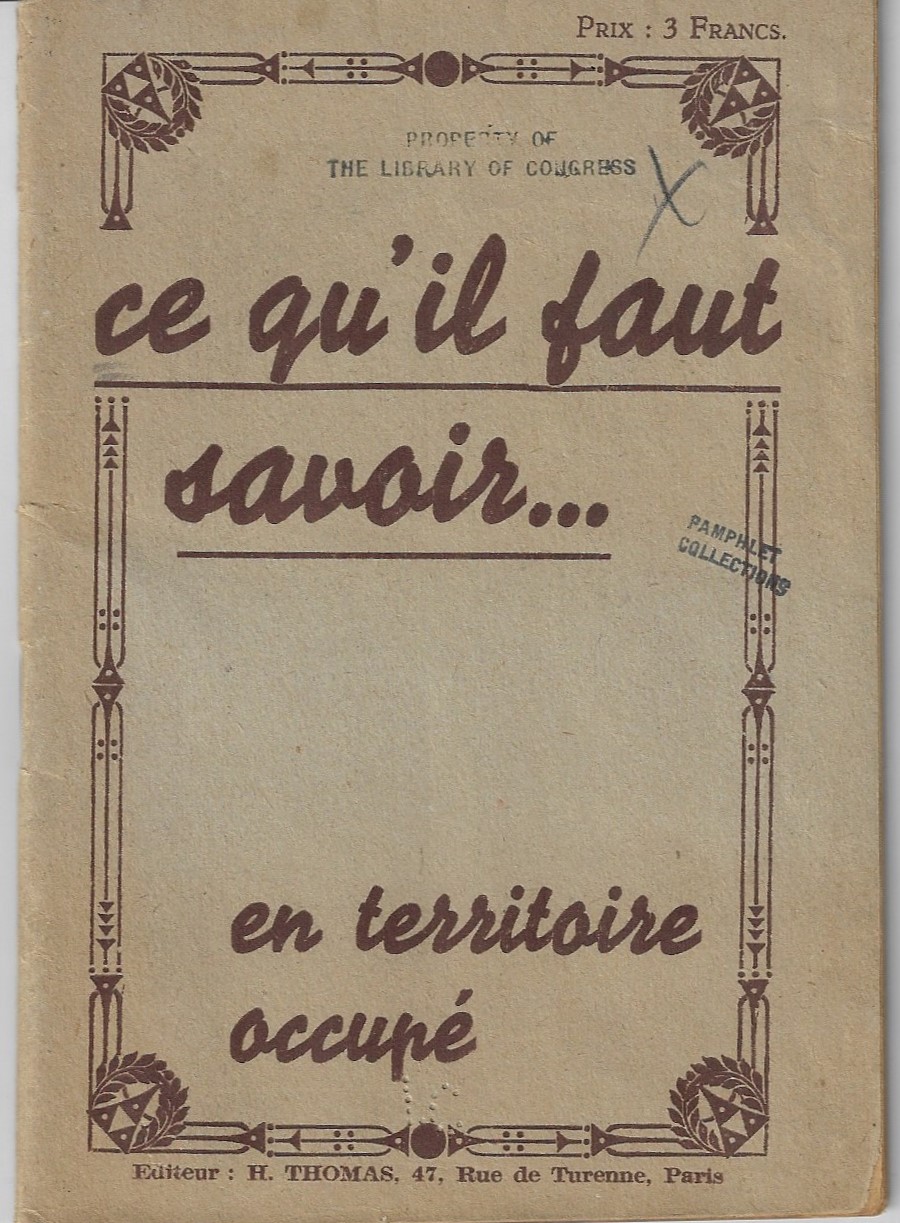
    Books covers france occupiedCe qu’il faut savoir … en territoire occupé, (Ed : H. Thomas, 47 rue de Turenne, Paris,) 6×4”, 46pp. No doubt the work of the Nazi government. Printed ca. August/September 1940. Original wrappers. Provenance: Library of Congress, with their stamp on the front wrapper and their surplus/duplicate stamp on the cover’s back.  Good copy. $200

    By the title, Ce qu’ill faut savoir en territoire occupe (“what you need to know in the occupied territories”) we see that this short/small and rather plain pamphlet is an outline of expected behavior of conquered France…or shall I say “overrun” in its six miserable weeks of fighting which found no good end, all of it coming to a close on 22 June 1940, though there were strong pockets of resistance that would arise and take hold until the defeat of the Germans five years later. It is almost ephemeral, having virtually no “presence”, if appearance were to judge—it looks like nothing, nearly. It is hardly that, and represents a coming great evil.

    It contained the rules of society from the Germans and from Vichy, and in no small way dictated the expectations of the conquerors. The thinking was wide and brutal and trite, defining the occupied territories, the new justice system, economics of the occupation, and the like, as well as the “camouflage” of street lights, rates of exchange, bicycle rules, and the use of motorcycles.

    What caught my eye was the header for a two page section on French Jewry, “Les Dispositions pour les Juifs”.

    It is announced simply that the “German authorities” and of course the Vichy government have taken measures against Jews in the occupied territories.

    • (“Les autorites allemands ont pris des dispositions contre les Juifs demeurant en territoire occupe…a ces dispositions pourront en etre adjointes d’autres prises par le gouvernement francais de Vichy…”) and then went about its business.

    The first thing to do was for the Jews to make themselves available and report to authorities before 20 October 1940. It encouraged the head of a household to make a report on the entire family.

    • (“Pour le moment, les obligations faites aux juifs en territoire occupe sont les suivantes de ne pas rentrer, pour les juifs qui ont lui la zone occupe de se presenter avant le 20 Octobre 1940 a la sous-pretecture de leur arronfissement de domicile pour se faire inscribe a un registre special. La declaration du chef de familie est valable pour toute la familie.”)

    Next of course came the subjugation, demanding the identification of all businesses either run by or principally owned by Jews to identify themselves as such, with fines and imprisonment (and confiscation) the consequences of not doing so. A Jewish business was also defined as having more than 50% investment by Jewish interests.

    • (“…d’afficher en langue allemand et francais la mention entreprise juive a tout comemrce dont le proprietaire ou le deteneur est juif. Les dirigeants des communautes israelites doivent fournir. Les contraventions sont punies de prison et d’amende, ou d’une de ces deux peines. La confiscation des bien pourra en outre etre prononcee…”)

    Then comes the identification of who is a Jew, and according to this document, someone is a Jew if their grandparents were (“or appeared to be”) Jews.

    • (“Sont retenus comme Juifs ceux qui appartiennent ou, la religion juive ceux qui ont plus de deux grands-parents.”)

    Just a couple of hundred words. Two pages. And yet it outlines the basics of population control and discrimination, setting the stage for removal. All contained in this little pamphlet, which I should point out was not free, but sold for 3 Francs. There would be a many-orders-of-magnitude price to pay in the very near future.


    ·Posted by :

    ·in:

Recent Posts

Archives

Categories