A Daily History of Holes, Dots, Lines, Science, History, Math, Physics, Art, the Unintentional Absurd, Architecture, Maps, Data Visualization, Blank and Missing Things, and so on. |1.6 million words, 7500 images, 4.9 million hits| Press & appearances in The Times, Le Figaro, Mensa, The Economist, The Guardian, Discovery News, Slate, Le Monde, Sci American Blogs, Le Pont, and many other places… 5000+ total posts since 2008.

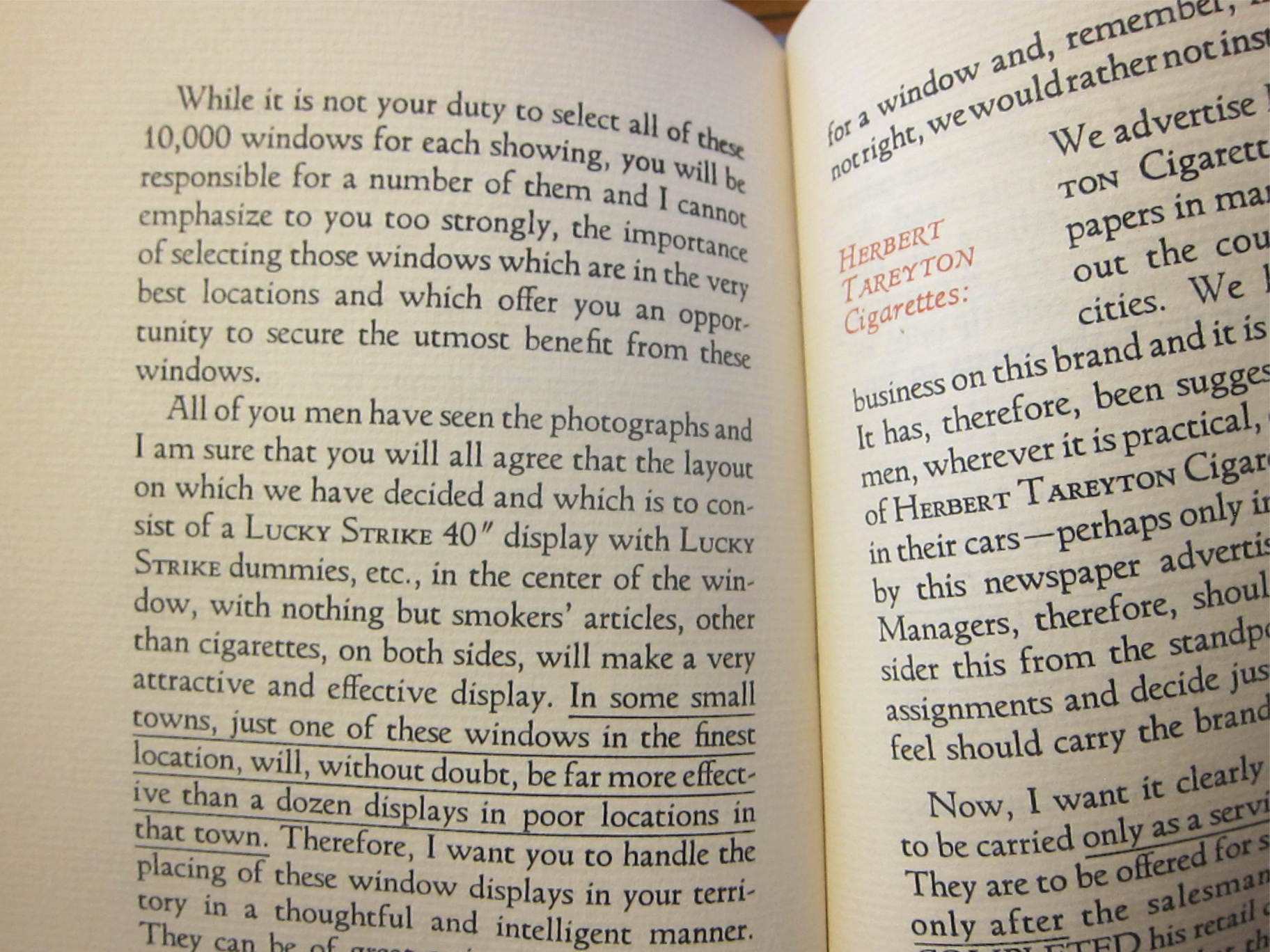
  • 10,000 Windows Filled with Cigarettes (1937)

    American tobacco _3_Riggio, Vincent. American Tobacco Company, Sales Organization. Printed by ATC on fine laid paper. 7”x5”, 61pp. Embossed cloth. FINE copy. (Provenance: few scant small internal stamps from the Library of Congress.) I can’t find this in WorldCat/OCLC.  $95

    Riggio (1878-1960) was a classic rags-to-riches story: Sicilian-born, lower East Side, quit school to work, opened barber shop on 117th, etc., and by 1947 was one of the highest paid execs in the country at $484k/yr. (Its hard to translate this wealth, even after fiddling with CPI—at the time though 30 million of the 39 million families in the US Census for 1950 made less than $5k/yr.)

    Anyway Riggio’s book was boosterism and a how-to for sales. The one part that stopped me was the instruction on filling “10,000” windows in high-traffic areas with ciggie displays.  There were 93 cities in the US with 100k or more population in 1930 (105 in 1940, 50 in 1910, and 68 in 1920) so even if the windows concentrated on the big cities that’s 100 big windows (think classic giant window displays busy intersection) per each of the 100 cities. That’s in addition to massive amount of print ads and radio/sporting event sponsorships. (And remember the print ads used movie stars, doctors, lawyers, Santa, sports figures, and so on, plus the combination of the cigarette with the possibility of expressive manhood AND sexual allure.) These folks got their message across, which was too bad. 

    And for the record ATC was founded in 1890 by Buck Duke, and was one of the original 12 companies1 comprising the first index for the Dow Jones averages (1896). ATC was busted2 in 1911 as a monopoly, after which it became a simple oligopoly.

    Notes:

    1. The twelve companies included American Cotton Oil, American Sugar, American Tobacco, Chicago Gas, Distilling & Cattle Feeding, General Electric, Laclede Gas, National Lead, North American, Tennessee Coal & Iron, U.S. Leather preferred, and U.S. Rubber.

    2. United States v. American Tobacco Company, 221 U.S. 106 (1911), “…which held that the combination in this case is one in restraint of trade and an attempt to monopolize the business of tobacco in interstate commerce within the prohibitions of the Sherman Antitrust Act of 1890.”–Wikipedia
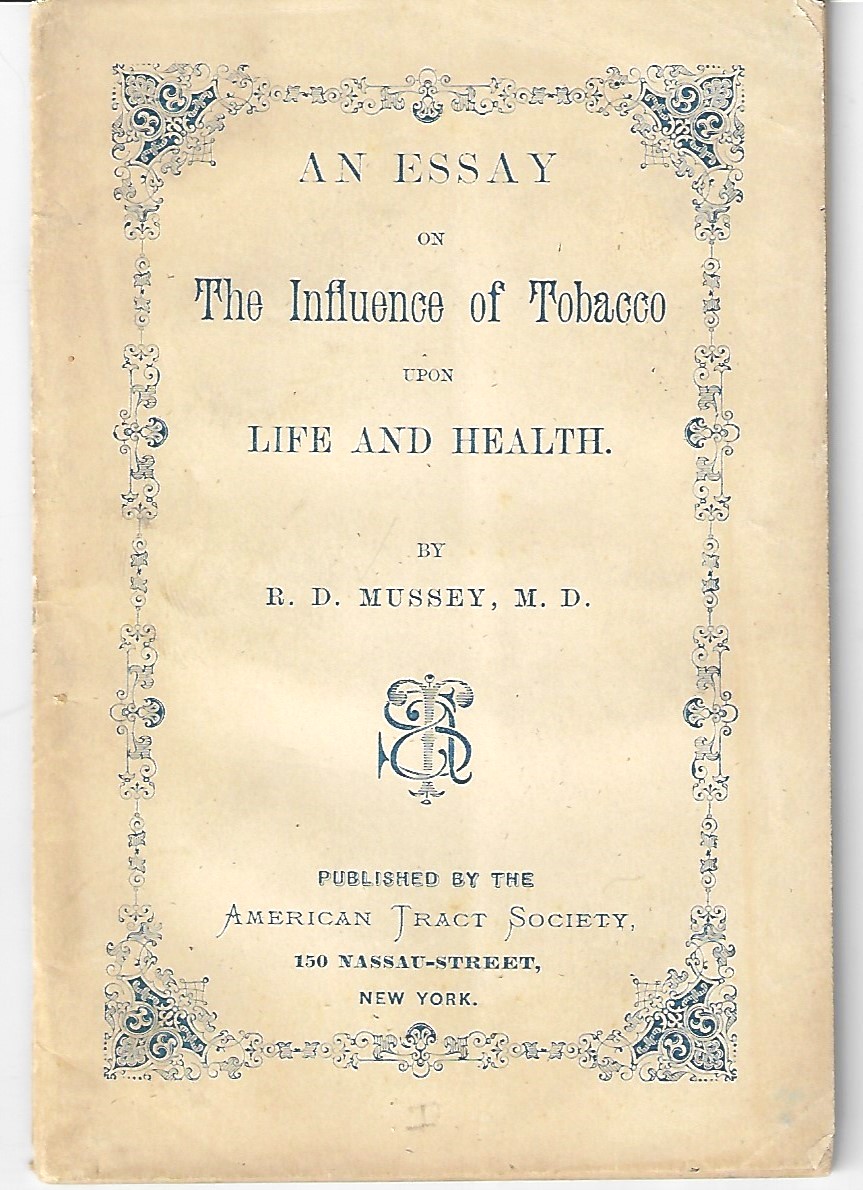
  • Reuben Dimond Mussey An Essay On The Influences Of Tobacco Upon Life And Health Published By The American Tract Society Ny

    Tobacco and essay on Mussey  Reuben Dimond Mussey, An Essay on the Influences of Tobacco upon Life and Health. Published by the American Tract Society, NYC, ca. 1840’s. “A New Edition”, 6″ x 4″, 64pp, original wrapper. Old and small rubber stamp on front title page, ownership rubber stamp on rear wrapper, otherwise VG. This is a strong bit of advice and a presentation of known facts on the evils of tobacco and its effects upon health. The first edition of 1836 was 48pp long–this version is a bit expanded.  

    ·Posted by :

    ·in:

  • 105 Dont’s from NYPD, 1937

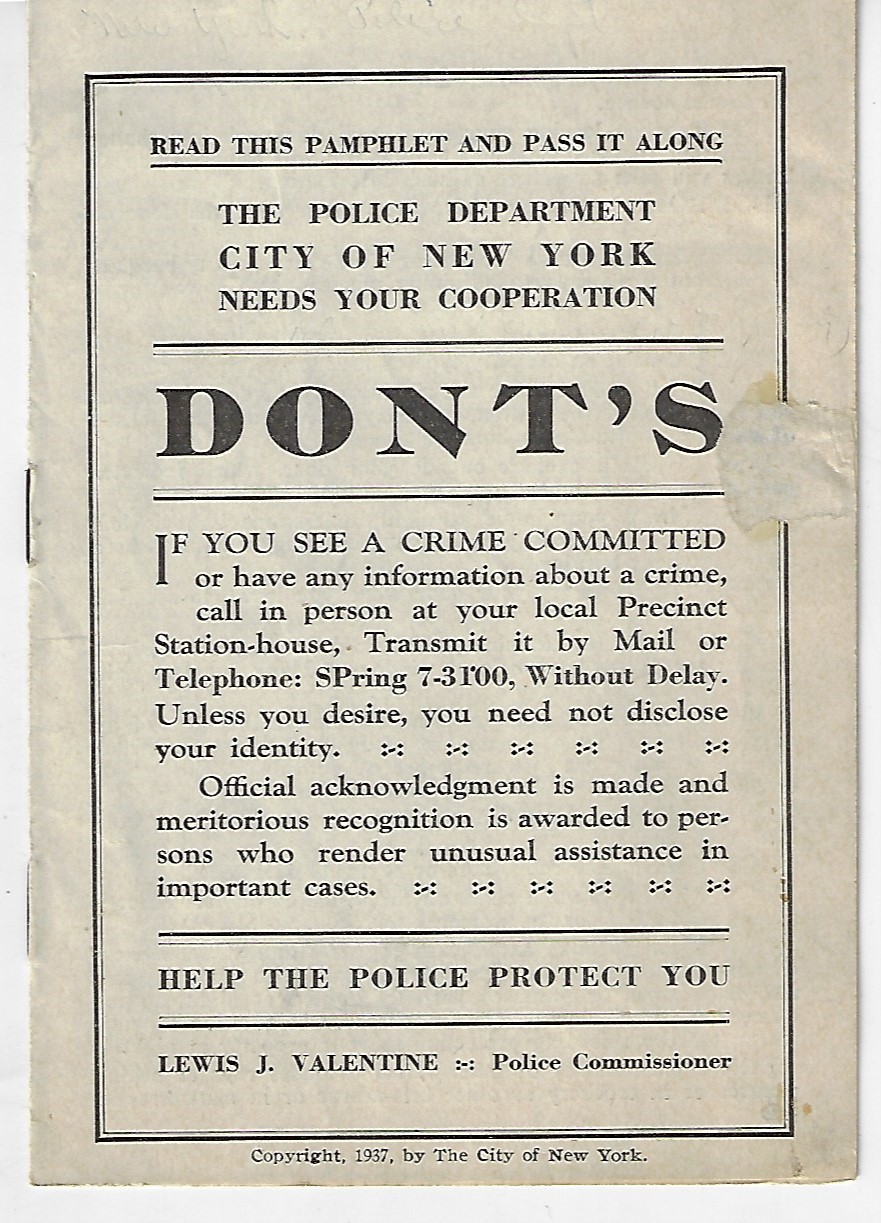
    Police dontsLewis J. Valentine, Dont’s. The Police Department City of New York Needs Your Cooperation…Help the Police Protect You.  Published by the City of New York, and written by the Police Commissioner. 6″x4″, 7pp. Original self wrappers. Very nice copy, though there is a smidge of the right margin rubbed away on teh front corner, affecting no text, and measuring about 15x20mm. I cannot find it in WorldCat/OCLC, under various attempts at different titles.  $35

       Commissioner Valentine offers the reader of this little tract a list of about 105 different DONT’S (“DON’T leave your rings in the wardrobe” and “DON’T leave your handbagin the baby carriage under teh pillow” and other such nuggets from Depression-era NYC.  

    ·Posted by :

    ·in:

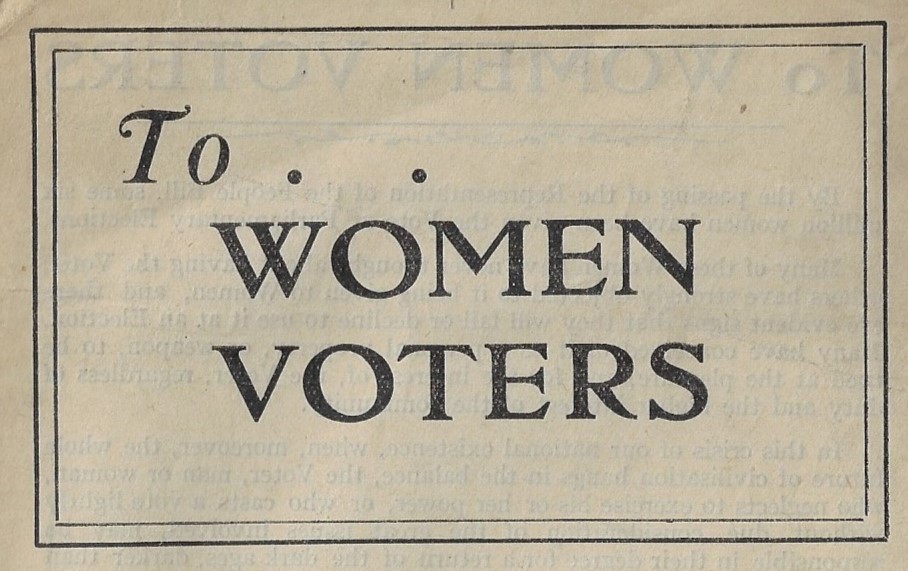
  • To Women Voters (1918)

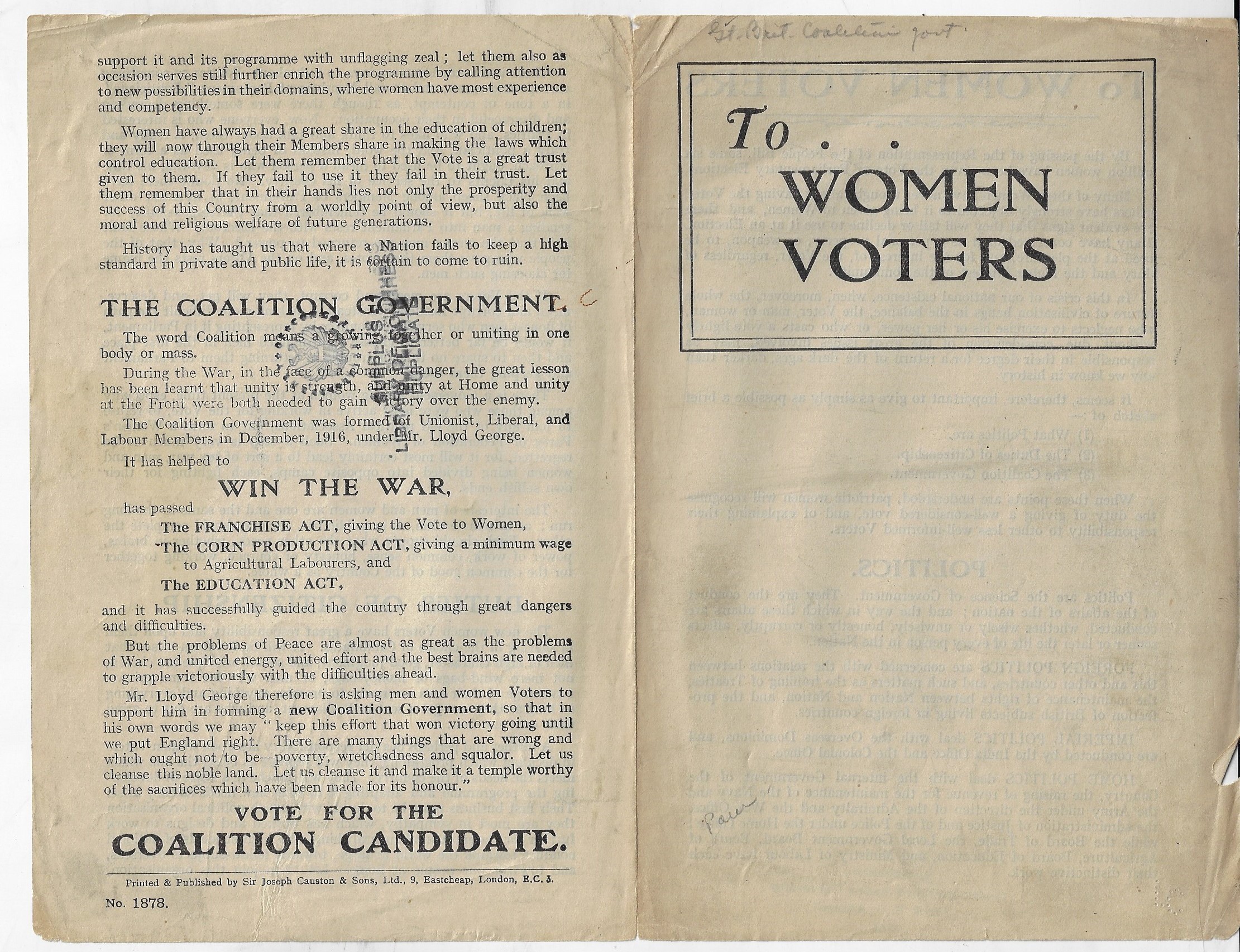
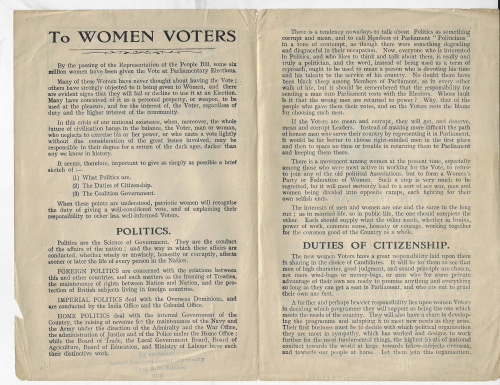
    Books covers to women voters detailTo Women Voters. Printed by Sir Joseph Causton (viz Midsomer!) of London for the Lloyd George U.K. Coalition Government, 1918.  8.5” x 5.5”, 4pp (one sheet folded in half.  Provenance: from the collection of Prof. E.D. Adams to Leland Stanford Jr University, and then the Library of Congress. The LC surplus stamp is on back cover, while the small Stanford stamp is at the bottom of page 2.  Good condition, with some bumps and short tears around edges. Printed on very thin paper. $125

    The coalition government of Lloyd George lasted until 1922 when it was replaced by that of Bonar Law. 

    This pamphlet was a very remedial introduction to women, defining the subjects of “Politics”, “Duties of Citizenship”, and the “Coalition Government”, mostly in the service of having the women who could vote and would do so to vote for the Lloyd George ministry. 

    “The Representation of the People Act 1918 widened suffrage by abolishing practically all property qualifications for men and by enfranchising women over 30 who met minimum property qualifications. The enfranchisement of this latter group was accepted as recognition of the contribution made by women defence workers. However, women were still not politically equal to men (who could vote from the age of 21); full electoral equality was achieved in Ireland in 1922, but did not occur in Britain until the Representation of the People (Equal Franchise) Act 1928.”–Wikipedia

    Books covers women voters inside


    Books covers women voters inside

    ·Posted by :

    ·in:

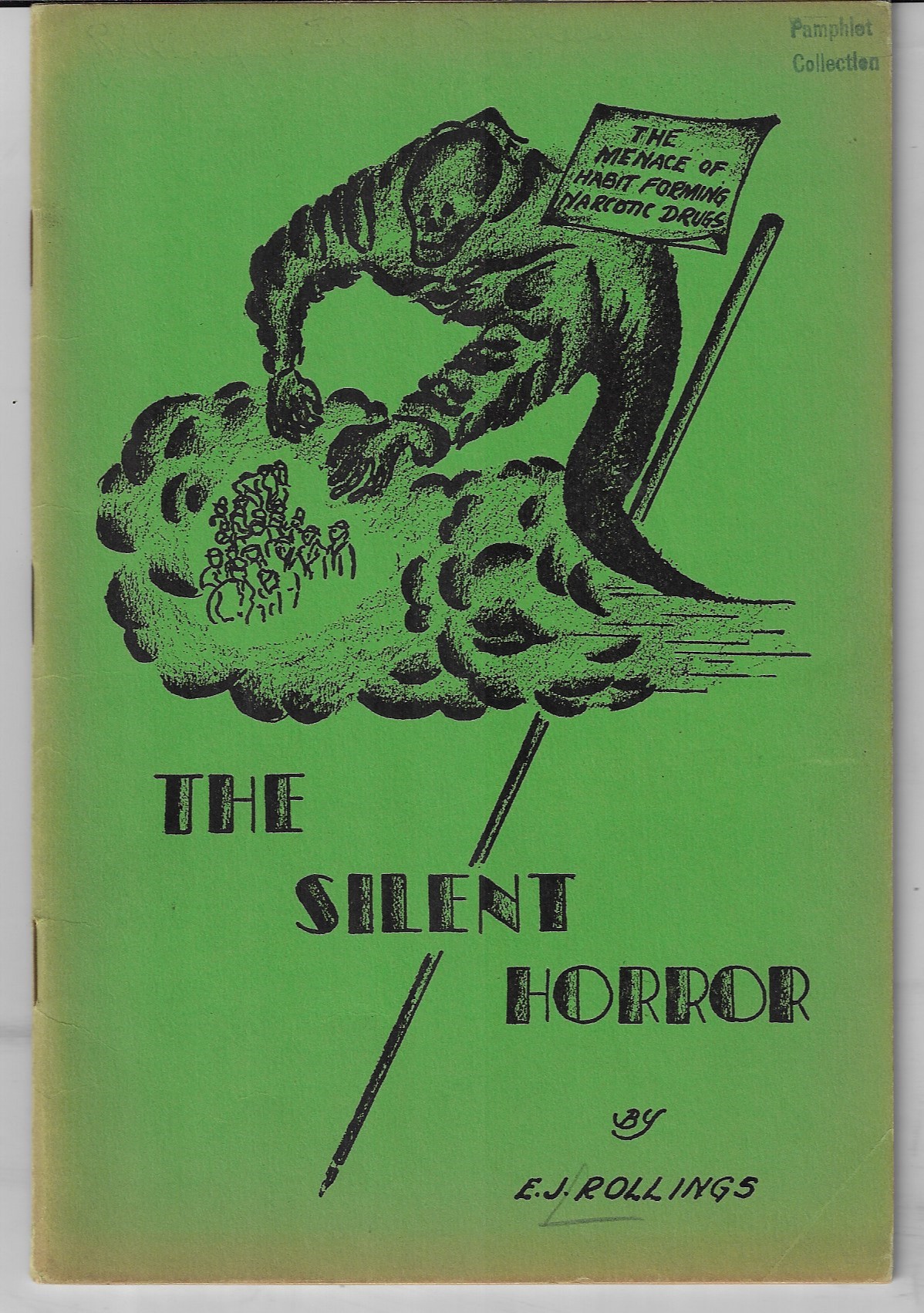
  • “Each Marijuana Cigarette is Capable of Producing Destruction, Disaster and Death!” (1939)

    Books silent horror(Rev.) E.J. Rollings, The Silent Horror. Defender Publishers, Witchita, Kansas. 1939. 9”x6”, 45pp. Original decorated wrappers. Inexpensive production, printed on not-very-good paper, though still in nice shape, but with browning around the edges of the very green wrappers. $250

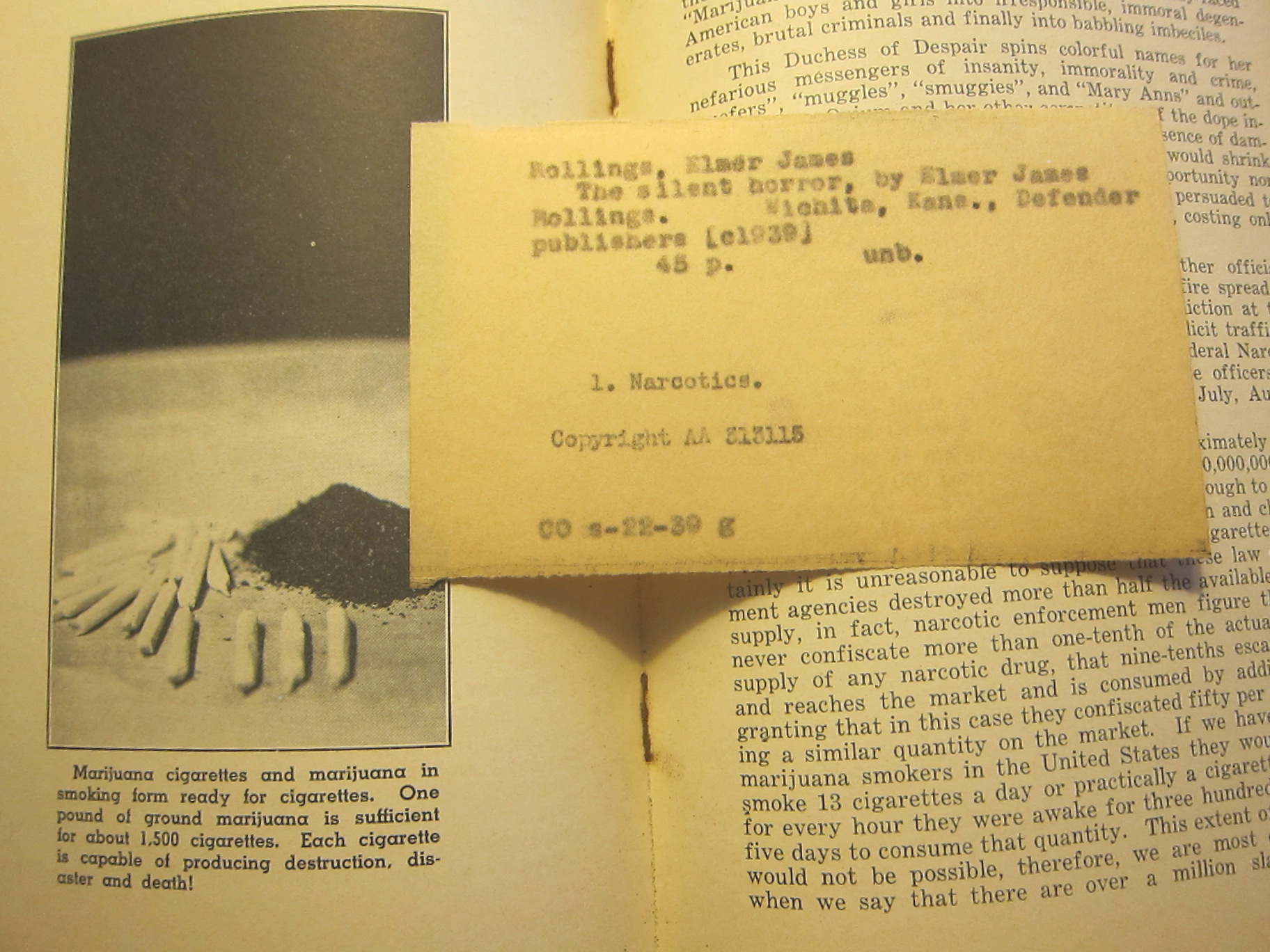
    Provenance: Library of Congress, with their stamp on the rear cover. Also: there is a carbon copy of the entry for the original LC card catalog card. Quite nice.

    • WorldCat locates only ONE copy, oddly enough.

    The major chapters deal with the shades of narcotics: Opium, the King of Dope; Crown Prince, Morphine; Cocaine, the Princess of Perdition; Marijuana, the Dutchess of Dispair; the Dope Peddlers; and Addicts.

    Other books by Elmer James Rollings: Marijuana, the weed of woe:The peril of the poppy; The world today in the light of Bible prophecy.

    The book is very highly inflamatory, and includes stories and languages such as this:

    “An eighteen-year-old boy in a Midwestern “city smoked two “reefers” and an hour later choked his sweetheart to death because she refused his shocking, lustful advances, born in a marijuana-crazed brain. He later testified that he loved her and had intended to marry her and when normal would never have dreamed of an improper suggestion, let alone the horrible murder” 

    “A sixteen-year-old boy shot his mother and father to death with his father’s shotgun after smoking several “Mary Anns” given to him by a new friend whose acquaintance he made by chance. He could neither explain nor remember the killing when the effects of the drug had worn off and sobbed himself into hysterical grief when told of his crime. And so, on and on, runs the record of thievery, forgery, banditry, kidnapping, brutal murder, degeneracy, and rape, all chargeable to this paralyzer of conscience and inflamer of depravity — Marijuana! “

    There are several provocative photos, as well.

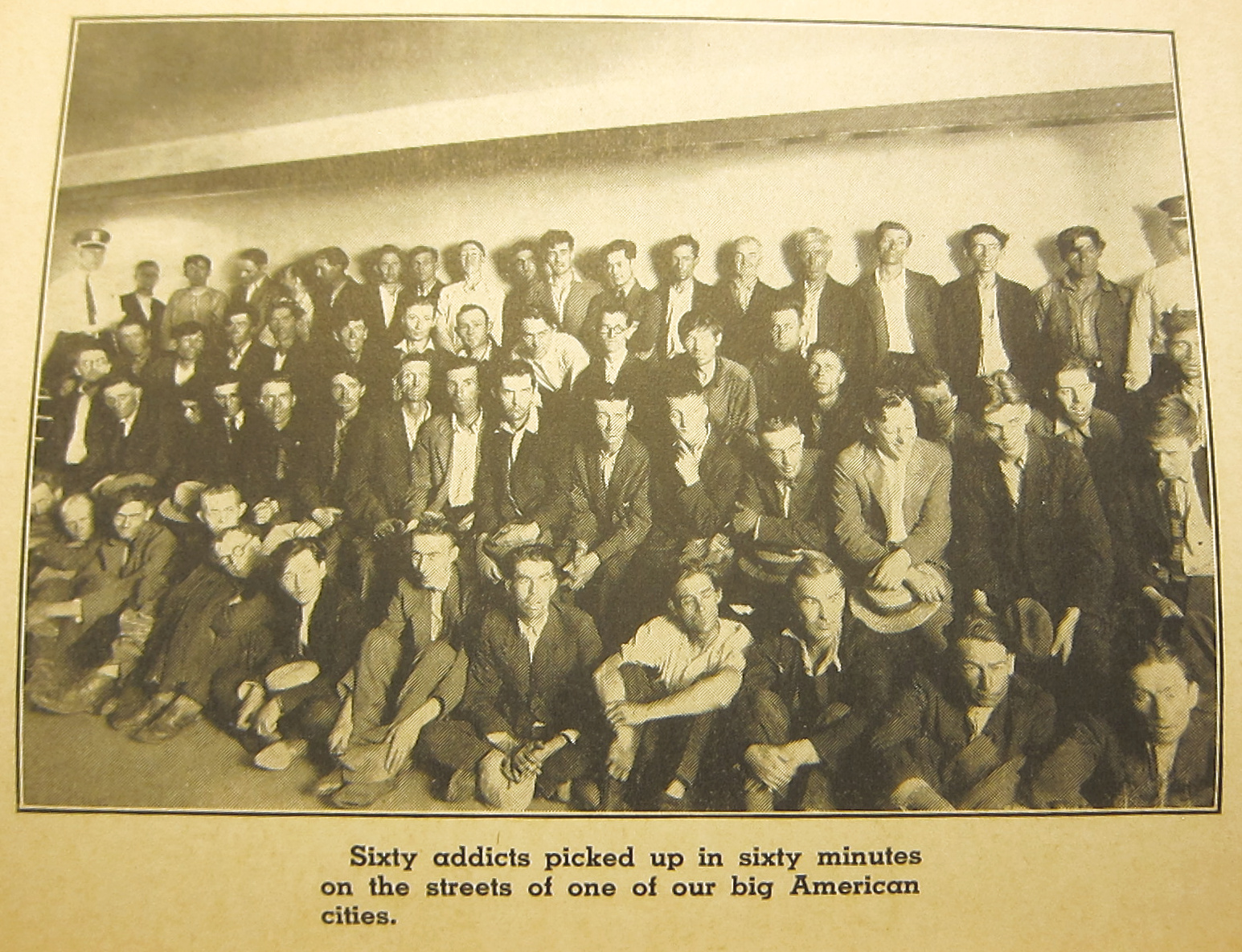
    Books silent horror addicts

    Books SIlent Horror (1)

    ·Posted by :

    ·in:

  • Alcatraz and the C.O., 1933

    Books Devils Island(Philip Grosser)  Uncle Sam’s Devil’s Island : experiences of a conscientious objector in America during the World War. Published by “a group of friends”  at the Excelsior Press, Boston, (1933?)  19cm, (8), 26, (2)pp, portrait. Original red marble-like wrappers. Prtovenance: Library of Congress, with their surplus stamp on front inside cover.  Very crisp copy. Just about in FINE condition.  $125

    Philip Grosser (1890 in Slavuta – October 3, 1933 in Boston) was an anarchist and anti-militarist hailed by Alexander Berkman as “one of [my] finest comrades”. He was imprisoned at the Federal Military Prison on Alcatraz Island, having refused the draft during the first World War. By the end of 1920, two years after the war ended, he was the only remaining conscientious objector at Alcatraz, and in poor health. Grosser is notable for writing one of the first exposés of Alcatraz Prison, the 32-page pamphlet Uncle Sam’s Devil’s Island, which told of his experience in the prison. He committed suicide in Boston, Massachusetts on October 1933 and was buried on October 20, 1933.”–Wikipedia

    ·Posted by :

    ·in:

  • On the Prussian Police, 1929

    Paul Riege, Die preußische Polizei Kurze Darstellung ihrer Entwicklung und heutigen Form. C.W. Weller, Berlin, 1929. First edition. 6.5” x 4.5”, 56pp. Oriignal printed wrappers. Provenance: International Commission on Law, and then the Library of Congress, with the two rubber stamps of those institutions on the front and rear wrappers. VG copy, about. There’s a bit of discoloration on the front wrapper, though overall it is a nice copy. $95

    There were five editions of this work printed 1929-1935, though there are only 9 copies of the work located for all editions, and only three of those in the U.S.

    Riege was a police major at the time (1929), and rose higher with the Nazis, becoming an SS officer. Questioned several times at Nuremberg I can see no evidence that he was convicted of any crime—at one time he worked in the Generalgouvernement, at Krakow, and then in Prague later in the war. To his credit he refused or escaped taking part in the destruction and mass murder at Lidice.

    ·Posted by :

    ·in:

  • Marchant Calculators

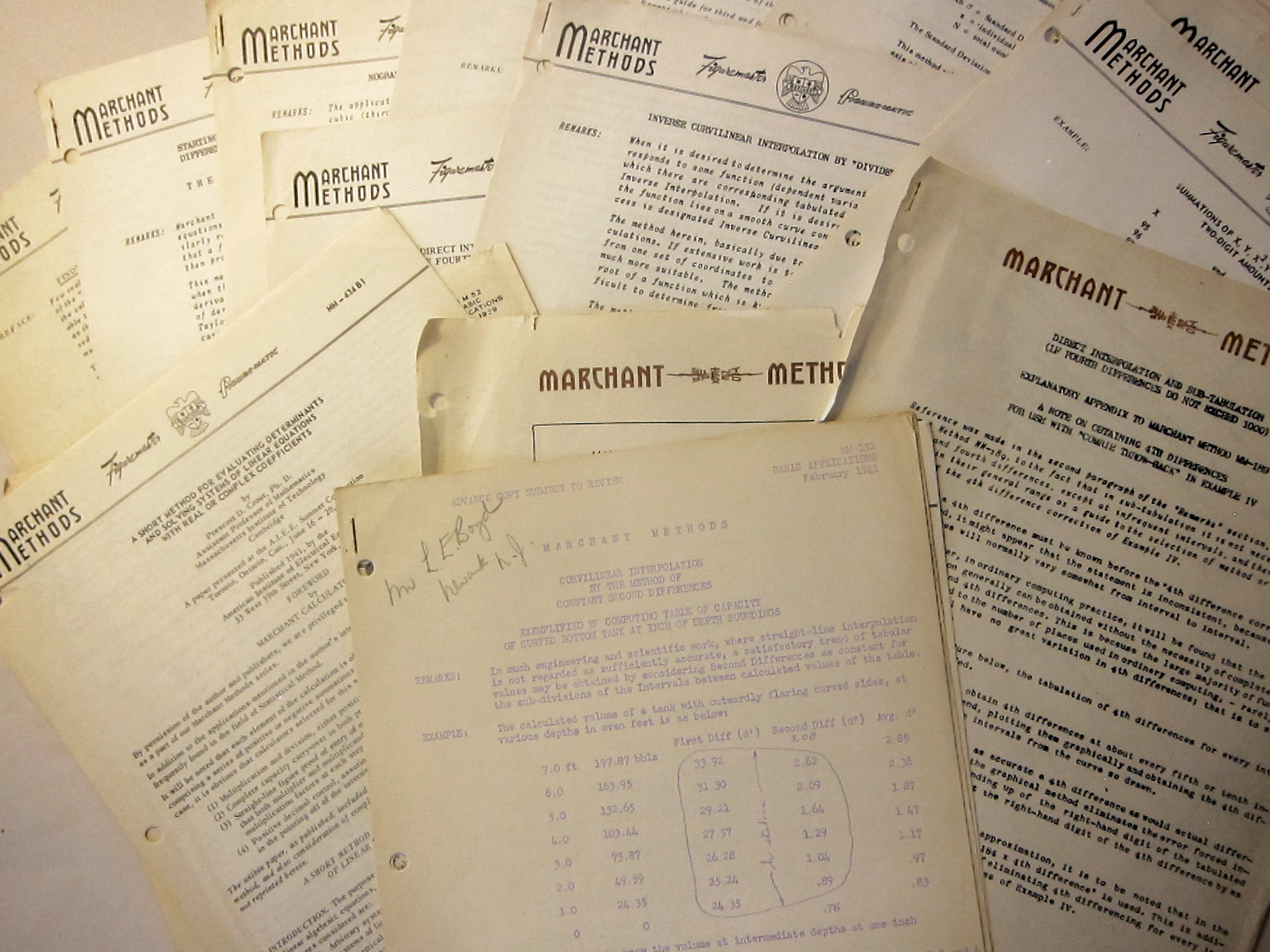
    Marchant Calculator materials. Marchant Methods. Figuremaster/Figurematic. Examples of the publication on the ins-and-outs and tricky bits, useful data, so on, for using the calculator to its fullest advantage.

    24 short publication, about 50pp all together. Only a few dates appear but they are all 1941–I suspect that the group is from this year or thereabouts.  The group:100.00

    Marchant Methods

    ·Posted by :

    ·in:

  • Spaceflight and Rocketry Material

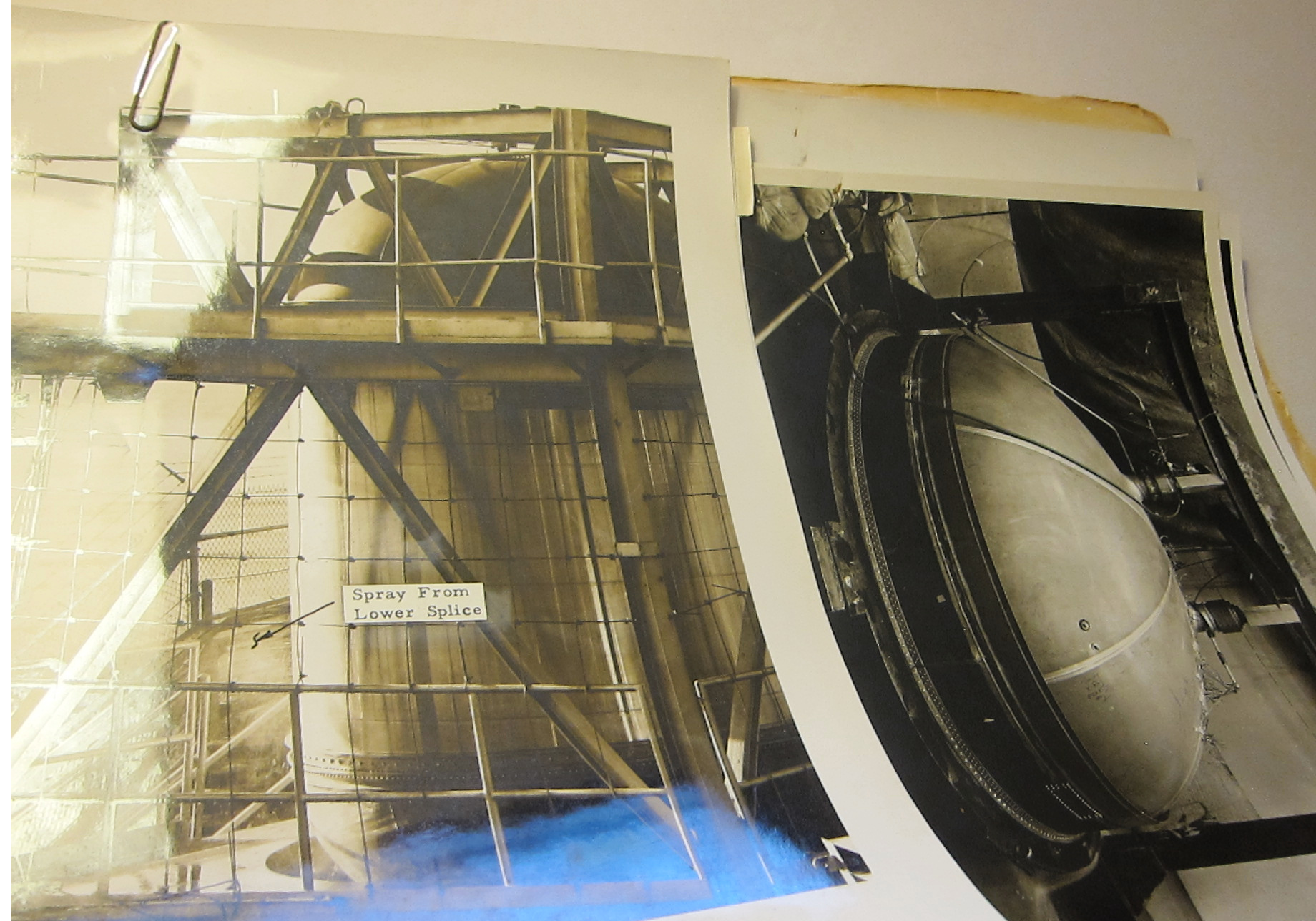
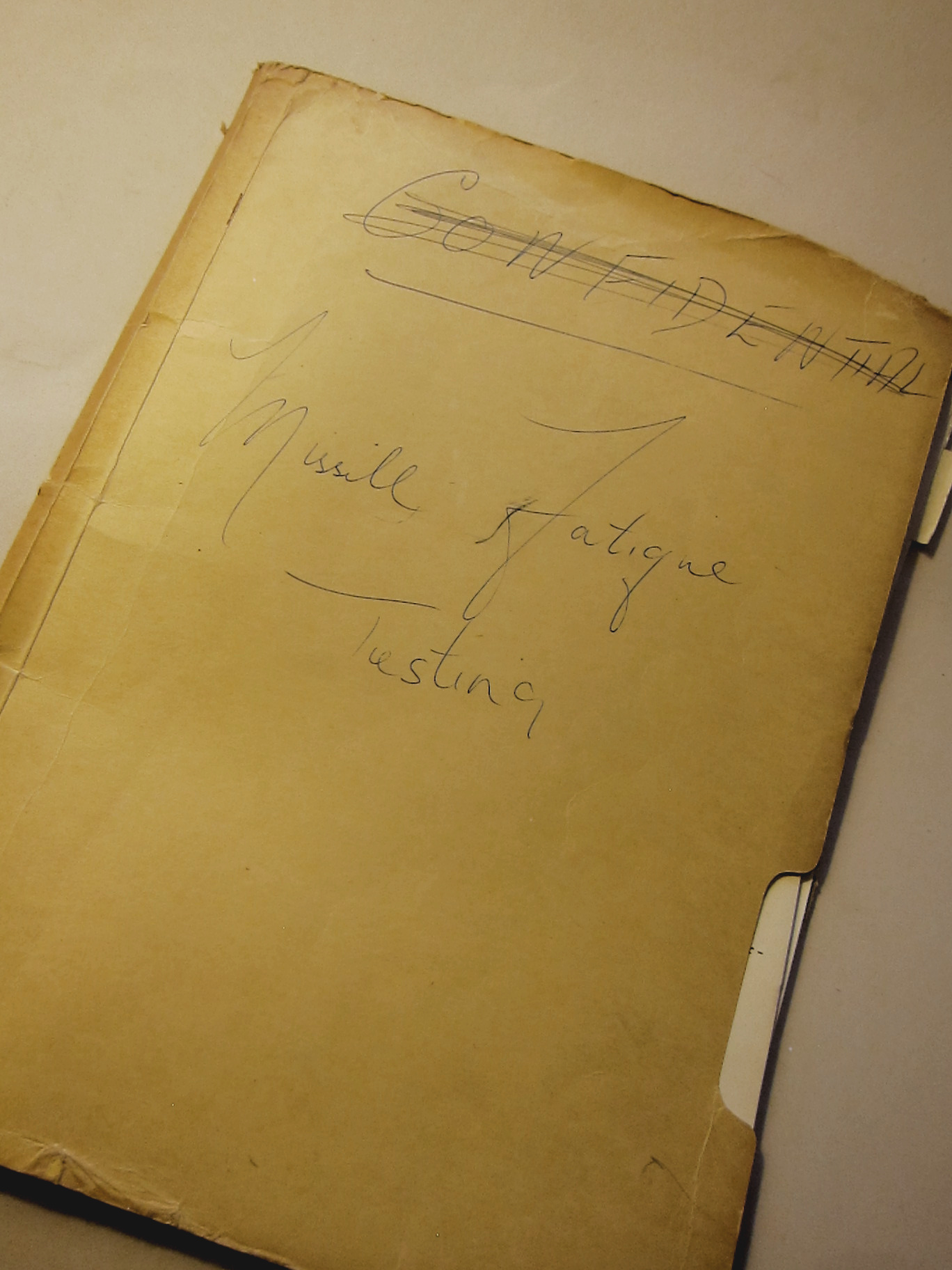
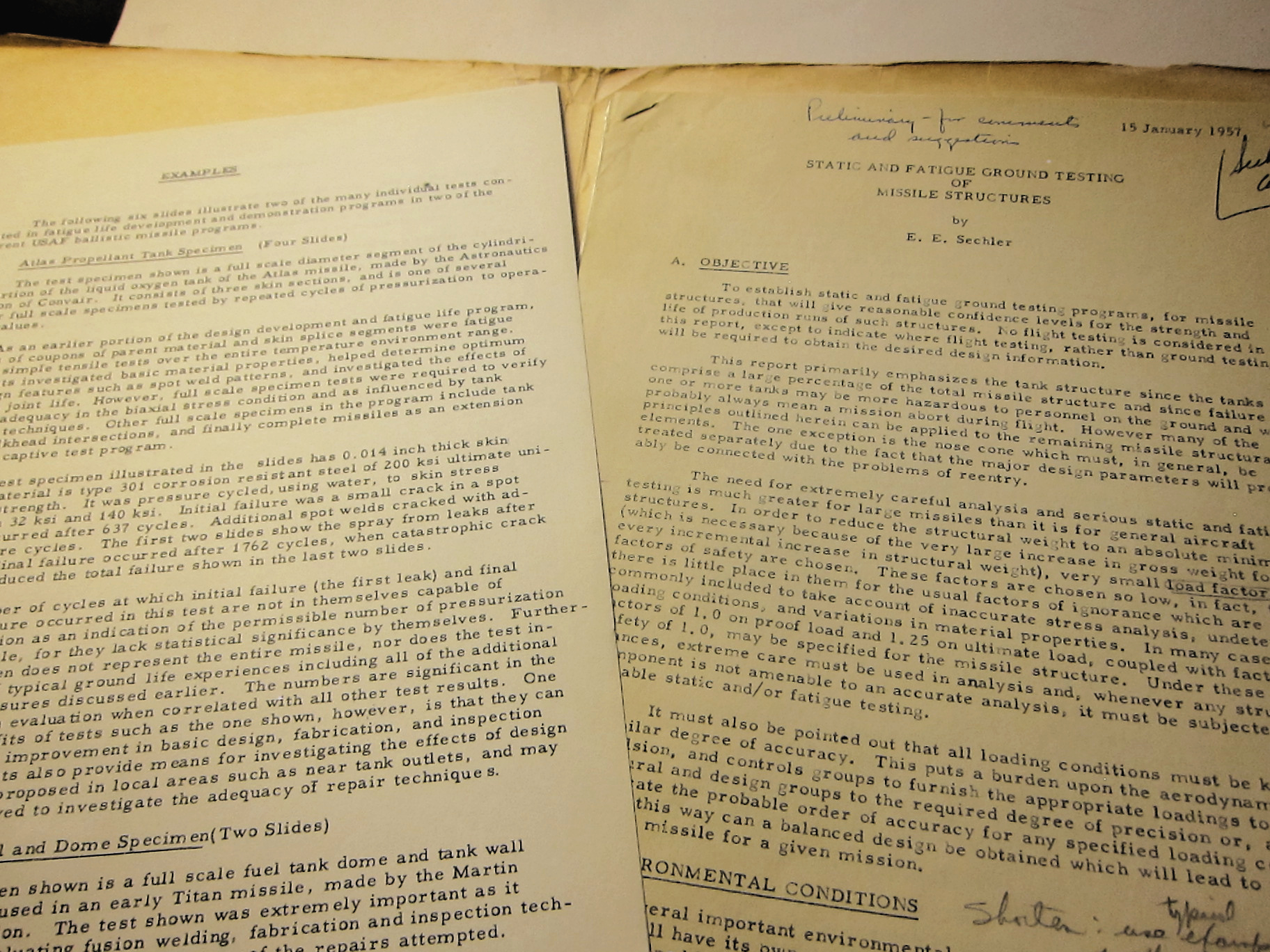
    Sechler, E.E.  Static and Fatigue Ground Testing of Missile Structures.  (“Preliminary–for comments and suggestions” written in ink at top of cover page. Also: “Sechler copy”.) 15 January 1957, 11″x 8.5″, 18 leaves. This is some sort of photomechanical reproduction, I think, with many additions and corrections in manuscript. With six original glossy photos, each 11″x 8″.  Housed in an old manila folder, with “CONFIDENTIAL” crossed out in pen. Very good condition.  $125

    “Ernest Edwin Sechler (1905-1975) was an aerospace engineer and scientist who specialized in thin-shell structures. He earned his doctorate in 1934 at Caltech as one of the early students of Theodore von Kármán with a dissertation on the mechanics of thin-plate compression. ‘A graduate student named Ernest E. Sechler (now a professor of aeronautics at Caltech) was reviewing research in the strength of thin metal plates which had been carried out by the National Bureau of Standards. Sechler reported that the engineers didn’t think that sheet metal could be used to make structural elements in an airplane because the metal would give way…Sechler’s report intrigued me.’—T von Karman, ‘The Wind Beyond’.  Von Kármán showed that by stiffening with re-enforcing strips the “effective width” of metal sheets could be increased to withstand the load aloft. In 1934 Sechler wrote his thesis, The ultimate compressive strength of thin sheet metal panels, under von Karman’s supervision. Development of light, fail-safe structure became the main theme of his professional life.”[1] His thin-wall structures included missiles, booster rockets, and a movable dome for Palomar Observatory. This work was performed as consultant to NASA and industry.”—Wikipedia

    Missile fatigue _3_
    Missile fatigue _3_
    Missile fatigue _3_


    Lewis H. Abraham (in collaboration with the NASA Research Advisory Committee on Missile and Space Vehicle Structures). Important structural research problems for the support of future space missions, prepared by Lewis H. Abraham in collaboration with the NASA Research Advisory Committee on Missile and Space Vehicle Structures. NASA, August 1963. NASA TN D-2059

    10”x 8”, 16pp. Original wrappers. Fine. $50


    M.V. Barton, Important research problems in missile and spacecraft structural dynamics. NASA, TN D-1298, May 1962.  10″ x 8″, 57pp.  Original wrappers. Fine condition.  $50


    J.D. Wood, Factors Affecting the Response of Missiles Excited by Rigid Shock. Space Technology Laboratories, 1960.  STL/TN-60-0000-09031. 11″ x 8.5″, 16pp. Original wrappers. Fine. $25


    John H. Boeckel, The Purposes of Environmental Testing for Scientific Satellites. NASA, Technical Note D-1900, TN D-1900. 1963. 11″ x 8″, 24pp.  Original wrappers. Fine.. $25


  • An Early U.S. Effort on Lunar Exploration: the Able-5 Rocket (1960)

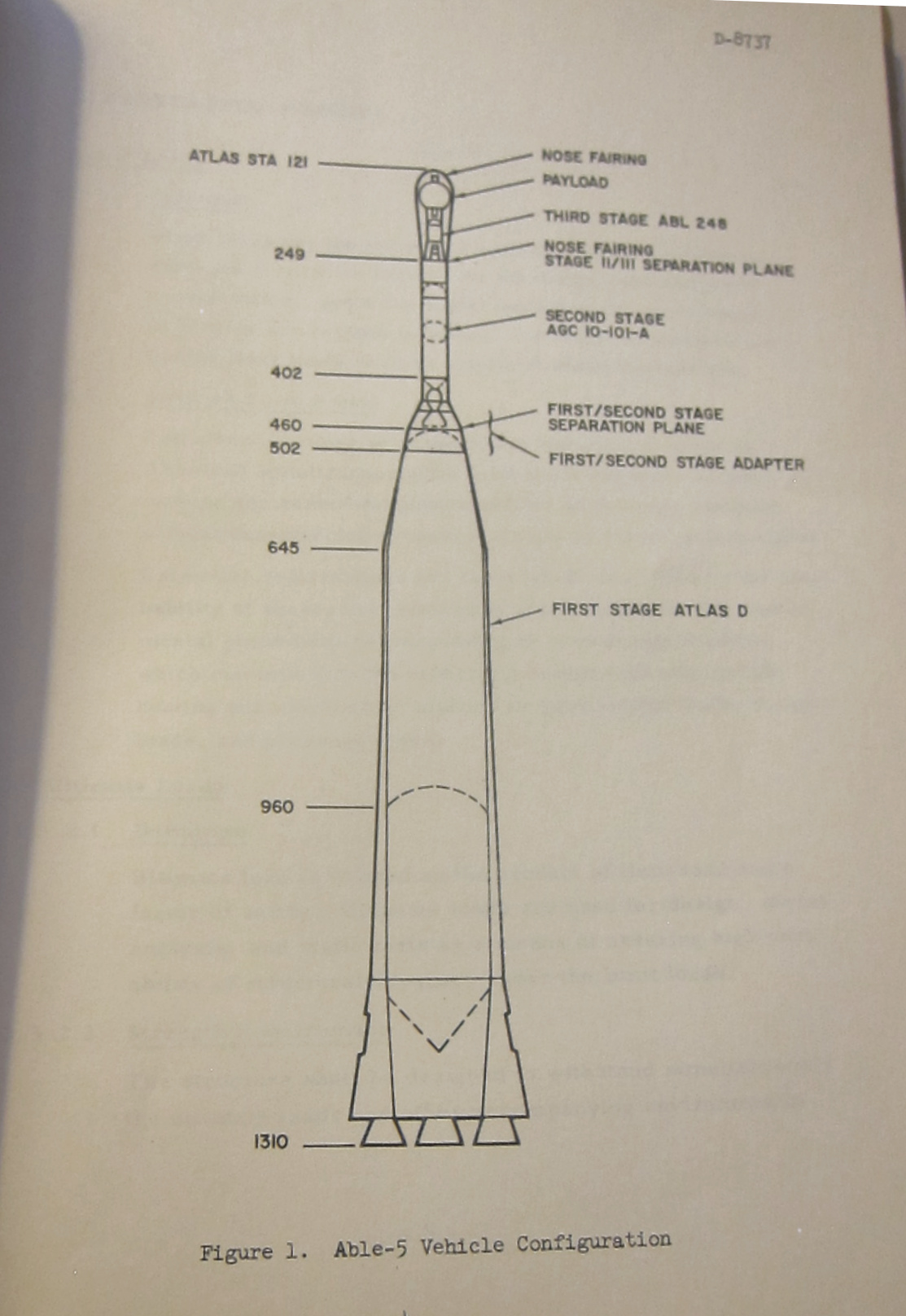
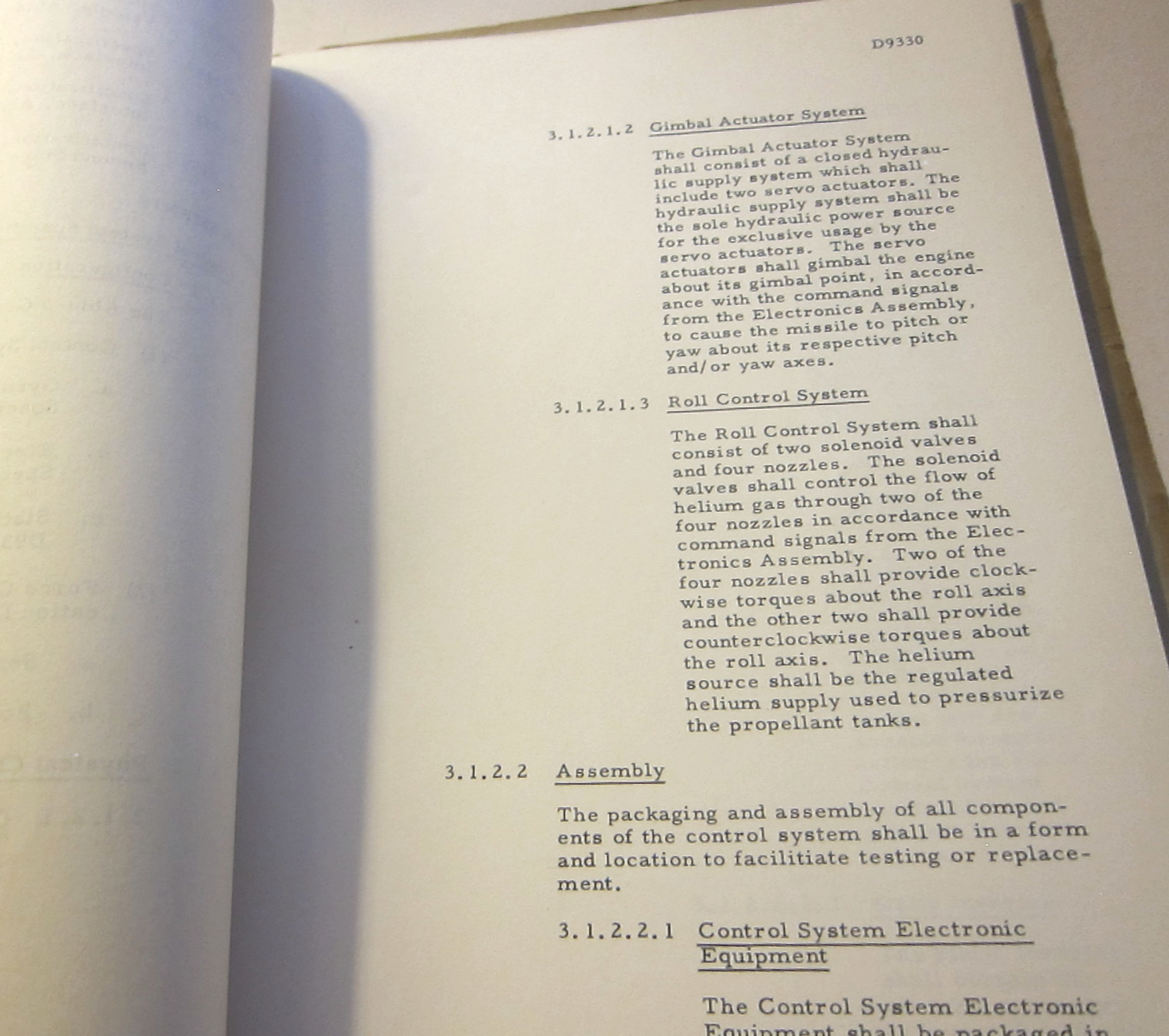
    Selected Specs _4_Selected Structural Design Criteria Able-5.  Space Technologies Laboratories, Los Angeles, 1960. 

    Printed on 11″x8.5″ sheets (on one side only), (2), 65pp, folding table. This is seems not to be published but distributed internally to Space Technology Laboratories (Ramo-Wooldridge Corp subsidiary), bound in a two-hole punch STL binding. Very Good condition.  $175

    Includes the following sections: Specifications on Structural Design Criteria (35pp); Specifications for Control System Second Stages  (16pp); Specification for Force Control System, Second Stage Vehicle (16pp); Specifications for Third Stage ((5pp); Specifications for Temperature Control, Payload (3pp). 

    “The first step beyond Earth orbit for the USAF, called Project Able-1, was a series of attempts to place a small spacecraft into orbit around the Moon. These orbiters, along with a pair of small US Army-JPL lunar flyby probes, were part of the ARPA-sponsored Operation Mona, which was approved by President Dwight Eisenhower on March 27, 1958. Three launch attempts made by the USAF between August and November of 1958, now called Pioneers 0, 1, and 2, all failed to reach the …But even before these missions flew, the USAF, in conjunction with the builders of their first lunar orbiters, STL (Space Technology Laboratory, a division of TRW), began to study follow-on missions not only to lunar orbit but also to Venus to be launched during the 1959 launch window…”—Andrew LePage, from his Drew Ex Machina site, “NASA’s Forgotten Lunar Project”

    Selected Specs _2_

    ·Posted by :

    ·in:

    —
  • Scarce Work by Mark Kac edited by Two Computer Pioneers


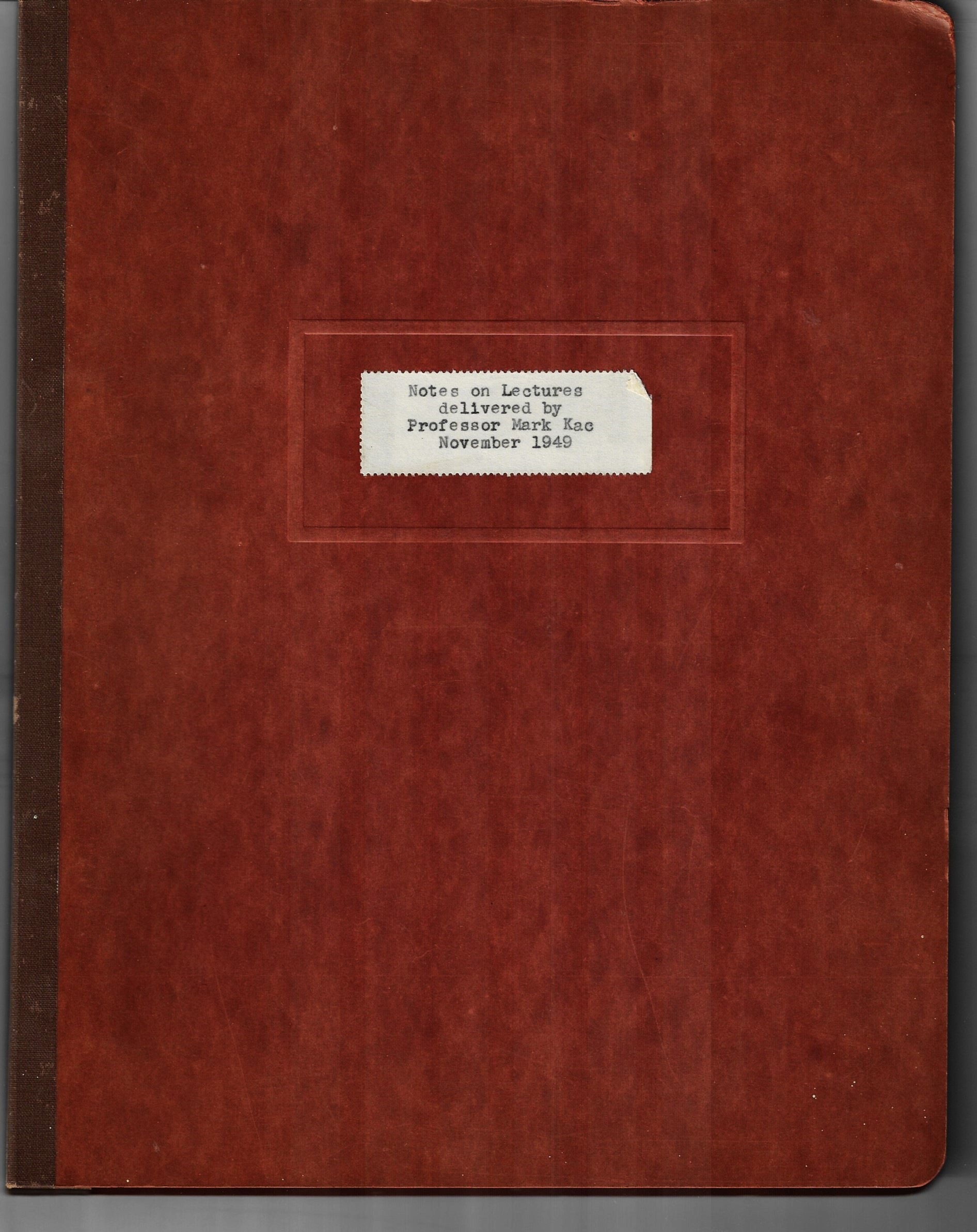
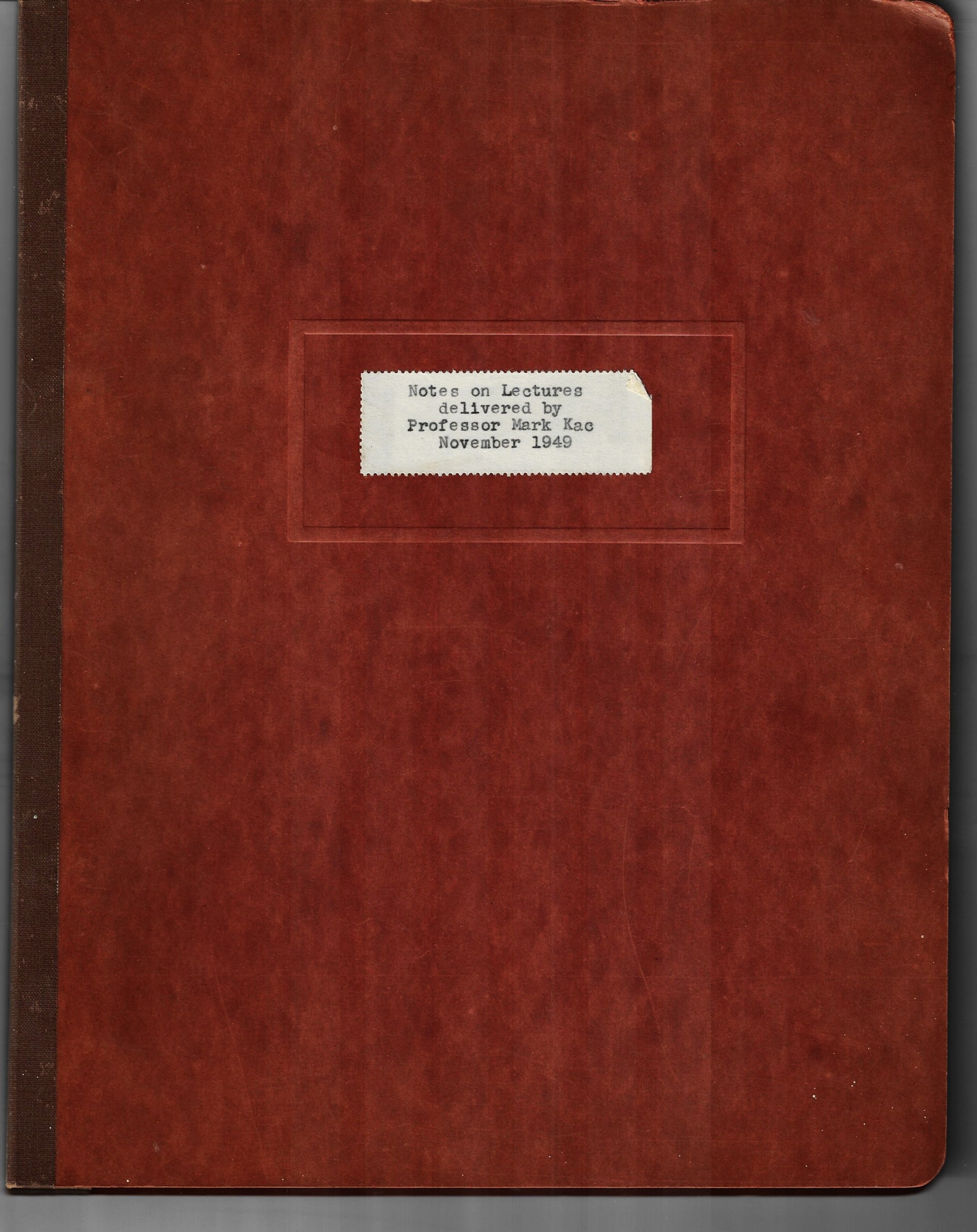
    KacMark Kac, Alan J. Perlis, John W. Carr. Notes on Lectures delivered by Professor Mark Kac, Cornell University. Applications of Statistical Methods to Differential and Integral Equations. MIT, November 1949.   1949/1950 (?) 11”x8.5”, 38 leaves, offset from typed sheets. Bound in a manila two-hole punch folder; homemade title label on cover. Very much an in-house production by two grad students producing the notes for the Kac class. Only ONE copy located by WorldCat/OCLC (Padua). Scarce $150

    On Kac: “From 1939-61 he was at Cornell University, first as an instructor, then from 1943 as assistant professor and from 1947 as full professor. While there, he became a naturalized US citizen in 1943. In the academic year 1951–1952 Kac was on sabbatical at the Institute for Advanced Study. In 1952, Kac, with Theodore H. Berlin, introduced the spherical model of a ferromagnet (a variant of the Ising model) and, with J. C. Ward, found an exact solution of the Ising model using a combinatorial method. In 1961 he left Cornell and went to The Rockefeller University in New York City. In the early 1960s he worked with George Uhlenbeck and P. C. Hemmer on the mathematics of a van der Waals gas. After twenty years at Rockefeller, he moved to the University of Southern California where he spent the rest of his career.”–Wikipedia

    Perlis (numerical analyst who would get his Ph.D. at MIT in the next year) and Carr are both prominent figures in the history of computing, Perlis especially so (particularly in the development of programming languages, ALGOL 58, ALGOL 60, etc., and  founder and first editor of ACM Computing Reviews).  and in the See JAN Lee’s Computer Pioneers.

    ·Posted by :

    ·in:

Recent Posts

Archives

Categories