A Daily History of Holes, Dots, Lines, Science, History, Math, Physics, Art, the Unintentional Absurd, Architecture, Maps, Data Visualization, Blank and Missing Things, and so on. |1.6 million words, 7500 images, 4.9 million hits| Press & appearances in The Times, Le Figaro, Mensa, The Economist, The Guardian, Discovery News, Slate, Le Monde, Sci American Blogs, Le Pont, and many other places… 5000+ total posts since 2008.

Category: Strange Things in the Sky

  • Searching for Structure: Triangles and Trees

    JF Ptak Science Books  Post 1494
    Structure512

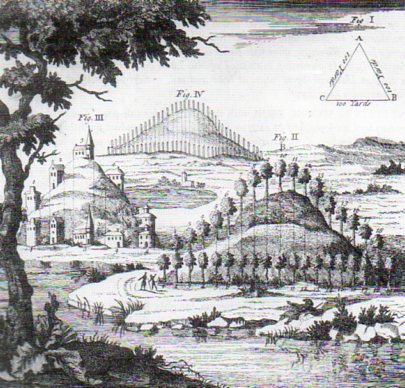
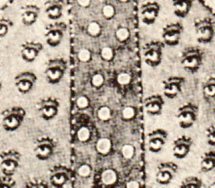
    It was this lovely engraving from Richard Bradley’s A General Treatise of  Husbandry and Gardening..., printed in London in 1721/2, that brought up the issue of structure in creation, and how that issue was in one way approached by the new tool in the scientific toolchest, the microscope. 

    “…the Contrivances of the Almighty Creator is as visible in the meanest Insect of Plant, as in the greatest Leviathan or the strongest Oak.  To touch upon all the Wonders this Instrument shews us would be infinite”–William Molyneux, on the microscope, in his A Treatise of Dioptricks in Two Parts (1692, quotation fro the second edition of 1709 via Marjorie Nicholson’s Science and  Imagination, Cornell, 1956.

    The question that the microscope—newly introduced and popularized by Robert Hooke in 1665 and Anton van Leeuwenhoek in 1674–was so able to address at this time was the question of the structure of things, and whether the Almighty Creator allowed for unrestrained creativeness or if the cosmos was subject to patterns and forms.  The microscope was so tremendously nimble that it allowed its observers the luxury of finding “correct” answers on either/both sides of the issue, that arguments could be well made and sustained for variety and regularity. But of course all found the reason for either end of the argument deeply seated in the e hands of god, as seen in the lovely quote below by the great early microscopical popularizer, Henry Baker1. 

    But this is just the tiniest bit of a nod at the question of structure in the history of science, a search for the relationships between, well, things small and large:  atomic, molecular, cellular, organism, population, ecosystem,solar system, universe.  The issue of structure may be the only issue–perhaps if you were made to select one question to have answered, automatically, an answer for everything, it might be this issue of how things stand in relations to one another.

    Which gets us to this 1721 engraving of a tree-covered hill, following the designs of a human creator, a re-animator of the natural landscape according to a theory of beauty, part of which hangs in the form of a triangle  in the right-hand upper corner.  A three-sided strategy of the relationships in nature, provided by a human vision. A very small  appreciation of an attempt to recognize the relationships between things, and in this case, the beauty of trees and hills. 

    Notes:

    1.  “The first Part of this Treatise discovers in the Particles of Matter composing Salts and saline Substances, Properties whose amazing Effects would surpass all human Belief or Conception, were we not convinced of their Truth by the strongest ocular Demonstration. That beautiful Order in which they arrange themselves and come together under the Eye, after being separated and set at Liberty by Dissolution, is here described and composed but one kind of figure, however simple, with Constancy and Regularity, we should declare it wonderful: What must we then fay, when we see every Species working as it were on a different Plan, producing Cubes, Rhombs, Pyramids, Pentagons, Hexagons, Octagons, or some other curious Figures peculiar to itself; or composing a Variety of Ramifications, Lines, and Angles, with a greater Mathematical Exactness than the most skilful Hand could . draw them?”

    “Sensible of my own Ignorance, I pretend not to account how this is done: all I know is, that Chance or Accident cannot possibly produce Constancy and Order, nor inert Matter give Activity and Direction to itself. When therefore these Particles of Salts are seen to move in Rank and File, obedient to unalterable Laws, and compose regular and determined Figures, we must recur to that Almighty Wisdom and Power which planned out the System of Nature, directs the Courses of the Heavens and governs the whole Universe.”  — Original, shorter quote of Henry Baker in his Employment of the Microscope (1753) found in Nicholson’s book; the above, longer version is from the 1764 (and second) edition, found here.
  • Strange Things in the Sky Department: the Sky-borne Seat of All Wisdom in the 12th century

    JF Ptak Science Books   Post 1486

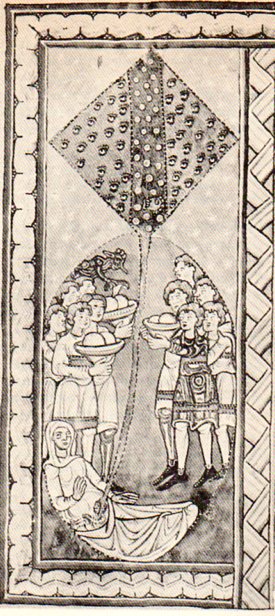
    Hildegard of Bingen (ca. 1098-1179) was a polymathic religious visionary1, composer and writer who was a well-know intellectual whose work attracted the attention of people at all levels, not the least of which were several popes  In one version of the manuscript of her 150,000-word work, Scivias (Scito vias Domini, or “Know the Ways of the Lord” ) we find the following illumination, which is basically an image of the object that contains the nameless stuff of the human soul:

    Sky strange hildegard492
    The image above—from the Wiesbaden manuscript and unfortunately only in a black-and-white, and found in Charles Singer’s From Magic to Science (1928)2–shows Hildegard’s vision of the soul entering the body. (There’s a wide range of opinion concerning how much influence Hildegard had on these images—some say that she sketched out the outlines, or directed the illuminator, or had some sort of hand in the construction of the image, all with varying levels of involvement.3)

    Sky strange hildegard493

    It is an extraordinary thing, trying to represent what gives the human-ness to people as seen from a 12th-century perspective, and in Hildegard’s version/vision it is the soul, the very essence of the birth and death cycle of human nature.  It is resident as we see within a special place in the sky, the “the wisdom of god” (Singer page 226), and it passes from the vault of heaven into the fetus while still within the mother’s womb.  It is in this square, evidently, that the essential matter of the creator can be found, and within that structure can be seen the essence of the stuff of human nature that is about to pass into the developing fetus through the tube-like connection. As Singer writes, quoting (loosely?) from the manuscript: “down this [the tube] there passes into the child a bright object, described variously as ‘spherical’ and as ‘shapeless’ which ‘illuminates the whole body’ and becomes or developes into the soul.” (Singer, p. 226).

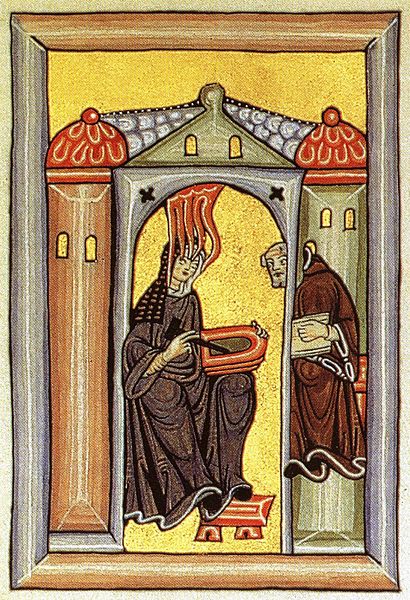
    In the frontispiece to another ms of Scivias, we see Hildegard herself sitting and making a sketch on a wax tablet (a sort of Medieval chapbook, or hornbook, or slate/charcoal sketchpad that could be reused), showing that the images she created were the product of a higher source, of light from another metaphoric vault:

    Strange sky--hildegard

    Notes

    1. Hildegard said that she had these vision,s from a very early age, beginning at about 3.

    2. This manuscript was removed from Wiesbaden during WWII and “sent to Dresden for safekeeping”, where it subsequently “disappeared”. “Destroyed” is more like it, as Dresden of course was the scene of an enormous firebombing campaign in the last days of the German involvement of WWII. There are still hopes that the ms lives somewhere in someone’s grandfather’s attic, perhaps taken in the third week of February 1945 as war booty, and then forgotten. “You guys burnt the place down, turned it into a single column of flame. More people died there in the firestorm, in that one big flame, than died in Hiroshima and Nagasaki combined.” –Kurt Vonnegut, Jr

    3. Historian of science Charles Singer and medical anomaly writer Oliver Sacks have both made strong cases for Hildegard to have been a migraine sufferer, though they do explicitly state that given that as the case it does not necessarily affect the vision that she had.

    As found in the Wikiu article on Scivias:” Some authors, such as Charles Singer, have suggested that the characteristics of the descriptions of the visions and the illustrations, such as bright lights and auras, imply they may have been caused by scintillating scotoma, a migraine condition.[25] Oliver Sacks, in his book Migraine, called her visions “indisputably migrainous,”[26] but stated that this does not invalidate her visions, because it is what one does with a psychological condition that is important.[27] The resemblance of the illuminations to typical symptoms of migraine attacks, especially in cases where it is not precisely described in the text, is one of the stronger arguments that Hildegard herself was directly involved in their creation.[28]

    It has also been suggested that the visions may have been due to hallucinogenic components present in ergot, common in that area of the Rhineland, at certain times of the year.[29]”

    The contents of Scivitas:


  • The Cosmology of Creation, 1554

    JF Ptak Science Books   Quick Post

    Biblia germanica419
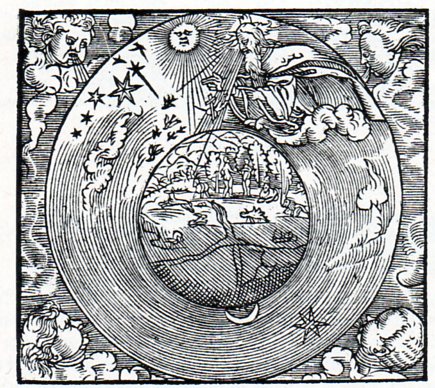
    This woodcut comes to us from Biblia: Dat ys De gantze Hillige Schrifft Vordudeschet dorch D. Mart. Luth. Vth der lesten Correctur mercklick vorbetert, and published in Mageburg by Michael Lotter in 1554.  I’d say that it depicts the Eath-centered cosmology of the creation just after the introduction of Eve, where everything seems to be in perfection and harmony, there (perhaps) inthe sixth day of the creation story.

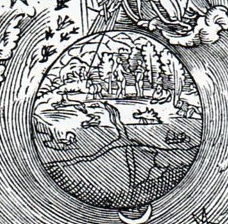
    In the detail we can clearly see the Garden:

    Biblia germanica419

    There doesn’t seem to be any sign of the serpent, though Eve does seem to be covering herself in some sort of modesty, even though we are told in the OT that the two humans were naked but not ashamed.

    The world seems to be divided into quarters, following the symbolic depiction of the world into sections, though more commonly seen as a three-section map,m the T-O, as seen below:


  • Strange Things in the Sky Dept.–Dante and Beatrice and the Vault of Stars

    JF Ptak Science Books    Post 1457

    There is a developing thread on this blog relating to strange things in the sky. Sometimes the images are extraordinary, impossible, beyond fiction:  multiple/duplicate Earths, flying buildings, horses in balloons, extra-human missing souls downloaded to the Earth from extra-Moons, and so on.  And at other times, the images are more subtle, questioning, ambiguous, as in the example of some 16th century prints that show the sky opening to reveal the Creator, who is in turn pictured against, say, a completely blank background, suggesting an enveloping nothingnesss of Heaven; or a field of beautiful stars filling a Renaissance sky of deepest red, at night.  A gigantic foot shown floating in the sky in a 17th century image might be ambiguous, and it also wildly so;  both it and the more subtle ambiguities–for example early representations of caves-over-mountains that give them an inside-out appearance–are welcomed sights.

    Perhaps some of the most beautiful of the Strange Things in the Sky department might belong to the skies of  Dante–they can be extraordinary, straightforwardly unusual and–when the narrative is presented pictorially–beautifully strange and with little ambiguity.  They are presentations of ideas of time and space, fantastic adventures in imaginary environments, as much an internal journey as Milton’s Paradise Lost is an external one1.

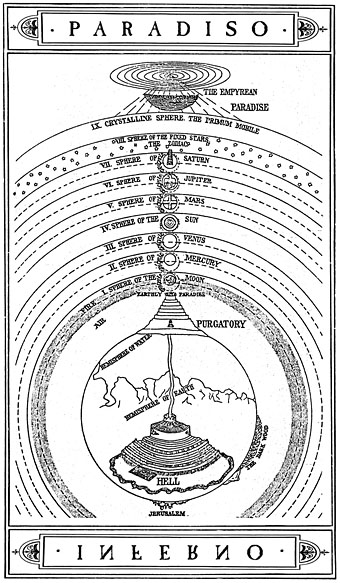
    Dante’s celestial exploration and the foundation that he provides have led to the possibility of an entire atlas of maps of paradise, hell and purgatory.  Here’s an interesting map2 constructed by Michelangelo Caetani (1804-1882) showing the structure of the Comnedia:

    Dante comedia
    I’ve presented this map just to give a context for the placement of the following images, though I do like the Caetani because it presents a good overview of the entire placement of Dante’s work, though necessarily having to leave out almost all of the detail of what is actually going on in each level. 

    Nearly all of the images below are from La comedia di Dante Aligieri con la nova espostione di Alessandro Vettlutello, published in Venice in 1544 by Francesco Marcolini (or Marcolino)3.  For the present collecting/browsing purposes I’m just going to go over the images lightly rather than try to launch into an ill-advised exegesis on a subject that I don’t know very well at all.

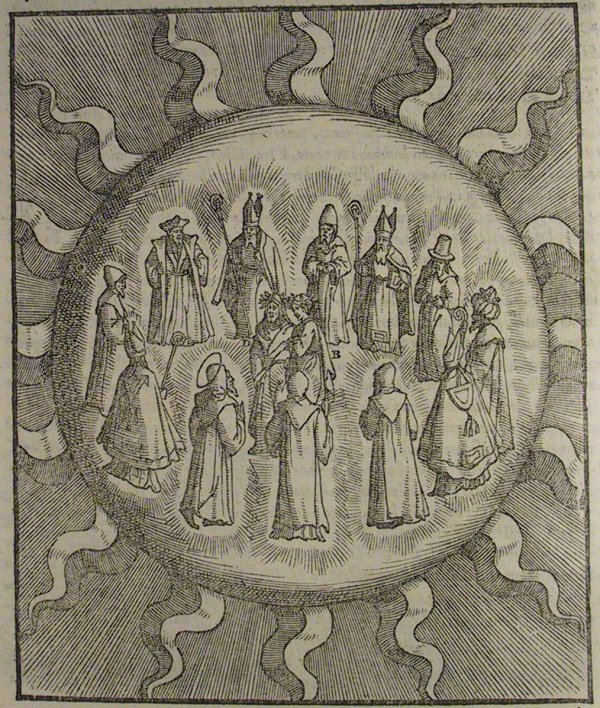
      Dante sun big
    In the Sphere of the Sun Dante and Beatrice among the wise and the learned, hearing them all (eleven) named so by Thomas Aquinas.  They include Albertus Magnus, Gratian, Peter Lombard, Solomon, Dionysius the Areopagite, Orosius, Boethius, Isidore of Seville, Bede, Richard of St. Victor, Siger of Brabant. Paradiso X

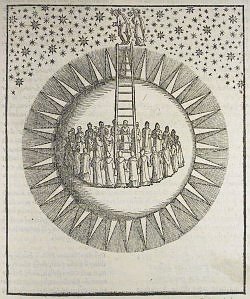
       Dante fixed stars
    Dante and Beatrice entering the sphere of the fixed stars, using a ladder of contemplation, mythically suggesting stairs and in this case a stairway to god. 

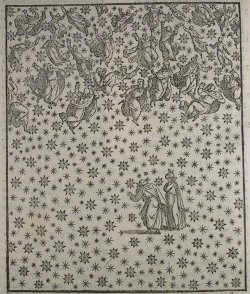
    Ante--empyrean

    The souls ascent to the Empyrean, with Dante looking down to see the Earth (“the little patch that makes us so vicious”), and to trace the (“mad”) voyage of Ulysses, and to see perhaps how far he has traveled (Paradiso XXVII).  Dante listens to St. Peter, and Beatrice, who describe the place, which is basically the mind of god and which is the envelope surrounding the final sphere:

             “The nature of the universe which holds
              The center still and whirls the spheres around it
              Takes from this region here its starting-point.
     
              “And here this heaven has no other where
              Than in God’s mind, where there flames up the love
              That spins it, and the power it pours down.
     
              “Light and love enclose it in one circle
              As it does all the rest, and this enclosing
              He alone who circles it can comprehend.

    Beatrice and Dante


    Beatrice and Dante together with Saint John and Saint James,  Paradiso XXV.

              “My body is still earth within the earth
              And will remain there with the rest until
              Our number equals the eternal tally.
     
              “Only those two lights who have ascended
              Wear their two robes here in the blessed cloister,
              And this word you shall bring back to your world.”
     

    Woodcut illustrating Paradiso II
    I couldn’t resist straying a bit to show this fantastic 1491 woodcut (published in Venice by Petrus de Plasiis) illustrating Dante and Beatrice surveying and then entering the Moon.  The scene is described in  Paradiso II:

              “Turned toward me, as glad as she was lovely,
              And said, “Direct your mind with thanks to God
             Who here has made us one with the first star.” –-[the Moon is described and identified as a star.]
     
              I thought we were enveloped in a cloud,
              Shining, solid, dense, and highly polished
              As a diamond struck by the sun would be.
     
              The timeless pearl took us inside itself
                In the same way that water can receive
              A ray of light while it remains intact”
    Again, my apologies to those among you who know Dante–I really was just trying to get at the luxuriant strangeness of these images and display them–much more so than talk about them. 

    Notes

    1. “The difference is that the visual phantasy bequeathed by Dante was mainly a congeries of intense and intricate symbolisms of his own personality,” Masson explains, “whereas that offered by Milton was mainly a sublime version of an independent objective tradition.” 12. David Masson, The Life ofJohn Milton: Narrated in Connexion with the Political, Ecclesiastical, and Literary History of His Time, vol. 6, 1660-1674 (1880; reprint, New York,
    1946), p. 522.

    2.  Michelangelo Caetani, La Materia della Divina Commedia di Dante Aligherie (1855).

    3..   Francesco Marcolini (or Marcolino), a typographer born in Forlì, also published the first book of cartomancy, or telling the telling of the future and fortune through the use of a deck of cards, in his 1540 Le sorti intitolate giardino d’i pensieri (“The oracle called garden of thoughts”).


  • Wonders of Nature and Strange Things in the Sky, 1744: Comets.

    JF Ptak Science Books   Post 1454

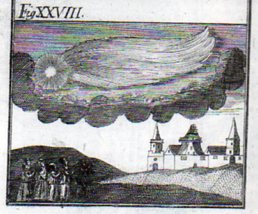
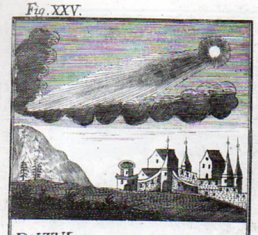
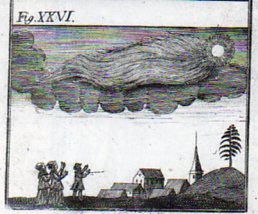
    As part of this blog’s continuing series on Strange Things in the Sky is this delightfully illustrated work by Conradus (Konrad)  Lycosthenes (1518-61), Die Wunder Gotes in der Natur, bey Ewrscheinung der Cometen oder, Besondere Anmerckung der vornehmsten Cometen, oder, Strobel-Stern published in Frankfurt in 1744.  I’m sure it was anything but “delightful” at the time, being a wonder book of God’s handiwork in the heavens and all, revealing twhat some  famous comets (and other celestial wonders) might have looked like through the ages.  Lycosthenes was a polymathic guy, teaching grammar and dialectics at Basel, and embarked on a wide writing career in which he wrote (and translated) on many different areas, though it seems that he was interested in recurring oddities and the unusual, a humanist encyclopaedist. 

    Comet wonders396

    Comet wonders393

    Comet wonders395

    The book is actually about nine inches tall or so and is illustrated with 41 pages each of which is crowded with two images, face-to-face, as so [source]:

    Conrad Lycosthenes - Cometen (1744)
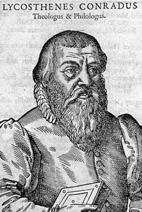
    The author:
    Photo of Konrad Lykosthenes

    The rest of the 41 engraved plates can be seen below [source]:


    Phénomène obbservé lors du passage de la comète de 1744. [Cote :2487A]

    1 : Phénomène obbservé lors du passage de la comète de 1744. [Cote :2487A]


    ·Posted by :

    ·in:


  • Horses in the Sciences: Proving Nothing and Something

    JF Ptak Science Books   Post 1419   [Dedicated to our primum mobile family horse person, Emma Digh Ptak.]

    Horsepower281

    The history of horses in the sciences is not a very wide subject area, though I’d like to look at a few instances in which they help to prove both something and nothing–particularly in the third case below, when the “nothing” was a very big “something”. 

    First, in the history of horsepower (and such an odd history it is, having somewhat and famously to do with billing issues for steam powered engines) there is a certain restricted high-percentage element that are just no-go, unworkable ideas.  Some of them served as the basis for further and deeper thinking,and some of them were simply far ahead of the technical abilities of their times. 

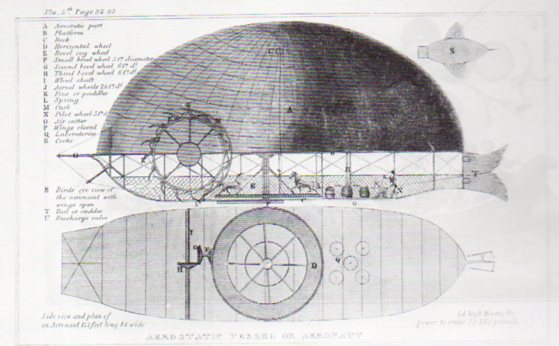
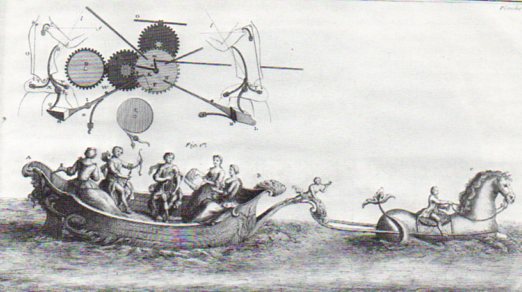
    In 1825 Edmond Genet1 published an interesting book (Memorial on the upwards forces of fluids and their applicability to several arts, sciences and public improvements) which in and of itself is a milestone in a number of different technical aspects–one part of it though sensationally and beautifully elevates itself to the Not-Quite-a-Good-Idea-at-Almost-Any-Time Department.

    Horsepower282
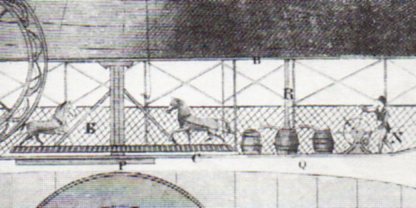
    “The actual plans of Genet’s airship called for a balloon shaped to resemble the rounded back of a large fish and containing about 1,023,000 cubic feet of hydrogen gas, with a platform or deck fastened beneath. Two horses, moving on a revolving wheel on this platform, were to provide the power for operation of a pair of large, silk-covered aerial wheels, while the rudder in imitation of a fish tail was intended “not only to steer the machine, but also to supply it with an additional force of propulsion”. –Genet in his Memorial…

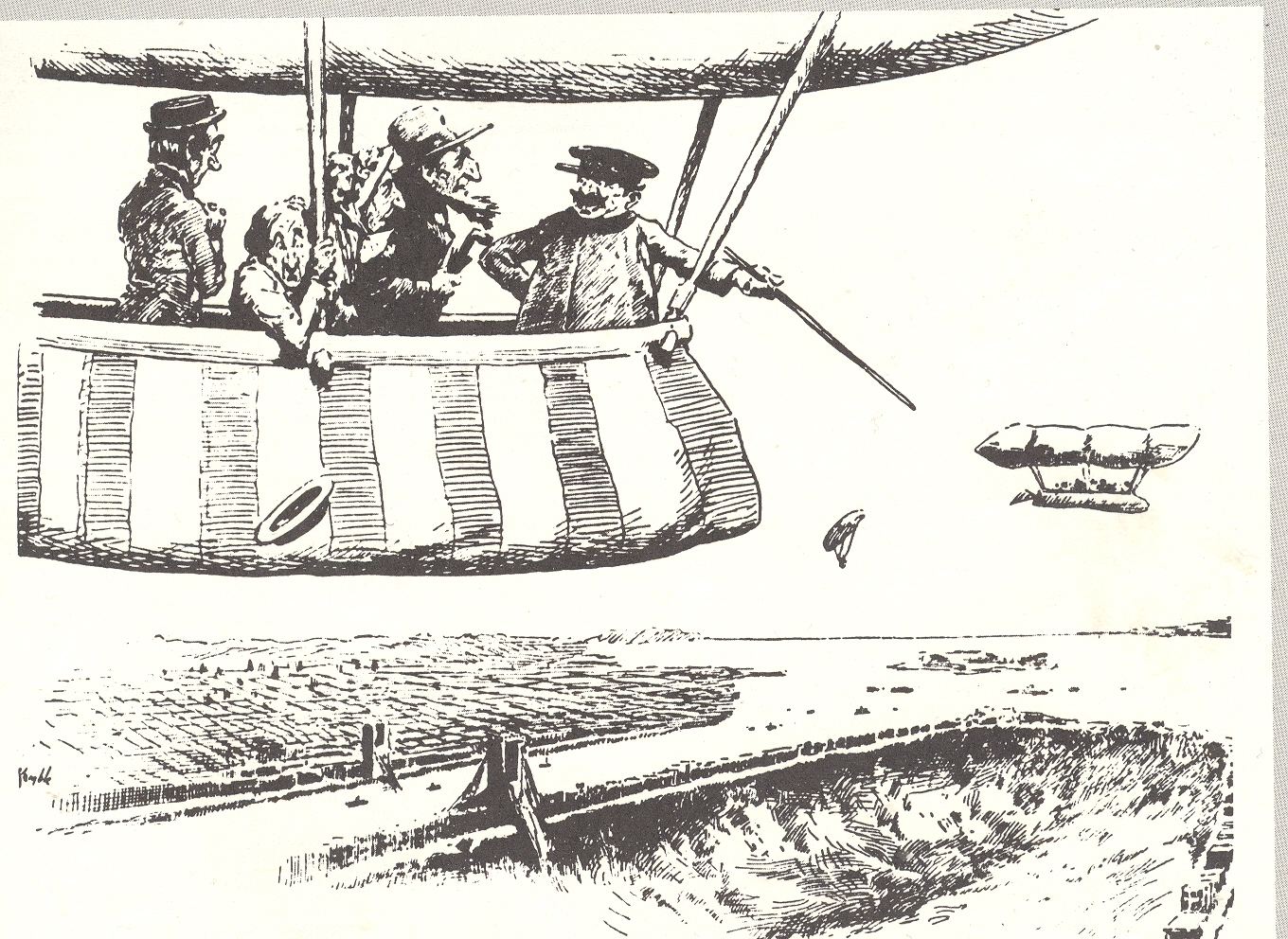
    One thing that makes Genet’s work so impressive is that as a result of it he applies for and is granted the first patent made in the U.S. for a flying machine.  The flying machine he presented in his work though is a little problematic:  the canopy and the machine itself are not at all drawn to scale, and their size and breadth are lost a little in that under-representation.   I’d say that the figures in the drawing should be half of what they are, given that the flying machine was 132′ long and 46 feet wide (and 54 feet high), and the canopy was to be filled with a million cubic feet of helium.  The thing was a beast, and was supposed to be blessed with the capacity for lifting 72,000 pounds2.   The horses were along for the forward propulsion, moving two large paddle wheel-type wheels on either side of the airship.  It just doesn’t look right.

    Next is a tempting mechanism, an inset living inside a larger engraving depicting a mode of transport not-so-tempting.  It comes from Colonel Jean-Gaffin Gallon’s (1706-1775) Machines et inventgions approuvees par l’Academie Royale des Sciences....published between 1735 and 1777, and poetically covers its subject over a 111-year span from 1666 to 1777.   The massive work was illustrated with nearly 500 engravings covering all manner,shapes and description of technological invention and advancement, not the least of which was the first illustrated description of Pascal’s logic machine.  Amid all of this vast wealth of potentially revolutionary achievement,. I pluck out this equine example of possible nothingness: 

    Horsepower280

     which I am just not sure about, not having the text.  I can only hope that the horse was some sort of imaginary mechanical something, given its task and its size.  From the looks of its neck and the rider and the length of the horse, if it was a living thing it would have been gargantuan. 

    Here’s an appearance in the Gallon work (from 1735) of another, mechanical, horse that was used for stage productions, and which seemed fairly articulated:

    And thirdly, there is this, perhaps the most famous image of horses in the history of scientific illustration:

    Mantegna vacuum von guer

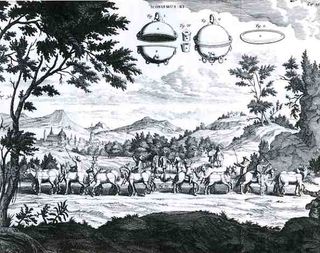
    This beautiful illustration is from one of the greatest experimental physics books of the 17th century, coming as it does from Otto von Guericke’s  Experiemnta nova (ut vocantur) Magdeburgica de vacuo spatio (Amsterdam, 1672).  (In another minute department, this one is also I guess the greatest book ever written by a Mayor of anywhere (as von Guericke (1602-1886) was mayor of Magedeburg for 33 years).)  The image shows the greatest of von Guericke’s efforts, and one of the greatest (or most important) experiments in experimental science–the dramatic demonstration of the vacuum, showing here that teams of horses could not pull apart two halves of an evacuated sphere, and of course the efficacy of air pressure operating against it (um, the vacuum). The “floating” bits in the sky were an exploded view of the sphere that was the subject of the experiment. 
                   
    What was more important though, and what the general reader today might easily miss, was that von Guericke created something that many scientists and philosophers said didn’t, and couldn’t, exist:  the vacuum.  In modern times, Copernicus depicted the universe as a vast void; Descartes came in the back door (following the ancient and interesting though incorrect theory of Aristotle), not liking the idea very much, and claiming that such empty space couldn’t exist.  Von Guericke provided the proof that the vacuum, that nothing, did exist.

    As a matter of fact the issue of nothingness was very contentious, with the concept of its possibility and the display of a vacuum not achieved until this effort by von Guericke, with his team of horses tugging away at the essence of nothing.

    NOTES

    1.  Genet is best remembered in American history as “Citizen Genet”, at least far more so than that being remembered for gentleman farming or his work in aerostatics and invention.  “Edmond Charles Genet had tried to recruit American volunteers to serve in the armies of Revolutionary France and to outfit American privateers to fight against the British. Despite President Washington’s orders for him to desist from his high-handed appeals to the American public, he continued the same practices until he was forced from office. Washington permitted him to remain in this country as a private citizen, saving him saving him from the possibility of being guillotined for his failure.” So writes the great historian of Science I Bernard Cohen.  It wasn’t altogether true though that it was Washington who saved Genet; his being allowed to remain in the U.S. was strongly pursued and lobbied by Alexander Hamilton, Genet’s greatest detractor/enemy/nemesis in Washington’s cabinet.

    2. By contrast, the Wright I Flyer (the famous first-flight airplane of 1903) had a wingspan of 40 feet, weighed 625 pounds and sported a 12 horsepower, 170 pound  engine (and which by the way was all produced for about a thousand dollars–not nothing, but not a lot).


  • Display of Information: What a Dreadnougth was Worth in Airplanes, 1911

    JF Ptak Science Books  Post 1408   [Display of Quantitative Information series]

    Info display dreadnought237

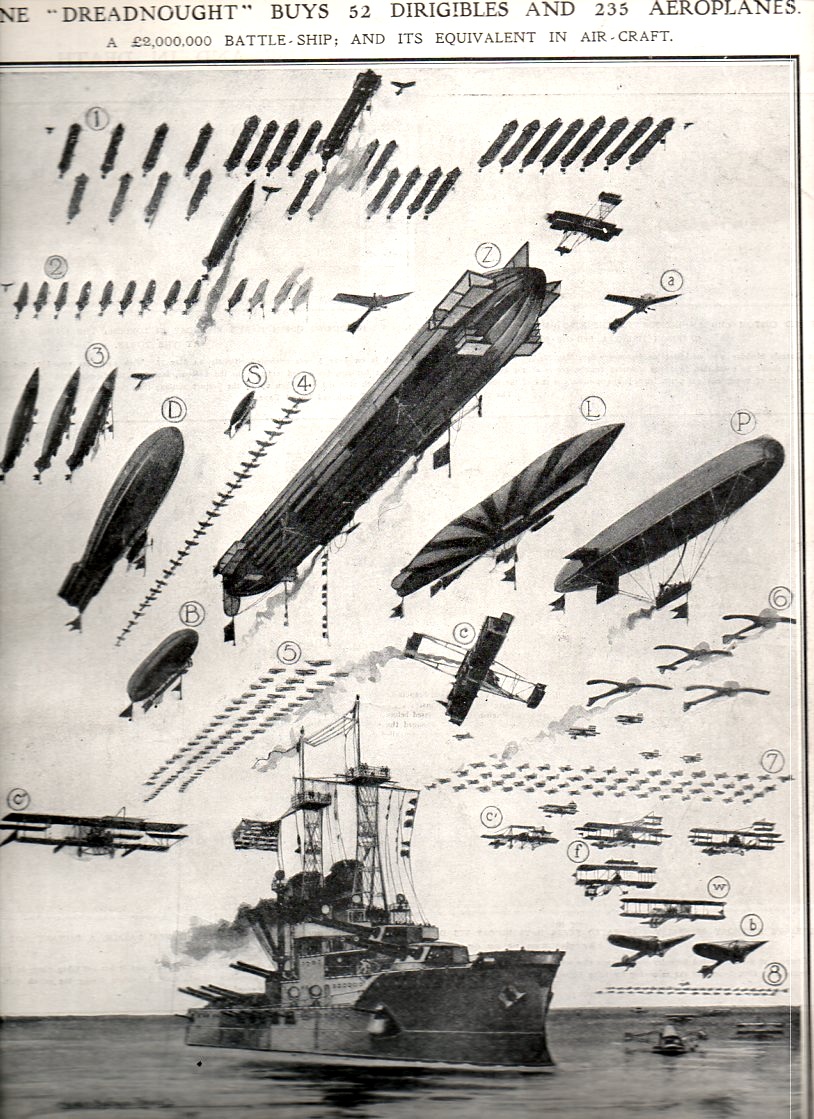
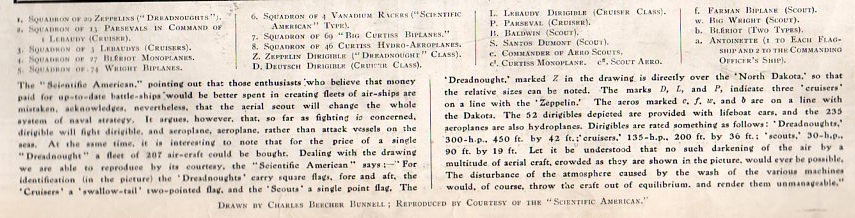
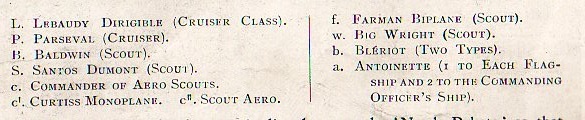
    There’s nothing quite so satisfying as seeing a representation of quantitative data like this where the graphical displays are flying.  “One Dreadnought Buys 52 Dirigibles and 235 Aeroplanes” is a full-page diagram appearing in the 3 June 1911 , making a very strong point that in the new air-age 2 million pounds for one battleship buys a lot of aircraft.  Of course this is a British journal and the ship is flying an American flag–the image originally appeared in the Scientific American just a short while before this publication, and so it also enumerates American and international aircraft, making for a lovely representation of a broad range of airplanes filling up the same sky.  (This image is available for purchase from our blog bookstore, here.)

    Info display dreadnought238
    Info display dreadnought239
    Info display dreadnought240


  • Reading Symbolism in Raymond Lull’s Portrait

    JF Ptak Science Books  Post 1333

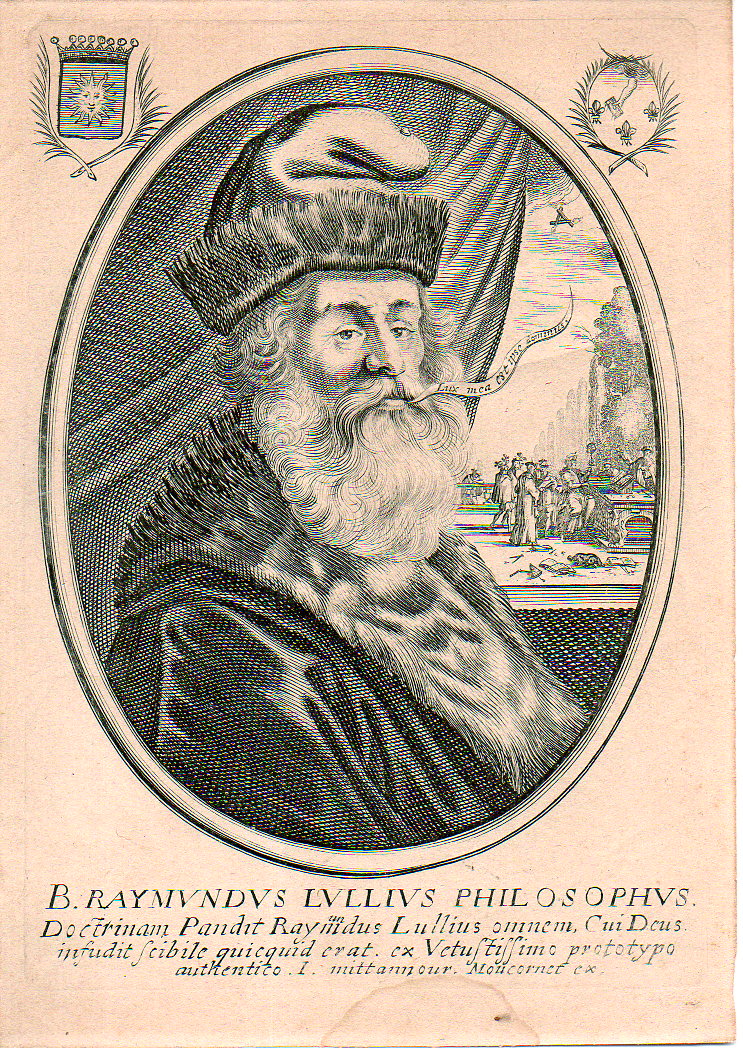
    Raymon Lull is perhaps the most famous Catalan given to the world–he is also one of the most famous people in history with the most names. (He was also known as Ramon, Raimundo and Raymond, Raimundus and Raymundus Lull, Lully, Llull, and Lullus and Lulio, among others.) Seriously though, he was a very interesting thinker who went far beyond the norm, and then some, his creativity overmatching the possibilities of the parenthetical sciences of his time, and stretching timeless logic as well as he went along.  But so it goes, as they say; he did do aggressive work and at the very least it was for the most part quite pretty-sounding.  And as he pushed up and against existing thinking it was up to that confronted thinking to push back–which sometimes happened and sometimes didn’t. He studied the law, alchemy, botany, religions, and may well have written the first novel ever to appear in Europe (at least it was the first in Catalan)–I think that you could say, overall, that he was a rationalist. 

    • The original engraving is available at the blog’s bookstore, here. 
    This engraving is one version of many that I’ve seen online, and may be the original–this is a pure guess on my part, my reasoning is so mainly because there is so much more added detail than in any other versions of the engraving.  the added bits in the corners, and of course the scene revealed by the pulled-back curtain.  The engraved lines are also very sharp, very pronounced, not like some of the other version which look a little less defined…this one is razor sharp. (The image is available for purchase from our blog bookstore.)

    Lull087

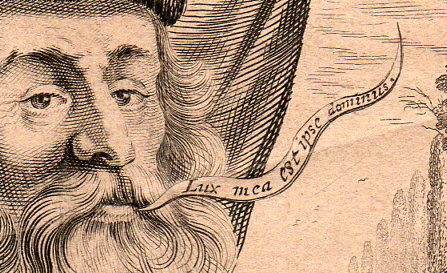
    The word balloon (and by the way I wrote a post here two years ago on the history of word balloons) coming from Lull’s mouth is Lux mea est ipse dominius “My light is that of the Lord”, a claim for divine inspiration, guidance, fortitude.  Beyond all else Lull was a Christian, and a Christian to some severe fault–he was very involved in the conversion of Muslims, and was also an (utter) expulsioist in regards to the Jews.  The Christian philosophies of Lull are clearly shown in this 17th century portrait of the man. 
    Lull371

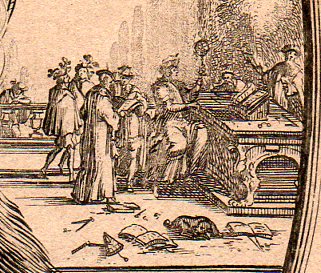
    And in the scene that is not seen in the other reproductions of this portrait online we see a small host of interesting sci-philosophical instruments cluttered around what seems to be a giant working with an astrolabe.  (This fellow is a head taller than the other people gathered around him, and he is most definitely sitting down on a high stool, making him taller still.)  We see dividers and various measuring devices, plotting instruments, and even a pair of specs, which would’ve been very uncommon in in the 13th century.  I’m happy to see a dog sleeping through the ruckus.

    In the sky in place of the sun is a triangular collection of burning candles, or they seem like candles, which continues a very old tradition of symbolizing unity, and in this case, in  a Christian theme, a god surrounded by the holy trinity… related symbols appear frequently in images depicting the Old Testament creation cycle. 

      Lull373

    Continuing this theme, if you look in the right upper corner of the engraving there is another interesting symbol–a hand issuing from a cloud with a book, sourounded by three fleur de lis.  This is in obvious reference to the balloon statement, the hand of god issuing a book, or knowledge, to the recipient (which would be the reader or Lull); the fleur de lis, a French lily, was often used in Renaissance and Baroque imaging as a representation of the holy trinity, and of purity and chastity, spirituality.  Or  perhaps it was just a flower. 

     My own interest in Lull–aside from the  great beauty in which his ideas were encapsulated and presented–is in his idea generator, and the possible influence it had on later thinkers like Leibniz who may have built on his interesting breakthrough to produce one of the earliest arithmetical calculators.  Lull’s own calculator (which I wrote a little about here) is simple and elegant, and may actually be powerful for some–it was a series of discs that when turned would relate ideas and letters and numbers which were by serendipity intended to generate unexpected ideas to think about.  For the 13th century this was a major idea, and I like it even today. 


  • New York City: Attacked by Tentacled Flying Saucers, Giant Flying Snakes, Glaciers, and Mining Missile Space Aliens, 1929-1941

    JF Ptak Science Books   Post   1118

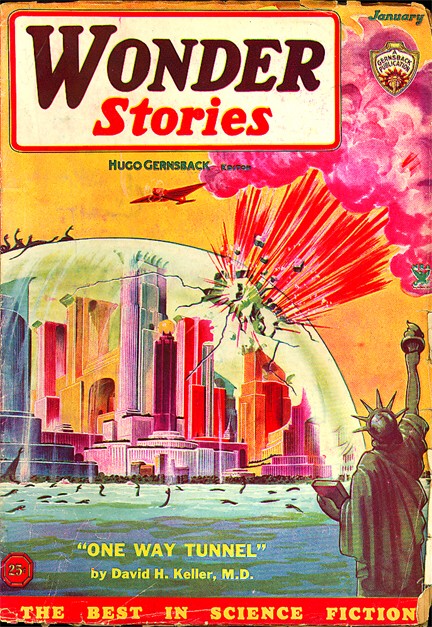
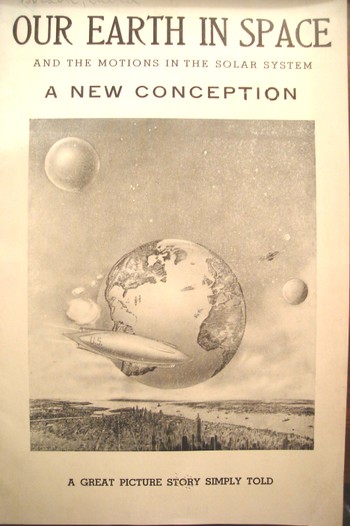
    This is a simple, non-analytical image dump for some in a continuing series on images of New York City in fantastical and improbable situations–there’s artwork that show the city being consumed by glaciers, drowned by the tide, ripped from the Earth and flung into the sun, floating in the sea, floating in space, sunken, and of course simply attacked by any number of different things, though most of those weren’t real.  There is of course the great unknown classic that I stumbled across–the duplicate NYC on a duplicate Earth orbiting the Earth ((?!) and pictured at the end of this post). I doubt that there’s enough for a dictionary of disasters, though there’s plenty for a Doomsday Book.

    For example the first image for this post shows a domed New York City–and in this scifi sub-classic,  like other major cities of the United States, NYC was suffering a catastrophic attack by winged snake monsters.  I don’t know why  the dome is exploding because the snakes don’t appear to be armed.

    NYC attacked

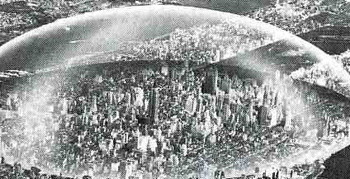
    This does remind me of an image from the mind of Buckminster Fuller, who
    came up with an extraordinarily bad idea to protect NYC against
    thermonuclear weapons. (Fuller’s dome appears here.)

    Big_archfuller_detail141 

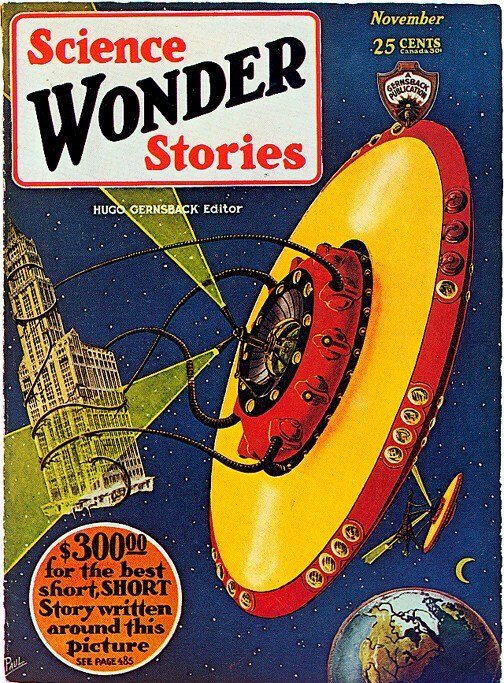
    Then there’s this magnificent cover for November, 1929, featuring a tentacled flying saucer removing the Woolworth Building into outer space (as well as the Eiffel Tower by another brethern craft (the Earth appearing again, as nearly usual, without cloud cover):

    Woolworth

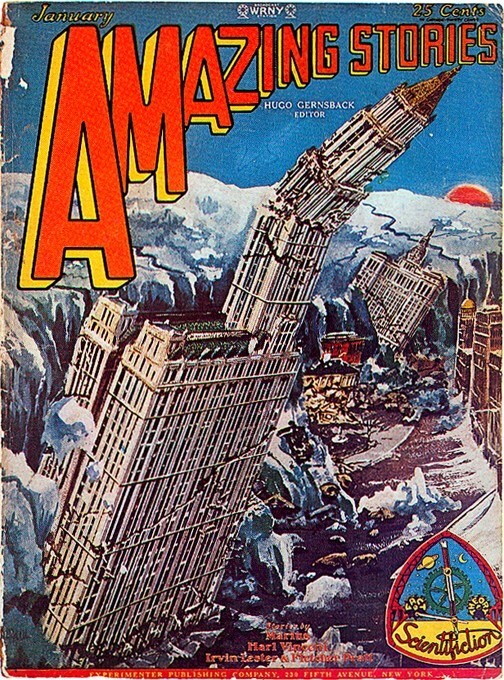
    And yet another destroyed Woolworth Building, this from January 1929, featuring an enormous glacier attacking the City:

    NYC destroyed--woolworth

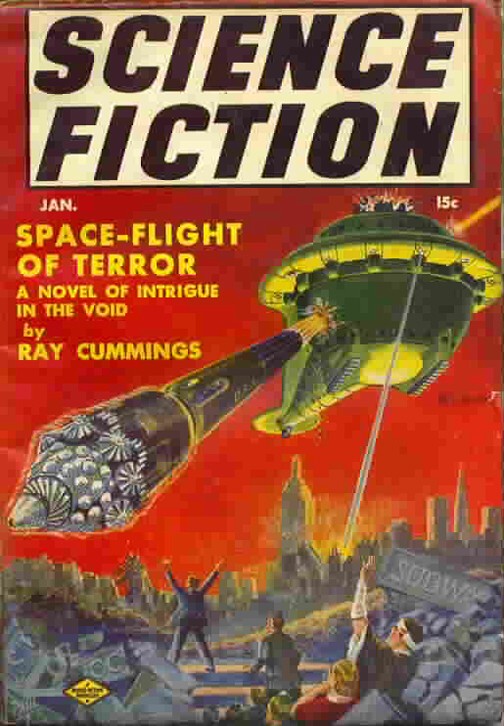
    And this vision of a decimated NYC, coming at the hands of giant hovering mining/missile space aliens:

    NEw York City in Ruins

    And of course, the duplicate NYC on Extra Earth:

    Dsc04543


  • Strange Things in the Sky Department: Manhattan Ripped from the Earth and Flung into the Sun

    JF Ptak Science Books   Post 1116

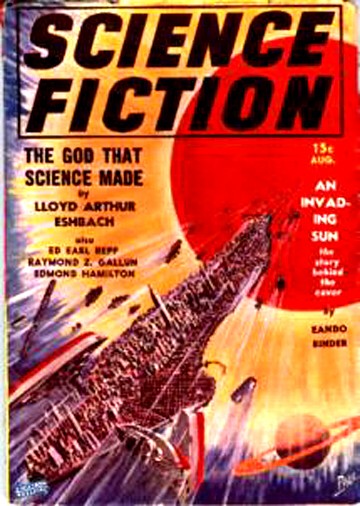
    Well, no, this isn’t quite the case, but it does look as though Manhattan was mysteriously transformed into a spaceship of some sort, an island in the sky (that it already is), hurtling towards a destiny with the sun.  But in sci-fi

    Strange things in the sky--Manhattan

    fact, Manhattan was being ripped straight out of the Earth, swallowed along with other Earthly goods and Solar System fixtures by an advancing and ravenous Sol.  (I should note that there is a battleship floating upside down over Manhattan–this is the second image of an upside-down above-Manhattan hovering battleship I have seen this week from Mr. Paul, an earlier version seen here.) .Physics problems aside, this cover was just too spectacular to not merit its own post, so that it is easily findable (even amidst the rest of the NYC swallowed/missing/in space/attacked/duplicated posts). 

    For example, there is the following case of Manhattan being missing, submerging itself into the bedrock under the weight of its skyscrapers (in 1902):

    3--nyc gone

    Frank R. Paul did the cover art for the story “An Invading Sun” that appeared in Science Fiction for August, 1939, and that’s as far as I got with this issue–anything more is destined to be a shrinking denouement.  There would’ve been plenty in the air, as it were, in the summer of 1939 to put the artist and the author in a foul prognosticating mood.  The Japanese had already been scourging China for several years now, and Nazi Germany had moved into Austria and Czechoslovakia, and were just about to begin WWII in earnest with their attack on Poland, just weeks away.  The 1930’s were a glorious decade for physics (and included the Miracle Year of 1932 spiked by Fermi, the Joliot-Curies and Carl Anderson; Oppenheimer and gravitational collapse, the overwhelmingly better-understood quantum theory, nuclear physics, and all the rest…a very busy decade). So the world was coming into a landing of some sort in 1939, what with densely compacted collapsing stars, the discovery of subatomic particles, the real birth of QM and nuclear physics, Nazis, the Japanese running amok in Asia, the death pangs of the Depression panging away, deep anti-involvement attitudes int he US, and so on.  No wonder the Earth was being consumed in science fiction fires. 

    _________

    Cover art by Frank R. Paul for August 1939 Science
    Fiction
    magazine source: Frank Wu’s Frank R. Paul Gallery.