A Daily History of Holes, Dots, Lines, Science, History, Math, Physics, Art, the Unintentional Absurd, Architecture, Maps, Data Visualization, Blank and Missing Things, and so on. |1.6 million words, 7500 images, 4.9 million hits| Press & appearances in The Times, Le Figaro, Mensa, The Economist, The Guardian, Discovery News, Slate, Le Monde, Sci American Blogs, Le Pont, and many other places… 5000+ total posts since 2008.

Category: Strange Things in the Sky

  • On Bombing the Sky with Bone (1914) and Making the Sky Bomb Us (1967)

    JF Ptak Science Books   Post 1774  [Part of the Strange Things in the Sky department]

    I’m not at all sure when the first stories were told on the implosion of the sky, or when the sky was peeled away like a layer of mica, or when an expanding hole was punched into the blue, or when the sky dissolved, or when it simply fell to the ground, or when it was simply exploded, any of which would leave a shambles of broken stars and a boring nothingness.

    Visions of the coming of hell or the apocalypse or the end of existence or the exaltation of duration were certainly depicted in art at least during the high Medieval period and the Renaissance, though I am uncertain of ever having noticed the sky on fire or facing obliteration. Perhaps the implications of its destruction would be clear in the symbolic representation of The End, the evidence of a smoking atmosphere in an infinite hole was just implied, Dr. Pangloss at play with Mr. Leibniz over paint and canvas.

    Heaven opened and stars fell in various texts, not the least of which is the Book of Revelation (6:14, KJV, “And the heaven departed as a scroll when it is rolled together; and every mountain and island were moved out of their places”). Imaging this part though was another story, especially when considering that destroying the sky was a secular event, and not driven by the great deities.

    Now holes do appear in the sky in Renaissance images, but they open to allow the hand of the creator to reach through it from the nether world, or heaven, or the infinite.  In the many examples of these holes that I have seen the background within the hole is entirely blank–plain white, no detail, no peek into heaven.  Then again, these are holes, and not a wholesale destruction of the sky.
    ++ Nov 26 eyes in sky

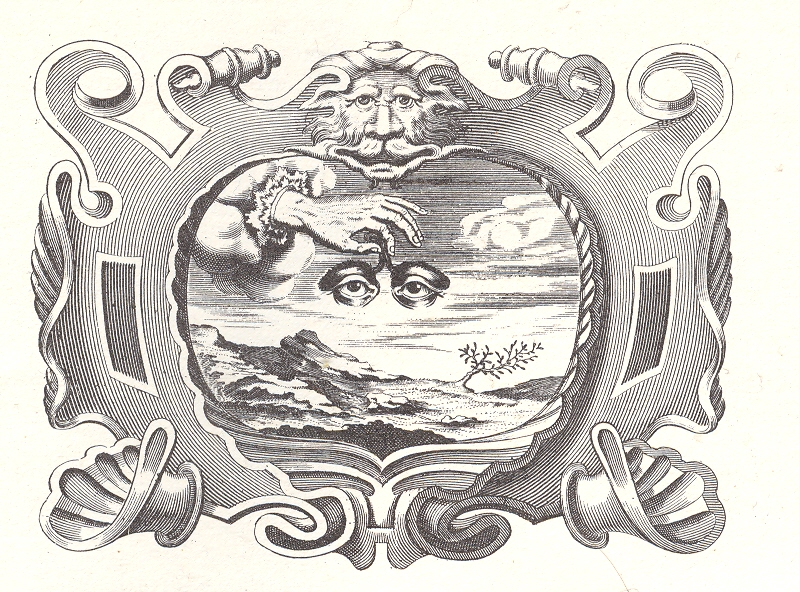
    As an example I’d like to point out the work by the Jesuit Franciscus Nerrincq (1638-1712), De goddelycke voorsienigheydt, in which there are several odd eyes that burn their way through the atmosphere.   Eyes/eye of the creator occur frequently in religious presentations and emblems, but not so very often as hands holding a pair of eyes.  I know all of this is very heavy stuff in the history of Christian iconography and the progression of emblemata, but I’d rather deal with the images out of context here and have them stand on their own without interpretation. 

     Of course the answer for the modern equivalents of this blowing-up-the-sky adventure must have deep and varied roots in the sci-fi canon, though presently they remain a mystery to me.  It is interesting to note that at one point in June 1945 in the Jornada del Muerto/the Dead Man’s Walk, at the Trinity site in the desert near Alamogordo, a group of scientists were placing bets as to whether or not the test explosion of the world’s first atomic weapon would set fire to the atmosphere. 

    In a way Tycho Brahe brought down the sky with his (naked eye) observation of a super nova on 11 November 1572. With the exception of comets and eclipses the sky had remained immutable, a perfect score of the creator’s creation, until Tycho Brahe noticed something new in Cassiopeia, something that was not a comet—a “something” that was a star. This was momentous because the night sky had been seen for centuries as being complete—a new star, the Nova of Brahe, contradicted this high belief, offering the possibilities of newness where there had not been one previously.  And so too with Kepler’s new star of 1602. This wasn’t perhaps a tearing-away of the old sky, but it certainly questioned the sky that was seen. 

    I should also point out that perhaps a reverse of the destruction of the celestial ceiling came about when Galileo turned his telescope to the sky and found to the astonishment of nearly everyone that there was an order of magnitude more stars in the heavens than anyone had ever experienced before. This in a way collapsed the old sky with its perfect and unchanging number of stars, showing that the creator of the universe had indeed provided more stars than anyone had ever imagined, though for reasons not yet known had kept that knowledge from humanity.  By 1610 Galileo had produced his fifth and most powerful telescope, allowing things to be seen one thousand times closer, using it to make enormous discoveries–discoveries so big in fact that their towering significance is a but hard to understand today in the context of early 17th century knowledge. It was all published in his fantastic Sidereus Nuncius on March 4, 1610—the extraordinary title page1 of the book proclaiming some of the great discoveries of Galileo’s adventure. One of the things that Galileo brought to the world was this entirely new sky, revealed to him through his telescope—so many stars that he could only guess (though he reckoned that there was an order of magnitude more stars than previously known “stars in myriads, which had never been seen before…and which surpasses the old, previously known, stars by ten times”). In a way Galileo introduced the sky-above-the-sky, available only to people with a special instrument to see it–the new reality.

     This is what I had in my mind when I saw this unusual patent application (above and below). Just weeks before the beginning of WWI, two weeks before the assassination of Archduke Ferdinand, followed quickly by a cascade of war declarations a few days after that, came this rather footloose idea for bombing the atmosphere

    J.M. Cordray came up with and patented this notion–a barrage of balloons, heavily armed balloons, sent aloft with dangerous cargo to be exploded in the atmosphere, which was supposed to initiate a chain-reaction of some sort which would end in supplying rain for the rest of us. Theoretically, anyway. The unspecified number of balloons would be sent aloft, laden with large amounts of crushed bone and concentrated sulfuric acid (to be combined to produce nitrogen), potash, water, and large amounts of crude oil for the fire’s fuel.  And a candle to light it all.

    It seems that the attempt to blow up a part of the sky with bone and sulphuric acid to make rain just didn’t work, though I cannot (easily) find a record of the experiment being attempted. 

    Mr. Cordray presented himself at the top of his patent as “J.M. Cordray/Rain Maker”.

    The one thing that is for certain is that Cordray’s attempt at weather modification was quite early–it would be another three decades before pioneering work of Kurt Vonnegut’s brother, Bernard, was published (beginning in 1947, finding the ice-nucleating properties of silver iodide, AgI),  which established the very real possibilities of altering the weather.  This practice was employed in the U.S. military’s Operation Popeye, which used cloud seeding to prolong the rainy seasons along the areas covered by the Ho Chi Minh Trail in Vietnam from March 1967 to July 1972.  This sort of weather warfare is now prohibited by international convention.

    And so in a way by employing weather modification as a tool of war we’ve been able to turn the sky into a weapon, which means that this post has followed the bombing of the sky to the sky bombing us. 


    See an interesting article at Paleofuture on the Cold War weather modification attempts here.

    Notes

    1. The title page in full reads:  Great and very wonderful spectacles, and offering them to the consideration of every one, but especially of philosophers and astronomers; which have been observed by Galileo Galilei … by the assistance of a perspective glass lately invented by him; namely, in the face of the moon, in innumerable fixed stars in the milky-way, in nebulous stars, but especially in four planets which revolve round Jupiter at different intervals and periods with a wonderful celerity.
  • Balloons I Know But Do Not Love–Deaths from Above, Ads and Bombs

    JF Ptak Science Books   Post 1771

    In the early days of aviation aerial assault must have seemed incredible–and an abomination.  Hurling stones and other offensive weapons by trebuchet and catapult is one thing, and  launching balls and shot from cannons and mortars is quite another–but actually having your weapon flown over an enemy’s position and dropped, remotely or via cable, must have been ab excruciating achievement, militarily speaking.  To be able to direct an explosive charge over a position not reachable by an infantry (say in 1915) must’ve been a short-lived comfort on the offensive end, though the user of such a technology would also have to contend with the contrary, as the enemy would be able to do the same thing themselves. 

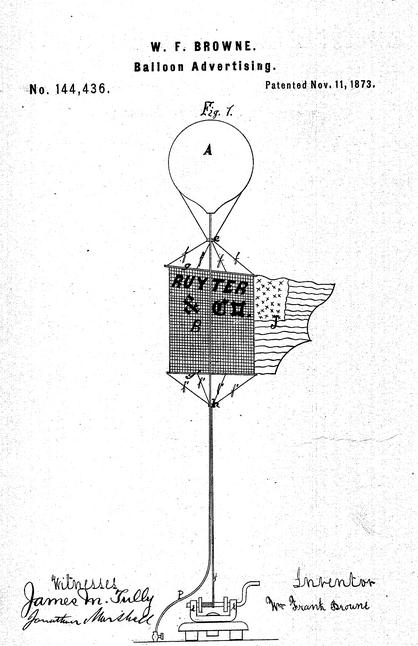
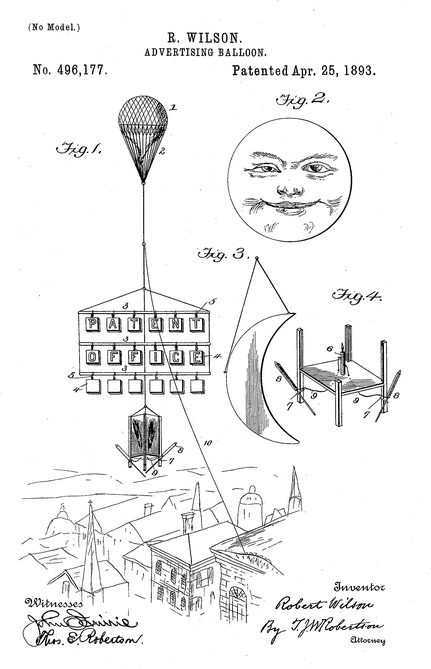
    This idea was not limited to just military purposes.  Companies could now wage an advertising war war against competitors  in a thee-sky’s-the-limit campaign, hoisting their ads on balloons anchored over a city, making it possible for the first time to have your message so universally read, a pre-intertubes version of smoke signals. 

    Patent balloon advertising 1893[Source:  Google patents, http://www.google.com/patents/US496177?dq=balloon]

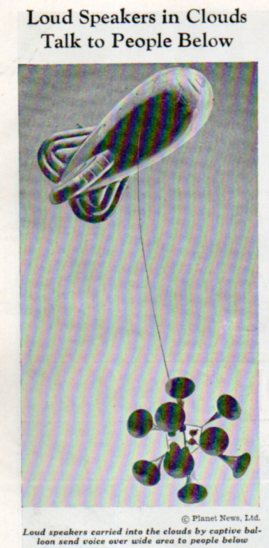
    Sky speakers413

    And this, seeming more on the Orwellian/1984 side, or perhaps more contemporary as an instrument of the Dear Leader in North Korea (left, from Popular Mechanics, July, 1939).


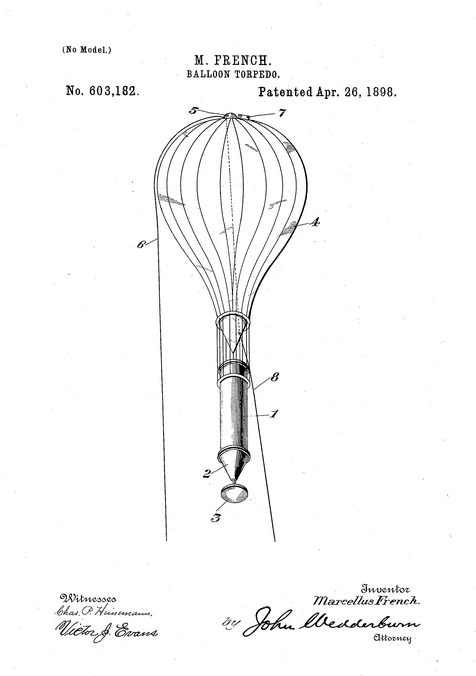
    Here’s an interesting, pre-airplane, airship-delivered explosive device: floated over an enemy’s position, the chord would be pulled at the desired time to create a tear in the balloon’s top, sending the craft down, with the bomb exploding on impact:

    Patent balloon torpedo[Source: Google patents, http://www.google.com/patents/US603182?dq=balloon]

     Another sort of slow death from above advertising scheme:

    Patent balloon 1873

    [Google patent:  http://www.google.com/patents/US144436?dq=balloon]

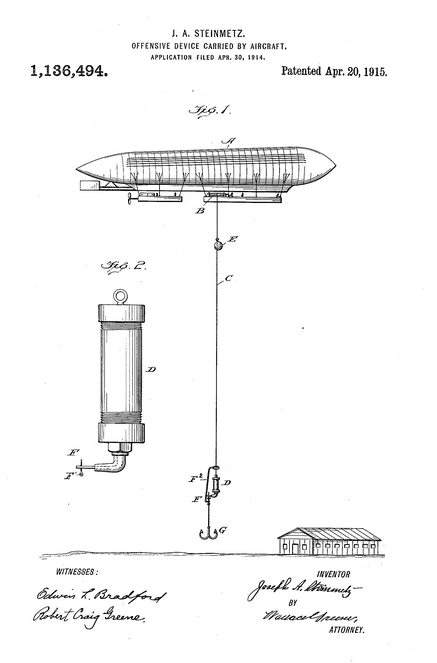
    In this device patented by Steinmetz the explosive device is still actually attached to the aircraft when exploded–not a very common way of delivering your weapon.  The airship would advance on the enemy, with the bomb  attached to a cable just above an anchor at bottom; the anchor would grapple the target, and the bomb detonated from the  gondola of the airship:

    Patent Balloon gondola


  • Strange Things in the Sky Department: Disintegratging Moon and Lunar Nuclear Alien Space Nazis

    JF Ptak Science Books  Post 1767

    In a post last week in the Strange Things in the Sky department: the Exploding Moon, I mentioned that images of the Earth’s Moon actually exploding seem to be quite uncommon. The ever-observant  Ray Girvan wrote to say that the Moon does just that in the 2002 remake of H.G. Wells’ The Time Machine, when Earth’s lunar mining operations disrupt it so that it makes the Moon disintegrate, raining parts of itself on Earth. 

    Strip Mining Shatters the Moon

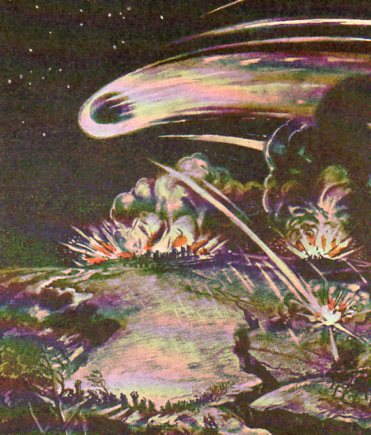
    And it just so happens that I stumbled on another odd image of the Moon coming to its end:  a mention of a drawing by Thomas Voter, showing the Moon disintegrating under the force of the Earth’s gravity.  It appears in the November, 1939 issue of Popular Mechanics in the “Explorers of Space” article. 

    Moon explode407
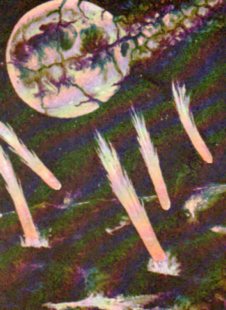
    And then, on the next page of the magazine appears another image of the breaking Moon by Wallace Favereau, this also showing bits of the Moon slamming into the Earth.

    Moon explode408
    Thomas Voter’s illustrations led me to his image showing Boy Scouts flying on their odd destiny to the Moon for a rendezvous with Post-War Moon Nazis in what is a surprising juvie novel by Robert Heinlein, Rocket Ship Galileo (1947).  [Image courtesy of the excellent Roborant site, well worth a visit and bookmark, here.]  The three boy-rocket-experimenters are on their way their with their Nobelist uncle, piloting a thorium-fueled mail rocket that the Manhattan Project Uncle was able to rig up for interplanetary adventures, which gets them to a nuke-war-ravaged-Moon with victorious commanding Nazis over whom the intrepid travelers eventually triumph.  This really has nothing to do with exploding or disintegrating Moons, but finding a reference to Moon Nazis does classify as a strange-thing-in-the-sky. evidently the story is much disparaged by modern readers, though the author of Roborant feels as though there is a much greater depth to the story that the possible high-comic storyline implies. 

    It looks like there is a sub-genre for Evil Alien Space Nazis in books and film, but I just can’t go any further with the topic.


  • 17th & 18th Century Steampunk Flight

    JF Ptak Science Books   Post 1764  [Part of the Unintentional Absurdist/Surreal series]

    Belidor upside down
    I’ve called on M. de Belidor (1698-1761) before in this blog, using some of the images of his books to describe the Found-Surreal, the Unintentional Dadaist (and so on), images that once slightly removed from their original context take on an entirely new life, sometimes fantastical and odd. 

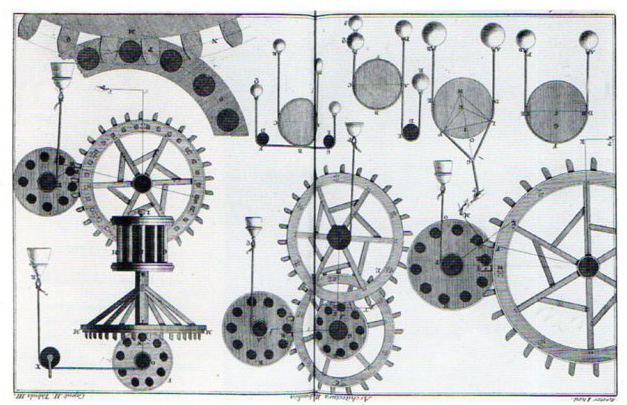
    The engraving above is a fine example, an appears innocently (and beautifully, and importantly) in his Architectura Hydraulica (1740), and titled “Demonstration of Friction”.  I’ve simply inverted it and removed some of the numerical notation–and then, suddenly, it becomes a sort of Steampunk Balloon Machine–a lovely collection of small balloons lifting large wheels and cogs, assembling some sort of something in mid-air, demonstrating very little friction, of lightness and airiness

    Belidor was a remarkable engineer and theoretician who blended the two practices perfectly–actually one of the great issues in his career as trying to disseminate higher levels of techno-competence among people working with machines and using technology to some end.  He often found that the skills necessary to reproduce and maintain some of the machines he wrote about to be, um, lacking in the population at large.  He was also very transparent in technology’s role in military life (which at about the time he was writing was nearly tautological) and tried to apply the advancements he made in that area (as he was a military engineer and soldier) to the industrial and social sphere. In any event he was a very interesting man who produced books that were significant for a half-century or more past his death. 

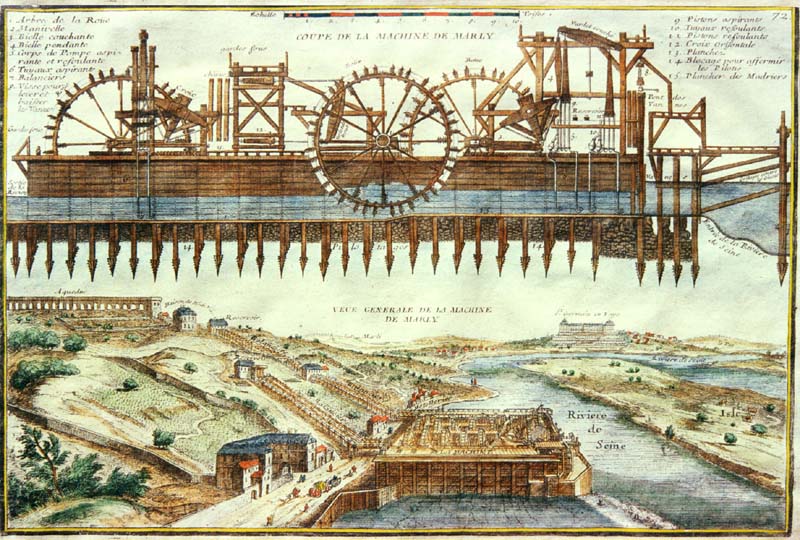
    The second image is even more striking, and is not altered at all–the difference in perspective comes with a difference of perspective, which in this case is simply labeling the image as something it isn’t, a Massive Steampunk Flying Machine of the 17th Century:

    http://world.std.com/~hmfh/mferclrsect.jpg

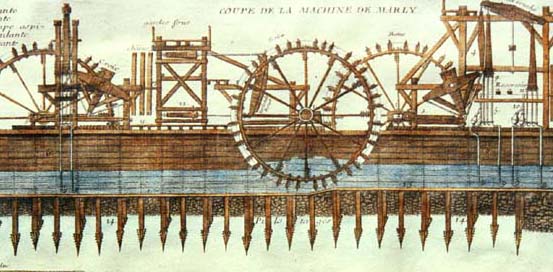
    It is nothing of the sort, of course, but if you suspend a little critical thinking then that is what this engraving sort of looks like.  In reality it a combined profile of the machine (top of the image) and view of its placement (bottom) of the great technological and engineering feats of the day, a modern marvel, a wonder–the Marly Machine. This was a large, integrated device constructed (over a seven-year-long period and finished in 1684) to pump water from the Seine to Louis XIV’s chateaux at Versailles and Marly, and did so magnificently up a 500-foot vertical rise to an aqueduct and then on to the final destinations.  Those paddle wheels on the sides of the installation were monsters:  36′ in diameter, capturing and releasing the water of the Seine to power 250 pumps which sent the water on its way up the long and steep hill. 

    Marly

    Here’s a view of the device in situ, with a long course of other implements ascending the hill.  [Images courtesy of Marlymachine.org.]

    So with a slight suspension of analysis and a little inversion, these two images take on a flighty life of their own, independent of their intended purposes.


  • Strange Things in the Sky Department: the Exploding Moon.

    JF Ptak Science Books    Post 1763   [Part of the Strange Things in the Sky Department.]

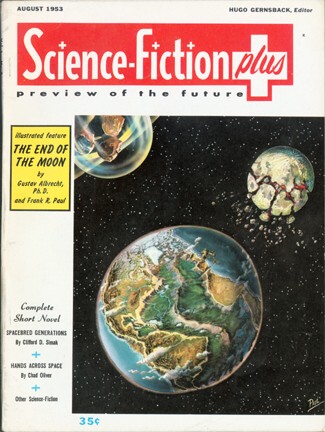
    Moon exploded[Cover art by the great Frank R. Paul for the August 1953 issue of Science Fiction Plus.]

    In my experience of Strange-Things-in-the-Sky Department,the idea of the exploding Earth is far more popular and more illustrated than that of the Exploding Moon.  So far as I can recall Moon doesn’t explode in most cases of early sci fi, including the earliest case of Lucian’s Icaromenippus and his great True History (a satire on outer space travel and interplanetary warfare between the kings of the Moon and the Sun over possession of the Morning Sat (Venus).  Nor does the Moon explode in the other very early efforts of de Bergerac (1657), Francis Godwin (Man in the Moone, 1632, where Our Hero gets to the Moon on a goose-powered aerial something), Johnannes Kepler (Somnium, 1634) and others.  The Moon gets into trouble enough, but not so much trouble to lead it to blow up. 

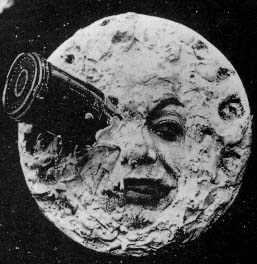
    File:Le Voyage dans la lune.jpg

    (I can’t leave this without mention of Robert Heinlein, who wrote many short stories addressing the Moon, many with fantastic titles and even better story lines:   “Columbus Was a Dope”,  1947;  “Gentlemen, Be Seated!”, 1948, about a lunar tunnel;  a Boy Scouts on the Moon, “The Black Pits of Luna”, 1948;  “The Man Who Sold the Moon”, a 1949    “Nothing Ever Happens on the Moon”, 1949 (future Boy Scouts on the Moon);     “The Menace From Earth”, 1957, (Lunar teenager angst and a muscle-powered space ship); “The Moon Is a Harsh Mistress” (1966), (and a Lunar penal colony)–lovely titles for some superior writing.

    The Moon certainly takes abuse here and there, ranging from cloud attack (in Lucian) to colonization to this very memorable (and frightening/disturbing, as I found as a child)  as in the case of the Man in the Moon being shot in the eye with a space ship (George Melies, Le Voyage dans la lune (A Trip to the Moon) (1902)). 

    Frank Rudolph PaulAnd of course there’s always the runaway Moon and the havoc that it would soon cause to the Earth, though then again this is not an exploding Moon, except it seems as though it might soon be so. 

    And so in a bit of rambling about the Moon that has gone on in this blog, there are no other mentions of the Moon exploding, though there are some other strange things going on there.  Just not “exploding” strangenesses.

    And especially not Laurie Anderson’s “The Exploding Moon“.


  • The Death Ray and Cloud Writing–Battlefield to Breakfast in a Few Short Years.

    JF Ptak Science Books  Post 1749  [Part of the Strange Things in the Sky department.]

    The Death Ray is a long-discussed idea, extending back as far to Archimedes at least–discussed, attempted, abandoned and dismissed.  But as a matter of fact, the thing was actually invented, and deployed, though not int he sense of an EM weapon, or LRAD/ultrasonic, or Teller x-ray laser, or even a Wellsian heat ray (below).

    File:Alvim-correa12.jpg

    The “Death Ray” made its appearance in the 1880’s, but not in the normal sense of what we would today think of as a “weapon”–this death ray could locate the enemy hidden miles from the front, or pick out ships at sea far from shore, and so on, removing stealth capacity, making it possible for these elements to be identified as targets, and then possibly removed, though not by the ray itself. 

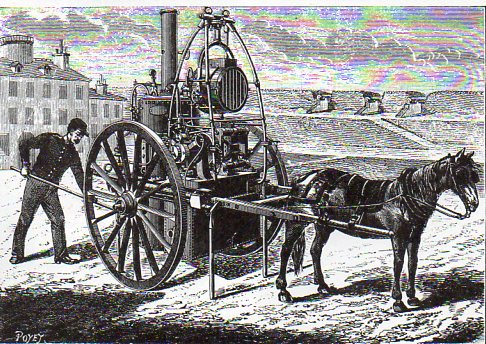
    This “death ray” was the search light.  In the 1880’s when the technology of electric lighting was still in its first practicable decade, the idea of being able to focus a beam of light from a lantern source hauled on a single-mule carriage and powered by an on-board battery, small steam engine  and Gramme dynamo was a spectacular. achievement. 

    Searchlight359
    [This image appeared in the Scientific American in 1886 and features what is probably a one-foot diameter mirror, making it capable of illuminating an object up to about a mile away.  Something with a three-foot diameter could work its magic on object up to four miles away.]

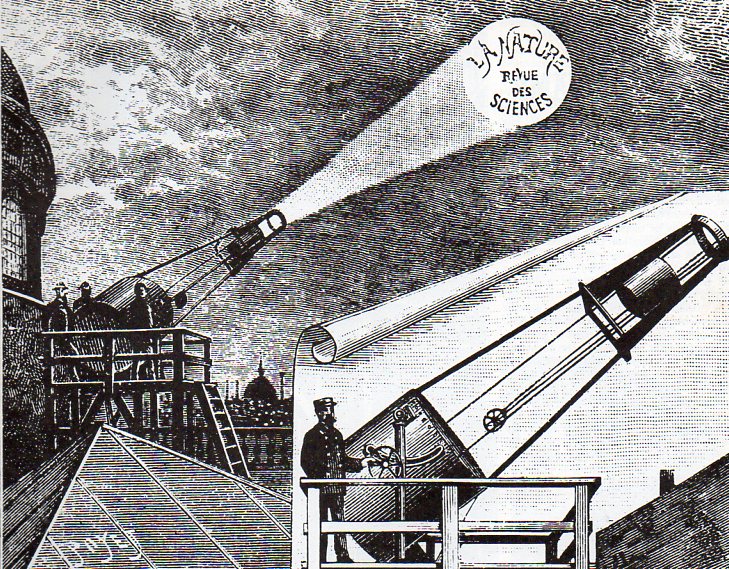
    This defensive/offensive weapon/device was very soon afterwards made into a trickle-down appliance that was placed into commercial use almost immediately.  The standard use of course would be upgrading lighthouses, but one special use was using a large mirror in a device to project an advertisement on the clouds in a city–ads in the sky.

    Searchlight360[Source, La Nature, 1894; also reprinted in Scientific American in the same year.]

    Such a device was used experimentally at the Columbian Exposition in Chicago for the World’s Fair of 1893, flashing the daily attendance on the clouds.  I’m not sure why the greater revenue-generating employment of this technology took another year to develop.  And so “The Death Ray”, from Battlefield to Breakfast Cereal in a few short years. 


  • Strange Things in the Sky Series: Floating Trees

    JF Ptak Science Books   Quick Post  [A part of the Strange Things in the Sky series.]

    “… Living only for the moment, turning our full attention to the pleasures of the moon, the snow, the cherry blossoms and the maple leaves; singing songs, drinking wine, diverting ourselves in just floating, floating; … refusing to be disheartened, like a gourd floating along with the river current: this is what we call the floating world..”.–Asai Ryōi, in his Ukiyo monogatari “Tales of the Floating World”, c. 1661

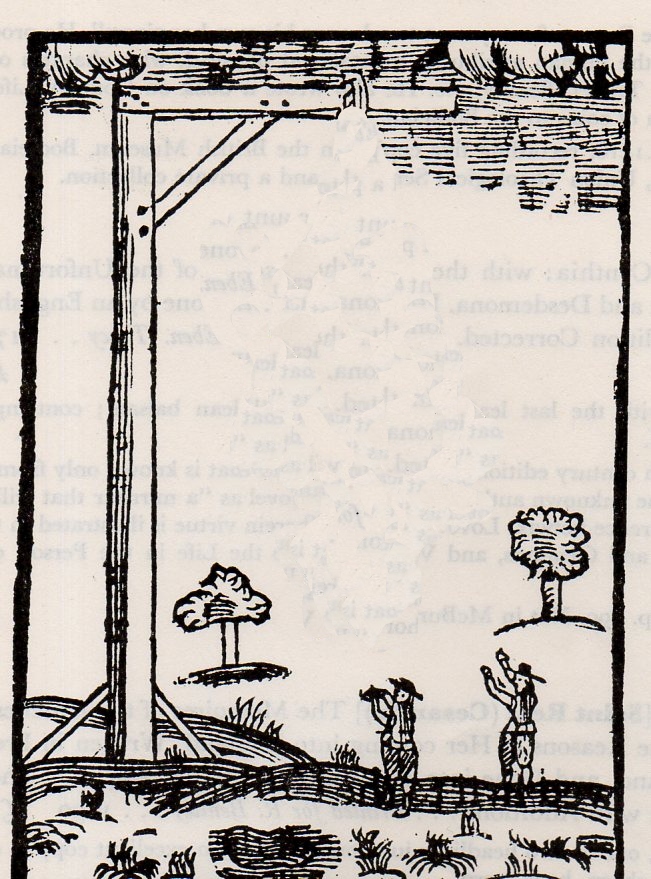
    Floating trees955
    Unfortunately I have lost (!) the reference for this image, but my guess is that it is definitely English and that it comes at the times of the Civil War(s) of 1642-1651.  This image below shows the hanging of some poor fellow–and though it seems to be a crown (?) that the man is wearing I can’t imagine who the royal person would be do be executed in such a manner.  It seems to me that the mode of execution was beheading (as with Charles I) and also by firing squad, and I just don’t know who was hanged.  In any event, I’m after the weird, removal bits from the image more than what it says to us from history. And the out-of-context item hjere of course are the “floating” trees:

    Floating trees955 missing


  • Strange Things in the Sky Dept.: Mountains and Allegories of Time

    JF Ptak Science Books  Post 1554

    In the history of mountains seldom have they raised themselves so magnificently as that seen in Jacopo da Valenza’s St. Jerome in the Wilderness. Painted in about 1509, da Valenza (who flourished from 1478-1509) depicts the 4th century Saint–a Doctor of the Catholic Church,  proponent of asceticism, scholar, philosopher, historian and translator of the Bible–sitting calmly and reading a book balanced on the top of  a rock pile, sitting in a deep state, with a metaphorical depiction of time and biography looming impossibly and invisibly behind him in the form of a mountain.

    I believe that the scene that wind their way around the mountains are those from St. Jerome’s life, displayed for all but not to him, shown as a chronological memory in simultaneous display. 

    The imagery of the mountain displays as much history and imagination as required by the viewer.  It has a distinct Tower of Babel quality to it, though here the mountain very decidedly has no upper limit, no summit, the mountain disappearing into the north end of the painting, and actually seems to be getting larger and more dense as it ascends. 

    Jerome is serene, larger matters on his mind than a simple history of one life. 

    The saint is frequently shown in very stark surroundings, and occasionally appears in more formal and lush biblio-related scenes–as the man did, after all, serve his Pope in very advanced capacities in Rome for a number of years.  But this I think is how we picture Jerome in a generalized way–except for the extraordinary mountain. 


  • Strange Things in the Sky Department: When Worlds Collide (1933+1951)

    JF Ptak Science Books   Quick Post  Part of our Strange Things in the Sky Department

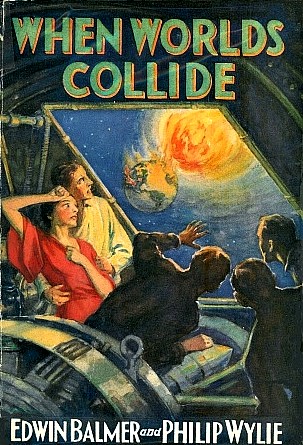
    When Worlds Collide wasn’t so much about another world colliding with the Earth–it was another star, a “rogue star”, that enters the solar system and heads directly towards the Earth.  Luckily for a selected few, a billionaire astronomer sees the thing coming and decides to construct a spaceship to populate a friendly “planet” near Alpha Centauri.  Oh well, its 1933, and perhaps anything was possible–after all, the Empire State Building (which is depicted in so many of these movie posters in a not-good way) was just finished in 1931, after two years of construction (!). 

    So the following are movie posters for the 1951 film version of the 1933 book–except for the first image, which is from the book.

    Strange sky--when worlds collide   


    http://www.mattfind.com/12345673215-3-2-3_img/movie/v/z/n/when_worlds_collide_1951_300x439_193460.jpg


  • Strange Things in the Sky Department: Floating Ships, Cities, Airports

    JF Ptak Science Books   Quick Post

    This is a  continuation of a  series of posts in the Strange Things in the Sky Department. 

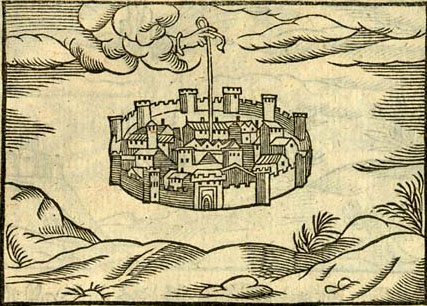
    This image of St. Augustine’s City of God shows the Primum Mobile holding the walled city (Rome, or Romish) aloft, the artist distinguishing it from the earthly city:

    http://iamyouasheisme.files.wordpress.com/2010/09/heavenly-city.jpg

    Strange things sky Perspective drawing

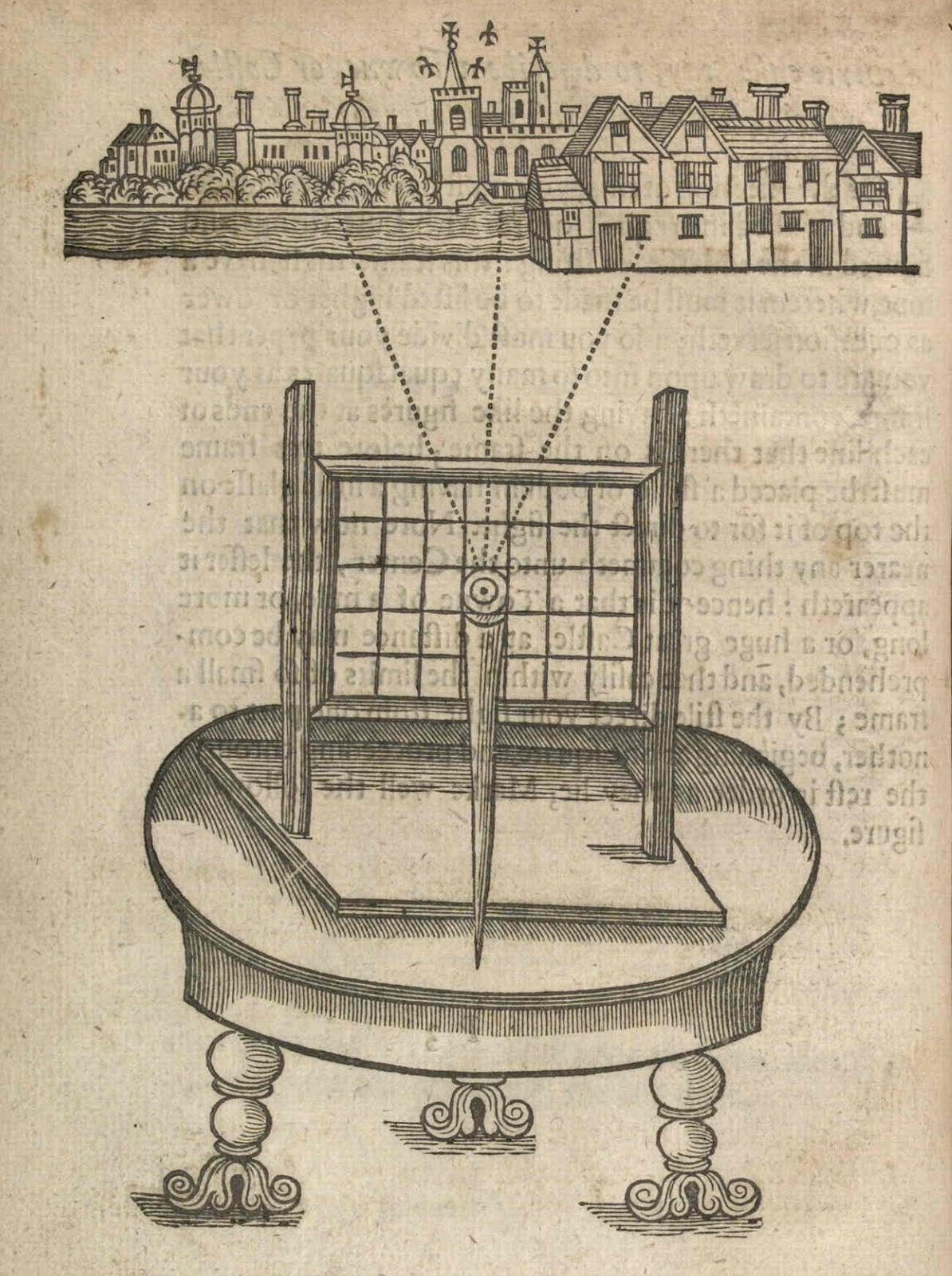
    Perspective drawing apparatus, from  John Bates’ encyclopedic The Mysteryes of Nature and Art : Conteined in foure severall Tretises, the first of Water Workes, the Second of Fyer Workes, the third of Drawing, Colouring, Painting, and Engraving, The fourth of divers Experiments, as wel serviceable as delightful: partly collected, and partly of the Authors Peculiar Practice, and Invention, printed in London ” for Ralph Mab and are to be sold by Iohn Jackson and Francis Church at the Kings armes in Cheapside 1634″.   [Source: the fabulous Bibliodyssey blogsite.]   This was a book that Isaac Newton owned and worked from when he was a teenager, using its useful recipes and instructions to build a number of bits, prankish and practical.  (This city isn’t actually floating, of course–it just looks that way.)

     [airwonder_1929_11_frpaul.jpg]

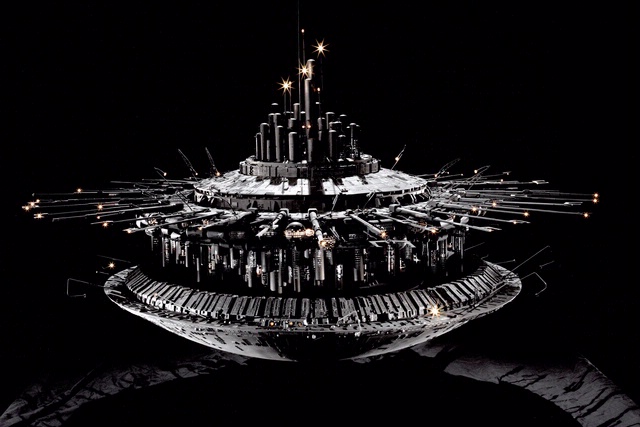
    Here’s a semi-famous illustration that appeared earlier in this blog–perfect here to offset the older “floating cities”.  This one depicts a floating or hovering or anti-gravity-something installation of a future Manhattan, existing peacefully above its former Earth-bound base, now overgrown with nature.  The New Manhattan Air Island is many square miles of buildings, and reminds me of the mothership from Close Encounters of the Third Kind. 

    http://www.nasm.si.edu/webimages/640/WEB10041-2003_640.jpg

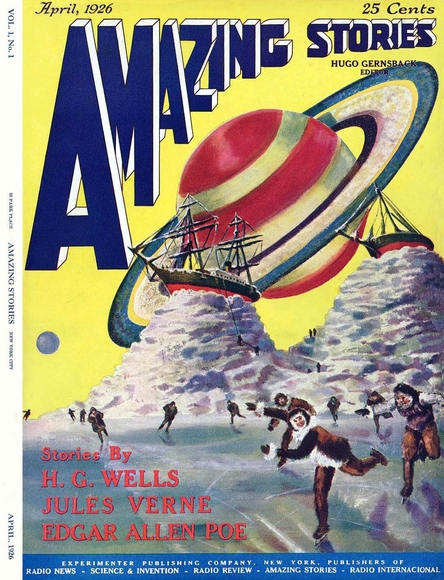
     I just don’t know the story behind this image, though perhaps it is…well, I don’t know.  There’s a whole lot of things that it could be, but then there’s the Tall Ships on the top of mountains of ice and the air-breathing skaters in the foreground…I don’t know: 

    Strange things in sky  saturn


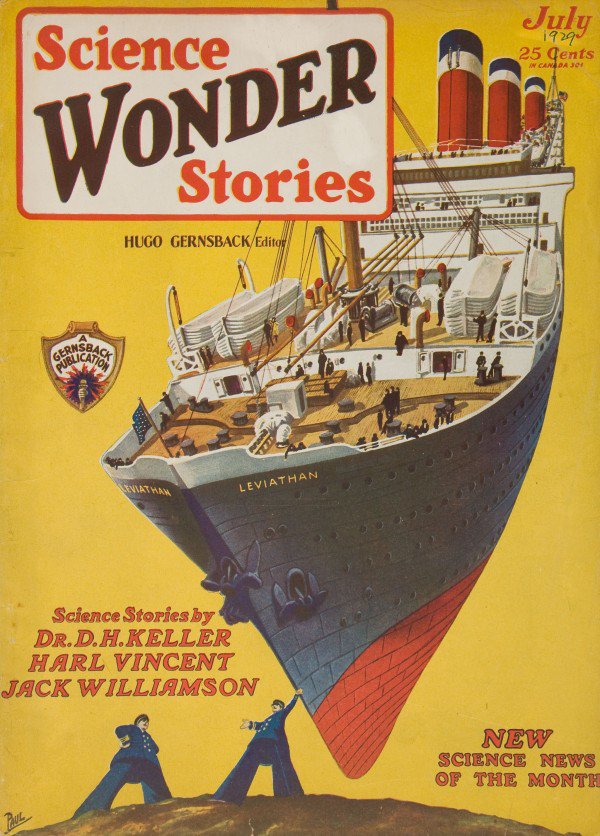
    Science Wonder Stories ship in sky

    [Source: http://pulpcovers.com/tag/sciencewonderstories/]

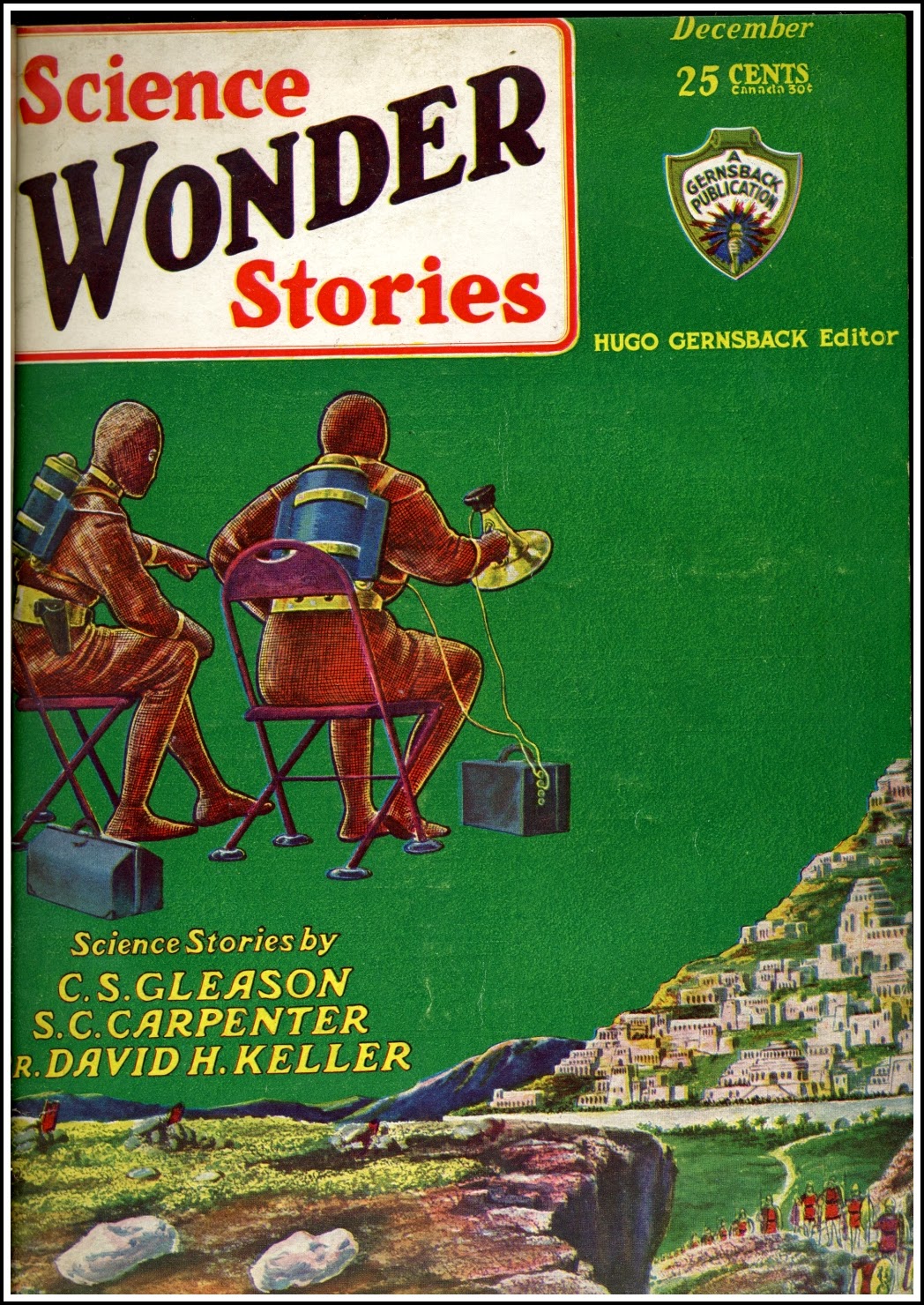
     And this in a sort-of opposite way to the above, a disembodied sitter in a very articulated space:

    Science wonder stories seated floating

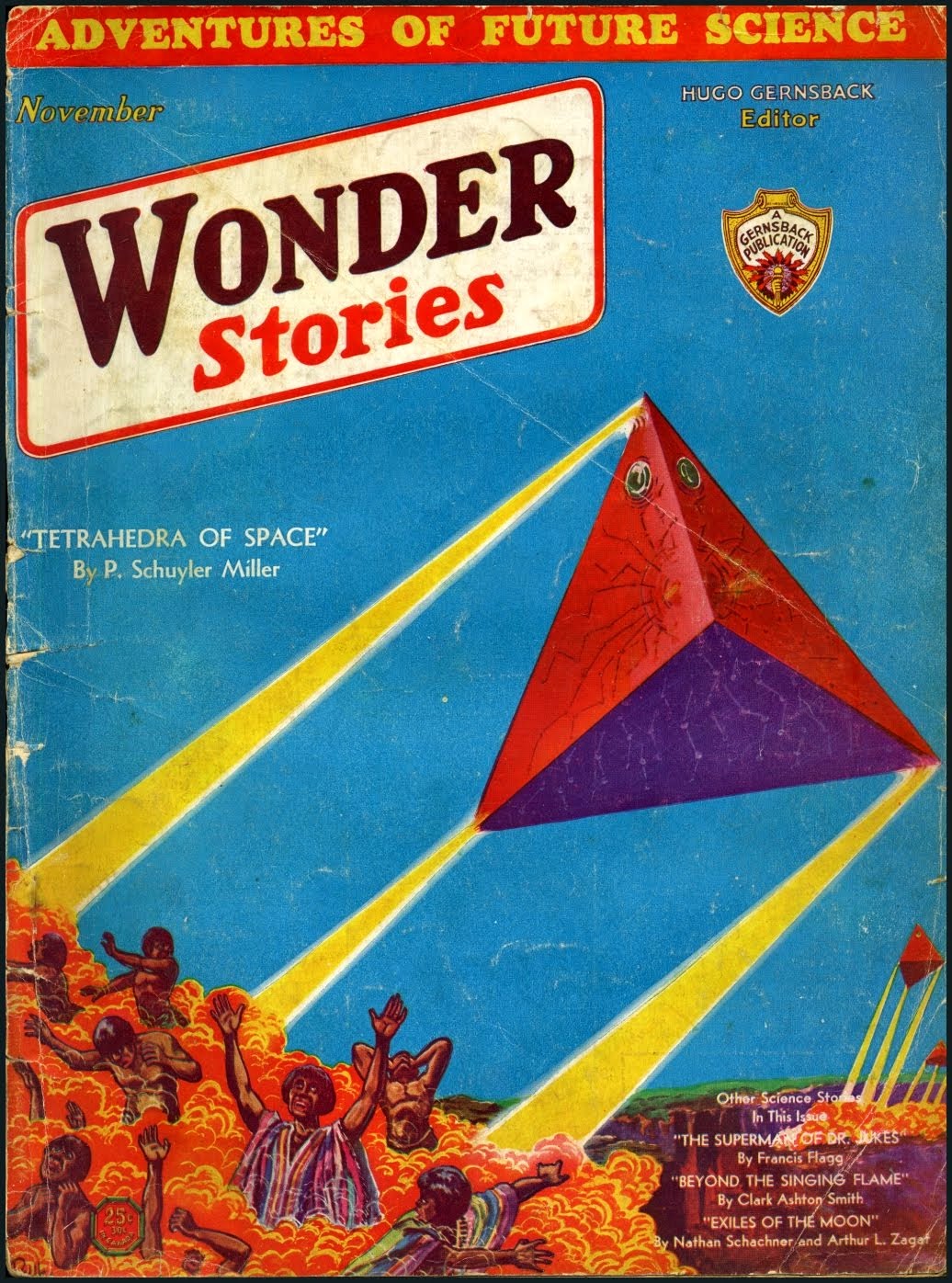
     I’m not sure what to make of these buggers, though it is very creepy looking…,perhaps its the bad-blue sky that just sets everything off badly:

    Wonder stories cubic triangles

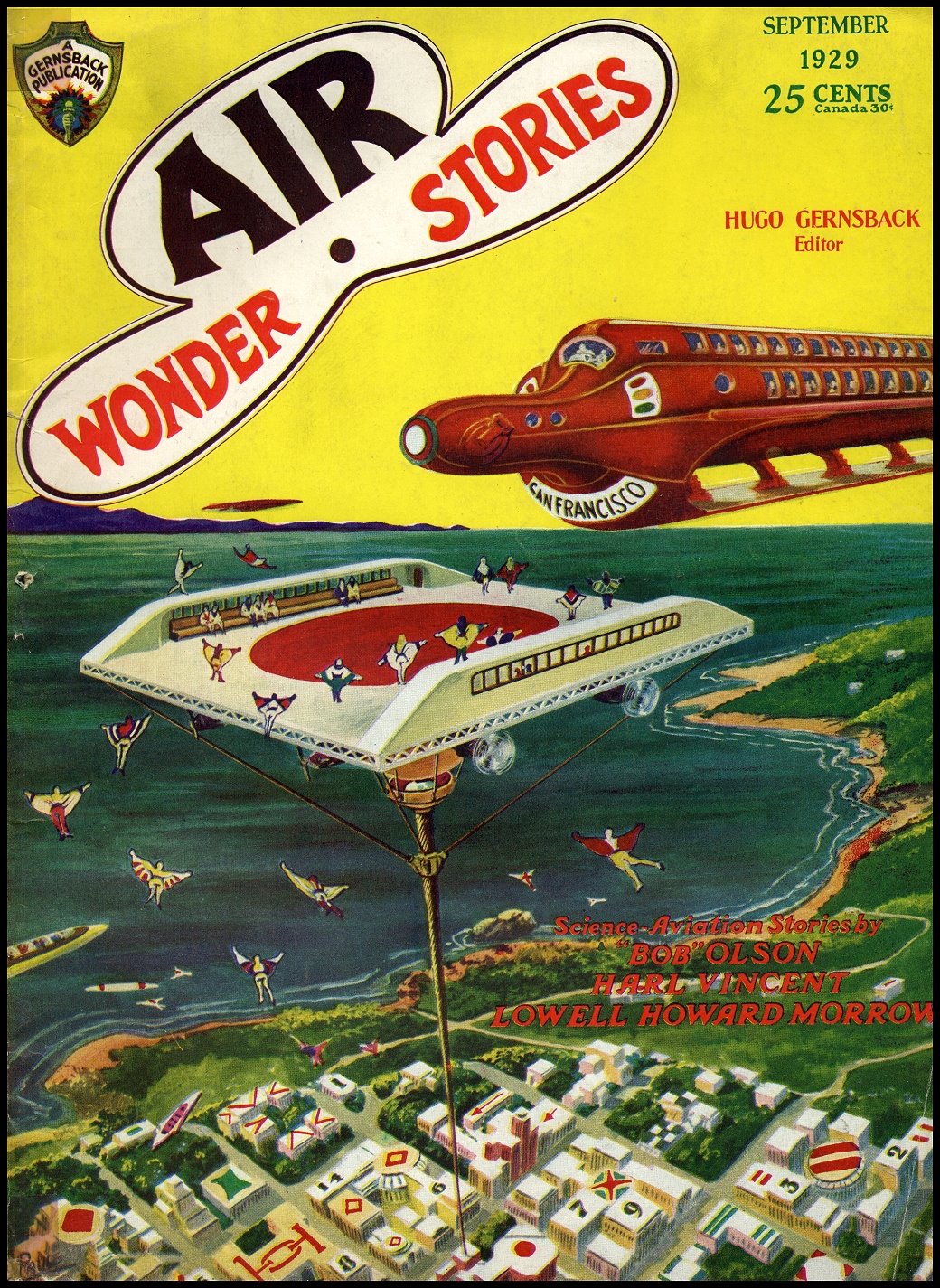
    This image from yet another ubiquitous Gernsback publication and shows (another!)  floating airpad/port for whatever sort of hovering vehicle that approaches.  Interestingly there are a number of skydivers using unisuitwhich probably seems pretty attractive to skydivers today.  Also the roof decorations are unexpected!


    Airwonder_1929_09_frpaul


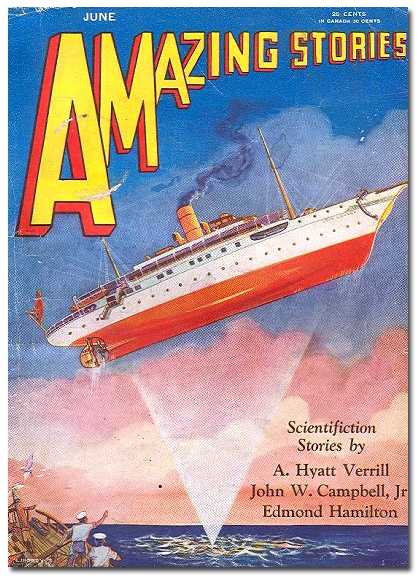
    Amazing stories floating ship

    [Source: http://thatsmyskull.blogspot.com/2007/11/ocean-liners-in-sky.html]

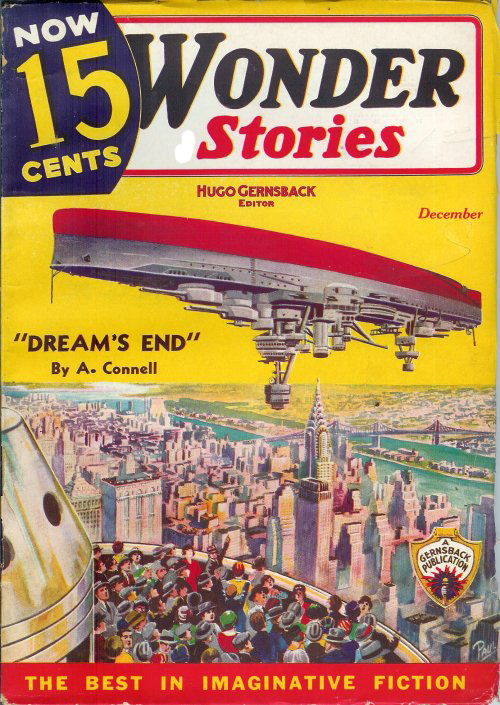
    WOnder stories upside down floating ship