A Daily History of Holes, Dots, Lines, Science, History, Math, Physics, Art, the Unintentional Absurd, Architecture, Maps, Data Visualization, Blank and Missing Things, and so on. |1.6 million words, 7500 images, 4.9 million hits| Press & appearances in The Times, Le Figaro, Mensa, The Economist, The Guardian, Discovery News, Slate, Le Monde, Sci American Blogs, Le Pont, and many other places… 5000+ total posts since 2008.

Category: Strange Things in the Sky

  • When a Little Bit of the Future Got To WWI

    JF Ptak Science Books  Post 2600

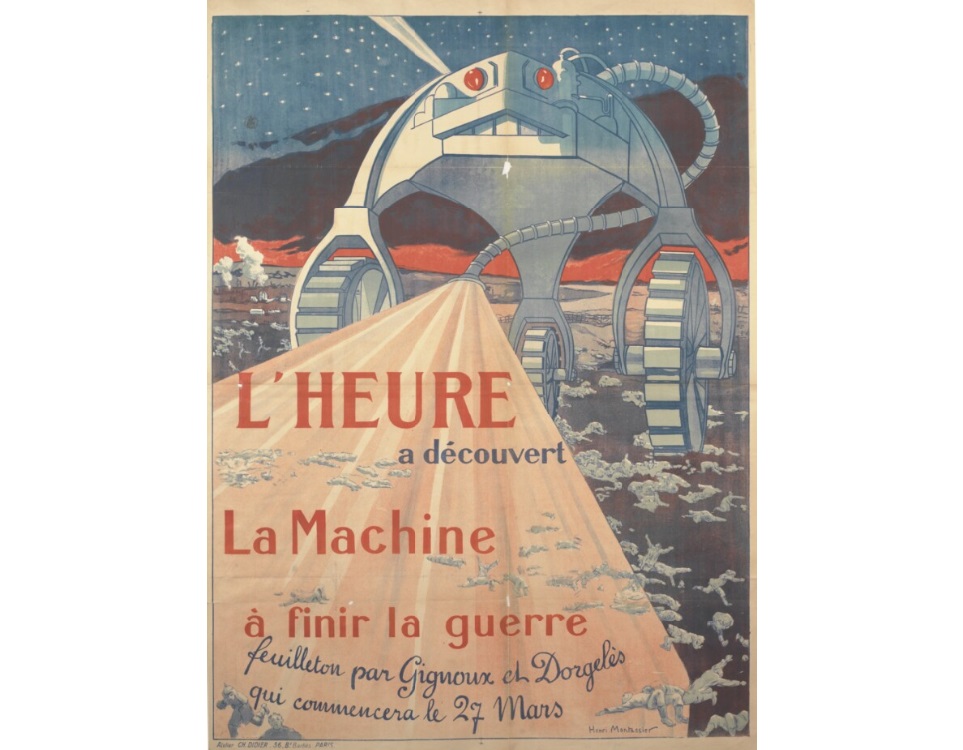
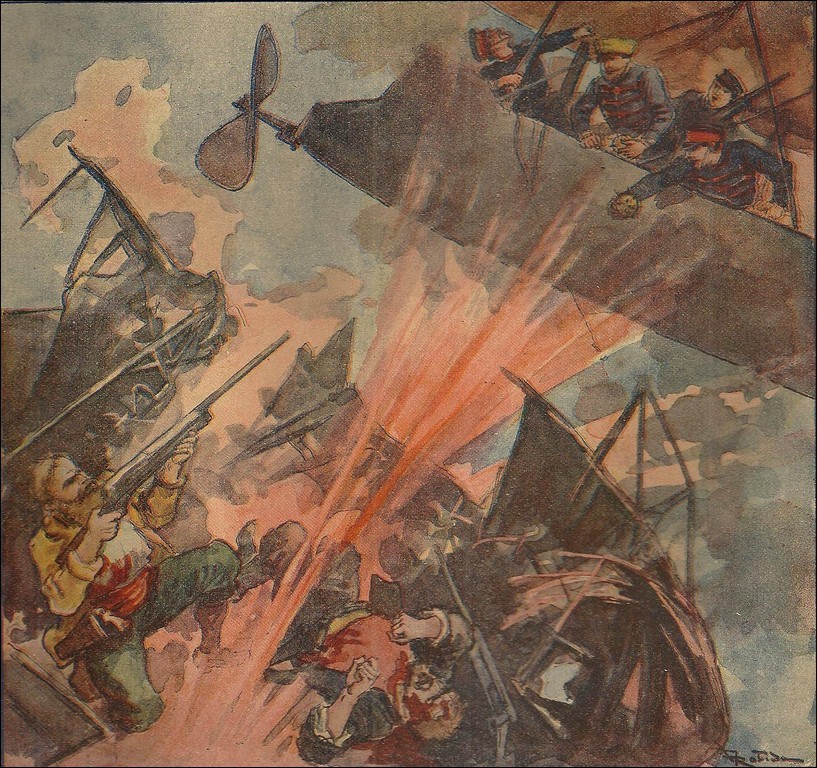
    The hope for technological advancement to hasten the end of the war were much discussed during WWI–the dreams and aspirations sometimes winding up in a serialized fashion in magazines such as l’Heure, seen below.  The promise of the magazine “The Hour” was to reveal the nature of a machine discovered that would bring an end to the war.  It was highly fanciful, this machine, and highly effective, as we can see by the large field littered with German soldiers, done in by a death ray/spray of some sort. The whole of it looks more like a Wells’ Martian creation than anything else. 
    WWI IWM future war

    [Image source: Imperial War Museum, http://www.iwm.org.uk/collections/item/object/19414]

    And long as I am here and the reference is at hand, I  would like to point out this terrific link to the very interesting La Guerre Infernale by Pierre Giffard, and with illustrations by the iconic A. Robida:
    Rhobida guerre infernal

    [Source, with a set of all of the illustrations is found here:  http://www.merveilleuxscientifique.fr/auteurs/robida-alfred-la-guerre-infernale/]

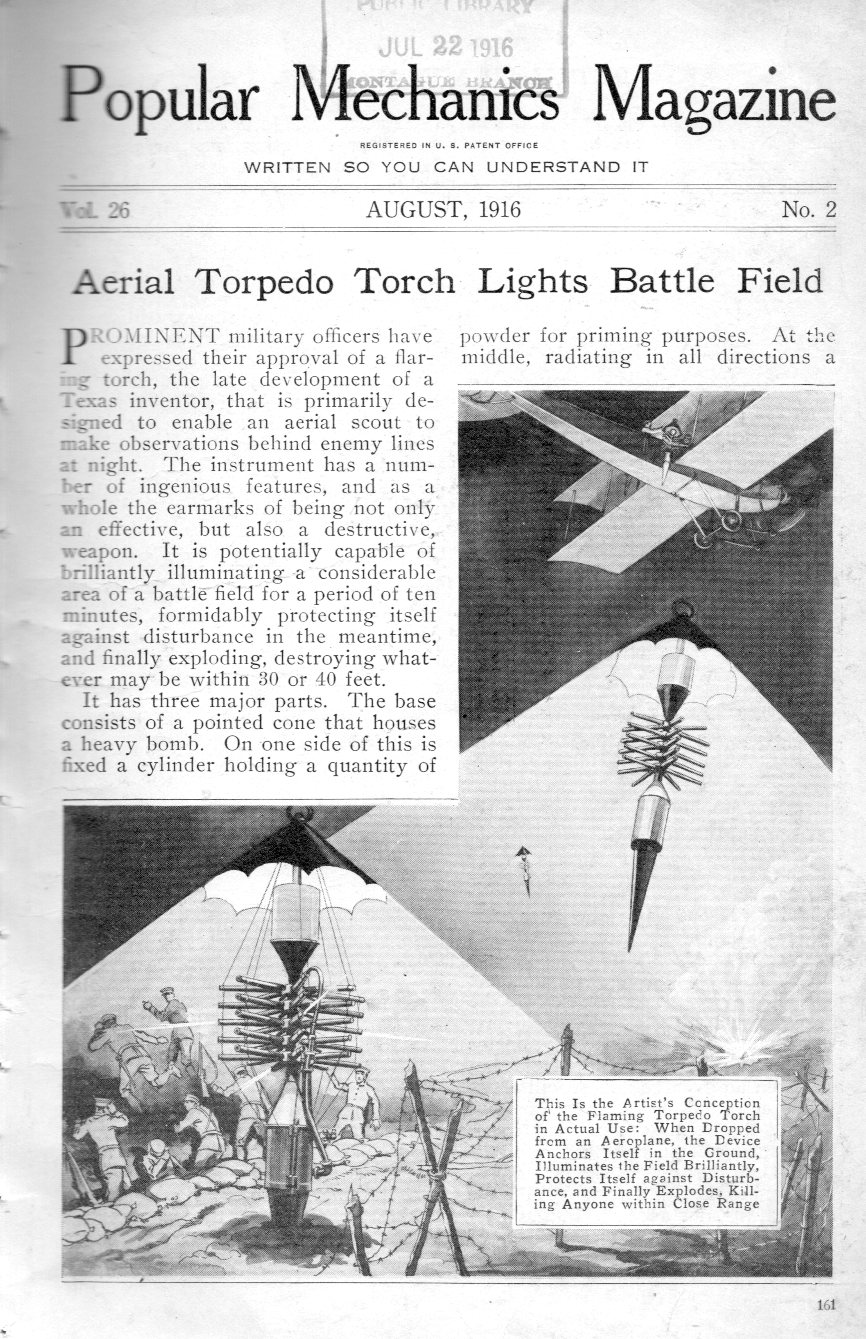
    But what I really wanted to talk about was on the much smaller and real level, particularly this exploration of battlefield lighting, found in the August 1916 issue of Popular Mechanics Magazine.  It was one of the technological advances in this war that brought something that worked better and much more simple than that displayed in the magazine–the “simple” flare gun, also known in England as the Very pistol. It was new to war (along with such things as the tank, military applications of barbed wire, depth charges, flamethrowers, and such) and it was of course very effective. And deadly. And protective. It illuminated a field of battle, particularly Dead Man’s Land, that stretch of land between the two offensive lines that was a meeting place of death, cluttered with bodies, spoiled earth, water-filled craters, barbed wire, waste, and so on–and it was sometimes into this sort of field that an attack would be made under cover of darkness, and it was the Very pistol that would be fired to illuminate the attackers, who would suffer greatly from it.  In any event, it was a far better response to a need than the aerial torpedo torch.  
     

    Aerial torpedo torch067


  • Measuring Things With Ships (Again)

    JF Ptak Science Books  Quick Post

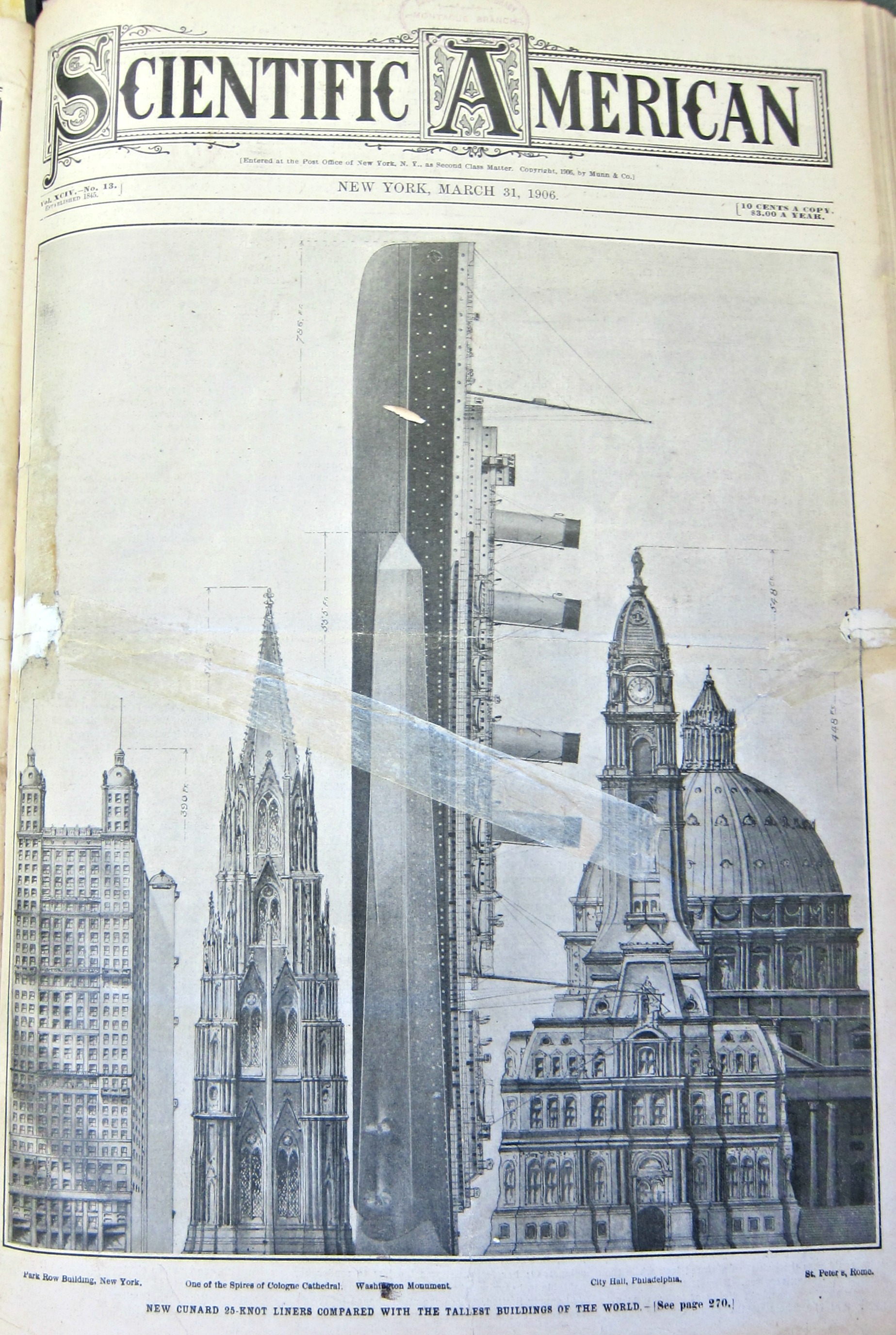
    I didn’t think that there would be many entries for a series on measuring things with ships–they do pop up here and there, as with this issue of the Scientific American for March 31, 1906.  There’s probably room for a History of Measuring Things By Uncommon Non-Standard Means series on this blog–after all, there are examples for ships as a measure, and there are other bits on this blog about measuring things in units of the Eiffel Tower, gargantuanly-oversized bread, enormous nails, collections of beef, Trinity Churches, miles of soldiers, and the like.  Here are a few examples: 

    • Measuring Things in Terms of Trinity Churches https://historyofideasblog.com/thesciencebookstore/2013/12/jf-and-so.html
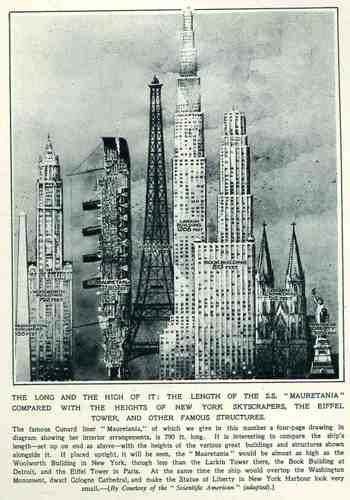
    • Ships in the Skyline    https://historyofideasblog.com/thesciencebookstore/2008/09/comparative-d-1.html
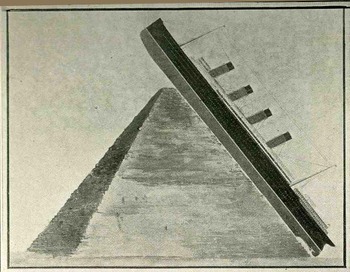
    • Ships on the Pyramid  https://historyofideasblog.com/thesciencebookstore/2008/09/jf-ptak-scien-3.html

    These units of measurement do seem a little odd, but they really have a capacity to humanize inescapably difficult numbers by putting them in context with a known entity, like Trinity Church.  In this new case of ship/measurement, the newest of the Cunard Line’s transatlantic ocean liners (that would be named Lusitania and Mauritania) is presented here on the front page of the Scientific American pressed up against structures that are presumably well known amongst its readers. 

    Scientific American ship standard


    Blog1sept_17_ship_city_btm_det572

    •  [Source:  https://historyofideasblog.com/thesciencebookstore/2008/09/jf-ptak-scien-3.html]

    Blog1sept_16_ship_skyline564

    • [Source: Ships in the Skyline    https://historyofideasblog.com/thesciencebookstore/2008/09/comparative-d-1.html}

  • Dirt in the Sky–a Floating Sepulcher

    JF Ptak Science Books  Quick Post   

    I have not made an entry to the Strange Things in the Sky department in a while, though I’m happy to have made my way to this one this morning. While many entries in this category truly are strange and actually in the sky, many are not–they are strange and unexpected, though appearing ‘in” the sky by virtue of placement in an image, which is what we have here.

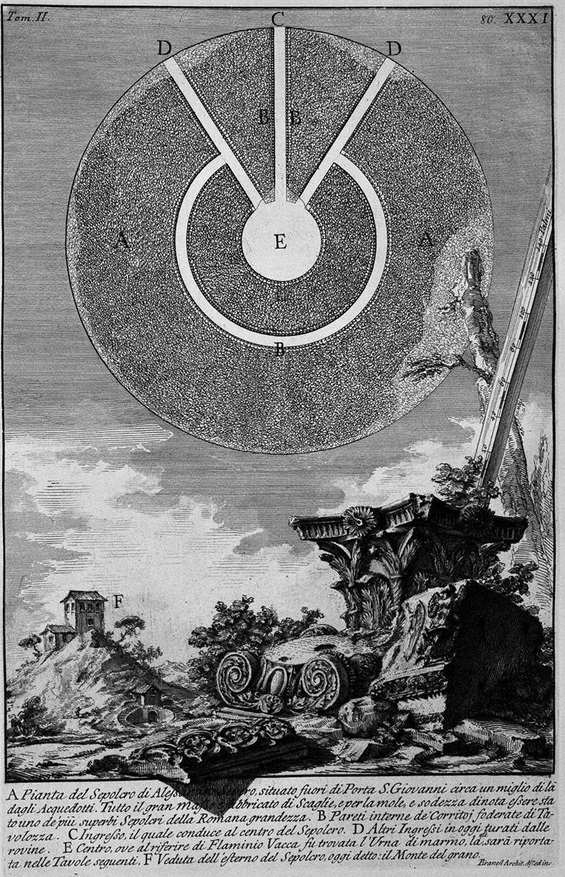
    Giovanni Piranesi’s collected works on the antiquities of the Roman empire are astonishing in form and function, and scope and breadth, and sometimes all of the above plus the placement of the represented objects on a piece of paper.  In this case we have the plan of the sepulcher of the last Roman Emperor of the Severi dynasty, Alessandro Severo, who reigned at age 13 from 222-235 in a bitter part of 3rd century Roman history.  The bumpy plan appears to float in the sky above unindexed ruined bits, while in the far background (lettered “F”) is the building/construction itself, occupying perhaps only 5% of the image space.  

    Piranesi fragment alessandro severo[Source: http://www.wikiart.org/de/giovanni-battista-piranesi/the-roman-antiquities-t-2-plate-xxxi-fragment-of-stucco-gouged-by-the-time-of-nicchioni-is-one-1756#supersized-artistPaintings-262292]

    And the next etched plate in Piranesi’s book gives a fuller appreciation of the tomb: 

    Piranesi alessandro severo tomb

    [Source: http://www.wikiart.org/de/giovanni-battista-piranesi/the-roman-antiquities-t-2-plate-xxxi-fragment-of-stucco-gouged-by-the-time-of-nicchioni-is-one-1756#supersized-artistPaintings-262291 The Roman antiquities, volume 2, Plate XXXII. “Plan and external view of the tomb of Alexander Severus located outside Porta S. John about a mile from the aqueducts”, 1756.]

    Piranesi is filled with treasures of all shapes and descriptions, but what I find to be among the most sensational in the gigantic work are the arrangements of the found bits and the unexpectedly-placed objects. 


  • The Physics and Non-physics of Catching a Baseball

    JF Ptak Science Books  Post 2348

    If I was a Nazi going back in time and given the opportunity to assassinate five allied leaders to change the direction of the war, I’m pretty sure that one of my choices would be Vannevar (that’s “van ee var” Bush (not related to you-know-who).1  He was the head of the Office of Scientific Research and Development (OSRD) for the U.S. for World War II, which is saying A LOT.  It was his responsibility to determine where and how to apply effort and brainpower and money for the best outcome to win the war–and he did a fabulous job.  Wasted effort/money/power/intelligence costs a lot, especially during wartime, and Bush did an absolutely superior job in performing this task. He was also a great engineer, a fine creator of analog calculators; he was a visionary and often is referred to as the grandfather of the internet; he was VP of MIT, and many other things, on and on.  

    However, in his grand opus one thing he wrote was that baseball was not a scientific game.

    I’m pretty sure he was joking around because the game is all angles of motion and repose (and a lot of the later), of effort and response, and in the immortal words of the Great Beakman (of TV science show for kids fame), “everything goes somewhere”.  

    Bush chose to leave a little mystery in the game when he wrote about it in Science is Not Enough, (1967) in the essay “When Bat Meets Ball”. The pitch, the crack of the bat,the flight of the ball, the outfielder turning instantly to get to the place where he thinks he needs to be, calculating all of this on the fly so that he can catch the ball, is in some sense like tracking enemy aircraft or an ABM.  The outfielder, running along, has sorta figured out the velocity of the pitch and the angle at which the ball leaves the bat, figuring out acceleration, elevation, and manipulates it all in his head to sand in a certain grassy spot to be in exact location to interfere with the ball’s response to all of the vertical and horizontal displacements and the work of gravity to return it to its initial altitude of 0 (+the distance of the glove to the ground).  Which is all pretty cool stuff, and it happens it the rain or wind or whatever conditions and perhaps with a hurt ankle, all of which get tossed into the equations.  

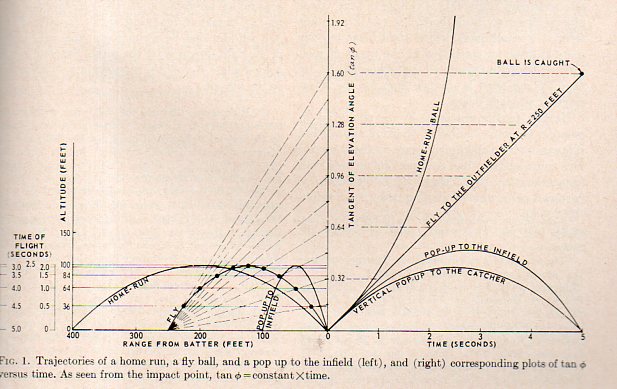
    This is all beautifully addressed in a short article called “Catching a Baseball”, by Seville Chapman of the Cornell Aeronautical Lab in the October 1968 issue of the American Journal of Physics.  Dr. Chapman also offers up the following figure, which is helpful and pretty, but which would have bounced off completely of the invisible shield of fielding mediocrity that enveloped the otherwise fantastically gifted Manny Ramierez (or Ted Williams or any other number of great hitters who were not so much interested in fielding because it wasn’t hitting).  

    Anyway, here’s the illustration from the Chapman article:  

    Baseball physics368

     Notes:

    1.  Some of the others would have ot be Churchill (probably my first choice, because he held everything together from 1940-1942 and created an effective war machine…without him the war may well have been lost, well before the U.S. would have become involved; also of course F.D.R., and probably Eisenhower for his superior handling of the Invasion  and for the push east.  I am not sure about who I might choose on the Soviet side.  I wouldn’t choose them in the first rank, but I’m not sure who I would choose first to do in between Montgomery and Patton–it is easy to neglect Montgomery for all of the obvious reasons, but when everything is said and done he was very effective and successful given his own plodding and unpleasant way)…


  • Strange Things in the Sky Department: Feathers

    JF Ptak Science Books    Strange Things in the Sky Department  Post 2209

    In the 30 or so posts I’ve made in this department I have yet to deal with anything having to deal with birds. This is understandable since they’re the ones who have been up in the air for 200+ million years (or at least late Jurassic), while humans have been in the air for only about .0001% of that time in our controlled falling.  

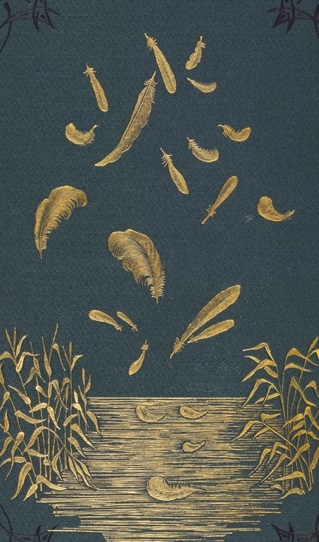
    Feathers detail

    But it still struck me as odd, these feathers in the air, and very uncommon to my decades+ experience of Looking At Pictures. They are simply a gilt-stamped decoration in a book cover, a piece of arresting design, for an ornithological journal (see below)–still, it is an unusual image, in-context or not. 

    I imagine that if you were resting on this little body of water from the journal cover and one of those feathers happened to fall on you that it would be quite the experience.  But there was a time when receiving a feather meant something far worse than an unusual natural history experience. That was the other thing about this unusual book cover decoration–it reminded me of a piece I read a few years ago (found again!) by Francis Beckett of The Guardian who tells a very difficult story about his grandfather receiving a white feather from a complete stranger on the street during WWI.  The brief story here is that his grandfather tried to enlist in 1914 but was not accepted because of poor eyesight and also being the father of three girls; but, while out and about in 1916 he was handed a white feather from a woman on the street, a complete stranger–that feather at the time being a symbol for cowardice.  Evidently the grandfather went the next day to enlist, and after millions of deaths the eyesight/children issue two years earlier was no longer an issue–he was accepted,  and fought for two years before being killed in 1918.  Beckett’s grandmother held the white feather woman responsible for her husband’s death.  

    The feather has meant many things to many cultures for thousands of years, and nearly all of it was good:  ascension, lightness of being, virtue, glory, flight, and so on, mostly having to do with cosmic connectivity.  On the other hand using the white feather for taking flight from duty and cowardice was a devastating thing.  


    ·Posted by :

    ·in:


  • An Aggressive Cover Illustration for Sputnik (1957)

    JF Ptak Science Books  Quick Post

    Sputnik063

    This cover illustration for Alte Welt und Neue Sterne (“Old World / New Star”) really does break through the headlines and into its own space.  It is a DDR publication and although my copy has two outer wrappers for decoration and title it has no title page–the celebration skips the necessaries and gets right into the forward and then the crux of the matter, most of which was a high-principled statement of accomplishment and a low-dark anti-American humor in having “lost” the space race.  (While Eisenhower golfs, the Soviet Union has launches a new moon, losing not only the apce race but prestige as well–one cartoon places a joyous Khrushchev successfully courting a young woman labelled “Lesser Countries” with a beaming gesture to an orbiting Sputnik as Uncle Sam reels on his heels and drops his going-courtin’ flowers in the process. “Wer sonst koennte dir einen Mond schenken” (“Who else can give you a moon?”), proudly offered as commentary that had appeared in the New York Times.

    In any event, I just wanted to share the design, which is pretty strong. (The pamphlet is undated but I suspect it was in print immedaitely following the 4 October 1957 launch.)


  • Strange Things in the Sky Department: Tall Ships Flying

    JF Ptak Science Books   Quick Post  Strange Thing in the Sky series
    Follow Me on Pinterest


    Source: Encyclopedia Britannica via Google Books
    I love Tall Ships, but perhaps never so much as when they are flying–real or imagined. 


  • Strange Things in the Sky Dept: Martians with Telescopes and Cannons, 1901-1932

    JF Ptak Science Books    Post 1965

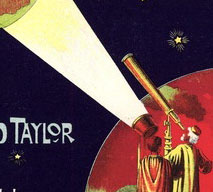
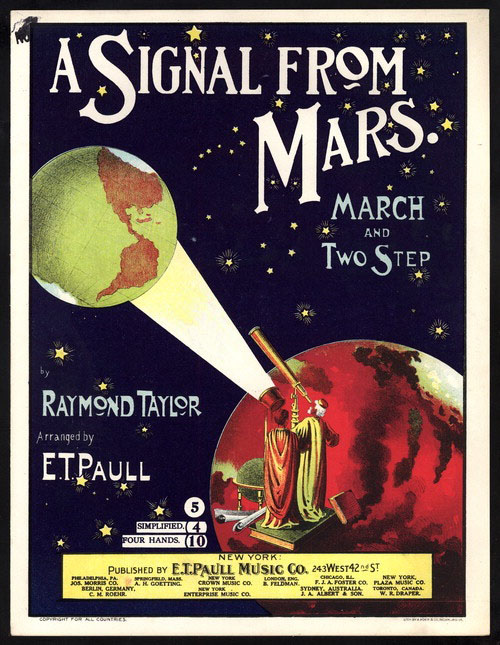
    In this episode of the Strange Things in the Sky Department there are a number of posts dealing with Strange Earths–sometimes there are strange Earths int he sky, above the Earth. And so on.  In this small offering we see a green-sea earth viewed by Martians from, well, Mars. It is the cover art for sheet music “A Signal from Mars”, composed by Raymond Taylor and arranged by E.T. Paull in 1901. Somehow the Earth is being illuminated by a small canned power source of high energy light that must have the energy of a pulsar, and  there’s a five-pointed star that is added for unknown effects. There’s mot much more that can be said, except that the music (sampled below), which is a ragtime march, has nothing to do with Mars so far as I can tell.  Mars was certainly in the news when this sheet music was published in 1901–Percy Lowell had taken it upon himself to interpret Giovanni Schiaparelli’s 1877 of “canali” on Mars as “canals” rather than “channels” and convinced himself that what he was seeing with his superior instrumentation were indeed structures built by engineers of another race on another planet.  So, perhaps “A Signal from Mars” was much like the Atomic Motels in 1945 and Radium Cakes in 1897–folks just used a popular name in the news to excite interest in their own work via association with repetitive references.

    Earth from Mars martians[Source: the Library of Congress] This is a detail from:

    Earth from Mars

    Another curious image of Martians with telescopes comes from Puck magazine in 1904:

    Martians and earth in background

    [Source: the Library of Congress.]

    Martians pointing telescopes at the Earth is a much more preferable situation than Martians pointing gigantic cannons:

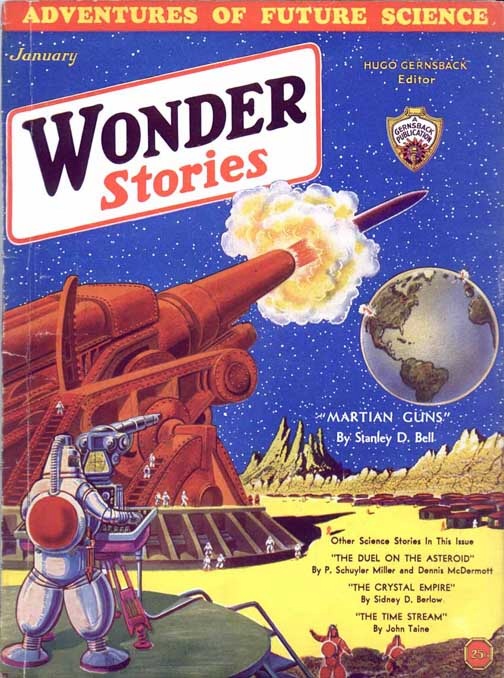
    Strange things in sky--martian guns

    This is the cover art by the fabulous Frank R. Paul for Stanley D. Bell’s “Martian Guns” found in the January 1932 issue of Wonder Stories. 
    There’s really no way to determine how big the gun is except to say
    that it is probably “big”–there’s just nothing to place the thing in
    perspective, as the figures in the foreground, being Martian, don’t have
    a specific height.  They could be 6′ tall, or 60′–perhaps they’re
    only 1/10 of an inch tale, and the projectile they’re firing to the
    earth is so devastatingly powerful that size doesn’t matter.


  • The Battle of the Extra Earths: Mini-Extra-Earth Vs. Full-Sized-Standrard-Earth (?)

    JF Ptak Science Books  Quick Post     Part of a series on Strange Things in the Sky

    Follow Me on Pinterest

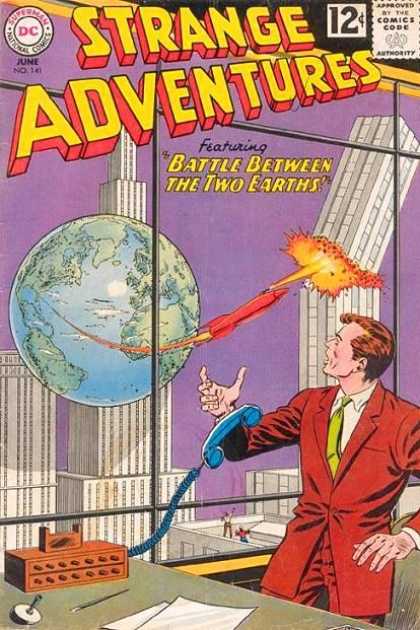
    This is a quick addition to the Extra-Earth category of this blog–and an amazing one. In the other examples the extra-Earths appear simply appear , with little or no interaction between the two. In this instance we have one Earth attacking the other. 

    Extra earth

    There is no necessity for this to make much or any sense, what with the purple sky and, of course, the extra-Earth–but the attacking rocket taking off from the extra-Earth extra-Florida (or thereabouts) seems to grow in size as it gets closer to its target.  After all, the attacking extra-Earth is less than 300′ away from what has become an enormous and marauding space vehicle (judging from the distances in relation to the buildings) which is now longer than the extra-Earth-America is wide.  But in the world where a miniature extra-Earth can attack a standard-sized-Earth, this would be a minor quibble. 

    Honestly, I think I like to write about such things for the joy in having to think of a title for the post. 


  • Earth Squared and Halved and Shrunken and Invisible and Doubled and Miniaturized–the Astounding “Mystery in Space”

    JF Ptak Science Books   Post 1936

    Follow Me on Pinterest

    This post is a part of overlapping categories, including:

    • Duplicate Earths (including Mondo Bizarro, Science Afflictions and the Dubious Mind—Bad Science, Part 1. NYC in Space (?!) here and Extra-Earth Humano-Alien Souls From Outer Space Repopulate Earth-Hell!!(??) here)

    Earth strange half earth
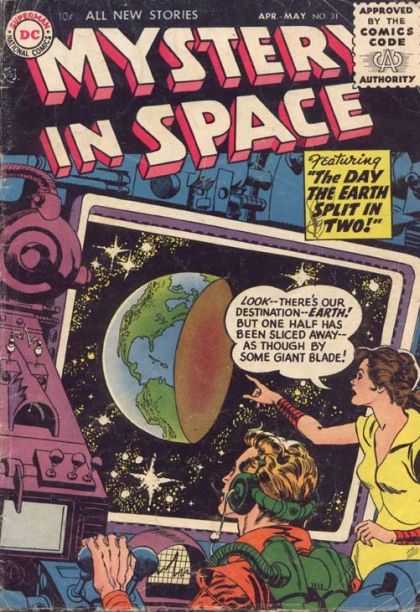
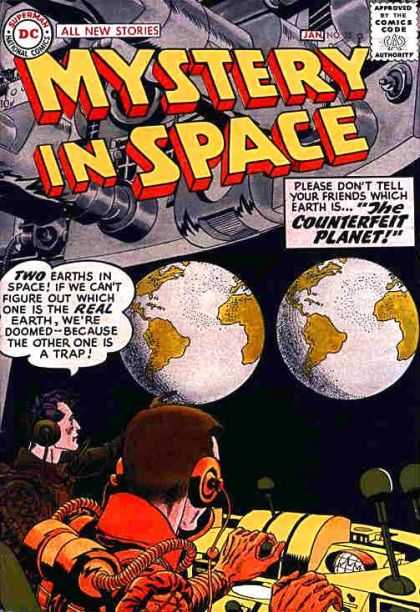
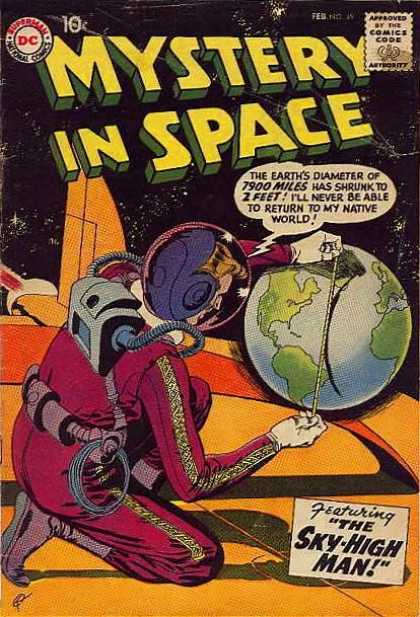
    In the five years or so of collecting information and stories for the odd-bits section of this blog  I have never encountered so many choice visual examples in one place for strange/weirdly-imagined/impossible/high-SciFi of the Earth than with the comic book, Mystery in Space. The very dedicated keepers of Coverbrowse.com website have reproduced thousands (?) of covers of pulpily-published science fiction and exotic-thinking comics books, including the home base in which all sixteen-plus years of Mystery in Space live.

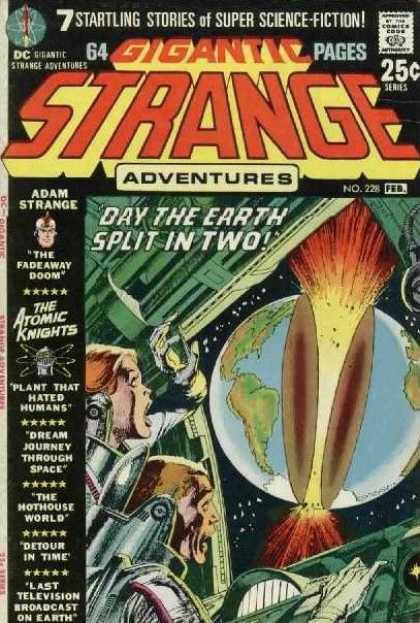
    I’ve just found another Earth-halved image, this from the comic Strange:

    Earth split in two!

    Earth strange duplicate
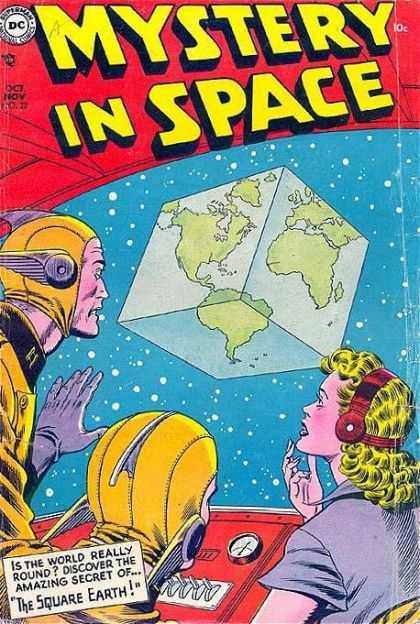
    Written from 1951-1966, Mystery in Space very freely uses words like “astounding” and “astonishing” and “amazing” and “strange” to describe itself–on its cover (!)–and then lives up to it in so many astounding/astonishing/amazing/strange ways.  Keeping simply to odd representations of the Earth, we find it halved, duplicated,cubed, miniaturized, dragged, tugged, targeted, canaled, and bullseyed; it is also the background to a WWI biplane attacking a spaceship in space, a flying skyscraper, and an alien craft lifting the United States from its geological moorings–in short, a very high and filling feast. And this, again, is just judging this book by its cover, which might actually be the best thing to do as the covers tell enough of the story to let your imagination tell the rest of the adventure. The covers tell fabulous stories of such highly unexpected ideas that they may be the only part of the book that we need to bother with, the cover doing away with the need for the printed narrative; and it may be the case that it saves the reader from the interior eye-splitting out-of-time writing.

    Earth strange mini earth
    The artwork and promise of the story are almost always (issue-after-issue) compelling, and there are a number of superb examples of simple jaw-dropping, belief- suspending, flabbergasting and mostly bad but very unexpected science fiction. But this is so potentially high-bad that the “bad” looks good, a tried-and-true badness the content of which is so surprising that its high degree of creativity and difference transcends everything else.  And since we’re just looking at pictures/cover art, there is no time-sink involved wading through turgid/florid/bad-bad prose for hours to only discover that the story is only getting simpler and lost and the writing even worse (worser). So Mystery in Space is a great visual luxury, a bookmark for ideas rendered in artwork that is obviously deadline-dependent, swirling in bad color and modest skill seemingly steeped in smoke and alcohol, and which delivers joyful incredulous surprises time after time.

    Earth strnage cubed earth