A Daily History of Holes, Dots, Lines, Science, History, Math, Physics, Art, the Unintentional Absurd, Architecture, Maps, Data Visualization, Blank and Missing Things, and so on. |1.6 million words, 7500 images, 4.9 million hits| Press & appearances in The Times, Le Figaro, Mensa, The Economist, The Guardian, Discovery News, Slate, Le Monde, Sci American Blogs, Le Pont, and many other places… 5000+ total posts since 2008.

Category: Perspective

  • The Bumpy Earth and the Loss of Perfection, 1543

    JF Ptak Science Books LLC  Post 800 

    The idea of the Earth as a sphere is an ancient one, proved over and over
    again across the centuries, most famously proved by Aristarchus with a stick
    and a hole and a shadow. The idea of the Earth as perfect, as a perfect sphere,
    is an old belief wrapped in layers of hopeful scientific thought, God’s
    creation and the cradle of mankind necessarily being perfect (Summa aside).  This was a rigidly enforced perception and a
    religious assumption, just like the belief that the Earth was the center of this
    universe, and that a vacuum was a theological and therefore physical
    impossibility.  (See my post On the Discovery of Nothing.)+ earth perfect

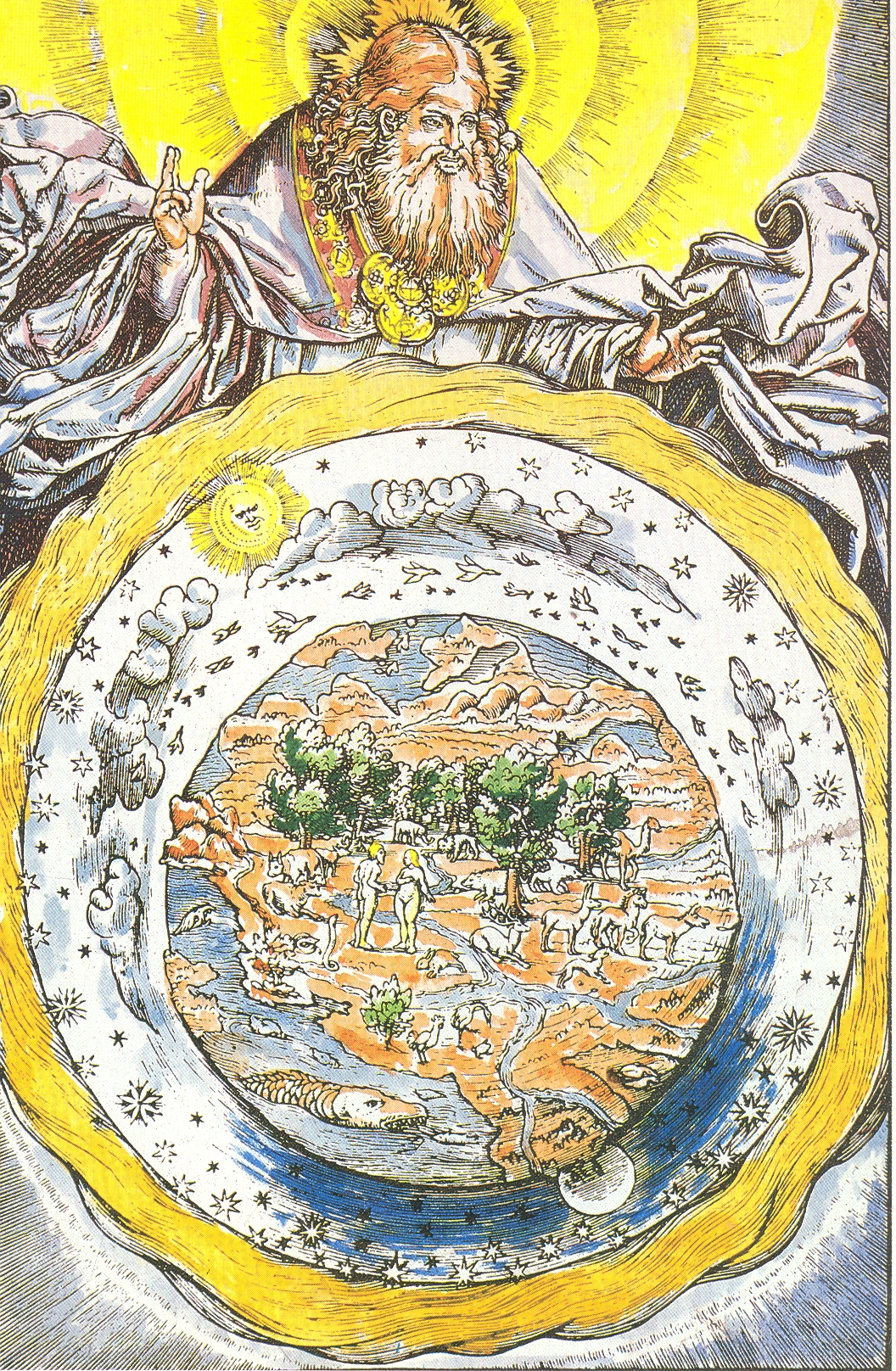
    The
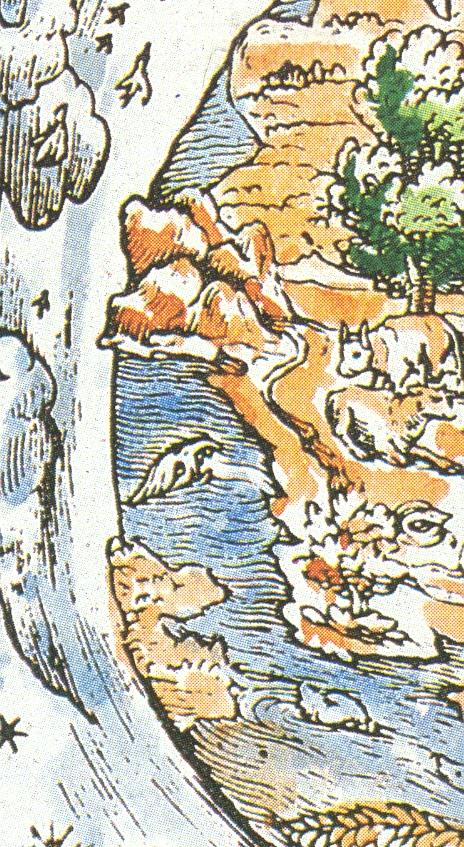
    woodcut illustrated here—a depiction of a robbed and medaled God lording over
    his creation—is interesting in its depiction of what seems to be a not-perfect
    sphere of the Earth. The planet is definitely not smooth around its perimeter,
    and the inclusion of three-dimensional mountain rendering accentuates this
    depiction, which to me seems all very novel. 
    The source for this image is given as a “Martin Luther Bible of 1543”,
    but that is wrong, unfortunately, which makes it less of a story. 
    If this woodcut was really done in 1543 it would’ve occurred in the same
    year as two monumental publications: 
    Nicolas Copernicus’
    De revolutionibus orbium coelestium and Andreas Vesalius’
    De humani corporis fabrica (On
    the Fabric of the Human Body)
    ,
    marking what is the birth of modern science.  (The print appeared in Luther’s translation of the Bible in 1534.)

    + earth perfect det

    But offhand I don’t see Luther’s “Bible” for this year, and in general 1543 is not a good year in general for Luther
    so far as I’m concerned.  He busily
    published
    Von den Juden
    und ihren Lügen
    (On the Jews and Their Lies ) and  Vom Schem Hamphoras und vom Geschlecht
    Christi
    (On the Holy Name and the Lineage of Christ), both of which
    were horrible anti-Semitic attacks, and worse. 
    For example, from the first work, he wrote that the Jews were a “base,
    whoring people, that is, no people of God, and their boast of lineage,
    circumcision, and law must be accounted as filth.”, and
    in the second wrote that it was not an immoral act for not killing Jews.  This really has nothing to do with the point
    of this post, but I just couldn’t let the reference to 1543 slide by without
    mentioning this very ugly tragedy of Luther’s  theology. 


  • A Question about Einstein and Missing (?) Modernism

    JF Ptak Science Books LLC  Post 799 

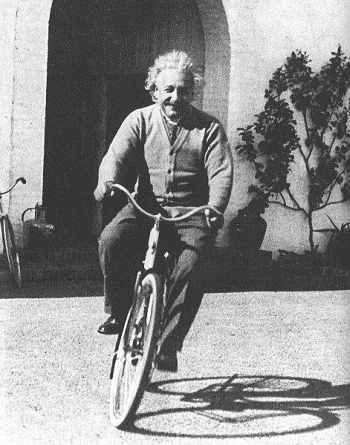
    Einstein-bicycle1 How much was Einstein affected by the many pieces of what was the greatest
    revolutionary period in history?  The
    period from, say the pre-Impressionists (1860 or so) to the period just after
    Cubism (again, say 1920), saw epochal changes across the sciences, medicine,
    the arts, literature….virtually everything. I cannot think of any period in
    intellectual history that approaches this 60-year period. Actually, the gargantuan
    changes can be shaved down to the period of Einstein’s living memory beginning with the stunning discovery of Roentgen’s
    x-rays in 1895 to the invention of non-representational painting in 19111.  Breathtaking, really. 

    In all of this, I wonder how Einstein saw the vast changes that were not in
    the fields of physics or mathematics? 
    Poincare, Boltzmann, Planck were analyzed and understood and appreciated
    and etc.  But what about Strindberg, and
    Schoenberg, and Seurat, and Leger, and Joyce, and Malevich, and Duchamp, and
    Kandinsky, and Klee?  Einstein certainly
    loved music and had a deep understanding of it, but it was with Mozart and Bach
    that he found beauty.  The music of the
    sphere, the primum mobile, the hand
    of the creator, were found in these two men.  Beethoven was too melodramatic; Wagner (in
    1939) was disgusting.  Others were just
    too simple, too light. 

    I don’t know what he felt about Schoenberg, or Joyce, or Klee.  Perhaps they were too messy, too
    unstructured, too removed from the fundamentals of nature that he felt Mozart
    found and displayed.  I just don’t know. As the architect of one of the most fundamental changes in the history of science, I wonder if (and why) he stood so seemingly unaffected by so many of these other enormous changes.

    Notes:

    1.  There are a number of books that address these revolutionary changes, but only one, I think, that looks at the great broad swath of revolutionary activity across many fields:  William Everdell’s The First Moderns (U Chic). A lovely book.

    ·Posted by :

    ·in:

    —

  • Pig Iron vs. Eiffel Tower: Visualizing Difficult Numbers and Concepts

    JF Ptak Science Books   Quick Post  

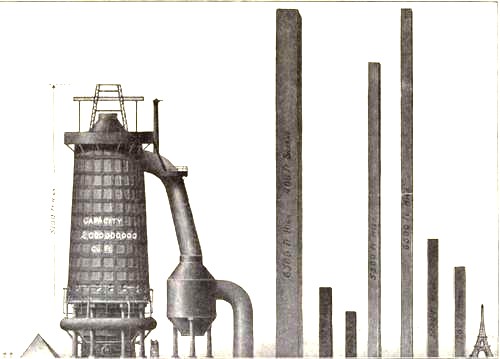
    Several years ago I wrote about some triumphantly unusual images (plus one on the 1891 10-ton Eiffel Tower bullet) of the Eiffel Tower–today I’d like to add another, a queer image which manages to loose the Eiffel Tower (and the Great Pyramid) in representations of pig iron production.

    Diagram steel eiffel 

    I love comparison like this (which appeared in the Illustrated London News for 1910), representing big, hard-to-associate  numbers of something against another quantity that can be instantly understood–the relationship between the two might be tenuous and complex, but at least it can give you some sort of handle on what would normally be an inaccessible, stand-alone number. Plus, any time that you can show what an ungraspable concept might “look like” and be explainable to a 10-year-old, well, you’ve got something. 


  • Straight Lines and Blank Space in Early Western Cartography

    JF Ptak Science Books LLC  Post 788   Blog Bookstore

    Blank and Empty Series #53

    It is sobering to look at the work of the early cartographers and see how much space in their maps they were willing to relinquish  to the blank unknown.  For example, Jacobus Ziegler, in his Quae intus continentur Syria,
    Palestina, Arabia, Aegyptus, Schondia,
    Holmiae, Regionem superiorem, singulae tabulae geographicae
    , published in 1532, was among the first to publish anything at all about Scandanavia and Greenland, wasted no effort in trying to add detail where there wasn’t any, a trait that was lost on many other cartographers and mapmakers in the centuries to follow.  His book was mostly about travel in Palestine, but at the end of the book he deals with the new and problematic geographic areas, featuring them in his eighth map, announcing the contents as follows:

    The western half of the map, featuring Sweden, Norway, Finland, Lapland and Greenland, is spectacular, and features an enormous, flat-detail, straight-edged Greenland as the bulky land mass in the west (“ulte Gron/rio/lan”, a terra incognita).  The extremely angular Greenland coastline stands in sharp contrast to the lovely wavy ocean, the mapmaker unafraid to stake his claim in what he didn’t know. 

    The eastern half of the map, Scandanavia, is more recognizable (if you focus on Denmark and Germany in the south and then work your way north):

    <

    Though the unencumbered line, far from the fractal nature of Mandelbrot’s coastline of Britain, appeared everywhere in the eight maps of Ziegler’s work, as we  can see in this intestinal-appearing Dead Sea (below).  The fact of the matter is that this was the state of the art in the first third of the 16th century, and there was in general not a great effort to embellish guesses and gloss over the areas where there was no information.  Of course there was still mythical placements of beings and locales and willing things into existence (like Prester John, sea monsters, El Dorado, no-headed men of South America, Patagonian giants, monsters, and so on), but I still find it remarkable to see how much rigor was given known geographic detail. 

    The Nile too received this unrelenting treatment of calm appraisal:

    I do admire this effort for not making things up, or covering areas for which there wasn’t good data with ephemeral and unnecessary features that would swallow up large swaths of white, empty space, as in this map of the lands eastern Syria:

    Though there were still no problems including sea serpents, even so close to the Syrian coast:

    On the whole though Ziegler’s stylized effort is quite beautiful and truthful,  and I enjoy the depiction of the sea giving way to the chunky, rectangulariness of even such decently known forms such as Cyprus.

    The bottom line here is that folks seeing this work for the first time in 1532 would have had a similar reaction to it as you had when you zoomed in on your house in Google Earth for the first time–it was an extraordinary display of information for the time. 


  • An X-Ray of the Earth, 1756

    JF Ptak Science Books LLC   Post 787   Blog Bookstore

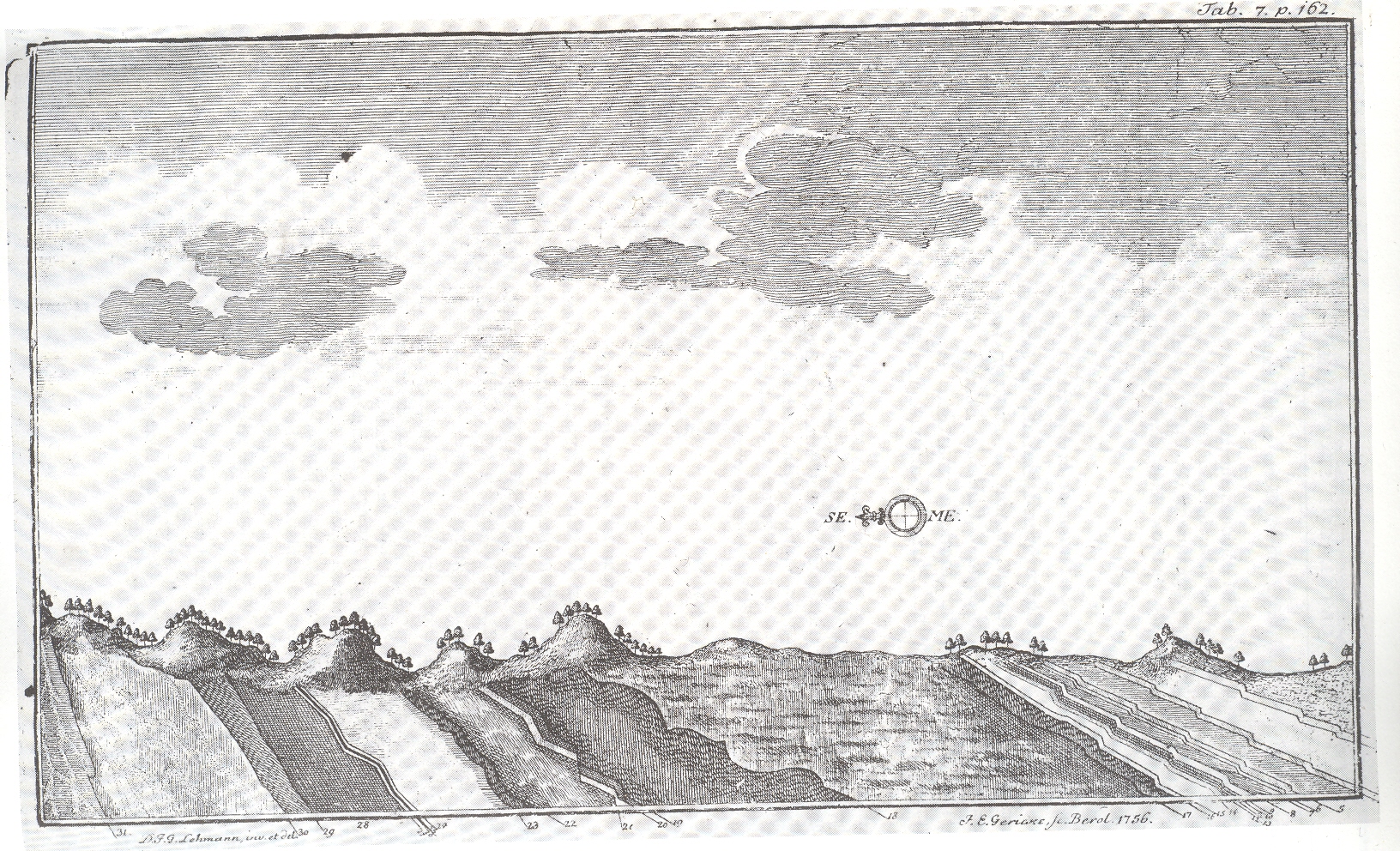
    I’m not sure why there was so much included in this engraving that had
    nothing to do with its subject matter. 
    The essential part of the image is the cross section at bottom:  the image of landforms, created by the man
    most responsible for the establishment of stratigraphy, the German
    physician/chemist/mineralogist/geologist Johann Gottlieb Lehmann (1719-1767).  What Lehmann accomplished was a sensational,
    x-ray-like interpretation of the surface of the earth, a privileged vision
    distant from the real birth of the science of geology in the work of James
    Hutton more than 50 years later. (Hutton was about the first to treat the entire
    corpus of the geology of the earth and which was also completely removed from myth
    and fable.  His work formed the basis for
    that of Charles Lyell who in turn provided some of the intellectual basis for Charles
    Darwin.)  He seems to be the first to
    create such a slice of the earth, illustrating an orderly, historical formation
    of the various layers (and not an unrelated jumble), and the first steps
    towards establishing the laws of formation of geological sequence.

    + lehmann

    Outside of the spectacular introduction to the workings of earth in this cross
    section, I’m taken by the enormous sky, and the very lonely compass, placed,
    seemingly haphazardly in a blank field, creating a very considerable blank space above the great discovery.
    The scientific greatness of the images aside (can I even say such a
    horrible thing?), the engraving looks to me like a modern surreal work. 

    Book Note:  Lehmann, Johann. Versuch einer Geschichte von Flotz-Gebuergen,…1756, printed
    in Berlin
    .  “This unpretending treatise must be
    ranked as one of the classics of geological literature”—Archibald Geike


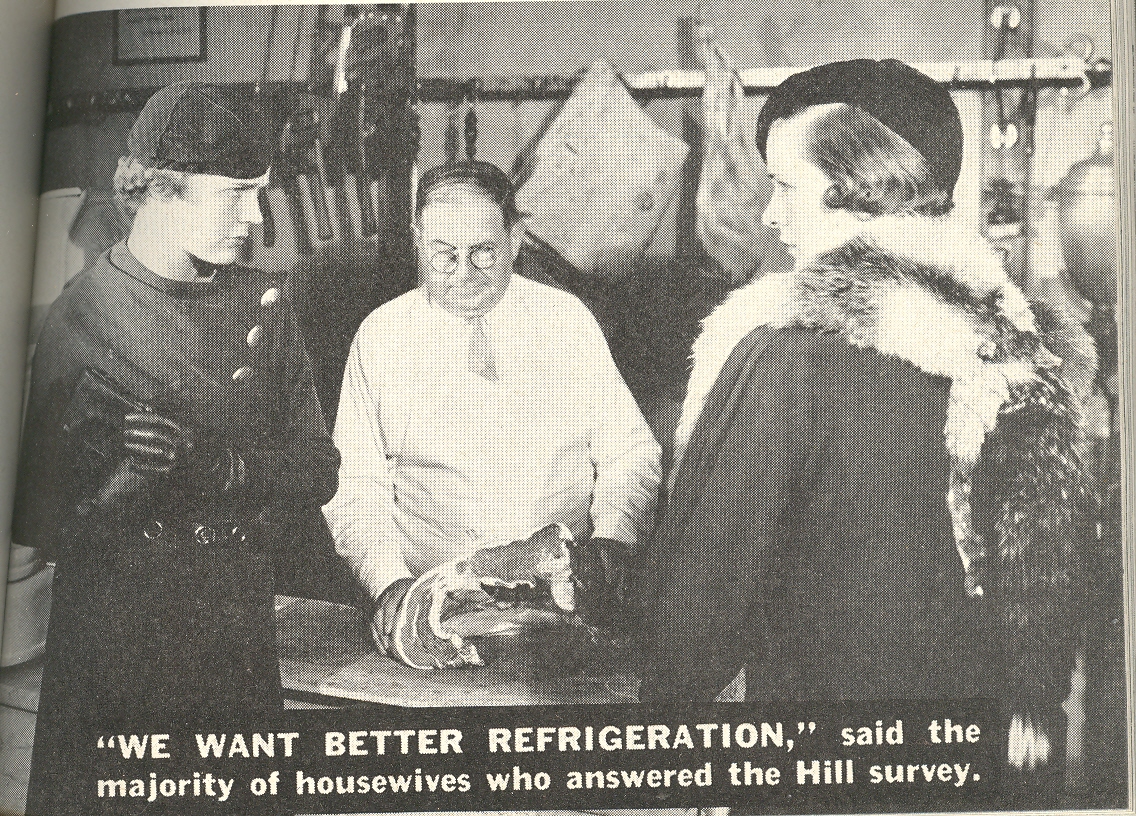
  • Selling to “Simple” Women, 1939: “She’s Not Interested in Bloody Meat”

    Post 882 (revised; part of the History of Women Series; also see Women Meat Pioneers.)

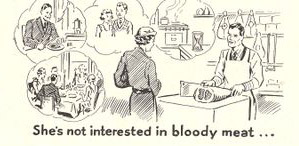
    Women--bloody meat
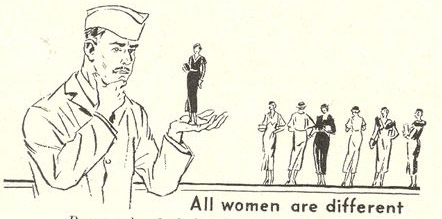
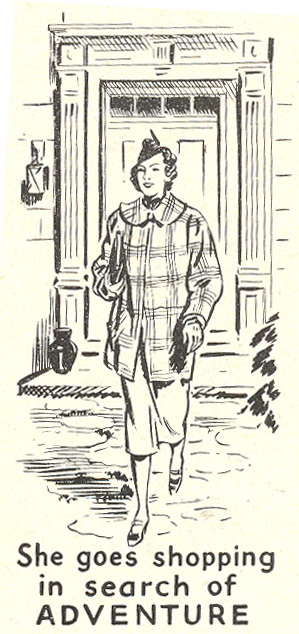
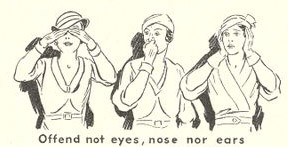
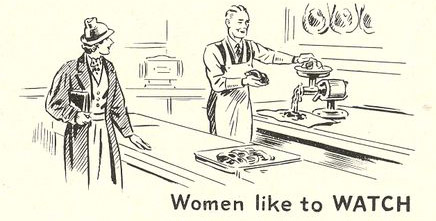
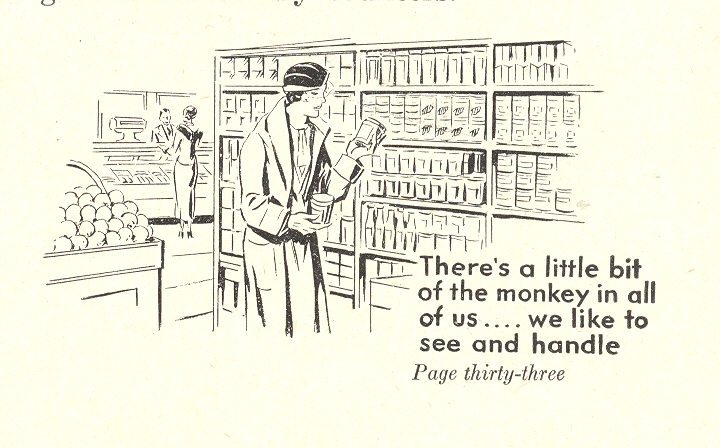
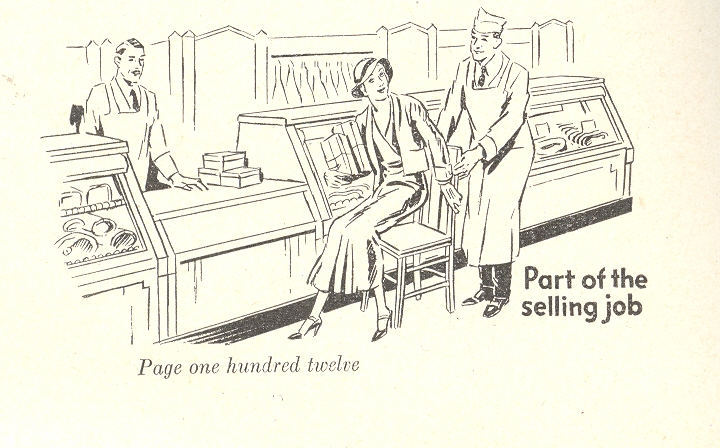
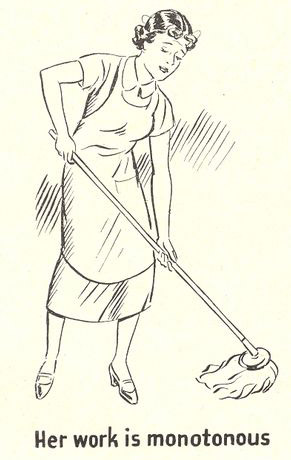
    These sales-happy customer relations images from a  modern food merchandising catalog (Modern Merchandising, 1939) come at an interesting time in the history of eating—or lesser yet, the history of buying food.   The pamphlet addresses the growing idea of the super market, a notion still new in the minds of consumers —it seemed as large to the consumer familiar with the 1920’s concept of a market as it seems tiny to the megamarket people of the present.The illustrations–all quite small, margin-inhabiting affairs, space killers, no bigger than 1×2 inches–are there to help the grocer deal with women customers and better understand “them”. 


    Women--all different 

    Women--shopping


    I’ll address the interesting merchandising changes here in another post—right now I’d like to focus on the marginal drawings in the bottom corners of the text.  They may be small and offhanded–generally they are less than two square inches–but the messages they delivered, marginalia or not, were very strong.  Over and over again these bits demand the sub-class of women, emphasizing their trivial, ephemeral interests—bits of Nothing reinforcing large bits of Something.  

    Women--offend not eyes

    The messages beneath the images, collectively: “women judge meat by appearance:; “there a little bit of the monkey in all of us…we like to see and handle”; “offend not eyes , nose nor ears”; “part of the selling job”; “women like to WATCH”; “her work is monotonous”; “she goes shopping in search of adventure”; “she’s not interested in bloody meat”. They present cascading reactions: they’re somewhat funny to my eyes, and then uncomfortable, and outrageous, and then simply sad that their solemn pronouncements on the status of women would be so acceptable, their as-yet unidentified sexism and bitter “racism”a non-sequitur.

    Women--like to watch
    .

    + women monkey 


    + women sitting down 


    Women--her work


    + women want more refrig


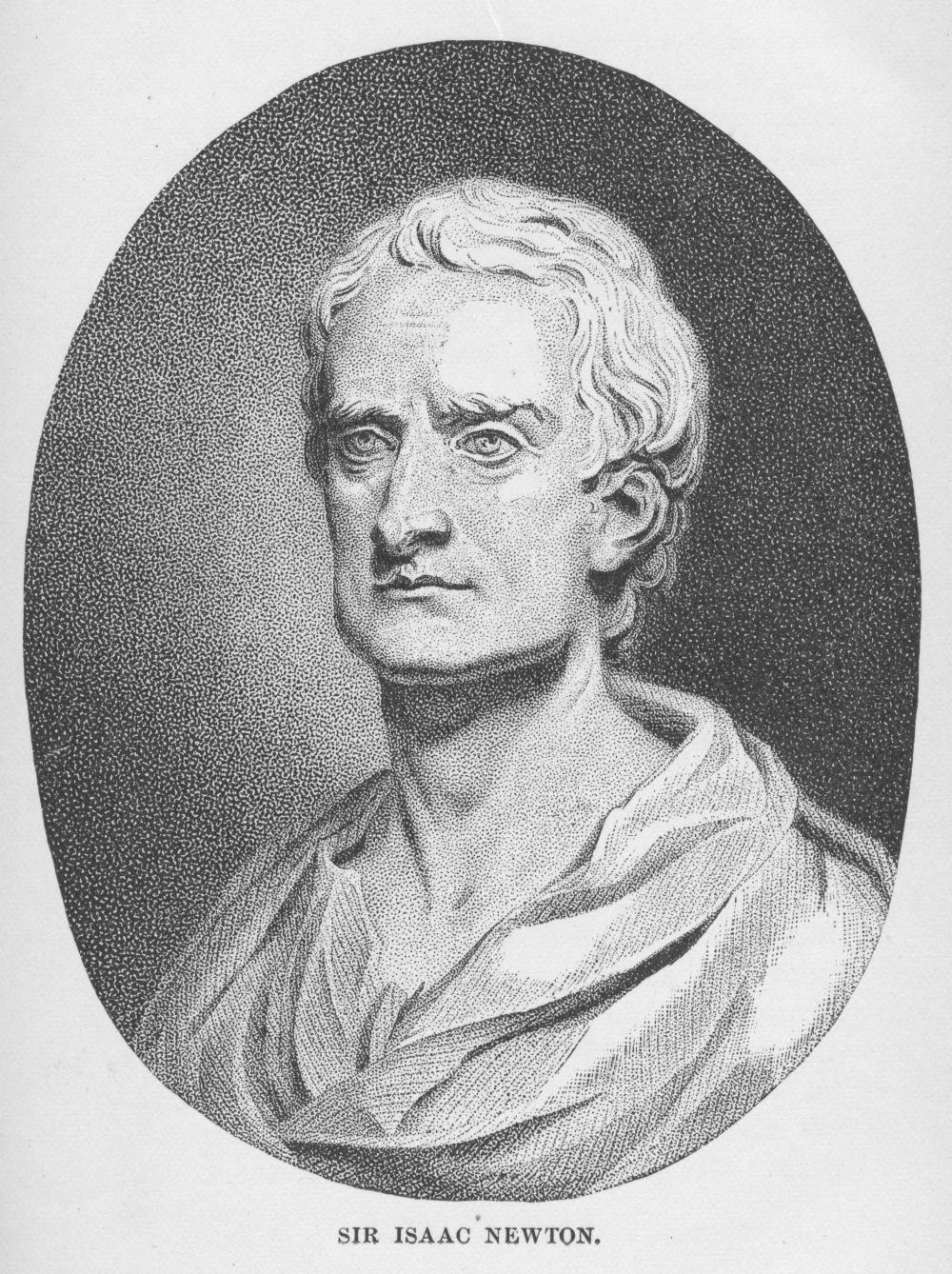
  • Great Sceintific Understatement Department: Isaac Newton as the First and Only above Equals

    JF Ptak Science Books LLC  Post 719 Blog Bookstore

    Newton2

    Earlier in this blog I’ve addressed some great understatements in the history of science and technology.  For example:

    –the Wright brothers’ telegram to their father on the successful flight at Kitty Hawk, telling him to “inform Press” [sic], and misspelling Orville (“Orvelle”)

    –the announcement of the invention of the telephone, giving Mr. Bell a scant 200-word mention in the London-based journal Nature.

    –the alpha and omega element of the severe understatement of George Gamow on discovering the background radiation of the Big Bang.

    –and the atomic bomb/nuclear Armageddon bit from the National Emergency Planning Council:  ( “Because of recent changes in the technology and potential tempo of war and because of the base power of force is in being (including equipment and supplies), there is general recognition that any future war in which the United States is engaged, especially if it is an unlimited nuclear war, may be decided without significant additional military demands upon the nation’s industrial economy.” Hmm. He continues: “That is not to say, however, that the post-attack economy would not face enormous logistical support problems.” There is no human element of this equation. “The logistic requirements of survival and recovery would present very heavy demands.”)

    Newton It is rare to see such terrific understatement concerning some of the scientific worthies, but this one (below) found in a  penetrating, interesting and very entertaining work  Devices of Wonder (2001) is really pretty remarkable.  The book illustrates an exhibition co-curated by Barbara Stafford (Chicago), and the passage comes in a part of the book by Frances Terpak.  I hate to take someone to task like this, particularly having written such a fine book, and further hate to drag anyone over coals that at all times wait for me, but Terpak’ description of Newton’s accomplishments as “innovations” (page 194)  goes far beyond the line.  Within two sentences she does discuss Newton’s “monumental” stature and “great experiments”, but alas the cat is out of the bag.  If Newton’s Opticks and Principia and et cetera are “innovations”, then virtually nothing else is; everything else being at least not-innovations, identifying a world of sameness.  I know that this is a simple editorial oversight, but it is a big one, at least in my head, and does fit perfectly (even if by mistake) into the blog’s “great understatements” topology. 

    ·Posted by :

    ·in:

    — —

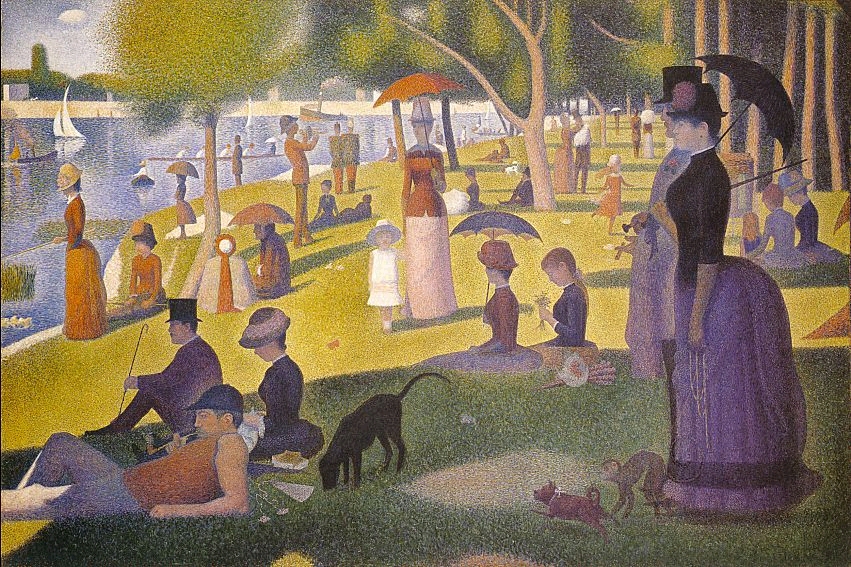
  • Dots in Revolutions of Modern Art: Seurat & Kandinsky

    JF Ptak Science Books LLC  Post 683  Blog Bookstore

    Part of the History of Dots series

    It is interesting to think of the importance of dots in the first revolutionary changes in 500 years in the history of art.  Honestly, there wasn’t anything epochal that happened between the re-discovery of perspective (ca. 1330-1400) and the arrival of Impressionism (and just afterwards of non-representational art) in the 1872/3/4-1915 period.  

    Suerat Dots aren’t brought to bear formally in the revolutionary movement until the early 1880’s.  Impressionism for all intents and purposes is formed with the Societe Anonyme in 1872 (whose members included Monet, Pissarro, Degas, Sisley, Morisot and eleven others), and perhaps more realistically in 1874 when the Societe exhibited its first salon.  (The first show held at the Nadar Studio in Paris in April 1874; a tiny, one month long affair, compared to mammoth exhibitions like the Universal Exposition in Paris in 1867.) 

    It was Georges Seurat who brought the whole world to the dot experience with his artisitc method of Pointilism, in particular with his magnificent Un dimanche après-midi à l’Île de la Grande Jatte, an enormous work given its composition—dots.  The dots replaced the brushstroke, and their placement in relation to their color was an absolutely brilliant innovation, establishing a perfect result for the viewer when examining the work as a whole.  (It may well be that the French chemist an designer Michel Chevreul made this discovery a few decades earlier, noticing the effect and changes in color depending on placement and—in his case, with fabric—color in the dyes for his material.)

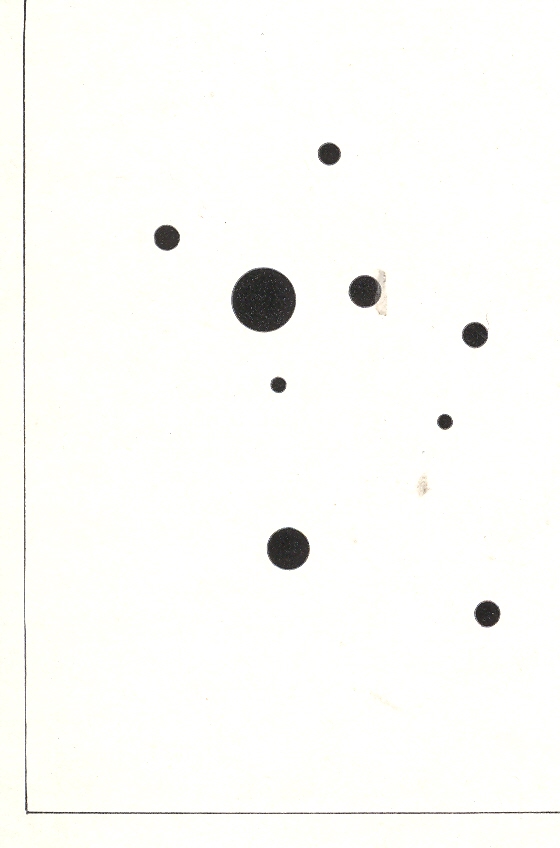
    Wassily Kandinsky (1866-1944), the discoverer of nothingness in art and the introduction of the first BLOG==july 13=kamd non-representational paintings in art history (1913) used his fair share of dots in his exploration of the previously invisible.  One good example is his 9 Points in Ascendance (1918), which is nothing but black dots, an impossible composition just two decades prior to its creation. 

    In the middle of this appeared the half-tone illustration, the great liberator of photographic illustration in popular publication.  Invented in the late 1870’s by Stephen Henry Horgan and used in the Illustrated London News for the first time in 1881, it made the publication of accurate images much feasible and economical.  No longer were readers dependent on the accuracies of artists interpreting photographs or photographed scenes—the photographs themselves were now publishable at little cost and in high quality, vastly increasing the veracity of published reports dependent upon images.  This was revolutionary in its own way, democratizing the sharing of images and icons.

    And so in just thirty years the lowly dot availed itself of some of the most spectacular achievements in modernism.  Of course we can say the same of the line, but this is, after all, a history of dots. 

    ·Posted by :

    ·in:

    — —

  • First and Early Impressions: Hitler, Mass Production and the Use of the Long View

    JF Ptak Science Books LLC  Post 666

    Harold, like the rest of us, had many impressions which saved him the trouble of distinct ideas  George Eliot.

    A novel is balanced between a few true impressions and the multitude of false ones that make up most of what we call life.
    Saul Bellow

    First (and other early) impressions get made once, for the very first time, and then re-invented, re-examined every time after that, especially as the first impressions start to age and get forgotten, slipping around the windsock of time.  But every so often these antique first impressions come back onto the playing field, and it is remarkable, really, what lessons can be learned of them. 

    A review of a very early biography of Adolph Hitler appeared in the pages of The Illustrated London News for 27 August 1932—this was the year before Hitler assumed formal control of the government and nine years after he began his rise to power.  The book was Hitler, by Emil Lengyel, published by Routledge in 1932; it is the subject of a very sharp-eyed review by “C.K.A” in the pages of the ILN. It was also reviewed so to speak by the Nazi leadership, which ordered that Lengyel (1898-1985) be picked up and disappeared at any early opportunity for being an enemy of the state.  Some of the interesting bits that the reviewer pulled from the Lengyel book include the following—I’ve included several here because of his particular and early insight):

    “There are no limits, however, fantastic, to which this fanaticism will not go; though what the Jews have done to Germany to deserve this frantic vendetta remains obscure.

    “It is almost incredible to Englishmen that this barbaric mania (Jew hating) should be erected to the position of a fundamental political tenet…”

    “Some of the Party principle are Olympic in their sweep and scope.  Thus:” “offenders against the interests of the community, usurers, profiteers, etc., are to be punished with death…” Much virtue in your ‘etc.”!

    “Behind all stand the emotional political impulses—repudiation of war-debts, hatred of France, hostility to the League of Nations, fanatical exaltations of race,…All this was to be expected…it is not too much to say that by the Treaty of Versailles the allies brought the Nazi movement upon themselves. The marvel is that it has been so long postponed.”

    “What Hitler’s flag stands for he has never revealed beyond irresponsible generalizations and decrepit platitudes…”

    “(On Lengyel’s Hitler):  He is a vox et praterea nihil—a shallow, paltry, neurotic person, with no constructive ability, a woodly intelligence, and little to comment except glibness and passionate prejudice. This is difficult to believe but by no means impossible.”

    “It may well be…that Hitler the man is as empty as his absurd Swastika”.
    Blog==june 26--1st impression

    The Yellow Spot, The Extermination of the Jews in Germany (1936) was the earliest printed document on the coming of the Nazi Holocaust, the earliest
    catalog on the mistreatment and systematic dehumanization of the Jews, and the
    earliest book to associate “extermination” with Nazis and the Jewish people. (The “yellow spot” part coming from the early history of racially marking Jews–it appeared first it seems in the 11th century in Islamic lands and then used periodically around Europe and the middle east for hundreds of years afterwards.  Using the Star/Shield of David seems  be a 20th century invention.)  It was also one of the earliest books on Hitler and what he represented.  (My friend Andy Moursund has published a very
    compelling poster on the early books regarding Hitler and Nazism and can be
    seen here.)  Another sort of first
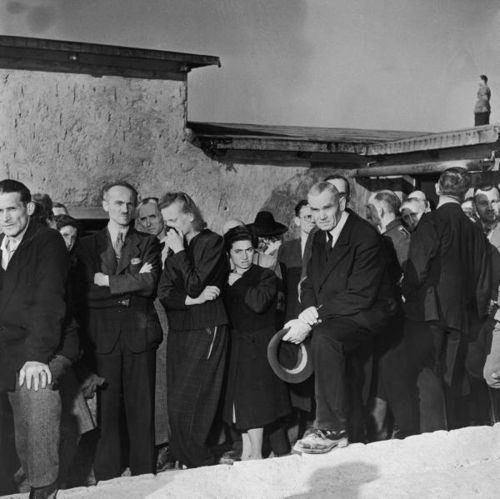
    impression that makes it mark is a series of pictures by the great Margaret
    Bourke-White (who seems to have been everywhere from the Depression to the
    Korean War and wrote and photographed what she saw brilliantly) made at the
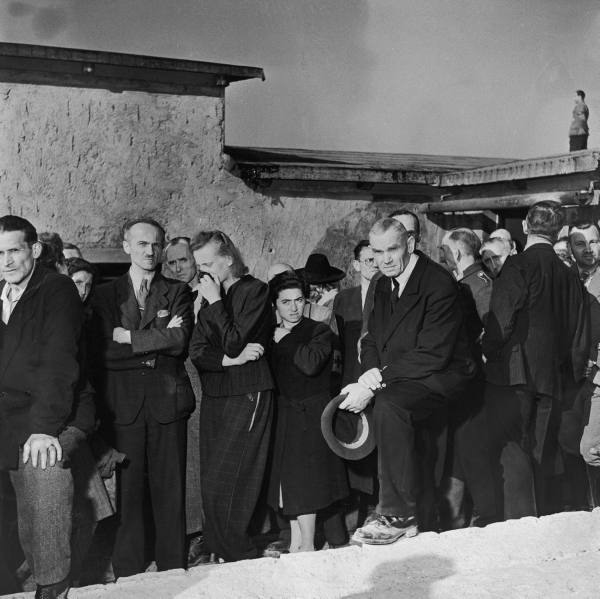
    Buchenwald Deathcamp just after liberation. 
    She did make photographs of the horrors of the place, but she also turned
    the camera around to record the faces of the locals who were forced to tour
    and view the camp in their communal midst. You can see very clearly in the
    faces of these people—for whom Blog==june 28 chaplinthe camp could not have been a mystery unless it was internalized so—how much they wanted to not see what they were looking at.

     

     And speaking of Hitler, Henry Ford’s contribution to the
    ethos of the American standardization and robotization of the workforce—the industrial
    production line—was well portrayed in the first cinematic appreciations of the
    idea.  (Writers had long since made
    observations on the evils of industry and society, going back at least as far
    as Charles Dickens—but its representation in the most democratic medium of the
    first half of the last century–the movies–received it first treatments in two strong
    impressions in the 1930’s.  The film that
    comes quickest to mind is Charlie Chaplin’s still-brilliant and
    still-applicable Modern Times (1936,
    though originally named The Masses)—a
    dire film (in one place dissolving sheep entering a slaughterhouse with a scene
    of workers entering a factory) that offered no solution to the factory.  Aldous Huxley wrote about the sickness of
    production in his Brave New World (1932)
    which is even scarier in its own right—though the scary image of the future
    delivered with the dark humor of Chaplin is tough to surpass—if for no other
    reason than it winds up discussing the “principle of mass production applied to
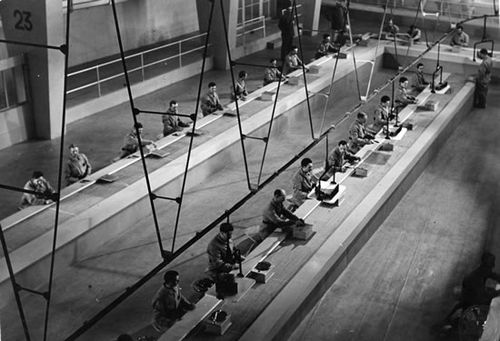
    biology”.  But earlier still is the
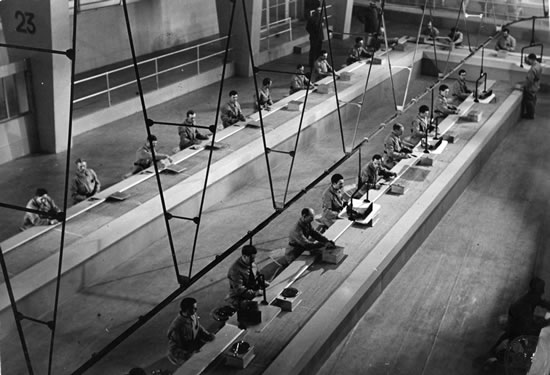
    little-seen film by Rene Clair (1931) A
    nous la libertie
    (Give Us Liberty/Freedom),
    which presents the mass production system as a thin metaphor for a prison labor
    system.  (Upton Sinclair said that the
    Ford assembly plants should be presented in “Museums of Unnatural History”.)
    Blog==jine 28 clair This really is an endless and mammoth subject as what I’m
    talking about is a history of perception, and all I’ve done here really is to
    draw a few things together that I have within reach.  It seems an interesting pursuit, following the
    threads of thought regarding early impressions of major (and minor) events, and
    one could easily construct a large Borgesian encyclopedia of them.  Check under “C”, for cable, for example:  the physicist Jacques Babinet thought it
    impractical and far too expensive to construct a communication line under the Atlantic ocean (as did many others, seeing the starts and
    fits of the various cable companies that were begun to try to capitalize the
    operation.  The cable business barely had
    a heartbeat, at times, in the mid-century even. 
    And speaking of heartbeats, William Harvey withstood blistering attacks
    on his correct statements on the circulation of the blood (costing him nearly
    all the patients in his practice). 
    Though at least Harvey
    lived to see a brighter day:  Michel
    Servetus, on the other hand, didn’t, and was burned at the stake for his heresies,
    one of which was the centering of the circulation of the blood in the heart
    rather than the brain.  The list goes on
    and on:  Semmelweis was killed but did
    wind up ion an asylum; Galileo didn’t wind up in an asylum but did wind up
    imprisoned; Copernicus wound up in neither place, escaping possible clerical
    criticisms by dying just as his revolutionary work was published.  Phillippe Lebon’s ideas for illumination by
    gas were seen as ridiculous, as were the revolutionary ideas of Edward Jenner
    and Luigi Galvani.  Einstein’s 1905 ideas
    weren’t happily received in France
    for a decade, and David Hilbert’s impressions of mathematics in the middle of
    the third decade of the 20th century was that it was “done”.  (Actually the young Einstein was also
    cautioned about going into physics because that field was seen as pretty much “completed”.)
      There was of course the other side of
    the impressions coin to all that I’ve mentioned above—for example, the resistance
    to Copernicus was not actually  as
    fearful as we think of it today, most thinking people were ready for it and
    were relieved with his 1543 publication.  The idea of looking at first impressions may actually have some utility in seeing how we view new things in our contemporary culture–or at least it would give us the sense of wideness and of the future, and to be at least circumspect about newness. 

    *A note on the production technology using interchangeable parts–this idea really did have its seat in  American industry. Colt’s “system of manufacturing” (c. 1851), Charles Tomlinson’s
    1853 Rudimentary Treatise on the Construction of Locks, rifle manufacturing at
    the Springfield Armory in the early 1850’s,  Eli Whitney and the cotton gin, Singer Sewing
    Machines,  (ca. 1865) phonograph machines
    produced on conveyors by Thomas Edison, and so on, till you get to Ford’s own
    Highland Park Factory around 1913.  All are indicators of this sort of conveyor belt, standardized parts, interchangeable units that marks this brand of manufacture. For an early, interesting reading see Charles Fitch’s “Report
    on the Manufacture of Interchangeable Mechanism” (1881)  as part of one of the reports of the massive
    overall report of the Tenth U.S. Census,
    and also  “The Rise of the Mechanical Ideal”
    in the Magazine of American History
    (1884)

  • Strange Things in the Sky Department: the Alchemical Cosmology, 1618

    JF Ptak Science Books LLC  Post 594       Blog Bookstore

    Well.  There’s a simple ton of complexity going on in this difficult, famous print by the
    great Mathias Merian—its like a moving puzzle to me, complicated by the
    virtually changing size of its pieces.  There’s
    just too much in it that I don’t understand, too much archaeo-religico-alchemical
    bubbly going on for me to make much deep sense of it all.  I do like that it is all coming from the sky,
    though, which is why I’ve selected it for this continuing series

    BLOG--THINGS IN THE SKY--MYLIOUS  

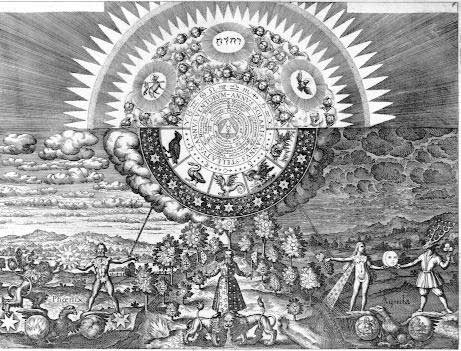
    The engraving, Tabula Smaradina (“Emerald Tablet”) is
    Merian’s interpretation of the alchemical cosmology, a  schemata and representation of the order of
    things.  It appears (first) in Johann
    Daniel Mylius Tractatus III Seu Basilica Philosophica… (1618) and makes
    subsequent appearances in other works by the author, as well as in Lukas Jennis’
    Musaeum Hermeticum (1625, see below). 

    Basically, the Emerald Tablet shows the opening of a
    complex heaven and the delivering of the philosopher’s stone to the earth.  It is a magnificent effort and no doubt has a
    great power to alchemists, and I can understand only a bit and a piece here and
    there.  For example, in the bottom right,
    we see a couple of people holding a((n) eclipsed?) Moon, standing on the wings
    of an eagle which protects a double hemispheric representation of the
    constellations.  The figure on the right
    is a naked woman, who may well represent Luna:  her right breast is a star, and from her
    armpit is a streaming torrent of stars which comes close into contact with
    shrubs labeled with the astrological signs of the planets.  The cluster of grapes in her right hand and
    the stream that she is straddling must indicate a generation, or a birth, or
    rebirth, or time, or the universe.  Luna
    is connected via something to the heaven-element which in turn is connected on
    the left sign of the print to a man holding a sun, who I guess must be Sol.  Heaven and Earth, Brother Sun and Sister
    Moon, and so on.  From here it all gets
    away from me, no that it isn’t gone already. 
     

    ·Posted by :

    ·in:

    — —