JF Ptak Scinece Books LLC Post 591 Blog Bookstore
Category: Perspective
-
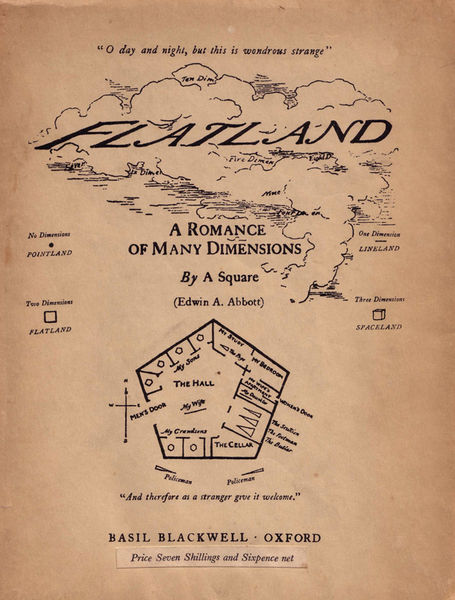
The Dot and the Sphere—the Depiction of Multiple Dimensions
The
Edwin
And
It
The
The
Eventually,
But
19
dimension.
hero of early
And
-
Fish-Eye Views, Part II: Escher’s Tetrahedral Planetoid
J.F. Ptak Science Books LLC Post 586 Blog Bookstore
 Late
Late
last month I wrote a short post about an antiquarian fish-eye view of the city
of Vienna
things (Looking
Straight-on At Things and Looking
Straight-Down on Things) and I can say that they are in general pretty
uncommon–this is the first time though that I’ve noticed a fish-eye
view looking straight down, an image conveying a 360-degree horizon-to-horizon
landscape.”) I’ve not found another
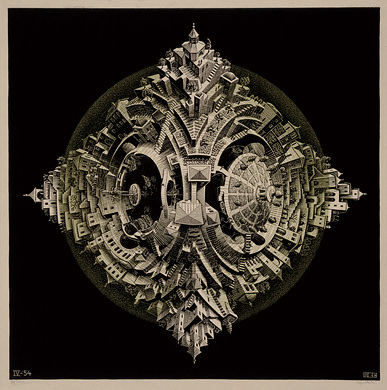
antique view like this, but I did just come across this magnificent work by
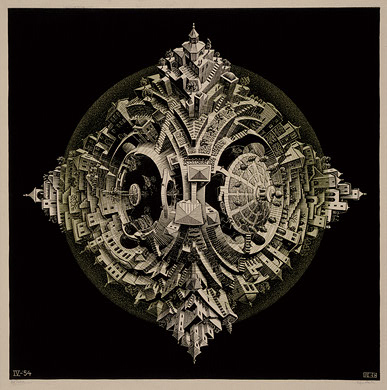
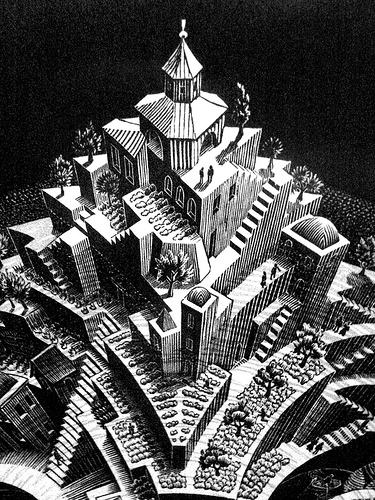
M.C. Escher (1989-1972) called
Tetrahedral* Planetoid, produced in 1954 and now living at D.C.’s National
Gallery.The
view of the planetoid is quite complete, as we can see individual houses and even
some people What I find particularly
amazing, apart from the design of course, is that this meticulous ideal was an engraving
done on wood. It is a glorious accomplishment,
and a joyful optical shock to the system. .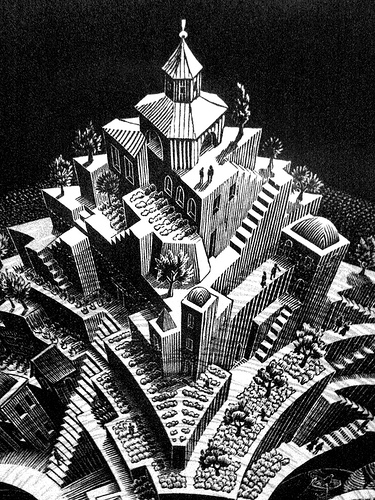
*A tetrahedron (plural: tetrahedra) is a polyhedron
composed of four triangular faces, three of which meet at each vertex.
-
“Emerging” as a Verb: a Note on Patterns in Science and Art
JF Ptak Science Books LLC Post 583
Blog BookstoreAnd all that appears confusedly on walls is very like the vibration of bells:
you can hear in their ringing all the sounds or words you want to imagine.” – Leonardo da Vinci 1492Finding recurring events, schemes and objects, finding predictability, finding a pattern, making a pattern emerge seems to be what we do here on earth. After all, the stuff that we use to organize our existence into transferable bits of knowledge–points and lines and symbols that stand for sounds which stand for other things which constistute language–don’t exist, but they do tell us pretty much everything we need to know about our environments, real and imagined.
Stars are (as my daughter Emma pointed out when she was four) “messy” until imaginary lines are drawn between them; the relationship of the elements are mysterious until a (a) they were “discovered” and (b) table of relationships was figured for them. Mathematics, the queen of the sciences, is nothing but making patterns emerge. Art* and aesthetics developed over millennia to arrive at things like paint and the golden ratio [(a+b)/a=a/b] and perspective, making images and other representations emerge from the chosen media. Patterns emerge from massive, seemingly too-complex entities: even the weather’s patterns emerge (to within a particular range). (Better yet, with weather, it is extraordinary to see how small variations of the initial condition of this sort of dynamical system can produce large, long term variations. Have a look at one of the greatest works on the circulation of the atmosphere at my blog store.)
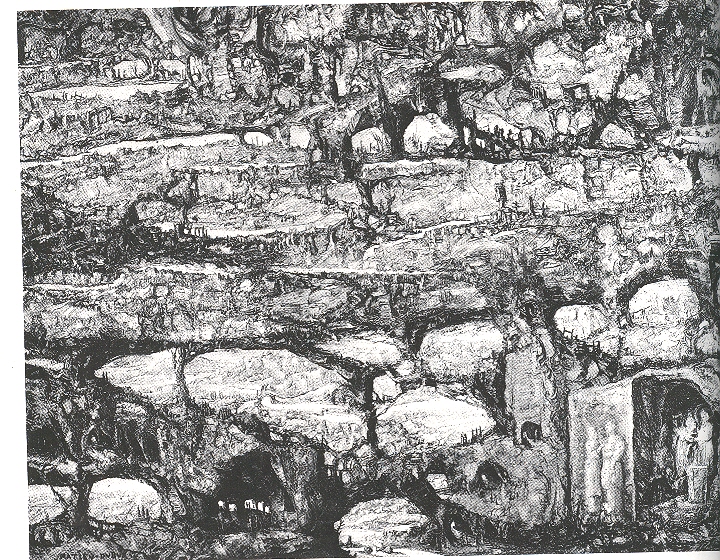
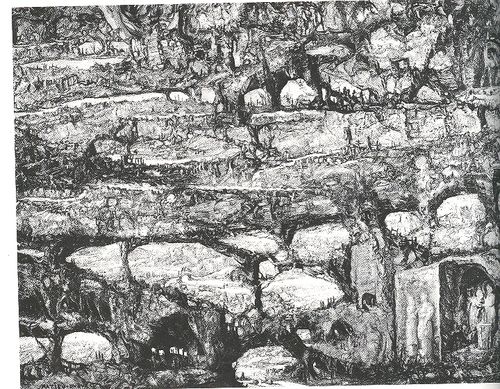
In a slightly odd and definitely beautiful book by Jurgis Baltrusaitis, Aberrations, an Essay on the Legend of Forms (MIT 1989) I found a fantastic illustration of the work of Mathieu Dubus (1590-1665/5). Dubus evidently was a pre-modern modernist, and painter of fantastic landscapes, though (apparently) very few have survived the years. He was an outsider to the great Golden Era of Dutch art of the 17th century, probably a little too far afield for most tastes, though his associate and contemporary, Hercules Seegers (Seeghers), another experimentalist-as-artist, found far more afield, at least so far as royal patrons were concerned. (Segers was also collected somewhat by Rembrandt, who owned at least one of his paintings. In his own bit of “emerging”, Rembrandt actually purchased one of the metal plates from which a Seegers print was made, and reworked it, making it his own, publishing prints from the “combined” effort.) It is also interesting to note that if Dubus was included in the Big Books on Dutch art of this era, he would fall between the beautiful Gerard Dou (small, exquisite, dark, very layered) and Jakob Duck (who had a very Dickensian taste for street/common/low life).
The Dubus work, The Destruction of Sodom and Gomorrha., is exceptional, and odd–I still don’t understand if the image was actually painted on an old and decaying wall, or if was painted on agate that looked like a decaying wall, or if was painted on canvas and made to look like the above. No matter–the effect is that the artist used the “natural” occurrence of breaks and segments to make his picture of the great destruction from Genesis emerge from the seemingly “found” surface. It is a remarkable image, and I’m fairly well certain that the 17th century wasn’t ready for it.
It is remarkable that humans have sought for thousands of years to make representations of their environment and ideas more clear; and it wasn’t until the second decade of the twentieth century that artists sought the “reverse”, until, finally, a person wasn’t able to tell what a painting was “of” unless told so. (Jackson Pollock told the story many times of seeing his work exhibited upside down.)
*”Art is the imposing of a pattern on experience, and our aesthetic enjoyment is recognition of the pattern.” is what Alfred North Whitehead (1861-1944, English philosopher and mathematician) said, sucking the very life out of the discovery part of the whole experience.
-
Lonesomeness, Anti-Humans, Vestie Davis and the Quark
JF Ptak Science Books LLC Post 577
I arrived at the subject of Lonesomeness in a roundabout way–taking my first look at the lovely 3 Quarks Daily site and thinking about Muster Mark and Humphrey Earwicker and Leon Ledermann and the quark’s (pronounced “quork”, by the way, this from the master’s voice) phenomenologically-obsessed creator, Murray Gell-Mann.
[The story of the discovery of the quark is a little tricky; Gell-Mann was the first to publish his discovery, preceding the independently-established work and findings of George Zweig. Zweig’s quarks were called “aces”, and after publishing his results in an internal CERN document, had considerable difficulty in placing the paper in The Physical Review, so much so that he abandoned the effort, only placing the paper in print years later. The CERN paper by Zweig is beautiful, even to someone like me–his high visual thinking (as with Richard Feynman) is highly apparent. Gell-Mann has been insistent on referring to Zweig’s work and its significance ever since its appearance in the first year of publication of the European Physics Letters in 1964.]
It is when fast forwarding through the experimental voyage for the picturing of the quark that we meet Leon Ledermann, whose animated semi-serious reference to the discovery of the anti-quark leading was his speculation on “anti-humans”. The idea of “anti-humans” is quite a lot to think about, and is something much deeper than simply not have humans being there. But also something different from the anti-neutron, the anti-quark, anti-matter.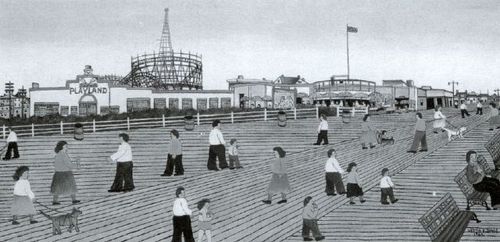
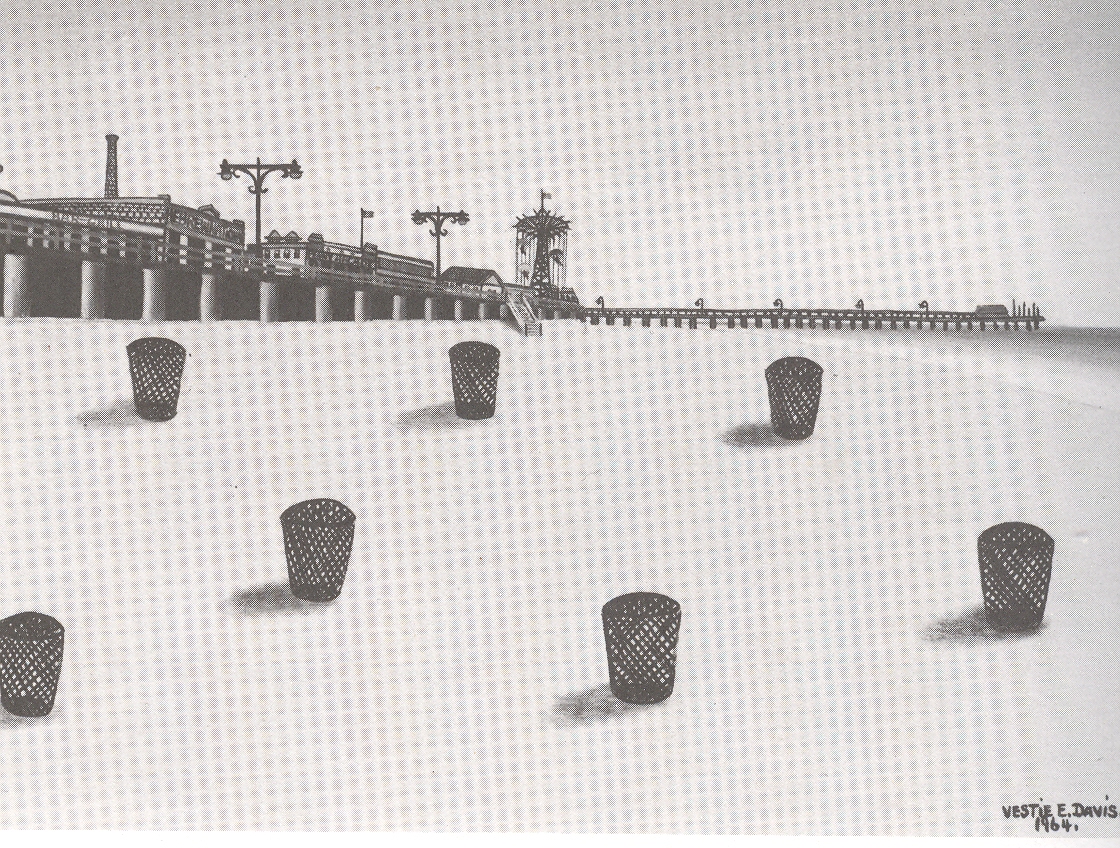
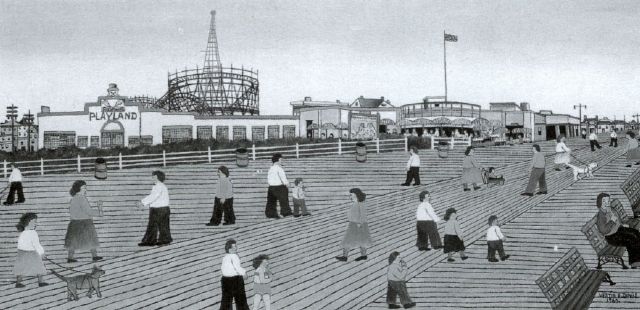
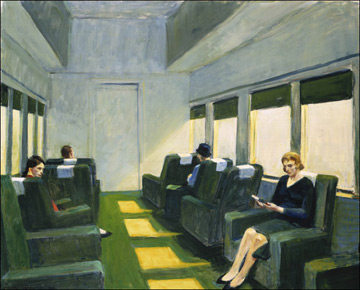
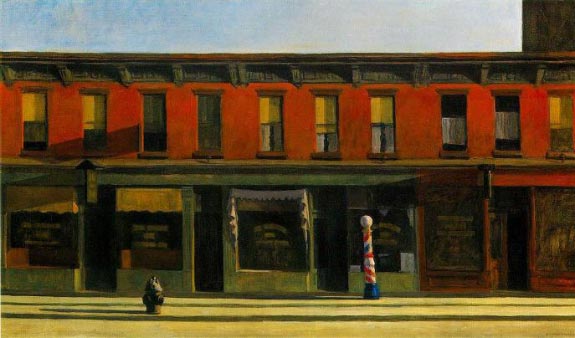
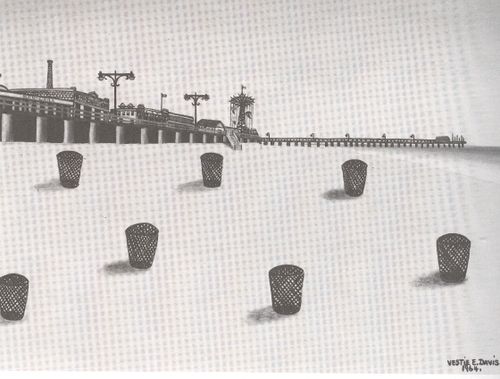
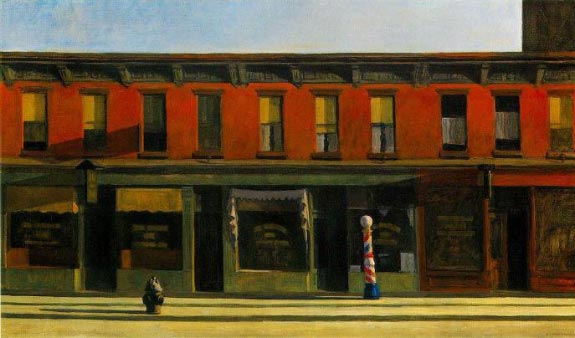
The anti-human led me to the “not being there” part, and then to the depiction of that idea, and the idea of Lonesomeness, in art. For me the very compelling imagery of lonesomeness is found in this painting at Coney Island by “part-time undertaker, newsstand dealer, and mortuary organist” Vestie E. Davis (1928-1978). It is a scene desolate of interaction, Even when Davis begins to add people into his paintings (making them “sell better”), the populations seem as brittle as Eliot’s utterly precise diction in The Love Song of J. Alfred Prufrock. In meek forebearance I add the artwork of Edward Hopper Both of these men seem to give their canvases a reality that is stretched so thin
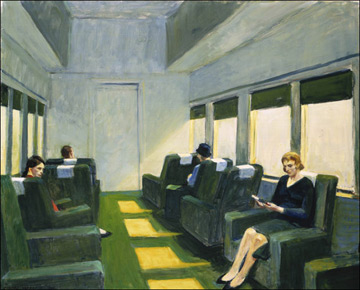
that it crystalizes the singular moment, and captures the lonesomeness of it all in the instant before the fabric tears. This is lonesomeness no matter if the seen is vacant or filled with people; Hopper and Davis introduce a finite nothingness that too me is as cold and scary as the antiquarian tombstone for the unnamed “Wife of____”, standing smaller and apart from the dead husband.
Maybe its the colors–or rather, for me, maybe its the color white. White is largely absent in nature, at least big (excluding clouds), at least that’s what poets like Wordsworth said. It is Goethe’s vexing color, Melville’s lonesomeizer. White works to distance everything in the images I’m presenting here, helping to make it possible for lonesomeness to exist in a bleak landscape as well as one with lots of people.
And so there you have it–I’m nowhere in this post except to have it serve as a placeholder for some sort of idea about quarks and space and absence and lonesomeness. Just an exploration.
-
The First Fisheye View? Vienna, 1529
JF Ptak Science Books LLC Post 567
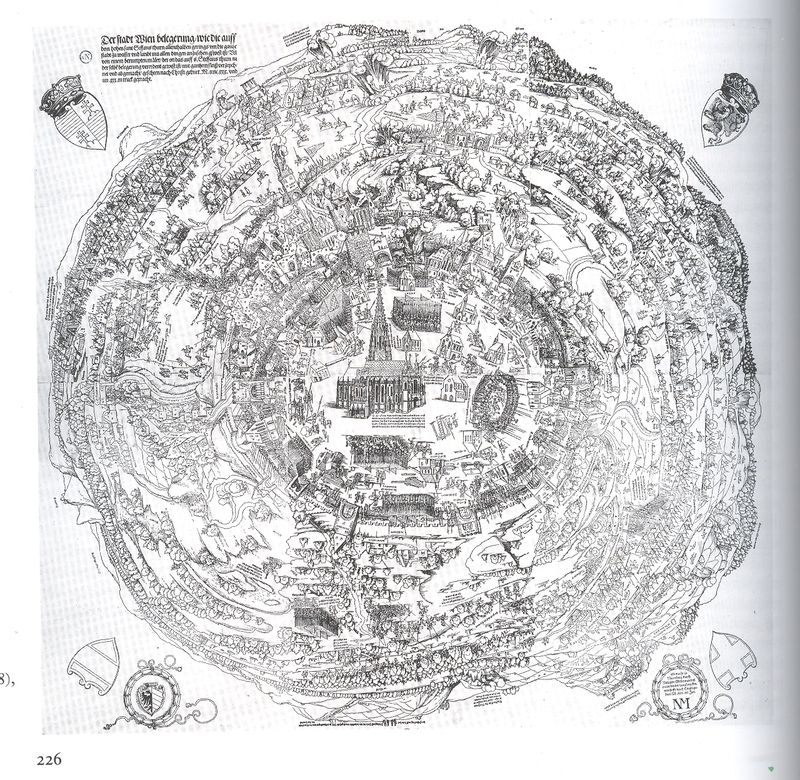
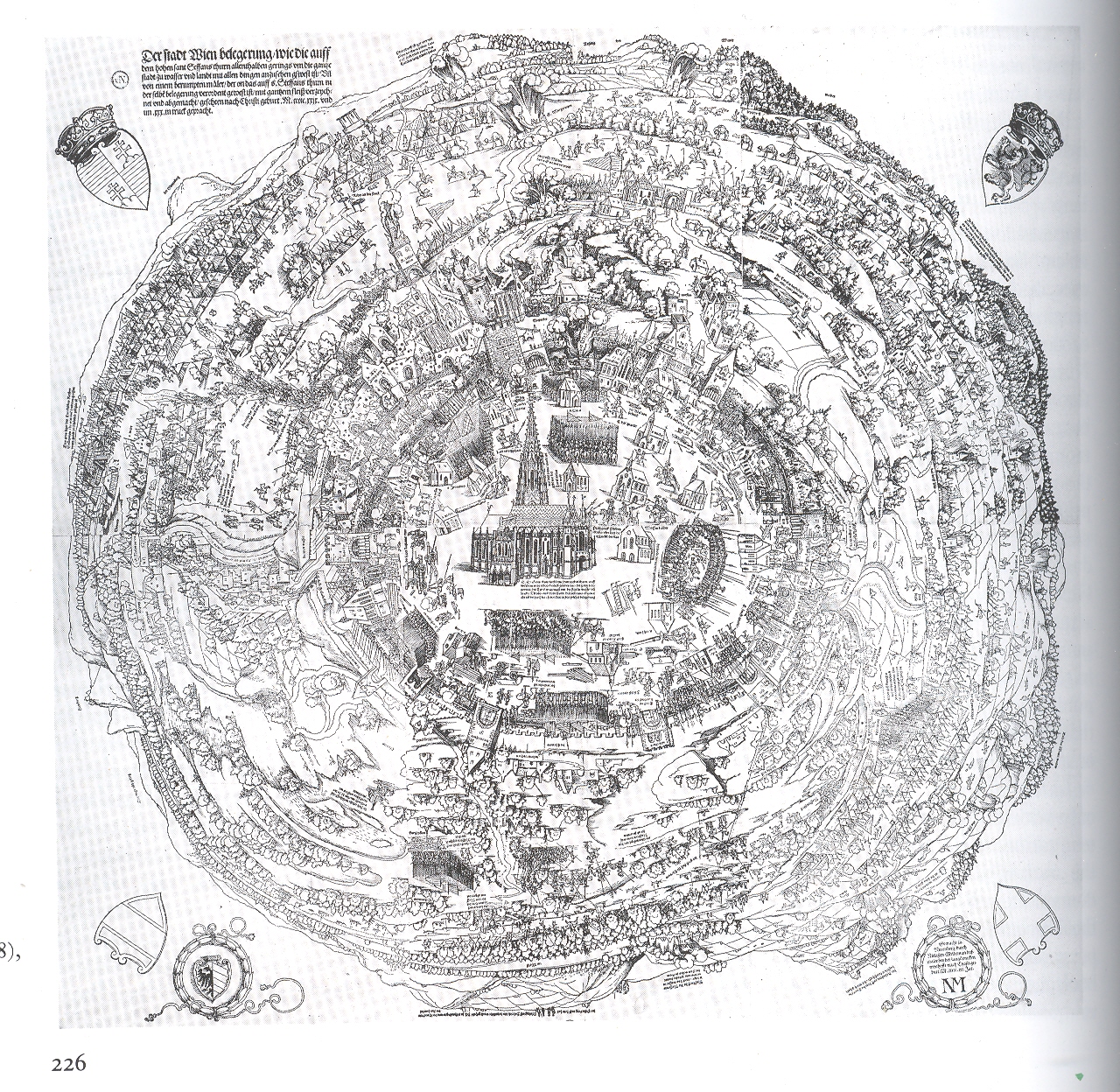
This magnificent woodcut, The Siege of Vienna*, executed by Nicolaus Meldmann, was published in 1529/30 and depicts a view of the city of Vienna from an extraordinary and perhaps unprecedented perspective. I’ve paid some attention to antique images that look straight down at things (Looking Straight-on At Things and Looking Straight-Down on Things) and I can say that they are in general pretty uncommon–this is the first time though that I’ve noticed a fish-eye view looking straight down, an image conveying a 360-degree horizon-to-horizon landscape. It is just simply phenomenal, even if a fair number of the buildings in town are missing and so on–the (unnamed) artist-on-the-spot actually climbed a high spire and made a number of sketches, extrapolating it all into this horizon-bending whole. But the representation of the city wasn’t the paramount concern in the print–it was the placement of what was going on outside of it that was important. And what was happening concerned all of Europe–it was the invasion by the Muslim Ottoman
Empire, led by Sultan Suleiman I (the magnificent), and in 1529 they had made their way through Hungary and into central Europe, laying seige to the principal city of Vienna with an army of 150,000 (or 300,00) soldiers. . It was the high point of the Ottoman expansion, as they were ultimately turned back by the Austrians in a determined and complex series of battles of mining/tunnels versus anti-mining and anti-tunnels (such battles being fought, still, deeply into World War I). So this print was made for a wide audience of Europeans, trying to get a glimpse of the siege of Vienna and the positions of the Ottoman forces, knowing that the outcome of the siege could very well hold the fate of the rest of Europe.If you check out the other posts in this blog on “Looking Straight Down” you’ll see a number of examples of early straightdownedness–none though approach the vast area that the artist of this print had taken under control and displayed.
*I found this reproduction in Landau and Parshall’s beautiful, attentive and intuitively incisive The Renaissance Print,1470-1550, published by Yale University Press in 1994. It is a rich book, with very deep depth and a light touch, hard to do in an academic/historical work. But they did it.
-
Pre-modern Advanced Technologies and Looking at the History of the Future
JF Ptak Science Books LLC Post 541
Future (Definition) That period of time in which our affairs prosper,
our friends are true and our happiness is assured.
Ambrose Bierce, Devil’s Dicitonary“It is by no means an irrational fancy that, in a future existence, we shall look upon what we think our present existence, as a dream.” E.A. PoeLooking “into” what the future might hold is a nasty business suited for hairshirts, geniuses and fools–except of course to say that there will be what would seem to us to be shock and awesome display that will wash over future generations like the shock of Darwin washing over those in the 1870’s.* Looking into the past of looking into the future is far more approachable but not necessarily “easy”. The major difficulty in finding the future amidst all the historical majors and minors is that given the optical distortions in the broadening of our depth of field to our WayBack Vision. It is harder to see things that are out-of-place to a given t
 ime given our familiarity with it.
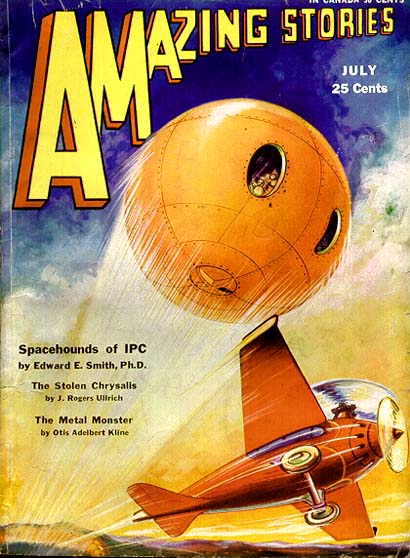
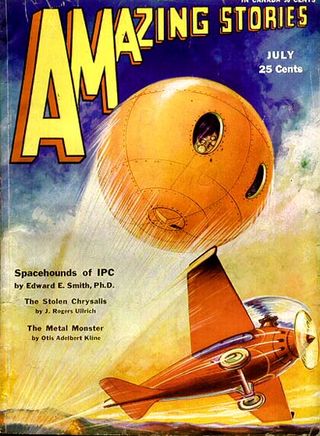
(Neil R. Jones (1909-1988), a relatively obscure scifi writer, seems to be the first to introduce the concept of a history of the future in his Amazing Stories article of July 1930 called “The Jameson Satellite”. (It is interesting to note that at about the same time he also introduced the word “astronaut”, and, further into the decade introduced some of the first appearances of cyborg/robotic story characters.))
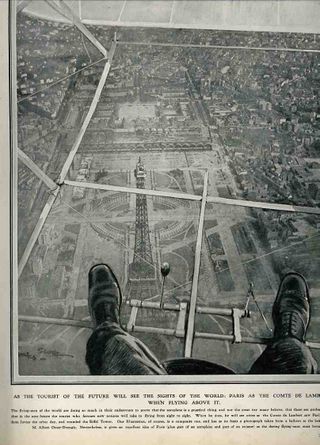
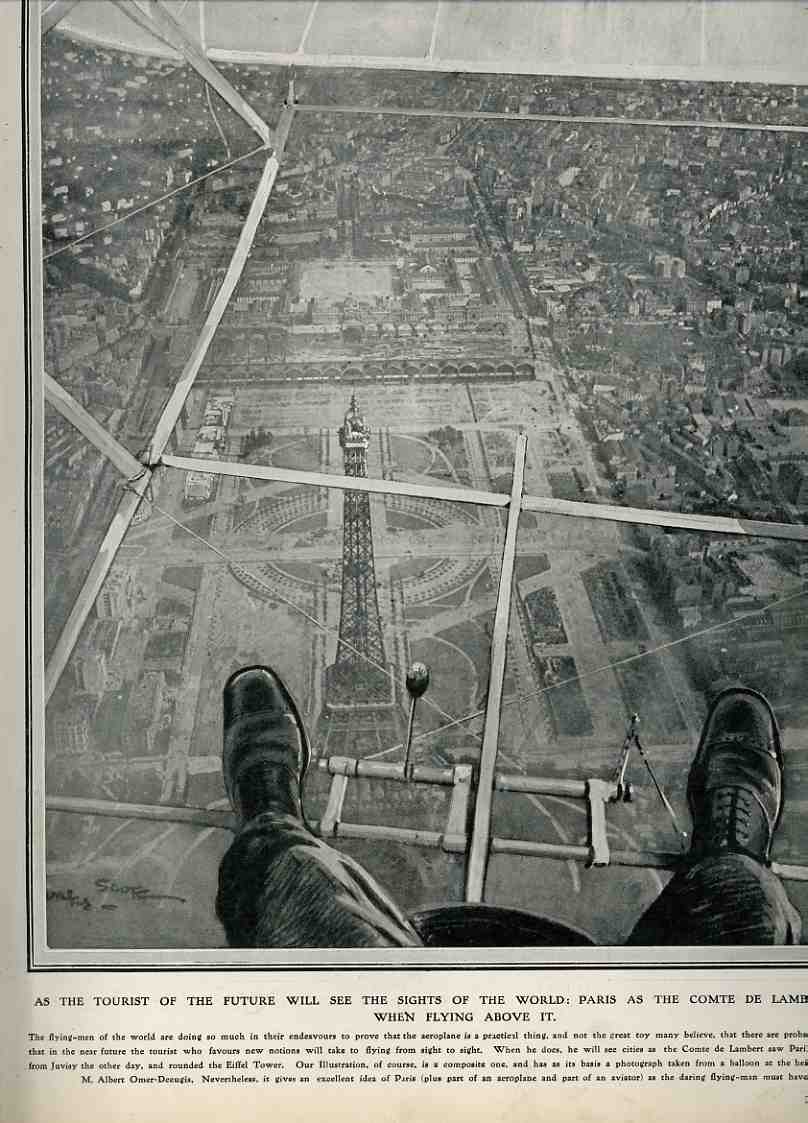
The idea of identifying these parts of future history is certainly easier when they identify themselves so, as seen in the caption of this wonderful you-are-there image of a person flying in an aeroplane over the Eiffel tower, and printed in the redoubtable Illustrated London News for 1909. The writer leaves himself plenty of wiggle room, though still firmly convinced that even though flying was still in its relative infancy in Europe, the time would certainly come when people would flit about it planes simply to see great wonders.
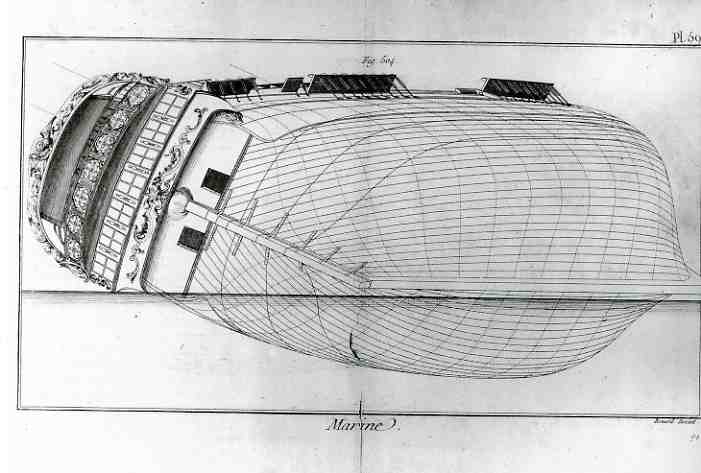
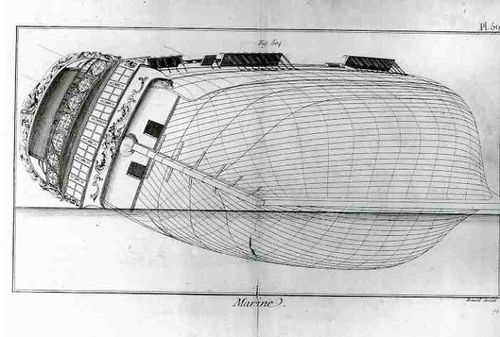
Images of at the edges of contemporary technical capabilities and whose skill hints at bigger things to come are trickier to see. Take for example the following engraving found in the Encyclpoedie methodique*, published in Paris from 1782 to 1830. This engraving depicts a ship of the line in an unusual perspective, best suited I think to show th eshape of the hulol, and looking to me extremely similar to a computer-generated graphic.
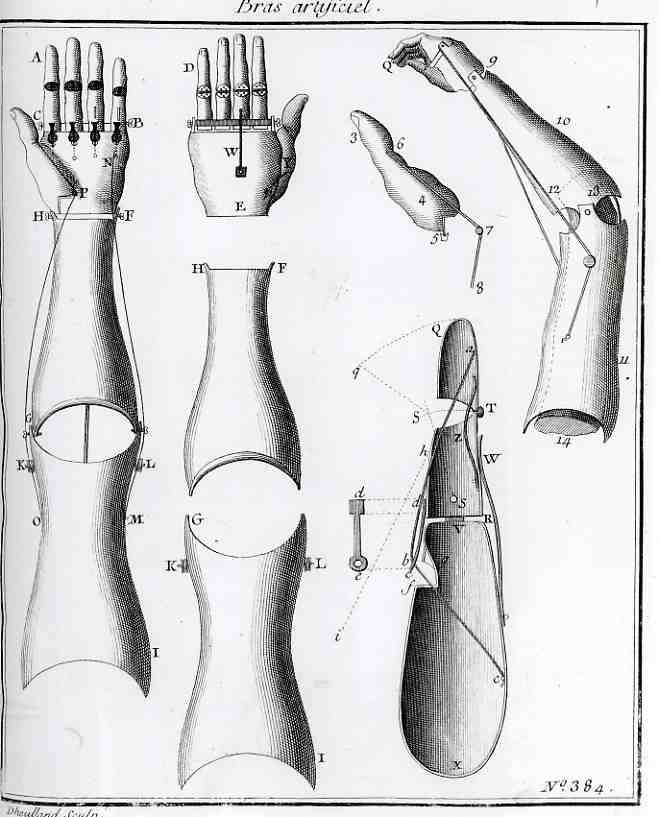
Also, the fantasitic
 ally articulated and probably unworkable set of metalic artificial limbs was another peep into the future–I think that the technology necessary for these limbs to be anything close to operational just escaped its manufacturer when they were designed in the 1760’s.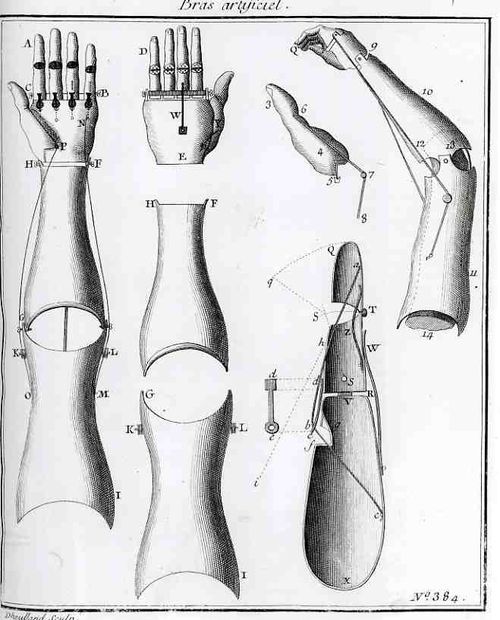
In any event the exercise of finding the future in contmeporary writings of the past is interesting and fruitful, and really does make you pay attention to your sense of history and what modern prejudices one brings to it.
*”We may expect that a series of shocks of the type of Darwinism will
be given to established opinions on all sorts of subjects. One cannot
suggest in detail what these shocks will be, but since the opinions on
which they will impinge are deep-seated and irrational, they will come
upon us and our descendants with the same air of presumption and
indecency with which the view that we are descended from monkeys came
to our grandfathers. ..
JBS Haldane, “Daedalus, or Science and the Future** The L’Encyclopédie méthodique ou par ordre de matières par une société
de gens de lettres, de savants et d’artistes; précédée d’un Vocabulaire
universel, servant de Table pour tout l’Ouvrage, ornée des Portraits de
MM. Diderot et d’Alembert, premiers Éditeurs de l’Encyclopédie appeared in over 200 volumes, and was a version of the famous Diderot encyclopedia,m though expanded, and ordering its iformation according to subject area rather than alphabetically.·Posted by :
·in:
-
Blank and Missing Things: Missing Horizons, Giant Women and Edouard Manet
JF Ptak Science Books LLC Post 536
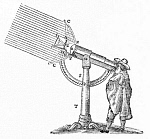
The Nine Foot Woman and the Nine Inch Man
perspective world infrequently happened on purpose (except to accentuate
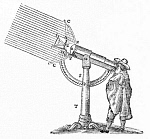
another aspect of perspective), and was usually the result of artist or artisan failure or naivety. A famous example is in Rene Descartes La Dioptrique (1673), in which this image of his compound
microscope was somehow confused with a telescope—probably the result of the
illustrator’s misunderstanding of the concept and a mistake in the proofing
period. This does sort of look like a
telescope, if viewed with your squinty-eye specs, at least in the hands of the illustrator—if the
microscope-and-man was pictured in this scale was really this large and
collecting THAT much light it would’ve fried the retina of the viewer and
whatever specimen was being looked at. If
the scope was that big then the man using it would’ve been about 9 inches tall. In any event, it was an accident (and one of
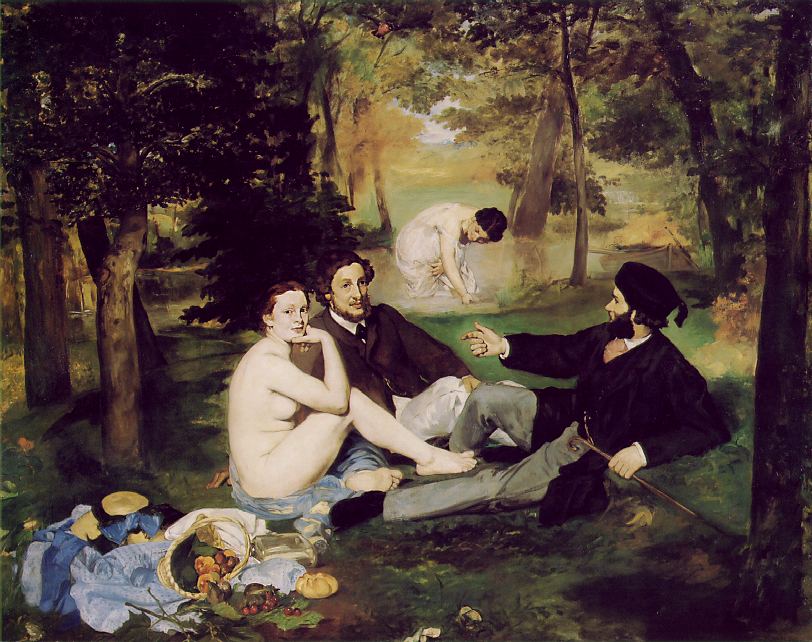
fairly high order)—the nine-foot-tall woman in Edouard Manet’s Le Dejeuner sur
l’Erbe (1863) was an entirely conscious decision, and one that helped initiate
the birth of Impressionism. Of course
there was a lot of other stuff going on in Manet’s mind beyond the giant woman—he
abandoned entirely the very accomplished and polite work that he had been doing
(trained by Thomas Coutre) celebrating his independence on his 27th
birthday by burning all of his old work.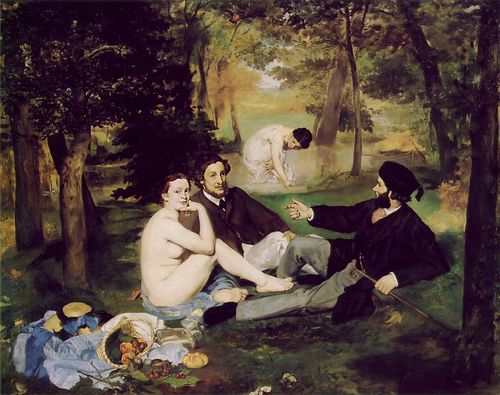
Le Dejeuner was a scandal when it was exhibited in 1863—Manet
painted what he wanted to, unbound by perspective, by color, by composition,
and on and on. The folks in the painting were not connected to anything,
really, and were unconnected to each other, no one paying any of the others any
mind, even when the women were naked.
Nothing seems to be going on—the people are just simply there. This is in itself was a disconnect from
previous practices, the vision in painting was about something, and was directed. Light seems to be coming from a number of
different places, and the shadows from the trees reflect this, simultaneously stretched
towards and away from the light sources.
The bathing woman in the background, or what used to be background, had
she been drawn using proper perspective, would’ve been about nine feet
tall. But what happens here is that
there is no foreground or background in this painting, just middle. It was this collection of abandonments, starting here in the Le Dejeuner in 1863, that ushered in the modern in art.
-
God in Reverse: the First Painted View of Future Action (1912?)
JF Ptak Science Books LLC Post 529
Jeff Donlan from Salida, Colorado, sparked this post with his comment from yesterday*. I don’t think that Matyushin really knew where he was going , either, even though he was writing in the years (1896-1916) when this issue of time and space and motion was being hammered on god’s holy anvil. The thinking that the artist of this time were in some way responsible for shaping the social vessel necessary for the scientific development of these ideas has never been attractive to me. Frankly this image wound up in the dead idea cemetery (along with the cemeteries of lost ideas, the cemeteries of blind ambitions, of fear, of lust-conquered-love and vice versa; the cemeteries of hollow illusion, near-achievement, and good will; the cemeteries of childhood despairs, of extra vowels, of dropped change, of the thoughts behind bad thoughts, and of ill-gotten gains. There are no cemeteries evidently for incompetencies or mediocracies, as these things, in addition to being lifeless, cannot be killed.)
This issue is strongly entertained by Linda Dalrymple Henderson in her Princeton-published doorstopper The Fourth Dimension and Non-Euclidean Geometry in Modern Art, where she prettily and exhaustively declares “nope” to the egg-chicken possibility of the space/time issue being born in art and nurtured-up in the sciences, which is fine with me.
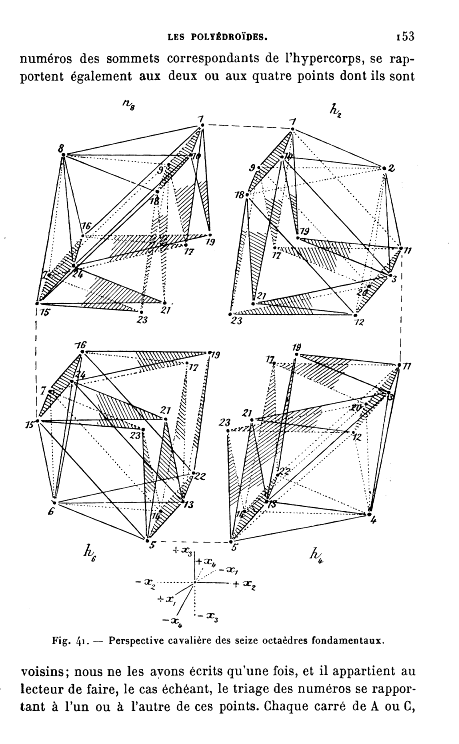
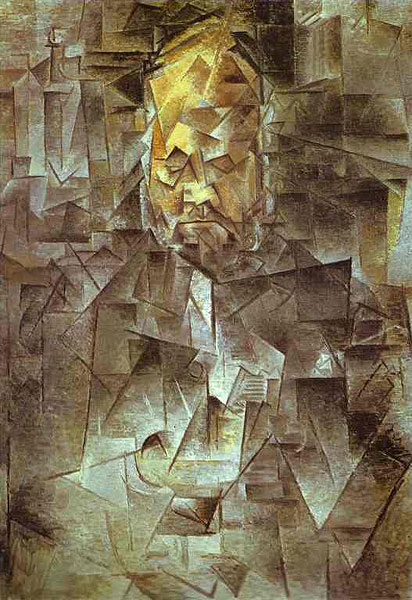
That’s not to say that the art produced in the sciences to illustrate fourth- and nth-dimensional space weren’t without (great) artistic qualities.W.L. Stringham (“Regular Fgures in n-Dimensional Space”, 1880), E. Jouffre (Traite elementaire de geometrie a quatre dimensions, 1903), H.P. Manning (Geometry of Four Dimensions, 1914) are excellent and early examples of gorgeous illustration illuminating complex issues, and are also published many years before the works of Braque and Picasso and Metzinger and Gleizes and Le Fauconnier and of course Duchamp. These artists are all producing their important work before 1912, but are also definitely coming after some of the major work in the history of the fourth dimension.
But getting back to Matyushin and to the title of this post: I wondered when the first painted images depicting future action was painted. “God” comes into this because, I think, a case might be made for the depcition of future action via the depiction of the progression to life-after-death states (and marching towards heaven/hell.) Removing god from the equation takes us, maybe, to the backwards spelling of god: “dog”.
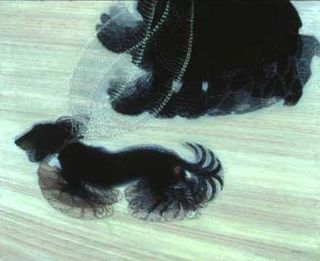
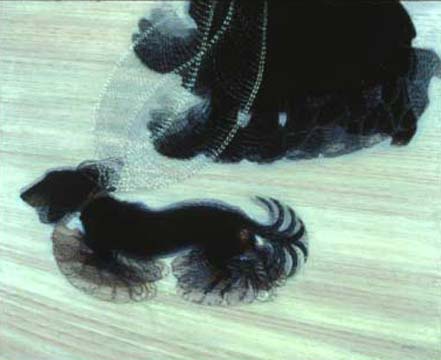
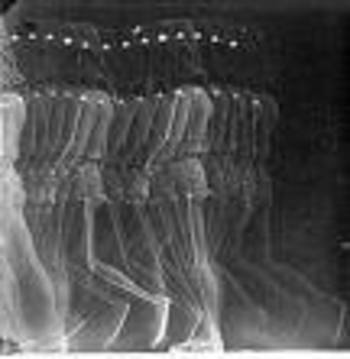
Giacomo Bella’s Dynamism of a Dog on a Leash (1912) may well be the god-reverser, the first painting of the future, with simultaneous views of space and time, wrapped up in the gift of speed. Whether this is accurate or not I really don’t know–Duchamp’s Nude Descending was painted and almost and nearly exhibited in this same year (having been throw out of the art exhibition by friend and foe alike because his work was too risky)–I really like that this “first” involved the picture of a doggie, even though it is vastly inferior to the Duchamp and all.This is a complex issue that I’m just passing quickly through–I’m not sure that this whole issue wasn’t dealt with first(artistically) in the comics, the space/time bit perhaps getting an early cover in places like Windsor McKay’s Little Nemo in Slumberland (1908) and Lyonel Feininger’s The Kin-der-Kids (1909). Then there’s the issue of Etinne Marey’s beautiful studies of motion, which look a tremendous lot like the things to come in Duchamp et cie twenty years later, but that’s another story. But I think it highly poetic that this issue boils down to a stumpy dog, Little Nemo, a French polymath with a gun camera, and M. Duchamp (who didn’t take any of it seriously).
__________
* “Pictures
like these are porn for the unhappy multitasker. What Matyushin could
not know in 1915 is that when we rush fast enough, our left brain shuts
down and the right brain takes over suffusing us with an intense
feeling of oneness. We don’t really see the totality; we just feel we
do. I don’t know that this is true, but I feel that it is as I rush
through this so I can write my library column before I forget…” This was said in response to the following: “Mikhail Matyushin, in 1915: “Only motion cystallizes outward appearance
into a single whole…a speeding train fuses the separatness of the
cars into a compact mass…” He goes on to say that “when at last we
shall rush rapidly past objectness we shall probably see the totality
of the whole world”, though I think that he got that part of it
backwards, or perhaps inside out.”
-
Looking at Things Straight On, Part 3: Perspective Books in the 16th Century
JF Ptak Science Books LLC Post 496
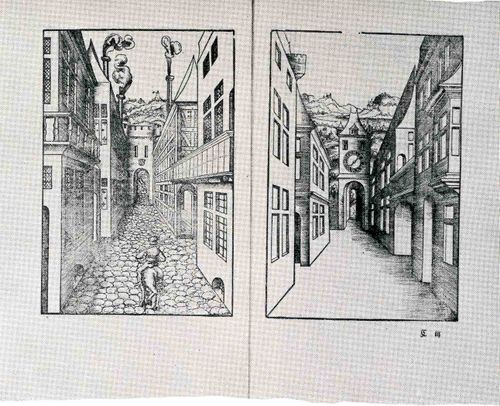
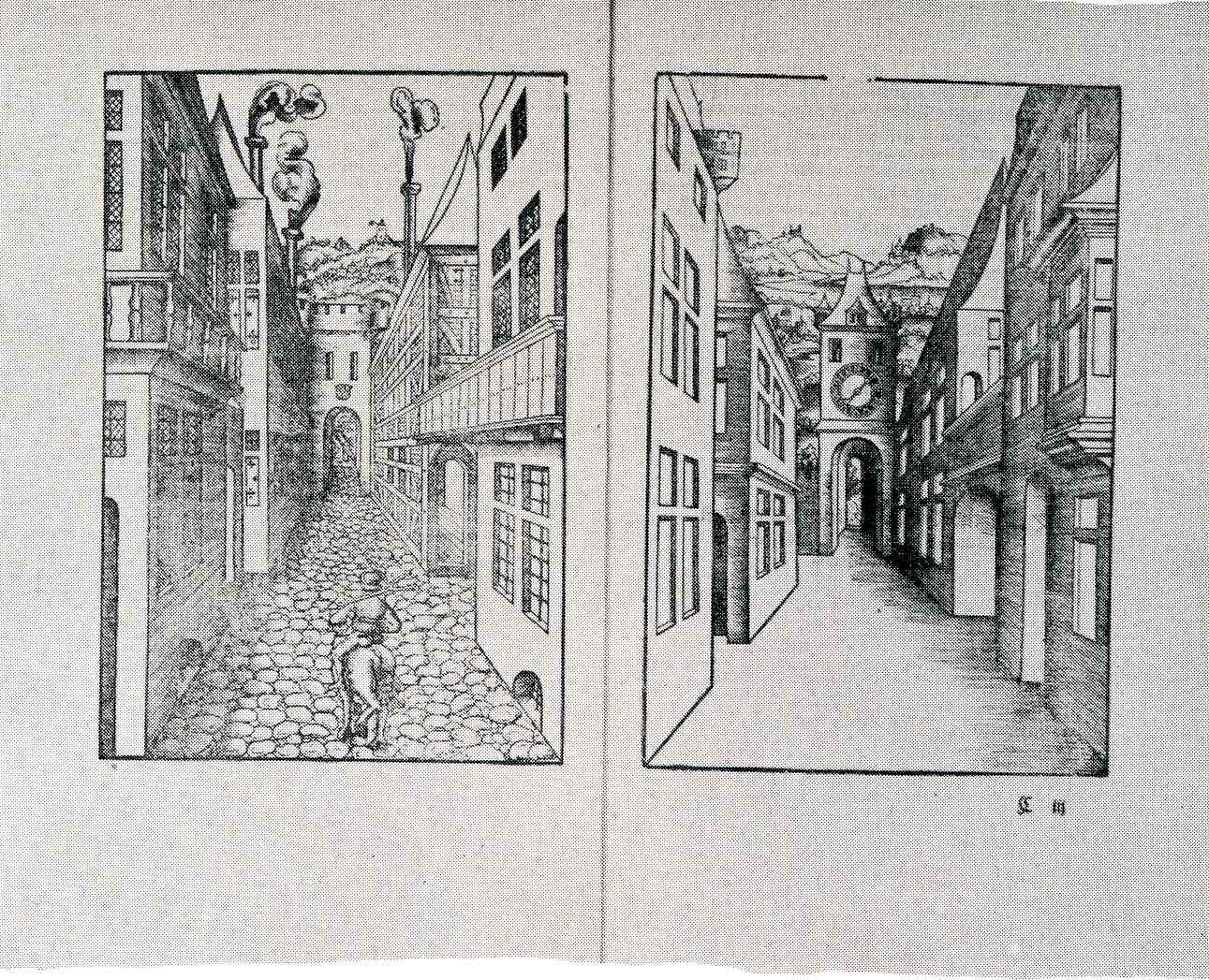
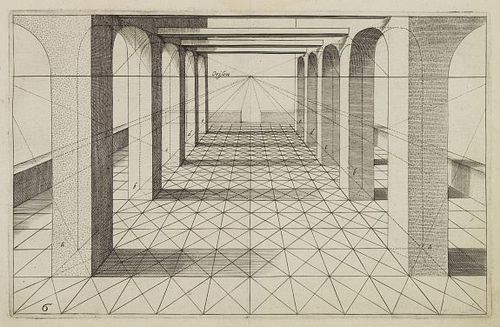
Hieronymus Rodler (who died in 1539) wrote one of the greatest books of the Renaissance on the use and care of the relatively-newly-discovered practice of perspective. Perspectiva, Eyn Schon nuetzlich buchlin und underweisung der Kunst des Messens...(Useful Booklet and Instruction in the Art of Measurement), published in Frankfurt a.M. in 1546 (as a second edition following the 1531 first). I say “newly” because Rodler wrote his book to help explain, or at least somewhat simplify, the 1525 Underweysung der Messung (Instruction in Measurement) by Albrecht Durer, a great work of some substantial complexity and difficulty.
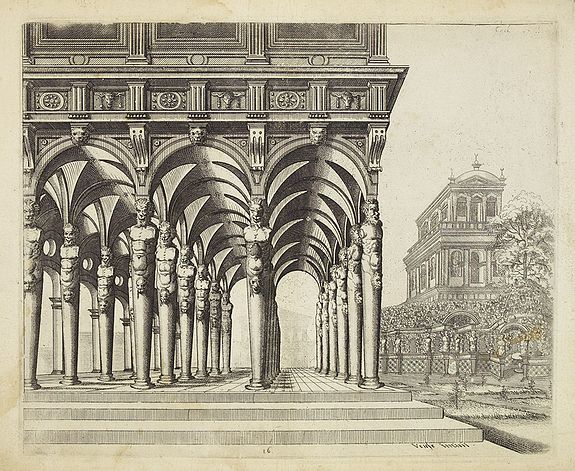
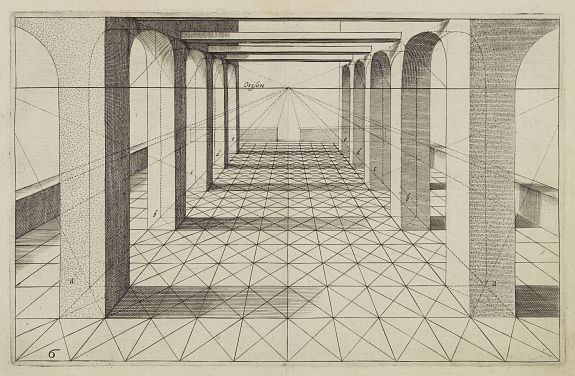
The works of Wenzel Jamnitzer (1564 and 1568), Heinrich Lautensack (1564) and Hans Lencker (1567), all fine examples of earlish work in perspective and al quite lovely–but it is Hans, or Johannes Vredeman de Vries (ca.1527-1604, “The King of Architects” among the Dutch, at least), whose Perspective of 1604 rises to the greatest heights, a book filled with superb copperplate engravings of the master’s work, vanishing points into which all the lines of the engraving converge, sucked as it were into a perspective Black Hole. That, and of course there are so many of them that look exactly at the center of a receding horizon. (And this continues two earlier posts written along the same vein, here.)
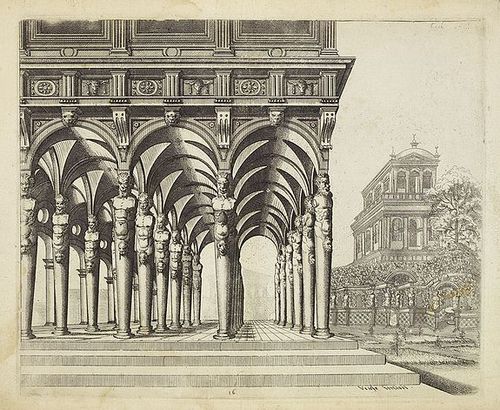
In his dedication to the reader (“To the Studious Viewers of Optics”), Vredeman de Vries writes that
“My eyes and mind took pride
In Sacred Optics. Thereunto allied
was a fructifying labor, forty years
I plied this art devoutly, Here appears
a doctrine worn by time. That art is famed
For trustworthiness which trusty rules have framed…
This art, which guides the eye and soothes the brain,
with images, but never cheats the sight
with lying views…”I have purposely not said anything about early artists (like Uccello, Filippo Brunelleschi, Leone Alberti (Optics), Piero della Francesca, Piero della Francesca, Federico Commandino, Jan van Eyck, Leonardo, and Serilo and Vignolla, Raphael, and so on) and the development of perspective in painting because, well, I can’t figure out how to do it in a paragraph. But you can certainly consult fine books like Samuel Edgerton The Renaissance Rediscovery of Linear Persepctive (1975) and Hubert Damisch The Origin of Perspective (1994) for a bigger taste of teh issue. Me, I just wanted to look straight-on at some 16th century perspective illustrations…
-
The Future of Future Truisms: David Byrne’s Knee Plays vs the Fat Man Nuclear Warist, Herman Kahn
JF Ptak Science Books Post 407
 David Byrne, former Talking Heads member, produced a series of twelve short pieces to be used in the Philip Glass (and Robert Wilson*) Opera CIVIL warS in 1985. (“Opera” may not be the right word for this piece, as I think it was one only in so far as the composition needed an opera house to be performed in.) The Byrne pieces, called ”Knee Plays”, were meant to fill in the spaces, the spaces in-between, place holders, between the sections of the day-long multimedia production.. Glass had used this idea of inter-pieces to the whole earlier in 1976 in his at-the-edge Einstein on the Beach, in which the connective elements were meant to not only join the pieces of the production together, but were also meant to stand alone, as a cohesive unit, if removed from the opera. (Glass said they were “short connecting pieces which appear throughout the work much as prelude, interludes and post-ludes. Taken together they form a play in themselves”)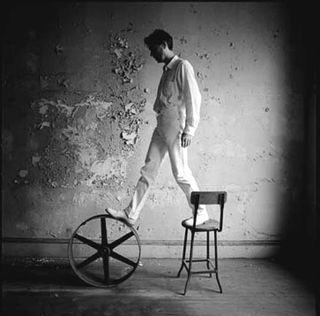
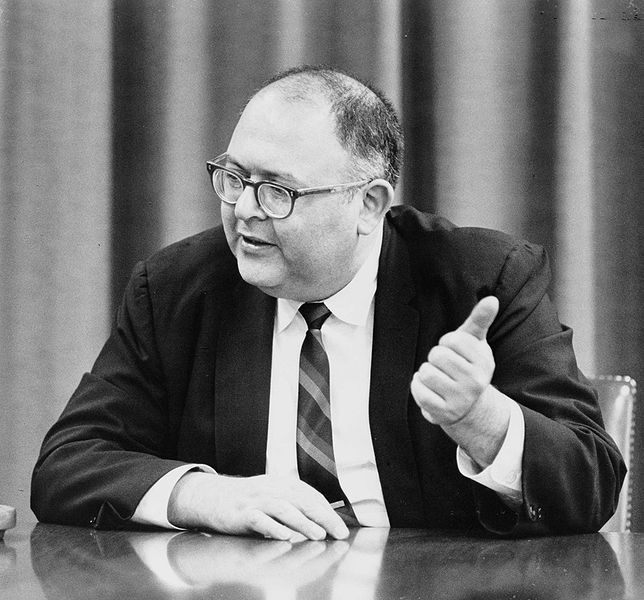
One of the Knee Plays, “In the Future” (Knee Play Number 12) is a slippery, stacatto brass section accompanying Byrne’s 51 sophisms about life in the future. About thirty years earlier, “futurist” and think-tank-filler (or maybe it was “Think Tub”?) Herman Kahn (1922-1983), occupying a lot of space at the RAND and Hudson Institutes (he was also known in many circles as the “Fat Man”), diligently recorded his myopic views of the future. He is generally regarded as a systems theory and military strategy guy, and is most remembered for (as he claims, perhaps) introducing the term “Vietnamization” which described the ultra-failed de-escalation (?) process and withdrawal for the United States from Vietnam (attention Obama administration). Superluminarily speaking though his contribution to thought on constructing and implementing thought regarding nuclear weapons exchange (pointless to refer to this as “war”) in two books, Thinking About the Unthinkable (1962) and, On Escalation (1965), where he famously put The Bomb on the table of use possibilities. In addition to these books—which he is busily trying to forget out there in his afterlife, somewhere, maybe in a penitential place where you are forced to think endlessly about paths-to-bad-decisions) is that 1967 peek into the future, The Year 2000. Petroleum and oil are not issues. Computers are of minor societal importance. And then other things of no importance happen.
 When you take Byrne’s Knee Play 12 and place it next to Kahn and other mis-spent prognosticators, the musician looks positively brilliant. Some of the stuff has come to pass, some hasn’t; some will, and some won’t. Some are open to a little interpretation, and some, a lot. Overall, though, if you think through these little future buillets a little carefully, David Bryne looks very good. Byrne’s lyrics/list is below.
*Robert Wilson is a phenomenal conceptualist and theatrical designer. On the liner notes to CIVIL warS is found the interesting note on Wilson and Byrne: “At first, Robert Wilson asked David to compose pieces for several sections of The CIVIL warS, but on account of David’s limited time, he composed only The Knee Plays part. The CIVIL warS was supposed to be played in its complete form at the Olympic Games in Los Angeles, but if one plays every part, it takes at least eight hours. There was also a financial problem for playing every part. So only some parts of it were staged there. David himself was very interested in composing for such a play and dance and this time again he enjoyed this work very much. Last time, for The Catherine Wheel, he used recorded tape, but this time he made musicians play on the stage.”
IN THE FUTURE (KNEE PLAY 12)
In the future everyone will have the same haircut and the same clothes
In the future everyone will be very fat from the starchy diet
In the future everyone will be very thin from not having enough to eat
In the future it will be next to impossible to tell girls from boys, even in bed
In the future men will be ‘super-masculine’ and women will be ‘ultra-feminine’
In the future atomic fusion will enable us to build a skyscraper with
the energy obtained from a grain of salt
In the future through genetic surgery there will be a race of menial
workers, studs, ‘whores’, TV personalities and politicians
In the future half of us will be ‘mentally ill’
In the future there will be no religion or spiritualism of any sort
In the future the ‘psychic arts’ will be put to practical use
In the future we will not think that nature is beautiful
In the future the weather will always be the same (relative to the way it is now)
In the future no one will fight with anyone else because anyone can
be anything he or she want to be
In the future there will be an atomic war that will reduce the survivors to savages
In the future water will be expensive
In the future all material items will be free
In the future everyone’s house will be like a little fortress
In the future everyone will think about love all the time
In the future TV will be so good that the printed word will function as an artform only
In the future people with boring jobs will take pills to relieve boredom
In the future everyone but the wealthy will be very happy
In the future everyone but the wealthy will be very filthy
In the future everyone but the wealthy will be very wealthy
In the future communication/distribution systems will be so good that no
one will live in cities
In the future farming will be managed through a nationwide computer hookup
In the future there will be mini-wars going on everywhere
In the future political and other decisions will be based completely on opinion polls
In the future only the very wealthy will be able to travel or move out their houses
In the future individuals with soldier inclinations will go out for ‘killer’ sports
In the future there will be machines which will produce a religious
experience in the user
In the future there will be a classless society, no one richer than anyone else
In the future people will constantly be having plastic surgery, altering
their features many times during a lifetime
In the future there will be many mass suicides
In the future there will be groups of wild people, living in the wilderness,
who will rob suburbanites
In the future there will be only paper money which will be personalized
In the future everyone will only get to go home once a year
In the future everyone will stay home all the time
In the future we will not have time for leisure activities
In the future we will only ‘work’ one day a week
In the future our bodies will be shrivelled up but healthy and our brains will be bigger
In the future there will be starving people everywhere
In the future no one will be able to afford TV or newspapers, resulting in
no one knowing what’s going on
In the future people will live in space
In the future only the very wealthy will have pets
In the future the poor will be regulated by the rich
In the future the crippled, retarded, and helpless will be killed
In the future everyone’s house will be a total entertainment centre, with
video, pills, dancing, sex tools, holographic movies, and game machines
In the future everyone will have his or hers own individual style of very way-out clothes
In the future we will all eat our favorite foods, only they will all be synthetic
In the future we will fuck anything, anytime, anywhere
In the future there will be so much going on that no one will be able to keep track of it