A Daily History of Holes, Dots, Lines, Science, History, Math, Physics, Art, the Unintentional Absurd, Architecture, Maps, Data Visualization, Blank and Missing Things, and so on. |1.6 million words, 7500 images, 4.9 million hits| Press & appearances in The Times, Le Figaro, Mensa, The Economist, The Guardian, Discovery News, Slate, Le Monde, Sci American Blogs, Le Pont, and many other places… 5000+ total posts since 2008.

Category: Perspective

  • A Room with a View: Hornor’s Panorama of London (1821) and its Cache of Irony

    JF Ptak Science Books LLC  Post 450
    0 blog dec 30 room at the top328

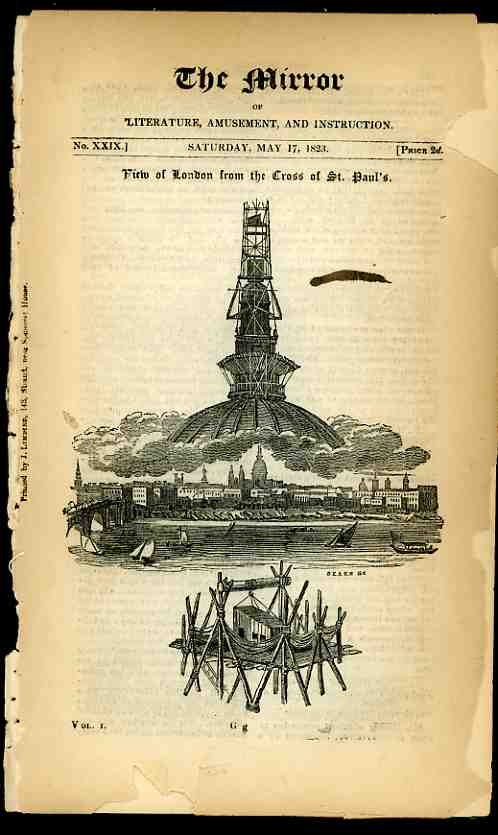
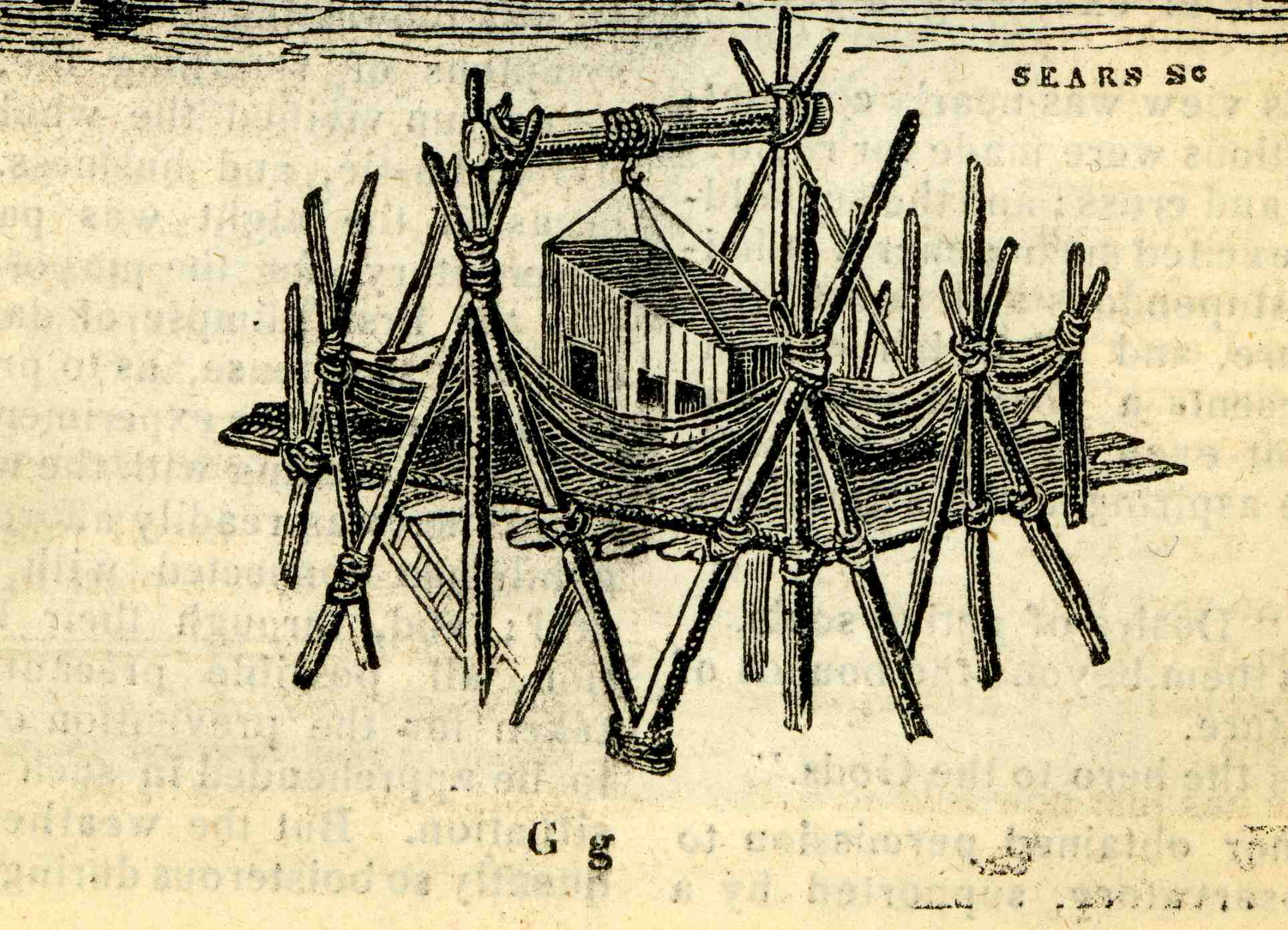
    Before satellite imagery, before airplanes, before balloons, and before photography, the only way of obtaining large-scale and factual panoramic views was to get to a good observation point and draw away.  Thomas Hornor (a surveyor and panoramist, 1785-1844) did just such a thing in 1821:  taking advantage of the cross being removed for cleaning from the top of St. Paul’s (London), he somehow convinced the powers-that-be to allow him to construct an observation post for himself in its place for  a long term, uninterrupted and altogether fabulous view of the city of London.  He set up shop up there, about 400 feet above the ground, and stayed, making minutely detailed drawings of the cityscape, working with a telescope and a great deal of reserve.  And some amount of courage–we can see from this detail of his story published in The Mirrour in 1823 that his shack was, well, not the safest-looking shack that has ever been built atop a cathedral. 

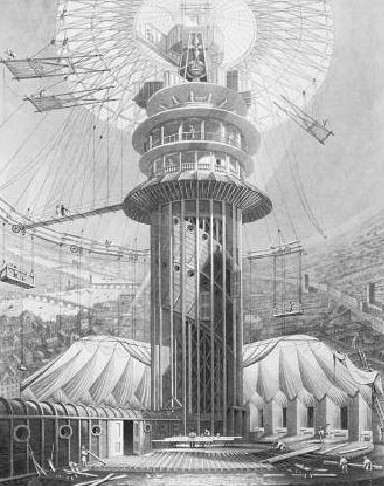
    The end result was an enormous, fantastically detailed acre-sized painting which was installed and displayed in Decimus Burton’s Colosseum. The installation was as much an artwork as the painting–it was affixed to the walls and people would view it from a multi-story observation deck in the middle of the building.  For those who didn’t want to climb the stairs to get to the viewing room,  an “ascending car” was fabricated, making the structure one of the earliest buildings to have an elevator.  There is some sort of irony in that:  people would pay to see a painting using London’s (perhaps)
    0 blog dec 30 room at the top329

    first elevator to get to the top of a small structure inside another
    structure to see a painting made from the top of a large structure of a
    scene that could be viewed for free by walking outside.  Nonetheless,
    the fantabulous painting was viewed by more than a million  people
    before moving on.

    I have a feeling that this may be an interesting category to develop (a “room with a View” that is), pursuing other rooms in other tall places. 
    For example the last little triangular window is the hole in the sky for something at the Chrysler Building in NYC.  I had heard that it was initially a bathroom that was built for the avuncular Mr. Chrysler, so that he could do his
    Hornor2

    business higher than anyone else in th world, which seems to have
    fitted his personality.  After all, he did his fair share of this
    behavior, having dumped on people of all shapes and sizes, not the
    least of whom included the architect for his spectacular
    building, William Van Alen.  He was stiffed by Chrysler because of
    mysterious and misbegotten ideas arising from old Walter’s temperamental
    and stingy belly–that dear readers takes a lot of ____, not paying the
    architect who designed the world’s tallest building and then to put his
    name on it.  

    I should mention that this little room in the Chrysler building pops up every now and then, perhaps most famously in Kurt Vonnegut’s Jailbird, where beautiful Kurt stuffs the head offices of the American Harp Company.

    Check out Stephen Oetterman’s The Panorama, a History of a Mass Medium (1997) and Bernard Comment’s The Panorama (1995).
  • Shakespeare in America: Mother Goose, Jumbo and P.T. Barnum

    JF Ptak Science Books LLC  Post 421

    ShakepeareDedicated to David Robinson

    There are some squinty-eyed connections between one of America’s greatest printer/publishers (Isaiah Thomas), William Shakespeare, Mother Goose,  P.T. Barnum and Jumbo the elephant.  There are clear connections at the two ends of these relationships, but what is the thin corpus callosum that completes this house in which the Mother Goose-Jumbo lineage happily live?  (There’s a hint in there:  “house”)

    Isaiah Thomas was the first person to put Shakespeare into print in America.  For some reason, the Bard had escaped publication on our lovely shores until 1786, when Thomas, an innovative and savvy businessman and reader, published (not for the first time) some of the Mother Goose stories (Mother Goose’s Melody, or, Sonnets for the Cradle: In Two Parts…*) and included, as a toss-in, hanging out in the back of the book, some of Shakespeare’s sonnets–the first time Shakespeare was printed in America.  At the end of Mother Goose.  It would take only a decade for all of Shakespeare’s work to be put out in a collected edition (in Philadelphia, by Samuel Johnson in 1796), but for some reason American appetite for this impossible talent was fed by British publishers, the keepers and controllers of The Memory.

    The “house” in question here is Shakespeare’s own, and in folds nicely into the Jumbo part.  The deal was that, somehow, the Bard’s Stratford residence was up for sale.  It was Barnum’s (1810-1891)  idea to purchase the place, cut in into little pieces and ship it across the ocean for display in his New York location, and then, perhaps, to cart it around the country.  The British heart turned inside out and was instantly covered with marble crumpets at the breadth of the idea–the house was instantly removed from sale and declared a National Treasure, to be saved forever in England.  Which seemed like a good idea when faced with the alternative–how it could’ve come to pass that Barnum could’ve gotten so far in the purchase plans and negotiations is a little beyond me.  (I can see it now–Barnum moving the Bard’s house out in little bits, at night, to waiting wagons, just like the way the Colts were stolen from Baltimore, Johnny Unitas’ soul twisting slowly in the swirling, blizzardy wind of that night.) 
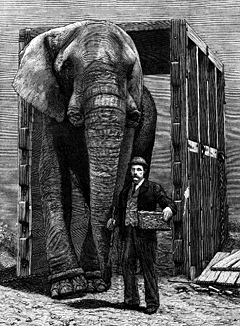
    Jumbobw

    Barnum’s brain** turned into an itchy scab, and the way he scratched it would be to buy Jumbo (1861-1885), the world’s largest elephant, from the London Zoo.  The Brits were furious over this, too, but since we’re talking elephant and not Shakespeare, the annoyance passed, probably as soon as the fartacious Barnum lifted his foot from British soil.  Poor Jumbo toured the country and wound up being squashed by a locomotive in Ontario, his skin going to the Natural History Museum in D.C. and his heart to Cornell.  Barnum’s body simply went into a box and into the ground.  Mother Goose’s body too wound up in the earth for a comfortable dirt nap.  Shakespeare’s body isn’t in his tomb.

    *Thomas, Isaiah, William Shakespeare, and Oliver Goldsmith. Mother Goose’s Melody, or, Sonnets for the Cradle: In Two Parts : Part I Contains the Most Celebrated Songs and Lullabies of the Good Old Nurses, Calculated to Amuse Children and to Excite Them to Sleep : Part II: Those of That Sweet Songster and Nurse of Wit and Humour, Master William Shakespeare : Embellished with Cuts, and Illustrated with Notes and Maxims, Historical, Philosophical, and Critical. Worcester (Massachusetts): Printed by Isaiah Thomas, and sold at his bookstore, 1786.

    **Barnum’s first name was Phineas, as is the first name of Mr. Gage, a railroad worker who survived a spectacular accident in which a large metal tamper was exploded through his skull and brain, removing a frontal lobe.  Maybe there is a connection, maybe not. (Sorry.)

    An Estimate of the Number of Shakespeare’s Atoms in a Living Human Being 
    “It straightforward to determine the number of Shakespeare’s atoms that enter a person each day through breathing, drinking and eating. The result is almost 20 billion. That means that, even if one’s body were cleansed of the playwright’s atoms, it would only take about 10 days to return to “normal.” If you live to 75 years, some 500 trillion of his atoms enter you during your life. After we’ve lived a while, our direct knowledge of Shakespeare is rather substantial, which proves the statement that education is a lifelong endeavvor. The only reason why you have just 200 billion of his atoms in you is that you are also losing his atoms at virtually the same rate as you are gaining them, as the analysis on equilibrium in Part I above makes clear.”

    ·Posted by :

    ·in:


  • The Future of Future Truisms: David Byrne’s Knee Plays vs the Fat Man Nuclear Warist, Herman Kahn

    JF Ptak Science Books   Post 407

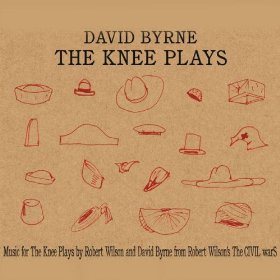
    0-blog-dec 3 byrne David Byrne, former Talking Heads member, produced a series of twelve short pieces to be used in the Philip Glass (and Robert Wilson*) Opera CIVIL warS  in 1985. (“Opera” may not be the right word for this piece, as I think it was one only in so far as the composition needed an opera house to be performed in.)   The Byrne pieces, called ”Knee Plays”, were meant to fill in the spaces, the spaces in-between,  place holders, between the sections of the day-long multimedia production..  Glass had used this idea of inter-pieces to the whole earlier in 1976 in his at-the-edge Einstein on the Beach, in which the connective elements were meant to not only join the pieces of the production together, but were also meant to stand alone, as a cohesive unit, if removed from the opera.  (Glass said they were “short connecting pieces which appear throughout the work much as prelude, interludes and post-ludes. Taken together they form a play in themselves”)

    0-blog-Dec 3 David_Byrne1991

    One of the Knee Plays, “In the Future” (Knee Play Number 12) is a slippery, stacatto brass section accompanying Byrne’s 51 sophisms about life in the future.  About thirty years earlier, “futurist” and think-tank-filler (or maybe it was “Think Tub”?) Herman Kahn (1922-1983), occupying a lot of space at the RAND and Hudson Institutes  (he was also known in many circles as the “Fat Man”), diligently recorded his myopic views of the future. He is generally regarded as a systems theory and military strategy guy, and is most remembered for (as he claims, perhaps) introducing the term “Vietnamization” which described the ultra-failed de-escalation (?) process and withdrawal for the United States from Vietnam (attention Obama administration).  Superluminarily speaking though his contribution to thought on constructing and implementing thought regarding nuclear weapons exchange (pointless to refer to this as “war”) in two books, Thinking About the Unthinkable (1962) and, On Escalation (1965), where he famously put The Bomb on the table of use possibilities.  In addition to these books—which he is busily trying to forget out there in his afterlife, somewhere, maybe in a penitential place where you are forced to think endlessly about paths-to-bad-decisions) is that 1967 peek into the future, The Year 2000.  Petroleum and oil are not issues.  Computers are of minor societal importance.  And then other things of no importance happen.

    0-blog-dec bryne kahn When you take Byrne’s Knee Play  12 and place it next to Kahn and other mis-spent prognosticators, the musician looks positively brilliant.  Some of the stuff has come to pass, some hasn’t; some will, and some won’t.  Some are open to a little interpretation, and some, a lot.  Overall, though, if you think through these little future buillets a little carefully, David Bryne looks very good.  Byrne’s lyrics/list is below.

    *Robert Wilson is a phenomenal conceptualist and theatrical designer.  On the liner notes to CIVIL warS is found the interesting note on Wilson and Byrne:  “At first, Robert Wilson asked David to compose pieces for several sections of The CIVIL warS, but on account of David’s limited time, he composed only The Knee Plays part. The CIVIL warS was supposed to be played in its complete form at the Olympic Games in Los Angeles, but if one plays every part, it takes at least eight hours. There was also a financial problem for playing every part. So only some parts of it were staged there. David himself was very interested in composing for such a play and dance and this time again he enjoyed this work very much. Last time, for The Catherine Wheel, he used recorded tape, but this time he made musicians play on the stage.”

    IN THE FUTURE (KNEE PLAY 12)

    In the future everyone will have the same haircut and the same clothes
    In the future everyone will be very fat from the starchy diet
    In the future everyone will be very thin from not having enough to eat
    In the future it will be next to impossible to tell girls from boys, even in bed
    In the future men will be ‘super-masculine’ and women will be ‘ultra-feminine’
    In the future atomic fusion will enable us to build a skyscraper with
    the energy obtained from a grain of salt
    In the future through genetic surgery there will be a race of menial
    workers, studs, ‘whores’, TV personalities and politicians
    In the future half of us will be ‘mentally ill’
    In the future there will be no religion or spiritualism of any sort
    In the future the ‘psychic arts’ will be put to practical use
    In the future we will not think that nature is beautiful
    In the future the weather will always be the same (relative to the way it is now)
    In the future no one will fight with anyone else because anyone can
    be anything he or she want to be
    In the future there will be an atomic war that will reduce the survivors to savages
    In the future water will be expensive
    In the future all material items will be free
    In the future everyone’s house will be like a little fortress
    In the future everyone will think about love all the time
    In the future TV will be so good that the printed word will function as an artform only
    In the future people with boring jobs will take pills to relieve boredom
    In the future everyone but the wealthy will be very happy
    In the future everyone but the wealthy will be very filthy
    In the future everyone but the wealthy will be very wealthy
    In the future communication/distribution systems will be so good that no
    one will live in cities
    In the future farming will be managed through a nationwide computer hookup
    In the future there will be mini-wars going on everywhere
    In the future political and other decisions will be based completely on opinion polls
    In the future only the very wealthy will be able to travel or move out their houses
    In the future individuals with soldier inclinations will go out for ‘killer’ sports
    In the future there will be machines which will produce a religious
    experience in the user
    In the future there will be a classless society, no one richer than anyone else
    In the future people will constantly be having plastic surgery, altering
    their features many times during a lifetime
    In the future there will be many mass suicides
    In the future there will be groups of wild people, living in the wilderness,
    who will rob suburbanites
    In the future there will be only paper money which will be personalized
    In the future everyone will only get to go home once a year
    In the future everyone will stay home all the time
    In the future we will not have time for leisure activities
    In the future we will only ‘work’ one day a week
    In the future our bodies will be shrivelled up but healthy and our brains will be bigger
    In the future there will be starving people everywhere
    In the future no one will be able to afford TV or newspapers, resulting in
    no one knowing what’s going on
    In the future people will live in space
    In the future only the very wealthy will have pets
    In the future the poor will be regulated by the rich
    In the future the crippled, retarded, and helpless will be killed
    In the future everyone’s house will be a total entertainment centre, with
    video, pills, dancing, sex tools, holographic movies, and game machines
    In the future everyone will have his or hers own individual style of very way-out clothes
    In the future we will all eat our favorite foods, only they will all be synthetic
    In the future we will fuck anything, anytime, anywhere
    In the future there will be so much going on that no one will be able to keep track of it


  • Hero’s Stairs to Nowhere: an Intolerably Small Look at a Great and Important Book

    JF Ptak Science Books LLC  Post 356

    000-ebay--Nov 1 heron978
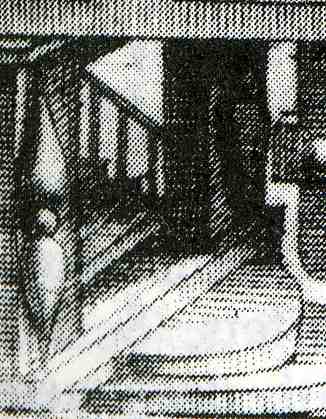
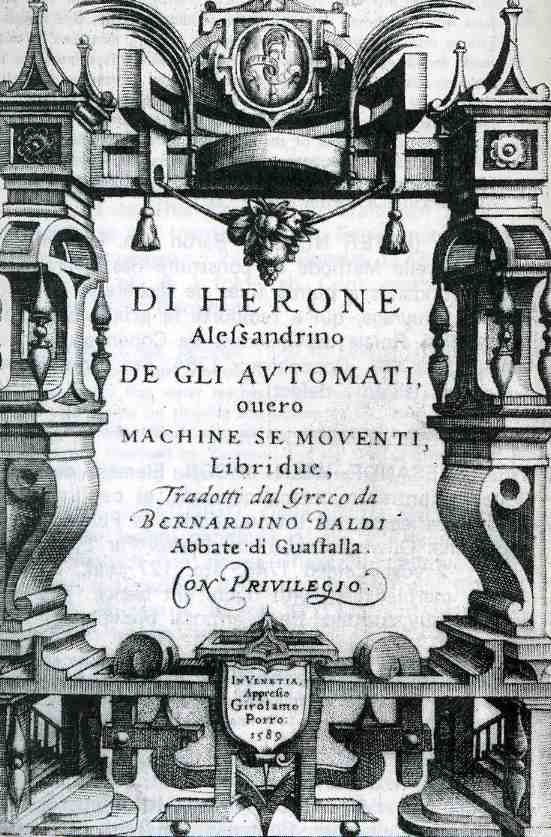
    And so here we have a gorgeous title page for the very first treatise on automata, and the thing I’m focusing on are the stairs in the bottom corners of the design, the stairs that go nowhere.  Maybe its just because of the seemingly flat effect of the perspective that they became so obvious to me, or the  subtle sense of a twisted two-and-a-half dimensions feel to it, the very Escher-y feel of complex, impossible and improbable dimensionality.  For example, the very pre-Baroque ornamentation of this very heavy title page construction seem to bounce between convex and concave, like the background and foreground change place somehow, as it the case of Escher’s trying to find a place between planes of two- and three-dimensional representation.  Although here I’m pretty sure the effect is unintentional; whereas in Escher, the effect is the aim of the art. 

    000-ebay--Nov 1 heron977

    The design and the printing of this large book was the work of the firm of Bernardino Baldi, of Venice, who published De gli avtomati oueri machine se moventi...in Venice in 1589, the original by Her/Heron of Alexandria, who lived ca. 10-70 ACE.   Hero was one of the most exalted of Greeks in the pantheon of ancient experimenters and scientists, an unparalleled inventor and producer of the earliest automatic and robotic devices. Have a look at  the illustrated link to Hero’s fabulous work called Penumatics (below).


  • A Sea of Hats: 1915

    JF Ptak Science Books LLC  Post 364

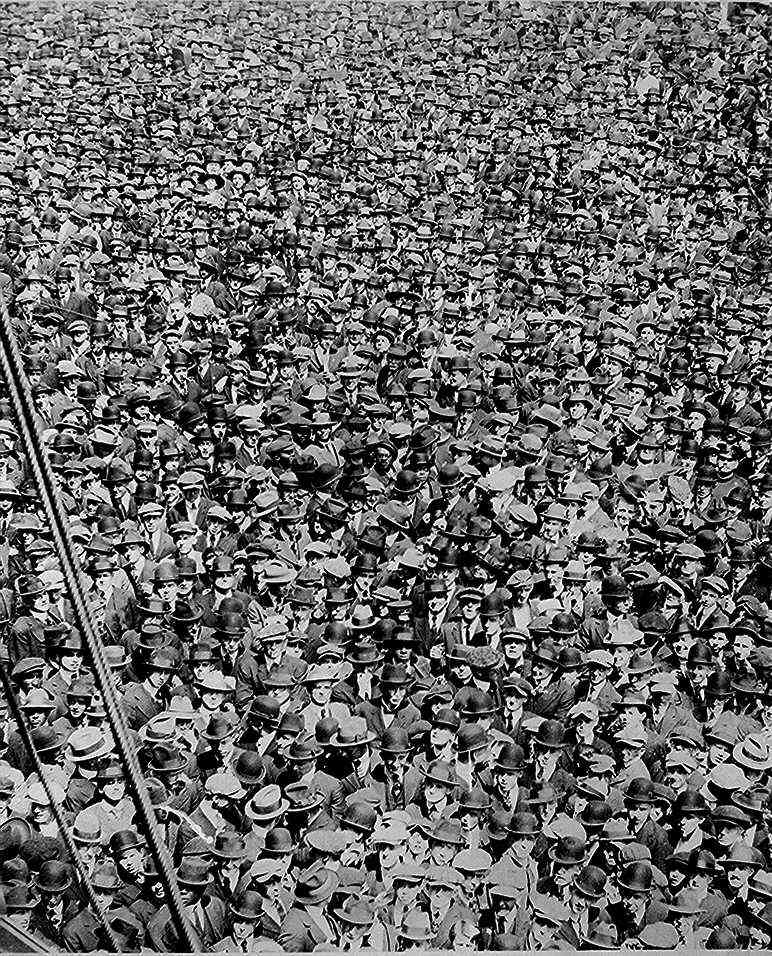
    Hatsdetail Another extraordinary image of pressed-together humans, of a human sea, a carpet of hatted men.  And believe me, every person in this image of (I’d say) approximately 5000 men has got a hat on.  There are hundreds of folks in the photo who re aware of the photographer and who are looking right at the camera, but there is only *one* person who is lifting his hat to the photographer. 

    I don’t have much to say, and I have nothing to connect the photo to (know); I just wanted to surface it before I lost it again….

    Hats


  • The Tomb of Broken Dolls–an Appeal for Respect for Outgrown and Disabled Toys

    JF Ptak Science Books  Post 349

    “No two toys are ever broken in the same way or with the same emotional results.” RobertGraves, Poetic Unreason

    000-ebay--Nov 1 doll tomb975


     I first wrote about this fabulous idea–a tomb or memorial for broken and lost toys–on this blog almost three years ago–it still seems like an utterly fantastic practice.

    000-ebay--Nov 1 doll tomb975

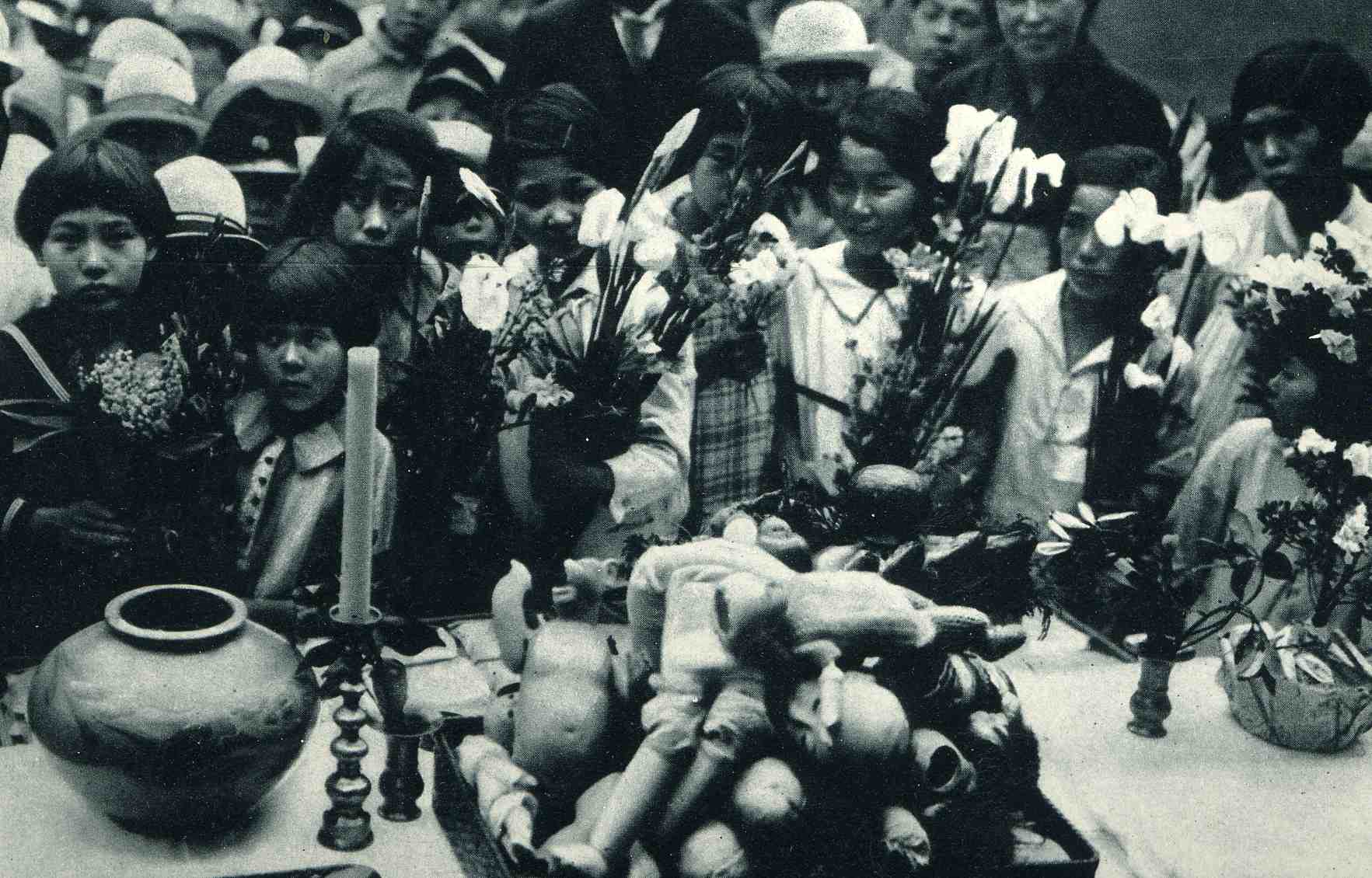
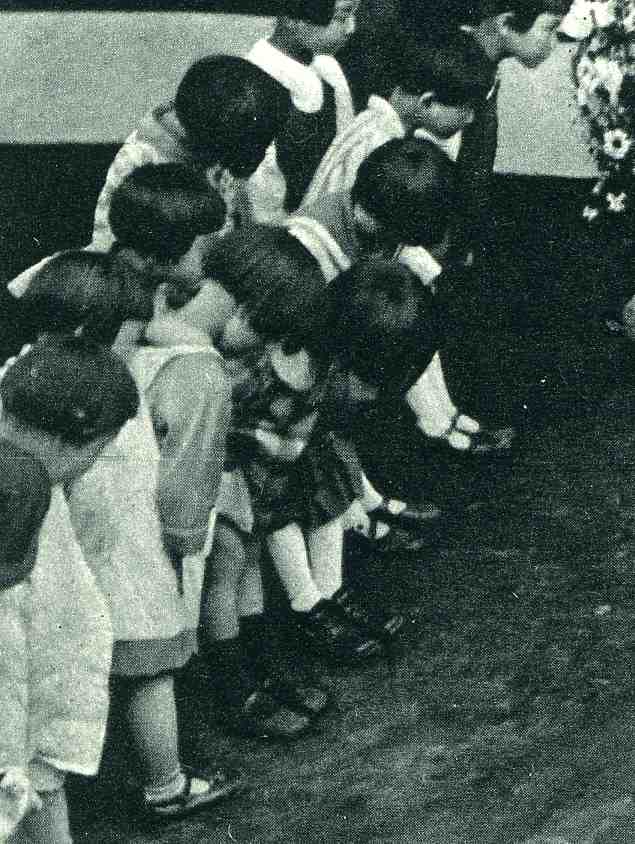
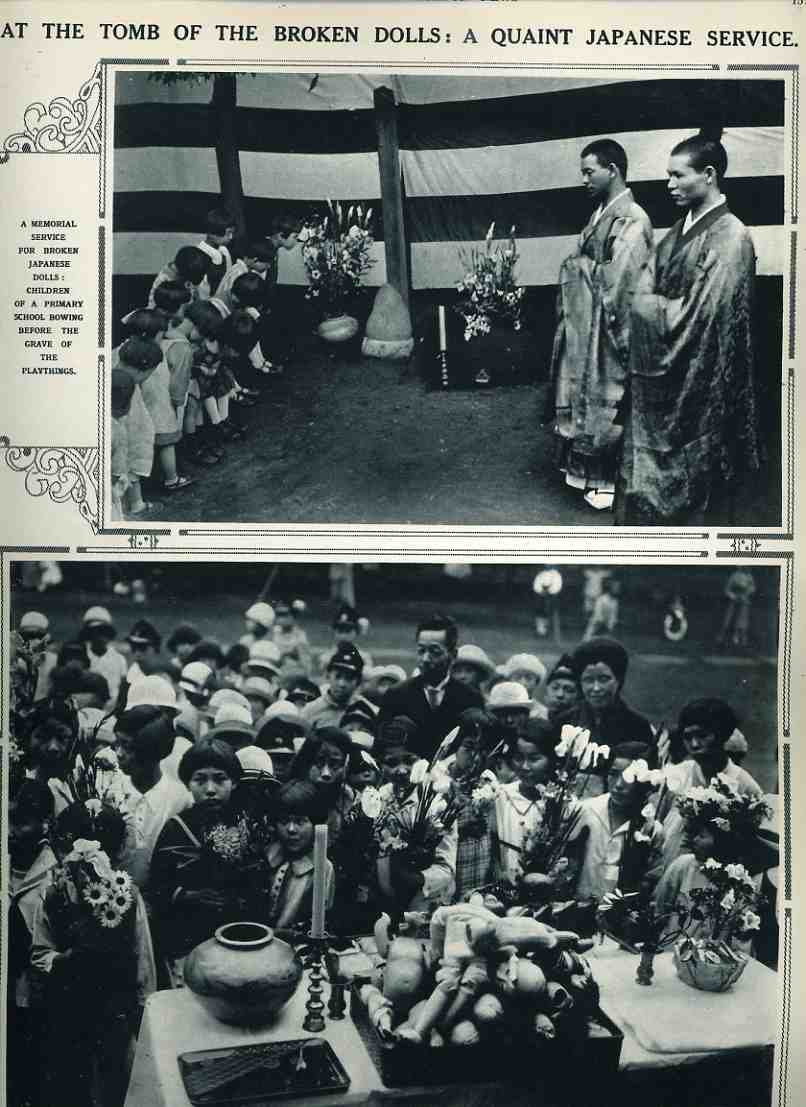
     This is an absolutely outstanding concept, and I simply have no notion as to why we don’t have such observations in the United States.  (The following two details are from the larger images, below, found  in the 27 July 1929 issue of The Illustrated London News, page 157.) The story provides these two pictures and unfortunately scant details of the ceremony which was held at the Imperial Primary School at Sugamo, Japan. 

    The first photo shows the detail of children offering flowers for the altar on which their tray of broken dolls is being venerated; and to the right is the detail of children bowing to the grave of “broken playthings”, though the markings on the (grave?) stone indicate that it is for dolls.  It also seems to be a marker for a mass of toys, not that each toy would have its own marker; I suspect it to be enough to have a place where allot of kids could come to venerate objects in which they might have invested countless hours of their time, effort, attention and affection.  That it is a shared place and experience makes the monument all the more so powerful.

    000-ebay--Nov 1 doll tomb976

    There are few better things to teach a child than to pay respects for something that has given them pleasure or helped them, or, say, for returning the love which has been showed them from their doll or toy.  It has always struck me as not-quite-right that a toy can be a beloved object one day and a dust-magnet the next, destined for the trash heap.  Certainly these are holy objects in themselves, and deserve a better and more kinder fate than being mixed with broken glass and greasy unmentionables. 

     000-ebay--Nov 1 doll tomb974


    Are there greater things to be concerned with?  Yes, of course, but only on the face of it–I think that helping kids understand the underlying dignity of inanimate objects such as their playthings could give them a greater awareness for the other seemingly invisible things that they will find throughout their lives. Further I think that a visible, constant reminder for these objects would be really more like a memory-monument for a period of time, a place in nearly everyone’s life in which held a certain purity and promise, a protected and beloved frailty of the human experience shared by all.  I can honestly think of no other monument that could reach across religious or philosophical or belief systems to arouse a feeling of common goodness than this. Everyone has had a toy that they’ve loved, and I have no doubt that if remembered these would be powerful emotions, and could be about the most common denominator we have on the planet.  I can think of no divisive element in such a monument of veneration.


  • The Department of What Things Look Like: the Casualties of the Somme, Visualized

    JF Ptak Science Books LLC  Post 323

    00blogoct_16crowds865_2I wanted to return to a post for a few days ago on what victory looks
    like in relation to the sub-war/Battle of the Somme in 1916,tying to
    relate the staggering proportions of the 1.5 million casualties from
    that action to a photograph of a group of people.  This is not terribly
    easy to do, especially without using images that are iconic standards
    of “large crowds”, or even images that can be image-googled. I have
    found two interesting images, though—one real, and the other, well, the
    other one I made.  (This is the only image of the 1200 images that I
    have posted to this site that I have altered or created, just for the
    record,)

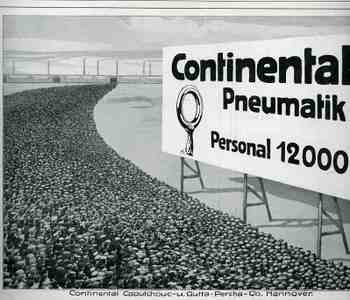
    The first image comes from the Illustrierte Zeitung (Leipzig),
    for October 1910.  It presumably shows the 12,000 employees emerging
    from the factory of Continental Pneumatic Tires, only I make the crowd
    out to be more like 40-50,000  That means that the casualties of the
    Somme would be thirty (30) of these crowd scenes, end-to-end.  30.

    00blogoct_16crowds866

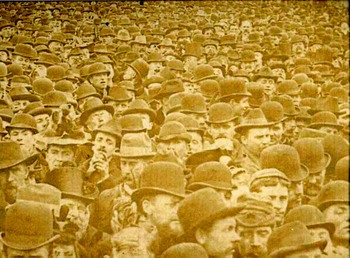
    The next image is a montaged photo, a photo of hats, taken about 12
    feet off the ground or so, but a sea of hats that attaches faces to the
    hats, unlike the sea of hats in the image above it.  This is a sea of
    faces, giving a better sense of humanity to the sea of bodies.  There
    are perhaps 500 people in this photo, meaning you’d need 300 of them to
    illustrate the Somme casualties.

    It all still pales in comparison to the actual numbers.  Victory still looks not so victorious.


  • Not the War of the Worlds II—Ripping Off H.G. Wells

    JF Ptak Science Books  LLC   Post #109
    Blogwelllsgoble

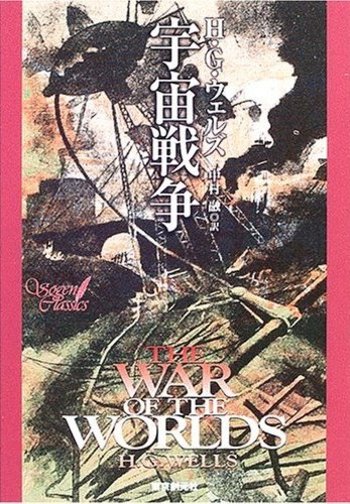
    Herbert George Wells’ War of the Worlds was one of the very first efforts in modern history to reverse the outward-bound human trend of reaching out—he introduced aliens and the big idea of aliens (other than god or gods) coming to earth and doing us harm.  He wrote WOTW in the third year of a very rollicking decade-long intellectual purge that would change the face of science fiction writing in Western lit, changing the idea of fantasy science, replacing burnt brain stems with powerful, well-written ideas.  (In the period 1895-1905 Wells wrote The Time Machine (1895), Island of Dr. Moreau (1896), The Invisible Man (1897), WOTW (1898), The First Men in the Moon (1901), When the Sleeper Awakes (1899), Anticipations (1901), the Discovery of the Future (1902) , A Modern Utopia (1905), among others*.)

    Wells (born a year after the American Civil War ended and died a years after WWII ended) was a huge thinker and a gifted craftsman, with big ideas that he was able to put into simple, well constructed forms that were enormously popular.  (Orwell remarked that Wells was the most read person in English in the 1900-1920 period.)

    The prescient, observant futurist, Wells sought to also protect his own future in regards to his work, particularly with the WOTW—he secured all serial and reprint rights to the work in the United States, where it was being published in installments simultaneously by two different magazines.  But rights be damned, as the magazine editors changed the story to suit their regional needs, painting the work in putrid reds and mauves to such a degree that the enraged Wells—who could do nothing about any of the changes–paid it a salty goodbye in the U.S.

    But I think the major intellectual theft occurred in the weeks following the finale of the installments.  An American popular science writer, Garret P. Serviss, was contracted by the Hearst Newspaper group to pick up the WOTW story where Wells had ended it.  It would be continued—rather the story was stolen so that it could be twisted into another form—as a short novelette, problematic because of its interesting reach, but a problem nonetheless.  Serviss was a popular but modestly gifted writer, both rising and falling to the occasion in the wake of Wells.  His work, Edison’s Conquest of Mars, an intrepid journey in another man’s shoes, featured Thomas Edison raising an army in space ships, hell bent on getting to Mars to extract revenge for a dismembered, fractured earth, rendered nearly impotent by Wells’ Martians attacks.

    Edison et alia make it, and all sorts of first-time stuff happens—the first “phaser” weapons are introduced, mid-space attack and counter-attack, asteroid mining, and lots of other things of concern in the originality of science fiction ideas.  Unfortunately it was all borne on the back of a stolen series of ideas and story, and those happened to belong to Wells.

    Here’s something worth noting, though—Serviss’ work may be one of the only instances of employing Wilhelm Roentgen, (the discoverer of the X-Ray (in 1895) and recipient of the first Nobel Prize in physics) and Lord Kelvin (perhaps the most eminent of English physicists of the late 19th century) as heroic members of a Martian attack force.  Throw in the magnificent but moral incompetent Thomas Edison, and you have a unique real-life triumvirate employed in the telling of a stolen fantasy who, fortunately or not, come up with some really good, and early, ideas.

    *The full 1895-1905 list from the HG Wells Society is very impressive, as is the whole of his output:
    1895
    Select Conversations With an Uncle
    The Time Machine
    The Wonderful Visit
    The Stolen Bacillus, and Other Incidents
    1896
    The Red Room
    Island of Dr. Moreau
    The Wheels of Chance
    1897
    The Plattner Story, and Others
    The Invisible Man
    Certain Personal Matters
    1898
    War of the Worlds
    1899
    When the Sleeper Wakes
    Tales of Space and Time
    1900
    Love and Mr. Lewisham
    1901
    The First Men in the Moon
    Anticipations
    1902
    The Discovery of the Future
    The Sea Lady
    1903
    Mankind in the Making
    Twelve Stories and a Dream
    1904
    The Food of the Gods
    1905
    A Modern Utopia
    Kipps: The Story of a Simple Soul


  • The Best Images of Horses, Ever: Hans Beham and Perspective, 1528

    JF Ptak Science Books LLC Post #105
    Blogmodel_bookhorses129

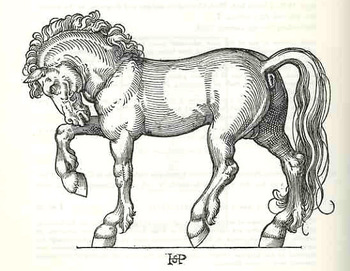
    Hans Sebald Beham wrote—produced, rather, the text and illustrated—Dises buchlein zeyget an und lernet ein mass oder proporcion der Ross, nutzlich iungen gesellen, Malern und goltschmiden, a tremendous, inspired model book for artists and observers, back there in 1528.  Amidst the heavy, blocky Gothic type of the book lie a series of just beautiful, proportional studies of horses.  It is probably the single greatest illustrated work on horses done in the history of printing to this time; and it has stood the test of time as a work of art, rather well.

    It is also, evidently, the work of an anti-Lutherian and certified “godless” painter, expelled by the city of Nurnberg (along with his brother and as it turns out the subject of yesterday’s Saturn post, George Pencz).  He, and his brother Barthel, and Pencz—with whom he shares birth and death dates of 1500 to 1550—were shaken by the city half way through his life in 1525 for having bad thoughts about religion and the proper way of not avoiding it. The decision by the city didn’t affect his art, as we can well see
    Blogmodel_bookhorses2130

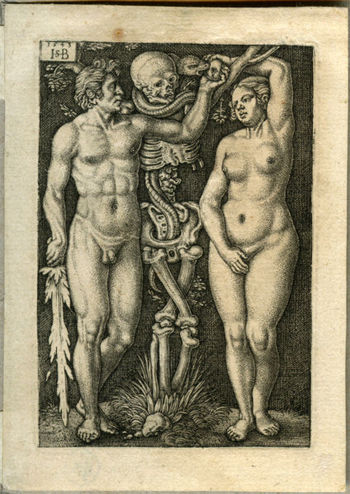
    Beham’s model book on the horse was followed by one on the human figure.  He was an extraordinary talent whose fine, deft touch can be recognized across the room, miniature or not.

    Behamadam_and_eve
     

    ·Posted by :

    ·in:

    —

  • Missing People–[Addition]. Joachim van Ringelberg, 1541.

    JF Ptak Science Books LLC  Addition to Post #88

    I’ve
    found another extraordinary image that would fit just perfectly in an an
    earlier post, Missing People—Pelerin, Schoen and Marey and Picturing Absent and
    Empty People for the Study of Perspective
    .

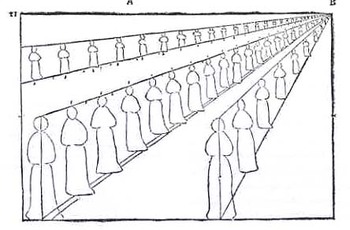
    Blogmissing_add107
    This
    wood engraving comes from the Flemish Joachim Sterck van Ringelberg’s (1499-1536
    or so) book Lucubrations, printed in Basel in 1541 Ringelberg was one of those famous wandering
    scholars from the first half of the 15th century, and the book was no doubt constructed for the use of his pupils. This is one of about 30 books that Ringelberg
    wrote–he intended to wrtie a thousand, but times being what they were, and
    living to only 37 or so, he fell short of the mark. He did produce quite a lot
    though given his youth, the hardship of travel, access to published works, and
    tools, and general annoyances of the 16th century traveler who was not a
    royal. It is really quite
    remarkable. Ringelberg taught a wide
    range of subjects belying his quest for M books–he was competent in astronomy,
    mathematics, literature, classics (of course) , and languages.

    This “missing people” image comes from a section of this book dealing
    with perspective. I’m just endlessly
    entertained trying to get inside the head of a 16th century student seeing
    these empty, missing, place-holder human forms for the very first time. As I’ve said earlier, these figures just
    don’t occur in Western art.   


    ·Posted by :

    ·in:

    —