A Daily History of Holes, Dots, Lines, Science, History, Math, Physics, Art, the Unintentional Absurd, Architecture, Maps, Data Visualization, Blank and Missing Things, and so on. |1.6 million words, 7500 images, 4.9 million hits| Press & appearances in The Times, Le Figaro, Mensa, The Economist, The Guardian, Discovery News, Slate, Le Monde, Sci American Blogs, Le Pont, and many other places… 5000+ total posts since 2008.

Category: Perception

  • What Victory Looks Like: the Battle of the Somme and the Thin Line Between Winning and Losing

    JF Ptak Science Books  Post 317

    In a play on the concept of the Powers of Ten, I had a look at a photograph depicting the French victory at the Somme; or was it a British victory?  Or German, via the lure of the others to a semi-victory?  Its hard to say who won, or if there really was a winner.  The Battle, which looks to me to be a sub-war within the war, occurred over the period of July through November 1916.  When the smoke settled, there were some 1.5 million casualties on both sides.It has long been held that the battle really was won by someone, the British, the French; but there was so little that was accomplished by the action that there probably wasn’t a winner, just losers. 

    00blogoct_14somme850_2

    And big losers, at that: Great Britain, Canada, Australia, New Zealand, Ireland, South Africa and Newfoundland lost 419,654 casualties, with 95,000 killed; the French lost 204,000 casualties and 50,000 killed.  That made a total of 623,000 casualties and 146,000 killed for the allies; Germany lost 465,000 casualties and 164,000 dead.  The advances made along the battle front went a few miles one way and then the other along a 12-mile stretch of battlefield, which four lives were traded for every inch gained along that porous front.

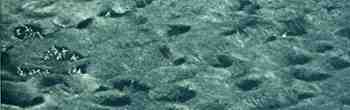
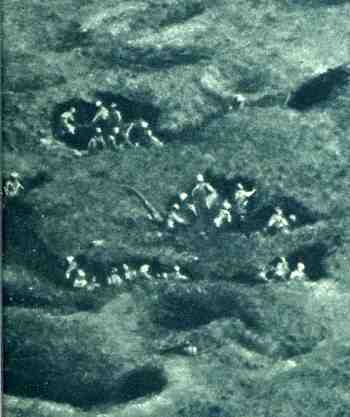
    The first image here (above)  is a very sharp detail from the overall picture published in The Illustrated London News for 6 January 1917, representing about 1% of the entire photo

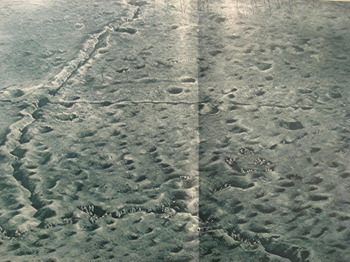
    The next image places the micro-detail in more context; this detail is itself about 5% of the main image, which is found just below this one.

    00blogoct_14somme849_2

    The overall image from which these two details are removed is below. In turn, this large image is but a small detail of the greater overview of the battlefield, making up perhaps a few percent of the field of operations. 

    I’m trying to get a feel for the enormity of the battle, but I really can’t, not even via powers of ten, manipulating the idea of orders of magnitude.

    In one last try, I hypothesize that the 1.5 million casualties could not be displayed in 10 of these large images.  .

    That wouldn’t look like victory at all. 


    Ballistics_123


  • “Getting it” Backwards: Sanctorius’ (1676) Medical Invention, Spongebob, and the Alaskan Bull Worm

    JF Ptak Science Books   Post 309

    Alaskanischer_stierwurm
    By virtue of my children I think that I can safely say that I am now a stone-cold expert on Spongebob Squarepants, and if I tried just a little I could use it to reference just about anything. (This is also the case with The Simpsons, though I really didn’t need much excuse from my older daughter, Emma, who was/is a fan, to watch them.)  In one episode of SBSP, Sandra “Sandy” Cheeks, the underwater deep-sea-diver-outfitted “land” squirrel and close friend of SB, decides that since she is from Texas she can do anything, and attempts to wrestle the enormous Alaskan Bull Worm which has invaded their home of Bikini Bottom and taken her tail.  (I’m horrified to find that someone has transcribed the hundreds of SB epsiodes, god help them. And just for the record and to show I might be as removed as these folks, I’ll point out that in addition to getting most of Sandy’s tail, the worm also eats the “Welcome to Bikini Bottom” sign, a wheelbarrow, the homework of two children, the butt of a fish (twice) and most of SpongeBob’s pineapple house. There.)  So yadda yadda yadda she finds herself wrestling the worm in a cave against SB’s ignored and interrupted warnings.  She subdues the huge beast, and announces her victory.  SB gently corrects her, saying that what she was wrestling was just the tongue of the worm, and that the cave was its mouth, and that it was waaaaay bigger than Sandy had ever imagined.  The whole thing dawns on her slowly, [Sandy: “Ohhhhhhhh. This is the tongue, and… (trailing off) the whole thing… is the… worm. (freaks out) RUN FOR YOUR LIFE!!! “(she and SB sprint away; the worm growls angrily, chomps down, and chases after them)]   SO.  So Sandy just misses the big picture that was staring her square in the face, concentrating on the one detail she thought she could recognize and handle.

    From recognized oversight comes epiphany!

    1blog_oc_t11sanctorious811

    And such is the case with my reaction to the wood engraving here, concentrating on the use of the apparatus and how out of proportion its physicality was with its function.  And until I started reading about it I missed its monumental importance completely, concentrating as I was on the thing I thought I knew. 

    I was having a wide swipe at a man who is seen by nearly all authorities as being the founder of the physiology of metabolism.  The man is Santorio Santorio* (1561-1636, and who was also known as Santorio Santorii, and Sanctorius of Padua), and the image is from his Medicina Statica, or, rules of Health, in eight Sections of Aphorisms…English’d by J[ohn] D[avies], printed in London for John Starkey in 1676. (this is a reprint of the fourth edition of 1737, following the first edition of 1614.)  For many years Sanctorius weighed and measured just about everything that went into his body and everything that came out of it.  One of the principle instruments used by him in this process is the famous weighing chair, which was (seemingly) laboriously suspended from a device in the floor above the dining room.  the net effect of all of this (as we see in the illustration) was that, after eating began, once the chair touched the floor it was the signal to stop.

    What I was missing in this, what I didn’t put together and what I didn’t ask myself was where did this apparatus fit in the history of this sort of thinking?  The more substantial question yet was what other sorts of machines were employed in determining metabolism in humans?  The answer to the second question is “none”–this is the first time that a machine was used in this sort of analysis. Actually, it is the FIRST man-machine interaction of any sort in the history of medicine. And the answer to the first question is that this was the first time that data had been collected and analyzed  such a longitudinal and coherent fashion. 

    So I missed the whole thing, making fun of this enormous piece of machinery that would be used to tell someone when to stop eating, wrestling the Alaskan Bull Worm’s tongue in my own little cave.

    * According to the great bibliography of Garrison and Morton on the history of medicine, “Sanctoris was the founder of the physiology of metabolism.  He introduced into physiology exact methods of measurement, pulse counting, temperature determinism, and weighing”.


  • What Things Are Not Department: Life, Cityscapes, and the Virgin Mary in Stone.

    JF Ptak Science Books   Post 305

     1blog_oc_t_9_not_here791

    Stone has preserved the evidences of much of the life on Earth—in the fossil record (which happens to stretch some number of years back before 4004 BCE contrary to what one of the vice presidential candidate believes), or an arrested day in Pompeii; indeed the entire landscape shows the way life looked by filling in the negative of what you see today., a negative landscape in a way of what has come before. The City of Rocks, New   Mexico, for example, out there near  Silver City, is a wonderful example of trying to employ your imagination to render in your mind the massive volcano that once stood there, the “City” being the last remnant of its existence. Better yet is the great Ship Rock (hello Officer Jim Chee!), a massive 1,800 foot tall fractured volcanic breccia spire in Navajo Land (Tsé Bit’a’í, in Navaho, “rock with wings”), the internal remnant of yet another massive volcano, though in this case the enormous radiating dykes (igneous rock called “minette“.) exploding away from its base gives you a better idea of the footprint of the missing mountain. You can see this magnificent mountain from a great distance, and it is only when you start to get closer and drive through one of the dikes (that has been separated for the road) that is 20’ tall and still a long way from the base of the mountain that you get a =good appreciation of just how massive it all is. 1blog_oc_t_9_not_here792


    I cannot imagine the gargantuan profundity felt by the person who first realized that the Grand Canyon was formed by erosive forces over previously unimaginable long periods of time, its awesome and enormous silence a negative punctuation to the enormity of the idea.

    Prior to the major discoveries in geology in the 19th century, say from the mid-18th century and earlier, there were many “discoveries” of life in stone—they weren’t very useful and most often were very misleading, but they were, in two words, pretty and unusual.

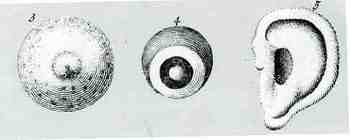
    The people who made and recorded these discoveries were often more circumspect about what they were finding than their readers; sometimes not. Jean-Baptise Robinet (1735–1820) was a French naturalist, Jesuit-philosopher and encyclopediaist (best  known for his five-volume work De la nature (1761-8)) who found all manner of interesting and scientifically-divergent items in stone—eyes, ears, skulls and occasionally an entire body. Antoine J.D. d’Argenville at about the same time in the 1750’s also uncovered silhouettes of dressed human,  birds, cityscapes, trees and the like in stones, which seeped its recordings of the animate into receptive fantasies.

    1blog_oc_t_9_not_here_kircher_793
    But these durable micro- explorations in agate go back thousands of years, expounded by Pliny and some of the other ancients, who followed the origins of humanity back into the rocks. This was a popular idea for the origin of animate beings, propounding itself for centuries, even winding up in the bony lap of Leibniz of all people, who wrote that “men derive from animals, animals from plants, plants from fossils, which in turn derive from bodies that the senses and imagination represent to us as being totally dead and formless”. Stoners therefore held the seeds of the formation of the world; all things living, breathing, and not.

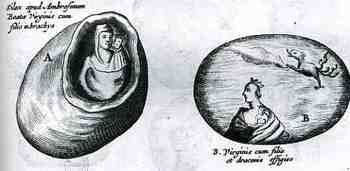
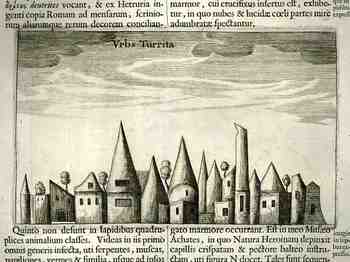
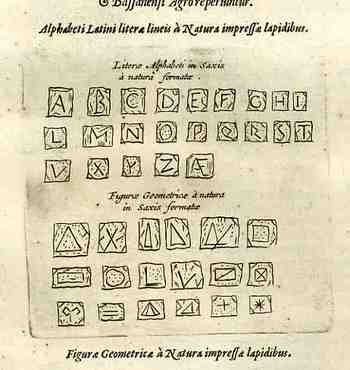
    Our own Athanasius Kircher, the definition of Polymathic ability and superior imagination was responsible for many such observations and discoveries. It seems to me that as much as Kircher gave, he took away, keeping ahead of his critics and the rest of the scientific community with tremendous output…people I think just couldn’t keep up with him. He found all sorts of things in stone: as early as 1619  he exhibited an image of   St. Jerome (in no less a place than the cave of the Nativity in Bethlehem!) that he found in agate. His Munduis Subterraneus (1661) is ahome to a wide range of these objects: quadrupeds of all shapes and descriptions, human full-length portraits, hands with jewels, and even the Virgin Mary and child. AS spectacular as these are there is always more: the magnificent cityscape (reproduced here) and the sublime discoveries of a full set of the alphabet and a series of 15 geometrical drawings, all naturally impressed in stone.

    1blog_oc_t_9_not_here_kircher_alpha

    Perhaps these men gave little more regard to the details in this stone than was necessitated by accepted theory; perhaps they added details to suit their observational needs, as they images were, after all, drawings of the susceptible and the fantastic, and were not photographs. Recording their record was as much open to interpretation as were the theories. I have no doubt that if you look hard enough at things you will at some point find what you are seeking. Only here it is by chance that these figures appeared, and not by the will of a divine creator placing a seed of potential in the stone.

    My five-year-old daughter, Tessie, asked me just the other day about where numbers and letters “came from”. She wanted to know “why are they here?”, which is a fabulous question with a long difficult answer. I do know though that they didn’t come to us from agate. 


  • Deep Discrimination in a Classic of Anti-Discrimination: Japanese Americans and World War II

    JF Ptak Science Books LLC  Post 299

    1ebay_oct_4_these_are_americans744
    For another project of mine I’ve been reading about the
    Japanese internment camps (posting an earlier post here), and just started to
    read some post war material on the interpretation of those actions. The first book I turned to is regarded as a
    liberal (in the classic sense of the word) regard and homage to the Japanese in
    the Hawaiian Islands by John Adrian Rademaker, (a Professor of Sociology at the University of Hawaii 1944-1947), who in 1951
    published These Are Americans: The Japanese Americans in Hawaii During
    World War II
    . It documents the
    contributions made to the war effort by of people of Japanese ancestry living
    in Hawaii, including the Varsity
    Victory Volunteers, the 100th Infantry Battalion, and the 442nd RCT, and so far
    as I can determine is one of the earliest pioneering works to attempt to right
    the significant wrong done to these people.

    In the past I always thought of it as a photographic essay,
    and I’m sure that I never actually read the thing., But this time I, I did, and I was stopped
    almost immediately, half-way through the first sentence.

    It reads:

    “During World War II, I was one of a considerable number of
    persons who were directly concerned with the care and re-establishment of the Japanese Americans in the continental
    United States.”

     To be honest about it, I’m not sure what this means or where it came from.   The rest of the sentences in the 277 pages of
    this book are laudatory and informative and attempt to right the public opinion
    wrongs of the wartime Japanese-American persona. But “care and re-establishment” is awful and
    weird, and stupid—so much so I wonder if the phraselet was stuck in there by
    some zealot editor. Removing 110,000
    Americans from their lives and residences and families and communities and
    businesses, stripping them ¾ of whom
    were American citizens) of their rights, forcing them to sell whatever they
    couldn’t carry at fire sale prices, and then sticking them all in horse stalls
    or deeply removed and very difficult locations for three years is disgustingly-not
    “care and re-establishment”.

    Unless of course the author believed it, and if such is the
    case then he really didn’t understand what happened to those 110,000 people, sociologist
    or not; or at least didn’t get it in 1951.

    He did make a strong case overall for the American Japanese
    in Hawaii being loyal
    citizens/ Rademaker points out that 1,440
    Americans of Japanese Ancestry (AJA) who were detained by local authorities (excluding
    Federal efforts) out of a population of over 150,000 AJA in Hawaii. They were nearly all Issei (first generation immigrants)
    and Nisei (born in the USA)

    From December 7, 1941till the end of the war, some 1,440 AJAs were
    picked up by the authorities. This constituted nine-tenths of one percent of
    the AJAs in Hawaii. 879 of those were Japanese Issei, first-generation immigrants. 534 were
    Nisei. Nearly half of this number were
    released after preliminary hearings, with the rest being “kept” for other
    reasons, though they were simply community leaders (doctors, nurses, school teachers,
    benign) and that sort of thing. He
    states that no AJA in Hawaii was ever convicted or found to have committed any treasonable offense or
    committed any sabotage whatsoever.

    I’m just pointing out how odd this
    first sentence is in the face of the rest of the book. Was it meant to diminish the American government’s
    actions in rounding up and removing these people? (The government has had a very long history
    of doing exactly this, and doing it deathly well—just look at the hundreds of Indian “removals”, the entire
    institution of slavery, and many, many others, up to and including to a lesser
    degree the displacement of Katrina refugees.) Arrest and disappearing people is
    not “care and re-establishment”, period.

    For the record, another truly
    measurable aspect of AJA fortitude is their military participation during WWII
    which stands as follows (presenting the 100 Battalion of the 442 and then the
    442 as a unit):

    The 100th Battalion and 442nd Combat
    team:

    Killed in action  569.
    Died of wounds 81.
    Missing in action 67.
    Wounded in action 3,506.
    Injured in action  177.
    Total casualties  4,120.

    The 100th Battalion and the 442nd
    Combat Team won the following decorations:

    1 Medal of Honor

    1 Medal of Honor
    47 Distinguished Service Cross
    1 Distinguished Service Medal
    12 Oak Leaf Cluster to Silver Star
    350 Silver Star
    18 Legion of Merit
    16 Soldier’s Medal
    41 Oak Leaf Cluster-to Bronze Star Medal
    823 Bronze Star Medal
    1 Air Medal
    500 Oak Leaf Cluster to Purple Heart Medal
    3600 Purple Heart Medal
    2 Army Commendation Ribbon
    40 Army Commendation
    87 Division Commendation
    1 brigade Commendation
    12 Croix De Guerre (French)
    2 Palm to Croix De Guerre (French)
    2 Croce Al Merito Di Guerra (Italilan)
    2 Medaglia De Bronzo Al Valor Militare (Italian)

    Overall the 442—composed entirely of Japanese Americans, emerged
    as the most decorated combat unit of its size in the history of the United
    States Army —suffered an “unprecedented casualty rate of 314 percent and
    received over 18,000 individual decorations. Many were awarded after their
    deaths for bravery and courage in the field of battle. Among the decorations
    received by the 100th/442nd soldiers were one Medal of Honor, 52
    Distinguished Service Crosses, 560 Silver Stars, 28 Oak Leaf Clusters to the
    Silver Star, 4,000 Bronze Stars and 1,200 Oak Leaf Clusters to the Bronze Star
    and, perhaps most telling of the sacrifices made by these gallant soldiers,
    9,486 Purple Hearts.” The 442nd Combat
    Infantry group emerged as the most decorated combat unit of its size in the
    history of the United States Army.
    ·Posted by :

    ·in:

    — — —

  • The Collapse of the Electric Light and Failure of Edison, 1879: Getting Things Terribly Wrong Just Before Things Get Incredibly Right

    JF Ptak Science Books   Post 272

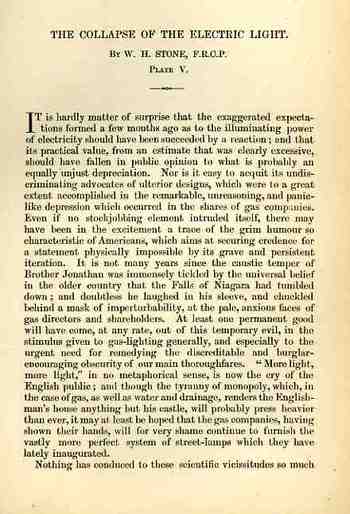
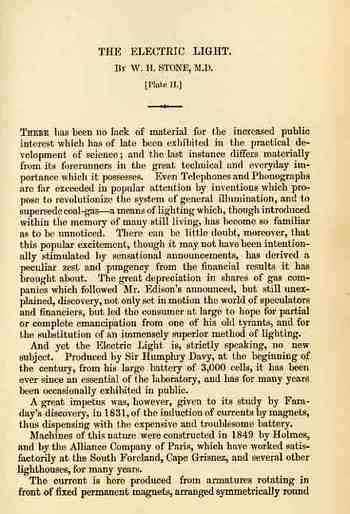
    As ranging and seemingly gawking as these titles might seem today (W.H. Stone’s “The Electric Light” in January 1879 and “The Collapse of the Electric Light” in June 1879 and published in the London’s Popular Science Review), they were somewhat, limitedly, correct.  It really wasn’t until several months later in that same year that Edison got the design of the light bulb more correct, following his developments of a smaller carbonized filament in a better globe vacuum and utilizing a lower current of electricity–this produced a much more long lasting light, far surpassing his 13-15 hours filament from 1876, and making the electric light a definite economic property. Naturally there was much more to be done, like establish the entire backbone and network of an electrical grid, from improving the generating dynamos to the creation and installation of on-off switches, but that was all doable. The modern power grid was inaugurated on September 4, 1882, when  the first commercial power station, located on Pearl Street. serviced about a square mile of lower Manhattan.  Six years earlier,  in 1876 this prospect seemed futuristic, and the prospect for Edison’s light itself  looked pretty dim.

    Ebaysept19edison590 Ebaysept19edison2591

    Stone wrote “It is hardly a matter of surprise that the exaggerated expectations formed a few months ago to the illuminating power of electricity should have been succeeded by a reaction, and that its practical value, from an estimate that was clearly excessive, should have fallen inn public opinion to what is probably an equally unjust depreciation….causing panic-like depreciation in the stocks of gas companies…”

    He continues to wail away at Edison, who was just weeks away from solving the riddle of mass electrical illumination: “Much of the contrivance [light bulb] is of great ingenuity, and evidences considerable mechanical skill.  But all competent authorities are agreed in considering that it in no way supercedes existing methods [gas lighting] or that in any sense fulfills the revolutionary  prognostics freely made in its favor….”

    Oh dear.  I can’t find anything that Stone wrote about the new Edison developments over the coming year.  The man got some of his assessment correct, but he got the overall appreciation patently incorrect, and with terrifically bad timing, calling the day false just minutes before the dawn. 

    Edison was hardly alone in this pursuit even in 1876, the year of great discovery.  It was a crowded house.  And even a quick consideration shows how many others there were preceding Edison in this pursuit:Humphrey Davy, the great English chemist and all-around smart-guy, invented the firs sort of electric light in 1809.  It was quite simple but the idea was definitely there–he produced the first arc light by passing an electric charge through a charcoal strip causing its charged carbon to glow and emit light.  Eleven years later, in 1820, Warren de la Rue made improvements upon this idea and employed platinum rather than carbon, producing a literally and figuratively rich glow.  The electrical revolution waited for its Edison in spite of earlier creations of practical light bulbs by James B. Lindsay (1935), Edward Shepard (1850) and Henricg Globel (1854, and perhaps the most significant of the last three).  There was really an incredible amount of work being done between 1850-1880, but it really was Edison who pulled it al together–and even then, when he perfected his light bulb, it was based on the 1875 patent he purchased from inventors, Henry Woodward and Matthew Evans, his filament burning bright in an oxygenless glass whose basis was derived from the work of Herman Sprengel who had invented the mercury vacuum pump capable of producing this vacuum.

    And then the real industrial revolution could get underway. 

    Stone finishes the second article with this I’m-sitting-on-a-tree-limb-way-up-high-and-cutting-through-it-with-an-antique-saw-between-me-and-the-tree sensibility of terrifically impending high embarrassment:

    “…the electric light, while invaluable for exceptional cases, such as for lighthouses, military telegraphy and exploration…or even for stage effects and festive occasions, is neither so pleasant, so safe, so steady, so simple, or so manageable as the better forms of ordinary gas-lighting now universally adopted”, and thus putting his own gas lighting service back just as the metropolitan power station “on” switch gets thrown.   (I did find a few other articles by the same author: one in the Popular Science Review for 1881 on “The Determination of Musical Pitch” and another in Nature for 1883, writing on” Speaking, Singing and Stammering”.  Not much said about Edison, there.)

    ·Posted by :

    ·in:

    —

  • Food Packaging, Plastics and the New Desire: the du Pont Company, WWII.

    JF Ptak Science Books LLC Post 159
    Blogcandy282

    I was initially drawn to this small collection of pamphlets because of the very provocative assertion that candy is food (but is food candy?) which, I guess, it is, technically speaking.  (Maybe we should determine what food is on a sliding scale of what we would take to a deserted island somewhere and have to depend on those foods for survival.  I don’t think that I’d have a trunk full of Mounds bars with me.  Evidently if you had to choose one food product (and one product only) to survive on for a year it looks like the best thing to select is dry dog food.)

    The Candy is Delicious Food pamphlet was published in 1939 with the intent of instructing the grocer how to better sell candyFood—expressing the ease, storage and profit margin.  Curiously, the thing was published in September  1939, a few months into the war—I wonder if the publisher (saved for naming below to more effect) was prescient in determining the coming problems with food, and that candy would certainly not have those issues during a global conflict? 

    The Post-War Food Dollar was also the product of the same publisher.  Published in 1943, this pamphlet exhorted the grocer to prepare for the coming peace, explaining where the new dollars might be spent once the war (and the supply and ration problems) was won.  Blogcandy_post_war287

    As it turns out these pamphlets were mostly about display and merchandising, and finding the goods that looked best on the shelves—and evidently that which looked best was that which the product could be seen.  And the way that the product could be seen was with the use of the “new”packaging filament, cellophane, produced in the United States (almost exclusively) by du Pont (E.I. du Pont de Nempours & Co. with  their chemist William Hale Charch figuring out how to make cellophane moisture –proof, which led to very large-scale good packaging using the product.)   Another very big bit which turns up unmentioned but illustrated in this pamhlet is seen in this The Future is Now! scene of a modern supermarket–the “SERVE YOURSELF” butcher/meat section, which was a new idea in the early 1940’s, and one that was not at all common in the consuming world.  This idea wasn’t as big a deal as the invention of mass produced sliced bread (or, as Squidward Tentacles encountered in one episode of SpongeBob, “Bread in a Can–the best Thing Since Sliced Bread”), but it was a very important de3velopm,ent in marketing–and also another gargantuanly consumptive venue for the sale of the packaging element, cellophane.

    It was DuPont who published this series of pamphlets for the sole purpose of marketing foods and ideas to grocers that were almost entirely dependent upon cellophane, and DuPont manufactured 75% of all cellophane made in the U.S.  So, to me, it seems as thought all of this business about Food being Candy and the Post-War food spending dollar was really just about selling cellophane—the food was incidental, which is why the cellophane-encased candy was called “food” to begin with.  (It was Whitman Candies who first used cellophane in the U.S. , in  1912, to package their goods for retail.)
    Blogcandy_post_war285_2
    As an aside it is interesting to note that du Pont was brought to court in 1947 over their alleged monopolization of cellophane manufacturing in the United States.  Thus was the U. S. v. DUPONT (THE CELLOPHANE CASE)  filed December 13, 1947, which “charged Du Pont with monopolizing, attempting to monopolize and conspiracy to monopolize interstate commerce in cellophane and cellulosic caps and bands in violation of Section 2 of the Sherman Act”.   DuPont successfully defended themselves in this case.

    The other, minor, thing here that really caught my attention was on page 10 of the Candy is Delicious Food pamphlet—an innocent picture of the grocer tallying up the customer’s purchases, sure enough, but if you look at the detail you can see the grocer writing it all down on the bag that he’d use bag up the purchases.  I have a dim memory of seeing this done in the across-the-street-from-the-A&P Mom & Pop grocery sawdust-strewn store (on Main Street, of course) in Great Barrington, Massachusetts, when I was a kid in the early 1960’s.  I
     
    don’t recall this being done after that, what with real cash registers and then, much later on, with more sophisticated inventory control hardware.  I’m sure that I recall this being done in hardware shops (almost all gone), and my Mother recalls this more recently—in the 1970’s—in butcher shops, but I think this recording practice was pretty much extinct by the mid  1960’s.  I know that this means nothing, but the picture of this guy writing on the bag was so sharp in my memory that I needed to record the emotion.
      Blogcandy_bag283Blogcandy_bag284


  • Color Music–Found Images and the Second Perfect Number.

    JF Ptak Science Books LLC  Post #93

    (Notes for a Future Post)
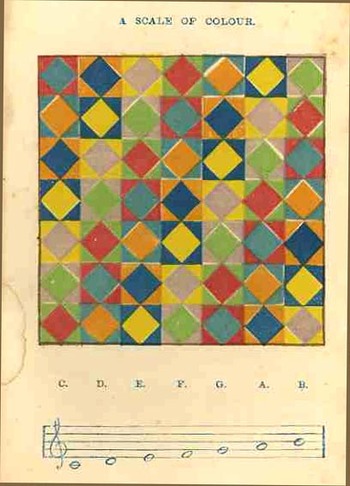
    Blogcolor_scales097
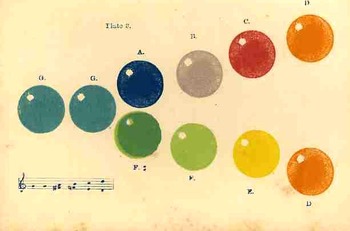
    I found these two beautiful lithographs a while ago—they are really quite gorgeous, and I don’t have a clue to their source.  They probably were printed in the 1860s or so, perhaps 1870s, which I thought—given their subject matter—would make their identification easier.  The subject matter is old, appearing hundreds of years before these images were published. For example, in 1690 the philosopher and constitutional muckrack John Locke reported on a blind synesthesiastic man “who…bragged one day that he now understood what scarlet signified … It was like the sound of a trumpet.” 

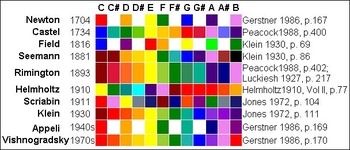
    Equating the frequency of sound waves with the corresponding wavelengths of light was a quest by Sir Isaac in 1704 (In the Opticks), while in 1742 the French mathematician Louis Bertrand Castel strengthened Newton’s proposal of a solid relationship between the seven colors and the seven units of the scale. Slightly later he  undertook the  construction of a clavecin oculaire–a light-organ–as a new musical instrument,. which would simultaneously produce both sound and the “correct” associated color for each note.  A century and a half later Bainbridge Bishop had constructed at least three color organs, while in 1893 Rimington had patented the name “color organ,” and had already toured with his own device, performing color tone presentations of the works of Chopin,
    Blogcolor_scales_bubbles098

    Bach, Wagner and Dvorak.  Experimentation of a new order took place in the early 20th century in the hands of Scriabin (who thought colors were associated with tonality, not with singular notes), Kandinsky, Schoenberg and Marc. 

    Now, getting back to the “scale of colour” illustration, we find our anonymous author equating the following scales thus, beginning with the first column, reading top to bottom, and looking first at the underlying color:
    C:  red, blue, orange, blue, yellow, violet and green.
    D:  orange, blue, yellow, violet, green, red indigo
    Blogcolo_rmusic_rimington
    E:  yellow, violet, green, red, indigo, orange, blue.
    F:  green, red, indigo, orange, blue, yellow, violet.

    And so on through the scales of G, A and B. 

    When you assign numerical values to each one of these colors (green=1, red 2, indigo=3, violet=4, red=5, green=6, yellow=7), the sum is 28. 
    28 is an interesting number in itself, being the
    Blogcolor_organ_bishop
    second perfect number (following the first perfect number which is 6)—a perfect number being the sum of its divisors, including unity but excluding itself (so 28= 1+2+4+7+14).

    The color systems proposed by Castel and Bainbrisge are as follows:

    Castel

    B (dark) violet Bb agate A violet Ab crimson G red F# orange
    F golden yellow E yellow Eb olive green D green C# pale green C blue

    Bainbridge
    B violet-red Bb violet A violet-blue G# blue G green-blue
    F# green F yellow-green E green-gold / yellow
    D# yellow-orange D orange C# orange-red C red

    Blogcolor_schemes

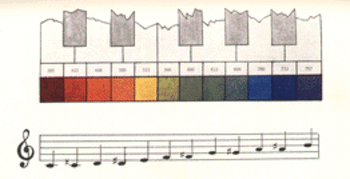
    The following chart is from the wonderful color/music siteVISUAL MUSIC.

    ·Posted by :

    ·in:

    — —

  • Making People Disappear Part 2-Conjurers, Blank People and Anti-Blank People. Orson Welles, Robert Heller and J.J. Thomson

    JF Ptak Science Books LLC  Post #87
    Blogorson
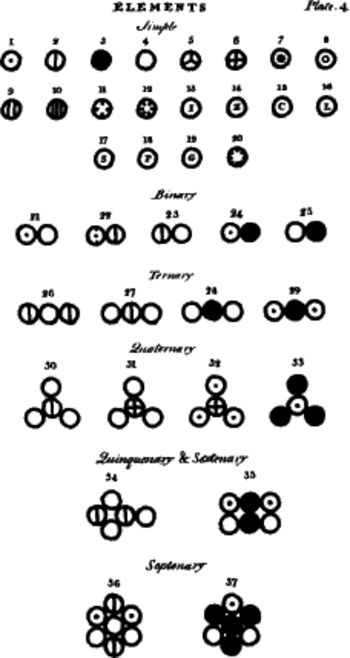
    Following up on an earlier post on disappearing people  (and making things disappear) is this slight abrasion on seeing things that aren’t there, and making other people see the same not-there things.  This is good and bad, depending on what seats you have in the theater and what kind of theater it is that holds these seats.  It is many times fabulous in the theater of science, where people like Democritus and Leucippus (5th century BCE Greek) proposed thinking of the world being composed of tiny, individual, non-solid and invisible elements—these elements were there, of course, because they reasoned that everything could not come from nothing, and thus they had to be so small as to seem to not exist at all.  This was the beginning of the atomic theory which would be added to and subtracted from over the next 2500 years, encountering atomists-in-extremis like John Dalton (1766-1844, with the first truly scientific/experimental/useful atomic theory) and JJ Thomson (who in 1897 actually discovered a constituent element of the invisible universe called the electron, and then on to Max Planck (who complicated things enormously and fabulously with the quantum theory in 1900,
    and Planck’s constant  h-bar =
    h/2p)and on and on.
    Dalton

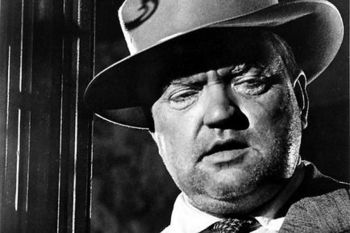
    In the theater that we expect to be shown nothing and believe in it, humans have been happily deceived for thousands of years.  Our gorgeous Orson Welles, for example, still semi young when he made his B-movie masterpiece Touch of Evil, transforms himself utterly with a little make up and a whole lot of acting, disappearing himself and producing Detective Hank Quinlan in his place.  In this movie, witch is perhaps one of the greatest black-and-white, sheerly, unstoppably black-and-white, with no grey tones and contrasts sharp enough top cut your pinkies on black-and-white, the most noire of flim noires, Orson manages to hide himself in the shadows and let Det. Quinlan take his disappeared place, right there in front of you.
    Blogdisappear_conjure092

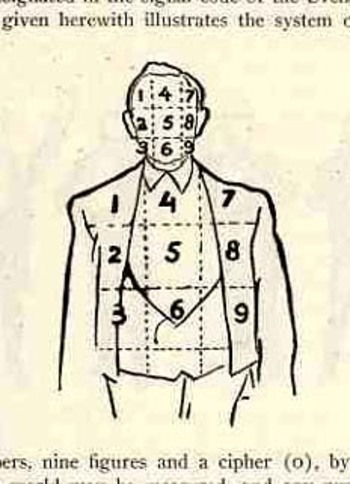
    Another wonderful illustration of empty, waiting-to-be-filled-up humans, human tabula rasa so to speak, was employed by the “second sight” conjurer Robert Heller. He abandoned his wig and his French accent, along with his piano, to become a conjurer, and became one of the “best” of his day. Heller (born Palmer, 1826-1878) took advantage of people’s lack of scientific background and inventive acuity, and their need to believe ion something mysterious and larger than themselves, in some sort of simple primordial goo that might hold together the vastly differentiated universe, to trick them into believing that he could somehow divine a manner of objects and thoughts with his razor/divination vision. 

    Unfortunately, all he was doing was working with confederates and employing a slightly elaborate signaling system to communicate his so-called deep vision. (For example in this manikin image, Heller woul dbe able to signal his  confederates the number he was “divining” by touching these parts of his body as he was setting the foundation for the trick.)   It was a smart idea, a two-beer idea, that he acted on and parlayed (along with a broad theatrical stage presence)into a significant bankroll.  He had other sorts of magical helpers and automata to push his sleight show forward, but mostly, it seems, it was his ability to “force” people to know something that they couldn’t, all worked with secret alphabets and hidden associates.  It was easy and a little feeble, and it worked for years until his will just gave out. He was a local to the vicinity of my old shop in Georgetown, and it is perhaps appropriate that his magic was worked and also gave out in Washington, D.C.

    To tidy things up, it was the scientists who found the things that are there but can’t be seen but couldn’t make the vast percentage of the population “see” the unseeable, while people like Heller and other magicians couldn’t find their unseen things anyway but could make people “see” their non-existent unseeables—all of which seems fairly paradoxical.

    (“I see”, Patti Digh just brightly said.)(Below I’ve attached the opening scene from Touch of Evil–it is one continuous single take, one of the greatest opening shots in film history I think.  And old Uncle Orson was able to do all of the magic on a buck-two-eighty.)


  • Blank & Missing People—Pelerin, Schoen and Marey and Picturing Absent and Empty People for the Study of Perspective.

    JF Ptak Science Books  Post #85
    Blogmissing_people076

    In some of the elementary thinking on perspective in the history of art and science there is a certain amount of subtraction that must occur before addition and advancement can be made—these experiments have resulted in some very unusual-singular even—images, which when viewed apart from their proper context and considering the times in which the images were made make them seem revolutionarily modern. 
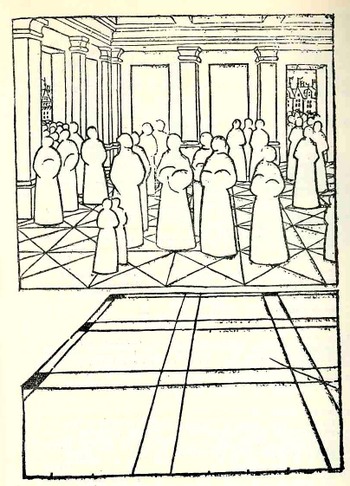
        Take for example the extraordinary work of Jean Pelerin (also called “Viator”) in his De artificiali perpectiva, a very rare woodcut-illustrated book printed n Nurenberg in 1509. In illustrating what he referred to as his “three point perspective” Pelerin removed much of the gothic-tradition bric-a-brac that is so heavily favored in these early books and replaced them with outlines from his rather astonishingly expressive notebooks, and replacing people, individual humans, with what may be the first “almost-entirely-absent” human forms. These roundish, ghost-like figures are just meant to hold the outlines of space, meant to function in the role of a simple comparative unit. This works quite well as an artistic technique—a solicitation tool which I think gives his reduced, “empty” humans an incredible, ethereal look unlike any other in the history of the first 60 or so years of printing.  It is difficult to imagine what the observer of these images back there in 1509 was thinking when they looked at these figures, and perhaps removed them from their textural context—it  would have been a unique visual experience for them
    .Blogmissing_peopl_2e077_2

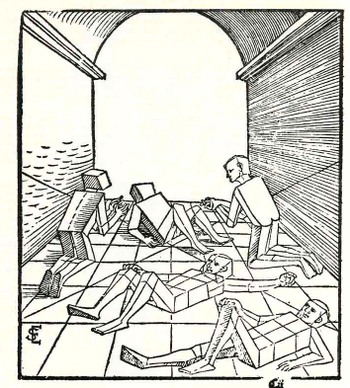
    Just a little while latter Erhard Schoen, in his Unnderweissung der proportzion und stellung der posssen liegent und dtehent, printed in Nurenberg (as well!) in 1538, presented another unique way of representing the human form in model for the sack f studying perspective.  He used simplified geometric form to stand in for the curvy humans, replacing them with proportional stacks of boxes which would more easily explain to the younger reader how to represent the human body n space and in proportion to other things.  Again like the Pelerin, I think that these were monumentally combative images showing humans in a radical, previously unknown way. 

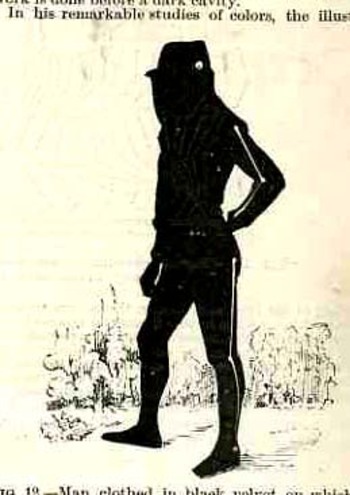
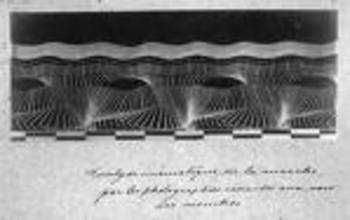
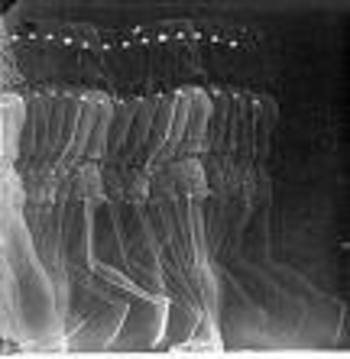
    Dashing into the 19th century we find another superb image of the empty man from Etienne Marey in his photographic and moving-photographic studies of motion.  This is actually a little odder, as the man in this image can be either completely empty or the convex, being completely filled up.

    Blogmissing_menmarey084
     

    Blogmssing_marey_2

    Marey would fit sensors at moving/jointed parts of the human body, affixed to a black-cloth-wearing experimental helper.  The point was to collect simply *movement* images and not necessarily-at this point at least—the parts of the body responsible for the movement.  At this time Marey was interested in the effects of motion, and used his empty man to do just that.

    Blogmissingmarey_one


  • Digital “Computers” 1450-1750: Memory and Calculating on the Fingers and Hands

    JF Ptak Science Books Post #81  (Expanded)

    Bloghands_memory072_2
    These lovely images weren’t intended to show people living in the Renaissance and Baroque eras how to actually record data on their hands—they were intended rather as templates to show how they could use their fingers and hands for calculating and as memory devices.  Much like Frances Yates has shown us so beautifully in The Art of Memory and how info and data was stored in imagined and compartmental palaces in the mind (relying upon images), the hands were also used as a theatre of memory in addition to extended calculation. 

    These mnemonic devices were necessary—especially during the Renaissance—because of the general lack of and access to affordable vellums or paper and writing instruments.  Having notebooks filled with memoir or history of calculation was generally not something that was happening for even the not-wealthy but not struggling class.  These mental images were used widely in the areas of religion, palmistry, astrology mathematics, astronomy, astrology, alchemy, music, and other such fields. 
    Bloghands_big074_3

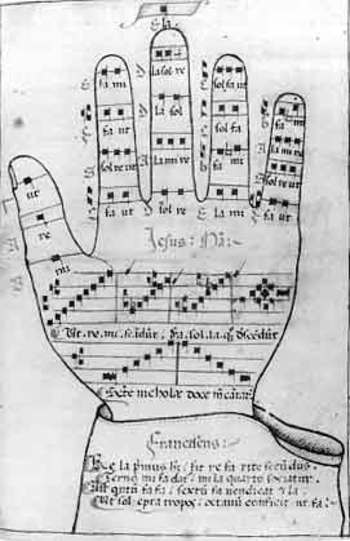
    The first image (from a German manuscript) of the hand-theatre was found and deciphered by Claire Richter Sherman (Folger Shakespeare Theatre) and is religious in nature, an intentional piece of memory for the devoted and for devotions.  The needs of religion were splayed out as the hand was opened and fingers flexed, and working from thumb to pinkie, from finger tip and joint—“do God’s will, examine  your conscience, repent, confess”, and so on, and above all be content with your lowly penitente stature.  If there were 28 of these admonitions or reminders at different points of the hand and you memorized them all, it would be a much simpler time to recall and keep them in order if you merely had to touch a part of your hand where that memory should be to invoke what it was you were supposed to do.  Therefore you could theoretically cast about with your creator with your hands in your pockets—if you had pockets. 

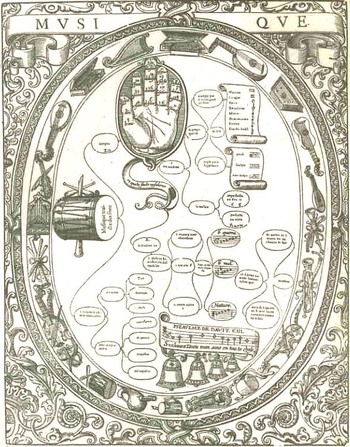
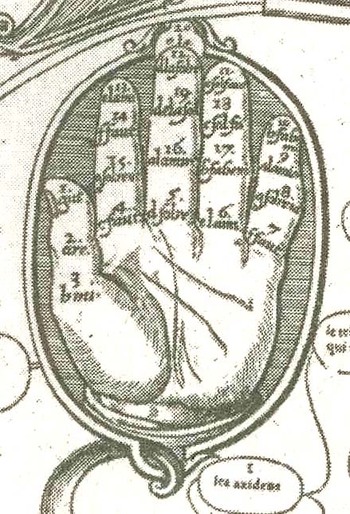
    The next two images (including the enlargement of the hand section) are from a work from 1587 entitled Musique and are attributed to John Cousin the Younger (1522-1597).
    The basic premise for this device—it seems to me—was to be able to order the different chords of 20 different instruments. 
    Bloghands070_2

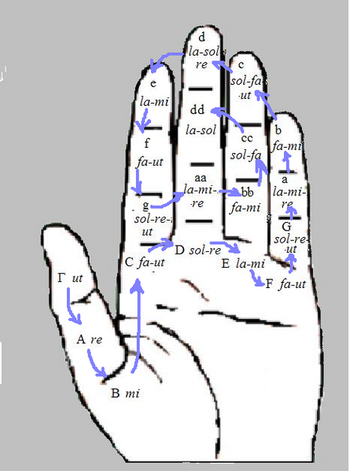
    Another musical hand mnemonic was the Guidonian hand, a survivor of Medieval times, and possibly named after Guido of Arezzo (a musical theorist), and was an aid to singers learning to sight sing.   

    The entry for the Guidonian hand in Wiki explains it use rather well:  “The idea of the Guidonian hand is that each portion of the hand represents a specific note within the hexachord system, which spans nearly three octaves from “Γ ut” (that is, “Gamma ut”) (the contraction of which is “gamut”, which can refer to the entire span) to “E la” (in other words, from the G at the bottom of the modern bass clef to the E at the top of the treble clef). In teaching, an instructor would indicate a series of notes by pointing to them on their hand, and the students would sing them. This is similar to the system of hand signals sometimes used in conjunction with solfege…”
    Bloghands_bodies071

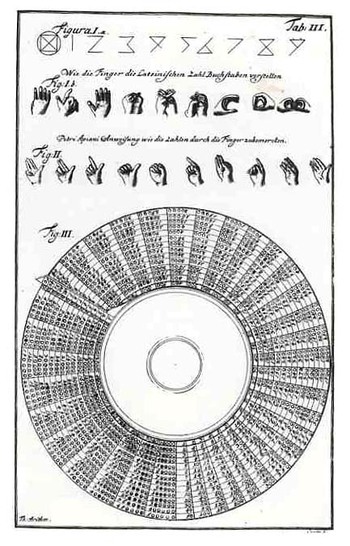
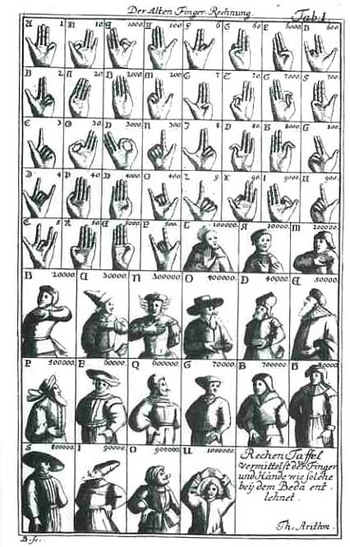
    The final two examples come from Jakob Leupold’s  (1674-1727) Theatrum Machinarum (1724)—this was a complex work involving nine sections and addressed the theoretical  aspirations of engineering (load, flexure, that sort) and its applications to its daily practitioners.  In one section of the book he sought to explain the connections (and correlations) of hand motion and symbolism to the origins of the number systems, carrying it out further still into body language, so that two people conversant in these symbols could talk and bargain between themselves in economic/body terms.  Barbara Maria Stafford, in her Artful Science, Enlightenment,

    Bloghand_guido

    Entertainment and the Eclipse of Visual Education (1994) points out the long history of this tradition, and that it reached far back into misty time:  Leupold knew that Appian, the Venerable Bede, and Aventinus had been fascinated by manuloquio, or natural language with the hands.  He thus linked counting to a global….medium of prearranged gestures…”

    Bloghandguido_2_2


    ·Posted by :

    ·in:

    — — —