A Daily History of Holes, Dots, Lines, Science, History, Math, Physics, Art, the Unintentional Absurd, Architecture, Maps, Data Visualization, Blank and Missing Things, and so on. |1.6 million words, 7500 images, 4.9 million hits| Press & appearances in The Times, Le Figaro, Mensa, The Economist, The Guardian, Discovery News, Slate, Le Monde, Sci American Blogs, Le Pont, and many other places… 5000+ total posts since 2008.

Category: Perception

  • Blank and Missing Things: Missing Horizons, Giant Women and Edouard Manet

    JF Ptak Science Books LLC  Post 536
    Blog--march 7--descartes
    The Nine Foot Woman and the Nine Inch Man

    Manipulating perspective in the post-re-discovery of
    perspective world infrequently happened on purpose (except to accentuate
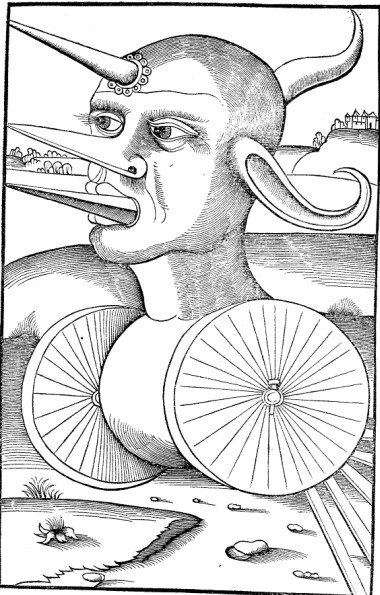
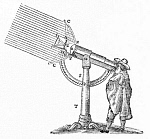
    another aspect of  perspective), and was usually the result of artist or artisan failure or naivety.  A famous example is in Rene Descartes La Dioptrique (1673), in which this image of his compound
    microscope was somehow confused with a telescope—probably the result of the
    illustrator’s misunderstanding of the concept and a mistake in the proofing
    period.  This does sort of look like a
    telescope, if viewed with your squinty-eye specs,  at least in the hands of the illustrator—if the
    microscope-and-man was pictured in this scale was really this large and
    collecting THAT much light it would’ve fried the retina of the viewer and
    whatever specimen was being looked at.  If
    the scope was that big then the man using it would’ve been about 9 inches tall.  In any event, it was an accident (and one of
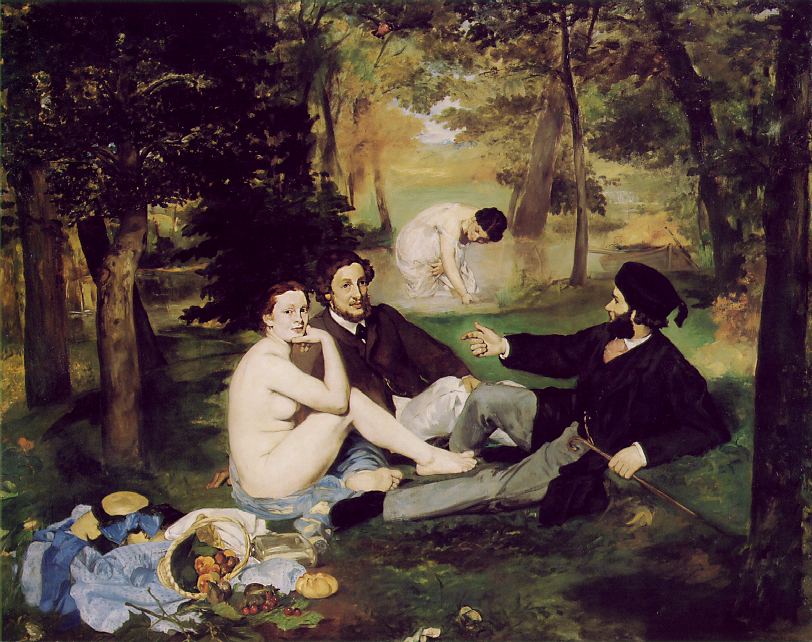
    fairly high order)—the nine-foot-tall woman in Edouard Manet’s Le Dejeuner sur
    l’Erbe
    (1863) was an entirely conscious decision, and one that helped initiate
    the birth of Impressionism.  Of course
    there was a lot of other stuff going on in Manet’s mind beyond the giant woman—he
    abandoned entirely the very accomplished and polite work that he had been doing
    (trained by Thomas Coutre) celebrating his independence on his 27th
    birthday by burning all of his old work.
    Blog--march 7--manet bathers
    Le Dejeuner was a scandal when it was exhibited in 1863—Manet
    painted what he wanted to, unbound by perspective, by color, by composition,
    and on and on. The folks in the painting were not connected to anything,
    really, and were unconnected to each other, no one paying any of the others any
    mind, even when the women were naked. 
    Nothing seems to be going on—the people are just simply there.  This is in itself was a disconnect from
    previous practices, the vision in painting was about something, and was directed.  Light seems to be coming from a number of
    different places, and the shadows from the trees reflect this, simultaneously stretched
    towards and away from the light sources. 
    The bathing woman in the background, or what used to be background, had
    she been drawn using proper perspective, would’ve been about nine feet
    tall.  But what happens here is that
    there is no foreground or background in this painting, just middle.  It was this collection of abandonments, starting here in the Le Dejeuner in 1863, that ushered in the modern in art.  

  • Music, Math, and the Mathematical Piano: Pascal, 1645

    JF Ptak Science Books LLC   Post 524

    0 abay feb 23 pascal computer621

    Music is the pleasure of the human soul experiences from counting without
    being aware that it is counting. – Gottfried Leibniz

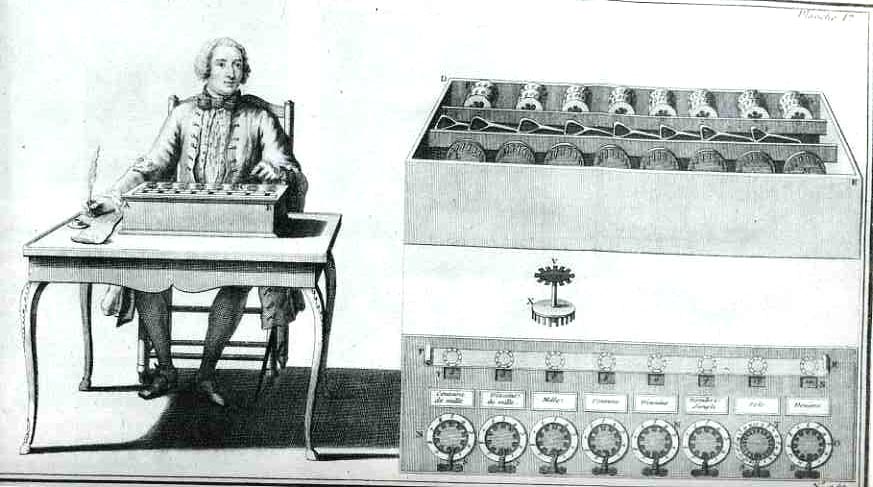
    Blaise Pascal (1623-1662), physicist and
    mathematician–rather, mathematician and physicist–and philosopher as well,
    invented the second mechanical calculator in 1645 (after that of Wilhelm
    Schickard (1592-1635) in 1623).  He had a
    phenomenal output in many different, difficult, and complex areas, all
    completed before he died at the improbable age of 39. (His predecessor in invention,
    Schickard, was dead at 43.)   We see him
    here, seated in front of his beautiful invention (called the Arithemtique, and
    the Pacalina), looking to be quite a bit older than his age at invention, which
    was 23.  He looked pretty content with
    himself, even though, I think, he didn’t care all that much for the machine–at
    least he didn’t care enough about it to perfect it, or to try to make real
    money on the thing.  But the picture of
    him here always looked to me as though he was playing an enharmomic harpsichord,
    or using some sort of musical instrument, or doing something more socially beautiful
    than the optical doing of arithmetic, though both were exhibitions of tuning
    the polyphonic sub-mysteries harmonies of nature.  His image seems to wed the millennial Pythagorian
    creation of the music of the spheres, and Leibniz’ scorn of Newton’s occult-y causes of nature’s
    phenomena, and of Augustine’s “distraction” of perfect creation—a polychord
    romance of science and music.

    Or, maybe, it was just a guy sitting behind a calculator.


  • A History of Smallness, Part 3: Dew and Space (Charles William Wells, 1814)

    JF Ptak Science Books LLC  Post 515

    0 blog feb 13 dew581

    Little things comfort us because little things distress us. Blaise Pascal

    Science is simply common sense at its best. ~Thomas Huxley

    Physics is imagination in a straight jacket. ~John Moffat

    Science does not know its debt to imagination. ~Ralph Waldo Emerson

    Moderation, which consists in an indifference about little things, and in a prudent and well-proportioned zeal about things of importance, can proceed from nothing but true knowledge, which has its foundation in self-acquaintance. Plato

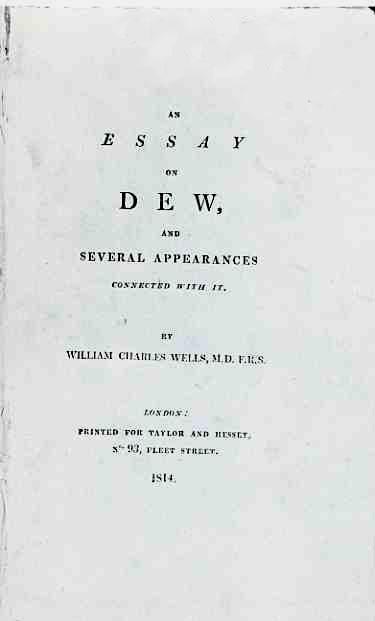
    William Charles Wells (1757-1817), a Charleston-born Londoner who was the physician to St. Thomas’s Hospital from 1800-1817, did one of those great, little experiments (sort of but not really like Charles Darwin crawling around on his imaginarily-sick tummy at Downs watching worms) from which big things were born. The experimentation, lovely and penetrating and elegant, took place over several years from 1812 to 1814, were published in this semi-slender, 146 page tract, which the great Thomas Huxley called “a model of wise inquiry and lucid exposition”. (Actually, 146pp on dew might seem like a lot until you consider what dew is all about.) What Wells so ably exposed about dew was its great terrestrial demeanor–that the movement of dew, its accumulation and dissipation, was due to nothing less than radiation from space, regulated (or interrupted) by the action of the Sun and clouds, ‘introducing a clear view of what is now called the radiation balance of the atmosphere”. (W. Middleton, A History of the Theories of Rain, pp 188-191).  So this is a bit of smallness, something small and seemingly insignificant, leading from its own bit of nothingness into a theory of radiation from space and a theory of the atmosphere, a result almost completely unanticipated.  It is too in its own way somewhat like Robert Hooke re-introducing the often seen and little liked flea–showing people what the flea actually was, under magnification for the first time, showing what sort of world was going on in front of us that was simply just too small to see. 


  • Darwin and Lincoln and the Emancipation of Thought

    JF Ptak Science Books LLC  Post 511


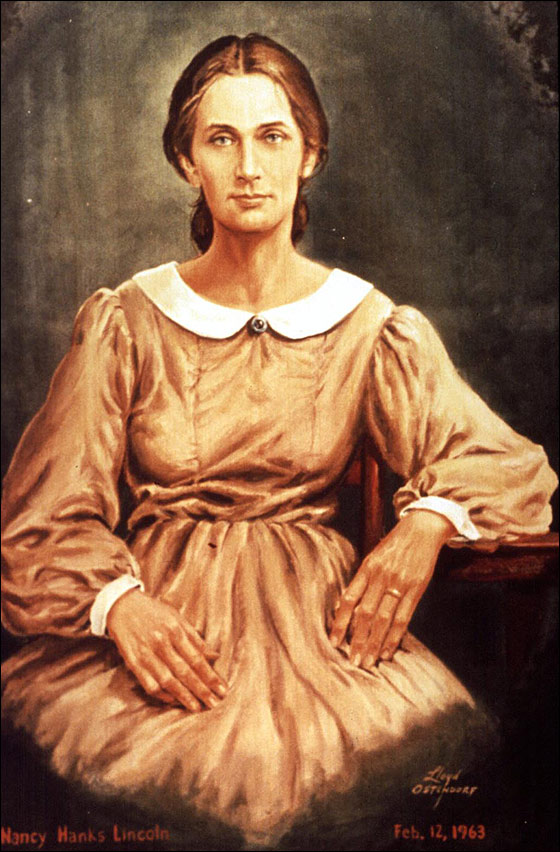
    0 blog feb 12 darwin mom Today is a much-loved day for Abraham Lincoln and Charles Darwin, born within a few hours of one another 200 years ago on this day in 1809.  I’m not so sure that we should celebrate them on their birth dates—it has always seemed a bit off to me; perhaps we should celebrate their mothers (Darwin’s left, Lincoln’s below) instead, leaving another date of importance/accomplishment for the celebration of the birthday boys.  Darwin would be an easier pick for this than Lincoln—23 November 1859 being the red-letter day, for the publication of his On the Origin of Species, which is also up for a big 150th anniversary this year.  The book was an instant best seller, selling out of the first printing almost immediately (at least for the publishing world of 1859) before going on to a life of its own, with five more editions being published before Darwin was finally sem0through with it (and that in the wake of at least a dozen other influential works to his credit).  Lincoln is harder in this respect—there’s Juneteenth, of course, but finding one particular day for his monumental and successful task of not letting the country fizzle away is a bit hazy; perhaps the day of his beautiful second inaugural address, or Gettysburg?  Dates like this would make their celebration much more specific, with a great idea in mind, rather than just a foggy celebration of a birth date celebrating the span of a big life.  (Also, we combine Lincoln and Washington into a Lincington Day, and barely recognize Darwin at all, unless we’re busy throwing him out of the schools [like, say, in Kansas] to better protect our children from the man with the big white beard.  Darwin, not god.)

    23 November seems like a good choice for Mr. Darwin.  He did write much else of course, but Natural Selection was his paramount idea.  As ideas go, in the entire history of ideas, it is about as good an idea as anyone has ever had—big, muscular, profound, explanative, correct.  (There are many big ideas that are harmful but whose idea-ness stretches/breaks the social fabric of societies:  the Big Lie, Slavery, Compound Interest, Inferiority, to name a few.  I’m not so sure about how good an idea heaven might be.) 
    0 blog feb 12 lincoln mom
    Darwin came to the idea of Natural Selection 20 years* or so before he actually published on it, though there was a chosen circle of friends and correspondents who formed a mesh through which Darwin passed some of his ideas.  Listen:  I heard a “science” report on NPR this morning talking about why it took “so long” for Darwin to actually publish.  And what the science commentator came up with—so far as I could listen—was something about a bubbling god/marriage/love/embarrassment/social debate curative, that Darwin was somehow saving his wife-to-be the retribution of society as Charles did away with the creator.  In this porridge of lint I see nothing.  Darwin didn’t publish because, for almost all of those years, he wasn’t ready; rather, the theory of natural selection wasn’t ready for presentation.  Darwin was still putting together the evidence for his case; and when he was ready, his case was superb.  He knew the implications of what he was saying, and he needed to have This Most Beautiful Theory ready, spending 20 years building a castle.  He was finally convinced/cajoled into writing a bit about it in 1858 with the young Alfred Russell Wallace (Charles Darwin and Alfred Russell Wallace “On the Tendency of Species to Form Varieties; and on the Perpetuation of Varieties and Species by Natural Means of Selection.”  Journal of the Proceedings of the Linnean Society, III, 9, (1858). —a man who like Darwin’s younger self aboard the Beagle in South America  made his way around the Malay Archipelago collecting, analyzing, theorizing, until he too came up, independently, with the theory of natural selection.   Priority in this case was not in question.

    Perhaps we should also recognize the people who were important to the development of the greatnesses of these two men.  Speaking to Darwin, there are many, but to make a few examples, we have Thomas Burnet (whose The Theory of the Earth, 1684-90 was the first critical investigation of the implications of geological change, and that in spite of his religiosity and biblical foundations).  James Parkinson’s  Organic Remains of a Former World, (1804-1811),  was an important interpretation of the fossil record albeit with an evolution in favor of god’s continuous actions.  Charles Lyell’s Principles of Geology was perhaps the greatest influence on Darwin’s thinking, the young Charles taking a copy of it aboard the Beagle (after being told by friend Henslow not to believe in the book) where it was studied and devoured, being scientifically introduced to the idea of actions over long periods of time. 

    Seldom mentioned in groups like this, though, is a great scientist and physician, the polymathic Hermann von Helmholtz.  This man is principally remembered for experimentally determining what was thought to be impossible—the rate at which the nerves in the body function, and as the inventor of the ophthalmoscope, and as a leading color theorist, and for major contributions to mathematics and physiology, and for his independent discovery of the conservation of energy, the second law of thermodynamics (On the Conservation of Force, 1847).  (This is a little problematic, as Joule and Mayer came up with the same thing at about the same time, but the 26-year-old physician figured it out at the same time on his own.) There is much else, but what concerns us here is his Darwin-related bit, an epochal discovery that Darwin must’ve known about—the discovery of the age of the sun, when the sun would expend all of its energy, and then, the age of the universe.  These were enormous ideas in 1854—that the impervious sun could actually have a life span, and that by extension so too could the earth and the universe writ large, and that the universe was on the order of hundreds of millions of years old (at least), were shocking revelations.  And Helmholtz was more correct than not, giving another verification of massive time that was so necessary to the function of natural selection. 

    And so I wish good tidings to Mrs. Darwin (Wedgewood), Mrs. Lincoln (Hanks), Alfred Wallace, Charles Lyell, Thomas Burton, and  James Parkinson—and also of course to Abraham Lincoln and Charles Darwin.

    _______

    *Darwin was undoubtedly an evolutionist by 1837, and probably earlier.  As Francis Darwin points out that this date may be as early as 1832, pointing out that Darwin, in his Autobiography, wrote:

    “During the voyage of the Beagle I had been deeply impressed by discovering in the Pampean formation great fossil animals covered with armour like that on the existing armadillos; secondly, by the manner in which closely allied animals replace one another in proceeding southward over the Continent; and thirdly, by the South American character of most of the productions of the Galapagos archipelago, and more especially by the manner in which they differ slightly on each island of the group; none of the islands appearing to be very ancient in a geological sense. It was evident that such facts as these, as well as many others, could only be explained on the supposition that species gradually become modified; and the subject haunted me.”

    ·Posted by :

    ·in:

    —

  • Lethal Teeth & Causes of Death in London; Milk Leg, Breakbone Fever and Eel Thing. The Death List for 1665

    JF Ptak Science Books LLC  Post 464

    Blog--bills of mortality
     Coming on the heels of the only post that I’ve made on teeth is this happy
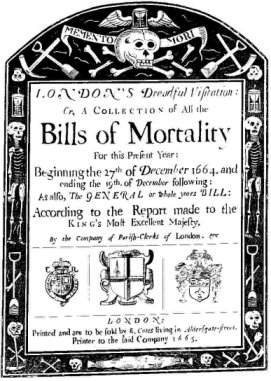
    element, a brief mention of lethal teeth in London in 1665. The listing of the death and
    its introduction (if not the actual dead themselves) comes in the form of a
    publication called The London Bills of Mortality, which was begun (so it seems)
    in 1538.  As an instrument of society the
    Bills were more for legal ramifications than for compiling medical
    information.  The Bill was a necessary
    element for legal burial and the transfer of an estate, composed to make sure
    (or for extent possible at this time) that death had indeed occurred and that
    the legal course could be enacted to disassemble the accumulated physical life
    of the decedent.  The weekly reporting
    and compilations must’ve been wearying, and I imagine that this was not the
    most auspicious or desirable job to have, wringing in the newly dead.  Death’s accounting procedure grew more
    systematized as time wore on, getting a more formal approach as early as
    1603.  And it was not in every English parish
    that the cause of death was recorded, and the recorders were hardly a army of medical
    experts—causes of death were sometimes accurate, sometimes not, sometimes
    whimsical and sometimes all or none of the above.

    The list below attests to a somewhat poetical bent in the naming of lethal
    afflictions; of course most meant something immediate and understandle to the
    reader in 1665, though today many of the names seem quire airy and adventurous,
    hardly things to actual die of.  The list
    comes from the groundbreaking work of London haberdasher and man of
    semi-science, John Graunt, who in 1662 published Natural and Political
    Observations … on the Bills of Mortality
    (1662):  it was a tremendously important work and a
    foundation stone in statistical applications in health and epidemiology, as
    Graunt tried to organize and interpret the collected data. 

    Again, my attraction to this all stems from yesterday’s post on the question
    of the existence of teeth in the Renaissance—“teeth” is listed as a cause of
    death in 39 of these cases, the 6th leading cause of death among the
    39 causes listed.  I guess death might’ve
    been caused by a systemic infection caused by a rotten tooth ; or  perhaps the tabulator observed a dead body,
    saw a mouthful of bad teeth and nothing else obviously wrong with the body, and
    thus dubbed the cause of death as the most heinous looking thing that could be found.


    Abortive
    Aged
    Ague
    Apoplexy
    Asthma
    Bloody Flux
    Cancer
    Childbed
    Chrisoms
    [1]
    Colick
    Consumption
    Convulsion
    Dropsie
    Evil
    Fever
    French-Pox
    Gangrene
    Gout
    Griping in the Guts
    Headmouldshot
    [2]

    3
    52
    12
    1
    2
    1
    4
    4
    2
    2
    78
    112
    26
    1
    76
    2
    1
    1
    14
    2

    Jaundies
    Imposthume
    [3]
    Mortification
    Plurisie
    Rash
    Rheumatism
    Rickets
    Rising of the Lights
    [4]
    Rupture
    Small-Pox
    Stilborn
    Stone
    Stoppage in the Stomach
    Suddenly
    Teeth
    Thrush
    Tissick
    [5]
    Twisting of the Guts
    Ulcers

    1
    2
    7
    2
    1
    1
    1
    1
    1
    54
    9
    2
    2
    1
    39
    1
    5
    6
    1

    A few of the obscure terms explained:

    Ague: 
    deep fever
    Body Flux: sepsis? 
    Childbed: 
    a baby or mother who dies during childbirth
    Crisoms: 
    refers to a white baptisimal robe worn by an infant, meaning that this
    was a very young baby born    before baptism occurred.
    Dropsie: 
    lethal inflammation or edema
    French-pox: 
    syphilis (called “French” because of a decimating outbreak of teh
    disease in the French army.  That, or the
    prescribed treatment, which was the ingestion of mercury. 
    Headmouldshot: edema of the brain
    Imposthume: Abcesses or cysts
    Rising of the Lights:  inflammation of the lungs or general lung
    problesms
    Thrush—an infection of the mouth (especially
    in babies).
    Tissixk: 
    tuberculosis

    According to the website Magic-Nation “other causes of death included affrighted, bladder in the throat, breakbone
    fever, canine madness, commotion, eel thing, frogg, gathering, grocer’s itch,
    hectic fever, kink, milk leg, screws, stranguary, stuffing, rag picker’s
    disease, St. Anthony’s fire, tympany, worm fit, wolf, and being planet struck”.
    Most of these I have little  insight on,
    and even though they caused someone’s death, they still have a lilting, lyrical
    quality about them.  I particularly like
    and am curious about “eel thing”, “milk leg”, and “Stuffing”


  • The History of the Future, Living Life Backwards, and a Wordle of Benjamin Button

    JF Ptak Science Books LLC  Post 451

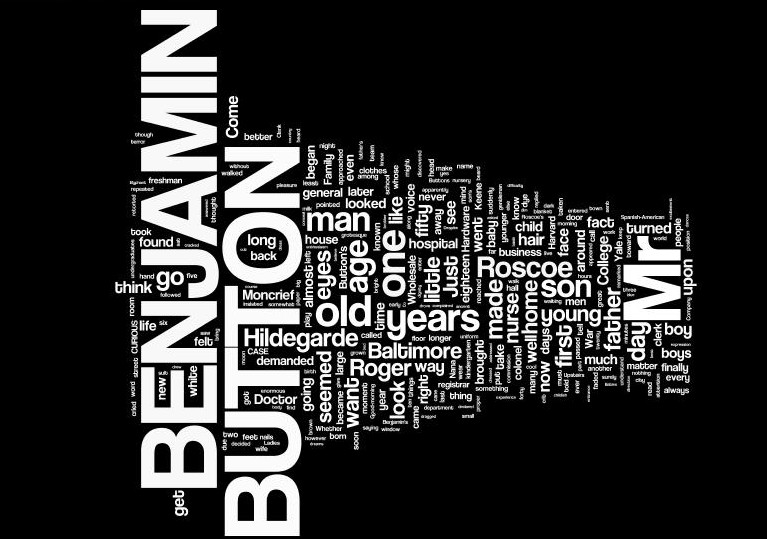
    Beginning life with the final kiss of a Shakespearean comedy is far more complex than it is interesting.  The ordeal of Benjamin Button, a current movie based on the 1922 short story by Scott Fitzgerald (found in his collection Tales of the Jazz Age), presents some very curious aspects of the physics of life–especially if it is more than just Mr. Button who gets to live their life out again in reverse.  It also isn’t a very wide genre of literature, so far as I know.  Another good example of a life lived backwards is the book Time’s Arrow, by Martin Amis, who tells the story of a problematic character named Tod T. Friendly. (“Tod T. Friendly” is also “Todt Friendly” or “death friendly, taking a piece of his name from German, which evidently Mr. Friendly was.)  On the other hand, the novel Stuart, a Life Lived Backwards doesn’t make the cut, as Stuart does live his life forwards.  Christopher Homm, (homme?) written by C.H. Sissons in 1965, tells the story of the title character backwards, though his life is lived forwards as well.

    Wordle--button

    (CLICK to enlarge.)

    The idea of the future, or the having of a future, seems like it should be an ancient idea, and it is–though it isn’t necessarily a universal idea.  Mesopotamians, Babylonians, Mayans embraced the idea of vast distances of time; early Christian faith, o the other hand, doesn’t necessarily have a great future, what with time ending at Judgment Day.  Hinduism and Buddhism have a sense of the future, though there is some very problematic circularity involved with it.  The true scientist bits about the concrete possibilities of vast amounts of time extending into the millennia are found in Charles Lyell (Principles of Geology) who in 1830 took up some earlier work and made it possible to think of the age of the earth in terms of millions of years.  Charles Darwin was also a cultivator of the past and possible future, as was Hermann von Helmholtz, who predicted the ultimate age of the sun, meaning that time’s arrow had the possibility of being hundreds of millions of years long.  These were startling, epochal ideas, and all came within a period of thirty years, creating for the world a fluidity of scientific thought such as had never been seen.  The future came to life in the hands of novelists like Jules Verne, H.G. Wells and Aldous Huxley, not to mention the fabulous worlds of Robert Heinlein (who launched his terrific series of articles on the history of the future in the March 1941 issue of Astounding Science Fiction–just a month after John W. Campbell had evidently coined the term in the same magazine.  I can’t leave this without mentioning Edward Bellamy, a great trailblazer in this area of thought, and his work Looking Backwards, which was a view of a socialist utopia live din the year 2000 by an 1887 man who had fallen into a 113-year-long sleep. 

    But the difficult part of multiple people living their lives backwards comes in the multiplicity of changes that would be caused by two actors adjusting their behavior for the “future” based on lives they had already “lived”.  I can’t imagine the implications of the “butterfly effect” when spread across a broader spectrum than just Mr. Button.

    I haven’t seen the movie, but I have now read the Fitzgerald story, and the idea is very disturbing, like coming out of Alzheimer’s to climb right back in again.  The worst of it seems t take place not at the end of the reverse life, but right before–Mr. Button enters Harvard as a genius sportsman with his years of expertise and learning already under his belt–four years later, though, as a senior, he is struggling, his brain and mind slipping away, his knowledge restricted to that of a 16-year old boy.  And it just gets worse from there, though his ability to distinguish his diminishing capacity grows dimmer and dimmer, thankfully, the closer he comes to his cradle grave.  Its a difficult story to read.

    (In a cursory look I don’t see anything interesti9ng with anything read backwards in Mr. Button’s story.)

    ·Posted by :

    ·in:

    — —

  • The Future of Future Truisms: David Byrne’s Knee Plays vs the Fat Man Nuclear Warist, Herman Kahn

    JF Ptak Science Books   Post 407

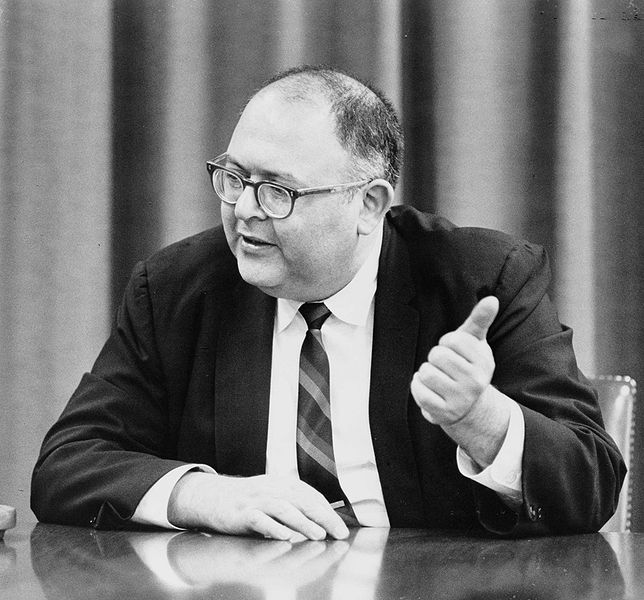
    0-blog-dec 3 byrne David Byrne, former Talking Heads member, produced a series of twelve short pieces to be used in the Philip Glass (and Robert Wilson*) Opera CIVIL warS  in 1985. (“Opera” may not be the right word for this piece, as I think it was one only in so far as the composition needed an opera house to be performed in.)   The Byrne pieces, called ”Knee Plays”, were meant to fill in the spaces, the spaces in-between,  place holders, between the sections of the day-long multimedia production..  Glass had used this idea of inter-pieces to the whole earlier in 1976 in his at-the-edge Einstein on the Beach, in which the connective elements were meant to not only join the pieces of the production together, but were also meant to stand alone, as a cohesive unit, if removed from the opera.  (Glass said they were “short connecting pieces which appear throughout the work much as prelude, interludes and post-ludes. Taken together they form a play in themselves”)

    0-blog-Dec 3 David_Byrne1991

    One of the Knee Plays, “In the Future” (Knee Play Number 12) is a slippery, stacatto brass section accompanying Byrne’s 51 sophisms about life in the future.  About thirty years earlier, “futurist” and think-tank-filler (or maybe it was “Think Tub”?) Herman Kahn (1922-1983), occupying a lot of space at the RAND and Hudson Institutes  (he was also known in many circles as the “Fat Man”), diligently recorded his myopic views of the future. He is generally regarded as a systems theory and military strategy guy, and is most remembered for (as he claims, perhaps) introducing the term “Vietnamization” which described the ultra-failed de-escalation (?) process and withdrawal for the United States from Vietnam (attention Obama administration).  Superluminarily speaking though his contribution to thought on constructing and implementing thought regarding nuclear weapons exchange (pointless to refer to this as “war”) in two books, Thinking About the Unthinkable (1962) and, On Escalation (1965), where he famously put The Bomb on the table of use possibilities.  In addition to these books—which he is busily trying to forget out there in his afterlife, somewhere, maybe in a penitential place where you are forced to think endlessly about paths-to-bad-decisions) is that 1967 peek into the future, The Year 2000.  Petroleum and oil are not issues.  Computers are of minor societal importance.  And then other things of no importance happen.

    0-blog-dec bryne kahn When you take Byrne’s Knee Play  12 and place it next to Kahn and other mis-spent prognosticators, the musician looks positively brilliant.  Some of the stuff has come to pass, some hasn’t; some will, and some won’t.  Some are open to a little interpretation, and some, a lot.  Overall, though, if you think through these little future buillets a little carefully, David Bryne looks very good.  Byrne’s lyrics/list is below.

    *Robert Wilson is a phenomenal conceptualist and theatrical designer.  On the liner notes to CIVIL warS is found the interesting note on Wilson and Byrne:  “At first, Robert Wilson asked David to compose pieces for several sections of The CIVIL warS, but on account of David’s limited time, he composed only The Knee Plays part. The CIVIL warS was supposed to be played in its complete form at the Olympic Games in Los Angeles, but if one plays every part, it takes at least eight hours. There was also a financial problem for playing every part. So only some parts of it were staged there. David himself was very interested in composing for such a play and dance and this time again he enjoyed this work very much. Last time, for The Catherine Wheel, he used recorded tape, but this time he made musicians play on the stage.”

    IN THE FUTURE (KNEE PLAY 12)

    In the future everyone will have the same haircut and the same clothes
    In the future everyone will be very fat from the starchy diet
    In the future everyone will be very thin from not having enough to eat
    In the future it will be next to impossible to tell girls from boys, even in bed
    In the future men will be ‘super-masculine’ and women will be ‘ultra-feminine’
    In the future atomic fusion will enable us to build a skyscraper with
    the energy obtained from a grain of salt
    In the future through genetic surgery there will be a race of menial
    workers, studs, ‘whores’, TV personalities and politicians
    In the future half of us will be ‘mentally ill’
    In the future there will be no religion or spiritualism of any sort
    In the future the ‘psychic arts’ will be put to practical use
    In the future we will not think that nature is beautiful
    In the future the weather will always be the same (relative to the way it is now)
    In the future no one will fight with anyone else because anyone can
    be anything he or she want to be
    In the future there will be an atomic war that will reduce the survivors to savages
    In the future water will be expensive
    In the future all material items will be free
    In the future everyone’s house will be like a little fortress
    In the future everyone will think about love all the time
    In the future TV will be so good that the printed word will function as an artform only
    In the future people with boring jobs will take pills to relieve boredom
    In the future everyone but the wealthy will be very happy
    In the future everyone but the wealthy will be very filthy
    In the future everyone but the wealthy will be very wealthy
    In the future communication/distribution systems will be so good that no
    one will live in cities
    In the future farming will be managed through a nationwide computer hookup
    In the future there will be mini-wars going on everywhere
    In the future political and other decisions will be based completely on opinion polls
    In the future only the very wealthy will be able to travel or move out their houses
    In the future individuals with soldier inclinations will go out for ‘killer’ sports
    In the future there will be machines which will produce a religious
    experience in the user
    In the future there will be a classless society, no one richer than anyone else
    In the future people will constantly be having plastic surgery, altering
    their features many times during a lifetime
    In the future there will be many mass suicides
    In the future there will be groups of wild people, living in the wilderness,
    who will rob suburbanites
    In the future there will be only paper money which will be personalized
    In the future everyone will only get to go home once a year
    In the future everyone will stay home all the time
    In the future we will not have time for leisure activities
    In the future we will only ‘work’ one day a week
    In the future our bodies will be shrivelled up but healthy and our brains will be bigger
    In the future there will be starving people everywhere
    In the future no one will be able to afford TV or newspapers, resulting in
    no one knowing what’s going on
    In the future people will live in space
    In the future only the very wealthy will have pets
    In the future the poor will be regulated by the rich
    In the future the crippled, retarded, and helpless will be killed
    In the future everyone’s house will be a total entertainment centre, with
    video, pills, dancing, sex tools, holographic movies, and game machines
    In the future everyone will have his or hers own individual style of very way-out clothes
    In the future we will all eat our favorite foods, only they will all be synthetic
    In the future we will fuck anything, anytime, anywhere
    In the future there will be so much going on that no one will be able to keep track of it


  • A Forgotten (?) Photographic Protest of the 1933 Chicago World’s Fair

    JF Ptak Science Books  Post 352

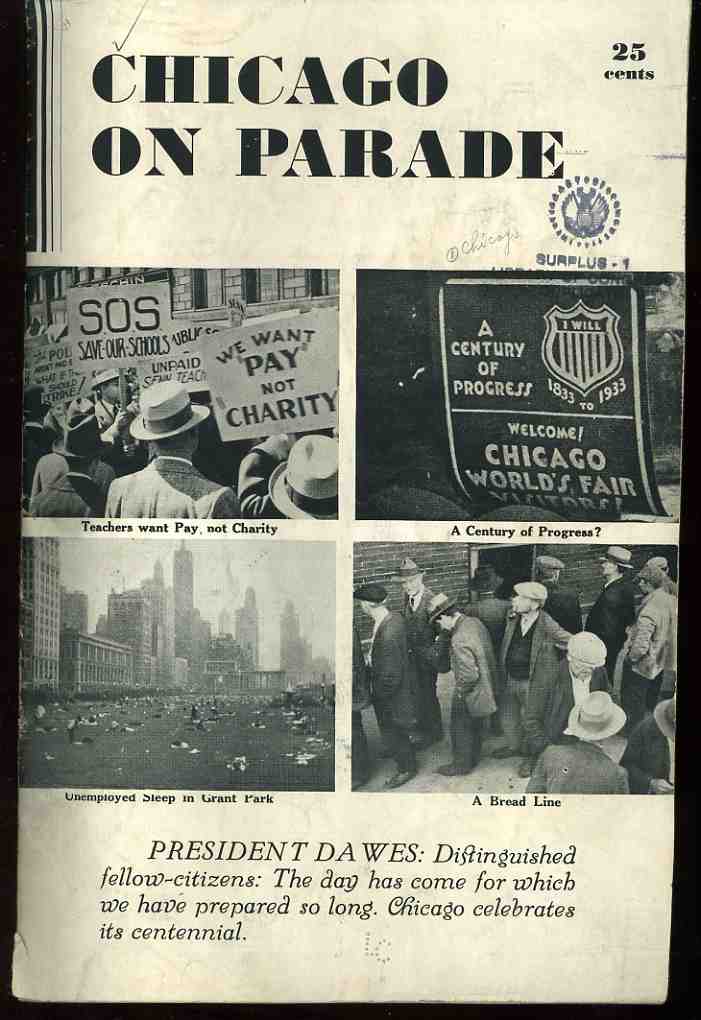
    000-ebay--Nov 4--chic 1985 This short pamphlet is a very strong tonic to those thinking about Chicago’s “Century of Progress” celebration and World’s Fair that was taking place in the middle of the Depression in 1933. (It was intended to instill hope and foster a little forgetfulness during a time in which the Depression in full swing nationwide, plus native-Chicago problems of gangsterisms, race riots, red scare, and economic distress ) As a matter of fact this pamphlet didn’t seem to find much distribution, or at the very least it didn’t get saved in spite of the fantastic documentary images that it contains.  This copy of Herman O. Duncan’s Chicago on Parade (1933), was his own, sent to the Library of Congress as a gift in 1942 before it came to me in 1999. I can find only three other copies of this pamphlet located in libraries world wide (Oxford, Duke, Chicago), and it seems very strangely underrepresented. 

    Duncan addressed the work directly to the Rufas Dawes (President of the Century of Progress Celebration), and to the mayor of  Chicago and governor of Illinois as a very blunt request to not forget the actual world of real Chicagoans living in dire straits within site of the fairgrounds.  Duncan was obviously taking issue with the many statements of wonderment and flourishes of progress that accompanied the propaganda surrounding the fair, so that the attention of the public would not be “diverted by our political and civic leaders”.  Duncan continued that these photographs, “none of which had been published previously in the United States” could “perhaps suggest a point of reference from which Chicago can measure its Second Century of Progress”. 000-ebay--Nov 4--chic 6 det991

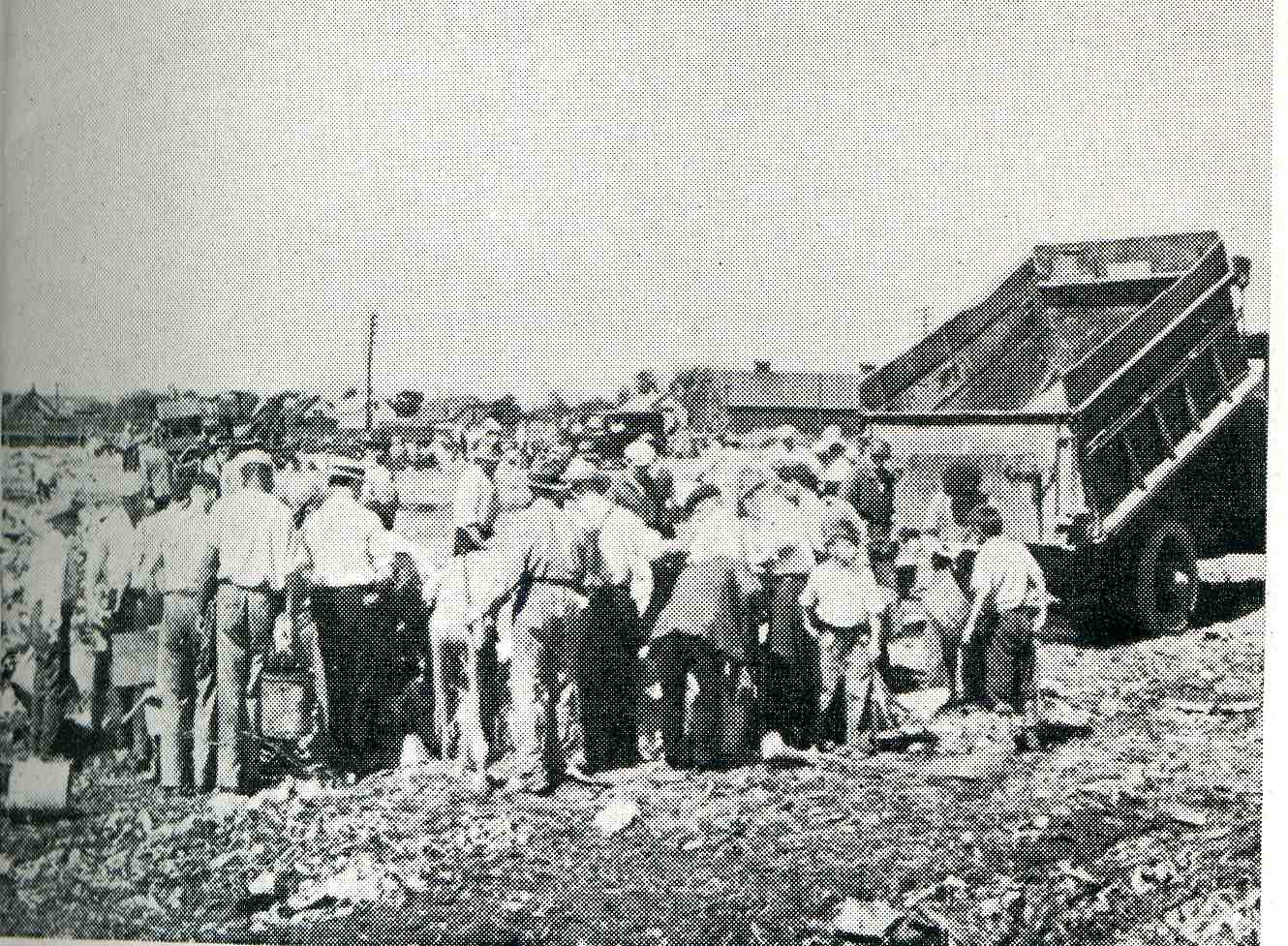
    Duncan (who unfortunately did not identify the photographer(s)) was very strong in the use of images.  He was not afraid to show long bread lines, people (including children) scavanging at the city dumps, blacks and whites marching together in protest of police brutality, (many hundreds) of people sleeping out of doors in Grant Park (Chicago’s “front yard”),because they had no where else to go, and much more.  The photographs had a real touch of journalistic acumen, and none of the images look forced or posed–they are the real stuff of social documentary, and how they have escaped wide notice is not known to me
    . 

    000-ebay--Nov 4--chic 2986
    Perhaps the strongest statement (outside of the
    photos of the children scrounging for food in dustbins and at the dump) is this series (below) showing views of the city of Chicago that were within site of the tower for the Century of Progress Sky Ride (“See the Fair / Come Up in the Air”).  The series make an elegant and strong and incontrovertible point, and that there was definitely something very wrong going on outside the walls of the celebration which had been scooped out of the city’s east side.  (The images remind me of series of photos of the US Capitol Building that appeared in the great classic of social and cultural recording of class division, Neglected Neighbors, which my friend Andy Moursund introduced me to many years ago in Georgetown.)

    The logo design for the event is terrific and I’m sure that everyone had seen it at least once in their lives, but out of the many hundreds of other pamphlets and display materials that I have here for the expo I’ve got to say that the overwhelming majority of them are luridly colored with a palette found outside nature.

    And anti-nature colors are somewhat schizoid-happy  colors, like MGM technicolor cartoons from 1949, which applies a massively ugly chromo-palette to the blight of the surrounding Depression problems.  Mr. Duncan was determined that this not happen, at least so far as he could help it, and published these arresting images to remind the rest of Chicago that the vividly colored happy face placed over the city like a stamp for the Century of Progress was not the case in fact. 

    There are another few images in the “continued reading” section.

    Note:  click on the photos for a larger, more detail view.


  • Vegetius and the 4th Century Underwater Attack

    JF Ptak Science Books LLC  Post 342

    Blog--vegetius
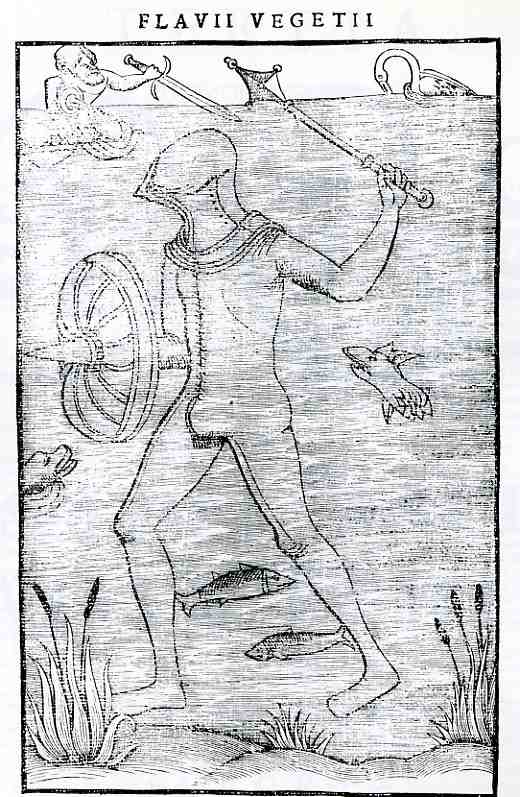
    The name of Flavius Vegetius is not so much popularly known today, though his influence is felt through the hands of other, more famous, writers and thinkers.  He was seen as the most adept writer on the Roman mind in warfare, and his De re militari libri quator… was his masterpiece.  It was reprinted in 1532 by Christian Wechel from sources reaching back to the original, which was written around 390 ACE, and found a wide readership not only for its authority on all things military/Roman but also for his iconic insights and aphorisms on warfare in general.  It was Machiavelli who came under his spell and who adopted some of Vegetius, who became further disseminated through the military followers of Machiavelli, and so on.

    I came to this work much more simply than all of this – I liked this image of the underwater warrior, who was somehow able to breathe while submerged.  I get the importance of this sort of undercover, guerilla maneuver, but what I really like was the rarity of seeing a Renaissance illustration of human submarine life, which is pretty uncommon.  Also, the use of the lines to represent the underwater quality of the image—giving the woodcut an overall grey tone—is also very scarce in the history of illustration, at least before 1600.  And very neat!  One of the hallmarks of this printing of Vegetius was the liberal use of white space in many of the (119) woodcut illustrations, though it is clearly not on display in the woodcut that I’m sharing here.
    00-blog-Oct 28 vegetius939

    Of further interest are the following excerpts of Vegetius from the 1767 English translation found at the Digital Attic website. I’ve selected four interesting bits on the selection of recruits, their initial training, the size of recruits and the need of the new soldiers to learn how to swim.  I find them a fascinating insight into the appreciation of the raw military recruit from 1600 years ago. 

    The Military Institutions of the Romans (De Re Militari)

    By Flavius Vegetius Renatus

    INITIAL TRAINING

    The first thing the soldiers are to be taught is the military step, which can only be acquired by constant practice of marching quick and together. Nor is anything of more consequence either on the march or in the line than that they should keep their ranks with the greatest exactness. For troops who march in an irregular and disorderly manner are always in great danger of being defeated. They should march with the common military step twenty miles in five summer-hours, and with the full step, which is quicker, twenty-four miles in the same number of hours. If they exceed this pace, they no longer march but run, and no certain rate can be assigned.
    But the young recruits in particular must be exercised in running, in order to charge the enemy with great vigor; occupy, on occasion, an advantageous post with greater expedition, and prevent the enemy in their designs upon the same; that they may, when sent to reconnoiter, advance with speed, return with greater celerity and more easily come up with the enemy in a pursuit.


  • Wicked Polly Reveals the Sameness of Names, 1827

    JF Ptak Science Books LLC Post 341

    00-blog-Oct 22-polly908
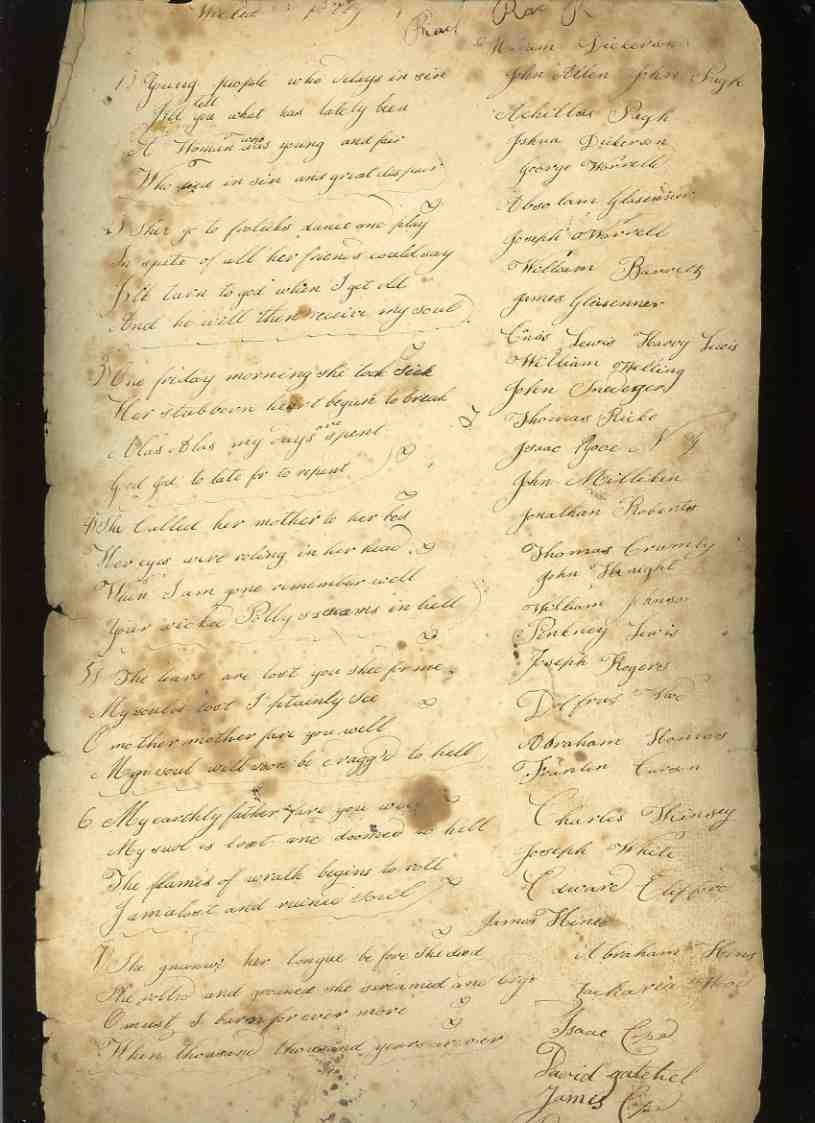
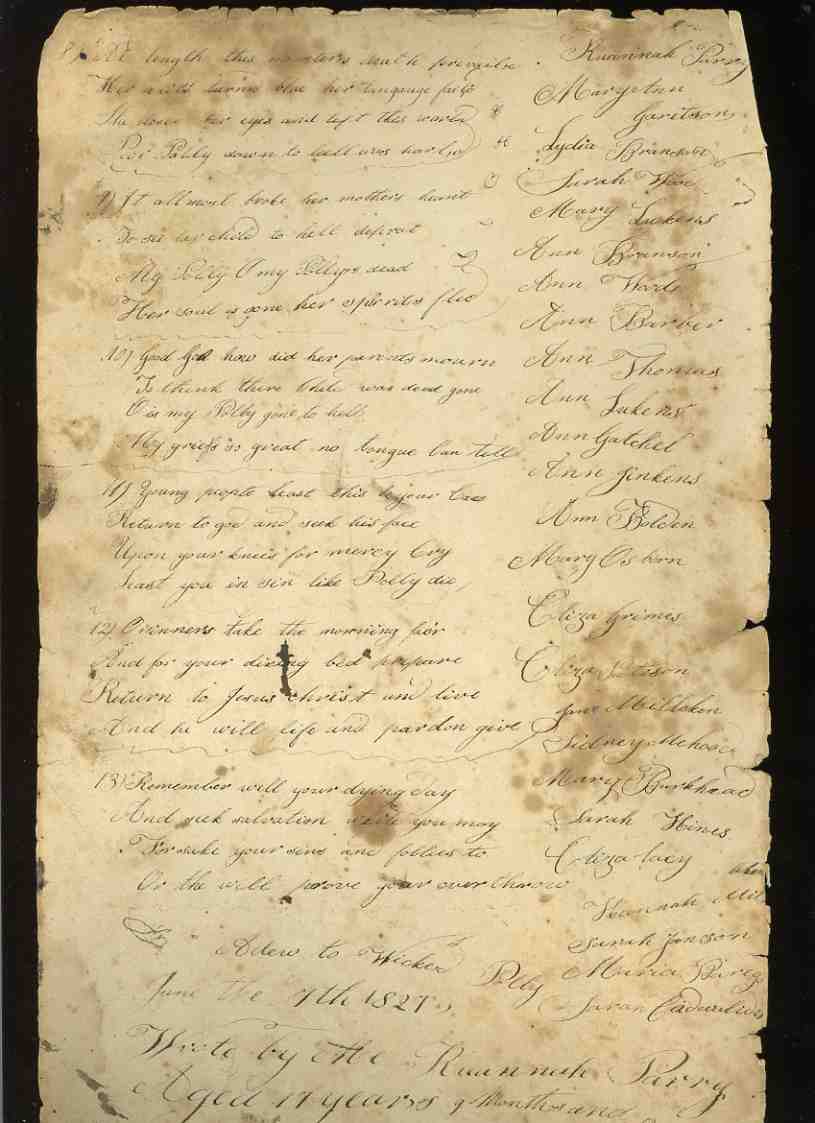
    In my collecting of antique children’s art (that is, art produced by children from 1880 and earlier) I’ve stumbled across a number of interesting other associated, relateable,  things.  One such item is this manuscript copy–from 1827–of a much older children’s warning/lesson poem, called “The Lamentable Story of Wicked Polly”, a scare-the-kids-to-death kind of poem, instilling (and installing) a very healthy dosage of the wrath of god, a falling away from the just Jesus, and the regretably-late realization on the everlasting pain of sin.  A rosey children’s lullaby it is not.

    [The lyrics are below; click on the images for a more legible resolution.]

    But the side interest here is literally at the side, a perhaps revealing bit of marginalia in which the copyist has recorded the names of 54 children (I imagine).  Are these names the names of classmates, other children in school, kids in town?   There are 26 girls and 28 boys; the girls, as it urns out, have 9 different names; the 28 boys have 18 different names. I wonder why?  The girls have the following names (and with the number of holders):  Ann (7), Ekiza (4), Mary (4), Hannah (3), Sarah (3), Mary (3), Jane (2) and then one each for Lydia, Sidney and Maria. 

    The boys have more imaginative names:  most popular are William (4) and John (4); this is followed by Joseph (3), James (2), and Abraham (2).  The rest of the names are single-uses, and include: Achilles, Joshua, George, Absolom, Enos, Thomas, Pinkney, Charles, Edward, Zachoria, Isaac, Dening and Reason.  This is a small and unexpected sample, but it is interesting nonetheless–I don’t even have an explanation, just this observation. 


    00-blog-Oct 22-polly909

    The Lamentable Death of Wicked Polly


    Young people who delight in sin.
    I’ll tell you what has lately been:
    A woman who was young and fair,
    Who died in sin and sad despair.

    She’d go to frolics, dance and play,
    In spite of all her friends could say;
    I’ll turn to God when I get old,
    And He will then receive my soul.

    One Friday morning she took sick,
    Her stubborn heart began to break;
    Alas! alas! my days are spent,
    Too late! too late for to repent.

    She called her mother to her bed-
    Her eyes were rolling in her head-
    When I am dead remember well,
    Your wicked Polly screams in Hell.

    The tears are lost you shed for me,
    My soul is lost, I plainly see;
    Oh! Mother, Mother, fare you well-
    My soul will soon be dragged to Hell.

    My earthly father, fare you well,
    My soul is lost and doomed to Hell;
    The flaming wrath begins to roll,
    I am a lost and ruined soul.

    She gnawed her tongue before she died,
    She rolled and groaned and screamed and cried,
    Oh, must I burn forever more,
    When thousand, thousand years are o’er?

    At last the monster Death prevailed,
    Her nails turned blue, her language failed;
    She closed her eyes and left the world,
    Poor Polly down in Hell was hurled.

    It almost broke her mother’s heart
    To see her child to Hell depart;
    My Polly, O my Polly’s dead,
    Her soul is gone, her spirit’s fled.

    Alas – how did her parents mourn
    To think their child was dead and gone.
    Oh! is my Polly gone to Hell,
    My grief’s so great no tongue can tell.

    Young people, lest this be your case,
    Return to God and seek His face.
    Upon your knees for mercy cry,
    Lest you in sin like Polly die.

    Oh! sinners, take the warning fair
    And for your dying bed prepare,
    Return to Jesus Christ and live,
    And He will life and pardon give.

    Remember well your dying day,
    And seek salvation while you may;
    Forsake your sin and follies, too,
    Or they will prove your overthrow.