A Daily History of Holes, Dots, Lines, Science, History, Math, Physics, Art, the Unintentional Absurd, Architecture, Maps, Data Visualization, Blank and Missing Things, and so on. |1.6 million words, 7500 images, 4.9 million hits| Press & appearances in The Times, Le Figaro, Mensa, The Economist, The Guardian, Discovery News, Slate, Le Monde, Sci American Blogs, Le Pont, and many other places… 5000+ total posts since 2008.

Category: Absurdist, Unintentional

  • The Future of Hope and Fear: Fortune-Telling Questions for Men and Women, 1540

    JF Ptak Science Books  Post 1456

    In 1540 Francesco Marcolini (or Marcolino), a typographer born in Forlì, published in Venice Le sorti intitolate giardino d’i pensieri (“The oracle called garden of thoughts”). This book is among the earliest known documents of cartomancy (divination with cards), a card-playing fortune-telling and future-telling game and belief system. (I’ve written about other beautiful if not proud accomplishments in this area, other products of the 16th century, here.)  I find the illustrations of the combinations of cards to be rather beautiful, a suggestion of an unknown alphabet or hieroglyphic for a civilization of hope or distress or both that hangs somewhere out there in the gauzy future, the characters capable of change and interpretation depending on the needs of the viewer.  Therefore the story that is told can easily become the story that could be told, the characters permeable to whimsy and insight.  It seems unlikely that there is a numeral system associated with this quicksand.

    Image:Marcolini fraude.jpgThe tarot encyclopedia website provides an interesting insight to the times if not so much to the gearing of this wonder machine–this mainly in the form of the fifty questions to be asked of the players of this game/amusement/hopenet, including thirteen each to be answered solely by men and women. 

    Questions Asked of Men

    It turns out that for the men, 8 of the 13 questions deal with his wife or mistress–4 about wives, 3 about mistresses, and 1 that can go either way.  The remaining few questions then are left to cover the range of All Other Things

    1.Will the destiny of the man will be good or bad? [Fato - Fate]
    2.Is the lover loved by his mistress? [Fama / Fame]
    3.Is it better to marry a beautiful woman or an ugly one? [Beneficio - Gain]
    4.Will the desire of the man be fulfilled? [Tempo - Time]
    5.In which will the man be more lucky? [Fortuna - Fortune]
    6.Will the man have to suffer for his beloved? [Dolore - Pain]
    7.Is the man appreciated by the other people? [Virtu' - Virtue]
    8.How many wives will the man have? [Punizione - Punishment]
    9.Will he that goes to war gain victory? [Vittoria - Victory]
    10.Will a strange wife become humble? [Pertinacia - Obstinacy]
    11.Is it good to change mistress? [Peccato - Sin]
    12.Is it good to take a wife? [Matrimonio - Marriage]
    13.Which is the best mistress: the widow, the married woman or the unmarried woman? [Timore - Fear]
    

    Questions to be asked by women

    The questions for the women actually seem a little more balanced, or at least don't 
    deal with the blossoming aspects of additional/multiple lovers, though the question of

    whether her husband will be faithful does come up, as does the issue of whether it
    is good or not to change lovers. And the issue of how often she will be married.
    And whether or not she will suffer for her lover--I'm not sure what this one means
    in the antiquarian sense, but there seems to be a follow-up
    on whether the bad
    husband will become good. But overall these seem not so extra
    ordinarily self-indulgent
    as do the questions for the men.
    14.Is the woman appreciated by the man she adores? [Vanita' - Vanity]
    15.Will the destiny of the woman will be good or bad? [Destino - Destiny]
    16.Will the woman will give birth to a boy or a girl? [Natura - Nature]
    17.In which will the woman be more lucky? [Honore - Honour]
    18.How many husbands will the woman have? [Penitenza - Penitence]
    19.Will the woman have children? [Sterilita' - Sterility]
    20.Will the woman suffer for her lover? [Dipserazione - Desperation]
    21.Will the desire of the woman be fulfilled? [Insidia - Danger]
    22.Will the bad husband become good? [Sorte - Chance]
    23.Is the woman loved by everyone? [Disgrazia - Disgrace]
    24.Is it good for the woman to change lover? [Odio - Hate]
    25.Is it good to get married? [Servitu' - Slavery]
    26.Will the husband be faithful? [Occasione - Occasion]

    Questions that can be asked both by men and women

    Certainly the non-gender-specific questions are most interesting, some even poetically
    captivating ("will two lovers make peace?")
    , most of which could be asked today, and
    some still demanding long thought. In general though they do mostly have an
    adult-version of a Ouija experience, with a few golden nuggets tossed in for higher
    cortical seasoning.
    27.Is a certain courtesan infected with the French disease? [Difetto - Defect]
    28.Is it good to take vengeance of an offense? [Virilita' - Virility]
    29.Will the world find peace? [Parche - Moirae]
    30.Will art or trade produce gain? [Industria - Industry]
    31.Will some trouble bring happiness in the end? [Ricchezza - Richness]
    32.Is the rule of a Lord appreciated by the people? [Verita' - Truth]
    33.Is it good to serve Lords and priests? [Infingardo - Idler]
    34.Will a promise be kept? [Fraude - Fraud]
    35.Is the person that traveled far alive or dead? [Sapere - Knowledge]
    36.Will the exile return? [Esilio - Exile]
    37.Is it better the wife or the husband? [Poverta' - Poverty]
    38.Who loves with more passion, the man or the woman? [Nobilta' - Nobility]
    39.Will a dream come true? [Ignorantia - Ignorance]
    40.Is it good to start a certain enterprise? [Otio - Idelness]
    41.Will the person that went away be back soon? [Desiderio - Desire]
    42.Will the awaited new be good or bad? [Malinconia - Melancholy]
    43.Does the appearance of the person give a good impression? [Menzogna - Lie] 
    44.Must one trust what people say? [Discordia - Conflict]
    45.Will two lovers make peace? [Pace - Peace]
    46.Which will be the end of a very deep love? [Caso - Chance]
    47.Will changing place bring better luck? [Consiglio - Counsel]
    48.Will the person be the winner of a dispute? [Corruttella - Corruption]
    49.Will someone get free of a certain vice? [Furto - Theft]
    50.What will be the reward for faithfulness in serving? [Calamita' - Calamity]

    In short, much of this seems modern to me, at least with a little editorial clean-up.
    The big difference seems to be that people in 1540 actually interacted and answered
    these questions, while in 2011 most folks would be watching other folks talk about
    answering these questions on a reality t.v. show.
  • History of Normalcy Series: Warehousing Epileptic “Defectives”, 1912

    JF Ptak Science Books   Post 1450

    This series is meant to illustrate the very transitory, shadowy and basically non-existent nature of “normal”.

    “It is thus with regard to the disease called Sacred: it appears to me to be nowise more divine nor more sacred than other diseases, but has a natural cause like other affections. . .”–Hippocrates on epilepsy and recognizing it as just another brain disorder devoid of mysticism, about 2400 years ago.

    Epilepsy383 One stop in the history of normalcy is the perception of brain disorders, which is a long and complex history–very long in the case of epilepsy, its epidemiology stretching back thousands of years before Hippocrates.  It particular normalcy for the vast majority of that time was that people who exhibited the results of the disorder were cursed, or touched by the gods as holders of some possible divine inspiration, or touched by the gods as accursed and punished people, or bewitched (I wonder about the number of epileptics put to the flame during the Witch Hunt crazes), and so on.  The first pharmaceutical treatments for the disorder really didn’t come about until Emil Fischer and Bayer introduced phenobarbitol in 1902/04, which was able to calm the seizures of some people with epilepsy.  Until that point, most treatments were generally topical, plus the quack ingestives and various sorts of incantations, spells and prayers. 

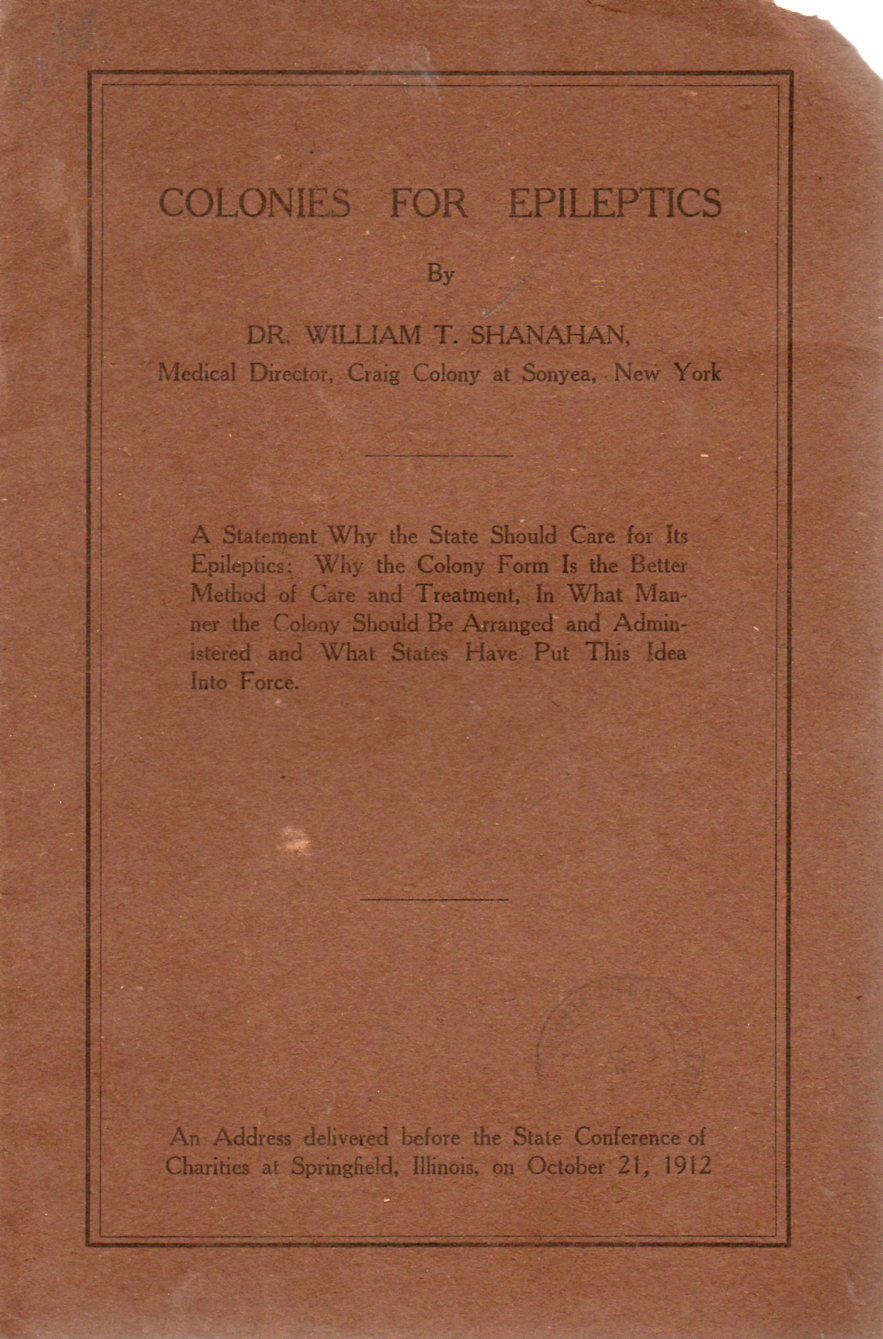
    In Dr. William T. Shanahan’s Colonies for Epiletpics, (the original available for purchase through our blog bookstore) written in 1912, the treatment of epileptics was seculsion, warehousing them in state asylums in the countryside.  Shananhan felt that the epileptic needed “its” own environment, “apart from the the defectives”–and by that he meant apart from the wide classification of people who did not fit the scheme of 1912 normalcy, like “morons, imbeciles, the insane, the sexual addict, the recurring syphlitic [and] the criminally insane…”.  Actually this as a good move in some cases–apart from the vocabulary–as epileptics were stored away in almshouses and prisons along with the criminal element and the hopelessly insane, and at least removed the epileptic from a different sort of horror and disgrace. 

    Dr. Shanahan’s aim was to remove the epileptic from society because they “couldn’t adjust to a life in the ordered community” and that holding a job for them was “impossible”–that plus what he saw as the need to protect society from the epileptic’s “progressive mental deterioration”.   He felt that “the great majority should be committed[to the epileptic colonies] as are the insane”, and also to remove them to these places “from a young age”, to an “institution for defectives”, there separated according to “sex and mental grade”. 

    Overall, though, it was Shanahan’s other aim to provide as “normal” a life for epileptics as could be arrived at, and outside of his trying to save society from them–at a time when the eugenics people were out castrating epileptics–, he was arguing that this method was the best of all possible worlds for people with this disorder.  He does however seem to be totally ignorant of any medical approach to dealing with epilepsy.

    By the way, there’s a very curious imprint on the back cover of this pamphlet showing who printed it and where.  I cannot recll ever having seen such a small thign, placed so centrally, in such an obvious place. Its obvious and present, yet tiny.  Here it is, before magnification:

    Epilepsy384

    And here is what the slug says:

    Epilepsy385
    Its just a very curious thing.


  • Strange Things in the Sky Department: the Suburbs

    JF Ptak Science Books   Post 1434

    A continuing thread on this blog (this post is a good example) has surfaced unusual thing that have been found floating in the sky in prints, photographs and ideas:  there have been “extra Earths”, holes leading to heaven, massive stone tetrahedra, swimming pools, hangars, airports, downloaded aliens from extra moons, flying Woolworth buildings, and much else (not limited to 19th century balloon-hoisted horses, here). Today’s unusual thing to be found in the sky is the suburbs.

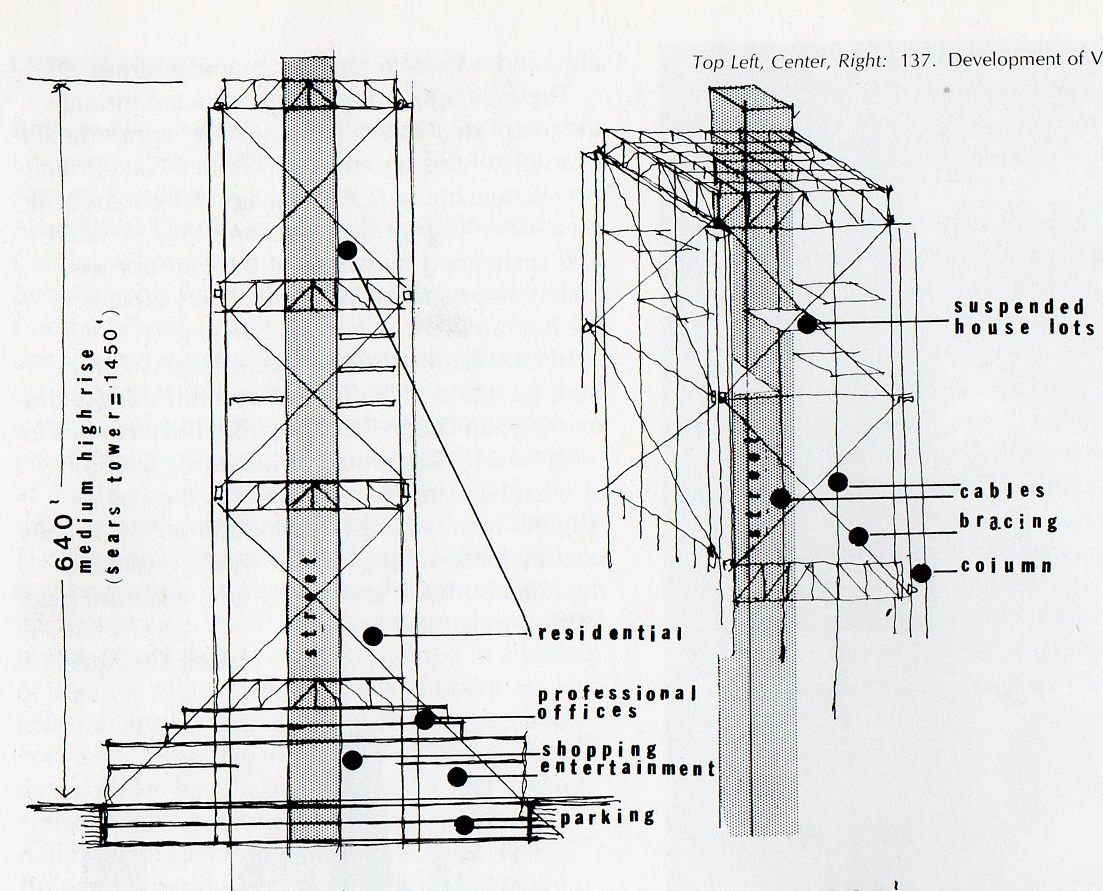
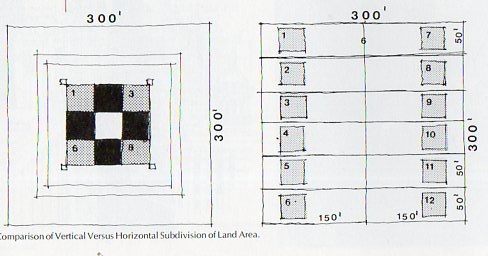
    The Romanian architect Harlan Georgesco came up with an idea to prevent suburban sprawl from making one city out of the land from San Diego to San Francsico–put the suburbs in the sky.  The story is in the wonderful Unbuilt America by Sky and Stone under the subheading “Relocation of Los Angeles”, where they quote Mr. Georgesco saying that the sprawl of a plan to develop 300×300 foot “horizontal plots” in a larger scheme of an endless horizon of such housing could be made into “vertical tracts”.

    Vertical suburbs360

    The vertical tracts of 300×300 feet (90,000 square feet or about two acres) oe chunks thereof would be suspended via “steel in tension” (giving the Golden Gate Bridge as an example of this system) in a structure 640 feet tall, which is labeled as a “medium high rise”).  (I should point out that the WTC was 208′ square.)

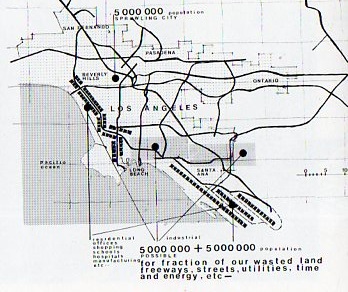
    Mr. Georgesco’s proposal called for a total reorganization of dwelling life in California–he was thinking of housing 5 million people in this way.  The little squares on his map (below) shows the emplacement of colonies like this vertical city. 

    Vertical suburbs362

    It seems to me that as a futurist the architect’s plans contained an abundantly fatal flaw in assuming the construction of suburban houses on a platform 600′ tall.  To be concerned with waste by stacking cul de sacs one on top of one another seems to miss the point, some. 

    Vertical suburbs361

     Notes:

    I would be curious to know about Mr. Georgesco’s life in Romania during the 1939-1945 period.  He certainly became successful and accomplished, though the period in Romania was–lightly put–complicated.  Starting out the war as a neutral, Romania moved quickly to be an ally of the Nazis, participating in Barbarosa, and over the next 3 years lost hundreds of thousands of soldiers, and civilians.  And of course there was a participation in the Holocaust.  By 1944 the King of Romania was able to lead a revolt and Romania joined the war on the Allied side, declaring war on Germany.  They were almost immediately overtaken by the Soviets, who would stay for quite a long time.  When the Soviets arrived, they basically “took” the Romanian army (of 130,000 men or so) back to the Soviet Union–the vast majority never to return.  Mr. Georgesco left in ’47.


  • A Note on Teaching Math, Unexpected Art, and Picturing Things Differently

    JF Ptak Science Books   Post  1427

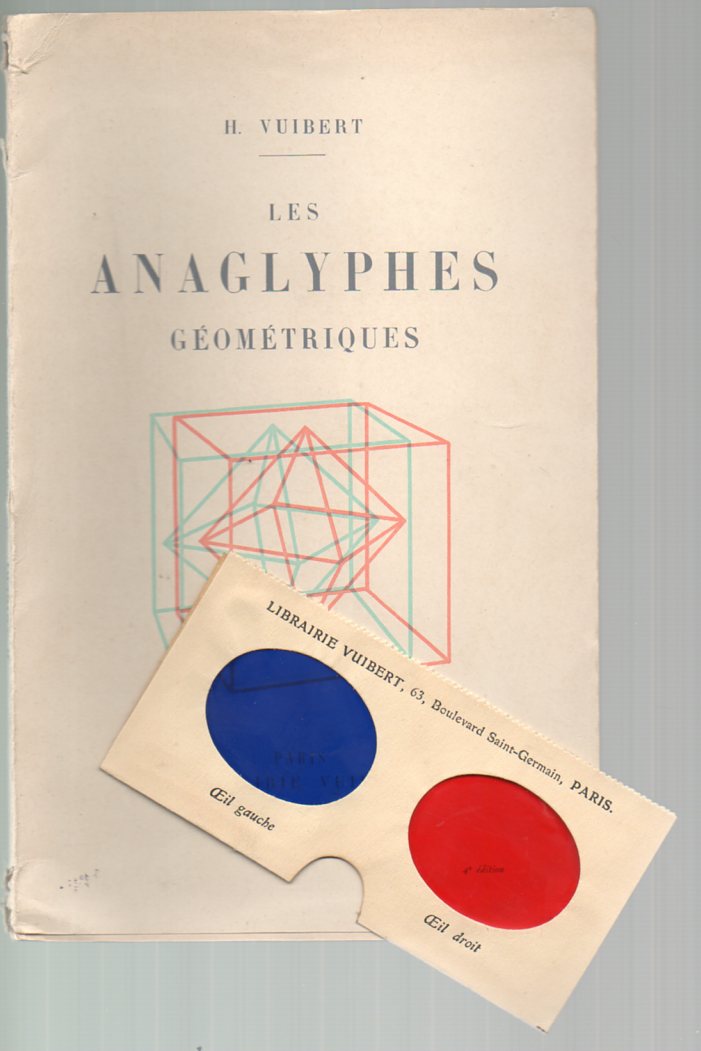
    Vuibert308 Stereo viewing geometrical figures may or may not be useful–I find it a little off-putting, creating a slight dizzying effect, though I’m sure it helps others (particularly children?) see complex geometrical figures a little more easily., especially when it comes to crystalography images. Education was certainly what Henry Vuibert , the author of Les Anaglyphes Geometriques had in mind when he published the work in 1912.  He had a long history in mathematics education, having founded the firm that bears his name back in 1877, a publishing house specializing in school texts in the maths, physics and general sciences.  (We offer the book for purchase at out blog bookstore.)

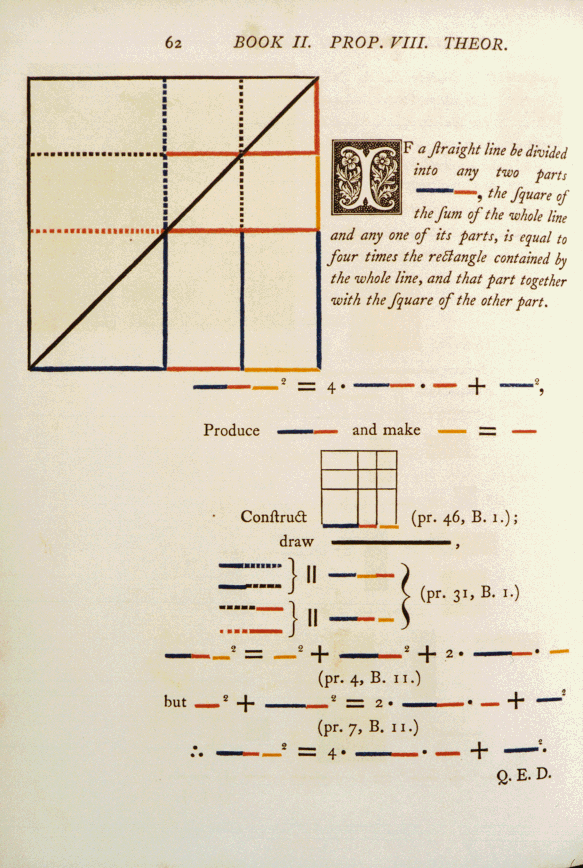
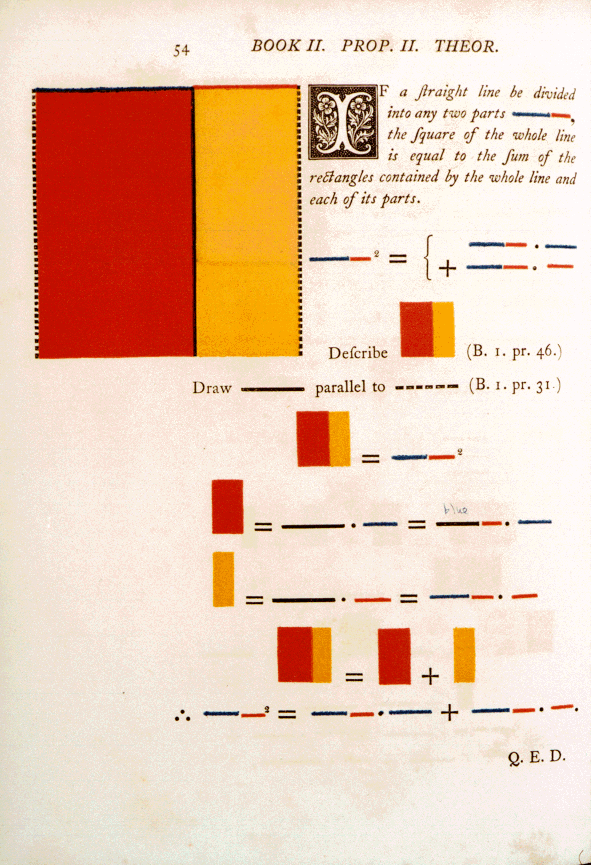
    Vuibert’s book is a very early example of the use of the anaglyphe–examples of the use of the method go back to the 1850’s, when d’Almeida used a version of the idea to punctuate lectures using a magic lantern; the (printing) process of the anaglyphe wasn’t patented until the 1890’s by L.D. DuHaron.  It does confuse me or remind me quite a bit of Oliver Byrne’s beautiful monster The First Six Books of Euclid in which coloured diagrams and symbols are used instead of letters for the greater ease of readers… printed at the Chiswick Press by C. Whittingham for William Pickering in 1847.  The book is, well, unusual and probably not at all usefu11.  Bryne replaced all of the algebraic notation, identifying letters and almost all of the descriptive text with color and color codes, leaving Euclid mysterious, hidden, awkward, impervious, and, yes, beautiful2. As a matter of opinion this work presages the cubists (and especially Piet Mondrian) by 60 years, and all by accident artwork. 

    Byrnes 11.8


    There are certainly much earlier works that tried to get at a fuller representation of geometrical objects, not the least of which was a 16th century Elements of Euclid in which the figures were cut-out paper, pasted into the book and attached to a string so that the reader could pull out the illustration and see it displayed in three dimensions. The elements of geometrie of the most auncient philosopher Euclide of Megara. Faithfully (now first translated into the Englishe toung…3, printed in London in 1570, was no doubt a great and exasperating labor of love, a complex “pop-up” book accomplished with sixteenth century technology.  (The photo below shows the Smithsonian Institution’s copy.)

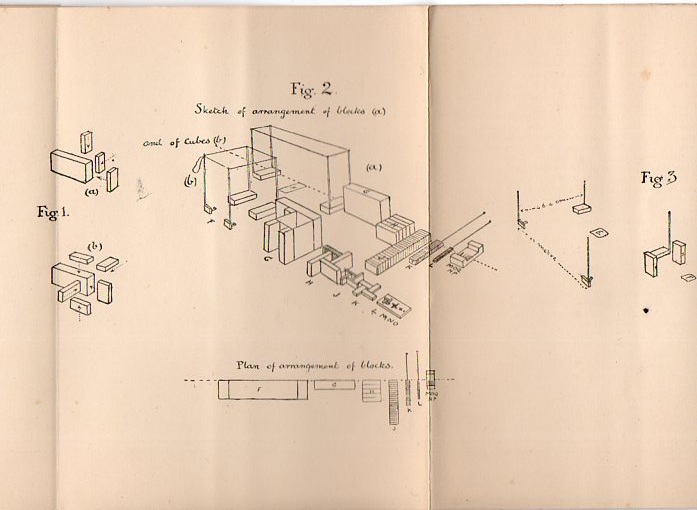
    Of course there’s the very old fashioned way of representing mathematical concepts, and that’s with sticks and stones and blocks and such.  For visceral memory and practical applications, the idea is hard to beat, unless of course, you really beat it , which is difficult to do.  But to me that’s just what Major G. Mackinlay did in his Realistic Arithmetic,  for Teaching Children the Elements of Arithmetic by Means of Special Blocks4, published in London in 1900–his ideas for the use of blocks was very sound and stable; his instructions (and in particular his illustrations) for what to do with the blocks was not.  I am reminded of inscrutable, badly translated and designed instructional manuals for tech stuff that need a manual for the manual. 

    Here’s one of the folding plates describing how to assemble the blocks:

    Math blockis309

    Then there are other sorts of wooden (and etc.) three-dimensional models, such as the (600+) gorgeous geometric designs housed in the Institute Henri Poincare, transferred there from the laboratory of geometry of the Faculty of Sciences of the University of Paris in 19285.  Most of these models were constructed around the time of vast change in mathematics and art (1900-1920), which means that many of them predate the revolutionary ascensions of  Cubism and non-representational art.

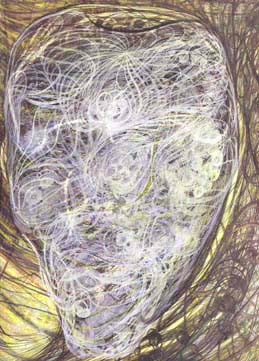
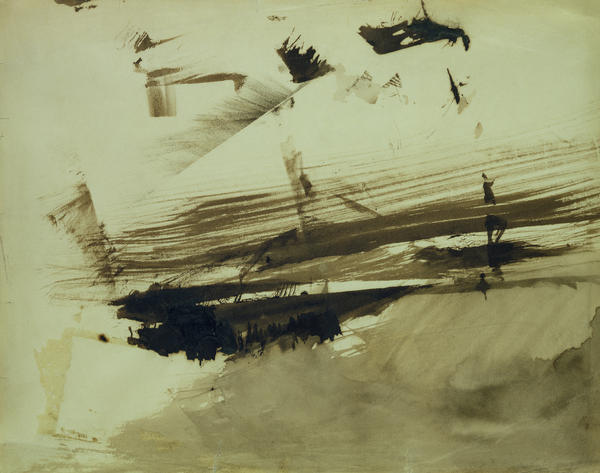
    And as long as were at the point of unintentional and under-recogniozed epochal works, I think that there is a broad book that could be done on exactly this topic, calling into play such examples as Georgina Houghton, Victor Higo, Emily Vanderpoel, and many others. 

    Georgina Houghton, for example, produced this non-representational painting in 1870 (or thereabouts):

    Georgiana

     And Victor Hugo, from the 1860’s

    Evocation of an island Painting  - Evocation of an island Fine Art Print

    And Emily Vanderpoel (1900 or so):

    Art-vanderpoel186
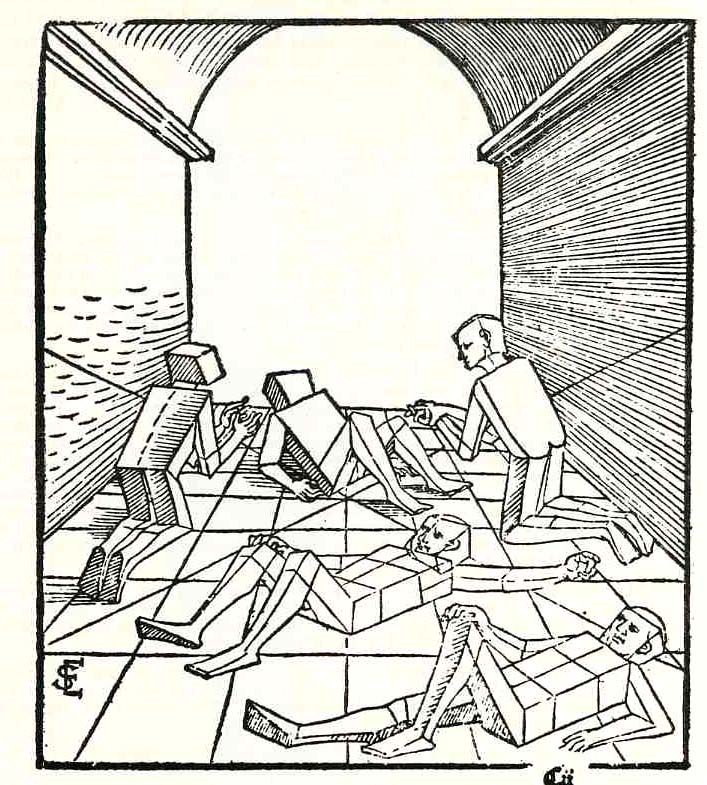
    In another, much earlier case of removing detail and adding abstraction for the sake of simplicity in representing an idea,  Erhard Schoen, in his Unnderweissung der proportzion und stellung der posssen liegent und dtehent, printed in Nurenberg  in 1538, presented these cubed figures (below).  He used simplified geometric form to stand in for the curvy humans, replacing them with proportional stacks of boxes which would more easily explain to the younger reader how to represent the human body in space and in proportion to other things. 

    Schoen

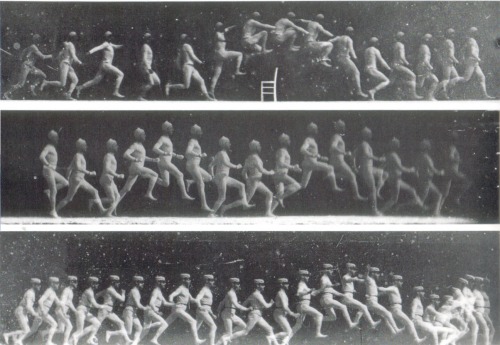
    I think that these were monumentally combative images showing humans in a radical, previously unknown way, much like the moving-through-space-and-time photographs of the somewhat forgotten Etienne Marey, who in the 1870’s created what was essentially the world’s first “slow motion” device. One iteration of Marey’s apparatus was basically a long series of ganged cameras recording a motion for a Marey12 simple task at a given time frame and presented on a continuous strip of photographic paper, sort of like a motion picture with the camera speed set at three frames per second. The resulting images were phenomenal and showed people for the first time the exactness of all manners of simple motions–motions that no longer looked so “simple” once all of its aspects could be studied from captured photographic evidence.  Even the act of hopping over a small stool or bending to pick up a bucket of water were enormously revealing in a way like Robert Hooke’s Micrographia displayed the great detail and complexity of the seemingly simple fly.  Perhaps the most famous of Marey’s series of images was that of a galloping horse, which also for the first time revealed what exactly the horse’s legs were doing and proving that almost every painter in the history of art represented the galloping horse incorrectly.  His series of photographs (as in this sample below) show a fairly close fit to the work of the futurists (like for example Duchamp) who would come into being after another four decades. 

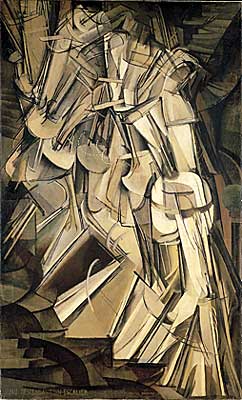
    Marey  And Duchamp’s Nude Descending (1912):

    Duchamp


    I do want to make it clear that this is just a simple note, a thinking-out-loud piece on how attempts to visualize things differently for the sake of explanation or education can come “unintentionally” close to what would become epochal works.  More later.

    Notes

    1. Augustus De Morgan, mathematician and logician, wrote a very highly critical book A Budget of Paradoxes in which he describes hubbub, fakirs, frauds, perpetual motion machines, squaring the circle efforts, millstones and other useless books in the maths, and in here he sniffily dismisses Byrne’s work. At best, to De Morgan, the Byrne book is “curious”. But useless and curious, as I have seen many thousands of times, does not mean that it can’t be attractive and beautiful, and the Byrne book is probably the leading candidate in the Bad & Beautiful category.

    2. In his Victorian Book Design McLean calls the Byrne book “…one of the oddest and most beautiful books of the whole century…a decided complication of Euclid, but a triumph for Charles Whittingham [the printer]”.

    3.  This is also the first appearance of Euclid in English.  The full title: The Elements of geometrie of the most auncient philosopher Euclide of Megara faithfully (now first) translated into the Englishe toung by H. Billingsley, citizen of London; whereunto are annexed certaine scholies, annotations, and inventions, of the best mathematiciens, both of time past and in this our age; with a very fruitfull praeface made by M.I. Dee, specifying the chief mathematicall scieces, what they are, and whereunto commodious; where, also are disclosed certaine new secrets mathematicall and mechanicall, untill these our daies, greatly missed. London, Imprinted by I. Daye, 1570.

    4.  From the Report of the Annual Meeting of the British Association for the Advancement of Science, 1906:


    5.  From the IHP website:  “Most of the models  were created by Martin Schilling in Leipzig between 1900 and 1920 and  a few of them  (in wood)  were made between 1912 and 1915 by J. Caron, Professor of Descriptive Geometry in charge of  the “graphic work” course at the ENS at the beginning of the century (between 1912 and 1915).”

    Also this:   “In the thirties, the surrealists, led by Max Ernst, were interested in these geometric objects. André Breton alludes to them in  “Crise de l’objet” , an article  in the magazine  Cahiers d’Art (May 1936, No. 1-2, p. 21-26.). Man Ray took photographs of the models, which where published in same issue. He would later use them to compose what he called  “Shakespearean Equations”. Many artists, painters, architects and sculptors drew inspiration from them.”


  • Miss Atomic Bomb: the A-Bomb in Popular Culture–Comics, Cakes and the Will of God

    JF Ptak Science Books   Post 1425 
    Follow Me on Pinterest


    I’ve written dozens of posts on this blog about atomic bomb history and where the bomb has shown up in popular culture.  This installment is on the bomb in very popular culture

    Miss Atomic Bomb is an icon of some sort for the relationship of the bomb with society, or, perhaps the bomb and Vegas, which is where this picture was taken. I guess there are reasons to put pretty women in front of computers (in the 1950’s/60’s), cigarettes and automobiles–why not with The Bomb?

    Atomic Bomb Miss
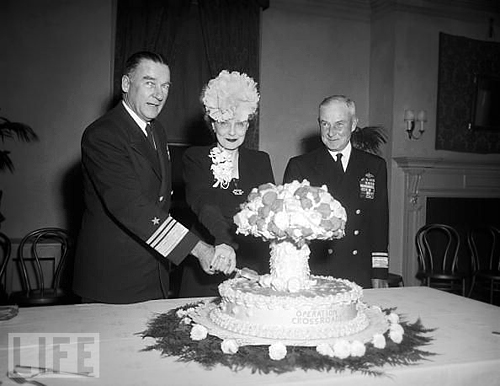
    The atomic cake (with matching headware):

    Atomic cake

    The caption to this story from Life magazine (1946) reads: “U.S. Navy Vice Admiral William H. P. Blandy, his wife, and Rear Admiral Frank J. Lowry cut a cake made in the shape of a mushroom cloud at a reception for Operation Crossroads, November 6, 1946.”  Actually Blandy was an early (August 1945 or thereabouts) forward thinker about how to deal with the U.S. owning the bomb and  international control.  I have little doubt that he probably thought that the cake was a bad idea, but, well, he did what he needed to do.

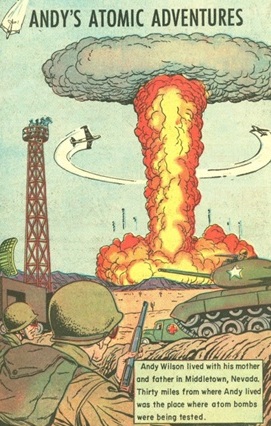
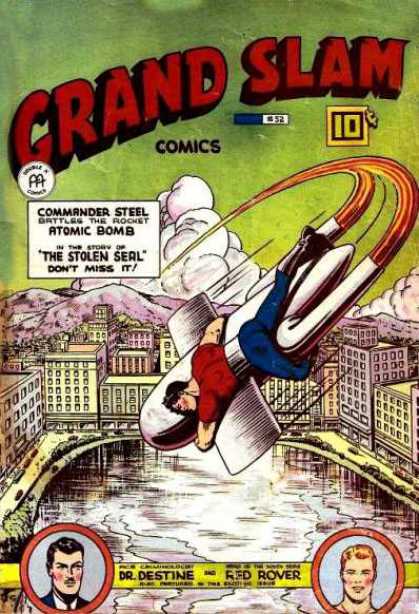
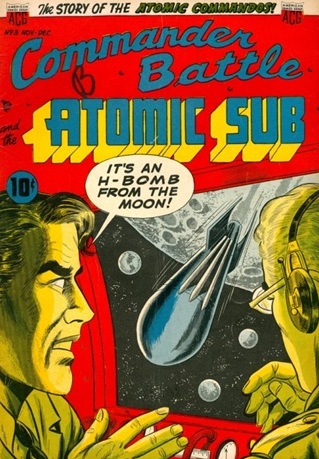
    There were all sorts of comic book adventures dealing withe the atomic bomb, right from the very beginnig (as it seems the earliest of them appears a month after the Hiroshima bombing).  These are just a few examples with the a-bomb on the comic’s cover(s):

    Atomic andy

    Atomic grand slam
     
    Atomic  h bomb from moon

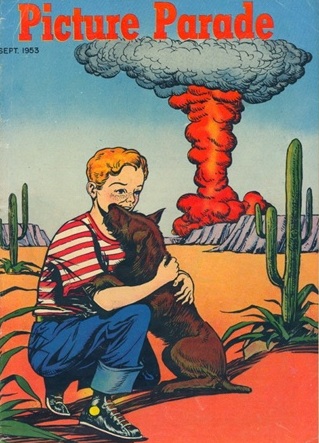
    AtomicbombBizarro–I don’t know the story of this image in Picture Parade, only having the cover graphic–perhaps that’s enough, perhaps we don’t need anything more, perhaps the backstory would spoil a perfectly bizarre image with something perfectly benign.  Or perhaps not. 

    Atomic bomb biazzaro
    Bizarre but for different reasons–a pocket-sized ball bearing patience game. Tokyo is included as a target for this game but in actuality was not considered atomic-bomb-worthy, mainly because it was decimated,  blanketed with a firebombing  that destroyed a host of the city just weeks before the first blast. (On March 9-10, 1945, 339 B-29’s dropped 2000 tons (4 million pounds, about 496,000 bombs) of the incendiary M-69 on Tokyo.  Two initial passes were made on the city, marking a large, burning “X” in the city.  Each plane had the capacity to cover a drop area of 350 feet by 2000 feet, which means a much greater area was affected. The citizens of Tokyo met their ends with buckets of water and brooms in defense. Hours later fifteen square miles of the city were destroyed.  In the months prior to Hiroshima and Nagasaki, 66 cities were bombed with M-69, killing about a million people, and wounding more.)  Fresh cities were needed for the atomic weapons so that there effectiveness could be judged against a palette of a normal. intact city, and not one that had been previously attacked. 

    Atomic Bomb dexterity game
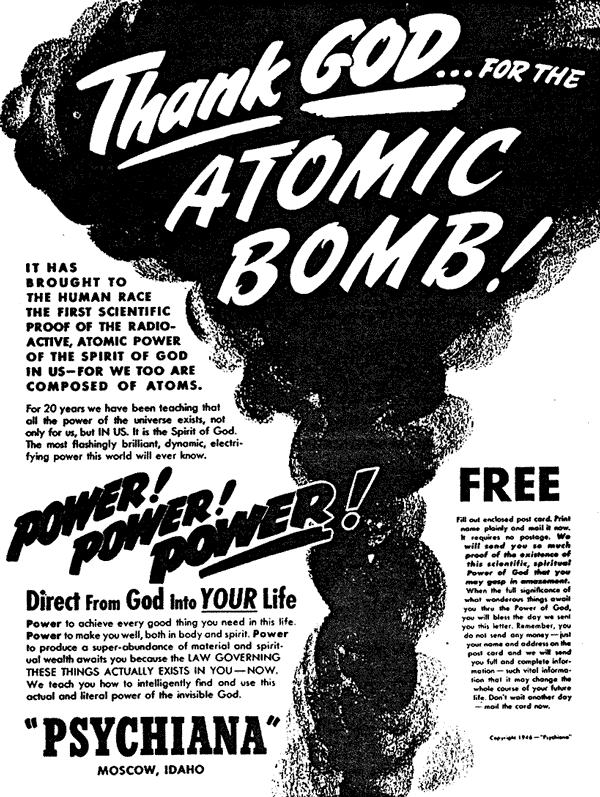
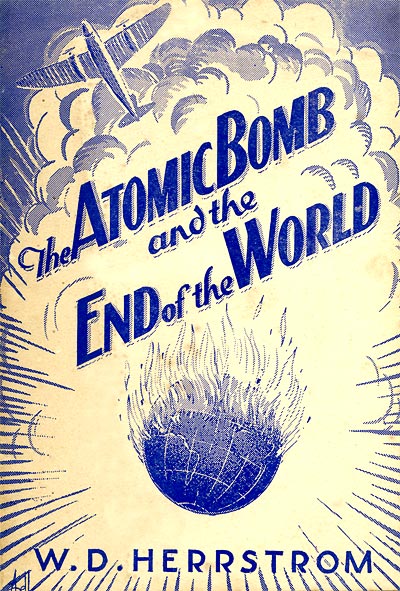
      And still more bizarre, when you combine all of the aspects of the race to the bomb with the race to god and the people who would believe such a thing.  This advertisement belonged to a mail order religico empire builder, Frank B. Robinson, (1886-1948), who claimed himself to be a prophet of god, had conversations with the Creator, and in general used whatever was of interest in the newspapers to drive interest in his ministry by mail.  It looked like his creation–Psychiana–wasn’t much more than a feel-good, self affirming, positive-thinking enterprise driven by a man with a personality big enough to be on speaking terms with the god, who in the ad below somehow was selling “the atomic power of the spirit of god in us”  because we are composed of atoms.

    Atomic bomb thankgod

    And of course on the other end of this:

    Atomic_bomb_end_of_world

    This is an example of a host of end-of-the-world, post apocalypse movies (and books, and short stories, and so on) made to scare and entertain.  Judging from the trailer the more-modern television series Jericho owes a lot to Ray Milland. 
    Atomic panic-in-year-zero

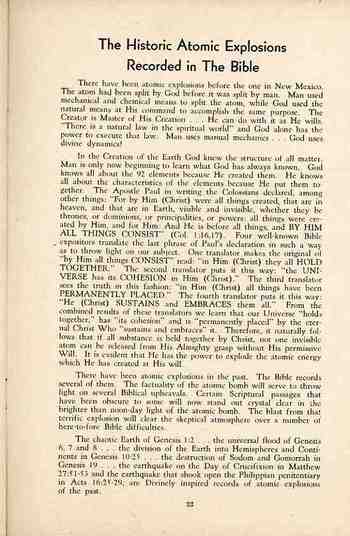
    Mel Morris  published God’s Atomic Bomb  in 1945, which means he must’ve worked a little feverishly to pump up his bible prophesy and history to include the new atomic weapon to replace whatever else he had been using as a prophecy for end of times.  (As it turns out, “God’s Atomic Bomb” was more tempest and disaster in the bible, and not (whew!) the bomb itself.  Though as we’ve learned from scientologists and the sort-of creative mind of Ron Hubbard, a civilization came to the earth thousands of years ago and pummeled it with “atomic bombs” and other nastiness, polluting humans for milennia to come.  But that’s another story–suffice to say that Morris found many dozens of examples of “God’s Atomic Bomb” being used in the deep biblical past, and that the use of the real atomic bomb in 1945 was pre-ordained, and not without its figurative historical counterparts.  I’m not sure why any of this was necessary outside of proving to some small minority that these preachers could at least be contemporary and topical. 

    Blogsept_2_atomic_bomb_god_2txt483

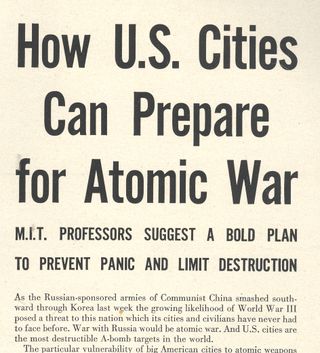
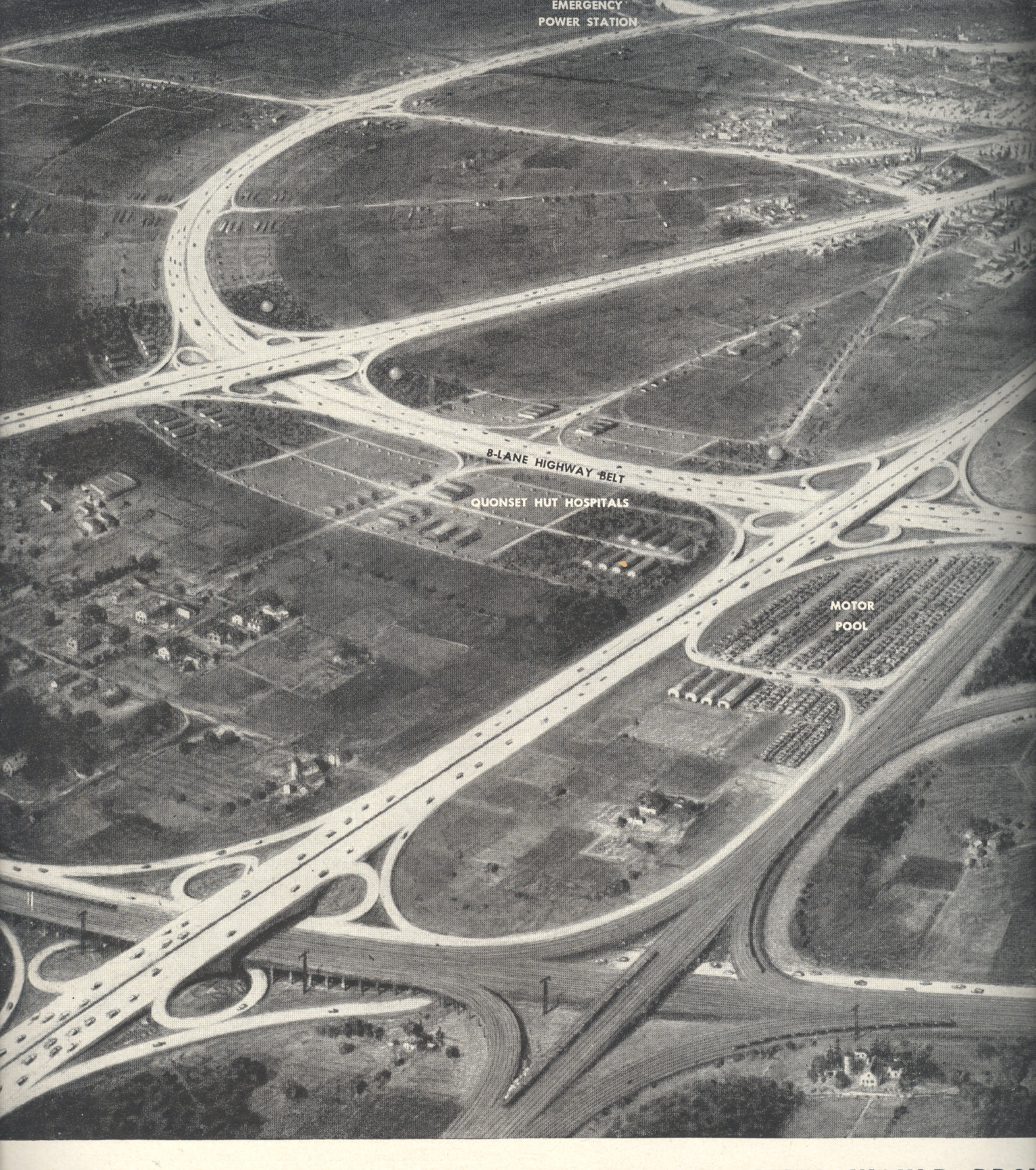
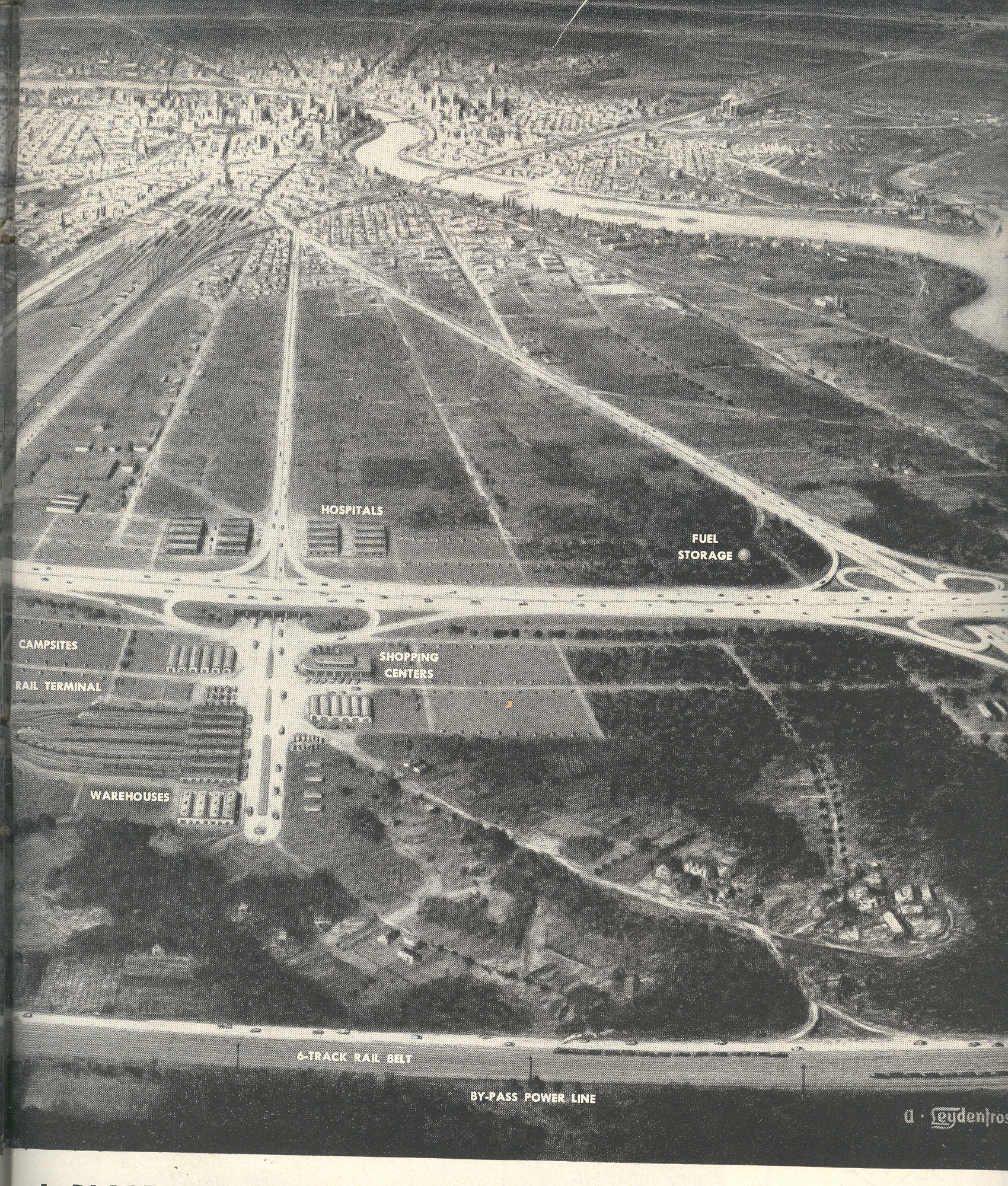
    The following is not the worst idea regarding the survival of nuclear holocaust, though it is an extremely bad one.  (Atomurbia, which makes the entire country a suburb to itself and therefore nothing, and which I write about below, is perhaps the worst idea that I have seen on combating the Soviet menace.)   But this one, which appeared in Life magazine in 1950, does come close, setting up post-attack suburbs (for “refugees”) and which takes some pre-attack city planning into some account.  There is a lot of planning for people in cars to make their way out of the city, which reminds me of the evacuation maps of Washington D.C. (which were still being handed out in the early 1980’s), which sends people on their way east and west depending upon the last digit of their car’s license plate being an odd or even number. 

    Atomic city plan war

    ==Blog July 27=wiener left

    One reaction to impending Doomsday was to construct concentric outer highways around metropolitan areas, “life belts around cities (which) would provide a place for bombed-out refugees to go”. In the birds eye view provided here, we see the plan in action, the main parts of which are an 8-lane “express” highway belt 10 miles away “from the built up edges of the city” , and a 6-track railway belt five miles further out, these accompanied by various feeder arms stretching straight-away from downtown.  In between the two outer rings would be land that would be kept free of development, so that farms and tent cities could be constructed after the attack. There would also be major collections of hospital and fuel depots in the greenbelt area.  Infrastructure would already be in place (gas and electricity, supplied with power from who-knows-where).   Shopping centers and a giant “motor pool:” would also already be in place, waiting for the Doomsday clock to strike midnight. 

    ==Blog July 27=wiener right

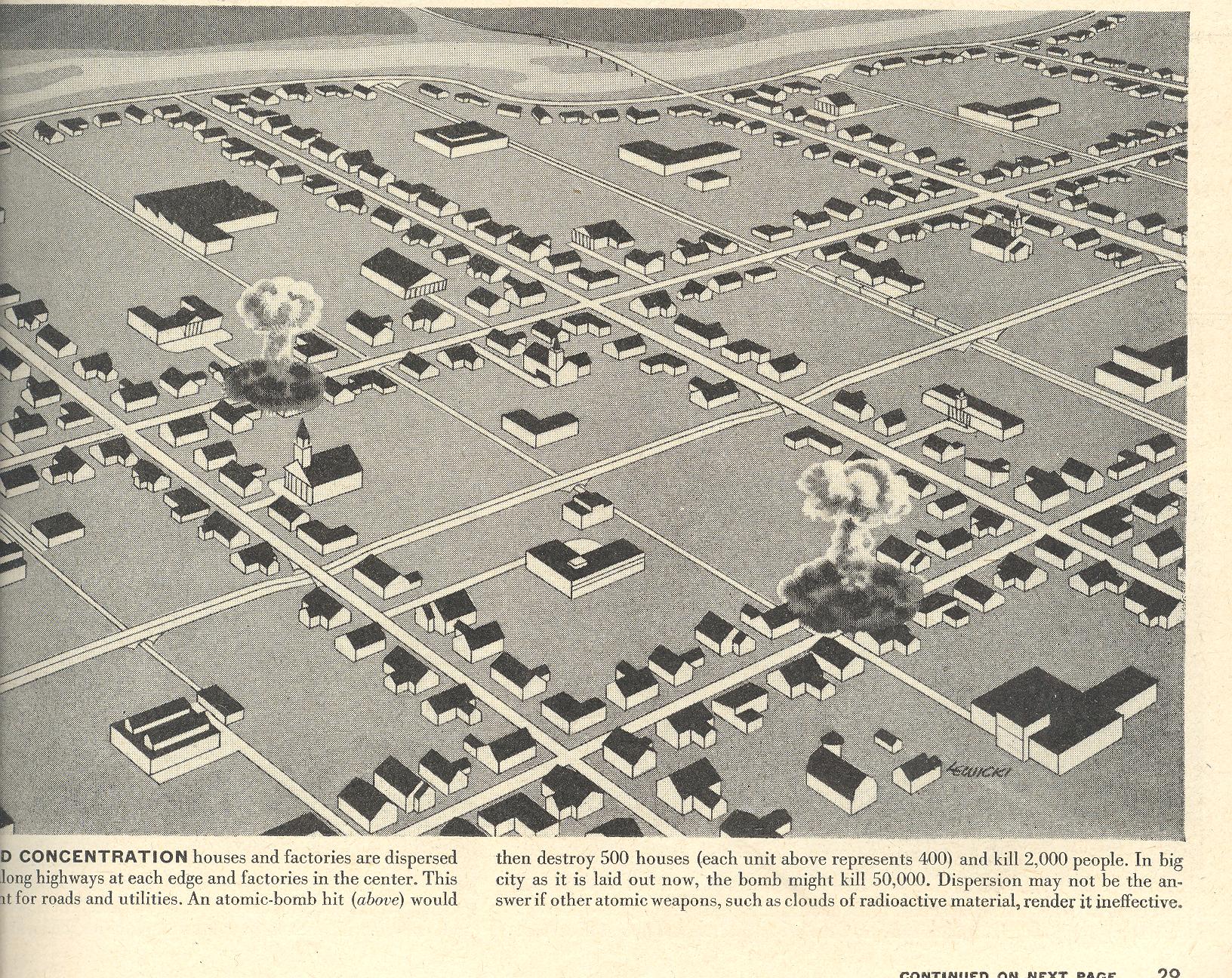
    This idea of city planning was one of many offering the prospect of safety from nuclear attack by spacing out the population of the United States so that the Soviet Union wouldn’t have enough nuclear warheads to take everyone out.  It called for the redistribution and resettlement of virtually everyone in the country, and is one of the most spectacularly bad ideas that I have come across in this field.  (I wrote about it earlier in this blog, here.)

    1-may 3-atomic 4

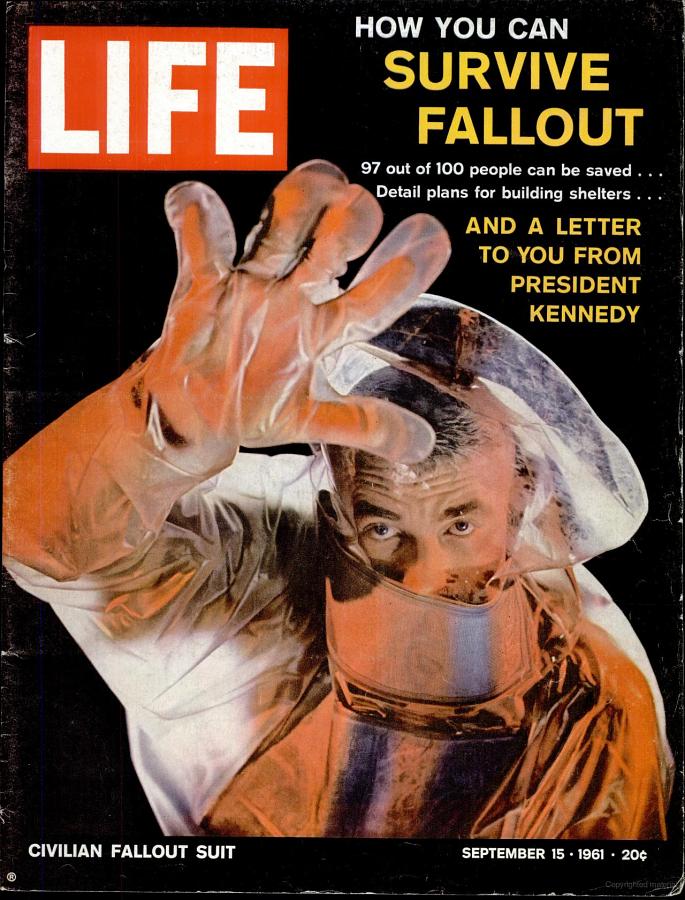
    This issue of Life offered the possibility of hope that 97% of the American population could survive a nuclear attack by the Soviet Union. It was a hard sell of a bad idea of insane optimism.

    Books_004


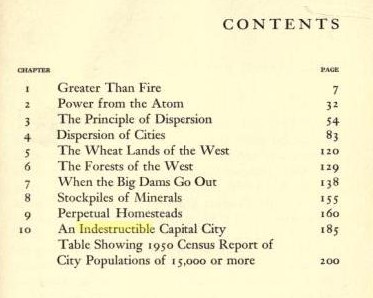
     Sylvian Kindall’s Total Atomic Defense (published by a very severely right-wing publisher in 1952) is one of a series of books made for a deceived American population, offering the general reader both fear and hope, often from the same, exact source. But Kindall has a  somewhat diffident approach, offering his belief that the country and its population can largely  survive an all-out nuclear waBlog--untinkable tpr–intact.  Chapter 10 tells the remarkable story of how to make the captial city of America atom-bomb proof, mostly by digging it into the side of a mountain.

     
    Blog--unthinkable


    Again, this is just the barest touch of the top of a huge pile of such stuff–and I’ve not even mentioned duck-and-cover films.


  • The First X-Ray of an Atomic Explosion Inside a Person? Superboy/Superman & the Atomic Bomb, 1945-1964

    JF Ptak Science Books  (Continuing  Post 1140)

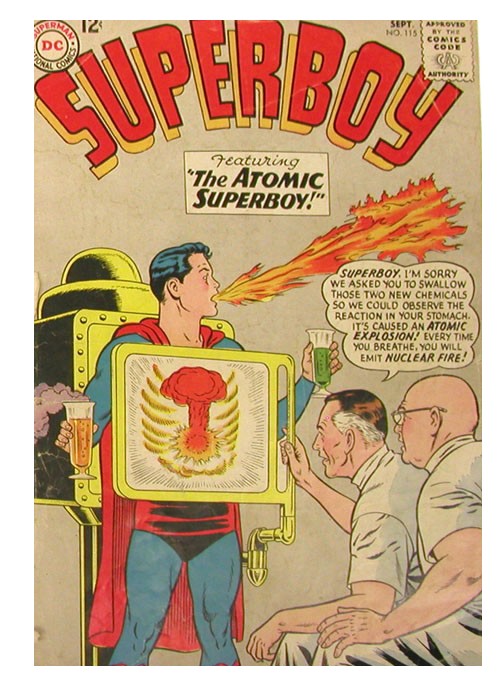
    I don’t know why, but I cannot remember ever having seen an x-ray of an atomic explosion taking place inside of a person, before today.  I guess that Superboy’s body is susceptible to x-rays but is also at the same exact time capable of preventing a nuclear explosion from escaping his body–all except for the “nuclear fire” coming from his mouth.Now that’s some sort of body control! The men in white seem pretty confident, being so close to the Trinity-like action and all.

    Atomic explos superboy
    Superboy evidently needs fewer ribs than humans, and it looks like the detonation point is right on the transpyloric plane, taking out kidney, liver, gall bladder and just about everything else.  And his spine doesn’t show up, either–along with a lot of other innards.

    Atomic explos superb deta 

    The original (published in September 1964) comes from the Oak Ridge Associated Universities, and they point out that this issue comes right after the signing of in-air nuclear weapons testing ban (after a speech by JFK in June 1963, marked by a memorial that was about 10 feet away from where I used to practice the shot put in D.C.)

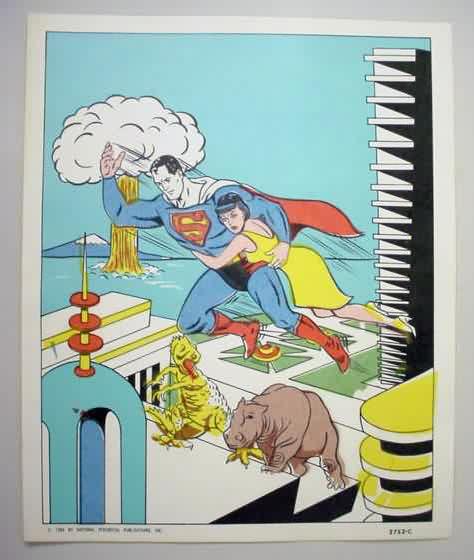
    This mushroom cloud doesn’t take place inside of Superman, but it does seem to take place, well, oddly–there was no text that I could find that accompanied this image, so we’ll have to leave the story arc to imagination. 

    Supermanrubon-rhinoclean

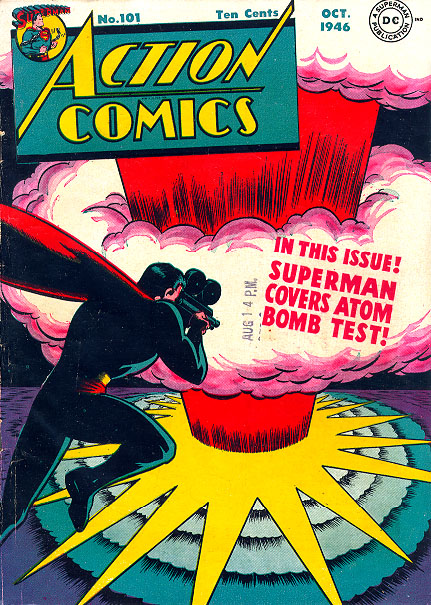
    And, well, if you’re not having an atomic explosion in your stomach and not combating one, I guess as Superman you could cover one (image found here):

    \Atom Action#101Med

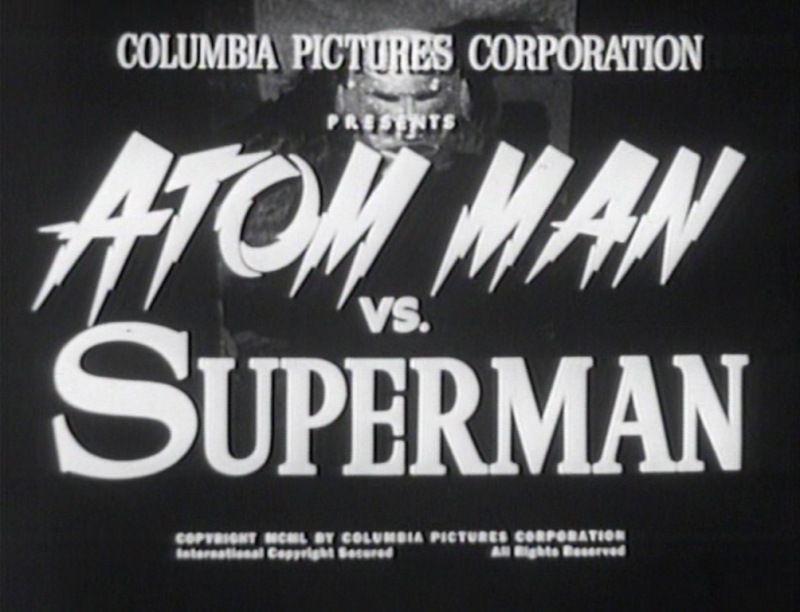
    Atomic Superman50Title


  • The Old is New Department: Refuting Darwin with Commas, Adjectives, and the Creator (1873)

    JF Ptak Science Books    Post 1423

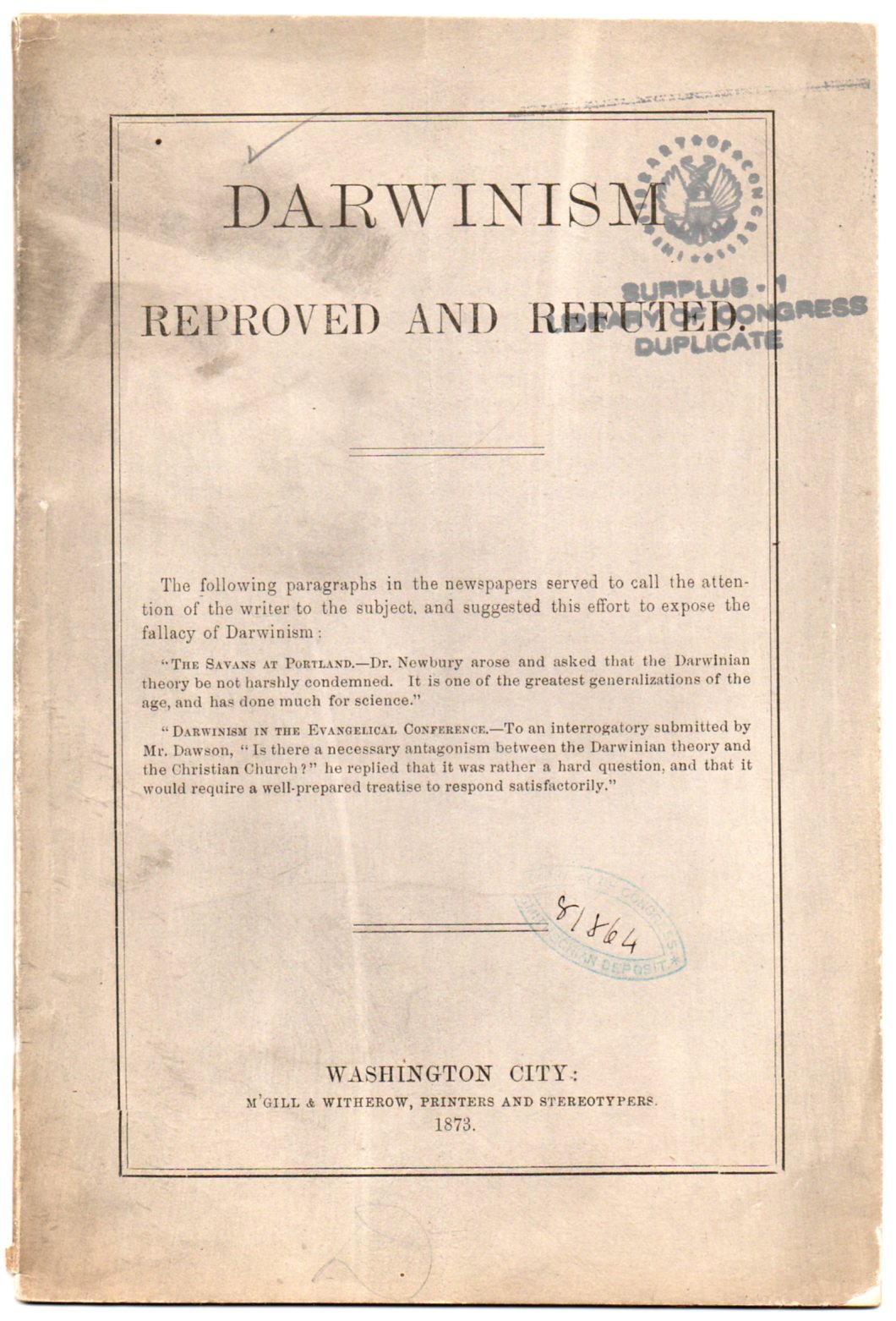
    Darwin refuted296 I wasn’t going to write anything at all about this pamphlet, but the vocabulary was so strong and vehement, and reminded me so much of what we can read in today’s daily press, that I thought to at least pick out some of the choice morsels. 

    Darwinism Reproved and Refuted, published in Washington D.C. in 1873, is left without any attribution to the author, the writer not caring to sign his/her name, not even to use as the wood into which some shingle with a weak social sciences/psych/religious Ph.D. could be nailed.  It is just left to the imagination or indignation that the writer didn’t or couldn’t feel confident enough to actually sign their work.  It is also one of hundreds if not thousnads of anti-Darwin vehemence–there is a chance I guess that there were more of these things written than there are visible-to-the-naked-eye stars in the night sky.  (The original pamphlet is available at our blog bookstore.)

    The author has little room for Mr. Darwin’s work1, clearly on a super-rant over The Descent… and on the theory of evolution, using such colorful words in runny purple prose like “\repugnant, revolting, unsophisticated, outrage, deadening influence, peculiar, fallacious, cunning”–and this coming from the first two paragraphs.  Needless to say, even though  the writer was too weak to sign their name, they did have some strong opinions. 

    “Utterly false, radically and fundamentally wrong, futile in the extreme, unreliable, ungrounded, false, short-sighted (in relation to god), ridiculous…” continues the author. The endowments of the Creator stuff doesn’t work its way in until the third page, when the adjectival and adverbial assault was already on it way, all without the assistance of any scientific counterexamples–but then the rest of the work is dedicated to proving the godless nature of Darwin’s work and its escape from scientific reality.

    We find this:  “Evolution is founded on materialism, which is another term for atheism”….”let this doctrine be compared with the Mosaic account of creation, and then the student of nature determine if he will choose for his progenitors Darwin’s pair of ring-tailled [sic] monkeys, or ‘Adam…’ “

    And so that’s what we get to in the refutation:  the Creator.  Old version of a contemporary complaint to get Darwin tossed out of classrooms to protect the youth of America, replacing it with divination.  The author writes:  “In the investigation of nature which is the proper province of the scientist, the most effectual method of studying it, in order to render this subject clearly intelligible to the human mind, is to regard the economy of nature as a form of government, having God for its founder, its Supreme Ruler, and Law-giver.”

    There’s not too much one can do with that, and even though it sounds antique, isn’t necessarily so, because the philosophy exists today, only with fewer commas. 

    Notes:

    1.  By 1873 Darwin already had produced an epochal body of work, including but not limited to On the Origin of Species by Means of Natural Selection, or the Preservation of Favoured Races in the Struggle for Life (1859),  On the various contrivances by which British and foreign orchids are fertilised by insects (1862), On the Movements and Habits of Climbing Plants  (1865), The Variation of Animals and Plants under Domestication (1868), The Descent of Man, and Selection in Relation to Sex (1871), and  The Expression of Emotions in Man and Animals (1873)


  • Obfuscation as a Weapon–on Teaching Indians to Read, 1875

    JF Ptak Science Books   Post 1417 

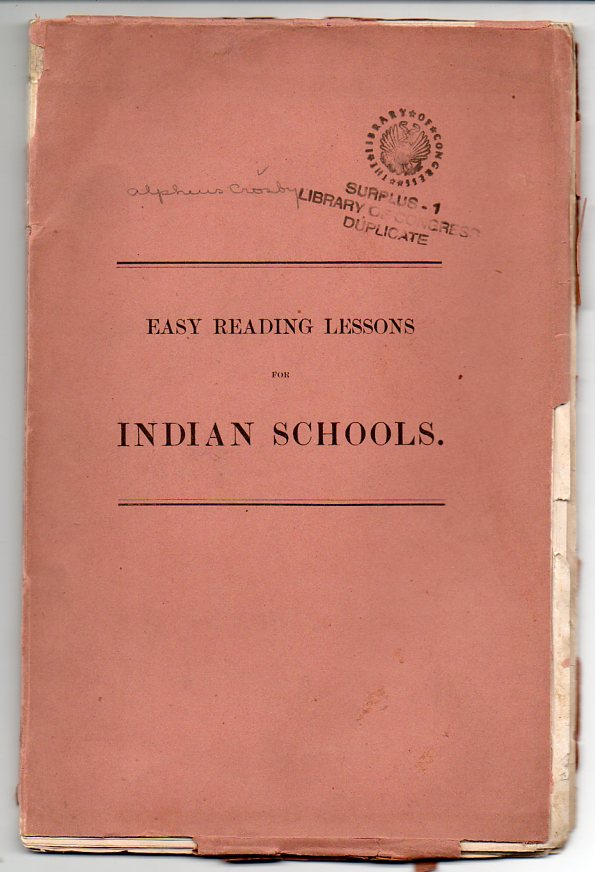
    This small pamphlet, Easy Reading Lessons for Indian Schools, was published for the Department of Indian Affairs (as a section of the Interior Department, classifying the Indian along the lines of cattle and agriculture) by the federal government, printed by the indomitable Government Printing Office in Washington DC in 1875.  (The original is available at our blog bookstore.)

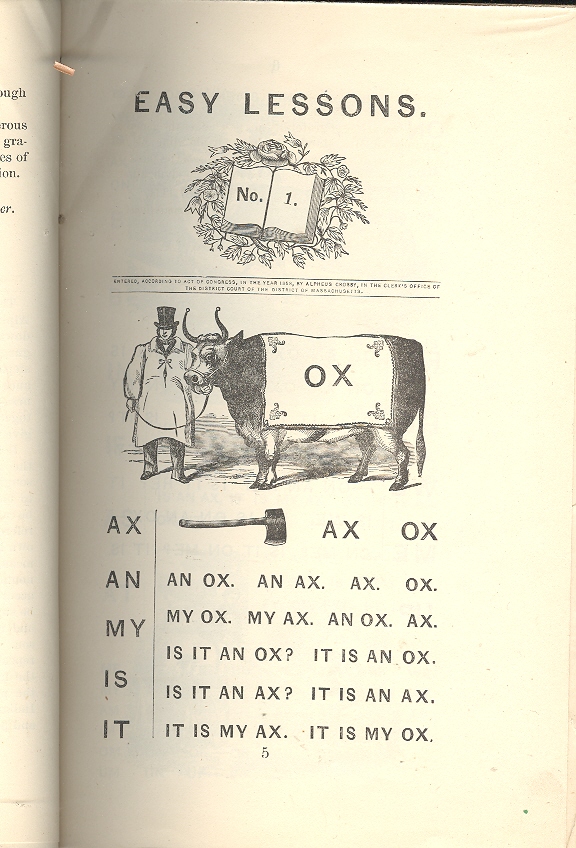
    Indian school269 It is an unintentionally quiet indicator of the general American policy towards the Native American in the last quarter of the 19th century.  The work is indifferent to any particular need of the student.  It is intended for the person who could not read, and nowhere in this work is there a listing of the alphabet.  It is ignominiously but softly complex, and looks to me to be a total disaster as a text.  (This is true when comparing the work to nothing at all; but when you stand it next to, say, McGuffey’s reader or the Eclectic or any of the other classic how-to-read books of the 19th century, the weaknesses of the Indian book become instantly clear.

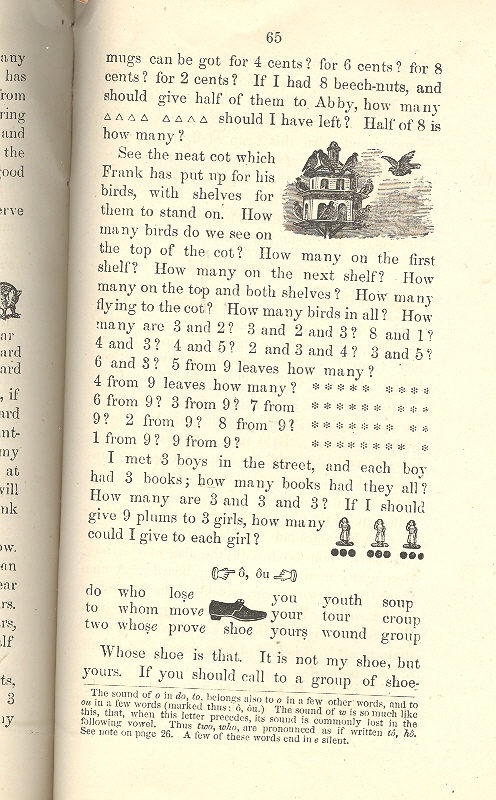
    How in the name of great bog could anyone have thought it just and fair and equitable to teach English-illiterate “Indians” to read with such an instructional?  It isn’t even close to being a book, and it comes no where near to being able to transcend its own terminal obliqueness.  It introduces simple words and phrases in a tongue-twisting ways, and then complicates the situation by quickly adding more structured words in a more confusing environment.  The thing is terrifying.  I actually had a hard time reading it out loud. 

    Here on page 17 (already!) is a tremulous example:

    “See the lad.  Is it Mat?  It is Mat; and Fan is by him on the sod.  He has his hat. But it is not on. Has Fan a hat?  Mat has a bat. Dan cut it by the bog. Mat had his bat, and ran at my dog Boz., and sat on a log, and hit him.  He did it in fun. And Boz had his fun.  He got the bat and ran it way and hid it in a box. Dan got it but bid Mat not hit the dog.”

    Indian 001

    For crying out loud! (The bat by the way is, yes, a baseball bat.  Pretty early stuff in 1875.)  Why would someone use this series of images to teach someone how to read?  The pamphlet continues to exhaustion, taking only 80 pages to do so. For me it is a perfect symbol of the way in which the government—in general—dealt with the “Indian Problem”.  Confusing children and making life more needlessly complex, making it harder for them to succeed, making it more difficult for them to rise above the difficult situation that they have unexpectedly been born into,  is a superior sign of inferiority of the dominant power. 

    Wait a minute.  Am I writing about the Indian in 1875 or the poor kids in  SE DC in 2009?  I can’t tell.  The corruption of the social model for caring for people who need federal attention more than anyone else—the underprivileged child—is antiquarian and entrenched and as strong as ever.  At least there’s a moral foundation for the care of kids whose parents cannot afford health insurance.  Um, oh, wait another minute….

    Indian 002


  • Vast Understatement Department: Re-crushing the Crushed “Indian Problem”, 1887-1934

    JF Ptak Science Books   Post 1405

     “This might seem like a somewhat rapid reduction of the land of Indian estates”–Thomas Morgan, Commissioner of Indian Affairs, on the sale/disposition of 15% of all Indian Lands over the period 1887-1891.

     Indian Affairs Commissioner Thomas Morgan had a commanding view of the situation regarding the American Indian at the end of the 19th century, considering that he was king of the hill, surveying the scene from his commanding height, in control of the affairs of all American Indians from the relative security of knowing hardly anything about them. It so happens that during the period 1887 through 1903, the Indians suffered about as much loss to their way of life and their lands than about any other time in their history, and this at a time when almost all Indian resistance to federal control had already been eliminated by force or terror or hunger or the sheer weight of the impossibility of fighting the United States1.

    Most of the problems with the loss of land and the approach of the near-end of their tribal system occurred with what federal representatives referred to as the “Indian Emancipation Act”, which was formally known as the Dawes Act (and also the General Allotment Act) of 18872. The general fatal thrust in this Congressional action was to relieve the Indians of their reservation system and then their land, to enforce their assimilation into American (white) society, and then to become individual property owners and then tax payers, making the Indian self-reliant and independent. The underlying philosophy here is that it was the reservation system was the cause of the Indians’ problems—that it kept the Indians from fulfilling themselves by excluding them from American society, segregated them from “self-improvement”.

    “The Indian may now become a free man; free from the thralldom of the tribe; freed from the domination of the reservation system; free to enter into the body of our citizens. This bill may therefore be considered as the Magna Carta of the Indians of our country.” –Alice Fletcher, one of the Architects of the Dawes Act

    The Act not only managed to give the Indians the lands that they already owned, but it also took the land away at the same time, making it available to heads of households in 160-acre plots. It was supposed to make the Indians into useful members of the white community, and to teach them to be farmers, and to “properly use” the lands which they were given. According to Ronald Takai3, Morgan saw the Indian land as going fallow, and that if they didn’t use their land to a good end, then they should lose it. AS Commissioner of Indian Affairs, Morgan said that most of the land that was taken by the government was not being “used…for any purpose whatsoever” with “scarcely any of it….in cultivation”. Hence if the Indians didn’t farm the land then the land was being wasted, and if the land was being wasted then the Indian had no right to keep it. Thus the circularity of the Indian’s problem was complete—they would be given land if they were using it “properly”, which meant to break off chunks of tribal land and deed it to individual families, which at the end of the life of the head of the household the land would more than likely have to be sold4; and if the land wasn’t being cultivated, then the government would take steps to seize it via its system of aggravated purchase.

    “The sooner the tribal relations are broken up and the reservation system done away with, the better it will be for all concerned. If there were no other reason for this change, the fact that individual ownership of property is the universal custom among civilized peoples of this country would be a sufficient reason for urging the handful of Indians to adopt it.”

    In the four years following the passage of the Dawes Act, something on the order of 17.4 million acres of Indian land was sold or re-allocated, which was about 15% of all Indian lands.

    The Burke Act of 1906 was the second time the Dawes Act was amended, and was also perhaps the most devastating change yet made to the tribal ownership system. It gave the government the right to determine which Indians were “competent and capable” to own land, though by design the definition of “competency” was left vague, though it often meant that there was a certain amount of European blood in the Indian being judged. This meant that the “competent” Indian would have their land taken out of trust status, and then become subject to taxation and could be sold by the owner. This also meant that communally owned tribal lands could be divided into individual plots which may then top sold to the highest bidder, If the person was deemed to be “not competent”, though, something entirely different happened:

    “…the Secretary of the Interior may, in his discretion, and he is hereby authorized, whenever he shall be satisfied that any Indian allottee is competent and capable of managing his or her affairs at any time to cause to be issued to such allottee a patent in fee simple, and thereafter all restrictions as to sale, encumbrance, or taxation of said land shall be removed. “

    Given the situation that the Indian’s per capita income was so low, and that most of that was coming from the sale of land and from government stipends, it was almost entirely assured that the Indians, who were in desperate straights, would almost assuredly sell their property once it was within their individual capacity to do so. It was also the case that some Indians were actually judged to be “competent” but weren’t informed of it—this wouldn’t matter except for the critical part of that Indian’s lands now being subject to taxation; and if you didn’t know that the lands were being taxed, after come years Uncle Sam came by to collect on the back taxes, and since the Indian would have no money5, the land would then have to be sold to pay for the taxes that the landholder didn’t know was accumulating.

    The result of the complex story of the Dawes Act and its aftermath was that by its end (which came to an explosive halt in 1934) the Indians lost about 90 million acres of their 1887 land base., amounting to about 66% of all of their land. Plus the dozens of land-grants that were awarded to the railroad companies.

    The Indian Reorganization Act of 1934 stopped these practices, offering a “New Deal” to the Indians, empowering the new commissioner of Indian Affairs, John Collier, with a sensical approach to the institutional/bureaucratic Indian problem(s) created by U.S. Government with the Dawes Act. It stopped much of the bad craziness of the previous forty years, though the effects of that time are felt to this day.

    Notes:

    1. There was still the Ghost Dance to come in 1890, but this was a limited action of desperate people, ending in American soldiers of the 7th Cavalry standing over a trench filled with the bodies of 150 frozen Lakota Sioux (men, women and children) following their massacre at Wounded Knee Creek. There were another 51 Sioux wounded, including 47 women and children.

    2. Opening text of the Dawes Act: “….the President of the United States be, and he hereby is, authorized, whenever in his opinion any reservation or any part thereof of such Indians is advantageous for agricultural and grazing purposes, to cause said reservation, or any part thereof, to be surveyed, or resurveyed if necessary, and to allot the lands in said reservation in severalty to any Indian located thereon in quantities as follows: To each head of a family, one-quarter of a section; To each single person over eighteen years of age, one-eighth of a section; To each other single person under eighteen years now living, or who may be born prior to the date of the order of the President directing an allotment of the lands embraced in any reservation, one-sixteenth of a section.  The full text is here. 

    3. Ronald Takai, A Different Mirror, Little Brown, 1995, page 236-7.

    4. Under a new law in 1902 at the death of the head of the household the family was required to purchase the land or it would be sold at auction. Since most of the per capita income was made via federal distribution or payment from the government for earlier purchase of tribal land, it was in general the case that only a small percentage of the $200/year was made through farming. Basically, few Indians had the cash to actually buy their land, and so it went to sale, bought in the overwhelming majority of cases by white speculators.

    5. In 1907, the combined income of the Cheyennes and Arapahoes was $217,312, of which some $5, 312 resulted from farming. Of the 78 dollar per capita for these two tribes, about 78 cents came from working the fields.


  • The Mysteries Offered of Images out of Context

    JF Ptak Science Books   Post 1403

    “Certainly the most novel, if not the most successful, enterprise that New York has seen for many a day is the pneumatic tunnel under Broadway. A myth, or a humbug, it has hitherto been called by everybody who has been excluded from its interior; but hereafter the incredulous public can have the opportunity of examining the undertaking and judging of its merits.”  —The New York Times, on the opening of the pneumatic tunnel, September 1870.

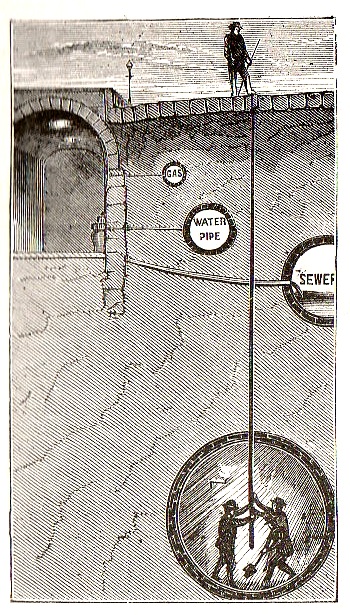
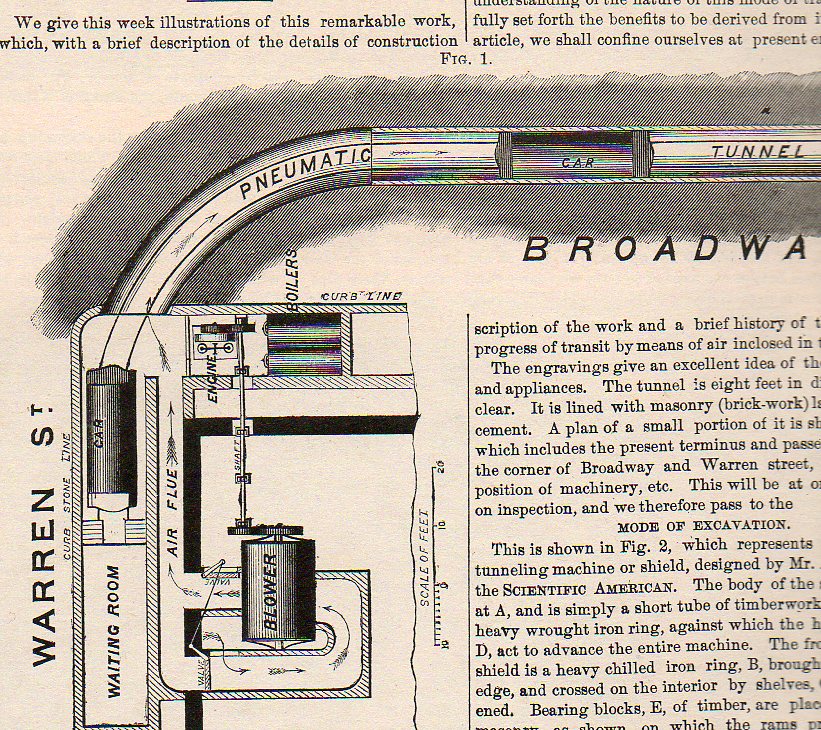
    These unusual images are all only so if they are removed from their context, taken from their stories, their explanations lost.  But the fact of the matter is simple–they show cross sections of some construction elements of “the pneumatic tunnel under Broadway, N.Y.C.” as it appeared in the Scientific American for 5 March 1870.  It was an experimental line, and did not really deserve the description received from the Times. The idea for an underground such as this was the brainchild of Alfred Ely Beach, and was basically a single-train, single-station, one-block system established for demonstration purposes, and was kept in operation from 1870 to 1873.  Technology overtook Beach’s idea of pneumatic propulsion with the development of electric trains, making the forced-air idea obsolete in short order.

    The images, without explanation, their purpose is well hidden.

    The first example simply depicts the way in which the progress of the tunnel was measured and mapped.  The two men underground sent up a series of pipes to the surface, under the very paving stone of Broadway, where a surveyor would make the spot where the pipes met the surface.  (We are told that this work was done at night, when the streets were empty.)  Any number of stories could be made of this image–all stretching beyond its intended purpose.

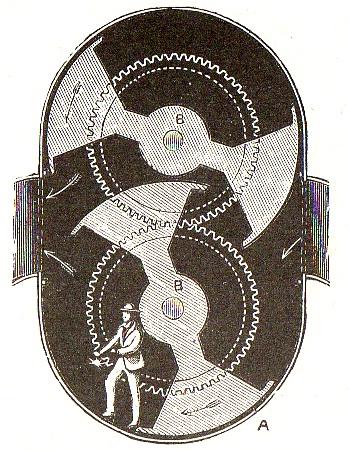
    Underground man224 This machine below could be virtually anything in the mind of anyone, except of course for its real purpose, which was to power the train.  It is a cross section of the apparatus, showing its two massive fans with a figure of a man added to show scale. 

    Underground man225

    “The power transfer is one of the most simple things imaginable. Air is forced into the tunnel by a gigantic blowing engine made by P. H. & F. M. Roots, of Connersville, Ind., a section of which is shown in Fig. 7. [missing] This blower is actuated by a steam engine of 100-horse power, and is calculated to deliver when worked at maximum speed, a volume of 100,000 cubic feet of air per minute. A pressure of one fourth of one pound to the square inch would be an aggregate of three-fourths of a tun on the end of the car, far more than required for propulsion.”

    Underground man226