A Daily History of Holes, Dots, Lines, Science, History, Math, Physics, Art, the Unintentional Absurd, Architecture, Maps, Data Visualization, Blank and Missing Things, and so on. |1.6 million words, 7500 images, 4.9 million hits| Press & appearances in The Times, Le Figaro, Mensa, The Economist, The Guardian, Discovery News, Slate, Le Monde, Sci American Blogs, Le Pont, and many other places… 5000+ total posts since 2008.

Category: Absurdist, Unintentional

  • Backwards Atlas?

    JF Ptak Science Books   Quick Post

      Atlas470
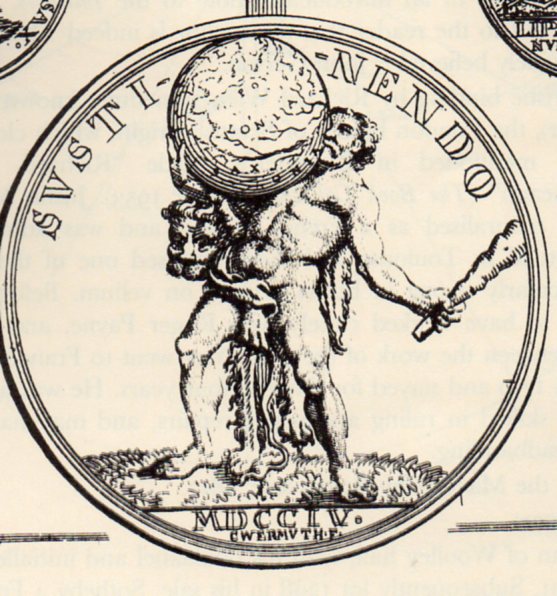
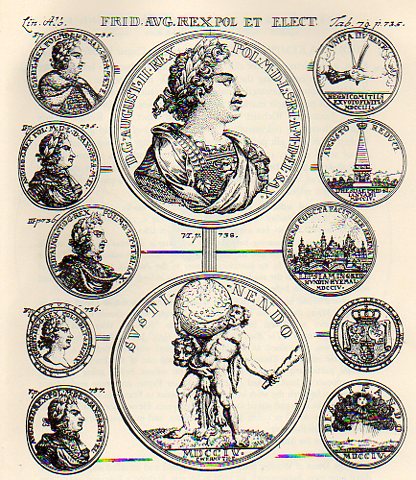
    I found a rather unusual image in this sniffy but no doubt very useful book on heraldry.  On the reverse side of a medal shown below (“Augustus II D.G. Rex Pol M. D Lit. D. Sax. I.C.M.A.”, or declouded it is August II, D.G., King of Poland, Grand Duke of Lithuania, Duke of Saxony, Julich, Cleves, Berg, Angria, and Westphalia) we see a compromised image of Hercules, the only time that I can remember seeing him balancing the sphere on his chest.  It looks very uncomfortable. 

    Atlas469

    Originally Atlas was supporting a sphere representing the sky, a punishment that he stand on the Earth and support the Heavens so that the two did not meet.  Over modern time Atlas has been given a new burden to bear, and generally it is that of the Earth rather than all creation. 

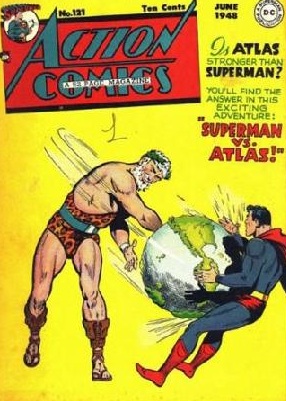
    Of course if we went looking a little further to see what else Atlas might be doing with his burden, there is the following:

    Atlas
    where for ten cents it would have been possible to see the outcome of this epic battle; but since I can’t spend the ten cents here, we’ll never know.  It is interesting to see the representations of the mountains on the globe–given their bumpiness I’d say that their scale would relate to those peaks being 50 miles high.

    And just for the sake of it “Atlas” became associated with a colletion of maps bound in a volume in  Antonio Lafreri’s  Tavole Moderne Di Geografia De La Maggior Parte Del Mondo Di Diversi Autori (1572) not because he employed the word first, but rather because he used an image of Atlas on the book’s title page–the first use of he word comes a little later in the work of Gerald Mercator. 


  • Electro-LUXurious 9: Combination Medical Apparatus and Alarm System, 1892.

    JF Science Books   Quick Post

    This is the fourth in a new series of posts on interesting, early applications of electricity, most of which are taken from the archives of the U.S. Patent Office.

    I am uncertain why there should be a combination bell/alarm and electrical stimulation medical device wrapped up in one small wooden package, but here it is.  Certainly there was no explanation for the need for the bell, or alarm; but then again, there wasn’t an explanation on what this thing did to the body (or soul, or whatever) either–that was not the job of the patent report, which tells the reader how the thing works, but not necessarily what it does. Of course this is just finding fault with a small bit of nonsense wrapped up in a larger chunk of junk…perhaps it was all just distraction.  In the larger world of electrical vapor baths, vacuum coffins, electrical hair, automatic tongue pullers, and so on, what difference could one extra bell make?


  • Really, Really Big Plans: Filling in the East River and Parts of NYC Bay, 1911-1916

    JF Ptak Science Books   Post 1470

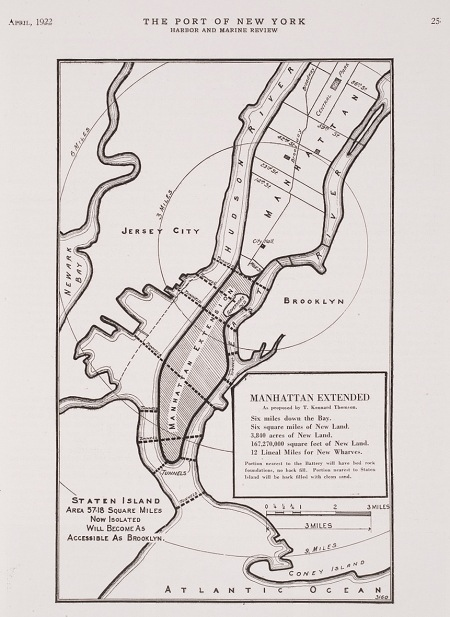
    Last week I wrote a post on  Herman Soergel’s  plan for extending the landmass of the countries around the Mediterranean Sea by damming the straits of Gibraltar, lowering the sea and irrigating the Sahara–an original, interesting but not very good idea, filled with briney cultivation and racial politics. In the past on this blog I’ve written about other city plans–and in particular, for New York City–that have involved floating Manhattan into the harbor, or filling up large chunks of the Narrows, or floating the city on an enormous anti-gravity platform, and so on. Some of those plans were real, some science fiction, and some were plainly beyond both.  The plan presented above is another monster, but at least this one could work, if not for the doing of it, and the expense. And the will.

    NYC Really Big
    But the bottom line, according to the engineer doing the thinking on this project, Kennard Thomson, would supposedly net the city a cool billion dollars after everything was said and done, and that would be 1916 dollars–that was equal to about 5% of the American GDP (!) in 1916, which would be about $400 billion in terms of 2010 GDP.  I’m not sure how Thomson came up with this very big/very round number, though it must have been done for effect–I can just imagine him standing before a smokey room filled with civil engineers talking about his massive plan for enlarging NYC and throwing out the billion-dollar figure, watching the cigars glow red in exhaled disbelief.

    Thomson did know what he was talking about–he was a busy (and “leading” according to the NYT) Manhattan civil engineer of stature, working on the Canal Barge and being the principal engineer for the Municipal and Singer buildings, for example–and his project seems to be well within the scope of possibility.  Their sensical aspects however are, well, questionable. 

    Here’s the story–around 1911, while examining proposals to repair and extend New York’s wharves, Thomson came upon the idea–a magnificent, fabulous idea–of adding new wharves by adding new lands to the city.  In short, the overall plan was to fill in the East River (!!) and reclaim the new land for city living,  dam Hell Gate,  construct a New East River (from Flushing to Jamaica Bay),  extend the tip of Manhattan Island from the Battery to within a quarter-mile of Staten Island (!), create a new 40-square-mile island between Sandy Hook and Staten Island, extend the Jersey shoreline, add two new Manhattan-sized appendages to the east shore of Staten Island, and more.  All of this would be connected by various new bridges and roads and tunnels, as well as a 6-track elevated railway that would circumnavigate the city.  The purpose of all of this would be to add 100 miles of new docks, an enormous amount (“50 square miles of reclaimed land”) of new land and the capacity for NYC to house 20+ million people, all of which would be worth a billion dollars. 

    Thomson really meant “really” in the title for the proposal. There have been reclamation projects undertaken in New York Bay since then of course, and I think that virtually all of what Thomson talked about could be done.  I think it would be a very interesting project for a class of some sort to undertake an estimation of what such a thing would cost today (and I would guess to duplicate the idea in real terms now would take up a sizable chunk of the GDP).  Maybe all of this will make sense at some more future point. 


  • Electro-IronPunk Centrifugal Birthing Machine–a Fantastically Bad Idea

    JF Ptak Science Books   Post 1500

    I found this by accident, and needed to share it immediately, because in the splendid and chilly vastness of the infinite Encyclopedia of Bad Ideas, this entry would seem quite the poster child for such a stupendous effort–the mud to which all dust aspires. 

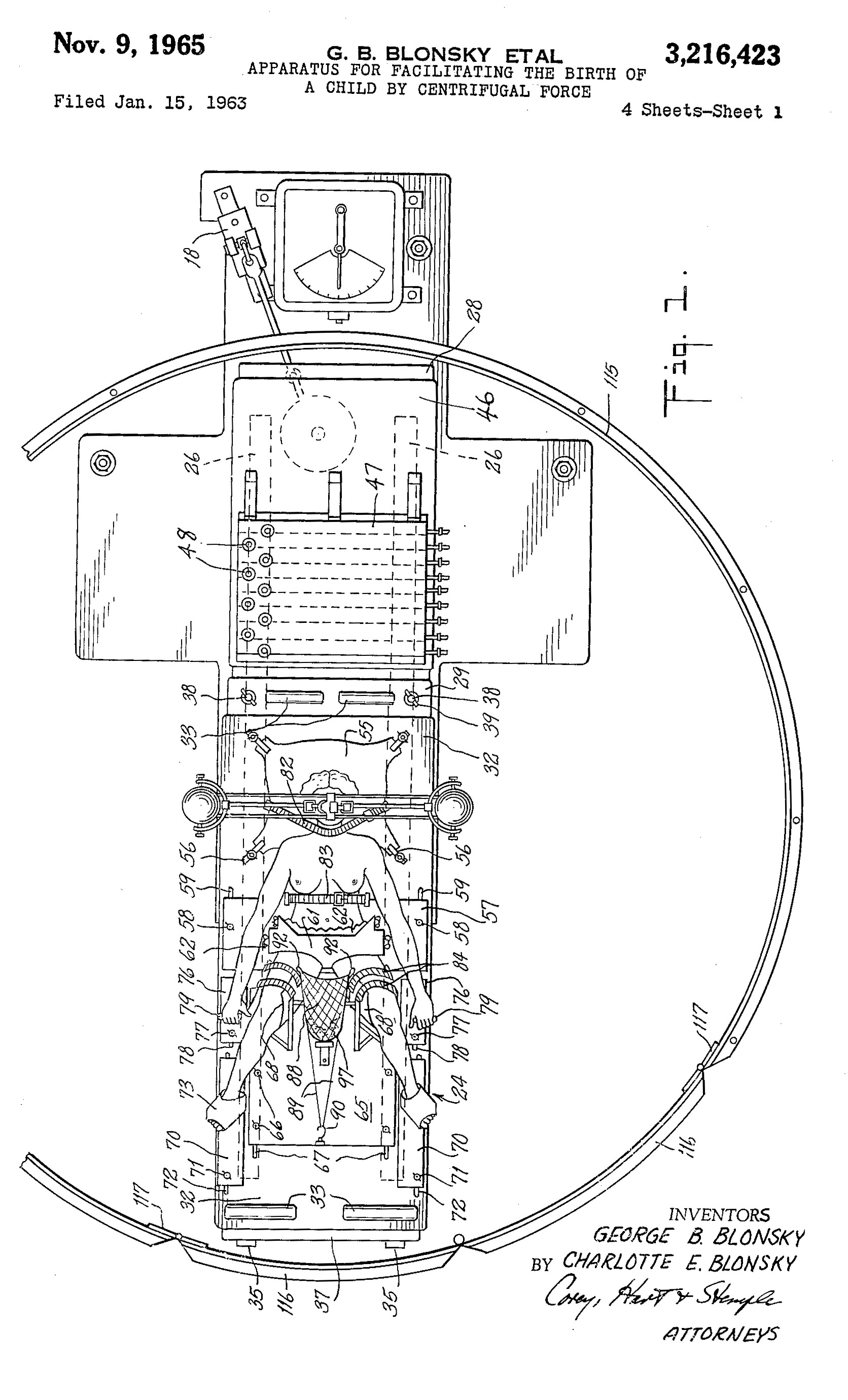
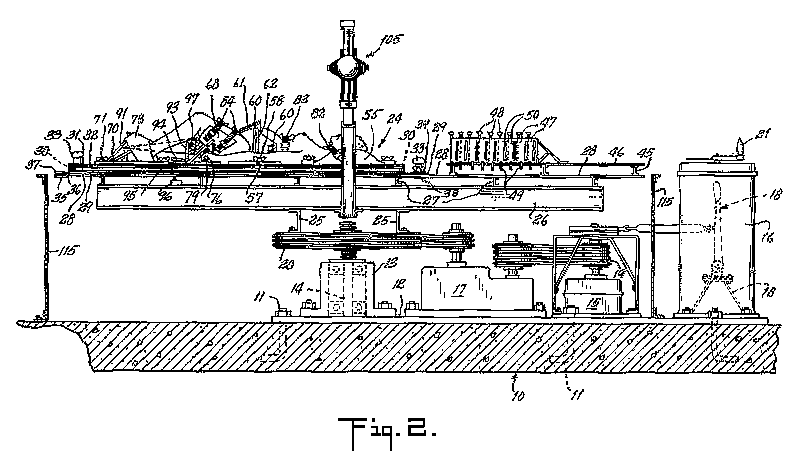
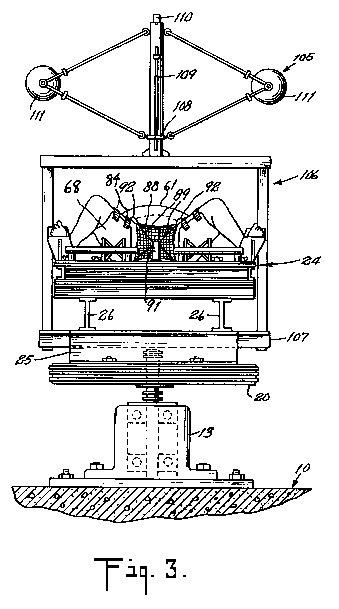
    The centrifugal machine for human birth…its hard to even finish that sentence, let alone finish it without wincing. What could possibly go wrong, or right, with spinning a pregnant woman strapped like Hannibal Lechter on a spinning turntable?  

    I think what we have here is the Vitruvian Woman of Bad Ideas relating to human birth, the patent described more fully in this great piece by Marc Abrahams (of the Annals of Improbable Research) in The Guardian, 2006). And how could the symbology of the thing get any weirder? It looks like this poor woman has her head resting on a stretched piece of animal skin, all of which is located on a cross–but since there is a person on it the medical device become a crucifix. And let’s not forget the counterweights on either side of the governor, which in detail below are suspend to either side of the woman’s head; and also the baby sack, for, well, catching the baby…

    Image source:  Google Patents

    Centrifugal birth patent a overview fixed

    And the excruciating, inexorable detail:

    Centrifugal birth

    In their patent application, Blonsky and Blonsky explained the grievous and imaginary need:

    “In the case of a woman who has a fully developed muscular system and has had ample physical exertion all through the pregnancy, as is common with all more primitive peoples, nature provides all the necessary equipment and power to have a normal and quick delivery. This is not the case, however, with more civilised women, who often do not have the opportunity to develop the muscles needed in confinement.”–from the Blonsky patent.

    “Therefore, wrote Blonsky and Blonsky, they would provide “an apparatus which will assist the under-equipped woman by creating a gentle, evenly distributed, properly directed, precision-controlled force, that acts in unison with and supplements her own efforts”.–Marc Abrahams, quoting the Blonsky patent in The Guardian (referenced above).

      Centrifugal birth b

      Centrifugal birth c


    The text of the patent report, below, in full:


  • Electro-LUXurious 8: Electrical Medical Cane, 1899

    JF Ptak Science Books   Quick Post

    This is the eight in a new series of posts on interesting, early applications of electricity, most of which are taken from the archives of the U.S. Patent Office.  Unlike the general post in this blog, many of the Electro-LUXurious post images and documentation can be presented without commentary.

    I thought at first when I found this “electric cane” that there would be a light source or something embedded in the hanle.  There is a small light bulb inside the handle, but there are no lenses, no glass; just metal caps.  It turns out that this is a medical cane, an electrical unit with brass or copper barrels to be held in the hands or applied to various areas of the body for electrical stimulation. 


  • A Backwards, Inside-Out, Oil + Iron Internet (1937)

    JF Ptak Science Books   Quick Post

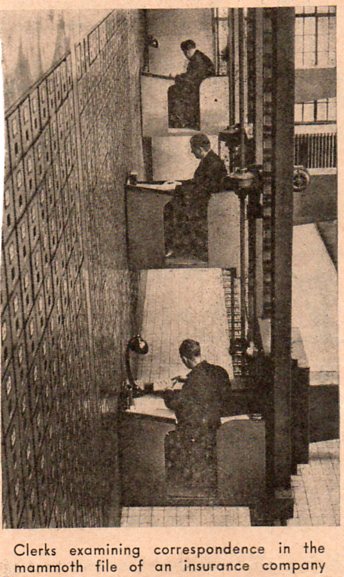
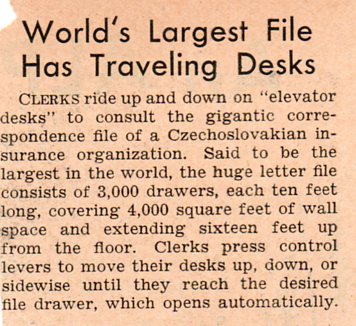
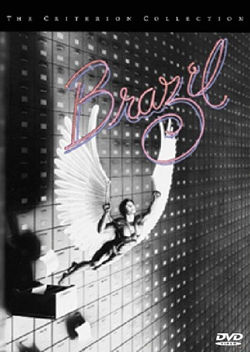
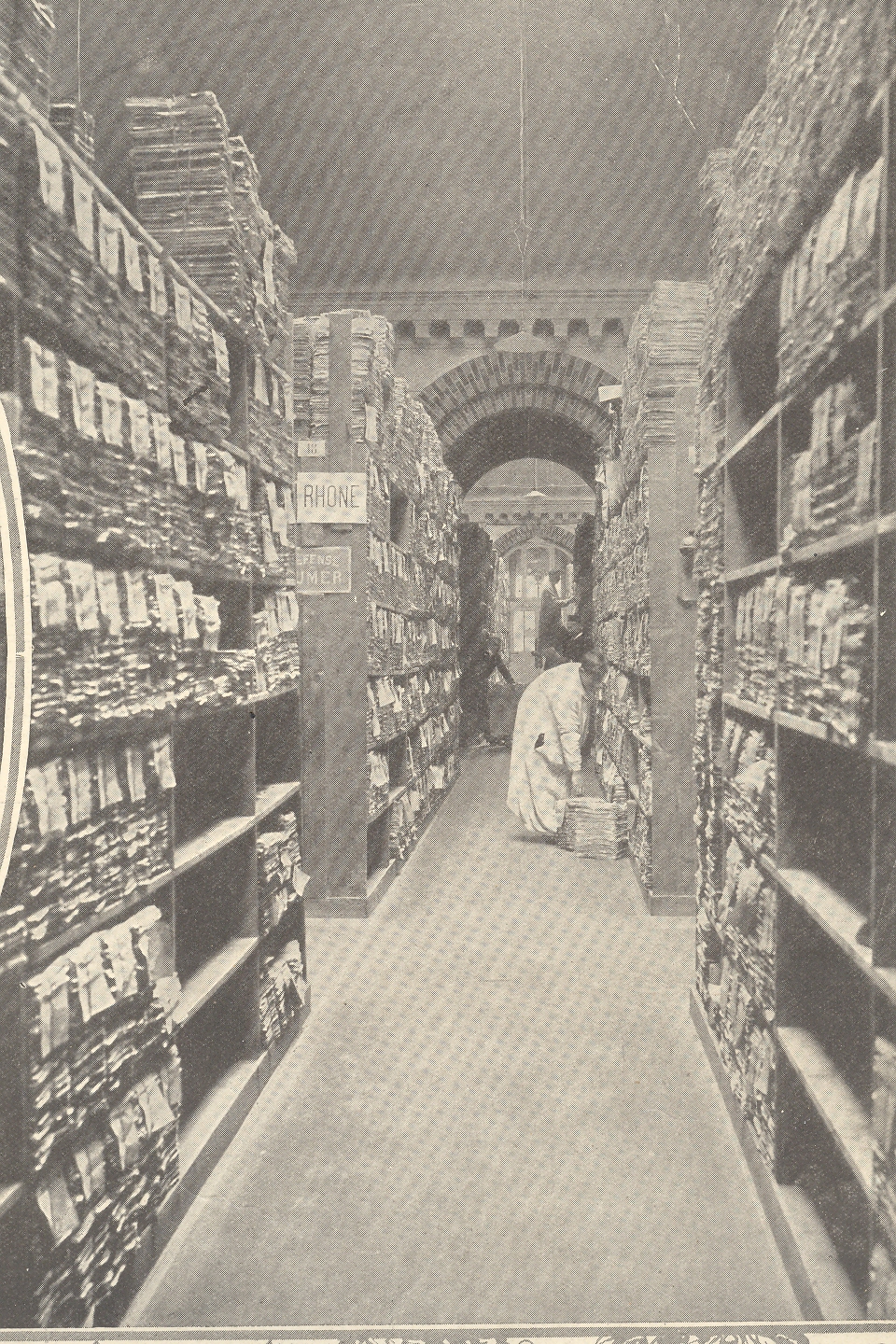
    I feel slightly queasy seeing this photograph, found in the August 1937 issue of Popular Science magazine–-it seems to me to be a backwards, inside-out analog cyberpunk (without the cyber) variety of the internet, a robotic device moving people around from data bit to data bit, an oil and iron process of automatic info retrieval, moving the user to the information rather than the other way around.  Desks517 Desks516 The image does put me in mind of Terry Gilliam’s Brazil, which renders info and other muck in a high-dystopian fashion with endless ducts and file cabinets, making things oppressively inaccessible in their accessibility.

    Brazil

    And to some degree there’s a little Spongebob similarity in there too, though without the iron nd metal part, just Mr. Squarepants and his cardboard filing cabinets for all of this thoughts and memories, serviced by smaller units of himself whop presumably have their own filing systems in their heads.  Filing cabinets, all the way down. 

    Spongebob's Brain
    There is a more-refined image of what is basically the same idea, found here in the fantastic bio-art of Fritz Kahn (1888-1968), who published his Der Mensch als Industriepalast (Man as an Industrial Palace or thereabouts) in Stuttgart in 1926.  Kahn is seen as a “modernist”, which I guess is true; to me he is far more than that–he’s “different”.

    In Charlie Chaplin’s great 1937 Modern Times, there are no file cabinets and I don’t think that there’s any paper, just the results of vast mechanization:

    http://www.altfg.com/Stars/m/modern-times-chaplin-conklin.jpg

    And of course, Fritz Lang’s Metropolis, made a little earlier, in 1927:

    Worker in Fritz Lang's movie, Metropolis

     And finally, an image of the semi-reverse of the gigantic filing system:  moving humans through mounds of paper not contained in file cabinets, stacked upon stacks of stacks.  Once everything is said and done, none of this info-sausage-factory seems very pretty.

    ++ blog ++ nov 16 french census 3


  • Electro-LUXurious 7: Electric Hair Brush with Stimulator Sponges, 1899

    JF Ptak Science Books  Quick Post

    This is the seventh in a new series of posts on interesting, early applications of electricity, most of which are taken from the archives of the U.S. Patent Office.  Unlike the general post in this blog, many of the Electro-LUXurious post images and documentation can be presented without commentary.


    And then there’s this beauty from 1912:


  • Atom Bombs: the Game.

    JF Ptak Science Books   Post 1497

    Atomicbomb pieces I do not know the precise date when displaying the death of children was used to sell detergent.  There were deep hints of a child’s death in a Twilight Zone episode (selling Borax) in the ate 1950’s, but in general I think that killing kids on television for story development and entertainment is more an ’80’s creation than anything else.  Children dying in stories on television had been verbotten, a non-starter, for decades; now kids die in Dr. House’s hands and all over the rest of that wasteland place and there’s barely a wrinkle in the entertainment continuum.

    Killing children in literature is entirely different, and of course much older.  Given the overwhelmingly and horrible basis of the news reports of the Old Testament, I wonder what the great flood would’ve looked like on OT TV?  After all, it was reported that the creator did away with almost everything on Earth–men, women, and of course  every child and baby on the planet, drowned like rats in a bag, but without a bag–kids left to float away from their parents, and then drown, sinking into the cold black sea created by the very thing that created them.

    Kids killing things in play is another matter, especially since it is done so for fun. I guess they smote or smitted things for time immemorial, but it wasn’t until very recently, and mostly with the invention of the middle class and the creation of disposable income, that killing toys were sold to kids in stores. Toy guns and knives and other implements of destruction at least made whatever the kids were doing a face-to-face activity.  When the atomic bomb toys started to appear in the late  ’40’s, killing stuff took on the potential of worldwide destruction.  Of course I doubt that any kid playing with these atom bomb toys had an inkling of what it meant to use the weapon in the real world, but the appearance of atomic bomb toys–while not quite yet at the level of Auschwitz board games–is on the revolting side.  On the other hand the destruction of entire galaxies has been witnessed by kids in any number of movies and television programs, what with billions of living being killed in the process.

    I don’t know what the effect is of exposing children to mass killings in the name of grand theft auto, let alone opening apocalyptic floodgates by putting nuclear weapons within their reach.  It just isn’t right.

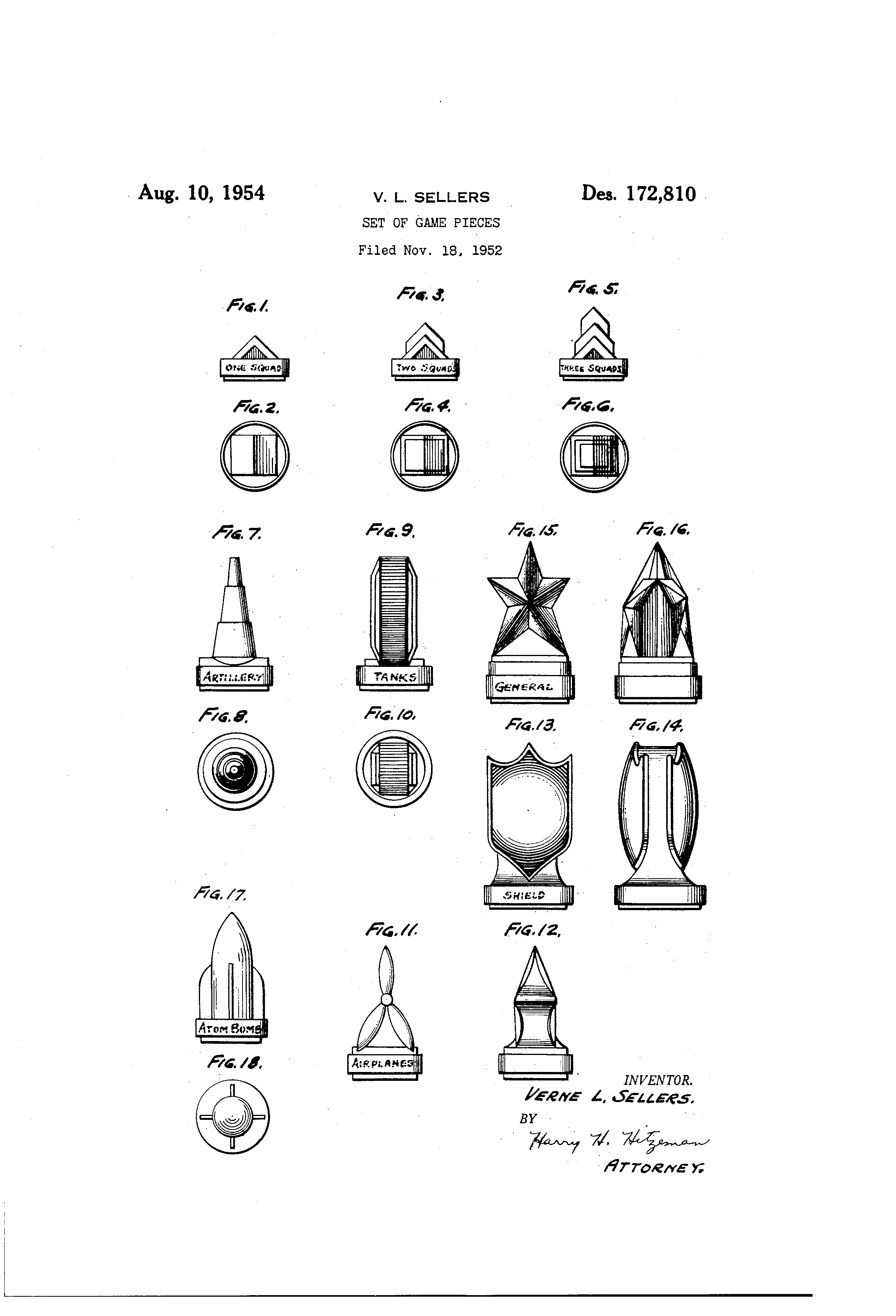
    Does these things, below, seem appropriate to you?  Take for example a simple matter in this detail from a U.S. Patent Office report for game pieces for a board game–the pieces were described; the game wasn’t.  The inventor, Verne Sellers, provided tanks, artillery, an air power of some sort, a “shield”, a general, a few undesignated items, and of course an atom bomb.  The atom bomb would make things all right. 


    Games atom bomb[Source: atomic bomb game pieces from US Patent and Trademark Office via Google Patents: http://www.google.com/patents/USD172810?dq=atom+bomb+game]

    And then there is the “Safe, Harmless, Giant Atomic Bomb”, which is something that is made to sound so much like nothing that it gives “nothing” a new meaning.

    Atomic bomb toy

    [Source: Pinterest https://www.pinterest.com/electrichermit/atomic-age-america/]


    Then this lovely thing, a small and cheap dexterity toy that places atomic destruction in the sphere of a semi-mindless time-killing toy, a real neutralizer to the significance of the thing it portrays:

    Atomic Bomb dexterity game

      I can’t imagine many people wouldn’t feel some sort of sympathy for this gigantic King Kong, who looks up just in time to see the massive nuke falling on his head, personalizing the delivery system of mass destruction:

    http://4.bp.blogspot.com/_xKCH2IWimP8/TKo0NZZutWI/AAAAAAAABgY/RbpLA7QTTD8/s1600/Konga+Atomic+Bomb.jpg

    Total destruction as a game, or game piece; an oxymoronic trivial pursuit.


  • Electro-LUXurious 5: Alpha and Omega Casket and the History of Death

    JF Ptak Science Books   Post 1491

    This is the fifth in a new series of posts on interesting, early applications of electricity, most of which are taken from the archives of the U.S. Patent Office.  Unlike the general post in this blog, many of the Electro-LUXurious post images and documentation can be presented without commentary.

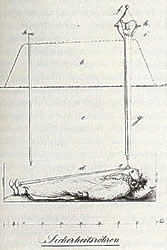
     It has not been an easy job over the centuries in determining whether a person was alive or dead, and dead as in really truly dead, absolutely so.  Consider how this would be done in case of coma and such in the days before the stethoscope, when doctors and medical people would use cones and other hearing apparatus to help the wizened old practitioner hear with their deteriorated hearing, listening for signs of life with an inferior instrument and Burial premature limited auditory capacity.  (The stethoscope wasn’t invented until 1816 by Rene Laennec–who produced a monaural device much like a primitive hearing horn made of solid wood—which was a vast improvement over no stethoscope at all, by again was very crude compared to early 20th century devices.) There is little wonder about the tales of horror of premature burial (as with Poe) and the spate of burial devices where–of the dead suddenly became not so, awakening in the coffins underground, that they could activate one of the many ingenious life-saving devices to alert someone to come and dig them up. (There were also patented designs that would deliver air to the coffin as well as have an accessible ladder to the surface.)
    The most fool-proof way of determining death in the 19th century was to leave the body alone for three days or so to see if it began to putrefy–this was the method proposed by Christian August Struwe, among others, who advocated the construction of special hostels for the dead (“Leishenhauser”), where they, the supposed dead, would lie in state for the period of time necessary for putrefaction.  This was also among the most elegant solutions given limited technological capabilities, especially when compared to nipple-pulling, scalding, tongue-yanking and of course the infamous tobacco smoke enema (seen below).

    What I am getting to though in the Electro-LUX series is the coffin/life-determination box, a sort of all-in-one affair where a body could be both determined to be dead and buried in the same thing, one of the few (?) medical devices that after performing its job be used as a coffin for its patient.  It is an alpha & omega bit, supposedly sparking to life the pre-dead if they were alive, or serve as the taxi to eternity for those who were truly and most sincerely dead.

    I’m having a bit of fun with this, but the issue of what constitutes being “dead” is still somewhat contentious–the issue was much larger 150+ years ago, when the philosophical/physical/biological questions were still very wide open, still. 


    Here are some other examples of determining whether a person was dead, or not, all taken from  Jan Bondeson’s delightful Buried Alive, the Terrifying History of Our Most Primal Fear (Norton, 2001):

    –Christian Friedrich Nasse’s Thanatometer was a long thermometer  that was inserted into the stomach, supposedly measuring a core body temperature that would determine if life was possible (and published in 1841);

    –The (Englishman’s) Barnett scalding death cure, which recommended burning the skin of the arm to see if it blistered (no blister/no life);

    –the German Middeldorph invented a heart flag, a needle device that would be thrust into the heart, which if functioning would trigger something or other that would cause a flag to be released at the top of the needle (a very Victorian and visual one, this);

    –Christian August Struwe’s interesting Lebenspruefer (1805) was an electrical device that delivered a dual shock to the eye and lip, the logic here being that if the person was still alive that there would be a resulting twitch;

    –the nameless tobacco enema, which blew smoke…(delivered in the beginning by breath through a tube and improved later to replacing the lips with a bellows, this secondary improvement by Antoine Louis2 and furthered by Dr. P.J.B. Previnaire’s much more powerful anal tobacco furnace.  [Now there’s three words I’ve never strung together before].)1

    –Leon Collongues believed that he could hear the capillary functions of a possibly-dead person’s fingers if placed in his ear;

    –Jules Antoine Josat2 invented a nipple-pincher (“pince-mamelon”) life-rejuvenation device, operating on the assumption that a deeply sedated person could not resist a strong pinch of the nipple and would have to wake up if alive.

    Perhaps the most spectacularly extension of the nipple-pincher was the tongue-pulling idea of Dr. J.-V. Laborde3 (1830-1903), a research physician with wide credentials, who reasoned that a continued regimen of advanced and strenuous pulling of a patient’s tongue would over time bring them back to life if alive.  This is what leads us to the point of this post:  Laborde established a mortuary, and in this mortuary, where the dead were waiting to die, he employed a man whose job it was to pull the tongues of these bodies.  In the misty picture of all of this that is painted in my mind’s eye, the fellow working his way from body to body pulling their tongues with a heavy pincer seems far worse than nipple squeezing or even being an anal smoke blower, though to choose between the three in a twisted Purgatorial mandate would be hard to so.  Although the nipple pincher wasn’t replaced by anything mechanical, the smoke blower was (by a powerful bellows), and so was our friend the tongue puller, who after complaining of the boredom of his task was pushed aside by an electrical device. 

    Notes:

    The text for the patent report, below:

    1. From the Bondeson book, page 156:

    “Antoine Louis had also proposed another method of testing life, or at least stimulating the vital spark in the apparently dead person: with a powerful bellows, he administered an enema of tobacco smoke. One of the pipes of this remarkable apparatus was thrust into the anus of the apparently dead person; the other was connected, by way of a powerful bellows, to a large furnace full of tobacco . Such enemas of tobacco smoke were thought to be very beneficial and were used to try to revive not only people presumed dead but also drowned or unconscious individuals. In 1784, the Belgian physician P.J.B. Previnaire was given a prize by the Academy of Sciences in Brussels for a book on apparent death, which described and depicted an improved bellows for enemas of tobacco smoke, which he called Der Doppelblaser. These enemas were regularly used well into the nineteenth century, particularly in Holland; modern science has discerned no physiological rationale for their use, except the pain and indignity of having a blunt instrument violently thrust up one’s rear passage must have had some restorative effect.”

    2.  Josat.  From Weird Universe.net I found the following, quoting Death and Sudden Death, by Paul Brouardel and F.L. Benham:

    “Josat invented a pair of forceps with claws, with which he proposed to pinch the nipples of persons whose death has to be ascertained. Josat obtained the first prize of the Academy, but Briquet, repeating the same tests on the hysterical subjects under his care, proved that they did not react under Josat’s forceps any more than the dead.”

    3.  M. Laborde won a 2500 franc prize for his innovation in 1894 (as reported by the Revue scientifique.  He sounded like an interesting man:  according to the British Medical Journal (in reporting his death 25 April1903) upon his own death in that year Laborde: “as a freethinker had a civil ceremony; as an hygienist was cremated; as a member of the Societe Mutuelle d’Autopsie willed his body to be dissected; as an anthropologist willed his brain to be preserved at the Anthropological Museum…” Some of Laborde’s works include   Le traitement physiologique de la Mort. And Les tractions rythmées de la langue, moyen rationnel … de ranimer la fonction respiratoire et la vie … Avec … dessins, etc  And:  La traitement physiologique de la mort (Paris , 1894) And: La signe automatique de la mort reelle (Paris, 1900). And  “Les Tractions Rhythmees de la Langue”, VIII, pp. 76 ff, ed. 2, Paris, 1897, and VIII, 2d part, pp. 406-510. And commented upon in some number, for example:  Le Traitement physiologique de la mort par les tractions rythmées de la langue. Le tracteur lingual automatique Laborde, by Alix Hache.
  • Questionable Quidity: the Preservation of Decay–Atomic Bomb Suits

    JF Ptak Science Books   Post 1486

    Part of this blog’s long series on Atomic and Nuclear Weapons


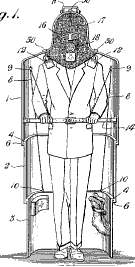
     Is there anything more revolting than this solitary, encapsulated,  iron maidenesque survival sarcophagus and its promised hope of survivability? 

    Perhaps not.  This patent application for an individual survival suit from 1958 gives us something to think about, perhaps gives us the cause to imagine what the world would look like from the inside of that portable evacuation chamber (that had its own attache case for storage).

     
    Atomic suit 2
     
     
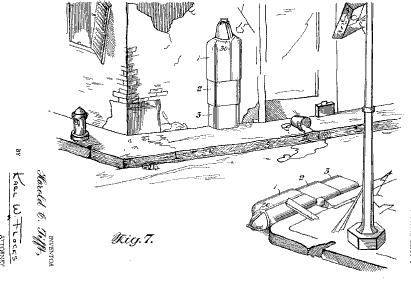
    Another variant, from 1958, shows a handy, mobile triangular leaf-incinerator-like environment that you wheel into position, put on its side, and then crawl into and die:
     
    The bomb(s) would go off, and there you would be, standing with your back against the wall, or laying in the gutter pressed against the curb, just another piece of the dead city, another piece of metal waiting to decay.  I’m not sure what is going on in this scene, which while being crude is still steeped in a high-creep factor.  I get the impression of slow time in these images, as though the atom-bomb-suited people have been there for a long time, though I suspect that we are seeing an urban area just after a blast.  It is a wincingly bad scene. 


    Atom bomb suit
    (Why is it that when seeing Civil Defense films and etc from this period we see people ducking-and-covering from one bomb?  Since the great majority of Americans lived in one of the 75 “essential delivery acquisitions” areas (I forget now the source for this phrase) it was exceptionally unlikely that people would be dealing with a single acquisitions implement, since the Soviet stockpile of nuclear weapons would’ve been at probably half-par with the U.S., which at this point (1958 or so) would be around 18,000.)
     
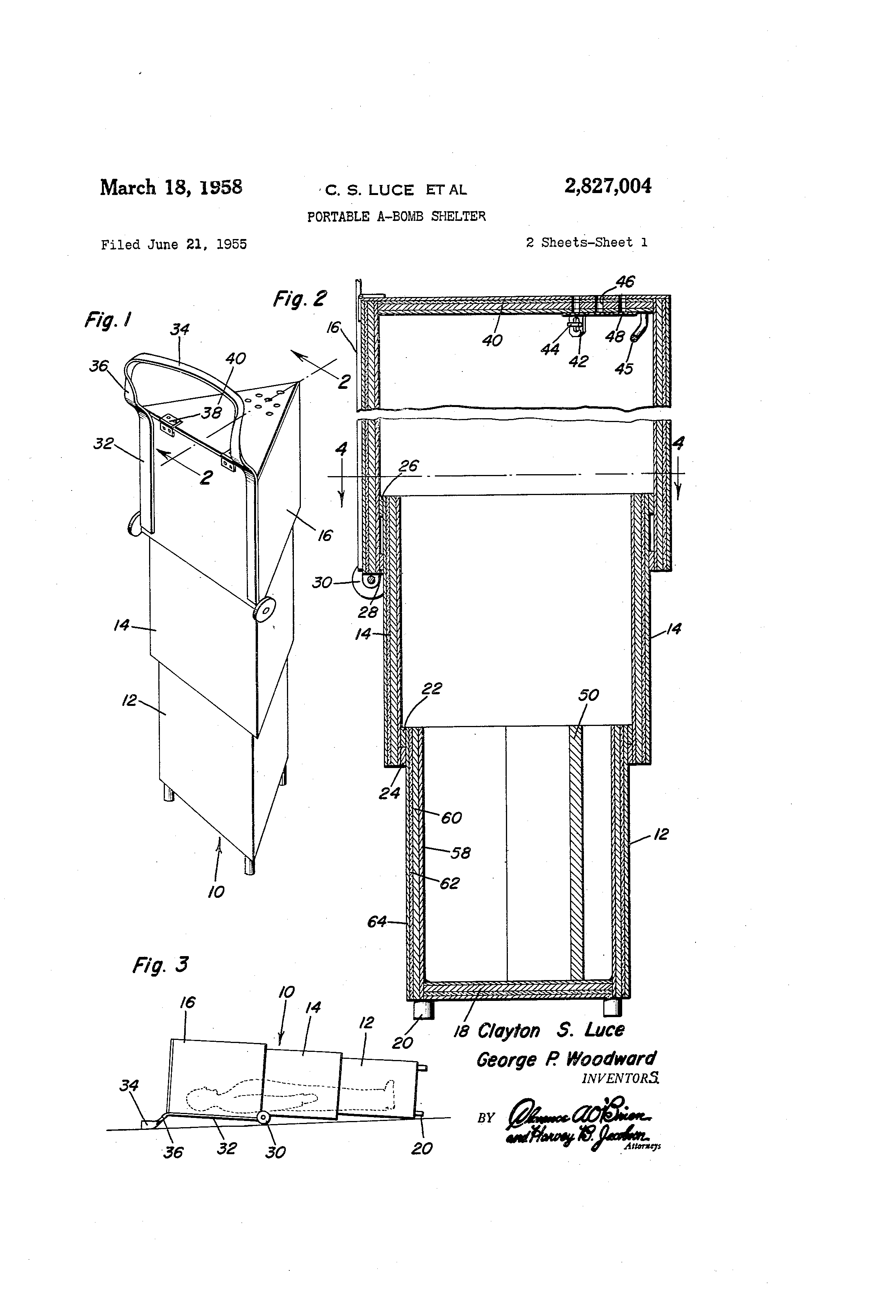
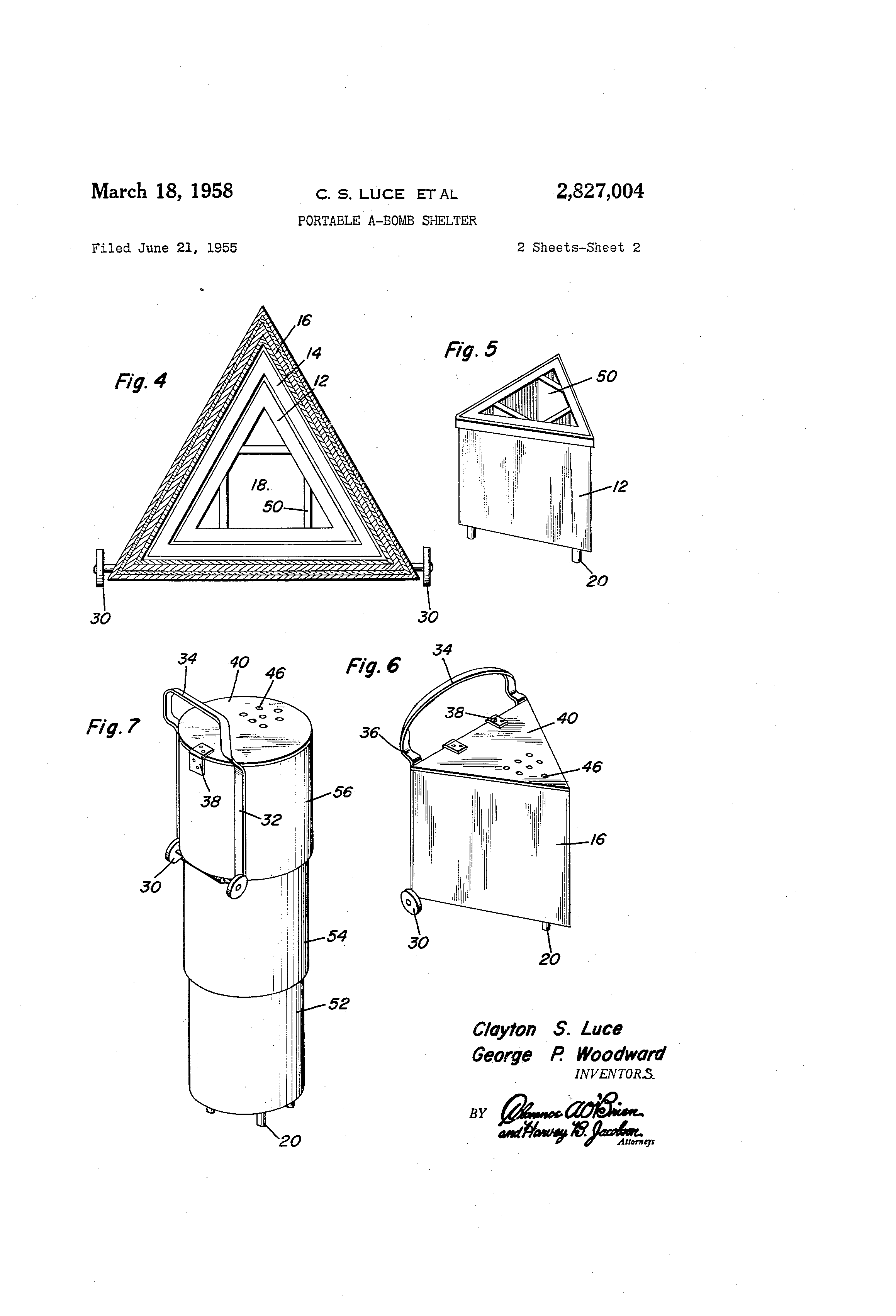
    Here’s another example of some unusual thinking on surviving nuclear holocaust, 1958, only these–while solitary–are not terribly mobile, even if they did come with wheels. (Didn’t it bother anyone that something that was supposed to prevent you from flying glass and bricks and the terrestrial ring of fire could be moved around on such tiny wheels?) They look more like waste receptacles.  Maybe that’s what they would wind up being, if they were ever used for their intended purpose. 
    Atom bomb proof suit prone

    [Source: Google patents, http://www.google.com/patents/US2827004]

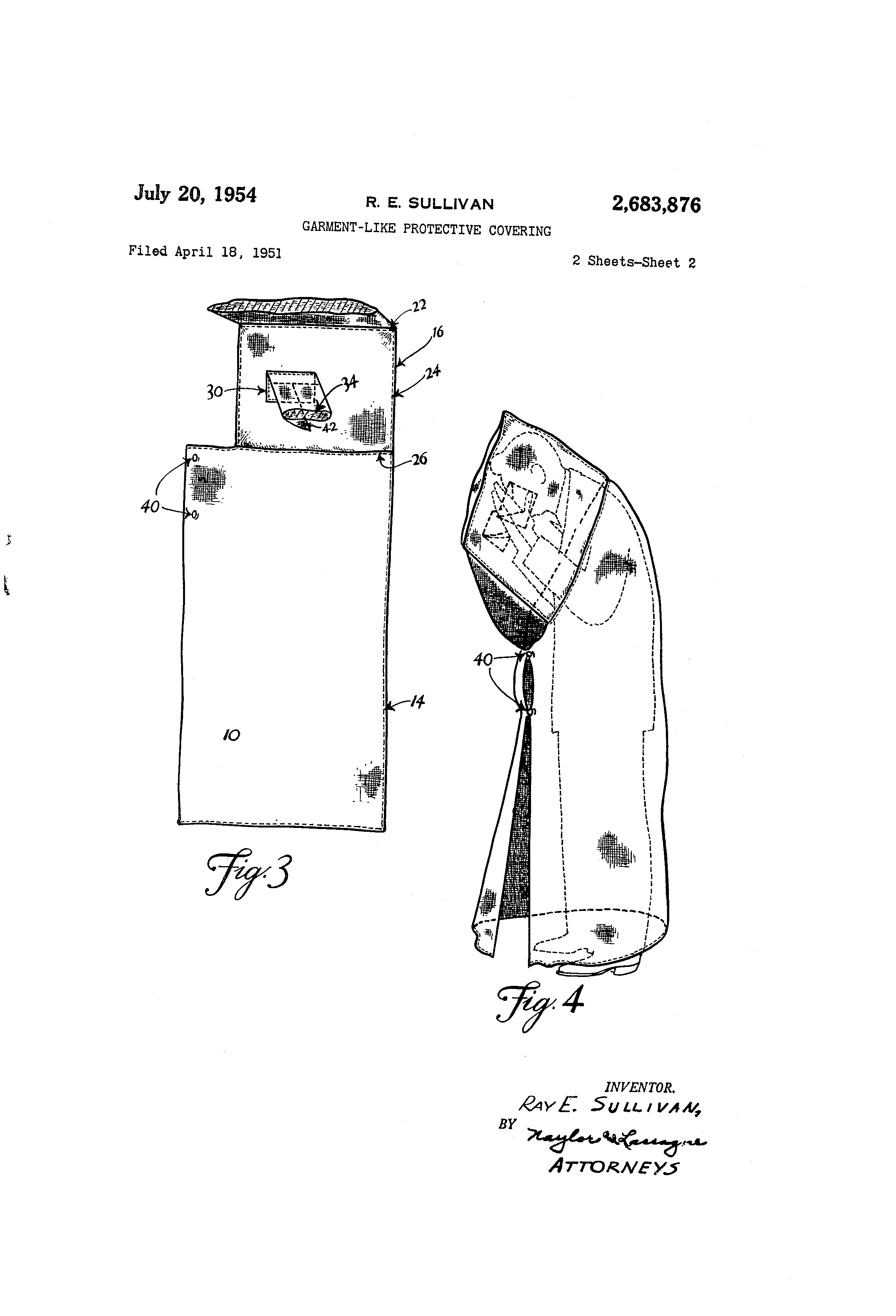
    And another atomic bomb “garment-like” thing–this looks like it might actually be useful on airplanes, because most people who die in crashes do so from smoke inhalation…but providing one of these per person would be a bad flying vibe, just like seat belts (so ferociously resisted by Mr. Iacocca) were seen by the car industry as an unnecessary reminder of how dangerous cars were/are).

    Atom bomb proof suit 1958

    [Source: Google patents, http://www.google.com/patents/US2827004]

    Anyway, the only way these things might be useful in times of such an emergency as atomic holocaust would be as a burial shroud.  And since a bunch of people would (presumably) already be wearing them at the time of attack, the job of burying them would be that much less work, since they were already shrouded.  Of course, that’s assuming (a) that people would or could be buried, and (b) that there was anyone left to do the burying. 

    Atom bomb suit bent over

    [Source: Google Patents, http://www.google.com/patents/US2683876]