A Daily History of Holes, Dots, Lines, Science, History, Math, Physics, Art, the Unintentional Absurd, Architecture, Maps, Data Visualization, Blank and Missing Things, and so on. |1.6 million words, 7500 images, 4.9 million hits| Press & appearances in The Times, Le Figaro, Mensa, The Economist, The Guardian, Discovery News, Slate, Le Monde, Sci American Blogs, Le Pont, and many other places… 5000+ total posts since 2008.

Category: Absurdist, Unintentional

  • Disturbing and Disturbed Obstetrical Devices: Straps, Belts and Iron Bits

    JF Ptak Science Books   Post 1501

    Where does a device like the one, below, belong, exactly?  Where in the long rolls of intellectual history should it be found?

    E.A. Agerton is actually Ella C. Agerton–it was easy for me to assume that the person Agerton was a man, because to my experience when I find such devices in the patent office archives they are usually made by men. What Ms. Agerton was attempting with this device is something I don’t understand, though she does make the following statement in her Patent Office record:


    Here’s another, earlier version of this beast, displayed in practical use.  I have to say that the drawing of the woman’s face is deeply disturbed:

    I’ve also found quite by chance that the drawings of the faces of the women drawn as “patients” of these devices can be very unsettling, hardly faces at all, even though the representation of the rest of the body is functional.  For example, the face of the woman below looks as though it is part of the furniture/device:

    The drawings of faces can be so bad that I wonder if anyone can actually be that bad of an artist without trying to be.

    None if this even reads comfortably; I don’t know what it would have been like to been trussed up in such a thing. 
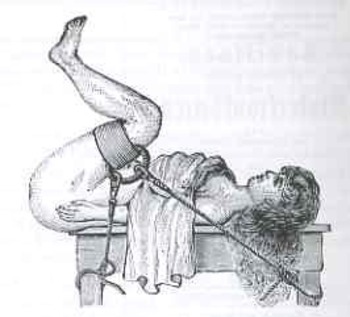
    Blogonbstetrics271 This leads to another uncomfortable image.  At first glance I thought it was part of a delivery procedure, but it turns out that this was the rigging for a woman undergoing a gynecological examination.  The woodcut appears in the first volume of Sammelband von 7 Kleinschriften zu gynakologischen Spezialthemen, 1858-1901, and more exactly in the contribution by Ludwig Neugebauer on an examination with a “speculum bivale l’ecarteur vaginal a trios branches…”  published in 1884.  I know that the prissy prejudices brought about with the coming of Queen Victoria in 1837 still had another 17 years to go at this point, which could explain why, perhaps, a doctor would want an aid in helping a woman maintain an examination position without him having to touch his patient, but, well, just look at the massiveness of the restraints!  Also, the woman’s arms are *inside* the ropes—not down, not holding the ropes, but inside the binding, restrained.  Either way, it isn’t good, treating the woman—in either case of pregnancy or obstetric examination—as the inferior vessel.

    This is also part of a long history of the subjugation of women—the medical aspects of that indoctrination were perhaps somewhat more heinous than the social/legal/ethical/pedagogical/moral constituents.  This illustration, even coming at the end of the Victorian era and approaching the dawn of encroaching bits of equality for (white) women, is a fair example of their subordinate status.

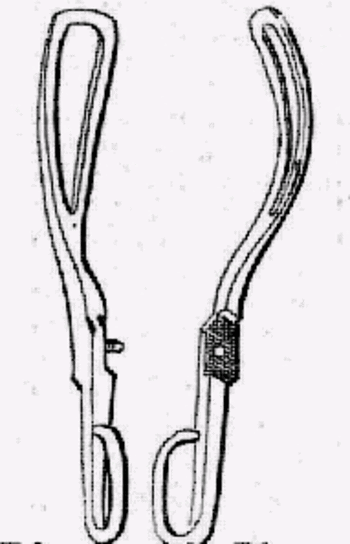
    I just happened upon this picture during the course of my business day—a random image compiling these thoughts.  If I were to try and choose another example of the medical aspect of the subjugation of woman I think that I would choose the story of the Chamberlen family.  For several generations, beginning around 1680, this family of medical doctors practiced a secret—their secret—in delivering breeched babies.  Breeched babies are those who were born feet first, which was usually a death sentence for both the child and the mother.  Patriarch William Chamberlen invented a device that would greatly aid in delivering babies in this position—the forceps.  And evenForceps though everyone today knows what these things are, the Chamberlens kept them a secret from the inquisitive medical world for more than a century.  Their instrument was shrouded—literally!—in secret(s), used under cover, with ceremony, conveyed to the delivery area in a box and brought out with no witnesses.  The Chamberlens felt their invention to be their own, for their own particular use and monetary gain, and the rest of the world be damned, and at least three generations (grandfather, father, son) kept the family secret. If their family could not be in charge of such a delivery then there would be no use of their extraordinary invention.  This of course would save their income from being chipped away by other physicians or midwives or whatever competent person could be found to utilize the forceps—their economic gain coming at the cost of (savable but imperiled) pregnant women who would either pay the Chamberlens for aid in their breeched births or, well, probably die.     To what degree this revolting behavior damaged other people can not be calculated. I’m not even sure about how to translate this into something more recognizable—would it be like Robert Koch keeping his isolation of Bacillus anthracis (1877), or  tuberculosis bacillus (1882) a secret?  Or Wilhelm Roentgen shrouding his discovery in secrecy somehow? (I know, I know, this is impossible.)  Or isolating a secret, proprietary cure for cancer?
    There is a large part of me that believes that if the Chamerlens had figured out something like this that affected only men, a silver bullet for something or other, that their secret wouldn’t stayed a secret for 100 hours, let alone 100 years. 

  • The Geology of Hair

    JF Ptak Science Books   Quick Post

    “The geological formations of the globe already noted are catalogued thus: The Primary, or lower one, consists of rocks, bones or mired mules, gas-pipes, miners’ tools, antique statues minus the nose, Spanish doubloons and ancestors. The Secondary is largely made up of red worms and moles. The Tertiary comprises railway tracks, patent pavements, grass, snakes, mouldy boots, beer bottles, tomato cans, intoxicated citizens, garbage, anarchists, snap-dogs and fools“. (Ambrose Bierce, from the entry “Geology” in The Devil’s Dictionary.)

    AS it turns out, the geology of replaced hair, of hair lost, hair forgotten, is rather sedimental.  Its a surface category only, with so little underneath, so little actual “geology”, that the underneath part is almost on top. The only thing that seems to have any geological depth to it in the history of toupees is the part, which in most cases doesn’t even exist.


    And of course the Trumpian Flip:

    ·Posted by :

    ·in:

    —

  • On the Use of Blood, Bone and Guts -and- the Man Who Painted Dead Chicken Feet

    JF Ptak Science Books  Quick Post–possible revulsion factor

    I was looking for something else–mortality rates in Canada for a post on the value of a dead human body in 1860–when I found this book on the use of discarded goods and raw byproduct, a sort of early recycling effort.  The work was by Edwin Lankester, and it is called The Uses of Animals in Relation to the Industry of Man; Being a course of lectures delivered at the South Kensington Museum (published in London by Robert Hardwicke in  1860), and the initial data that caught my attention was this:


  • Atom Bombs: the Game.

    JF Ptak Science Books   Post 1497

    Atomicbomb pieces I do not know the precise date when displaying the death of children was used to sell detergent.  There were deep hints of a child’s death in a Twilight Zone episode (selling Borax) in the ate 1950’s, but in general I think that killing kids on television for story development and entertainment is more an ’80’s creation than anything else.  Children dying in stories on television had been verbotten, a non-starter, for decades; now kids die in Dr. House’s hands and all over the rest of that wasteland place and there’s barely a wrinkle in the entertainment continuum.

    Killing children in literature is entirely different, and of course much older.  Given the overwhelmingly and horrible basis of the news reports of the Old Testament, I wonder what the great flood would’ve looked like on OT TV?  After all, it was reported that the creator did away with almost everything on Earth–men, women, and of course  every child and baby on the planet, drowned like rats in a bag, but without a bag–kids left to float away from their parents, and then drown, sinking into the cold black sea created by the very thing that created them.

    Kids killing things in play is another matter, especially since it is done so for fun. I guess they smote or smitted things for time immemorial, but it wasn’t until very recently, and mostly with the invention of the middle class and the creation of disposable income, that killing toys were sold to kids in stores. Toy guns and knives and other implements of destruction at least made whatever the kids were doing a face-to-face activity.  When the atomic bomb toys started to appear in the late  ’40’s, killing stuff took on the potential of worldwide destruction.  Of course I doubt that any kid playing with these atom bomb toys had an inkling of what it meant to use the weapon in the real world, but the appearance of atomic bomb toys–while not quite yet at the level of Auschwitz board games–is on the revolting side.  On the other hand the destruction of entire galaxies has been witnessed by kids in any number of movies and television programs, what with billions of living being killed in the process.

    I don’t know what the effect is of exposing children to mass killings in the name of grand theft auto, let alone opening apocalyptic floodgates by putting nuclear weapons within their reach.  It just isn’t right.

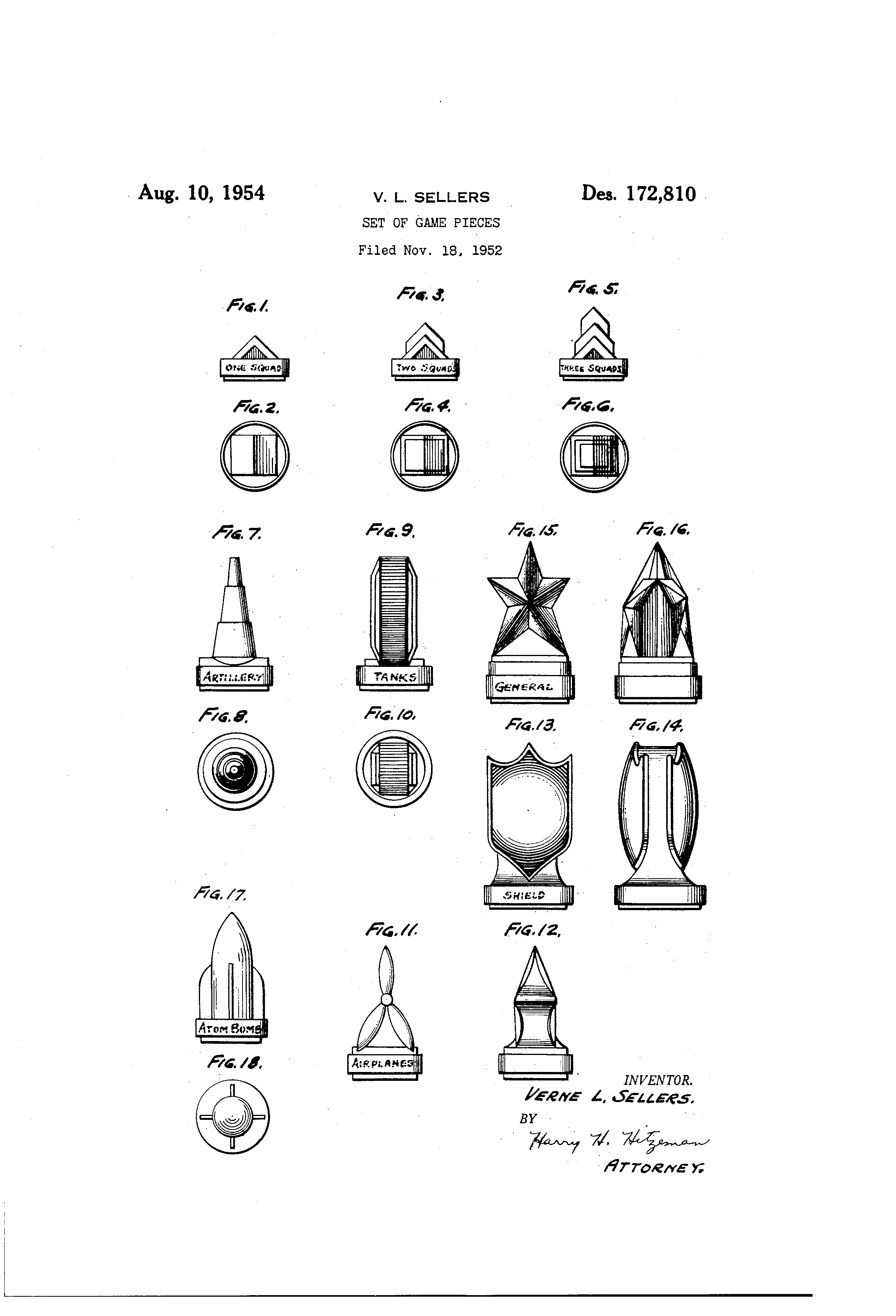
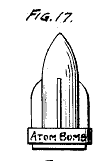
    Does these things, below, seem appropriate to you?  Take for example a simple matter in this detail from a U.S. Patent Office report for game pieces for a board game–the pieces were described; the game wasn’t.  The inventor, Verne Sellers, provided tanks, artillery, an air power of some sort, a “shield”, a general, a few undesignated items, and of course an atom bomb.  The atom bomb would make things all right. 


    Games atom bomb[Source: atomic bomb game pieces from US Patent and Trademark Office via Google Patents: http://www.google.com/patents/USD172810?dq=atom+bomb+game]

    And then there is the “Safe, Harmless, Giant Atomic Bomb”, which is something that is made to sound so much like nothing that it gives “nothing” a new meaning.

    Atomic bomb toy

    [Source: Pinterest https://www.pinterest.com/electrichermit/atomic-age-america/]


    Then this lovely thing, a small and cheap dexterity toy that places atomic destruction in the sphere of a semi-mindless time-killing toy, a real neutralizer to the significance of the thing it portrays:

    Atomic Bomb dexterity game

      I can’t imagine many people wouldn’t feel some sort of sympathy for this gigantic King Kong, who looks up just in time to see the massive nuke falling on his head, personalizing the delivery system of mass destruction:

    http://4.bp.blogspot.com/_xKCH2IWimP8/TKo0NZZutWI/AAAAAAAABgY/RbpLA7QTTD8/s1600/Konga+Atomic+Bomb.jpg

    Total destruction as a game, or game piece; an oxymoronic trivial pursuit.


  • Electro-LUXurious 5: Alpha and Omega Casket and the History of Death

    JF Ptak Science Books   Post 1491

    This is the fifth in a new series of posts on interesting, early applications of electricity, most of which are taken from the archives of the U.S. Patent Office.  Unlike the general post in this blog, many of the Electro-LUXurious post images and documentation can be presented without commentary.

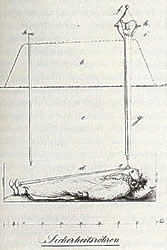
     It has not been an easy job over the centuries in determining whether a person was alive or dead, and dead as in really truly dead, absolutely so.  Consider how this would be done in case of coma and such in the days before the stethoscope, when doctors and medical people would use cones and other hearing apparatus to help the wizened old practitioner hear with their deteriorated hearing, listening for signs of life with an inferior instrument and Burial premature limited auditory capacity.  (The stethoscope wasn’t invented until 1816 by Rene Laennec–who produced a monaural device much like a primitive hearing horn made of solid wood—which was a vast improvement over no stethoscope at all, by again was very crude compared to early 20th century devices.) There is little wonder about the tales of horror of premature burial (as with Poe) and the spate of burial devices where–of the dead suddenly became not so, awakening in the coffins underground, that they could activate one of the many ingenious life-saving devices to alert someone to come and dig them up. (There were also patented designs that would deliver air to the coffin as well as have an accessible ladder to the surface.)

    The most fool-proof way of determining death in the 19th century was to leave the body alone for three days or so to see if it began to putrefy–this was the method proposed by Christian August Struwe, among others, who advocated the construction of special hostels for the dead (“Leishenhauser”), where they, the supposed dead, would lie in state for the period of time necessary for putrefaction.  This was also among the most elegant solutions given limited technological capabilities, especially when compared to nipple-pulling, scalding, tongue-yanking and of course the infamous tobacco smoke enema (seen below).

    What I am getting to though in the Electro-LUX series is the coffin/life-determination box, a sort of all-in-one affair where a body could be both determined to be dead and buried in the same thing, one of the few (?) medical devices that after performing its job be used as a coffin for its patient.  It is an alpha & omega bit, supposedly sparking to life the pre-dead if they were alive, or serve as the taxi to eternity for those who were truly and most sincerely dead.

    I’m having a bit of fun with this, but the issue of what constitutes being “dead” is still somewhat contentious–the issue was much larger 150+ years ago, when the philosophical/physical/biological questions were still very wide open, still. 


    Here are some other examples of determining whether a person was dead, or not, all taken from  Jan Bondeson’s delightful Buried Alive, the Terrifying History of Our Most Primal Fear (Norton, 2001):

    –Christian Friedrich Nasse’s Thanatometer was a long thermometer  that was inserted into the stomach, supposedly measuring a core body temperature that would determine if life was possible (and published in 1841);

    –The (Englishman’s) Barnett scalding death cure, which recommended burning the skin of the arm to see if it blistered (no blister/no life);

    –the German Middeldorph invented a heart flag, a needle device that would be thrust into the heart, which if functioning would trigger something or other that would cause a flag to be released at the top of the needle (a very Victorian and visual one, this);

    –Christian August Struwe’s interesting Lebenspruefer (1805) was an electrical device that delivered a dual shock to the eye and lip, the logic here being that if the person was still alive that there would be a resulting twitch;

    –the nameless tobacco enema, which blew smoke…(delivered in the beginning by breath through a tube and improved later to replacing the lips with a bellows, this secondary improvement by Antoine Louis2 and furthered by Dr. P.J.B. Previnaire’s much more powerful anal tobacco furnace.  [Now there’s three words I’ve never strung together before].)1

    –Leon Collongues believed that he could hear the capillary functions of a possibly-dead person’s fingers if placed in his ear;

    –Jules Antoine Josat2 invented a nipple-pincher (“pince-mamelon”) life-rejuvenation device, operating on the assumption that a deeply sedated person could not resist a strong pinch of the nipple and would have to wake up if alive.

    Perhaps the most spectacularly extension of the nipple-pincher was the tongue-pulling idea of Dr. J.-V. Laborde3 (1830-1903), a research physician with wide credentials, who reasoned that a continued regimen of advanced and strenuous pulling of a patient’s tongue would over time bring them back to life if alive.  This is what leads us to the point of this post:  Laborde established a mortuary, and in this mortuary, where the dead were waiting to die, he employed a man whose job it was to pull the tongues of these bodies.  In the misty picture of all of this that is painted in my mind’s eye, the fellow working his way from body to body pulling their tongues with a heavy pincer seems far worse than nipple squeezing or even being an anal smoke blower, though to choose between the three in a twisted Purgatorial mandate would be hard to so.  Although the nipple pincher wasn’t replaced by anything mechanical, the smoke blower was (by a powerful bellows), and so was our friend the tongue puller, who after complaining of the boredom of his task was pushed aside by an electrical device. 

    Notes:

    The text for the patent report, below:

    1. From the Bondeson book, page 156:

    “Antoine Louis had also proposed another method of testing life, or at least stimulating the vital spark in the apparently dead person: with a powerful bellows, he administered an enema of tobacco smoke. One of the pipes of this remarkable apparatus was thrust into the anus of the apparently dead person; the other was connected, by way of a powerful bellows, to a large furnace full of tobacco . Such enemas of tobacco smoke were thought to be very beneficial and were used to try to revive not only people presumed dead but also drowned or unconscious individuals. In 1784, the Belgian physician P.J.B. Previnaire was given a prize by the Academy of Sciences in Brussels for a book on apparent death, which described and depicted an improved bellows for enemas of tobacco smoke, which he called Der Doppelblaser. These enemas were regularly used well into the nineteenth century, particularly in Holland; modern science has discerned no physiological rationale for their use, except the pain and indignity of having a blunt instrument violently thrust up one’s rear passage must have had some restorative effect.”

    2.  Josat.  From Weird Universe.net I found the following, quoting Death and Sudden Death, by Paul Brouardel and F.L. Benham:

    “Josat invented a pair of forceps with claws, with which he proposed to pinch the nipples of persons whose death has to be ascertained. Josat obtained the first prize of the Academy, but Briquet, repeating the same tests on the hysterical subjects under his care, proved that they did not react under Josat’s forceps any more than the dead.”

    3.  M. Laborde won a 2500 franc prize for his innovation in 1894 (as reported by the Revue scientifique.  He sounded like an interesting man:  according to the British Medical Journal (in reporting his death 25 April1903) upon his own death in that year Laborde: “as a freethinker had a civil ceremony; as an hygienist was cremated; as a member of the Societe Mutuelle d’Autopsie willed his body to be dissected; as an anthropologist willed his brain to be preserved at the Anthropological Museum…” Some of Laborde’s works include   Le traitement physiologique de la Mort. And Les tractions rythmées de la langue, moyen rationnel … de ranimer la fonction respiratoire et la vie … Avec … dessins, etc  And:  La traitement physiologique de la mort (Paris , 1894) And: La signe automatique de la mort reelle (Paris, 1900). And  “Les Tractions Rhythmees de la Langue”, VIII, pp. 76 ff, ed. 2, Paris, 1897, and VIII, 2d part, pp. 406-510. And commented upon in some number, for example:  Le Traitement physiologique de la mort par les tractions rythmées de la langue. Le tracteur lingual automatique Laborde, by Alix Hache.


  • Questionable Quidity: the Preservation of Decay–Atomic Bomb Suits

    JF Ptak Science Books   Post 1486

    Part of this blog’s long series on Atomic and Nuclear Weapons


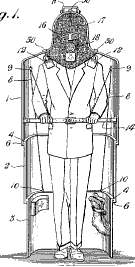
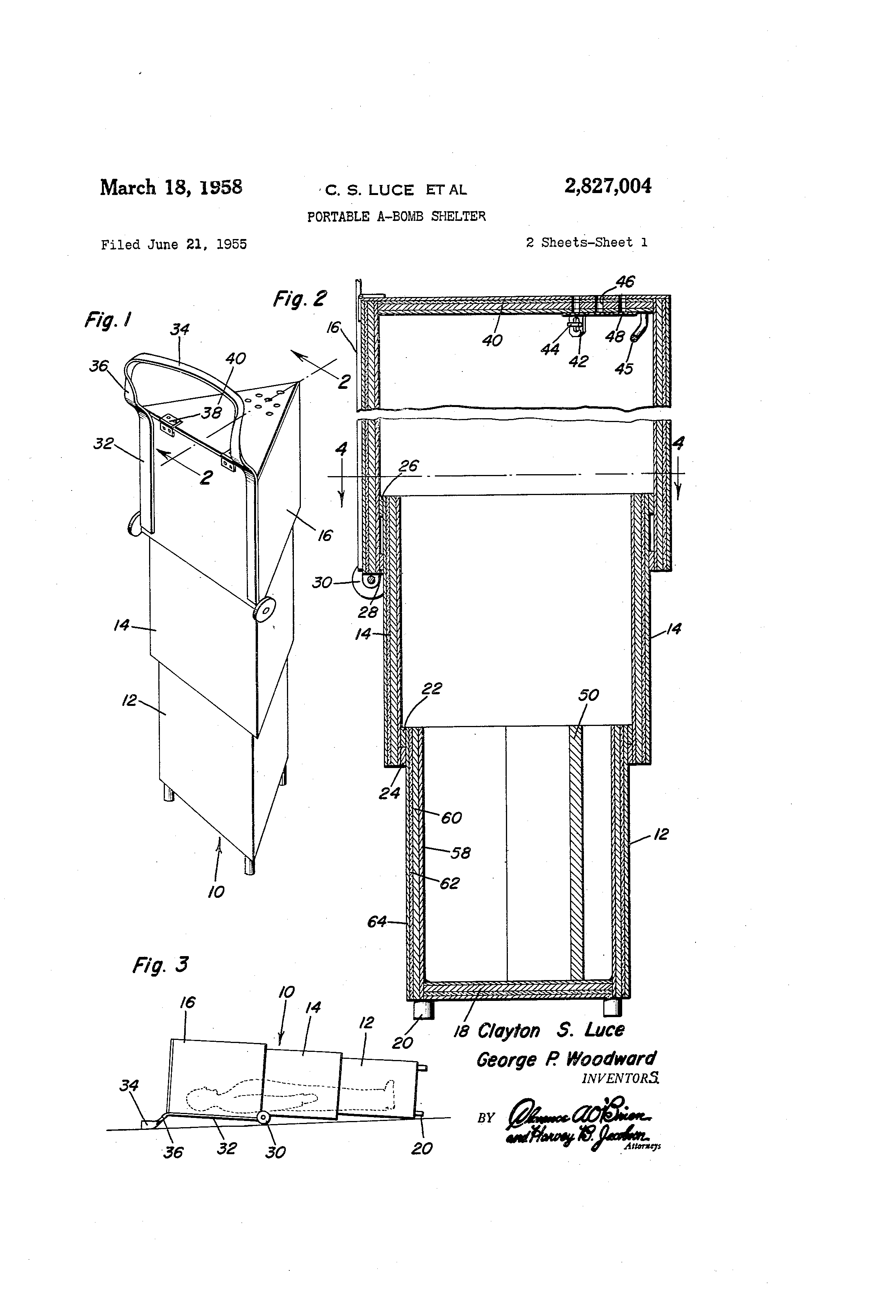
     Is there anything more revolting than this solitary, encapsulated,  iron maidenesque survival sarcophagus and its promised hope of survivability? 

    Perhaps not.  This patent application for an individual survival suit from 1958 gives us something to think about, perhaps gives us the cause to imagine what the world would look like from the inside of that portable evacuation chamber (that had its own attache case for storage).

     
    Atomic suit 2
     
     
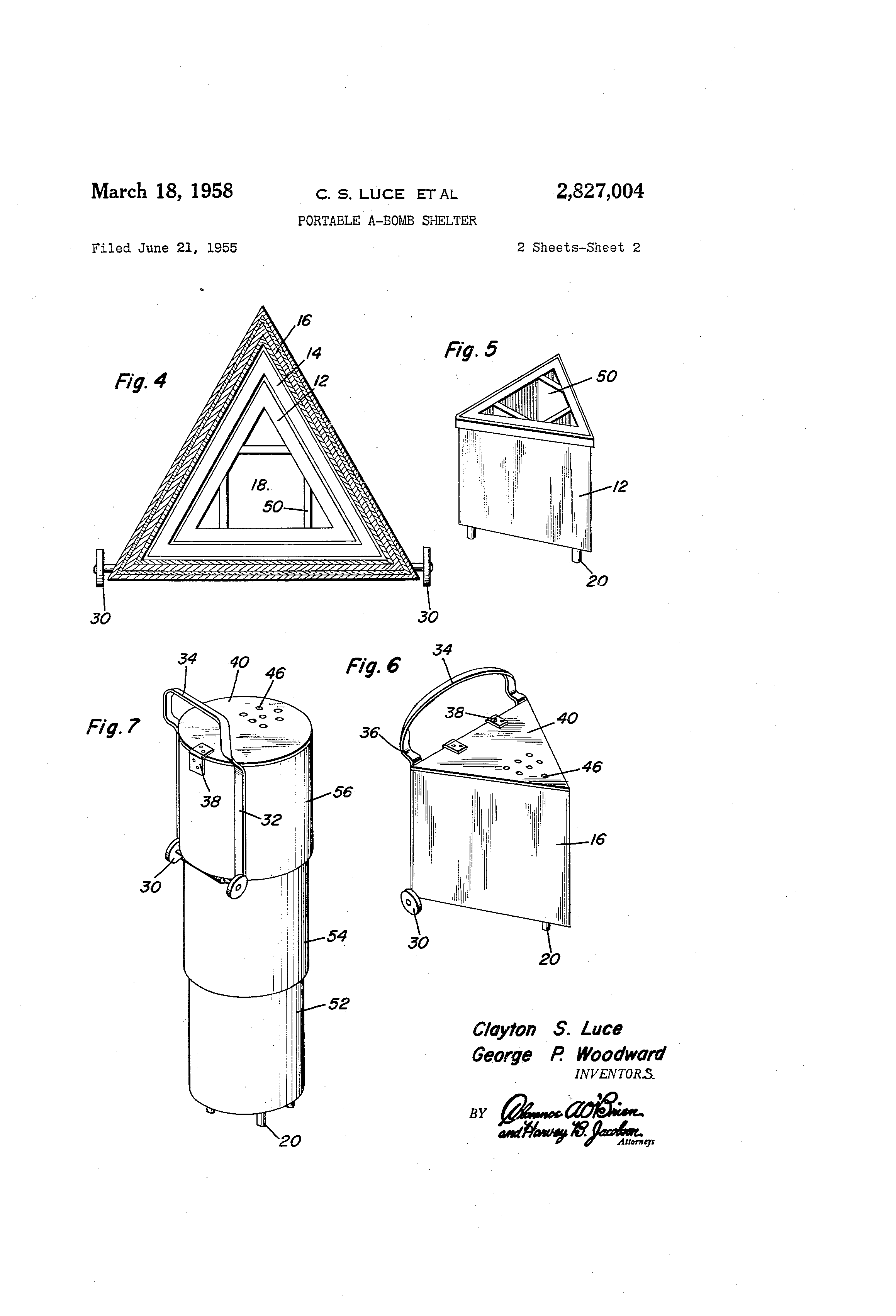
    Another variant, from 1958, shows a handy, mobile triangular leaf-incinerator-like environment that you wheel into position, put on its side, and then crawl into and die:
     
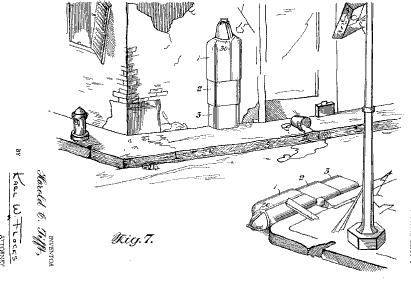
    The bomb(s) would go off, and there you would be, standing with your back against the wall, or laying in the gutter pressed against the curb, just another piece of the dead city, another piece of metal waiting to decay.  I’m not sure what is going on in this scene, which while being crude is still steeped in a high-creep factor.  I get the impression of slow time in these images, as though the atom-bomb-suited people have been there for a long time, though I suspect that we are seeing an urban area just after a blast.  It is a wincingly bad scene. 


    Atom bomb suit
    (Why is it that when seeing Civil Defense films and etc from this period we see people ducking-and-covering from one bomb?  Since the great majority of Americans lived in one of the 75 “essential delivery acquisitions” areas (I forget now the source for this phrase) it was exceptionally unlikely that people would be dealing with a single acquisitions implement, since the Soviet stockpile of nuclear weapons would’ve been at probably half-par with the U.S., which at this point (1958 or so) would be around 18,000.)
     
    Here’s another example of some unusual thinking on surviving nuclear holocaust, 1958, only these–while solitary–are not terribly mobile, even if they did come with wheels. (Didn’t it bother anyone that something that was supposed to prevent you from flying glass and bricks and the terrestrial ring of fire could be moved around on such tiny wheels?) They look more like waste receptacles.  Maybe that’s what they would wind up being, if they were ever used for their intended purpose. 
    Atom bomb proof suit prone

    [Source: Google patents, http://www.google.com/patents/US2827004]

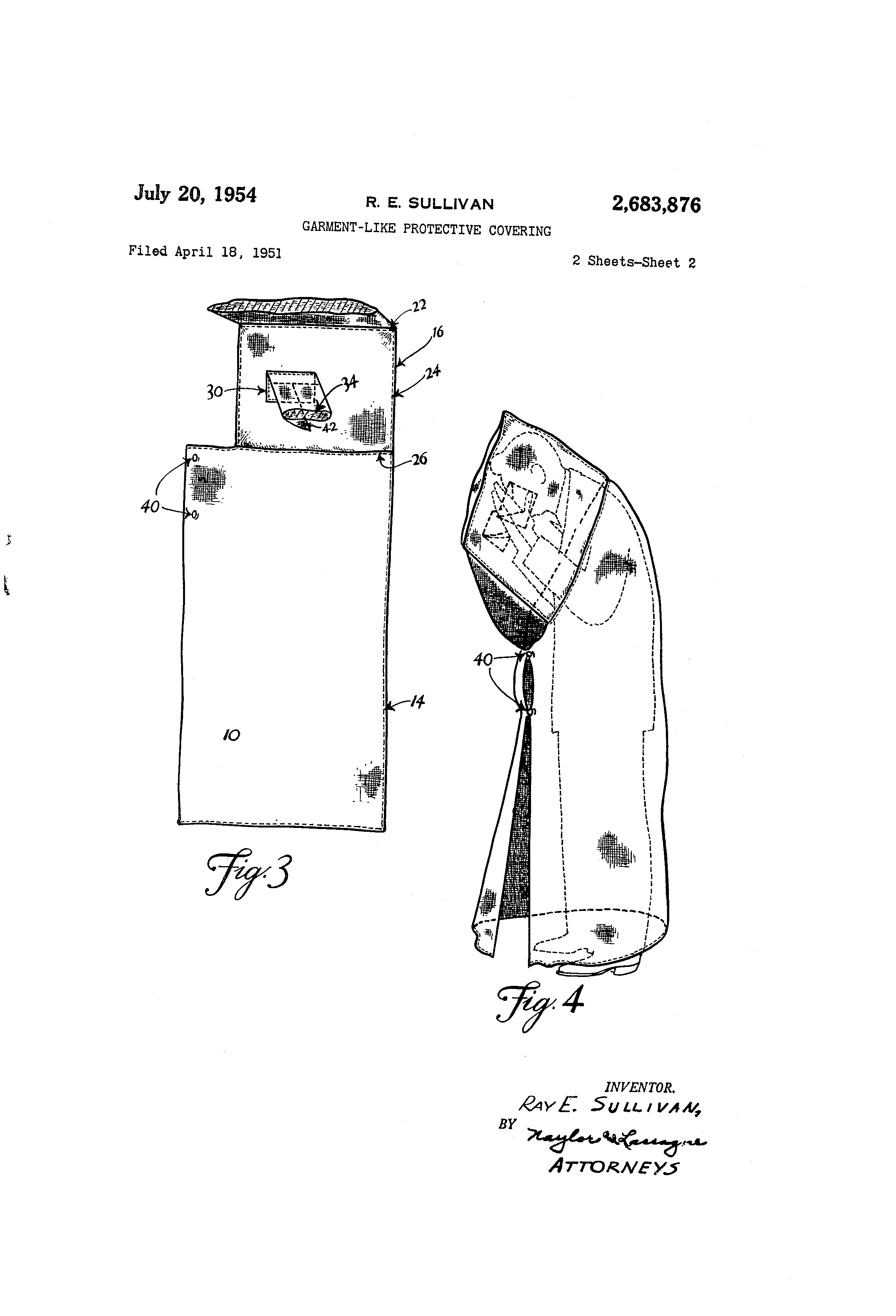
    And another atomic bomb “garment-like” thing–this looks like it might actually be useful on airplanes, because most people who die in crashes do so from smoke inhalation…but providing one of these per person would be a bad flying vibe, just like seat belts (so ferociously resisted by Mr. Iacocca) were seen by the car industry as an unnecessary reminder of how dangerous cars were/are).

    Atom bomb proof suit 1958

    [Source: Google patents, http://www.google.com/patents/US2827004]

    Anyway, the only way these things might be useful in times of such an emergency as atomic holocaust would be as a burial shroud.  And since a bunch of people would (presumably) already be wearing them at the time of attack, the job of burying them would be that much less work, since they were already shrouded.  Of course, that’s assuming (a) that people would or could be buried, and (b) that there was anyone left to do the burying. 

    Atom bomb suit bent over

    [Source: Google Patents, http://www.google.com/patents/US2683876]


  • Spaghetti Map of the Army-McCarthy Hearings, 1954

    JF Ptak Science Books   Post 1489

    Some things are complex, and complicated and pretty–you don’t realize that they are this involved, exactly, because of the elegant way in which they are presented.  An anti-gravity undertaking by Brunelleschi, in creating his dome, was an enormous challenge,  solved with circles within circles, a series of nine of them enclosed in a polygon, the result being one of the most beautiful and iconic achievements in the history of architecture (and engineering).

    And then sometimes things are complicated and complex and look and behave that way, their messiness outdistancing their own necessities.

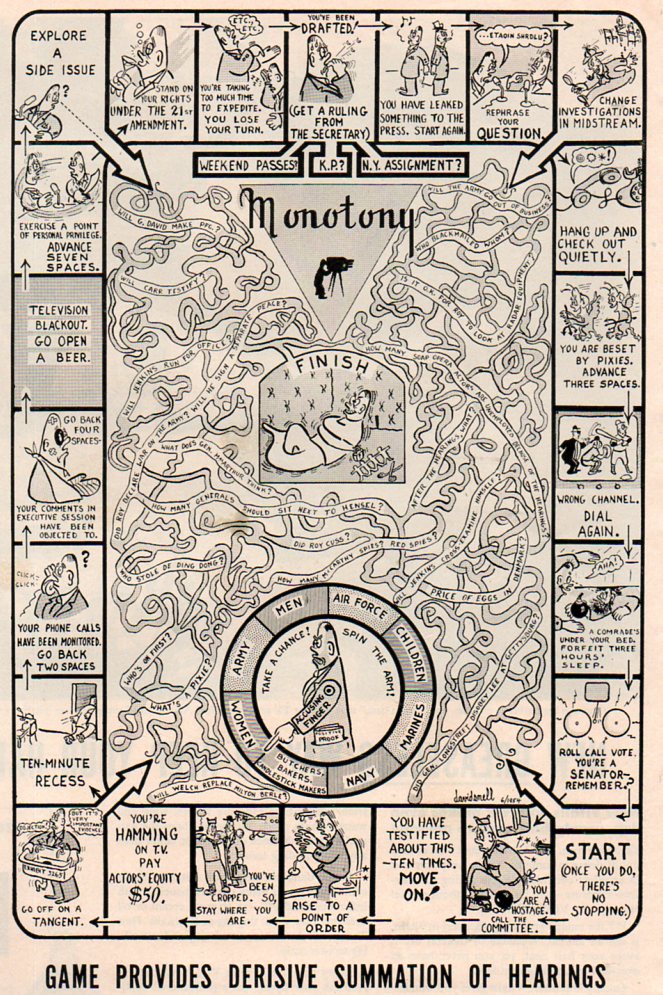
    Which gets us now to this game, a mass of entwined spaghetti, which was a tongue-in-cheek poke at the Army-McCarthy Hearings of the spring of 1954, a popular review in the tradition of Thomas Nast that is very effective.. The “Army” was the U.S. Army, and the “McCarthy” was Senator Joesph McCarthy, of Appleton, Wisconsin, a man who was about at the end of a short, meteoric career of vast unsubstantiated accusation, discord, lies and fraud. The hearings were supposed to sniff out Communists in the Army and the defense industry, because that’s what McCarthy did, being a rabid impersonator of a man with a decent mission. The hearings were long, involved, and traveled nowhere fast although much ground was covered.

     The bottom line to the whole affair was that as the first televised Senate hearings, McCarthy drew a huge audience, estimated at some 80 million people over the course of the event. And what happened was that “Tail-Gunner Joe” (an appellation he gave to himself that among many other things in his personal and public life were exaggerations) found out that he was seen better int eh minds of Americans when he was not being televised. In short, he was outed for many as a crude, threatening liar, and his career of ruining people in his quixotic quest for deeply-rooted Commies was about over when the last lights in the hearing room went out.

     Joe McCarthy would be dead in about three years, his liver failed, evidently (as his biographers say) from too much drink. He was a dangerous and divisive man, but one who had many friends and supporters to keep him re-elected and in power. (He was a darling of the Kennedys, being a favorite of Joe Kennedy, the godfather of Robert Kennedy’s first child, and one who dated two of the JFK’s sisters. Being Catholic and a vehement Commie-hunter went a long way with Joseph Kennedy, who had his own set of issues with power and rule.)

    McCarthy hearings495

    [Image source:  LIFE magazine, 21 July 1954, page 42.]


  • Questionable Quidity: Fireworks Boxing

    JF Ptak Science Books   Quick QUIDITY Post

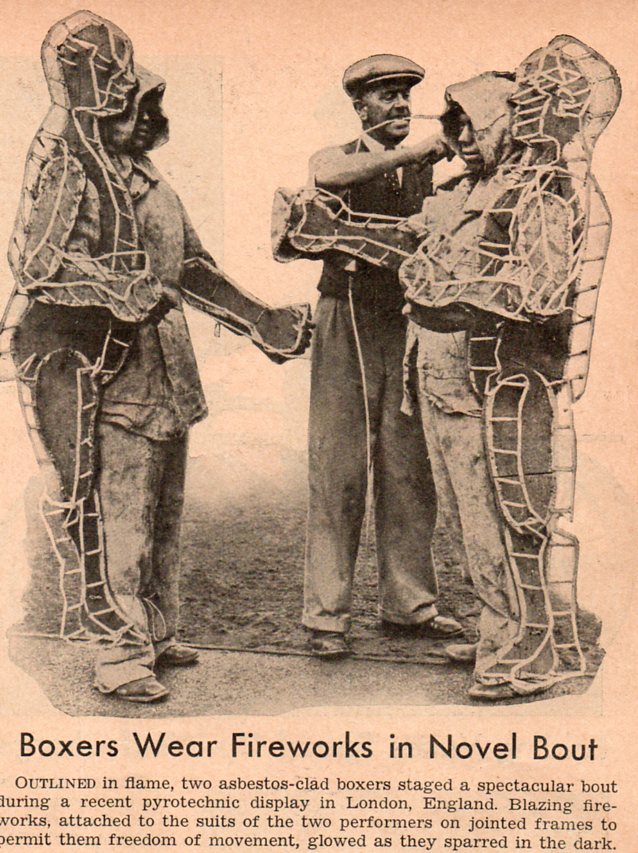
      Quidity514
    Certainly in the history of creative chemistry there were more reasonable things to do than this.  But perhaps not, perhaps the folks in 1934 had come to the realization that the idea of creativity was spent, that there were not going to be any new, good ideas, that the era of reasoned inquiry was gone–and to celebrate, the sport of fire boxing was born. 

    These realizations came in 1934, and 1935, and every year, before and since.  The struggle with or for creativity and genius is a second-by-second bout, and there is no doubt that the quidity of what passes for a “good idea” for x^x ideas must surely fill the middle of the infinite Encyclopedia of Stuff that Doesn’t Make Sense. 

    My guess is that the number of bad ideas stays a relative constant among humans.  The only difference over time is the number of humans having the bad ideas and the ways in which everyone hears about them. 

    Note:

    The guy on the left bears a small resemblance to Augustus Saint-Gauden’s Adams Memorial (sometimes called “Grief”). 

    Quidity515 Adams-memorial-2


  • Atomic- , Vacuum- , & Solar-Powered Dirigibles with Built-in Airports–Bits of a Bad Historic Future

    JF Ptak Science Books   Post 1487

    A post (“Nuclear Everything”) over at Dark Roasted Blend that featured a magnificent and stodgy atomic-powered zeppelin pushed me into this short visual note on differentially-powered airships, and then in general about airships with airports on them. (There’s a whole other category for planes-of-tomorrow that were so enormous that they had landing strips on their wings, but that’s another story.)

    And they remind me of things that just aren’t “right”, because these things just weren’t.  I’m not sure why, but I’m drawn into an old story about the legendary Charlie Goodnight, Texas pioneer, one of the creators of the idea of the cattle drive (the Goodnight-Loving Trail), a man who lived an extraordinary and powerful life.  He lived for a long time, too, from 1836 to 1929 (almost to the year of the birth of Larry McMurtry, who told a version of Goodnight’s story so spectacularly well in Lonesome Dove), well into a future so far advanced from the year of his birth that he could scarcely have imagined it.  Anyway, towards the end of his life, in 1916, Goodnight had the idea of making a movie of the Old West that included a “final” Indian buffalo hunt.  I’ve seen the film, and it is a fascinating, heartbreaking, wonderful/awful thing, that somehow might appeal to almost no one.  It certainly didn’t appeal to the folks at the time looking for a cowboy film, because much like Mr. McMurtry’s cowboys, Goodnight’s reality didn’t much resemble the cowboys that the public wanted to see.  In a sense Goodnight lived beyond the history that he so much helped to create, and that his old, passed “present” was something that the people in his future really didn’t want to recognize. Then of course one of the things that made it all seem “not right” to me was seeing a vignette of Goodnight entering into one of the scenes, in  a car, making the whole thing a little spooky.

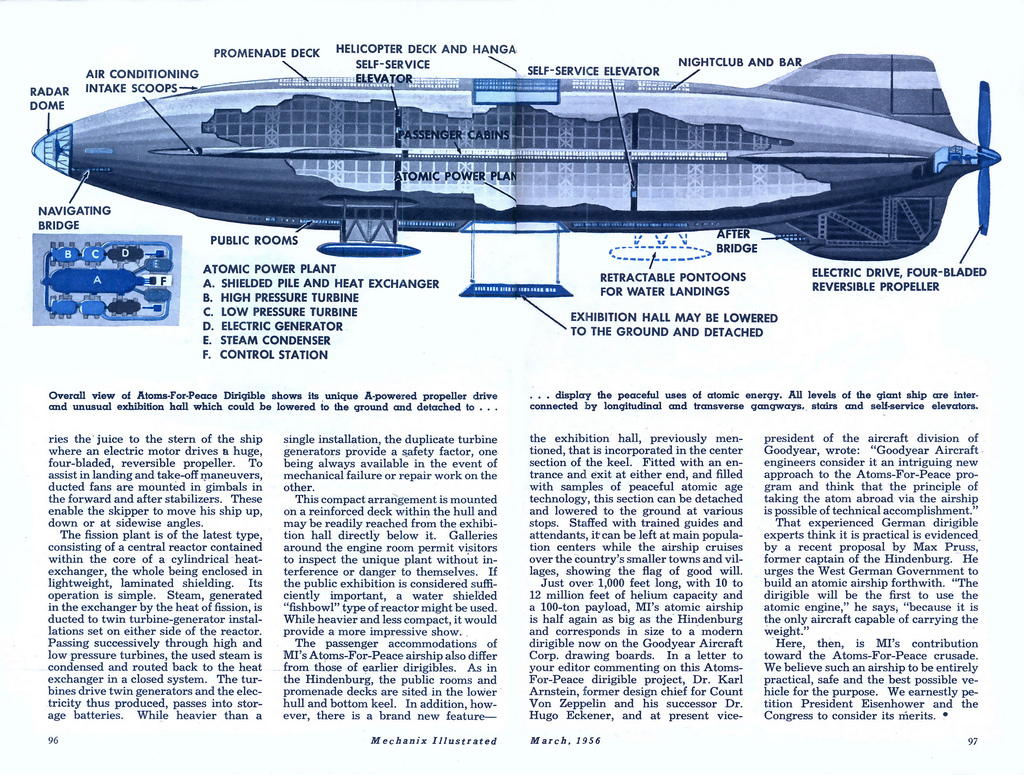
    First up is this mammoth flying advertisement to both peace and war, a nuke-powered dirigible proposed by Eisenhower in 1953 as part of the Atoms-for-Peace push, a move which by this point was already entirely too late.

    Atom everything zep for peace

    For some reason it was seen as a good idea to have a detachable convention hall built for the airship. \

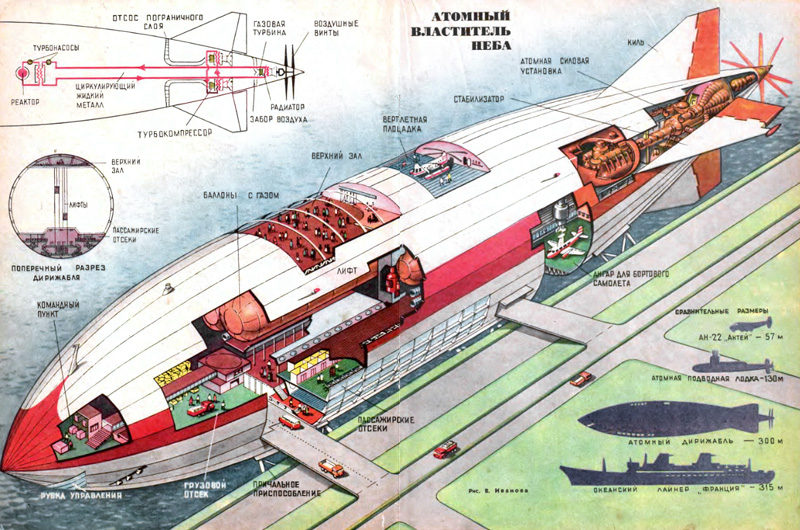
    And of course there is no greater element of a Something-for-Peace anything unless there was a competing idea, as seen in this mammoth Soviet atomic zeppelin, a ship completely absorbed in being bigger than the big thing that it already was:

    Atom everything zep

    At 300 metres this monster had room enough for virtually anything, though it didn’t have the retractable/detachable convention hall–it did however have a small airport. 

    Another dirigible approached the airport-on-board idea, but preferred solar power for its energy source.


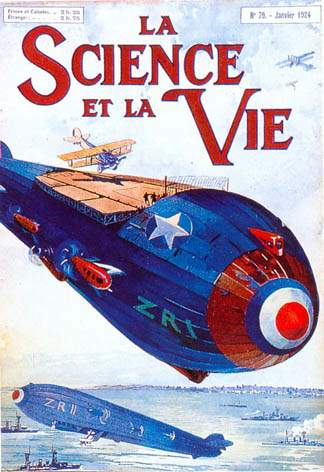
     The magnificent possible, 1924, saw another kind of airborn airport:

    https://historyofideasblog.com/a/6a00d83542d51e69e2012875ea3636970c-pi

    Guido Tallei’s 1932 Diri-Disk was a combination airplane/dirigible, and looked as though it could harbor an expansive airport on its NCC-1701-like wing, but didn’t, alas:

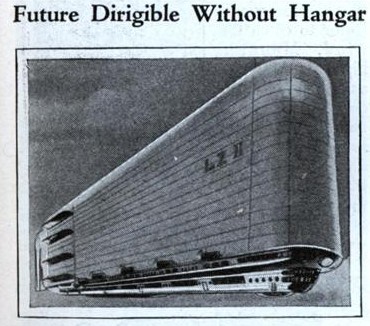
    Konstantin Eduardovich Tsiolkovsky (1857-1835), the Russian/Soviet space pioneer who was nearly without peer (and who somehow survived the bloodlust of Stalin which sucked up and murdered so many of his scientific colleagues),  stepped outside his spaceflight bubble to write about this monster with collapsing sheathing:

    https://historyofideasblog.com/a/6a00d83542d51e69e20128769ed30d970c-pi

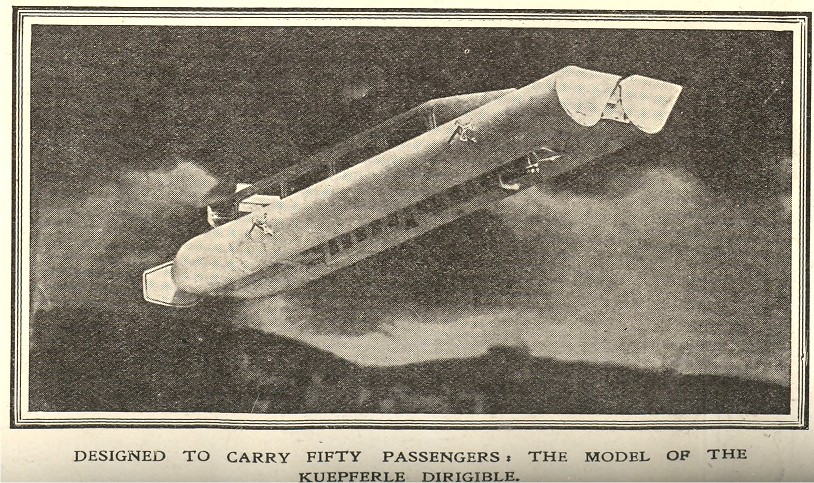
    The Kueperle dirigible, planned in 1909, was nothing if not pretty, and pretty is pretty much what the whole thing consisted of:

    https://historyofideasblog.com/a/6a00d83542d51e69e2012875ea2c87970c-pi

    And lastly, this example of the tracked airship–this must have been a popular notion because I’ve seen perhaps 15 different plans and I don’t spend much time at all reading in this area.  But harnessing the power of the balloon or dirigible or (kite!) whatever to a track system seemed to be a good idea, once upon a time:


  • Precursor to Zombie-Phone-to-Deadsville: the Telephone Medical Metal Detector “X-Ray”

    JF Ptak ScienStructure513ce Books  Post 1495

    Did President Garfield Die Because of Metal Bed Springs?

    Thomas Edison famously took advantage of a naive reporter, telling the young man that he was working on an invention that would allow a person to telephone dead people–a story that was reported as true, and one which Edison (both thoroughly disgusted and joyful) helped to perpetuate to the day he died by simply not discussing the issue. (This story appears on this blog here.)

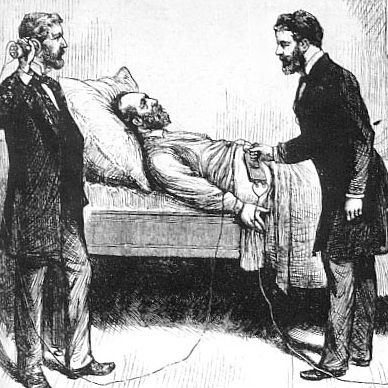
    Much earlier, only five years after Alexander Graham Bell first patented and published his invention of the telephone, the device was used by Bell to do some very early electrical medical imaging.  The new President of the United States, James Garfield, had been shot by Charles Guiteau in Baltimore and Potomac Railway Station (on 2 July, 1881, after a lengthy period of semi-abstract stalking and planning) Station in Washington, D.C., receiving fatal wounds in July and which would cause his death later in September.  The problem was that at this point in the history of surgery it was  difficult to locate bullets in the body, becoming more so if the bullet took a non-straight course through the wounded.  Normally, in 1881, a doctor could for example use a device called  a Nelaton probe, a thin porcelain device (as opposed to most other probes, which were metallic) to help locate the embedded bullet.  But given the nature of Garfield’s wounds, this was just not applicable, and the bullet escaped recognition from this and other probes.

    Bell enters the scene with an electromagnetic invention, the induction balance, which he created to detect interference on a telephone line.  In the process of experimentation Bell recognized that the balance could be disturbed if the metal and battery-fueled probe came into contact with a piece of metal.–basically, the device was a medical metal detector. Bell resolved to use the device on Garfield, passing the probe along the President’s body while another person listened to a telephone ear piece for the telltale “click” of a proximate metallic object.

    Bell telephone garfield
    Bell was not successful with this, or at least not so at this time, and the President died, succumbing to an infection, finally.  But Bell was able to perfect this instrument, something that stayed in use as the principal means of detecting metal objects in the body, and was about as fine an instrument as could be expected, though it was completely eclipsed by the revolutionary machines brought about by Wilhelm Roentgen’s discovery of X-Rays in 1895.  And as it just so happens, the first surgical case in which the x-rays were used was for a case involving a shotgun wound. 

    Finally, one of the reasons why Bell’s instrument didn’t quite work on President Garfield is that Garfield’s bed had a metal box spring, which very well might have played havoc with Bell’s instrument.  Perhaps if there was no metal in examining area, Bell’s device might’ve worked. 

    Notes:

    An earlier and more crude device had been invented by Wilhelm Heinrich Dove (1803-1879, a German physicist and early meteorologist) though I am not sure that it comes into play with Bell’s apparatus at all.

    From Harper’s Weekly, 13 August 1881:

    “The experiments made by Professor Alexander Graham Bell with the view of determining by the aid of the electric current the location of the bullet in the President’s person were of the most interesting nature. The possibility that a time might come when it would be necessary to make incisions at once for the removal of the bullet, without consuming precious time for further consultation, gave to the experiments an importance which added greatly to their interests.”

    “An apparatus known as the induction balance had been used by Professor Bell in analyzing metals. This instrument, modified so as to impart to it the highest degree of sensitiveness, was used in the search for the leaden ball. Its nature is such that it is not easily understood except by electricians. It consists of a battery, two coils of insulated wire, a circuit-breaker, and a telephone. The ends of the primary coil are connected with a battery, and those of the secondary coil are fastened to the posts of the telephone. This latter connection renders audible any faint sound produced by the circuit-breaker, or any change in the pitch of that sound. The coils may be so placed in their relationship to each other that no sound is made by the circuit-breaker. They are then said to be balanced, and the wires are extremely sensitive to the disturbing presence of any other piece of metal. A bullet like that with which the President was shot, before it was flattened, will, when placed within two and one-half inches of the most sensitive point on the pair of coils, cause a faint protest against the disturbance to arise in the telephone. A flattened bullet of the same bulk, when presented with its flat surface toward the coils, will make its presence felt at a distance of nearly five inches. When its sharp edge is turned toward the plane of the coils, no sound is produced beyond the distance of one inch.”

    “With these facts in view, the experiments to locate the position of the bullet in the President’s body were begun. The patient was bolstered up in bed, and he watched the proceedings with mute interest. His physicians stood around. Professor Bell stood with his back toward the President, holding the telephone to his ear, while Mr. Tainton, Professor Bell’s assistant, moved the coils over that portion of the abdomen where the leaden ball was thought to be imbedded. When the sensitive centre of the instrument was immediately over the black and blue spot that appeared shortly after the President was wounded, Professor Bell said, “Stop! there it is.”

    “The experiment was repeated several times — once with Mrs. Garfield listening at the telephone; and she told the President when the coils had been brought to the spot where the presence of the bullet had previously caused the delicate instrument to give forth a singing sound. From these tests it was inferred that in any event the bullet was less than five inches from the surface, and that if it was only slightly flattened, or if its edge was turned obliquely toward the surface, it might be much nearer to the skin. The conclusion reached was that if it should become necessary to remove the bullet at any time, this might be speedily accomplished by two quick cuts with the surgeon’s lancet.”