A Daily History of Holes, Dots, Lines, Science, History, Math, Physics, Art, the Unintentional Absurd, Architecture, Maps, Data Visualization, Blank and Missing Things, and so on. |1.6 million words, 7500 images, 4.9 million hits| Press & appearances in The Times, Le Figaro, Mensa, The Economist, The Guardian, Discovery News, Slate, Le Monde, Sci American Blogs, Le Pont, and many other places… 5000+ total posts since 2008.

Category: Absurdist, Unintentional

  • Obfuscation as a Weapon–on Teaching Indians to Read, 1875

    JF Ptak Science Books   Post 1417 

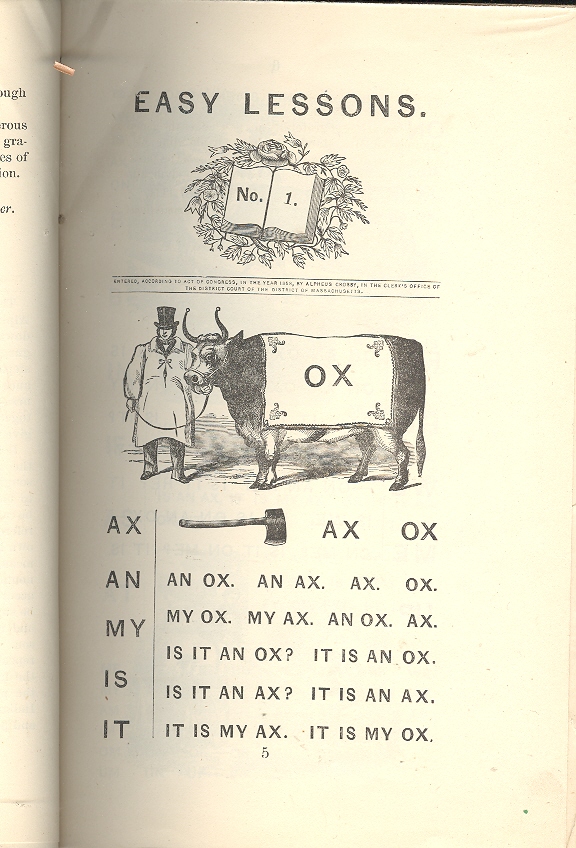
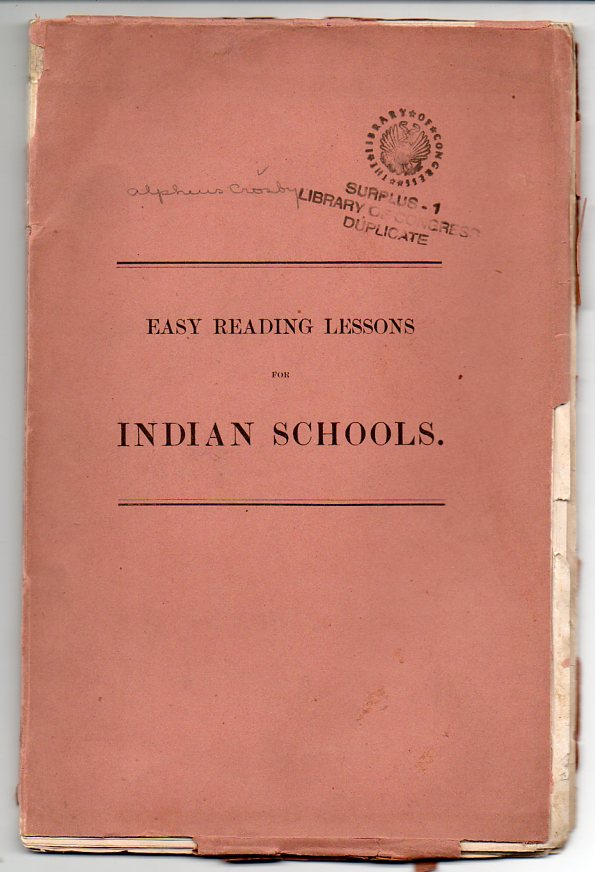
    This small pamphlet, Easy Reading Lessons for Indian Schools, was published for the Department of Indian Affairs (as a section of the Interior Department, classifying the Indian along the lines of cattle and agriculture) by the federal government, printed by the indomitable Government Printing Office in Washington DC in 1875.  (The original is available at our blog bookstore.)

    Indian school269 It is an unintentionally quiet indicator of the general American policy towards the Native American in the last quarter of the 19th century.  The work is indifferent to any particular need of the student.  It is intended for the person who could not read, and nowhere in this work is there a listing of the alphabet.  It is ignominiously but softly complex, and looks to me to be a total disaster as a text.  (This is true when comparing the work to nothing at all; but when you stand it next to, say, McGuffey’s reader or the Eclectic or any of the other classic how-to-read books of the 19th century, the weaknesses of the Indian book become instantly clear.

    How in the name of great bog could anyone have thought it just and fair and equitable to teach English-illiterate “Indians” to read with such an instructional?  It isn’t even close to being a book, and it comes no where near to being able to transcend its own terminal obliqueness.  It introduces simple words and phrases in a tongue-twisting ways, and then complicates the situation by quickly adding more structured words in a more confusing environment.  The thing is terrifying.  I actually had a hard time reading it out loud. 

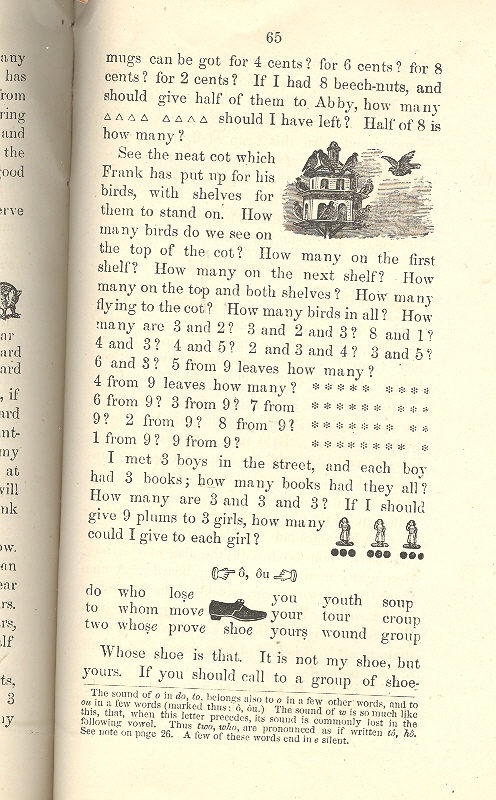
    Here on page 17 (already!) is a tremulous example:

    “See the lad.  Is it Mat?  It is Mat; and Fan is by him on the sod.  He has his hat. But it is not on. Has Fan a hat?  Mat has a bat. Dan cut it by the bog. Mat had his bat, and ran at my dog Boz., and sat on a log, and hit him.  He did it in fun. And Boz had his fun.  He got the bat and ran it way and hid it in a box. Dan got it but bid Mat not hit the dog.”

    Indian 001

    For crying out loud! (The bat by the way is, yes, a baseball bat.  Pretty early stuff in 1875.)  Why would someone use this series of images to teach someone how to read?  The pamphlet continues to exhaustion, taking only 80 pages to do so. For me it is a perfect symbol of the way in which the government—in general—dealt with the “Indian Problem”.  Confusing children and making life more needlessly complex, making it harder for them to succeed, making it more difficult for them to rise above the difficult situation that they have unexpectedly been born into,  is a superior sign of inferiority of the dominant power. 

    Wait a minute.  Am I writing about the Indian in 1875 or the poor kids in  SE DC in 2009?  I can’t tell.  The corruption of the social model for caring for people who need federal attention more than anyone else—the underprivileged child—is antiquarian and entrenched and as strong as ever.  At least there’s a moral foundation for the care of kids whose parents cannot afford health insurance.  Um, oh, wait another minute….

    Indian 002


  • Vast Understatement Department: Re-crushing the Crushed “Indian Problem”, 1887-1934

    JF Ptak Science Books   Post 1405

     “This might seem like a somewhat rapid reduction of the land of Indian estates”–Thomas Morgan, Commissioner of Indian Affairs, on the sale/disposition of 15% of all Indian Lands over the period 1887-1891.

     Indian Affairs Commissioner Thomas Morgan had a commanding view of the situation regarding the American Indian at the end of the 19th century, considering that he was king of the hill, surveying the scene from his commanding height, in control of the affairs of all American Indians from the relative security of knowing hardly anything about them. It so happens that during the period 1887 through 1903, the Indians suffered about as much loss to their way of life and their lands than about any other time in their history, and this at a time when almost all Indian resistance to federal control had already been eliminated by force or terror or hunger or the sheer weight of the impossibility of fighting the United States1.

    Most of the problems with the loss of land and the approach of the near-end of their tribal system occurred with what federal representatives referred to as the “Indian Emancipation Act”, which was formally known as the Dawes Act (and also the General Allotment Act) of 18872. The general fatal thrust in this Congressional action was to relieve the Indians of their reservation system and then their land, to enforce their assimilation into American (white) society, and then to become individual property owners and then tax payers, making the Indian self-reliant and independent. The underlying philosophy here is that it was the reservation system was the cause of the Indians’ problems—that it kept the Indians from fulfilling themselves by excluding them from American society, segregated them from “self-improvement”.

    “The Indian may now become a free man; free from the thralldom of the tribe; freed from the domination of the reservation system; free to enter into the body of our citizens. This bill may therefore be considered as the Magna Carta of the Indians of our country.” –Alice Fletcher, one of the Architects of the Dawes Act

    The Act not only managed to give the Indians the lands that they already owned, but it also took the land away at the same time, making it available to heads of households in 160-acre plots. It was supposed to make the Indians into useful members of the white community, and to teach them to be farmers, and to “properly use” the lands which they were given. According to Ronald Takai3, Morgan saw the Indian land as going fallow, and that if they didn’t use their land to a good end, then they should lose it. AS Commissioner of Indian Affairs, Morgan said that most of the land that was taken by the government was not being “used…for any purpose whatsoever” with “scarcely any of it….in cultivation”. Hence if the Indians didn’t farm the land then the land was being wasted, and if the land was being wasted then the Indian had no right to keep it. Thus the circularity of the Indian’s problem was complete—they would be given land if they were using it “properly”, which meant to break off chunks of tribal land and deed it to individual families, which at the end of the life of the head of the household the land would more than likely have to be sold4; and if the land wasn’t being cultivated, then the government would take steps to seize it via its system of aggravated purchase.

    “The sooner the tribal relations are broken up and the reservation system done away with, the better it will be for all concerned. If there were no other reason for this change, the fact that individual ownership of property is the universal custom among civilized peoples of this country would be a sufficient reason for urging the handful of Indians to adopt it.”

    In the four years following the passage of the Dawes Act, something on the order of 17.4 million acres of Indian land was sold or re-allocated, which was about 15% of all Indian lands.

    The Burke Act of 1906 was the second time the Dawes Act was amended, and was also perhaps the most devastating change yet made to the tribal ownership system. It gave the government the right to determine which Indians were “competent and capable” to own land, though by design the definition of “competency” was left vague, though it often meant that there was a certain amount of European blood in the Indian being judged. This meant that the “competent” Indian would have their land taken out of trust status, and then become subject to taxation and could be sold by the owner. This also meant that communally owned tribal lands could be divided into individual plots which may then top sold to the highest bidder, If the person was deemed to be “not competent”, though, something entirely different happened:

    “…the Secretary of the Interior may, in his discretion, and he is hereby authorized, whenever he shall be satisfied that any Indian allottee is competent and capable of managing his or her affairs at any time to cause to be issued to such allottee a patent in fee simple, and thereafter all restrictions as to sale, encumbrance, or taxation of said land shall be removed. “

    Given the situation that the Indian’s per capita income was so low, and that most of that was coming from the sale of land and from government stipends, it was almost entirely assured that the Indians, who were in desperate straights, would almost assuredly sell their property once it was within their individual capacity to do so. It was also the case that some Indians were actually judged to be “competent” but weren’t informed of it—this wouldn’t matter except for the critical part of that Indian’s lands now being subject to taxation; and if you didn’t know that the lands were being taxed, after come years Uncle Sam came by to collect on the back taxes, and since the Indian would have no money5, the land would then have to be sold to pay for the taxes that the landholder didn’t know was accumulating.

    The result of the complex story of the Dawes Act and its aftermath was that by its end (which came to an explosive halt in 1934) the Indians lost about 90 million acres of their 1887 land base., amounting to about 66% of all of their land. Plus the dozens of land-grants that were awarded to the railroad companies.

    The Indian Reorganization Act of 1934 stopped these practices, offering a “New Deal” to the Indians, empowering the new commissioner of Indian Affairs, John Collier, with a sensical approach to the institutional/bureaucratic Indian problem(s) created by U.S. Government with the Dawes Act. It stopped much of the bad craziness of the previous forty years, though the effects of that time are felt to this day.

    Notes:

    1. There was still the Ghost Dance to come in 1890, but this was a limited action of desperate people, ending in American soldiers of the 7th Cavalry standing over a trench filled with the bodies of 150 frozen Lakota Sioux (men, women and children) following their massacre at Wounded Knee Creek. There were another 51 Sioux wounded, including 47 women and children.

    2. Opening text of the Dawes Act: “….the President of the United States be, and he hereby is, authorized, whenever in his opinion any reservation or any part thereof of such Indians is advantageous for agricultural and grazing purposes, to cause said reservation, or any part thereof, to be surveyed, or resurveyed if necessary, and to allot the lands in said reservation in severalty to any Indian located thereon in quantities as follows: To each head of a family, one-quarter of a section; To each single person over eighteen years of age, one-eighth of a section; To each other single person under eighteen years now living, or who may be born prior to the date of the order of the President directing an allotment of the lands embraced in any reservation, one-sixteenth of a section.  The full text is here. 

    3. Ronald Takai, A Different Mirror, Little Brown, 1995, page 236-7.

    4. Under a new law in 1902 at the death of the head of the household the family was required to purchase the land or it would be sold at auction. Since most of the per capita income was made via federal distribution or payment from the government for earlier purchase of tribal land, it was in general the case that only a small percentage of the $200/year was made through farming. Basically, few Indians had the cash to actually buy their land, and so it went to sale, bought in the overwhelming majority of cases by white speculators.

    5. In 1907, the combined income of the Cheyennes and Arapahoes was $217,312, of which some $5, 312 resulted from farming. Of the 78 dollar per capita for these two tribes, about 78 cents came from working the fields.

  • The Mysteries Offered of Images out of Context

    JF Ptak Science Books   Post 1403

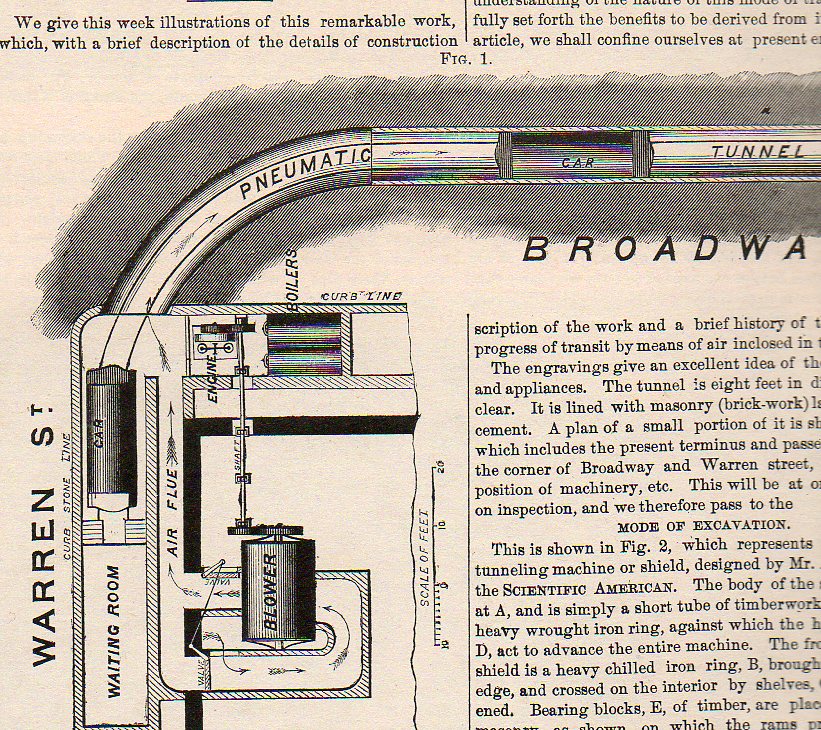
    “Certainly the most novel, if not the most successful, enterprise that New York has seen for many a day is the pneumatic tunnel under Broadway. A myth, or a humbug, it has hitherto been called by everybody who has been excluded from its interior; but hereafter the incredulous public can have the opportunity of examining the undertaking and judging of its merits.”  —The New York Times, on the opening of the pneumatic tunnel, September 1870.

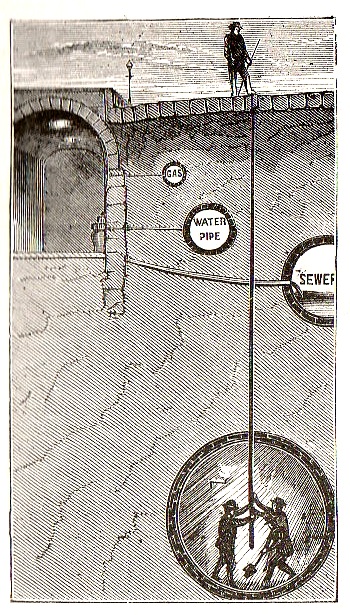
    These unusual images are all only so if they are removed from their context, taken from their stories, their explanations lost.  But the fact of the matter is simple–they show cross sections of some construction elements of “the pneumatic tunnel under Broadway, N.Y.C.” as it appeared in the Scientific American for 5 March 1870.  It was an experimental line, and did not really deserve the description received from the Times. The idea for an underground such as this was the brainchild of Alfred Ely Beach, and was basically a single-train, single-station, one-block system established for demonstration purposes, and was kept in operation from 1870 to 1873.  Technology overtook Beach’s idea of pneumatic propulsion with the development of electric trains, making the forced-air idea obsolete in short order.

    The images, without explanation, their purpose is well hidden.

    The first example simply depicts the way in which the progress of the tunnel was measured and mapped.  The two men underground sent up a series of pipes to the surface, under the very paving stone of Broadway, where a surveyor would make the spot where the pipes met the surface.  (We are told that this work was done at night, when the streets were empty.)  Any number of stories could be made of this image–all stretching beyond its intended purpose.

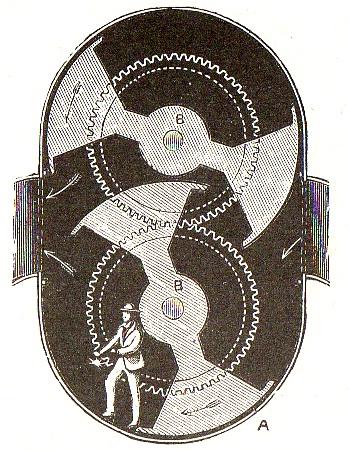
    Underground man224 This machine below could be virtually anything in the mind of anyone, except of course for its real purpose, which was to power the train.  It is a cross section of the apparatus, showing its two massive fans with a figure of a man added to show scale. 

    Underground man225

    “The power transfer is one of the most simple things imaginable. Air is forced into the tunnel by a gigantic blowing engine made by P. H. & F. M. Roots, of Connersville, Ind., a section of which is shown in Fig. 7. [missing] This blower is actuated by a steam engine of 100-horse power, and is calculated to deliver when worked at maximum speed, a volume of 100,000 cubic feet of air per minute. A pressure of one fourth of one pound to the square inch would be an aggregate of three-fourths of a tun on the end of the car, far more than required for propulsion.”

    Underground man226


  • Fantastic and Blandly Supra-Inspired Book Titles

    JF Ptak Science Books   Post 1401

    Fabulous titles216This is another in a series on fantastically-titled books and pamphlets.  When written the titles were aptly descriptive, indicating their contents, selling the wares, so on–but now, with a little time between publication and now, the connections of the titles to the contents seem to have withered like dried toothy neurons, gainfully displayed for all to see in their isolated weird elegance. 

    Fabulous titles214
    And so we experience the found, unintentional absurd in printed material like some of the examples below.  Their title pages can be experienced as art in a way, at least today, so far removed from their original meaning and context that the words float like disembodied arks of meaning looking for whatever piece of land/meaning that they bump into.  Sometimes their titles are the bizarre-ity, masking a mundane, pedestrian contents; much of the time the title and contents emanate the stench of lost meaning through and through. Sometimes the titles are just nothing. 

    Fabulous titles212 Fabulous titles215   Fabulous titles210
    Fabulous titles213


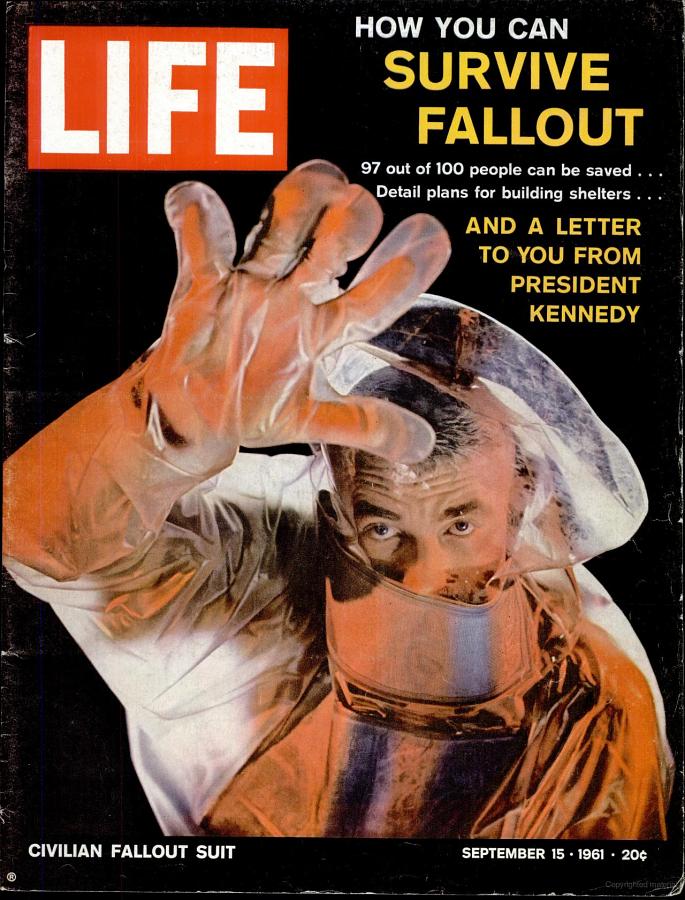
  • How YOU Can be One of the 97% of Americans Who Survive Nuclear Holocaust, 1961

    JF Ptak Science Books  Post 1378

    Books_004

    Well, I’d think that this issue of LIFE magazine would’ve sold in the hundreds of millions with the promise it makes here–right on the front cover–that 97 out ot 100 Americans could survive a nuclear slugfest–if only they were to follow the instructions of this article.

    We only get to the marrow of the issue after wading through a few articles and ads for Hires Root Beer, Maiden bras, silk skin girdles, Bayer aspirin, Schlitz beer, Old Taylor Whiskey, Ge “telephone color” night table clocks, scotchguard raincoats, Lanolin Plus Hair Spray Net, Marja bras, Red Rose cologne, nylon carpet, Maidenform girdles, NY Life, Sealy mattresses, Metrecal, Corn Flakes, Hammond organ, John Hancock Life Insurance, Friskies dog food, Cahmpion spark plugs, Budweiser, BF Goodrich tires, Tang, RCA, Anacin, Speedstick deodorant, Castro convertibles, B+W Whiskey, Kodak and  Vista TV.  Probably I missed a few. When you get to the big ad for Royal Crown Colas with the white-hatted BBQ cook getting a kiss with a big wiener on a stick, you’ve arrived at the article on saving the life of your family and your country.

    If only we could build enough shelters–and by “we” I mean “you”, and build them properly, and outfit them, and are able to get to them in the 14 minutes that you might have to get to your destination, and you stay down long enough and the attack light enough, then probably some people will survive.  How these folks got the 97% number is an issue of faith–I think that they must’ve steeped themselves in mystical prayers to secretly reformulate the percentage “23” into “97” without actually telling anyone.  I figure that this was the key to survival.

    I’ve written many times on this theology of survivability (see the series on atomic and nuclear weapons on this blog, here) but seldom does one see such an incredible, indefensible claim such as this, and splashed across the cover of America’s most popular picture magazine, accompanied by a letter of support from Camelot.  Somehow in the great looming nuclear confrontation that actually comes to pass, somehow “only”3% of the population doesn’t make it.  Of course if there was a natural catastrophe in which 3% of the country was killed–that would be about 4.5 million in 1961 population or about 9 million in 2011–it would be an absolutely phenomenal tragedy. (Ofcourse there were many European countries that lost more than 3% of their populations during WWI and WWII, but that’s another story).  But to escape nuclear Armageddon in this country with 3% loss is much better than other government figures published around the same time that predicted casualty rates exceeding 100 million. 

    But hearts and minds are won abroad and at home, so the homefires must have been stoked to prevent a colossal depression from befalling the country, which of course goes hand-in-hand with the policy of Mutually Assured Destruction, with all policies somehow making it possible for the rush to the abyss to be the one thing that was keeping us (in a Zeno-ish paradox) from falling into it. 

    But 97%?  You can read the article here from page 95 for the full story. 


  • Baseball and the Rifle Team at the NYSE, 1927

    JF Ptak Science Books  Post 1377

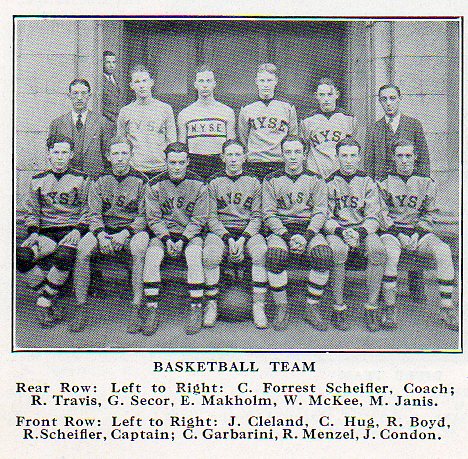
    NYSE bb107

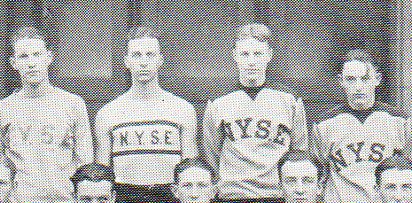
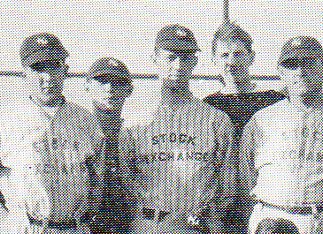
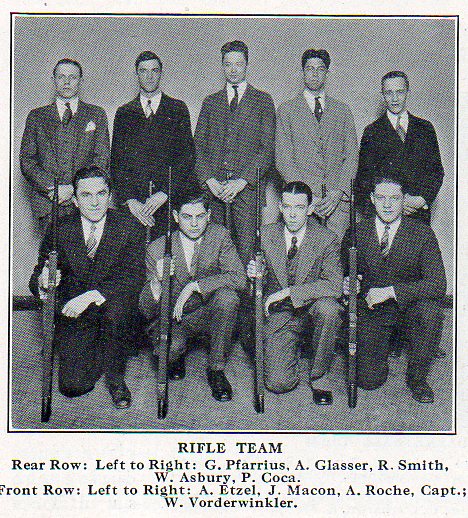
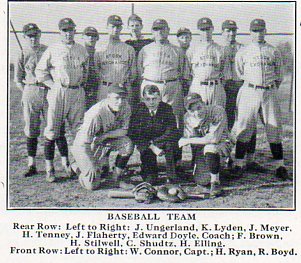
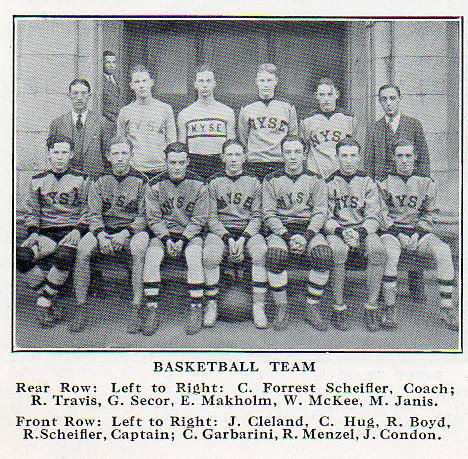
    Is there nothing else that shouts out $15 trillion market cap than this NYSE basketball team?  Well, probably.  These photos appear in a New York Stock Exchange personnel department publication for 1927, and as the HR -arm of the Exchange,  devoted itself to all things necessary to the average employee of the 1300-person entity.  The NYSE seemed to be fairly well involved with the health and free-time status of its workers, reporting on programs for self-betterment, general reading, health care, health insurance, savings and spending, training, “mental guidance”, retirement plan (singular), and so on.  These photos come from the “Employee and His Play” section, and discusses the achievements of the many sports teams hosted by the Exchange. 

    NYSE bb106

    NYSE bb105

    NYSE bb108
    NYSE bb104


  • Outrageous Analogy Dept: How Hitler Can Help in the Post-Nuclear-Attack USA, 1967

    JF Ptak Science Books  Post 1371

    “Understanding, n.  A cerebral secretion that enables one having it to know a house from a horse by the roof on the house.  Its nature and laws have been exhaustively expounded by Locke, who rode a house, and Kant, who lived in a horse.”  Ambrose Bierce, The Devil’s Dictionary

    “The German experience in reordering an industrial economy for total war in the midst of conflict offers insights into planning for postattack conditions”–Stanford Research Institute, 1967

    If such is the case for understanding, then I think that those responsible for the pamphlet German Wartime Industrial Controls:  an Analogy to Recovery from Nuclear Attack intended to ride their house in the Kentucky Derby and upgrade the kitchen in their horse.  After all, ideas are just connections among words, though it seems that here it might be just between words, or suggestions between letters, although the words might all be privately defined. [The original document is available form our blog bookstore, here.]

    This pamphlet is another one of those monuments of living proof showing the impossibility of defining where the “bottom” might be in the well of bad ideas–even when you strangle this Nazi business into its own, narrowly-defined category, trying to extricate the logic of its titanically bad idea, the pamphlet instantly ignites when removed from its ether-y vacuum of under- and over-think and  exposed to oxygen. 

    It was the Stanford Research Institute (Menlo Park, California) that produced this thing, carved whole and with precision from a quivering block of fat and federal dollars.  If the title doesn’t stop time, the first page will.  There we are introduced to Albert Speer (1905-1981), Minister of Armaments and War Production and architectural joyboy for Adolph Hitler.  We are told about the basis for his exceptional achievement in reordering the German economy to all-out war production thus:

        “…a vast armament production would have to be obtained through scrupulous attention to increased production efficiencies and the most effective use of fixed supplies and essential materials and skilled labor.  Speer developed a unique variant of conventional economic planning for a controlled economy and applied it successfully…” (from page 1.)

    Speer, a high-ranking Nazi party member since 1931 and intimate of Hitler, was convicted of crimes against humanity and war crimes at the Nuremberg Trials in 1946, and sentenced to 20 years at Spandau prison, not the least of which was for his broad and acknowledged use of slave labor.  The “P” in the square standing on its edge at the top of this post is the symbol worn by a Polish slave laborer–there were some 12 million people abducted/arrested/stolen by the Nazis to work on various parts of German society. 

    Buna069

    Perhaps this was part of the “scrupulous” detail and the “effective use” of fixed supplies that the author of the Stanford paper was writing about?  Surely anyone studying Speer’s methods would have known this–that the author would chose to ignore this sets every moral compass everywhere into free spin. 

    But such is the realm of the coin in the ugly, a bubbling bulk of post-attack scenario scripting done at the taxpayers’ vast expense in waging the Cold War is littered with vocabulary meant to redirect the attention, essentially to change the meaning of words in discussing the outcomes of vast nuclear war.   For example, we find the phrases “period of fractionation“, “the break in traditional economic time series” and “production degradation” in certain documents  (which I discuss in an earlier post here)  used to describe the breakdown of the American social and  industrial base following a nuclear war.. These are just three of thousands of such examples, not the least of which is nuclear “exchange”, which is a conceit suggesting something less than the U.S. and the Soviet Union blasting away at one another with spectacularly deadly weapons. (Perhaps the thinking is that such a situation wouldn’t necessarily be a “war”, and so it is something less than that, like the Korean War really wasn’t one but a U.N. policing action.)

    But enough of this, were not even a full page into the report, which I remind you tells us we can find useful lessons in Hitler’s monstrosity, particularly about war production–that is producing materials post-attack so that we can either defend ourselves or attack again, all by taking a look at Germany, and particularly  “the improvisation by gifted industrialists driven to the limits of their power and imagination” (page 12 of the report).  It is difficult to want to read this report because everywhere I look there are Orwellian Ghosts–half-referenced facts wrapped in Newspeak, available at random.  For example, on page 31, in discussing oil and rubber production, I find:”The output of the new synthetic Buna-s rubber was increased to 22,000 tons in 1939 and to 69,000 tons ion 1942 by accelerated production of new plant.”  The “new plant” is the think tank version of “new plants” (the plural is left off of many things for unknown reasons but I guess mostly for a form that seems to have more economo-cache than the simple English expedient), which is a very simplistic way of telling of the enormous production battles in Germany to come up with their own, home-brewed (and not foreign-dependent) rubber (the super-necessity of all things military).1 The other part not mentioned here in what seems to be a disingenuous appraisal of Nazi rubber production is the increase in 1943/1944, particularly from the “new plant” at Monowitz, which was also known as the Buna Works, and better known yet at Auschwitz III, where slave laborers were put into work-or-die situations producing Buna-s as part of the overall Auschwitz complex of forty camps and subsidiaries. 

    Here’s another example, tying Hiter and (Fritz) Todt and Speer together–Todt was “one of Hitler’s most important administrators”, who would be replaced by Speer “who had been an assistant to Todt”–though not mentioning that Todt had used millions of slave laborers (Zwangsarbeiter) in doing his “administrating”.  Speer would do the same.  

    ANd so on and on this paper crawls until it reaches its end, which is published on detachable sheets on pages one through three, pullaways for the executive summary so that the text and subsequent documentation and analysis could be discarded.  It seems to have been a waste of detachable paper when the whole thing could be thrown away at once.  The author makes a case for studying the Nazi situation because it was the closest thing in modern times to use as an analogy to the possible scenario in America after nuclear war, and then launches into an analysis of Nazi “competitiveness”.  The author never comes close to making a compelling argument for the closeness of fit for its major assumption, though, and as far as I can tell the logic of it just doesn’t work,which makes the rest of what follows unnecessary.  I guess they could’ve kept their federal grant by identifying ideas that wouldn’t work as America post-attack analogies–which is also useful–and could’ve easily used what they had here for that purpose.   But at that point I’m not sure what is the more ridiculously-titled idea–I couldn’t imagine someone reading the report on why Nazi industrial controls weren’t a good analogy, because it seems tautological and unnecessary; and yet the opposite is what gets thought about and published, in all of its error and omission, swimming in its own turgid muck.  This is what people were thinking about in 1967 when, evidently, houses didn’t have roofs. 

    ______

    1.  Germans were forbidden to import chemicals and food from 1933-1937, forcing Germany industry to come up with their own versions of things like rubber, meaning that there were many new places in which Buna-s (BUtdiane & NAtrium) was produced.  That rubber production increased so much was a function also of not being able to import the stuff. 


  • An Alpha-Vile Alphabet Autopsy of Lost Emotions

    JF Ptak Science Books

    Alpha-vile alphabet038

    Following yesterday’s post on semi-indulgent expressions from pamphlet covers printed at the end of the Depression of business motivational ideals come these images, found as text illustrations to these marvelous non-sequitur works.  Although only four pages long, these pamphlets (leaflets, really) have provided–pound-for-pound–more images of quietly bizarre, unexpected images than just about any source that I have seen.  Taken out of context these posed photographs ask more questions and provide for more imaginative jungle trots than their disappointing original intentions.

    A is for Annoyed, which Mrs. Harrison is, annoyed that Mr. Harrison has yet again forgotten to paint his bald spot.  He thinks that his wife is over-reacting, pushed over the edge of reasonableness from her quack prescription of Neck-So-Thin dietary supplements.  He keeps his opinion to himself. 

    Alpha-vile alphabet q034

    B is for Bowls of Business–there is no telling what the kitchen scene means so far as business is concerned for this woman in 1937.  Perhaps she is calling in a good deal from her bra-phone  (the ‘phone cord seems to be going right into her heart) on a sale on bed pillows for bowls.  I know that when she pushes back from the table her wooden chair will make a high-skreetching sound against the linoleum uni-fit flooring; her merchant husband, Mr. Beemish, will be awakened from his late sleep by the sound, again, and demand that she return the bowl to bed, pillow or not.  Mr. Beemish was slightly feverish, wondering if he should go to his shop with window displays of nothing.  The milkman–late again–shares a cigarette on the front porch with the ice man.  The cigarette smoke rises to Mr. Beemish’s  bedroom window as he strains against his own miniature pillow to hear what the men are saying, while thinking of nothing but his ice melting and his milk getting warm.  And his pillow-less bowl. 

    Alpha-vile alphabet 031

    ·Posted by :

    ·in:

    —

  • An Alphabet of Unintentionally Semi-Absurd Motivational Images, Business Publications, 1930’s

    JF Ptak Science Books   Post 1367

    Biz alphabet--e014

    This alphabet fell into place almost by itself as I wandered through this maze of business motivational pamphlets published by Men of America Inc (of Chicago), all printed in the late 1930’s to about 1941.  The design of the covers of this series is sensational (and I gulp wind as I say this) in very short and limited ways, just like it is sensational to watch a motionless penguin for a long time and then to see it suddenly turn its head to the left.  But these images served a very dedicated purpose when they were printed, and were even perhaps useful,or successful, as this publication saw at least 500 different numbers in this series.

    Perhaps more interesting–where did these models come from? 

    I think many of these covers are fantastic: charmingly naive, naively bizarre, cluttered with fantastically abandoned sentiments, and dripping with design elements all but forgotten and/or abandoned.  They are beautiful in their own special way.  And I’m not so sure that I wouldn’t want to go back in time, read them and take their lesson to heart. (All are available for purchase via our blog bookstore.)

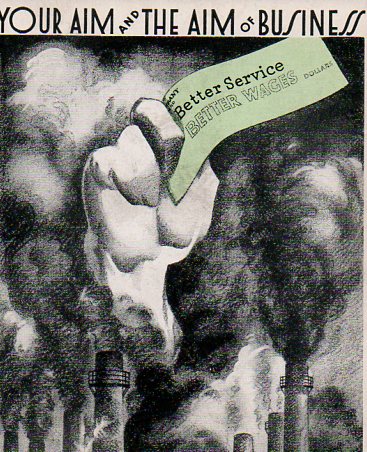
    A is for AIM to keep workers happy and profit happier

    Biz alphabet--a007

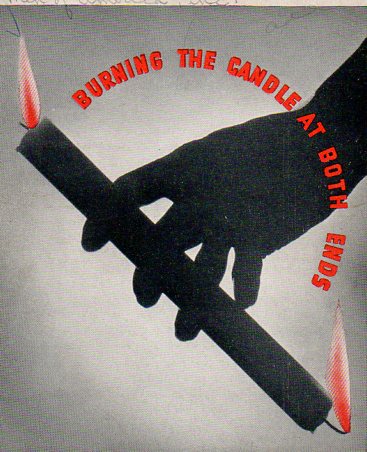
    B is for BURN and hoping for a better-built candle

    Biz alphabet--b008

    C is for CAPITALIST, an exclamation point in a land of question marks

    Biz alphabet--c010


  • Children, Artillery and the Geometry of Cannon Fire

    JF Ptak Science Books  Post 1366

    Cannons ha003

    There were many integral components to firing a cannon on a ship, not the least of which were the Powder Boys, the small, young, semi-strong kids who would run the gunpowder from a below-decks armory to whatever gun deck was needed.  It was a relatively simple procedure, filling up a longish tube (cannon  derived from the Italian  cannone–or large tube–which came from the Latin canna from the Greek  kannē , meaning something like a reed or any similar hollow thing) with gunpowder and then cannonball/shot and then wad, then causing the gunpowder/propellant to ignite and throw the ball.  Basically, that was it, though you needed to maintain the cannon, aim it, and so on (don’t forget to first swab the bore from unexploded gunpowder so you don’t blow things up!).

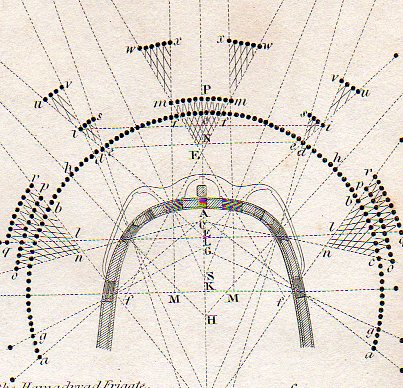
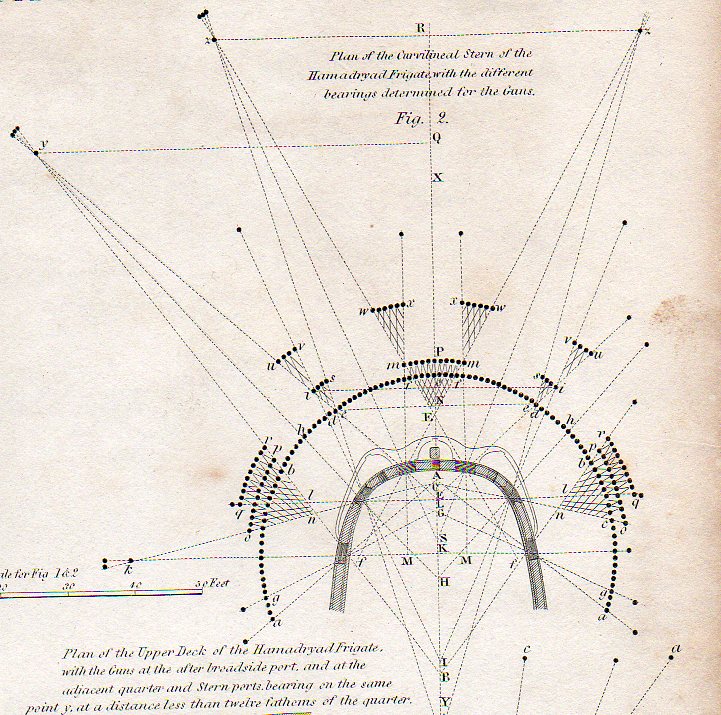
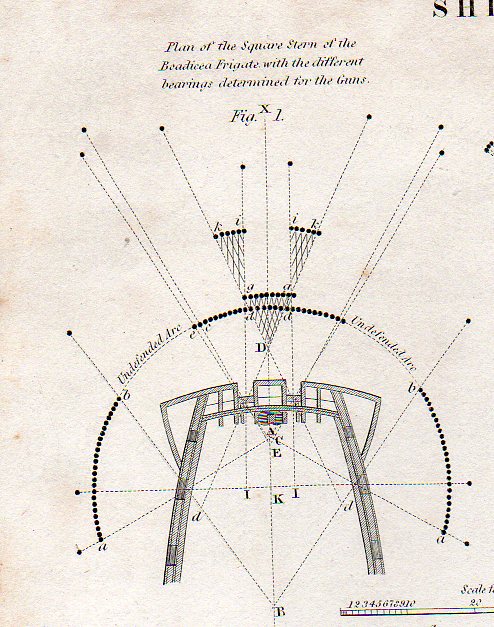
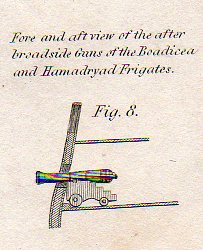
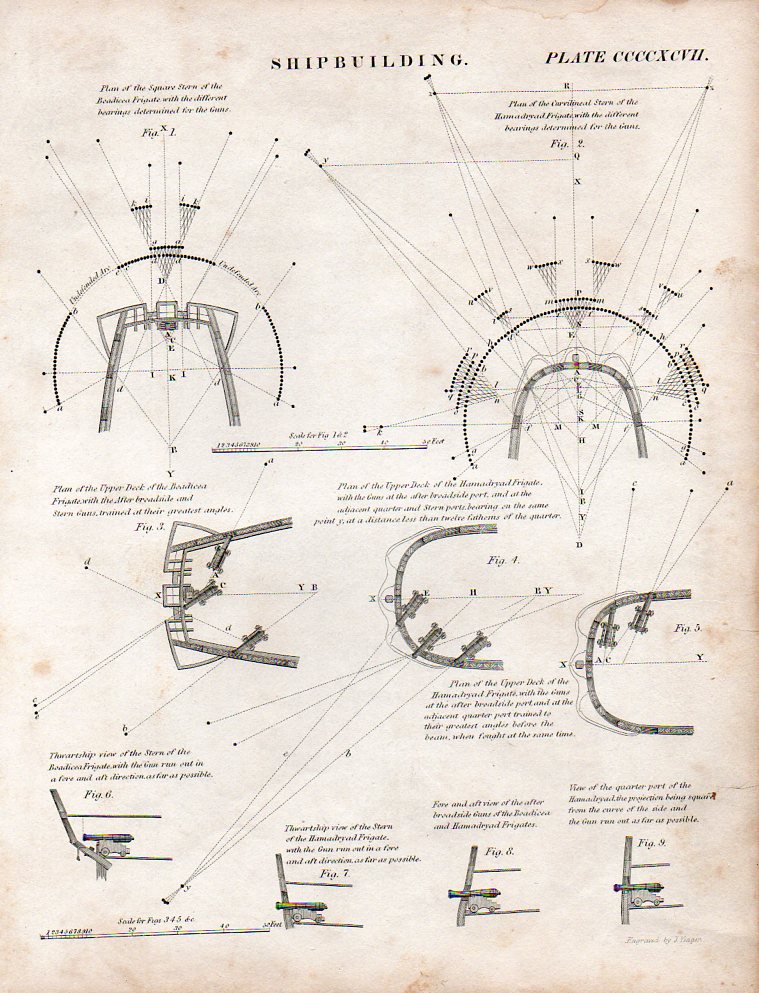
    The (first)  image above of found modernist/semi-dadaist artwork comes form 1812 and was found in Rees’1 Encyclopedic Dictionary from the article on “Shipbuilidng”   and illustrates the ways in which the stern of a ship can be outfitted with cannons–actually, the sterns of the HMS Bodiceae (28 18-pounders)  and HMS Hamadryad  (36 guns). Also by this time cannons had been carried on naval ships for nearly four hundred years, while the first cannons appeared on the ground in Europe another few hundred years before that. 

    Cannons ha002


    In the third detail (below) we see the coverage of the four cannons placed in the stern of the Bodicae, mainly pointing out its weaknesses, showing the undefended arc, which comprises about 1/3, or about 60 degrees of the defensive posture.  The Hamadryad on the other hand shows 100% coverage of the 180+ degrees of attack possibilities shown, along wioth secondary and teriary areas of fire coverage covered by mor ethan one gun.

    Cannons b004

    A fine,tiny detail from the full engraved sheet:

    Cannons little005 And the full sheet, available at our blog bookstore:

      Cannons001

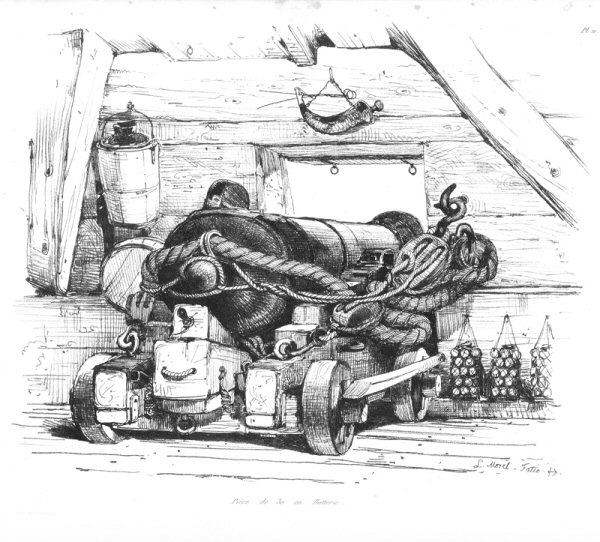
    This is pretty much all that was needed to fire a cannon, except the men of course.

    File:Antoine Morel-Fatio pl10.jpg

    NOTES:

    1.   I’ve written about before here, just enter “Rees” in the google box and there will be a dozen or so other posts.