A Daily History of Holes, Dots, Lines, Science, History, Math, Physics, Art, the Unintentional Absurd, Architecture, Maps, Data Visualization, Blank and Missing Things, and so on. |1.6 million words, 7500 images, 4.9 million hits| Press & appearances in The Times, Le Figaro, Mensa, The Economist, The Guardian, Discovery News, Slate, Le Monde, Sci American Blogs, Le Pont, and many other places… 5000+ total posts since 2008.

Author: JF Ptak

  • Outsider Logic Department: Earth Clocks, Ocean Spigots, and Mystery Exhausts

    JF Ptak Science Books LLC  Post 597

    Several years ago I purchased a very large collection of pamphlets of the Library of Congress.  It was all housed in 2400 blue document boxes, all the document boxes were labeled and neatly ordered.  The problem was that the classification scheme really didn’t relate to one thing in particular, and the judgment which set one pamphlet in a box wasn’t the same through and through—the alphabetization could have related to author or title or region or keyword or publisher.  In short, each box was an adventure—and a lovely, bizarre one at that.
    Blog--april 27-bizarre earth clock

    It may be a unique one, too.  The one thing that really did hold this thing together as a collection was that the vast majority of the pamphlets were not located in any other libraries in any part of the world.  Now for many of them it was probably okay for the work to slip into a bliblio-singularity, but for thousands and thousands of others, it was a good save.

    And here’s the larger rub:  as I classified and segregated the pamphlets into the “normal” areas of interest, I also started a pile of good-god-what-is-it pamphlets. The GGWII material was extraordinary—some had fantastic covers (and which many times was the most interesting thing about the publication), some had extreme titles, some had ludicrous subject matter, and some were just, well, bizarre.  As the GGWII pile grew into the low thousands, I started to box them for a rainy day project, because I frankly didn’t want to deal with them.  Some of the pamphlets’ covers/subject/title were rather mundane, pedestrian things when they were originally published; however, the high-winded sands of time ripped the flesh from this commonness, making them somewhat unapproachable, unknowable, and incredible–this group was called The Naïve Surreal .   A subset of this group are works that were not approachable and enveloped by their own unique needs from the day they were born; pamphlets made of the stuff of incomplete dreams and adventurous vocabulary—the Outsider Logic group. 

    The Naïve Surreal has all manner of representatives:  pamphlets with just question marks or exclamation points as the title, or histories of unknown things, or beginning with “The Story of ______ “ [mud/zippers/a stone/a bubble/etc].  You get the picture.  The Outsider Logic pamphlets are really very difficult to categorize—perhaps that is their unintended  job.

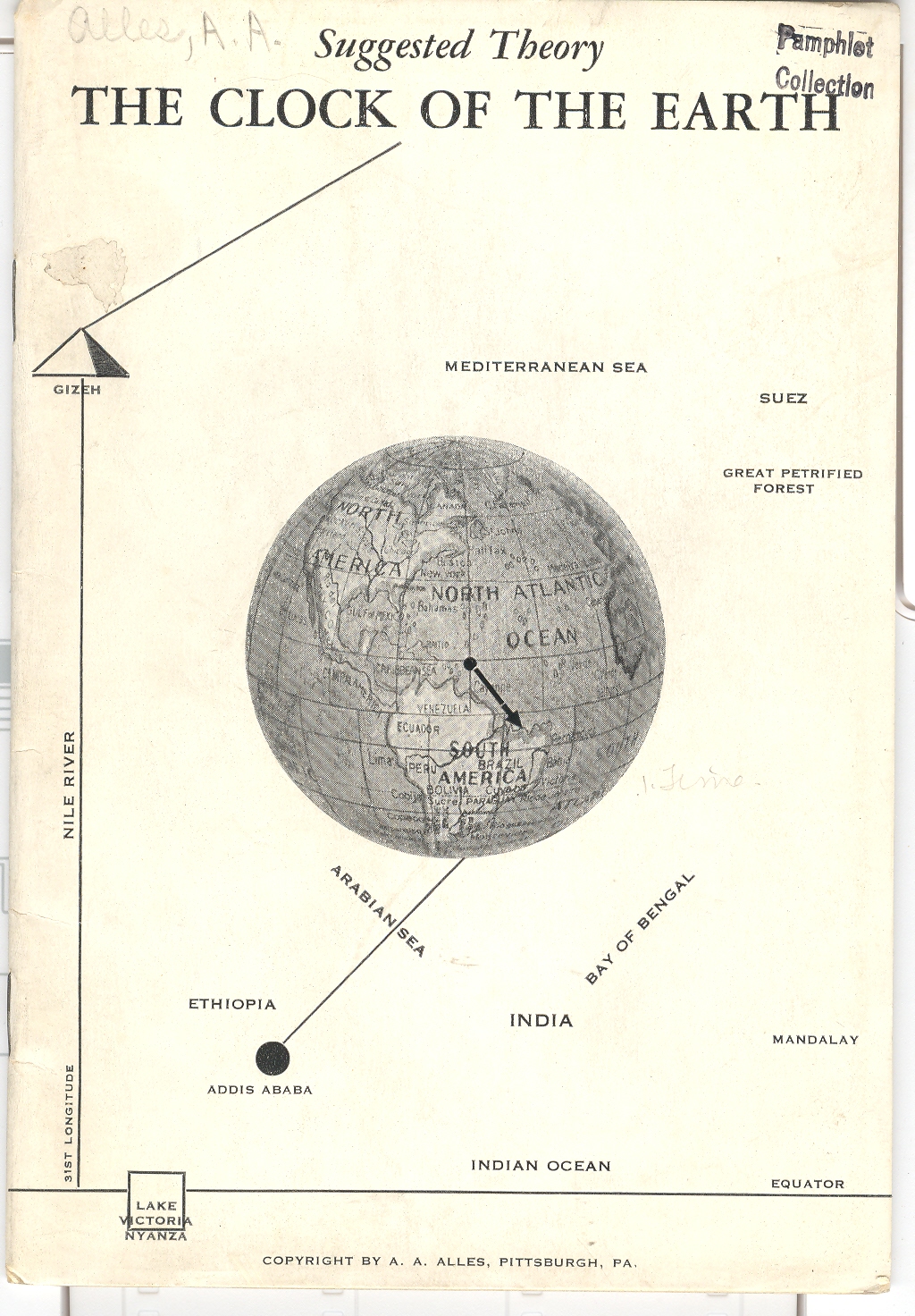
    Today’s emergent beauty from the Outsider Logic collection is .A. Alles Suggest theory The Clock of the Earth, printed in Pug, Pa., in 1935.  This pamphlet is only 18 pages long but I just couldn’t read it.

    Here’s why:  the first sentence reads:

    “The Clock of the Earth represents strange matter from inner-stellar space collected and compounded at the equator which accurately controls the revolutions of the seasons…”

    It goes on but I just can’t type it out.  Sometimes there is a benefit to reading the Outsider Logic pamphlets, and sometimes the benefit is knowing the cover.

    Mr. Alles’ cover is striking and deeply inscrutable, as you can see.  Somehow there is a system for the hour hand there at the equator, but it is mainly a secret, even though it is explained.  Why the geographic locations are printed in the white space surrounding the earth and connected to Addis Ababa, the Nile, Gizeh and the Great Petrified Forest and placed the way they are and connected to the equator clock will have to stand as art rather than explanation.

    Most of the time superior, deeply-removed art like this cover is disappointed by the textual counterpart.  Mr. Alles may not disappoint with his writing, though.  He ends the book beginning the last paragraph with this:

    “Four thousand years ago the open spigot on the equator at longitude thirty-one degrees east of Greenwich , flowing directly to the pyramids in Gizeh…. “ Then there’s something about “exhaust flow”.  Again, as I said, I just can’t penetrate this work.  I’m happy enough with the art, forever open to interpretation.

  • The Anatomy of Comparison Department: HMS Ships Firing On London, 1909

    JF Ptak Science Books LLC  Post 596    Blog Bookstore

    HMS Ships Firing On  London,
    1909, Old vs. New  Comparing Shipboard
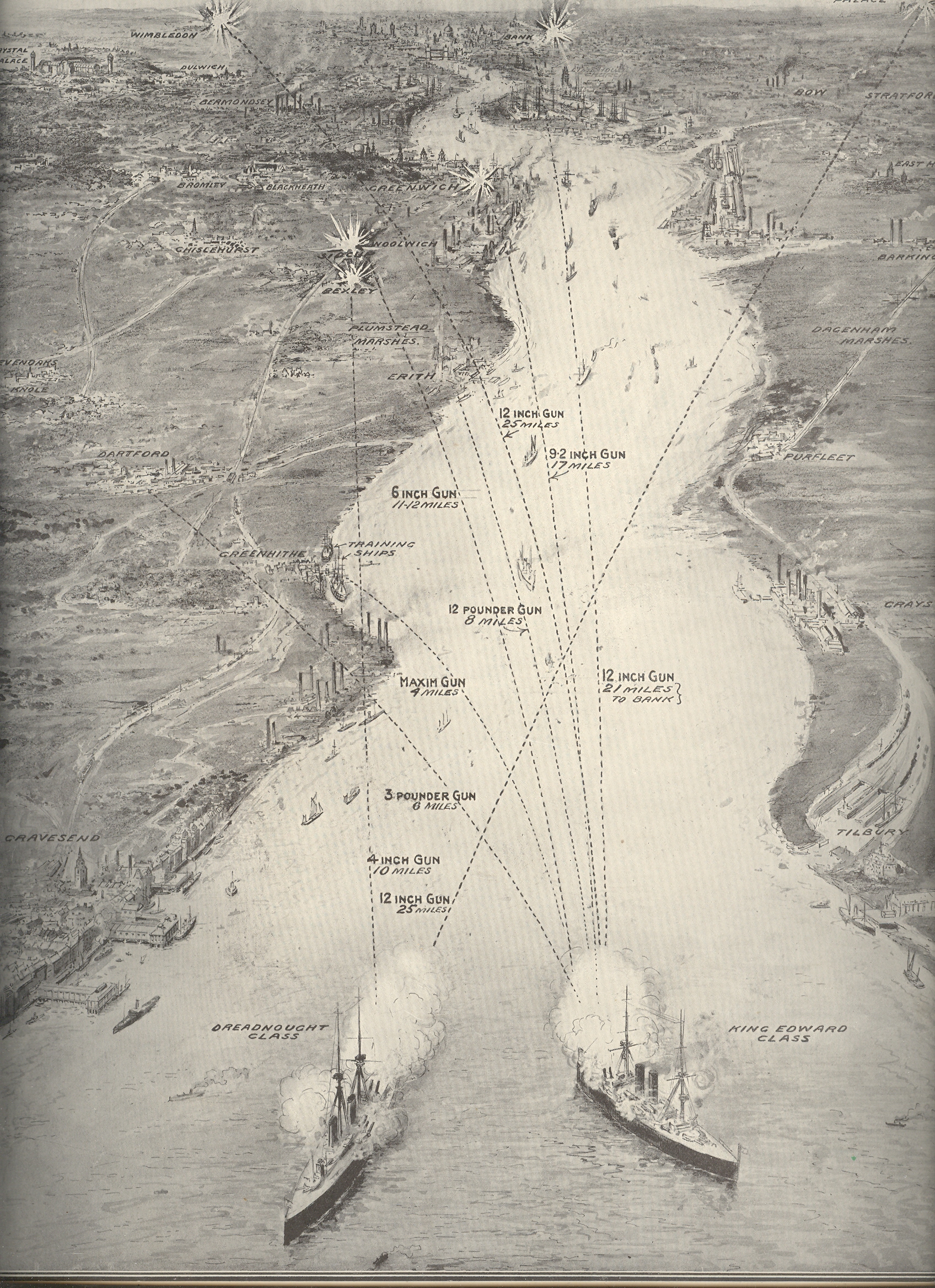
    Firepower:  a Compelling Comparative Graphic Display from the Illustrated London News for 24 July 1909

    Blog--april 26--london bombed Without looking at the sub-title and explanation of this of this print (“Firing
    from Thames Mouth to the Edge of Greater
    London”) its purpose might be a fair mystery, given the ships and the targets
    and all. The two large ships at bottom are a Dreadnaught Class battleship and a
    (smaller) King Edward Class ship, and, yes, they are firing towards London—but they
    are doing so to illustrate a point on modern weaponry and the vast, new
    superiorities of British advances in the death/protection arts.

    In June 1667 during the Second Anglo-Dutch War the British were set upon by
    an running attack by the Dutch Admiral Michiel de Ruyter, who had advanced as
    far up and into the coast as the mouth of the Thames.  The Dutch advance up the Thames was repulsed,
    though their secondary targets (so to speak) at Gravesend
    and the River Medway proved a scorching defeat for the British, and propelled
    the rocky war to a quick peace favorable to the Dutch. 

    This image shows what could’ve been the results of that engagement at
    Gravesend had the Dutch fleet been outfitted with the HMS’ new 12-inch guns—de Ruyter
    would’ve been able to reach the outskirts of London from that position, and
    could’ve b=done so from a distance of 25 miles or so. Of course the artist and
    editor aren’t really suggesting a “what if” scenario to the course of events of
    the Second Dutch War—they were merely creating a very compelling, highly
    illustrative comparison from old to new firepower, and to perhaps quite some fears
    about the strength of the Navy as the unstable and rickety international system
    limped its way into WWI, just five years in the future. 


  • A Proficiency of Insult: a Biting Poem on the Medical Profession, 1736

    JF Ptak Science Books LLC   Post 595   Blog Bookstore

    “For even they who compose
    treatises of medicine or natural philosophy in  verse are denominated poets…” Aristotle’s Poetics
    [Translated by Thomas Twining, New
    York 1957]

    Skeleton Edward Baynard (1641-1719) of  London must have been a pinchy/gouty 
    physician.  Or not.  Perhaps he was an overdressed, deeply-dimpled
    fop.  Or perhaps he was skinnily
    invisible, a plain, vanishing custard of a man, scrupulously clean and who
    saved all money, deeply in love with his chambermaid, sleeping on a mattress of
    gold. 

    But what he
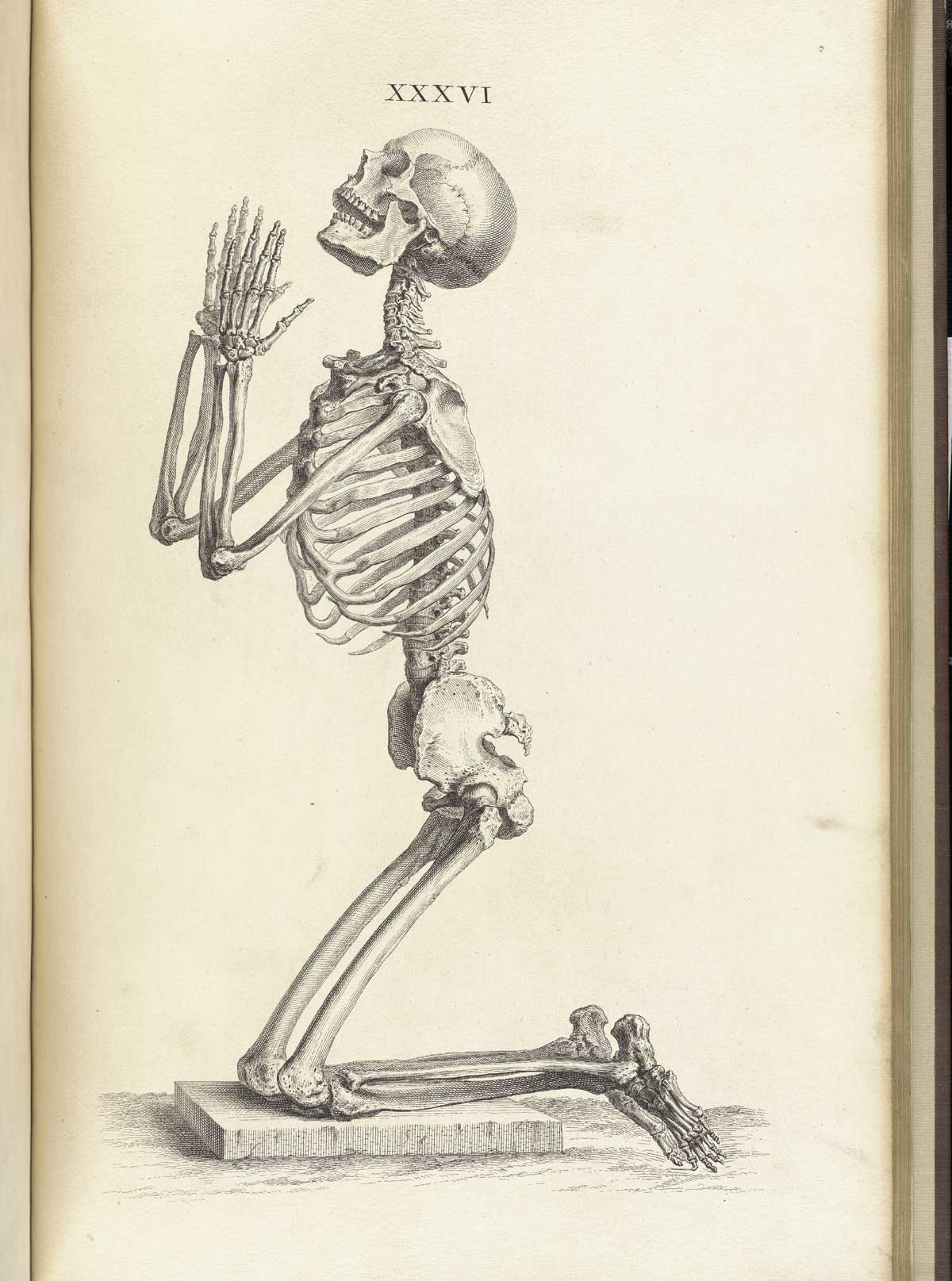
    was a definite cynic, occasionally cranky to his own reaching profession.  His poem, Health, a Poem, Shewing How to Procure,
    Preserve and Restore
    It, was a best-selling book, reaching at least
    ten editions during his lifetime.   It evidently contained a number of frugal
    dispensations on achieving health, most of which involved  purging. Or sweating.  Or vomiting. 
    Such was the state of the art, much like our own when viewed from the
    year 2109.  (I overheard a conversation
    this morning in a hot dusty field, a physician saying that we would never simply
    ingest a plil that would render us a new liver. 
    Well.  How would the
    contemporaries of the newly discovered X-Ray have viewed the peek into the
    future of the “discovery” of DNA in 1953, only 59 years later?  And what about the enormous difference in the
    state of medicine and imaging capacities in the 56 years since then?  Phenomenal. 
    It would be nearly impossible to say what developments in medicine await
    the grandkids in their late years?  Or in
    300 years?  Hypo-livers in
    Dixie  cups, I say.)

    Returning
    to Dr. Baynard—he summarized the ten most important words and concepts in
    medicine in the second  poem of his book, as follows.  He held little in
    reserve.

    “For some
    of the ten are always advised:

    Piss,
    spew and spit

    Perspiration
    and sweat

    Purge,
    bleed and blister

    Issues
    and clyster

    These few
    enunciations

    Cure all
    the doctor’s patients

    If
    rightly applied

    By a wise
    physic guide”

    Indeed. 

    [“Clyster” is
    an enema;  “an  ‘issue’ refers to
    the Galenic practice of creating an infection at some designated spot on
    the body because of the belief that some kind of ‘sympathy’ between the illness
    and the localized pool of pus would draw the illness out of the body”. ]

    ·Posted by :

    ·in:

    —

  • Strange Things in the Sky Department: the Alchemical Cosmology, 1618

    JF Ptak Science Books LLC  Post 594       Blog Bookstore

    Well.  There’s a simple ton of complexity going on in this difficult, famous print by the
    great Mathias Merian—its like a moving puzzle to me, complicated by the
    virtually changing size of its pieces.  There’s
    just too much in it that I don’t understand, too much archaeo-religico-alchemical
    bubbly going on for me to make much deep sense of it all.  I do like that it is all coming from the sky,
    though, which is why I’ve selected it for this continuing series

    BLOG--THINGS IN THE SKY--MYLIOUS  

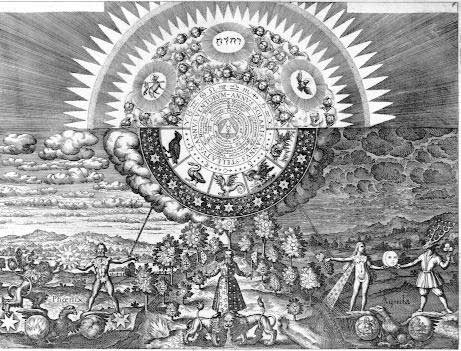
    The engraving, Tabula Smaradina (“Emerald Tablet”) is
    Merian’s interpretation of the alchemical cosmology, a  schemata and representation of the order of
    things.  It appears (first) in Johann
    Daniel Mylius Tractatus III Seu Basilica Philosophica… (1618) and makes
    subsequent appearances in other works by the author, as well as in Lukas Jennis’
    Musaeum Hermeticum (1625, see below). 

    Basically, the Emerald Tablet shows the opening of a
    complex heaven and the delivering of the philosopher’s stone to the earth.  It is a magnificent effort and no doubt has a
    great power to alchemists, and I can understand only a bit and a piece here and
    there.  For example, in the bottom right,
    we see a couple of people holding a((n) eclipsed?) Moon, standing on the wings
    of an eagle which protects a double hemispheric representation of the
    constellations.  The figure on the right
    is a naked woman, who may well represent Luna:  her right breast is a star, and from her
    armpit is a streaming torrent of stars which comes close into contact with
    shrubs labeled with the astrological signs of the planets.  The cluster of grapes in her right hand and
    the stream that she is straddling must indicate a generation, or a birth, or
    rebirth, or time, or the universe.  Luna
    is connected via something to the heaven-element which in turn is connected on
    the left sign of the print to a man holding a sun, who I guess must be Sol.  Heaven and Earth, Brother Sun and Sister
    Moon, and so on.  From here it all gets
    away from me, no that it isn’t gone already. 
     

    ·Posted by :

    ·in:

    — —

  • An Unusual View: Looking into the Past and the Future–St. Quentin, 1917

      JF Ptak Science Books LLC  Post 593       Blog Bookstore

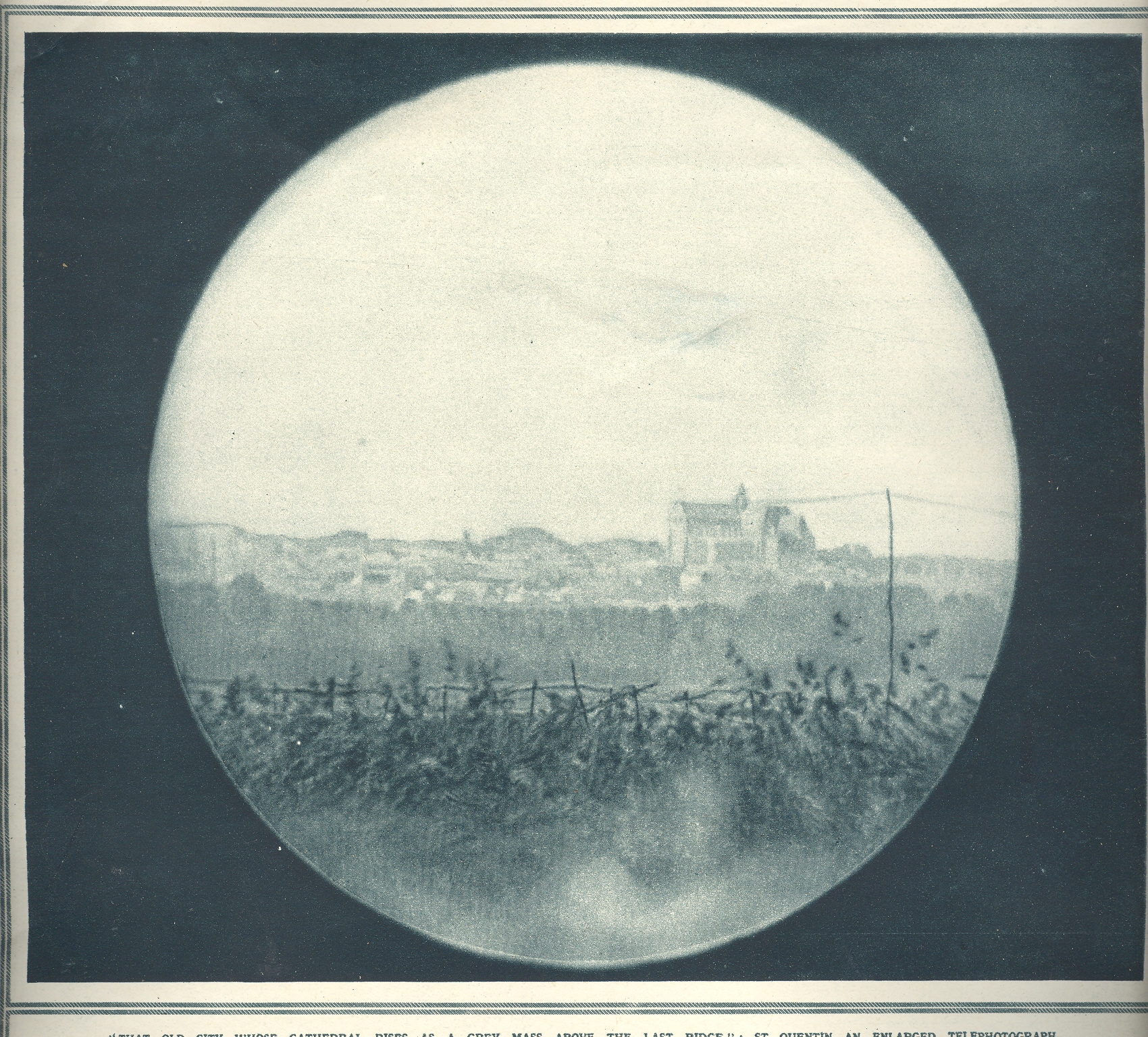
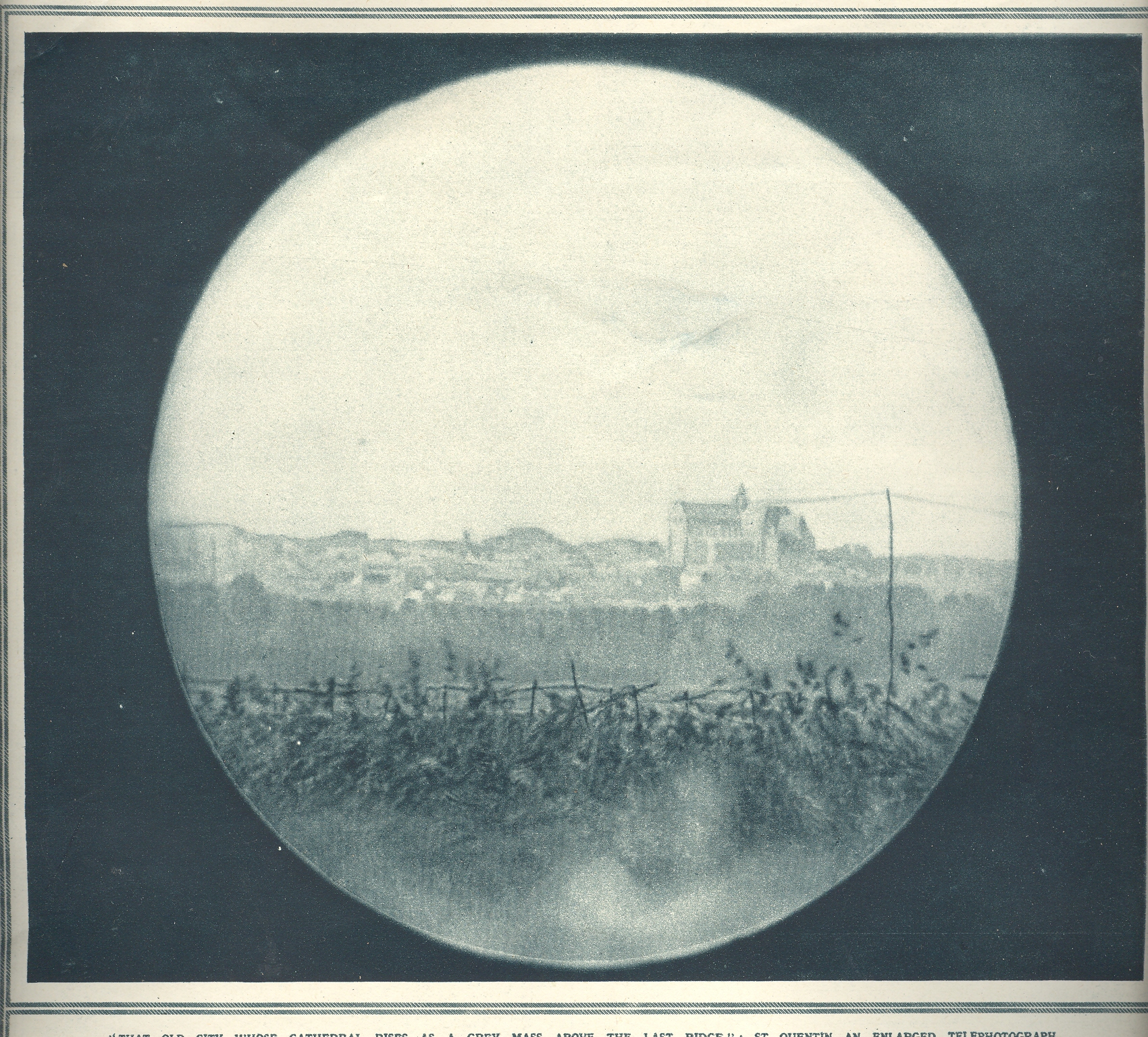
    Blog--WWI--st. quentin This lovely, seemingly antique daguerreian view is what the American Expeditionary Force (AEF) commander General JJ Pershing saw at the front lines of St. Quentin in July 1917.  The U.S. had entered the war, finally, on April 2 1917, nearly three years after the war began, landing in France 13  June 1917 and entering almost immediately into battle at Chateau-Thierry.  On 2 July Pershing estimated that the U.S. would need a million fighting men; the day that this photo was published in The Illustrated London News, he revised that estimate to three million.  The view he was seeing here was more than of a town about to be pounded by thousands of artillery shells–the magazine was sharing a view of what the European and Empire countries had been seeing for 31 months, and what the Americans would now be sharing for another 17 months. 

    Blog--WWI--st. quentin det
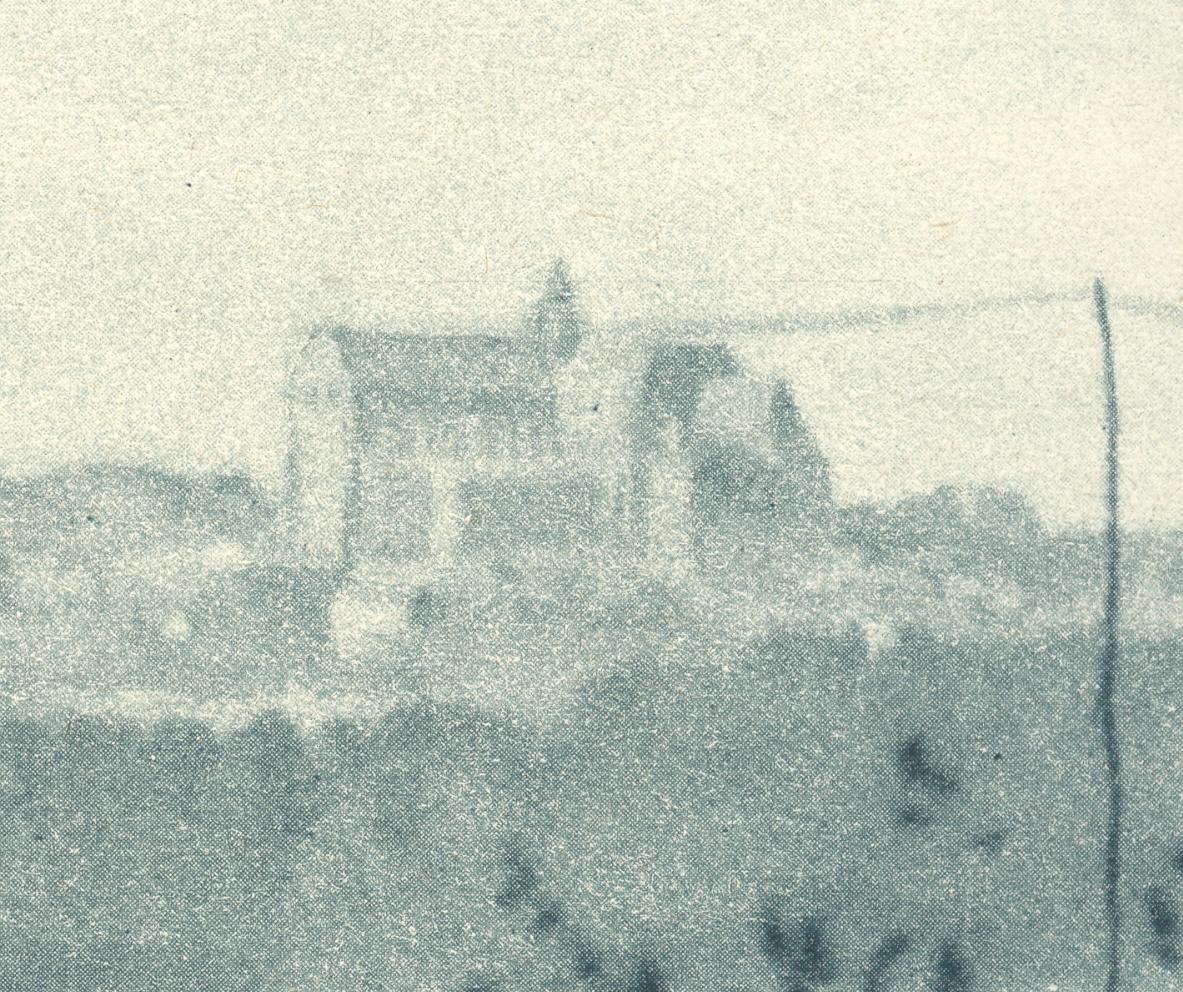
    It is a beautiful and deadly view, seen through French field binoculars at the tip of the front for the battle.  The large building to the right is the town’s Gothic cathedral/collegiate masterpiece:  it was old and large, with a 370-foot-long and 130-foot-high nave.  It was a highpoint for that part of France, and was the burying place for St. Quentin and St. Victorious–their graves would be covered by the rubble of the cathedral’s collapsed roof very soon after this picture was taken.  The building was shelled and burned all night long–the French blaming the Germans and vice versa. 

    If Pershing had really good sight he might’ve been able to see the 116,000 American soldiers wIraHayesArlingtonho would be killed in battle, though I suspect he had a pretty good idea of what was to come, thinking as he did that he need 3 million soldiers.  To be utterly fair I don’t think that he could’ve possibly  seen in his imagination  what 9 million dead soldiers looked like, or what 16 million dead soldiers and civilians looked like, or what 37 million dead and wound soldiers and civilians looked like, all the casualties of this war, all done in 4 years. 

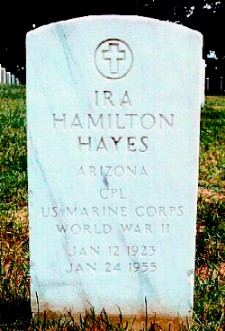
    I’ve found it odd in a way that I’ve not really been able to explain that Pershing is buried so very close to Ira Hamilton Hayes at Arlington.  I used to leave a good twig on Jackson’s headstone on Memorial Day, and then get that unusual, uncomfortable emotion on seeing the large Pershing monument just a few hundred feet away. 


  • Things Out Of Place Department: Ledoux’s Architecture of Multiple Planets

    JF Ptak Science Books LLC   Post 592              Blog Bookstore

    A Cosmology Seeded in Salt?

    It  is, I admit, mere imagination; but how often is imagination the mother of truth?–Sherlock Holmes

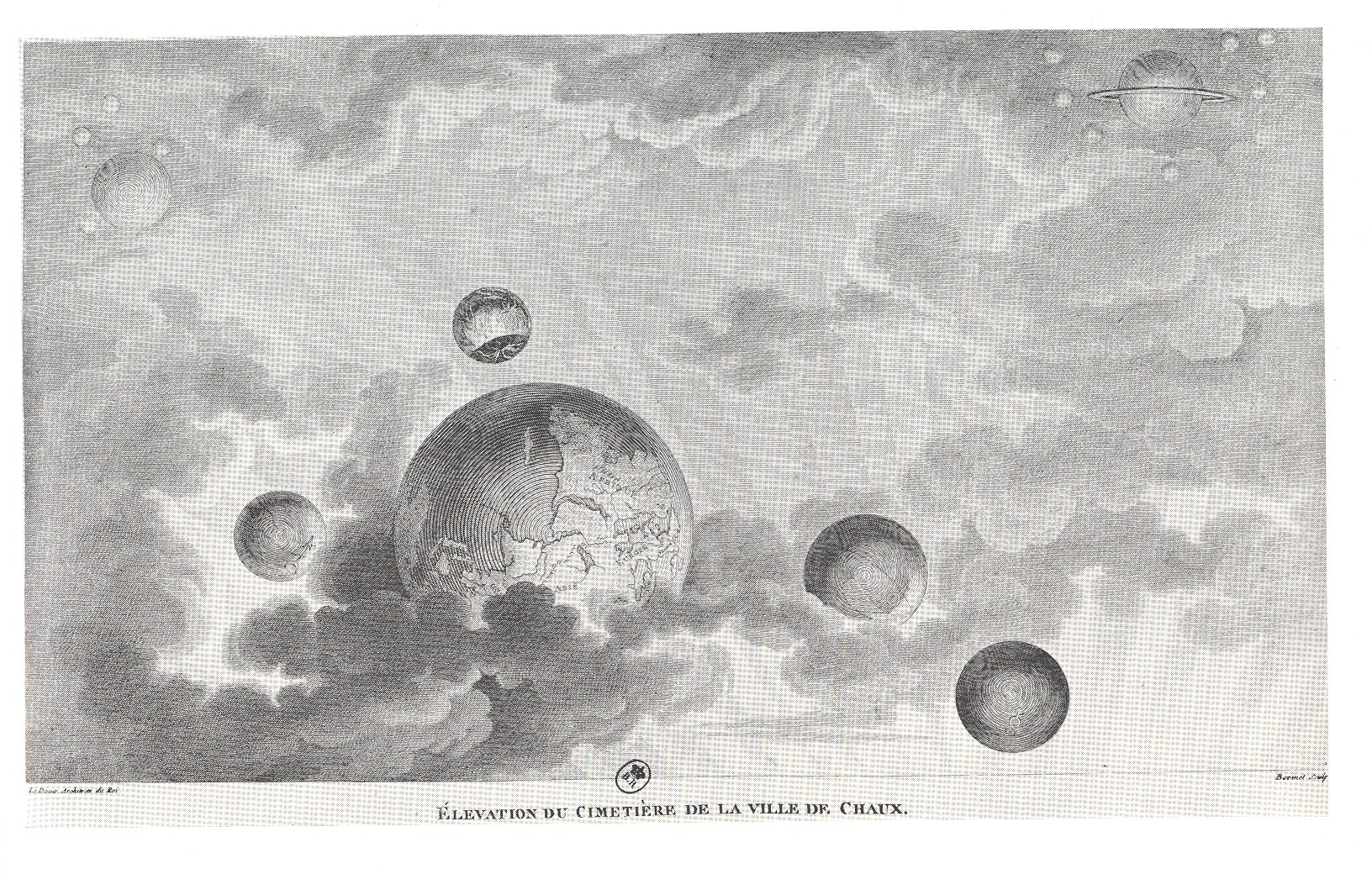
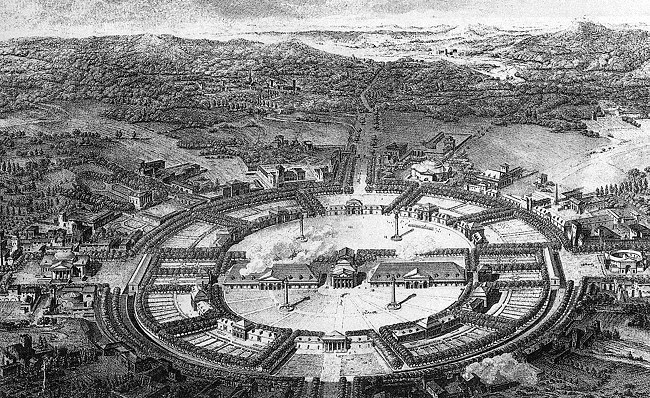
    I’ve written a little earlier in this blog about the beautiful Claude-Nicolas-Ledoux  (1736 —1806) being the 18th century Marcel Duchamp (or vice versa).  I was struck by this image by the master–a depiction of the Earth nestled in clouds amongst other  planets in exceptionally close proximity.  There was evidently very little explanation to go along with this idea, except that it was inspired by his utopian plan for the saltworks of the factory-village at Chaux. On the face of it there seems to be no physical connection between the two–it must be the philosophical connection that Ledoux was thinking about.  From my point of view the idea for the city of Chaux was of course idealistic, perfect, communal, with a vast sense of fairness and correctness, and of great sensibility.  It was a “gathering of brothers” as Ledoux wrote, a city of lodges of workers, gathered together for mutual profit.

    Blog--sphere--boullee

    Perhaps this vision of cushioned planets was a larger expression by Ledoux of heavenly gratuity?

    Anthony Vidler points out (in his book The Writing of the Walls) that Ledoux described his utopian Chaux as a “galaxy of…utopian forms” (page 101).  Since Ledoux also described the architect as the “delegate of the Creator”, perhaps he reverse-engineered a cosmology describing a mutually beneficial community of planets from a community of brotherhood gathered around the (admittedly important in 1780) production of salt. 

    Blog--ledoux--chaux

    Or perhaps not–this may just be way to simple and, well, just wrong.

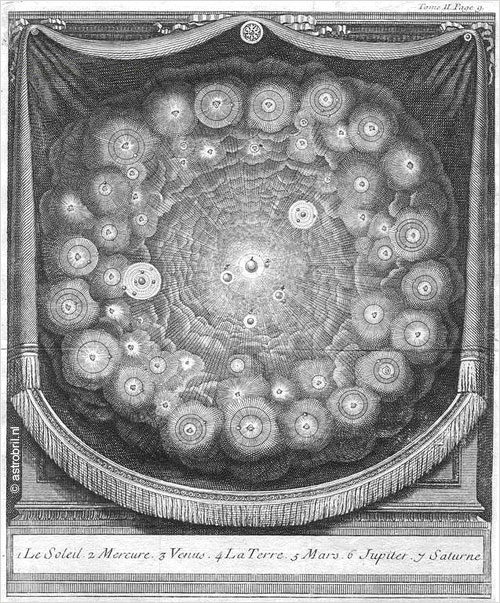
    Blog--plurality of world fontenelle NOTE:  I do just want to point out here (and discuss at another
    time) that Ledoux was by no means the first to describe multiple-world
    systems.  One of the prettiest of the earlier attempts, for example,
    belongs to Bernard le Bovier de Fontenelle who published this
    delightful rendition of an extra solar-systemic galaxy in 1682 in his Entretriens sur la pluralite des mondes.  This
    sort of thinking was somewhat well-established by the time Ledoux
    offered his idea around the time of the turn of the 18th century.  

    Should we not come to the rescue of a cosmic phenomenon  trying to reveal itself in a sea of errors?  Peter van  de Kamp (1983)


    For a beautiful romp, have a look at Ledoux’s L’Architecture considérée sous le rapport de l’art, des mœurs et de la législatio. I’ve included a short list of projects (with links) in the expanded reading section below. 


  • The Dot and the Sphere—the Depiction of Multiple Dimensions

    JF Ptak Scinece Books LLC  Post 591       Blog Bookstore

    The
    History of Dots, Part 10
    .

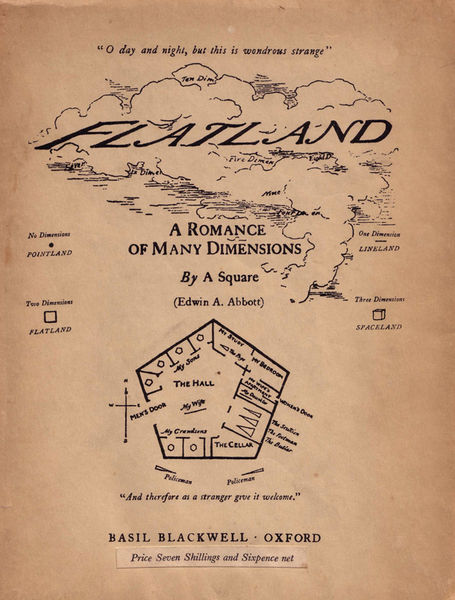
    Edwin
    Abbott’s slender Flatland is perhaps one of the best books ever written on
    perception and dimensions, a beautifully insightful book that was quick and
    sharp, and in spite of all that was also a best-seller.  Written in 1884 when Abbott was 46 (Abbott
    would live another 46 years and enjoy the book’s popular reception), it introduces
    the reader to a two dimensional world with a social structure in which the more
    sides of your object equals power and esteem. 
    Thus the lowest class would be a triangle (three sides) while the
    highest (priestly) class would be mega-polygons whose shape would approach a
    circle.  Abbott’s magistry comes in
    explaining to the three-dimensional reader what it was like to be in a
    two-dimensional world.Flatland_cover

    And
    to this world one day came an epochal event.

    It
    was a dot.  The dot was a magnificent new
    thing to the 2-D world, and what happened was this—it grew concentrically and
    outwardly, expanding and then contracting in a series of circles, morphing
    until it appeared as an entirely new and revolutionary form rising from the
    plane of Flatland.   It became a sphere.

    The
    sphere was from Spaceland and amazed the population of Flatland (Lineland,
    actually); the story was (and the book’s title page saying it was written by) a
    Square, whose deep interest was immediately enhanced by its great imagination.  It turns out that once every millennium the
    good folks of Spaceland visit Flatland to return one its  inhabitants home to try and introduce them,
    educate them, to the idea of added dimensions. 
    Safely in Spaceland,   the Square was presented with the radical
    newness of the third dimension, it engaged the Sphere about the possibilities
    of yet higher (fourth, fifth and sixth) dimensions.  The Sphere was not altogether please—talk of
    higher dimensions in the3-D world was outlawed just as the discussion of the
    3-D world was in Flatland.  Pissed, the
    Sphere returns the Square home to its land of lines. 

    The
    Square finds it very difficult to be home again. (Did I ever mention here that
    my house is about a thousand feet away from Thomas Wolfe’s grave?) It finds it
    a very tough go to convince anyone of its journey and the existence of another
    dimension.  To complicate things further,
    Abbott has the Square dream a remarkable thing—a visit to Pointland, a totally
    self-involved dimension consisting of one ruler, a Point, which exists across
    all area and things.  Even Square’s
    introduction of an idea or question comes to the Ruler of Pointland as an idea
    from its own head, because nothing and no one else exists.  Fantastic!

    Eventually,
    things go badly for the Square—the edict is described making it illegal for any
    further discussion of the third dimension, with dire consequences on a sliding
    scale according to class./caste/sides, with death the penalty for the
    Triangle.  The Square itself winds up in
    prison, an unhappy being locked “in” a cell and prohibited in its mind. 

    Jouffret

    But
    Abbott is certainly successful in relating the possibilities of
    higher-dimension thought by introducing the view from a higher- to a
    lower-dimension.  Still, it’s a tough
    go. 

    19
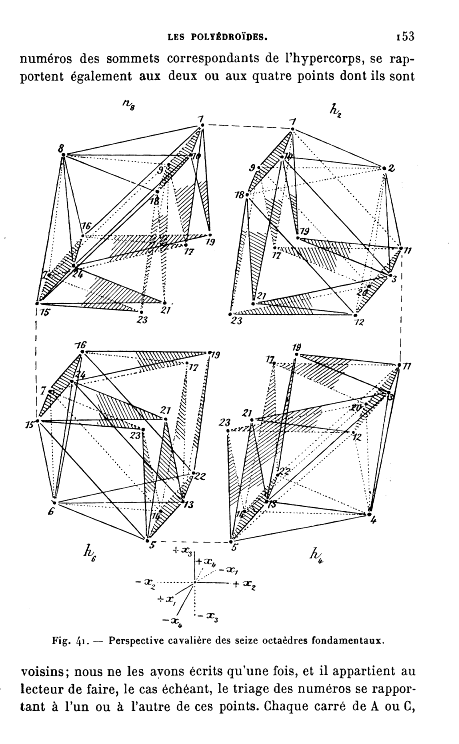
    years later dots came to further assistance to a mathematician and military man
    named Esprit Pascal Jouffret*, who wrote a remarkable and beautiful geometry
    book on picturing the fourth

    dimension. 
    Actually, the book was more an example of how to discus the representation
    of the fourth dimension on a piece of paper, and didn’t’ offer a comprehensive  treatise on the matter.  But the images of depicting space and time
    would look extraordinarily familiar in just a decade in the paintings of the
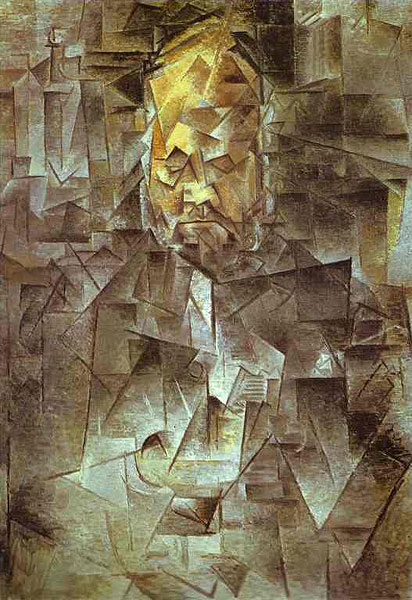
    Cubists.  For example, the morally-lonely
    Picasso’s 1910 portrait of the movement-molding art dealer Ambroise Vollard looks
    very much like many of the images in the Jouffret book.  Marcel Duchamp—for me the true

    Picasso_vollard1910


    hero of early
    modernism—also drew on the work of Jouffret, and made no secrets about the path
    of his intellectual foundation (unlike the squirrely Picasso). 

    And
    so from the lowly dot comes a beauty unsuspected in soliphismy Pointland. 


  • “Enemy Aliens” and the Invisible Japanese, 1941

    JF Ptak Science Books LLC   Post 590    Blog Bookstore
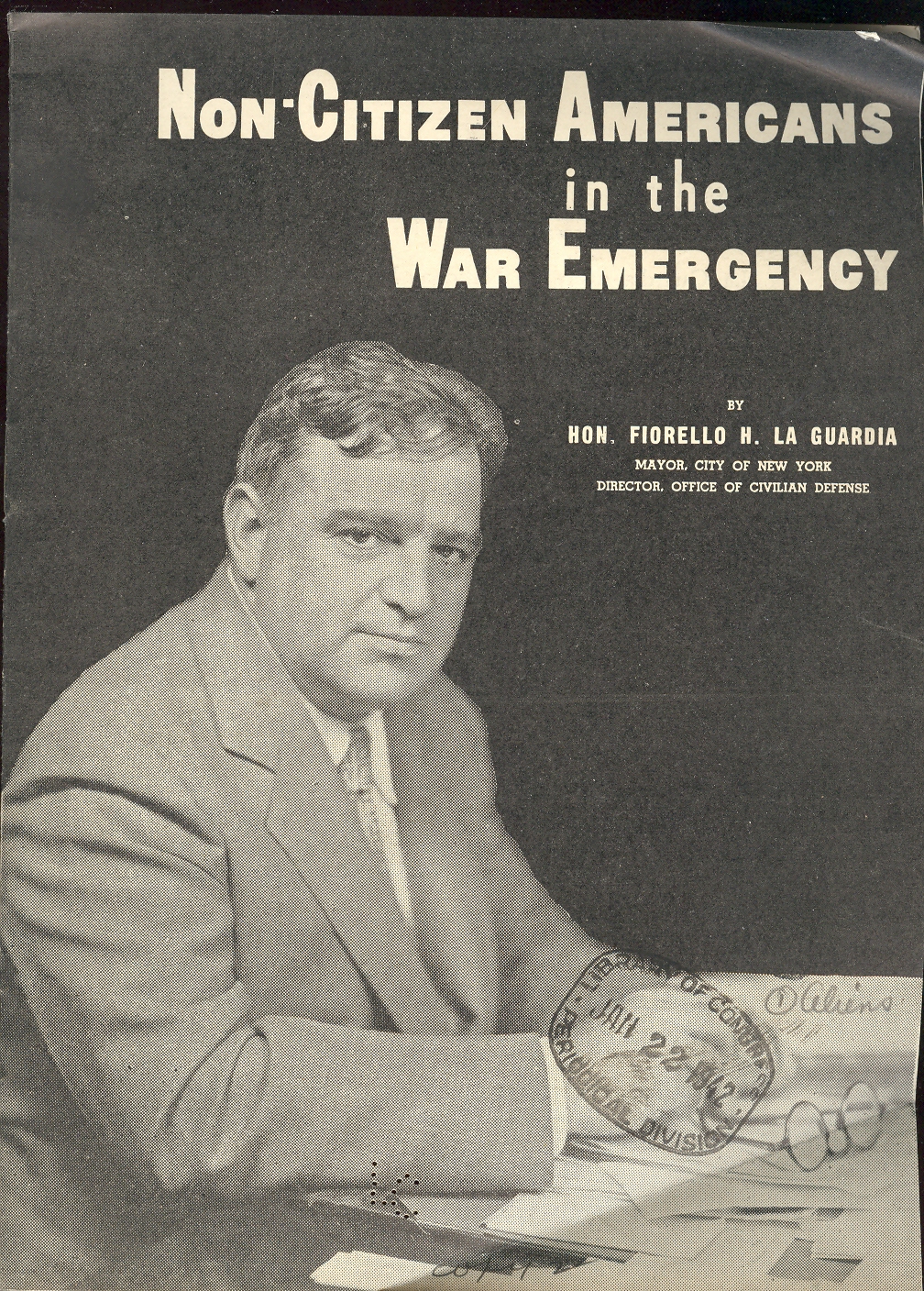
    Blog--laguardia
    The Little Flower was publicly coming to grips with “enemy aliens” in this small pamphlet, published in the last days of December 1941.  Laguardia–a Republican Congressman defeated for re-election in the Roosevelt landslide of 1932 and elected Mayor of NYC in 1933–was an outspoken critic of the Nazis and Hitler from his first day in Gracie Mansion.  In addition to being the first Italian-American elected to the U.S. Congress, Laguardia was also Jewish, and was a superb and constant speaker* against the monster in Germany. 

    In this pamphlet Laguardia outlined the legal implications of war and the non-citizen  German or Italian immigrant, and possibilities and consequences of their being declared enemy aliens, resulting in “arrest” and detainment.  (This applied to all “…natives, citizens, denizens or subjects…” of any foreign
    nation or government with which the United States is at war, and who could be “…
    liable to be apprehended, restrained, secured and removed as alien
    enemies….”.)  Attorney General Francis M. Biddle cited Department of Justice figures: “Of the 1,100,000 (sic) enemy aliens in the United States, 92,000 were Japanese, 315,000 were German, and 695,000 were Italian. In all, 2,972 had been arrested and held, mostly Japanese and Germans. Only 231 Italians had been arrested**”  (by 1943).  By the end of the war, there were fewer than 3,000 Germans and Italians who had been impounded (the Italians being released by October 1943 following Italy’s surrender). 

    There were upwards of 100,000 Japanese-Americans impounded, half of whom were American citizens.  For some reason there was not a single mention of the Japanese population in this pamphlet. 

    *In 1933, the year of Hitler’s major seating, Laguardia said: “Part of [Hitler’s] program is the complete
    annihilation of the Jews in Germany”, an uncommon and of course prescient point of view.

    **This authority was based on Executive Order 9066 (issued February 19, 1942) and Executive Order 9102 (issued March 18, 1942). These orders authorized the “removal from designated areas of persons whose removal is necessary in the interests of national security”.

    ·Posted by :

    ·in:

    —

  • When Bad Ideas Were “Good”: Just Say “No” to Fighting Fascists, 1938

    JF Ptak Science Books LLC  Post 589    Blog Bookstore

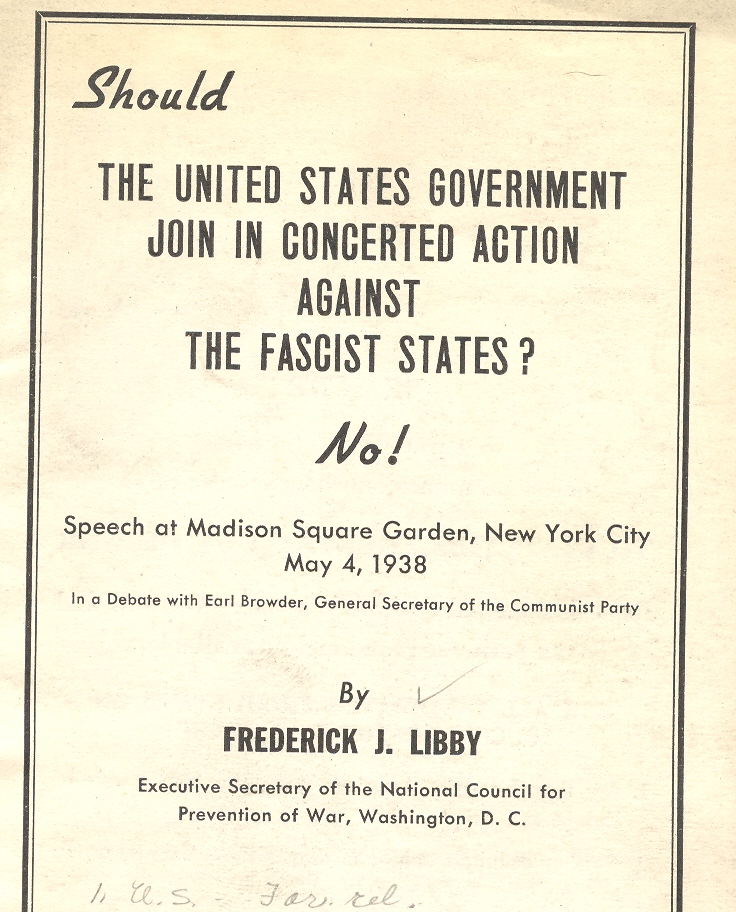
    Blog--fascist Sometimes the screaming done in pamphlet titles like this example are odd and outrageous and entertainingly naive and are often taken out of context.  This one isn’t.  It isn’t odd and it isn’t entertaining and it isn’t naive (at least in the outsider sense).  It is the effort of Frederick J. Libby (1874-1970) to convince Americans that it was against their morality and their best interest to engage in any war to stop fascist aggression in Europe or Japan.  The world was well on its way to total war–Japan had already been savaging China for five years at this point and Europe was sinking into the Styx.  (Just two months before Libby’s May 4th speech Hitler “annexed” Austria and in April had signed a pact with Franco. In the short months following the speech Hitler would mobilize the German army, sign the Munich agreement with the failed Chamberlain, occupy the Sudetenland, and initiate Krystal Nacht.)  The speech was given at Madison Square Garden, which in another years would see have an audience of 20,000 supporting the German American Bund, one of the limp pro-Nazi organizations which sought an anxious fifth-column foothold in the U.S.) 

    The biographical bits I’ve found on Libby support him as a a decent pacifist.  His National Council for Prevention of War–which hosted his speech at the Garden–was evidently his great achievement, though his subject matter was not.  Now it isn’t as though there was a spearhead movement to get the suffering U.S. involved in European activities in 1938–and remember it took 27 months  after the invasion of Poland to get the U.S. into WWII, and that took a massive attack by a non-European entity.  So Libby’s “No!” was really playing to the strengths of the majority.  The U.S. was still in the grip of the Depression–and had just suffered another fresh setback in that year–so there wasn’t much public concerted support for stopping the very visible spread of Fascism around the world.  So as eyebrow-raising as his immodest title might seem, it did reflect the answer that most people in the U.S would have given to that question in the spring of 1938.

    ·Posted by :

    ·in:

    —

  • Unfinished, Blank and Empty: Durer, Gaudi, Schubert, Mozart, West, Stuart

    JF Ptak Science Books LLC  Post 588       Blog Bookstore

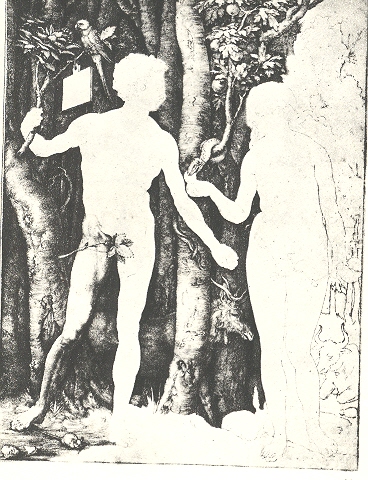
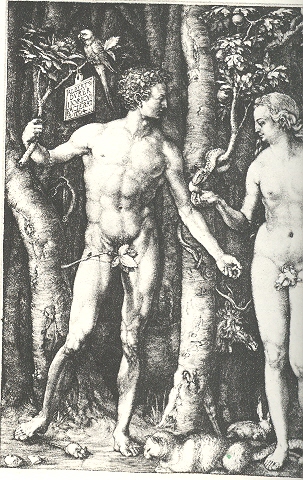
    Unfinished in some ways is part of something that is not there, part of the missing, the blank, the empty.  One aspect of this calling to emptiness is seen in this semi-completed, semi-empty trial proof version of Albrecht Durer’s intaglio Adam and Eve (1504) , the finished and full state of which is seen below.  The unfinished bit is easier to see but hard to find, sometimes.  Leonardo comes to mind several times:  the magnificent Sforza equestrian statue and St. Jerome Praying in the Wilderness come to mind, as with his Study for the Adoration of the Magi.  Gilbert Stuart’s ultra-famous mostly-finished portrait of George Washington wound up in thousands of schoolrooms across the United States as well as—cropped—one the one dollar bill. Nearly-as-famous Benjamin West left unfinished another icon of revolutionary American history, the American Peace conference, half of the historical figures faded unfinished into history.

    There are some things that are unfinished but really aren’t so:  say, for example the not-endable Ulysses, complete and incomplete in its circularity.  Mozart’s Requiem, a piece of music that helped drive the poor man to his death, was unfinished though completed by another hand.  Blog--blank durer 001

    There are unfinished examples of architecture bounding into the urban landscape, fantastic examples of extraordinary things.  The great Schloss Neuschwanstein, the empty and unfinished dream of the “mad” and mysteriously murdered King Ludwig of Bavaria, is certainly one.  This building ironically seems for me more compelling, filled far more than Uncle Walt’s doppelganger in Orlando.  The greatest structure of the Drippingly Baroque is another unfinished masterpiece, the work of Gaudi in Barcelona, the Sagarda Familia.  Started in the 19th century and stopped with Gaudi’s death in 1926, the Sagarda’s forest of towers was only 15% complete—the city is still at work on it, with 40% more to go.  

    We could look at these images while listening to audio examples of the unfinished:  the tidied-up requiem of Mozart, Schubert’s unfinished 8th Symphony, and Mahler’s unfinished 10th  come to mind.

    There are spectacular monuments to unfinished business: American Federal treaties with Native Americans (almost all of which were signed, documented and not enforced; empty, blank, broken); the assurances to the millions still waiting for some verifiable change in the townships of South Africa; promises of decent wages and health coverage for the marginalized “partners” of oblivious behemoth  monsterstores. [I can think of one major player whose corporate name spelled backwards relates to railroading the law, driving that point home to employees, suppliers and patrons.  “Tram Law.”] A history of unfinished business would be massive, and then, once you got to the end, all you’d be doing would be driving a Ford Pinto off the end of an unfinished bridge.
    Some things that looked sort-of finished are later revealed to be not so:  Einstein’s Unfinished Symphony of relativity (titled so in Listening to the Sounds of Space-Time  by Marcia Bartusiak) is one. Mathematics—all of mathematics—also comes to mind, the great edifice nearly “completed” by Hilbert until one of his famous questions got answered by Goedel, and then all became unfinished again.  One day everything seemed filled-up; the next, well, it wasn’t.