A Daily History of Holes, Dots, Lines, Science, History, Math, Physics, Art, the Unintentional Absurd, Architecture, Maps, Data Visualization, Blank and Missing Things, and so on. |1.6 million words, 7500 images, 4.9 million hits| Press & appearances in The Times, Le Figaro, Mensa, The Economist, The Guardian, Discovery News, Slate, Le Monde, Sci American Blogs, Le Pont, and many other places… 5000+ total posts since 2008.

Author: JF Ptak

  • The Invention of Small Things and the Coming of the Internet–Back to the Flea

    JF Ptak Science Books LLC  Post 615  Blog Bookstore

    “A network of such [computers],
    connected to one another by wide-band communication lines [which provided] the
    functions of present-day libraries together with anticipated advances in
    informationstorage and retrieval and [other] symbiotic functions.” —J.C.R. Licklider, 
    his epochal “Man-Computer Symbiosis”, 1960

    There is a famous
    and most likely apocryphal story made famous in Stephen Hawking’s A Brief History of Time where a famous
    “scientist” (I‘ve heard him described as James Jeans, for one and the nicest
    fit, others say Bertrand Russell though it matters not) is confronted by a
    member of his audience during a lecture on astronomy/cosmology.  A woman rises and confronts the speaker,
    determining that what has come to pass as fact regarding the universe is all
    rubbish, and that the Earth was in fact a flat object resting on the back of a
    turtle.  The speaker then asks her what
    the turtle is standing on; she replies immediately of course that it is another
    turtle, and that it is “turtles all the way down”.  It’s a nice story, and bears some resemblance
    to Native American stories of the Earth born on the back of a turtle, of the
    Hindu legend of the Earth being borne by an elephant standing on the back of a
    tortoise, and so on, all the way down. 
    Even Dr. Seuss’ Yertle the Turtle
    can make an appearance in this one.
    1875large

    This came to mind
    thinking about the contribution of (the not-entirely forgotten) John Benjamin
    Dancer (1812-1887) to photography and its relation to the history of the
    Internet.  Dancer was in the immediate
    second wave of the greats of photography following the short first wave of
    Niepce and Talbot and Daguerre, and did come up with a number of very good
    ideas at the birth of photography—one of them in theory is an early foundation
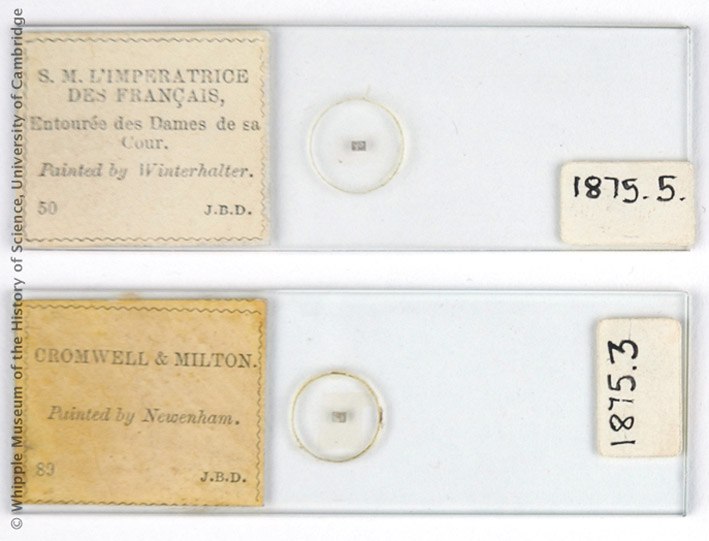
    stone for the technical distribution of data and information.(These two slides are  examples of Dancer’s work and are reproduced from the Whipple Museum of the History of Science, Cambridge.)

    Dancer evidently
    went to work immediately after reading of Daguerre’s 1839 process.  The technical aspects of the Daguerre effort
    were les daunting than they were messy—he found the descriptions “crude and obscure”,
    and proceeded with his own series of experiments, producing a camera some six
    weeks later.  It is interesting too that
    he seemed to have based the camera on a camera obscura:  “being a practical optician the camera was
    one of my own construction, such as I had frequently supplied to artists for
    tracing the outline of views in the camera….”

    He lectured later
    in that same year (1839), showing lantern slides of his accomplishments to
    crowds of up to 1500 people.  His great
    accomplishment was in the field of microphotography—I should say rather that he
    invented the field.  And it is of great
    interest that the first images that he made using the brand new invention of
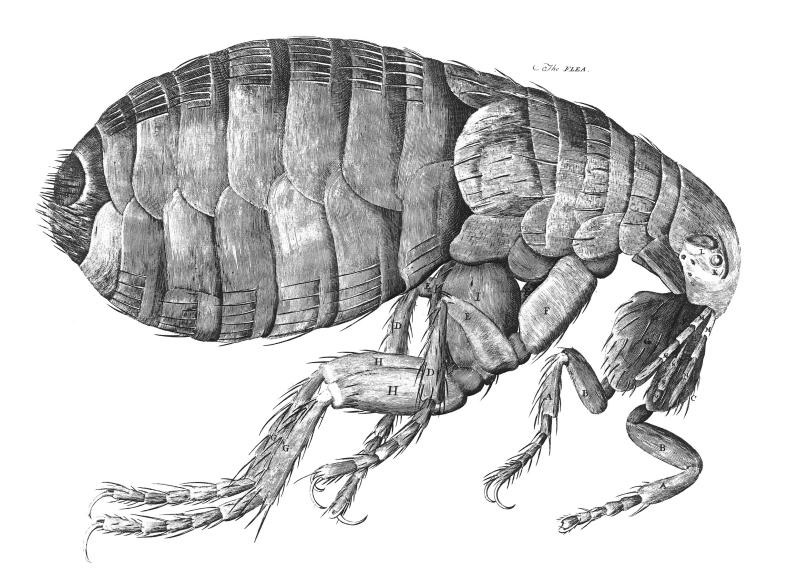
    the camera coupled with a microscope was that of a flea.  In yesterday’s post I wrote about Robert
    Hooke’s Micrographia and his spectacular discovery of the fineness and detail
    of biological specks like the flea, showing audiences—the world—for the first
    time that these insignificant creatures represented an entirely new,
    just-discovered world, and that they were as tremendously well-developed as any
    other large living thing.  Back to the
    flea, as it were, went Dancer—I have no idea whether he knew he was calling on
    Hooke’s iconic image or not.  But it is
    at least a lovely coincidence.

    Dancer also
    displayed images of documents that he reduced by a scale of 1/160, printing a
    fully-legible copy of a printed document that was only 3mm tall.  The significance of this invention seems to
    have been lost until it was picked up again in 1853 by the great John Herschel,
    who recognized the process as a way to archive significant documents.

     I like it more for its possible impact,
    perhaps, on some of the thinking on the construction of a world-wide
    distribution of knowledge, as a necessary step to get to the stage where
    Vannevar Bush—who was widely acknowledged as being the grandfather of the
    internet at a MIT Conference about a 20 years ago—could theorize about his own
    precursor to the internet–the Memex,
    describing it for the popular audience in the Atlantic Monthly in June*, 1945. 
      Among many other things,
    Bush—who was also, probably, one of the great figures of WWII for his heroic
    role in leading the U.S. scientific and technical war effort and seeming to
    make the correct decisions all of the time—foresaw a means of distributing
    data, more or less instantly, calling on the delivery of microfilmed
    information. Bush, who was also a great engineer and father of one of the
    countries best analog computers (in 1931/33), had the notion for a world wide
    technical distribution of knowledge, but, as he wrote this in 1945 (!), could
    not see far enough into the future development of the digital computer (the
    ENIAC just being born at that time, though it must be pointed out that Bush was
    open to the idea of magnetic storage). 
    His ideas were very far reaching, touching on microminiaturization and
    artificial intelligence, and his ideas even now aren’t so much coyly science
    fiction as they are, well, implemented. 
    There’s a lot of Bush’s memex that are in place today

    So, the turtles and
    wondering about Dancer’s influence in the string of inventions and discoveries
    that gave birth to the www: how far down do these influences go?  The touchstone for the creation of the internet
    is usually seen as being with JCR Licklider (see quote above) in 1960, or with
    Paul Baran or Leonard Kleinrock a year later; but perhaps it is earlier still with
    the implementation of ARPA (set into place immediately after the launch of Sputnik).  Of course none of this is possible without
    computers, so you could work your way back through time to the transistor, to
    Bush, to the Stibitz (Bell)Relay Computer, to Johnny von Neumann, to the thermionic tube (Bush), and then
    all of the support discoveries and inventions that rolled into these, and so
    on.  Back to photography, back to Babbage’s
    plans for his analytical engine, back to the invention of moveable type, to the
    invention of paper, to the creation of libraries, to the general idea of the
    popular distribution of knowledge.  All the
    way down.  But I do think it worthwhile
    to think of Dancer’s contribution in so far as it allowed people to think of
    easier, quicker ways of moving around vast amounts of data and
    information.  And that I think is worth
    remembering. 

    *I’ve also got to
    say that at the same time Bush was writing about the future of intelligence he
    was also at work developing the U.S.  response to the upcoming race in atomic weapons.  He and his team were busy crafting responses
    and policies and the reaction of the Soviets and the sharing of the atomic bomb
    data and all of that, and all before the test at
    Alamogordo. Really, the guy was spectacular.


  • The History of Dots Part 9: the Cell and Robert Hooke

    JF Ptak Science Books Post 614   Blog Bookstore

    This is another in a continuing series of posts on the History of Dots.  Let’s face it:  dots are the alpha and the omega of our existence, from the imaginary point in space; to the great dots in the sky seen by the ancients for thousands of years before their vastness and complexities were revealed with the invention of the telescope (and etc.); to the fantastic smallness of “dots” whose organization was revealed through the invention of the microscope; to the atomic and sub-atomic world, right to the very point of singularity. The dot is a big deal. 


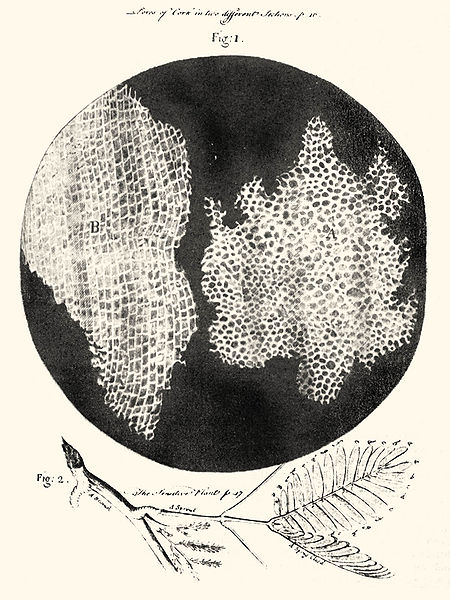
    May 15 hooke cork

    Had there been no Newton every school child would know the name of Robert Hooke (1635-1703) in its place—he was polymathic, totally energized, big-thinking non-sleeping experimentalist and theoretician who worked across numerous disciplines (physics and astronomy, to chemistry, biology, and geology, to naval technology), not the least of which was architecture (having helped Christopher Wren in the design of the new St. Paul’s).  He was an enormous figure who was also never below a fight or argument, and whose grasp of his own very considerable accomplishments never seemed to be limited by what he had actually done. Some people lay the blame for Hooke’s obscurity upon Newton’s great and tireless vindictiveness against Hooke, but that’s by far from the whole story of Hooke’s troublesome personal legacy.  Not only is his portrait not on the coin of the realm nor hanging everywhere in the halls of academia, but there is no known surviving portrait of the man.  He didn’t come close to Newton’s enormity, not really, but in the absence of  Jupiter and Saturn even the Earth starts to look a little bit big.among the rest of the planets.

    One of the very big things that he did was to become the first person to observe “cells”—the “dots” of concern in this post.  After reading Antonie van Leeuwenhoek’s* (1632 – 1723) work  Hooke had made (by Mr. Cock) a version of the L’s microscope, reproduced some of the observations, and then set out on his own.  The slice of cork pictured here was the first time anyone had seen such things as cells, Hooke believing them to transmit the essentials of the plant.

    In “Observation XVIII” of the Micrographia, he wrote: “. . . I could exceedingly plainly perceive it to be all perforated and porous, much like a Honey-comb, but that the pores of it were not regular. . . . these pores, or cells, . . . were indeed the first microscopical pores I ever saw, and perhaps, that were ever seen, for I had not met with any Writer or Person, that had made any mention of them before this. . . “

    Flea

    The 28-year old Hooke published the results in a gorgeous and revolutionary book, Micrographia, in 1665, which became an instant best seller and highly praised and valued. (Samuel Pepys, perhaps among the shiniest stars whose imprimatur was like a royal blessing, said the book (was)“the most ingenious book that I ever read in my life.”) There is no telling what the people of the mid-17th century thought of seeing such incredible discoveries in the little semi-invisible stuff that made up their normal, daily lives.  The only thing that somewhat equates to this would be if the first images of the Hubble were those of Earth-bound objects whose detail had previously been unknown.  Hooke’s observations and drawings of things like the common flea were just an astonishment—that such a creature of “low order” could have such intricate detail and design was a complete revelation.  The drawings of the fly’s eye, too, was an inescapable wonder, an incredible object to consider as having any detail pre-microscope, and then revealed to have unimaginable design and elegance. 

    May 15 van Ls microscope


    *Leeuwenhoek’s major contributions came in the form of letters to the Royal Society.  He operated in his own cellular world, if you will, not having been schooled in languages outside of his own native Dutch or receive any real formal education in the sciences at the university level.  He labored mostly alone save for his great correspondence. For example, in a letter of September 7, 1674, Leeuwenhoek described observations on lake water, including an excellent description of the green charophyte alga Spirogyra: “Passing just lately over this lake, . . . and examining this water next day, I found floating therein divers earthy particles, and some green streaks, spirally wound serpent-wise, and orderly arranged, after the manner of the copper or tin worms, which distillers use to cool their liquors as they distil over. The whole circumference of each of these streaks was about the thickness of a hair of one’s head. . . all consisted of very small green globules joined together: and there were very many small green globules as well.” 

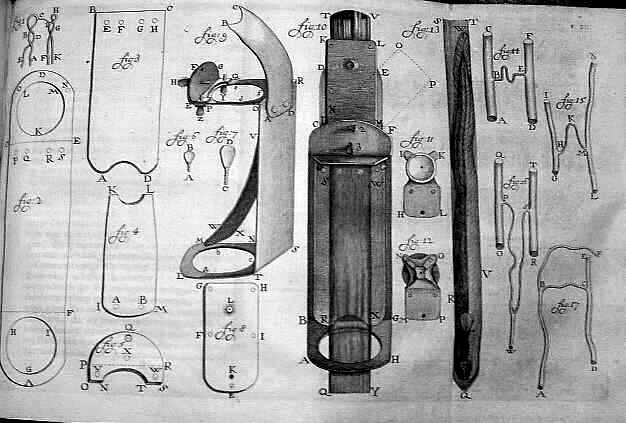
    The image above is  an engraving of one of Leeuwnhoek’s later microscopes–in  the history of his work, Leeuwenhoeck made something like 500 scopes, with powers varying from 50-500x. 


  • Where Was Disgust and Horror in Italian Renaissance Painting?

    JF Ptak Science Books  Post 613  Blog Bookstore

    St. john


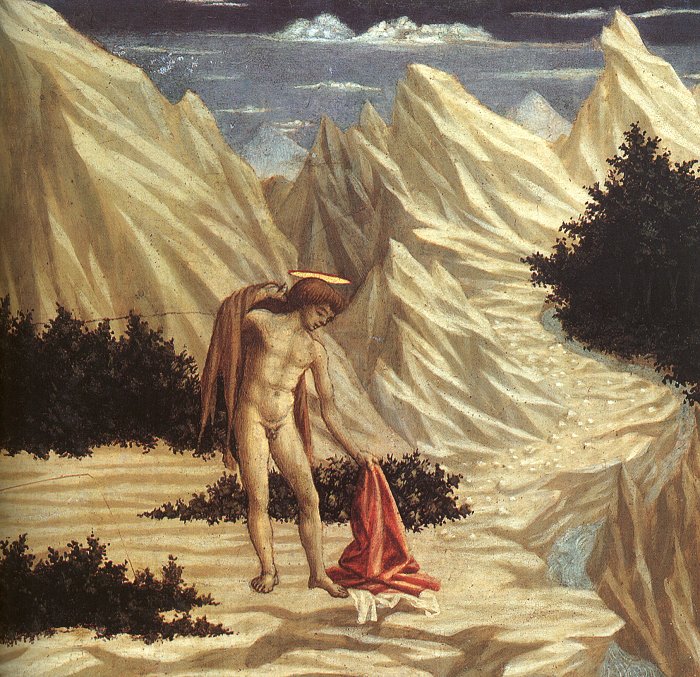
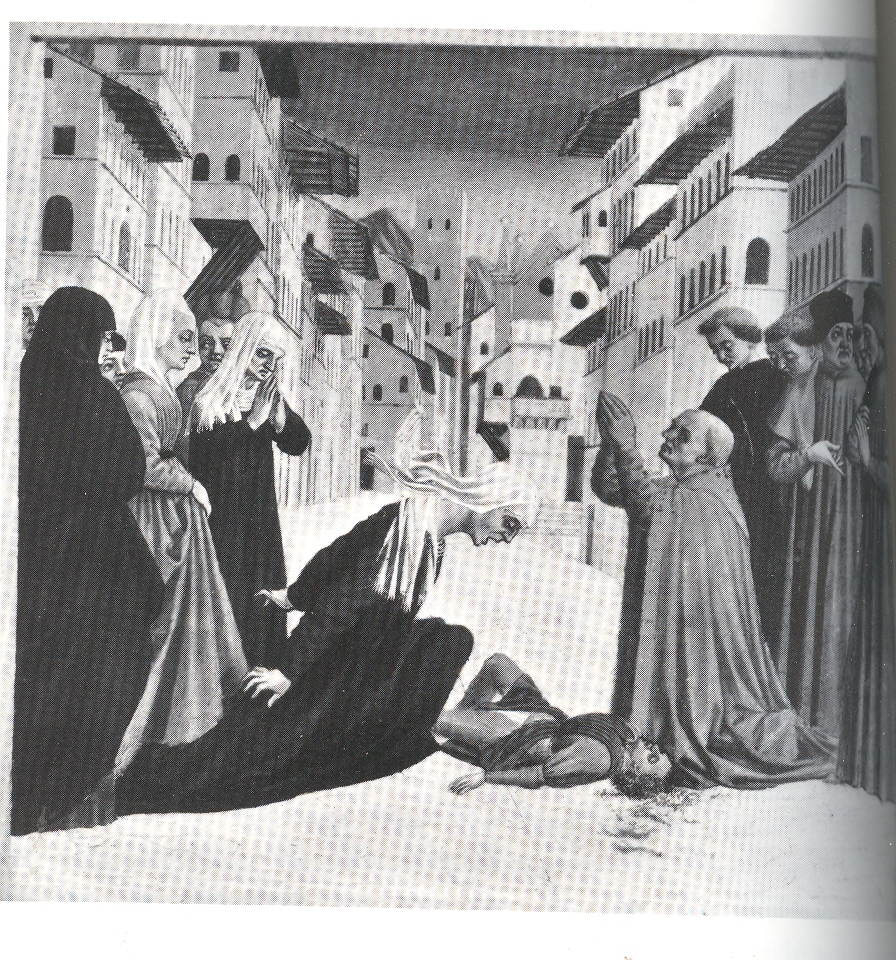
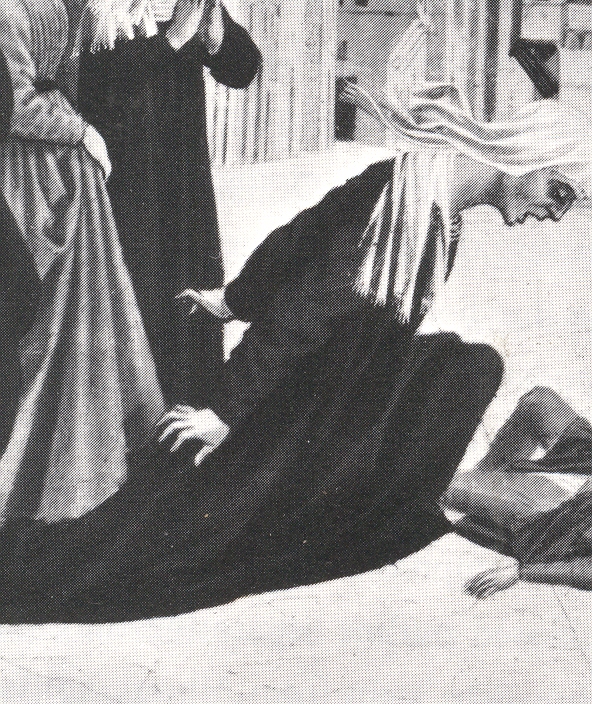
    When considering the alphabet of emotions displayed in Italian Renaissance art, it seems to me that Horror and Despondency seem not to appear very often. (Again, this is for the Italians–not the northern Renaissance.)  This flimsy conclusion may be of my very own not-very-well exposed weakness and may be fantastically wrong—well, I think the odds are more in the favor of this being modestly wrong rather than fantastically so.   This inspiration took hold when looking at an uncommonly-reproduced work by Domenico Veneziano (b. Venice, ca. 1400 and dying in Florence in 1461) displaying a posture and an emotion that I have seldom seen.  I am a little familiar with Veneziano–having lived in Washington DC for 29 years I visited the National Gallery many many times, and themiddle point of the visit was almost always at Veneziano’s fantastic and weird St John in the Desert (ca. 1445) or with his St. Francis Receiving His Stigmata.  (There are more examples of his work in the Continued Reading section below.)  But this image was new to me and astonishing–it is the Resurrection of the Child , and the painting’s main character,  the mother of the injured child, displays a character of grief and body language that is singular to my experience.  (The image appears in James Ackerman’s superb Distance Points, Essays in Theory and Renaissance Art and Architecture (MIT, 1991, p. 86)

    Veneziano

    Veneziano 001

    When I think of all of the Pietas (by Botticelli, Raffaellino de Gardo, Berruguete) I cannot recall seeing this level of  grief, or horror, or terror; or curling fingers in the deepest base of despondency in the features of Mary or just about anyone else.  Actually, Carol Crivell approaches this sort of emotion, but it seems fairly scarce in the history of Renaissance Pietas.  Rending scenes of the dead and bleeding Christ, and rape scenes, lamentations, still do not approach this sort of expression as we can see in  Perugino’s Lamentations and Cruxifiction, Antonello Messina’s Rape of Helen,andCarpaccio’s Meditation on the Dead Christ.

    There are occasions when St. George shows some real fear and horror (Cosimo Tura’s  St. George), and mothers are spectacularly despondent over the killing of their babies (Matteo di Giovanni Massacre of the Innocents), but to me the myriad of images showing the Temptations of St. Anthony and the ravages of time and the seven deadly sins and on and on, just, really, never come quite to this level of terror in Veneziano.  I’m probably off base with this, but honestly, the contrasting pull of the mother’s body both lunging forward and pulling backwards, the enormous passion of her face, the curling fingers, are almost too much to bear.  You can hear her scream as her body works against itself, pulling her apart. And when comparing Veneziano’s Resuscitation with others in this genre–Ghiberti’s child being brought back to life by St. Francis, Lippi’s Drusiana by St. John the Evangelist, for example–this deepest of all expressions of horror isn’t there.  I imagine that the other images of terror and horror are wrapped in Holy cloth and Infinite Wisdoms, these people being saints and all, but when it comes right down to mortals and losing their children, there’s no room for holiness, and Veneziano allows the truth of the emotion to come pouring out. 

    ·Posted by :

    ·in:


  • Oppressed Peoples and Social Movements Catalog Now Offered

    JF Ptak Science Books   Blog Bookstore

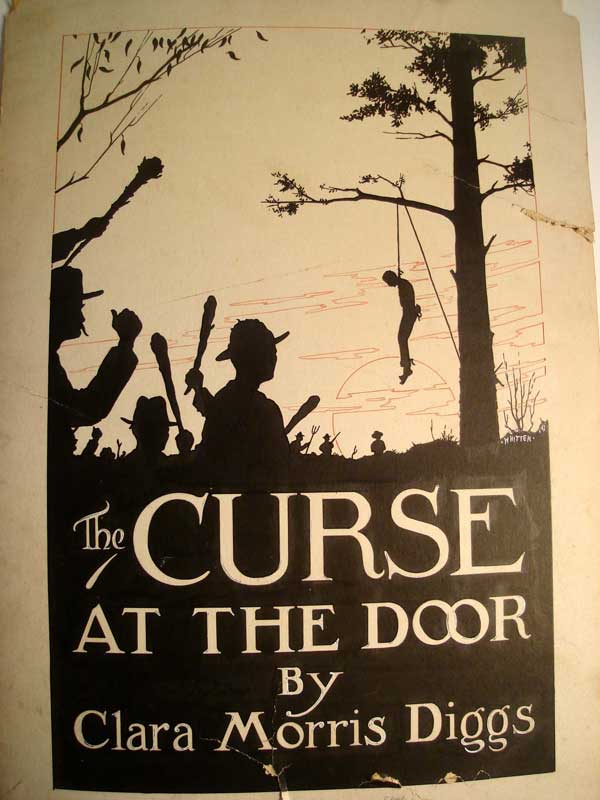
                   Lynching                                                                                                                                                                                             I’ve just started List 10  (located in the Blog Bookstore/Non-science section of this blog)  which will be an ongoing effort to catalog some of the 1,000 or so pamphlet in the store having to do with oppressed and disadvantaged people, as well as the social movements that were started to address those tragedies.  Material covers the American Black experience (1850-1940), the Holocaust and other aspects of antisemitism, Japanese-American internment camps, Labor Unions, anti-immigration policies, war propaganda, and other related areas.

    (An example of what I’ll be offering is above–this is the original artwork for the dust jacket for an anti-lynching book by Clara Morris Diggs, published in 1934.)

    ·Posted by :

    ·in:


  • Bizarre Titles with Real Content: the Fine Art of Squeezing

    JF Ptak Science Books LLC  Post 612   Blog Bookstore

    The Heart is a Lonely Hunter, This Side of Paradise, Revolutions of the Heavenly Spheres, In Praise of Folly, the Divine Comedy,  Pride and Prejudice.

    Sometimes magnificent titles of books deliver magnificent things.

    Blog--may 11--odd 001

    Then there are the uneven, unruly titles hiding great works like Aristtotle’s On Youth and Old Age, On Life and Death, On Breathing; Das Kaptial, On the Origin of Species, Paradise Lost, Brothers Karamazov,  Tractatus Logico-Philosohicus.

    There are badly-titled books that are just bad–we don’t need to get into that right now, wounding the wounded.

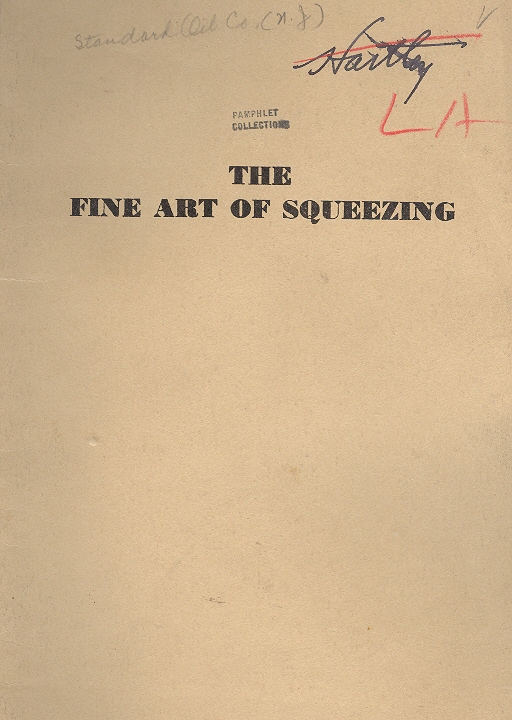
    And then sometimes a book title promises a lot and delivers it–but not the “a lot” that you expected.  The Fine Art of Squeezing, god knows, is a title that demands attention.  I thought, well, I’m not sure what I was expecting–possibly it would actually be on squeezing things. (I’ve seen many examples of this sort of bizarre title/content continuity, so I thought it a possibility.)  But  the story here is delivered by the Standard Oil Company of New Jersey and details their properties being nationalized–squeezed–by the government of Mexico in 1938.  It is one of a series of pamphlets, and it evidently sucked up every bit of creativity at Standard Oil:  The Question of Subsoil Rights in Mexico and The Accustomed Practices in Cases of Expropriation and Confiscation are two titles that deliver the contents’ good accurately and dryly.  This singluarly-titled work also has chapter headings that equally lovely and bizarre:  “The Revolutionary Squeeze”, “The Constitutional Squeeze:, “The Concession Squeeze”, “Strangling the Goose “and other fortifies the reader with the possibility of a surreal experience.  It is not, of course–it is a competent and direct summation of Standard’s deal with Mexico. 

    Blog--may 11--odd 003


    Soap…in Everyday Life is another one of those lovely naive titles, though it only hides a very accurate and authoritative display of Soap Knowledge, published by the Colgate-Palmolive-Peet Co. The draw to this pamphlet for me stops as soon as you open it.  (It is a happy little soap-making theme on the cover, though.)

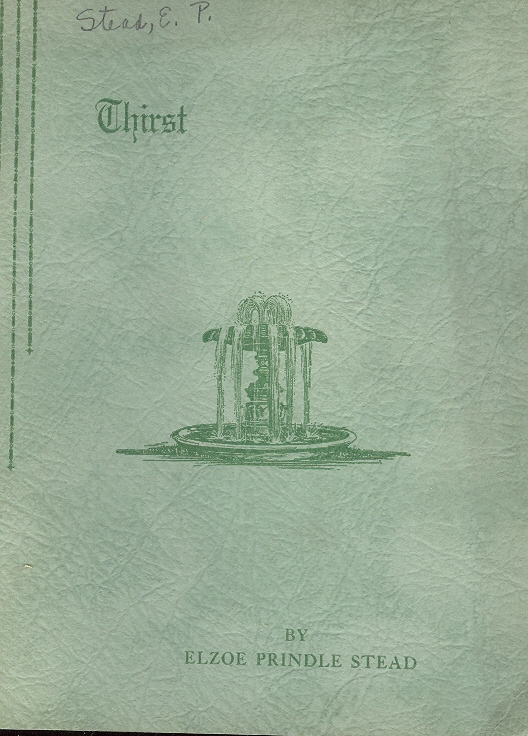
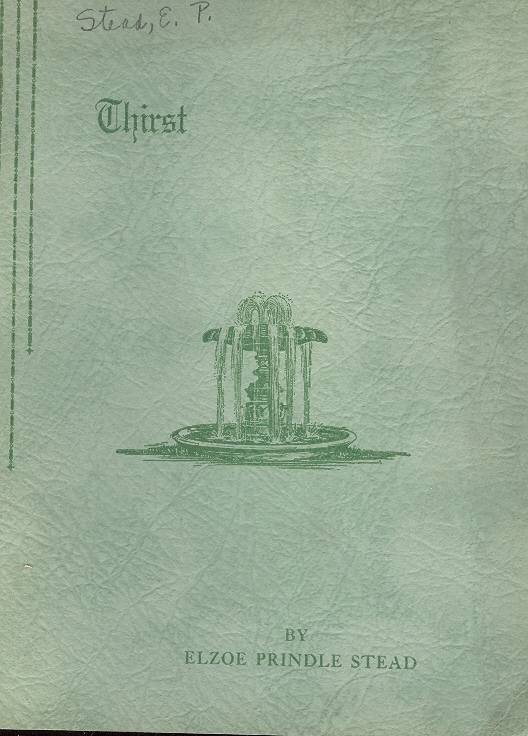
    Thirst is another disappointment–weird title and design, and was written in 1937 (and self-published) by Elzoe Prindle Stead.  The joy of the title is quickly dissolved by the content, with chapter headings such as “Born Once”, “Once to Die”, “Going to Hell”, “For Him of the Second Death”, “Forgotten or rejected Savior”, and “Jesus goes to the Cross.  Its a major proselytizing vehicle which defines itself with the last chapter title, “Why Not”. 
    Blog--may 11--odd 


  • The Weight of Fog: the Big Lie in the Sino-Japanese War, 1937

    JF Ptak Science Books LLC  Post 611

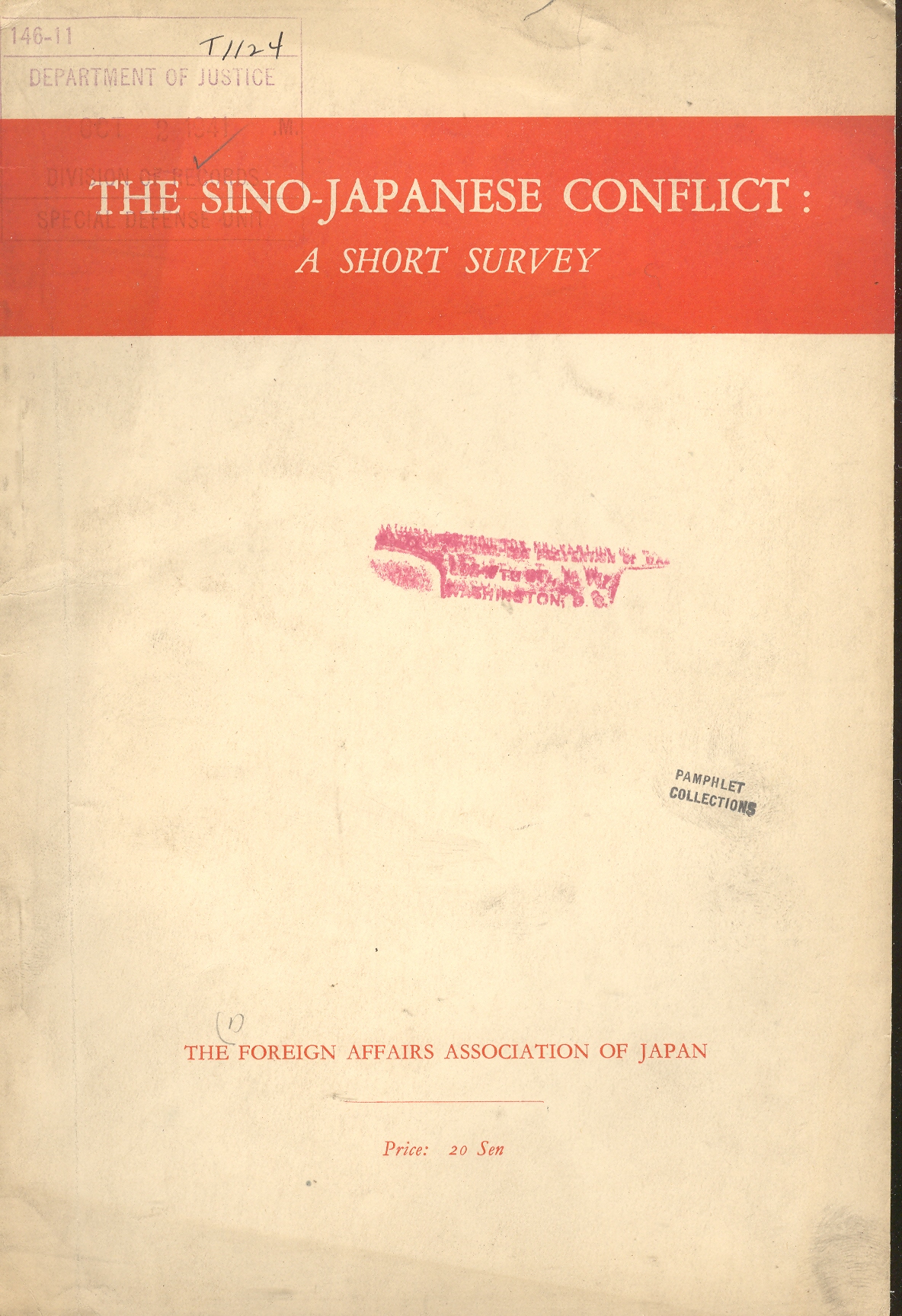
    The creation of international incidents to bring/drag countries into open war against one another is quite ancient–just in our own recent times we have seen the Tonkin Gulf “Incident” and the Iraqi WMD scenarios play out to long and disasterous (and continuing) results.  And so too with the so-called beginning of the Sino-Japanese War of 1937-1945.  There is a little trouble with the beginning date of this war–1937–since the Japanese had already invaded and militarily punished China beginning in 1931.  But no matter to the author of The Sino-Japanese Conflict, a Short Survey (published in English in Japan in October 1937).   The unnamed
    correspondent centered his attention on what the Japanese contended was open rebellion and hostility to Japan, which was supposed to be the attack by Chinese army elements upon garrisoned Japanese troops at the  Lugou Qiao (“Marco Polo”) Bridge in the suburbs of Beijing in June/July 1937.  He doesn’t mention why the Japanese troops were there, but so it  goes. 

    Blog--may 12--sino japanese war

    What happened before the Bridge Incident was this:  the Japanese attacked and occupied Manchuria in 1931, establishing a puppet government there in the form of Manchuko Province.  In 1932 the Japanese armed forces invaded Chahar Province, and in 1933 Rehe–this meant that all of China north of the Great Wall was in Japan’s steely hands.  The Japanese forces were exceptionally well-equipped, their air force finding virtually no resistance and its tanks finding no response from anti-tank weapons.  There was a fair amount of use of sabres by Chinese troops. (Reminds me somewhat of the Nazi/Poland fight in September 1939.)

    So, quickly told, what happened at the bridge was that a Japanese soldier went missing, and the Japanese forces responded in full force.  Weeks later, the fighting was all over, the Chinese sent into retreat, and Japan was in control of Beijing and just about everything else north, west and east.  The missing soldier eventually showed up This wasn’t on the level of Tonkin or WMD, as the Japanese were already entrenched in China for years; but the so-called “incident” at the bridge marks (for most) the real beginning of the Sino-Japanese War.  At least that’s when the armies made no pretense about not-fighting.  Millions of Chinese lives later, the Japanese were defeated.

    The challenge to the writer of this pamphlet was to deal with the affront of China to the Japanese forces in their country without mentioning that Japan was an invading force.  Happens all the time. 

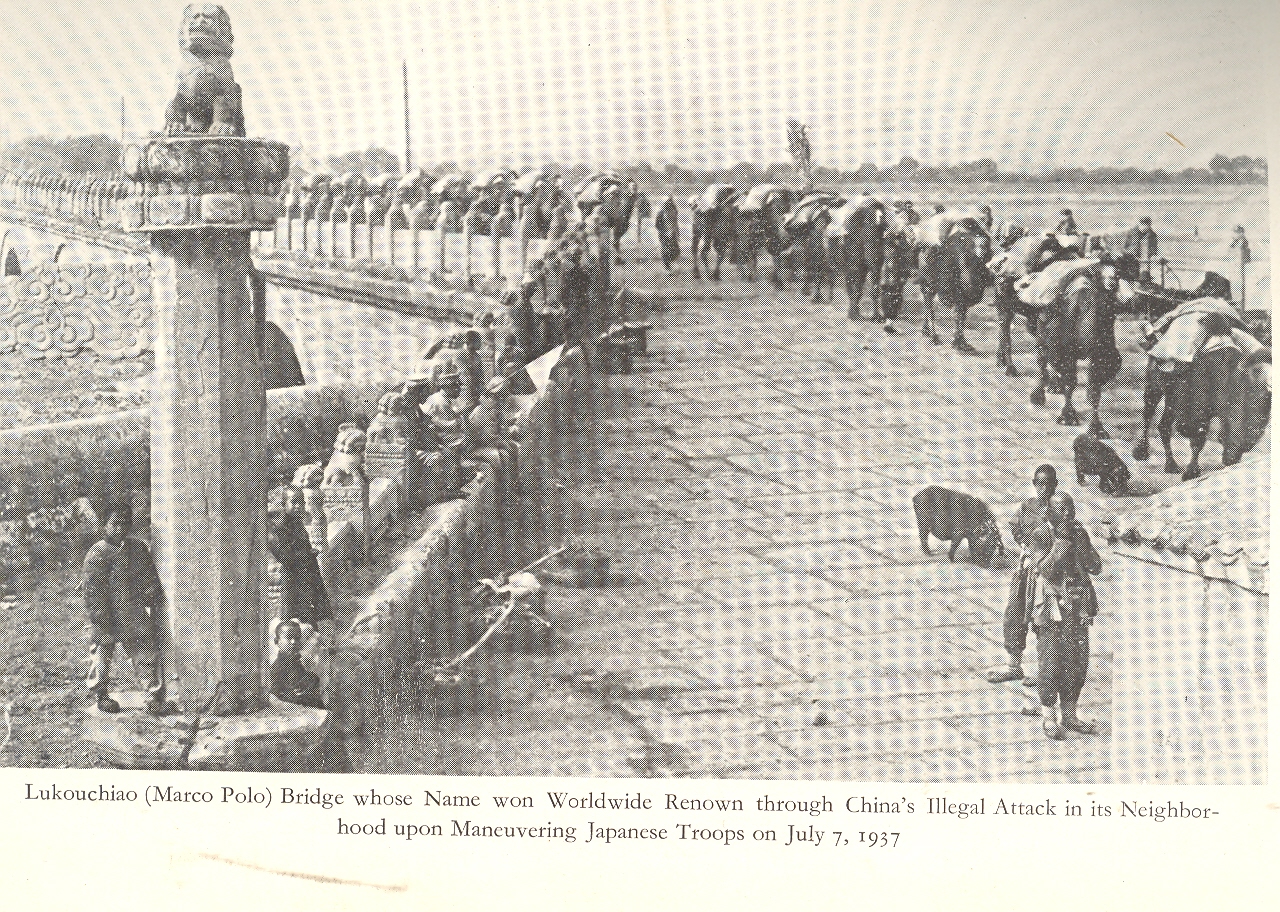
    The photo of the bridge is benign, showing workers, kids at play, a roaming pig; symbols of peace on the 400-year-old structure.  The scene was painted to make it appear that the Chinese showed up, manouevered around the “garrisoned” Japanese troops, and attacked. Blog--may 12--sino japanese war 001

    The bombing (and “Rape”) of Nanjng was also, incredibly,  the fault of the Chinese. “The conduct of Japanese planes calls for no reproach” we read.  This was the beginning of a major atrocity, with 300,000 Chinese in Nanjing murdered by the spring of 1938. 

    The pamphlet ends on the note that the hostilities and fighting were firmly in the hands of the Chinese.  “Protracted hostilities is much more China’s problem than Japan’s” it reads, and then, somehow, explaining it all in terms of the Japanese government being more capable of funding a war and, therefore, should.  This pamphlet was supposed to make the Japanese invasion and decimation of China as invisible to the consciousness of the West as possible–it was being done in a series of handy hearts-and-minds engines like this one, the hope being that the conflict would be viewed as an internal affair, and that Japan would be left alone, and that China “had it coming” anyway.  Pretty convincing stuff if you didn’t think about it too hard, or, well, if you didn’t think about it at all.    But, as we’ve seen again just recently, if you repeat a falsehood often enough, it becomes part of the cognitive landscape, a misty fog of possibilitiy; which means it might as well be true. 

    ·Posted by :

    ·in:


  • Bad Electronics Dreams–the Future Grotesques of Hugo Gernsback, 1945

    JF Ptak Science Books    Post 610   Blog Bookstore

    Blog--may 11--odd 005

     
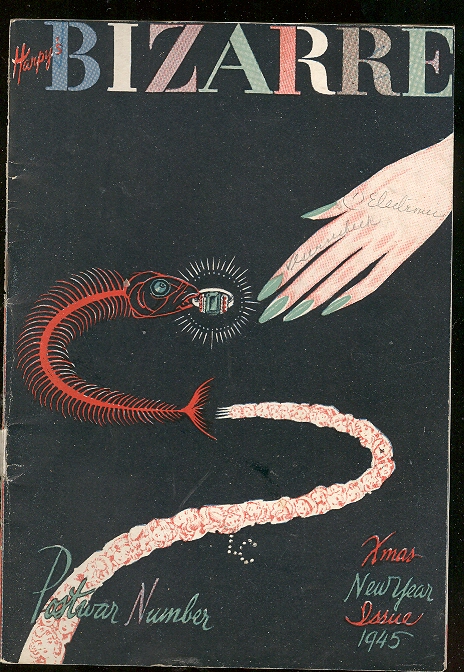
    I am very attracted to the innocence and softly bizarre category of my store’s Naïve Surreal Collection, like this little pamphlet that came out New York in 1945.   The titles in this category are odd but still understandable, and the “what the ____!” response to the subtle ones isn’t quite so high and the exclamation points not so many as in the cases of the Naive Surreal titles.  Bizarre is just that, certainly not hiding behind any lesser or ambiguous title–it seems to be a parody of  small magazines and their advertising sponsors,  and copyrighted by the very far-reaching Hugo Gernsback, who in 1926 started the first magazine dedicated to the genre of science fiction (Amazing Stories) and for whom the World Science Fiction Society’s annual award for Science Fiction Achievement is named (the “Hugo”).  Gernsback evidently had a taste for cheeky parody, producing similar magazines to this called Quip, Forecast, Jolliers, Tame and Newspeep.

    I guess that this was deeply weird for mass-production publication, and it was probably funny–now it is just weird, odd, and somewhat discomforting–a successful and intentional reach for being part of the Naive Surreal right from the start.

    Blog--may 11--odd 008


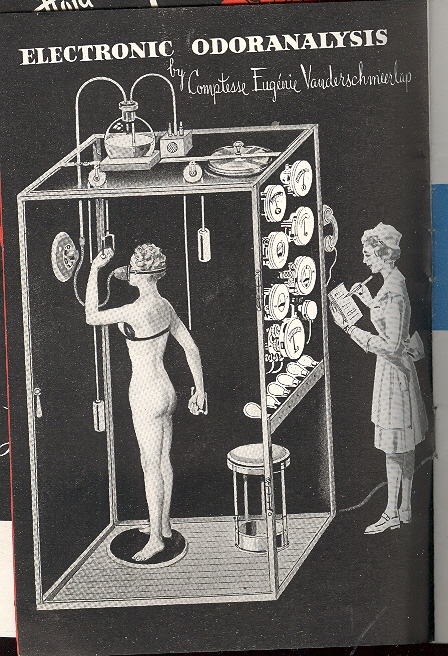
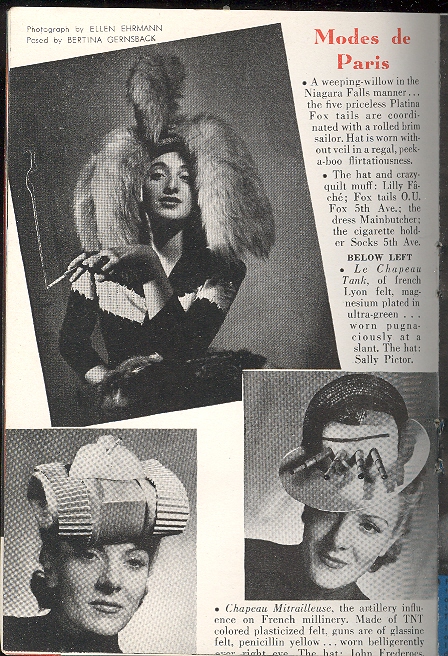
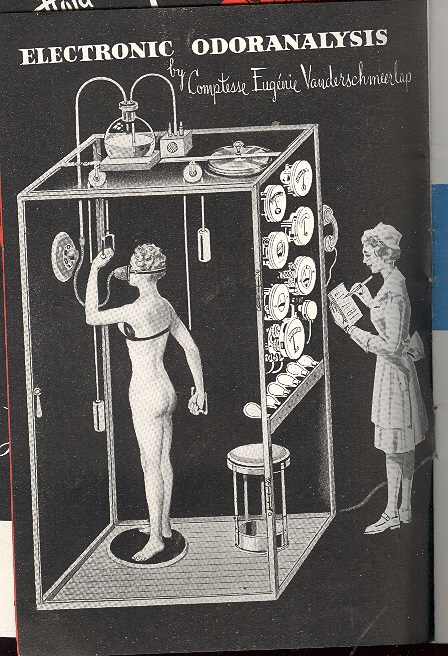
    Most of the magazine is dedicated to imaginary electronic delights–analog electronics (though it is still fairly early to be having such dreams and using the word “electronics”, as it was just barely two decades old at this point).  One of the oddest of these inventions of the near future was the Electronic Odoranalyzer, which was necessary for reasons I couldn’t discern.  There were hats of weeping willow Platina fox tails; some hats had tanks (as with the Le Chapeau Tank hat, modeled for the magazine and “worn pugnaciously at a slant”); other hats had canons (the French Mitrailsuese).  You could also relax to your favorite tunes in style with a $125,000 radio–it was made for war profiteers who couldn’t find banks enough to hold their cash and was billed as too expensive to steal.

    Blog--may 11--odd 006

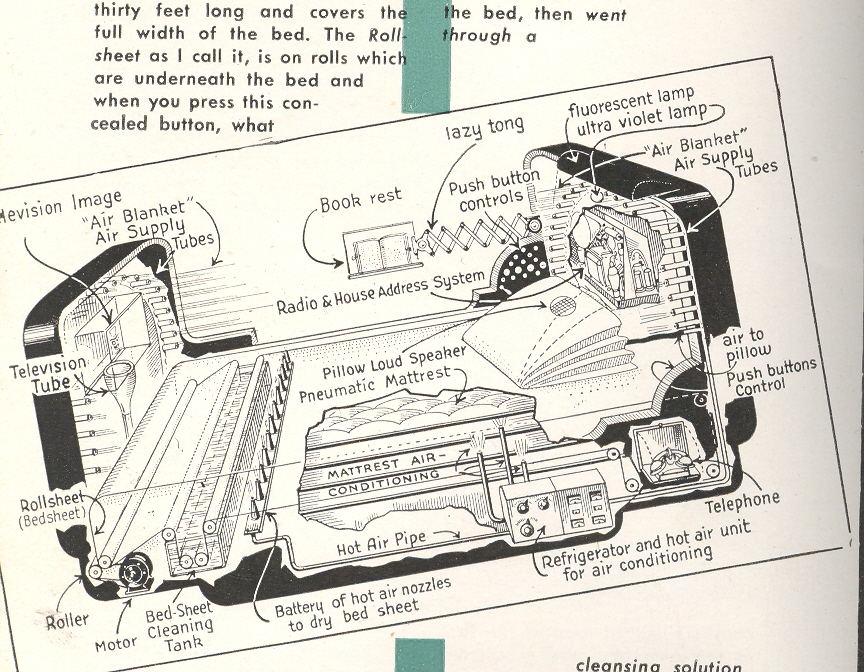
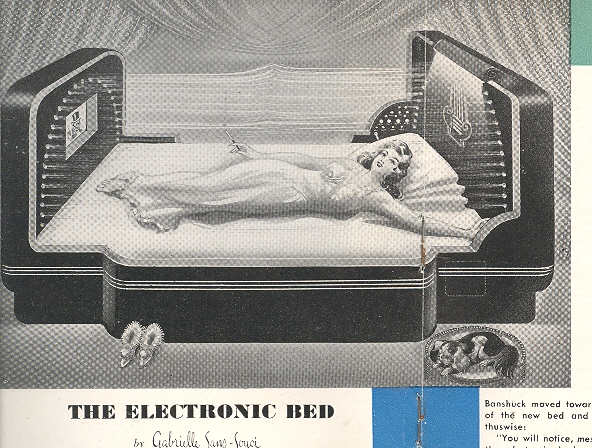
    Then there’s the EBC–the Electronic Bed Company–with their magnificent new product, an invention “by the great sage of Hackensack” so spectacular  as to make ordinary sleeping obsolete.  The bed was an air-conditioned, self-washing, self-adjusting, self covering, fiberglass-cushioned, telephone-capable, air pillowed, air conditioned masterpiece that looked like it was about ready for anything but sleep, which I guess would make it revolutionary.

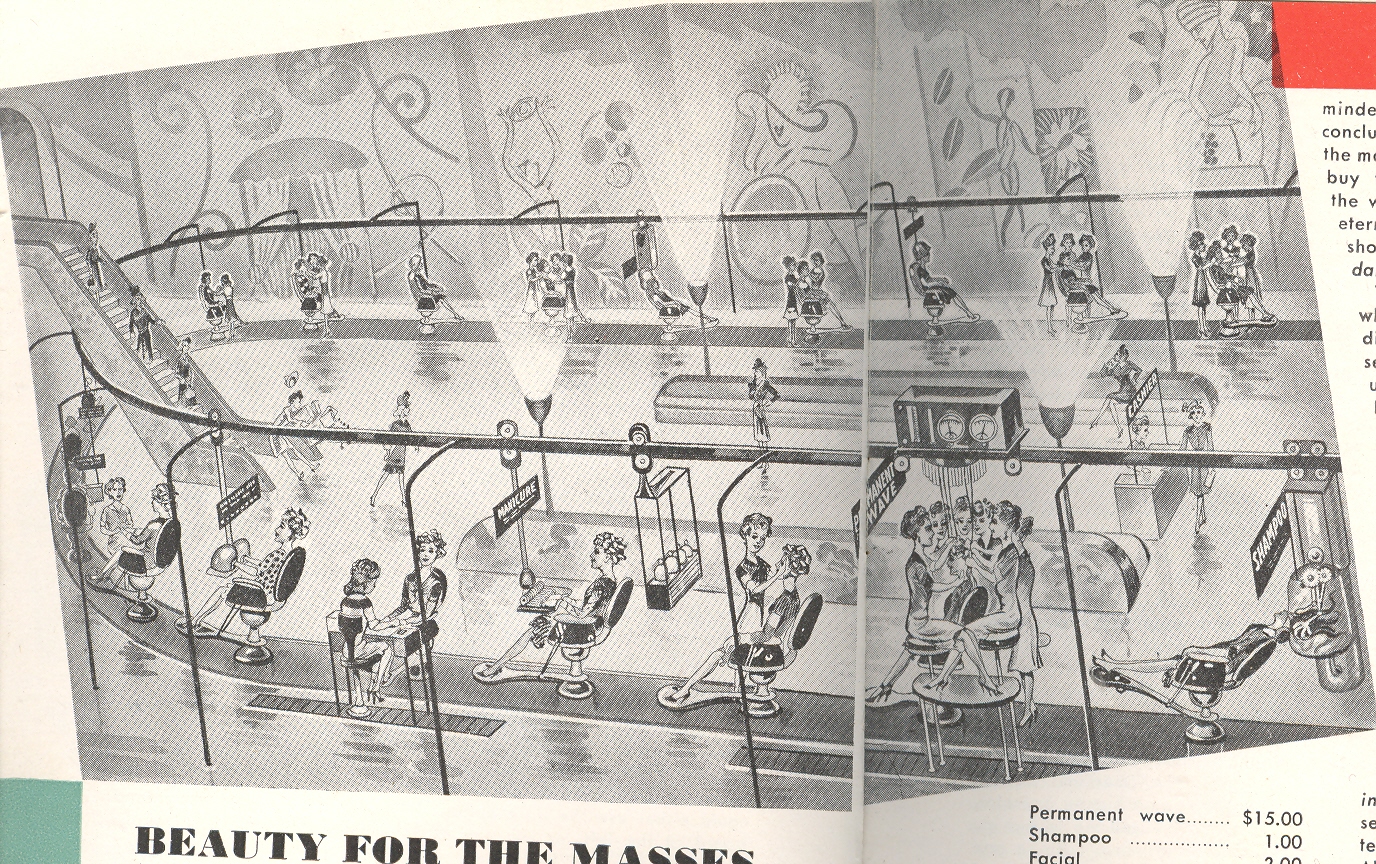
    Another wonderful bit in Bizarre was the assembly line beauty parlor that was staffed mostly by robots–I think that this is the very first display of robot-reach in the world of coiffure.  This was an attempt at “beauty for the
    masses”, producing the normal human three-hour/20-dollar “ladies’ hairstyling” experience into a 2 dollar, one hour affair.  The production room was 150 feet by 30 feet, with room for 100 women, all moving, though it did not look very satisfying, though perhaps the savings and the quickness of it all made the experience worthwhile. 

    Blog--may 11--odd 002

    There were contributions to future-think elsewhere:  the six-foot wide pocketbook was funny, as was the electronic lipstick (available in the “ultra-reckless” “strumpet pink”. The Chamembert Inferno CheeChee perfume was also interesting–the claim for this product was that it was so infernally devastating that Satan himself could succumb to it.

    All-in-all I suspect that the pioneer and inventor (and the coiner of the phrase “Science Fiction”) Gernsback had a good time with this pamphlet, enjoying a few or too many adult beverages while sharpening a skeptically fiction-laden eyeball on the wonderful world of soon-to-be electronic conveniences.

    Blog--may 11--odd 009

    Blog--may 11--odd 007


    ·Posted by :

    ·in:


  • Condemnation of the American Correctional System: 1929 = 2009?

    JF Ptak Science Books LLC  Post 609   Blog Bookstore
    Blog--may 10--prison
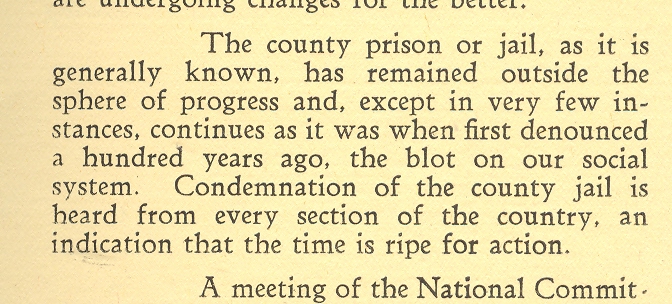
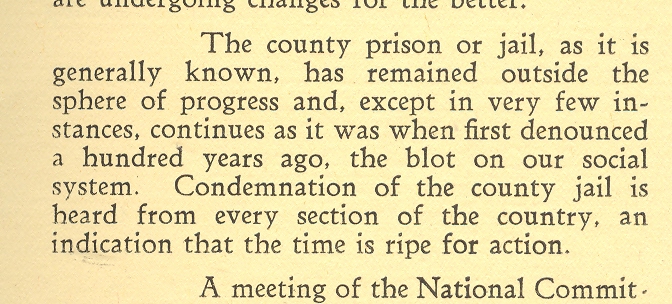
    This pamphlet is the address by the philanthropist Alfred Lewisohn–a German immigrant who made many dozens of millions of dollars and with his brother became Copper Kings–to the national Committee on Prisons and Prison Labor.  Lewisohn was a major contributor and the honorary president of this group–a very liberal, very convincing group with a large measure of outrage with the way in which American crime was addressed and criminals imprisoned.

    Lewisohn was enraged with the prison system in the U.S.,though he did have hope for the Federal system, which he hoped would (soon) become the template for the successful treatment of criminals. Everything else below the Federal level was a mess, a mistake, wrong–he thought it absurd that such vast amounts of money would be spent on systems which were milled in deceit, harmful to almost everyone involved, and utterly broken.  He saved his greatest vituperative for the county jail, which was beneath contempt.

    Blog--may 10--prison 001

    Lewisohn’s complaints, condemnations and suggestions seem, unfortunately, pretty modern–he would also be spinning QUASAR-like in his grave if he had any idea of what was going on now, 80 years after the publication of this paper.  Corporal punishment by corrections officers is probably almost entirely gone, replaced by that which is administered by other prisoners; the obscene labor requirements from the prisoners is also pretty much gone, as are other things. The spending, the enormous incarceration rates, the idleness and waste–those are all still there.  Except that the incarceration rates–those are far beyond anything that Lewisohn could have imagined.   For example, when Lewisohn was writing the incarceration rate that he complained about went from 110,000 people in jail in the U.S in 1920 to 180,000 in 1930.  The numbers rose to 272,000 in 1940 , down to 252,000 in 1950, then up again to 332,000 in 1960 and 338,000 in 1970.  Things get really bad in the 1980’s with the war against drugs:  the American prison population rises from 474,000 in 1980 to 1.18 million only ten years later.  In 2000, the total rose to 1.9 million, and by 2009 the figure topped 2.4 million.  I should also point out that this is a figure for people actually in prison–for those in the criminal justice system, the number balloons to 7.8 million.  

    And so with the war on drugs, we find ourselves in this country with 1.2 million non-violent people in prison.  According to the Justice Policy Institute (and the Bureau of Justice statistics), it costs something like $50 billion to keep these people in jail, or about the cost per year of schooling at an A-school for 1.2 million kids.  That figure is also twice the total amount of money spent on the Aid for Families with Dependent Children (AFDC), which services something like 8 million people.  With food.  The total bill for keeping people in prison in the U.S. is around 100 billion.  Its harder for me to calculate the total-total for dealing with the other 5 million somewhere in the criminal justice system–but it is a pretty big figure, coming to some large chunk of a non-wartime military budget. And all that money on something that doesn’t work all that well. 

    [Other social expenditures dwarfed by 50 billion in the continued reading section below…]

    ·Posted by :

    ·in:


  • What 4,890 B-17s Might’ve Looked Like, Flying Togther

    JF Ptak Science Books LLC    Post 608  Blog Bookstore

    I’ve long been interested in the history of the display of quantitative data, and have written about it here and there on this blog.  Yesterday’s post on Big Crowds touched on a display of parked B-17s, seen in an airfield in Munich right at the end of WWII.  My friend Jeff Donlan posted a comment on how cool the image of the B-17s looked when he used the scroll button on his mouse.  And voila–he was right and it moved me to fit together a series of these to get a slight idea of what a lot of these planes might’ve looked like, flying together. At one point in 1944, there were more than 4,890 B-17s flying, and so I pieced together 47 sheets to see what effect it would have to see all of these planes in one swing. Even though I knew what to expect–since I was making this little video–I still had  a “Holy bloody crap!” reaction to the display of the numbers. It is really difficult to try and get some sort of idea about what 4,890 planes might look like–this really doesn’t come close, and it doesn’t address the enormous sound involved, but it is a start. 

    ·Posted by :

    ·in:


  • Crowds: Servicemen and B-17s at the End of WWII

    JF Ptak Science Books Post 608 

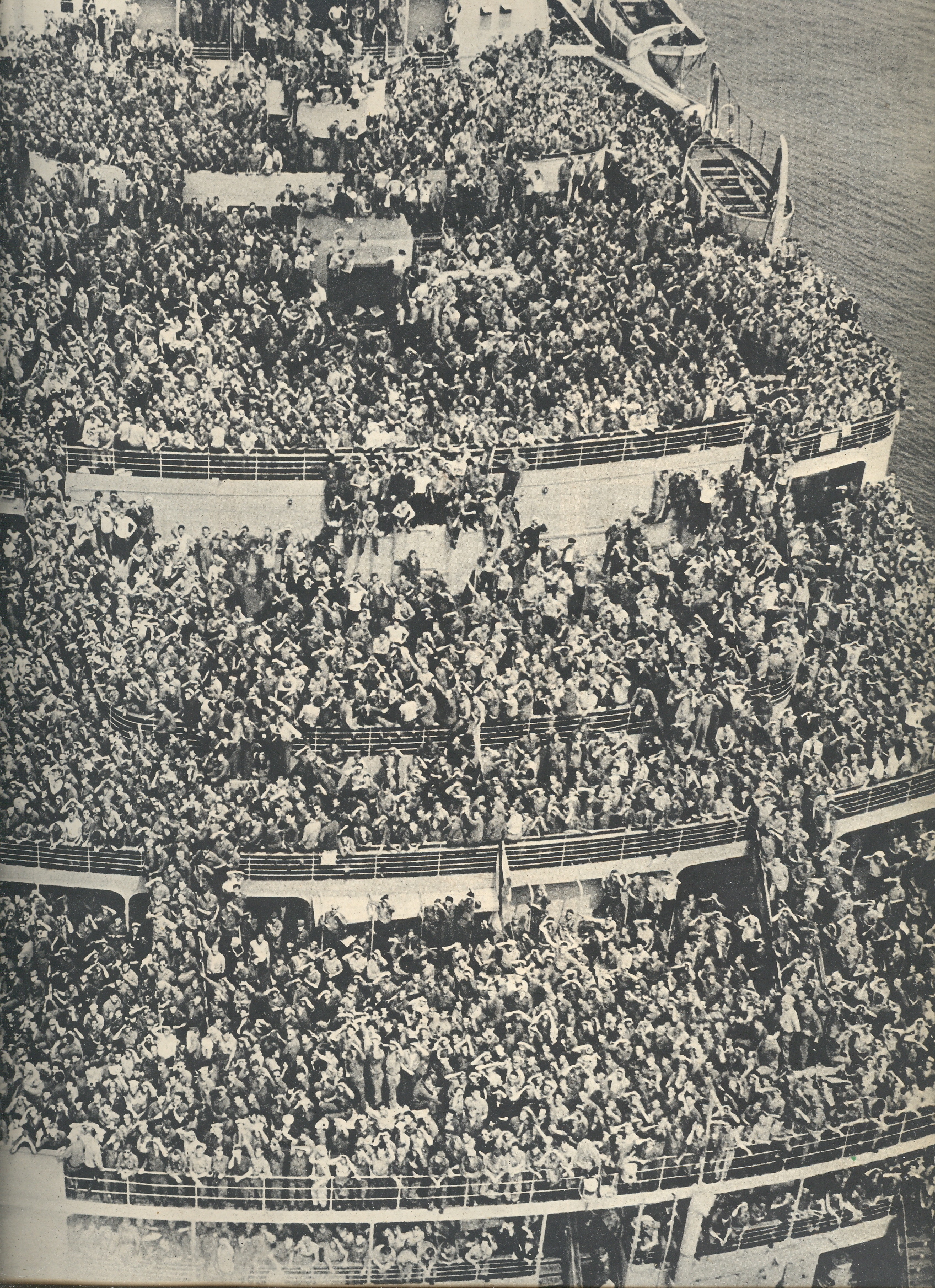
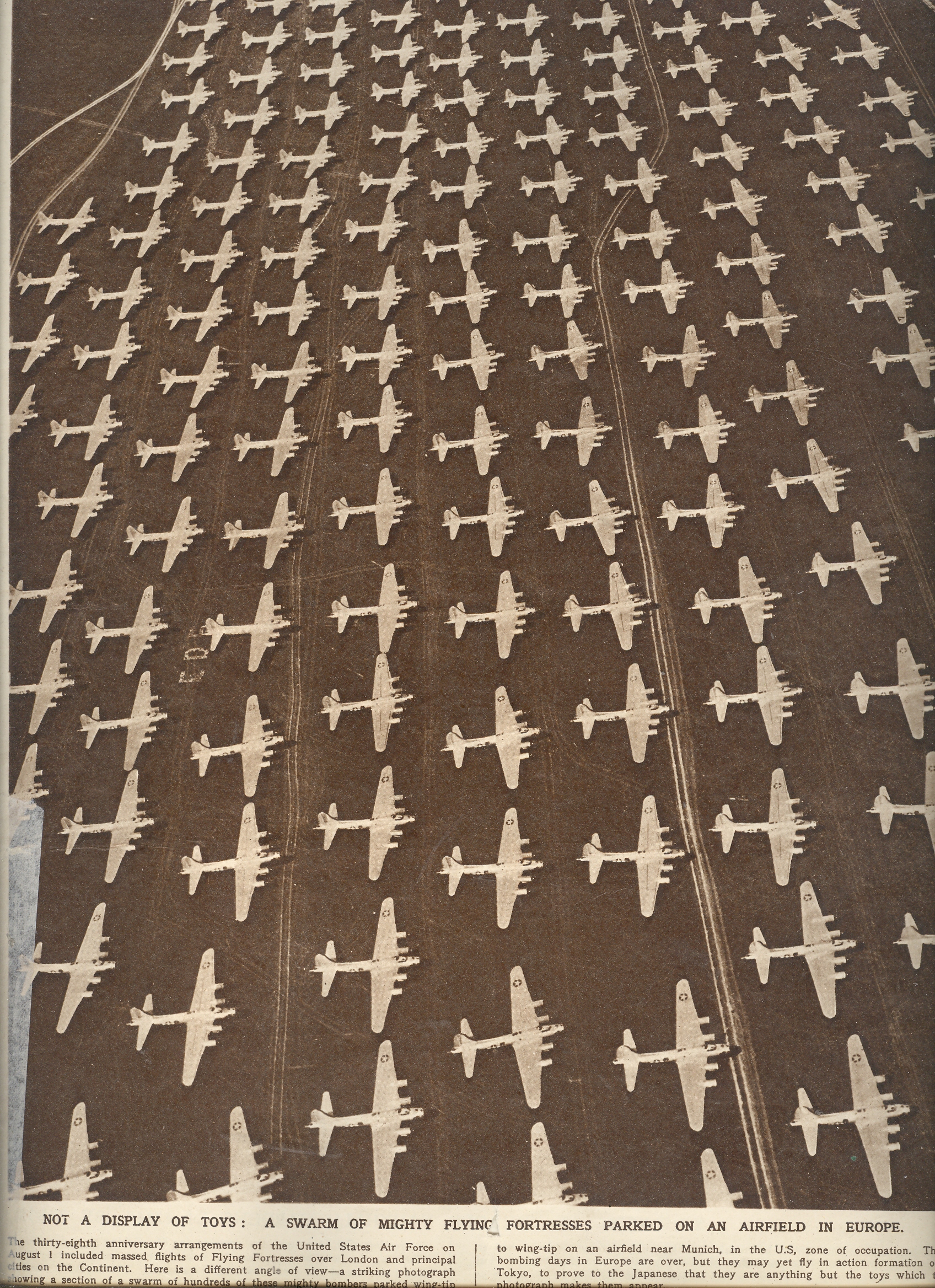
    These two images of crowds come in the same remarkable issue of The Illustrated London News for 4 August 1945—the war in Europe  was over, and the war in the Pacific, for all intents and purposes, would be over in days.

    Blog--may 8--vrowds QE


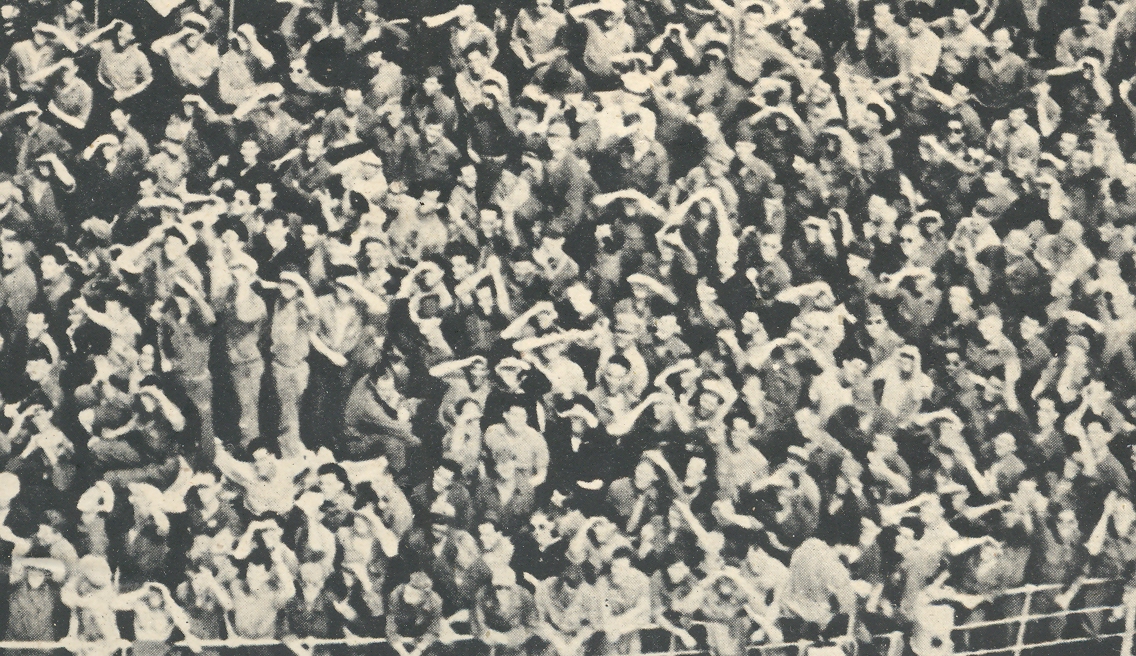
    The first image shows  passengers on board the “Queen Elizabeth”—a contingent of 14,000 American soldiers beginning their journey home following the defeat of Hitler.  It is a raucous, joyful image, with nearly everyone waving, happy to have arms to wave, happy to be alive to wave their arms, happy to be going home.Blog--may 8--vrowds QE det  


    The second, “Not a Display of Toys”, shows only one section of a large airfield “in Europe” (actually in U.S.-administered Munich).  There’s about 300B-17 (e?) parked wingtip to wingtip, off duty now from the fight in Europe, but (as the caption says) prepared for a fight in Japan. I don’t think anyone in high command had any doubt that these planes had seen their last action.  The atom bomb worked, and would work again (and again, and more so if necessary), and the fear that these planes would make their way East was not a real concern. This photo represents about 7% of the highest number of B-17’s in service in Europe at any given time. 

    Blog--may 8--vrowds