A Daily History of Holes, Dots, Lines, Science, History, Math, Physics, Art, the Unintentional Absurd, Architecture, Maps, Data Visualization, Blank and Missing Things, and so on. |1.6 million words, 7500 images, 4.9 million hits| Press & appearances in The Times, Le Figaro, Mensa, The Economist, The Guardian, Discovery News, Slate, Le Monde, Sci American Blogs, Le Pont, and many other places… 5000+ total posts since 2008.

Author: JF Ptak

  • The Measured Intelligence of the Letter “C”

    JF Ptak Science Books LLC    Blog Bookstore

    Dots I’m sure that by now everyone has seen those “are you
    smarter than____ (Barack Obama, 130 I.Q.)” pop ups seen on some news
    sites.  (I doubt that President Obama’s
    IQ would be that limited; his predecessor, well, let’s not comment on that.)  Giving in, and dumping twenty-five minutes
    that I’ll never get back, I took the test. 
    Three times.  The first time I
    filled in all the answers as “A”; the second time, “B”, and the third, “C”.  It turns out that the IQ for A was 80 and for
    B, also 80.  C, however, came in at
    90.  C seems to be the smartest of all of
    the first three letters of the alphabet.

    And what of lonely “D”?   I could not but forebear to press on with my life, leaving it an alpha-intelligent mystery. 

    Did I mention that I’ll never get those twenty-five
    minutes back?

    ·Posted by :

    ·in:


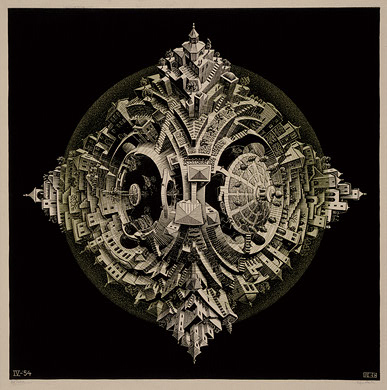
  • Fish-Eye Views, Part II: Escher’s Tetrahedral Planetoid

    J.F. Ptak Science Books LLC  Post 586    Blog Bookstore 

    Planetoid Late
    last month I wrote a short post about an antiquarian fish-eye view of the city
    of Vienna(1529). (“I’ve paid some attention to antique images that look straight down at
    things (Looking
    Straight-on At Things
      and  Looking 
    Straight-Down on Things
    ) and I can say that they are in general pretty
    uncommon–this is the first time though that I’ve noticed a fish-eye
    view looking straight down, an image conveying a 360-degree horizon-to-horizon
    landscape.”)  I’ve not found another
    antique view like this, but I did just come across this magnificent work by
    M.C. Escher  (1989-1972) called
    Tetrahedral* Planetoid, produced in 1954 and now living at D.C.’s National
    Gallery. 

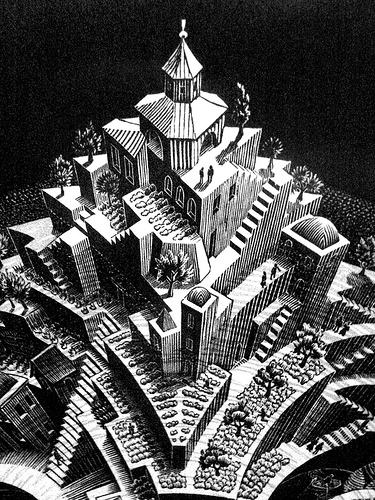
    The
    view of the planetoid is quite complete, as we can see individual houses and even
    some people  What I find particularly
    amazing, apart from the design of course, is that this meticulous ideal was an engraving
    done on wood.  It is a glorious accomplishment,
    and a joyful optical shock to the system.  .

    Escher planetoid

     
    *A tetrahedron (plural: tetrahedra) is a polyhedron
    composed of four triangular faces, three of which meet at each vertex.


  • Bad Resurrections: 19th Century Cadaver Trade in New England

    JF Ptak Science Books LLC  Post 585       Blog Bookstore

    History of Missing Things Part XXXVII

    Grave rob For some, “anatomy is
    destiny”, but not in the way the reach-y Sigmund Freud meant–their
    anatomy quite literally was their destiny, their bodies resurrected (in the bad
    way) from their coffins by chin hooks and sent to the local med school for
    quick and dirty study.  This night-time
    version of ice fishing for cadavers was addressed in a sniffily conceited but
    informative book by A.M. Lassek, Human Dissection:  Its Drama and Struggle (1958).  Lassek, professor of anatomy at Boston University ,
    presides over all aspects of the history of anatomy, but I somehow found my way
    instantly to the cadaver-catching mechanical operations end of it: specifically
    the work of American specimen providers in
    in the early part of the 19th century. 

    Listen:  if I found my way back in time in the Boston area in 1835 and
    was the night jobber and bad-‘un for the local apothecaries hunting down the
    lonesome freshly dead, I think–with praise to Lassek–that I’d be
    able/equipped to do the job.  I hadn’t
    really thought very deeply about the supply of cadervous specimen for the
    thriving medical schools before, but there are many considerations to the
    proper way of stealing a body. (And by “proper” I mean “not
    being caught doing it”.) First of all, there was a serious spike in the
    creation of medical schools, the number of recognized institutions in America
    increasing from seven in 1810 to 33 in 1840 (and 90 in 1870), with a huge new
    population of data-thirsty students to go along with it.  Human anatomy was an exceptionally difficult
    subject to demonstrate with actual specimens (due to moral and legal
    restraints), so the med schools (including the Harvards) had to resort to
    creative solutions:  the bodies had to be
    “found”. And finding bodies had more to do with stealing them than
    arranging for the corpse of a condemned criminal to be purchased from the
    sheriff. 

    The local townsfolk and neighbors of
    medical schools knew this all too well. 
    There were a number of precautions that the bereaved could undertake to
    prevent the resurrection of their departeds. 
    One simple way was to have a guard at the grave all night long–that
    would certainly cause some pain and consideration for the grave robber, though
    it has been the case where the guards were plied with money and alcohol to
    effect a soft gaze on the grave.  Since
    the newly interred laid under six feet or so of newly churned earth, there was some
    amount of extra stuff that was thrown into the pit.  Stones, and rocks and tree limbs were added
    to the hole to make a tougher and noisier go for the robbers; also, wide heavy
    planks were placed width-wise across the coffin and then covered so that the
    robbers would have to dig much wider in order to pull up the boards before
    getting to the coffin.  Another fantastic
    bit that I had never thought of but which falls into the category of branding
    cut lumber for the ride down the river: 
    intricate designs were placed on top of the grave with sticks and stone
    and such so that the family members would be able to detect a defiled
    grave site.  All of this attention would be
    heaped on the grave site for ten days or so–after that the body was deemed too
    far deteriorated as to he of any use to the medical school.

    “Detect?”  Yes, indeed. The grave robber needed to be
    stealthy, leaving no indication of the dark and stinking deed.  Working in very low or no light, the robbers
    would find their mark and lay at least two tarpaulins on the ground. they would
    collect all of the dirt in these catch-alls so as to not excite any attention
    that the grave had been disturbed.  They
    would dig a 3×4 foot hole towards the head of the casket, and, once reaching
    their prize, would drill holes (quietly!) into the wood, break it, and then
    attach a hook under the chin of the corpse and yank it out.  Placed on another tarp, the body would be
    stripped of all clothing, and then wrapped securely to prevent anything
    incriminating falling from it during the trip across town.  Once received by the medical school, the
    hair, teeth and other distinguishing characteristics would be removed to
    prevent detection and identification.  I
    imagine that the skin of the face would also have been peeled away, skillfully
    removed with one cut and a careful pull. 
    All of this was precautionary, in case the relatives of the now-specimen
    suspected foul play and came looking for their beloved.  It would be a corpse among other
    corpses.  Or not. Lassek writes that the
    bodies would be hidden, secreted in different and obscure places around the
    campus, in “domes, belfries and observatories”.  Observatories?  Well! 
    I’m not so sure about that aspect of Lassek’s report on grave robbing,
    but I was pretty impressed with his knowledge on the other aspects of the
    business. 

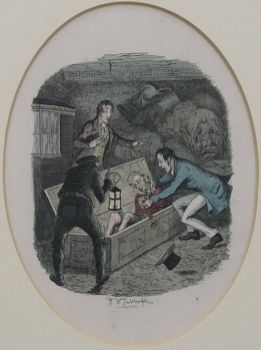
    I am
    indebted to Dr. Lassek for the image of the grave-marking anti-theft
    artwork.  I may have fabricate a grubby
    1837 cemetery keeper’s chapbook with drawings of their designs and make an
    entry for it in my imaginary museum catalog for
    things-that-don’t-exist-but-should.


  • A Short Homage to the Alphanetical Past of Union-Made American Brooms

    JF Ptak Science Books LLC  Post 584
    Blog Bookstore

    I was breezing through what seems to be an innocuous forgotten document:  the 1941 Union Label Catalogue-Directory. It lists the union labels of trades who were part of the American Federation of Labor (AFL), a 32-page pamphlet advising its readers on how to hunt for union-made goods, and to get the union-earned dollar spent with other unions. Even though only 68 years old, the list of unions seems far more antiquarian, the unions and the jobs/workers they protected seemingly from another, earlier time: the Allied Printing Trades, Cigar Makers, Clerks Protective Association, Glove Workers, Hatters, Horse Shoers, Meat Cutters, Pocketbook Workers, Novelty Workers, Sheep Shearers, Stereotypers, Telegraphers, Wall Paper craftsman, and on and on.   

    But it was the broom and whisk makers union label that really struck me. There is something beautiful and sad in this design–the design is lovely as is the idea of the workers who were probably protected by the union; what is instantly saddening is the recognition of the incongruity that such a trade was widespread enough to need protection and organization, and how far gone such industries are. Really gone.  Blog--broom

    Looking through the names on the list of union shops of broom and whisk makers suggests elements for a poem on vanished brooms.  There is of course the Ace Broom Company, and the Acme, and, yes, the American Broom Company; followed by the Amor, Artzcraftz, Baria, Bard, Birminham, Best, Brown, Buckholtz, Burlington, Coleman, Continental, Eagle, Galesburg, Haferman and Hanset, Ideal, Imperial, Lighthouse, Mid-West, Montana, M & M, Mutual, National, Progress, Progressive, Rainbow, Reliable, Rich, Royal, Western, Terre Haute and Zenith.  The “R’s” have the field, hands down. 

    The pamphlet ably describes the design and its color, and where the label appeared on the product.  In the case of the brooms and whisks, it also assured the purchaser that the product was not made by “contract prison labor”.  (I have a prison-manufactured catalog from Angola Prison here that I’ll have to write about some day–published in 1937, it was glossy and thick, offering hundreds (?!) of items for the office and home, but mostly heartpine and heavy oak goods for white collar consumption.  The scale of the operation is pretty surprising to me.)

    I like the whole idea of the handshake, the square deal, the care in the construction of the broom.  I just looks right.  And as you well know a good broom is a thing of beauty–it will do its just correctly and last forever. 

  • “Emerging” as a Verb: a Note on Patterns in Science and Art

    JF Ptak  Science Books LLC  Post 583
    Blog Bookstore

    And all that appears confusedly on walls is very like the vibration of bells:
    you can hear in their ringing all the sounds or words you want to imagine.”
    – Leonardo da Vinci 1492

    Finding recurring events, schemes and objects, finding predictability, finding a pattern, making a pattern emerge seems to be what we do here on earth.  After all, the stuff that we use to organize our existence into transferable bits of knowledge–points and lines and symbols that stand for sounds which stand for other things which constistute language–don’t exist, but they do tell us pretty much everything we need to know about our environments, real and imagined.

    Blog--emerge

    Stars are (as my daughter Emma pointed out when she was four) “messy” until imaginary lines are drawn between them; the relationship of the elements are mysterious until a (a) they were “discovered” and (b) table of relationships was figured for them.  Mathematics, the queen of the sciences, is nothing but making patterns emerge.  Art* and aesthetics developed over millennia to arrive at things like paint and the golden ratio [(a+b)/a=a/b] and perspective, making images and other representations emerge from the chosen media.  Patterns emerge from massive, seemingly too-complex entities:   even the weather’s patterns emerge (to within a particular range). (Better yet, with weather, it is extraordinary to see how small variations of the initial condition of this sort of dynamical system can produce large, long term variations. Have a look at one of the greatest works on the circulation of the atmosphere at my blog store.)

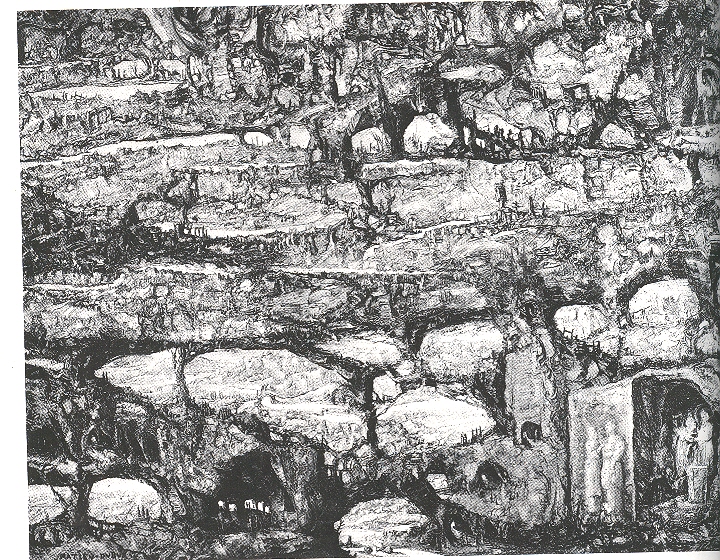
    In a slightly odd and definitely beautiful book by Jurgis Baltrusaitis, Aberrations, an Essay on the Legend of Forms (MIT 1989) I found a fantastic illustration of the work of Mathieu Dubus (1590-1665/5). Dubus evidently was a pre-modern modernist, and painter of fantastic landscapes, though (apparently) very few have survived the years.  He was an outsider to the great Golden Era of Dutch art of the 17th century, probably a little too far afield for most tastes, though his associate and contemporary, Hercules Seegers (Seeghers), another experimentalist-as-artist, found far more afield, at least so far as royal patrons were concerned.  (Segers was also collected somewhat by Rembrandt, who owned at least one of his paintings.  In his own bit of “emerging”, Rembrandt actually purchased one of the metal plates from which a Seegers print was made, and reworked it, making it his own,  publishing prints from the “combined” effort.)  It is also interesting to note that if Dubus was included in the Big Books on Dutch art of this era, he would fall between the beautiful Gerard Dou (small, exquisite, dark, very layered) and Jakob Duck (who had a very Dickensian taste for street/common/low life).

    The Dubus work, The Destruction of Sodom and Gomorrha.,  is exceptional, and odd–I still don’t understand if the image was actually painted on an old and decaying wall, or if was painted on agate that looked like a decaying wall, or if was painted on canvas and made to look like the above.  No matter–the effect is that the artist used the “natural” occurrence of breaks and segments to make his picture of the great destruction from Genesis emerge from the seemingly “found” surface. It is a remarkable image, and I’m fairly well certain that the 17th century wasn’t ready for it.

    It is remarkable that humans have sought for thousands of years to make representations of their environment and ideas more clear; and it wasn’t until the second decade of the twentieth century that artists sought the “reverse”, until, finally, a person wasn’t able to tell what a painting was “of” unless told so.  (Jackson Pollock told the story many times of seeing his work exhibited upside down.) 

    *”Art is the imposing of a pattern on experience, and our aesthetic enjoyment is recognition of the pattern.” is what Alfred North Whitehead (1861-1944, English philosopher and mathematician) said, sucking the very life out of the discovery part of the whole experience. 


  • A Surprised Christ and Internal Dialog: St. Francis and Bartholomaeus of Pisa, 1510

    JF Ptak Science Books LLC Post 582
    Blog Bookstore

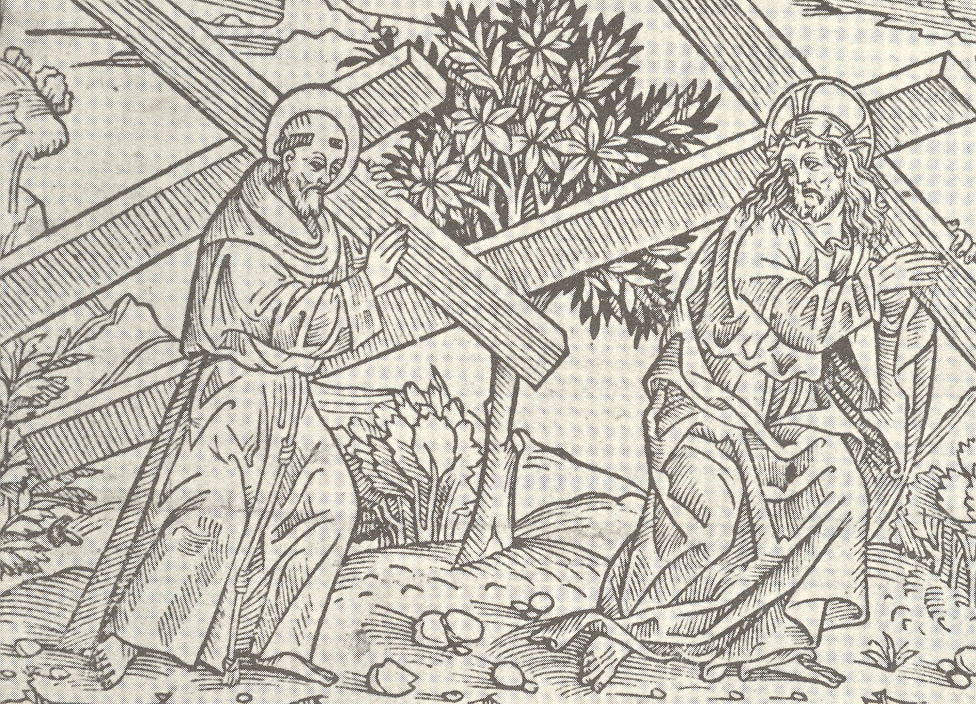
    Blog--christ surprised
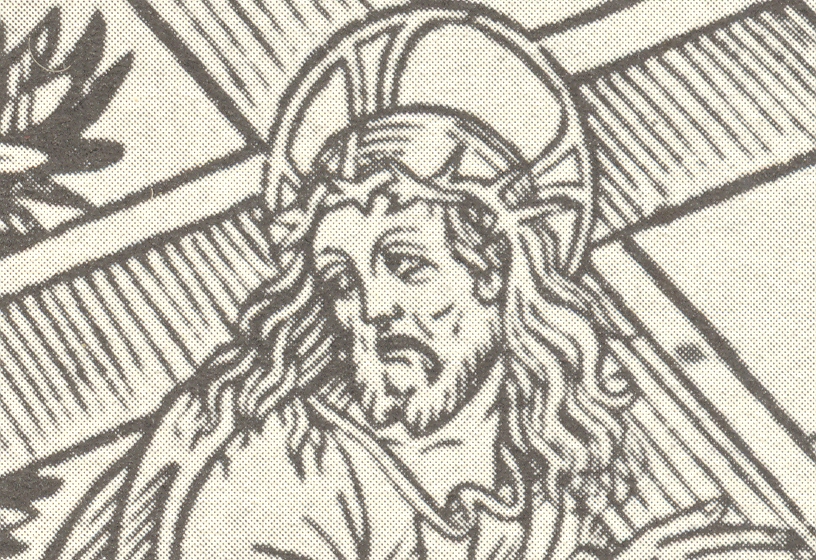
    In Portrait of the Artist as a Young Man, Joyce uses Ovid’s (Metamorphoses, VIII:188) epigram  Et ignotas animum dimittit in artes (“And he applies his mind to unknown arts”  and which continues “and changes the laws of nature”) to describe Daedalus.  It may well address the smaller world of interpretation and metamorphosis of images as it does the larger.  I found this image (at left) in an old bookseller catalog from 1980–it is pretty singular, a show-stopper in a way, the dual burdens of the agony, Christ and the other man.  Actually the woodcut is from the beautiful Liber conformitatium vitae Beati Francsici ad vitam Jesu Christi  (1510) by Bartholomaeus de Rinonichi of Pisa and depicts a scene from the life of  St. Francis of Assisi (1181-1226).  The bookseller notes the work as being very curious and lets it go at about that. On the one hand the work may just well be the massive correspondence on the similarities between the beloved St. Francis and Jesus Christ that it seems to be.  When I look though at the images I can’t help seeing an anti-St. Francis twist to it all. One thing I think that is inescapable is the quizzical look on Christ’s face–he is definitely not sharing the agony, or welcoming a helper. He is clearly at wonder–which in itself is wonderful, as I cannot think of another image showing Christ “surprised”.  It would seem to be a not-subtle attack on the Franciscans in general, an effort to rid it of an exalted place by depicting Francis’ multitudes of too-close similarities to Christ, attacking the order much like the attack on the cults of Mary a thousand years earlier.  I really don’t know–I’m terrifically beyond my element here–I’m just pointing out some surprisingly bothersome aspects of some of the illustrations.  
    Blog--christ surprised 2
    Then again, I’m sure I’m wrong about this “surprised” bit, as this book was a standard for the Order for many years–I just don’t understand the pictures and the interior dialogs that they implied.  I turned to Joyce–perhaps the great master of the internal dialog–to see what I might find there, and then to Hugh Kenner, a revered Joycean interpreter.  And what I found in Kenner commenting on the internal dialog was this:

    “…the Portrait is important not only as an independent work of art but also as a demonstration that the intricate analogical simultaneities of Ulysses and Finnegans Wake are not irresponsibly excogitated from esoteric reading, but grow out of Joyce’s persistent contemplation of intense psychological experience”

    I might as well be working my way through Derrida on Joyce, though without the great suffering.  Could you make that sentence any more difficult by using the same number of words (and without creating poststructuralist vocabulary)? Probably not. His insight might be as obscured as mine.


  • Is the Antiquarian God Left-Handed?

    JF Ptak Science Books LLC  Post 581      Blog Store Site

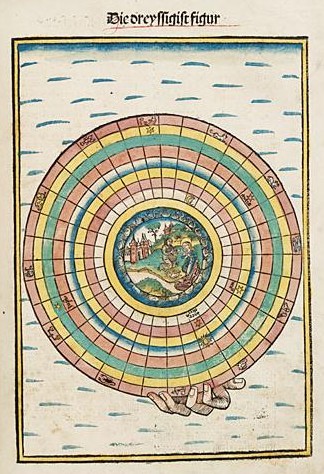
    Blog--fridopion This woodcut is the work of Michael Wohlgemut (1434 – 1519) for an illustration in Stephan Fridolin, Der Schatzbehalter oder Schrein der waren Reichtümer des Heils und ewger Seligheit, which was one of the 15th century’s most brilliantly illustrated books.  It was printed printed by Anton Koberger in Nürnberg in 1491, and formed the backdrop for his even more ambitious book of the next year, the Schedel Liber chronicarum (also known as the Nuremberg Chronicle).  Both books’ illustrations were by Wohgemut and Pleydenwurff atelier (a “school” in which Albrecht Durer had received some of his early training). 
    Hands_of_God_and_Adam
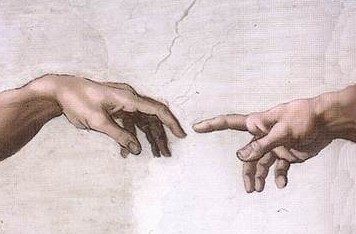
    This center of this woodcut shows the birth of Jesus Christ, a scene circumscribed by numerous other layers representing the heavens and, ultimately, the universe with layer of the heavens  given a zodiacal symbol.  The whole is set in a sketchy blue “sky”, supported underneath by the hand of the creator.  The left hand.  Generally, at least in my memory, images of the creator’s hands have been the right hand.  I’m not so sure why this one is the left.  But it is, and, well, that is unusual.  I don’t know what it means, if anything. 

    LeftHand2


  • 1932 Continued–More on the Beginning of the End

    JF Ptak Science Books LLC  Post 580

    Science Store (Blog with Books for Sale)

    BraveNewWorld_FirstEdition
    Yesterday I wrote about leafing through a 1932 issue of the Illustrated
    London News
    , piecing my way around unexpected bits of historical
    bric-a-brac, surprising myself with the oddness of it all, until I came
    to the reporting of the 1932 German election and the beginning of the
    Nazi takeover of Germany.  The beginning of the end. So it was like a
    bit of enjoyable, entertaining historical surprises until bumping into
    the Nazi cancer.  But 1932 stuck with me a bit. Thinking about it a
    little more, today, I realized that there was much more that the year
    had to offer in the way of epochal beginnings, many of which related in
    some fashion to the beginning and end of WWII (and particularly to the
    May-August 1945 period).

    1932 was a very big year in physics,
    especially in the sub-atomic world, most of which would result in
    Hiroshima and Nagasaki as well as five (!) Nobel prizes.  Irene Curie
    and Frederick Joliot produced proton emission from alpha-ray irradiated
    beryllium in January; James Chadwick discovered the neutron in February
    (getting the Nobel physics three years later); that same month E.O.
    Lawrence and M.S. Livingston developed the cyclotron (getting the Nobel
    in 1939 for it); J.D. Cockroft and ETS Walton produced the conversion
    of an element (He) (winning the Nobel in 1959); C.D. Anderson
    discovered the positron (receiving the Nobel for it in 1936);  Werner
    Heisenberg introduced the proton-neutron nuclear model; and H.C. Urey
    last in that year discovered deuterium (winning the Nobel in 1934).  It
    is an astonishing and long series of significant developments for a
    single year.

    On the seer-ing theoretical part of 1932 came Carl W. Spohr’s “The Final War”, with appeared as a short story in the magazine Astounding Stories.
    Spohr’s story involved the creation of a bi-polar world shared by two
    superpowers both of whom were kept in check with the threat of Mutually
    Assured Destruction–ultimately the MAD scenario fails and the atomic
    bombs fly, devastating the earth.  The Spohr idea of
    scientifically-induced Earth-shredding was preceded by others including
    H.G. Wells (in 1912?) and Pierrepont Noyes (1927).  (Actually, Noye’s
    first edition of his novel depicting nuclear holocaust was sleepily
    called “The Pallid Giant”; when re-issued in 1947 he renamed it with
    more teeth,  Gentlemen You Are Mad.  Noyes is also the son of
    the founder of the socialistic/semi-utopian Oneida society in upstate
    New York.  There was a complex of religious pullings going on up there,
    not the least of which was the living a new human life in the
    post-second-coming of Christ earth, complex marriage, and free love, a
    term Noyes’ father coined, and which did not go over well outside the
    community.  For his part, the younger Noyes settled on a more practical
    end to the community’s social and business life, and established a
    silver- and flat-ware company that became the world’s largest of its
    kind.)  Spohr was six years before A.G. Street’s Already Walks Tomorrow,
    probably the first science fiction/futuristic depiction of worldwide
    apocalypse via environmental disaster and dystopia.    It was also in
    1932 that Aldous Huxley’s Brave New World was published, which
    was the first depiction of a nightmarish end to failed and run-agog
    utopian planning. (The novel begins in the year 632 A(fter) F(ord),
    some years after civilization had been destroyed by war. Ford’s selection here is also ironic because of his heavily-disputed but well-documented anti-semitism and admiration for Hitler*) Huxley’s
    novel follows by two years the related work of Laurence Manning and
    Fetcher Pratt, whose City of the Living Dead tells another story of Utopian collapse, this time of the brain deadening possibilities of alternative and virtual realities. 

    On
    the political end–in addition to Hitler’s victory in the German
    elections–was the Japanese invasion of Manchuria, which may well be
    the true place to start the beginning of World War II. In 1933 Fritz
    Lang’s movie Das Testament des Dr Mabuse is a thinly-veiled
    tale of a brutish criminal organization taking control of the state via
    criminal means and is almost immediately banned by the new German
    government.  The Lang film is basically replaced in the next year by
    the primum mobile of Nazi propaganda films Triumf des Willens
    by the filmmaker who wouldn’t die, Leni Riefenstahl.  Riefenstahl lived
    to 101, long past the disgust that she presented so beautifully in her
    vile lickspittle hearts-and-minds film.  (Few artists have lived to
    100; I’m not so sure that any other filmmakers have.)

    And so for 1932.  This might all be too free-wheeling, but the more I thought about it, the heavier the year seemed to become.  Perhaps there is something there. 

    ·Posted by :

    ·in:


  • Redefining “the Present”: Bitter Bierce, James Joyce and H.G. Wells

    I do not define time, space, place and motion, as being well known to all.  Isaac Newton, Principia, 1687

    Books--burgess I had some lingering thoughts about my post from two days ago which briefly touched on Joyce’s dreamy Finnegan’s Wake (published in 1939, just two years before the author’s death), which led me to the language-creating, never-endingness of one day in his Ulysses* (1922).  It is also a novel of time, reprocessing its time-units lile old Zeno, finding halves of time in regressive size and in greater numbers, roiling around like fly-swatted mercury; we never do get to the bottom of time although it does slow it down considerably.  It follows a slight but powerful literary history, treating time somewhat like the earlier (earliest?) Poe, and especially like that clock ticking in Dostoyevsky’s Crime and Punishment (1866), where action is laid bar to exhaustive and minute interpretation, waiting for no person. 

    A little later on comes Ambrose (“Bitter”) Bierce, a crummudeonly misanthrope with a razor eye for criticism for everything beyond himself.  My guess is that every other person in the U.S. past the age of 30 has read his Alabama-based “An Occurence at Owl Creek Bridge” (1893) in which a lifetime or so could be lived in the moment that it takes for a man killed by hanging. (I have a feeling that this was a very apt way for Bierce to look at his own life, right up to the moment where he rode into infinity in the Mexican desert.)  The prgoression of time is interrupted to tell the tale, everything taking place in the time that it takes to travel eight feet. What I didn’t know when I read the story for the first time was how unusual, groundbreaking, it was for the distortion of time in this way in literature.  Monet and Impressionism Inc.  were at it for a little from the 1860’s or so, but it seems to me that in literature this fracturing of time was pretty scarce.

    These authors were performing experiments with the vast horizon of time, creating a new space in the very slim spectrum that we call the “present”.  In another way, Proust’s Remembrance of Things Past explores past action in a way that redefines what we can think of as a “normal” present.  Looking forward, too, can have a pulling effect on the present, as we can see in the novels of the future by Jules Verne and H.G. Wells. 

    Time in physics is the orders-of-magnitude incendiary to this discussion–it is the fundamental, measurable scalar unit from which stuff like motion  and energy and fields are derived. Things get really interesting in the history of science once you move through Galileo and Newton and Maxwell and get to the time of Planck and Einstein and Minkowski .  Interestingly, the most significant changes occurring in the treatment of time and the definition of the present come in the period from 1865-1915–a particularly fertile period of revolution and modernity, where nearly every discipline undergoes a radical, fundamental change. Everything except political studies, where the only really new thing to come into the fray at that time was the introduction of the concentration camp during the Boer War.  Everything else changes in remarkable ways:  physics, mathematics, art, music, literature, theater, dance.  Astonishing. SpongeBob-SquarePants-AM-FM_F43403B5

    If I was really clever I would find a way for this post to be circuitous, but I can’t, so I’ll just end by saying that I’m out of time.  

    *I’ve included the first lines of the Joyce novels in the continued reading section, along with a few choice others. 

    **For several years in the early 1980’s I read all of Anthony Burgess’ novels, collecting them as well.  I always liked A Clockwork Orange for its dark humor and inventiveness, and for each of  the few times that I met Burgess I had a copy of the book for him to sign.  He was always very gracious, signing my books with appropriate flourishes–with music, or Arabic, or whatever was implied by the subject of the book. The exploding orange is far and away my favorite.


  • Lonesomeness, Anti-Humans, Vestie Davis and the Quark

    JF Ptak Science Books LLC  Post 577

    I arrived at the subject of Lonesomeness in a roundabout way–taking my first look at the lovely 3 Quarks Daily site and thinking about Muster Mark and Humphrey Earwicker and Leon Ledermann and the quark’s (pronounced “quork”, by the way, this from the master’s voice) phenomenologically-obsessed creator, Murray Gell-Mann.

    Lonely--vestie 1

    [The story of the discovery of the quark is a little tricky; Gell-Mann was the first to publish his discovery, preceding the independently-established work and findings of George Zweig.  Zweig’s quarks were called “aces”, and after publishing his results in an internal CERN document, had considerable difficulty in placing the paper in The Physical Review, so much so that he abandoned the effort, only placing the paper in print years later. The CERN paper by Zweig is beautiful, even to someone like me–his high visual thinking (as with Richard Feynman) is highly apparent.  Gell-Mann has been insistent on referring to Zweig’s work and its significance ever since its appearance in the first year of publication of the European Physics Letters in 1964.]
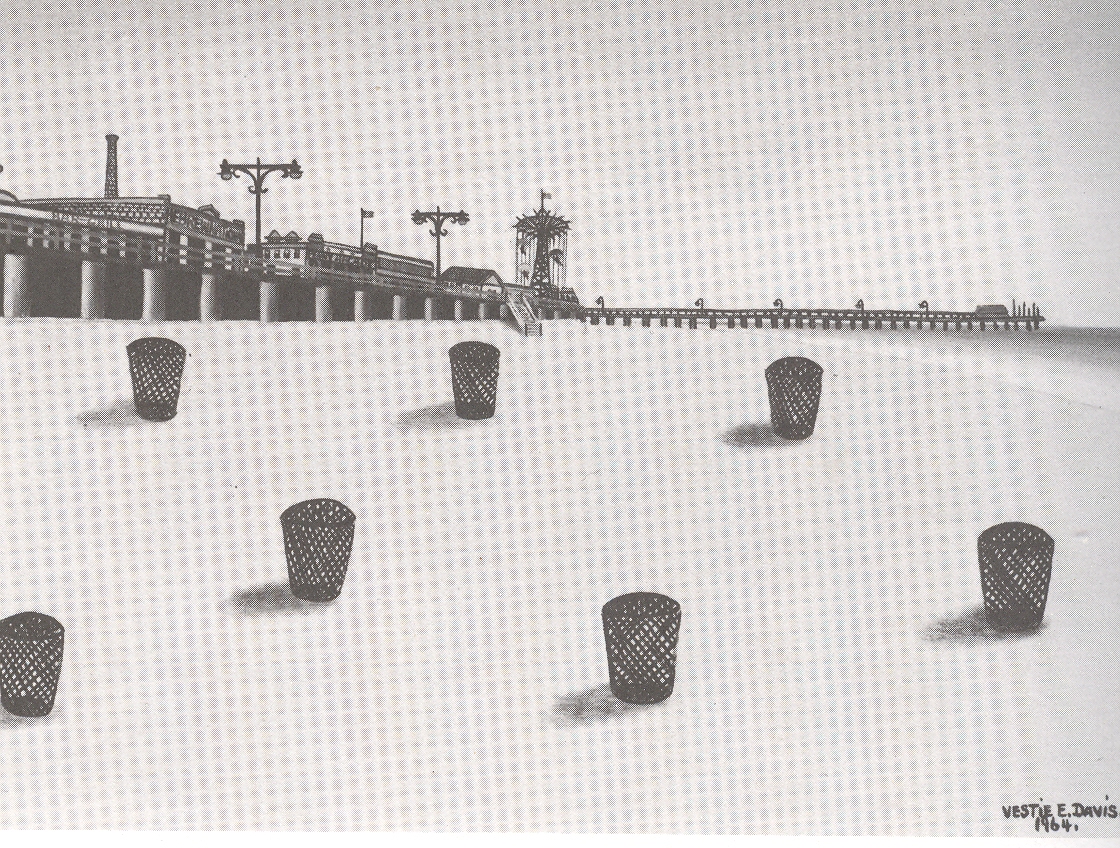
    It is when fast forwarding through the experimental voyage for the picturing of the quark that we meet Leon Ledermann, whose animated semi-serious reference to the discovery of the anti-quark leading was his speculation on “anti-humans”.  The idea of “anti-humans” is quite a lot to think about, and is something much deeper than simply not have humans being there.  But also something different from the anti-neutron, the anti-quark, anti-matter. Lonely--davis 2

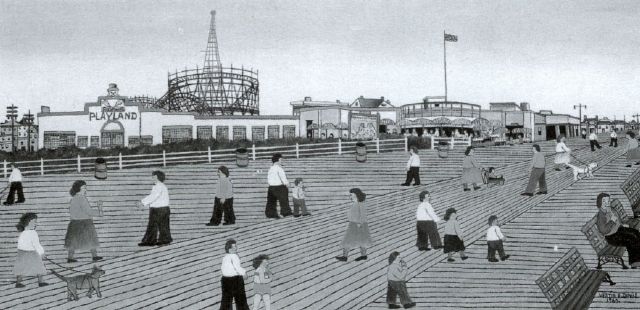
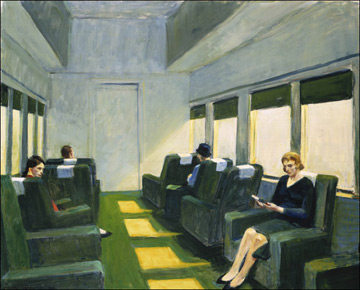
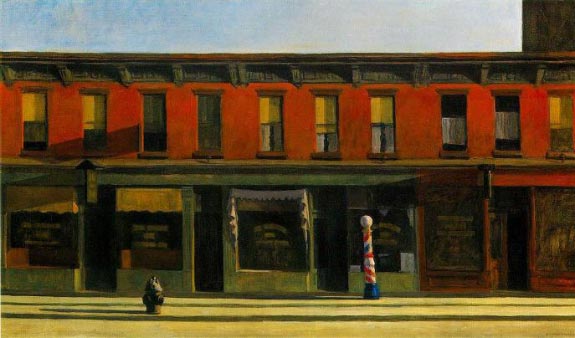
    The anti-human led me to the “not being there” part, and then to the depiction of that idea, and the idea of Lonesomeness, in art. For me the very compelling imagery of lonesomeness is found in this painting at Coney Island by “part-time undertaker, newsstand dealer, and mortuary organist” Vestie E.  Davis (1928-1978).  It is a scene desolate of interaction,  Even when Davis begins to add people into his paintings (making them “sell better”), the  populations seem as brittle as Eliot’s utterly precise diction in The Love Song of J. Alfred Prufrock.  In meek forebearance I add the artwork of Edward Hopper  Both of these men seem to give their canvases a reality that is stretched so thin

    Lonely Hopper

    that it crystalizes the singular moment, and captures the lonesomeness of it all in the instant before the fabric tears.  This is lonesomeness no matter if the seen is vacant or filled with people; Hopper and Davis introduce a finite nothingness that too me is as cold and scary as the antiquarian tombstone for the unnamed “Wife of____”, standing smaller and apart from the dead husband.

    Maybe its the colors–or rather, for me, maybe its the color white. White is largely absent in nature, at least big (excluding clouds), at least that’s what poets like Wordsworth said.  It is Goethe’s vexing color, Melville’s lonesomeizer.  White works to distance everything in the images I’m presenting here, helping to make it possible for lonesomeness to exist in a bleak landscape as well as one with lots of people. 

    And so there you have it–I’m nowhere in this post except to have it serve as a placeholder for some sort of idea about quarks and space and absence and lonesomeness.  Just an exploration. 

    Lonely hopper sunday morning

    ·Posted by :

    ·in:

    —