A Daily History of Holes, Dots, Lines, Science, History, Math, Physics, Art, the Unintentional Absurd, Architecture, Maps, Data Visualization, Blank and Missing Things, and so on. |1.6 million words, 7500 images, 4.9 million hits| Press & appearances in The Times, Le Figaro, Mensa, The Economist, The Guardian, Discovery News, Slate, Le Monde, Sci American Blogs, Le Pont, and many other places… 5000+ total posts since 2008.

Author: JF Ptak

  • The Most Important Menu in the History of Computing–the NORC, John von Neumann, & the Weather

    JF Ptak Science Books LLC  Post 576

    “There is no mystery about these machines[computers]. The mystery is how the human brain has been able to develop them. These devices are merely small tools which men have devised to help them do a better job.”–Thomas J. Watson, chairman of the board of IBM, 1954

    [I need to thank my friend P.J. Mode for pointing this connection out to me years ago!]
    Norc--von n group
    Here is something that one doesn’t get to say very often:  this is perhaps the most important memory in the history of computing. 

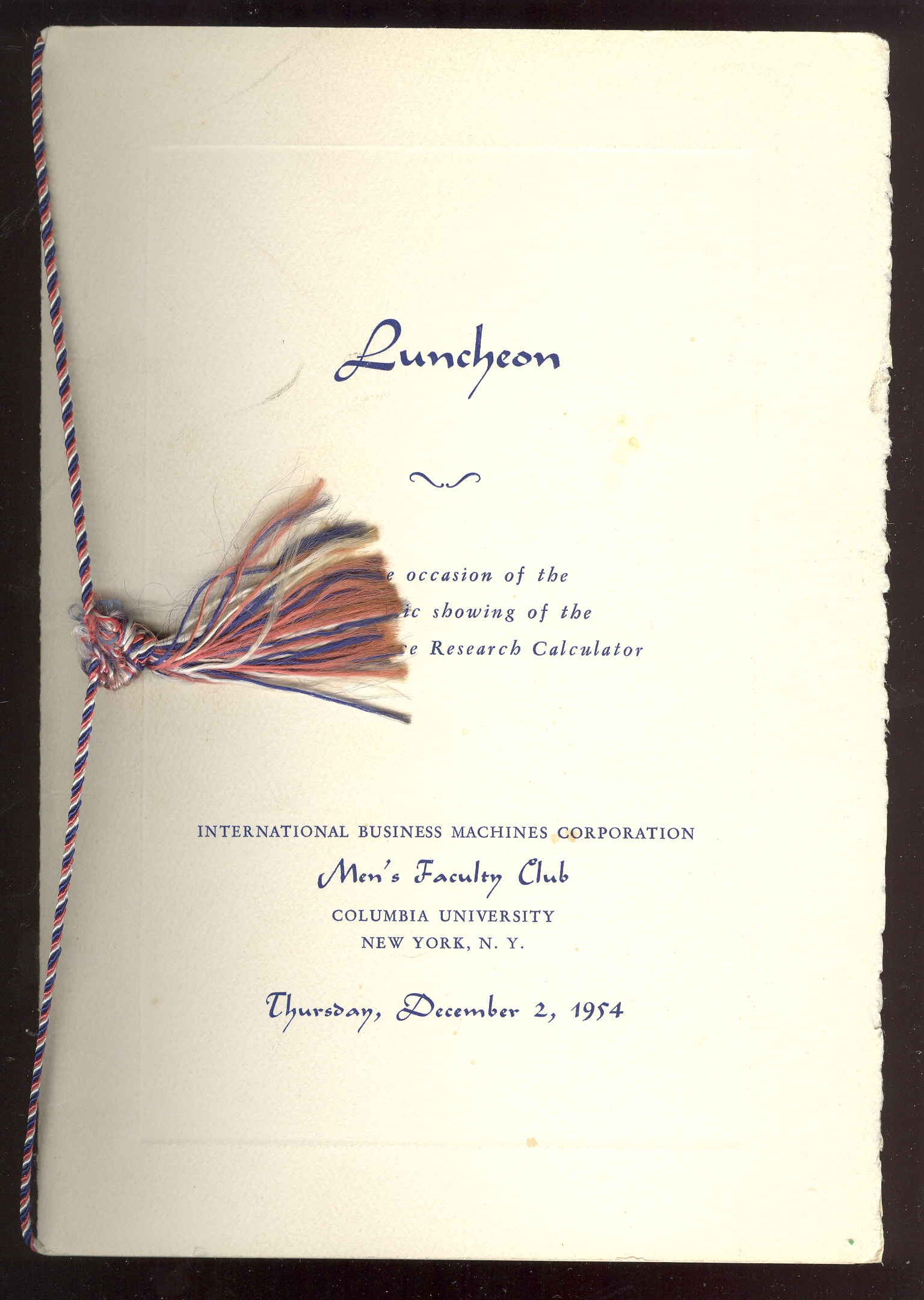
    This is the luncheon menu for the dedication of the NORC “Calculator” (the Naval Ordnance Research Calculator) a computer which was constructed principally with IBM parts and built at the Watson Scientific Computing Laboratory at Columbia.  The NORC was the world’s first supercomputer, and the most powerful computer on the planet for about ten years (from 1954 to 1963, until it was surpassed by Seymour Cray’s CDC 6600 in 1964). 

    The NORC was an astonishing accomplishment, difficult to summarize simply, really, though a very good example is that provided by Dr. Paul Herget, the director of the Cincinnati Observatory.  Dr,. Herget used the NORC in 1956 to make precise calculations of the earths orbit for the 1920-2000 period.  Dr. Herget said: “We used nine hours of running time and completed more computations than had ever before been done at one time in the history of astronomy.’”

    Outside of celebrating the accomplishment of the NORC, the luncheon was also  important for the remarks of the principal speaker, John von Neumann.  Von Neumann of course was perhaps the most expansive mind of the century–a thinker of phenomenal proportions and the father of the modern computer.  His brain was impossibly big.  Impossible. 

    During the luncheon von Neumann made prescient and extraordinarily wide remarks on the future utility of the computer.  Some of the highlights (from the entire address, included below):

    –it is now “practical and feasible” to forecast, with the NORC, the weather for an entire hemisphere thirty or sixty days ahead

    –calculation of the tidal motions of all the oceans, the marginal movements near the continents as well as the main motions of the oceans

    –the hydrodynamics of the earth’s fluid core

    –“In the statistical field, dealing with matters which are not wholly mechanical, such as troop operations and logistic operations which involve purely accidental factors like the prevailing weather during the operation, command decisions which have not yet been officially made can be stipulated and various solutions for various alternatives calculated. This has been done before on a minor scale but it takes too long to do on a large scale. “In this field the importance of NORC is enormous…”

    –in the first four hours of operations the NORC  performed more work than any calculator of ten years ago has performed in its entire lifetime. He termed this performance “completely fantastic; I doubt if it has ever been done before.”

    Norc--von n group menu

    The last section of von Neumann’s comments:

    “The last thing, which is very important, is said in fewer words, but I think that it is none the less important. And it is this: In planning new computing machines, in fact, in planning anything new, in trying to enlarge the domain of parameters with which one can work, it is of course customary and very proper that one should consider what the demand is, what the price is, whether it will be more profitable to do it in a bold way than in a cautious way, and so on. This type of consideration is necessary — the world would very quickly go to pieces if these rules were not observed in 99 cases out of a hundred.

    “It is terribly important that there should however be one piece in a hundred where it is done differently.

    “And that one uses the definition which Dr. Haven (?) pointed out 20 minutes ago, namely to occasionally do what the U. S. Navy did in this case and what IBM accepted in this case: to write a specification essentially to build the most powerful machine that is possible in this day with the present state of the art. I just hope that this will be repeated very soon and will never be forgotten.    http://ftp.arl.mil/~mike/comphist/54nord/

    It may be the last statement that is the most important–pressing those of the present and future to perform
    Norcd

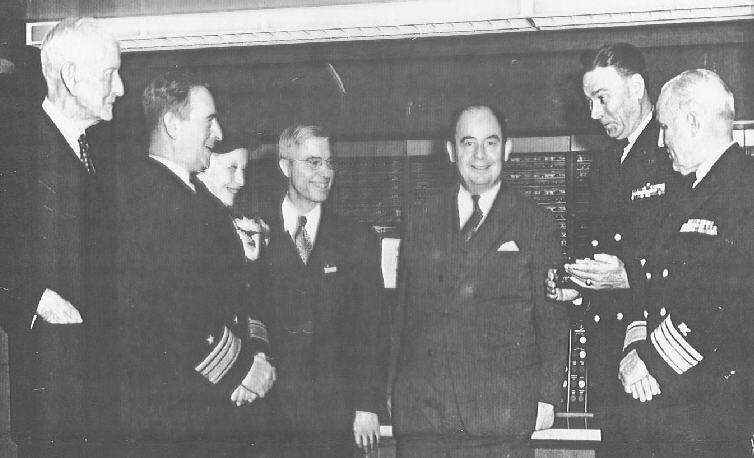
    The NORC group caption from the IBM Archive website:
    “At the NORC dedication in Watson Lab, 2 December 1954: IBM Chairman Thomas J. Watson, Rear Admiral E.A. Solomons (Executive Office, Secretary of the Navy), Jeannette Watson (Mrs. Watson Senior), Columbia Professor Wallace Eckert, John von Neumann, Captain C.K. Bergin (Director, R&D, Bureau of Ordnance, Dept of the Navy), Rear Admiral C.G. Warfield (Executive Office, Secretary of the Navy).”  The Navy is happy here because they wound up with the computer at Dahlgren.  Von Neumann was happy because he got to play von Neumann his whole life long. 

    The IBM press release for the NORC included the following summary of the event and the von Neumann address:

    NORC Press release//The following is the text of a December 2, 1954 IBM press release regarding the first public demonstration of NORC and its official “delivery” to the U.S. Navy.

    The first public demonstration of NORC (Naval Ordnance Research Calculator), fastest and largest capacity electronic calculator in existence, which has been built by International Business Machines Corporation for the Bureau of Ordnance, U.S. Navy, was conducted today at the Watson Scientific Computing Laboratory at Columbia University in the presence of approximately 150 representatives of the U.S. Navy and other Government departments, education and scientific research institutions and industrial companies. The machine was accepted on behalf of the Bureau of Ordnance by Captain C. K. Bergin, USN, Assistant Chief of research and development of the Bureau, from Thomas J. Watson, Jr., president of IBM.

    At a luncheon following the demonstration, Professor John Von Neumann, of the Institute for Advanced Study, Princeton University, and an appointee to the Atomic Energy Commission, discussed possible uses for the NORC other than for the immediate problems of the Bureau of Ordnance, instancing the field of geophysics as having great possibilities.

    It is now “practical and feasible” to forecast, with the NORC, the weather for an entire hemisphere thirty or sixty days ahead, by calculations occupying perhaps 24 hours, with results about as good as those obtained by an experienced subjective weather forecaster, “which are very good.” Calculations similar to those now made, forecasting weather over the area of the United States for 24 hours in advance, could be made on the NORC in perhaps half a minute, he stated.

    Complete calculation of the tidal motions of all the oceans, the marginal movements near the continents as well as the main motions of the oceans, is now, with the NORC, a matter of days and therefore feasible. He also declared that calculation of the hydrodynamics of the earth’s fluid core, the movements of which are responsible for the main phenomena of terrestrial magnetism, “becomes probably accessible for the first time.”

    In the statistical field, dealing with matters which are not wholly mechanical, such as troop operations and logistic operations which involve purely accidental factors like the prevailing weather during the operation, command decisions which have not yet been officially made can be stipulated and various solutions for various alternatives calculated. This has been done before on a minor scale but it takes too long to do on a large scale. “In this field the importance of NORC is enormous,” Dr. Von Neumann said.

    He concluded by pointing out that the NORC was assembled less than two months ago and put on test less than two weeks ago, yet in a test yesterday (Wednesday. Dec. 1) it ran for four hours without an error, doing in this period more work than any calculator of ten years ago has performed in its entire lifetime. He termed this performance “completely fantastic; I doubt if it has ever been done before.”

    Dr. Grayson L. Kirk, president of Columbia University, stated that during the test period the NORC will be available to the University for important research projects, particularly in the field of nuclear physics, before it is shipped to the Naval Proving Ground, Dahlgren, Va. to be installed in the Computation Laboratory already established there.
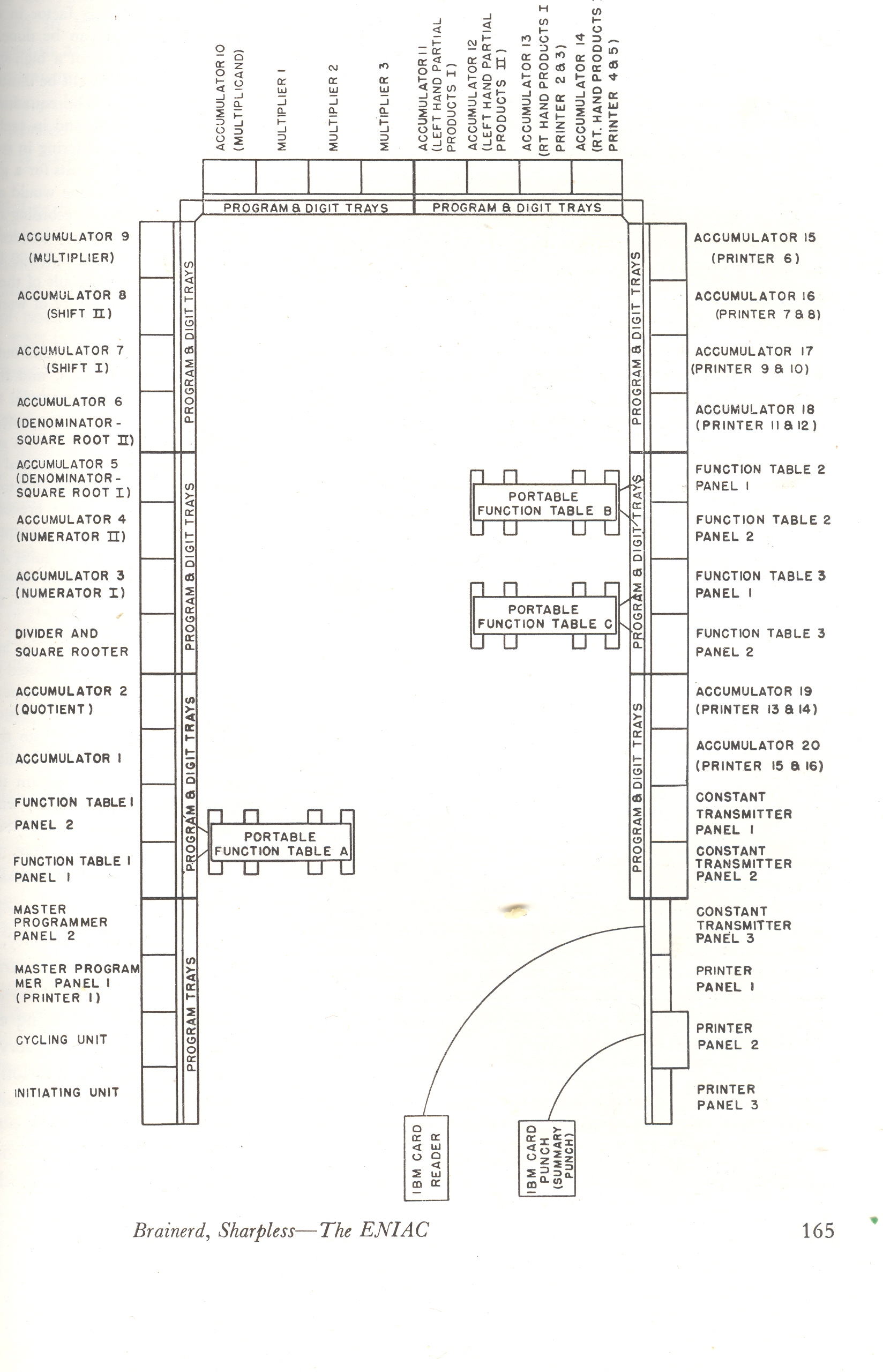
  • An Outline Map of a Great Complexity: the ENIAC, 1948

    JF Ptak Science Books LLC  Post 575

    “The ENIAC exists independent of its history”–Brainerd and Sharpless

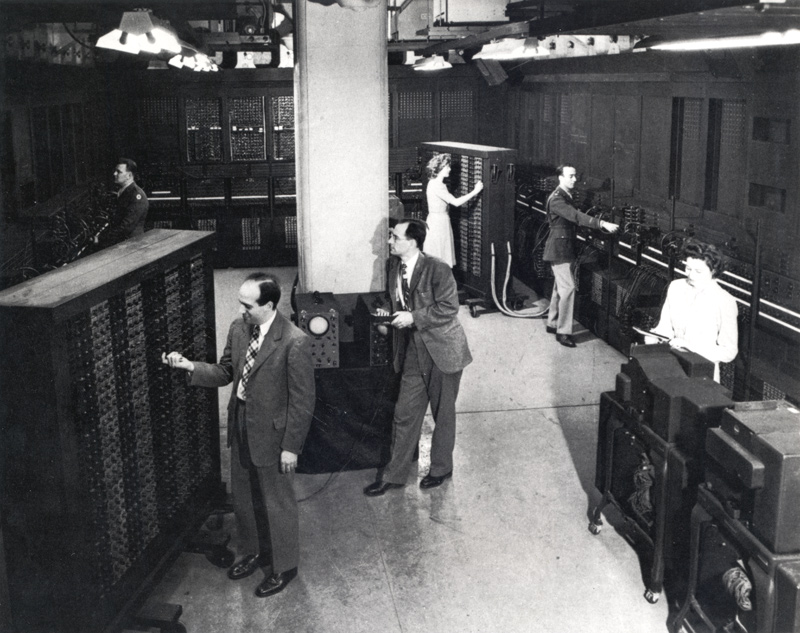
    Eniac


    The
    ENIAC (
    Electronic Numerical Integrator And Computer, b. 1943-45) was, basically, the world’s first
    operational, high-speed digital computer, and the father of the computer
    industry.  What we see to the left  is the floor plan for the
    computer-with-no-monitor—I know to most people working today with a computer
    that the idea of a “floor plan” for anything that is not in a dark place at NSA
    is not easily conceivable.  The 30-ton,
    18,000 tube, 125 KHz ENIAC’s space was about 1800 square feet, where it was able to
    add about 5000 numbers/second, which was vastly faster than anything else in
    existence. It operated with
    70,000 resistors, 10,000 capacitors, 5
    million hand-soldered joints and 6,000 manual switches. It was a magnificent achievement.

    There are many sites dedicated to the history of the ENIAC—all
    I want to do here is surface this detailed floor plan of the computer, which seems
    not to be online.  The diagram comes from
    an article by J.K. Brainerd and T.K. Sharpless (Sharp brain!), “The ENIAC”,
    from the February 1948 issue of Electrical
    Engineering,
    which defines the machine and its components in full.  The abstract states: “The ENIAC is the only
    electronic large-scale general-purpose digital computing device now in
    operation.  Its speed of operation
    compares favorably with other electric and mechanical computers.  Developed under wartime pressures, it has
    been of value not only in producing results but in pointing the way toward
    improvements for future designs.” 
    Indeed.  The authors, both of whom
    worked on the construction of the machine from 1943 onwards, describe it in the
    following ten points:

    “1. Large-scale 2.General purpose 3. Digital 4. Electronic  5.  Uses
    10-digit numbers   6. Uses decimal system   7. High
    speed   8. Synchronous operation    9. Some parallel operations possible 10. Complete
    flexibility within limits of programming capacity” (page 170).

    The authors make the following (qualified) understatement: “electrical
    engineers in the United States
    have had a major interest in development of large-scale computing devices”
    mentioning the major players as MIT, Moore
    School (U PA), GE, Bell
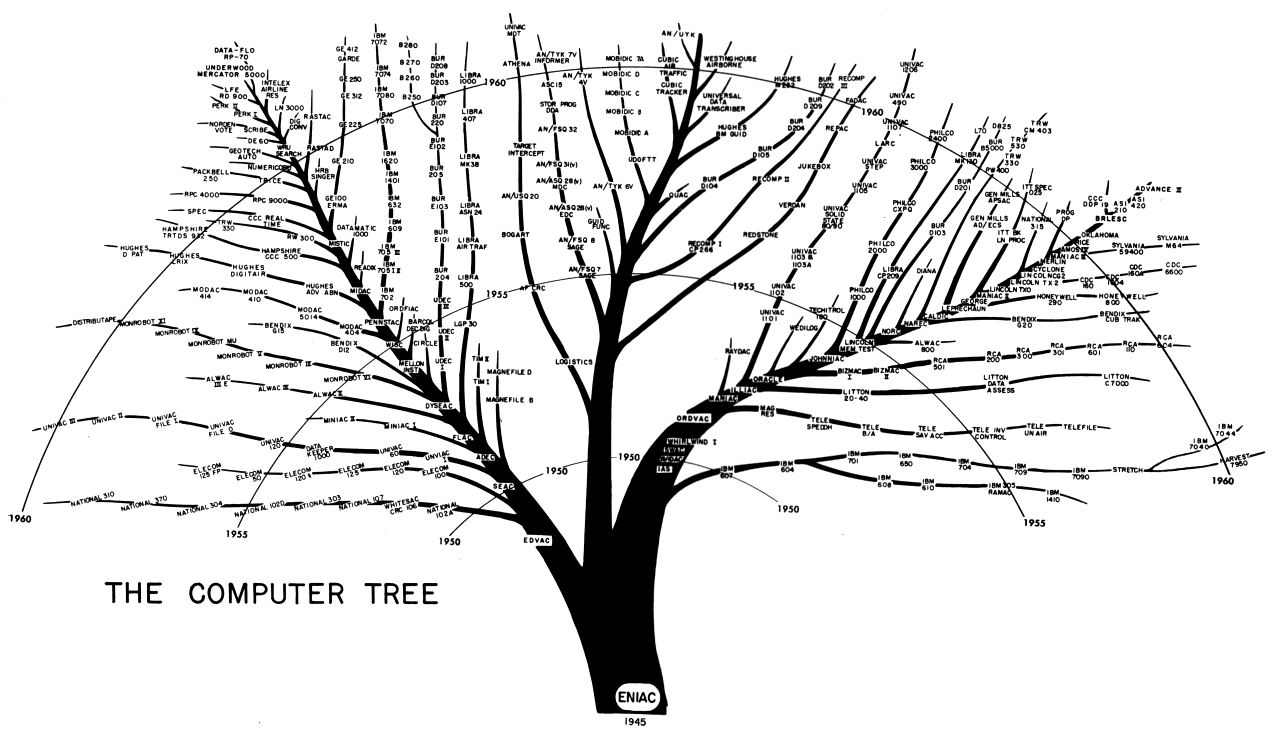
    Telephone, Harvard and the spelled-out “International Business Machine corporation”.  Within ten years of the end of WWII the second generation of computer was nearly functional, and (as can be seen in the wonderful computer tree below) there were dozens of new machines in operation. By 1960, the explosion was getting ready  with the advent of microminiaturization. 

    Eniac comp tree

    Eniac2

    The computers in operation from 1938 to 1948 include the
    following alphabetical hodgepodge: Z1 Z2 Z3 Z4, ABC, Bell Model II, S1, Mark I,
    Mark II, Elliot 152, ARC, Mark II, SSEM, and the more poetic Colossus and
    Demon. (Zuse Z1 1938;  Atanasoff ABC 1939;
     Zuse Z2 1939;  Bell Labs Complex Calculator aka Model I1940;  Zuse Z3 1941;  Zuse S1 1942; Bell Labs Model II; 1943
    Bletchley Colossus Mark I 1943; Zuse S2 1943; Bletchley Colossus Mark II 1944;
    Harvard Mark I 1944; Zuse Z4 1944; Bell Labs Model IV  1945;  Bell Labs Computer Model V  1947;  Elliott 152 1947; Elliott 153 1947;  Moore School ENIAC 1947;  Birkbeck ARC 1948; Harvard Mark II 1948;
    Manchester University SSEM 1948;  NSA DEMON
    1948.)


  • On the Under- , Partial and Full Discoveries of Oxygen

    JF Ptak Science Books LLC  Post 574

    Oxygen
    Our sea of air is composed of atoms, and the atoms are
    mostly nitrogen (78%) and oxygen (21%), and the atoms are of course all around us; though
    as obvious as it is, as present as it is, the most active component of air, oxygen,
    remained under-discovered until relatively late in human history.  Oxygen is present in all major classes of
    structural molecules in living organisms and in all manner of inorganic
    compounds, and is   When it was
    discovered, it really wasn’t; or it wasn’t discovered and recognized until the
    second time around.  But the stuff that
    was whirling around its near discoveries were important in themselves for their
    constituent parts. 

    Johann Joachim Becher (born in 1635 and dead at 47 in 1682)
    got part of the way there, though he didn’t discover oxygen—he discovered the
    thing that oxygen wasn’t: 
    phlogiston.  But the phlogiston
    theory worked a little, but not a lot. 
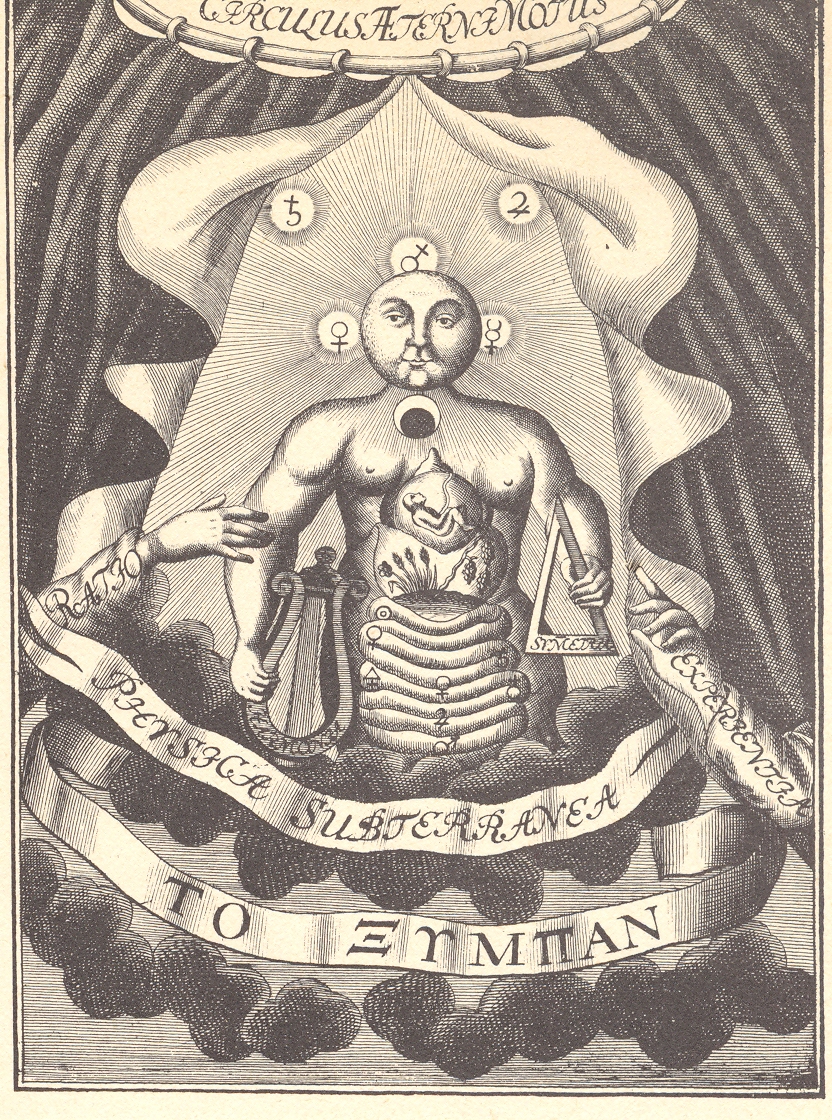
    The theory appeared in his book Physica
    subterranean profundam subterraneorum genesin e principiis bucusque ignotis…
    and
    was published in 1669. (Actually, his Subterranean book was published just a
    few years after our old friend Athanasius Kircher’s masterpiece Mundus Subterreaneus. Just a tired note
    from the small-world category.)  Actually
    what the phlogiston theory “did” was explain the process of fire and
    oxidation—phlogiston was the colorless/odorless/undetectable stuff that was released
    from the combustibles of the four elements of the Greeks when they rusted or
    caught on fire. Once the phlogiston was released, the true nature of the
    material that once held it was then revealed. 
    As James Conant wrote in. The Overthrow of Phlogiston Theory: The
    Chemical Revolution of 1775–1789
    . Cambridge :
    Harvard University Press (1950, page 14):

    “…in general, substances that burned in air were said to be
    rich in phlogiston; the fact that combustion soon ceased in an enclosed space
    was taken as clear-cut evidence that air had the capacity to absorb only a
    definite amount of phlogiston. When air had become completely phlogisticated it
    would no longer serve to support combustion of any material, nor would a metal
    heated in it yield a calx; nor could phlogisticated air support life, for the
    role of air in respiration was to remove the phlogiston from the body.”

    The other thing that happened was that the phlogiston
    released into the air could not on its own support life.  That meant it wasn’t not oxygen, it was the
    opposite of oxygen:  anti-oxygen.  Anti-oxygen is an interesting, very science
    fiction-y topic, a very cool brick for 
    the edifice of contracting imaginary worlds.  But in the world of the late 17th
    century and for another hundred years, it as the material of theory. 

    Becber’s
    Physica was actually not that at all,
    either:  it was a work on chemistry, and
    alchemy, and addressed itself too to the positive possibilities of
    transmutation.  On the other hand, Becher
    was the very first to attempt to construct a theory of chemistry.  As stated by Thompson in his history of
    chemistry:  “(Becher) was the first
    person who can with propriety be said to have attempted to construct a theory
    of chemistry; Boyle, who was responsible for hastening the downfall of
    alchemical and other onions, did not attempt to set out (such a theory)…”

    Joseph
    Priestly on the other hand did actually discover oxygen in 1774—or at the very
    least was the first to get into print about the discovery, establishing priority
    over 
    Carl Wilhelm Scheele who seems to have
    discovered oxygen first in 1773 but was second in print on the matter–but he couldn’t believe
    his own results enough to dislodge phlogiston, and went to his grave an
    unredeemed phlogistonist. ((I admit to being pretty flippant here, as Priestly
    was an enormously talented man, at high rank in part of the great panoply of
    scientists; he was also a great political observer and pamphleteer who paid dearly
     for his morality.)  It took Antoine Lavoisier’s beautiful
    experiment in 1777 that established the work of Priestly and Boyle beyond
    question, killing phlogiston once and for all. 
    As a matter of fact Lavoisier also published his account along with a
    general treatise on chemistry in his
    Traité élémentaire de chemie—a book that looks remarkably fresh for being
    printed in 1789—completely it at age 47, just four years before he was
    guillotined for being seen as an enemy to the people of France.  But that (along with the exceptional Mme.
    Lavoisier, is another story).
     

    _____

    The illustration above is actually from the 1738 edition of Becher.


  • Unusual Collections Department: a Collection of Roads

    JF Ptak Science Books LLC  Post 573

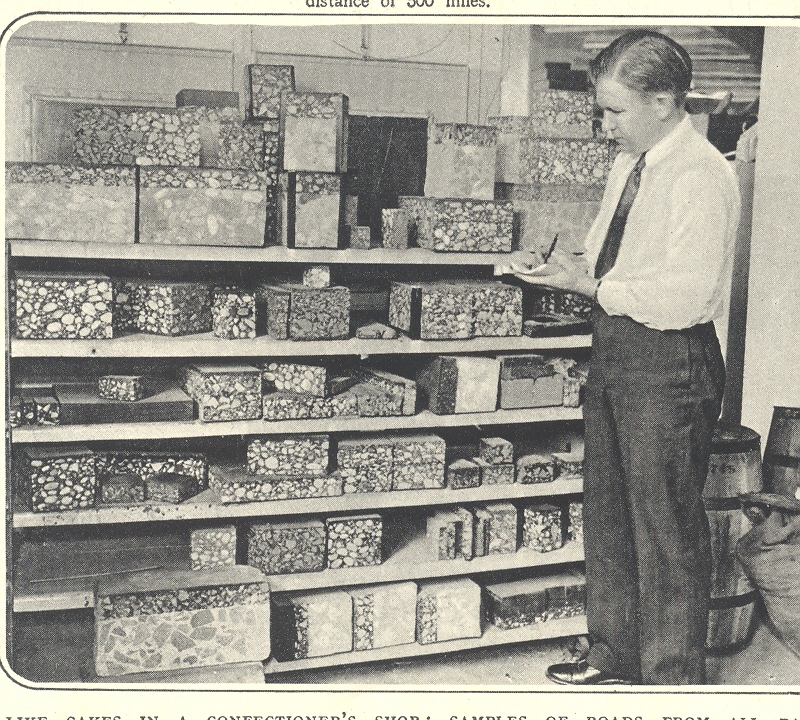
    Road samples
    In my time I’ve encountered interesting people with advanced, iconic and unusual collections:  there’s one fellow with a superb collection of (better than 20,000) cds with basically nothing to play them on (but of course he knew all  of the music, and listening was almost but not quite secondary); there’s another with an audio outfit worth better than a quarter million with literally almost nothing to play on it.  Then there was the delightful fellow in the salvage business who collected cornerstones (!) and giant iron puddlers.  And of course the bee collector with dozens of thousands of specimens.  Oh yes!  And there was that time when I had a meeting with a man on something (on the day the Challenger exploded) unrelated to the spectacular collection he showed to me:  the world’s largest, privately-owned 19th century mechanical toys.  It was really just unbelievable.  So was the man, who in the course of the day, as we sat watching the Challenger story unfold, performed on of the most amazing feats I’ve ever seen in my life. 

    My friend Marty Weil chronicles the wants and needs of collectors of all manner of things, from bus passes to matchbooks to god-knows-what, in his excellent ephemera blog.  I collect dirt and antiquarian artwork by children, among other things.   Also, once upon a time I owned a very large collection of lower gastrointestinal dissections as well as gorgeously prepared wet dissections of salivary glands. 

    And so it was that when I came upon this unusual image in The Illustrated London News for 21 May 1932 I felt a certain tenderness.  This is a pictre of a road collection, located somewhere in the U.S.,  and includes shelf upon shelf of cross sections of roads.  They happen to look like cubes of fat to me.  (We’ll leave the bags of eyes story for another time.)  I understand the need  for  such a collection for engineering purposes; I just happened to like the idea (and the picture) of A Road Collection, and have it undisturbed by any explanation or insight.  Just a collection of roads. 


  • On Degrees of Wrongness: Holocaust Denial and Checking Out a Footnote

    JF Ptak Science Books LLC  Post 572

    Extermination
    In researching an unusually early pamphlet on the
    extermination camps of Auschwitz and Birkenau (Les Camps d’Extermination Allemands Auschwitz et Birkenau, published
    in Paris in the July/August 1945) I stumbled upon—slid threw, I should say—a
    reference to it from a paper by Carlo Mattongo published by the Institute of Historical Review.  The IHR is a decades-old organization
    dedicated to the denial of the Holocaust (though they would call their work
    something different, like challenging plagued historicism and that sort of
    thing).   Now I’d soon as talk about this
    as I would the Creationist anti-evolutionary beliefs, but the author of the
    much-referenced  paper footnoted the
    scarce Camps publication, citing it
    as an example of incorrect reporting and thus supporting his Holocaust denial
    stuff.  Well, there are many dozens of
    footnotes like these in the IHR paper, but since I had the source reference
    right in my hand, I thought that I’d check out the scholarship a little and see
    what the complaint was all about.

    (The founders of the IHR had deep roots in such
    organizations as the (British) National Front (a white-only, far far right
    suprematist group which seems to spend a lot of time denying that they are
    Nazis) and the Liberty Lobby.  The
    Liberty Lobby was founded by a man who philosophy was absed onbt eh work of a
    disturbed Nazi-hagiograph named Francis Yockey (who wrote undethe name of Ulick
    Varange).  His own connections are a
    catechism of hate groups: he worked and had associations with The
    German-American Bund, the German-American
    National Alliance
    , William Dudley Pelley‘s Silver
    Shirts
    , Sir Oswald Mosley’s Union
    Movement
    , George Sylvester Viereck,  H.
    Keith Thompson
    , Gerald L.K. Smith, and James
    H. Madole
    ‘s National Renaissance Party. Such is the
    intellectual heritage of the IHR.)

    What Mattongo uses to bolster his anti-Holocaust claim is
    the Les Camps Exterminer description
    of the crematoria at Birkenau, which he says differs with another report (above ground
    versus underground crematoria). This difference in description is evidently a
    terrifically damning contradiction for that author, and in an O.J.-glove-like
    move uses it to question the entire edifice of the Holocaust.    

    The issue of the location of the crematoria is unclear in my
    reading of the document. 

    What is terrifically crystal clear is what comes on the very
    next page, just paragraphs down, from Mattongo’s citation:

    “En principe les Juifs seulement sont mis a mort par le gaz:
    les Aryens tres rarement, car on leur administer generalement le “traitement
    special” par fusillade..”  (p. 18). This
    states that it was pretty much only the Jews who were gassed, while everyone
    else was shot to death.

    I guess Mattongo
    liberalizes this statement to be inadmissible since the report had mentioned
    that the crematoria may have been underground rather than above ground.  What is more deeply remarkable is that this
    report is one of the earliest published documents to get a close estimate on
    the number of Jews exterminated:  there
    is a table on page 32 that calculates the number of Jews exterminated at
    Auschwitz and Birkenau from April 1942 to April 1944.  That number is 1.765 million.  It is 
    a big number, and it is a number dedicated solely to the Jews.  Even in the groundbreaking May 1945 report
    issued by the Eisenhower investigation the Jewish element of those exterminated
    in these camps was not emphasized.  For
    Mattongo and the Holocaust deniers, all of this becomes nothing, the fabric of
    history caught and unraveled, as it were, snared on a bit of a mostly-imaginary
    nail head. 

    The Holocaust deniers are deep in their own secret and dark
    world, inventing useful denying tools as they go along.  In this case, a reference is unclear, and the
    document was mined solely for supporting detritis, while ignoring every other
    remarkable item in it.  Here’s another example
    of their not-so-minor tricks that I’ve noticed in this journal—the overuse of
    quotation marks.  They are sometimes used
    properly, sort of, when quoting source material–but quotation marks are also
    liberally employed in general use, like when referring to words like “proof”
    and “murder” and “witness” and “Holocaust” when referring to them as ideas.  And so what happens is that the quoted and
    footnoted materials (however miserable and inaccurate they might be) are mixed
    in with the unattributed quotation marks, making them all look vaguely
    referenced in some way.  What the authors
    are doing is exterminating the value of the words used by others for ideas that
    they do not believe in. An inmate’s first-hand account of extermination at Auschwitz thus becomes a “witness”, and then becomes less
    than that, calling into question the absolute veracity of the first hand
    account.  Insidious, really. 

    I’m sorry to have spent time thinking about this.  But sometimes when you’re slapped in the face
    with a big paddle of Wrong you just have to react. 

    Here’s something else: when I went web-cruising for information on some of the founders of these IHR-like movements, I came across some very plain vanilla biographies of their Nazi/fascist heritage-makers in Wikipedia.  Obviously the entries were made by people who had some form of belief in their subject, and then granted the world access to their research via the online encyclopedia.  Now I know anyone can edit these entries to reflect a more more cogent, comprehensive, appraisal of founders of hate groups, but no one had.  I bump into questionable stuff like this in Wiki a lot.  My question is:  how much wrong must there be to make something valueless?  If the Encyclopedia Britannica was known to be 8% wrong, does it still have value?  If the PDR was 4% incorrect, would people still use it?  What about Wiki?  How wrong does something need to be before it needs to be started all over gain?

    ·Posted by :

    ·in:


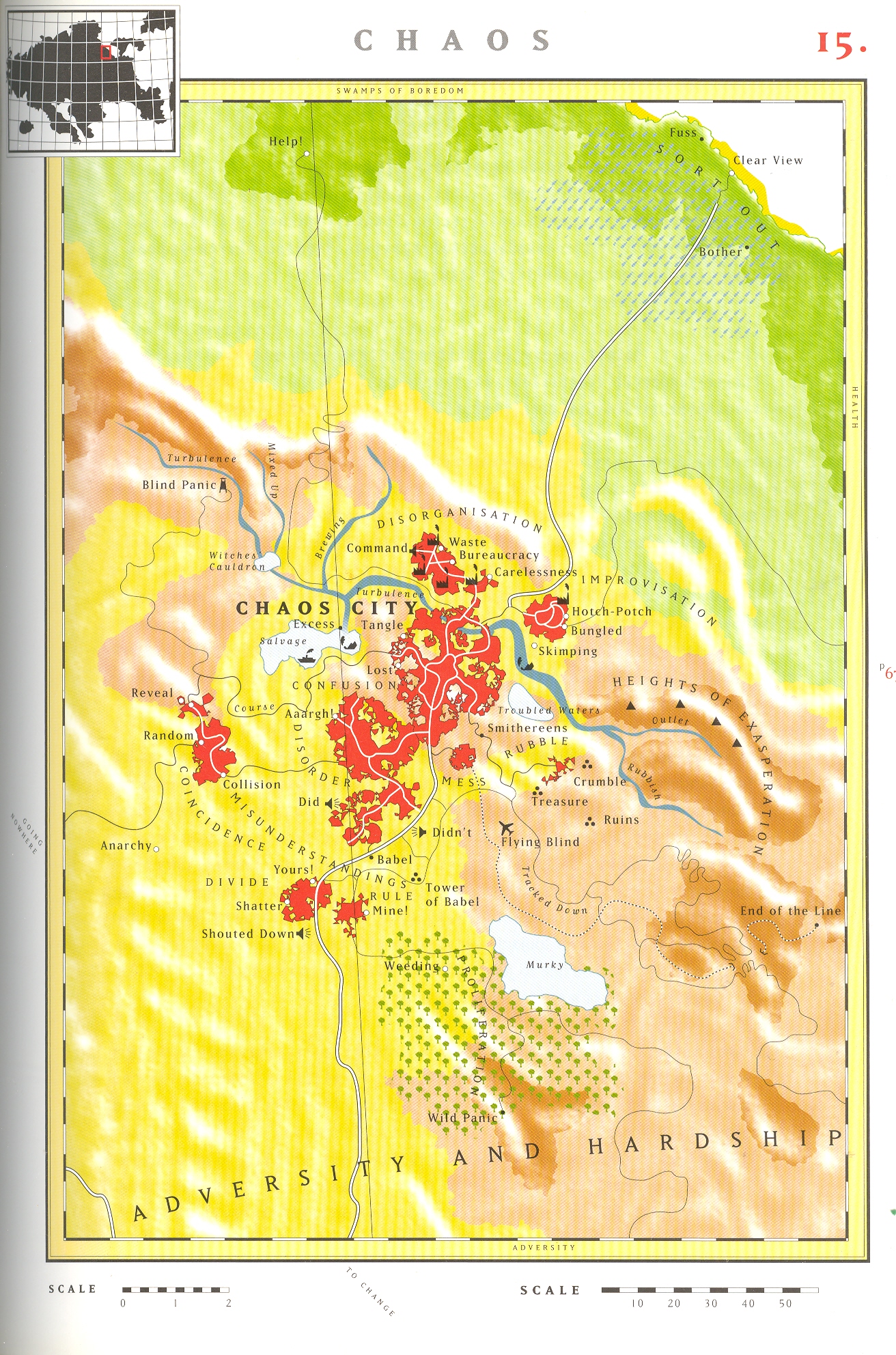
  • Locating Chaos (Addendum): The Land of Chaos in the “Atlas of Experience”

    JF Ptak Science Books LLC  Post 571 and a half

    The ink on my last post hadn’t really dried when my wife, Patti Digh, said that she had seen another a map of Chaos.   And of course she was right–it was sitting happily in the beauty-bending The Atlas of Experience by Louise van Swaaig and Jean Klare.  This is a most unusual work, using familiar mapping skills and general topography to create geographic landscapes for lands of ideas, concepts and emotions. They provide maps for Secrets, Knowledge, Bad Habits, Home, Boredom (my favorite!), Health, Stream of Ideas, The Isles of Forgetfulness, Passion, Mountains of Work, Growth, The Void, Adversity, Chaos, Adventure, Haute Cuisine, Pleasure, Change, Mortality, and Elsewhere (my second favorite).  This just a damned lovely book. 

    Chaos atlas


  • Locating Chaos: Giovanni Della Porta’s Natural Magic and Chaos in the Sky

    JF Ptak Science Books LLC  Post 571

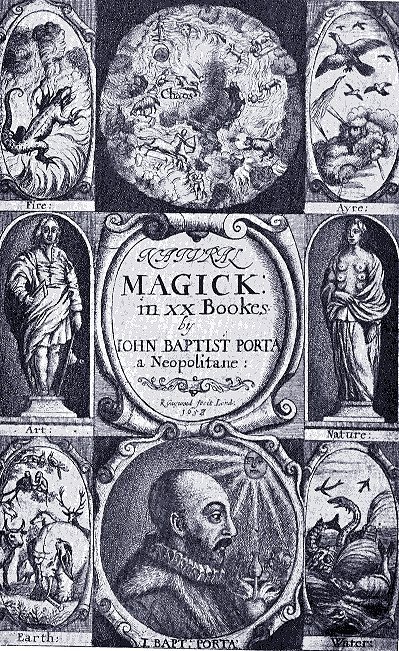
    Porta title page
    Giovani Baptista della Porta was a magus, or a natural
    magician*, who searched nature for similarities that would serve to build a
    broad template of forced  understanding of seeming likenesses, looking for the great connector
    in the exceptional and the unusual, the stuff outside of the formerly
    Aristotlean world.   Natural Magic is his magnum opus, an expansion of  its earlier
    version (Magna naturalis)  published in Latin in 1558, which Porta expanded to twenty sections in 1589. It was an encyclopedic work of vast proportions, a
    gold-mine of information and clever wishfulness, and very accessible due to
    Porta’s  wide inter-personal travel**,
    very wide reading and critical abilities, clear reasoning and deep vision:  the book was hugely successful, going into at
    least twelve Latin, four Italian, seven French, two German, and two English
    editions in the early modern era. Natural
    Magic
    , which first appeared in English in 1658, concerned itself with
    magic, alchemy, optics, geometry, cryptography, magnetism, agriculture, the art
    of memory, munitions, and many other topics, all grouped together and refined,
    distilled, into a cloudy assemblage of natural knowledge—it would end up that the magical
    whole was worth far less than the sum of its parts. 

    But the parts were pretty considerable, and much of the
    information was spot-on for the time, not the least of which was a very capable
    demonstration and explanation of a lensed camera obscura. 

    What I’m interested in right now though is the title page of
    the book.

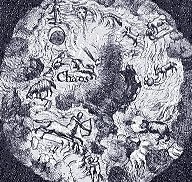
    Porta title page detailIt turns out and as we can see in the top image of the
    title page, Chaos is not some subspace trajectory of cellular automata, or in
    Dr. Brown’s/Einstein’s dancing dust—it is right above us.  This recognition of its regular, localizable structure
    probably does not support parameterization, or anything else for that matter,
    except to say that it is definitely “pretty”. 
    The title page has nine illustrated compartments:  the four corners depict the four elements,
    the two opposing middles show art and nature; the bottom shows the author,
    illuminated by the knowing sun.  The top
    center image is the element showing “chaos”, which I’ve chosen to use a map,
    identifying where exactly chaos might be. 
    I’ve not seen an antiquarian map identifying chaos, though I have seen a
    number showing lots of other non-existent places, like heaven and hell and
    purgatory and Eden and the Kingdom of Prester John, to name a few.  But not chaos.

    Porta sky

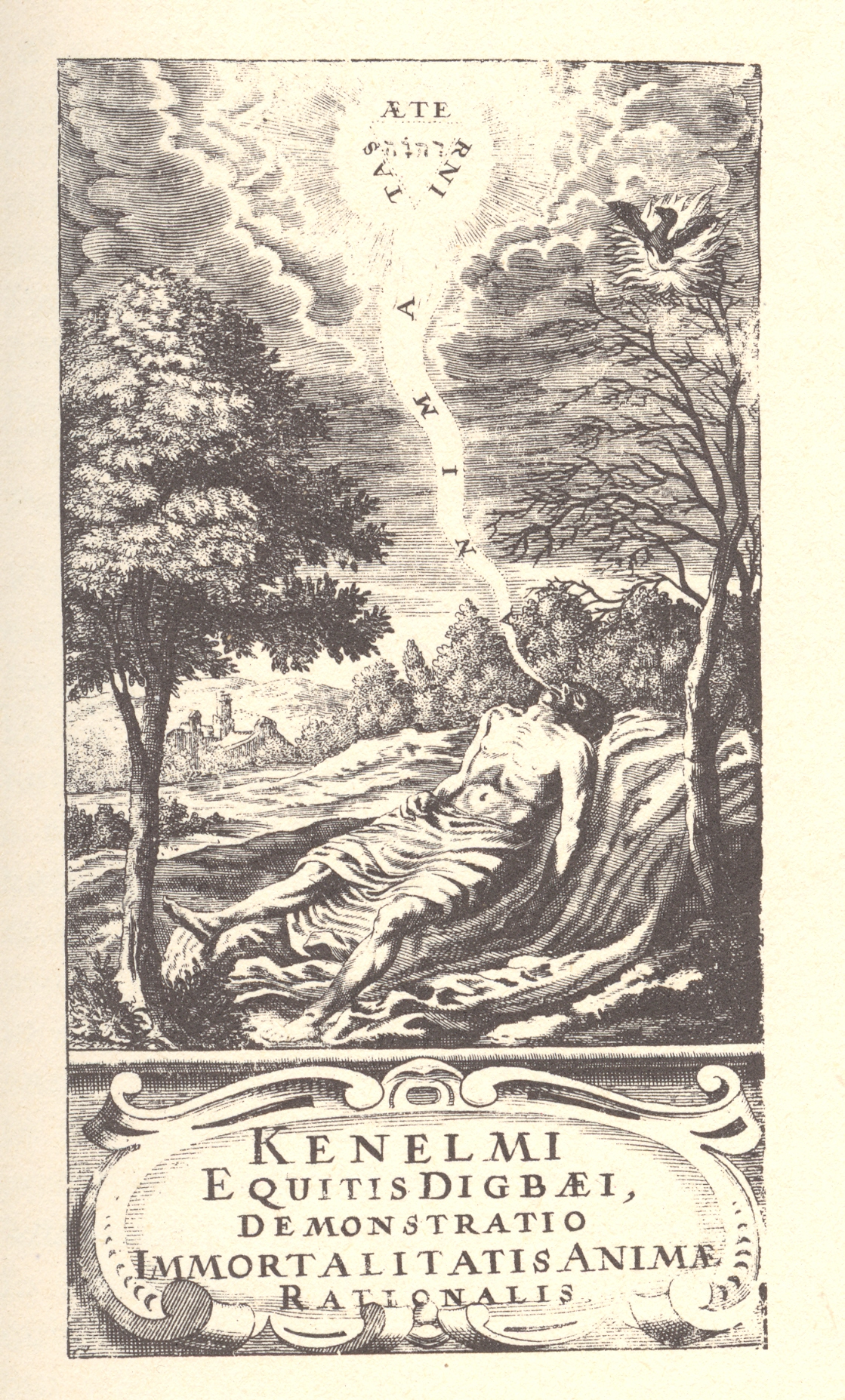
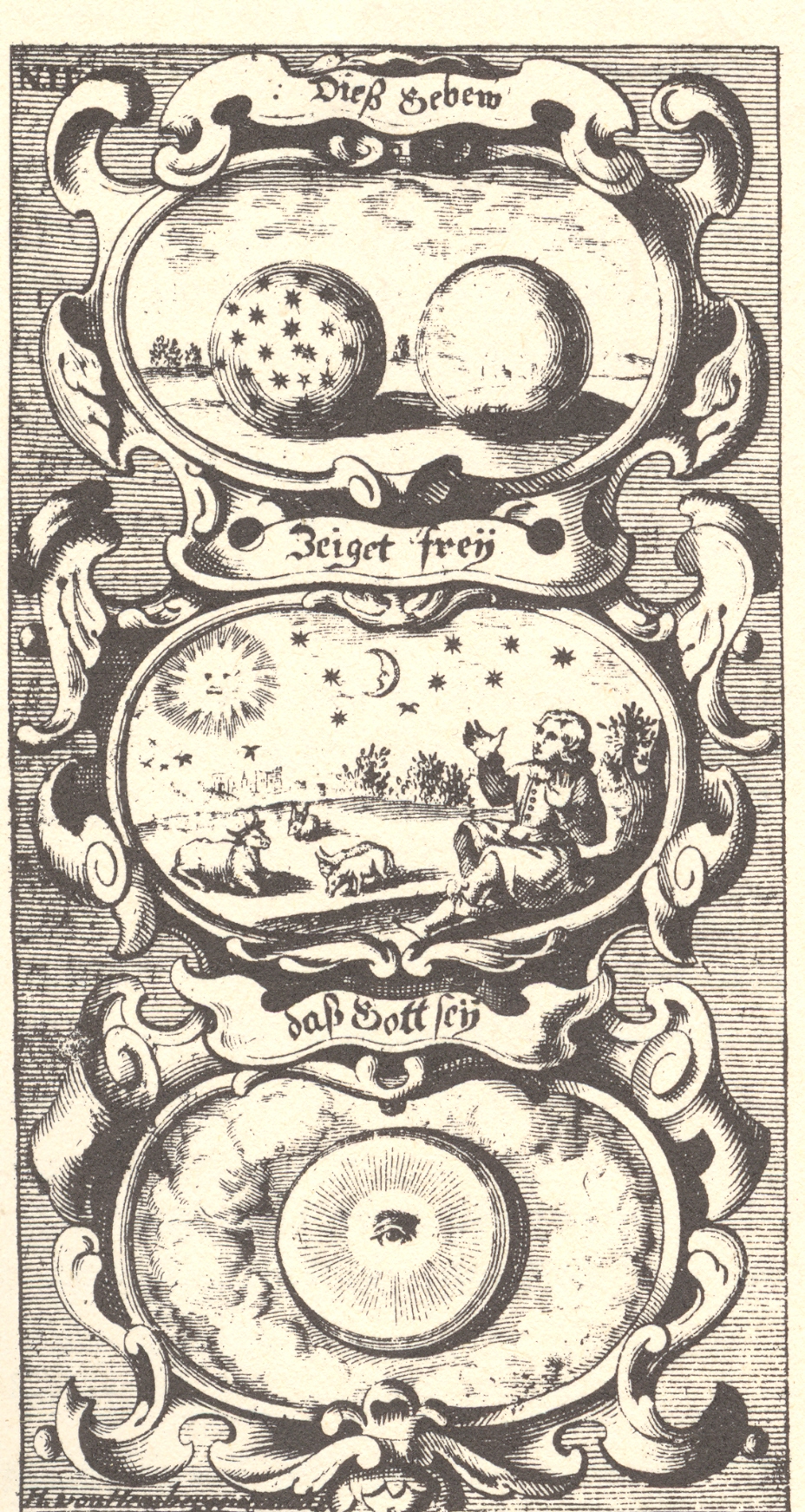
    On the other hand there are many different, substantiated, anthropomorphic objects that wind up in the sky in antiquarian images: there haven’t yet been anything spelling out chaos,  though there are many Hebrew names for the g*d incised and cut into plates of wood and metal.   There are all manners of hands-of-the-creator, gearworks for the Primum Mobile, eyes, doves, geometric shapes, blazing fires, blazing iconic people, multiple worlds, flying people, and so on. But no chaos.

    These are just two examples of the alternative-to-the-sun-in-the-sky category, a wonderful image from Kenelem Digby’s Demonstratio immortabiliitatis animae rationalis, printed in 1664.  The other is a very striking example from J.B.von Helmont’s surviving and prodigal (and prodigiously brilliant) son Franciscus Mercurius’  Das Geheimnuess der Schoepflung.  Printed in 1701, two years after FM’s death (and years after his other brothers succumbed to the Plague), the book was a bit of an amalgamation of the author’s vast and undisciplined interests, which sloshed over into the areas of magic, conjuring, Kaballa and astrology. 
    He had more success editing and translating his father’s works. 

    Porta sky 2
    I admit I’m taking a wide liberty with “chaos”, and that the the first image could simply be the creator stepping in to rid the heavens of chaos, but I liked the idea of chaos being located on a map better.  Mea culpa. 

    * Porta writes in the first chapter, defining the word “magic”:  Magic took her name and original [sic] from

    Persia.
    . . . In the Persian language, a Magician is nothing else but one that expounds
    and studies divine things; and it is the general name of wise-men in that
    country. . . . Magic was begun in Persia by Zoroastres.”

    ** A fair amount of information in this book was derived
    from his own house-bound Academia de
    Secret
    i—a name I now love!—a society of friends and scholars who discussed
    topics ranging from physiognomy to optics to cosmology to conjuring. 

    The Chapters/books of Natural
    Magick
    are shown here below to give an idea of what the book is about:

    The First Book of Natural
    Magick
     “Of the Causes of Wonderful Things.”
     “Wherein are searched out the
    causes of things which produce wonderful effects”

    The Second Book of Natural Magick  “Of the Generation of Animals.”
     “Showing how living creatures of
    diverse kinds, may be mingled and coupled together, that from them, new and yet
    profitable kinds of living creatures may be generated.”

    The Third Book Of Natural Magick  “Of the Production of New Plants.”
     Which delivers certain precepts of
    Husbandry, and shows how to intermingle sundry kinds of Plants and how to
    produce new kinds.

    The Fourth Book Of Natural Magick  “Of Increasing Household-Stuff.”
     Which teaches things belonging to
    house-keeping; How to prepare domestic necessities with a small cost; And how
    to keep them when they are procured.

    The Fifth Book Of Natural Magick  “Of Changing Metals.”  “Which treateth of Alchemy, showing how
    metals may be altered and transformed, one into another”

    The Sixth Book Of Natural
    Magick
     “Of Counterfeiting
    Glorious Stones.
    “

    The Seventh Book Of
    Natural Magick
     “Of the Wonders of
    the Load-Stone.
    “

    The Eighth Book Of Natural
    Magick
     “Of Physical
    Experiments”

    The Ninth Book Of Natural
    Magick
     “Of Beautifiying
    Women.”

    The Tenth Book Of Natural
    Magick
     “Of Distillation.“

    The Eleventh Book Of
    Natural Magick
     “Of Perfuming.
    “

    The Twelveth Book Of
    Natural Magick
    “Of Artificial
    Fires.
    “

    The Thirteenth Book Of
    Natural Magick
    “Of Tempering Steel.
    “

    The Fourteenth Book Of
    Natural Magick
    “Of Cookery.“

    The Fifteenth Book Of Natural Magick “Of Fishing, Fowling, Hunting, etc. ”
    (Complete)

    The Sixteenth Book Of
    Natural Magick
     “Of Invisible Writing.“

    The Seventeenth Book Of
    Natural Magick
    “Of Strange Glasses.“

    The Eighteenth Book Of
    Natural Magick
     “Of Static Experiments.“

    The Nineteenth Book Of
    Natural Magick
     “Of Pneumatic
    Experiments.
    “

    The Twentyth Book Of
    Natural Magick
     “Of the Chaos. “


  • Women Meat Pioneers, 1943

    JF Ptak Science Books LLC  Post 570

    (Science Book Blog)

    4-1 prop meat
    This simply irresistible, charmingly uncomfortable, and semi-surreal title is an excellent example of what I’ve come to know (and forget) in my  career of doing whatever it is I’m doing.  Generally though the thousand or so titles in my Naive Surreal collection belong to pamphlets and the occasional book, but the occasional advertisement makes its way into the fray.  (None really come quite close to the work of the immortal Otto Fleiss, who produced America’s greatest work on making art with fat,  White Art in the Meat Food Business.  A Practical Handbook for
    Butcher, Pork Stores, Restaurants, Hotels and Delicatessens on How to
    Make Lasting and Transferable White Art Decorations out of Bacon Fat
    Back for Window Displays, Ornaments on Meat Food Cold Buffets and for
    Exhibits and Advertising Purposes.  Enrich yourself with Personal
    Knowledge.
    It is a toweringly fantabulous work, and is one of this blog’s most-viewed posts.)

    This ad is innocent enough:  appearing in the 1 November 1943 issue of LIFE magazine, it was simply encouraging the modern housewife to go adventuring into cuts of meat that had been deemed unacceptable before rationing and the war, which brought about a meat drought.  (The Brits had a far worse time–this issue of LIFE also contained a photo of a leggy London showgirl posing with a “real lemon” which was being raffled off to raise hundreds of pounds for the general welfare.) 
    4-1 renaissance pandora
    I’m sorry to say that this image reminded me of an older, finer, more whimsical but far more damning and stern woodcut.  The two aren’t terribly-well related, I know, but as I shocked myself in being able to locate it I’m bound to use it now before it slips back into my misty print purgatory. 

    This image is probably the work of Georg Pencz and appeared in Hans Sachs’ Nachred das grewlihc laster...published in Nuremberg in 1535 The booklet was a work directed against the evils of libel and lying and spreading rumor.  Pencz’ woodcut personified all of this wrapped up in the form of a vice-charmed woman.

    The libel-charged rumor-mongre woman (watched from under a tree by a poet who is protected from her by a fellow with an imperial seal and stanchion) is outfitted with very feathery wings and a crowned seat on a collection of snakes.  She carries a lidded pot, an offering of some sort, while she hides a knife behind her back with her other hand.  She advances with a breast barred and another breast vut and bleeding, while she tugs along in her wake a ball and chain, which sets her traveled path on fire.  All-in-all, Pencz paints a dismal picture of womanhood. 

    As I said, it has little to do with the original image of a Pioneer Meat Woman, but they sort of looked similar in my memory. 


  • The Wartime U.S. Soldier as Advertising Commodity: Ads in LIFE, WWII

    JF Ptak Science Books LLC  Post 569

    4-1 prop meat 001
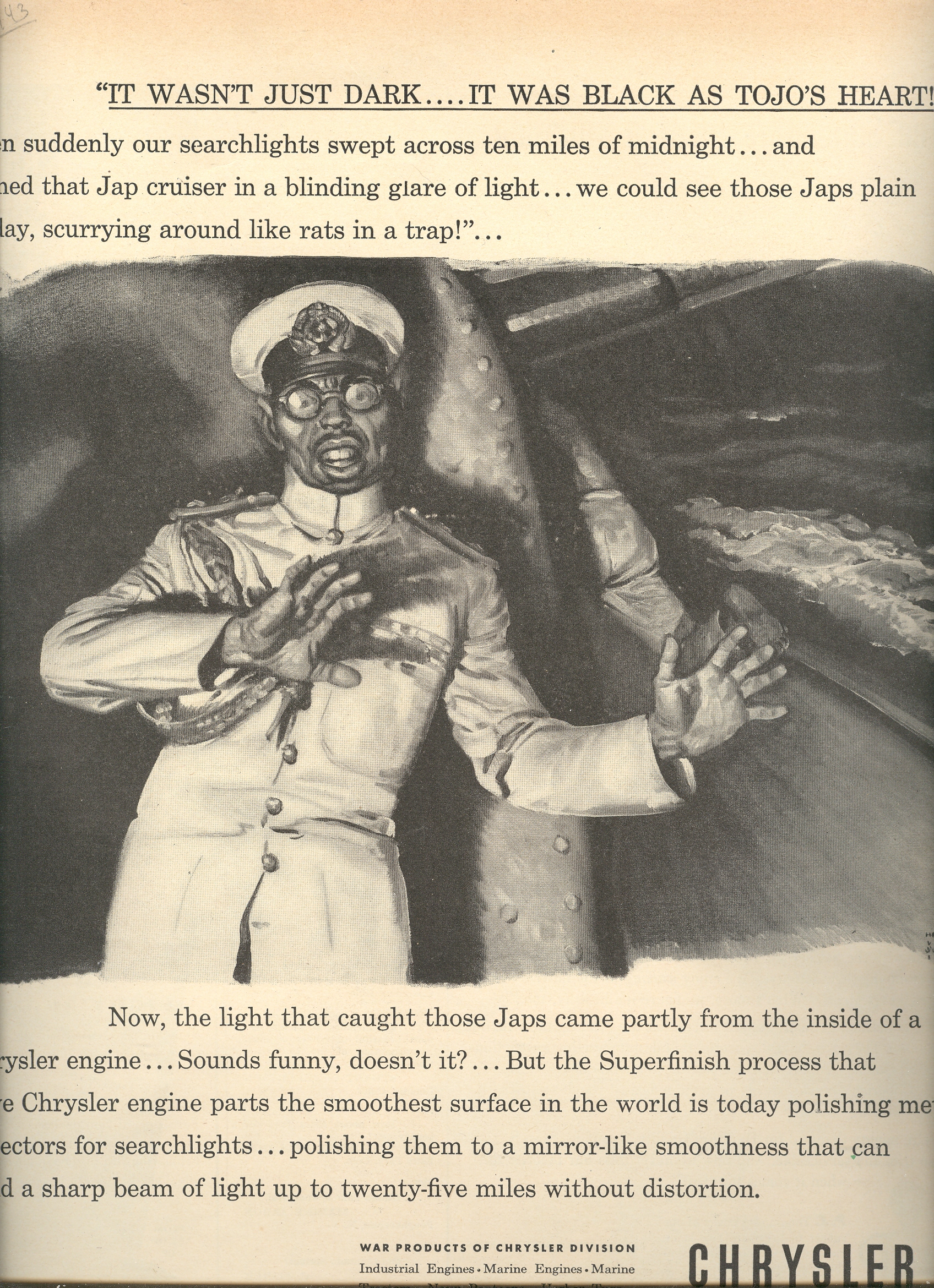
    I was making my way through LIFE magazine for 1943 and was struck by the ratio of the number of advertisements using the war as a backdrop (and American soldiers as convenient props) for sales against the actual space dedicated to war reporting.  Concentrating on just two randomly selected  weekly issues (November 1 and November 15 1943) I was surprised to find  28 ads (most of which were full-page); there was no war reporting in November 1 and just half a story (on the history of the Prussian General staff) in November 15.  Most of the ads were directly war-related, the companies mostly relegated to vast production of war goods, like General Motors, Cadillac and Boeing. The others were less clear, like the ad pictured here for Green Giant peas and corn.  This company was informing the home front that if there were shortages of their product it was because they were selling it to the Army or Navy–others were more adventurous for their spirited attempt at patriotism. I’m not sure that Wembly Ties really needed to include a GI in their ad, nor did I like the use of American soldiers to sell Interwoven socks. 

    There was a growing sense of sordidness to me, this use of images of wartime American soldiers, who were dying by the tens of thousands, being used to sell socks, ties and corn. This was particularly ironic since the magazine wasn’t finding anything to “report” in its full pages for the war for those two weeks–which is bizarre, because by that time in late 1943 there was a global FUBAR shitstorm happening to the east of NYC and to the east of San Francisco.  

    Some ads did have high propaganda value and were related to the general winning of the war.  The vast majority though were singling out their product for purchase.  4-1 prop blow up

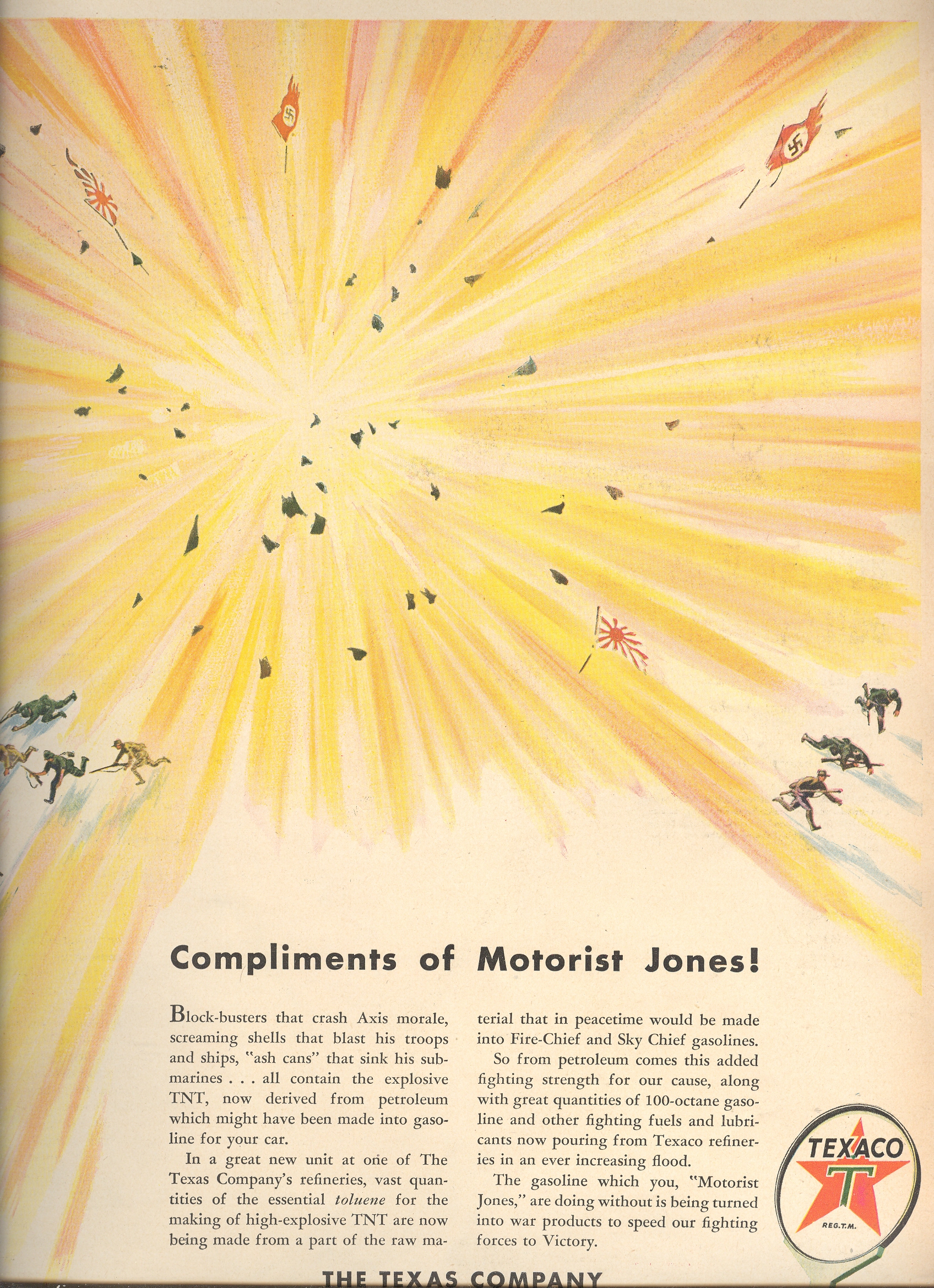
    Just for the record, the advertisers employing an American soldier to help sell their product  for these two weekly issues included Goodyear, Cadillac, Alcoa, Scotch Tape (for sealing boxes of tank parts), Sperry, Old Gold cigarettes, Lockheed, Schaeffer pens, Victory Airpower, Excide batteries, Camel cigarettes, Electric Power and Light companies, Oldsmobile, Cashmere Bouquet, ANSCO color film, Pontiac, Willys JEEP, Vinco (foodstuffs), Cavalier Whisky, Interwoven socks,Texaco, Eversharp pen, Wembly ties, Boeing, Black and White whisky, Ray-o-Vac, and Coke.  Seems like a lot for two weeks, no?  I’m not doing content analysis on this, just a passing interest, really, but when you look at similar issues for The Illustrated London News there’s very little of this sort of thing going on; even less so for the Illustrirte Zeitung (Lepizig).  

    I’m curious now to check out popular magazines for WWI.  It seems to me that there was a bit of this going on then, too.  Outside of cigarette and whisky ads, a lot of this sort of advertisement drops off during Korea; and by the time of Vietnam, these sorts of images have all but disappeared. 

    4-1 prop Jap

    ·Posted by :

    ·in:

    —

  • The First Fisheye View? Vienna, 1529

    JF Ptak Science Books LLC  Post 567

    Fisheye


    This magnificent woodcut,
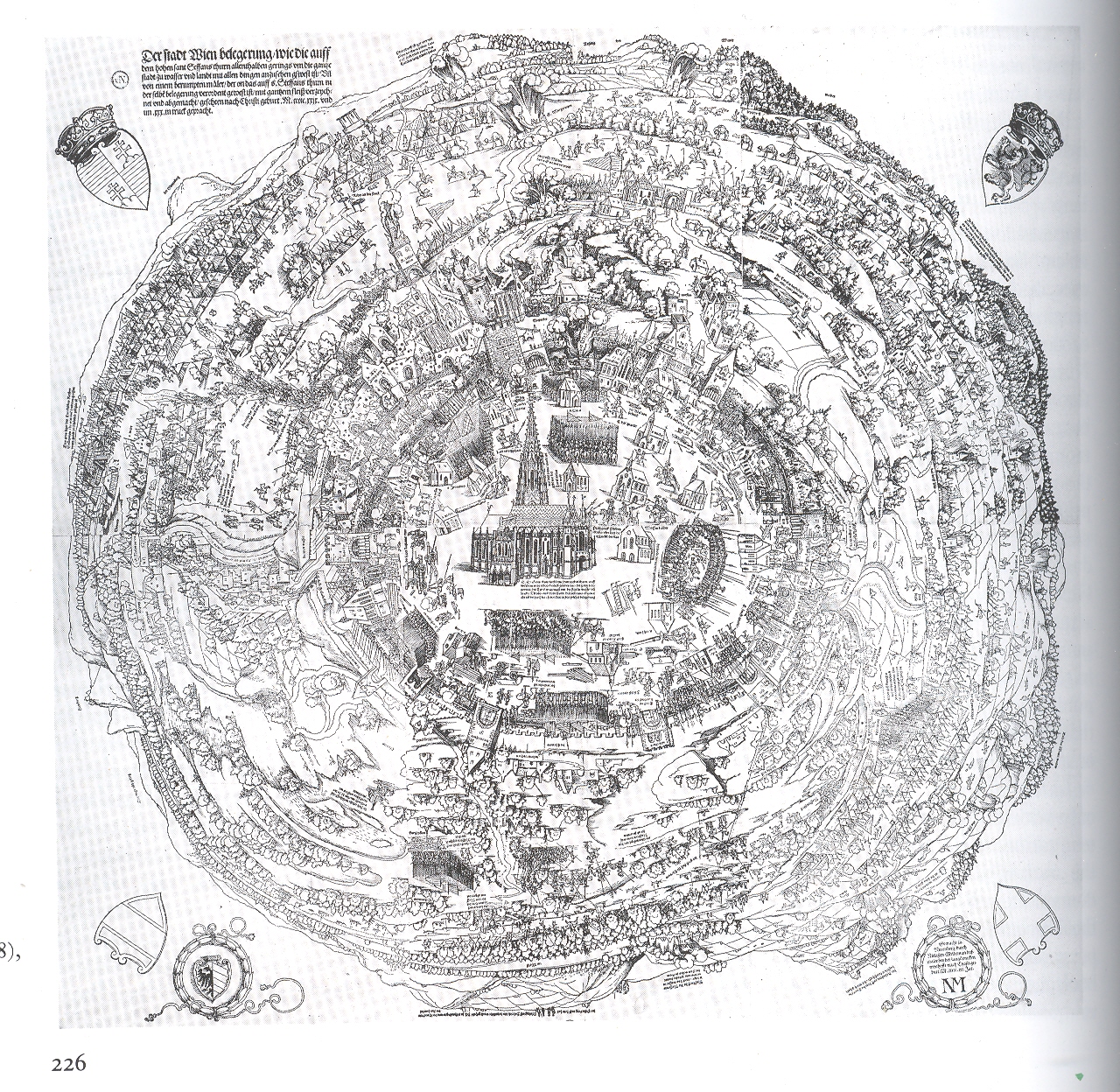
    The Siege of Vienna*, executed by Nicolaus Meldmann, was published in 1529/30 and depicts a view of the city of Vienna from an extraordinary and perhaps unprecedented perspective.  I’ve paid some attention to antique images that look straight down at things (Looking Straight-on At Things  and  Looking  Straight-Down on Things) and I can say that they are in general pretty uncommon–this is the first time though that I’ve noticed a fish-eye view looking straight down, an image conveying a 360-degree horizon-to-horizon landscape.  It is just simply phenomenal, even if a fair number of the buildings in town are missing and so on–the (unnamed) artist-on-the-spot actually climbed a high spire and made a number of sketches, extrapolating it all into this horizon-bending whole.  But the representation of the city wasn’t the paramount concern in the print–it was the placement of what was going on outside of it that was important. And what was happening concerned all of Europe–it was the invasion by the Muslim Ottoman
    Empire
    , led by Sultan Suleiman I (the magnificent)
    , and in 1529 they had made their way through Hungary and into central Europe, laying  seige to the principal city of Vienna with an army of 150,000 (or 300,00) soldiers. . It was the high point of the Ottoman expansion, as they were ultimately turned back by the Austrians in a determined and complex series of battles of mining/tunnels versus anti-mining and anti-tunnels (such battles being fought, still, deeply into World War I).  So this print was made for a wide audience of Europeans, trying to get a glimpse of the siege of Vienna and the positions of the Ottoman forces, knowing that the outcome of the siege could very well hold the fate of the rest of Europe.  

    If you check out the other posts in this blog on “Looking Straight Down” you’ll see a number of examples of early straightdownedness–none though approach the vast area that the artist of this print had taken under control and displayed. 

    *I found this reproduction in Landau and Parshall’s beautiful, attentive and intuitively incisive The Renaissance Print,1470-1550, published by Yale University Press in 1994.  It is a rich book, with very deep depth and a light touch, hard to do in an academic/historical work.  But they did it.