A Daily History of Holes, Dots, Lines, Science, History, Math, Physics, Art, the Unintentional Absurd, Architecture, Maps, Data Visualization, Blank and Missing Things, and so on. |1.6 million words, 7500 images, 4.9 million hits| Press & appearances in The Times, Le Figaro, Mensa, The Economist, The Guardian, Discovery News, Slate, Le Monde, Sci American Blogs, Le Pont, and many other places… 5000+ total posts since 2008.

Author: JF Ptak

  • Songs of the Streets, in Two Parts (and an Obscure Reference to an Important Anti-Darwinist)

    JF Ptak Science Books  Post 1600  {Appropriate musical accompaniment that can be listened to under the reading of this post, Carl Orff’s Gassenhauer, can be found here and minimized.]


    I found these two interesting images over the course of a hundred pages or so in the profusely illustrated weekly magazine, Punch, or the London Charivari, for early 1865.  The first image, published 18 March 1865, “A Song of the Streets”, drawn by “C.H.D.” (Charles Henry Bennett, 1828-1867), displays the general thoroughfare of sidewalk life in a place like London, people being blown about by late winds and snow.

    It is in the upper right-hand corner of the engraving that we find our “important Anti-Darwinist”, which seems like an illogical statement, except that it isn’t  The man in question is the fellow with the bellows, who seems to be the one instigating the weather, blowing so had and cold that it moves people off their feet and off the page.  The bellows is labelled “Fitzroy”, and the likeness is that of the man with the same name, Vice-Admiral Robert Fitzroy (b. 1800), who at this time was serving as the chief of a weather department for the Royal Society, the Meteorological Statist to the Board of Trade, appointed by the president of the society, and was basically a meteorologist, except that the title had yet been invented.  (It is also interesting that Fitzroy is depicted in captain’s (?) uniform, and surrounded by a floating telescope, book, thermometer and self-registering drum.) So even then, even with the first person in this position of authority, complaints for foul weather were being launched at the person “in charge”, even though that person created an extraordinary new tool for detailing the possible changes in weather.1

    It happens that this is the same Robert Fitzroy who was the captain of the HMS Beagle on its second voyage (1831-1836), when he approved of the addition of an added gentleman to help keep his sanity on the long adventure, a naturalist named Charles Darwin.  It was also Fitzroy who gave Darwin a copy of the first volume of Lyell’s Principles of Geology, a book integral to Darwin’s development into Charles Darwin.  The voyage was personally rocky for the two men, but ultimately highly successful.  Years later, Fitzroy was shocked and  dismayed with the result of young Darwin’s adventures–with the publication of On the Origin of Species…, Fitzroy felt a sense of personal guilt for Darwin’s theory, and felt shame and bitterness towards it, as in his mind the theory went against his bible and his religious beliefs.   Fitzroy and the Rev. Samuel Wilberforce were at the evolution debate meeting of the British Association for the Advancement of Science (1860) in which Rev. Soapy Sam challenged Darwin’s theory on “scientific” grounds, and against which Thomas Huxley (and other Darwin supporters) made his well-remembered defence2.  In the middle Samuel_Wilberforce_by_Mowbray_of_Oxfordof all of this was Robert Fitzroy, who cried for the crowd of onlookers–with his Bible held aloft–to reject man’s interpretation of nature and stay with that of God.   He was booed down.  Darwin was not in attenddance. [Image: Wilberforce, threatening.]
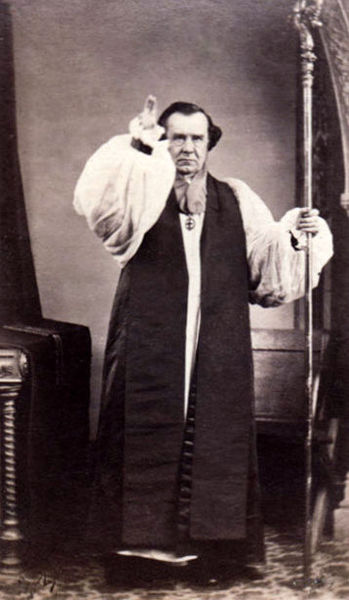
    So, in a way, Fitzroy proved to be important in the formation of the theory of evolution but also turned out to be an anti-Evolutionist, though not an important one.  Oddly enough this may be the last published image of Fitzroy during his lifetime, as he would die 42 days after the appearance of this issue.

    In the second image of the streets the view from the pages of Punch (for 27 May 1865), “The Banishment of the Beggars, a New Tramp Chorus”, we see a different type of street “cleaning”.  In this case, it. Charles Villiers (1802-1898, and for 63 years a sitting MP) and his Homeless Poor Bill of 1865 sweeping the “sham poor” from the city streets, the legislation designating that the capable poor actually be put to work and removed from their begging positions on the streets.  The complaints in the chorus against the highly visible poor of Metropolitania were considerable,


    finding among the beggars (“who disturb our peace”) a litany of fakes, many of who are featured in the illustration:

    “sham injured workmen (who display their wounds from door to door)”, the lame (who clap their crutches on our toes), the blind, sham paralytics, sham widows (with hired babies and brats), “artistic tramps” (who will no longer chalk on the sidewalk “I am Starving”), and the fake veterans of wars. 

    The way to salvation for these people was “the Mill”, provided by the Villiers bill, and a compulsory spot in a workhouse (work-house) where labor is exchanged for room and board. 

    London-Workhouse.jpg


    Notes

    1. Fitzroy was actually the person who coined the term “weather forecast”, or at least he was the first to use it who had any real chance of being correct or accurate, given how much data he was able to assemble and interpret. He was really a very important person in this regard, as well. 

    2. This is not the place to debate whether Huxley’s famous remarks were famnous at teh time.  In a letter to Darwin J.D. Hooker wrote this of the exchange: 

    “Well, Sam Oxon got up and spouted for half an hour with inimitable spirit, ugliness and emptiness and unfairness … Huxley answered admirably and turned the tables, but he could not throw his voice over so large an assembly nor command the audience … he did not allude to Sam’s weak points nor put the matter in a form or way that carried the audience”. ^ “Letter 2852 — Hooker, J. D. to Darwin, C. R., 2 July 1860”. Darwin Correspondence Project 

    On the other hand, another cotemporary of the exchange between WIlberforce and Huxley wrote:

    Alfred Newton wrote:

    In the Nat. Hist. Section we had another hot Darwinian debate… After [lengthy preliminaries] Huxley was called upon by Henslow to state his views at greater length, and this brought up the Bp. of Oxford… Referring to what Huxley had said two days before, about after all its not signifying to him whether he was descended from a Gorilla or not, the Bp. chafed him and asked whether he had a preference for the descent being on the father’s side or the mother’s side? This gave Huxley the opportunity of saying that he would sooner claim kindred with an Ape than with a man like the Bp. who made so ill a use of his wonderful speaking powers to try and burke, by a display of authority, a free discussion on what was, or was not, a matter of truth, and reminded him that on questions of physical science ‘authority’ had always been bowled out by investigation, as witness astronomy and geology.

    A lot of people afterwards spoke… the feeling of the meeting was very much against the Bp.” _Wiki on the 1860 debate.
  • Battle of the Future: a Note on the Value of Women from Two Different Utopian Novels of the Same Title

    JF Ptak Science Books    Post 1599

    http://afflictor.com/wp-content/uploads/2011/02/Grandville_-_Un_Autre_Monde_-_Juggler_of_Universes-J.-J.-Grandville.jpg

    This is a short tale of two novels of the future.  They both speak of utopias, they both were written in the 19th century, and (unusually) they both have the same title–but so far as the future of women goes, they have little in common.

    Three Hundred Years Hence, the novel title in question, was first published in 1836, and was the property of  Mary Griffith (1772–1846) who presented what was at the time a strongly pro-woman utopia set in the future, –and which was also as it turns out the first novel of its kind written by a woman in the United States.

    A lesser and unhappier story for women of the high Victorian mold belongs to William Delisle Hay1, whose own Three Hundred Years Hence, a Voice From Posterity (published in 1881) , elevates females to a supreme position, though without any real power or effect.  (Hay has a difficult history, or so it seems to me; he also wrote on mushrooms and other fungi, as well as the Maori “problem”, and had a wide strain of white suprematist running through his works.) In Hay’s future, in the 23rd century, there would be a global community, and at the head of the global body would be a perfect woman, a woman who would serve a ten-year term of glory and grandeur. She would not have any real duties, however, because she was didn’t have the intellectual powers of man, and so her brain would no tbe called on to perform tasks outside of womanly chores. He writes:

    “…the Empress does not possess one particle of actual power…for the facilities of women are not capable of following out the highest intellectual processes, since she has a less degree of pure Reason than the man.”

    And:

    “…Woman (is) most emphatically fitted to display in herself the ornamental part of government…and…she is manifested as the proper director of all that relates to domestic life”.

    This of course is 1881.

    Hay hardly stands alone in his misanthropic approach to women.   Percy Greg’s tale of the future in his Across the Zodiac, the Story of a Wrecked Record (1880) shows the extent of the intellectual calamity and inferiority of women extending to Mars.  In this novel2 Greg’s Martians have come to realize that it is not possible to elevate their women to the intellectual status of men, and that their grand experiment of equality was a failure.  There were many others, of course, like  Walter Besant (The Revolt of Man, 1882), who could not abide the thought of equality. 

    And according to the wonderful I.F. Clarke (The Pattern of Expectation, 1644-2001), there were many more who looked into the future and saw greatness and expansiveness in the equality of women.  There was E.B. Corbett (New Amazonia, 1889), H.R. Dalton (Lesbia Newman, 1889), Lady Dixie (The Revilution of 1900, 1890), G.N. Miller (The Strike of Sex,1891), A.G. Mears (Mercia the Astronomer Royal, 1895), R. Buchanan, (The Rev. Annabel Lee, 1898), and Sir Julius Vogel’s (Anno Domini 2000, or, Woman’s Destiny, 1889), where “woman became the guiding…force of the world”. 

    I think, that, overall, the people who saw the restriction of women in the future (near and distant) held sway, or at least the majority, of writers envisioning the sexes int he future. 

    Notes:

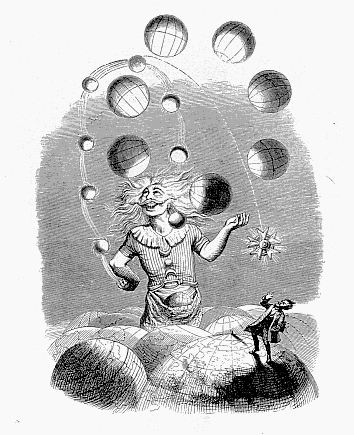
    * The first image is by the great and prolific and short-loved  J.J. Grandville (1803-1847) for his Autre Monde (1844).

    1. I have found another reference to a bitter world of the future written by Hay in the excellent Airminded blog, which records his effort at a novel of doom and destruction of the overtaken London of the future.

    2. Greg’s characters visit Mars via the benefits of a sort of anti-gravity spacecraft called the Astronaut, and, interestingly, the Martians had seem themselves as the only life forms in the galaxy.  It is also in this novel that the first attempt at creating an alien language appears.  There was also another science fiction effort by this title as well, though it really doesn’t apply to what we’re talking about, here.  (I wonder how prevalent duplicating titles is in the sci fi genre?)


  • The SteamPunk Clown Spoiler of Future ElectroPunk Technology, 1866

    JF Ptak Science Books  Post 1598

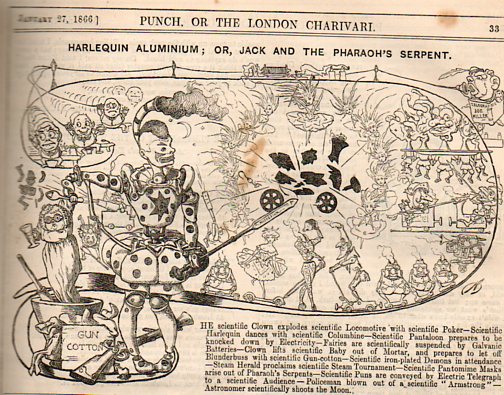
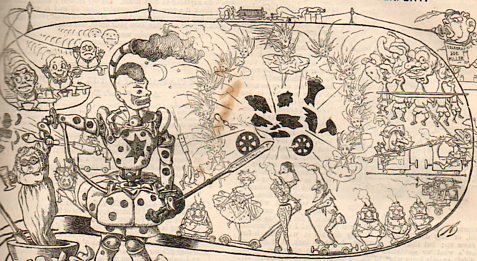
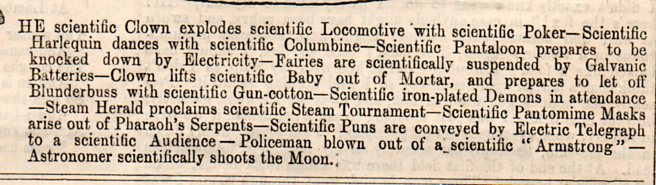
    Punch, or the London Charivari published this delightful and somewhat prescient illustration in its 27 January 1866 issue.  It is for me an excellent, sort-of early depiction of a steam-man, a steampunk man, a steam-driven clown:  deeply and frequently hinged, smoke belching from a curved smokestack coming from the back of its head, and controlling its own destiny.

    Sci clown694
    And what it seems to be doing with its poker in controlling its steam technology is busting the new technologies of the era, a rub and at the same time a statement of hope or expectation in a high-Victorian manner, a rationalism of all things via technological means.  And at this time, in the mid-1860’s, the new wellspring of hope was being found in electricity-based solutions–moving away from the pervasive steam-driven technologies–though as the cartoon suggests those expectations might be too soon, too fast and too deeply placed.  After all, these things are being exploded by a “scientific clown” with a “scientific poker”–and that clown is being driven by steam. 

    Sci clown695

    Sci clown692


  • The Holocaust-Denying Discoverer of the Atomic Bomb in the Bible (1945)

    JF Ptak Science Books  Post 1597 [Part of the Atomic and Nuclear Weapons series]

    Atomic bomb god723
    It is astonishing sometimes to think of all of the subterranean atom-bomb-applicable cultural subcultures that quickly/instantly popped into existence following the use of the weapon on 6 August 1945.  The United States, for one, became an atom-crazed country, from atomic laundry flakes to milkshakes to hotels to condoms. This exuberant atommannia knew no bounds, and leechingly found its way into religious messages.  One thing that the atom bomb seemed to be that few people anticipated was its popular impact on the general population, as well as its extraordinarily broad base of applications. 

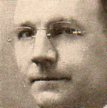
    Atomic bomb god724 The man trying to look into your soul from around the edges of his glasses, the man looking annoyed and reproachful and judgmental with his thin-lipped contempt, is W(illiam D(ewey) Herrstrom, the author of The Atomic Bomb and the End of the World, written in 1945, and published by Bible News Flashes of Minneapolis, Minnesota1. This is an unhappy little pamphlet filled with massive fear and innuendo, and calls for its readers to address that fear and all uncertainty by embracing Jesus Christ.  After all, it is not the Atomic Bomb that we need to worry about, says the author: it is our salvation and the potential wrath of the creator for all sinners.  Herrstrom shouts out that the atomic bomb will not end the world or set it on fire–that job is left for god, so we need to address god before we do so the bomb.  He writes:

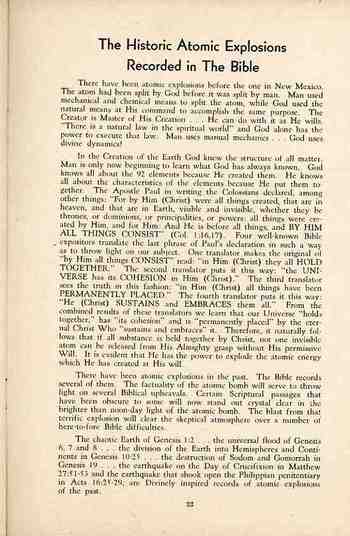
    “The scientists who say that the heavens could be ignited by man to bring about the end of the world may be right.  But there is at least one good reason why this will never happen.  That reason is clearly stated in II Peter 3:7.  God has “RESERVED” this for his own time.”

    Mr. Herrstrom’s–who may have believed too much in the transliteration of his name from the German, which would be “Mr. Power”– message was one of fear and perdition, of the End Times coming true, of prophesies found in the Bible that were being unearthed right there in 1945–luckily, Mr. Herrstrom was ready to supply all of the necessary information about dealing with such stuff in his Bible News Flashes magazine, every month, which was somehow available for the subscription of 25 cents per year.  He had earlier addressed these issues in his Judgment Day for Everybody (improbably in its second edition) and The Revived Roman Empire, both of which were skinny, and both published in 1939–not that he was taking advantage of any situation in particular to press forward his bitter and hard nail visions of the future of our souls and the coming death of a sinful world. 

    “The Bible is history pre-written and God’s book is scientifically correct…and is ahead of the human race…”

    And as proof of these revelations the author offers bits like the following, in this case, a Bible quotation as proof of foretelling the invention of the jet plane:  “Like…chariots on the tops of the mountains they shall leap” (Joel 2:5).  And this for the atom bomb:  “And men were scorched with great heat, and blasphemed the name of God” (Rev 16: 18-20) and seven more pages of other large-print proof2.

    Herrstrom advertisers himself–on the title page, and in his interior full-page portrait–as a “World Traveler, Prophetic Analyst” and editor of Bible News Flashes, the Illustrated Prophetic Monthly Magazine, which is advertised on the back cover of the pamphlet, and where Herrstrom adds “News photographer” to his credits.

    One thing he doesn’t credit himself with and for which he should receive major recognition is for being one of America’s earliest and ugliest Holocaust deniers. The fantastic all-things-atomic  Conelrad blog, which has written another story on Herrstrom and his work, finds Herrstrom in Deborah Lipstadt’s book3,4:

    “In 1952 W. D. Herrstrom, an American antisemite, declared in Bible News Flashes that there were five million illegal aliens in the United States, most of whom were Jews. These were the Jews who were supposed to have died in the Holocaust. “No use looking in Shickelgruber’s [Hitler’s] ovens for them. Walk down the streets of any American city. There they are.” pp 66-67

    Well, as confessions of a hating faith-based ignorance, one could scarcely find better examples than these. 

    Notes:

    1. (Unfortunately, the only address given on the pamphlet is for a PO Box for Lake St. Station. Herrstrom’s other pamphlets include:  Mussolini & Facism, 1937, Wichita Falls, Kansas, Defender Publishers (?!), 49pp;  Will This War End Armageddon, 1941, 47pp; Golden Key to Bible Interpretation, 48pp, 3rd revised edition (again, ?!), 1940; Is God  a Jew, 1943, 24pp; Judgment Day, 1943, 64pp; Revival of the Roman Empire, 1939, 48pp.  Herrstrom had a few years where he was on fire,m from 1937-1945, during which most of this stuff was written.  It is noteworthy that hewrote books that were mainly 24 or 48 pages long.  His Bible News Flash appeared from 1943-1949, and is located in six libraries in the U.S., which makes it on the rare side.  Somehow, The Atomic Bomb and the End of the World is not located in the massive database for worldwide library holdings. 

    2. Herrstrom was hardy alone in laying claim to the ecumenicism of the atomic bomb.  There was also, for example the following:

    Mel Morris  published God’s Atomic Bomb  in 1945, which means he must’ve worked a little feverishly to pump up his bible prophesy and history to include the new atomic weapon to replace whatever else he had been using as a prophecy for end of times.  (As it turns out, “God’s Atomic Bomb” was more tempest and disaster in the bible, and not (whew!) the bomb itself.  Though as we’ve learned from scientologists and the sort-of creative mind of Ron Hubbard, a civilization came to the earth thousands of years ago and pummeled it with “atomic bombs” and other nastiness, polluting humans for milennia to come.  But that’s another story–suffice to say that Morris found many dozens of examples of “God’s Atomic Bomb” being used in the deep biblical past, and that the use of the real atomic bomb in 1945 was pre-ordained, and not without its figurative historical counterparts.  I’m not sure why any of this was necessary outside of proving to some small minority that these preachers could at least be contemporary and topical. 

    Blogsept_2_atomic_bomb_god_2txt483

    3 Deborah E. Lipstadt, Denying the Holocaust, the Growing Assault on Truth and Memory, 1993.

    4.  Conelrad also found Herrstrom’s longest book,  Seventy Five Reasons Why Community Water Supplies Should Not be Fluoridated.  Good work, Conelrad!

    5. Bibliographic note–I’ve seen this cover now in three different colors (red, blue, green) and I believe now that it wasn’t so much a factor of a number of different printings being done of the work over time, but rather of using whatever cover stock in whatever color happened to be on hand for the first printing. 

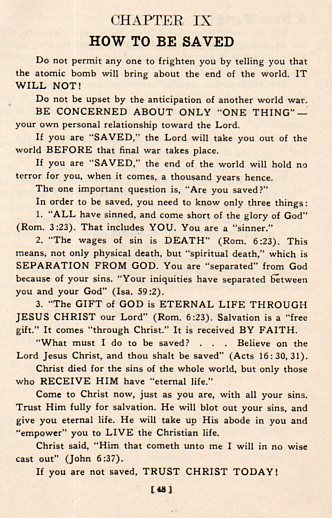
    Here’s a note from Herrstrom on how to get into Heaven:

      Atomic bomb god722


  • A Forty-Year Precursor to Modernism–Found Cubism in 1870

    JF Ptak Science Books  Quick Post     [History of Lines #18]

    I was very surprised to come across this illustration while browsing the (3 April)  1870  volume of Punch, or the London Charivari .

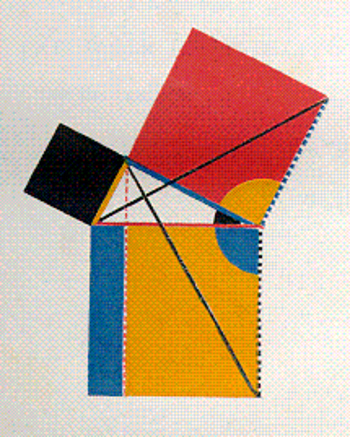
    I cannot think of any particular peculiar or unusual edition of Euclid that was published at about this time to demand such an unusual illustration. (The only newish edition that comes into any possible play here is Oliver Byrne’s semi-insane First Six Books of Euclid, published by the Chiswick Press in 1849 and one of the most unusual and beautiful books of any sort printed in the 19th century–but then again that was 21 years before this volume of Punch.) And by “unusual” what I really mean to say is “highly unexpected” , as this all-angular depiction of a woman appears for all the world to be a Cubist- or Expressionist-like image, predating those movements by four decades. 

    But the Angular Woman just seems to be happenstance, a happy precursor to a revolution-in-the-making, an accident forty+ years too early.  She is extraordinary–and for some reason she is smoking a cigarette. 

    [Below–an illustration from Oliver Byrne, illustrating the propositions of Euclid via the use of color rather than words, a beautiful but non-functioning work.]

    Blogrealbyrne


  • Looking Backwards: How Far Back in Time is 1949 (in Computer Years)?

    JF Ptak Science Books  Quick Post

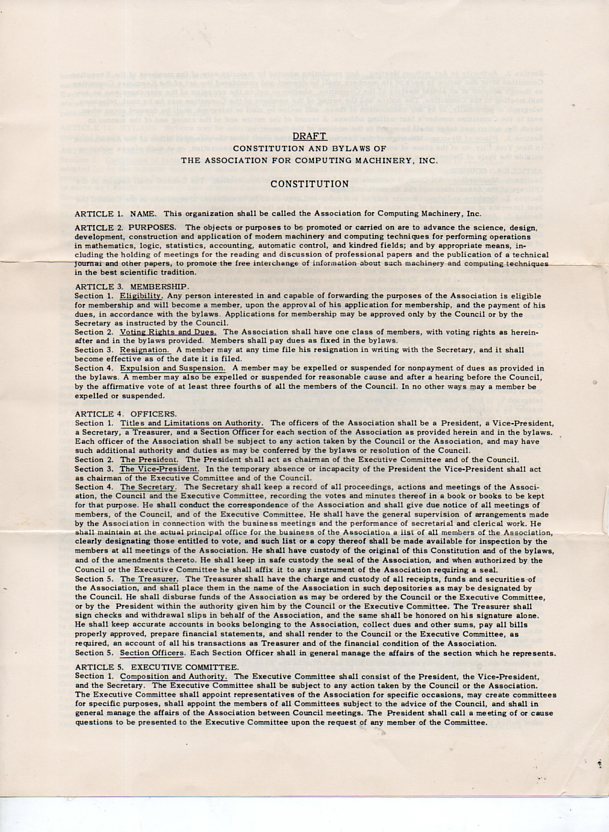
    The history of computing, in its inception, could be measured in decades, beginning, say with Babbage; by the time of the earliest large machines (1945-1950), computer time could be measured in a decade.  Come the deacade of 1960, the computer year could be measured finally in years.  After that, after microminiaturization, and the personal computer, the year started to be measured in months.  And then, of course, the year really sped up–I’m not sure if there is only a week or two in the year, now; maybe its measured in days. [This piece of computer history ephemera is available at our blog bookstore, here.]

    Acm draft713 [Click to expand]

    Looking at this document from the beginning of the first tweeks of mass professionalism in the development of the computer emphasizes this business of time.  This draft of the constitution and bylaws of the Association for Computing Machinery (the ACM) was complete in four pages, including the establishment of its members, officers, executive committee, meetings, bylaws, meetings–the whole deal, in four pages. 

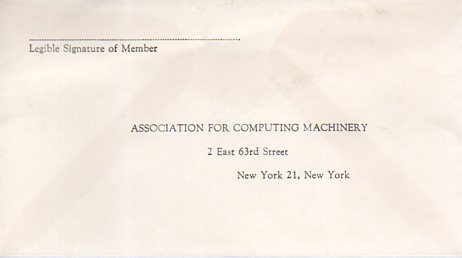
    Acm draft717

    The document is undated, but as far as I can determine, I believe that this document was printed in late 1949, soon after the ACM dropped the “Eastern” that used to appear as the first word in the title of the organization.   

    Its quite a spectacular thing, seeing what would become a vast organization be summed up in its infancy on one sheet of folded paper.   

    The rest of the document follows:

    ·Posted by :

    ·in:


  • The Radium Dance, 1898 and 1904

    JF Ptak Science Books   Post 1595

    photo
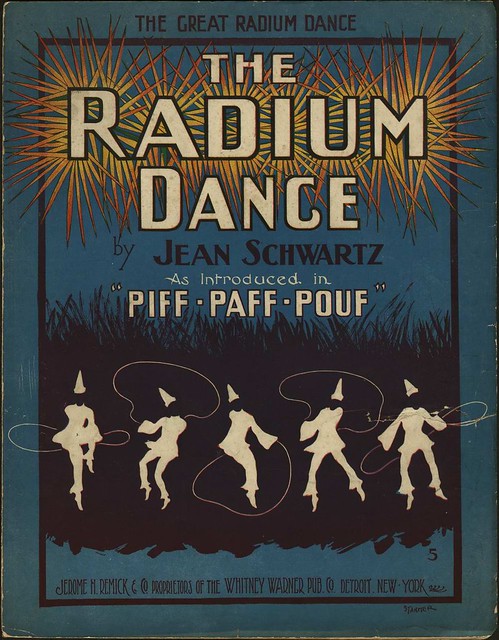
    Jean Schwartz (b. 1878) , composed this number for his (with the collaboration of William Jerome) Broadway (hit!) musical comedy Piff! Paff! Poof!  in 1904,  which sounded like this.
    But the real story–that we’ll deal with later–occurs a few years earlier, in 1898, with a married couple of scientists who made an epochal discovery:
    Curie712
    What was easier for folks to understand was the application of the discovery, just six years after the Curie effort–though it did take a little longer to take hold in the public creative imagination than, say, the discovery of the X-ray, which entered the public mind almost instantly following its discovery in 1895. 

    72dpi JPEG image of: The radium dance; Piff-paff-pouf

    [Source:  Duke University]

    [Source]

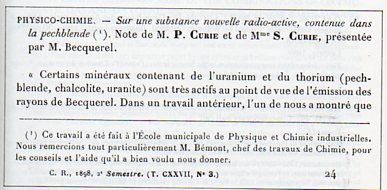
    Perhaps the real Radium Dance occurred for the first time by the people who found the thing, radium, back there in 1898–Marie Sklodowska Curie and Pierre Curie.  They were a happily married couple, beginning their joined life in 1895, vacationing on wedding present money on bikes through the French countryside.  They were soon back to their primary love in physics and chemistry, and inspired by the work of Henri Becquerel, began their assault on radioactivity in the next year.  After several years of effort and laboriously extracting a gram of  pure radium (by 1902) from a ton of pitchblende, they published their efforts in the volume of the great French scientific journal, Comptes rendus…Academie des Sciences (volume 127, in three short articles), announcing their discovery of polonium (after Marie’s country of origin) and radium. 

    The really big Radium Dance would occur the year before the Broadway hit, in 1903, when the Curies and Henri Becquerel were awarded the Nobel Prize in physics1. 

    Notes:

    1. The Nobel Prize in Physics 1903 was divided, one half awarded to Antoine Henri Becquerel “in recognition of the extraordinary services he has rendered by his discovery of spontaneous radioactivity”,the other half jointly to Pierre Curie and Marie Curie, née Sklodowska “in recognition of the extraordinary services they have rendered by their joint researches on the radiation phenomena discovered by Professor Henri Becquerel”.


  • Writers with Guns

    JF Ptak Science Books   Quick Post

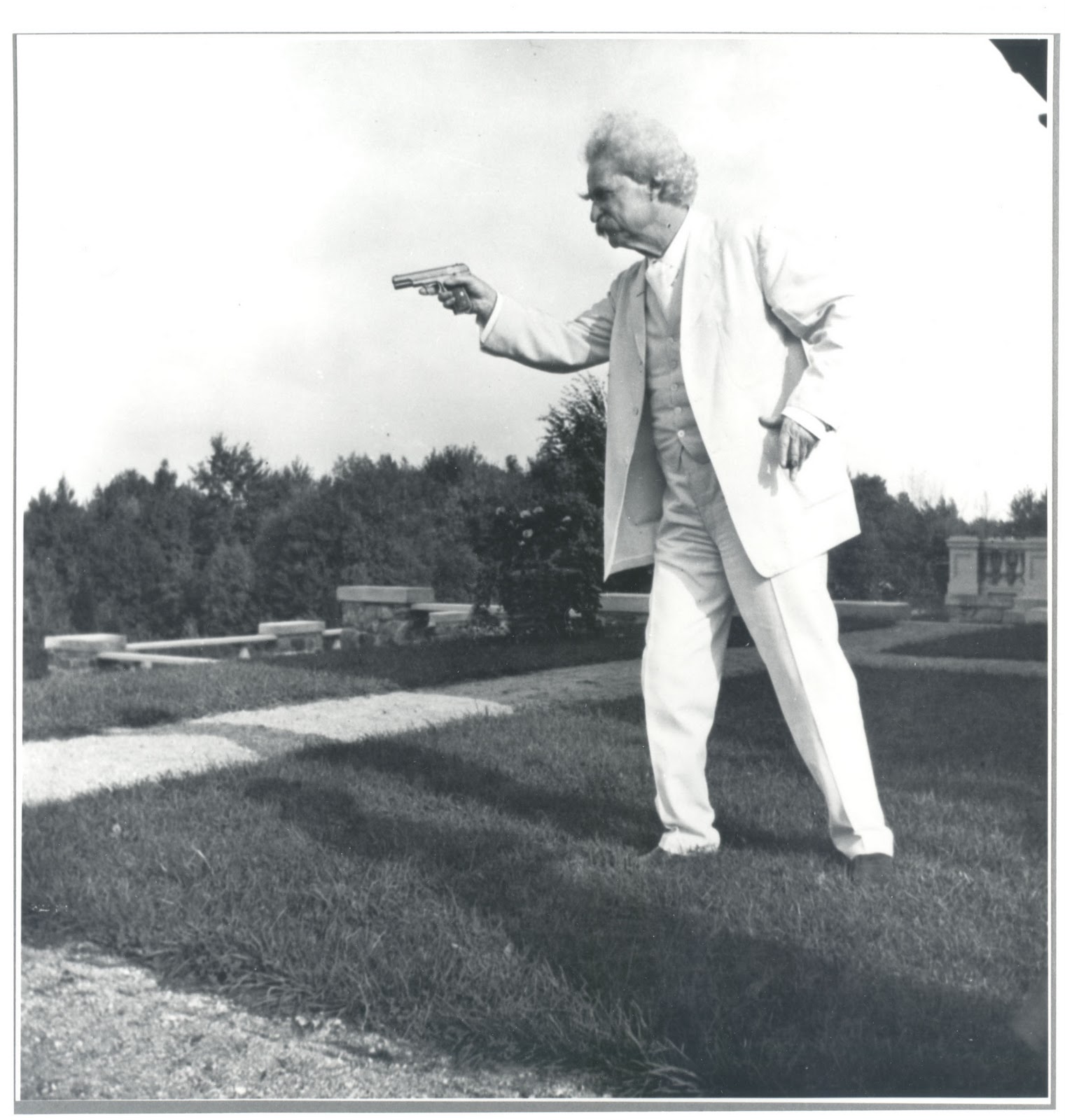
    Well, just a very quick post here for some found images of our leading lit figures posing with guns.  Real guns.  The Samuel Clemens image looks photoshopped to me but so far as I can tell it is real–its a long shadow produced by a rising/setting sun, the other shadow belonging to someone just out of the picture. I like his safe handling of the weapon. 

    http://4.bp.blogspot.com/_wmn8WjrdQfM/TOPSMEhhIzI/AAAAAAAAGVw/ZFcQ_C3-KG8/s1600/Twain+2.jpg

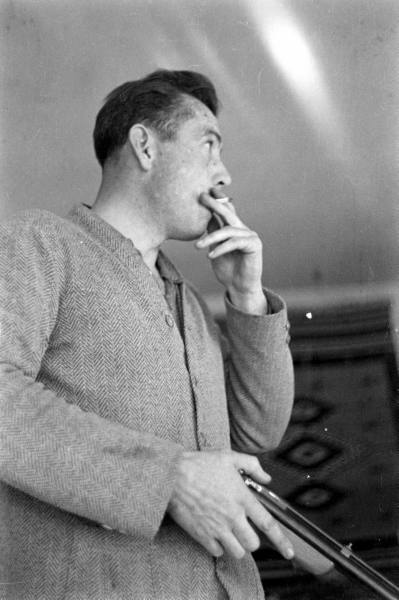
    Ernest Hemingway,  ca. 1905, with air rifle–evidently his connection with guns went way back, but so did it too for just about every other American boy. 

    http://4.bp.blogspot.com/_wmn8WjrdQfM/TOPSiD4kJqI/AAAAAAAAGV0/oa4HFWtYPLs/s1600/Hemingway.jpg

     [Source: Philosophisches & Literarisches Sehloft blog.]

    And of course there’s Mr. Burroughs.  He didn’t meet his end with a gun but he was on the oppsoite end of one that ended his wife’s life back in the old, dim days.  Now, Dr. Benway is dead with the rest of them, but his gun lives on. Ah Pook is here.

    burroughs

     Hunter S. Thompson.  He and Burroughs shared a middle initial and a taste for some wild things, as well as a very good sense of very dark humor.  Thompson was funny and a great political pundit ’till about, oh, perhaps 1974.  Maybe 1976.  But that’s about it–until then, he could call the state primaries like no one else and evidently made a fair amount of money doing it.  He respected Nixon’s ability to see into the future of primaries, even though he saw that man as a pig on fire. 

    huntersthompson1

    Burroughs and Thompson courtesy of ABove the Aether

    Lawrence Durrell, author of the Alexandria Quartet–I’m not sure about his gun connection, though we had to read his quartet in high school.  

    WRITERS WITH GUNS! Lawrence Durrell, Indian-born, Colonial - or rather Cosmopolitan, writer: Feb. 27, 1912 - 1990. Famous for The Alexandria Quartet from the late 50s - good friend of Henry Miller… Photo by Loomis Dean, 1960, probably at Durrell’s Cyprus residence…

    John Steinbeck, 1937.  I just like him. 

    WRITERS WITH GUNS! John Steinbeck (Feb. 27, 1902 - 1968), the American author who many say did not deserve getting the Nobel Prize in 1962 (when he was clearly way past his prime). Steinbeck himself stated bluntly that he did not deserve it. I think he deserved getting the Award, for a number of reasons: The Grapes of Wrath, Of Mice and Men, East of Eden… Photo of Steinbeck, 1937 in Pacific Grove near Monterey - by Peter Stackpole, LIFE

    ·Posted by :

    ·in:

    —

  • Filling Holes Up: the Reverse, “Two-Sided” Holes of Marcel Duchamp.

    JF Ptak Science Books  Post 1592  [Part of the History of Holes series.]

    “Let each man proclaim: there is a great negative work of destruction to be accomplished”–Tristan Tzara

    Duchamp Bride Stripped Bare by Her Bachelors, Even1915-23 detail
    I guess that “up” would be a redundancy in this post’s title, since we can’t really fill a hole going down, filling from the top of the cavity to its base, the reverse of digging a hole.  Or perhaps not if the task was given to M. Duchamp.

    But in this longish, developing thread on the history of holes it occurred to me that I hadn’t included anything on filling/stopping holes,the realization coming to me while browsing the lovely and very inclusive paper ephemera site of SHeaff-Ephemera.com

    RossellCorksTC

    [The original site for the above three images:  sheaff-ephemera.com; other images in Notes, below.]

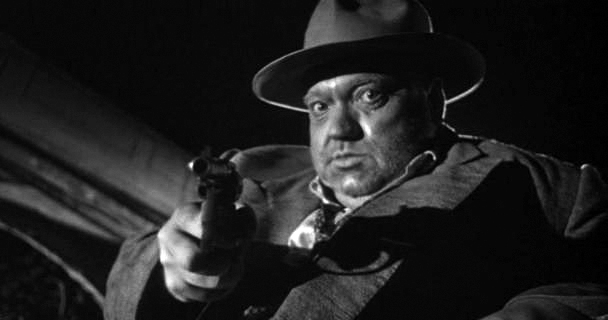
    Touch-of-evil-quinlan1 There have been a number of posts here about existing holes, but none thus far about making them (except for a few posts on aerial bombing) or filling them up–so far, the series has been in a hole-stasis.  There really should be a section on making high-speed hole-making (with bullets, like our friend Hank Quinlan, with Uncle Orson in the role in the magnificent Touch of Evil), and another on long, longitudinal and laboriously slow hole-making (with say foundation/caisson work in constructing the Brooklyn Bridge).

    But for right now I’d like to address the crafty M. Duchamp as a hole-filler, a  man who created a two-sided literal and figurative hole-making and hole-filling event, and what may be the first of its kind in the history of art.  Figuratively, Duchamp’s approach to art in the nineteen-‘teens was seen by many as a process to “destroy” art itself:  finding things like a bicycle wheel and implanting it on a stool and calling it art was seen by his friends as an event and not as art per se, but as a perversion.  Even Duchamp’s own group at the epochal 1916 international art show rejected his first “Readymade”2 (not yet then called so) as not art, leading Duchamp to abandon even them. (This had also happened three years earlier with his “Nude Descending”.)

    I don’t think that Marcel Duchamp was trying to “destroy” art, though I do believe that he was trying to force a conversation in which he had no interest in participating–a written conversation in which there was no real end or beginning, and so no middle, on top of which the punctuation would be removed and re-applied by chance. 

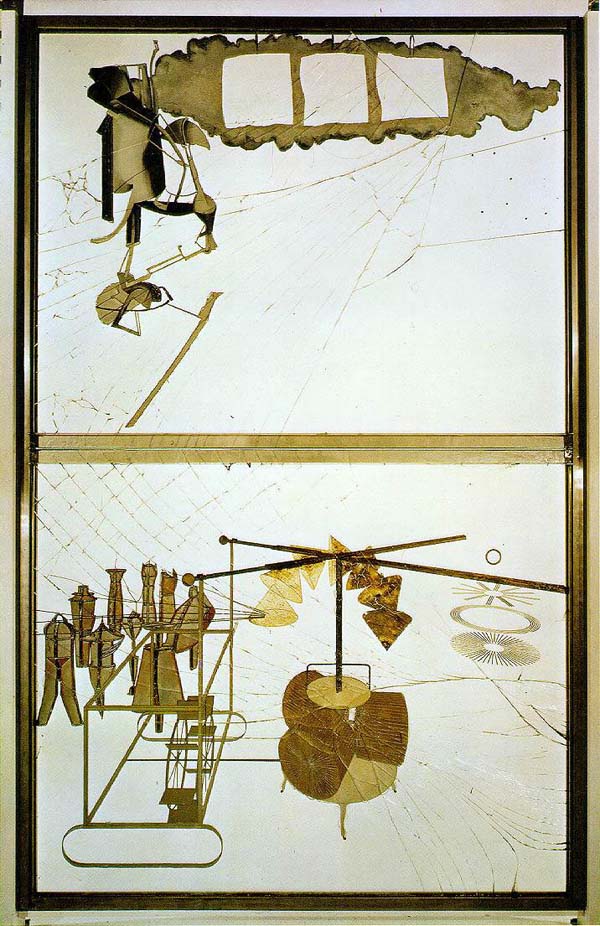
    Even the idea of a “hole” could be viewed differently in such circumstances–like the one that appears in his “The Bride Stripped Bare By Her Bachelors, Even” in the top part of the bottom (“Bachelor” panel, the detail of which appears at the head of this post, and the full version below).  Perhaps we should be talking about constructing something around a space, the remaining bit once encircled becomes a “hole”:  a reverse hole?  That would be similar to both constructing and filing the hole, almost at the same time; Duchamp included this hole in this artwork, and then covered it on both sides with glass, the self-described “lazy” Duchamp finishing it after many years of labor, a work he said to be “unanalyzable by logic”. 3

    It seems a little like making empty space inside a vacuum.

    http://4.bp.blogspot.com/_5fO6S8XT1sk/TMra2qt5_1I/AAAAAAAAANs/hI9G_RFH0mU/s1600/Duchamp+Bride+Stripped+Bare+by+Her+Bachelors,+Even1915-23.jpg

     [“The Bride Stripped Bare By Her Bachelors, Even (The Large Glass)” by Marcel Duchamp, is installed at the Philadelphia Museum of Art.]

    Notes:

    RossellCorks(back)

    [The original site for the above three images:  sheaff-ephemera.com.)

    2.  “The Bicycle Wheel is my first Readymade, so much so that at first it wasn’t even called a Readymade. It still had little to do with the idea of the Readymade. Rather it had more to do with the idea of chance. In a way, it was simply letting things go by themselves and having a sort of created atmosphere in a studio, an apartment where you live. Probably, to help your ideas come out of your head. To set the wheel turning was very soothing, very comforting, a sort of opening of avenues on other things than material life of every day. I liked the idea of having a bicycle wheel in my studio. I enjoyed looking at it, just as I enjoyed looking at the flames dancing in a fireplace. It was like having a fireplace in my studio, the movement of the wheel reminded me of the movement of flames”
    -and-
    “Please note that I didn’t want to make a work of art out of [Bicycle Wheel]. The word ‘Readymade’ did not appear until 1915, when I went to the United States. It was an interesting word, but when I put a bicycle wheel on a stool, the fork down, there was no idea of a ‘readymade,’ or anything else. It was just a distraction. I didn’t have any special reason to do it, or any intention of showing it, or describing anything. No nothing like that…”

    –http://www.toutfait.com/unmaking_the_museum/Bicycle%20Wheel.html
    3.  Calvin Tomkins, Duchamp, a Biography, p. 6.

  • The Mechanical Universe and the Use of Turning Things Upside Down: Newton, Grunpeck and the Power of Images

    JF Ptak Science Books   Post 1591
    0 blog jan 26 upside down430–


    • “Hence after Plato has, by succession from Pythagorean doctrine and by the divine profundity of his own genius, shown that apart from these ratios (i.e. musical ratios) there can be no possibility of conjunction: in his Timaeus, he constitutes the soul of the world by means of the com- position of those ratios, by the ineffable providence of God the craftsman. Consequently the soul of the world, which propels into movement this body of the universe visible to us, being constructed of ratios which created from themselves a musical concord, must of necessity produce musical sounds from the movement which it provides by its proper impulse having found the origin of them in the craftsmanship of its own composition.”                                –Isaac Newton on Plato and the rest of the cast of classical and ancient authorities, summarizing the common thread on music and the construction of the universe—that being the correlations of the orderliness of music and the heavens. 

    Newton did not intend notes like these to be published during his lifetime—as was the case with more than one million words that he dedicated to his very close and scientific research in the fields of alchemy and alchemical chemistry.  It is interesting to think of what sort of censorship went on with this work and long, deep interest of Newton’s—fully one-third of all of the scientific books that were in his library were dedicated to alchemy, and great gobs of his time was spent in alchemical pursuit, but most of this did not come to light until John Maynard Keynes purchase most of the this manuscript material at auction (!!) in 1936. 

    Newton was trying to find something that he thought only he might be able to see, trying to press his ear closer to god’s lips in whatever way possible—but for other scientists and non-modern historians of science, these pursuits seemed cumbersome, an embarrassment. 

    0 blog jan 26 upside down431
    I bring all of this up to get at what must’ve looked like a very anti-mechanical, discordant, and very non-rational set of images used to quickly convey a philosophy. 

    The great illustrator and social watchdog Thomas Nast discovered the power of the image in the 1860’s and 1870’s, when he was able to convey a message to readers and illiterates alike by creating very graphic displays  of  public corruptions and (some) social imbalances.   Of course this approach has been used for thousands of years, and is time-honored, but the spread of ideas via image in published media is not terrifically old.  (And by this media I mean by books or broadside, and not by paintings, which were generally intended for an incredibly small audience in the pre-museum days.  Messages were certainly displayed in this way for thousands of years, and most of these were messages of fear and loathing of unacceptable behaviors.  The Renaissance is beautiful but left little doubt about who was in control and what was deemed appropriate ways of acting and thinking—the church was the major patron of the arts, and its not for nothing that we see mostly passionate genuflectorial praise for the supreme being and his associates.)

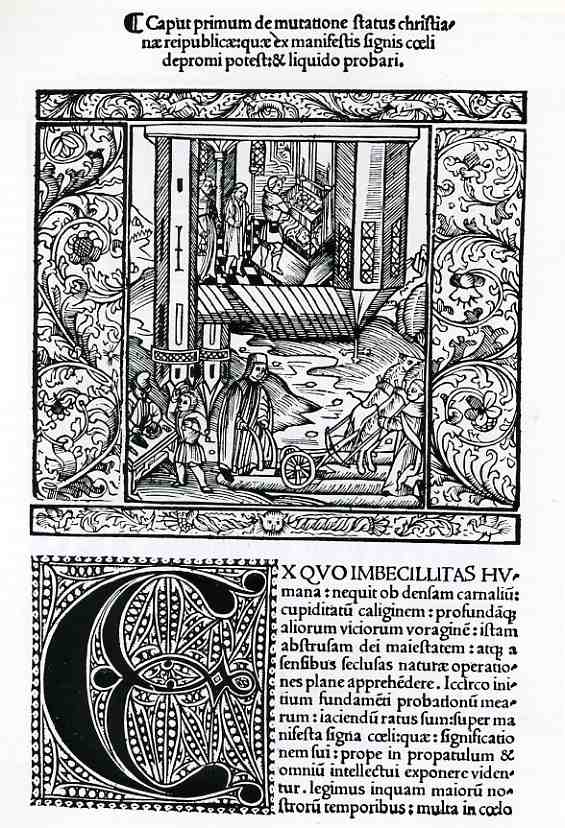
    And this brings us, I guess, to where I was trying to get all along—the superb images found in Joseph Gruenpeck’s (1473-1532) Speculum Naturalis Coelestis & Visionis…, a small folio published in Nurnberg in 1508 and illustrated with 13 fantastic woodcuts by the artist Wolf Traut (1486-1520).  Gruenpeck, who gave up his office as astrologer to Emperor Maximillian II to become a priest and to undertake the writing of this book, produced a pre-Reformation masterpiece, whose very sharp criticism of the church helped fuel the revolutionary fires among the peasants which eventually led to the Peasants’ Revolt of 1523-1525.  What is remarkable to me about the illustrations in this book are their head-butting discordant nature—one sees instantly that something is defiantly skewed, demanding the viewer’s attention—from there a very quick and generally acerbic message is delivered with great ease.  These were messages that were instantly understandable and translatable across language and culture, and it is perhaps for these reasons that this work was so important in helping to form a new social consciousness—much in the same way as more popular mass-communicators like Thomas Nast would do hundreds of years hence. 

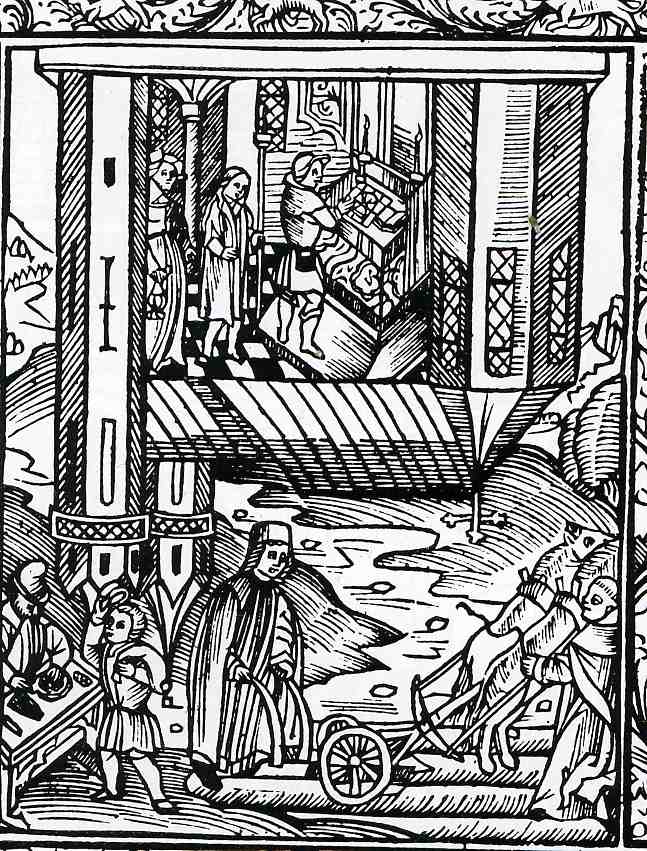
     Now, the Traut woodcut:  this is one of those very uncommon occurrences when a familiar object is place in it “opposite”, out-of-place position to attract the viewer’s attention—in this case, it is an upside-down church.  Not only is the allegorical church placed on its head, we see too that its clerics are outside tilling the soil, while the peasants and field workers are inside the church celebrating Mass, their positions in society switched  It is unlikely that such a book would’ve been in the hands of someone who couldn’t read, but, nonetheless, the image is still very powerful and must’ve made a big impact on any observer, it being such a strong attack on the foundation of the church.

    Recognition comes in many forms and flavors, as in the superb mechanical universe of Sir Isaac or the beautiful and melodious music of the spheres of Johannes Kepler; it sometimes comes via opposites and discordant methods, with the logic of Kurt Goedel, or with the images of Wolf Traut–either end pulls equally at opposite tails of the labyrinth, and a much-improved choice over a lottery in Babel. 

    ·Posted by :

    ·in: