A Daily History of Holes, Dots, Lines, Science, History, Math, Physics, Art, the Unintentional Absurd, Architecture, Maps, Data Visualization, Blank and Missing Things, and so on. |1.6 million words, 7500 images, 4.9 million hits| Press & appearances in The Times, Le Figaro, Mensa, The Economist, The Guardian, Discovery News, Slate, Le Monde, Sci American Blogs, Le Pont, and many other places… 5000+ total posts since 2008.

Author: JF Ptak

  • Darwin & Frankenstein–Mary Shelley on Creativity and the History of Her Idea

    JF Ptak Science Books Post 1606

    Today (September 9) in 1Frankensteinengravedimage_large797 was the day of the death of  Mary Wollstonecraft (Godwin), an English feminist and anarchist, best known for her tract  Vindication of the Rights of Woman (1792), and also for being the mother of Mary Wollstonecraft Godwin (Shelley), the author of Frankenstein, or the Modern Prometheus.  In all likelihood, Ms. Godwin died after complications in the birth of her daughter, giving way to “childhood fever”.
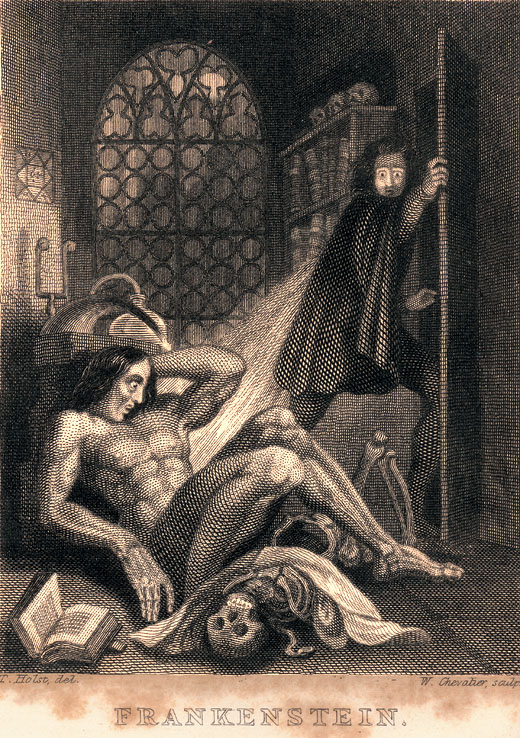
      The first time that Mary Shelley’s name appears on her Frankenstein… is on the title page of the second edition of the work, when it was printed in France in 1831, thirteen years after the anonymous Parisian printing of the first edition.  My guess is that a woman’s name–despite her high literary lineage–would just not fit on the title page of such an untoward, beastly book in which the monster of Frankenstein was created., and which was decidedly ungodly, a possible blasphemy.

    But when the second edition was published, in addition to the other changes that she made to the book–substantial, meaningful changes that suggest to scholars that the real, or intentional, Frankenstein produced by Shelley remains in the first edition–there was included a very interesting introduction.  It is in this intro that Shelley shares her story of the creation of this unusual book, as well as the literary and scientific influences in creating it–a sort of intellectual heritage to the idea, an outline of the process of her creativity that led to Frankenstein.

    The book is better known for the numerous movies that were very loosely based on it, and truth be told the book has a far greater depth to it than any of the movies ever remotely hoped to achieve–they were after unsettling horror, whereas the book was concerned with that plus the interplay of Romanticism and science/technology, and the understanding of the way in which life begins and how the brain acquires information. I think that was she was looking for was the essence of things out there somewhere in the empire1 of man.

    Shelley was influenced by a number of different scientists (though the term itself, “scientist”, wouldn’t be used for the first time until decades after the book was published) , some of whom wrote on the subject of Vitalism and other Romatic-era sensibilities rubbing up against the new technical revolution and objectivist capacities,  and the supposed capacity of electricity via Galvanism (and the work of Mesmer and Galvani) to restore life to the dead.  As Shelley writes in the introduction of the second edition: “Perhaps a corpse would be re-animated; galvanism had given token of such things: perhaps the component parts of a creature might be manufactured, brought together, and endued with vital warmth”. She wrote with accomplishment, a very nice prose, weaving a tale of Newtonian-Woodsworthian-Galvanism-Volatarianism, a Romantic-Scientist.

    But the Darwin that Shelley refers to in 1831 is of course Erasmus Darwin, the grandfather of Charles, and someone who I think Shelley didn’t actually read, but had heard about. So I think that the influence of Darwin on Shelley came through bits of remembered pieces from Percy and Byron, and only suggestive of what Darwin was  writing about.  (Even the reference to Darwin in the 1831 introduction is not there–she refers to what Darwin was writing about in the section ‘Spontaneous Vitality of Microscopic Animals‘ in the notes section of his The Temple of Nature, and doesn’t really quite get that part right, though if what Darwin was writing about could be described as a chocolate milk shake, Shelley could indeed say that the drink was chocolatey.

    The book is really quite an achievement, especially given its time; and the intro to the second edition is an unexpected revelation into how someone comes up with an idea.  A big idea. 

    The other influence in he writing of Frankenstein…--much of the book was conceived while Shelley was pregnant, a pregnancy which ended in a miscarriage and which almost cost Shelley her life. (Shelley gave birth to four children, only one of whom lived into maturity.)  The book also came a few years after two suicides in her family.  Life. Regeneration. Birth. Creation.

    Notes:

    Francis Bacon would tell us that

    But if a man endeavor to establish and extend the power and dominion of the human race itself over the universe, his ambition (if ambition it can be called) is without doubt both a more wholesome and a more noble thing than the other two. Now the empire of man over things depends wholly on the arts and sciences. For we cannot command nature except by obeying her.  Francis Bacon, 1620  Aphorism 129,’ Novum Organum (“The New Organon, or True Directions COncerning the Interpretation of Nature), Book I (1620



  • Two Gloriously Famous Bugs

    JF Ptak Science Books   Post 1605

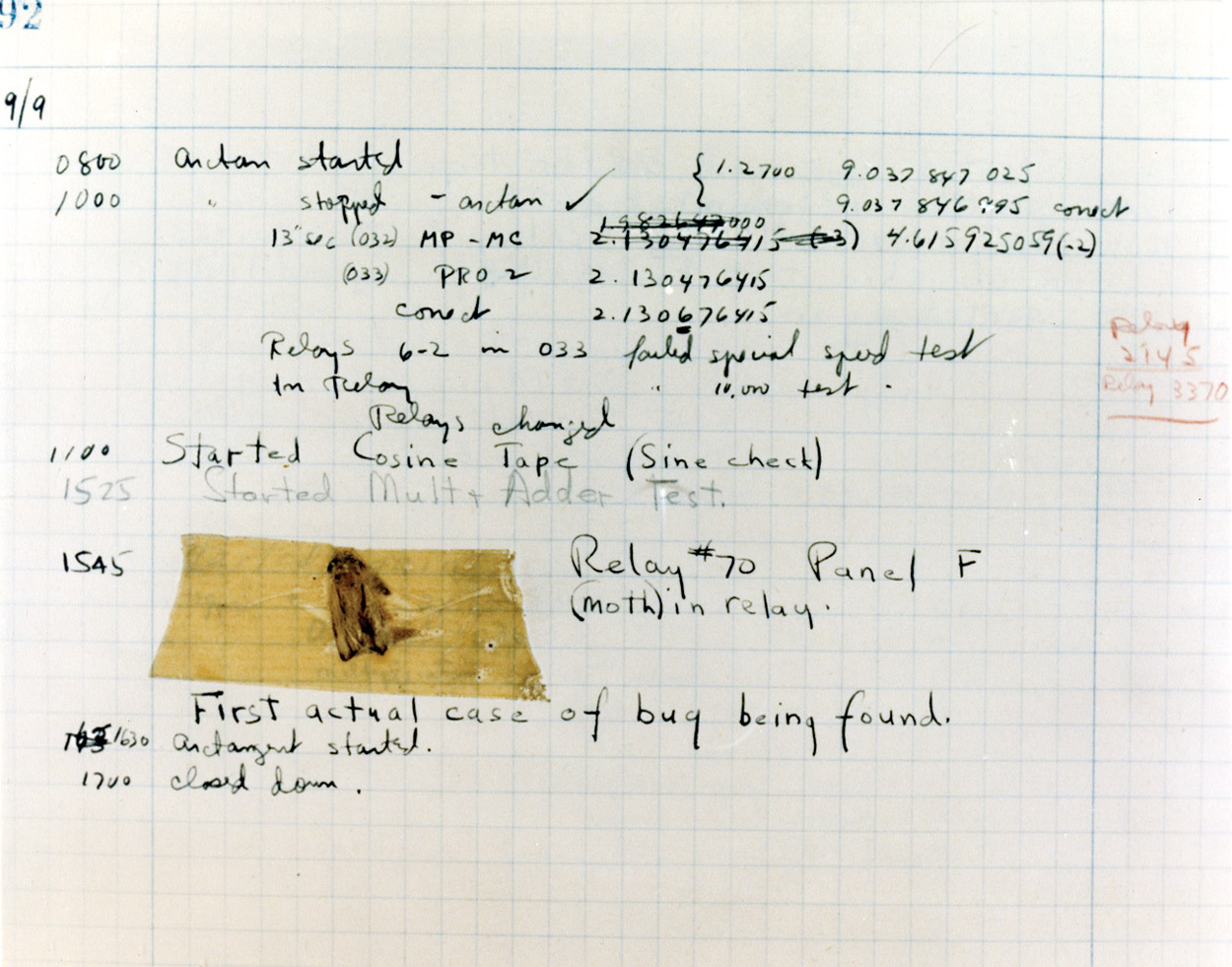
    September 9, 1947, is a big day in the page of The Big Book of Famous Bugs. This one found by Admiral Grace Murray Hopper in relay #70 of panel F of Harvard’s MARK II computer.  It was a 5 cm moth, actually, that was gumming up the works.  Hopper–an integral part of several teams  working on programming the earliest computers–witnessed the event, recorded the finding of the insect, and coined the word “debugging”.  She was an important figure in the history of computation, though Dr. Hopper is remembered by the general audience more for the bug than anything else.

    Grace Hopper Bug

     [Image source: https://yalealumnimagazine.com/articles/2633/you-can-quote-them]

    The other famous bug, perhaps the most famous in the history of science, belonged to Robert Hooke.

    Hooke--flea

    I’ve written elsewhere in this blog about Robert Hooke, and how, if there had somehow and impossibly been no Newton, he might’ve taken Sir Isaac’s place in the popular mind.  He was a tireless, relentless observer and experimenter, who lost little effort in a stranded idea and pursued interesting and problematic questions relentlessly.  More than others too he chased his won glory—minor but long and insistent—the years of which wore thin on many people in the scientific community.  But there were many characteristics of the man that made him not quite so lovable and endearing—not that Newton was any of those things, as he was not, but if you are going to be a secondary luminary to a super nova you’ve got to have something else going for you that the other man doesn’t have—sharing, helpful, greatly generous—to get you into the long pre-dusty pages of history. Also it would’ve helped if Hooke chose his battles with a little more aplomb and ingenuity—the war which began in 1672 with Newton went very badly for Hooke and followed him to the grave (and far beyond). 

    What I’d like to talk about right now, though, of the many things to talk about concerning Robert Hooke, is the most iconographic image he ever produced, and perhaps one of the most famous scientific images of the 17th century—the flea. 

    The 28-year old Hooke published the results in a gorgeous and revolutionary book, Micrographia (a lovely e-text edition appears at Gutenberg, here) in 1665, which became an instant best seller and highly praised and valued. (Samuel Pepys, perhaps among the shiniest stars whose imprimatur was like a royal blessing, said the book (was) “the most ingenious book that I ever read in my life.”) There is no telling what the people of the mid-17th century thought of seeing such incredible discoveries in the little semi-invisible stuff that made up their normal, daily lives.  The only thing that somewhat equates to this would be if the first images of the Hubble were those of Earth-bound objects whose detail had previously been unknown.  Hooke’s observations and drawings of things like the common flea were just an astonishment—that such a creature of “low order” could have such intricate detail and design was a complete revelation.  The drawings of the fly’s eye, too, was an inescapable wonder, an incredible object to consider as having any detail pre-microscope, and then revealed to have unimaginable design and elegance.

    And so the famous second bug.

    …”it is my hope, as well as belief, that these my Labours will be no more comparable to the Productions of many other Natural Philosophers, who are now every where busie about greater things; then my little Objects are to be compar’d to the greater and more beautiful Works of Nature, A Flea, a Mite, a Gnat, to an Horse, an Elephant, or a Lyon.”—Robert Hooke at the end of his 28-page preface to Micrographia (1665)


  • Fabulously Beautiful Non-Fascist Spaghetti

    JF Ptak Science Books    Post 1604

    {Images sources via 50Watts and Bibliodyssey]

    I wonder if there is a dominant semiology for the created cultures of advertising under the Fascist regime of Mussolini (which ruled the Kingdom of Italy from 1922-1943, and then followed by the Republican Fascist Party which ruled the Italian Social Republic from 1943 to 1945)  or as much so as there was for Adolf Hitler’s Nazi Germany?  A sweeping and broad generalization at which I’m just guessing at here is that the German model for creating a particular, wide-spread iconology of regime-controlled national images far outweigh their contemporaries in Italy. 

    One of the most inspired and perhaps one of the leading iconoclasts in Italy during this time was Federico Seneca, who seemed to stray far from any mainstream representations in the many ads and designs he produced from 1922-1945.  Seneca (1891-1976) really had the chops–he had a remarkable insight for placement and design and produced some beautiful and futuro-odd posters for some of Italy’s iconic companies. (The Futurism bit is a little “odd” because Marinetti’s attempt to make the/his movement the official art of the Fascist regime was rejected by the pwoers-that-be.)  I pray ask:  who would have thought of such a provocative, spare, impacting design top sell Buitoni pasta?   These creations were masterpieces of advertising poster art, and seemed to have little or nothing to do with Italian politics.

    1919 to 1935 or so, Seneca served as artistic director for ad campaigns for Perugina and Buitoni, while from the middle ‘thirties to WWII and from his own Milan-based studio he also produced graphics and posters for Italrajon, Fiat and Cinzano.  Then–for me, at least–there is a vast blank spot occupied by WWII, out of which Seneca emerges around 1950, doing more work for Cinzano, as well as Agipgas, Pibigas, Energol and  Lane BBB.


    Seneca wasn’t alone of course in his alone-place–there were plenty of artists in Italy sharing their own nodes of individuality.  For example, this fantastic poster for Amaro Gambarotta tuxedo sales in 1928 by  Saxida

    Ad for Amaro Gambarotta tuxedo, 1928, Saxida
    Though certainly this quasi-futurist style could be lovely, highly stylized, and political, as we see in this cover for a book on the young Fascist handbook, Il Capo Squadra Balilla, created in 1935 by Zedda. 

    Zedda, Il Capo Squadra Balilla, cover for Fascist youth handbook, 1935 Italy

    And of course there was plenty of work done solely for propaganda reasons:

    But for molding the cultural mind via advertising art, the Italians seemed to stay far-afield of their Germanic brethren. 

    ·Posted by :

    ·in:

    —

  • Another Example of Antique Artwork by Children, 1888 (though not really)

    JF Ptak Science Books   Quick Post   [Part of the antiquarian art for/by children series.]

    Kid art840 –The Sublime Antiquarian Art of Children, here.     

    –An Image Addition to a Series of Posts on the Antiquarian Publication of Artwork by Children, here.

    –The Great Rarity and Sublimity of Antiquarian Artwork by Children, here. 

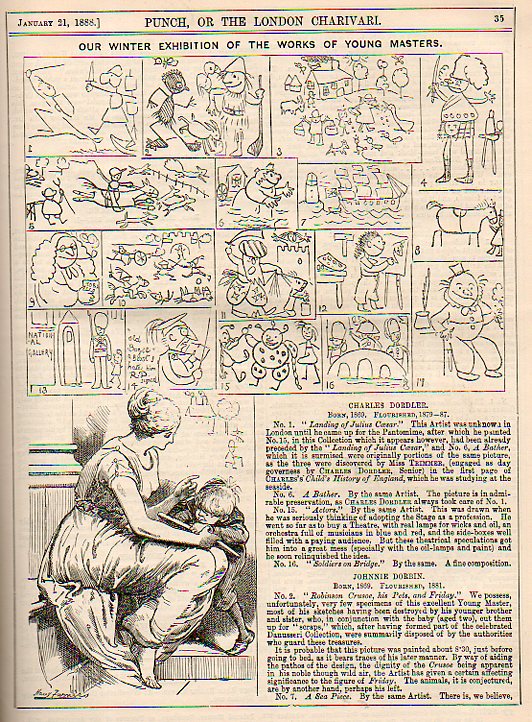
    I’ve written a number of posts to this blog on what I find to be a rare aspect of illustration–antiquarian publishing of artwork by children.  As explained in some of the earlier pieces (linked above) it seems to me that artwork made by children appear generally by chance, although this work starts to make a few appearances in late 19th and early 20th century pedagogical works on how to teach children in school and the layout of the classroom. But in general, the work just didn’t see much light of day in the publishing world.

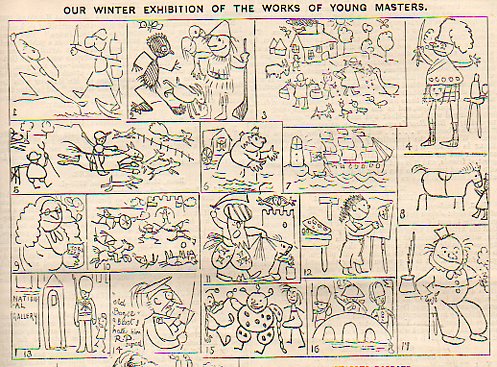
    Kid art841
    This image, found in the 24 January 1888 issue of Punch, or the London Charivari magazine, comes close to the issue, but not really–I’m sure that the work is that of one of the magazine’s full-time illustrators.  But the fates are in this image’s favor simply for bringing attention to the art of the very young.  I particularly like the image at bottom, with the small boy working hard at whatever is on his paper in the lap of his muse, with drawing graffiti on the wall over his head. 

    The key to the images, below:


    ·Posted by :

    ·in:

    —

  • Looking Backwards: How Far Back in Time is 1954 (in Computer Years)?

    JF Ptak Science Books  Post 1603

    How far back is “way back”, or “waaay back”, in terms of history?  As I’ve written earlier in this blog, about going deep into history in various disciplines, but perhaps in no discipline is time so compacted than in the computer sciences.   Mr. Peabody (above, with his boy, Sherman) would agree, and would hardly have to go “way back” in his “way back machine” to get chronologically deep in computer history. 

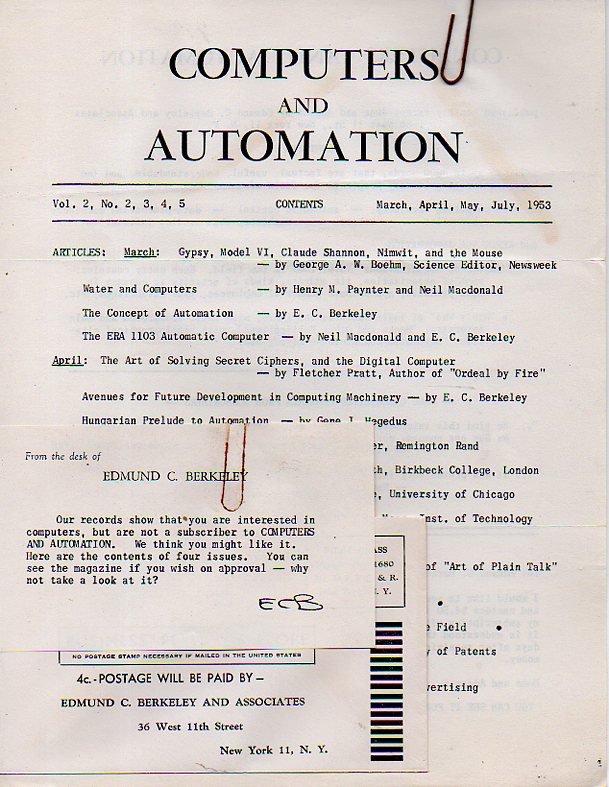
    Acm a835
    1954 is extremely deep in the history of electronic calculation–it is three years before Backus et alia created FORTRAN, five years before the integrated circuit was created, eight years before the first compsci department is established at Purdue, eleven years before the first Ph.D. is awarded in computer sci from a computer science department (Wexelblatt), and fourteen years before the first woman (Liskov) earned a Ph.D.(whose dissertation was A Program to Play Chess Endgames) in the field.  All of which sounds like ancient history, but almost all of which takes place during my own lifetime, which doesn’t make it sound so terribly “ancient”.

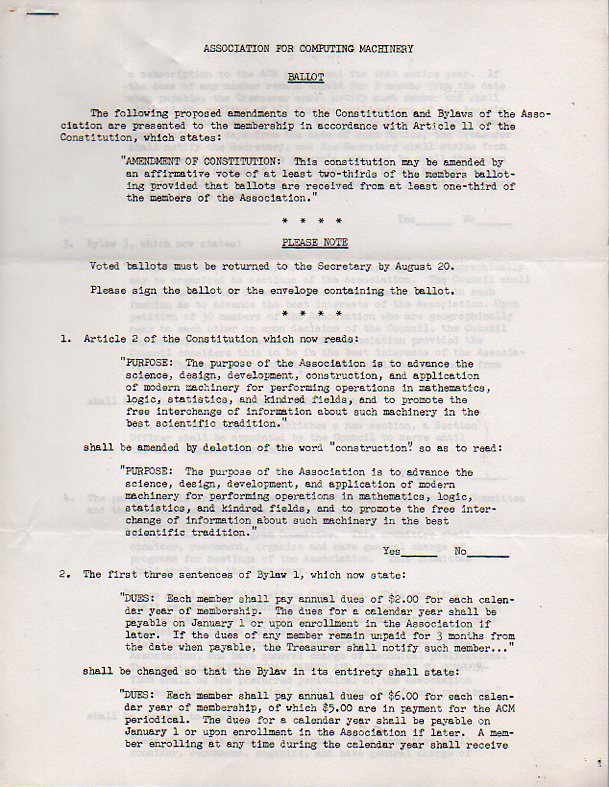
    Acm a839
    But looking at this ephemera on membership and dues and voting on the Constitution for the Association for Computing Machinery certainly makes it seem as though so–the voting and bylaws ballot is a few mimeographed pages long and is hand-stapled at the top, the announcenments for meetings fits on one sheet of paper, and Edmund C Berkeley is hand signing his initials on pleas for new subscribers to his Computers and Automation journal.  Everything looks so fresh and new and uncomplicated–and that’s because it was, relative to what we experience now.  In 1954 there weren’t 10,000 people working in the field of computing; 57 years later the growth in involvement of people working in the field is at least three orders of magnitude, and quite possibly four–the growth in the sheer volume of printed and digitally-circulated material is probably somewhere on the order of the differences between post-Gutenberg European printing and the printing industry in the year 1990.  The changes are spectacular, and they seem to be so much more appreciable when one looks at the foundation efforts from the early years. 


  • Buried by the Numbers–Literally

    JF Ptak Science Books   Quick Post

    A metaphorical statement is not often seen in its literal sense, graphically displayed–especially in mathematics.  But I did stumble across this example in the 15 June 1885 issue of Punch, or the London Charivari.  It was used to illustrate an inglorious poem on an inglorious topic that we don’t need to go into just now, but the tail-piece does exhibit the curious image of being buried by numbers.


  • History of Lines–The Mathematics of Euclidean Love & Maxwell’s Demon, 1879

    JF Ptak Science Books   Post 1603  {The History of Lines series.]

    If you give them a chance, physics and the maths will provide their own fairy tales.

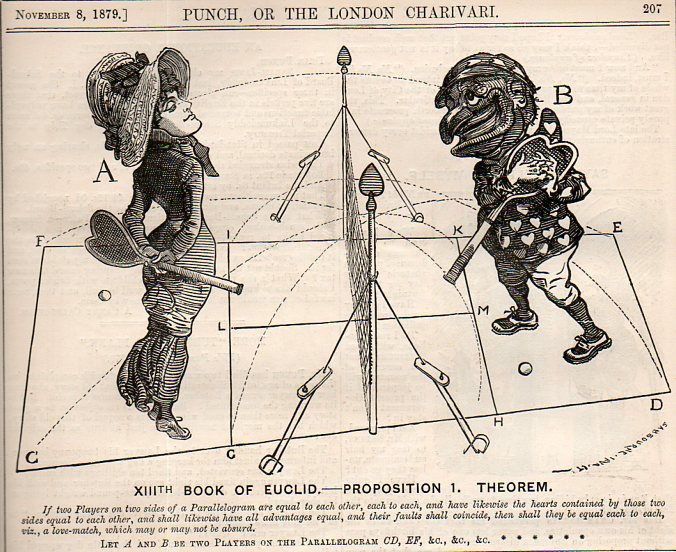
    This lovely trompe l’oeil of Euclid calls into play the play of love, in hard angles and parabolas, between Mr. Punch of Punch or the London Charivari  and the object of his affection.  The  image was published on 8 November 1879–just three days after the death of one of the greatest line-makers of the 19th century, James Clerk Maxwell.  (There is no mention of JCM anywhere in Punch, and I guess probably that there needn’t be, even if he was one of the greatest thinkers of the nineteenth (or any other) century.)

    Euclid733

              “XIIITH BOOK OF EUCLID.—PROPOSITION 1. THEOREM.

    If two Players on two sides of a Parallelogram are equal to each other, each to each, and have likewise the hearts contained by those two side» equal to each other, and shall likewise have all advantages equal, and their faulty shall coincide, then shall they be equal each to each, viz., a love-match, which may or may not be absurd.”

    Maxwell‘s really big lines come in a series of four papers called “On the Lines of Force”1, and were published in 1861 and 1862. It is in these papers that Maxwell’s famous equations are all found, and it is also the place where we’ll find the basis not only for the foundation of classical electrodynamics, but the forms for the structure of what would become the epochal/modern communication/electrical technologies. 

    File:On Physical Lines of Force.pdf
    MaxwellPhys1-10.png
    [Source:  here.]
    Maxwell’s Demon came into being as a gedankenexperiment in a series of letters–it was Maxwell not only playing devil’s advocate in trying to propose a circumstance in which the 2nd Law of Thermodynamics could be violated, but also providing the Demon, in the experiment, which he proposed as being a finite being, the contradictor.  JCM didn’t actually name this thing on his own–that appelation came via William Thomson in an article in Nature magazine3 in 1874. 
    We’ll continue this later with Faraday’s lines of force.
    2.   Maxwell stated it so:  “… if we conceive of a being whose faculties are so sharpened that he can follow every molecule in its course, such a being, whose attributes are as essentially finite as our own, would be able to do what is impossible to us. For we have seen that molecules in a vessel full of air at uniform temperature are moving with velocities by no means uniform, though the mean velocity of any great number of them, arbitrarily selected, is almost exactly uniform. Now let us suppose that such a vessel is divided into two portions, A and B, by a division in which there is a small hole, and that a being, who can see the individual molecules, opens and closes this hole, so as to allow only the swifter molecules to pass from A to B, and only the slower molecules to pass from B to A. He will thus, without expenditure of work, raise the temperature of B and lower that of A, in contradiction to the second law of thermodynamics….”
    3.  William Thomson (Lord Kelvin), “Kinetic Theory of the Dissipation of Energy,” Nature, 9 April 1874, pp. 441-444, and “The Sorting Demon Of Maxwell” (1879), Proceedings of the Royal Institution, vol. ix, p. 113.

    ·Posted by :

    ·in:

    —

  • The End of the World, Part 6–The Earth as a Bomb

    JF Ptak Science Books  Post 1601

    [I’ve written a number of times on this blog on the depiction of the end of the Earth–as it turns out, it is an uncommon subject for illustration before, say, 1950.  One in the series can be found here, with links to others.]

    Nd world maxim725
    Hiram Maxim–the inventor of the Maxim gun, almost-inventor of the light bulb, and general creative genius–wrote this article, “How the World Will End” around 1905.  He was a man with many answers to his own many questions, and here he Q-Aed himself about the end of the world.  He imagined the end coming in a number of different ways, one of which was set up by the Earth’s own mighty innards.  He imagined large-sale earthquakes and gigantic volcanoes, Krakatoa-sized volcanoes and then some, that would rend the Earth to pieces.

    Nd world maxim726
    But he starts that vision with a very odd inspiration, thinking about the power of the 1883 eruption of Krakatoa, and trying to equate the enormous explosive mission of the thing with something that was somehow doable, somehow understandable in human terms.  And what he comes up with is this–that if all the people in the world working  all time through all time in producing gunpowder and TNT, spending all of their time doing nothing but making explosives, that all of this gathered and ignited would approximate the energy of the Krakatoa eruption.

    Nd world maxim727
    He was wrong on this calculation, as smart as he was–I think just running some numbers in your head would put this thing to sleep.  But there wasn’t very much for him to compare Krakatoa to in 1905, or certainly nothing that he could compare it to that was produced by humans.  In our recent past, though–in a world that would be Maxim’s near-future–human beings have managed to manage Krakatoa-type releases of energy, namely in the form of nuclear weapons.  If we cobbled together 1,400 of the Hiroshima/Nagasaki bombs from August 1945 and detonated them at once, the amount of energy released would approximate Krakatoa.  This explosive force has since been rolled mostly into one bomb–the Tara Bomb, or Kuzka’s Mother–which was released into the world in a test shot in 1961.  That bomb was calculated to be a 50 megaton weapon, scaled down from its projected 100 megatons, and released 1.74×10¹⁷ J(oules), coming close to what some people have calculated the energy of Krakatoa to have been, at 8.4×10¹⁷J  (In a what-the-hell moment of calculation, someone reckoned the output per second of Star Trek’s U.S.S. Enterprise 1701-D to be 1.27×10¹⁹ J–an enormous number.)

    But it is an interesting form to fill up for a short scifi story.  Imagine a worldwide society which, for its entire existence, has done nothing but make the means for its own violent destruction, stockpiling fantastic amounts of explosives in a series of connected locations, waiting for the time in their history to end.  Imagine that generations would spend their time, doing nothing but producing the means for their own destruction that would come at some time.  The entire output of the combined civilizations banded together, branded for annihilation.  All working to a literal common end. 

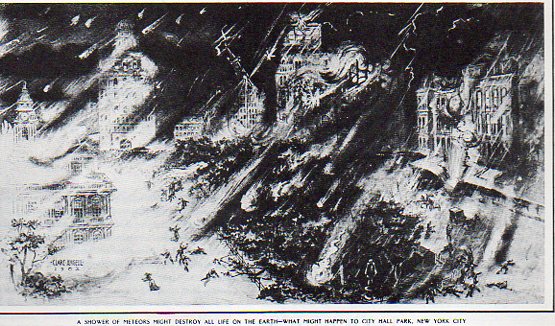
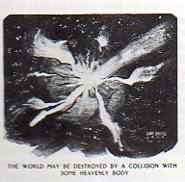
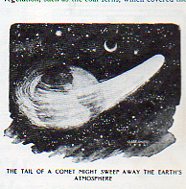
    Maxim saw other bits too in that firey end, as we see in the above illustrations:  for example, in the first image, we see the results of a meteor shower striking City Hall Park in New York City…a big “meteor shower”, a really big one.  Then there’s the possibility of a “collision with some heavenly body”, and of course the tail of a comet sweeping away the Earth’s atmosphere.  For all of his good thinking, though, I can’t get much past the image of societal bomb making…


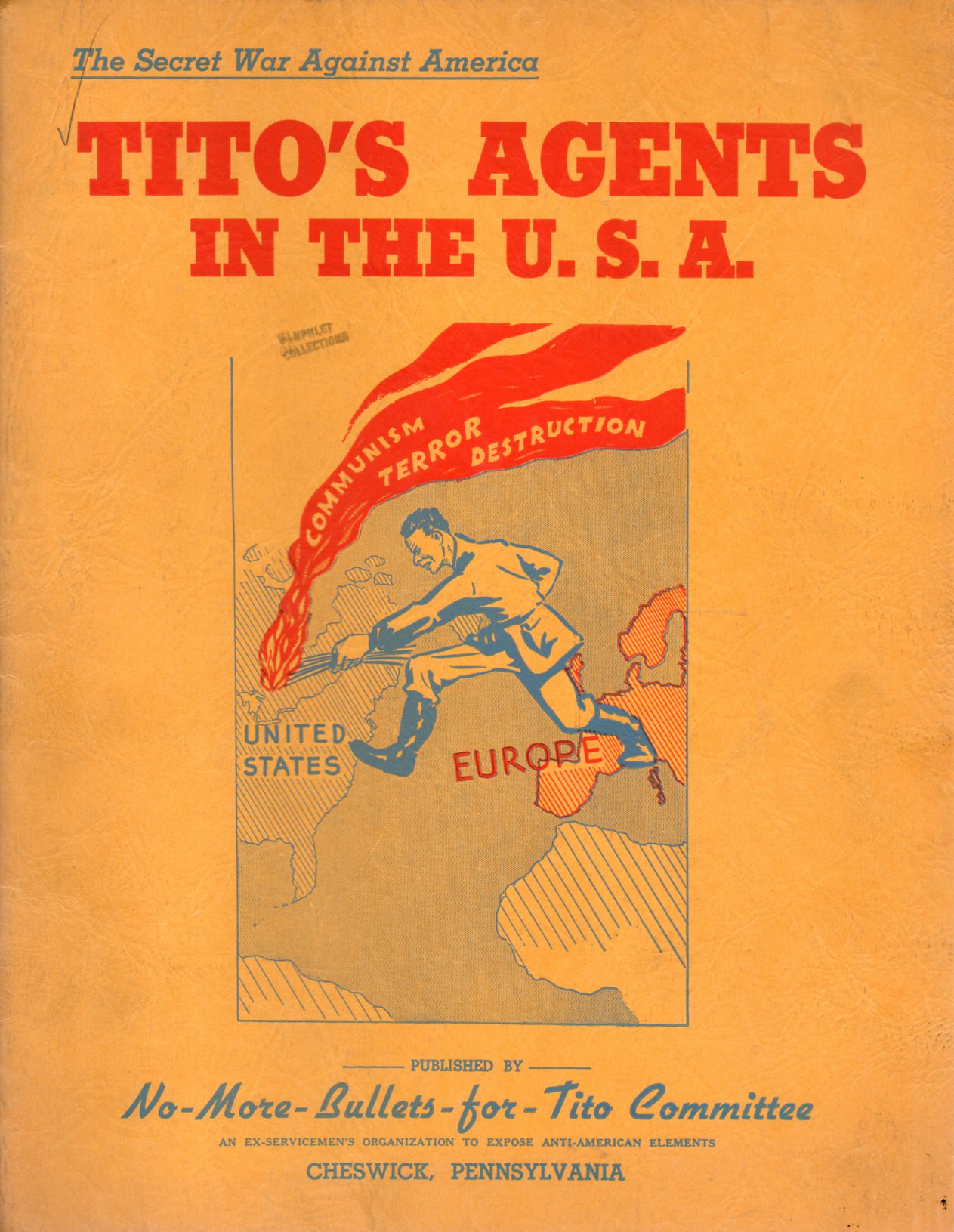
  • White Guard Fascist Terrorists in the USA, 1946

    JF Ptak Science Books   Quick Post

    White guard terrorist688

    Leon Dennen was a dedicated man with a broad experience in the affairs of the Soviet Union, the Eastern Bloc, and a capacity to see into the future.  And what this widely published man saw was this–that the countries in Eastern Europe that were presently (in 1945) under control of the Soviet Union were going to stay there1. He did see this correctly and at a time when seeing things like that correctly was pretty tough. 

    White guard terrorist687
    Earlier in his career he did see Fascists under American beds and published his view in this publication (above), published by The Friends of teh Soviet Union Society in New York City in 1935.  On the other hand he couldn’t see the Great Purge and the millions of Russians being eaten alive by the monstrous Joseph Stalin.  But his vision was pretty good for seeing the Soviet plans in Europe at the end of World War II–there weren’t that many people who save that, and those same people really didn’t see the Great Purge either. 

      White guard terrorist tito691

      White guard terrorist tito690

    White guard terrorist tito689
    Notes:

    1. Some biographical information from Commentary, January 1946:

    “Leon Dennen spent nine months in 1944 in the Near East as a representative of an American relief agency. Upon his return he announced that Soviet Russia was building a zone of influence in the Balkans that was “being nailed down with bayonets and terror by regimes deriving their authority not from the local nationalities but from the Soviet liberators.”

    “Mr. Dennen cites chapter and verse to support his contention. He shows that the peoples of the Balkans and the Near East, unable to order their own destinies, have become mere pawns in a gigantic battle for power between Britain and Russia—with Russia, propelled by the dynamism and ruthlessness of the newcomer and in a better geographical position, distinctly having the upper hand.”

    ·Posted by :

    ·in:

    —

  • The Pleasures of Astronomy–the Game, 1804

    JF Ptak Science Books  Quick Post

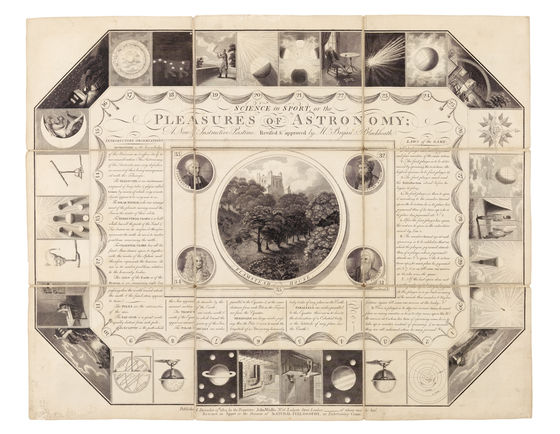
    –-“Whoever first arrives here is to take the title of Astronomer Royal‘”–end point of the game The Pleasures of Astronomy

    Astronomy board game I’m not sure how early the earliest board game featuring a scientific game might be, but I do know that this one–Science in Sport, or the Pleasures of Astronomy; A New & Instructive Pastime. Revised & approved by Mrs. Bryan; Blackheath–seems to be very advanced for its age.  Made in 1804 by John Wallis on London, the game such as it is isn’t very “game-y”–the gaming aspect of it isn’t very interesting or involved–mostly the mostly-representative aspect so the game is to just expose the young players to select aspects of the history of astronomy. As a pedagogical tool, the game probably works pretty nicely. 

    The game board, or the course of the game, is relatively standard, though the subject matter is not. The object was to arrive at Flamsteed House1, and by the course of victory the young player would become acquainted with elements of morals, ethics, natural philosophy (although Wallis did in fact produce a very similar game for that topic alone) plus of course some basics of astronomy. 

    Notes:

    1. “Flamsteed House, the original Observatory building at Greenwich, was designed by Sir Christopher Wren and Robert Hooke and built in 1675-76.”  See here for more information.

    ·Posted by :

    ·in: