A Daily History of Holes, Dots, Lines, Science, History, Math, Physics, Art, the Unintentional Absurd, Architecture, Maps, Data Visualization, Blank and Missing Things, and so on. |1.6 million words, 7500 images, 4.9 million hits| Press & appearances in The Times, Le Figaro, Mensa, The Economist, The Guardian, Discovery News, Slate, Le Monde, Sci American Blogs, Le Pont, and many other places… 5000+ total posts since 2008.

Author: JF Ptak

  • Albert Robida and the History of the Future

     JF Ptak Science Books  Post 1590

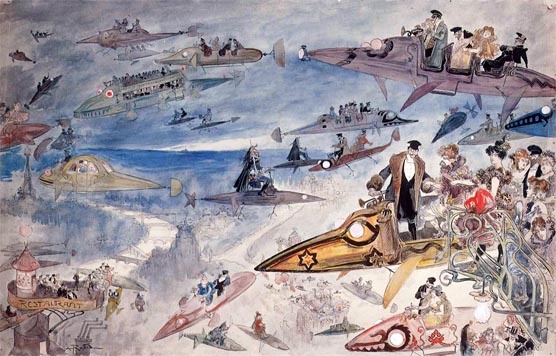
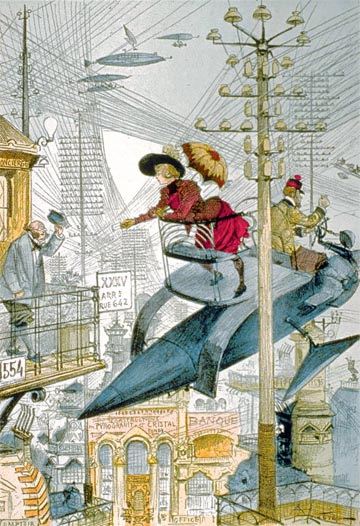
    Albert Robida (1848-1926) saw pretty deeply into the future, his mind wrapped around the plausibilities of possibilities, and getting a lot of them quite right.  He was enormously prolific, with some 60,000 designs to his credit as well as 200 illustrated books and many dozens of illustrated journals, many of them quite lovely and prescient, if somewhat upsetting to the common-reading mind of mid-late 19th Europe. 

    Robida1 shared several decades of peak-creativity time with the stone-cold master of the as-yet defined science fiction realms in the person of Jules Verne (1828-1905), who certainly wrote deeper and longer than Robida, though without Robida’s creative artistic talents.  But the 1870’s and 1880’s would have been prime space for both men, even though Verne’s2 best years were behind him and he had entered a decidedly darker period by that point–that said, the men did share the same oxygens of Europe, separated by just hundreds of miles. 

    It might be said that Verne had somewhat loftier visions of the future than Robida; perhaps not.,  Robida does seems to have a great (and perhaps more) concern with the future of the more middle-class/vast mass of people, and again, perhaps not.  One thing is for certain, to me at least–Robida does deserve much more attention than he presently receives, though perhaps that will come more in the future that he created.

    “La sortie de l’Opéra en l’an 2000”.  Original source:  Bibliodyssey

    “Un quartier embrouillé “, La Vie électrique, Paris, Librairie Illustrée, [1892].


  • Man is But a Worm–Darwin and Redon, 1881-1883

    JF Ptak Science Books   Post 1589

    http://cdn2-b.examiner.com/sites/default/files/styles/image_full_width/hash/b2/77/b277d4d3e88c41151d8a3c709696c8c8.jpg

    In the last tow years of his life Charles Darwin enjoyed some critical and popular success  with the publication of his The formation of vegetable mold, through the action of worms,  which was published by the steadfast John Murray in London in October of 1881.  It sold at a better clip even than On the Origin of Species, which had sold very well 22 years earlier.  By the time the cartoon (above) appeared in print by the relatively mid-brow Punch magazine (by Linley Sambourne, 6 December 1881) Darwin’s book sold about 7,000 copies, which for the time would make it a pretty good seller.

    Darwin only had a few months left to live at the time of the Punch publication (12 February 1809 – 19 April 1882), and I’m not too sure about what the old man would’ve felt in seeing it.  Actually, the Old Man wasn’t all that old, but at 73 and with a belly full of worms or whatever and a lifelong list of complaints real and imagined, Darwin was older than jis years.  After everything had been said and doen, and the tons of complaints heaped upon him from all quarters, I suspect that the cartoon would mean nothing to him.

    {Just for the record, we follow the evolution of worm-to-man in a trip one and a quarter times around the clock, starting with a big old (flat?)worm at bottom left, which develops counter-clockwised into a chimp-worm, then into a monkey-thing, then into a sort of comic-relief Darwin-ape-man, winding its course into Charles Darwin himself.  Not flattering to the man or the idea.]

    It would on the other hand be a curious thing to imagine Darwin meeting for a chat with the expansive evocateur Odilon Redon, who created some of the earliest (non-confrontational editorial) art based on Darwin’s Origin.  Redon (April 20, 1840 – July 6, 1916) published eight lithographs based on Darwin’s work in  Les Origine (Paris,  Lemercier and Cie), and they were unlike anything that I’ve ever seen regarding evolution–as a matter of fact (perhaps), Redon’s artwork in general was unlike most anything else that existed.  (Redon acknowledged this, of course, saying  “My drawings inspire, and are not to be defined. They place us, as does music, in the ambiguous realm of the undetermined.”)

    http://www.19thcenturypost.com/The%20Misshapen%20Polyp%20Floated%20on%20the%20Shores,%20a%20Sort%20of%20Smiling%20and%20Hideous%20Cyclops,%20Plate%203%20from%20Les%20Origines,%201883,%20by%20Odilon%20Redon,%20Museum%20of%20Fine%20Arts,%20Boston.jpg

     “The Misshapen Polp Floated on the Shores, a Sort of Smiling and Hideous Cyclops”, plate 3, 1883.

    But I don’t see that much being said between the two men, across a small table having tea–though I don’t have any hesitation saying that Redon would’ve had a lot of questions for Darwin.  My feeling is that Darwin wouldn’t have that many coming back. 


  • Buck Rogers and the Failure of Imagery in WWIII, 1946

    JF Ptak Science Books   Quick Post  [Part of the series on Atomic Weapons]

    Atomic war buck rogers683
    Atomic war buck rogers685
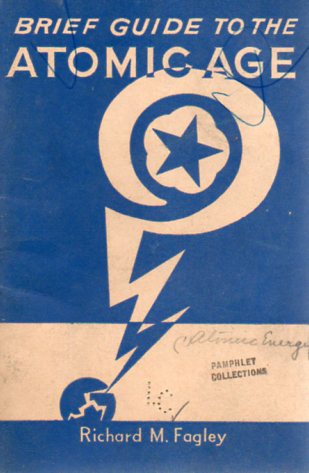
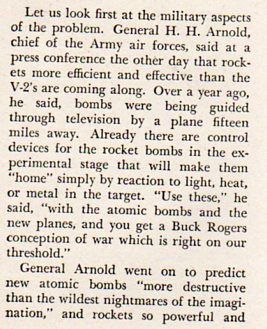
    Richard Fagley took a sleepy, 4th grade side step through the coming decade or so in the future of atomic weaponry.  The thign is, he got a bunch of it right.  But where he missed a bunch of it, where he underestimated the power of atom weapons, was that they would provide the future us with a “Buck Rogers” style of war.

    Now of course in 1946 the Soviets hadn’t developed a Bomb, but anyone who knew anything knew that it would be just a matter of time before they did.  Smart estimates were coming in at a decade or more–few people were prepared for the Soviet announcement in 1949 that they had achieved that goal

    Fagley missed the impact of atomic warfare of the future not on his own accord–he was quoting someone who knew far more and knew better–General Hap Arnold, the Commanding General of the U.S. Air Force.  But as it turns out, Arnold really didn’t have the vocabulary or this discussion, and couldn’t really estimate the “effectiveness” of the use of 

    Atomic war buck rogers684

    the new weapons. 

    So far as I know, Buck Rogers didn’t have weapons like atomic bombs; the war of the future, even though Fagley says that there wouldn’t be many survivors, would be far worse than they could imagine it to be–perhaps because that amount of destruction was still unimaginable. Buck Rogers just didn’t have the vocabulary for such enormous power and mass destruction, unless he had a planet-eater or something that I don’t know about.  In any event, words to describe the coming possibility of vast annihilation just didn’t seem to be at hand in 1946–the words and ideas, and the weapons, would soon (in the Ulam-Teller hydrogen bomb, 1951) be at hand, though. 

    Buck Rogers Will Wake Up In A 3D Future image


  • History of the Future–Advertising in Yellowstone, 1905

    JF Ptak Science Books  Quick Post

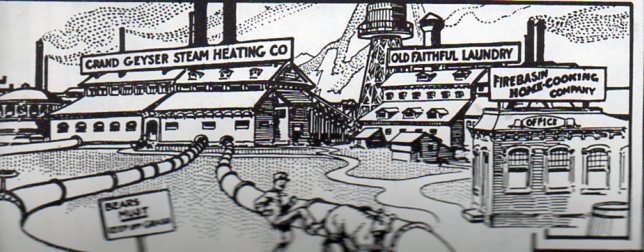
    Ads future662

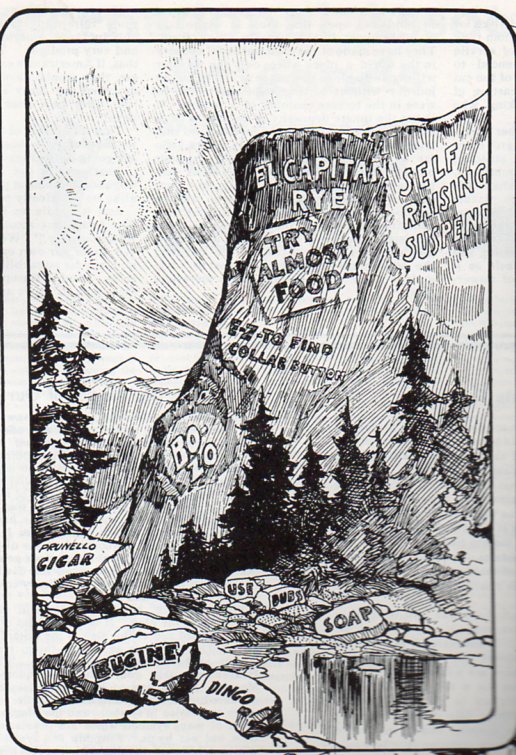
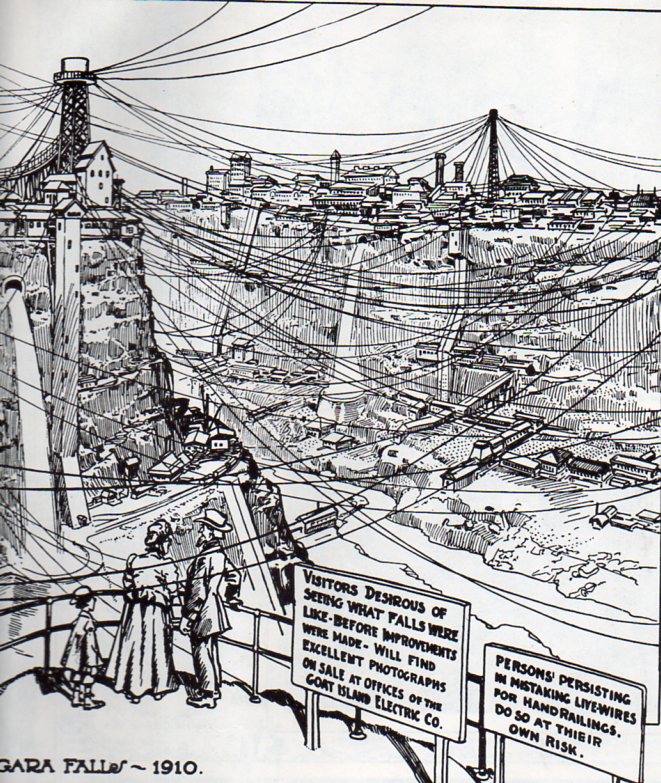
    The way of the new world, the spread of commercialism and of consumerism, the increase in the size of a middle class that was actually approaching what we today would think of as a middle class, the wanting rise of places for disposable income to go from millions of new people with spare money to spend, led the sellers of stuff-immemorial to start advertising their bits on the side of out-of-doors everything. The fight for the attention span of the new consumer went from the newspapers and magazines to the side of buildings and then, as the motor car began to proliferate, to thousands of miles of roadway. 

    But when these cartoons appeared in (the first) Life magazine in 1905, the car was still a distant image so far as common ownership was concerned, so the competition for the visual space of the new buying market was center on outdoor displays wherever people might happen to be outdoors.  (Remember, there’s no radio or television to absorb advert money and viewer attention, so efforts were magnified on billboards.)

    So Life took a peep into the future and didn’t like what it saw: the possible vast expansion of ugliness in the pursuit of whatever dollar might fall out of whatever pocket.  Just a little warning to America is all–the future of the country might not look as pretty it used to be, what with millions of new billboards to place. 

    The future Niagra Falls, five years hence:

    Ads future660
    Old Faithful, Yellowstone, as it could be in 1910:

    Ads future661


  • History of Normalcy and the Fluidity of “-isms”, 1867

    JF Ptak Science Books   Post 1578

    My wife, Patti Digh, and I have long talked about the history of normalcy—a history of what looks to be “normal”, or standard, or acceptable at one time that became not so over the course of time.  Buying and selling human beings, women and their children being property of her spouse, and Chinese immigrants not having (any) legal rights, are three good candidates (among thousands) for this history in the fluid mechanics of socially-accepted thought and practice.  It is an interesting proposition to think about—what things around you, or better yet, what thing you think or say or do, that look good and acceptable today might look embarrassing and unacceptable thirty years hence. What is today’s ridiculed or reviled _______ may be tomorrow’s standard practice.

    This small slug of a story (below) appeared in the 23 March 1867 issue of Punch, or the London Charivari, and takes all manner of French legal reasoning to trial. It is a good example of the changeability of the porous borders of rank belief, centered in this case on Catholicism–and it might as well have been virtually any other -ism that you can think of.   Evidently the editor, manager and even the printer of Libre pensee were hauled into court,subjected to prosecution, tried and convicted of what seemed like hate literature.  In a series of articles appearing in several issues of the journal in February and March 1867 the author launched particularly sharp criticisms at some religions, including Catholicism, which he described it as  “a rotten trunk, a receptacle of death whose fatal emanations spread all around desolation and solitude”.

    But that’s not why the editor and manager were thrown into jail for a few months, not really–the judge in the case took issue with the magazine bringing the issue to light and exposing the shortcomings of Catholicism–which he believed were many–and which could be believed by many (“if not all”) people who read the article.  It was also found that the rant against Catholicism was not without merit (“too much of it could be apparently proved”), and that it would receive little rescue in a refutation that was not conceivable (“Let us not, therefore, contemptuously leave it to meet with a refutation which it will not receive.”).  The complaint was that the editor and manager allowed the thing to be printed, a thing which could in the eyes of the court lead to unrest–jailed for printing what the judge considered a incendiary truth even though it was bound in deceit and defamation.

    The judge wrote:

    “It is not obvious. It is not manifest. There is too much verisimilitude in that description of Catholicism. There are too many people who are likely to believe a good deal of it, if not all. The truth, moreover, is that, if any argument about it were permitted, too much of it could be apparently proved. Let us not, therefore, contemptuously leave it to meet with a refutation which it will not receive. Our wisest plan is to silence its promulgators. Accordingly we will sentence the manager and editor of the Libre Pensee to fine and imprisonment.” This is logic.

    I think what Punch was responding to was “stupidism”:  “Here, in England, Papists and Protestants are free to abuse each other’s respective isms as much as they please, so long as they refrain from libeling one another or any one else. John Bull cannot see who is wronged by the abuse of an ism. Of course that blindness is owing to his want of logic.”

    There was no mention of what happened to the author, unless the author was the editor. 


  • John Stuart Mill and the Early De-gendering of the Subject–Inventing “Person-kind”

    JF Ptak Science Books   Post 1587

    File:Mill's logic 1867.jpg

    “That the principle which regulates the existing social relations between the two sexes — the legal subordination of one sex to the other — is wrong itself, and now one of the chief hindrances to human improvement; and that it ought to be replaced by a principle of perfect equality, admitting no power or privilege on the one side, nor disability on the other.”–On the Subjugation of Women, John Stuart Mill, 1861.

    Perhaps one of the most devastating logical displays in the history of the struggle for equality for women was that of John Stuart Mill.  He makes a powerful and inescapable argument on what he considered the basic enslavement of women in his The Subjugation of Women in 1861–that, and of course a complementary argument for the recognition of women as moral/ethical/legal equals of men.

    If Mill was the doctor of the state of England, he would have said that his patient was suffering a necrosis, that women as slaves would be the eventual death of the United Kingdom, and that equal freedoms and individual rights needed to be granted to them to ensure the survival of the state.  Women needed to be added to the equality register so far as the law was concerned, to be equal beneficiaries of everything that society had to offer.  and that equality extended to the family unit, where the married partners would share the domestic scene, and that the husband would live more of his social life within the family rather than without, changing the basic structure of the family for the better.  It was to this political end that as a Member of Parliament Mill–on 20 March  1867–introduced the idea of female suffrage to the House of Commons as a stipulation to the Representation of the People Bill, which would lead to the Reform Bill of 1867.  Mill suggested changing the word “man” to “person”. It was not a success, of coure, and women would not get the vote for another 50 years. 

    Punch, or the London Charivari, the leading satirical and social-commentating periodical of Great Britain, took a relatively neutral position on Mill a week later (30 March 1867) with a full-page cartoon (above).  Mill is daintily bu8t forcefully trying to clear a path for the women at his right hand, trying to open a way through a crowd of men being anchored by John Bull.  I’m no authority on any of these matters, but it seems to me that if Punch had decided to take a hard line against the vote for women they might’ve made the group of women depicted here more tawdry or “manish” or un-ladylike or something, anything, than the relatively benign group that was depicted. 

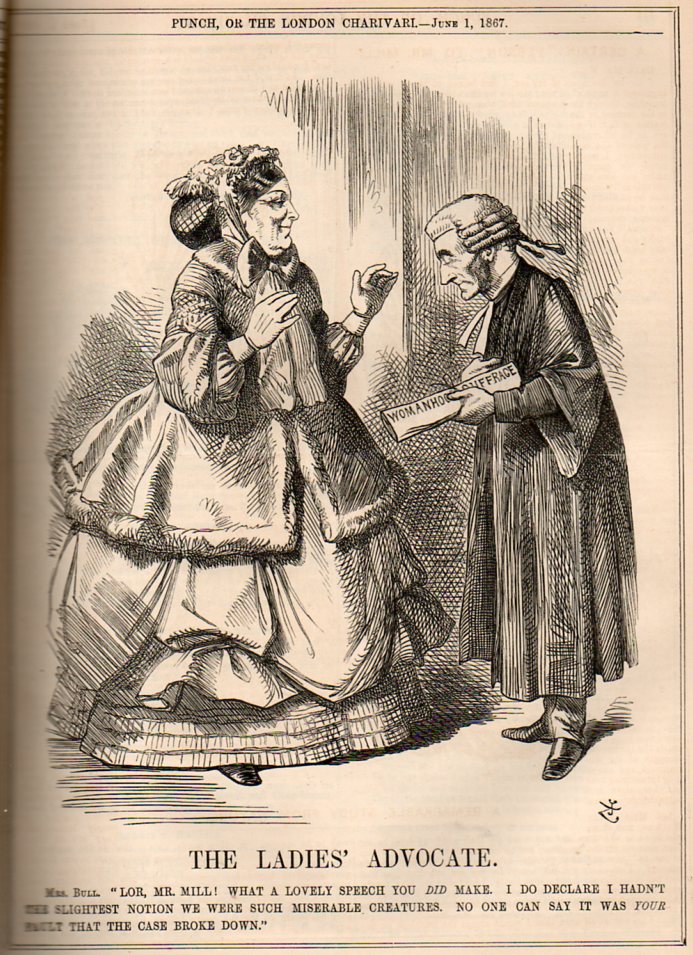
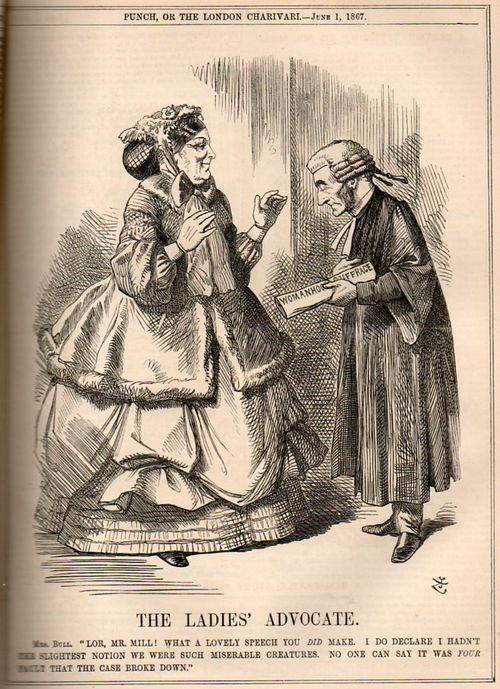
    A few weeks later another cartoon appears (on 1 June 1867) with Mrs. (John) Bull greeting Mill with some level of amusement, this time the editors carrying more of a challenge to the whole idea.  Mrs. Bull  says “I  hadn’t the slightest notion that we were such miserable creatures”, with a good smile and crinkling eyes, looking down at the diminutive Mr. Mill, whose head is bowed and eyes downcast in defeat of the bill. 
    Women vote 658

    I’ve not studied Punch but I have sat down with a few decades of it, and I’ve gotta say that I don’t see very much there at all regarding the vote for women–and even here, when it does, twice, the rebuke–if any–for thinking such thoughts as Mill is surprisingly mild. 

    Mill’s closing paragraph of his Subjugation, summing up:

    “When we consider the positive evil caused to the disqualified half of the human race by their disqualification — first in the loss of the most inspiriting and elevating kind of personal enjoyment, and next in the weariness, disappointment, and profound dissatisfaction with life, which are so often the substitute for it; one feels that among all the lessons which men require for carrying on the struggle against the inevitable imperfections of their lot on earth, there is no lesson which they more need, than not to add to the evils which nature inflicts, by their jealous and prejudiced restrictions on one another. Their vain fears only substitute other and worse evils for those which they are idly apprehensive of: while every restraint on the freedom of conduct of any of their human fellow-creatures (otherwise than by making them responsible for any evil actually caused by it), dries up pro tanto the principal fountain of human happiness, and leaves the species less rich, to an inappreciable degree, in all that makes life valuable to the individual human being.”
  • The Vast VD Landscape of “Procurable” Women: the Big WWII Poster Post on Veneral Diseases

    JF Ptak Science Books  Quick Post

    http://1.bp.blogspot.com/_Xq1_QVuOUV4/S_LGzpQOxBI/AAAAAAAAQlI/AAD8hijEhBk/s1600/1a4.jpg

    [All images from John Brown’s Public Diplomacy Press and Review Blog, here.]

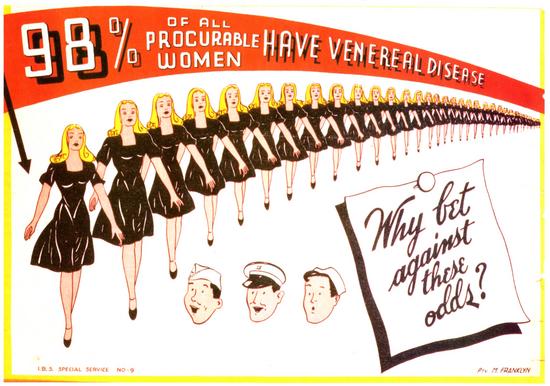
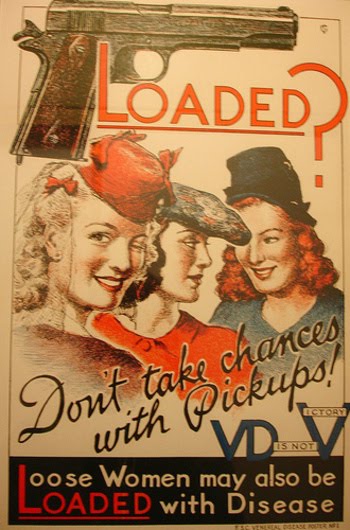
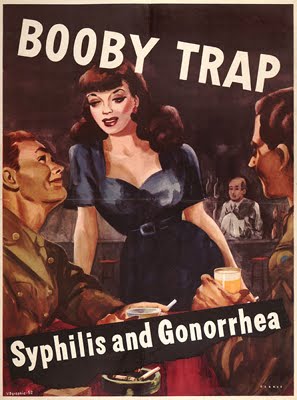
    Almost all of these posters were printed by the U.S. government as a preventative measure to help eradicate the costs of venereal diseases to the American armed forces.  They look a little outre and goofy and unbelievable in their way, but their message was very clear.  The effects of venereal disease too is a very clear one to military forces, because as important as it is to feed and clothe your troops, it is equally important to keep them healthy, for since the beginning of keeping armies there are always episodes of armed forces being decimated by disease, some percentage of them being sexually transmitted. 

    So I understand that the powers that be were trying to limit the lovelust interests of a (conquering) military force by scaring them,but sometimes the message came with a price, as with the lead poster on this post, which basically shrank the individuality of women down to the nexus, eliminating their individuality and robotizing them into VD-carrying sex toys.   .

    The percentage enough would carry this message, but a detailed view of the poster shows how it enunciates the mechanization of the female love receptacle:

    VD Poster det

    I don’t disagree with the underlying purpose of these posters, or even most of their sentiments–except of course for the lobotomized-disease-carrier-women parts.

    http://1.bp.blogspot.com/_Xq1_QVuOUV4/S_LHeo_CJQI/AAAAAAAAQlg/YU8fmOgsSxA/s1600/1a10.jpg

    http://4.bp.blogspot.com/_Xq1_QVuOUV4/S_LJt4wc0kI/AAAAAAAAQmg/ObWc9HCcJq8/s1600/1a22.jpg


    http://1.bp.blogspot.com/_Xq1_QVuOUV4/S_LI0YVjLQI/AAAAAAAAQmI/SQkMpPp6Wu8/s1600/1a18.jpg


  • Atomic Bomb Civilian Defense Posters

    JF Ptak Science Books   Quick Post

    [50s+bomb+poster.jpg]

    [AmerUndrComm.jpg]


  • Heavenly Chinese Space Program Posters

    JF Ptak Science Books  Quick Post

    I don’t know quite what it is about these poster for the Chinese space program, but they are magnificently bad, or simply beyond what I can consider “good” color sense and design.  Perhaps they are all just “something else”. 

    The source for the images:  Chinese posters.net.

    Little guests in the Moon Palace, early 1970s

    Roaming outer space in an airship, 1962


  • Apocalypse Then–World War III, The 36-Hour War of 1948

    JF Ptak Science Books   Post 1585  [Part of a long series on atomic and nuclear weapons]

    This is also part of a sub-series on the invasion of attack on America; examples of other posts include: Mapping the Invasion of America, 1942 (which is the most-viewed post from this blog, with over 500k readers), The Invasion of America, 1935,  Bombing Manhattan and the Amerika Bomber, 1943, and The Invasion of America, 1942, Part II .

    In the very near wake of the bombing of Hiroshima and Nagasaki, the editors of Life magazine published a prescient bit of propaganda on the coming of the Cold War.  I guess though that the Cold War had already begun by Yalta1, when the sick and basically-terminal FDR seems to have been corralled by Bloody Joe Stalin, leaving the new President Truman on alert for the possible coming aggressiveness of the Soviet Union.  The article appeared in the 19 November 1945 issue (pp 28-39), and it was a longish one, with nine illustrations (by A. Leydenfrost), and as articles go in Life from this time, this one was heavy. 

    It built itself up on a report generated from the offices of General Hap Arnold, and reckoned a new war, a New War, World War III, to occur in 1948–except that this time there were no natural difficulties that the U.S. could hide behind. (Arnold said: “…with present equipment an enemy air power can without warning, pass over all formerly visualized barriers and can deliver devastating blows at our population centers”.) The threat would come from above, and there would be little accurate defenses against them. 

    There would be survivors but massive destruction and death–and remember that this was at the point of the simple atomic weapon, before the development of the big stuff.  In the opening images of the article, a chilling two-pager showing eight major American cities being struck by atomic weapons, resulting in at least 10,000,000 casualties.

    But as grisly as all of this was, the American reader was told the the United States would prevail, and that our rockets “would lay waste” to the enemy’s cities; “the U.S. wins the atomic war”.

    [Image sources:  I’ve used the image from the Drexel University site as my copy of this issue of Life is in a massive half-yearly bound volume, impossible to scan.]

    This is what New York City was supposed to look like, afterwards, with inspectors sizing up the radiological waste of what was left of the NYPL at 412nd Street:

     Notes:

    1. The Yalta Conference was the third meeting between the leaders of the U.S., the United Kingdom and the Soviet Union, held 4-11 February 1945.  It came after the Tehran and Cairo Conferences, and preceded the final Potsdam Conference on 17 July- 2August 1945.

    More illustrations: