A Daily History of Holes, Dots, Lines, Science, History, Math, Physics, Art, the Unintentional Absurd, Architecture, Maps, Data Visualization, Blank and Missing Things, and so on. |1.6 million words, 7500 images, 4.9 million hits| Press & appearances in The Times, Le Figaro, Mensa, The Economist, The Guardian, Discovery News, Slate, Le Monde, Sci American Blogs, Le Pont, and many other places… 5000+ total posts since 2008.

Author: JF Ptak

  • Imaginary History: 2-D and 3-D Shadows

    JF Ptak Science Books    Post 1975 

    Follow Me on Pinterest


    In preparing an alphabetic sampler atlas of imaginary places (a thing which looks much finer capitalized, so An Alphabetic Sampler Atlas of Imaginary Places), I wondered about the non-existent relationships between these nonexistent places, and thought that this too might make an interesting alphabetization project. So an Alphabetic Sampler of Non-Existent Relationships Between Non-Existent Places came to be, and since it has such an oddly appealing ring to it, with a certain amount of surrealist qualities (really more affectations) it might be appropriate to start with Alfred Jarry, and here with his wonderful creation, Laceland1. and its relationship to Edwin Abbott’s Flatland2.. Their’s could be a war in the relationship of their light–or more exactly, their relationship of shadows.

    I can see across the vast and extremely limited sea that separates these two places a commonality in at least one dimension–and maybe only one, though being light, it is a rather large one. Light plays a big part in Flatland. The slender book Flatland is perhaps one of the best books ever written on perception and dimensions, a beautifully insightful book that was quick and sharp, and in spite of all that was also a best-seller. Written in 1884 when Abbott was 46 (Abbott would live another 46 years and enjoy the book’s popular reception), it introduces the reader to a two dimensional world with a social structure in which the more sides of your object equals power and esteem. Thus a lower class would be a triangle (three sides) while the highest (priestly) class would be mega-polygons, whose shape would then become a circle. On the lowest but complex strata is woman, who is represented as a line, but which is also the most contentious and unpredictable of all of the Flatland shapes. That is, until they all encounter a sphere, and the introduction of the third dimension, where Abbott’s magistry comes in explaining to the three-dimensional reader what it was like to be in a two-dimensional world.

    Jarry’s Laceland–along with Amorphous Island, Fragrant Island, Bran Isle and what is almost the pluralization of my surname, Ptyx–was an island kingdom that was surrounded by shadow and semi dark, but upon approaching it there would appear absolutely brilliant and blinding light the power outmatching that of the sun, glorious and fantastic, the light greater than that of the light of creation. The light is beautifully described by Alberto Manguel and Gianni Guadalupi in their excellent The Dictionary of Imaginary Places (1980):

    “The King of Lace spins this bright light, weaving pictures of madonnas, jewels, peacocks and human figures which intertwine like the dances of the Rhine-maidens. Clear patterns apper against the pitch-black darkness of the surrounding air, like shapes painted on windows by the first, and then disappear again into the shadows” (Page 204)

    Now in Flatland, light is a different sort of thing, coming as it does in only two dimensions, which means that two-dimensional light in a two dimensional world makes for a different sort of shadow, one that is rather flat and uninspired, especially compared to those of Laceland, which must be magnificent. Perhaps the shadow relationship between Laceland and Flatland is one of opposites. Polar opposites. Impossibles.

    This all seems to come together a little when considering that the Dr. Faustroll of the Laceland adventures, is the inventor of “pataphysics”, which is “the science of imaginary solutions”.

    Notes:

    1. Alfred Jarry. Ptyx, Laceland, Amorphous Island, Fragrant Island and Bran Isle, Exploits and Opinions of Dr. Faustroll, pataphysician, 1911.

    2, Edwin Abbott. Flatland: A Romance of Many Dimensions (1884).
    ·Posted by :

    ·in:

    —

  • A Sharp Insight on Fascists, Union-Busters & other Armed Vigilantes, 1937

    JF Ptak Science Books  Quick Post 

    Follow Me on Pinterest


    Vigilante071

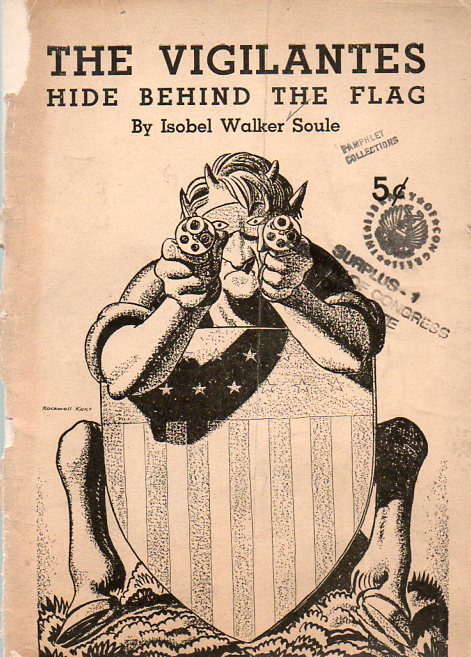
    The iconic, prodigiously-talented illustrator, old lefty and great inventive soul Rockwell Kent designed and drew this cover for Isobel Walker Soule’s The Vigilantes Hide Behind the Flag, a slim but powerful little pamphlet published by the National Committee for Defense of Political Prisoners in 1937.  Ms. Soule was a very present social worker and protagonist for the rights of workers–she and Kent would have shared this great passion–and published this work dealing with armed strike breakers (the “vigilantes”) as small targets and Fascists and the like as the larger–those, as well as the groups established by “the economic royalists (who) have given marching orders to their hordes and hope to trap the middle class into the vigilante net they’ve spread”.  

    {Soule could really spike a paragraph:  here’s an example of her addressing former Ashevillean William Dudley Pelley, founder of the lost-soul hate group the Silver Shirts:

    “…He was a YMCA representative with the AEF to Siberia in 1917. Returning to America he wrote for pulp magazines. he became a spiritualist. He had an inspiration and wrote  a story in which he claimed to have died,and spent seven minutes in eternity. On the basis of his fan mail he founded a magazine in North Carolina  with his clair-audient voices from the ether as assistant editors. Out of the magazine he founded the Silver Shirts”.)

    Soule fills up a stubby thirty pages like few others, addressing the very-present issues of thug-backed union-busting and the powerful growth of fascists at home and abroad.

    Vigilante070


  • Daily Dose from Dr. Odd: Outsider Logico-Economics and Free Steel Money

    JF Ptak Science Books  Quick Post   Daily Dose from Dr. Odd series

    Follow Me on Pinterest


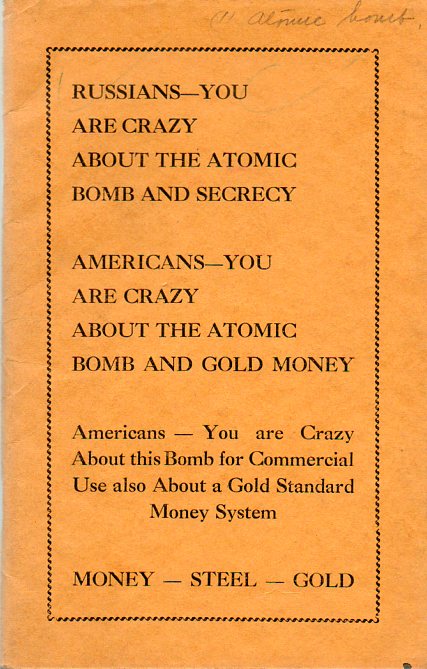
    Dr Odd series069I have rather deep well of sublimely different publications, some of which strain the merits of acceptable thought and the boundaries of logic; and some are filled with their own outsider logic, occasionally acting as a Black Hole of interpretation.  Some of these publications have incredible titles that obscure some good thinking in its pages; sometimes the title is bland or discerning but hide a text that is anything but that and sometimes nonsensical or outre. And sometimes the works have incredible titles with contents to match. Such is the case with Frank Freemont Frazee’s Russians You are Crazy about the Atomic Bomb and Secrecy; Americans, You are Crazy about the Atomic Bomb and Gold Money; Americans you are Crazy about this Bomb for Commercial use also about a Gold Standard Money System.  This work is certianly upper-drawer for publications with difficult titles. 

    And as it turns out, the content does not disappoint, if by “disappoint” we mean “confuse”–I’m still uncertain about what the man was saying in his Fabius, New York publication.  But after much talk of god and Henry Ford and bimetalism and fire and “cost and storage” and Moses and barter and “epitomes and repetition with inflation” and the like, it looks like the author presents a monetary system based on anti-atomic-bomb fear and freedom from major enterprises, along with steel dollars, which “would be a sound valuable dollar, because made of enough rust-proof sttel to be worth a hundred cents internally”.  He terms it “free steel…to be acutally produced competitively new dollars necessarily made of steel”, though by “free” he means “competitively produced and accepted by us and our government as money, freely and without limit”, which really doesn’t have anything to do with “free”.  And so it goes, on and on. 

    ·Posted by :

    ·in:


  • Standard Corpse, Inc. & Deadpunk: Shaving, Cooling, Lifting, Electroplating, and Diapering the Dead

    JF Ptak Science Books   Post 1975   Follow Me on Pinterest

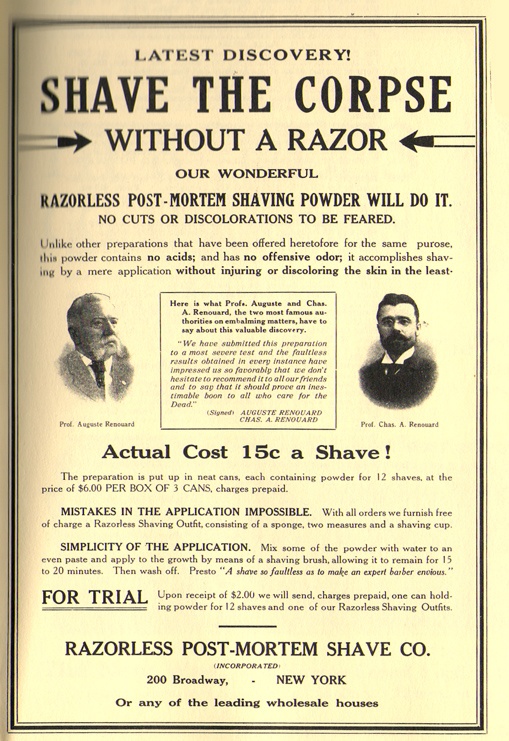
    The idea of creating an economy from a previously dead clientelle–the very after-market dead person–is relatively new. Once a middle class or lower working class with disposable income was created, celebrating the care of the dead was a paying option opened to the millions of families who were not the fastidious and celebratory wealthy.  Once the notion of having other people take care of the dearly departed became a part of the popular ritual of dealing with the dead, an entire new industry was born–spawning other related and associated industries for supplying the dead-care-givers with amenities and notions and necessities of a previously unthunk and unthinkable nature.  For example, the idea of needing to shave a corpse became an issue after it became fashionable to allow several days or more to pass between death and burial.  Beards and hair grow in death, so the people caring for the body and its display now were ordained an issue of economy in nultiple shavings of a corpse.  Now that may or may not have been an issue, but it was certainly presented as a possibility by the incredibly-named “Razorless Post- Mortem Shave Co.”


    Deadpunk shave

    {Many thanks to reader Max W for providing the information for the correct information for the citation of the above image–the magazine is Casket & Sunnyside for January 1912, and there are ample references to it in Charles Addams and Jessica Mitford.] The worry for the consideration of the cost of a shave (15 cents) for a dead person seems quite an inescapable weirdness and luxury. The weirdness of the name of the company nearly obscures it common nature–it isn’t exactly the Acme Corpse Company, but it is close to it, and it addresses just one small bit of minuatiae of deadness in the vast sea of Dead, Inc.

    The sellers of the razorless post-mortem shave equipment didn’t receive a patent for their process–nor did anyone else, for that matter, at least so far as I can determine. 

    Here are some further examples of Dead, Inc/DeadPunk patented death appliances:

    Post-mortem skull examination facilitator:

    Postmortem Underwear for the prevention of dead leakage and deodorization:


  • A Telephone Call From TomorrowLand and the Idea of Weighing Antique Surprise

    JF Ptak Science Books   Post 1973  Follow Me on Pinterest


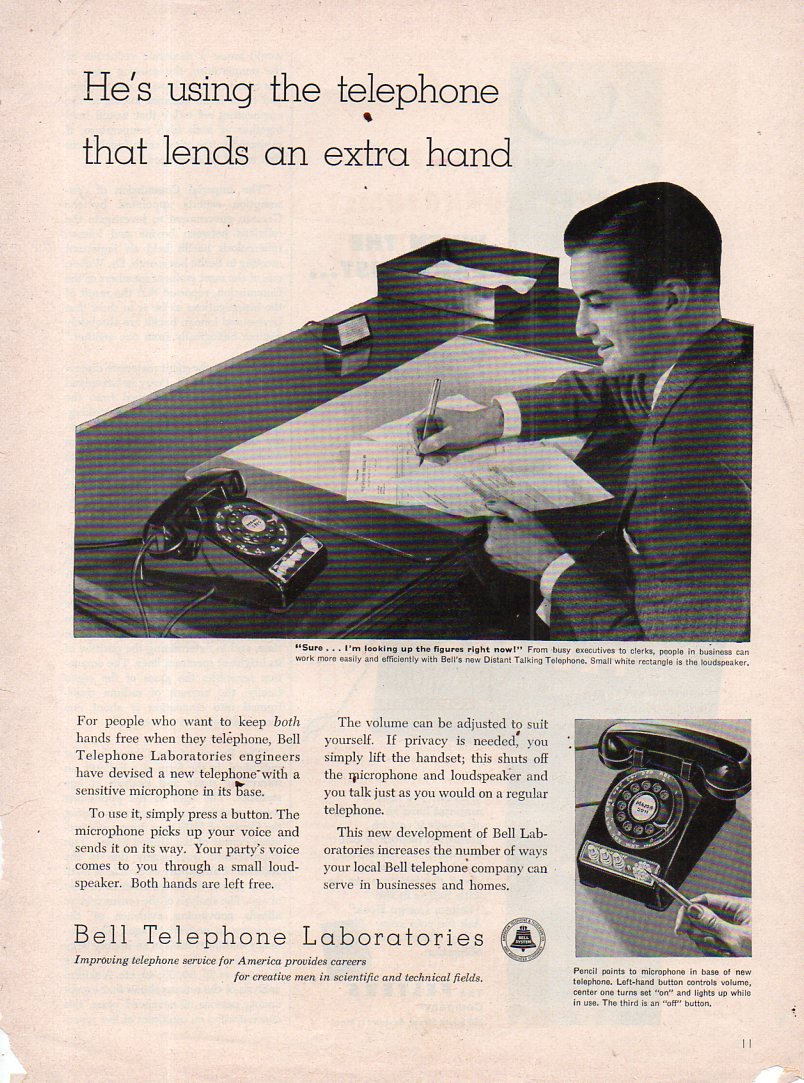
    This ad appeared only 59 years ago–that’s four generations in dog years, two human generations (or one for the more later-in-life crew, which is appealing as I knew a man whose grandfather was born in the 18th century), and 15 generations in managing data and communications. Perhaps more.  It is difficult to imagine the intense surprise that attended this ad showing a practical and popular adaptation of a communications breakthrough. 

    Telephone future064

    The electromagnetic telegraph, which is arguably the first electrically-powered iteration of the internet, was in the works from the 1820’s until it was nailed by Samuel Morse in 1837.  It was 40 years to the development of the Bell telephone (another dramatic example of an invention/technological idea/breakthrough that was “in the wind”, a popular undiagnosed monumental meme, some decades in the making in the hands of Bell anbd Reiss and Meucci and Gray and even Edison). Two more decades (just past the turn of the century) until more-widespread wireless telegraphy, another two decades after that (1920’s) for poular radio, and another two decades after that (post WWII/1950’s) for popular television broadcating. 120 years between the patented invention of the Morse telegraph to 50 million Americans with televisions in 1955. 

    The “telephone” of 2013 is as removed as the telephone of 1955 as the telephone of 1955 was removed from the electromagnetic telegraph–we’re not meeting half-way in the meeting of improbable impossible worlds, of worlds of the future unimagined in the past.  That is what comes to mind when I see this add for the speaking telephone in 1954–the astounding, astonishing, speaking telephone, the phone that allowed you to not have the receiver to the ear, tht allowed you to do free-hand work and communicate at the same time.  It was an ambitious improvement, and as soon as the phone appeared, it became a standard of necessity if that necessity was within budget. 

    It is the weight of surprise that is so abundant looking at pictures like this, giving us the opportunity to imagine the surprise elements of another time. It may well be that the new 1954 user of the speakerphone would have looked at the first telephone systems of 1894 as we look on that 1954 telephone today.  Probably not so, though, probably it was much more imaginable to have forseen the 1954 possibilities in 1894 than for 1954 to have seen in the same amount of time to 2013:  the technological pieces necessary for part of that imagination had not yet been invented, the science ahead of the scifi. 

    The other part of this surprise element is that 1954 is well within living memory, and that this combinaiton of technology and physics and mathematics has grown so incredibly from the speakerphone to the massive changes in 2013–it is as surprising to imagine this as to imagine the same scenario for what ahppened a year before in biology:  it is difficult to grasp the  sweeping changes in that field from the identification of DNA in 1953  and how far those fields have come since. 

    I think that if one could quantify this sort of “surprise” that the greatest amount of “Surprise Integers” (or whatever) ever recorded would have taken place within these past 50 or 60 years. Which makes me wonder–will people 59 years hence see the pictures of our fabulous accomplishments in 2013 as quaint reminders of how much things changed between 2013 and 2072?  Will those “Surprise Integers” be as great for that period of time as the (“our”) preceding period with concomitant revolutions in thought?  My guess is “yes”–its just hard to imagine. 


  • An Early and Unsatisfying Projection of an Electron, 1920

    JF Ptak Science Books  Quick Post

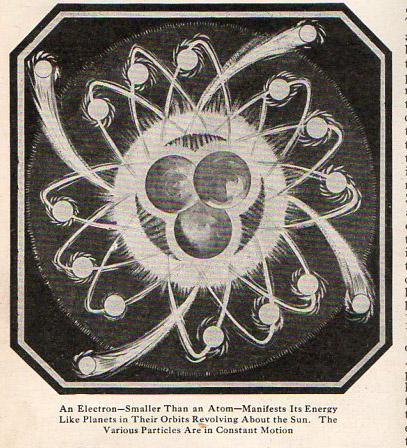
    People have been thinking along the lines of “electrons” for a long time, though the word is of relatively recent origin (1874), coined by the wonderfully-named Johnstone Stoney (1826-1911) after deducing that ther must be some type of electrical bit that vibrates within the atom that would generate light.  J.J. Thomson (1856-1940) stated later in 1897 in his paper “Cathode Rays” that evidence points to the fact that there must exist particles that are less massive than the hydrogen atom–he called these objects “corpuscles” but he was referring to what we now know as “electrons”. The gorgeous “oil drop” experiment of 1910 by R.A.Millikan (1868-1953) determined the charge of the electron, and in the next year–1911–Ernest Rutherford (1871-1937, and one of the 20th century’s greatest Kiwis) proposed the structure of the nuclear atom.  Then the major development of Louis de Broglie’s (1892-1960) particle/wave duality, and so on into our near-present.  But in between the beautiful work of Millikan and Rutherford came this little beast, a very unsatisfyingly-assumed image of an atom and its swirling electrons. The image appeared in the December 1920 issue of Illustrated World and just seems so unfair to the cause of beauty that I thought to share it.   

    Electron059


  • The Marcel Duchamp of 18th Century France: Jean-Jacques Lequeu

    JF Ptak Science Books  Follow Me on Pinterest

    Lequeu_portrait


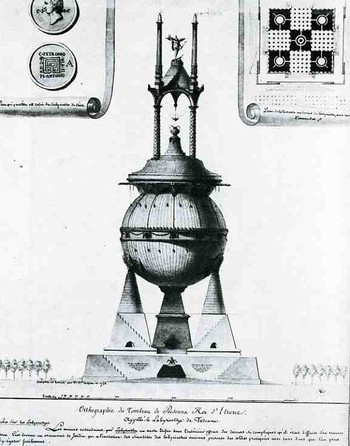
    Jean-Jacques Lequeu (1757-1825), a French architect of fabulously distanced sight, produced this breathtaking image in 1792.  The Tomb of Lars Porsena, King of Etruria (the great Etruscan king, d. ca. 500 BCE ), is just one of hundreds of works by Lequeu, a re-discovered architectural genius who worked during the same era as other visionary architects such as Etienne Boullee (1728-1799), Claude-Nicolas Ledoux (1736-1806), Louis-Jean Desprez (1743-1803), Francois Barbier (1768-1826), Charles Bernard (1765-1818), Francois-Joseph Belanger (1747-1818), and others, though these guys are the most famous.  As a matter of fact, I think, almost all of these architects were re-discovered—Boullee, perhaps the most famous of the lot, was found again not in his buildings but in his visionary drawings that he deposited with the National Library.  But Lequeu—found again in the same way–it seems had to be rescued from an even greater obscurity than the others.  He tried to expose a unity that he saw in the world, some secret sort of unity, that he saw all around him, and which was unseen by everyone else in creation—at least until the 20th century.

    Lequeu started out in a staid and brilliant way, a successful architect in his own right, and student of Scoufflot, designing ancient-inspiration buildings for the super rich.  But along came the Revolution and away went his career—he wound up a surveyor and a cartographer until his retirement in 1815, after which he enters social and historical oblivion, until he finally dies in total obscurity ten years later (or so, the date is unclear).  His post-revolutionary vision was as phenomenal as his success in selling his ideas were dismal.  Well, this is really a cheap shot—his imagination was shockingly large, enormous, his designs fantastic and beautiful, and completely unexpected, and they seemed to grow larger/loftier and more interesting as time wore away at him.

    I think that as Lequeu was cleaved away, cell by cell falling through the floorboards of his single rented room, he reached further into time and deeper into space than almost any architect of that hundred-year period.   I also think that he was very well aware of his genius being seen as pure eccentricity—his dozen or so self portraits are among the most bizarre that I’ve ever seen (before 1900).

    Bloglequewu289

    The odd thing in all of this is that in this brilliance there is still a reluctance to leave the Baroque, and this at a time when just about everyone else—beginning around 1750—was abandoning it.  So much of the work of the other visionaries mentioned earlier freed themselves of the Baroque—not entirely true, not true at all, for the unique creations of Lequeu, who (as in the Tomb of Lars Porsena) included more than a few bits of the practice even in his most incredible works. 

    Somehow Lequeu saw the Lars Porsena tomb as a 650-foot tall (!!) structure, with impossible insight and filigree.  Extraordinary. (In the upper corners of the drawing of the tomb Lequeu included a design for a coin and also the plan of the structure.  The original tomb of Lars Porsena, according to Pliny the elder in his Natural History, XXXVI, 19, 91ff, was a 15 meter high rectangular base with 90 meter sides–completely destroyed in the wars in the first century. 
    Bloglequewu288_2

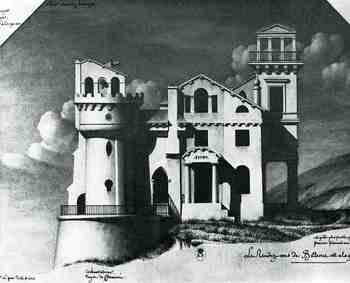
    Perhaps his most sensational creation (and one which was devoid of all Baroque influence, as it turns out) was his Meeting Place at Bellevue.  It is almost impossible to believe that it is am 18th century creation—it is as harmonious (armonia) as it is asymmetrical.  It looks deeply 20th century, and looked as far into the future as it was deeply unknown.


  • A Census of “Prefer” in “Bartleby the Scrivener”

    JF Ptak Science Books   Quick Post

    I wonder if Bartleby is more a “structure of words” than was famously said of Molly Bloom?

    The question just came up from Patti about what Bartleby’s classic rejoinder was in Herman Melville’s  (1819–1891) classic noirish “Bartleby, the Scrivener…” (1853)–was it “I would prefer not to” or “I prefer not to”?    

    Instantly I thought the former, but then, well, I wasn’t sure if it wasn’t the later.

    This is one of those instances that shows how magnificent the internet is:  I was able to conduct a quick census of Bartleby’s own spoken variations on this phrase in like ten minutes.  And the results are conclusive but a little complicated.   

    As  pure stand-alone phrases, “I would prefer not to” and “I prefer not” are used three times each.  However, there are variations on this theme, each used only one time by Bartleby:  “I would prefer not”, “I prefer not to”, “I would prefer not to go”, “I would prefer not to make any change”, “I would prefer not to be a little unreasonable”, “I would prefer to be left alone”, “I would prefer not to take a clerkship”, “I would prefer to be doing something else”, “I would prefer not to make any change at all”, and then “I prefer to give no answer” and the fatal “I prefer not to dine”. 

    So.  When comparing the use of “would” in the “not” and “not to” and all of the other extensions on the theme, “would” does come out on top, in general, 12 times to 6. 

    I have no preference for either phrase.


  • Breaking Bad in Half: a Book to Exhaust and Maim the Reader

    JF Ptak Science Books

    “Sometimes a book is just entirely bad, and sometimes it is entirely nothing. It is impossible for a book to be both very bad and very nothing. Impossible.  Except for this book, whose badness is exceeded only by its nothingness, and vice versa“. –Oscar Wilde

    And so into this black hole of imaged Wildeian description we go, into a very real-ish book.

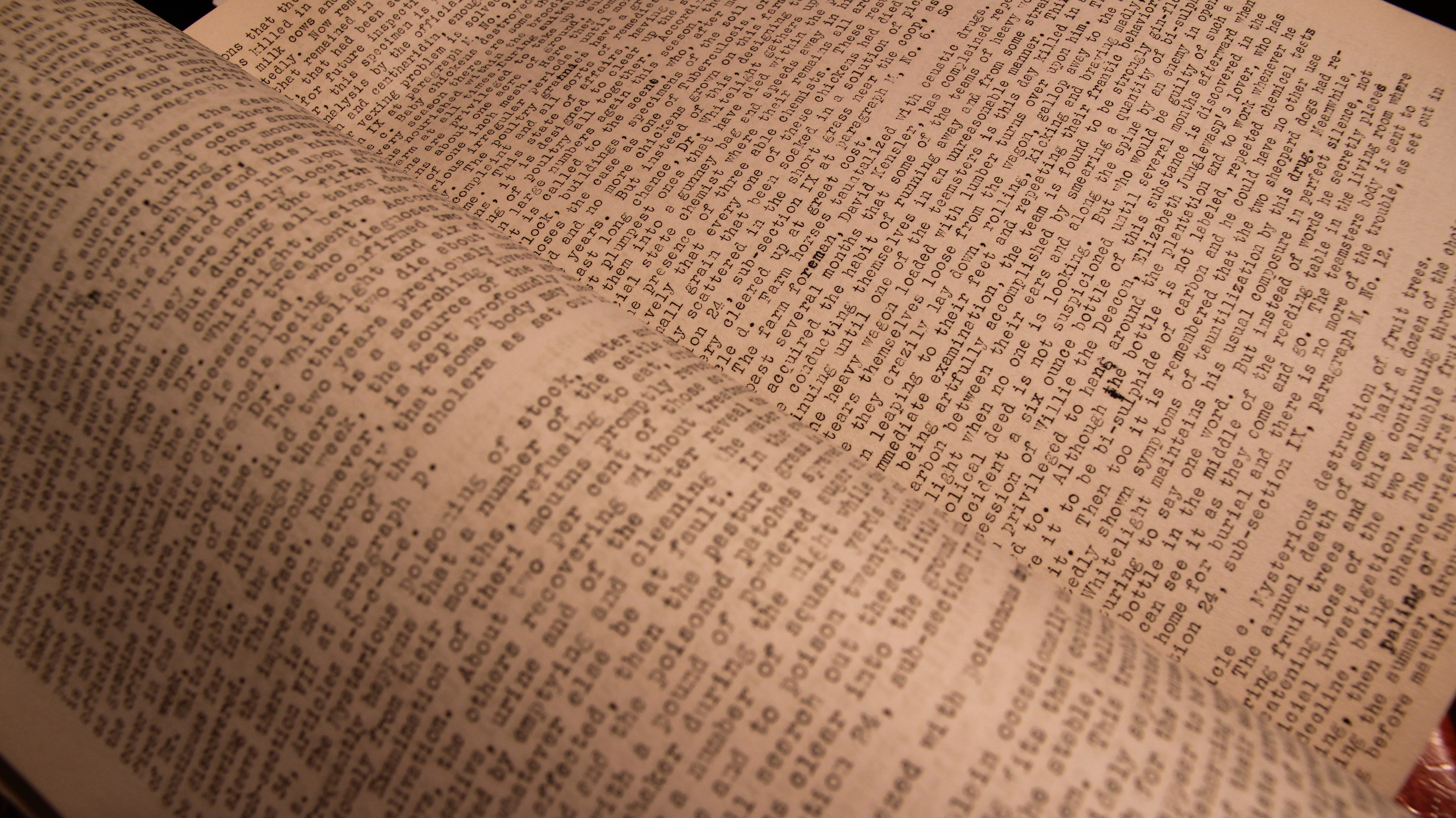
    I found a novel tonight, bought long ago and long ago mostly lost.  It was written by a doctor who worked in the District Hospital in Lima, Ohio, and written in 1934.  The Lima Hospital was the largest poured concrete structure in the world when it was built in 1915, and stayed so until the Pentagon was completed.  The hospital was established for the criminally insane, had 14″-thick walls, and reinforced steel bars laid into the walls that went “right down to bedrock”. 

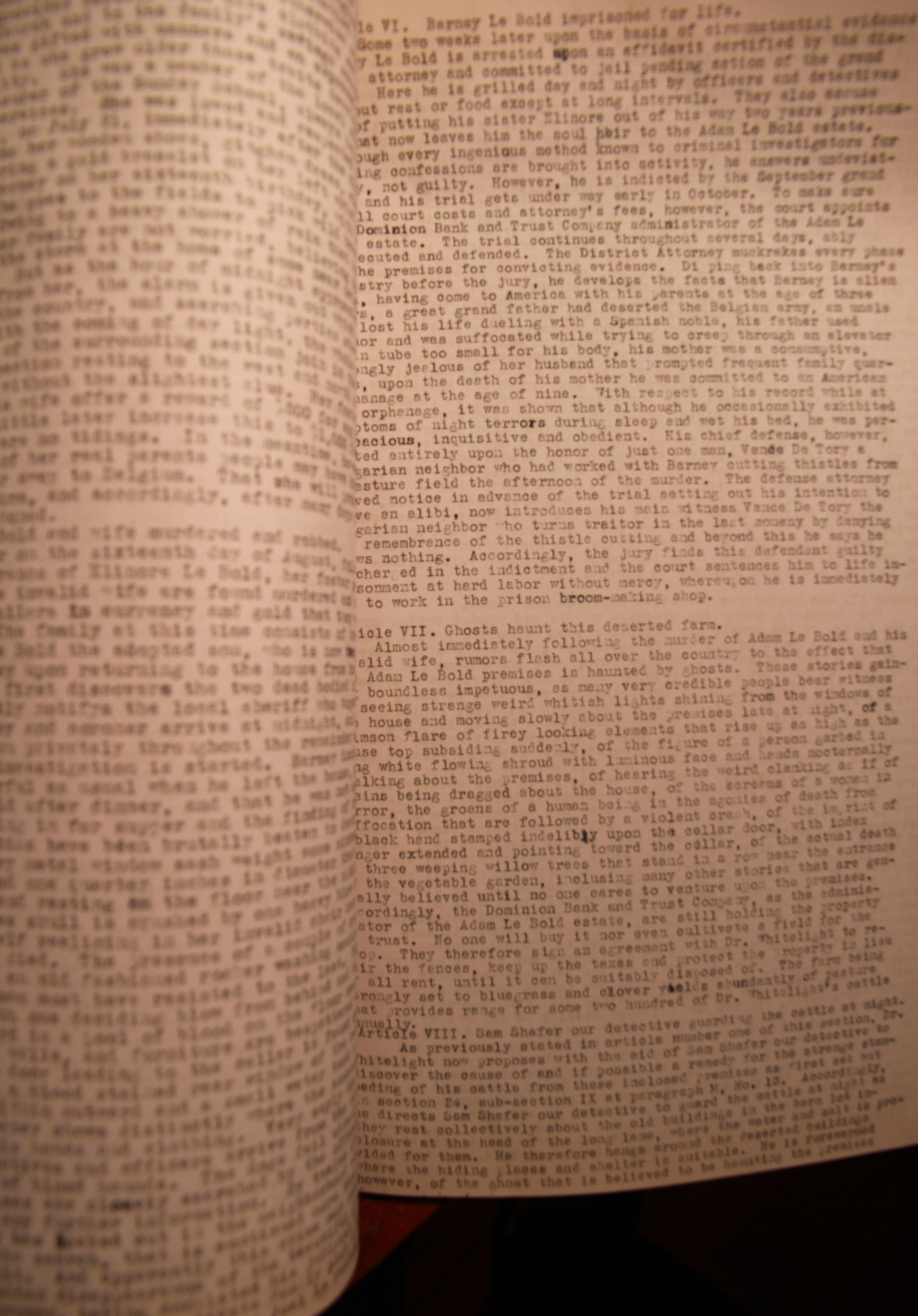
    It was somewhere in there that this doctor wrote something that was really so toweringly bad that it escapes comprehension. I own the carbon copy of the unpublished work, which is typed on 14×8.5″ sheets of paper, front and back, running 94 pages. It is a very crowded affair, with 90 lines of single-space typed lines, making the work about 115,000 words long. 

    There wasn’t enough space evidently for paragraphs, which gives the work a kind of insistent, casket-cramped cruelty.  To read it takes your breath away for its dullness–the book moves so weirdly and at the same time so very slowly that it doesn’t move at all even while moving.

    Manuscript insane one

    A few months ago I found the seven-foot-long scroll of the book’s plan–a work of crowded magnificence of nothing and confusion, being very orderly at the same time.  It went to a friend of mine who created artwork around it, and as it happens made a very noticeable appearance in a very significant yearly show in NYC last week. I was stunned to find that there was actually a text to go with the scroll-outline–it emerged from the warehouse this week, so perhaps this too will find a very celebrated life as art as well. Certainly the book would go nowhere on its own as a book, though it stood a chance at surviving on the grounds of its considerble design weirdness, which is of a complexified beauty.

    Manuscript insane two

    In the meantime, before all of the letters slide themselves off the page from sheer boredom and before the thing is resurrected as a magnificent artistic effort, I’ll share some ianges of the extra-ordinary book of reversed brilliant badness. I’ve also culled a few imaginary descriptions of the book from writers known and not:

    Potboiler scribbler:

    “He couldn’t speak.  He could barely see. Blinded by the flames ignited inside his eyeballs from the novel in his lap.  The words were like molten lead, sucked off the page by his eyes, forming a vacuum in his brain.  It was a bad book”.

    The first-time published novelist’s approach:

    “He couldn’t speak the words of the thoughts in his head, because they and all of his breath were stolen by the magic of the complete badness of the book in his lap”.

    Gertrude Stein:

    “The book was bad and bad, and bad was the book. Even the badness of the bad was bad, a whole new insight into being bad. It was the bad book by which bad books are called bad”.

    Ernset Hemingway:

    “He didn’t read the book so much as he looked through it.  It was easy–there was nothing there. As bad as it was, it could get no worse. So he shot it, and poured a drink”.

     You might wonder what this book is about.  Me too.