A Daily History of Holes, Dots, Lines, Science, History, Math, Physics, Art, the Unintentional Absurd, Architecture, Maps, Data Visualization, Blank and Missing Things, and so on. |1.6 million words, 7500 images, 4.9 million hits| Press & appearances in The Times, Le Figaro, Mensa, The Economist, The Guardian, Discovery News, Slate, Le Monde, Sci American Blogs, Le Pont, and many other places… 5000+ total posts since 2008.

Author: JF Ptak

  • What Happened Underground: Mining, Orwell, Trench Bombers, & Waits

    JF Ptak Science Books 

    Underground working steep102

    Blogjuly_17_work334

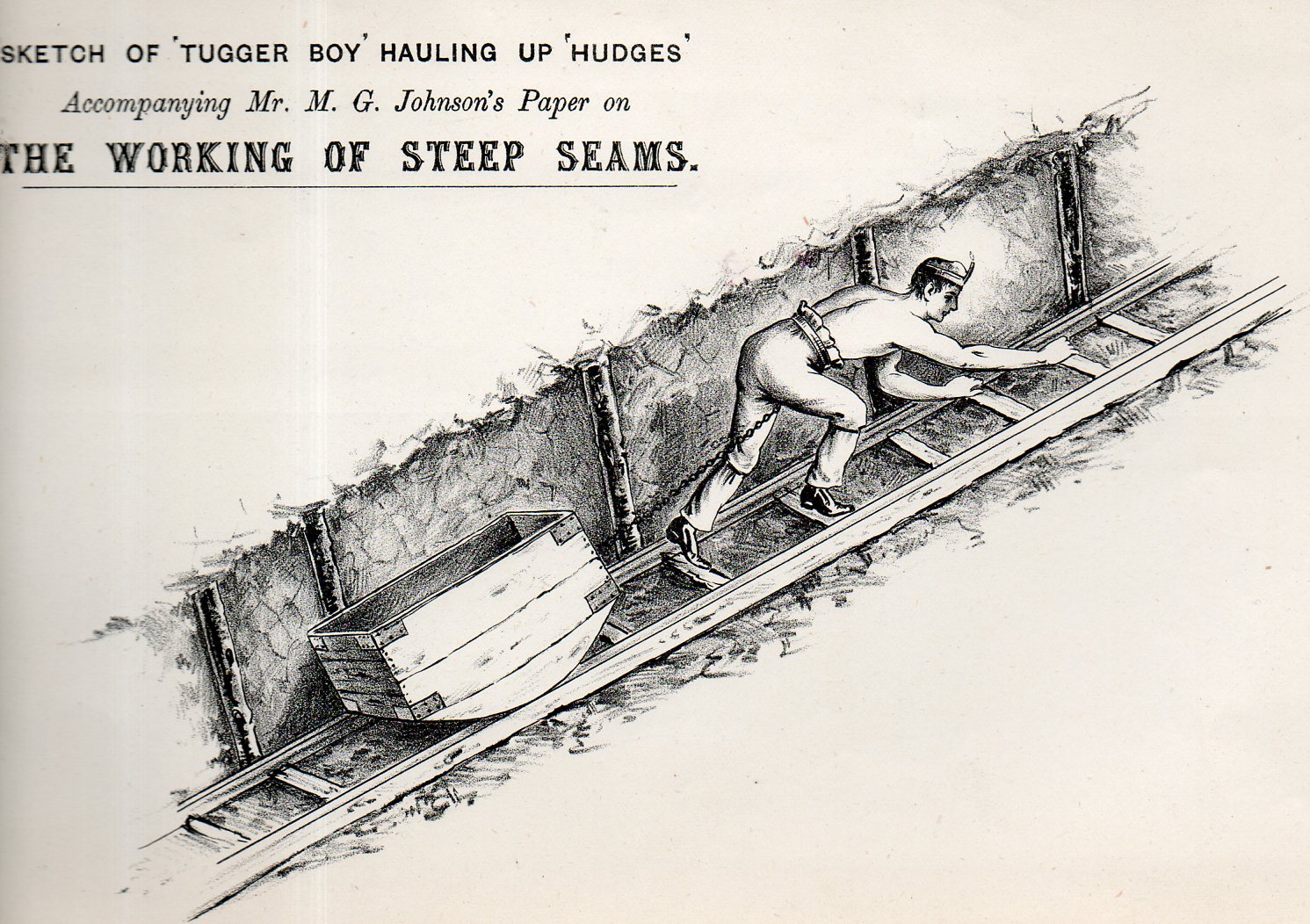
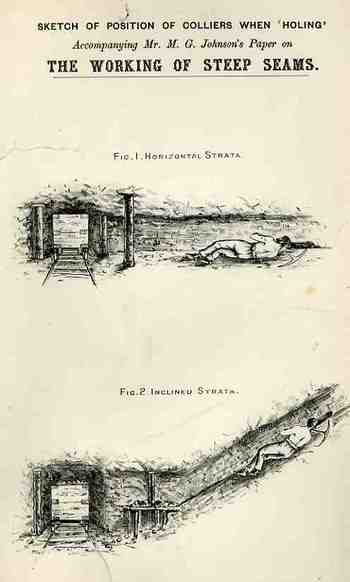
    Looking at these two images of the shirtless miner laying down and working on his side in the semi-dark way underground in what looks to be a tunnel about twice the width of his shoulders makes you wonder about how in the name of great bog could people have done this, day in and day out.  The fact that the appearance of these images were both essential and mundane further tells us—as we sit here in a comfortable chair in the print’s future—that this is, simply, what people did, and what they had to do.

    This was “holing”, as in working in a hole, and served to illustrate a point in Mr. M.G. Johnson’s paper “The Working of Steep Seams”, which I think appeared in a West Australian mining journal around 1900.  So, it seems, the guy, the worker, in the picture would spend his day chunking coal from a hard vein, laying down, scrapping (I think) away at the coal in a too-tight tunnel.  Did he do this for hours?  Days?  Weeks?  I guess the bad answer is that he did this as long as the coal could be followed.   (Also, it looks as though that the major tunnel in which the coal car is located may be 4 or 5 shoulders high—certainly not tall enough to walk in, which means that this guy could’ve crab-walked to this position for a half mile or more, just to get to work.  The tenacity of this worker to do his work and collect his pay to feed his family was just incredible. 

    The first image really doesn’t need much commentary, though calling the worker a “tugger boy” pulling up a “hudge” was probably a bit of sardonic camraderie–except that the doing of the job would distance you from its folksy name. Well, that, or the “tugger boy” really is referring to a boy, as we see in the followlign mining definition: “Tugger boy (Brist). One who draws small tubs or sleds underground by
    means of a tugger. Called Tugger-work. (Gresley), 1883).  The depiction of what seems to be a mature man in the image might be a piece of propaganda. In any event,  the Tugger Boy carries his own flame on the top of his headgear, and the chain that attaches him to the heavy coal bucket runs from his waste down the front of his body and through his legs.  Very hard work needless to say–harder yet done by a child.

    George Orwell wrote perhaps one of the most brilliant descriptions of the mining environment in his superb The Road to Wigan Pier. (It is well worth reading all of Orwell’s books at this point—his insights almost never looked so fresh.)

                                                       
    Blogjuly_18_mining_robinson338

    He  describes the crab-walk from the elevator to the place
    of work, telling how difficult and exhausting the process was of just
    getting to the place where you would then begin your difficult
    workday.  Of the miners he says at one point:  “Watching coal-miners at
    work, you realize momentarily what different universes people inhabit.
    Down there where coal is dug is a sort of world apart which one can
    quite easily go through life without ever hearing about. Probably
    majority of people would even prefer not to hear about it. Yet it is
    the absolutely necessary counterpart of our world above.”  Read more here.

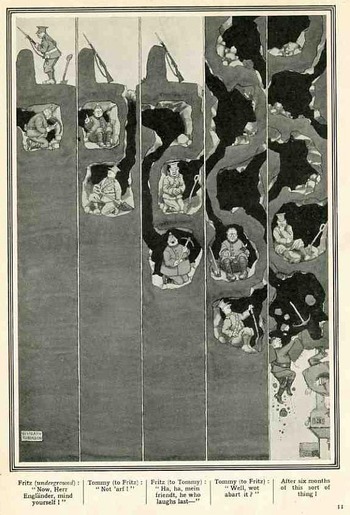
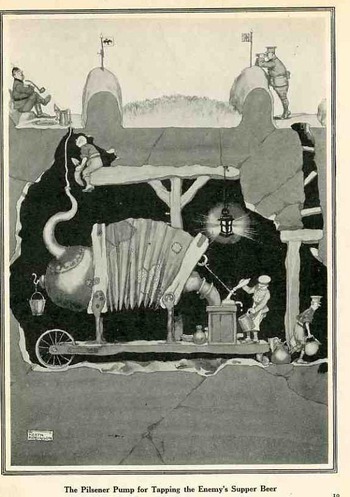
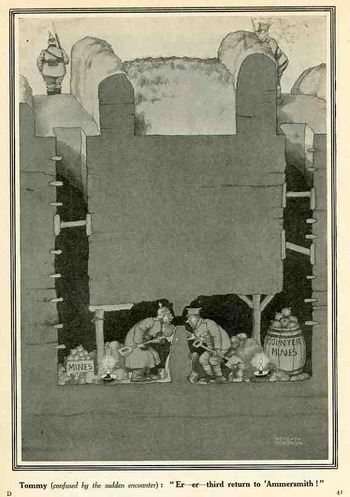
    The next series of images come from the pen of W Heath Robinson
    (1872-1944) who was a lovely, quirky, charming, skewed, dark,
    stiff-bouncing and creative illustrator capable of considerable whimsy
    (light and complex) and deep skepticism.  The images I’ve selected are
    from one of his three WWI books, Hunlikely, published in 1916 (Some “Frightful” War Pictures (1915), and Flypapers (1919),
    were the other two) and depict scenes from the intra-trench tunnel
    wars, which were battles fought in the midst (or, actually, beneath)
    other battles.  This was a savage, grueling, post-adjectival
    affair—exceedingly dangerous, difficult, awful.  And it happened a lot
    during the war, given the experience of stalemates between vast armies
    sunk into mole city trenches, with no one going anywhere for long
    periods because there was nothing in between the two impervious lines
    but a death vacuum.  So one of the solutions was to try and tunnel
    underneath the opposing army’s defenses, fill the far end with high
    explosives, and blow them up.  The other side was doing it too, and in
    the middle of it all was the incorporation of newer/better listening
    devices to detect forces rummaging around underneath your position
    dozens of feet into the ground.  It was a bad business. (One of the
    other means of breaching the trench lines was aerial combat, but
    bombers carrying tons of HE were still yet to be invented; poison gas
    was another.  Most of the time the armies would just meet in the
    middle  in wide plains of nothingness in a sea of hot, expanding metal,  where
    to this day in many of those places nothing can live).

    Blogjuly_18_tunnel_2_robinson340

    Robinson’s illustrations are odd, and oddly funny, the dark humor
    coming at the expense of both sides of the conflict, piercing
    each.   

    This puts me in mind of Tom Waits’ concrete-toothed “There’s A
    World Going On Underground” (1983) song from the Swordfishtrombones album. 

    Rattle big black bones in the danger zone
    There’s a rumblin’ groan down below
    There’s a big dark town, it’s a place I’ve found
    There’s a world going on underground
                
    They’re alive, they’re awake
    While the rest of the world is asleep
    Below the mine shaft roads, it will all unfold
    There’s a world going on underground
                
    All the roots hang down, swing from town to town
    They are marching around down under your boots
    All the trucks unload beyond the gopher holes
    There’s a world going on underground

    Blogjuly_18_tunnel_3_2_robinson341

    ·Posted by :

    ·in:


  • Beginning an Alphabet of Science Fiction -Punkisms

    JF Ptak Science Books  Post 1981
    “The most ignorant person at a reasonable charge, and with little bodily labor, may write books in philosophy, poetry, law, mathematics, and theology, without the least assistance from genius or study.”  Jonathan Swift, in Gulliver’s Travels (Actually, Travels into Several Remote Nations of the World, in Four Parts. By Lemuel Gulliver, First a Surgeon, and then a Captain of several Ships).  1726.

    I’ve produced the beginning of an alphabet of –Punkisms for variations of robot.machine/computer past and futures, science fiction indicators of possibility. Why should we stop at “Steampunk” when there’s FuturePunk and DeadPunk and such to be had?  So, please find folllowing a few possibilities, and accept them in the playful way in which they are offered–also, the very abbreviated descriptions of the science fiction works desscribed are open to interpretation. And please give this a “pass” for the over-abundance of hyphens.

    A

    ActorPunk: Walter Miller, ‘The Darfsteller’ (1954), human actors are replaced by robots on stage, as compared to being replaced by digital figures online. Some steps have been made with great care over the years by “perfecting” the imaging of women in magazine advertisement—in this way even the models who appear in the ad and are modified find it impossible to live up to the expectations of what their ads depict.

    Anti-technologicalPunk-topia: Samuel Butler, Erewhon, (1872).

    AutomatoPunk:  Kurt Vonnegut, Player Piano (1955), like Brazil and 1984, but with machines.

    B

    BiologoPunk:  Philip K. Dick, ‘Autofac’ (1955), machines find that they can reproduce themselves in a ’50’s iron-bio kind of way. 

    BrainPunk: Miles J. Breuer, ‘Paradise and Iron’ (1930).

    C

    ConsciousnessPunk: Philip K. Dick, Vulcan’s Hammer (1960) and the development of computer consciousness.  Also David Gerrold, When Harlie Was One (1972);
    Frank Herbert, Destination Void (1966); Harlan Ellison, ‘I Have no Mouth and I Must Scream’ (1967);  Robert Heinlein, The Moon is a Harsh Mistress (1966), and many others.


  • On Educating Women in the Sciences, Nature Magazine, 1871

    JF Ptak Science Books    Quick Post  Follow Me on Pinterest

    Nature099[The decorative gilt-stamped title of the cover of the volumes of my run of the great journal, Nature, 1871]

    In the 23 November 1871 issue of Nature appears “Science for Women”, a sort of unsigned editorial.  It is one in an interesting series of (for the most) part positive revelations about the education of women in the sciences, a step towards, well, not “equality”, but a normalization, a rapprochement,  extending the field of technical education away from the ruling/private school/university class of men towards women. This was happening at a time when there was not only a distinct division between men and women in education but also between the classes. 

    ·Posted by :

    ·in:


  • The Extreme Unction of Writing Posture

    JF Ptak Science Books     Daily Dose from Dr. OddFollow Me on Pinterest

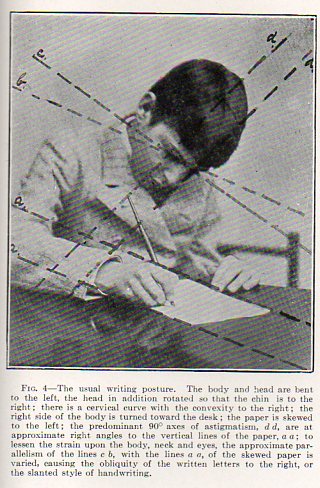
    This semi-wincing image was found in George Gould’s Righthandedness and Lefhandedness (Lippincott, 1908)–it is rather innocent, suggesting a study of penmanship posture; but taken out of context, it is quite something different, something with a bit of threat in it.  In- or out-of-context the author really meant to have the chin buried into the chest as a proper attitude.

    Right handedness098

    ·Posted by :

    ·in:


  • On Looking at Things Straight Down

    JF Ptak Science Books    Daily Dose from Dr. Odd

    Follow Me on Pinterest


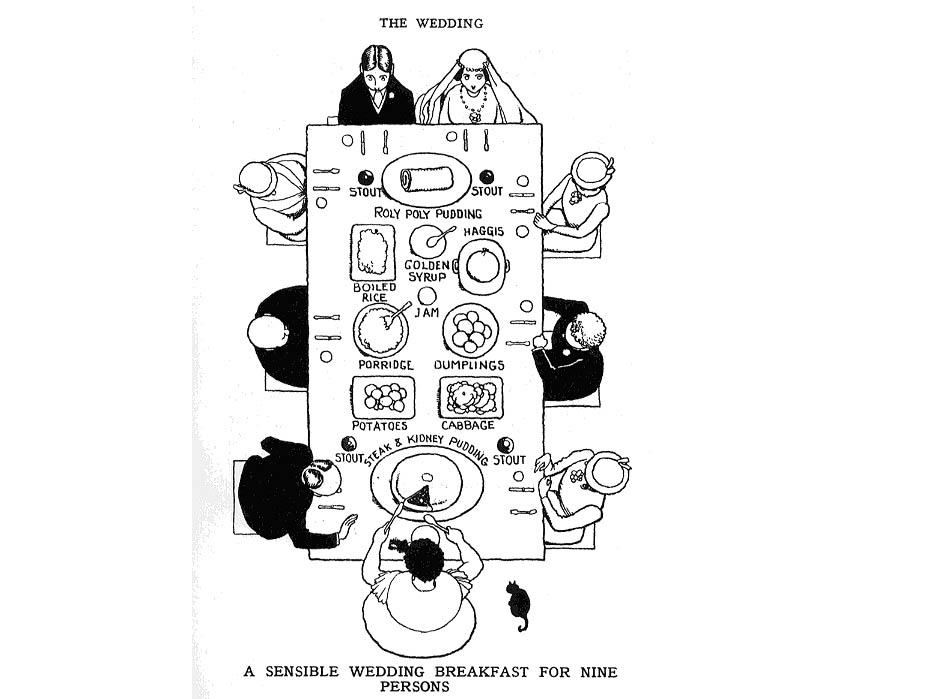
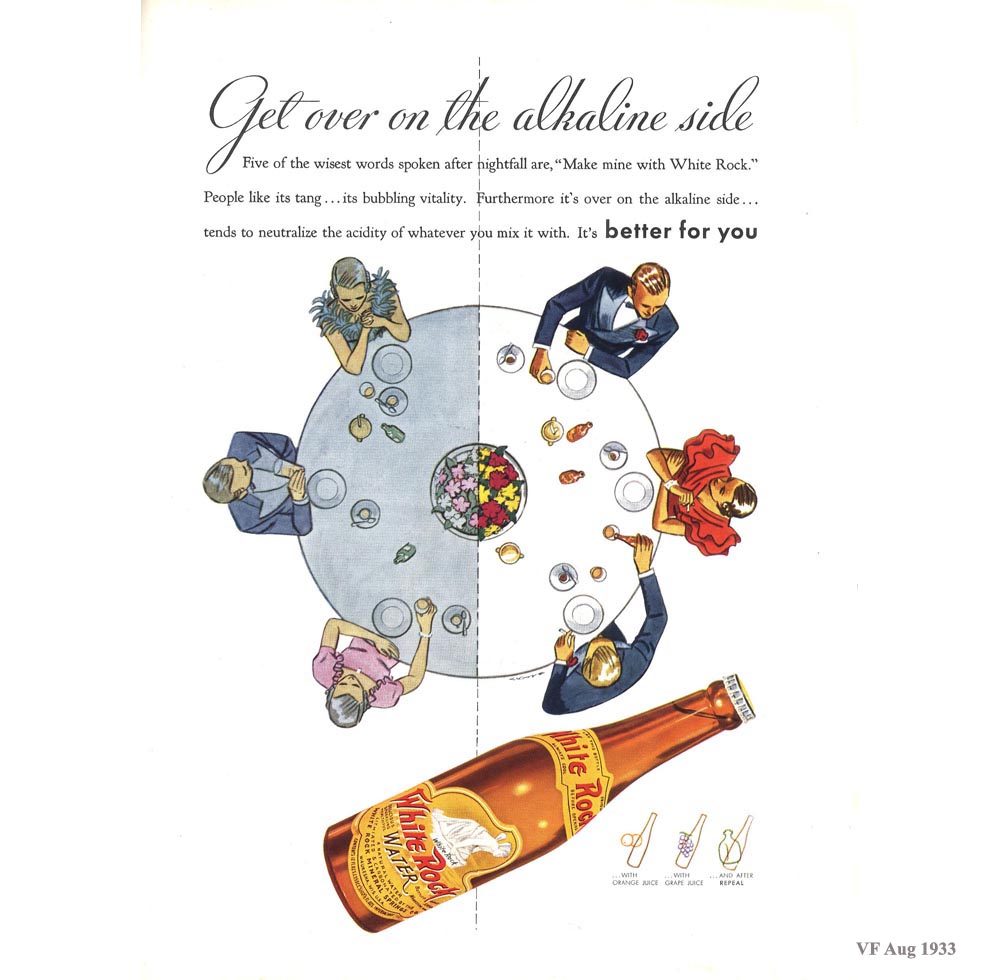
    This Daily Dose from Dr. Odd combines two interesting categories today, “Looking Straight Down” and “Display of Information”, and they involve food. Rather, its the placement of food, and maps of dinner tables, seen from above–directly above–and looking straight down.

    The idea of representing a view straight down, of looking straight down from some height, is a relatively recent occurrence, this view being somewhat rare in the antiquarian world pre-balloon or pre-heavier-than-air flight.  The pre-human-flight reason for its scarcity is understandable, but even after the first Montgolfier ascension in 1787, there’s another 120+ years of scarcity yet to come before these views would start to pop up in common (and uncommon) literature..  Now I’m not talking about cartography, which is basically a straight-down view of the world—what I’m referring to is that same view but not as a map per se, but what you would see if you were dangling out of a plane or balloon. It is an unusual and scarce perspective.

    Maps--Imaginary--Map of a Wedding Table


  • On a Census of Senses in Oz-Land: Adventures in the Land of Silence and Light

    JF Ptak Science Books  Post 1980    Follow Me on Pinterest

    With the endless images of the Land of Oz in our minds from the book and movie it is easy for the other lands generated by their creator L. Frank Baum to escape our attention   Oz isn’t the only place that Dorothy traveled to–far from it.  She went very far and wide in the mind of Baum, who was extraordinarily prolific both inside and outside of the Oz series.

    From 1900-1919, Baum (1856-1919) wrote 17 Oz books, as well as another 18 books in the non-Oz realm, plus 17 books in a juvenile series for girls under the pseudonym of Edith Van Dyne, plus six more books under the name of Floyd Akers, plus another seven other books under five other names, plus a pretty wide assortment (200+) of short stories, plus plays. Plus all of the stuff he wrote before 1900.  That’s a LOT of writing in 19 years.


  • Missing the Obvious: WWI and Kriegsoptik

    JF Ptak Science Books   Quick Post    Follow Me on Pinterest

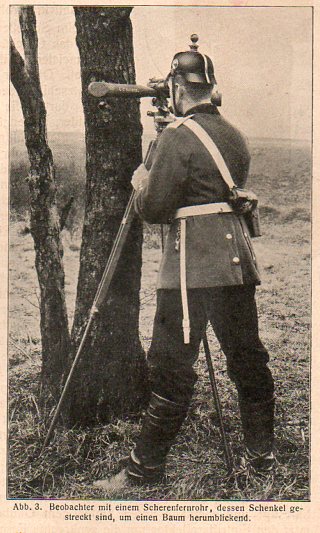
    For some reason this particular defensive utility of the binocular/rangefinder/”scherenfernohr” hadn’t occurred to me before seeing this photograph (in the September 1915 issue of Himmel und Erde).  Of course with the many billions of rounds of ammo that flew across open fields during the war, if it was your job to sight for artillery or what have you it would be better to do that from a trench (as this instrument was also known as a “trench periscope”, as varieties of the binoculars could have vertical tubes) and behind cover, or if in the field to be able to find a defensive position for your work. I hadn’t thought about standing behind a tree with the scope’s optics wide enough to operate beyond the diameter of the trunk–seeing the picture made me think, “of course”. On the other hand, this posture assumes that there’s very little flank to that field…

    Kriegsoptik097

    ·Posted by :

    ·in:

    —

  • The Machine in the Mind, 1919

    JF Ptak Science Books    Post 1979   Follow Me on Pinterest

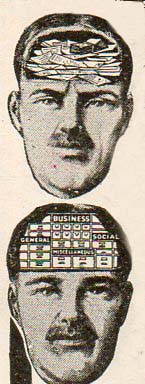
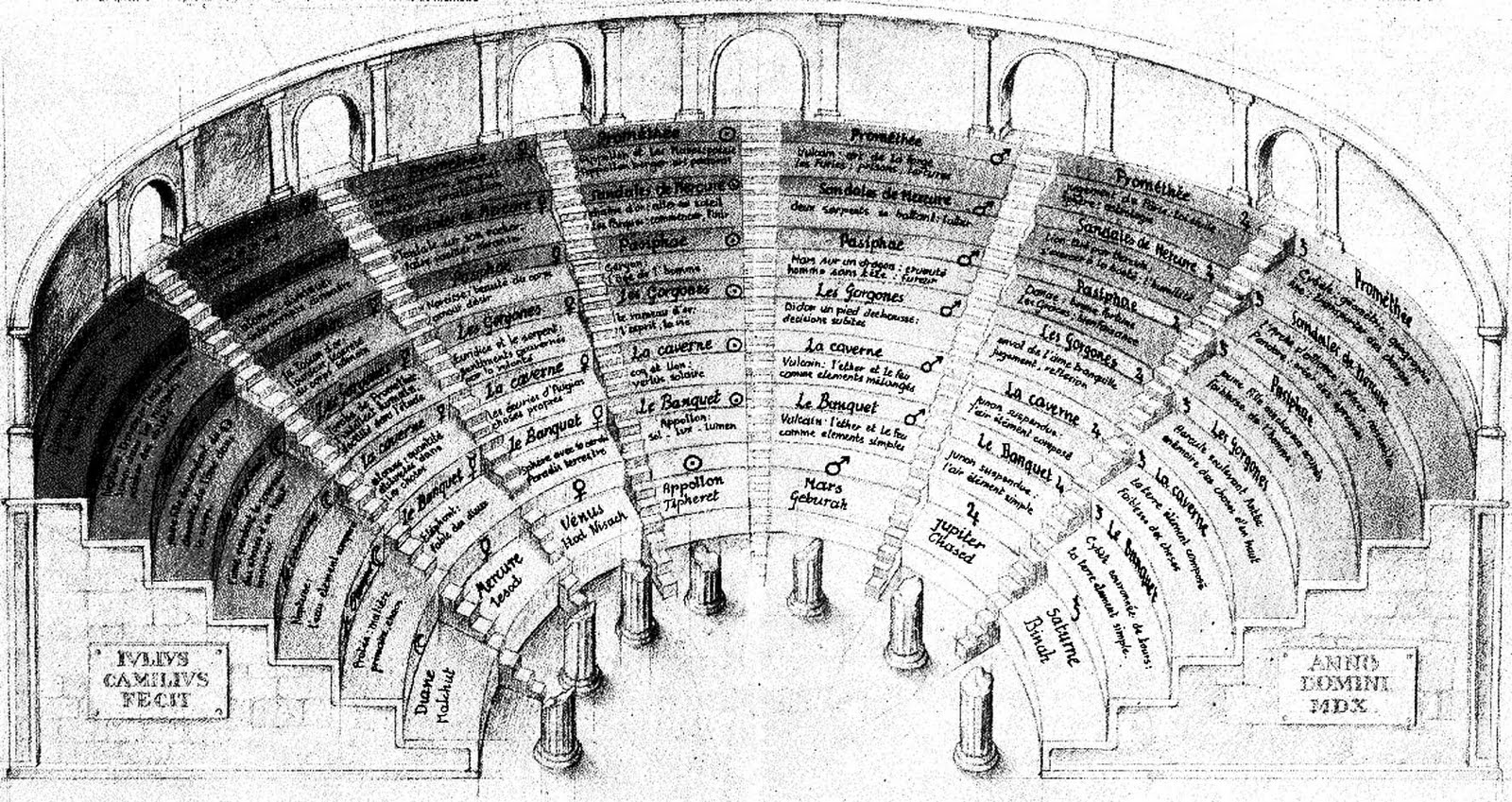
    Computer head089I’m unsure of when the first images appear representing the human mind as a sort of anthropomorphic filing system, utilizing a desk or filing cabinet or (later) a computer. From the early history of human memory-making mnemonic devices and memory palaces there are represnetations of where information in the brain could be stored for rapid access and retrieval, like memories being stored in rows of theater seating, or in the branches of complex trees, or in the buildings of a bird’s eye street map.  But these show where the memory “goes”, and not where this memory set sits in the brain of the individual. 

    Memory palace
    (An example of a memory palace, from Giulio Camillo,  L’idea del Theatro, 1550, from Bourbakisme blog).

    This came to mind seeing this odd little ad in the magazine Illustrated World for July 1919 seeing these fairly high-creep factor faces endowed with different sorts of cerebral applications. The top man is depicted with a messy desk and a hand-cranked calculator; at bottom we see the organized man, with papers sorted in their labeled places. (As it turns out, the image used for a company selling memory-improvement books).

     Perhaps this image was in a small way a pre-historic insight to brain computer interface (the acquired, direct signal processing of the brain to a computer), in the same way, say, as Hans Berger’s 1924 invention of the electroencephologram, where we can actually see electrical activity of the brain displayed on a piece of paper.  Of course, one image is a simple semi-folly to help hawk a mostly-useless huckerter book on memory improvement, while the other is a bona fide medical breakthrough.  But in similar ways they were insights into looking at the activity of the brain in connection to an external resource.

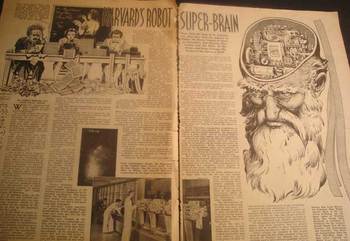
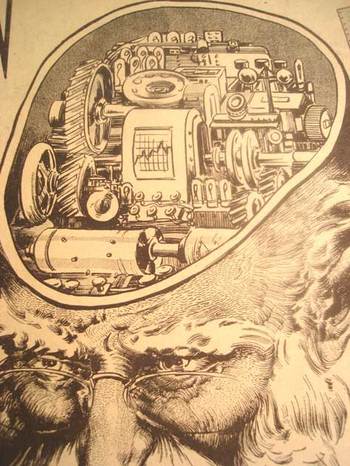
    In 1944 there was something else, something quite different allocated to the Leonardo-like head, something far in advance of the filing system of 1919: the computer.

    Blogharvardbrain
    This may well be the first public, popular, report on the Harvard Automatic Sequence Controlled Calculator (ASCC) (appearing in the American Weekly, 15 October 1944), the first automatic, general-purpose, digital calculator.  Known as the MARK 1, it was the brainchild of Howard Aiken (1900-1973), a graduate student at Harvard, who started it all in 1937 by proposing a series of coordinated Monroe calculators to function as a unified whole  that would cross the threshold of the physically-impossible calculation (though theoretically possible) to the eminently doable.  The project was immeasurably aided by the input of Harvard astronomer Harlow Shapley (who had earlier dealt with the enormously problematic aspects of the scale of the universe) who put Aiken in the hands of IBM at Endicott (NY).  From there the building of the computer came under the supervision of Clair D. Lake, with the engineering and theoretical team of Francis Hamilton, Ben Durfee and Howard Aiken.
    Blogharvardbraindetail

    The machine was basically completed in 1943 and tested in Endicott for the better part of the year before it was shipped of to Harvard in February 1944, where it was put almost instantly to work on ballistic calculations (like its cousin ENIAC at the Moore School at U Penn), as well as naval engineering and design issues. 

    The author of this article, Gordind Bhari Lal (“noted science analyst”), actually does a pretty decent job describing the machine and its (1940’s) possibilities, noting at the end that “it may even unleash for Man’s Use the long-dreamed-of energy of the atom”.  This part did come true, especially post-war, when the machine was put to fair use by the US Atomic Energy Commission. 

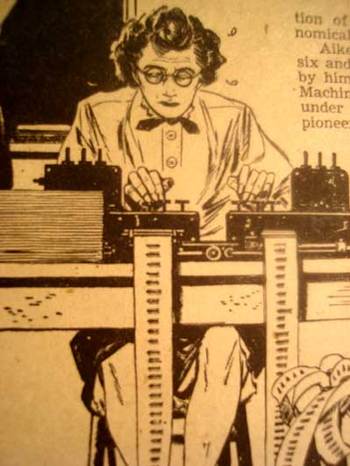
    The part I really don’t understand in this article is comparing the speed and function of the ASCC to two women working on calculators and Albert Einstein, working with a pencil, paper and pipe, none of whom look comfortable or happy.  (Actually the dresses on the women look a little hiked-up to me, just a little too high.)  Lal does make a decent comparative point (of uncertain veracity) about four generations of humans (the three above-mentioned calculators?) doing calculations that the ASCC could do in seconds.  Right or wrong, it gave the crowds in 1944 a real something to think about.

    Blogharvardbraingirl

    And so at the end of this post I believe that the representation of the brain as a mechanical device is relatively new, and I wonder if it isn’t a mostly-20th century creation.   Finding images of SteamPunk humans and robots and such roaming their ways through the literature in the 1920’s-1950’s is fairly easy, but showing the stuff inside the head and representations of how the mechanical brain was functioning seems to be a different matter.


  • WWII as Advertising Prop, 1943

    JF Ptak Science Books 

    Follow Me on Pinterest

    4-1 prop meat 001
    I was making my way through LIFE magazine for 1943 and was struck by the ratio of the number of advertisements using the war as a backdrop (and American soldiers as convenient props) for sales against the actual space dedicated to war reporting.  Concentrating on just two randomly selected  weekly issues (November 1 and November 15 1943) I was surprised to find  28 ads (most of which were full-page); there was no war reporting in November 1 and just half a story (on the history of the Prussian General staff) in November 15.  Most of the ads were directly war-related, the companies mostly relegated to vast production of war goods, like General Motors, Cadillac and Boeing. The others were less clear, like the ad pictured here for Green Giant peas and corn.  This company was informing the home front that if there were shortages of their product it was because they were selling it to the Army or Navy–others were more adventurous for their spirited attempt at patriotism. I’m not sure that Wembly Ties really needed to include a GI in their ad, nor did I like the use of American soldiers to sell Interwoven socks. 

    ·Posted by :

    ·in:

    —

  • Comet, Meteors, Aristotle, and Astrological Nothingness

    JF Ptak Science Books   Post 1977 

    Follow Me on Pinterest


    It seems to me that in the history of astrology–or at least for what seems to be most of it, at least through the late antiquarian publishing aspect of it–that comets and meteors were basically not utilized.  Perhaps it was because in that world these entites didn’t really effect anything–perhaps they were simply mysterious, spurious, and incongruent, and not a subject for installation in the astrological night sky.  Comets (from the Greek, kometes,  “long-haired”) and meteors (Greek again, from meteoran, a “thing in the air”) and bolides (exploding meteors, from the Greek bolis, or “missile”), holosiderites, siderolites, aerolites uranolites, and so on, have a long and complex story in the history of astronomy, at least in some ways; perhaps the most influential thinker on comets held thinking at bay and did so for two milennia: Aristotle’s Meteorology made the case that comets were not a planet or associated with planets or even necessarily part of the heavens–rather they were a phenomena of the atmosphere.  So perhaps their use as astronomical/astrological objects was limited by their very Aristotlean obviousness of being near-Earth objects. 

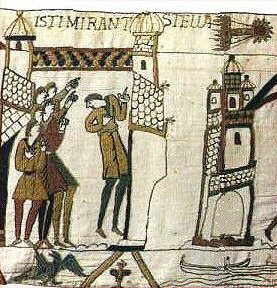
    The Comet of 1066 (later named Halleys’ Comet), as depicted in the Bayeux Tapestry (completed in the 1080’s)

    Comets bayeux

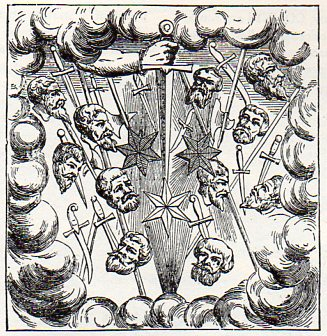
    The fear aspect of comets–the Comet of 1528–was depicted in Ambrose Pares Livres de Chirurgie (1597), and shows what part of the concern was (the coming demise of nations, the death of rules) with the appearance of decapitated heads and a large sword and raining daggers:

    Comet pare

    Comets 1560
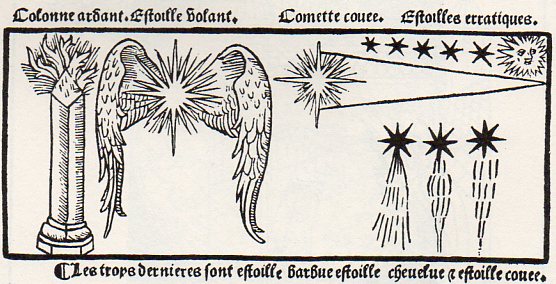
    [Nicolas Le Rouge, Le Grand Kalendrier et Compost des Bergieres, published in 1496 in Troyes.

    The night sky is a mnemonic device, a place to store memory and a holder of the alphabet of myths and beliefs of all, a culture written large across the sky. Meteors and comets were not predictable, and could add nothing insofar as a consistent bit of storytelling was concerned, though they certainly created their own stories in each observed appearance; they could also add punctuation and exclamation to whatever constellation they appeared in. For example if one appeared in a juncture with Jupiter, a major event for royalty would possibly be foretold.   But as a permanent element to the visualization of the night sky, they had little power even though they seemed to be displays of fantastic energy and power in themselves.

    Comets 3562
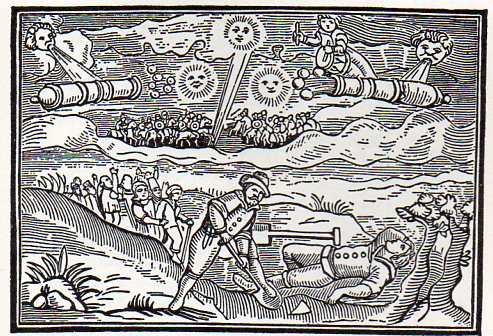
    [For some reason the celestial court, divided by sunlight and flanked by two other sources of light, have ofund it expedient to issue comets from the mouths of Heaven Canon.  I’m not sure what’s going on in the forground with the fellow working his spade next to the triangular blankness.  the man to his right seems to have been overtaken in fear (as have the group of people visible to the left over the shoveler’s shoulder).]

    Comets 4563

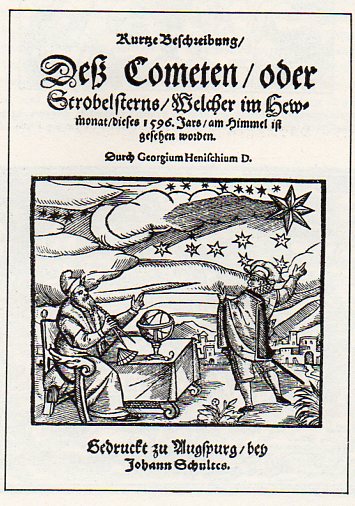
    [Halley’s comet appears again on the title page of this work by the Hungarian George Henischius, a professor of rhetoric, mathematics and medicine at Augsberg.]