A Daily History of Holes, Dots, Lines, Science, History, Math, Physics, Art, the Unintentional Absurd, Architecture, Maps, Data Visualization, Blank and Missing Things, and so on. |1.6 million words, 7500 images, 4.9 million hits| Press & appearances in The Times, Le Figaro, Mensa, The Economist, The Guardian, Discovery News, Slate, Le Monde, Sci American Blogs, Le Pont, and many other places… 5000+ total posts since 2008.

  • Jevons’ Logical Machine (1870)

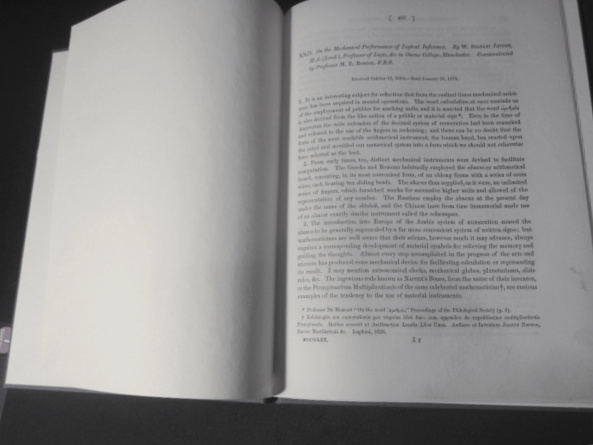
    Jevons logical _4_W. Stanley Jevons, On the Mechanical Performance of Logical Inference, in Philosophical Transactions of the Royal Society, 1870, pp 497–518. This is an extract from the volume, containing the entire article, plus its three engraved plates showing the works and interior of the machine. This is very tastefully bound in paper covered boards with a paper spine label. This is the first description of the one the preeminent. SOLD

    Jevons was a polymath and one of my favorite thinkers of the 19th century. He worked across many fields but seems to be remembered today mostly and unfortunately for his theory of the relationship between sunspots and economics cycles. He is not so well known as the inventor of one of the earliest pre-modern computers and particularly for it being the fastest machine of its kind ever invented.

    ·Posted by :

    ·in:

  • The Euphemisms of Life and Death–Nuclear Exchange, 1964

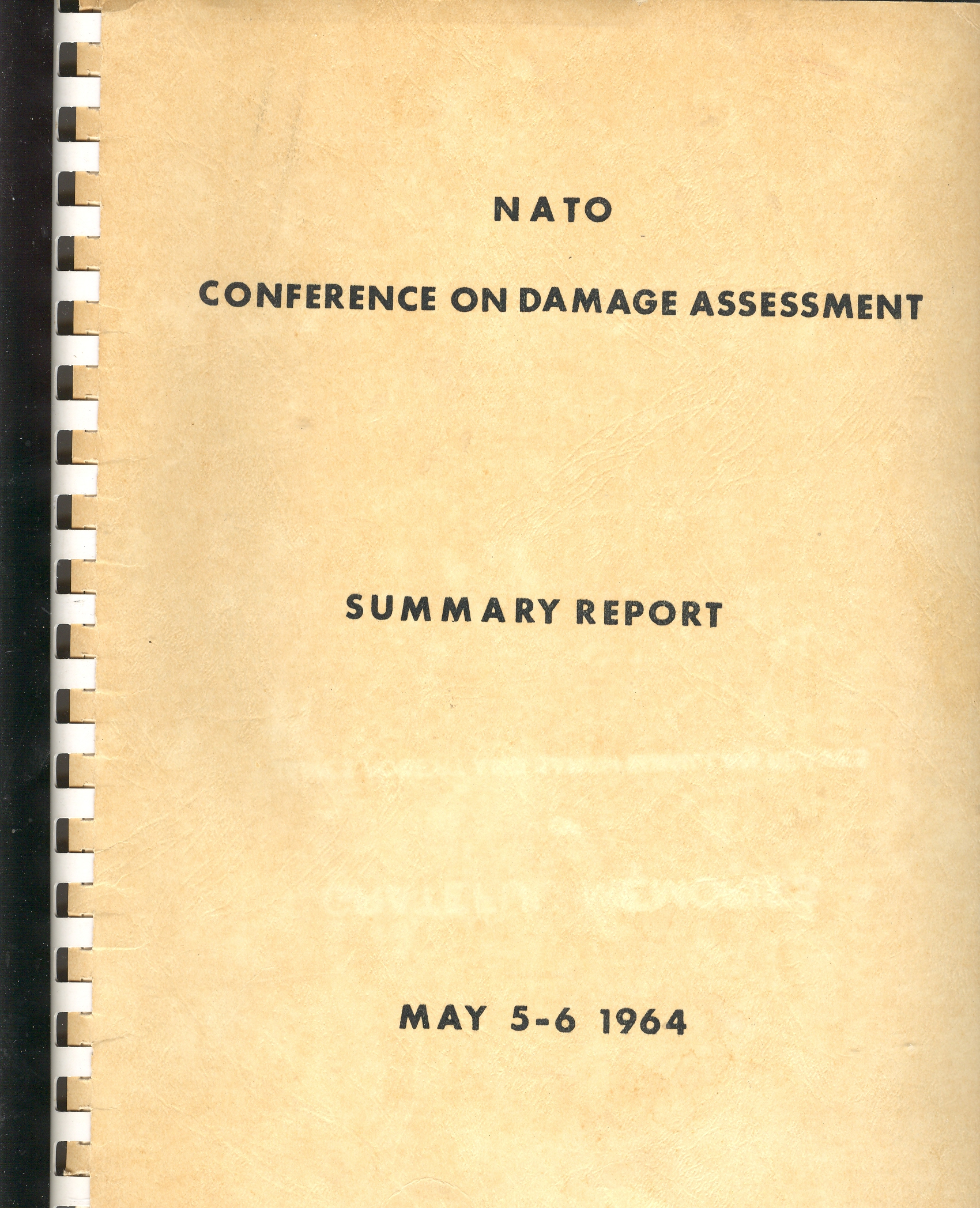
    The NATO Conference on Damage Assessment Summary Report (May 5-6, 1964).  Printed at NATO Hadquarters, Paris, France, May 1964. 11.5″ x 8.5″, iii, 115pp., with several dozen unpaginated tables.  GVC-binding with thick paper covers.  VG copy. $300

    Nato damage _4_


    The NATO Conference on Damage Assessment Summary Report (May 5-6, 1964) was not one written for its outcome, necessarily, but the means of getting there. The outcomes were highly differentiated levels of sameness, a strategic tour of Dante’s creation cataloging the layers of deep destruction like hose of his funneling pit.

    Professionally the paper dealt with several different ways of computing nuclear exchange scenarios (given names of understated inelegance like Jumbo, Brisk, Frisky, Dart and Dusk) with lots of smokily mirrored hocus pocus, the necessary ingredient of the philosophical technology of Mutually Assured Destruction. MAD. Somehow it all worked out without any exchange ever happening. (The principal contributor here was James Coker, chief of the National Resource Evaluation Center, Office of Emergency Planning, Executive off of the President.)

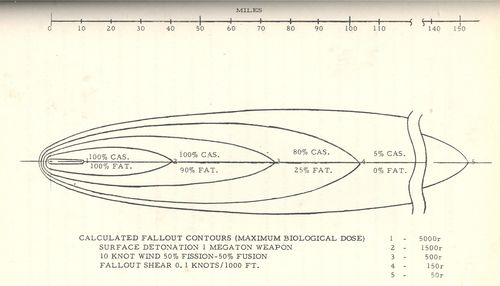
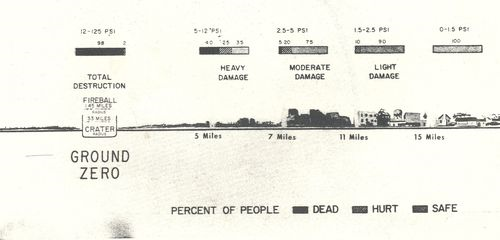
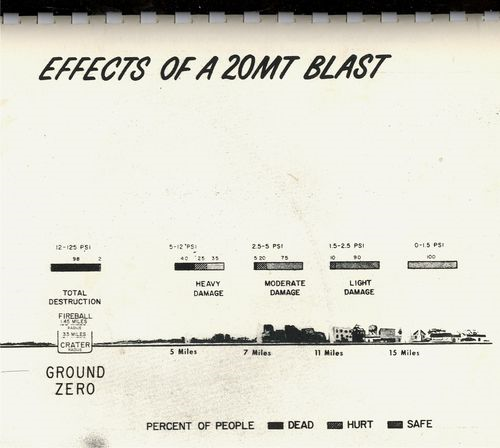
    The first image shows the effects of a 20 megaton nuclear blast detonated in in a city, presenting an incredible picture of absolute destruction, reaching out from ground zero for more than 11 miles. This doesn’t begin to measure the overall damage inflicted by radiation, which is deeply, extraordinarily, severe. This again is the effect of one weapon, the 100% fatality rate eventually reaching out 12 miles; 90% reaching over 40 miles. General casualties extend to 80% up to 70 miles from ground zero.

    Nato damage _4_

    Nato damage _4_
    Nato damage _4_
    Nato damage _4_

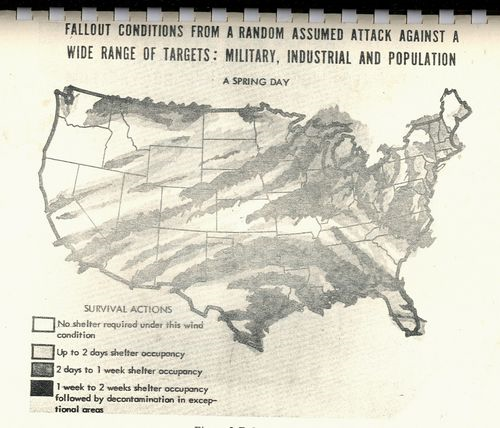
    The emergency planning end of the paper comes in at about this point. The fallout map of the U.S. shows a possible situation of an unspecified (though wide-ranging) attack (on a “spring day”) and its effects on the population as it is housed in various shelters and bunkers, suggesting the amount of time needed to “survive” the attack by staying inside the fail safe habitation.

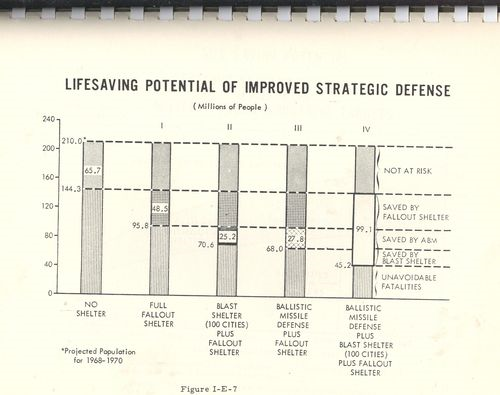
    The following chart, “Lifesaving Potential of Improved Strategic Defense” (in millions of people) shows the effect of the installation of the shelters and bunkers. In this scenario, in a massive strike, the fatality rate in the U.S. of an unprotected population was 65%, or 144 million. On the other end of the extreme was “ballistic missile defense plus blast shelters plus fallout shelters”, or a massively- protected population of fictional expanse shows that in spite of all precautions 45.2 million people would die (as “unavoidable fatalities”).

    Nato damage _6_

    This document is nothing if not a death sentence had the massive strike ever been launched. In the dozens of such reports that I’ve seen, there hasn’t been one with the Really Big One with thousands of euphemistically-named “exchanges”, which I assume would make all of these others pale by comparison

    ·Posted by :

    ·in:

  • American Medical Association. Anti-Quackery Reports.

    American Medical Association Propaganda Department.Medical Quackery, Facts , Cures Treatments–14 pamphlets, 1916-1924. American Medical Association, Propaganda Department of the Journal of the AMA. $175

    The following 14 publications, printed by the Propaganda Department of the Journal of the American Medical Association, detailing a public interest in ferreting out charlatans, hacks, fakes, cure-alls, phony cures and treatments, and schemers of all shapes and descriptions. All are 8″ x5″, in their original wrappers. All are from the Library of Congress, with their 6mm perforated “LC” on the cover and a rubber stamp surplus stamp on the front cover as well. All are in VG save one which is missing its rear wrapper.

    Published by the Propaganda Department of he Journal of the American Medical Association

    • Medical Mail-Order Concerns, 1924,
    • Cancer Cures and Treatments, (1920), 36pp
    • Deafness Cures, 1916, 3rd ed. 48pp.
    • Some Quasi-Medical Institutions, 192387pp.
    • At the Bar of Public Opinion, 1917, 28pp.
    • Mineral Waters, (1920?), 34pp.
    • Medical Institutes, (1920?), 85pp.
    • Convictions under the Food and Drugs Act, 1917, 4th ed, 96pp.
    • Epilepsy Cures, 1916, 2nd ed, 34pp.
    • Nostrums for Kidney Diseases and Diabetes, 1923, 51pp.
    • Miscellaneous “Specialists”, (1920?), 69pp.
    • Testimonials, “A Fake’s Protest is a Testimonial”,(1920?), 16pp.
    • Some Quasi-Medical Institutions, 1916, 58pp (lacking rear wrapper, Good copy only)

    ·Posted by :

    ·in:

  • Papers by Wernher von Braun

    (von Braun, Wernher) “A Biography”. In: Journal of the British Interplanetary Society, March 1950, vol 9 no. 2, this article being pp 57-58 in the issue of pp 49-92. Original wrappers. Very fine, fresh copy. $75

    Interesting two-page read on von Braun, if not whitewashed for the war years.

    Also there’s a great review of a German film on rocket development and the history of rocketry that spreads out over 8pp and which was evidently released sometime during WWII. The film is reviewed by members of the Society, and the comments on it are incisive and useful. It would be great to see the film, though to know that it exists is a step forward.

    Of a side interest to interplanetary flight is a short reference to “Spaceship I” (pictured above)–it is all very intriguing, though outside of two images of models for the proposed dirigible-like behemoth almost no other information is presented.

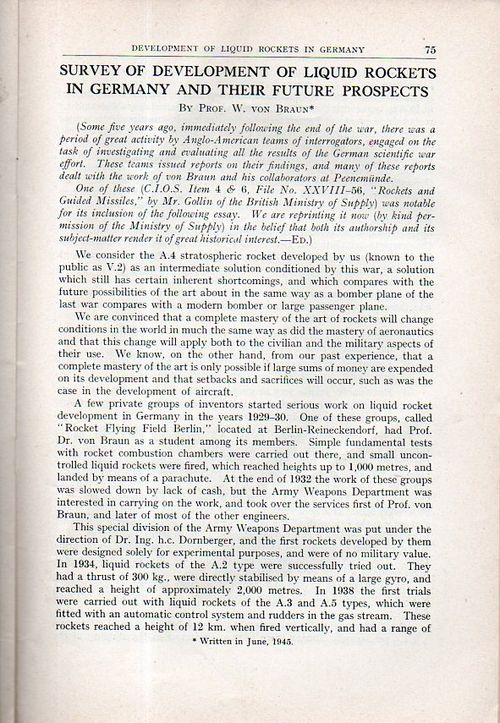
    von Braun, Wernher. “Survey of Development of Liquid Rockets in Germany and their Future Prospects”, in Journal of the British Interplanetary Society, March 1951, vol 10 no. 2, the paper occupying pp 75-80 in the issue of pp 49-99. Original wrappers. There is an older notation in ink at the top of the front wrapper, otherwise this is a very fine copy. $95
    Von Braun survey

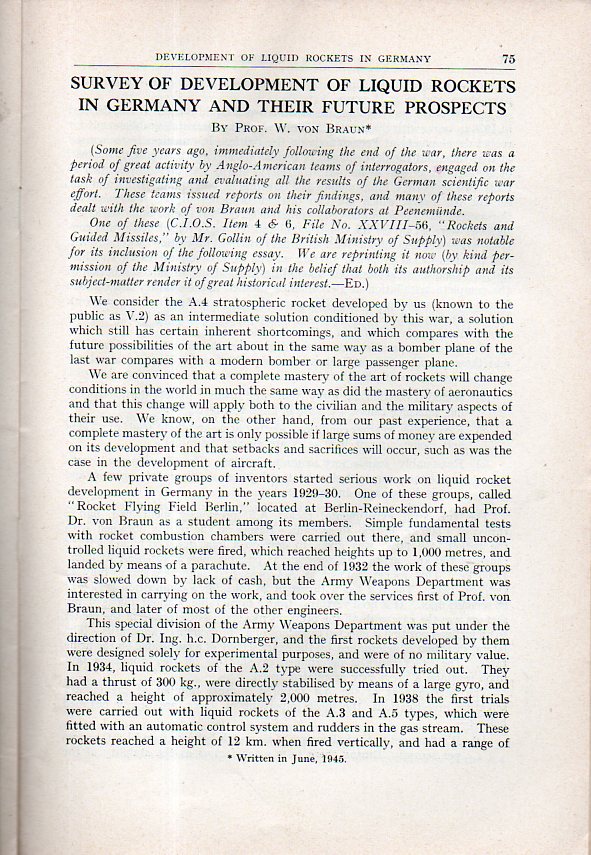
    “Survey of Development of Liquid Rockets in Germany and their Future Prospects” is a six-page effort that appeared in the Journal of the British Interplanetary Society on March, 1951. It is a reprint of a reprint of a report that he wrote for his Anglo-American interrogators in the summer of 1945, when he and the Allies were scurrying around and trying to figure out what to make of the post-war world with all of that valuable German technology-ops out there in the wind.

    In any event, von Braun wrote out this history and prognostication (as there is a big chunk of the paper devoted to future space travel and such) for them in 1945 which then found itself in print by at least 1946. There are many glosses. For example, his use of the A.-prefix determination throughout the course of the document to refer to the V-weapons though it is noted in the first sentence of the report (and no doubt by an editor), that the A.4 “is known to the public as the V.2”. (Perhaps that has the scent of freshness to it, to rid the report of a small part of its scrubbiness…or not.)

    He writes occasionally in the third person, and also makes the case that the development of the rocket complex at Peenenemunde was for research in high-flight/super-fast travel, when the place had always been intended for military applications. He does mention that the A.4 had severe problems with the guidance system, but that was acceptable since they were given large-target areas to bomb–such as “London”.

    Also in this issue: D.J. Cashmore, “Some Problems of Interplanetary Navigation”, pp 71-74; AND G.V.E. Thompson, “The Lunar Base”, pp 49-70.

    von Braun, Wernher. “The Early Steps in the Realization of the Space Station”, in Journal of the British Interplanetary Society, January 1953, vol 12 no. 1, the article occupying pp 23-25 in the issue of pp 1-54. Original wrappers. There’s a small notation in ink at the top of the front wrapper by the original owner, otherwise this is a fine copy. $95

    • Other articles in the issue include F.L. Whipple, “Astronomy from the Space Station”; M.W. Rosen, “A Down to Earth View of the Space Station”, and Percy Wilkins, “The Other Side of the Moon”.

    von Braun, Wernher. “Reminiscences of German Rocketry”, in Journal of the British Interplanetary Society, May-June 1956, vol 15 no. 3, with the article occupying pp 125-145 in the issue of pp 125-175. Original wrappers, lovely copy. Fine. $125
     

    ·Posted by :

    ·in:

  • Papers by Arthur C. Clarke, 1946-1950

    CLARKE, Arthur C. “The Challenge of the Spaceship”, in Journal of the Interplanetary Society”, December 1946, vol 6 no. 3, this paper occupying pp 66-78 in the issue of pp 65-94. In the original wrappers. VG copy. $250.00

    “Arthur C. Clarke’s 1946 essay on ‘The Challenge of the Spaceship’ was one of the founding manifestoes of the Space Age, and helped to establish him as the West’s leading techno-prophet. Restating his ideas in subsequent factual and fictional works, Clarke successfully propagated the belief that man’s destiny lay in space and that the process was already underway. On the surface Clarke’s oeuvre offers a classic astrofuturist model of progress as technology-driven, but on closer examination it also incorporates a more pessimistic, historically based strand of philosophy, British rather than American. This essay traces the genesis of Clarke’s early work and the influence upon him of the historian Arnold J. Toynbee and the moral philosophers Olaf Stapledon and C.S. Lewis. Toynbee was essentially a Christian pessimist who believed that western civilization was on the way out; his long historical perspectives were an important source of inspiration for Clarke, leading him to a cyclical rather than a simply progressive model of history which contemplated both the beginning and the end of civilizations. The concerns of Stapledon and Lewis with grand narratives of decline and redemption were also influences on Clarke. All this needs to be understood in relation to both the European experience of World War I and to the coming of the atomic bomb, the latter a profound influence on Clarke’s generation. Such perspectives gave European astroculture a more modulated vision of the human future in space than the technologically based astrofuturism which dominated in the USA.”–Robert Poole, “The challenge of the spaceship: Arthur C. Clarke and the history of the future, 1930–1970” History and Technology, Volume 28, 2012 – Issue 3: Rethinking the Space Age: Astroculture and Technoscience.

    • Also: “Discussion of Mr. Clarke’s Paper”, PP 79-81.
    • Also in this issue: E. Burgess, “Thermodynamics of the Rocket Motor”, pp 82-89.

    CLARKE, Arthur C. “Electromagnetic Launching as a Major Contribution to Space-Flight”, in Journal of the Interplanetary Society, November 1950, vol 9 no. 6, the article occupying pp 261-266 in the issue of pp 261-304. Original wrappers. One-line penned annotation on the top of the front wrapper, otherwise a fine copy. $75

    • Also with: Hermann Oberth, “Three Equations for the Rapid Calculation of Rocket Motor Thrust”, pp 275-278.

    CLARKE, Arthur C. “Astronautics and Poetry”, in Bulletin of the British Interplanetary Society, February 1947, vol 2 no. 2, the article occupying pp 21-24 in the issue of pp 21-40. Original wrappers. Fine copy. $75

    • Also with: L.R. Shepherd, “Le Moteur Nucleare”, pp 28-29.
    • And with: “German Industrial Developments (Reports)”, pp 33-34.

    CLARKE, A.C. “Space-Travel in Fact and Fiction”, in Journal of the British Interplanetary Society, September 1950, vol 9 no 5, the article occupying pp 213-230 in the issue of pp 213-260. Original wrappers. One old rubber stamp for “Osterreichische Gesellschaft fuer Weltraumforschung” (or Austrian Society for Space Research), with a penned annotation for “GFW Bibliothek” in a neat hand on cover top-left. Save for these issues, this is a FINE copy. $75

    ·Posted by :

    ·in:

  • Early Papers on the Hughes Microphone, 1878

    Early appearances of David Hughes’s microphone (invented in 1878), in Nature: (1) “The Microphone”, pp 57-8,   May 16, 1878.  (2) AND WITH Hughes, “Hughes’s Microphone”, in July 11, 1878 Nature, on pp 277-8. (3) AND WITH: “On the Physical Action of the Microphone”, in Nature, June 27, 1878, pp 239-240, by David Hughes. This is offered with the original wrappers.  All offered in the weekly issues, removed from a larger bound volume.”Hughes’s microphone, invented in 1878, was the forerunner of the various carbon microphones that were used in most telephones produced in the 20th century. From 1879 to 1886 Hughes performed a series of experiments in which his equipment transmitted wireless signals up to 500 yards.”–Britannica dot com  The three issues: $95.00

  • Two Classic Papers in Geometrodynamics (1957)

    Charles W. Misner, John A. Wheeler, Classical physics as geometry: Gravitation, electromagnetism, unquantized charge, and mass as properties of curved empty space”, in Annals of Physics, vol 2, 1957, pp 525-603. Bound with:

    John A. Wheeler, “On the nature of quantum geometrodynamics”. Ann. Phys, same volume, pp 604–614.

    Both papers in the single bound volume of vols 1+2 of Annals of Physics, 315+629pp. Bound n cloth. Ex-library IBM, though with no library markings. Fine copy. $300

    Also bound with F.J. Belifante and J.C.Swihart, “Phenomenological Linear Theory of Gravitation, I” (pp 168-196) and part II (pp 213-220).

    • Abstract (Misner/Wheeler): “If classical physics be regarded as comprising gravitation, source free electromagnetism, unquantized charge, and unquantized mass of concentrations of electromagnetic field energy (geons), then classical physics can be described in terms of curved empty space, and nothing more. No changes are made in existing theory. The electromagnetic field is given by the Maxwell square root of the contracted curvature tensor of Ricci and Einstein. Maxwell’s equations then reduce, as shown thirty years ago by Rainich, to a simple statement connecting the Ricci curvature and its rate of change. In contrast to unified field theories, one then secures from the standard theory of Maxwell and Einstein an already unified field theory. This purely geometrical description of electromagnetism is traced out in detail. Charge receives a natural interpretation in terms of source-free electromagnetic fields that (1) are everywhere subject to Maxwell’s equations for free space but (2) are trapped in the worm holes of a space with a multiply-connected topology. Electromagnetism in such a space receives a detailed description in terms of the existing beautiful and highly developed mathematics of topology and harmonic vector fields. Elementary particles and real masses are completely excluded from discussion as belonging to the world of quantum physics.”


    ·Posted by :

    ·in:

  • Classic Papers on Servo-Mechanisms and Methodologies (1934)

    H(arold) L(ocke) Hazen. “Theory of Servo-Mechanisms”, in Journal of the Franklin Institute, September 1934, vol 218 #3, pp 279-331.

    And offered with:

    “Design and Test of a High Performance Servo-Mechanism”, same volume, though in the November issue (#4), pp 543-580.

    Altogether, an 89-page contribution by the PhD from MIT (’31). The EE Hazen is remembered for his contributions and partnership with fellow-MIT associate Vannevar Bush for work on the AC Netowrk Analyzer and tehn more famously for the Differential Analyzer. Very sturdily bound in library cloth. Ex-library, with two scant markings on spine and a university bookplate. VG copy. $250

    ·Posted by :

    ·in:

  • Propaganda Maps–France, ca. 1935

    JF Ptak Science Books  Quick Post

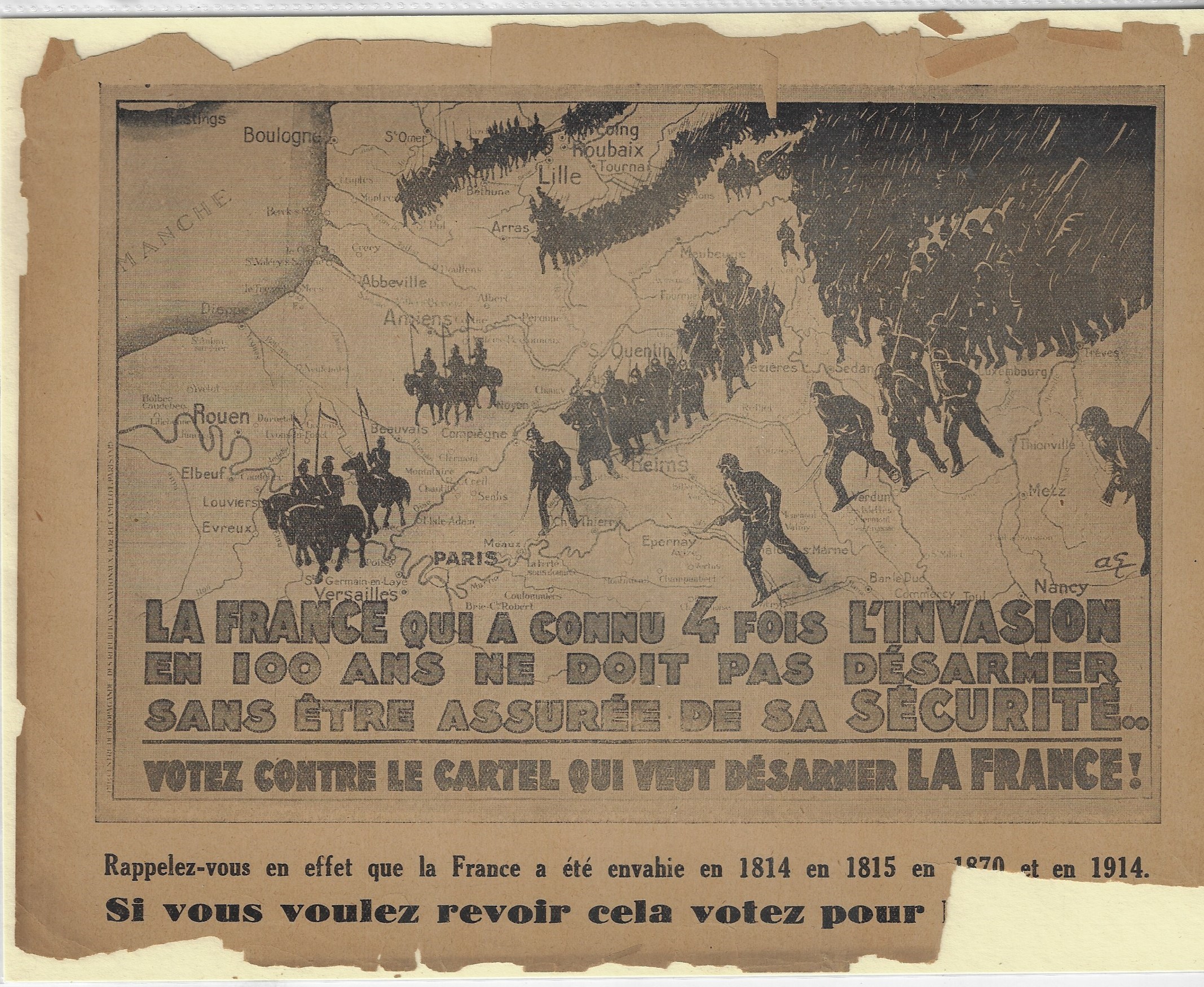
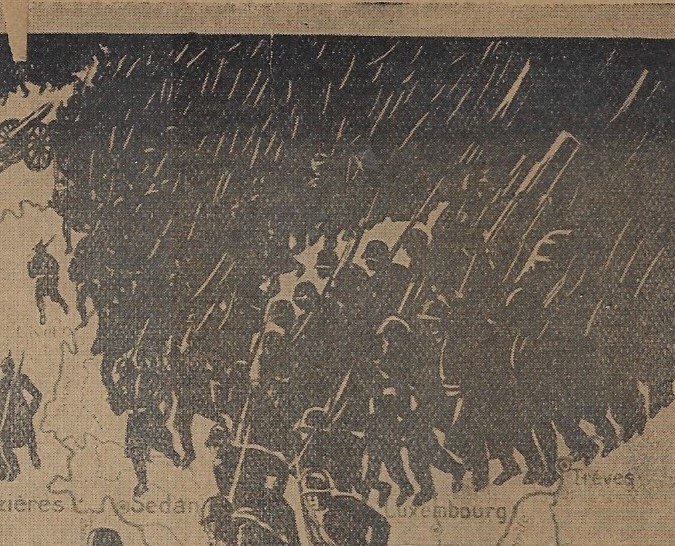
    This is certainly a successful design in describing fear and possibility for the near future and the security  (or lack of it) for France. Nothing quite conveys temporal disruption than a consolidated mass of dark and sharp objects advancing on the home front. 


    Maps propaganda France detail

    • “La France qui a connu 4 fois l’invasion en 100 ans ne droit pas desarmer sans entre assuree de sa securite. Votz contre le cartel qui vent desarmer la France!” (“France, which has been invaded four times in 100 years, should not disarm with being assured of its security! Vote against the cartel that will disarm France!”)   $50
    • Maps propaganda France detail

    The image is a moderate Right Wing political propaganda piece extolling people not to vote for a political group (unnamed but Left Wing) that would “disarm France” by referencing the four times that France has been invaded in the last 100 years (1814, 1815, 1870, and 1914). Design by Andre Galland and printed 1932-1936. The fifth invasion was already on its way, coming in 1940, when Germany simply did an end-run around the ill-conceived modern antique of the Maginot Line, after which the very large French army was slow to respond, with France surrendering 46 days later on 25 May 1940.

    • In a tiny scroll script in the left margin reads: (translated) Propaganda Center of the National Republicans (Republicains Nationaux).

    This is an effective design for sure, showing a mass of infantry and cavalry crossing the northern French border…so massive in fact that most figures blend into an almost-solid black mass save for the white streaks of rifles/bayonets.

    I’m not sure what the intended use was for my copy of this image, which was originally produced as a poster, though this copy measures only 27x21cm. I don’t know if it was meant as a flyer, or small poster, or if it was simply an illustration in a larger book. It is interesting, regardless. It is certainly worth sharing, though. 

    ·Posted by :

    ·in:

    —
  • Scarce Australian Anthropological Journal, 1899-1909

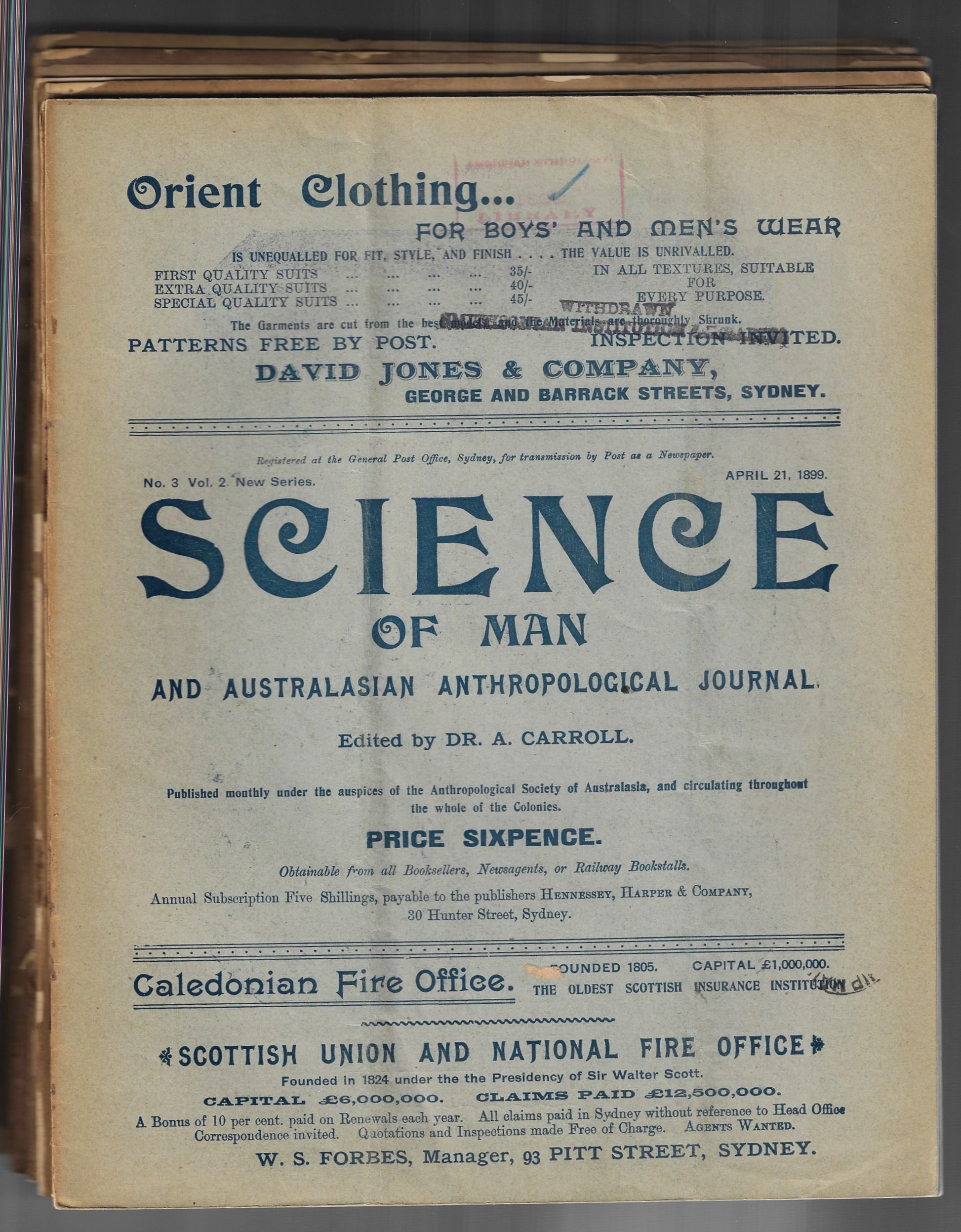
    Science of Man Australia Carroll, Alan (1827-1911), editor. Science of Man and Australasian Anthropological Journal. Published Monthly under the auspices of the Anthropological Society of Australasia… Hennessey, Harper & Company, Sydney (30 Hunter Street). 11” x 8.5”. Odd volumes, including volumes 2, 4, 5, and 11, 39 issues of 48. Original wrappers, offered in the original parts. The wrappers are mostly Fair-Good and many have become detached; the text for each issue is VG, in general. Scarce publication. 350.00

    It seems that there are very few complete runs of this journal, at least according to WorldCat and Trove. Also for the incomplete runs there aren’t many located, either; WorldCat in general finds 5 or 6 libraries, while Trove finds about the same in Australia (with WorldCat not locating those libraries.)

    Each volume is housed in a clamshell box. All are ex-library from he Smithsonian Institution, with their stamp on the cover wrapper, and also their name impressed on the foot of each box.

    The run includes the following: Vol 2 (1899) #s 2-8, 10-12; Vol 4 (1901) #s 1-5, 8-12; Vol 5 (1902) #s 1-8; Vol 11 (1909) vols 1-12 complete.

    ·Posted by :

    ·in:

  • Rare Document on Education in Occupied China, 1937-1945 (1945)

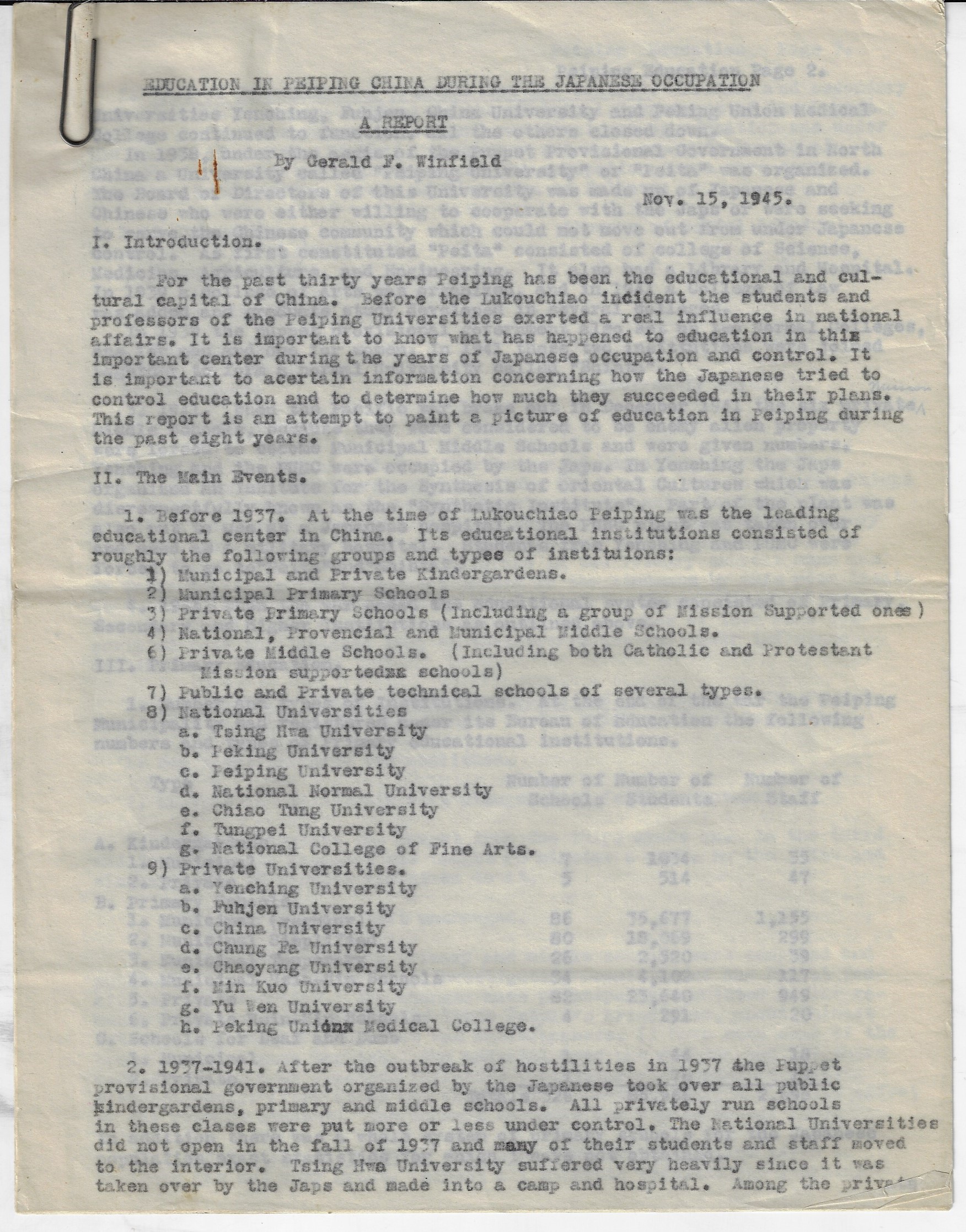
    Gerald F. Winfield. Education in Peiping China During the Japanese Occupation. A Report.

    • 7 leaves, carbon copies, dated Nov. 15, 1945. Gathered by a paper clip.
    • Approximately 3000 words. Tables.
    • No copies located in WorldCat/OCLC. No hits on the title whatsoever in various search engines.
    • Mr. Winfield seems to have published a fair amount on Asia.

    $200

    Education in China Japan Occupation


    ·Posted by :

    ·in:

Recent Posts

Archives

Categories