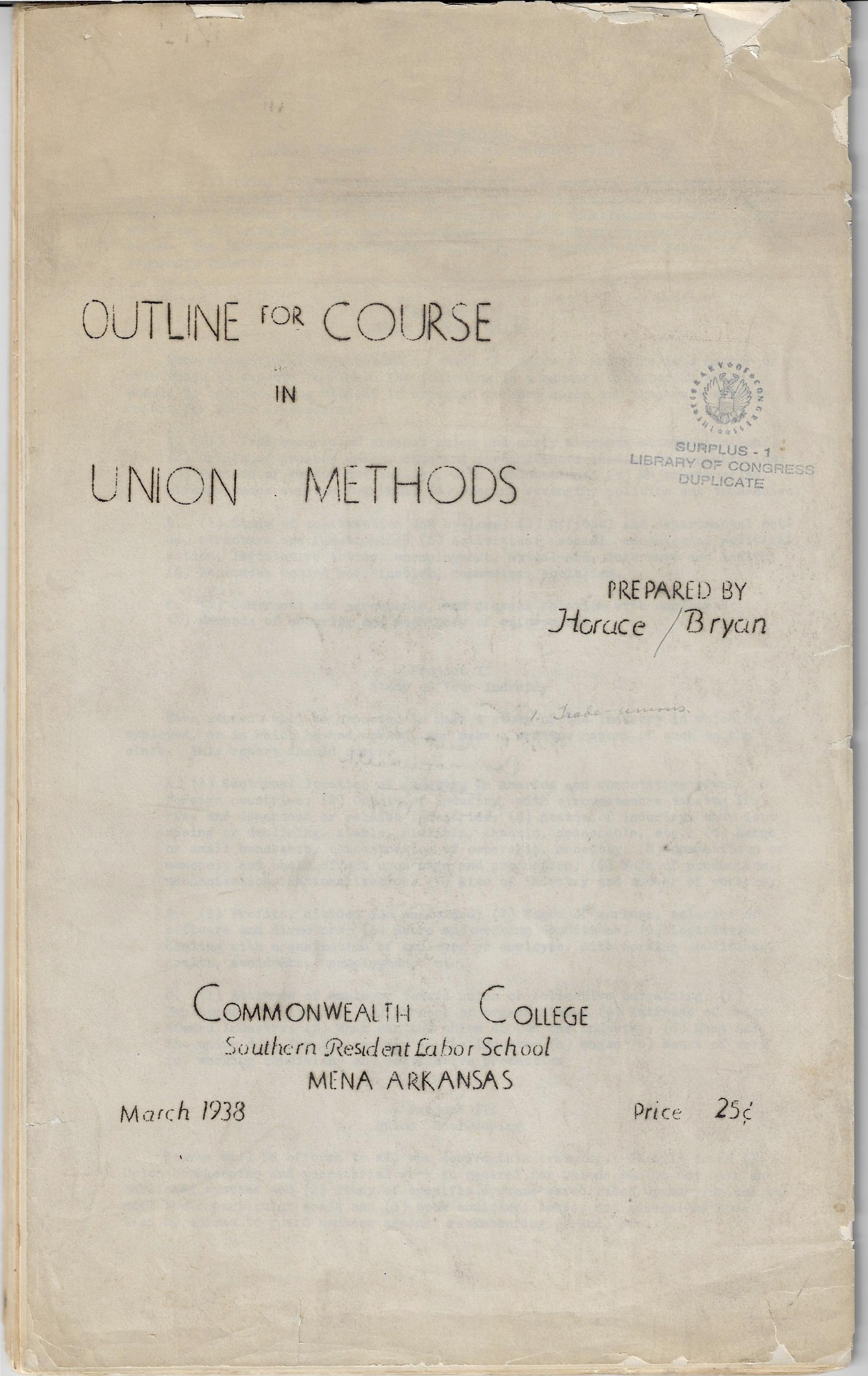
 Horace Bryan, Outline for Course in Union Methods. Printed at Commonwealth College (Southern Resident Labor School, Mena, Arkansas, March 1938. 13.5×8.5″, 35 mimeographed sheets, staple bound at top. Each sheet runs about 600 words, or 20,000 words or so for the document. There are six sections: Union Methods, Craft and Industrial Unionism, Job Organization, Organization and Conduct of Strikes (the longest section), Collective Bargaining, and Union Activity and Law. Condition: Good, overall. The title page is dusty and has been detached; there are several short tears here and there in the text, and the last section (each section being stapled together) is detached from the whole. Provenance: Library of Congress, with their rubber stamp surplus/duplicate on the cover, as well as the tiny “LC” perforated stamp on the bottom of page 1. Rare–only one copy listed in WorldCat/OCLC. $250
“Commonwealth College was started in 1923 to recruit and train people to take the lead in socio-economic reform and prepare them for unconventional roles in a new and different society.”–Wiki It ceased operations in 1940, and was a labor studies school in a similar standing of the Highlander Folk School, Work People’s College, Brookwood Labor College, and others. “Christian socialist the Reverend Claude Williams, “the preaching hillbilly”, then served as director from 1937 until 1940. Several people identified with Commonwealth were actively involved during this period in organizing the Southern Tenant Farmers’ Union, which aimed to unite the economic interests of tenant farmers, both black and white, and with the Congress of Industrial Organizations (CIO).”–Wiki, again.