A Daily History of Holes, Dots, Lines, Science, History, Math, Physics, Art, the Unintentional Absurd, Architecture, Maps, Data Visualization, Blank and Missing Things, and so on. |1.6 million words, 7500 images, 4.9 million hits| Press & appearances in The Times, Le Figaro, Mensa, The Economist, The Guardian, Discovery News, Slate, Le Monde, Sci American Blogs, Le Pont, and many other places… 5000+ total posts since 2008.

Category: Technology, History of

  • The Prehistory of the Manhattan Project: the MAUD Committee, 1941

    JF Ptak Science Books Post 280

    (Note:  both the MAUD and Frisch-Peierls documents are reprinted in the continued reading section below)

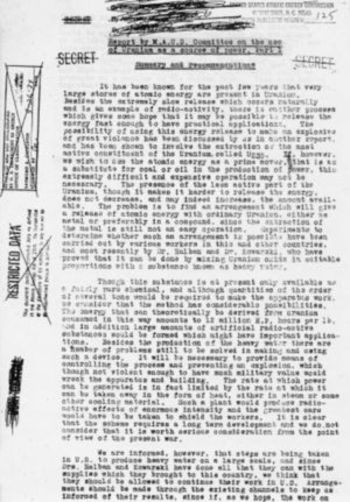
    As stated in the first paragraph of what once was a supremely-guarded secret, the British MAUD Committee (Britain’s initial steps towards the construction of an atomic weapon) :”Work(ed) to investigate the possibilities of utilizing the atomic energy of uranium for military purposes has been in progress since 1939, and a stage has now been reached when it seems desirable to report progress…”  There was quite allot of this work done between 1937 and 1939 (and even deep into 1940 the American physics journal Physical Review was still publishing papers they probably shouldn’t have on this subject), and the MAUD committee sought to get a handle on it all.
    Maud_report

    As stated in the first paragraph of what once was a supremely-guarded secret, the British MAUD Committee (Britain’s initial response to constructing an atomic weapon): “(w)ork(ed)  to investigate the possibilities of utilizing the atomic energy of uranium for military purposes has been in progress since 1939, and a stage has now been reached when it seems desirable to report progress…”  There was quite allot of this work done between 1937 and 1939 (and even deep into 1940 the American physics journal Physical Review was still publishing papers they probably shouldn’t have in the area). Then, coming out of UK’s Birmingham in February 1940, Otto Frisch and Rudolf Peierls, considered the possibility of fast fission in uranium-235. They estimated the likely effects of the bomb, possible methods of assembly and made estimates on how feasible it was to separate the uranium-235.

    The opening paragraphs of the 1940 Frisch-Peierls Memorandum. The text reads:

    Strictly Confidential. Memorandum on the properties of a radioactive “super-bomb”.The attached detailed report concerns the possibility of constructing a “super-bomb” which utilizes the energy stored in atomic nuclei as a source of energy. The energy liberated in the explosion of such a super-bomb is about the same as that produced by the explosion of 1000 tons of dynamite. This energy is liberated in a small volume, in which it will, for an instant, produce a temperature comparable to that in the interior of the sun. The blast from such an explosion would destroy life in a wide area. The size of this area is difficult to estimate, but it will probably cover the centre of a big city.

    In addition, some part of the energy set free by the bomb goes to produce radioactive substances, and these will emit very powerful and dangerous radiations. The effect of these radiations is greatest immediately after the explosion, but it decays only gradually and even for days after the explosion any person entering the affected area will be killed.

    Some of this radioactivity will be carried along with the wind and will spread the contamination; several miles downwind this may kill people.

    Their work was summarized in what was to become known as the Friesch-Peierls memorandum (see below for a WORDLE/word map of the report), and sent on to Marcus Oliphant, who passed the document on to Henry Tizard, chairman of the Committee on the Scientific Survey of Air Defence. The Maud Committee–molded into existence by Tizard and consisting of Sir George Paget Thomson,  Chairman Marcus Oliphant, Patrick Blackett,  James Chadwick, Philip Moon and John Cockcroft.–first met on 10 April 1940 to consider Britain’s actions regarding the mass of possibilities swirling around the “uranium problem”, and

    The MAUD committee approved two reports (See below for the World word map of the report below) on 15 July 1941 and disbanded; the first report was on ‘Use of Uranium for a Bomb’, giving a technical description of the bomb with specs and cost estimates, concluding that the bomb was indeed feasible. The other was on ‘Use of Uranium as a Source of Power’ and discussed the implementation of the bomb as well as the peaceful uses for what we would call a reactor.  It was a penetrating discussion.

    Meanwhile, in the U.S., Arthur Compton and the National Academy of Sciences (prompted and urged by folks like E.O. Lawrence and Vannevar Bush) studied and then, on 17 May 1941, issued a report on nuclear energy, incorporating the MAUD findings (which had been received in the U.S. by March 1941) discussing the possibilities of a bomb though without entering into any detail about actually producing one.

    The Brits evidently felt that the U.S. needed to take a much more advanced and urgent look at the issue than what was being allowed.  The Americans were still not in the war (and Britain had been fighting for 1.5 years by that point) and were still 7 months out from Pearl Harbor.  Pursuing and building the bomb was a gargantuan undertaking unlike almost anything else, and the fire had still not been lighted that would ignite this fuse. The bomb also could be built probably nowhere else on earth given the manpower and raw material and electricity and knowledge demanded by the project–at the end of the day, the Nazis, I think, just didn’t have the raw stuff for the project and were still removed from the theoretical aspects.  Britain of course couldn’t afford the project what with actually fighting the war.  Japan just wasn’t in the realm of possibility.  It had to be the U.S.

    And so it came to pass that Sir Marcus ‘Mark’ Laurence Elwin Oliphant, a 42 year old Australian (who died only recently, in 2000), came to the US  in  to do a very hard sell on the Americans for bomb production.   Oliphant, who with the rest of the nuclear establishment of Britain was puzzled by the inaction of the U.S. on MAUD  meet  with Lyman Briggs, his American counterpart to whom the report had been sent.  Oliphant recalled:
    “the minutes and reports had been sent to Lyman Briggs, who was the Director of the Uranium Committee, and we were puzzled to receive virtually no comment. I called on Briggs in Washington, only to find out that this inarticulate and unimpressive man had put the reports in his safe and had not shown them to members of his committee. I was amazed and distressed.”  I should say so

    Oliphant moved up the ladder and met with his friends EO Lawrence, James Conant and Enrico Fermi about his “problem”, which was evidently instantly digested.  It was from this point that Lawrence got together with Compton and Bush (who at that time was chair of the National Defense Research Committee), and created the vaster and more encompassing Office of Scientific Research and Development–perhaps one of the smartest American moves of the entire war. (I should also point out that it was also under the leadership and guidance of Vannevar Bush that this organization functioned so well and produced the amount of work that it did, which as really astonishing.  Bush in my my is one of the truly great unsung heroes of the war.)   It was from the OSRD that the Manhattan Engineering District was born after Pearl Harbor.  And then everything else, um, happened.

    MAUD Wordle

    Wordlemaud


    Frisch Wordle
     

    Wordlefrisch


  • Images of Scientific Breakthroughs: Astronomy–Gallucci, Galileo, Kepler

    JF Ptak Science Books Post 276

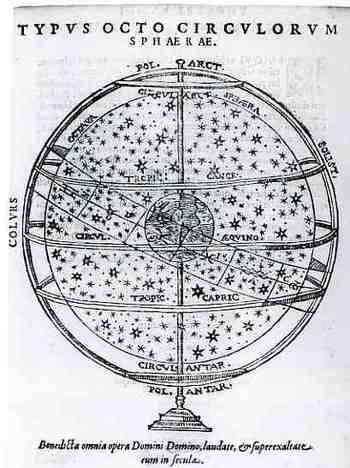
    A good heaping part of the vast beauty of printed scientific illustration over the last 500 years or so is occupied by luscious renderings of the constellations, night sky, and the general good works of the Primum Mobile. The woodcut to the left was published by Giovanni Paolo Gallucci in 1588, and is found in his Theatrum mundi. IT is a different sort of beautiful, not perhaps as beautiful as the earlier and more artistic efforts of other, but beautiful for being the first map of its kind to employ the use of stellar coordinates. Prior to this—and I mean for thousands of years—the imaging of the constellations was really an architecture of mnemonic devices, created so that there would be a memorable linkage and form, making the placement of the stars dependent on their connection/recognizable pattern to other stars.

    1blogsept_23_astro636

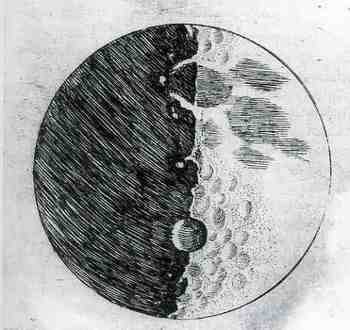
     The next two images really aren’t directly related to Gallucci and his predecessors, but there is a bit of slightly kindred spiritedness among them. The first image of the moon was really a sensation in the history of astronomy—it is the first published detailed map of the moon rendered by the use of the telescope, made by Galileo and published in his Siderius Nuncius in 1610. It was just a fantastic accomplishment—he even tried to show the relative heights of the mountains of the moon by giving them shadows of varying lengths.

    1ebay_sept_25_galileo_moon668 

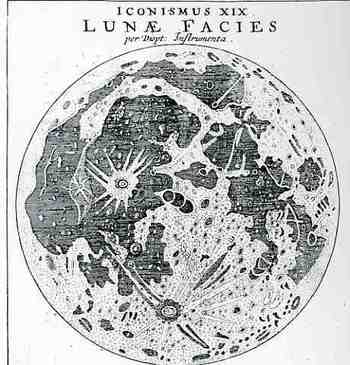
     In the very next year this monumental drawing was totally eclipsed by Johannes Kepler, who brought his own telescope to bear upon the moon and produced a map of prodigious detail, far surpassing the Galileo map. (I can only imagine how shocked people must’ve been when seeing this map, “Lunae Facies per Diopt Instrumenta” for the first time, which was found in Kepler’s Dioptrice of 1611.) The reason wasn’t that Kepler was a superior observer, but that he used convex lenses for the objective and eyepiece, giving him a far more dynamic, detailed and wider scope of field, resulting in this surprising modern map.

    1ebay_sept_25_galileo_moon_lunae669


    So these two sets of images really aren’t strongly connected, as I said, but they do show the significant, short-term effects of technical improvement and innovation in the illustrated depiction of the advancement of science. And of course they’re pretty.


  • Odd-looking Technical Inventions: the Blohm and Voss “141” Surveillance Aircraft, 1942

    JF Ptak Science Books Post 276

    1ebay_sept_24_blohm_voss_141667


    Talk about an unusual-looking aircraft: during the Second World War the Blohm u. Voss “BV 141” may have defined that category.  This image appeared in The Illustrated London News for 23 May 1942,  drawn by the indomitable G.H. Davis, and gives an excellent view of what the editors called “a lop-sided freak”.  Perhaps the editors of the ILN wanted to educate its readers on the plane since it was supposed to be widely employed on the Russian Front, though it looks like only 38 were ever built (and none survive today). Actually, the plane, designed by Dr. Richard Vogt (1894-1979),  was a high-flying three-seater  surveillance aircraft capable of 220 mph at 17,000 feet, powered by a single 1000 hp Bramo Fafnir 9-cylinder radial engine.  The idea for the design was to give the pilot and co-pilot a very wide field of view–and by this, I’m guessing that the field of view most affected and aided by this would be straight down. The rear gunner also had an enormous field of view. 

    As it turns out Vogt survived the war and spent his Golden Years in the U.S., seven of them (1960-1966) with Boeing to evaluate hydrofoils and vertical liftoff systems:  he had built other odd planes during his career, and carried them with them into near-retirement, making this sort of design his metier.


  • History of the Future of the City: Tomorrow Department #4, Ebenezer Howard and the Garden City, 1898

    JF Ptak Science Books  Post 275
    Bloghoward_1

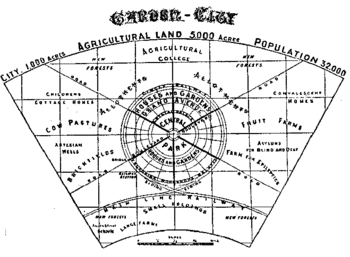
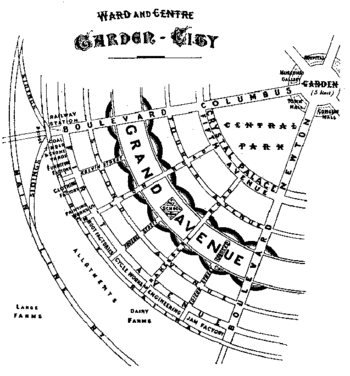
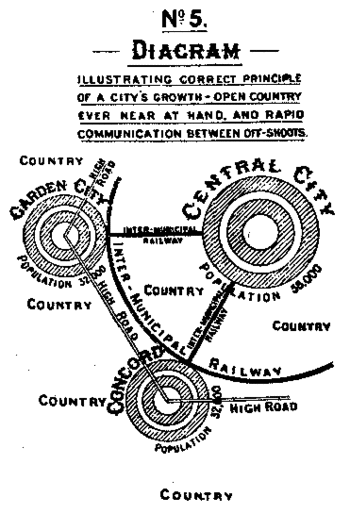
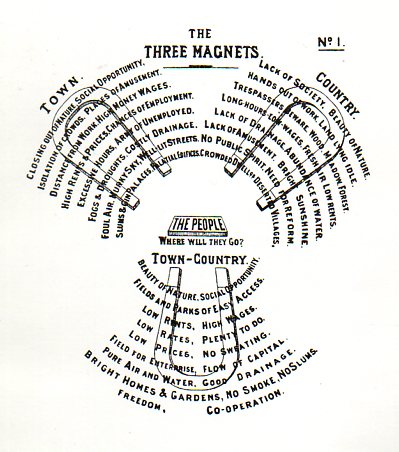
    Ebenezar Howard (1850-1928), London-born  failed Nebraskan farmer, Chicagoan stenographer, London Parliamentary reporter and non-obscure semi-visionary of town planning in The Future, drew some mighty pretty images of cities best reserved for random placement in the Encyclopedia of Difficult Imaginary Places.  Ideas about technically based Victorian wanderings on what to do with the laboring classes  must’ve been brewing in his head for some time before he self-published them in his Tomorrow, a Peaceful Path to Reform in 1898.  The ideas took shape in the for of Garden Cities—which, frankly, have a very industrial and technical look to them, which although brimming with forests and gardens and parks and green spaces galore still had a weird orthographic and predictable quality to them, making them look like green machines.   He hoped to start a revolution in city design, and his ideas proved popular enough to be forced into a new edition in 1902 in his Garden Cities of tomorrow, and then reprinted again in 1946 with a forward by none other than Lewis Mumford. Bloghoward_2

    I should say that I don’t “get” his design (which in all fairness, Howard provides a mea culpa for each of his drawings saying that the ideas really need to be implemented with an actual environmental footprint before they could be done) though I certainly do understand his idea. The garden city philosophy came to Howard after seeing the mess of Chicago following the great fire of 1871, and also by way of the writing of people like Edward Bellamy (Looking Backward) and John Ruskin, as well as utopian movements and things like the social “discovery” by Ed Booth and others of the miserable conditions of the million or so people in East London. The idea of people living in such an environmentally destitute area like East London must’ve seen appalling to him, and perhaps the thought of the industrialized and centralized urban landscape would’ve fallen into this same category as well. The best resource for curing such revolutionary societal ills for Howard was nature. , or rather wrapping nature around lesser urban centers and being far more attuned to the relationship between the earth and that the communities that we build, which is a fabulous idea, though I hardly think that Howard was

    Bloghoward_3

    the first to it. He was though the force behind the first planned garden city in England—Letchworth—so he certainly did have an impact on others who were thinking about the same sort of things. His own designs, though, seem distant and necessarily undoable to me.

    Architecture--ebenezer howard073


  • The Collapse of the Electric Light and Failure of Edison, 1879: Getting Things Terribly Wrong Just Before Things Get Incredibly Right

    JF Ptak Science Books   Post 272

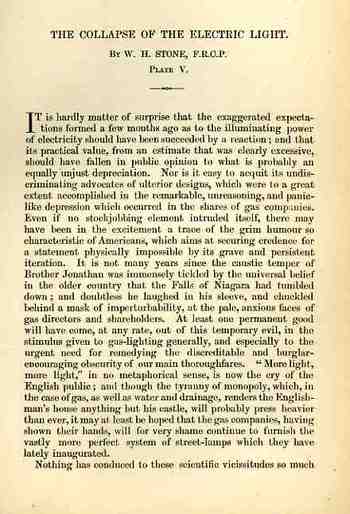
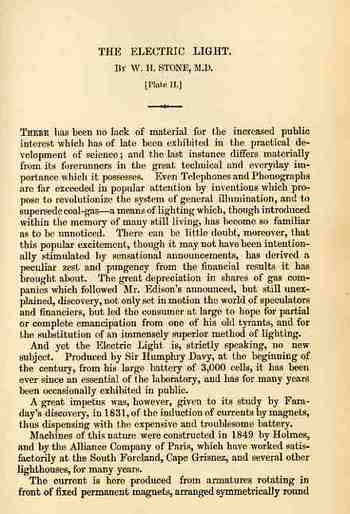
    As ranging and seemingly gawking as these titles might seem today (W.H. Stone’s “The Electric Light” in January 1879 and “The Collapse of the Electric Light” in June 1879 and published in the London’s Popular Science Review), they were somewhat, limitedly, correct.  It really wasn’t until several months later in that same year that Edison got the design of the light bulb more correct, following his developments of a smaller carbonized filament in a better globe vacuum and utilizing a lower current of electricity–this produced a much more long lasting light, far surpassing his 13-15 hours filament from 1876, and making the electric light a definite economic property. Naturally there was much more to be done, like establish the entire backbone and network of an electrical grid, from improving the generating dynamos to the creation and installation of on-off switches, but that was all doable. The modern power grid was inaugurated on September 4, 1882, when  the first commercial power station, located on Pearl Street. serviced about a square mile of lower Manhattan.  Six years earlier,  in 1876 this prospect seemed futuristic, and the prospect for Edison’s light itself  looked pretty dim.

    Ebaysept19edison590 Ebaysept19edison2591

    Stone wrote “It is hardly a matter of surprise that the exaggerated expectations formed a few months ago to the illuminating power of electricity should have been succeeded by a reaction, and that its practical value, from an estimate that was clearly excessive, should have fallen inn public opinion to what is probably an equally unjust depreciation….causing panic-like depreciation in the stocks of gas companies…”

    He continues to wail away at Edison, who was just weeks away from solving the riddle of mass electrical illumination: “Much of the contrivance [light bulb] is of great ingenuity, and evidences considerable mechanical skill.  But all competent authorities are agreed in considering that it in no way supercedes existing methods [gas lighting] or that in any sense fulfills the revolutionary  prognostics freely made in its favor….”

    Oh dear.  I can’t find anything that Stone wrote about the new Edison developments over the coming year.  The man got some of his assessment correct, but he got the overall appreciation patently incorrect, and with terrifically bad timing, calling the day false just minutes before the dawn. 

    Edison was hardly alone in this pursuit even in 1876, the year of great discovery.  It was a crowded house.  And even a quick consideration shows how many others there were preceding Edison in this pursuit:Humphrey Davy, the great English chemist and all-around smart-guy, invented the firs sort of electric light in 1809.  It was quite simple but the idea was definitely there–he produced the first arc light by passing an electric charge through a charcoal strip causing its charged carbon to glow and emit light.  Eleven years later, in 1820, Warren de la Rue made improvements upon this idea and employed platinum rather than carbon, producing a literally and figuratively rich glow.  The electrical revolution waited for its Edison in spite of earlier creations of practical light bulbs by James B. Lindsay (1935), Edward Shepard (1850) and Henricg Globel (1854, and perhaps the most significant of the last three).  There was really an incredible amount of work being done between 1850-1880, but it really was Edison who pulled it al together–and even then, when he perfected his light bulb, it was based on the 1875 patent he purchased from inventors, Henry Woodward and Matthew Evans, his filament burning bright in an oxygenless glass whose basis was derived from the work of Herman Sprengel who had invented the mercury vacuum pump capable of producing this vacuum.

    And then the real industrial revolution could get underway. 

    Stone finishes the second article with this I’m-sitting-on-a-tree-limb-way-up-high-and-cutting-through-it-with-an-antique-saw-between-me-and-the-tree sensibility of terrifically impending high embarrassment:

    “…the electric light, while invaluable for exceptional cases, such as for lighthouses, military telegraphy and exploration…or even for stage effects and festive occasions, is neither so pleasant, so safe, so steady, so simple, or so manageable as the better forms of ordinary gas-lighting now universally adopted”, and thus putting his own gas lighting service back just as the metropolitan power station “on” switch gets thrown.   (I did find a few other articles by the same author: one in the Popular Science Review for 1881 on “The Determination of Musical Pitch” and another in Nature for 1883, writing on” Speaking, Singing and Stammering”.  Not much said about Edison, there.)

    ·Posted by :

    ·in:

    —

  • The Most Literary Fireworks Catalog Ever Published? The Naming of Explosions.

    JF Ptak Science Books  Post 267

    Ebayfireworks_cvr579

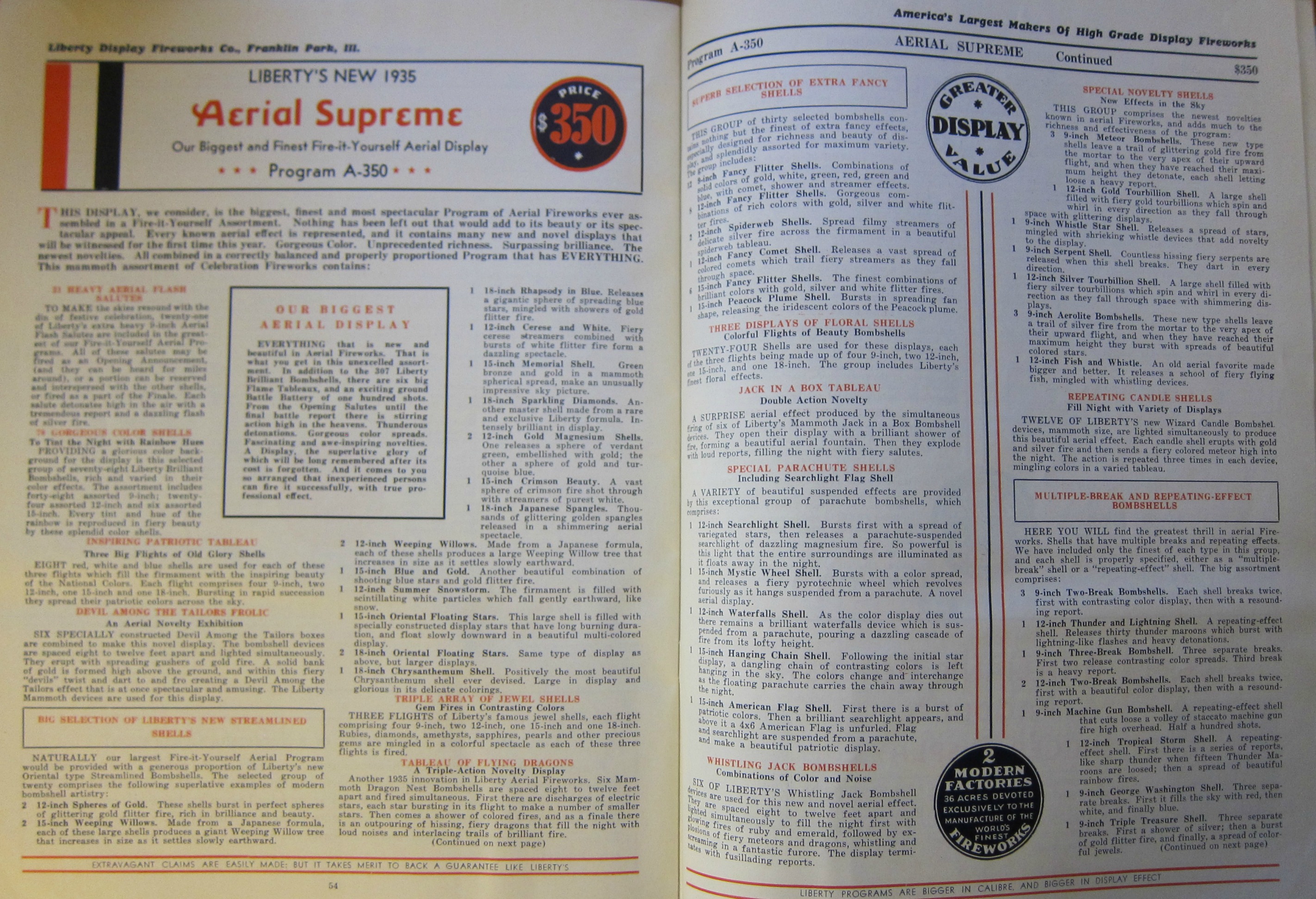
    I found this wonderful catalog this morning–the 1935 Liberty Catalog of Display Fireworks.  It is big (11×8 inches) and its 64 pages are filled with descriptions of the hundreds of different advanced firework displays that you could purchase.  Mostly the company was interested in selling very large, packaged displays, hovering in the hundreds of dollars, which was quite allot of money in the 1930’s, even without considering the impact of the Depression on the fireworks-pursuing populace.  These people were definitely not selling firecrackers to kids.

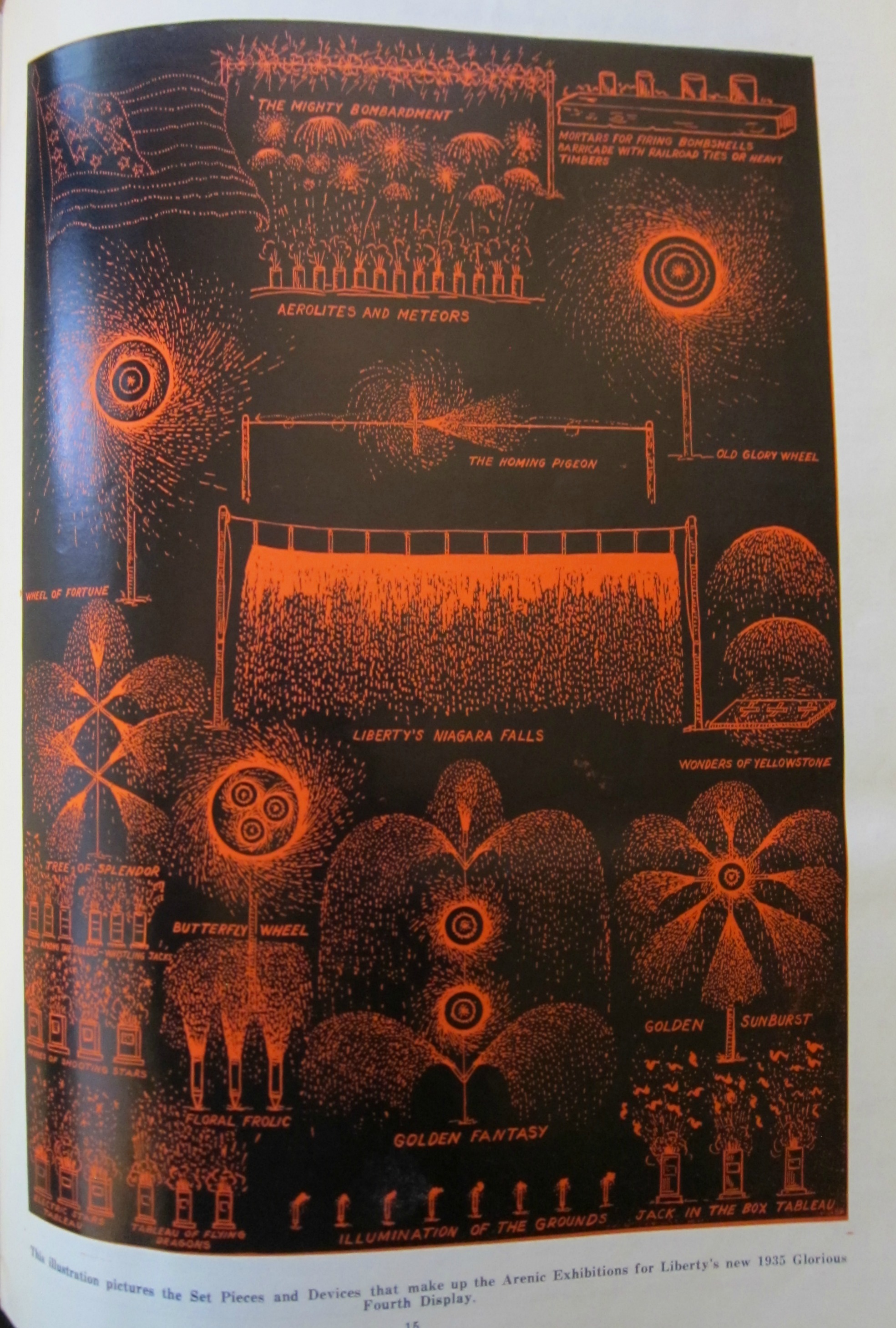
    The illustrations in the pamphlet are remarkable for displaying so many of their goods, and were printed in high relief, being dark red on a field of black.  Very effective!

    What is particularly striking about the catalog, aside from its terrific visual elements, are the names given to the fireworks–they are artistic, literary, mythological.  No “brainbusters” or “Finger Splinters” here. Some of the names include Cleopatra’s Jewels, the Victor Jerome Battle in the Clouds Shell, Flight of Egyptians Repeating Bombshells, Spiderweb Comet, the Arenic Festival of Flowers, Devil Among the Tailors, the Palmetto Fountain, Selma Lee Shell of Shells, Sparkling Diamonds and the Sparkling Diamond Merry-Go-Round, Temple of Isis, the Mammoth Devil Wheel, Prismatic Devil Wheels, Whistling Jack Bombshells, Messengers to Starlands, Radio Flash Rockets, Ceylon Rubies, Fish and Whistle, the End of the Rainbow, and my favorite: The End of the World.

    Fireworks _c_

    Funny thing is that they do sort of describe the effect of the fireworks.  I thought that I might learn something of the social under- or over-currents by having a peek at the names, but there was little of that:  several FDR displays are sprinkled around the catalog, a couple of special radio-related items, but really, that’s about all.  No insights there.  No  “Honey I’m Going to Catch the Danvillle Train and Get Me Some Dough” or “Brother Can You Spare a Dime” displays; who wants to be reminded of the not-so-nice when celebrating something with gigantic loud colorful controlled explosions?

    Fireworks _b_

    No. The surprising element was the naming of the explosions.  And naming explosions goes back quite a way in the history of military affairs, not that I really know anything about that–I do have photographs of French soldiers decorating their 15-inch shells with messages to the Germans in 1918, and there’s no end to the images of American soldiers writing/naming their bomb-to-be-delivered to whomever it was we were blasting.  But they weren’t quite in this Liberty Catalog arena of fresh literariness, though the more-modern military epigrams were more pithy, and drenched in their own sea of color. (This of course is Slim Pickens as he climbs aboard a thermonuclear device, nearly ready to buckaroo it down to its destination; the other device I think was called “Dear John”.) The atomic device at Trinity was decorated with scribble, but I’m not sure that any of the photos were ever clear enough to reveal the sentiments.
    Slim_picken_nuclear_2
       The U.S. government had names for every one of their test shots of nuclear devices, though none approached anything like a creative caliber:  Able, Baker, Prisiclla, Operation Plumbbob (yes, there is a double b), Thunderwell, Smoky, Diablo….pretty ordinary.  The government did wake itself up to use some scientific-biographical names for some of the tests in the Plumbbob Operation:  Franklin, Kepler, Pascal, Stokes, Galileo, Doppler, Fizeau (!), and Newton.  I think that only Sir Isaac would’ve been pleased with this honor.   Maybe Franklin. 


  • The Art of Writing in the Dark: a Fire-Lit Alphabet,1808

    JF Ptak Science Books LLC, Post 265

    Blog1sept_6_writing_in_dark515

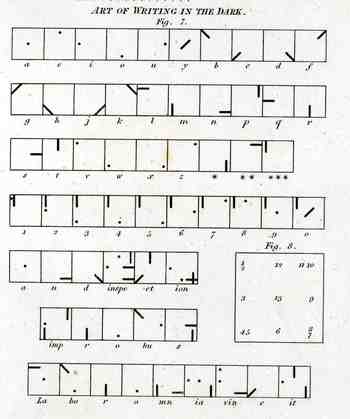
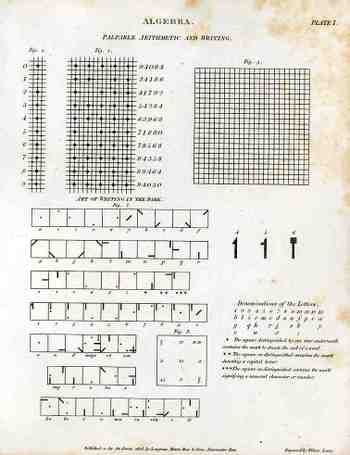
    This curious illustration appears in forty-five volume Cyclopedia of  Abraham Rees (published 1795-1820), displaying a system for communicating over distances at night.  When this part of the Cyclopedia was printed in 1808, the electrical telegraph was still 37 years away from coming into being–45 years from being somewhat well-used.  Before this time (visual) communications over long distances at night were limited to just these sorts of means–lighted semaphores, hand-held torches, that sort of thing.  Signaling at sea at night was somewhat different at this time and didn’t include anything remotely close to the alphabet.  So the rather complex system that we see at left is extremely uncommon–it seems also very cumbersome to put into effect.  Unfortunately I don’t have the text volume that would explain then entire system and implementation, so I’m going to guess that there was a large, powerful light source that was covered by a tight, black, covering tablet that would eliminate nearly all light leakage.  The symbols for each letter of the alphabet (and numerals) would be cut out from another tablet that would fit over the face of the light source, placed between the blank and the light.  To transmit a letter the user would then simply remove the blank covering tablet to reveal the light broadcast by the hole or slit in the tablet underneath.  The blank would then be placed back, a new tablet for a new letter placed underneath, and the process would begin again:  blank (dark); letter (light); blank (dark); letter (light), and so on to the end of the message.   I guess the distance at which these symbols could be seen would be dependent on light source, atmospheric conditions, ad so on.  The way that the letters are made into symbols seems to me very intelligent, so that you distinguish the differences from an appreciable distance.  I like it–its an elegant idea.  (Well, maybe it didn’t work in this manner, but it seems to make sense to me.)

    The image of the full sheet:

    Blog1sept_6_palpable514


  • The Glory of theTechnicolor Electronic Future Arrives: 1942 Electronics

    JF Ptak Science Books LLC   Post 253

    Blog1sept_9527

    I’m sorry to report that the publisher and beneficiary of this
    brilliant 1940’s advertising art–General Electric–swallowed up the
    identity of their artist.  Nowhere in the 1942 publication with the
    Huxleyesque title of Electronics, a New Science for a New World is
    there any mention of the poor artist who gave vision to this retread
    idea…or retread if you don’t consider the “electronics” part.  Yes,
    the art is a little removed and slightly, spatially, naive; and the
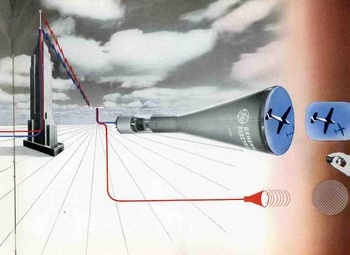
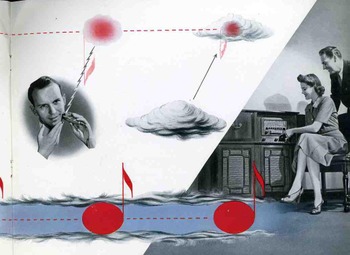
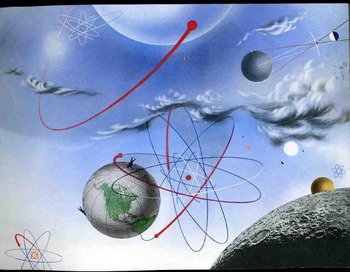
    colors are too much and the symbolism too big (there’s allot of host of hosts stuff, offerings up to the big sky),and the images are a little ridiculous,  but they are jolting (for good or for ill) and it really does speak for its time.  And in 1942 electronics was just about to come to the rescue and save World War II:  from tracking aircraft for anti-aircraft weapons to RADAR to the development of computers to the Enigma to the development of the atomic bomb, and on and on, “electronics” did ride in on a white horse to save the day.  I can understand perfectly well the sentiments exhibited in these fabulously bombastic illustrations: the extraordinary power of radio and the beginning of television, the beautifully rendered hands on the front cover (the shadows on the fingernails are done very well) holding the electronic chalice, the baby and the butterfly (and all of that other weird stuff strewn about); all are getting ready for the bigger world that was coming as the beneficiary of this electronic revolution.  And, as a matter of fact, no one really had a clue as to what was coming–that baby would be retiring now, and the changes that occurred during its lifetime are so supremely removed and incalculable from 1942 that it makes even the vast hope exhibited in these electronic icons seem mild.  It also makes me wonder about what brave oceanic beliefs and expectations of the future that we have today will look common and sugary (or saccharin, or whatever) in the year 2074.

    Blog1sept_9e531

    Blog1sept_9d530

    Blog1sept_9b528

    Blog1sept_9c529


  • Inventions Ill-Advised: Bicycle Malapropisms in Edwardian England, 1901-1906

    JF Ptak Science Books LLC  Post 241

    Blogcircus_bike
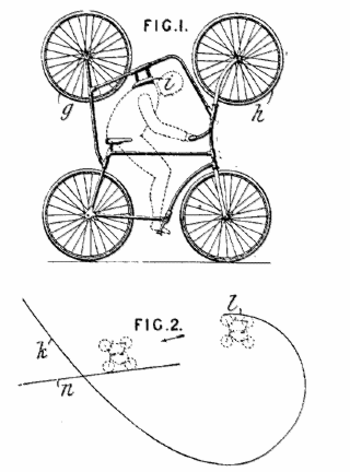
    I know that this invention by Karl Lange (1904, left) may or may ever come in “handy”,
    but, well if you were a circus performer it might be another story. The whole thing looks so improbably
    heavy  and unwieldy to me that it couldn’t possibly be of any use, though it is a
    thing of beauty. All one really needs to complete this picture is another rider seated on the inverted bike waiting for their turn.

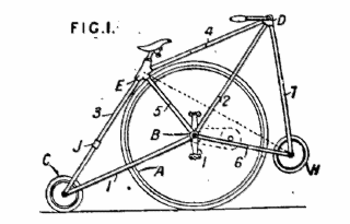
    Marshall Rigby’s
    machine (1901, below right) looks more like a geometry problem than anything else, but
    really intended to make the not-so-early-by-any-means larger-wheel velocipede
    easier to get on and get off. Why bother
    keeping the big middle wheel is anyone’s guess.
    Blogbikerigby

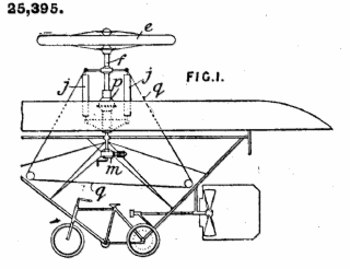
    Frederick Simms’s (1906, below left) bike-powered bike-opter doesn’t look like it could
    move forward let alone fly.

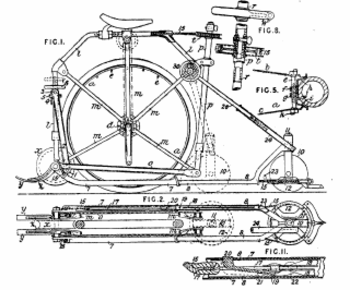
    Sayer’s “Improved Cycle Or Other Vehicle” (1905, below right) has a
    telescoping wheelbase and seat, and has brakes that can be adjusted so that
    they are automatically applied “at a predetermined inclination in the road”. It also has wheels “that may be readily
    adapted to rails”, though what rails and to where those rails might be going is
    again a mystery. Also a mystery here is how power is transmitted—I can’t tell
    how the thing is made to go, though it is a pretty drawing.
    Blogbikesimms

    Blogbikesayer

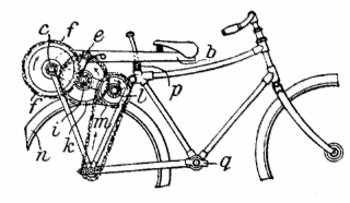
    Lastly for tonight is the bouncing bike of Herr Adolf Ernst Anton Mueller (1902, below),
    who came up with the idea of powering a bike from the “up and down motion” of
    the rider’s weight, thus doing away with pedal. He doesn’t provide a rest for the feet, which might make the bouncing a
    little difficult. Also, Lt. Mueller was writing from the
    Military Barracks of Grandenz (Germany)
    and was an officer in the Kulmer Infantry regiment, making me wonder if he was
    thinking in terms of regimental displays of bouncing German soldiers on bikes…

    Blogbikemueller

    Abstracts for the British patents mentioned above (from the British Patent Office), in their original format, retaining all of the juices and flavors of Edwardian engineerese:

    Lange, K. April 15, 1904.  Bicycles
    adapted for use by gymnasts and acrobats. -A cycle for use in performing the
    feat of looping the loop in circuses &c., on the mutilated loop k, l, n,
    has a second cycle attached above the rider’s head, which enables him, on
    leaving the part l, to complete the journey, head downwards, on the upper
    wheels g, h. The upper cycle may have more than two wheels, and other padding
    besides the cushion i.

    19018038. Rigby, M. April 19. Unicycles; safety wheels and supports;
    steering- mechanism; driving-mechanism; frames.-A unicycle comprises a large
    wheel A carrying on, or connected to, its axle B a frame consisting of forked
    members 1, 2, 3, 5, 6, 7 and a single member 4 arrange:! as shown. A socket E
    connecting the members 3, 4, and 5 carries the saddle-pin. Safety-wheels C and
    H, one of which may be replaced by a pair, support the rider when at rest or when
    steering. The wheels C and H may be mounted in pivoted forks which are actuated
    by a spring so as to keep the wheels in line. Rigid handles D enable the cycle
    to be steered when the wheel H is in contact with the ground, but, if desired,
    the wheel H may be mounted in a steering-post actuated by pivoted handles. The
    wheel A may be driven either by simple cranks, as shown, or by suitable
    treadle, crypto, or chain gearing. Either of the members 5, 6 may ba replaced
    by a member connected to the socket E and the axle of the wheel H. A bridge J
    serves as a step in mounting.

    25,395. Simms, F. R. Dec. 6. Gyroscopic apparatus.-For driving a gyroscopic
    wheel e on an aerial machine by a motor m in such a manner that the aeronaut
    can vary its inclination by pulling cords q, the driving-shaft f is made in two
    lengths connected by a ball-and-socket joint p. The two lengths are pressed
    together by springs j with sufficient force to cause the rotation of the motor
    to be transmitted to the wheel by the friction of the joint.

    18,699. Sayer, R. C. Sept. 16. Motor road vehicles; locomotive tramway
    vehicles. -Relates to a cycle or vehicle which has a variable wheel base,
    brakes automatically applied at a predetermined inclination of the road, and
    wheels that may be readily adapted for running on rails. The frame comprises
    struts m, radiating from the axis of the wheel a, tubes l, rods o, and a forked
    tube p. The steering-wheel 10 is mounted in a fork the stem 11 of which is
    fitted in a socket on the ends of the members 8 of the telescopic parts 7, 8 of
    the frame (and on and on)

    26,453. Mueller, A. E. A. Dec. 3. Body motion, propelling by.-The rider
    stands upon the foot-rests q, and, by the weight of his body, depresses the
    saddle, which is attached to a lever b, pivoted at its end c to the frame. The
    downward movement of the lever b causes a spring pawl e to actuate a
    ratchet-wheel f. The motion of the ratchet – wheel is communicated through wheels
    i, k, l to the chain-wheel m and thence to the hind wheel n, so that the
    bicycle is propelled forwards. The pressure on the saddle is then released, and
    the saddle is restored to its normal position by a spring p, when the cycle of
    operations is repeated.

    ·Posted by :

    ·in:

    — —

  • The Magnificent Mundane: an Instructional WITH PROP on How to Use the Telephone, 1946

    JF Ptak Science Books LLC  Post 236

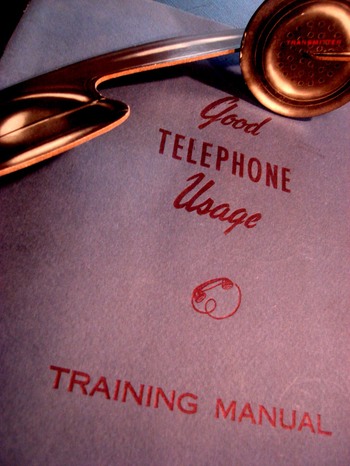
    Ballistics_049Yes, this elegant, well written (oversized) 1946 pamphlet, which explains
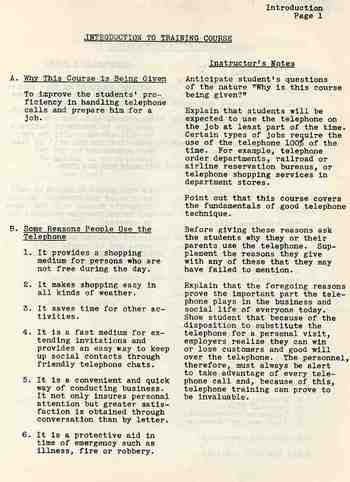
    in fabulous and excruciating detail how to use the telephone, does
    indeed come with a two-part heavy paper telephone receiver for the reader’s practice. It is packaged in an envelope in the back of the
    pamphlet with a large drawing explaining how to put the two pieces
    together.   The work is just so fulsome, wholesome, forthright,
    exacting and thorough that it just makes the casual reader stop in
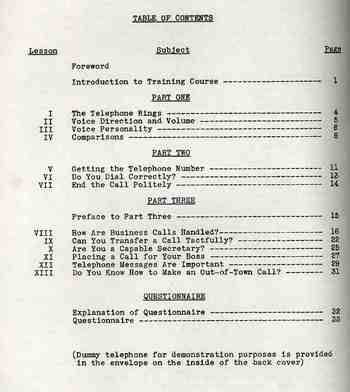
    their tracks.  For example, it isn’t until page 13 that we get to pick
    up the receiver (and listen for the dial tone). I’ve reproduced some of
    the table of contents to give an idea of the extent of the telephone
    usage. 

    What brings this so close to being from out of the science fiction
    past is that the booklet is ten years older than me.  Atanasoff’s ABC, Bell Labs Mark II, Bletchley’s  Colossus, and Harvard’s Mark I machines existed, television was getting off
    the ground, and telephones were exploding their way into more American
    homes and businesses.  But somehow, here on the verge of the greatest electrical revolution in history, we’re still getting instructions on how to pick up the telephone.  But I’m really not complaining here, not at all–its just the nexus of the “how to listen for a dial tone” and the coming of the ENIAC one year after this pamphlet is published that is so startling.

    Even so, this instructional is more complete and (of course) better written
    than any of the pc manuals that came with any of the machines that I’ve
    purchase int the last 25 years. It is a thing of great and supra-obvious beauty.

    Again, this is another example of a small job done Very Correctly.

    (Click on image to expand.)

    Blogsept3_tele489
     

    Blogsept3_tele490